
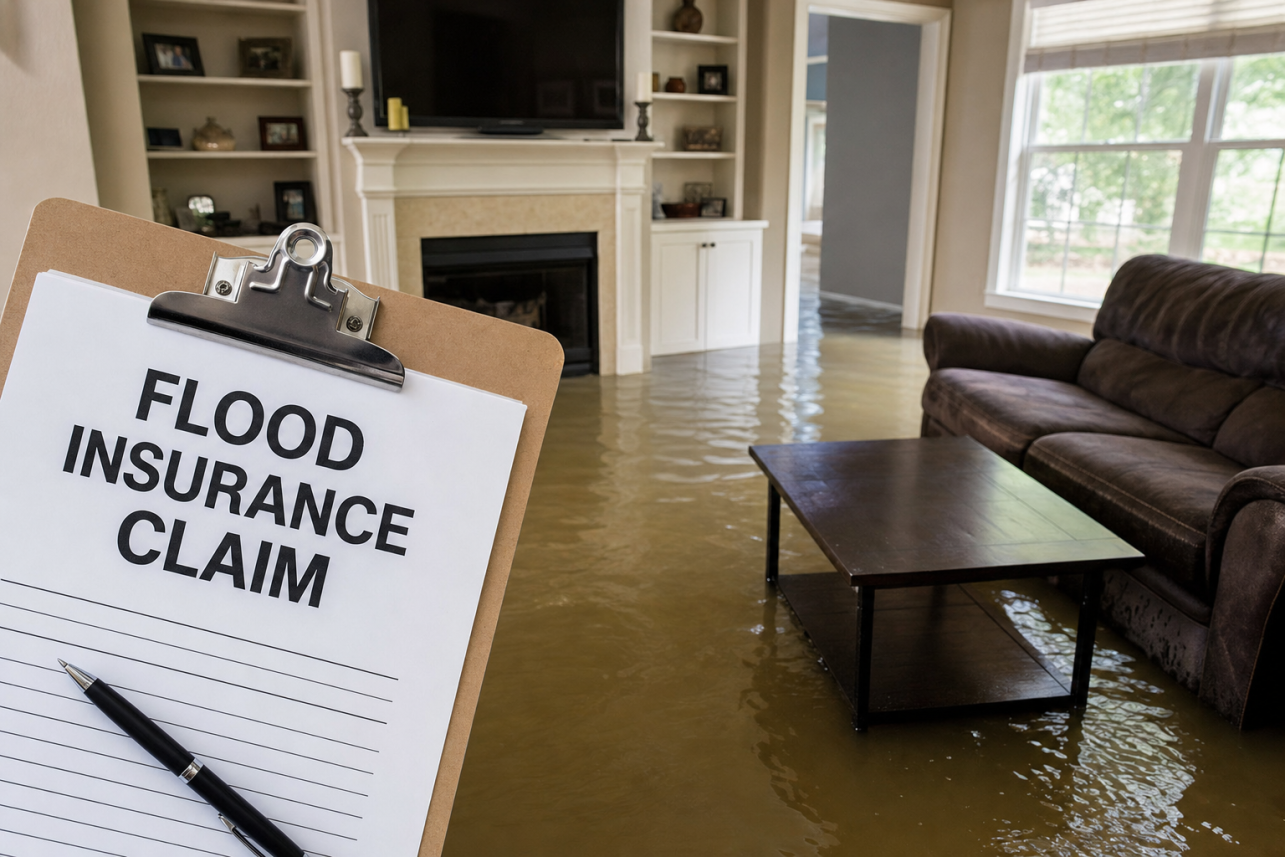
If you need help with a Flood Insurance Claim Burlington property owners can hire For The Public Adjusters, Inc. to document the damage, prepare the required proof of loss, and negotiate with the flood carrier on your behalf. We are licensed and bonded public adjusters who work only for policyholders, never for insurance companies. Flood claims run on strict federal rules and tight deadlines, and the first estimate you receive is rarely the full story.
What This Service Is
A flood claim is different from a normal homeowners claim. Standard homeowners policies exclude rising water, so flood damage is typically paid under a separate policy backed by the National Flood Insurance Program (NFIP), which has its own forms, deadlines, and payment rules. Miss a deadline or file an incomplete proof of loss, and a legitimate claim can be reduced or denied outright.
Our job is to level the playing field. We inspect the property, measure and photograph the water lines, document structural damage room by room, build a complete personal property inventory, and price the repairs at real local contractor rates. Then we present that package to the flood adjuster and push back when the numbers come in short.
We handle flood losses across Alamance County and the surrounding Piedmont, including Flood Damage Claim Help in Mebane just up the interstate. And because flooding rarely comes alone, we also handle related water, tree, and residential homeowners claims when a single storm causes more than one kind of damage.
Common Problems
What Will My Flood Insurance Claim Burlington Payout Actually Cover?
Flood policies have coverage limits for the building and separate limits for contents, and many owners discover after the water recedes that their contents were never covered at all. Payments for personal property are usually calculated at actual cash value, meaning the carrier deducts depreciation from what it would cost to replace your furniture, appliances, and belongings today.
Most flood policies also do not pay for a hotel or rental while your home is unlivable, which surprises families who assume additional living expenses are included the way they often are on a fire claim. Knowing exactly what your policy pays — and what it does not — before you sign anything keeps you from absorbing out-of-pocket repair costs that should have been part of the settlement.
The Adjuster’s Offer Won’t Cover My Repairs — Now What?
A low first offer is common. Flood adjusters often miss saturated insulation behind walls, damaged subfloors, and mold that develops in the days after the water drains. If the carrier’s estimate will not cover a licensed contractor’s actual bid, you have the right to dispute it, supplement the claim, and appeal — but you must act inside the deadlines, including the signed proof of loss that flood policies generally require within sixty days of the loss.
Courts have sided with policyholders who push back with solid documentation. In Broussard v. State Farm Fire & Casualty Co., homeowners whose house was destroyed took their insurer to trial after coverage was denied, and the jury found for the policyholders — a verdict the appeals court upheld on liability. Thorough evidence wins disputes, which is why our Water Damage Adjuster in Haw River team documents everything before the carrier closes the file.
Should I File This Myself Or Hire A Public Adjuster?
You can absolutely file on your own, and for a small, simple loss that may be fine. But flood paperwork is unforgiving: an incomplete inventory, a missed deadline, or a repair estimate that undercounts hidden damage can lock in a low settlement with little room to reopen it later.
A good public adjuster earns a contingency fee only from what the claim actually pays, so our interests line up with yours. Look for someone licensed and bonded in North Carolina, ask how they document structural damage and contents, and ask who will handle the negotiation. We cannot promise a specific dollar outcome — no honest adjuster can — but we can promise the claim will be fully documented and professionally presented.

Our Process
Inspect And Document Before Anything Is Thrown Away
We photograph water lines, flooring, drywall, mechanical systems, and damaged contents before cleanup erases the evidence. Flood carriers require proof, so we build the record the way the same standard we apply to Water Damage Claim Help in Bynum — thorough enough to survive scrutiny.
Prepare The Proof Of Loss And Full Claim Package
We complete the sworn proof of loss, assemble a room-by-room personal property inventory with values, and price the structural repairs using realistic local contractor estimates. Getting this package right the first time is what keeps a claim from stalling or being underpaid.
Negotiate, Supplement, And Appeal If Needed
We meet the flood adjuster on site, walk them through the damage, and challenge line items that come in short. If hidden damage or mold surfaces during repairs, we file supplements, and if the carrier still refuses to pay fairly, we pursue the appeal process and can coordinate with insurance dispute lawyers when a claim needs to escalate.
| What Happens | Filing on Your Own | With For The Public Adjusters |
|---|---|---|
| Damage documentation | Relies on the carrier adjuster’s walkthrough and visible water line | Moisture mapping, wall-cavity inspection, and elevation data prove the full extent of loss |
| Proof of loss (60-day NFIP deadline) | Often missed or filed incomplete, which can forfeit part of the claim | Prepared, itemized, and filed correctly before the deadline |
| Hidden damage (ducts, insulation, framing, panels) | Usually left out of the estimate entirely | Identified, documented, and priced line by line |
| Denial for ‘surface water’ or ‘groundwater’ | Most owners accept the denial | Challenged with rainfall data and neighboring-property evidence |
| Settlement negotiation | Carrier’s numbers rarely questioned | Every line item verified against NFIP-compliant pricing |
| Your time investment | Dozens of hours of calls, paperwork, and disputes | We handle it; you review and approve |
Commonly Overlooked In The Public Adjusting Industry
- Water wicking above the visible flood line — Drywall and insulation pull water 12 to 24 inches higher than the stain shows, so estimates written from the visible line cut walls too low.
- The 60-day NFIP proof of loss deadline — It’s a hard filing requirement separate from reporting the claim, and homeowners assume the adjuster’s visit satisfied it.
- Ductwork and mechanicals in the crawl space — Nobody crawls under the house during a quick inspection, yet submerged ducts and units are contaminated and covered.
- Corroded electrical panels and outlets that still ‘work’ — Submerged electrical components fail later from corrosion, but they pass a glance test on inspection day.
- The two-acre / two-property flood definition — Carriers deny claims as ‘surface water,’ and owners never learn that proving neighboring properties flooded can reverse it.
- Code-required upgrades like flood vents — Alamance County floodplain rules can require improvements during repair, and standard estimates price only like-for-like replacement.
- Separating flood damage from wind damage — When one storm causes both, each insurer points at the other, and undocumented losses fall into the gap between policies.
- Depreciation applied to items NFIP pays at replacement cost — Building coverage on a primary residence often qualifies for replacement cost, but settlements sometimes apply actual cash value anyway and no one catches it.
Case Studies
Case Study #1
Situation: A homeowner near Glencoe Mill Village on the Haw River had two feet of floodwater enter the crawl space and first floor after a tropical storm remnant stalled over Alamance County. The home carried an NFIP flood policy with $180,000 in building coverage.
Problem: The NFIP adjuster’s initial estimate came in at $31,400 — enough to replace drywall and flooring, but nothing for the HVAC system in the crawl space, the electrical panel, or the foundation vents that had been damaged by hydrostatic pressure.
Investigation: Our team performed moisture mapping of the framing and subfloor, documented water lines inside wall cavities the carrier’s adjuster never opened, and pulled the flood elevation data for the property to verify how high the water actually rose against what was reported.
Findings: Water had wicked 18 inches above the visible flood line inside the walls, saturating insulation and sill plates. The ductwork under the house was full of contaminated water, and the electrical panel showed corrosion consistent with submersion — all items the original estimate omitted entirely.
Solution: We prepared a line-item proof of loss using NFIP-compliant pricing, submitted the moisture readings, photos, and elevation documentation, and requested a reinspection. When the carrier pushed back on the ductwork, we cited the specific NFIP coverage provisions for mechanical systems below the lowest elevated floor.
Outcome: The claim settled at $97,600 — more than three times the original offer — covering full HVAC and duct replacement, panel replacement, framing remediation, and code-required flood vents.
Lesson: Flood damage almost always extends well above the visible water line, and NFIP estimates written from a walkthrough routinely miss everything hidden inside walls and under floors.
Case Study #2
Situation: A small commercial property owner on South Church Street had stormwater back up through the parking lot during a heavy rain event, flooding the ground-floor retail space and destroying inventory, fixtures, and the tenant build-out.
Problem: The carrier initially denied the claim, arguing the water was ‘surface water runoff’ from a drainage failure rather than a general flood condition, and that the loss didn’t meet the NFIP definition of flood.
Investigation: We obtained rainfall data from nearby Alamance County gauge stations, gathered photos and statements from neighboring businesses showing the same water event affected multiple adjacent properties, and documented the two-acre inundation area required to satisfy the policy’s flood definition.
Findings: The event met the NFIP standard: a general and temporary condition of inundation affecting two or more acres and more than one property. Three neighboring parcels flooded during the same event, which the carrier’s file never acknowledged.
Solution: We submitted a formal appeal package with the gauge data, aerial imagery, neighboring-property documentation, and a corrected proof of loss covering the flooring, lower wall assemblies, electrical, and covered building components.
Outcome: The denial was reversed and the building claim paid at $64,200. We also helped the owner document the tenant improvement portion correctly so nothing covered was left on the table.
Lesson: A flood denial based on the ‘surface water’ argument is often beatable — but only if someone proves the event met the policy’s technical definition of flood, which requires evidence most property owners don’t know to collect.
| Situation You’re Facing | Best Move | What It Depends On |
|---|---|---|
| Water just receded from your home | Photograph everything before cleanup, mark the high-water line, save damaged samples | Evidence disappears fast; carriers dispute what they can’t see |
| Carrier’s first offer feels low | Get an independent damage review before signing or cashing anything | Whether hidden damage (walls, ducts, subfloor) was ever inspected |
| Claim denied as ‘runoff’ or ‘groundwater’ | Appeal with proof the event met the NFIP flood definition | Whether two or more acres or multiple properties flooded in the same event |
| Approaching the 60-day proof of loss deadline | File a documented proof of loss immediately, even if incomplete — it can be supplemented | Missing it can bar recovery; extensions exist but must be requested |
| Contractor bids exceed the settlement | Submit a supplemental claim with the bids and updated scope | Whether the original estimate used current material and labor pricing |
| Both wind and flood damaged the property | Document which damage came from which peril separately | Homeowners and flood policies split coverage; gaps happen when perils get blurred |
| Mold appearing weeks after the flood | Report it and document moisture readings right away | NFIP limits mold coverage if remediation was delayed — timing matters |


Reviews
After the Haw River flooding, our NFIP adjuster spent maybe 40 minutes at the house and offered us $28k. For The Public Adjusters opened up the walls, found soaked insulation and rotting sill plates the first guy never looked at, and got the settlement up over $80k. They handled the proof of loss deadline too, which I didn’t even know existed.
Marcus T., Burlington NC
Our flood claim was denied because the carrier said it was ‘drainage runoff, not flood.’ These folks pulled rainfall records and proof that four houses on our street flooded the same night, filed the appeal, and got the denial overturned. I would never have known how to fight that on my own.
Denise R., Alamance County
Solid experience overall. The flood claim for our rental property near Graham took longer than I hoped — about four months — but that was the carrier dragging, not them. They found the ruined ductwork and water heater the insurance estimate skipped and roughly doubled the payout. Communication was consistent the whole way.
James P., Burlington
Frequently Asked Questions
How Does A Public Adjuster Help With A Flood Insurance Claim Burlington Homeowners Can Actually Rely On?
A public adjuster works for you, not the insurance company. When you hire For The Public Adjusters, Inc., we document your flood damage, prepare the detailed proof of loss the National Flood Insurance Program requires, and negotiate directly with the carrier’s adjuster on your behalf.
Flood claims are different from standard homeowners claims. Most policies in Alamance County are written through the NFIP, which has strict deadlines, its own claims manual, and coverage rules that surprise many property owners. For example, finished basements, detached structures, and personal property are handled very differently under flood policies than under regular home insurance.
Our team inspects your property room by room, measures water lines, photographs damage before demolition, and builds a line-item estimate using the same pricing software carriers use. That means when the insurance company’s adjuster produces a low figure, we can challenge it item by item rather than arguing in generalities.
Homes near the Haw River, Stony Creek, and the low-lying areas off Graham-Hopedale Road have seen repeated flooding over the years, and we understand how water moves through this part of North Carolina. That local knowledge matters when a carrier tries to blame damage on groundwater seepage or long-term neglect instead of the flood event itself.
Most importantly, we handle the paperwork burden. The 60-day proof of loss deadline on NFIP claims catches many families off guard while they are still displaced. We track every deadline so your claim never gets denied on a technicality.
What Should I Do In The First 48 Hours After Flood Damage To My Burlington Home?
The first two days after floodwater enters your home largely determine how your claim goes. Start by documenting everything before you touch it. Take wide photos of each room, close-ups of damaged items, and clear shots of the water line on walls and furniture.
Do not throw anything away yet if you can avoid it. Flood policies require you to prove what was damaged, and adjusters routinely reduce payments when items are discarded without documentation. If health concerns force you to remove soaked carpet or drywall, cut and keep samples, and photograph serial numbers on appliances and electronics.
Report the loss to your insurance carrier immediately and get a claim number in writing. NFIP policies have a strict 60-day window to submit a signed, sworn proof of loss, and that clock starts running from the date of loss, not from when the adjuster shows up.
You should also take reasonable steps to prevent further damage, such as running fans and dehumidifiers or tarping openings. Keep every receipt, because mitigation costs are typically reimbursable.
Finally, be careful with the carrier’s adjuster. Their first estimate is rarely the full picture, especially for hidden damage inside wall cavities, subfloors, and HVAC ductwork, which is common in Burlington’s older mill-era homes near downtown and along the Haw River corridor. Calling a Burlington public adjuster early means the damage gets documented correctly the first time, before evidence disappears into a dumpster.
Why Was My Flood Claim Underpaid Or Denied, And Can For The Public Adjusters, Inc. Reopen It?
Underpayments and denials on flood losses usually come down to a handful of recurring issues, and yes, in many cases we can reopen or supplement the claim.
The most common reason is causation disputes. Carriers often argue the damage came from groundwater seepage, hydrostatic pressure, or pre-existing conditions rather than the flood event, since those are excluded or limited under NFIP policies. We counter that with water-line evidence, weather data for Alamance County, and detailed inspection reports.
The second big issue is scope. The carrier’s adjuster may spend an hour at your property and miss saturated insulation, damaged subflooring, contaminated ductwork, or moisture trapped behind cabinets. Our estimates routinely identify thousands of dollars in damage the initial inspection overlooked.
Third is paperwork. If your proof of loss was incomplete, missed the deadline, or undervalued your contents, the payment reflects that. We prepare supplemental proofs of loss with full documentation to support a higher figure.
Whether a claim can be reopened depends on timing. NFIP claims have specific windows for supplements and appeals, and lawsuits against the program must generally be filed within one year of the written denial. That is why we urge Burlington and Graham area property owners to call us as soon as they receive a low estimate or denial letter, rather than waiting.
We review your policy, the carrier’s estimate, and the denial reasoning at no upfront cost. If we take the case, we work on a contingency basis, so our fee comes from the additional recovery we secure for you.
How Much Does It Cost To Hire A Public Adjuster For A Flood Insurance Claim Burlington Property Owners Are Filing, And Is It Worth It?
For The Public Adjusters, Inc. works on contingency, which means there is no upfront cost and no hourly billing. Our fee is a percentage of the settlement we recover, agreed to in writing before we start. If we do not recover money for you, you owe us nothing for the adjusting work.
North Carolina regulates public adjusters through the Department of Insurance, and our fee agreements comply with state licensing requirements. Everything is transparent from the first meeting, and you always know exactly what our percentage is before signing.
Is it worth it? For most flood losses, yes, and often significantly so. Flood policies are technical documents, and the difference between a carrier-written estimate and a professionally prepared claim frequently runs into the tens of thousands of dollars on a serious loss. Even after our fee, clients typically net far more than they would have accepted on their own.
There are also the intangibles. Handling a Flood Insurance Claim Burlington families are juggling alongside displacement, contractors, and work is exhausting. We take over the inspections, the estimate disputes, the proof of loss deadlines, and the back-and-forth with the carrier so you can focus on getting your household back to normal.
We serve all of Alamance County, including Graham, Mebane, Elon, Gibsonville, and Haw River, and we offer a free initial claim review. Bring us your policy and the carrier’s estimate, and we will tell you honestly whether we believe there is meaningful money being left on the table before you commit to anything.
How Long Does A Flood Insurance Claim Burlington Homeowners File Typically Take To Settle?
Most flood claims in Burlington resolve within 60 to 90 days when they’re documented correctly from the start, but poorly prepared claims can drag on for six months or longer. The timeline depends heavily on whether your claim falls under the National Flood Insurance Program or a private flood policy, since NFIP claims follow strict federal deadlines that private carriers don’t.
One deadline matters more than any other: under an NFIP policy, you must submit a signed, sworn Proof of Loss within 60 days of the flood. Miss it, and the carrier can deny payment outright, even for legitimate damage. Many Alamance County homeowners don’t learn this until it’s too late.
Our team front-loads the work to keep things moving. We complete the moisture mapping, room-by-room inventory, and structural documentation in the first two weeks, then submit a complete Proof of Loss package that the adjuster can’t easily dispute or delay. Incomplete submissions are the number one cause of stalled flood claims, because every request for additional information resets the clock.
Heavy rain events along the Haw River and Little Alamance Creek often flood dozens of properties at once, which stretches carrier response times across the whole region. When adjusters are overloaded, the best-documented files get processed first. That’s another reason having a professional build your claim from day one tends to shorten the wait rather than lengthen it, despite what carriers sometimes suggest.
Does My Homeowners Policy Cover Flood Damage In Burlington, Or Do I Need A Separate Flood Policy?
Standard homeowners insurance in North Carolina almost never covers flood damage. Rising water from heavy rain, creek overflow, or storm surge requires a separate flood policy, either through the National Flood Insurance Program or a private flood carrier. This surprises a lot of Alamance County homeowners after a major storm.
That said, the line between “flood” and covered water damage is where real money gets lost. If wind tore off shingles and rain entered through the roof before rising water reached your home, part of your loss may belong on your homeowners policy, not your flood policy. Carriers sometimes push all the damage onto whichever policy pays less, or point each policy at the other so neither pays fully.
Sorting that out is a big part of what we do. We inspect the property, establish the sequence of damage, and assign each portion of the loss to the correct policy with documentation that holds up. When two carriers are involved, we manage both claims so nothing falls through the gap between them.
If you live near the Haw River, Stony Creek, or in one of Burlington’s lower-lying neighborhoods and you’re not sure whether you even have flood coverage, check your declarations pages now, before the next storm. Mortgage lenders require flood insurance in high-risk zones, but plenty of flooding in this area happens outside mapped flood zones, where coverage is optional and often overlooked. Roughly a quarter of flood claims nationally come from properties outside high-risk zones.
What Documentation Do I Need To Support A Flood Claim On My Alamance County Property?
Flood claims live or die on documentation, and the standard is higher than most people expect. At minimum, you’ll need dated photos and video of standing water and waterlines on walls, a room-by-room inventory of damaged contents with age and replacement cost, receipts or proof of ownership where possible, and records of any emergency expenses like water extraction or tarping.
For NFIP claims, you also need evidence that flooding, not gradual seepage or groundwater, caused the damage. Waterline marks, debris lines in the yard, and neighboring property damage all help establish that. In Burlington, we often pull rainfall data and creek gauge records for the Haw River basin to prove the flood event itself.
One mistake we see constantly: homeowners throw out ruined drywall, flooring, and furniture before anyone documents it. You should absolutely remove wet materials quickly to prevent mold, but photograph everything first, cut and keep samples of carpet and drywall, and stack discarded contents where they can be photographed and counted. Never let a contractor haul debris away undocumented.
When For The Public Adjusters, Inc. handles a claim, we build this file for you. That includes moisture readings, thermal imaging where useful, a line-item structural estimate written in the same software carriers use, and a contents inventory priced at actual replacement cost. The difference between a homeowner’s photo album and a professionally prepared claim package often amounts to tens of thousands of dollars in the final settlement.

The Insurance Company Already Sent An Adjuster To My Flooded Home. Do I Still Need Help With My Flood Insurance Claim Burlington Residents Keep Asking About?
Yes, and this is exactly the moment when help matters most. The adjuster who inspected your home works for the insurance carrier or is contracted by it. Their estimate reflects the carrier’s interests, and with flood losses in particular, first estimates routinely miss hidden damage.
Floodwater wicks up inside wall cavities well above the visible waterline, saturates subfloors and sill plates, and contaminates insulation and ductwork. A quick walkthrough with a clipboard rarely captures any of that. We regularly re-inspect Burlington homes after the carrier’s visit and find damage the first estimate ignored entirely, including foundation issues, compromised electrical systems, and mold conditions that develop within days in North Carolina humidity.
Hiring a public adjuster after the carrier’s inspection doesn’t restart your claim or create a conflict. We review the carrier’s estimate line by line, document what it missed, and submit a supplemental demand backed by our own measurements and photos. Because a Flood Insurance Claim Burlington property owners file often involves both structural and contents coverage, we make sure both parts of the policy are fully used, not just the obvious repairs.
One caution: don’t sign a final release or accept a check marked “full and final settlement” until you’re confident the number is right. Accepting partial payments is usually fine, but a signed release can close the door on additional recovery. If you’re unsure what you’ve received so far, we’ll review your paperwork and the carrier’s estimate at no charge and tell you honestly whether there’s more to pursue.
What Is The 60-Day Proof Of Loss Deadline, And How Does It Affect A Flood Insurance Claim Burlington Policyholders Are Filing?
If your flood policy is written through the National Flood Insurance Program — as most policies in Alamance County are — you must submit a signed, sworn proof of loss within 60 days of the date of loss. This is not a suggestion. Miss the deadline without an approved extension, and the insurer can deny payment entirely, even for damage that clearly qualifies.
The proof of loss is more than a form. It has to be supported by a complete, itemized estimate of your building and contents damage, and the amount you swear to effectively caps what you can recover unless you file a supplemental claim later. Many Burlington homeowners sign a proof of loss based only on the insurance company’s numbers, then discover months later that drywall, insulation, subflooring, or HVAC damage was left out.
Our team prepares the proof of loss for you, backed by our own detailed scope of damage, so the number you swear to reflects the real cost of restoring your home. We also track the deadline from day one and request FEMA extensions when they apply, such as after federally declared disasters.
If your 60-day window is closing fast, call us immediately. There is often still time to build a proper claim, but the earlier we start documenting, the stronger your position will be.
Does Flood Insurance Cover My Basement And Contents After Flooding Near The Haw River Or Little Alamance Creek?
Basement coverage is one of the most misunderstood parts of NFIP policies, and it catches a lot of Burlington homeowners off guard. In a basement — defined as any area with its floor below grade on all sides — the policy covers only specific items: the furnace, water heater, electrical panels, foundation elements, unpainted drywall on the lowest level, and a short list of other structural components.
What it generally does not cover in a basement: finished flooring, carpet, painted walls, furniture, electronics, and most personal belongings. If you have a finished basement rec room near Little Alamance Creek that took on water, much of that finish work may be excluded — but the covered items are frequently underpaid or missed altogether, which is where we focus.
Above grade, the rules change significantly. Building coverage applies broadly to the structure, and if you purchased contents coverage, your personal property is covered at actual cash value, meaning depreciation is applied. Many homeowners don’t realize contents coverage is a separate election on flood policies, so we review your declarations page first to confirm exactly what you bought.
When we handle a flood loss in Burlington, we inventory every covered item room by room, document serial numbers and replacement pricing, and push back on excessive depreciation. Even within the NFIP’s limits, the difference between a rushed inventory and a thorough one is often thousands of dollars.
Can I Start Cleanup And Repairs On My Flooded Burlington Home Before The Claim Is Settled?
Yes — and in some respects you must. Your flood policy requires you to take reasonable steps to prevent further damage, which means extracting standing water, removing soaked materials that will grow mold, and drying the structure. Waiting for a settlement check before doing anything can actually hurt your claim, because the insurer may refuse to pay for mold or secondary damage they consider preventable.
The critical rule is: document everything before you remove it. Photograph every room from multiple angles, video the waterline on the walls, and keep cut samples of flooring, carpet, and drywall. If a mitigation company tears out materials before the damage is recorded, proving the full scope of your loss becomes much harder.
Hold off on permanent repairs — new drywall, flooring, cabinetry — until the damage has been fully inspected and scoped. Once repairs cover the evidence, disputes over what the flood actually destroyed almost always favor the insurance company.
Also save every receipt: water extraction, dehumidifier rentals, dumpster fees, even cleaning supplies from a Burlington hardware store. These mitigation costs are typically reimbursable under your policy, but only if you can prove them.
If you call us early, we photograph and measure the property before demolition, coordinate with your mitigation contractor, and build the claim file as the work happens. That sequencing protects both your home and your settlement.
Do You Handle Flood Claims For Burlington Businesses And Rental Properties, Or Only Homes?
We handle both. For The Public Adjusters, Inc. represents commercial property owners, landlords, and business tenants throughout Alamance County, and a Flood Insurance Claim Burlington business owners file is often more complex than a residential one — which makes professional representation even more valuable.
Commercial flood policies through the NFIP cover the building and business contents, including inventory, equipment, and fixtures, up to the limits you purchased. One critical point many owners along South Church Street and in downtown Burlington don’t realize: standard NFIP policies do not include business interruption coverage. Lost income has to come from separate private coverage if you have it, so we review every policy in your file to identify all available recovery.
For landlords, we document damage to the structure and any owner-supplied appliances or fixtures, and we help coordinate claims when tenants have their own contents policies. For business owners, we build detailed inventories of damaged stock and equipment with proof of value — invoices, asset lists, point-of-sale records — because insurers scrutinize commercial contents claims heavily.
Commercial losses also involve code upgrade issues, ADA compliance during rebuilds, and coordination with Alamance County permitting, all of which affect the true cost of restoration. Our estimates account for those realities rather than a bare-bones repair number.
Whether it’s a flooded storefront, a warehouse, or a rental duplex, the fee structure is the same as our residential work: we’re paid a percentage of what we recover, so our interests stay aligned with yours.
What Actually Counts As “Flood Damage” Under My Policy For A Flood Insurance Claim Burlington Adjusters Will Accept?
Under NFIP rules, a flood is a general and temporary condition where two or more acres of normally dry land, or two or more properties, are inundated by water. That includes overflow from the Haw River, Little Alamance Creek, or Stony Creek, plus heavy surface runoff pooling after the intense storms Alamance County sees in summer and during tropical remnants.
This definition matters because insurers deny claims by arguing the water source doesn’t qualify. Water backing up through a sewer or drain is typically covered only if a flood caused the backup. A burst pipe or a sump pump failure with no outside flooding usually falls under your homeowners policy instead, not flood coverage.
Where Burlington homeowners get hurt is in the gray areas. If runoff sheeted across your yard and only your lot flooded, the carrier may claim it wasn’t a “general condition.” We investigate rainfall data, neighboring property damage, and drainage patterns to prove the event meets the definition.
We also see mixed-cause losses, where wind drove rain through a damaged roof while floodwater entered at ground level. Those situations involve two separate policies and two separate claims, and carriers on each side tend to point at the other. Our team documents each cause of loss independently so neither insurer can shift blame and shortchange you. If a carrier has told you your water damage “isn’t a flood,” get a second opinion before you accept that denial.
My Home Flooded Before And Now The City Says I Have To Elevate Or Make Code Upgrades. Does Flood Insurance Pay For That?
Often yes, through a coverage many Burlington policyholders have never heard of: Increased Cost of Compliance, or ICC. Most NFIP policies include up to $30,000 in ICC coverage on top of your building limit. It pays when local floodplain rules require you to elevate, relocate, demolish, or floodproof a structure after flood damage.
ICC is triggered when the City of Burlington or Alamance County declares your home “substantially damaged,” generally meaning repair costs equal 50% or more of the building’s market value. Homes near the Haw River and in mapped floodplains along Little Alamance Creek are the most common candidates.
Here’s the problem: carriers rarely volunteer this coverage, and the paperwork is unforgiving. You need the substantial damage determination letter from the local floodplain administrator, contractor estimates for the compliance work, and a separate proof of loss. Miss a step and the $30,000 evaporates.
For The Public Adjusters, Inc. coordinates with local officials to secure the determination, builds the ICC claim alongside your main building claim, and tracks the deadlines so both payments come through. If you’ve already settled your flood claim but just received a substantial damage notice, ICC may still be available. Call us before you start elevation or demolition work, because payments are tied to completing the mitigation properly and in the right order.
I Applied For FEMA Disaster Assistance After The Flood. Is That The Same As Filing A Flood Insurance Claim Burlington Homeowners Submit To Their Carrier?
No, and confusing the two costs Alamance County families real money every disaster season. FEMA Individual Assistance is a federal grant program that only opens after a presidential disaster declaration. It’s capped, needs-based, and designed to make your home safe and sanitary, not to make you whole. Typical grants cover a fraction of actual losses.
A Flood Insurance Claim Burlington property owners file with their NFIP or private flood carrier is completely different. It’s a contractual claim under a policy you paid premiums for, and it can pay up to your full building and contents limits. If you have flood insurance, FEMA will actually require you to file the insurance claim first, because federal law prohibits duplicating benefits.
That sequencing trips people up. If you accept a low insurance settlement, FEMA generally won’t fill the gap for losses your policy should have covered. So the single most important number in your recovery is what your flood carrier pays, and that’s exactly where a public adjuster changes the outcome.
We prepare and negotiate the insurance claim to its full value first, then help you understand what remaining, uncovered losses might qualify for FEMA assistance or SBA disaster loans. Handling it in that order protects your eligibility on both fronts. If you’ve already gotten a FEMA denial letter citing your insurance, don’t panic. That usually just means the insurance side needs to be resolved properly, and we can step in at that stage.

The Carrier Paid Actual Cash Value And Held Back Depreciation On My Flooded Burlington Home. Can I Recover The Rest?
It depends on your policy and your property, and this is one of the most misunderstood parts of flood settlements. Standard NFIP dwelling policies pay replacement cost on the building only if the home is your principal residence and it’s insured to at least 80% of its replacement value. Otherwise, and for most contents, the carrier pays actual cash value, meaning replacement cost minus depreciation.
Even when you’re entitled to replacement cost, carriers typically issue the depreciated amount first and hold back the difference until you complete repairs and submit receipts. Many Burlington homeowners never claim that holdback because nobody told them it existed or how to document it.
There’s also a second issue: aggressive depreciation. We regularly see flood adjusters apply steep depreciation percentages to drywall, flooring, and HVAC systems in older Burlington neighborhoods, then undervalue contents like furniture and appliances. Depreciation is negotiable when it’s backed by evidence of an item’s actual age and condition.
Our team reviews the carrier’s worksheet line by line, challenges inflated depreciation, verifies whether you qualify for replacement cost on the structure, and manages the recoverable depreciation process so the second check actually arrives. If your flood settlement came in thousands below your contractor’s estimate, the ACV-versus-replacement-cost gap is usually a big part of why. Bring us the settlement letter and estimate, and we’ll show you exactly what’s still owed.
Local Relevance
Burlington sits in the heart of the Piedmont, where intense summer thunderstorms and the remnants of tropical systems can drop several inches of rain in a matter of hours. The Haw River and the creeks that feed it run right through Alamance County, and low-lying neighborhoods, basements, and commercial buildings near those waterways see flash flooding that standard homeowners policies simply will not pay for.
Many Burlington homes date back to the city’s textile-mill era, and older foundations, crawl spaces, and original hardwood floors soak up floodwater in ways that newer construction does not. That hidden saturation is exactly what gets missed on a quick carrier inspection.
We work these claims across the county, from Burlington and Graham to clients who call a Public Adjuster in Haw River after the same storm. Because the Federal Emergency Management Agency (FEMA) oversees the flood program, local claims still run on federal rules — and knowing both the local damage patterns and the federal paperwork is what gets Alamance County policyholders paid fairly.
Much of Burlington’s housing stock was built in the mill era on dense Piedmont clay that drains slowly, so floodwater often lingers around foundations and in crawl spaces long after a storm passes — which means moisture and mold damage frequently extends well beyond the visible water line and needs to be documented before the flood adjuster closes the estimate.
Flooded In Burlington? Talk To A Licensed Public Adjuster First
Before you accept the carrier’s estimate or sign a proof of loss, let For The Public Adjusters, Inc. review your policy and inspect the damage. We are licensed and bonded, we work only for policyholders, and our fee comes from the claim — not out of your pocket up front. Flood deadlines are strict, so the sooner we look, the more options you have.
Call us: (336) 331-8300
Helpful Resources
- National Flood Insurance Program (NFIP)
- Federal Emergency Management Agency (FEMA)
- FEMA flood insurance information — Federal agency that administers the flood insurance program
Serving Burlington · Alamance
Last updated: September 12, 2026