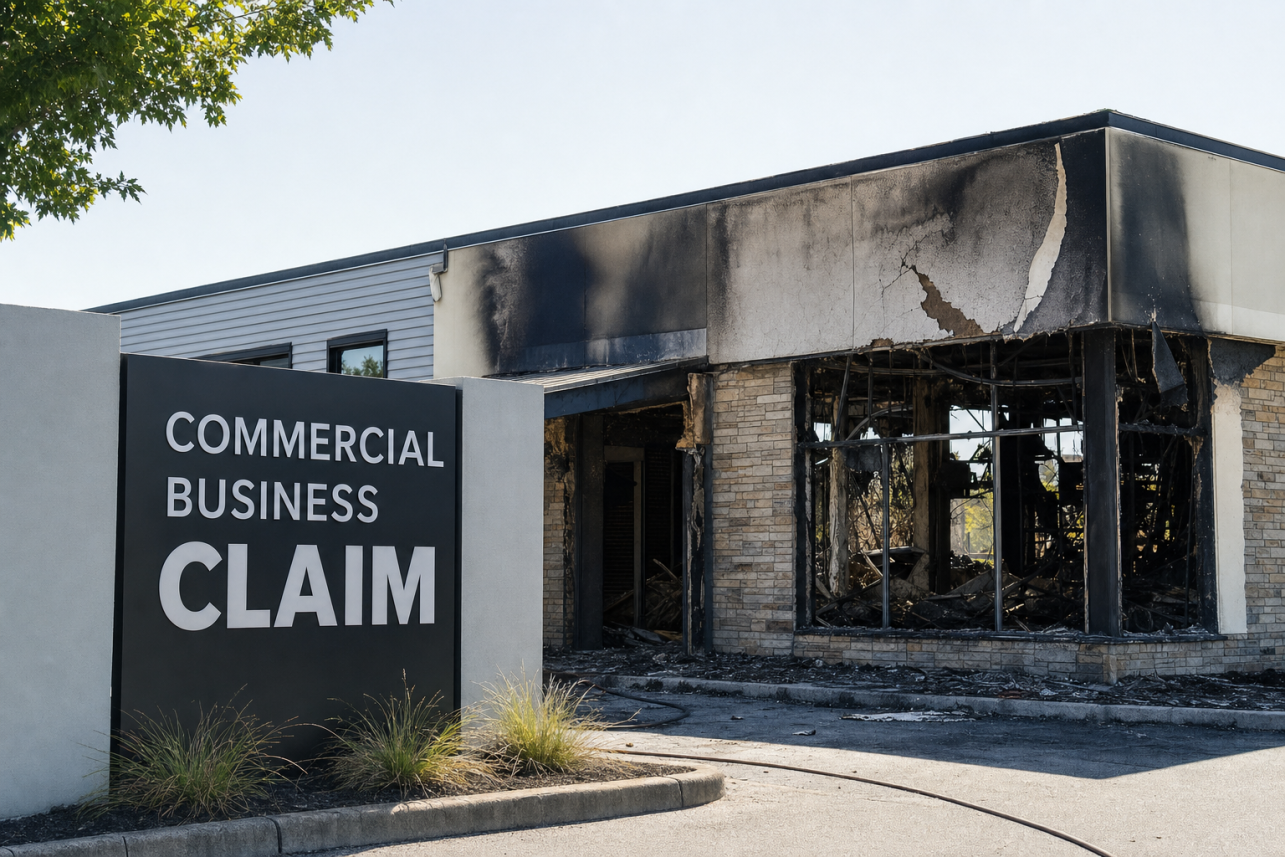
If you need help with a Commercial Business Claim Elon NC business owners can turn to For The Public Adjusters, Inc., a licensed and bonded public adjusting firm that works for you — not the insurance company. We document the full scope of your property damage, your lost income, and your extra expenses, then negotiate directly with your insurer. You focus on keeping your business alive; we handle the claim.
What This Service Is
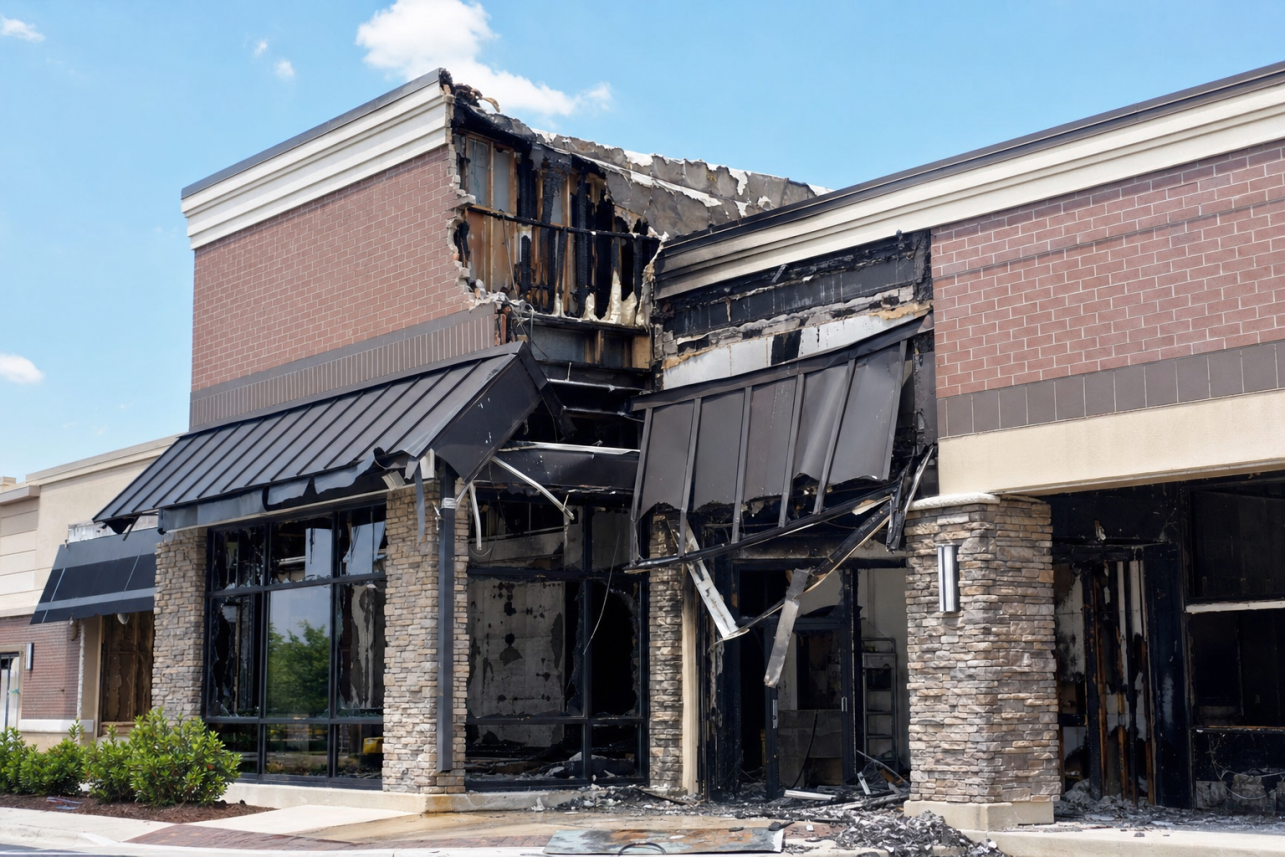
A commercial claim is rarely just about a damaged building. When fire, water, smoke, or storm damage shuts down a shop, restaurant, office, or warehouse, you are usually facing three losses at once: the physical damage, the income you stop earning while you are closed, and the extra costs of operating out of a temporary location or paying staff during the shutdown.
As public adjusters, we represent the policyholder in all three. We read your commercial property insurance policy line by line, identify every coverage that applies — including business interruption and extra expense coverage many owners do not realize they carry — and build the documented proof of loss your insurer requires.
That means a detailed inventory of damaged stock and equipment, realistic rebuilding and repair estimates, and a defensible calculation of lost revenue based on your actual books. It is the same disciplined approach we bring to every Commercial Business Claim in Burlington and across Alamance County. We never guarantee a specific outcome — no honest adjuster can — but we make sure your claim is presented completely and valued fairly.
Common Problems
Why Is My Commercial Business Claim Elon NC Settlement Offer So Much Lower Than My Repair Estimates?
Lowball offers usually come from an incomplete picture. The insurer’s adjuster may price repairs at depreciated actual cash value when your policy actually pays replacement cost, or may miss hidden damage — smoke residue inside HVAC systems, water trapped behind walls, warped subfloors under equipment.
Business income is where the gap grows fastest. If nobody properly documents your lost revenue using sales records, tax returns, and seasonal trends, the insurer’s number will almost always be low. We rebuild that calculation from your actual financials and push back with evidence, not opinions.
The Insurance Company Keeps Delaying My Claim — Is That Even Legal?
Insurers must handle claims in good faith, and courts have held them accountable when they do not. In Bi-Economy Market, Inc. v. Harleysville Insurance Co. of New York, a family-owned market destroyed by fire sued after the insurer delayed and underpaid the building and business interruption claim — and New York’s highest court sided with the insured, allowing the business to pursue consequential damages caused by the insurer’s own delay.
If your claim is stalling, the answer is pressure through documentation: a complete proof of loss, written follow-ups, and firm deadlines. When an insurer’s conduct crosses into bad faith, we can also coordinate with insurance dispute lawyers. That same escalation path applies whether it is a commercial loss or a fire damage insurance claim adjuster in Elon matter for a homeowner.
Should I Just Handle The Claim Myself, Or Is Hiring A Public Adjuster Worth It?
Small losses with clear coverage can sometimes be handled alone. But a commercial claim involves damage assessment, inventory valuation, income loss calculations, and policy language full of exclusions and conditions — and a mistake in any one of them can cost you far more than an adjuster’s fee.
Before hiring anyone, verify their license. The NCDOI Public Adjusters Guide explains that public adjusters in North Carolina must be licensed and work only for the policyholder, never the insurance company. For The Public Adjusters, Inc. is licensed and bonded, works on contingency, and only handles property claims — never cell phone, vehicle, health, or life claims. A good public adjuster in Elon should be able to walk you through your own policy before you ever sign anything.
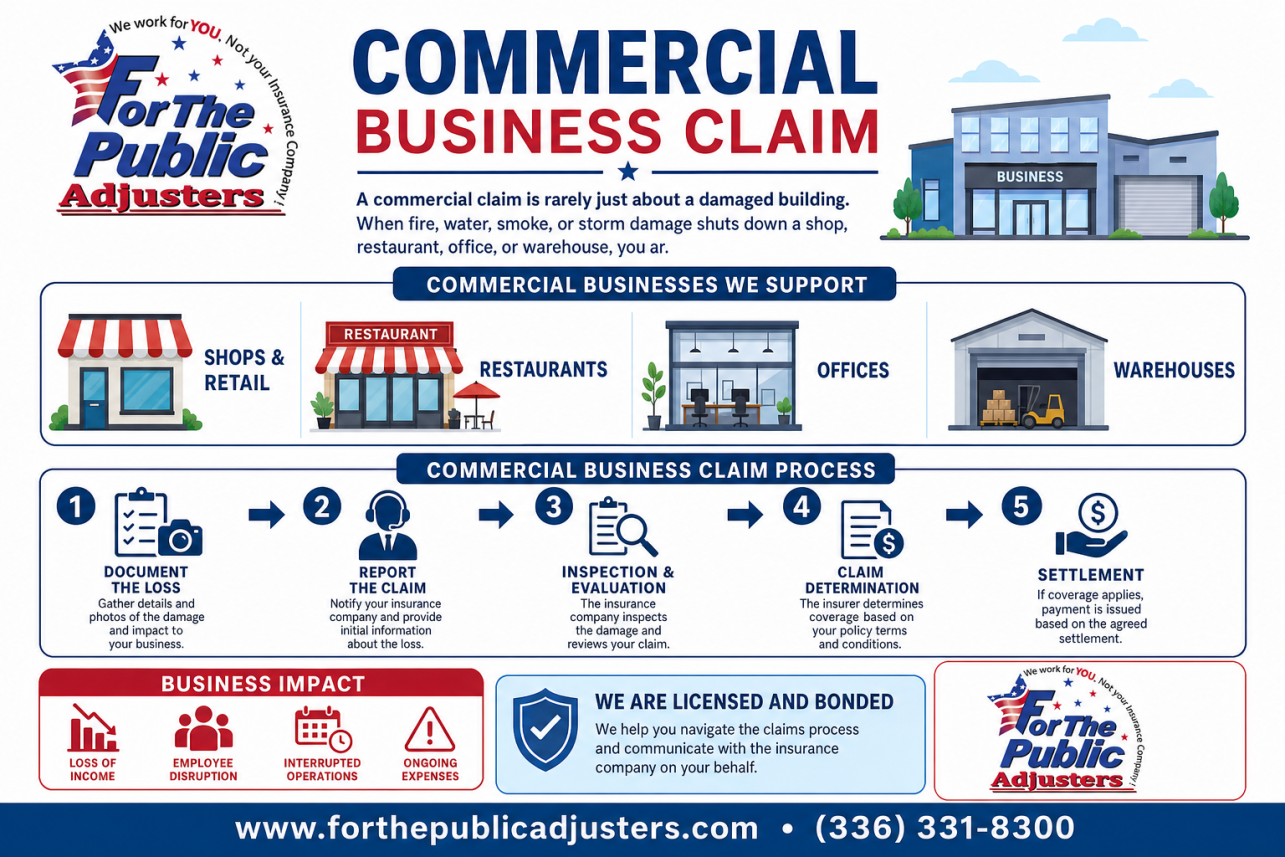
Our Process
Free Policy Review And Damage Inspection
We start by reading your actual commercial policy — the coverages, the deductible, the exclusions, and whether contents and equipment are valued at replacement cost or actual cash value. Then we inspect the property ourselves, documenting damage the insurer’s adjuster may have missed or minimized.
Building The Full Claim: Property, Income, And Extra Expenses
We prepare a room-by-room scope of damage, an inventory of lost stock and equipment with supporting values, and a business income loss calculation drawn from your sales records and financial statements. Extra expenses — temporary space, rush shipping, overtime — get documented too, because they are often covered and often forgotten.
Proof Of Loss, Negotiation, And Settlement
We file the proof of loss correctly and on time, then negotiate every disputed line item with your insurer’s adjuster. If they deny coverage or refuse to move, we escalate — including appraisal or referral to attorneys when warranted. You stay informed at every step, and you make the final call on any settlement.
| What’s at Stake | Filing on Your Own | With For The Public Adjusters |
|---|---|---|
| Damage scope | Carrier’s adjuster writes the estimate, often missing hidden moisture, soot migration, and code upgrades | Independent scope built with contractors, hygienists, and moisture mapping before any settlement talk |
| Business interruption | Flat monthly averages that ignore seasonal revenue, like Elon’s university calendar | Income model built from your actual books, sales cycles, and continuing expenses |
| Policy interpretation | Exclusions taken at face value, including wear-and-tear and ensuing loss language | Every exclusion tested against the full policy and North Carolina case law that has favored insureds |
| Contents and inventory | Generic pricing and pressure to accept salvage on items that can’t legally be reused | Itemized schedules with invoices, manufacturer statements, and regulatory disposal costs |
| Your time | Weeks of calls, paperwork, and inspections while trying to run the business | We manage documentation, meetings, and negotiation while you focus on operations |
Commonly Overlooked In The Public Adjusting Industry
- Extra expense coverage separate from business income — Owners assume lost income is the whole claim and never bill the carrier for temporary space, equipment rental, or rush shipping that kept the business alive.
- Ordinance or law coverage for code upgrades — Repairs in Alamance County often trigger current building code requirements, and carriers quietly price the rebuild to old code unless someone invokes this coverage.
- Soot and chloride contamination inside HVAC ductwork — It’s invisible after a wipe-down, so first estimates skip lab testing and the corrosion shows up months later in failed equipment.
- Ensuing loss language inside wear-and-tear exclusions — Carriers apply the exclusion to the entire loss when most policies only exclude the failed component, not the water or fire damage that followed.
- The period of restoration versus the actual reopening date — Business income is paid for the time repairs should reasonably take, and carriers shorten it by ignoring permits, contractor availability, and equipment lead times.
- Regulatory disposal costs for contaminated inventory — Medical, food-service, and clinical businesses can’t legally reuse water- or smoke-exposed stock, but adjusters routinely mark it salvageable.
- Tenant improvements and betterments in leased spaces — Buildouts the tenant paid for fall in a coverage gap between the landlord’s policy and the tenant’s, and nobody claims them unless the lease and both policies are read together.
- The appraisal clause as an alternative to accepting a low offer — Most policyholders don’t know their policy contains a built-in dispute mechanism, so they either give up or assume a lawsuit is the only option.
Case Studies
Case Study #1
Situation: A family-owned restaurant on West Haggard Avenue near the Elon University campus suffered a kitchen fire that spread smoke and soot through the dining room, HVAC system, and dry storage during the fall semester rush.
Problem: The carrier’s adjuster scoped the loss as a surface cleaning job, offered a settlement that covered wipe-downs and repainting, and denied most of the business interruption claim by arguing the restaurant could have reopened within two weeks.
Investigation: Our team pulled the full commercial property policy, hired an industrial hygienist to test for chloride and soot contamination inside the ductwork and walk-in cooler gaskets, and reconstructed twelve months of sales data to model lost income during the university’s busiest season.
Findings: Soot had penetrated the entire supply-side ductwork and contaminated food-contact surfaces the health department would never have approved after a wipe-down. The two-week reopening estimate ignored permit timelines, equipment lead times, and required hood system replacement.
Solution: We submitted a revised sworn proof of loss with the hygienist’s lab results, contractor bids for full duct replacement and hood remediation, and a business interruption calculation tied to actual semester-driven revenue cycles rather than a flat monthly average.
Outcome: The carrier reopened the claim and issued a settlement several times the original offer, covering full HVAC remediation, code-required hood upgrades, and a realistic period of restoration. The owner reopened without taking on debt.
Lesson: Smoke damage in a commercial kitchen is almost never a cleaning job, and business interruption should follow your real revenue calendar. North Carolina courts have long sided with insureds on property coverage disputes — in Gaston County Dyeing Machine Co. v. Northfield Insurance Co., 351 N.C. 293 (2000), the North Carolina Supreme Court ruled in favor of the insured on property damage coverage the carrier tried to escape. Documentation and policy knowledge decide these fights.
Case Study #2
Situation: A dental practice in a leased suite off University Drive in Elon discovered a burst supply line above the ceiling over a holiday weekend. Water saturated the ceiling grid, operatory walls, cabinetry, and thousands of dollars of sterile supplies and equipment.
Problem: The insurance company applied a wear-and-tear exclusion to the pipe itself, undervalued the specialized cabinetry at generic millwork prices, and treated water-exposed dental instruments and consumables as salvageable after drying.
Investigation: We separated the excluded pipe repair from the fully covered resulting water damage, brought in a moisture-mapping contractor to document saturation behind the operatory walls, and obtained manufacturer statements confirming that water-exposed sterile supplies and certain equipment could not legally be reused on patients.
Findings: The carrier’s estimate missed hidden moisture in two wall cavities that would have led to mold behind cabinetry, priced medical-grade casework at big-box rates, and ignored regulatory disposal requirements for contaminated clinical inventory.
Solution: We rewrote the scope with line-item pricing for medical-grade cabinetry, added contents schedules backed by purchase invoices, included code-compliant disposal costs, and documented lost patient revenue during the closure for the extra expense and business income claim.
Outcome: The revised claim was paid at a figure that reflected the true cost of restoring a clinical space, including replacement of contaminated inventory and income lost during the buildout. The practice reopened fully compliant instead of patching around the damage.
Lesson: A wear-and-tear exclusion on a failed component almost never excludes the resulting water damage, and specialized commercial contents should never be priced like residential goods. Read the ensuing loss language before accepting any denial.
| Type of Loss | Common Carrier Position | What the Outcome Usually Depends On |
|---|---|---|
| Kitchen or electrical fire | Surface cleaning and repainting only | Lab testing for soot and chloride in ductwork, equipment, and wall cavities |
| Burst pipe or appliance failure | Wear-and-tear exclusion applied broadly | Separating the excluded component from the covered resulting water damage |
| Tornado or hurricane structural damage | Partial repair instead of matching replacement | Documenting hidden structural movement and matching requirements under NC standards |
| Business interruption after any covered loss | Shortest possible restoration period | Realistic permit, lead-time, and buildout schedules plus seasonal revenue records |
| Flood damage to the building | Excluded under the standard commercial policy | Whether you carry an NFIP or private flood policy — start at FEMA.gov and FloodSmart.gov to confirm coverage |
| Theft or vandalism to a commercial space | Depreciated contents values and inventory disputes | Purchase records, replacement-cost provisions, and a documented inventory schedule |
| Smoke damage from a neighboring unit | Denial or minimal cleaning allowance | Testing that proves contamination migrated into your suite and HVAC system |

Reviews
After our kitchen fire, the insurance company’s number wouldn’t have even covered new ductwork. For The Public Adjusters brought in their own testing, rebuilt our business interruption numbers around the university calendar, and handled every call with the carrier. The final settlement let us actually reopen. I’d never face a commercial fire claim alone again.
Marcus T., restaurant owner, Elon
A burst pipe flooded three of our operatories and the carrier acted like drying the walls fixed everything. This team documented moisture behind the cabinetry the first adjuster never checked and proved our contaminated supplies couldn’t legally be reused. They understood both the policy and the realities of running a clinical practice. Worth every penny of their fee.
Dr. Priya R., dental practice owner, Alamance County
We manage a small retail strip and a tenant’s water heater failure damaged two adjoining units. The insurer tried to split the loss and lowball both scopes. For The Public Adjusters coordinated the whole claim, kept our tenants informed, and got the buildout priced correctly. The process took time, but they communicated at every stage and never overpromised.
James H., property manager, Elon NC
Frequently Asked Questions
What Does A Public Adjuster Do For A Commercial Business Claim Elon NC Policyholder?
When your Elon business suffers property damage, a licensed public adjuster works exclusively for you — never the insurance company. We review your commercial policy line by line, document the full scope of damage to your building, equipment, and inventory, prepare a detailed estimate, and negotiate directly with the insurer’s adjuster on your behalf.
That matters because the insurance company’s adjuster is paid by the carrier. Their job is to close your file; ours is to make sure every covered dollar of loss is actually claimed. For a commercial loss in Elon or elsewhere in Alamance County, that includes items owners often miss: business personal property, code-upgrade costs, debris removal, and business interruption losses while you rebuild.
Courts have repeatedly sided with policyholders who push back on lowball settlements. In Sproull v. State Farm Fire & Casualty Co. (Illinois Supreme Court, 2021), the court ruled the insurer could not depreciate labor costs when calculating actual cash value on a property damage claim — a win for the insured that put real money back into rebuilding.
For The Public Adjusters, Inc. is licensed and bonded, and we handle claims involving fire, smoke, water, hurricane, tornado, hail, theft, and vandalism damage to commercial buildings and contents. We do not handle claims involving motor vehicles, cell phones, health, or life insurance. While we cannot promise a specific outcome — no honest adjuster can — we can promise your claim will be documented and presented the way a business loss deserves.
How Long Does A Commercial Insurance Claim In Elon Usually Take To Settle?
It depends on the size and complexity of the loss. A straightforward theft or vandalism claim at a small Elon storefront might resolve in 30 to 60 days. A major fire or water loss at a larger commercial building — especially one with business interruption coverage in play — can take several months.
North Carolina law requires insurers to acknowledge claims promptly and to pay undisputed amounts within a reasonable time after agreement is reached. Delays usually come from disputes over scope: the carrier’s estimate covers less square footage, cheaper materials, or fewer damaged contents than the loss actually involved. That is where professional representation earns its keep, because a well-documented claim is much harder to stall.
Our team knows the local factors too. Elon and Alamance County contractors have real lead times, permit schedules through the Town of Elon matter for repairs, and business interruption calculations should reflect actual local revenue — not a carrier’s generic formula.
Policyholders who insist on proper valuation have strong legal footing. In Cheetham v. Southern Oak Insurance Co. (Florida 3rd DCA, 2013), the appellate court sided with the insured homeowners in a property damage dispute, confirming the insurer could not unilaterally limit what it owed under the policy’s repair obligations.
We stay on the carrier’s timeline from day one — documenting, responding, and escalating when adjusters go quiet — so your file never sits at the bottom of a stack. We are licensed and bonded, and we work only on property and contents claims.
My Elon Business Flooded — Is That Covered, And Can For The Public Adjusters, Inc. Still Help?
This is one of the most important distinctions in commercial property insurance. Standard commercial policies generally exclude rising water from outside the building. Flood coverage typically comes through a separate policy, most often written through the National Flood Insurance Program (NFIP), which is administered by FEMA. If your Elon property sits near a creek or low-lying area of Alamance County, it is worth reviewing floodplain maps at FEMA.gov and policy details at FloodSmart.gov, the official NFIP site.
Here is the good news: many losses business owners assume are “flood” are actually covered water damage — a burst pipe, a failed water heater, sewer backup (if endorsed), or rainwater entering through a roof opened by hurricane or hail damage. Sorting out which policy responds, and how, is exactly what we do.
If you carry an NFIP or private flood policy, we can help document the loss to the building and contents, prepare the proof of loss, and advocate through the flood claim process. If the cause turns out to be a covered peril under your commercial policy instead, we pursue it there.
Courts have protected policyholders in these coverage disputes. In Vargas v. Insurance Company of North America (2d Cir. 1981), the court construed ambiguous policy language in favor of the insured — a principle North Carolina courts also follow, meaning unclear exclusions are generally read against the insurance company. We are licensed and bonded, and while we never guarantee a specific recovery, we make sure every available coverage is put to work for you.
How Much Does It Cost To Hire An Adjuster For A Commercial Business Claim Elon NC Business Owners Can Afford?
We work on a contingency fee — a percentage of the insurance settlement, agreed to in writing before we start. There are no upfront costs, no hourly billing, and no fee if there is no recovery. For an Elon business owner already dealing with a fire, hurricane, tornado, hail, or water loss, that structure means professional representation without adding to your cash-flow burden.
The percentage varies with the size and complexity of the claim, and North Carolina regulates public adjuster contracts, so everything is disclosed and signed before any work begins. For The Public Adjusters, Inc. is licensed and bonded in North Carolina.
Does hiring representation pay for itself? We cannot and will not guarantee any particular result — every claim stands on its own facts and policy language. What we can say is that carrier estimates on commercial losses frequently omit items like code-required upgrades, contents inventories, smoke remediation, and business interruption income. A thoroughly documented claim gives you a far stronger position than accepting the first number offered.
Policyholders who challenge inadequate settlements have won in court. In Mee v. Safeco Insurance Co. of America (Pa. Super. Ct. 2006), the insureds prevailed against their carrier in a dispute over payment for structural property damage, with the court holding the insurer to its policy obligations.
One note on scope: we handle damage to commercial buildings, business contents, and related property losses only. We do not take claims involving motor vehicles, cell phones, health, or life insurance. Call us for a free review of your Alamance County loss before you sign anything from the carrier.
What Types Of Commercial Property Damage Does For The Public Adjusters, Inc. Handle For Elon Businesses?
We represent business owners on claims involving damage to buildings, contents, equipment, and inventory. In Alamance County, the losses we see most often include fire and smoke damage, water damage from burst pipes or roof leaks, hail damage, theft and vandalism, and structural damage from hurricanes or tornadoes that track through the Piedmont.
We also handle the business income side of a loss. If a fire shuts down your shop on Williamson Avenue or a pipe break closes your office near the university, your policy may include business interruption and extra expense coverage — and those figures are frequently underestimated when the owner calculates them alone.
If your Commercial Business Claim Elon NC situation involves flooding, keep in mind that most commercial policies exclude flood, which is typically covered under a separate policy through the National Flood Insurance Program (NFIP) administered by FEMA. We can review your policies and tell you honestly which coverages apply before you commit to anything.
To be clear about what we do not handle: we don’t work on claims involving cell phones, motor vehicles, health insurance, or life insurance. Our focus is strictly commercial and residential property — the building, what’s inside it, and the income it produces. We are licensed and bonded in North Carolina, and every claim we take on gets a documented, line-item estimate rather than a rough guess.
What Documentation Should I Gather Before Filing A Commercial Business Claim Elon NC Owners Can Support?
Start with your complete policy — not just the declarations page. Coverage disputes often turn on endorsements and exclusions buried deep in the form, so we want every page.
Next, document the damage before anything is moved or repaired. Take wide photos of each affected room, then close-ups of damaged equipment, inventory, and finishes. Video walkthroughs with narration are even better. If emergency mitigation is needed to prevent further damage — tarping a roof, extracting water — do it, but keep every receipt and photograph the conditions first.
For the contents portion, pull together purchase records, invoices, and asset lists. For business income, gather profit-and-loss statements, tax returns, sales records, and payroll from at least the prior twelve months. A restaurant near downtown Elon and a manufacturer off NC-100 will document income very differently, and we tailor the claim presentation accordingly.
Finally, keep a written log of every conversation with your insurance company: dates, names, and what was said. Carriers rely on their own file; you should have yours.
If that list feels overwhelming while you’re also trying to keep a business running, that’s exactly why owners bring us in early. Our team builds the inventory, prepares the estimates, and handles carrier communication so nothing gets missed. We never guarantee a specific outcome — no honest adjuster can — but a thoroughly documented claim is consistently in a stronger position than one filed in a hurry.
My Commercial Claim Was Underpaid Or Denied. Can An Elon Public Adjuster Still Get Involved?
Yes. A significant share of our work in Alamance County involves claims that were already filed, then underpaid, delayed, or denied outright. As long as the claim hasn’t been formally closed by settlement release and the policy’s deadlines haven’t expired, there is usually room to reopen the conversation.
We start by comparing the carrier’s estimate against our own independent inspection. It’s common to find missed damage — smoke residue in HVAC systems, water migration behind walls, code-upgrade costs, or business income figures calculated on incomplete financials. We then present a supplemental claim with documentation the carrier has to answer.
North Carolina courts have repeatedly held insurers to the language of their own policies. In Gaston County Dyeing Machine Co. v. Northfield Insurance Co., 351 N.C. 293 (2000), the North Carolina Supreme Court sided with the insured after equipment failure caused property damage, rejecting the insurers’ narrow reading of when the damage occurred and confirming coverage the carriers had tried to avoid. Cases like that matter because they show a denial letter is an opinion, not a verdict.
We can’t promise a specific dollar result, and we won’t pretend otherwise. What we can do is make sure your Commercial Business Claim Elon NC file is complete, correctly valued, and pressed through every avenue the policy allows — including appraisal, a dispute-resolution process built into most commercial policies. Bring us the denial letter and the carrier’s estimate, and we’ll give you a straight assessment at no charge.
Does Business Interruption Coverage Apply If My Elon Business Has To Close After A Fire?
In most commercial policies, yes — if your policy includes business income coverage, a covered loss like a fire that forces you to suspend operations can trigger payment for lost net income and continuing expenses during the restoration period.
The hard part is proving the number. Carriers calculate business income conservatively, and for an Elon business the seasonality matters enormously. A café or bookstore that depends on the university calendar earns very differently in September than in June. If your loss happens right before move-in weekend or graduation, a calculation based on a flat twelve-month average will shortchange you. We build income projections that reflect how your specific business actually earns.
Extra expense coverage is a second piece owners often overlook. If you rent temporary space in Burlington or Gibsonville, expedite equipment shipping, or pay overtime to reopen faster, those costs may be reimbursable — but only if they’re documented as they happen.
Watch the restoration period language too. Coverage generally runs until the property should reasonably be repaired, not until it actually is, so delays need to be documented and attributed correctly. Some policies also include extended business income coverage for the ramp-up period after you reopen, when revenue hasn’t yet returned to normal.
Our team prepares the financial claim alongside the building and contents claim so the three parts support each other. We’re licensed and bonded, we work only for policyholders, and we’ll tell you plainly what your policy does and doesn’t provide before you decide anything.
Should I Accept My Insurer’s First Settlement Offer On A Commercial Business Claim Elon NC Building Owners Typically Receive?
In most cases, no — at least not before an independent professional reviews it. First offers on commercial losses are frequently based on the insurance company’s own scope of damage, which can overlook code-upgrade costs, hidden structural damage, contents losses, and business income that continues to bleed while you’re closed.
North Carolina courts have repeatedly held that ambiguities in a policy must be resolved in the policyholder’s favor. In Gaston County Dyeing Machine Co. v. Northfield Insurance Co., 351 N.C. 293 (2000), the North Carolina Supreme Court ruled for the insured after a property loss, finding that where policy language is reasonably susceptible to more than one interpretation, the reading that favors coverage controls. That principle matters when an adjuster tells an Elon business owner something “isn’t covered.”
Before you sign anything, our team prepares an independent damage estimate, reviews your policy line by line, and compares it against the carrier’s offer. If the numbers don’t align, we negotiate directly with the insurance company on your behalf. We can’t promise a specific dollar outcome — no one ethically can — but we can make sure the offer you evaluate reflects the full, documented scope of your loss rather than a quick file closure.
Once you cash a final settlement check, reopening the claim becomes much harder, so it’s worth a professional review first. Consultations for Alamance County business owners are free, and you’ll know exactly where your claim stands before making any decision.
A Tornado Damaged My Commercial Property Near Elon — How Is That Claim Different From Other Losses?
Tornado damage claims are among the most complex commercial losses we handle in Alamance County. A tornado rarely causes just one type of damage. You may have roof and structural damage, water intrusion from rain that followed, destroyed inventory, damaged signage and HVAC equipment, and a forced closure that triggers business interruption coverage — each with its own policy provisions and proof requirements.
Insurance carriers sometimes attribute portions of the damage to “pre-existing wear” or maintenance issues rather than the storm itself. That’s where independent documentation becomes critical. We photograph and measure every affected area, bring in engineers or building consultants when the cause of damage is disputed, and build a claim file the carrier can’t easily discount.
Tornado events also create pressure to settle fast, because dozens of area businesses file at once and carriers want files closed. Fast is fine — but not at the expense of accuracy. Code upgrades alone can add substantial cost to rebuilding an older Elon commercial building, and those costs are often missing from early estimates.
As a policyholder in this situation, you also have duties: mitigate further damage, keep receipts for emergency repairs and tarping, and document the property before cleanup. We guide clients through each of those steps so nothing done in the first chaotic week undermines the claim later. If your building took a hit, call us before the carrier’s adjuster completes their inspection — being present for that walkthrough often changes what ends up in the estimate.
Are You Licensed To Handle Commercial Insurance Claims In North Carolina, And Why Does That Matter?
Yes. For The Public Adjusters, Inc. is licensed and bonded, and North Carolina law requires both for anyone representing policyholders on insurance claims. That matters more than most business owners realize.
An unlicensed “claims consultant” or a contractor negotiating your settlement can jeopardize your claim and, in some cases, violate state law. Licensed public adjusters are regulated by the North Carolina Department of Insurance, must meet continuing education requirements, and are bound by rules governing contracts, fees, and conduct. The bond exists to protect you, the policyholder.
Licensing also means we work exclusively for you — never for the insurance company. Company adjusters and independent adjusters, despite the similar titles, are paid by the carrier. A licensed public adjuster is the only claims professional legally authorized to advocate solely for the insured’s interests in North Carolina.
For an Elon commercial loss, that advocacy shows up in practical ways: we prepare our own scope and estimate rather than accepting the carrier’s, we invoke policy provisions like appraisal when negotiations stall, and we document business income losses with real financial records instead of rough projections.
One note on scope: we handle claims involving damage to buildings, business property, and contents. We do not handle claims involving motor vehicles, cell phones, health, or life insurance. If your loss involves your commercial building or what’s inside it — fire, smoke, water, hail, tornado, theft, or vandalism — that’s exactly what we do, every day, throughout Alamance County.
What Should I Do In The First 48 Hours After Discovering Damage At My Elon Business?
The first two days often determine how smoothly a Commercial Business Claim Elon NC policyholders file will go, so act deliberately.
First, make the property safe and prevent further damage — tarp roof openings, shut off water at the source, and secure the building against intrusion. Your policy requires reasonable mitigation, and carriers can reduce payments for damage that worsened due to inaction. Keep every receipt for emergency work.
Second, document everything before cleanup. Take wide photos of each affected room, close-ups of damaged equipment and inventory, and video walkthroughs with narration. Don’t throw anything away until it’s been photographed and, ideally, inspected.
Third, report the loss to your carrier promptly, but keep the initial report factual and brief: date, cause if known, and general areas affected. Avoid speculating about causes or estimating dollar amounts — early statements get quoted back at you later.
Fourth, if flooding is involved, understand that standard commercial policies typically exclude flood, which is covered separately through the National Flood Insurance Program. FEMA (fema.gov) and NFIP (floodsmart.gov) are worth reviewing so you know which policy responds to which damage.
Finally, consider calling us before the carrier’s adjuster inspects. Being on-site for that inspection lets us point out damage that might otherwise be missed and ensures the initial scope starts closer to complete. Our consultation costs nothing, and getting the claim structured correctly from day one is far easier than repairing a claim that started off wrong.
A Pipe Burst Inside My Elon Commercial Building — How Is That Handled Differently From Flood Damage On A Commercial Business Claim Elon NC Insurers Process?
This distinction matters more than almost anything else in your policy. Water that escapes from plumbing, sprinkler systems, or an HVAC unit inside your building is generally covered under a standard commercial property policy. Rising surface water from heavy rain or an overflowing creek — the kind Alamance County sees during severe storm seasons — is typically excluded and requires separate flood coverage through the National Flood Insurance Program (floodsmart.gov) or a private flood carrier.
Insurers sometimes blur that line to their advantage. In Accardi v. Hartford Underwriters Insurance Co., 373 N.C. 292 (2020), the North Carolina Supreme Court sided with policyholders whose property was damaged by water and sewage, holding that ambiguous water-related policy language must be construed in favor of the insured. That ruling is a powerful reminder that the carrier’s first reading of an exclusion is not the final word.
When we handle a burst-pipe or water-intrusion loss for an Elon business, we trace the water’s source, document the path of damage through walls, flooring, inventory, and equipment, and build the claim around the actual policy language — not the carrier’s summary of it.
If true flood waters were involved, we can still guide you through documentation and point you toward FEMA resources at fema.gov and DisasterAssistance.gov so nothing falls through the cracks. Every loss is different, so we never promise a specific outcome — but we do make sure the correct coverage is applied to the correct cause of loss.
The Insurance Company Already Sent Its Own Adjuster To My Elon Property. Do I Really Need My Own Representation?
The adjuster your carrier sent works for the insurance company — that is who pays them and whose interests they serve. A public adjuster is the only type of adjuster licensed in North Carolina to represent you, the policyholder, exclusively.
Carrier adjusters in commercial losses often handle heavy caseloads and rely on quick walkthroughs and software-generated estimates. A burned or water-damaged commercial building near downtown Elon or along University Drive can hide damage inside wall cavities, roof decking, electrical systems, and inventory that a thirty-minute inspection simply will not catch.
Our team performs its own independent inspection, prepares a line-item estimate, inventories damaged contents and stock, and calculates business income losses with supporting financial records. We then negotiate directly with the carrier’s adjuster on your behalf, meeting them at the property when needed.
Courts have repeatedly recognized that carriers do not always get it right. In Accardi v. Hartford, the North Carolina Supreme Court ruled for homeowners after the insurer denied water and sewage damage, construing the disputed exclusion against the company that drafted it. That same principle protects commercial policyholders here in Alamance County.
Having your own licensed, bonded advocate does not guarantee a particular dollar figure — no honest professional can promise that — but it does mean every element of your loss is documented, valued, and argued by someone whose only obligation is to you.
My Restaurant Near The Elon University Campus Lost Refrigerated Inventory After A Fire Knocked Out Power. Is Spoiled Food Part Of My Claim?
Very possibly, yes. Food spoilage after a covered event like a fire is one of the most commonly overlooked pieces of a restaurant or grocery loss in Elon. Coverage can come from several places in a commercial policy: the business personal property limit, a specific spoilage endorsement, or utility-service interruption coverage if the outage started off-premises.
The key is documentation, and it has to happen fast. Before anything gets thrown out, we photograph the contents of every cooler and freezer, record temperatures, and build an itemized inventory with purchase invoices and supplier records. Health department disposal requirements in Alamance County often force quick action, so evidence gathered in the first day or two frequently decides the outcome.
Spoilage rarely travels alone. The same fire that killed your power may have caused smoke contamination in dry storage, soot in your hood and duct systems, and a forced closure that triggers business income coverage. We assemble all of those pieces into one coordinated claim rather than letting the carrier evaluate them piecemeal.
One caution: if the power loss came from flooding rather than fire, different rules apply, and separate flood coverage through the NFIP (floodsmart.gov) becomes the relevant policy. We review your specific coverage forms before telling you what applies — because for a campus-area restaurant, a week of lost dinner service during the semester can matter as much as the walk-in full of spoiled product.
What Deadlines Apply To A Commercial Business Claim Elon NC Policyholders Need To Watch?
Filing a Commercial Business Claim Elon NC business owners can actually collect on means respecting several clocks that start ticking the moment damage occurs. Missing any one of them can weaken or destroy an otherwise valid claim.
First, your policy requires “prompt” notice of loss. There is no fixed number of days in most forms, but waiting weeks gives the carrier an argument that delay prejudiced its investigation. Report the loss quickly, even before you know its full extent.
Second, most commercial policies impose a proof-of-loss deadline — often 60 days after the insurer requests it — along with duties to protect the property from further damage and make it available for inspection. These are contractual obligations, and carriers enforce them.
Third, North Carolina law generally allows three years to file suit on a property insurance contract, though some policies attempt to shorten that window through limitation clauses. Courts scrutinize those provisions, and as decisions like Accardi v. Hartford (N.C. 2020) show, ambiguous policy terms are read in the insured’s favor — but you never want to rely on litigation timing when earlier action would have preserved your rights.
Our team tracks every one of these deadlines from day one. We prepare the sworn proof of loss, coordinate inspections at your Elon property, and keep a written record of every communication with the carrier. We cannot promise a specific result, but we can make certain no deadline quietly closes the door on your recovery.
Local Relevance
Elon’s business community — the shops, restaurants, and service businesses that thrive alongside the university — depends on foot traffic that follows the academic calendar. A fire or burst pipe in August hurts very differently than one in June, and a fair business interruption settlement has to reflect that seasonality. We build that into every income calculation.
The Piedmont climate adds its own risks. Humid summers feed severe thunderstorms, winter ice storms bring down trees and power lines, and remnants of Atlantic hurricanes push inland with heavy rain and damaging wind. Many commercial buildings in and around downtown Elon are older structures where water finds its way into aging roofs and masonry quickly.
We serve all of Alamance County, and when heavy rain overwhelms low-lying properties we also handle flood losses — including flood damage claim help in Mebane — under the separate flood policies most standard commercial coverage does not include. Business owners a few miles west can also reach our public adjuster in Burlington team for the same commercial claim services.
Because Elon’s retail and restaurant economy rises and falls with the university calendar, a business interruption payout based on a flat monthly average often shortchanges owners whose losses hit during peak semester weeks — insist that your lost-income calculation uses month-by-month sales history, not an annual average.
Your Business Can’t Afford An Underpaid Claim
Every week your claim stalls is another week of lost revenue. For The Public Adjusters, Inc. is licensed and bonded in North Carolina, and we work on contingency — we only get paid when you do. Call today for a free review of your commercial policy and damage, with no obligation and no pressure.
Call us: (336) 331-8300
Helpful Resources
- NCDOI Public Adjusters Guide
- Insurance Information Institute (III)
- North Carolina Department of Insurance — State regulator that licenses public adjusters and handles consumer complaints
- Insurance Information Institute business insurance resources — Nonprofit educational resource on commercial coverage and business interruption
Last updated: September 19, 2026