
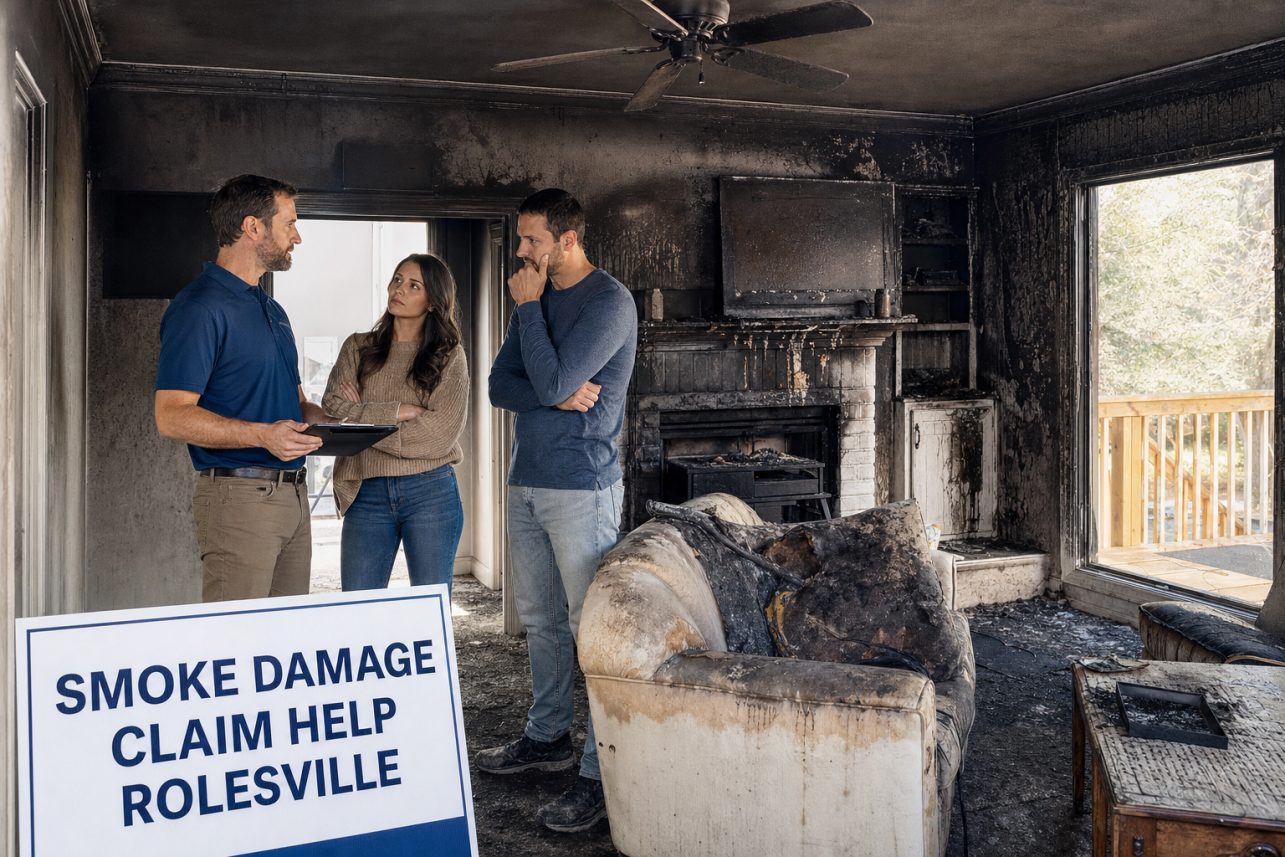
Smoke Damage Claim Help Rolesville homeowners rely on comes from For The Public Adjusters, Inc., a licensed and bonded public adjusting firm that works for you — never the insurance company. We assess the full reach of smoke and soot through your home, document every damaged item, and negotiate your claim so the settlement reflects what the loss actually cost you. Even a small kitchen fire can push smoke into walls, ductwork, closets, and attic spaces the insurer’s adjuster may never open up.
What This Service Is
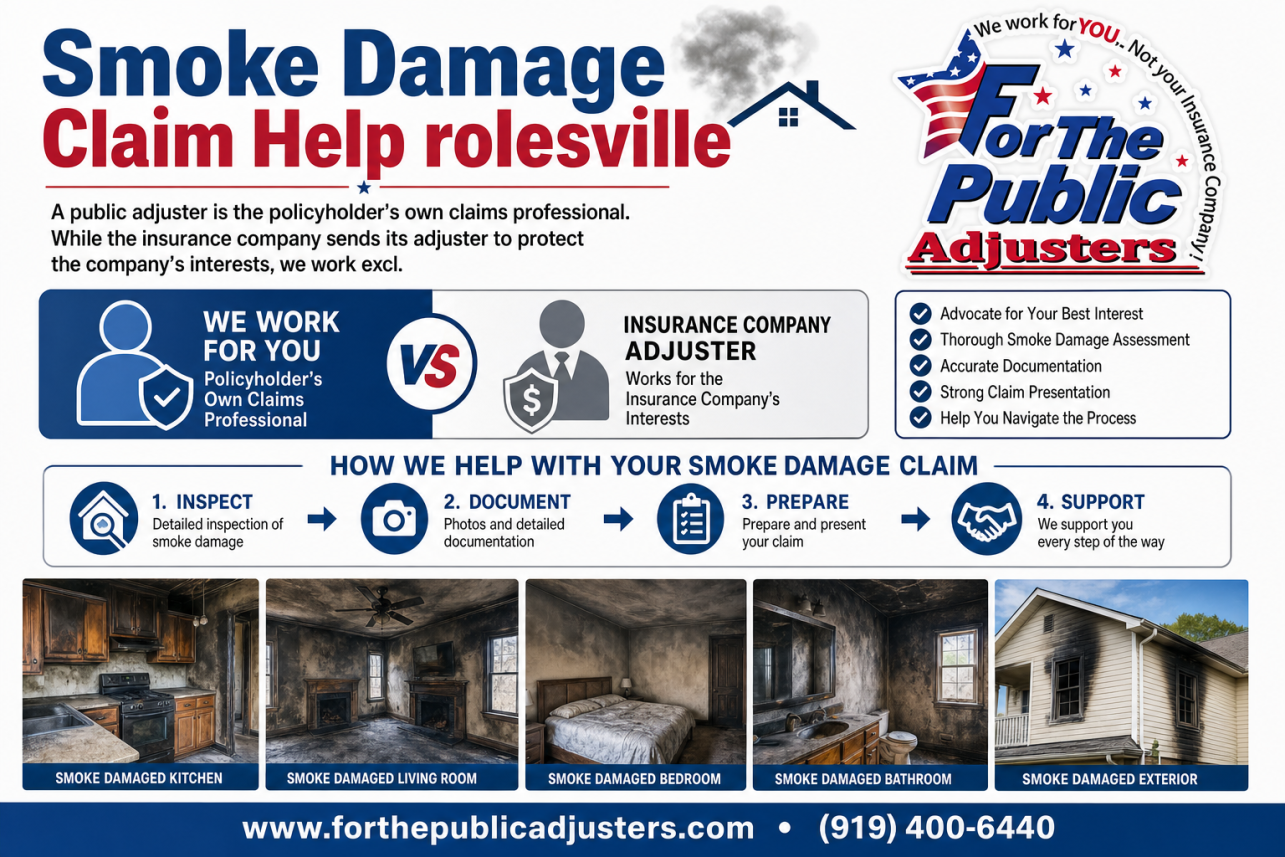
A public adjuster is the policyholder’s own claims professional. While the insurance company sends its adjuster to protect the company’s interests, we work exclusively for you — reading your policy, measuring the true scope of damage, and building the documentation your claim needs.
Smoke losses are among the most underpaid claims we see. Soot is acidic and keeps corroding metal, electronics, and finishes for weeks after the fire is out. Odor binds into drywall, insulation, carpet padding, and upholstered furniture. The National Fire Protection Association (NFPA) has long emphasized that smoke travels far beyond the room where a fire starts, and our inspections in Wake County bear that out constantly.
Our team handles the entire claim: photographing and testing for residue, building a room-by-room contents inventory, valuing personal property correctly, filing the sworn proof of loss on time, and negotiating with the carrier. We handle these losses across the county — a recent smoke damage insurance claim help Raleigh file involved soot found three rooms away from a contained oven fire. We also handle related fire damage, water damage from firefighting efforts, and commercial business claims when smoke shuts down a workplace.
Common Problems
The Insurance Company’s Offer Won’t Come Close To Covering The Cleanup — Now What?
Lowball offers on smoke claims usually happen for two reasons. First, the carrier’s adjuster prices surface cleaning only, skipping duct cleaning, sealing, insulation replacement, and odor treatment that professional restoration actually requires. Second, the offer applies heavy depreciation, paying you the ‘actual cash value’ of ten-year-old furniture instead of what replacement will really cost.
If your policy includes replacement cost coverage, you may be entitled to recover that depreciation once repairs and replacements are made — but only if the claim is documented and pursued correctly. Courts have sided with policyholders on scope disputes, too: in Windridge of Naperville Condominium Association v. Philadelphia Indemnity Insurance Co. (2019), a federal appeals court ruled the insurer had to replace all of a building’s siding — not just the damaged panels — so the property would actually match. The principle matters in smoke claims, where partial cleaning or patchwork repairs leave a home that looks and smells like it burned.
We rebuild the estimate from the ground up, item by item, so the number on the table reflects the real cost of making your home whole.
My Smoke Claim Keeps Stalling — Or The Adjuster Says Most Of The Damage ‘isn’t Covered’
Delays and partial denials are common with smoke losses because the damage is easy to dispute. The carrier’s adjuster walks through, sees walls that look mostly fine, and writes a light estimate. Meanwhile soot sits inside your HVAC system and recirculates every time the unit runs, and odor keeps seeping out of materials that were never treated.
There are also deadlines working against you. Policies set time limits for submitting your proof of loss and supporting documents, and missing them can jeopardize the whole claim. If you’ve been displaced, your additional living expense coverage — the part that pays for temporary housing and meals — has its own limits and paperwork requirements.
We’ve reopened underpaid files across northern Wake County, including a smoke damage claim help Wake Forest matter where hidden attic soot was missed entirely on the first inspection. When a carrier drags its feet, thorough documentation and persistent, professional negotiation are what move a file forward.
Do I Really Need Smoke Damage Claim Help Rolesville, Or Can I Handle The Insurer Myself?
You can file on your own, and for a truly minor loss that may be fine. The problem is that smoke damage is deceptive — homeowners routinely accept a cleaning-only settlement, then discover odor returning in humid weather, corroded electronics failing months later, and soot inside wall cavities and ductwork. By then, the claim is closed and the money is spent.
A good public adjuster does three things a homeowner can’t easily do alone: measures the full scope of damage (including what’s hidden), values contents using replacement pricing rather than guesswork, and negotiates from documented evidence rather than emotion. The NCDOI Public Adjusters Guide explains how public adjusters are licensed in North Carolina and what policyholders should expect from one — we encourage every homeowner to read it before hiring anyone.
Ask any adjuster you’re considering for their license, their bond, and specific examples of smoke losses they’ve handled. We’re happy to provide all three, whether the loss is here in town or a smoke damage claim help Knightdale file across the county.
Our Process
Full Smoke And Soot Assessment
We inspect well beyond the burn area — wall cavities, attic insulation, closets, ductwork, electronics, and appliances. Soot residue is acidic and keeps damaging surfaces after the fire is out, so we document its full reach with photos, notes, and testing before anything gets cleaned or discarded.
Documentation, Inventory, And Proof Of Loss
We build a room-by-room inventory of your damaged contents with replacement-cost valuations, review your policy for coverage limits and deadlines, and prepare the sworn proof of loss the carrier requires. If firefighting water caused secondary damage, we document that too — it’s frequently missed and it’s part of the same loss.
Negotiation And Settlement
We present the documented claim to your insurer, challenge unjustified depreciation and scope cuts, and negotiate until the settlement reflects the evidence. We can’t promise a specific dollar figure — no honest adjuster can — but we can promise your claim will be presented completely, professionally, and on time.
| Claim Step | Going It Alone | With For The Public Adjusters |
|---|---|---|
| Damage documentation | Photos of visible soot; hidden residue in ducts, wall cavities, and attic often missed | Room-by-room inspection, wipe sampling, and documentation of hidden contamination |
| Scope of repairs | Based on the carrier adjuster’s estimate, which often stops at cleaning and paint | Independent estimate covering odor removal, HVAC remediation, insulation, and contents |
| Contents and textiles | Homeowner inventories items alone; smoke-saturated clothing and furniture frequently undervalued | Full contents inventory with restoration vs. replacement analysis |
| Negotiation leverage | Policyholder negotiates against trained adjusters without technical support | Documented scope, applicable case law, and experienced negotiation on the policyholder’s behalf |
| Additional living expenses | Often unclaimed or cut short before odor work is finished | ALE tracked and pursued for the full remediation timeline the policy allows |
Commonly Overlooked In The Public Adjusting Industry
- Soot inside the HVAC system and ductwork — Ducts recirculate smoke residue into every room, but nobody sees inside them during a quick walk-through, so carrier estimates routinely leave them out.
- Protein residue from kitchen fires — It leaves almost no visible staining, so adjusters who rely on what they can see conclude the damage is minor while the odor keeps coming back.
- Attic insulation odor absorption — Fiberglass and cellulose soak up smoke like a sponge, but insulation is out of sight and rarely inspected unless someone climbs up and pulls samples.
- Progressive corrosion on electronics and metal fixtures — Acidic soot keeps etching circuit boards and finishes for months after the fire, so items that tested fine on day one fail long after the claim closes.
- Smoke migration through wall cavities and shared party walls — Contamination hides behind drywall where no one looks, which is especially common in townhomes when the fire started in an attached unit.
- Textiles, mattresses, and upholstered contents — Carriers often allow a token cleaning fee when porous items are actually saturated with smoke and can’t be restored by surface treatment.
- Additional living expenses during odor remediation — Policyholders assume ALE ends when repairs look done, but thermal fogging and sealing can extend the timeline and those days are frequently never claimed.
- Ordinance or law coverage during smoke-related rebuilds — When remediation opens walls, current Wake County code requirements can add cost that a policy covers — but only if someone knows to claim it.
Case Studies
Case Study #1
Situation: A family in the Granite Falls area of Rolesville had a kitchen fire that was extinguished within minutes. The flames were contained to the stovetop, but smoke moved through the entire two-story home.
Problem: The insurance company’s adjuster spent under an hour on site and offered a settlement covering repainting the kitchen and cleaning visible soot in adjacent rooms. Nothing was allowed for the HVAC system, the second floor, or the family’s clothing and soft goods, even though the whole house smelled of smoke.
Investigation: Our team performed a room-by-room inspection with wipe sampling, checked return-air grilles and supply ducts, and pulled insulation samples from the attic. We also documented protein residue on cabinet interiors, window glazing, and light fixtures — a film that is nearly invisible but carries persistent odor.
Findings: Soot and protein residue had migrated through the ductwork to every conditioned room. Attic insulation had absorbed odor, and corrosive residue was etching metal fixtures and appliance components. The insurer’s scope addressed roughly a third of the actual contamination.
Solution: We rebuilt the claim with a documented scope: full duct cleaning and coil replacement, thermal fogging and sealing, attic insulation removal and replacement, contents inventory with textile restoration, and repainting of affected surfaces throughout the home. We supported the position with case law, including Farmers Ins. Co. of Oregon v. Trutanich, 858 P.2d 1332 (Or. Ct. App. 1993), where the court held that persistent odor constituted direct physical loss and the cost to remove it was recoverable — and the homeowner prevailed against the insurer.
Outcome: After negotiation, the carrier accepted a revised scope several times larger than its original offer, including additional living expenses while the odor remediation was completed. The family moved back into a home that actually smelled clean.
Lesson: Smoke does not stop where the flames stopped. A settlement based only on what the eye can see almost always undervalues this kind of loss.
Case Study #2
Situation: A Rolesville townhome owner near Main Street suffered heavy smoke intrusion when the attached neighboring unit caught fire overnight. Her unit never burned, but smoke poured through shared attic space and wall cavities for hours.
Problem: Because her unit showed no fire damage, the carrier initially treated the loss as a light cleaning job and questioned whether much of the claimed damage was ‘physical’ at all. The first offer would not have covered professional soot removal, let alone contents.
Investigation: We opened access points in the shared party wall and attic, documented soot staining inside wall cavities and on framing, and inventoried contents including upholstered furniture, mattresses, books, and electronics showing corrosive residue on circuit boards and metal contacts.
Findings: Dry smoke residue had penetrated wall cavities, insulation, and the HVAC system. Electronics were at risk of progressive corrosion failure, and porous contents could not be restored with surface cleaning alone.
Solution: We prepared a detailed estimate with photographs, lab-supported residue documentation, and a full contents inventory. We cited Western Fire Insurance Co. v. First Presbyterian Church, 437 P.2d 52 (Colo. 1968), where the court ruled in favor of the insured, holding that contamination rendering a building unusable was a direct physical loss even without structural destruction. That precedent directly undercut the carrier’s ‘no physical damage’ position.
Outcome: The claim resolved with coverage for cavity remediation, insulation replacement, duct cleaning, contents restoration and replacement, and temporary housing. The owner avoided paying out of pocket for damage a fire she didn’t cause left behind.
Lesson: Smoke intrusion from a neighboring fire is a real, compensable loss. Documenting hidden contamination early is what turns a lowball cleaning allowance into a full recovery.
| Residue Type | Where It Comes From | Why It’s Tricky | What Your Claim Should Include |
|---|---|---|---|
| Protein residue | Kitchen fires — burned food, grease, meat | Nearly invisible film with a strong, lasting odor that ordinary cleaning misses | Cabinet interiors, appliance cleaning, sealing and repainting, odor treatment |
| Dry smoke | Fast, hot fires burning wood and paper | Fine powdery soot travels far through air gaps and duct systems | Whole-home assessment, duct cleaning, attic and wall-cavity inspection |
| Wet smoke | Slow, smoldering fires — plastics and synthetics | Sticky, smeary residue that smears if wiped and clings to every surface | Specialized cleaning agents, contents restoration, possible material replacement |
| Fuel-oil soot (puff-back) | Furnace or oil-burner malfunction | Oily black film spreads through the HVAC system in minutes | HVAC remediation, degreasing, textiles, and verification the unit is repaired |
| Neighboring-structure smoke | Fire in an adjacent home, townhome, or building | Carriers may argue there’s no ‘physical damage’ since nothing burned | Cavity and attic documentation, contents inventory, ALE if the home is uninhabitable |
| Corrosive residue on electronics and metals | Any fire producing acidic soot | Damage is progressive — devices may work today and fail months later | Electronics evaluation, corrosion documentation, replacement where restoration fails |
Reviews
After our garage fire, the insurance company said the smoke smell in the house was ‘pre-existing odor.’ For The Public Adjusters brought in testing, documented soot in our ductwork and attic, and handled every call with the carrier. The final settlement covered duct cleaning, new insulation, and our kids’ clothes and bedding — things the first offer completely ignored.
Danielle R., Rolesville
A furnace puff-back coated our whole downstairs in oily black film right before the holidays. I had no idea that greasy soot needed specialized cleaning until this team explained it and wrote a scope the insurer couldn’t argue with. They were patient, answered every question, and the difference between the initial offer and the final number spoke for itself.
Marcus T., Wake County
Our neighbor’s house fire filled ours with smoke even though nothing here burned. The adjuster the insurance company sent barely looked past the walls. For The Public Adjusters opened up the attic, found soot everywhere, and fought for full remediation plus our hotel costs. Licensed, professional, and genuinely on our side the whole way.
Priya S., Rolesville
Frequently Asked Questions
What Does Smoke Damage Claim Help Rolesville Actually Include, And Why Would I Need It?
When you hire For The Public Adjusters, Inc. for Smoke Damage Claim Help rolesville homeowners get a licensed and bonded advocate who works for you, not the insurance company. That distinction matters because smoke losses are among the most underpaid claims we see in Wake County.
Our work starts with a full documentation of the loss. Smoke travels far beyond the room where a fire started, settling into HVAC ductwork, attic insulation, closets, soft goods, and wall cavities. We photograph and inventory affected contents, test for soot and residue in areas the carrier’s adjuster may never open, and build a detailed scope of repair.
From there, we prepare and present the claim, handle correspondence with the carrier, meet their adjuster on site, and negotiate the settlement. You review and approve every step.
Courts have recognized how real this kind of damage is. In Trutanich v. Farmers Insurance Co. (Oregon Court of Appeals, 1993), the insured homeowner won when the court ruled that a pervasive, penetrating odor contaminating the house constituted direct physical loss to the property, and the cost of removing that odor was a recoverable repair cost. That reasoning is exactly why we push back when a carrier tries to dismiss smoke and odor damage as cosmetic.
We cannot promise a specific dollar outcome — no honest adjuster can — but we can promise that every damaged item and every affected surface in your Rolesville home gets documented and presented properly.
My Insurance Company Already Sent An Adjuster To My Rolesville Home. Why Is Their Smoke Damage Estimate So Low?
This is the most common call we receive from Rolesville and the surrounding Wake County area. The carrier’s adjuster works for the insurance company, and their estimates often reflect that.
Low smoke damage estimates usually come from a narrow scope. The adjuster may allow cleaning and painting for the room where the fire occurred, while ignoring soot that migrated through the HVAC system into bedrooms, the attic, and crawl space. Smoke residue is acidic and continues to corrode metals, etch glass, and stain finishes long after the fire is out, so a quick walkthrough days after the event rarely captures the full loss.
Contents are another gap. Clothing, upholstered furniture, mattresses, electronics, and children’s toys absorb smoke and often cannot be fully deodorized. Carriers frequently allow a small cleaning allowance instead of replacement, even when replacement is warranted under the policy.
Court decisions support policyholders here. In Western Fire Insurance Co. v. First Presbyterian Church (Colorado Supreme Court, 1968), the insured won when the court held that contamination rendering a building uninhabitable was a direct physical loss, even without visible structural destruction. The principle — that contamination is real damage — applies directly to smoke and soot losses.
As public adjusters, we re-inspect the property, prepare an independent estimate, and negotiate from documented evidence rather than accepting the carrier’s first number. We can’t guarantee a particular result, but a thorough, well-supported claim almost always tells a very different story than a rushed one.
How Long Does A Smoke Damage Insurance Claim Take In Wake County, And What Should I Do In The First Few Days?
Timelines vary with the size of the loss and how the carrier responds, but most residential smoke claims we handle in the Rolesville area run from several weeks for a contained kitchen fire to several months for a whole-house loss with extensive contents damage. Claims that go to appraisal or involve disputed scope take longer.
What you do in the first days matters enormously. Report the claim promptly, but be careful about giving detailed recorded statements before you understand the full extent of the damage. Do not throw anything away — even ruined contents are evidence, and carriers routinely dispute items they never saw.
Photograph everything before any cleanup. Keep receipts for hotels, meals, and emergency purchases, because your policy’s additional living expense coverage typically reimburses those costs if the home is uninhabitable. Take reasonable steps to protect the property from further damage, such as boarding openings, since most policies require it.
Avoid signing work authorizations or assignments with restoration contractors before you know your claim’s scope. Some agreements can commit you to costs the carrier later disputes.
When For The Public Adjusters, Inc. is brought in early, we manage this process from day one — documenting the loss while evidence is fresh, tracking policy deadlines, and keeping the claim moving. Homeowners near Rolesville, Wake Forest, and Zebulon often tell us the biggest relief is simply not having to fight the carrier alone while also getting their family resettled.
Do You Handle Wildfire, House Fire, And Puffback Smoke Losses, And Are There Claim Types You Don’t Take?
Yes. Our team handles smoke and soot claims from every common source in the Rolesville area: kitchen and electrical fires, chimney and fireplace incidents, furnace and oil-burner puffbacks that blast soot through ductwork, smoke drift from a neighboring structure fire, and outdoor burn or brush fire smoke that infiltrates a home. We also handle the fire damage itself and the water damage left behind by firefighting efforts.
We are equally experienced with contents claims — the personal property side of a smoke loss. Inventorying hundreds of smoke-affected items with accurate replacement values is tedious, and it’s where many self-handled claims fall short. We build that inventory item by item.
There are claim types we do not take. For The Public Adjusters, Inc. does not handle insurance claims involving cell phones, motor vehicles, health, or life insurance. Our practice is limited to damage to homes, commercial buildings, and their contents. If your loss also involves flooding, note that flood damage is typically covered under a separate flood policy rather than your homeowner’s policy; FEMA and the National Flood Insurance Program (NFIP) are the right starting points for flood-specific questions.
If you’re unsure whether your situation fits, call us. An initial conversation about smoke damage claim help in Rolesville costs you nothing, and we’re licensed and bonded to represent policyholders throughout Wake County. We’ll tell you honestly whether your claim is one we can strengthen — and if it isn’t, we’ll point you in the right direction.
How Much Does Smoke Damage Claim Help Rolesville Cost, And When Do I Pay?
For The Public Adjusters, Inc. works on a contingency fee, which means our payment is a percentage of the insurance settlement we help you recover. There is no upfront charge, no hourly billing, and no invoice if your claim pays nothing. That structure keeps our interests aligned with yours from the first inspection to the final check.
We review the fee percentage with you in writing before you sign anything, so there are never surprises. North Carolina regulates public adjuster agreements, and we are licensed and bonded, so every contract we use complies with state requirements.
Homeowners in Rolesville sometimes worry the fee will leave them worse off than handling the claim alone. In our experience, smoke losses are the claims where professional documentation matters most, because soot and odor damage are so frequently undervalued. Insurance carriers often price a wipe-down and a coat of paint when the loss actually requires sealing, duct cleaning, insulation replacement, and contents restoration.
While we can never guarantee a specific outcome, our job is to make sure every damaged item and every affected surface is documented, priced correctly, and presented under the terms of your policy. When you call, we will walk your property, give you an honest read on whether the claim justifies our involvement, and explain exactly how the fee would apply to your situation. If we do not believe we can add value, we will tell you that too.
My Smoke Damage Claim Was Already Denied Or Underpaid. Is It Too Late To Get Help In Rolesville?
Usually not. A denial or a low settlement offer is often the beginning of the negotiation, not the end. We regularly take on Wake County claims after the carrier has already issued a decision, and we can request a re-inspection, submit supplemental documentation, and invoke policy provisions like appraisal when the facts support it.
Courts have repeatedly sided with policyholders on contamination and odor losses. In Western Fire Insurance Co. v. First Presbyterian Church, the Colorado Supreme Court held that a church saturated with gasoline vapors had suffered direct physical loss even though the structure was not visibly destroyed, and the insured recovered. That reasoning matters for smoke claims, because carriers sometimes argue lingering odor or soot infiltration is not real damage. Case law says otherwise.
Timing does matter. Your policy contains deadlines for supplementing a claim, demanding appraisal, or filing suit, and North Carolina has its own statutes of limitation. The sooner we review your file, the more options remain open.
Bring us the denial letter, the carrier’s estimate, and any photos or reports you have. We will compare their scope of work against what a smoke loss in your home actually requires, from HVAC decontamination to sealing charred framing. We cannot promise a specific dollar result, but we can promise a thorough, documented claim presented by a licensed and bonded advocate who answers to you, not the insurance company.
Smoke Got Into My Furniture, Clothing, And Electronics. How Does A Rolesville Public Adjuster Document Contents Damage?
Contents are the most commonly shortchanged part of a smoke loss. Soot is acidic and corrosive, and it settles into upholstery fibers, closet interiors, electronics, and anything porous. A quick walkthrough by a carrier adjuster rarely captures the full extent of it.
Our team builds a room-by-room contents inventory for your home. We photograph and list each affected item, note whether it can be professionally cleaned or must be replaced, and price everything at current replacement cost using your policy’s actual terms. Textiles that hold odor after ozone treatment, electronics with soot on circuit boards, and mattresses that absorbed smoke all get documented individually rather than lumped into a vague cleaning allowance.
We also address items homeowners frequently forget: attic storage, garage contents, kids’ toys, pantry food exposed to smoke, and heirlooms that may need specialty restoration. If a restoration vendor says an item is cleanable, we push for testing to confirm the odor is actually gone before you accept that answer.
One note on scope: we handle homes, buildings, and their contents. We do not handle claims involving cell phones as standalone device claims, motor vehicles, health, or life insurance. But if smoke moved through your Rolesville house, nearly everything inside it is potentially part of the claim, and our job is to make sure the carrier accounts for all of it. No outcome can be guaranteed, but a complete inventory is the foundation of a fair contents settlement.

Can Smoke Damage Hide In Places I Can’t See, And Will An Insurer Pay For It?
Yes, and hidden damage is exactly where professional Smoke Damage Claim Help rolesville homeowners rely on earns its keep. Smoke travels on air currents, which means it rides your HVAC system into ductwork, settles in attic insulation, penetrates wall cavities through outlets and gaps, and coats the tops of cabinets and framing you will never see without opening things up.
Insulation is a common example. Blown-in attic insulation absorbs smoke odor and cannot be cleaned; it typically has to be removed and replaced. Ductwork often needs professional decontamination or replacement, because every time the system runs it can recirculate soot particles through the house. Carriers frequently omit both from their initial estimates.
We inspect these hidden areas, and where needed we recommend testing, such as wipe samples for soot residue or an industrial hygienist’s assessment, to prove contamination the naked eye misses. Documented lab results are hard for a carrier to dismiss.
Health is also a real concern. Soot residue contains combustion byproducts, and lingering exposure inside a home is not something to shrug off, especially for children or anyone with respiratory issues. A proper claim should fund genuine remediation, not a surface wipe-down and air freshener.
If your Rolesville home still smells like smoke weeks after the loss, that odor is physical evidence of remaining contamination. We can never guarantee what a carrier will ultimately pay, but we can make sure the hidden damage is found, tested, documented, and put in front of the insurance company in a form they have to answer.
The Insurer Says My Smoke Damage Is Only “Cosmetic” And Just Needs Cleaning. Is Smoke Damage Claim Help Rolesville Able To Push Back On That?
Yes, and this is one of the most common disputes we handle for Rolesville homeowners. Carriers often propose a light wipe-down and a coat of paint when the loss actually requires sealing, encapsulation, thermal fogging, or replacement of porous materials like insulation, drywall, and carpet pad that permanently absorb smoke residue and odor.
We push back with evidence, not opinions. That means lab testing for soot and char particulates, moisture and odor readings, hygienist reports when warranted, and line-item estimates built on the same pricing software the carrier uses. When the file shows contamination in wall cavities or HVAC ducts, “cosmetic” stops being a credible position.
Courts have repeatedly sided with policyholders when insurers cut corners on fire and smoke losses. In Bi-Economy Market, Inc. v. Harleysville Insurance Co. of New York, 10 N.Y.3d 187 (2008), a market was destroyed by fire and the insurer lowballed the building and contents claim. New York’s highest court ruled for the insured, holding the policyholder could pursue consequential damages caused by the carrier’s failure to pay the claim properly. Cases like that are a reminder that an insurer’s first estimate is a negotiating position, not a final word.
Our job as your Wake County public adjuster is to document the full scope of smoke contamination so the settlement reflects what proper remediation actually costs. We’re licensed and bonded, and while no adjuster can promise a specific outcome, a thoroughly documented claim is far harder to underpay.
Our House Isn’t Livable Because Of The Smoke Odor. Will Insurance Cover A Rental While Repairs Happen?
Most homeowner policies include Additional Living Expenses coverage, often called ALE or Coverage D. If smoke contamination makes your home unsafe or uninhabitable, ALE can pay the extra cost of temporary housing, meals above your normal grocery spend, added mileage, pet boarding, and even laundry costs while remediation is underway.
The fights usually start over two things: whether the home is truly “uninhabitable,” and how long you’re entitled to stay out. Carriers sometimes argue a smoke-damaged house is livable when the odor is overwhelming or air testing shows contamination. We counter with air quality readings, remediation timelines from contractors, and medical documentation when residents have respiratory issues.
For Rolesville families, we also make sure the ALE budget matches local reality. Short-term rentals near Rolesville, Wake Forest, and north Raleigh aren’t cheap, and the carrier’s allowance should reflect actual comparable housing here, not a statewide average.
Practical tips: keep every receipt from day one, track your normal monthly expenses so we can show the “extra” cost clearly, and don’t move back in just because the carrier pressures you before odor sealing and duct cleaning are finished. If you’re already mid-claim and ALE has been cut off early, that decision can often be challenged with the right documentation.
As your public adjuster, we handle the ALE ledger alongside the structure and contents claim so nothing falls through the cracks. We can’t guarantee any specific payout, but we can make sure every legitimate expense is claimed and supported.
What Should I Avoid Doing After A Smoke Loss That Could Hurt My Claim In Rolesville?
A few early missteps cause most of the underpaid smoke claims we see in Wake County. Avoid these and you protect your position.
First, don’t clean aggressively before documentation. Wiping soot off walls or shampooing carpets destroys evidence of contamination levels. Photograph everything first, keep damaged items rather than throwing them out, and let professionals test before cleanup begins.
Second, don’t give a recorded statement or sign anything without understanding it. Carriers may ask you to sign scope agreements, proof-of-loss forms, or releases early on. A signed release can end your claim even if hidden damage surfaces later inside wall cavities or ductwork.
Third, don’t accept the first check as final unless you’re certain the scope is complete. Cashing a payment usually doesn’t close your claim in North Carolina, but many homeowners assume it does and stop pursuing what they’re owed. Supplemental claims are common on smoke losses because odor and residue keep revealing themselves for weeks.
Fourth, don’t hire a restoration contractor who works off the insurer’s estimate without question. The carrier’s scope often omits odor sealing, content pack-out, HVAC decontamination, and testing.
Finally, watch your deadlines. Policies impose time limits for proof of loss and suit, and North Carolina’s statutes add their own clocks. Getting a Rolesville public adjuster involved early means the documentation, notices, and negotiations are handled correctly from the start. We’re licensed and bonded, and our fee comes from the recovery, so early guidance doesn’t require money out of pocket.
How Is A Public Adjuster Different From The Contractor Or Restoration Company My Insurer Recommended?
They serve completely different roles, and confusing them costs homeowners money. A restoration contractor repairs and cleans your property. A public adjuster represents you in the insurance claim itself, valuing the loss, negotiating scope and price, and handling the paperwork and deadlines. When people search for Smoke Damage Claim Help rolesville, the adjusting side is usually the piece they’re missing.
Be cautious with carrier-recommended vendors. Contractors in an insurer’s “preferred” program get steady referrals from that insurer, which can create pressure to keep repair scopes lean. That may mean painting over smoke-stained drywall instead of replacing it, or skipping duct decontamination that a truly independent scope would include.
A public adjuster works only for you. We inspect independently, test for soot and odor penetration, inventory contents room by room, and build our own estimate rather than working off the carrier’s numbers. Then we negotiate directly with the insurance company’s adjuster on your behalf, something a contractor generally isn’t licensed to do in North Carolina.
You can absolutely use both: we establish what the claim is worth, and your chosen contractor performs the work at a properly funded scope. Many Rolesville clients bring us in specifically because the contractor’s real-world repair bid was thousands above what the carrier approved.
One note on what we handle: our practice covers damage to homes, buildings, and contents, including fire, smoke, and puffback losses. We don’t take claims involving motor vehicles, cell phones, health, or life insurance. We’re licensed and bonded, and consultations are free.
My Neighbor’s House Fire Filled My Rolesville Home With Smoke. Can I File A Claim Even Though The Fire Wasn’t On My Property?
Yes, in most cases you can. Standard homeowner policies cover direct physical loss from smoke, and the fire does not have to originate in your own home. If smoke from a neighboring structure drifted into your house off Rogers Road, near Main Street, or anywhere else in town, the soot, staining, and odor absorbed by your walls, insulation, and contents are typically compensable under your own policy.
Courts have backed policyholders on this point. In Western Fire Insurance Co. v. First Presbyterian Church (Colorado, 1968), the court ruled that pervasive contamination and odor that made a building unusable qualified as direct physical loss, and the insured won. That reasoning is regularly cited when insurers try to argue that smoke intrusion without flames isn’t ‘real’ damage.
The challenge with neighbor-fire claims is proof. Carriers often argue the smoke exposure was brief or superficial. We counter that with surface soot sampling, odor documentation, photographs of staining in attics and closets, and a room-by-room contents inventory before anything gets cleaned or discarded.
As a Rolesville public adjusting firm serving Wake County, we prepare that evidence, present it to your carrier, and negotiate the scope so hidden contamination isn’t left out. We’re licensed and bonded, and while no one can promise a specific outcome, thorough documentation consistently changes how these claims are valued.
Will Smoke Damage Claim Help Rolesville Cover My HVAC System And Ductwork After Smoke Got Pulled Through The Vents?
This is one of the most commonly missed items in smoke losses, and yes, it’s a core part of what we evaluate. When a fire or puffback occurs while your HVAC system is running, the blower pulls soot and combustion particles through the return, coats the coil and blower housing, and distributes contamination through every supply duct in the house. Weeks later, the system keeps redepositing that residue every time it cycles on.
Insurance carriers frequently approve a basic duct cleaning and call it done. That’s often inadequate. Flexible ductwork, common in Rolesville homes built over the last few decades, has an interior lining that can absorb smoke residue and odor permanently. In those situations, replacement rather than cleaning is the correct scope, and it should be in the estimate.
Our process includes inspecting the air handler, taking photos inside supply and return runs, and, when warranted, bringing in an HVAC or industrial hygiene professional to document contamination the carrier’s adjuster never looked for. We then present that evidence with a line-item demand for cleaning or replacement, plus filter changes and post-remediation verification.
With Smoke Damage Claim Help rolesville, the goal is a complete scope, not a fast closeout. We can’t guarantee a particular dollar figure, but we can make sure your carrier is responding to documented contamination rather than a walkthrough glance at your registers.
What Is Recoverable Depreciation, And Why Did My Smoke Damage Check Come In Lower Than The Estimate?
Most homeowner policies in Wake County pay smoke losses on a replacement cost basis, but they do it in two stages. The first check is the actual cash value: the replacement cost minus depreciation for age and wear, minus your deductible. The depreciation that was held back is ‘recoverable’ once you actually complete the repairs or replace the damaged items and submit proof.
That’s why the initial check often looks far smaller than the estimate. If your smoke-stained drywall, carpet, and kitchen cabinets were estimated at $40,000 to replace but the carrier applied $12,000 in depreciation, your first payment reflects the reduced figure. Homeowners who don’t understand the process sometimes assume that’s all they’ll ever get and settle for less than the policy owes.
There are two places this goes wrong. First, carriers sometimes apply aggressive depreciation percentages to items that don’t wear meaningfully, or depreciate labor where the policy or state guidance doesn’t support it. Second, policies impose deadlines to complete work and claim the held-back funds, and missing that window can forfeit the money entirely.
As your public adjuster in Rolesville, we review how depreciation was calculated line by line, challenge inflated withholdings, track your completion deadlines, and prepare the documentation to release the recoverable portion. We’re licensed and bonded, and our fee structure means we’re working to maximize the documented value of your claim within your policy’s terms, not to rush a closeout.
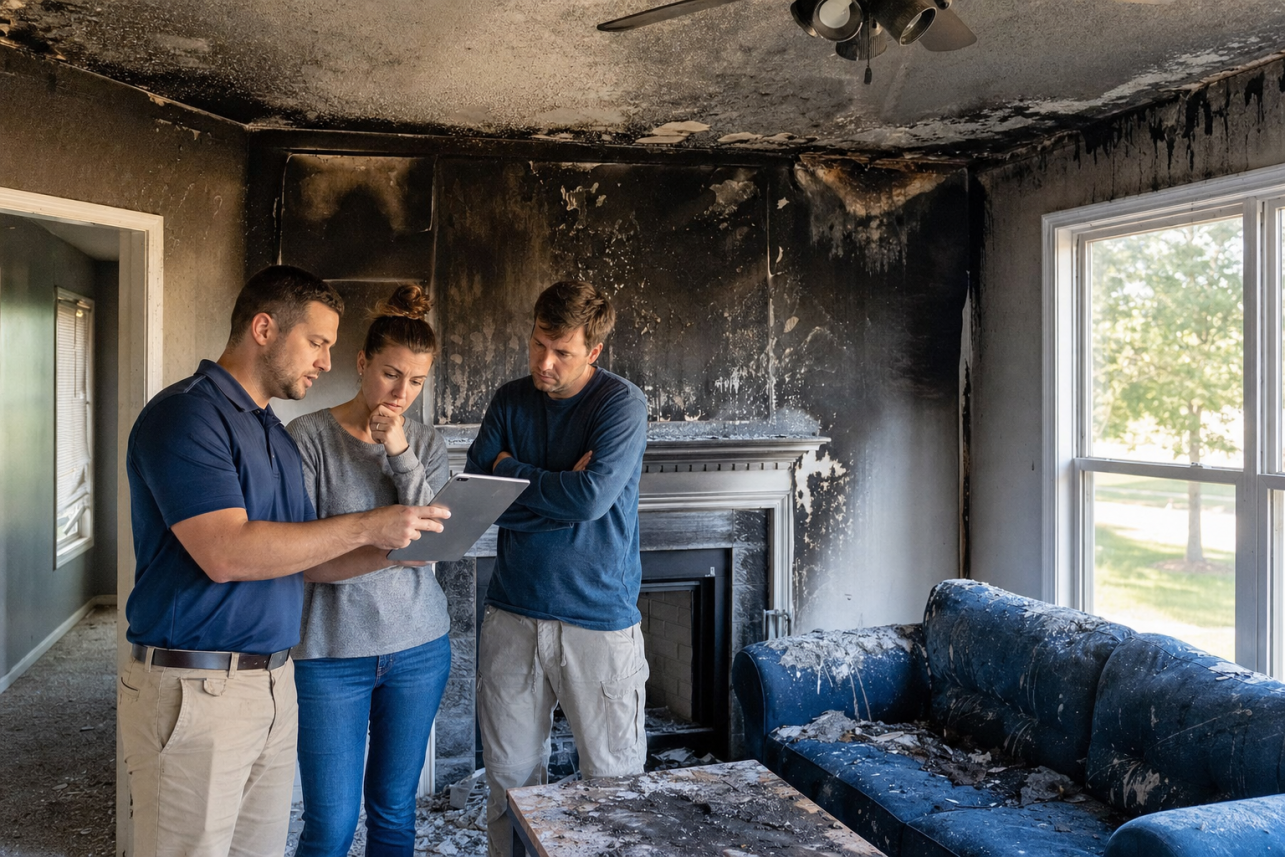
The Insurer Refuses To Pay For The Smoke Odor In My Home Because Nothing Burned. Does Smoke Damage Claim Help Rolesville Deal With Odor-Only Disputes?
Yes, odor-only disputes are something we handle regularly, and the law is more favorable to homeowners than many adjusters let on. Carriers sometimes take the position that if there’s no charring or visible soot, there’s no ‘physical loss.’ Courts have rejected that argument in property cases.
In Farmers Insurance Co. of Oregon v. Trutanich (Oregon Court of Appeals, 1993), the insured homeowner won when the court held that a pervasive odor that had penetrated the house was itself direct physical damage to the property, and the cost of removing it was covered. That case, and others like it, gives policyholders solid footing when a carrier dismisses odor as an inconvenience rather than a loss.
Smoke odor is chemistry, not perception. Combustion byproducts bond to porous materials such as drywall, insulation, carpet padding, and framing lumber. In Rolesville’s humid summers, trapped odor compounds often intensify, which is why a house that seemed tolerable in March can be unlivable by July. Proper remediation may require sealing, thermal fogging, hydroxyl or ozone treatment, or removing saturated materials entirely.
Our team documents odor with professional inspections, identifies which materials are salvageable versus replaceable, and builds a scope your carrier has to respond to on the evidence. We never promise a specific result, but we make sure an odor claim is treated as the physical damage claim it legally is, not brushed aside because the flames stayed next door or in the kitchen.
Local Relevance
Rolesville has grown fast, and its housing reflects that — newer open-floor-plan subdivisions sit alongside older homes and farmhouses that predate the boom. Open layouts are wonderful to live in, but they give smoke an unobstructed path: a cooktop fire in the kitchen can leave residue on ceilings and soft goods two rooms away in minutes. In older homes, smoke finds its way into plaster, original woodwork, and attic spaces where it’s expensive to treat properly.
The region’s humid subtropical climate makes things worse. Moisture in the air reactivates smoke odor trapped in drywall and fabrics, which is why so many local homeowners report the smell ‘coming back’ every summer after a cleaning-only settlement. Cooking fires remain the leading cause of home fires nationally according to the U.S. Fire Administration, and they’re the most common source of the smoke losses we see across Wake County.
We serve Rolesville and the surrounding towns daily — from a smoke damage claim in Apex to files in Wake Forest, Knightdale, and Raleigh — so we know how local carriers’ adjusters tend to scope these losses, and where they tend to come up short.
Rolesville’s humid summers tend to reactivate smoke odor that was sealed into drywall, insulation, and upholstery, which is why many local homeowners who accepted a quick surface-cleaning settlement notice the smell returning months later. Getting duct cleaning, odor sealing, and material replacement into the claim scope the first time is far easier than reopening an underpaid file.
Get A Second Opinion Before You Accept That Smoke Settlement
If your Rolesville home has smoke or soot damage and the insurance company’s number feels light — or the claim is stalled, disputed, or partially denied — talk to us before you sign anything. For The Public Adjusters, Inc. is licensed and bonded, we work only for policyholders, and the initial claim review costs you nothing.
Call us: (919) 400-6440
Helpful Resources
- NCDOI Public Adjusters Guide
- National Fire Protection Association (NFPA)
- U.S. Fire Administration – Home Cooking Fire Safety
- U.S. Fire Administration home fire prevention resources — Federal guidance on home fire causes and prevention
- North Carolina Department of Insurance — State regulator that licenses public adjusters and assists consumers
Serving Rolesville · Wake
Last updated: September 28, 2026