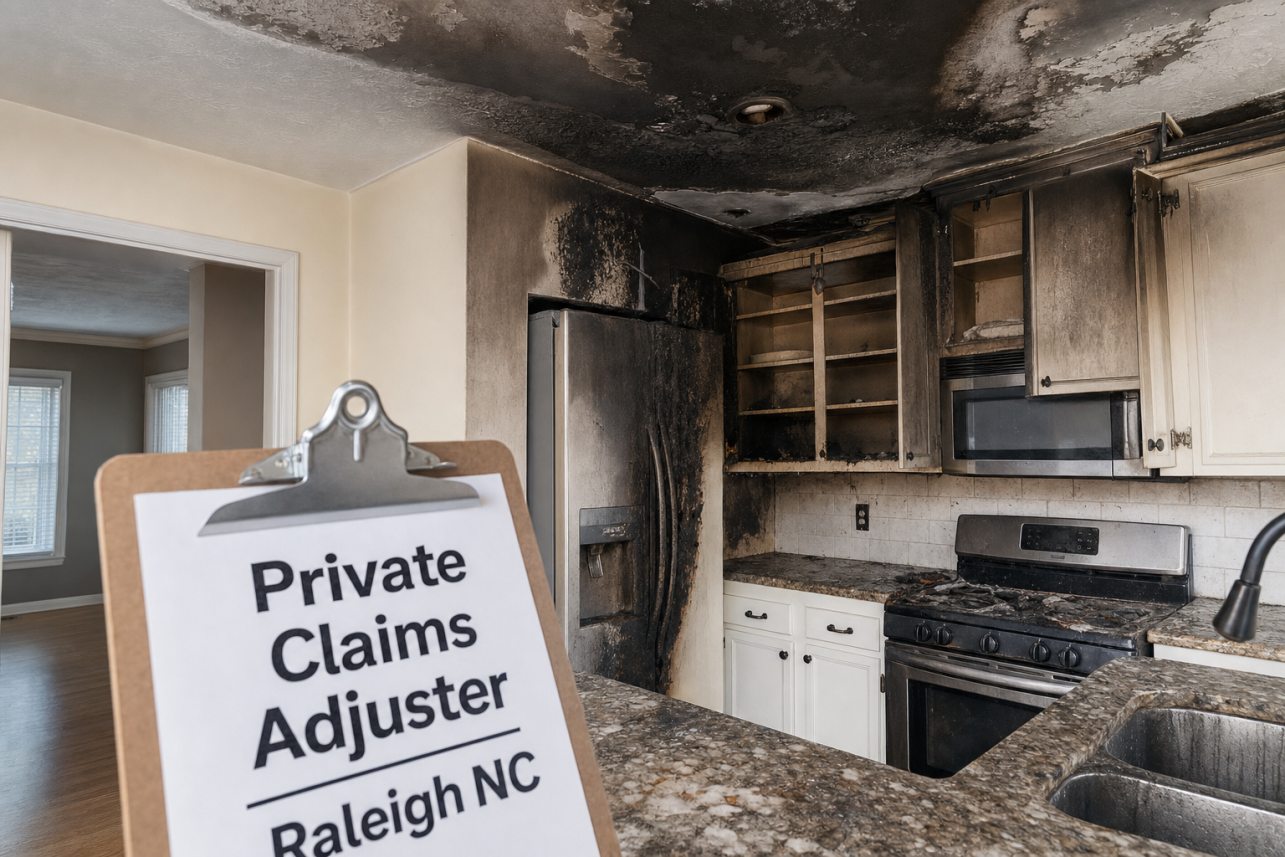
A Private Claims Adjuster Raleigh NC policyholders hire works for you — not the insurance company — to document your loss, read your policy, and negotiate your settlement. For The Public Adjusters, Inc. is licensed and bonded in North Carolina and handles fire, water, smoke, tree, flood, and vandalism claims for homes and commercial buildings throughout Wake County. The carrier's adjuster is paid to protect the carrier's interests; we are hired to protect yours.
What This Service Is
People search for this service under several names — public claims adjuster, public insurance claims adjuster, or independent insurance claims adjuster — but the role is the same. We are claims professionals retained by the policyholder, licensed by the state, who prepare, present, and negotiate property insurance claims on your behalf.
That starts with a line-by-line reading of your policy, because most underpayments begin with a coverage argument, not a repair argument. Then we build the file the carrier should have built: moisture mapping on water losses, contents inventories after a fire, engineering-level scopes on structural damage.
The work is the same whether the loss is in Raleigh or a smaller town nearby — the same documentation we bring to fire insurance claim help in Siler City applies to a kitchen fire inside the Beltline. The North Carolina Department of Insurance explains the role plainly in its NCDOI Public Adjusters Guide: a public adjuster represents the insured, period.
North Carolina courts back the policyholder's side of close calls, too. In Gaston County Dyeing Machine Co. v. Northfield Insurance Co., the North Carolina Supreme Court sided with the insured business, holding that ambiguous policy language must be construed in favor of coverage. We lean on that principle every time a carrier reads an exclusion more broadly than the policy actually says.
Common Problems
What Does A Raleigh Public Claims Adjuster Cost — And Is It Actually Worth It?
We work on a contingency fee, a percentage of what the claim pays. There is no hourly bill and no retainer, so our interest lines up with yours from day one.
Where the value shows up is in scope. Carrier estimates on Raleigh homes routinely miss code-upgrade costs, matching issues on siding and shingles, hidden moisture behind walls, and smoke contamination in rooms the fire never touched. A properly scoped water damage coverage insurance in Pittsboro claim, for example, often looks nothing like the carrier's first estimate once the drying, demolition, and rebuild are all accounted for.
We never guarantee a specific outcome — no honest adjuster can. What we can promise is that your claim will be measured, documented, and argued the way the policy allows, instead of accepted at the carrier's first number.
My Claim Is Stalled Or Underpaid — What Does A Private Claims Adjuster Raleigh NC Homeowners Hire Actually Do About It?
Delays and lowball offers usually trace back to one of three things: an incomplete scope, a coverage position the carrier hasn't been forced to defend, or a file nobody is pushing forward. We attack all three.
First we re-document the loss and issue a complete, itemized estimate the carrier has to respond to in writing. Then we challenge coverage positions against the actual policy language — 'wear and tear' denials on storm-dated roof damage are a classic example in Raleigh's late-'90s and 2000s subdivisions, where storm dates and hail reports make or break the file.
If the dispute hardens, claims can move to appraisal under the policy, and when litigation becomes necessary we coordinate with insurance dispute lawyers. Most claims settle well before that point once the documentation is airtight.
Should I Hire A Public Insurance Claims Adjuster Or Handle The Claim Myself?
Small, clean claims with cooperative carriers often don't need us, and we'll tell you that honestly. The calculation changes when the loss is large, the damage is partly hidden, or the carrier's position doesn't match what you're seeing in your own house.
Fire, smoke, and major water losses are the clearest cases, because contents inventories and contamination testing are nearly impossible to do well without experience. Tree strikes are another — we handle everything from Raleigh roof punctures to tree damage insurance claim help in Carrboro, and the structural scope is almost always bigger than the hole in the shingles.
When you compare adjusters, verify the North Carolina license, ask who will personally work your file, and ask for examples of similar losses they've settled. One note on scope: we handle property claims only — homes, buildings, and contents — not vehicle, cell phone, health, or life claims.

Our Process
Free Policy And Damage Review
We walk the property, review your policy declarations and endorsements, and tell you candidly whether your claim warrants professional representation. If it doesn't, you'll know that before signing anything.
Full Documentation And Claim Presentation
We photograph and measure the loss, run moisture and contamination testing where needed, inventory damaged contents, and prepare a complete itemized estimate. The same standard applies whether we're representing a homeowner in North Raleigh or working as a public adjuster in Garner — the file has to stand on its own.
Negotiation Through To Settlement
We present the claim, meet the carrier's adjuster on site, respond to every coverage position in writing, and negotiate until the settlement reflects the documented loss. You stay informed at each step and nothing settles without your approval.
| What's Involved | Handling It Yourself | With For The Public Adjusters, Inc. |
|---|---|---|
| Damage documentation | Phone photos and the carrier adjuster's notes — easy to miss hidden moisture, soot migration, and structural issues | Moisture mapping, photo logs, contractor scopes, and line-item estimates built to carrier standards |
| Policy interpretation | You rely on the insurance company's reading of exclusions, depreciation, and matching | Independent review of every coverage, endorsement, and deadline — including ones the carrier never mentions |
| Negotiation | You're negotiating against trained adjusters on their terms | A licensed and bonded professional who works only for the policyholder presents and defends the claim |
| Deadlines and paperwork | Proof of loss forms, recorded statements, and supplement requests fall entirely on you | Deadlines tracked, sworn statements prepared, supplements filed when new damage surfaces |
| Your time | Dozens of hours of calls, estimates, and follow-ups during an already stressful period | We manage the process so you can focus on your family or your business |
Commonly Overlooked In The Public Adjusting Industry
- Hidden moisture in wall cavities and under flooring — Carrier adjusters rarely open walls or run moisture meters beyond the visible stain, so saturated framing and subfloor get left out of the estimate entirely.
- Flooring and siding matching across continuous runs — Insurers often pay to patch a few boards when a continuous hardwood or siding run can't be partially replaced and still reasonably match, which North Carolina claim disputes turn on constantly.
- Smoke and soot migration through HVAC ductwork — After a fire, residue travels through the duct system into rooms with no visible damage, and estimates written from a walk-through miss it.
- Additional living expense and loss-of-use coverage — Many Raleigh homeowners never learn their policy pays for hotel stays, meals, and pet boarding during repairs because nobody at the carrier volunteers it.
- Sworn proof of loss deadlines — Policies — and especially NFIP flood policies, which generally require proof of loss within 60 days — carry strict filing deadlines that quietly expire while homeowners wait on the carrier.
- Ordinance and law coverage for code upgrades — Wake County code requirements can add thousands to a rebuild, and the endorsement that pays for those upgrades is routinely left off the carrier's estimate.
- Recoverable depreciation — Policyholders often cash the actual-cash-value check and never realize they can claim the withheld depreciation back once repairs are completed.
- The appraisal clause as a dispute tool — Most policies contain a built-in mechanism for resolving pricing disputes without a lawsuit, but homeowners who don't know it exists simply accept the lower number.
Case Studies
Case Study #1
Situation: A homeowner in North Raleigh's Bedford neighborhood discovered a second-floor supply line had been leaking inside a wall for weeks, saturating the subfloor, kitchen ceiling, and hardwood flooring below.
Problem: The insurance company's adjuster spent twenty minutes on site, approved drying equipment and a small drywall patch, and issued a payment of roughly $9,400. The estimate ignored the hardwoods, the kitchen cabinets, and any testing behind the walls.
Investigation: Our team brought in moisture mapping equipment and documented elevated readings in the wall cavities, the subfloor, and under cabinetry the carrier never opened up. We photographed cupped hardwoods that ran continuously through the kitchen, dining room, and foyer.
Findings: The water had migrated well beyond the visible stain. The cabinets were particleboard and had wicked moisture at the toe kicks, and the continuous hardwood flooring could not be partially replaced and still match — an issue North Carolina carriers know well from matching disputes.
Solution: We prepared a line-item estimate covering full flooring replacement across the continuous run, cabinet replacement, proper containment, and additional living expenses while the kitchen was out of service, then presented the documentation package to the carrier with our moisture logs and photos.
Outcome: After two rounds of negotiation, the carrier revised its position substantially and the family was able to restore the home properly rather than living with a patched ceiling over damaged framing. Every claim is different and results vary, but documentation changed the conversation entirely.
Lesson: North Carolina courts have long held carriers to the actual language of their policies when property is damaged — in Gaston County Dyeing Machine Co. v. Northfield Insurance Co., 351 N.C. 293 (2000), the North Carolina Supreme Court sided with the insured on coverage for property damage the insurer tried to exclude. The takeaway for homeowners: the first estimate is a starting point, not a verdict.
Case Study #2
Situation: A small commercial property owner near Capital Boulevard sustained roof and interior damage when the remnants of a hurricane pushed heavy rain through Wake County, tearing membrane sections loose and soaking two tenant suites.
Problem: The carrier attributed most of the interior damage to 'wear and tear' and 'pre-existing deterioration,' offering payment only for a few squares of membrane. The owner was facing tenant complaints and a repair bid five times the offer.
Investigation: We pulled weather data confirming the storm's rainfall and gust records for Raleigh on the date of loss, obtained the roof's maintenance records showing recent inspections, and had the roofing contractor document fresh tears and displaced flashing consistent with storm forces rather than age.
Findings: The maintenance file directly contradicted the deterioration narrative. We also identified business income and extra expense coverage in the policy that the carrier's adjuster never mentioned, triggered by the tenant suites becoming unusable.
Solution: We rebuilt the claim from scratch: a full roof scope, interior repairs to both suites, and a documented business income calculation. We submitted a sworn proof of loss within the policy deadline and requested re-inspection with our evidence in hand.
Outcome: The claim was reopened and resolved at a figure that funded the roof replacement and interior restoration, and the owner recovered lost rental income for the displacement period. No two claims resolve the same way, but the maintenance records were decisive.
Lesson: When a carrier says 'pre-existing damage,' your own records are your best rebuttal. North Carolina case law, including Gaston County Dyeing Machine Co. v. Northfield Insurance Co., shows insureds can and do prevail when the evidence supports coverage — but only if someone builds that evidence.
| Claim Scenario | You May Be Fine Alone If… | Call a Raleigh Public Adjuster If… | Key Watch-Out |
|---|---|---|---|
| Burst pipe / water damage | Damage is one small, visible area and the carrier's estimate matches a contractor's bid | Water reached walls, flooring, or cabinets, or the first estimate ignores continuous flooring runs | Hidden moisture becomes mold fast in Raleigh humidity — document before drying out |
| House or kitchen fire | Rarely — fire claims almost always involve smoke, contents, and structural scope disputes | There's any smoke odor, soot residue, or a contents inventory to build | Carriers often price cleaning where replacement is warranted |
| Hurricane or tornado damage | A single, clearly storm-caused item with a cooperative carrier | The carrier blames 'wear and tear' or splits the roof from the interior damage | Pull weather data for your date of loss before the narrative is set |
| Flood damage (NFIP policy) | Minimal damage fully visible above the floor line | Flooring, drywall, HVAC, or contents were affected — NFIP rules and deadlines are unforgiving | NFIP generally requires a signed proof of loss within 60 days; review your policy at FloodSmart.gov and FEMA.gov |
| Claim already denied | The denial letter cites a clear exclusion and an attorney confirms it holds up | The denial relies on 'pre-existing damage,' late reporting, or vague policy language | NC insureds have prevailed in coverage disputes — see Gaston County Dyeing Machine Co. v. Northfield Ins. Co., 351 N.C. 293 (2000) |
| Theft or contents loss | A handful of items with receipts in hand | Dozens of items, no receipts, or the carrier is applying heavy depreciation | Depreciation on contents is negotiable and frequently overstated |
| Underpaid settlement | The gap between offer and repair bids is small | The carrier's estimate is a fraction of real contractor pricing in the Triangle | Accepting payment usually doesn't close the claim — supplements may still be possible |

Reviews
After a kitchen fire in our 1940s bungalow, our insurer offered an amount that wouldn't have covered the cabinets, let alone the smoke damage through the whole house. For The Public Adjusters documented soot residue in rooms we hadn't even thought about, itemized our contents, and handled every call with the carrier. The final settlement was a completely different number than the first offer. I'd never go through a fire claim alone again.
Marcus T., Five Points, Raleigh
A pipe burst while we were out of town and the insurance company's estimate basically covered drying fans and some paint. These folks found moisture behind the master bath wall the carrier's adjuster never tested, caught the flooring matching issue, and knew the policy language better than the desk adjuster did. They kept us informed every step and the outcome let us actually repair the house correctly.
Deborah L., Brier Creek
Hurricane remnants dropped a limb through our roof and the carrier tried to split the claim into 'storm damage' versus 'maintenance.' Working with a private claims adjuster in Raleigh changed everything — they brought weather records, a proper roof scope, and pushed back on the depreciation calculations line by line. Honest about what the policy did and didn't cover, which we appreciated. Settlement came in far above the original offer.
James & Priya K., Oakwood
Frequently Asked Questions
What Does A Private Claims Adjuster Raleigh NC Policyholders Hire Actually Do For Them?
A Private Claims Adjuster Raleigh NC homeowners and business owners bring in works exclusively for the policyholder, never for the insurance company. That distinction matters, because the adjuster the insurer sends is paid by the insurer and answers to it.
When you hire For The Public Adjusters, Inc., we read your full policy, document every area of damage, prepare a detailed estimate using the same software insurance carriers use, and then negotiate the claim on your behalf. We handle the paperwork, the deadlines, and the back-and-forth so you can focus on getting your home or building back to normal.
In Raleigh and the rest of Wake County, we routinely find covered damage that was missed in the carrier's first inspection — wet insulation behind walls after a pipe burst, smoke residue in HVAC systems after a kitchen fire, or hidden structural issues after a tornado moves through. Those items add up, and if they are not documented, they are not paid.
We are licensed in North Carolina and bonded, and our role is recognized under state insurance law. We cannot and will not promise a specific settlement amount — no honest adjuster can — but we can promise that your claim will be documented thoroughly and argued professionally. For most policyholders, this is the first large claim they have ever filed; for us, it is what we do every day.
What Kinds Of Property Claims Do You Handle In Raleigh And Wake County, And Are There Any You Don't?
We handle insurance claims involving damage to homes, commercial buildings, and the contents inside them. In Raleigh that most often means fire and smoke damage, water damage from burst pipes or appliance failures, hurricane damage when storms push inland from the coast, tornado damage like the kind Wake County has seen come through with little warning, and flood losses.
Flood claims deserve a special note. Most standard homeowners policies exclude flood, so these claims are usually paid through the National Flood Insurance Program (NFIP). If you have a flood loss, it helps to review the resources at FEMA.gov and FloodSmart.gov, the official NFIP site, because flood policies have their own proof-of-loss deadlines and documentation rules that differ sharply from a standard homeowners policy. We help policyholders navigate those requirements.
There are claim types we do not handle. We do not work on claims involving motor vehicles, cell phones, health insurance, or life insurance. Our focus is strictly real property and contents — the structure itself and the belongings or business property inside it.
If you are not sure whether your situation fits, call us and describe what happened. A Raleigh public adjuster from our team can usually tell you within a few minutes whether your loss is something we can take on, and if it is not, we will say so plainly rather than waste your time.
Have Policyholders Actually Won Against Insurance Companies In Court In North Carolina?
Yes, and one North Carolina case worth knowing is Gaston County Dyeing Machine Co. v. Northfield Insurance Co., decided by the North Carolina Supreme Court in 2000. The insured suffered a loss when a pressure vessel it had manufactured failed and caused damage. The insurance companies denied coverage, arguing the policy language excluded the loss. The Supreme Court of North Carolina sided with the insured, holding that the damage fell within the coverage the policyholder had paid for.
The lesson for Raleigh property owners is simple: an insurer's first denial, or its first low estimate, is not the final word. Policy language is often ambiguous, and North Carolina courts have repeatedly held that ambiguities in an insurance policy are construed in favor of the policyholder, not the company that wrote the contract.
Most claims never need to go to court. A well-documented claim, presented with a line-by-line estimate and supported by the actual policy language, usually gets resolved through negotiation. That is where a public adjuster earns their keep — building the kind of file that holds up under scrutiny.
We cannot guarantee any particular outcome on any claim, and anyone who does should raise a red flag for you. What we can do is make sure your fire, water, flood, hurricane, or tornado claim is measured, documented, and argued the way the Gaston County case shows it should be: on the actual terms of the policy.
How Much Does It Cost To Hire A Private Claims Adjuster Raleigh NC Property Owners Can Trust, And When Should I Call?
For The Public Adjusters, Inc. works on a contingency fee, meaning our fee is a percentage of the settlement your insurance company pays. There is no hourly billing and no upfront retainer. If the claim does not pay, we do not get paid. The exact percentage is spelled out in writing before we start, as North Carolina law requires, and we are licensed and bonded in the state.
As for timing: the best moment to call is before you file, or as soon as possible after. The statements you give your carrier in the first days, the photos you take, and the temporary repairs you make all shape how the claim unfolds. Getting a Raleigh-based adjuster on your side early means the claim is built correctly from the start rather than repaired later.
That said, it is rarely too late. We regularly take over claims that have stalled, been underpaid, or been denied outright. If your carrier paid you for a kitchen fire but the smoke odor still lingers through the house, or paid for one room of water damage when three were affected, those are exactly the situations worth a second look.
We serve Raleigh and all of Wake County, and the first conversation costs nothing. You will get an honest read on whether your claim has room to improve — not a sales pitch, and never a promise of a specific dollar figure, because no ethical adjuster can make one.
How Long Does The Claims Process Usually Take Once I Bring In A Public Adjuster In Raleigh?
Every claim is different, but most residential claims in Raleigh and the surrounding Wake County area move through three phases: documentation, negotiation, and settlement. The documentation phase — inspecting the property, photographing damage, preparing a detailed estimate, and inventorying damaged contents — typically takes one to three weeks depending on the size of the loss.
Once we submit our estimate and supporting documents to your insurance carrier, North Carolina's claims-handling standards generally require insurers to respond to communications within a reasonable time. Straightforward claims, such as a kitchen fire or a burst pipe in a North Hills townhome, often resolve in 30 to 90 days. Larger losses, like a whole-house fire in Five Points or extensive hurricane damage, can take several months, especially if structural engineers or mold remediation reports are involved.
Hiring our team early usually shortens the timeline rather than lengthening it. Carriers move faster when they receive a complete, professionally documented claim package the first time, instead of going back and forth over missing receipts or vague repair scopes.
We can never promise a specific settlement amount or an exact closing date — no honest adjuster can — but we can promise that nothing sits on our desk. We follow up with the carrier on a set schedule, keep you updated at every stage, and push back promptly when the insurer's response falls short of what your policy actually covers.
Does A Private Claims Adjuster Raleigh NC Homeowners Hire Handle Flood And Hurricane Damage Claims?
Yes, with an important distinction. Hurricane damage — roof damage from hurricane-force winds, tree strikes during a named storm, or tornado damage like the areas near Raleigh saw during past outbreaks — falls under your standard homeowners or commercial property policy, and we handle those claims regularly.
Flood damage is different. Rising water is excluded from nearly every standard homeowners policy in North Carolina. Flood losses are typically covered through the National Flood Insurance Program (NFIP), administered by FEMA, or through a private flood policy. If your Raleigh property sits near Crabtree Creek, Walnut Creek, or the Neuse River floodplain, it's worth checking your flood zone at FEMA's Flood Map Service Center and reviewing coverage options at FloodSmart.gov, the official NFIP site.
We can represent you on NFIP and private flood claims, and those claims come with strict deadlines — NFIP requires a signed, sworn Proof of Loss, generally within 60 days of the flood, though FEMA sometimes extends that after major disasters. Missing that deadline can sink an otherwise valid claim, which is one reason flood policyholders call us early.
So in short: hurricane and tornado wind damage, yes, under your property policy. Flood damage, yes, under your flood policy. What we don't handle are claims involving motor vehicles, cell phones, health, or life insurance — our work is strictly damage to homes, buildings, and the contents inside them.
My Insurance Company Already Denied Or Underpaid My Claim. Can You Still Help, Or Is It Too Late?
In most cases it is not too late. A denial letter or a low settlement check is often the beginning of the negotiation, not the end of it. Under most North Carolina property policies, you retain the right to dispute the carrier's position, submit supplemental documentation, invoke appraisal, or ultimately pursue the matter in court within the policy's suit limitation period.
North Carolina courts have repeatedly sided with policyholders when insurers read coverage too narrowly. In Gaston County Dyeing Machine Co. v. Northfield Insurance Co., 351 N.C. 293 (2000), the North Carolina Supreme Court ruled in favor of the insured in a dispute over property damage coverage, rejecting the insurer's attempt to escape paying for the loss. Cases like that one shape how carriers must interpret ambiguous policy language today — ambiguities are construed in favor of the policyholder.
When a Raleigh homeowner brings us a denied or underpaid claim, we start by reviewing the full policy and the carrier's denial reasoning line by line. We frequently find that the insurer's own estimate missed damage entirely — hidden water migration behind drywall, smoke residue in HVAC systems, or code-upgrade costs required by Wake County inspections.
We then build a documented rebuttal and reopen negotiations. If the carrier still won't move, we can recommend appraisal or refer you to a policyholder attorney. We can't guarantee any particular outcome, but a professionally reopened claim gets far more serious attention than a homeowner arguing alone.
Are You Actually Licensed To Represent Policyholders In Wake County, And How Can I Verify That Before Hiring You?
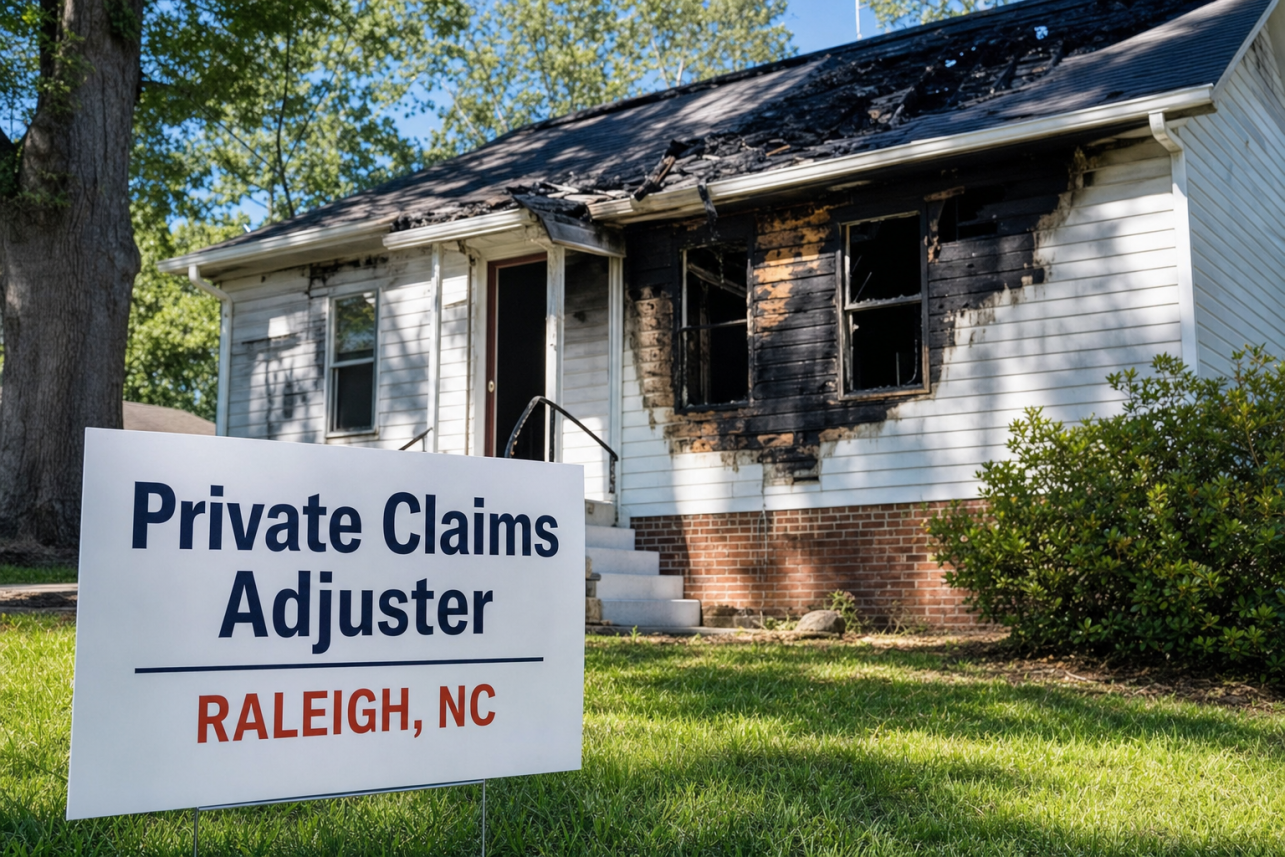
Yes. A Private Claims Adjuster Raleigh NC property owners hire is required by state law to hold a public adjuster license issued by the North Carolina Department of Insurance, and For The Public Adjusters, Inc. is fully licensed and bonded. North Carolina also requires public adjusters to maintain a surety bond, which protects you as the consumer.
Verifying us is simple, and we encourage every potential client to do it. Visit the North Carolina Department of Insurance website and use the agent and adjuster license lookup tool, or call the NCDOI consumer line in Raleigh — the Department is headquartered right here in the capital. You can confirm our license status, license number, and standing in minutes.
Licensing matters more than most homeowners realize. After major storms, unlicensed "claim consultants" and out-of-state operators sometimes canvass Raleigh neighborhoods from Brier Creek to Garner, collecting fees for work they aren't legally permitted to perform. North Carolina law prohibits unlicensed persons from negotiating claims on a policyholder's behalf, and contracts with unlicensed adjusters may be unenforceable — leaving you with no recourse.
Beyond the license itself, ask any adjuster you interview for their contract in writing, their fee structure up front, and local references from Wake County claims they've handled. We provide all three without hesitation. We serve Raleigh, Cary, Garner, Knightdale, Wake Forest, and the rest of Wake County, and our work covers damage to homes, commercial buildings, and contents only — never vehicle, health, or life claims.
What's The Difference Between A Private Claims Adjuster Raleigh NC Homeowners Hire And The Adjuster My Insurance Company Sends Out?
The adjuster your insurance company sends works for the insurance company. That person may be a staff adjuster or an independent adjuster hired by the carrier, but either way their job is to evaluate the claim on the insurer's behalf. They are not there to represent your interests.
A public adjuster, by contrast, is licensed to represent you — the policyholder — and no one else. For The Public Adjusters, Inc. is licensed and bonded in North Carolina, and our only client in the claim is you. We document the damage to your Raleigh home or building, read your policy line by line, prepare our own detailed estimate, and negotiate directly with the carrier's representatives.
That distinction matters in practice. The carrier's adjuster may spend thirty minutes at your Wake County property and write an estimate from a handful of photos. We take the time to open ceilings, trace water paths, inventory damaged contents, and account for code upgrades and hidden damage that quick inspections routinely miss.
Many policyholders assume the adjuster who showed up after their fire or storm loss was neutral. They were not. If you want someone in the room whose legal duty runs to you, a policyholder's adjuster is the only type of adjuster that fits that description.
Should I Accept My Insurance Company's First Settlement Offer, Or Have It Reviewed Before I Sign Anything?
Have it reviewed first. First offers on home, building, and contents claims are frequently based on incomplete scopes — missing trades, overlooked rooms, depreciation applied too aggressively, or hidden damage that was never opened up and inspected.
North Carolina courts have seen what happens when carriers lowball. In Guessford v. Pennsylvania National Mutual Casualty Insurance Co. (M.D.N.C. 2013), a North Carolina homeowner whose damaged house was repeatedly undervalued by his insurer pursued the carrier in federal court, and the insured prevailed — the case stands as a reminder that policyholders who push back on inadequate home-damage payments can win. You should not have to litigate to be paid fairly, but that case shows the stakes of accepting a number at face value.
When a Private Claims Adjuster Raleigh NC property owners bring in reviews an offer, we compare the carrier's estimate against our own independent scope, current Wake County labor and material pricing, your policy's actual coverages, and applicable building-code requirements. If the offer is short, we document exactly where and by how much, then negotiate from evidence rather than opinion.
We never guarantee a specific outcome — no honest adjuster can — but we can promise the offer will be measured against a complete, properly priced scope of your loss before you decide anything. Reviewing an offer costs you nothing up front, and once you cash a final settlement check, your leverage drops sharply. Get the second opinion first.
Will Hiring A Public Adjuster In Raleigh Damage My Relationship With My Insurance Company Or Get My Policy Cancelled?
No. Hiring your own representation is a right you have under North Carolina law, and insurers deal with policyholder adjusters every day. Carriers cannot lawfully cancel or non-renew your policy simply because you exercised that right, and in our experience the process often becomes more orderly once a licensed professional is handling communication on your side.
What actually changes is the tone of the claim. Instead of you fielding calls, chasing paperwork, and trying to interpret estimate line items between work and family obligations, the carrier's adjuster deals with someone who speaks the same technical language. Disputes get resolved around documentation — moisture readings, photographs, itemized scopes — rather than frustration.
Some Raleigh homeowners worry that pushing back will flag them as difficult. The reality is the opposite: well-documented claims presented professionally tend to move through review with less friction, not more. Adjusters on the carrier side generally prefer a complete, organized file to a half-documented one they have to rebuild themselves.
For The Public Adjusters, Inc. is licensed and bonded, and we conduct every negotiation professionally and in writing wherever possible. Our goal is a fair, policy-based settlement for your fire, water, hurricane, tornado, or other covered property loss — reached through evidence, not conflict. Your policy relationship stays intact; the only thing that changes is that you are no longer navigating the claim alone.
What Should I Gather Before My First Meeting With Your Team About A Raleigh Property Claim?
Bring whatever you have — we can work with an incomplete file, and we help fill the gaps. That said, a few items make the first meeting far more productive.
Start with your full insurance policy, including the declarations page and all endorsements, not just the summary card. Add your claim number, any correspondence from the carrier, and any estimate, denial letter, or reservation-of-rights letter you've received. If the carrier's adjuster already inspected, notes on what they looked at (and skipped) are valuable.
Next, gather damage documentation: photos and video from before and after the loss, receipts for emergency repairs or temporary housing, and a rough list of damaged contents. Don't throw anything away yet — damaged items are evidence. For contents, even old photos of rooms taken for other reasons can help establish what you owned.
If your loss involves flood damage, bring your separate flood policy as well, since flood coverage is typically written through the National Flood Insurance Program rather than your homeowners policy. The NFIP's resources at FloodSmart.gov and disaster assistance information at FEMA.gov are worth reviewing alongside our work on your claim.
One note on scope: we handle claims for homes, commercial buildings, and contents. We do not handle claims involving motor vehicles, cell phones, health insurance, or life insurance. If your loss falls within what we do — fire, smoke, water, hurricane, tornado, theft, vandalism, and similar property losses across Raleigh and Wake County — we're ready to review it with you.
Can A Private Claims Adjuster Raleigh NC Residents Hire Help With Fire And Smoke Damage To My Home And Contents?
Yes. Fire and smoke losses are among the most complex claims we handle for Raleigh homeowners, and they're also among the most commonly underpaid. Smoke, soot, and odor damage often extend far beyond the visibly burned area, reaching into HVAC systems, attic insulation, wall cavities, and soft contents throughout the house.
Insurance carriers frequently scope only what's charred and overlook contamination that requires professional cleaning or full replacement. Our team documents the entire loss, including a room-by-room contents inventory with age, condition, and replacement value for each item. That inventory alone can shift a settlement significantly, because contents are where policyholders most often leave money on the table.
Courts have sided with policyholders on these valuation disputes before. In Lammert v. Auto-Owners Mutual Insurance Co. (Tennessee Supreme Court, 2019), homeowners with storm-damaged property challenged their insurer for depreciating the cost of labor when calculating actual cash value. The court ruled in favor of the insureds, holding that labor could not be depreciated under the policy language at issue. That same depreciation tactic shows up in fire claims across Wake County, and it's exactly the kind of issue we scrutinize.
We can't promise a specific dollar outcome on any claim, but we can make sure your fire loss is fully documented and professionally presented. If your home in Raleigh has suffered fire or smoke damage, call us before you accept the carrier's initial scope.
What's The Difference Between Water Damage And Flood Damage, And Does It Change How My Claim Gets Handled?
It changes everything, and it's one of the most misunderstood distinctions in property insurance. Water damage from a burst pipe, a failed water heater, or a roof leak during a hurricane is typically covered under your standard homeowners or commercial property policy. Flood damage — rising water from outside the home, storm surge, or overflow from creeks like Crabtree or Walnut — is excluded from almost every standard policy.
Flood losses are instead covered through the National Flood Insurance Program (NFIP) or a private flood policy. You can learn more about NFIP coverage at FloodSmart.gov, and FEMA.gov offers resources on flood zones and disaster assistance for Wake County residents.
Why does this matter for your claim? Because insurers sometimes dispute the source of water, and the classification determines which policy pays — or whether anything pays at all. After heavy rain events in Raleigh, we've seen carriers attribute interior water damage to "flood" to shift the loss onto an exclusion, even when the actual cause was wind-driven rain through hurricane-damaged roofing.
As a Raleigh public adjuster, our job includes establishing the true cause of loss with proper documentation, so your claim is evaluated under the correct coverage. We handle both standard water damage claims and NFIP flood claims, and we're licensed and bonded in North Carolina. If you're unsure which category your loss falls into, that uncertainty alone is a good reason to have it reviewed before you file.
My Settlement Mentions 'recoverable Depreciation' And 'actual Cash Value.' What Do Those Terms Mean For My Raleigh Claim?
These two terms determine how much money actually reaches you, so they're worth understanding. Actual cash value (ACV) is the replacement cost of your damaged property minus depreciation for age and wear. Replacement cost value (RCV) is what it costs to replace the item new today. Most Raleigh homeowners policies pay ACV up front, then release the depreciation — the "recoverable" portion — after you complete repairs and submit proof.
Problems arise in two places. First, carriers sometimes apply aggressive depreciation rates that don't reflect the true condition of your roof, flooring, or contents. Second, some insurers have depreciated the cost of labor, not just materials — a practice policyholders have successfully fought in court. In Lammert v. Auto-Owners Mutual Insurance Co. (2019), the Tennessee Supreme Court ruled for homeowners, holding that labor costs could not be depreciated when calculating actual cash value on their damaged homes.
There's also a practical trap: if you never complete repairs or never request the recoverable depreciation, that money stays with the insurance company. We've reviewed claims across Wake County where thousands of dollars in recoverable depreciation simply went unclaimed.
A Private Claims Adjuster Raleigh NC property owners work with should review the depreciation schedule line by line, challenge rates that don't match reality, and make sure every recoverable dollar is actually requested and released. We can't guarantee a particular result, but we can make certain the math on your settlement is scrutinized rather than accepted at face value.
Is There A Deadline For Filing Or Disputing A Property Claim In North Carolina?
Yes, and missing it can end your claim entirely. In North Carolina, the general statute of limitations for breach of an insurance contract is three years, but your individual policy almost always imposes shorter deadlines of its own. Many policies require prompt notice of loss, a sworn proof of loss within a set window, and suit limitations that can be shorter than the state statute, depending on the policy language.
There are also practical deadlines that hurt policyholders long before any legal cutoff. Evidence disappears fast — hurricane-damaged roofs get tarped and repaired, water-damaged materials get torn out, and contents get discarded. Once the physical proof is gone, documenting the full scope of your loss becomes much harder, whether the property is in Five Points, North Hills, Cary, or anywhere else in Wake County.
If your claim was already denied or underpaid, don't assume the clock has run out. Supplemental claims and disputes are often still possible within the policy and statutory timeframes, and we review the specific deadlines in your policy as one of our first steps.
Our advice for Raleigh property owners is simple: report the loss promptly, photograph everything before cleanup, and get a professional review of your policy's time requirements early. Our team reads those deadlines carefully at the start of every engagement so nothing lapses while your claim is being built. The sooner you call after a loss, the more options remain open to you.
Local Relevance
Raleigh's claim patterns are shaped by its trees, its building boom, and its creeks. Whole subdivisions went up between the late 1990s and mid-2000s with builder-grade shingles and minimal flashing, and those roofs have reached the age where carriers reflexively argue wear and tear on legitimate storm damage. Hail and tornado paths here are also famously narrow — the April 2011 tornadoes cut thin swaths where one street lost everything and the next was untouched — so 'nobody else on your street filed' proves nothing about your roof.
Flood exposure hides off the map, too. Crabtree Creek, Walnut Creek, and the Neuse tributaries regularly put water into homes outside the designated high-risk zones, and rapid development has added more pavement and runoff than older maps account for. Standard homeowners policies exclude flood; separate coverage through the National Flood Insurance Program is how that gap gets closed, and too many owners learn the distinction after the water is already in the house. When flood losses do occur, we handle them across the region as well, including flood damage claim help in Mebane.
Add the region's humidity — which turns any slow water leak into a mold problem fast — and Wake County losses reward early, thorough documentation more than almost anything else.
In Raleigh, trees cause more losses than wind itself: most of what gets called hurricane damage here is loblolly pines and big willow oaks coming down after days of rain soften the ground — a lesson Fran taught this city in 1996. And many homeowners are surprised to learn that when a neighbor's healthy tree lands on their house, it's usually their own policy, not the neighbor's, that responds.
Get A Second Opinion Before You Accept The Carrier's Number
If your Raleigh fire, water, tree, or flood claim feels stalled, underpaid, or wrongly denied, let a licensed and bonded policyholder advocate review it at no cost. We'll tell you honestly whether representation will help — and if it will, we go to work immediately.
Request Your Free Claim Review
Call us: (919) 400-6440
Helpful Resources
- NCDOI Public Adjusters Guide
- National Flood Insurance Program (NFIP)
- North Carolina Department of Insurance — State regulator that licenses public adjusters
Last updated: October 3, 2026