
If you're dealing with tree damage to house Pittsboro NC insurance claims, a licensed public adjuster works for you — not the insurance company — to document the full extent of the damage and negotiate your settlement. For The Public Adjusters, Inc. handles severe structural damage claims across Chatham County, from crushed roof framing to cracked walls and water intrusion that follows a fallen tree. We are licensed and bonded, and we manage the claim from first inspection through final settlement so you aren't left arguing with your insurer alone.
What This Service Is
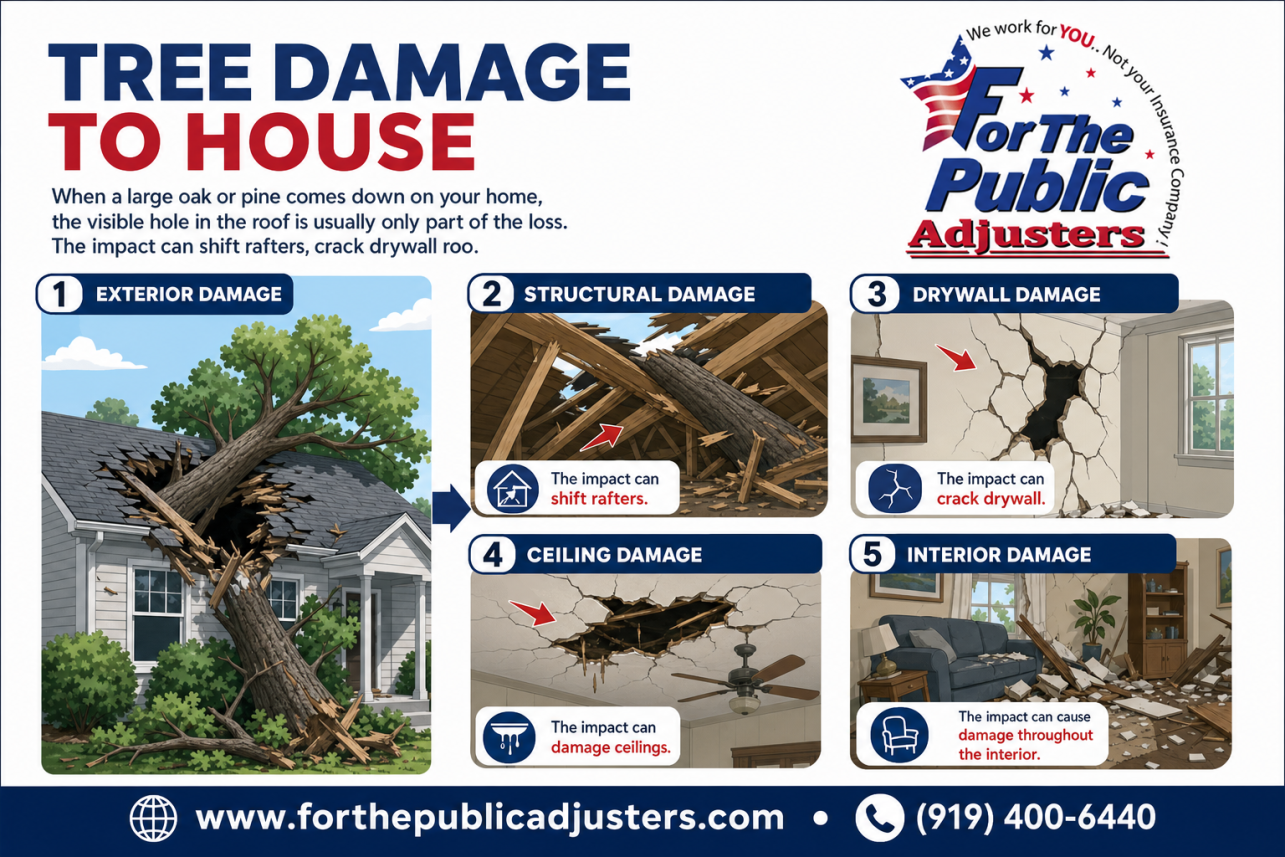
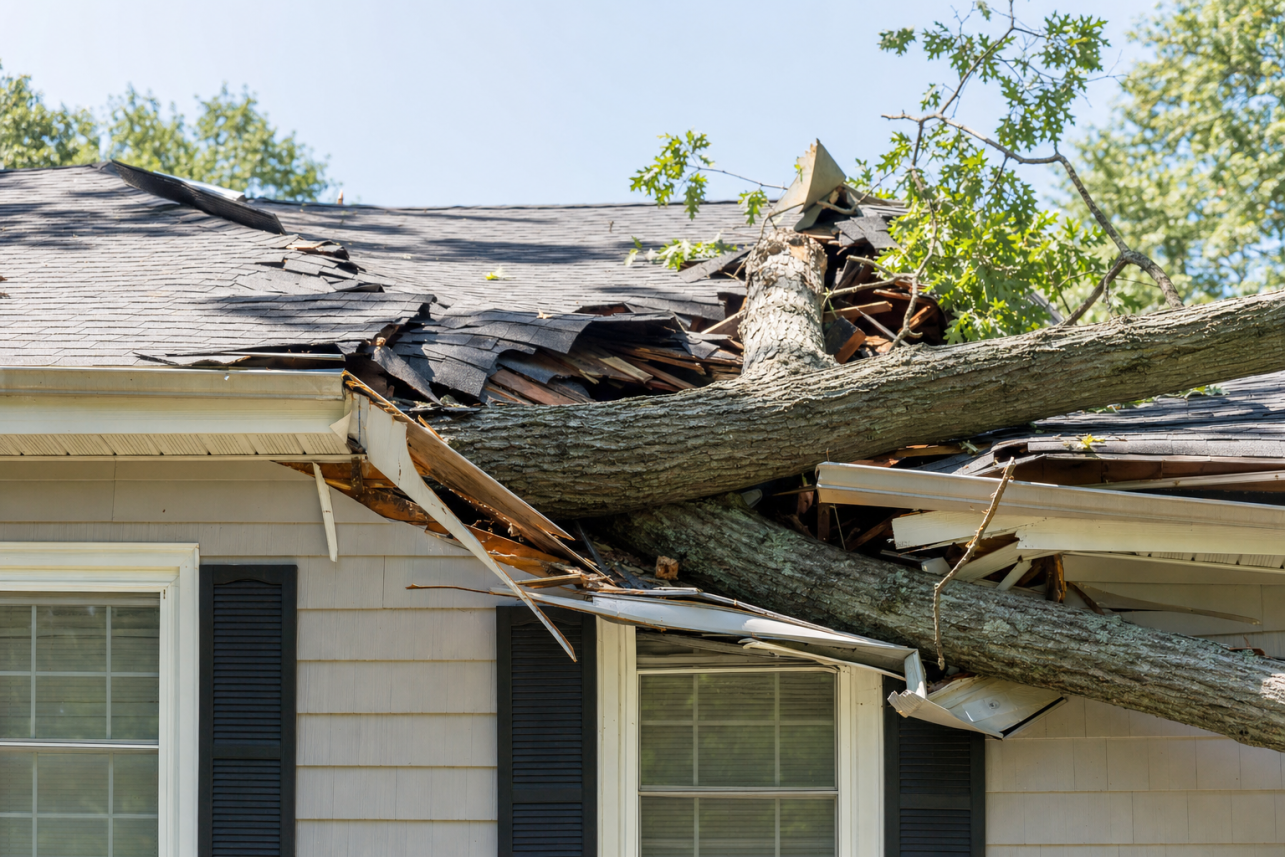
When a large oak or pine comes down on your home, the visible hole in the roof is usually only part of the loss. The impact can shift rafters, crack drywall rooms away from the strike point, and open the house to rain that soaks insulation and ceilings. A public adjuster's job is to identify all of it — not just what's easy to see from the driveway.
We review your homeowners policy, inspect the structure, document every category of damage, and prepare the detailed estimate and proof of loss your insurer requires. Then we negotiate directly with the insurance company's adjuster on your behalf. That matters because the adjuster your insurer sends is measuring the loss for the company that has to pay it.
The North Carolina Department of Insurance, in its NCDOI Public Adjusters Guide, explains that public adjusters are the only licensed professionals in the state who can represent policyholders in negotiating property claims. If your loss involves fire, water, smoke, or a vehicle striking the home, we handle those residential and commercial claims as well. We never guarantee a specific dollar outcome — no honest adjuster can — but we make sure nothing is left out of the claim.
Common Problems
Will My Insurance Actually Pay To Remove The Tree And Rebuild — Or Just Patch The Roof?
Most homeowners policies cover the structure, your damaged contents, and at least a portion of tree removal when the tree hits the house. The fights start over how much. Insurers often price a patch when the roof deck and framing need real rebuilding, or apply depreciation so you're paid actual cash value instead of what replacement will genuinely cost.
Your deductible comes off the top, but it should come off a complete estimate — not a minimized one. If the home is unlivable while repairs happen, additional living expenses coverage may pay for temporary housing, and many policyholders never claim it because no one told them it existed. If a neighbor's tree caused the damage, your own policy usually still responds first, though there are situations where their liability matters. We sort out what your specific policy owes before the insurer defines it for you.
What If My Tree Damage To House Pittsboro NC Claim Comes Back Low Or Denied?
Lowball offers and denials usually trace back to a narrow inspection — the company adjuster spends twenty minutes on site, misses the shifted framing or the saturated insulation, and writes a scope that covers half the loss. Others deny by pointing to policy exclusions, arguing the damage was pre-existing rot or wear rather than the tree strike.
You have the right to dispute the estimate, and deadlines apply, so acting quickly protects the claim. North Carolina courts have backed policyholders here: in Gray v. North Carolina Insurance Underwriting Association, the state's Supreme Court allowed homeowners to pursue claims against their insurer over the bad-faith handling of hurricane damage to their home. When an insurer delays, underpays, or refuses without a sound basis, that conduct can be challenged — and a documented, professionally prepared claim is what makes the challenge stick.
Should I Handle The Claim Myself, Or Is Hiring A Public Adjuster Worth It?
For a small loss, handling it yourself can make sense. Severe structural damage is different. You'd be responsible for reading the policy's fine print, meeting documentation deadlines, pricing structural repairs correctly, and pushing back when the insurer's numbers come in short — while also living through a construction project.
A good public adjuster shows you a North Carolina license, is bonded, works on the policyholder's side only, and explains their fee before you sign anything. Be cautious of anyone who appears at your door right after a storm promising a specific payout — no one can promise results. What we can promise is thorough documentation, a complete estimate, and experienced negotiation, which is where underpaid claims most often get corrected.
Our Process
Emergency Protection And Full Inspection
First, the house gets protected — tarping, board-up, and safe temporary repairs, which your policy typically requires and reimburses. Keep those receipts. Then we perform a room-by-room scope of damage inspection, photographing the strike point, the roof structure, interior cracking, and any water intrusion, so the loss is documented before evidence disappears under repairs.
Policy Review, Estimate, And Proof Of Loss
We read your policy for what it covers, what it excludes, and how it values the loss — replacement cost or actual cash value. From the inspection, we build a line-item repair estimate and prepare the formal proof of loss, filed within your policy's deadlines. This is the paperwork stage where do-it-yourself claims most often leave money out.
Negotiation And Settlement
We meet the insurance company's adjuster at the property, walk them through the documented damage, and negotiate the settlement item by item. If the carrier disputes the estimate, we respond with evidence — photos, measurements, and repair pricing — until the claim reflects the actual loss. You stay informed at every step, and nothing gets settled without your approval.
| What Happens | Filing on Your Own | With For The Public Adjusters |
|---|---|---|
| Damage scope | Carrier adjuster notes visible impact hole and surface damage | Structural engineer traces hidden framing, ridge, and wall damage beyond the impact point |
| Tree removal costs | Often capped at policy sub-limits without pushback | Removal negotiated as necessary access for repairs, not just debris cleanup |
| Water intrusion | Frequently missed if drywall looks dry on the surface | Moisture mapping documents saturation in insulation, cavities, and adjacent rooms |
| 'Diseased tree' disputes | Homeowner has no evidence to counter neglect arguments | Certified arborist report establishes the tree failed from storm forces |
| Settlement negotiation | First offer often accepted under time pressure | Line-item estimate, code upgrades, and matching law leveraged for full value |
| Your time investment | Dozens of hours of calls, paperwork, and inspections | We manage the entire claim while you focus on your family |
Commonly Overlooked In The Public Adjusting Industry
- Racked framing beyond the impact zone — Impact force travels down rafters and studs far from the hole, and nobody finds it unless walls and ceilings are actually opened.
- Ridge board deflection and shifted roof geometry — A roof can look repairable from the ground while the ridge has dropped or twisted, which only shows up under measurement.
- Saturated insulation two or three rooms away — Rain that entered before tarping wicks laterally through cavities, and dry-looking drywall hides it from a quick walkthrough.
- Brittle shingle test on the surrounding roof — Aging shingles that crack when lifted can't be spot-repaired, but carriers rarely test them unless someone insists.
- Chatham County code upgrade requirements — Repairs must meet current building code, not the code when the house was built, and standard estimates often price the old standard.
- Preserving the stump before cleanup crews grind it — Once the stump is gone, so is the evidence an arborist needs to defeat a 'diseased tree' denial.
- Tree removal billed under a debris sub-limit instead of repair access — Carriers apply a small removal cap when the same work often qualifies as necessary access to make covered repairs.
- Additional living expenses starting from day one — Homeowners pay for hotels and meals out of pocket for weeks before anyone tells them those costs were covered all along.
Case Studies
Case Study #1
Situation: A family on Hanks Chapel Road east of downtown Pittsboro had a mature white oak come down on their two-story home during a spring thunderstorm. The trunk crushed a corner of the roof and punched through into a second-floor bedroom.
Problem: The insurance carrier's field adjuster scoped only the visible hole in the roof and offered roughly $28,000 — enough to patch shingles and drywall, but nothing for structural framing, and the tree removal payment was capped before the tree was even fully off the house.
Investigation: Our team brought in a structural engineer within a week. We opened up ceiling cavities, measured ridge deflection, and traced the impact load path from the roof down through the wall studs to the sill plate. We also documented rain intrusion that occurred in the 36 hours before the home was tarped.
Findings: The engineer confirmed cracked rafters and a shifted ridge board well beyond the visible hole, two racked wall sections, and moisture saturation in insulation two rooms away from the point of impact. The carrier's estimate had missed roughly 60% of the actual scope.
Solution: We rebuilt the claim from the ground up with an engineer-backed structural scope, line-item pricing for framing, sheathing, full roof replacement due to widespread brittle-test failure, interior finishes, and code-required upgrades under Chatham County's current building code.
Outcome: The claim settled at a little over $147,000 — more than five times the original offer — including additional living expenses for the four months the family lived elsewhere during reconstruction.
Lesson: The hole you can see is almost never the full loss. When a tree strikes a house, the impact travels through the frame, and only a structural inspection reveals how far.
Case Study #2
Situation: A retired couple in the Fearrington Village area had a pine snap during an ice storm and land across their attached garage and kitchen roofline. The carrier initially argued the tree was 'diseased' and tried to shift blame toward maintenance neglect.
Problem: Beyond the coverage dispute, the couple's first payment didn't account for matching issues — their discontinued architectural shingles and custom cedar trim couldn't be patched to match the undamaged portions of the home.
Investigation: We hired a certified arborist who examined the stump and rings and documented that the pine was healthy and failed from ice load, not rot. We then documented every elevation of the home, pulled the shingle manufacturer's discontinuation notice, and cited North Carolina's matching considerations in our demand.
Findings: The neglect argument collapsed under the arborist's report. The matching documentation established that a spot repair would leave a visibly mismatched roof and trim, which supported replacement of full slopes and continuous trim runs rather than patches.
Solution: We negotiated a revised settlement covering full roof slope replacement, matching cedar trim on the entire affected elevation, structural repair to the garage header, and interior kitchen ceiling and cabinet damage from water intrusion.
Outcome: The final settlement came in at just under $94,000, compared to an opening offer of $31,500, and the couple owed nothing out of pocket beyond their deductible.
Lesson: Carriers sometimes challenge whether a fallen tree was a covered peril at all. An arborist's report and matching documentation can turn a disputed patch job into a full, fair rebuild.
| Your Situation | Immediate Priority | What the Outcome Usually Depends On |
|---|---|---|
| Tree still resting on the roof | Stay out of rooms below the impact; get emergency tarping and a crane-assisted removal | Whether removal is documented as required for repair access, not billed against a small debris sub-limit |
| Trunk punched through into living space | Have an engineer assess before anyone walks the roof or attic | How far the impact load traveled through rafters, ridge, and load-bearing walls |
| Rain got in before tarping | Document standing water and wet materials with photos and dates | Proving the water followed the storm opening, so it isn't recast as long-term leakage |
| Carrier says the tree was rotten or neglected | Preserve the stump and trunk sections; don't let cleanup crews haul everything away | An arborist's ring and root analysis showing the tree was viable and failed under storm load |
| Neighbor's tree fell on your house | File under your own policy first; liability against the neighbor is a separate question | Whether the neighbor had documented prior notice the tree was hazardous |
| Home unsafe to occupy | Ask about additional living expense coverage before booking lodging | Policy ALE limits and keeping every receipt from day one |
| Offer already received and it feels low | Do not cash checks marked as final settlement without review | Whether the estimate includes structural framing, code upgrades, and matching materials |
Reviews
A red oak went through our roof during the June derecho and our insurer offered $19k. For The Public Adjusters brought in an engineer who found cracked rafters we never would have known about. Final settlement was over $110k and our house was actually rebuilt right, not just patched. Worth every penny of their fee.
Marcus T., Pittsboro
When a pine landed on our den, the carrier tried to say the tree was rotten and deny most of the claim. This team got an arborist report proving otherwise and fought the 'wear and tear' argument line by line. They also caught water damage in walls the first adjuster never opened. We went from nearly denied to fully paid.
Denise W., Chatham County
Honest and thorough. Our tree claim was complicated because our shingles were discontinued and the insurer only wanted to patch one slope. They documented the matching issue and got the whole roof plus interior repairs covered. Only wish we'd called them the day the tree fell instead of three weeks in.
Jim and Carol H., Fearrington area
Frequently Asked Questions
What Should I Do First After Tree Damage To House Pittsboro NC Storms Have Caused?
The first priority is safety. If a tree has punctured the roof or an exterior wall, stay out of the affected rooms until a professional confirms the structure is stable. Trees that land on homes in Chatham County often crack rafters and trusses in ways that aren't visible from inside, and a compromised roof can shift hours after impact.
Once everyone is safe, document everything before anything is moved. Take wide photos of the tree on the home, close-ups of every point of impact, and pictures inside each affected room, including the attic if you can reach it safely. This evidence becomes critical later, because once the tree is removed, proof of how it hit and where it crushed framing is gone forever.
Next, take reasonable steps to prevent further damage. Tarping the roof opening and covering broken windows protects your claim, since insurance policies require homeowners to mitigate additional loss. Keep every receipt for tarping, tree removal from the structure, and emergency board-up.
Finally, before you accept your insurance company's first assessment, consider having your own advocate review the loss. For The Public Adjusters, Inc. represents Pittsboro homeowners, not the insurance carrier, and we routinely find structural, roofing, and interior damage that initial carrier inspections miss. Calling us early means the claim is documented correctly from day one, which is far easier than reopening an underpaid claim months later.
Will My Homeowners Insurance Cover Severe Structural Damage When A Tree Falls On My Pittsboro Home?
In most cases, yes. Standard homeowners policies cover damage caused by falling trees when the cause is wind, ice, or a storm, which covers the majority of losses we see around Pittsboro and the rest of Chatham County. That includes the roof, framing, siding, gutters, interior ceilings and walls, and personal property crushed or soaked as a result.
Coverage also typically extends to detached structures like garages, carports, and sheds, though often at a lower limit. Debris removal is usually covered too, but only for the portion of the tree that actually struck a covered structure, and often with a cap per tree or per occurrence.
Where homeowners run into trouble is with how the carrier values the loss, not whether it's covered. Insurers frequently pay to patch a section of roof rather than replace it, overlook cracked trusses hidden under insulation, or ignore matching issues with siding and shingles that North Carolina claim practices should address.
There are exceptions worth knowing. If the tree was visibly dead or diseased and the insurer can prove neglect, they may deny the claim. If your neighbor's tree fell on your house, your own policy typically pays first, though subrogation against the neighbor is sometimes possible.
If the carrier's offer seems low or the inspection felt rushed, a licensed public adjuster can reassess the damage and negotiate on your behalf before you sign anything.
The Insurance Company's Estimate Seems Too Low. Can A Public Adjuster In Pittsboro Really Increase My Settlement?
Very often, yes, and tree losses are one of the claim types where the gap between the first offer and the true cost of repairs tends to be largest. When a large oak or pine comes through a roof, the visible hole is only part of the story. The impact travels through the structure, cracking rafters, shifting load-bearing walls, breaking drywall seams in adjacent rooms, and opening the home to water intrusion.
Carrier adjusters handle high volumes of claims and frequently scope only what's obvious from a quick walkthrough. We've reviewed estimates for Pittsboro homeowners that paid for a roof patch and one bedroom ceiling when the actual loss involved truss replacement, full roof replacement due to matching requirements, insulation removal, and mold remediation from rain that entered before tarping.
As your public adjuster, For The Public Adjusters, Inc. performs an independent, detailed inspection, documents hidden structural and moisture damage, prepares a line-item estimate using the same software carriers use, and negotiates directly with the insurance company. You deal with us instead of chasing the adjuster for callbacks.
Our fee is a percentage of the recovery, so we only get paid when you do, and there's no cost to have us review your estimate. Even on claims that have already been paid, North Carolina generally allows supplemental claims within the policy's time limits, so a low settlement isn't necessarily final.
How Long Does A Tree Damage Claim Take In Chatham County, And Can I Start Repairs Before It Settles?
Timelines vary with the severity of the loss. A straightforward claim with clear roof and interior damage may resolve in four to eight weeks. Severe damage involving structural engineering reports, disputes over roof replacement versus repair, or additional living expenses because the home is unlivable can take several months, especially after a major storm when carriers are flooded with claims across central North Carolina.
You don't have to wait to make the home safe. Emergency mitigation, including tarping, board-up, water extraction, and removing the tree from the structure, should happen immediately, and your policy expects it. Keep detailed receipts and photograph conditions before and after each step so nothing is lost from the record.
Permanent repairs are different. We strongly advise Pittsboro homeowners not to begin full reconstruction until the scope and settlement are agreed, because once damage is repaired, it can no longer be inspected or disputed. Contractors also can't be expected to work from an underpaid estimate, and starting early often locks you into the carrier's low numbers.
When For The Public Adjusters, Inc. handles a claim involving tree damage to house Pittsboro NC homeowners have suffered, we manage the timeline for you: meeting the carrier's adjuster on site, submitting documentation promptly, and pushing back on delays. North Carolina regulations require insurers to acknowledge and respond to claims within set timeframes, and we hold them to it so your family can get back into a fully repaired home sooner.
Who Pays For Tree Removal And Debris Cleanup After Tree Damage To House Pittsboro NC Homeowners Experience?
When a tree strikes your home, most homeowners policies cover removal of the portion of the tree that is actually on or against the structure, because it must come off before repairs can begin. That removal cost is typically part of the dwelling claim, not a separate expense you should be absorbing yourself.
Where Pittsboro homeowners get shortchanged is with the rest of the tree and the surrounding debris. Insurers often apply a small debris-removal cap, sometimes as little as $500 to $1,000 per tree, even when a mature oak or pine has scattered limbs across the roof, yard, and driveway. Around Chatham County, where large hardwoods are common on older lots, actual removal quotes frequently run several times that figure.
We review your policy's debris-removal provisions carefully, including the additional coverage percentage many policies add on top of your dwelling limit. That extra allowance is easy for a carrier to overlook and easy for a homeowner to never hear about.
We also make sure crane fees, specialized rigging, and stump-related structural concerns are documented and claimed where the policy allows. If a tree punched through the roof deck, the removal method matters, and cutting corners can worsen the structural damage underneath.
Keep every invoice and take photos before any cleanup begins. If a removal company has already hauled the tree away, we can still often reconstruct the scope from photos, neighbor statements, and the contractor's records to support full reimbursement.
My Neighbor's Tree Fell On My House In Pittsboro. Whose Insurance Handles The Claim?
In North Carolina, the general rule surprises most people: your own homeowners policy handles the claim, even though the tree belonged to your neighbor. Insurance follows the damaged property, not the tree's owner, so your carrier pays for repairs to your roof, framing, and interior.
The exception is negligence. If your neighbor knew the tree was dead, diseased, or visibly leaning and did nothing about it, their liability coverage may come into play. Proving that requires evidence — prior complaints, arborist reports, photos showing obvious decay, or even a record that you notified them in writing before the storm.
We see this situation regularly on the wooded lots around Pittsboro and throughout Chatham County, where property lines run through stands of mature pines and oaks. Our team investigates the tree's condition, documents rot or root failure at the break point, and determines whether a liability claim against the neighbor's carrier is realistic alongside your own claim.
There is a practical benefit to pursuing the negligence angle when the facts support it: recovering from the neighbor's insurer can protect you from paying your own deductible and may keep the loss off your claims history.
Either way, do not let the two insurance companies point fingers at each other while your home sits exposed. We coordinate the documentation, present the claim to the correct carrier or carriers, and keep the repair timeline moving so a coverage dispute between insurers never becomes your problem.
How Do You Prove Hidden Structural Damage That The Insurance Adjuster's Quick Inspection Missed?
A tree impact transfers enormous force through a house, and the visible hole in the roof is often the smallest part of the loss. Staff adjusters frequently spend under an hour on site and scope only what they can see from a ladder. That is how cracked rafters, shifted load-bearing walls, and separated trusses get left out of settlements.
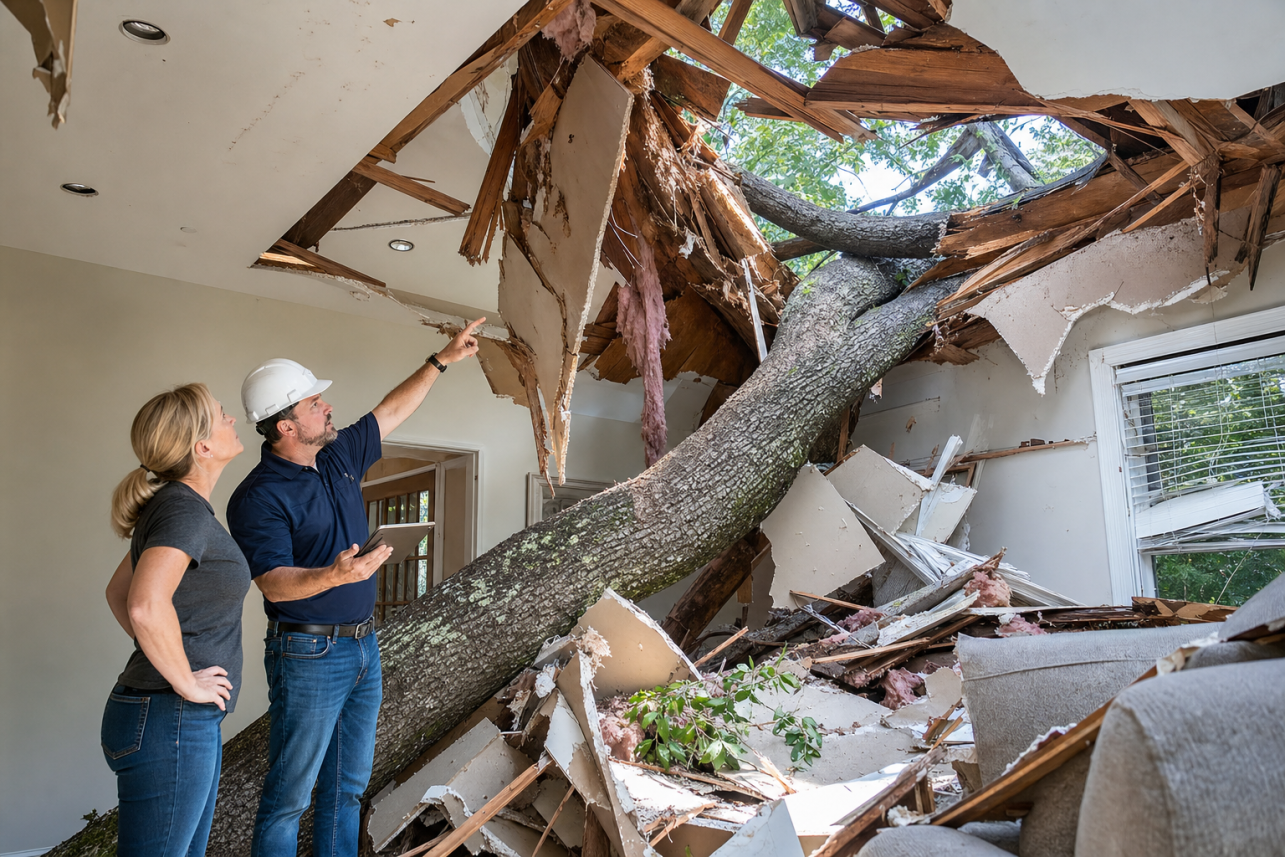
Our approach is different. We open up the attic and inspect the framing at every point of impact, checking for fractured ridge boards, split rafters, and sheathing that has pulled away from its fasteners. We look for drywall cracks radiating from corners, doors that suddenly stick, and gaps at crown molding — all signs the structure moved when the tree hit.
When the evidence warrants it, we bring in a structural engineer to document the damage in a formal report. Carriers can dismiss a homeowner's opinion, but a stamped engineering report addressing tree damage to house Pittsboro NC properties have sustained is very difficult to argue with.
We also document moisture intrusion. Even a brief gap between impact and tarping lets rain into insulation, wall cavities, and flooring, and that hidden water becomes mold and rot months later if it is not claimed and remediated now.
Everything goes into a detailed, line-item estimate using the same pricing software carriers use, so there is no vague back-and-forth. The insurer sees exactly what was damaged, exactly what repair is required, and exactly what it costs in the Chatham County market.
What Does It Cost To Hire For The Public Adjusters, Inc. For A Severe Tree Damage Claim, And Is It Worth It?
We work on a contingency fee, meaning we are paid a percentage of the settlement we recover for you. There are no upfront costs, no hourly billing, and no fee if we do not recover anything. Our interests are aligned with yours from the first phone call: the better your outcome, the better ours.
For severe losses — a tree through the roof into living space, compromised framing, water intrusion, a family displaced during repairs — the gap between a carrier's first offer and the true cost of restoration is often substantial. Insurance company adjusters handle high volumes of claims and work from estimates that routinely miss code-upgrade requirements, engineering costs, matching issues with roofing and siding, and additional living expenses while your Pittsboro home is uninhabitable.
A licensed North Carolina public adjuster works only for you, never the insurance company. We read the full policy, including endorsements most homeowners never review, and we claim every coverage that applies — dwelling, other structures, contents, debris removal, loss of use, and ordinance or law coverage for bringing older Chatham County homes up to current code during repairs.
In practice, the increase we secure on a serious structural claim typically exceeds our fee many times over, and you get your time and peace of mind back. Instead of trading calls with a claims department while tarps flap on your roof, you have a professional managing the entire process. We offer a free claim review, so you can see what your claim is actually worth before deciding anything.
Will Insurance Pay For A Hotel Or Rental If Tree Damage To House Pittsboro NC Storms Caused Makes My Home Unlivable?
In most cases, yes. Nearly every standard homeowners policy includes Additional Living Expenses (ALE) coverage, sometimes called Loss of Use. If a fallen tree has crushed your roof, opened your home to the elements, or knocked out structural supports, and the home is not safely habitable, ALE pays the reasonable extra costs of living elsewhere while repairs are completed.
That can include a hotel or short-term rental, restaurant meals above your normal grocery spending, pet boarding, extra mileage if you're commuting from Siler City or Sanford, and even storage fees for your furniture. The key word is 'extra' — the coverage pays the difference between your normal living costs and what you're spending now.
Where Pittsboro homeowners get shortchanged is documentation and duration. Insurers often approve only a few weeks of ALE, even when severe structural repairs realistically take four to eight months, especially with the contractor demand we see in Chatham County after major storms. Keep every receipt from day one, and don't let the carrier declare the home 'habitable' just because part of it is dry.
We fight to extend ALE for the full, realistic repair timeline and to recover every legitimate expense. Families who track nothing routinely leave thousands of dollars of this coverage on the table. If you've already been displaced, call us before you accept the insurer's ALE cutoff date.
I Already Settled My Tree Claim But Found More Damage During Repairs. Can The Claim Be Reopened?
Usually, yes — and it happens more often than you'd think with severe tree strikes. When a mature oak or pine comes through a roof, the visible hole is rarely the whole story. Contractors in Pittsboro regularly open up walls and find cracked rafters, shifted load-bearing framing, sheared truss connections, or water intrusion that the original inspection never caught.
Accepting a settlement check does not automatically close the door. In North Carolina, most policies allow supplemental claims for newly discovered damage related to the same loss, as long as you're within the policy's suit limitation period and any contractual deadlines. What matters is proving the newly found damage was caused by the tree event, not by wear, age, or a later storm.
That's where we come in. Our team documents the additional damage with photos, contractor findings, and when needed, structural engineering reports that tie the hidden damage directly back to the original impact. We then prepare and negotiate the supplemental claim so you aren't stuck paying out of pocket for repairs the policy should cover.
One important caution: stop demolition and photograph everything the moment your contractor uncovers something new. Ripping it all out before it's documented makes the insurer's job of denying the supplement much easier. If you're mid-repair on a Chatham County home and the numbers stopped adding up, reach out before the walls close back up.
My Roof Was Only Partially Crushed. Can I Get Full Roof Replacement Instead Of A Patch Job?
Often you can, and this is one of the most contested issues in tree damage to house Pittsboro NC claims. Insurers frequently want to pay for repairing only the damaged slope — replacing a section of decking and shingles where the tree hit. The problem is that shingles fade and weather, and discontinued products often can't be matched at all, leaving you with a visibly mismatched roof.
North Carolina recognizes matching arguments in property claims, and many policies must restore your home to its pre-loss condition, which includes a reasonably uniform appearance. If the existing shingle line is discontinued, or the repaired slope would clash noticeably with the rest of the roof, there's a strong case for full replacement of the roof or at minimum entire slopes.
There's also a structural angle. A heavy tree impact can flex trusses and decking well beyond the point of contact. We've handled homes off Hanks Chapel Road and in neighborhoods around Chatham Park where the 'undamaged' side of the roof had cracked decking and popped fasteners that a fast inspection missed.
Our job is to document all of it — shingle discontinuation letters from suppliers, deflection measurements, decking damage, and manufacturer repair limitations — and present the carrier with evidence they can't reasonably dismiss. Homeowners who accept the first 'repair the hole' estimate usually end up with a patched roof worth less at resale. Push back before you sign anything.
Are There Deadlines For Filing A Tree Damage Claim In Pittsboro, And What Happens If I Waited?
Yes, and waiting can genuinely cost you, though the situation is rarely as hopeless as insurers make it sound. Most policies require 'prompt' notice of loss, and North Carolina generally gives you three years to bring a legal action on a property claim, though some policies attempt to shorten that window contractually. The exact language in your policy controls, so it's worth having it reviewed.
The bigger practical problem with delay is causation. If a tree damaged your Pittsboro house months ago and rain has been seeping in since, the carrier will try to split the damage — covering the impact but denying the water intrusion as 'neglect' for failing to mitigate. That's why tarping and documenting quickly matters so much.
That said, a late claim is not a dead claim. We regularly help Chatham County homeowners who waited because they feared premium increases, assumed the damage was minor, or got quoted repair costs that turned out to be far below reality. We reconstruct the timeline with dated photos, weather records from the storm event, and contractor statements to establish when and how the damage occurred.
If the insurer has already denied you for late notice, don't take that as final. Denials get overturned when the evidence is rebuilt properly. Bring us your denial letter and policy, and we'll give you an honest assessment of whether the claim can be revived — at no cost for the initial review.
Can My Insurer Deny A Tree Damage To House Pittsboro NC Claim By Saying The Tree Was Dead Or Rotten?
They can try, and in Chatham County we see this argument regularly. Insurers sometimes assert that a fallen tree was diseased, dead, or visibly decayed before the storm, then deny the claim on the grounds that the loss was preventable neglect rather than a sudden accident.
Here is the problem with that tactic: the burden is largely on them, and most tree failures around Pittsboro are caused by saturated clay soil, wind shear, or internal decay that no reasonable homeowner could have spotted. A pine that looked healthy from the ground can be hollow at the core. That does not make you negligent.
When For The Public Adjusters, Inc. handles a denial like this, we document the tree itself before it is hauled away, photograph the root ball and trunk cross-section, and, when needed, bring in an arborist to establish that the failure was storm-driven. We also pull weather data showing wind speeds and rainfall for your specific address on the date of loss.
In most cases of tree damage to house Pittsboro NC insurers push back on, the policy language covers sudden and accidental falling objects regardless of the tree's condition, because the covered peril is the falling object striking your home, not the health of the tree. If you have received a denial letter citing rot or neglect, do not accept it as final. Get the denial in writing, preserve the tree debris if you still can, and have the policy language reviewed before you walk away from a legitimate claim.
Does Insurance Cover My Detached Garage, Shed, Or Fence If The Tree Hit Those Instead Of The House?
Yes, in most cases. Standard homeowners policies in North Carolina include what is called Coverage B, or other structures coverage, which typically equals 10 percent of your dwelling limit. That applies to detached garages, workshops, sheds, well houses, fences, and even the carports and pole barns common on larger Chatham County properties.
There are a few wrinkles worth knowing. If the tree fell on a fence or shed without hitting anything, some policies only pay for the structure's damage and cap or exclude tree removal itself. If the structure was used for business, like a home workshop generating income, coverage can be limited or excluded entirely, so read the fine print before assuming you are covered.
Depreciation is the other trap. Insurers frequently pay actual cash value on outbuildings, deducting heavily for age even when your policy allows replacement cost recovery once repairs are complete. We routinely see Pittsboro homeowners accept a depreciated check for a crushed shed without realizing they were entitled to recover that holdback.
Our team inventories every affected structure on the property, not just the obvious one. A large oak coming down often damages the fence it fell across, the shed it clipped, and the driveway it cratered, and each item belongs in the claim. Before you accept a settlement for a fallen tree, walk your whole property and photograph everything the tree or its limbs touched. Small items add up quickly, and once you sign off, adding them later becomes an uphill fight.
What Is Recoverable Depreciation, And Why Was My First Tree Damage Check So Much Smaller Than The Estimate?
This catches almost every Pittsboro homeowner off guard. If your policy pays replacement cost, the insurer still issues the first check at actual cash value, meaning the replacement cost minus depreciation for the age and condition of your roof, siding, and other materials. That withheld amount is called recoverable depreciation.
Here is a real-world example. Say the estimate to repair severe damage where a tree crushed your roof and gable is 60,000 dollars, and your roof was 15 years old. The insurer might depreciate 18,000 dollars and cut a first check for 42,000 minus your deductible. The 18,000 is not gone. You recover it after completing repairs and submitting proof, usually a contractor invoice and photos.
Problems arise in two places. First, some insurers depreciate items that should not be depreciated at all, like labor, which North Carolina case law treats differently than materials in many situations. Second, homeowners who do the work themselves or negotiate a lower contractor price sometimes get shorted on the holdback release.
When we manage a claim for tree damage to house Pittsboro NC insurers have underpaid, we audit the depreciation line by line, challenge excessive age deductions, and track deadlines, because most policies give you only 180 days to two years to complete repairs and claim the recoverable amount. If your first check seemed shockingly small, do not panic and do not settle for it. Read the estimate's depreciation column carefully, or have someone who reads these documents daily do it for you.
Should I Use The Insurance Company's Preferred Contractor To Repair Severe Tree Damage On My Pittsboro Home?
You are never required to, and we generally advise caution. In North Carolina, you have the legal right to choose your own contractor. The insurer's preferred vendor program exists primarily to control claim costs, and the contractor's ongoing relationship is with the insurance company, not with you.
That creates a quiet conflict of interest. A program contractor who wants to keep receiving referrals has an incentive to work within the insurer's estimate, even when that estimate misses cracked rafters, shifted load-bearing walls, or moisture intrusion behind the visible damage. With a tree strike severe enough to breach the roof structure, those hidden items are often where the real money and the real safety concerns live.
A better approach for Chatham County homeowners: get your own independent estimates from established local contractors who work on the older farmhouses, log homes, and newer builds common around Pittsboro, and who understand current Chatham County permitting and building code requirements. Code upgrades alone, like bringing 1990s framing or electrical up to current standards during reconstruction, can add thousands to a legitimate claim if your policy includes ordinance or law coverage.
Our adjusters at For The Public Adjusters, Inc. write our own detailed scope of repairs independent of both the insurer and any contractor, then negotiate the settlement based on what it actually costs to restore your home properly. Once the claim is settled correctly, you hire whichever qualified contractor you trust. That order of operations, settlement first with an accurate scope, keeps you in control instead of leaving the insurer's vendor to define what your home gets back.
Local Relevance
Pittsboro sits under a canopy of mature hardwoods and tall loblolly pines, and that's exactly what makes tree strikes here so destructive. Summer thunderstorms, the remnants of tropical systems moving inland, and the occasional winter ice storm all bring down trees across Chatham County — and a sixty-foot pine doesn't dent a roof, it goes through it.
The housing mix here adds another layer. Older homes in and around downtown Pittsboro often have original framing and plaster that cost more to repair properly than a standard insurance estimate assumes, while newer construction on the town's growing edges comes with its own material and pricing questions. Either way, the Insurance Information Institute notes that homeowners policies generally do cover a tree falling on the house — the real question is whether the settlement covers the full repair.
We work these claims locally, which means we know how area storms damage area homes, and we build estimates around what repairs actually cost in this market — not a national software average.
Around Pittsboro, the most underpaid tree claims tend to be pine strikes during saturated-ground conditions after tropical remnants pass through — the tree often falls whole, root ball and all, driving impact deep into the framing, so damage frequently extends well beyond the visible roof hole and initial insurer estimates often stop at the shingles.
A Tree Went Through Your Roof. Don't Face The Insurance Company Alone.
For The Public Adjusters, Inc. represents Pittsboro and Chatham County homeowners with severe structural damage — licensed, bonded, and working only for you. The sooner we document the loss, the stronger your claim. Call before you accept the insurer's first number.
Call us: (919) 400-6440
Helpful Resources
- NCDOI Public Adjusters Guide
- Insurance Information Institute (III)
- North Carolina Department of Insurance consumer resources — State agency guidance for policyholders
- Ready.gov severe weather preparedness — Federal storm safety and preparedness information
Last updated: August 15, 2026