
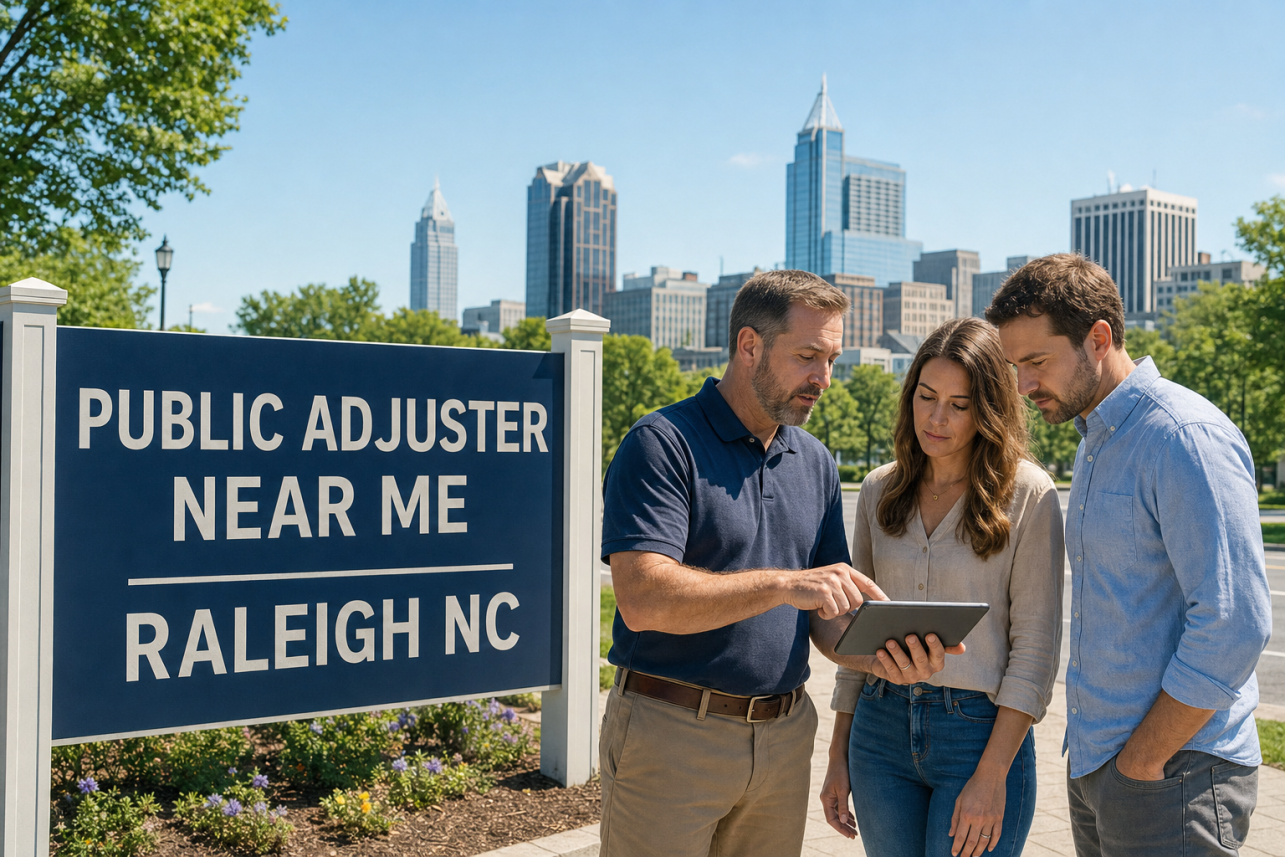
If you typed Public Adjuster Near Me Raleigh NC after a fire, burst pipe, or fallen tree, the direct answer is this: a licensed public adjuster works for you, not the insurance company, and For The Public Adjusters, Inc. serves homeowners and business owners throughout Raleigh and Wake County. We document your loss, prepare the estimate, and negotiate with the carrier on your behalf. We are licensed and bonded in North Carolina, and we only get paid when your claim gets paid.
What This Service Is
A public adjuster is the only type of insurance adjuster licensed to represent the policyholder. The adjuster your insurance company sends works for the carrier. An independent adjuster also works for the carrier, just on contract. When Raleigh homeowners search for a public insurance adjuster near me, what they are really looking for is someone on their side of the table.
The North Carolina Department of Insurance licenses and regulates public adjusters, and the NCDOI Public Adjusters Guide spells out what we can and cannot do, including caps on fees and required written contracts. That regulation matters: it means a legitimate Raleigh public adjuster puts everything in writing before any work begins.
Our work covers residential homeowners claims and commercial business claims alike: fire and smoke damage, water damage from plumbing failures and roof leaks, tree strikes, vandalism, arson losses where you are the innocent victim, and flood claims under separate flood policies. We read the policy, scope the full damage including what is hidden behind walls and under floors, build a line-item estimate, and handle the back-and-forth so you are not negotiating against a professional alone. We do not handle claims involving vehicles, cell phones, health, or life insurance.
Common Problems
What Does A Raleigh Public Adjuster Cost, And Is It Worth It On My Claim?
Public adjusters in North Carolina work on contingency, meaning a percentage of what the claim actually pays. There is no hourly bill and no upfront retainer with our firm. If the claim pays nothing, you owe nothing.
The honest answer on whether it is worth it depends on the loss. A small claim near your deductible rarely justifies hiring anyone. A kitchen fire, a slab leak that ran for weeks, or a pine through the roof is a different story, because those claims involve hidden damage, code upgrades, contents inventories, and loss-of-use coverage that first offers routinely miss.
We cannot and will not guarantee a specific result — no ethical adjuster can. What we can do is show you, line by line, what the carrier's estimate left out before you decide anything.
The Carrier Is Delaying, Lowballing, Or Blaming "Wear And Tear" — Now What?
This is the most common call we get in Raleigh. Whole subdivisions here went up in the late 1990s and 2000s with builder-grade roofing and flashing, and carriers now lean on "wear and tear" or "maintenance" language to shrink or deny storm and leak claims on those homes.
The counter is documentation: storm dates, moisture readings, photographs of the failure point, and a policy-based argument for why the loss is covered. Courts have backed policyholders who push back — in Gaston County Dyeing Machine Co. v. Northfield Insurance Co., the North Carolina Supreme Court sided with the insured in a property damage coverage dispute the carrier had tried to escape, a reminder that the policy language, not the adjuster's opinion, controls.
If a claim has already been denied or underpaid, it can often be reopened or supplemented. We handle that regularly, the same way our Fire Damage Adjuster in Morrisville team does when a fire payout misses smoke and odor damage in rooms the carrier never scoped. When a dispute truly cannot be settled, we can also point you toward insurance dispute lawyers.
How Do I Choose A Public Adjuster Near Me Raleigh NC Homeowners Actually Trust?
Start with the license. Every public adjuster in North Carolina must be licensed through the Department of Insurance, and you can verify a license yourself before signing anything. Walk away from anyone who shows up uninvited after a storm pushing a contract on the spot.
Then ask about claim types. An adjuster who mostly handles coastal hurricane work may not know how Triangle carriers argue tree claims, ice-dam leaks, or slow plumbing losses. Ask for local references and examples of claims like yours.
Finally, ask who does the work. At For The Public Adjusters, Inc., the person who inspects your Raleigh home is the person who writes the estimate and negotiates it. We handle claims across Wake County — a Public Adjuster in Garner request gets the same hands-on treatment as one inside the Beltline.

Our Process
Free Inspection And Policy Review
We walk the property, photograph and measure the damage, and read your actual policy — endorsements, exclusions, and all. Many Raleigh homeowners have never seen their full policy, only the declarations page. This visit costs nothing and obligates you to nothing.
Full Documentation And Estimate
We scope everything, including what the carrier's adjuster skipped: smoke residue in adjacent rooms, moisture migration under flooring, structural impact from a tree strike, contents, and additional living expenses. Then we build a detailed line-item estimate using the same software carriers use, so the negotiation happens on equal footing.
Negotiation And Settlement
We present the claim, meet the carrier's adjuster on site when needed, and push each disputed line item with evidence. You approve every decision. The work the same way whether it is a Raleigh commercial loss or a Fire Damage Insurance Claim Adjuster in Rolesville assignment — thorough documentation first, settlement second.
| Factor | Public Adjuster (Works for You) | Insurance Company Adjuster | Handling It Yourself |
|---|---|---|---|
| Who they represent | The policyholder only — licensed and bonded in NC | The insurance company that pays their salary | You, but without training in policy language or estimating |
| Damage documentation | Moisture mapping, engineering reports, full contents inventories | Often a single brief inspection | Phone photos and guesswork |
| Estimate detail | Line-item scope using local Wake County pricing | Carrier software defaults that frequently miss items | Contractor bids the carrier may dispute |
| Knowledge of NC case law | Understands rulings like Gaston County Dyeing Machine Co. v. Northfield Ins. Co., where the insured prevailed | Applies the carrier's reading of the policy | Usually none |
| Cost | Contingency fee — paid only from the claim recovery | No cost, but incentives favor the carrier | Free, but underpaid claims can cost far more |
| Time demand on you | Minimal — we manage inspections, calls, and paperwork | You still do most of the legwork | Dozens of hours during an already stressful time |
Commonly Overlooked In The Public Adjusting Industry
- Recoverable depreciation left unclaimed — Many Raleigh homeowners never realize the carrier is holding back depreciation they can collect after repairs are completed, so thousands of dollars simply expire.
- Matching requirements for flooring, siding, and shingles — Carriers often pay to patch one area, but when materials can't reasonably match, broader replacement may be owed — a detail first offers almost never include.
- Ordinance and law (code upgrade) coverage — Raleigh and Wake County building codes have changed over the decades, and older homes frequently need code-required work the carrier's base estimate silently excludes.
- Hidden moisture inside wall cavities and under flooring — Surface readings look dry while insulation and framing stay saturated, leading to mold and rot that surface-level inspections miss entirely.
- Smoke and soot migration through HVAC systems — Smoke travels through ductwork into rooms far from the fire, and estimates that stop at the visibly burned area leave contamination behind.
- Flood versus homeowners coverage confusion — Rising water is handled under a separate NFIP flood policy, not homeowners insurance, and filing under the wrong policy — or missing an NFIP proof-of-loss deadline explained at FEMA.gov — can sink an otherwise valid claim.
- The appraisal clause as a dispute tool — Most policyholders don't know their policy contains an appraisal provision for valuation disputes — North Carolina's Supreme Court enforced that process in the insured's favor in Register v. White, 358 N.C. 691 (2004).
- Additional living expenses and loss of use — Families displaced by fire or water damage often pay for hotels and meals out of pocket, never realizing the policy typically reimburses those costs when documented.
Case Studies
Case Study #1
Situation: A family in Raleigh's Five Points neighborhood came home from a weekend trip to find a second-floor supply line had burst, sending water through the ceiling, hardwood floors, and finished basement of their 1940s home.
Problem: Their carrier's adjuster spent twenty minutes on site and issued an estimate of roughly $18,400 that covered drying and surface repairs only. It ignored the plaster walls, the site-finished oak flooring that could not be patch-matched, and the family's damaged contents.
Investigation: Our Raleigh public adjuster team performed moisture mapping with thermal imaging, opened inspection points behind baseboards, and documented saturation inside wall cavities the carrier never checked. We also built a room-by-room contents inventory with replacement pricing.
Findings: Moisture readings showed wet insulation and framing in three rooms the carrier marked as unaffected. The original estimate also omitted plaster repair, continuous flooring replacement required for a uniform match, and code-required electrical work in the basement.
Solution: We prepared a detailed line-item estimate, submitted a supplemental claim with photos, moisture logs, and contractor pricing specific to Wake County, and negotiated directly with the carrier's adjuster through two revised scopes.
Outcome: The claim settled at more than three times the original offer, enough to restore the plaster, replace the flooring throughout the connected areas, and reimburse the family's contents. Every claim is different and results vary, but thorough documentation changed this one.
Lesson: Carriers often pay for what is visible, not what is wet. North Carolina courts have long held that ambiguous policy language must be read in favor of the insured — the N.C. Supreme Court said exactly that in Gaston County Dyeing Machine Co. v. Northfield Insurance Co., 351 N.C. 293 (2000), a property damage coverage dispute the policyholder won. Knowing that principle matters when a carrier reads its own policy narrowly.
Case Study #2
Situation: A small commercial property owner near southeast Raleigh had a tornado tear across his strip building — the same kind of fast-moving storm Wake County saw in April 2011. The roof membrane peeled back, the parapet cracked, and rain poured into two tenant spaces overnight.
Problem: The insurance company's adjuster attributed much of the interior damage to 'long-term wear' and offered a settlement that covered a roof patch and some ceiling tiles. It excluded the structural parapet damage, tenant improvement losses, and the owner's lost rental income.
Investigation: We brought in a structural engineer to evaluate the parapet and roof deck, pulled historical inspection records showing the roof's pre-storm condition, and documented the interior water path from the tornado breach to each damaged tenant space.
Findings: The engineer's report tied the parapet cracking and deck displacement directly to tornado wind uplift, not age. We also identified ordinance-and-law exposure, since Raleigh's current commercial code required upgrades the old patch estimate never contemplated.
Solution: We filed a comprehensive supplement with the engineering report, code citations, and a business-income worksheet for the vacancy period, then sat through every reinspection alongside the carrier's adjuster so nothing was glossed over.
Outcome: The carrier revised its position and funded a full roof replacement, structural repairs, code-required upgrades, and a meaningful business-income payment. No two claims resolve the same way, but the engineering evidence left little room for the wear-and-tear argument.
Lesson: When a storm claim gets blamed on age, independent expert documentation is the counterweight. Policyholders who push back with evidence have prevailed in court too — in C.D. Spangler Construction Co. v. Industrial Crankshaft & Engineering Co., 326 N.C. 133 (1990), the North Carolina Supreme Court sided with the insured on property damage coverage the carrier tried to deny.
| Your Situation | Recommended Move | What It Depends On |
|---|---|---|
| Fresh fire or smoke damage, claim not yet filed | Bring in a public adjuster before the carrier's first inspection | Severity of smoke spread into HVAC, attic, and contents — early documentation sets the whole claim's scope |
| Carrier offer feels low after water or pipe damage | Request the full estimate and get an independent review | Whether hidden moisture, matching flooring, or code upgrades were left out of the carrier's scope |
| Hurricane or tornado damage to roof and structure | Independent inspection plus engineering support if structure is involved | Whether the carrier is attributing storm damage to age or wear instead of the event |
| Claim denied outright | Have the denial letter and policy reviewed line by line | Policy language — NC courts construe ambiguity in the insured's favor, as in Gaston County Dyeing v. Northfield Ins. Co. |
| Flood water entered from outside (rising water) | Check whether you hold an NFIP flood policy; see FEMA.gov and FloodSmart.gov | Homeowners policies typically exclude rising water — flood claims run through the National Flood Insurance Program |
| Large contents loss after any covered event | Build a professional room-by-room inventory before accepting payment | Whether you can document brand, age, and replacement cost — undocumented items usually go unpaid |
| Claim open for months with no movement | Formal written demand with a documented supplemental estimate | How complete the carrier's file is and whether deadlines like proof of loss are approaching |
| Small, simple claim under your deductible range | Likely handle it yourself | If the honest repair cost barely exceeds the deductible, professional fees may not make sense |
Reviews
After Hurricane-remnant rain and that storm damage hit our roof, our carrier offered about half of what two contractors said repairs would cost. For The Public Adjusters re-measured everything, found hidden decking damage the first adjuster never climbed up to see, and handled every call so I didn't have to. The final settlement actually covered the work. I'd never negotiate a property claim alone again.
Marcus T., North Raleigh
We had a kitchen fire and the smoke went everywhere — closets, attic, HVAC ducts. The insurance estimate barely addressed cleaning. This team documented smoke residue room by room, inventoried our contents piece by piece, and got the scope rewritten. They were honest from day one that nothing is guaranteed, which I respected, and the outcome was far better than what we started with.
Deena W., near Lake Johnson
I honestly just typed public adjuster near me into my phone after my claim for a burst pipe stalled for two months. Glad I found these folks. They knew the Raleigh market pricing cold, pushed back on the carrier's depreciation numbers, and explained the recoverable depreciation process so I actually collected it. Took weeks of back and forth but they never dropped the ball.
Robert H., Garner / Wake County
Frequently Asked Questions
When I Search For A Public Adjuster Near Me Raleigh NC, What Exactly Will For The Public Adjusters, Inc. Do For My Claim?
When you look up a Public Adjuster Near Me Raleigh NC, you're searching for a licensed professional who works for you — not the insurance company. The adjuster your insurer sends is paid by the insurer. We are retained by the policyholder, and our job is to document, value, and negotiate your property damage claim on your behalf.
For a Raleigh home or commercial building, that starts with a full review of your policy so you understand what coverages, limits, and deadlines apply. We then perform our own detailed inspection, photograph and inventory the damage, and prepare an independent estimate of repair and replacement costs, including damaged contents.
From there, we handle the back-and-forth with the insurance carrier: meeting their adjuster at the property, responding to requests for documentation, challenging low estimates, and pushing the claim toward a fair resolution under the terms of your policy. We are licensed and bonded in North Carolina, and we know how Wake County construction costs, local building codes, and permit requirements affect what a proper repair actually costs.
Many Raleigh policyholders accept the first figure the carrier offers simply because they don't know the claim can be documented more thoroughly and negotiated. We can't promise a specific outcome — no honest adjuster can — but we can make sure your loss is fully measured and professionally presented, so the settlement reflects the real scope of your damage rather than a quick desk estimate.
What Types Of Property Claims Does Your Raleigh Team Handle, And Are There Any Claims You Don't Take?
Our Raleigh public adjusters handle insurance claims involving damage to homes, commercial buildings, and the contents inside them. That includes fire and smoke damage, water damage from burst pipes or appliance failures, hail damage to roofs and siding, and storm damage from hurricanes and tornadoes — both of which Wake County knows well, from Hurricane Fran's destruction across Raleigh in 1996 to the tornadoes that have touched down in the area since.
We also assist policyholders dealing with flood losses. Flood damage is typically covered under a separate flood policy rather than your standard homeowners policy, usually through the National Flood Insurance Program (NFIP). If you've had flooding, it's worth reviewing resources at FEMA.gov and FloodSmart.gov, the official NFIP site, to understand how those claims differ — and we can help you navigate that process alongside any homeowners claim.
There are claims we do not handle. We do not work on insurance claims involving cell phones, motor vehicles, health insurance, or life insurance. Our focus is strictly real property and contents: the structure of your house or building, attached systems, and the personal property or business contents damaged in the loss.
If you're not sure whether your situation fits — for example, a kitchen fire that damaged both the structure and your belongings, or hurricane damage affecting a rental property you own in Raleigh — call us. We'll tell you honestly whether it's a claim we can help with.
Do Policyholders Ever Actually Win When They Push Back Against An Insurance Company's Numbers?
Yes — and there's strong legal precedent showing courts will side with property owners when carriers undervalue claims. A notable example is Sproull v. State Farm Fire & Casualty Co., decided by the Illinois Supreme Court in 2021. A homeowner's roof and property were damaged in a storm, and State Farm calculated his actual cash value payment by depreciating not just materials, but the cost of labor too — shrinking the payout. The court ruled for the policyholder, holding that labor does not lose value over time and cannot be depreciated that way. The decision affected thousands of similar homeowner claims.
That case matters for Raleigh property owners because "labor depreciation" and similar valuation shortcuts show up in claim estimates everywhere, including North Carolina. Most policyholders never notice the deduction buried in the carrier's paperwork. A trained adjuster working for you does.
To be clear, hiring our firm is not about filing lawsuits — the vast majority of claims we handle in Raleigh and across Wake County are resolved through documentation and negotiation, not litigation. But cases like Sproull prove an important point: the insurance company's first calculation is not the final word, and policyholders who understand their rights and present well-supported claims are in a far stronger position.
We can't guarantee any particular result on your claim, but we can make certain every legitimate dollar of damage to your home, building, or contents is identified, documented, and argued for under the actual language of your policy.
How Much Does Hiring A Public Adjuster Near Me Raleigh NC Cost, And When Should I Bring One In?
Hiring a Public Adjuster Near Me Raleigh NC through For The Public Adjusters, Inc. typically costs nothing upfront. We work on a contingency basis — our fee is a percentage of the settlement your insurance company pays, agreed to in writing before we start. If the claim doesn't pay, you don't owe us a fee for adjusting it. There are no hourly bills or retainers, which keeps our interests aligned with yours: we only do well when your claim does.
As for timing, earlier is almost always better. The strongest position is bringing us in right after the loss, before the carrier's adjuster inspects. That lets us document the damage properly from day one, control how the claim is presented, and avoid gaps in evidence that get used to justify lower payments later.
That said, it's rarely too late. If you've already received an offer that seems low, or your claim has been delayed or denied, a Raleigh public adjuster can review the carrier's estimate, re-inspect the property, and reopen or supplement the claim where your policy allows it. We've seen Wake County homeowners accept early offers on fire, water, and hurricane damage that didn't come close to covering real repair costs.
We are licensed by the North Carolina Department of Insurance and bonded, and the initial consultation is free. We'll look at your policy and your damage honestly — and if we don't believe we can add value to your claim, we'll tell you that, too.
Is For The Public Adjusters, Inc. Licensed To Work Claims In Raleigh And The Rest Of Wake County?
Yes. For The Public Adjusters, Inc. is licensed and bonded to represent policyholders throughout North Carolina, which includes Raleigh, Cary, Garner, Wake Forest, and every other community in Wake County.
That matters more than many homeowners realize. In North Carolina, only a licensed public adjuster can legally negotiate a property claim on your behalf for a fee. Contractors, roofers, and water-mitigation companies cannot, no matter what they promise at your front door after a storm.
Licensing also means accountability. The North Carolina Department of Insurance oversees our conduct, our contracts, and our fee agreements, and the bond exists to protect you, the policyholder. You can verify any adjuster's license directly through the Department before signing anything, and we encourage you to do exactly that.
When you hire a Raleigh public adjuster from our firm, you get someone who works claims under North Carolina policy language and North Carolina case law every day. We know how local carriers staff their Wake County desk adjusters, how they schedule inspections after a hurricane or tornado moves through the Triangle, and where their estimates most often fall short on Raleigh construction costs.
One honest note: we never guarantee a specific dollar outcome. No ethical adjuster can, because every policy and every loss is different. What we do promise is a thorough, documented, professionally argued claim presented by a licensed advocate who answers to you, not the insurance company.
A Tornado Or Hurricane Damaged My Raleigh Home. How Soon Should I Bring In A Public Adjuster?
As early as possible, ideally before the insurance company's adjuster performs the first inspection. The opening days of a hurricane or tornado claim shape everything that follows, and decisions made in week one are hard to undo in month three.
Raleigh and Wake County know severe weather. Hurricane Fran tore through the Triangle in 1996, Florence and Fred pushed damage inland more recently, and tornado outbreaks like April 2011 left scars across the county. After events like these, carriers are flooded with claims and field adjusters move fast, sometimes spending twenty minutes on a house that deserves two hours.
When we get involved early, we document the loss before temporary repairs hide the evidence. That means photographing water-stained framing before the drywall goes back up, scoping the full roof system rather than just the visible shingle damage, and inventorying contents room by room before anything is discarded.
We also handle the policy deadlines. North Carolina policies contain strict notice and proof-of-loss requirements, and missing them gives the carrier an easy reason to reduce or deny payment.
If your claim is already underway, or already underpaid, it is still worth calling. We regularly take over hurricane and tornado claims mid-stream, re-inspect the property, and submit supplemental documentation. There is no obligation for the initial review, and you will know quickly whether the carrier's numbers reflect what it actually costs to rebuild in today's Raleigh construction market.
Can You Help With Flood Damage In Raleigh, And How Is A Flood Claim Different From Other Water Claims?
Flood claims follow completely different rules than the water losses most homeowners are used to, and yes, we handle them.
A burst pipe, a failed water heater, or rain entering through storm-created roof damage typically falls under your standard homeowners policy. Rising water from Crabtree Creek, Walnut Creek, or the Neuse River does not. Flood, meaning surface water that rises and enters the home, is excluded from nearly every homeowners policy and must be claimed through a separate flood policy, most often one issued through the National Flood Insurance Program (NFIP).
NFIP claims carry their own strict requirements. The proof of loss generally must be submitted within 60 days, the documentation standards are rigid, and coverage for basements and contents is more limited than many Raleigh homeowners expect. We prepare these claims to NFIP specifications so avoidable technical denials do not derail your recovery. FEMA's website and FloodSmart.gov are worth reviewing to understand your specific policy's rules.
The trickiest situations involve mixed causes, such as a hurricane that drives both wind-created openings and rising water into the same home. Carriers sometimes push damage toward whichever policy pays less. Part of our job is sorting the causation accurately and documenting which policy owes for which damage.
We will tell you upfront what your flood policy realistically covers. We never promise a particular payout, but we do make sure every covered dollar is properly claimed, documented, and pursued.

My Insurer Denied My Claim. Does Searching For A Public Adjuster Near Me Raleigh NC Actually Lead To Results, Or Do Carriers Always Win?
Carriers do not always win, and a denial is often the beginning of the conversation rather than the end of it. Policyholders who push back with solid documentation and correct policy interpretation succeed more often than most people assume.
North Carolina offers a clear example. In DENC, LLC v. Philadelphia Indemnity Insurance Company, the owner of an apartment building in North Carolina suffered a breezeway collapse and the insurer refused to pay, arguing the loss did not qualify as a covered collapse. The federal courts, including the Fourth Circuit in 2021, sided with the insured building owner, holding that the damage fell within the policy's collapse coverage and that the carrier owed for the loss. The policyholder stood firm on the policy language and won.
That is exactly the kind of fight a public adjuster prepares you for. When someone types Public Adjuster Near Me Raleigh NC into a search bar after a denial, what they usually need is a second, independent reading of the policy, a proper re-inspection of the damage, and a documented rebuttal to the carrier's position. Denials frequently rest on thin inspections or selective policy readings, and both can be challenged.
To be clear, we cannot guarantee any denial will be reversed, and no honest firm can. What we can do is evaluate whether the denial actually holds up against your policy wording and the physical evidence at your Raleigh property, then build the strongest supplemental claim the facts support. If the matter ultimately requires an attorney, our documentation becomes the foundation of that case too.
What's The Difference Between A Public Adjuster Near Me Raleigh NC And The Adjuster My Insurance Company Sends Out?
The adjuster your carrier sends works for the insurance company. Their job is to evaluate the claim within the carrier's guidelines, and their estimate often reflects the insurer's interests, not yours. An independent adjuster is also paid by the carrier, despite the name.
A public adjuster is different. We are licensed by the North Carolina Department of Insurance to represent one party only: the policyholder. When you hire For The Public Adjusters, Inc., we document the loss ourselves, build our own line-item estimate, and negotiate directly with the carrier on your behalf.
That distinction matters in real dollars. North Carolina courts have long recognized that carriers don't always get coverage right. In Gaston County Dyeing Machine Co. v. Northfield Insurance Co., 351 N.C. 293 (2000), the North Carolina Supreme Court sided with the insured in a property damage coverage dispute after the insurers tried to limit what the policy actually covered. Cases like that are a reminder that the carrier's first position is an opinion, not the final word.
For a Raleigh homeowner dealing with fire, smoke, water, hurricane, or tornado damage, having a licensed and bonded advocate reading the policy the way the law reads it — in favor of the insured where the language is ambiguous — changes the entire tone of the claim. We can't promise a specific outcome on any claim, but we can promise the carrier's estimate won't go unchallenged if it falls short of what your policy owes.
What Should I Do In The First 48 Hours After Fire, Smoke, Or Water Damage To My Raleigh Home?
First, make sure everyone is safe and the property is secure. Your policy requires you to take reasonable steps to prevent further damage, so board up openings, tarp a damaged roof after a hurricane or tornado, and shut off water at the source if a pipe failed. Keep every receipt for emergency work.
Second, document everything before anything is moved or thrown away. Take wide photos of each room, then close-ups of damaged items, and video walkthroughs with narration. In Raleigh homes, smoke and water often travel into wall cavities, crawlspaces, and HVAC systems — damage that's easy to miss and easy for a carrier to overlook.
Third, report the claim to your carrier promptly, but be careful what you sign. Do not give a recorded statement or sign contents inventories, release forms, or assignment agreements until you understand what they mean. Early paperwork is where many Wake County claims quietly get undervalued.
Finally, call us before the carrier's adjuster inspects, if you can. When a Raleigh public adjuster from our office is present at that first inspection, hidden damage gets flagged on day one instead of fought over in month three. We prepare the scope of loss, the contents inventory, and the additional living expense documentation so you're not building a claim from memory.
Everything we handle involves homes, buildings, and personal contents — we don't work vehicle, cell phone, health, or life claims — so your property loss gets our full attention from the first phone call.
My Claim Already Settled, But The Payment Didn't Come Close To Covering Repairs. Can You Reopen It?
In many cases, yes. In North Carolina, accepting a claim payment usually isn't the end of the road unless you signed a full release. Most homeowner policies allow supplemental claims when additional covered damage is discovered or when the original estimate missed scope, and you generally have up to the policy's suit limitation period to act.
This happens constantly in Raleigh. A contractor opens a wall during repairs and finds smoke residue or saturated insulation the carrier's adjuster never saw. Or the carrier's estimate used pricing that doesn't match what Wake County contractors actually charge, leaving you thousands short.
Our process starts with a full review of your policy, the carrier's estimate, and the payment history. We then re-inspect the property, build an independent line-item estimate, and submit a documented supplement with photos, measurements, and code-upgrade items the first estimate ignored. From there, we negotiate the difference directly with the carrier.
Be aware of deadlines. North Carolina policies typically include time limits for filing suit, often shortened by the policy itself, so an underpaid claim shouldn't sit for a year while you hope the carrier reconsiders on its own.
We're licensed and bonded, and we work on a contingency basis — our fee comes from what we help recover, so reopening a claim doesn't require money out of pocket up front. We can't guarantee any specific result, but we can tell you honestly after our review whether a supplement is worth pursuing.
How Do I Know I'm Hiring A Legitimate Public Adjuster Near Me Raleigh NC And Not A Storm Chaser?
After a hurricane or tornado moves through Wake County, out-of-state solicitors flood Raleigh neighborhoods knocking on doors. Some are legitimate; many are not. Here's how to protect yourself.
Ask for a North Carolina public adjuster license number and verify it with the North Carolina Department of Insurance. Searching Public Adjuster Near Me Raleigh NC will return plenty of names, but only a licensed adjuster can legally negotiate your claim in this state. For The Public Adjusters, Inc. is licensed and bonded, and we'll put our license number in front of you before you sign anything.
Be wary of contractors who offer to "handle the insurance" for you. In North Carolina, it is unlawful for a contractor to negotiate your claim with the carrier — that's the licensed public adjuster's role. A roofer who promises to deal with your insurer is a red flag, not a convenience.
Read the fee agreement carefully. A legitimate contract states the contingency percentage plainly, includes the cancellation rights required by state law, and never asks for a large upfront payment. Walk away from anyone who pressures you to sign on your doorstep the same day.
Finally, ask about local experience. We know how Raleigh building codes affect repair scopes, what Wake County permit requirements add to a rebuild, and how area carriers typically respond to hurricane, tornado, fire, and water losses. A storm chaser is gone in six weeks. We're here when your claim hits month four and the carrier goes quiet.
How Long Will My Claim Take Once I Hire A Public Adjuster Near Me Raleigh NC?
Every claim moves at its own pace, but most residential losses we handle in Raleigh resolve within 60 to 120 days of our involvement. Smaller, well-documented claims can close faster. Large fire losses, commercial buildings, or disputed claims that require the appraisal process can take longer.
North Carolina law works in your favor here. Once an insurer receives a complete proof of loss, it is expected to acknowledge, investigate, and respond within reasonable timeframes, and unjustified delay can expose a carrier to bad-faith liability. Courts have taken delay seriously. In Bi-Economy Market, Inc. v. Harleysville Insurance Co., 10 N.Y.3d 187 (2008), a market destroyed by fire sued its insurer over a slow, lowballed building and contents payout — and the policyholder won, with the court holding the carrier liable for consequential damages caused by its own foot-dragging.
What actually speeds things up is preparation. When our Wake County team submits a claim, it arrives with a line-item estimate, a photographed contents inventory, moisture or engineering reports where needed, and a properly executed proof of loss. Carriers have far less room to ask for 'one more document' when everything is already on the table.
We can't promise a specific date or dollar figure — no honest adjuster can. What we can do is remove the delays caused by incomplete paperwork and keep steady, documented pressure on the carrier from day one through final payment.
Will My Insurance Company Drop Me Or Raise My Rates Because I Hired A Raleigh Public Adjuster?
This is one of the most common worries we hear from homeowners in Raleigh, and the short answer is no — hiring your own adjuster is a right, not a red flag. North Carolina licenses public adjusters specifically so policyholders have professional representation, the same way the carrier has its own staff and independent adjusters.
Your premiums are driven by the claim itself — the type of loss, the amount paid, and your claims history — not by who negotiated it. A fire, a burst pipe, or hurricane damage goes on your record whether you handle the claim alone or with representation. In other words, the claim already exists; we simply make sure it's documented and valued correctly.
Nonrenewal decisions work the same way. Carriers in North Carolina must follow state notice requirements and base underwriting decisions on risk factors, not on whether you exercised your contractual rights. Retaliating against a policyholder for pursuing a legitimate covered loss is exactly the kind of conduct that invites regulatory complaints and bad-faith exposure.
In practice, we often see the opposite of what homeowners fear. When a carrier knows a licensed, bonded professional is reviewing the estimate, checking the policy language, and tracking every deadline, the file tends to get handled more carefully — not more hostilely. The adjusters on the other side are doing a job, and most would rather negotiate with someone who speaks the same technical language of Xactimate line items and policy provisions.
What Should I Gather Before For The Public Adjusters, Inc. Inspects My Raleigh Property?
If you've been searching for a Public Adjuster Near Me Raleigh NC, a little preparation before our first visit makes the whole claim stronger. Start with your full insurance policy — the declarations page and the complete policy form, not just the summary. If you can't find it, request a certified copy from your agent; you're entitled to one.
Next, pull together anything that shows the property before the loss. Photos from family events, real estate listing photos, and home videos are gold for proving pre-loss condition of both the structure and contents. For contents, don't throw anything away until it's been photographed and logged, even items that seem like total losses.
Gather your paper trail: receipts for emergency repairs, tarping, water extraction, hotel stays, and meals if you've been displaced. Additional living expense coverage often goes underused simply because homeowners don't keep receipts. Save every letter, email, and estimate from the insurance company, and jot down dates and names from phone calls.
Finally, note any prior claims or repairs on the home, since the carrier will ask. When our team arrives at your Raleigh home, we'll photograph and measure everything ourselves, build a room-by-room inventory, and prepare the formal estimate — but the documents above help us catch coverage you might not know you have.
One caution: don't sign any release, assignment of benefits, or contractor agreement before we review it. A signature in the first week can limit your options for the life of the claim.
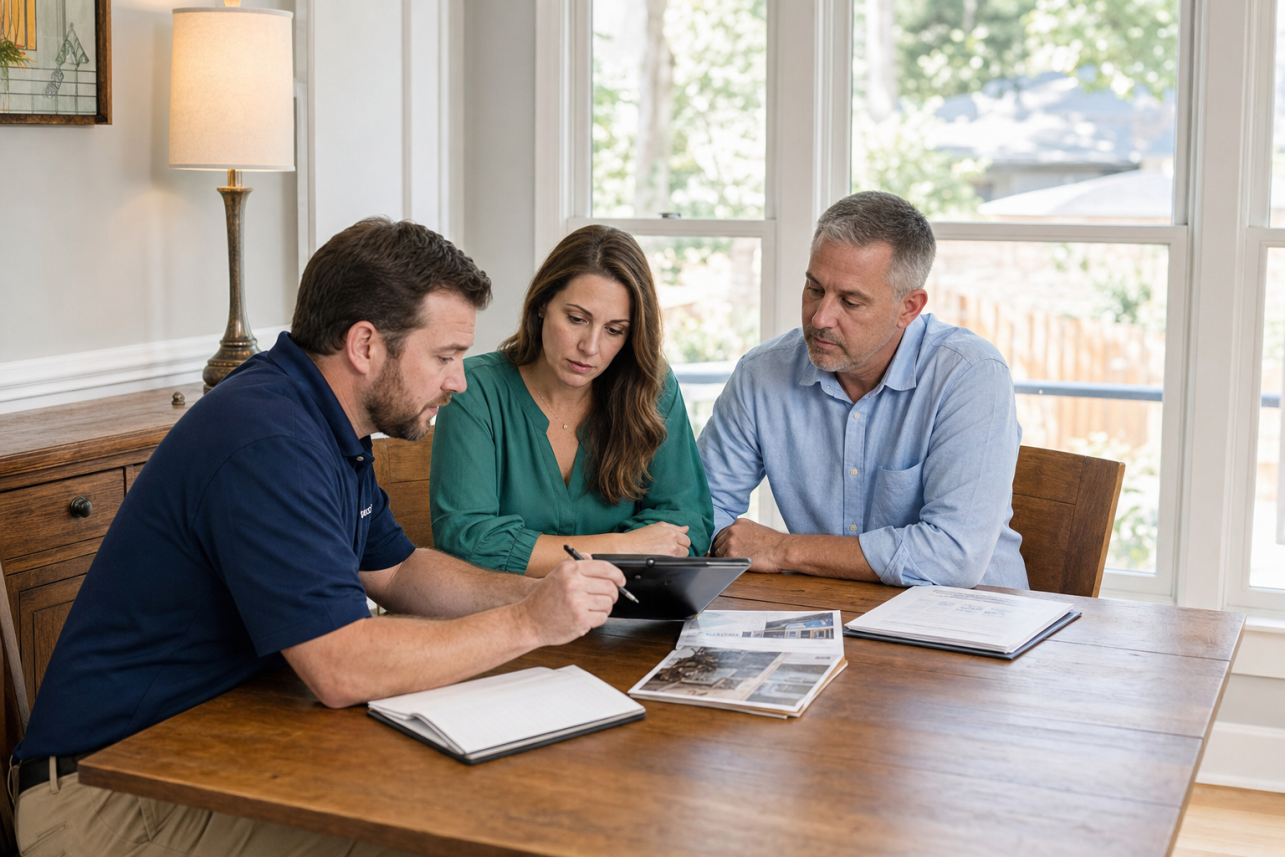
Do You Represent Commercial Property Owners And Landlords In Wake County, Or Only Homeowners?
We represent both. Alongside Raleigh homeowners, our adjusters handle claims for retail buildings, offices, restaurants, warehouses, churches, condo associations, and rental properties throughout Wake County — from downtown Raleigh to Cary, Apex, Wake Forest, and Garner.
Commercial claims carry layers that residential claims don't. Business income and extra expense coverage, tenant improvements, code upgrade (ordinance or law) provisions, and coinsurance penalties all affect what a building owner actually recovers. A fire or hurricane loss at a commercial property is rarely just a structure claim; it's a structure claim, a contents claim, and often a lost-income claim running in parallel. We build and document all three.
For landlords, we handle loss-of-rents coverage and coordinate claims across multiple units, which matters after widespread events like hurricane damage or an apartment fire. For flood losses at commercial or rental buildings, we prepare the strict proof-of-loss documentation the National Flood Insurance Program requires — the deadlines and forms on NFIP policies through FEMA are unforgiving, and missed paperwork is a common reason flood claims fall short.
To be clear about scope: we work first-party property claims only. We do not handle motor vehicle, cell phone, health, or life insurance claims of any kind.
Whether the loss is a 1,800-square-foot home or a 40,000-square-foot warehouse, the fee structure is the same contingency arrangement, and we're licensed and bonded in North Carolina. If you own damaged property anywhere in Wake County, a consultation costs you nothing.
Local Relevance
Raleigh's claims have a distinct local fingerprint. The city sits under a heavy tree canopy of loblolly pines and mature oaks, and after days of soaking rain those trees come down on roofs even without a named storm. Hurricane remnants that cross the Piedmont do most of their damage here through falling trees, not wind itself, and homeowners are often surprised to learn that when a neighbor's tree lands on their house, it is usually their own policy that responds.
Water is the other constant. Humid summers, freeze-thaw winters, and the occasional ice storm produce ice-dam leaks, burst pipes, and slow hidden moisture losses that carriers love to call "long-term seepage." And flood risk in Raleigh hides off the map: Crabtree Creek, Walnut Creek, and other Neuse tributaries have flooded homes outside the mapped high-risk zones, and homeowners policies exclude flood entirely. Separate coverage through the National Flood Insurance Program is the only policy that responds to rising water, which is why we urge Wake County owners to check their flood status before the loss, not after.
We work these same loss types across the Triangle, from Tree Damage Insurance Claim Help in Carrboro to water losses in rural Chatham County, so we know how regional carriers and their adjusters argue each one.
In Raleigh, trees cause more insured losses than wind itself — most of what gets called hurricane damage here is loblolly pines and big willow oaks coming down after days of rain soften the ground, a lesson Fran taught this city in 1996. When a tree lands on your house, even a neighbor's healthy tree, it is usually your own policy that pays, and documenting the strike properly is what separates a full roof-and-structure settlement from a patch job.
Talk To A Raleigh Public Adjuster Before You Accept The Carrier's Number
Whether it is a kitchen fire, a tree through the roof, or a water loss the carrier is calling wear and tear, you are entitled to an advocate who reads the policy the way the insurance company does. For The Public Adjusters, Inc. is licensed and bonded in North Carolina, the inspection is free, and you owe nothing unless your claim pays. One conversation will tell you whether your settlement offer is fair.
Call us: (919) 400-6440
Helpful Resources
- NCDOI Public Adjusters Guide
- National Flood Insurance Program (NFIP)
- North Carolina Department of Insurance — Verify public adjuster licenses and consumer guidance
Last updated: October 4, 2026