
If a vehicle has crashed into your house, a Car Hits Home Claim Raleigh NC policyholders file is usually paid first by your own homeowners insurance, not the driver’s auto carrier — and that surprises almost everyone. Your insurer pays, then pursues the at-fault driver’s company behind the scenes to recover what it spent. The danger is that vehicle impacts often cause hidden foundation and load-bearing damage that a quick carrier estimate misses. For The Public Adjusters, Inc. is a licensed and bonded firm in Wake County that documents the full loss and negotiates on your side, not the insurance company’s.
What This Service Is
When a car leaves the road and hits a house, the damage is rarely limited to what you can see from the curb. The impact travels through brick veneer, framing, and footings. A wall that looks “just cracked” may have shifted off its plate, and a porch column that got clipped may have been carrying roof load.
A public adjuster is a state-licensed professional who works for you, the policyholder — never for the insurance company. We read your policy, inspect and document the structural damage, build a complete repair cost estimate, and handle every call, letter, and meeting with the carrier’s adjuster.
Vehicle-into-building losses involve two insurance companies: your homeowners carrier and the at-fault driver’s auto insurer. Coordinating both, and making sure neither one shortchanges you while they sort out liability between themselves, is exactly what we do. It’s the same work behind every Car Hits Home Insurance Claim in Durham we handle — the mechanics don’t change across the Triangle, but the stakes are always your largest asset.
North Carolina requires public adjusters to be licensed, and the NCDOI Public Adjusters Guide is a good plain-language overview of what we may and may not do for you. We encourage every homeowner to read it before hiring anyone, including us.
Common Problems
The First Offer Looks Low — Does It Really Cover Foundation And Framing Repairs?
A home insurance adjuster low ball offer after a vehicle strike almost always follows the same pattern: the carrier prices visible brick and siding repair and skips what’s behind it. Cracked footings, racked wall studs, and separated sill plates don’t show up in a twenty-minute walkthrough.
Watch the fine print, too. Many first offers pay actual cash value — the depreciated worth of old materials — rather than the replacement cost your policy may actually owe once repairs are complete. Depreciation deductions on a structural loss can quietly remove thousands from your check.
Then there are code upgrades. Raleigh inspectors won’t let a contractor rebuild a wall to 1970s standards, and if your policy includes ordinance or law coverage, those required upgrades should be in the settlement — not coming out of your pocket.
My Insurance Adjuster Isn’t Responding And The Driver’s Carrier Says ‘Wait’
This is the most common call we get. The homeowner files with their own carrier, the carrier says it’s investigating liability, the driver’s auto insurer says it hasn’t accepted fault yet, and weeks pass while a hole in your house sits under a tarp.
Here’s the truth: your homeowners policy owes you regardless of who was driving. Liability determination and the subrogation process — your insurer chasing reimbursement from the at-fault driver’s company — are their problem, not yours. A home insurance adjuster not responding is not a reason your repairs should stall.
If you disagree with what the adjuster finally offers, you have real options: a documented rebuttal estimate, the appraisal clause in most policies, and a complaint to the North Carolina Department of Insurance. Courts have backed homeowners who pushed back — in Guessford v. Pennsylvania National Mutual Casualty Insurance Co., a North Carolina homeowner whose storm-damaged home claim was underpaid was allowed to pursue bad-faith and unfair-practices claims against the insurer in federal court. When negotiation isn’t enough, we also work alongside Insurance Dispute Lawyers in Cary on claims that need legal pressure.
Should You Handle A Car Hits Home Claim Raleigh NC Carriers Send You Alone?
You can file on your own, and for a small, purely cosmetic hit that may be fine. But the moment the damage touches a load-bearing wall, the foundation, or makes any part of the home unsafe to occupy, you’re negotiating a structural settlement against professionals who do this every day.
A good public adjuster brings three things you don’t have: a trained eye for impact damage that hides behind drywall, a line-item repair estimate written in the same software carriers use, and the licensing to negotiate on your behalf. Our fee is a percentage of the recovery, disclosed up front in writing — no recovery, no fee.
Judge any adjuster the way the state does: verify the license, confirm they’re bonded, and ask for references on vehicle-impact losses specifically. A firm that mostly handles roof claims may never have priced a pushed-in masonry wall. We handle these losses across the region, from Raleigh to a Car Hits Home Claim in Elon, and the pattern of underpayment is remarkably consistent.

Our Process
Emergency Stabilization And Free Damage Review
First, the opening gets secured. Emergency board-up, shoring, and tarping are covered expenses under most homeowners policies — keep every receipt, because those out-of-pocket costs belong in the claim. We review your policy at no charge and tell you honestly whether the loss is big enough to need us.
Full Structural Documentation And Estimate
We inspect well beyond the point of impact: foundation, framing, roof load paths, and utilities the vehicle may have disturbed. If the home can’t be safely occupied, we document that too, so your loss of use coverage pays for temporary housing instead of your credit card. Everything goes into a detailed, line-item repair estimate the carrier has to answer point by point.
Negotiation With Both Carriers Until The File Closes Right
We present the claim to your homeowners carrier, coordinate with the at-fault driver’s insurer where it helps you, and push back on depreciation games, scope cuts, and delay. State Farm home insurance claims and every other carrier’s files get the same treatment: documented demands, deadlines, and escalation when needed. We stay on the claim through supplements, because hidden damage often surfaces once contractors open walls.
| What’s at Stake | Handling the Claim Yourself | With a Raleigh Public Adjuster |
|---|---|---|
| Hidden structural damage | Carrier scopes what’s visible; cracked footings and shifted framing often go unlisted | Engineering inspection documents force transfer beyond the impact point before repairs hide it |
| Which policy to file under | Many homeowners wait months on the driver’s slow liability carrier | Strategic filing on your homeowners policy with subrogation to recover your deductible |
| Contents and personal property | Crushed furniture, tools, and stored items frequently left off the estimate | Item-by-item inventory with documented replacement pricing submitted with the claim |
| Code-upgrade costs | Rebuild priced to old construction standards, leaving you to pay the difference | Ordinance-and-law coverage identified and applied to current Wake County code requirements |
| Negotiation posture | You against a trained company adjuster | Licensed and bonded professionals who estimate, document, and negotiate on your behalf |
Commonly Overlooked In The Public Adjusting Industry
- Force transfer beyond the point of impact — A vehicle strike sends energy through framing and into footings far from the visible hole, and estimators who only scope what they can see miss it entirely.
- Subrogation recovery of the homeowner’s deductible — Many Raleigh families never learn their own carrier can pursue the driver’s insurer and return the deductible, so they absorb a cost they were owed back.
- Brick veneer delamination past the crash zone — Impact vibration loosens veneer ties several feet in each direction, but the damage only shows when a mason sounds the wall — something drive-by estimates never include.
- Crushed utilities inside the wall cavity — HVAC linesets, wiring, and plumbing routed through exterior walls get flattened by the impact and stay hidden until the wall is opened.
- Ordinance-and-law (code upgrade) coverage — Wake County requires rebuilds to meet current code, and estimates priced to the home’s original construction leave the homeowner paying the gap.
- Contents and stored-property inventory in garages — Attached garages hold tools, appliances, and storage that get crushed in a vehicle strike, yet contents are routinely left off structural-focused estimates.
- Matching requirements for siding, brick, and trim — Carriers often pay to patch only the damaged section, even when a reasonable match to the surrounding materials is impossible — a point North Carolina policyholders can and do push back on, as the state Supreme Court’s pro-insured property coverage ruling in Gaston County Dyeing Machine Co. v. Northfield Insurance Co., 351 N.C. 293 (2000), illustrates.
- Additional living expense eligibility — When structural damage makes part of the home unsafe, temporary housing costs may be covered, but homeowners who aren’t told about it never claim it.
Case Studies
Case Study #1
Situation: A family in North Raleigh’s Bedford neighborhood had a sedan jump the curb and crash through their brick veneer, breaking through the living room wall and shifting the sill plate on the foundation.
Problem: The driver’s auto liability carrier offered a quick settlement based on a drive-by estimate that covered only cosmetic brick repair and drywall. It ignored the cracked footing, the racked wall framing, and the HVAC lineset that had been crushed inside the wall cavity.
Investigation: Our adjusters brought in a structural engineer to document foundation displacement, performed moisture and thermal imaging behind the impact zone, and opened the wall cavity to photograph crushed framing, severed wiring, and the damaged refrigerant lines.
Findings: The impact had transferred force well beyond the visible hole. The engineer documented a quarter-inch of lateral sill movement across twelve feet of wall, two cracked floor joists, and brick veneer delamination extending six feet past the point of contact. The original estimate missed roughly two-thirds of the real scope.
Solution: We filed a fully documented claim against the homeowner’s own policy to avoid waiting on the liability carrier, itemized every structural and mechanical repair, and coordinated so the homeowner’s insurer could pursue subrogation against the driver’s carrier afterward.
Outcome: The homeowner’s carrier approved a rebuilt wall section, foundation repair, new HVAC lineset, electrical rework, and matching brick replacement across the full affected elevation. The family also recovered their deductible through subrogation.
Lesson: North Carolina courts have long sided with policyholders when carriers try to read property coverage narrowly. In Gaston County Dyeing Machine Co. v. Northfield Insurance Co., 351 N.C. 293 (2000), the North Carolina Supreme Court ruled for the insured on property damage coverage, rejecting the insurer’s attempt to limit what counted as covered loss. Vehicle-impact damage deserves the same full-scope reading — the harm almost always extends past what you can see.
Case Study #2
Situation: A retired couple near Cary’s border in southwest Wake County had a pickup truck slide on wet pavement and strike the corner of their garage, cracking the slab edge and knocking the garage door frame out of square.
Problem: Their insurer accepted the claim but scoped it as a simple garage door replacement. The estimate left out the fractured corner footing, the split corner studs carrying roof load, and the contents damage — a workshop’s worth of crushed tools and shelving.
Investigation: We photographed and inventoried every damaged item in the garage, measured the out-of-plumb corner post, and had an engineer evaluate the slab crack at the impact corner. We also pulled the policy to confirm contents and code-upgrade coverage applied.
Findings: The corner post carried a point load from the roof, and the impact had split it. The slab crack ran under the wall plate. Local code required updated anchor bolting and header sizing on the rebuild — costs the original estimate never contemplated. The contents inventory alone exceeded the carrier’s entire first offer.
Solution: We submitted a line-item rebuttal estimate with engineering support, a room-by-room contents inventory with replacement pricing, and the applicable code-upgrade provisions, then met the carrier’s adjuster on site to walk the damage together.
Outcome: The revised settlement covered structural rebuilding of the garage corner, slab repair, a new door and frame, code-required upgrades, and the full documented contents loss — a figure several times the opening offer.
Lesson: When a vehicle strikes a structure, the contents claim and the code-upgrade coverage are forgotten almost as often as the hidden structural damage. Documenting all three before repairs begin is what moves a settlement from cosmetic to complete.
| Decision Point | Best Move | What It Depends On |
|---|---|---|
| File under your homeowners policy or the driver’s auto liability | Usually your own policy first, then subrogation | How cooperative the driver’s carrier is; liability claims often stall while your home sits open to weather |
| Make emergency repairs right away | Yes — board up and tarp, but photograph everything first | Policies require you to prevent further damage; undocumented repairs weaken your claim |
| Accept the carrier’s first estimate | Rarely without an independent scope | Whether hidden damage behind brick, framing, and slab has been professionally evaluated |
| Let the driver’s insurer send its own inspector alone | Have your representative present | Their estimate protects their insured’s exposure, not your rebuild |
| Stay in the home during repairs | Depends on structural findings | An engineer’s assessment of load-bearing walls and foundation; additional living expense coverage may apply |
| Call a public adjuster before or after the carrier’s visit | Before, whenever possible | Early documentation of the full scope prevents an anchored low estimate you then have to fight uphill |
| Wait on police and incident reports | Request them, but don’t delay the claim | Reports support subrogation, but prompt notice to your carrier is required under your policy |

Reviews
A car ran off Glenwood and hit the corner of our 1940s bungalow. The insurance estimate basically covered patching the hole. For The Public Adjusters brought an engineer who found the impact had shifted our pier foundation. The final settlement covered the foundation work, matching our original siding, and the furniture that got destroyed. Night-and-day difference from where we started.
Marcus T., Five Points
The driver’s insurance company kept stalling for months after their customer drove into our den. These folks explained we could file on our own homeowners policy instead and let the companies fight it out. They documented everything — cracked rafters, bent ductwork, our deductible came back through subrogation. I only wish I’d called them the week it happened instead of waiting.
Deena R., Knightdale
Truck lost its brakes and ended up in our attached garage. First offer covered a garage door and some drywall. Their team inventoried every tool and found the load-bearing corner was compromised. Honest about the process the whole way — never promised a number, just promised thorough documentation, and that documentation is what got us a fair result.
Paul and Jenny S., North Hills
Frequently Asked Questions
How Does A Car Hits Home Claim Raleigh NC Process Typically Work After A Vehicle Crashes Into My House?
The process starts the moment the vehicle is removed and your home is made safe. Call 911, get the police report number, and photograph everything before any debris is cleared — the breach in the wall, cracked foundation blocks, shifted framing, and damaged belongings inside.
From there, you have two potential sources of recovery: the at-fault driver’s liability coverage and your own homeowners policy. In Wake County, we often recommend opening a claim under your homeowners policy first because it tends to move faster, and your carrier can then pursue the driver’s insurer through subrogation.
What many Raleigh homeowners don’t realize is that vehicle impacts cause hidden structural damage. A car that punches through a brick veneer can rack wall studs, crack sill plates, and transfer force into the foundation several feet away from the visible hole. A quick drive-by estimate from the insurance company’s adjuster frequently misses this.
As licensed and bonded public adjusters, we document the full scope — structural, cosmetic, and contents — and negotiate with the carrier on your behalf. We work only for policyholders, never for insurance companies. We also prepare the claim so that code-required upgrades under Raleigh’s current building standards are included where your policy provides ordinance or law coverage. While no one can promise a specific outcome, a thoroughly documented claim gives you a far stronger position than accepting the first estimate handed to you.
Whose Insurance Pays When A Car Hits My Raleigh Home — Mine Or The Driver’s?
Both policies can come into play, and understanding the difference matters. The driver’s auto liability policy is ultimately responsible if the driver was at fault, but North Carolina’s minimum property damage liability limit is often far less than the cost of rebuilding a damaged wall, porch, or garage in today’s Triangle construction market.
Your homeowners policy covers vehicle impact as a named peril, regardless of who was driving. Filing under your own policy usually gets repairs funded sooner, and your carrier then has the right to recover what it paid from the driver’s insurer. If your carrier recovers, you may get your deductible back as part of that subrogation.
The complication is scope. The driver’s liability insurer has every incentive to minimize what it owes, and your own carrier may initially price the repair as a simple patch job. We routinely see estimates in Raleigh that cover drywall and siding but omit engineering inspections, foundation evaluation, matching brick or siding across the full elevation, and damaged contents like furniture and appliances near the point of impact.
An important note: our firm handles the damage to your home, other structures, and personal property only. We do not handle motor vehicle claims, so any damage to your own car — even one parked in the garage that was struck — must go through an auto claim separately. For the house itself, we build the full damage file and deal with both insurers’ adjusters so you aren’t caught between them.
What If The Insurance Company Lowballs The Structural Damage After A Vehicle Strikes My Home?
You are not required to accept the first estimate, and North Carolina courts have repeatedly held insurers to the actual terms of their policies when policyholders push back with proper documentation.
A useful example is Gaston County Dyeing Machine Co. v. Northfield Insurance Co., decided by the North Carolina Supreme Court in 2000. The insurers argued the property damage fell outside coverage, but the Court sided with the insured, holding that the damage was covered under the policy language as written. The case is a reminder that carriers do not get the final word on what their own policies mean — courts in this state will enforce coverage in favor of the policyholder when the facts and policy support it.
Vehicle-impact claims are especially prone to underpayment because the worst damage is often invisible. Force from a collision travels through framing, and a wall that looks patchable may have cracked studs, a compromised top plate, or foundation damage below grade. We bring in structural documentation, measure the full repair scope including matching materials across the damaged elevation, and present a detailed, line-item claim the carrier must respond to.
If the carrier still disputes the amount, most North Carolina homeowners policies include an appraisal provision — a formal dispute process that resolves the dollar amount without a lawsuit. We guide Raleigh policyholders through that option when negotiation stalls. We can’t guarantee a specific figure, but we can make sure nothing legitimate is left off the table.
Why Hire For The Public Adjusters, Inc. For A Car Hits Home Claim Raleigh NC Instead Of Handling It Myself?
Because this type of loss sits at the intersection of two insurance companies, a police report, structural engineering, and local building codes — and every party except you has professional representation from day one.
The driver’s liability carrier sends an adjuster trained to limit its payout. Your homeowners carrier sends its own adjuster, who works for the insurance company, not for you. A public adjuster is the only licensed adjuster in the process who represents the policyholder exclusively. We are licensed and bonded in North Carolina, and our fee structure means we only do well when your claim is documented and presented properly.
In practice, that means we handle the parts most Raleigh homeowners don’t have time or tools for: measuring the full structural scope, inventorying damaged contents room by room, pricing repairs at real Wake County contractor rates rather than database averages, verifying whether your policy includes ordinance and law coverage for code upgrades, and managing deadlines so nothing lapses while you’re displaced or juggling repairs.
We also coordinate the interplay between the two claims so your homeowners payout and any liability recovery don’t conflict. One caveat worth repeating: we handle the home, attached and detached structures, and personal property only — never vehicles, cell phones, health, or life claims.
If a car has come through your wall, porch, or garage anywhere in Raleigh or greater Wake County, a free claim review costs you nothing and will tell you quickly whether the carrier’s estimate reflects the true damage.
How Long Does A Car Hits Home Claim Raleigh NC Usually Take To Settle?
A Car Hits Home Claim Raleigh NC typically takes anywhere from six weeks to six months, depending on how badly the vehicle damaged the structure. A clipped porch column with a clear liability picture can resolve quickly. A car that punched through a load-bearing wall, cracked the foundation, or shifted the framing almost always takes longer because engineering inspections are required before anyone can price the repair accurately.
North Carolina gives insurers 30 days to acknowledge a claim and requires them to act in good faith, but the clock really depends on documentation. Claims stall when the carrier’s estimate omits hidden damage — racked framing, broken sill plates, compromised brick veneer — and the homeowner has no independent proof to push back with.
Our team shortens that timeline by front-loading the file: structural photos, moisture readings where plumbing was struck, contractor and engineer input, and a line-item estimate the carrier has to respond to specifically. When disputes do escalate, the law tends to favor well-documented policyholders. In Gaston County Dyeing Machine Co. v. Northfield Insurance Co., 351 N.C. 293 (2000), the North Carolina Supreme Court ruled for the insured in a property-damage coverage dispute, rejecting the insurer’s narrow reading of the policy. That precedent matters here in Wake County, because it shows our courts will hold carriers to the coverage they sold.
We can’t promise a specific settlement figure or date — no honest adjuster can — but a complete, professionally built claim file is the single biggest factor in getting a vehicle-impact loss closed fairly and on time.
What Hidden Damage Should I Look For After A Vehicle Crashes Into My Raleigh House?
The visible hole is rarely the whole loss. When a car strikes a home, the impact energy travels through the structure, and the most expensive damage is often the damage you can’t see from the curb.
Start with the framing. Impact can rack wall studs, crack top and bottom plates, and shift the structure off its sill. In Raleigh’s many brick-veneer homes, a strike frequently cracks mortar joints or separates the veneer from the wall ties several feet away from the point of impact. Foundations deserve a close look too — a vehicle hitting a crawl-space wall can crack block courses that only an engineer will catch.
Then check the systems inside that wall. Cars routinely sever electrical wiring, crush plumbing supply lines, and damage HVAC ducts or gas lines. A slow leak from a struck pipe can quietly feed mold inside the wall cavity for weeks. Doors and windows that suddenly stick are a classic sign the frame has shifted.
We document all of it before the carrier writes its estimate, because insurers price what’s in the file — nothing more. We also coordinate structural engineers when the loss warrants it, so the scope of repair reflects reality rather than a drive-by inspection.
One note on scope: we handle the damage to your home, other structures, and contents. We don’t adjust claims for the vehicle itself — that stays between the driver and their auto carrier. Our focus is making sure your house is restored completely, not patched over a compromised frame.
Can I Make Temporary Repairs And Stay Somewhere Else While My Home Is Fixed?
Yes — and in most cases you’re actually required to make reasonable temporary repairs. Nearly every homeowner policy obligates you to protect the property from further damage after a loss. When a vehicle leaves a hole in your wall, that means boarding up the opening, tarping exposed areas, and securing the home against weather and intrusion. Keep every receipt; those emergency costs are generally reimbursable under the policy.
What you should not do is start permanent repairs before the damage is fully documented and the scope is agreed. Once a wall is rebuilt, you’ve lost your evidence, and carriers routinely use premature repairs to dispute what was actually damaged.
If the strike made your home unsafe or uninhabitable — a breached exterior wall, severed gas line, or a City of Raleigh inspection flag — your policy’s Additional Living Expense (ALE) coverage typically pays for comparable temporary housing, plus the increase in your normal costs like meals and mileage. ALE is one of the most under-claimed coverages we see in Wake County, often because homeowners don’t realize partial losses can qualify.
Our team documents habitability issues on day one, tracks your ALE spending properly, and presents it alongside the structural claim so nothing gets separated or forgotten. We’re licensed and bonded in North Carolina, and while we never guarantee what any claim will pay, we make sure every coverage you purchased — dwelling, other structures, contents, and ALE — is actually put to work for you.
How Are Public Adjusters Paid On A Vehicle-Into-Home Claim, And Is It Worth The Fee?
Public adjusters in North Carolina work on a contingency fee — a percentage of the claim settlement, agreed to in writing before any work begins. There are no upfront costs and no hourly billing. If the claim pays nothing, you owe nothing. That structure keeps our interests aligned with yours: we’re paid to maximize the documented, covered scope of your loss, not to close the file quickly.
Whether it’s worth it depends on the loss. A minor fence strike probably doesn’t need us. But a car-into-home loss is one of the most commonly underpaid claim types we see in Raleigh, because carriers tend to estimate only the visible breach while hidden structural, electrical, and plumbing damage goes unscoped. On complex losses, the gap between an initial carrier estimate and a fully documented claim can be substantial — though every loss is different, and we never promise a specific outcome.
North Carolina courts have repeatedly backed policyholders who hold insurers to the full language of their policies. In Gaston County Dyeing Machine Co. v. Northfield Insurance Co., the state Supreme Court sided with the insured over the carrier’s attempt to limit property-damage coverage — a reminder that the policy means what it says, not what an adjuster’s first estimate implies.
For The Public Adjusters, Inc. is licensed and bonded, and we handle the entire Car Hits Home Claim Raleigh NC process from documentation through negotiation, so you’re not learning insurance law while your wall is boarded up.
What Does My Homeowners Policy Actually Cover After A Vehicle Crashes Into My Raleigh House?
Most standard homeowners policies in North Carolina treat vehicle impact as a covered peril, which means the damage to your dwelling, attached structures, and personal property inside should be covered. That typically includes the obvious wall and framing damage, plus debris removal, damaged contents, and in many policies, additional living expenses if the home is unsafe to occupy.
One important distinction: we handle the damage to your home, building, and contents only. The vehicle itself is a separate auto claim that we do not work on, and any injuries fall under health coverage, which is also outside our scope.
Where homeowners often get shortchanged is in the less visible categories — foundation cracking, shifted load-bearing walls, plumbing or electrical runs crushed inside the wall cavity, and matching costs for brick, siding, or interior finishes. Carriers sometimes read coverage narrowly, but North Carolina courts have pushed back on that. In Gaston County Dyeing Machine Co. v. Northfield Insurance Co., 351 N.C. 293 (2000), the North Carolina Supreme Court sided with the insured on a property damage coverage dispute, rejecting the insurer’s attempt to limit what the policy language actually covered.
As licensed and bonded public adjusters, we review your specific policy forms and endorsements, document every category of covered loss, and present the full scope to the carrier. We can never guarantee a specific outcome, but we can make sure nothing covered gets left off the estimate.
What Documentation Should I Gather To Support A Car Hits Home Claim Raleigh NC?
Start with the police report. Raleigh Police or the Wake County Sheriff’s Office will document the incident, identify the driver, and record insurance information — all of which matters later if your carrier pursues the driver’s auto insurer for reimbursement.
Photograph everything before anything is moved: the point of impact, interior damage, cracked drywall in adjoining rooms, displaced contents, and the vehicle’s position if it is still on site. Take wide shots and close-ups. Video walkthroughs help too, especially for showing how far cracking extends from the impact zone.
Keep every receipt. Emergency board-up, tarping, structural shoring, hotel stays, and meals above your normal spending may all be reimbursable, but only if you can prove them. Save contractor invoices and any written estimates you receive.
Finally, pull together your policy documents — the declarations page and the full policy form, including endorsements. Coverage for ordinance or law upgrades, matching materials, and additional living expenses varies by policy, and the details drive what you can claim.
When a Raleigh homeowner brings us in early, we build this file systematically: engineer reports where structural movement is suspected, itemized contents inventories, and line-item repair estimates written to local Wake County pricing. That documentation is the backbone of the negotiation, and it is much easier to assemble in week one than to reconstruct in month three.
Do Wake County Building Permits And Codes Affect How My Home Gets Repaired After A Vehicle Impact?
Yes, and this is one of the most commonly underpaid parts of a Car Hits Home Claim Raleigh NC. Structural repairs — replacing studs, headers, foundation sections, or load-bearing masonry — require permits through the City of Raleigh or Wake County inspections offices, depending on where you live. Inspectors will require the repair to meet current North Carolina building code, not the code in place when your home was built.
That matters financially. An older Raleigh home may need upgraded framing connections, modern electrical work in the repaired wall, or current energy-code insulation, all of which cost more than simply putting back what was there. If your policy includes ordinance or law coverage, those code-driven upgrade costs should be part of the settlement.
Carrier estimates frequently price the repair as a like-for-like patch and skip code upgrades entirely. They may also omit engineering fees, which inspectors often require before sign-off on structural work. Each omission reduces what you are paid.
Our job is to catch those gaps. We review the carrier’s estimate line by line against local permit requirements and current code, document what the jurisdiction will actually demand, and negotiate from there. We cannot guarantee any particular dollar figure, but we can make sure the claim reflects what a code-compliant repair in Wake County genuinely costs, so you are not funding inspection-mandated upgrades out of pocket.
What If The Driver Who Hit My House Was Uninsured Or Fled The Scene?
You still have a path forward. Your own homeowners policy covers vehicle impact to the dwelling regardless of who was driving or whether they stopped, so an uninsured or hit-and-run driver does not leave you without coverage. You file through your carrier, pay your deductible, and your insurer may later pursue the driver through subrogation if they are ever identified.
File a police report immediately, even for a hit-and-run. A report number from Raleigh Police or the Wake County Sheriff’s Office documents the date and cause of loss, which protects you if the carrier later questions how the damage occurred. Neighbors’ doorbell cameras and nearby security footage can also help identify the driver, which may eventually get your deductible reimbursed through subrogation.
Be aware that some carriers scrutinize hit-and-run property claims more closely, asking for proof the damage came from a vehicle rather than settlement or another cause. Tire marks, paint transfer on brick or siding, and debris from the vehicle are worth photographing before cleanup.
North Carolina law gives policyholders real leverage when carriers underpay or delay. Courts in this state have repeatedly held insurers to the plain language of their policies in building-damage disputes, as the insured’s win in Gaston County Dyeing Machine Co. v. Northfield Insurance Co. demonstrates. As your public adjuster in Raleigh, we document the loss thoroughly, handle the carrier communication, and push for a settlement that reflects the actual repair cost — though no one can ethically promise a specific result.
Can For The Public Adjusters, Inc. Reopen A Car Hits Home Claim Raleigh NC That Was Already Denied Or Underpaid?
Yes, in many situations a Car Hits Home Claim Raleigh NC can be reopened, supplemented, or disputed even after the carrier has issued a check or a denial letter. Cashing a payment in North Carolina does not automatically close the door on additional money if covered damage was missed or undervalued.
We start by pulling your full policy and the carrier’s estimate, then performing our own inspection of the impact zone. Vehicle strikes frequently damage framing, brick ties, slabs, and utility lines in ways a quick field-adjuster visit never documents. When we find a gap, we prepare a supplemental demand supported by photos, measurements, and contractor-level pricing for the Raleigh market.
North Carolina courts have made clear that insurers who wrongly shortchange homeowners can be held accountable. In Gray v. North Carolina Insurance Underwriting Association, 352 N.C. 61 (2000), the North Carolina Supreme Court allowed homeowners to pursue bad-faith and unfair-practices claims after their insurer refused to fairly pay for damage to their home — and the policyholders ultimately prevailed. That precedent gives Raleigh homeowners real leverage when a carrier digs in on an unreasonable position.
We are licensed and bonded, and while no one can promise a specific outcome, we can promise a thorough, professionally documented presentation of every dollar of covered damage. If the carrier still refuses to move, we can help you evaluate appraisal or other dispute options under your policy.
Will Filing A Claim After A Car Strikes My Raleigh Home Raise My Premiums Or Get Me Non-Renewed?
This is one of the most common worries we hear from Wake County homeowners, and the honest answer is: usually not in the way people fear, especially when a third party caused the loss.
A vehicle crashing into your house is a not-at-fault event. You did nothing to cause it, and insurers generally treat it differently than claims tied to maintenance or negligence. In most cases, your homeowners carrier will pay your claim and then pursue subrogation against the driver’s auto liability insurer to recover what it paid. A successful recovery often means the claim has little or no lasting effect on your rates, and your deductible may even be refunded.
That said, North Carolina carriers do look at claim frequency. If you have had several recent claims of any kind, one more entry on your loss history can matter at renewal. That is a reason to make the claim count — document everything, capture all the structural and interior damage in one well-supported filing, and avoid reopening the file repeatedly for items that were missed.
Our team in Raleigh handles that documentation from day one, so the claim is presented completely the first time. We also make sure the carrier’s file clearly reflects that the loss was caused by a third-party driver, which supports subrogation and protects your record. We cannot control underwriting decisions, but a clean, well-organized claim caused by someone else’s vehicle is among the lowest-risk claims a homeowner can file.
Do You Also Handle The Damage To The Car, Or Injuries From The Crash?
No — and it is important homeowners understand this up front. For The Public Adjusters, Inc. does not handle insurance claims involving motor vehicles, health, or life. The driver’s vehicle damage and any bodily injuries are handled through the auto carriers and, where injuries are involved, through an attorney.
What we handle is everything that happened to your property. When a car comes through a wall in Raleigh, the home claim is almost always the larger and more complicated of the two. It can involve foundation and slab damage, sheared studs and headers, cracked brick veneer, displaced plumbing and gas lines, HVAC damage, flooring, drywall, insulation, and personal contents crushed or contaminated in the impact. That is where a Raleigh public adjuster earns their keep.
The two claims do intersect in one way: liability. If the driver was at fault, their auto liability coverage is a source of recovery for your home repairs, either directly or through your homeowners carrier’s subrogation. We coordinate the property side so that the right carriers are on notice, deadlines are met, and nothing about the structural claim falls through the cracks while the auto carriers sort out fault.
If you were injured in the crash, we will tell you plainly that you need a personal injury attorney for that piece, and we are happy to work alongside your counsel. Keeping the lanes clear means each part of your recovery gets handled by the right professional — our lane is your house, your building, and your belongings.
What Happens To My Furniture, Electronics, And Belongings Damaged When A Vehicle Came Through The Wall?
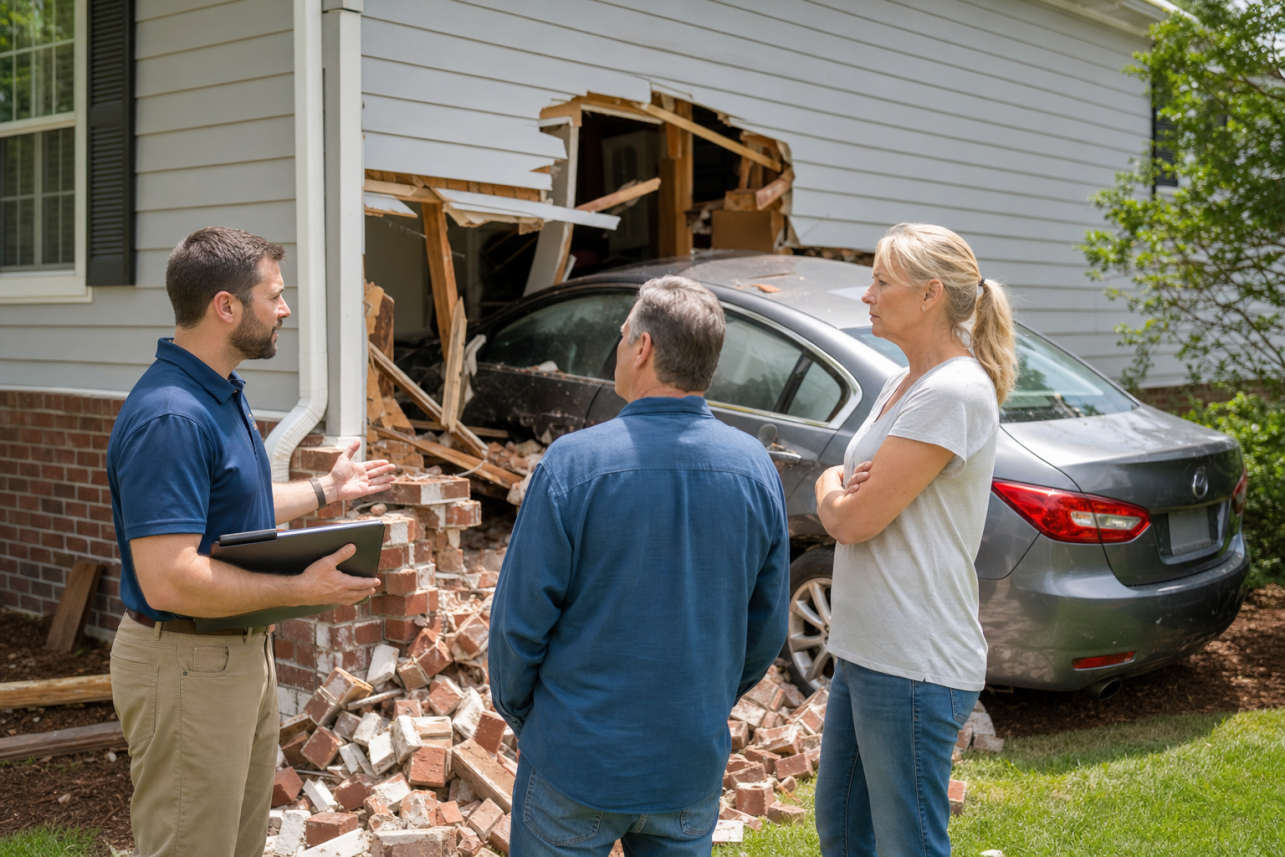
Your personal property is covered under the contents portion of your homeowners policy — Coverage C — and it is routinely underpaid after a vehicle-into-home loss because everyone focuses on the hole in the wall.
Think about what actually happens in these crashes. Furniture is crushed or thrown. Electronics are knocked over or exposed to weather through the breach. Drywall dust, insulation fibers, and sometimes vehicle fluids contaminate upholstery, rugs, clothing, and bedding in nearby rooms. In Raleigh’s humid climate, a breached exterior wall can also expose contents to moisture within hours if the opening is not properly sealed.
Our process is to inventory every affected item room by room: description, age, condition, and replacement cost at current local pricing. If your policy includes replacement cost coverage on contents, you are typically owed the full cost to replace items new, though carriers often pay actual cash value first and hold back depreciation until you replace the items. We track and claim that recoverable depreciation so it does not get forgotten.
We also push back when carriers try to “clean” items that are realistically a total loss — a sofa saturated with glass fragments and fiberglass insulation is not a cleaning candidate. Courts have sided with policyholders who fought for full, fair payment on home and contents losses, as in Gray v. North Carolina Insurance Underwriting Association, where homeowners prevailed against an insurer that refused to pay fairly for their property damage.
Keep damaged items until the adjuster has documented them, photograph everything, and do not throw anything away without written approval.
Local Relevance
Raleigh’s growth is part of why cars end up in living rooms here. Older neighborhoods inside the Beltline were built close to streets that now carry far more traffic than they were designed for, and newer subdivisions across Wake County put homes near curving collector roads where a distracted or impaired driver leaves the pavement fast.
Much of the local housing stock is brick veneer over wood framing. Brick hides impact damage well — the veneer can be patched while the studs and sill plate behind it stay cracked and shifted. That’s why a cosmetic-looking estimate from a carrier should never be accepted on faith in this market.
The Insurance Information Institute notes that homeowners policies generally cover damage to your dwelling from vehicle impact, which means your own carrier is on the hook even before fault is sorted out. We serve policyholders throughout Wake County, including clients who find us through our Public Adjuster Cary NC and Public Adjuster Garner pages, and the vehicle-impact claims look the same across the county: fast first offers, slow structural engineering.
In Raleigh’s older in-town neighborhoods, homes often sit just feet from streets that have become busy cut-throughs, and the mid-century brick veneer common there tends to mask framing and foundation damage after a vehicle strike — so a quick cosmetic repair estimate frequently misses the real structural loss behind the wall.
A Car Hit Your House? Talk To Us Before You Accept The Carrier’s Number
For The Public Adjusters, Inc. is licensed and bonded in North Carolina, and we work only for policyholders — never for insurance companies. The policy review is free, and if we take your claim, our fee comes from the recovery, disclosed in writing before we start. Call before you sign anything, because the first offer is rarely the full story.
Call us: (919) 400-6440
Helpful Resources
- NCDOI Public Adjusters Guide
- Insurance Information Institute (III)
- North Carolina Department of Insurance — State regulator for insurance and public adjuster licensing
- Insurance Information Institute — Consumer education on homeowners coverage and claims
Last updated: October 1, 2026