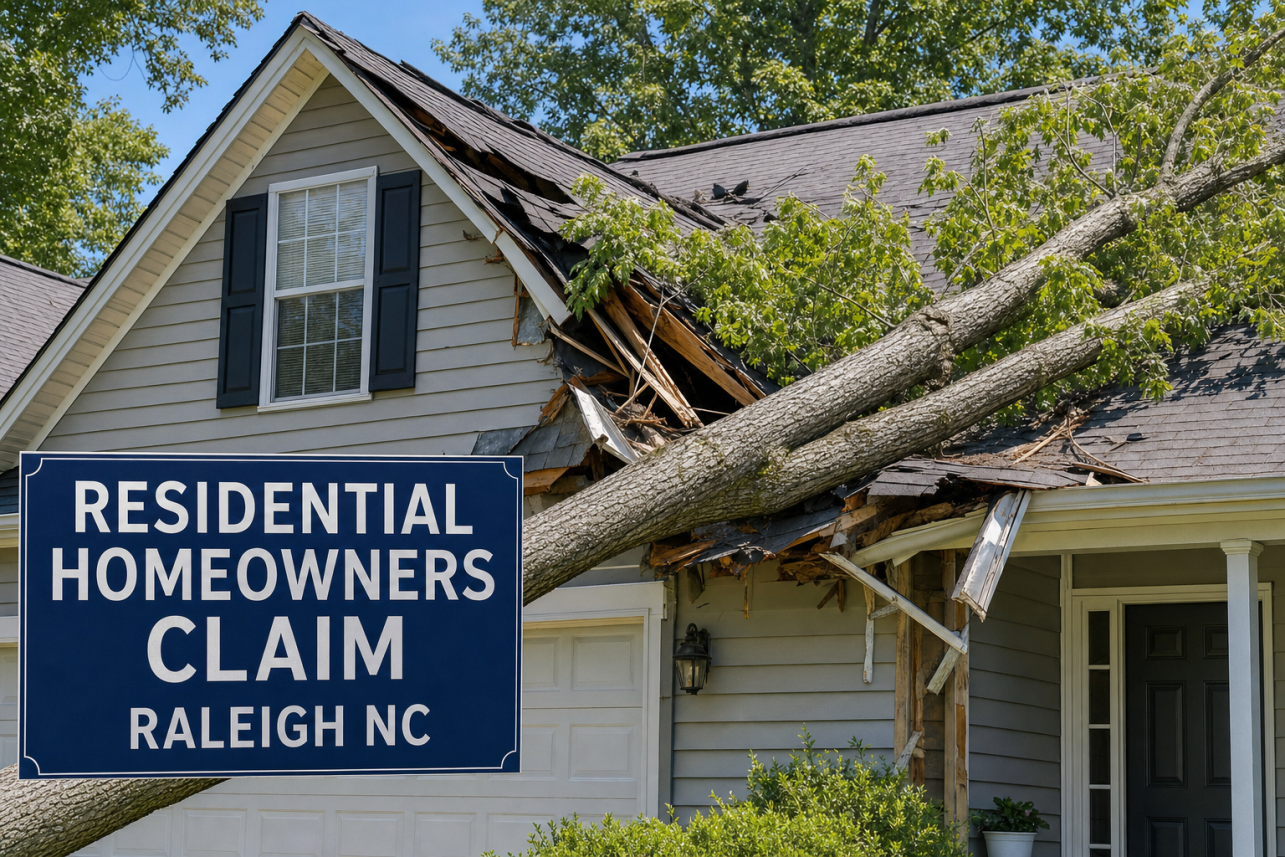
If you need help with a Residential Homeowners Claim Raleigh NC policyholders can hire For The Public Adjusters, Inc. to represent them — not the insurance company — from the first inspection to the final check. We are licensed and bonded public adjusters who review your policy, document every dollar of damage, and negotiate the settlement on your behalf. Whether your claim was denied, delayed, or came back thousands short of the contractor's repair estimate, you have the right to push back, and we know how.
What This Service Is
A public adjuster is the only insurance professional licensed to represent you, the homeowner, in a property claim. The adjuster your insurance company sends works for the insurer. We work for you.
When you hire us for a homeowners claim in Raleigh, we start by reading your actual policy — the coverage limits, the deductible, and whether you're owed full replacement cost or a depreciated actual cash value payment. Most homeowners have never been shown the difference, and it can change a settlement dramatically.
From there we perform our own property damage assessment. Fire and smoke damage, water damage from burst pipes or roof leaks, tree strikes, vandalism, and hurricane damage all get documented room by room, down to contents and hidden damage the insurer's adjuster often walks past.
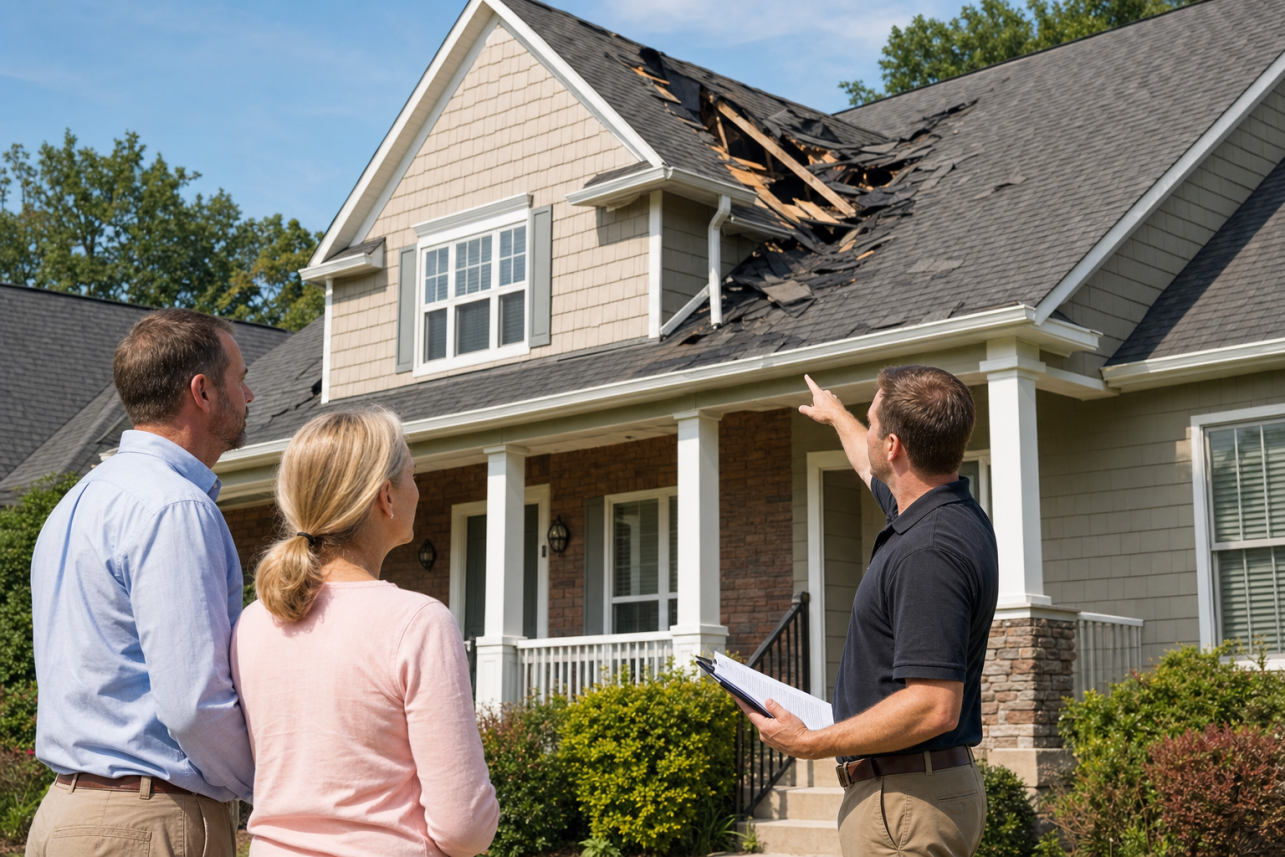
We then prepare the proof of loss paperwork, meet the insurer's adjuster on site, and handle the settlement negotiation. The North Carolina Department of Insurance publishes the NCDOI Public Adjusters Guide explaining exactly how this licensing and representation works, so you can verify anyone you hire — including us. We do the same work across Wake County, including every Residential Homeowners Claim in Cary we represent.
Common Problems
Why Was My Residential Homeowners Claim Raleigh NC Settled For Less Than The Repairs Cost?
This is the most common call we get. The insurer's first offer is frequently built on a quick walkthrough, missed damage, and aggressive depreciation deductions — and it lands well below what your contractor's repair estimate says the work will actually cost.
That gap becomes your out-of-pocket problem unless someone challenges the numbers. We re-scope the loss line by line, compare it against your coverage limits and deductible, and show the insurer what a complete repair truly requires.
Homeowners are not required to accept the first figure. North Carolina courts have backed that up: in Gray v. North Carolina Insurance Underwriting Association, the state's Supreme Court upheld a verdict — including punitive damages — for policyholders whose hurricane-damaged home claim was unreasonably lowballed by their insurer. The law is on the side of a fair, fully documented payment.
My Claim Was Denied Or Keeps Getting Delayed — What Can I Actually Do?
A denial letter is not the end of your claim. Denials often rest on thin reasoning: the insurer calls sudden water damage "long-term wear," blames roof damage on age instead of the storm, or claims you missed a filing deadline that your policy doesn't actually support.
Delays work the same way. Weeks of unreturned calls and repeated document requests wear homeowners down until they accept less. Meanwhile you may be paying for temporary housing that your additional living expenses coverage should be handling.
We handle denied home insurance claim disputes by rebuilding the file — cause-of-loss evidence, moisture readings, photos, and a proper proof of loss — then formally challenging the decision. It's the same approach we bring to water damage insurance claim help in Bennett and everywhere else we work.
Should I Handle The Claim Myself, Or Is A Public Adjuster Worth It?
Plenty of small, straightforward claims don't need us, and we'll tell you that honestly in a free review. But when the damage is significant, the policy language is doing heavy lifting, and the insurer's number doesn't match reality, representation usually changes the conversation.
A good public adjuster does three things you can verify before hiring: shows you a current North Carolina license, explains their fee in writing before you sign anything, and walks you through your own policy instead of making vague promises. Be wary of anyone who guarantees a specific payout — no honest adjuster can.
We're licensed and bonded, we work on claims across the Triangle — you'll find the same team working as a Public Adjuster in Apex NC — and when a dispute needs to escalate, we coordinate with insurance dispute lawyers rather than leaving you to start over.

Our Process
Free Policy And Damage Review
We read your homeowners policy and inspect the damage before you commit to anything. You'll learn what's covered, what your deductible means for the numbers, and whether the insurer's position holds up — whether it's a roof damage claim after a storm or smoke damage from a kitchen fire.
Full Documentation And Proof Of Loss
We build the evidence the insurer has to answer: itemized damage scoping, contents inventories, photos, moisture and burn documentation, and the formal proof of loss filed correctly and on time. Deadlines in your policy matter, and missing one is a preventable way to lose leverage.
Negotiation Until The Settlement Is Right
We meet the company adjuster on site, challenge lowball line items and excessive depreciation, and push for replacement cost where your policy provides it. If hidden damage surfaces during repairs, we file the supplemental claim so new findings get paid too.
| Factor | Filing on Your Own | With For The Public Adjusters |
|---|---|---|
| Who represents you | No one — the carrier's adjuster works for the insurance company | A licensed, bonded public adjuster who works only for you, the policyholder |
| Damage documentation | Your photos and the carrier's walkthrough notes | Line-item estimates, moisture mapping, contents inventories, and code research |
| Policy knowledge | You interpret exclusions, deadlines, and proof-of-loss rules yourself | Every coverage — dwelling, contents, ordinance and law, additional living expenses — is reviewed and applied |
| Negotiation | Accept, argue, or give up | Documented, professional negotiation backed by evidence and precedent |
| Your time | Weeks of calls, paperwork, and disputes | We manage the process while you focus on your family and home |
| Cost | Free, but underpayment risk falls entirely on you | A percentage of the recovery — no recovery, no fee |
Commonly Overlooked In The Public Adjusting Industry
- Ordinance and law coverage on older Raleigh homes — Carrier estimates rebuild homes to their original condition, but Wake County code requires upgrades to wiring, plumbing, and framing once walls are opened — a cost that goes unpaid unless someone claims it.
- Smoke and soot inside the HVAC system after a fire — Ducts hide contamination that a visual walkthrough never catches, and running the system later spreads soot back through rooms that were already cleaned.
- Hidden moisture behind cabinets, toe-kicks, and wall cavities — Drying companies place equipment where damage is visible, so saturated materials behind fixed cabinetry are routinely left wet and later become mold claims that get denied.
- Matching of continuous flooring, siding, and roofing — Carriers pay to patch the damaged section, but discontinued products and continuous installations often make partial repair impossible — an argument insureds have won in court.
- Recoverable depreciation deadlines — Many homeowners never realize the first check is the depreciated amount and that they forfeit thousands by missing the window to complete repairs and claim the holdback.
- Additional living expenses beyond the hotel bill — Displaced families rarely track the extra mileage, meals, laundry, and pet boarding that the ALE coverage in their policy is written to reimburse.
- Contents inventoried at replacement cost instead of garage-sale value — Without a documented, itemized inventory with current pricing, carriers apply steep depreciation that dramatically shrinks the personal property payment.
- Proof of loss and documentation deadlines in the policy — Policies impose strict timelines that most homeowners never read, and a missed sworn proof of loss can give the carrier grounds to reduce or deny an otherwise valid claim.
Case Studies
Case Study #1
Situation: A family in Raleigh's Five Points neighborhood suffered a kitchen fire in their 1938 bungalow. Flames were contained quickly, but smoke and soot traveled through the plaster walls, the attic, and the original heart-pine floors.
Problem: The insurance carrier's first estimate covered repainting the kitchen and replacing a few cabinets — roughly $28,000. It ignored soot contamination in the HVAC system, smoke odor absorbed into the plaster, and the family's damaged contents throughout the home.
Investigation: Our team performed a room-by-room inspection with the homeowners, pulled switch plates and register covers to document soot migration, photographed every affected surface, and built a complete contents inventory instead of relying on the adjuster's walkthrough notes.
Findings: Soot had penetrated three rooms beyond the kitchen, the duct system tested positive for combustion residue, and the home's ordinance and law coverage applied because Wake County code required electrical upgrades once the walls were opened. None of this appeared in the carrier's estimate.
Solution: We prepared a detailed, line-item estimate with supporting photos, lab results, and the contents inventory, then negotiated directly with the carrier's adjuster. We also documented the family's additional living expenses while they stayed in a rental near Cameron Village.
Outcome: The claim settled for a figure several times the original offer, including duct cleaning, plaster remediation, code-required upgrades, contents, and displacement costs. Courts have long recognized that fire losses must be paid fully and fairly — in Bi-Economy Market, Inc. v. Harleysville Insurance Co. of New York, 10 N.Y.3d 187 (2008), the insured prevailed after a fire destroyed its building and the carrier delayed and underpaid, with the court holding the insurer accountable for the consequences of its handling.
Lesson: Fire damage is almost never limited to what burned. Smoke, soot, odor, and code requirements routinely double or triple the true scope of a loss, and they are exactly the items a quick carrier estimate leaves out.
Case Study #2
Situation: A homeowner in North Raleigh's Bent Creek subdivision came home during a January cold snap to find a burst supply line in the second-floor bathroom. Water had run for hours, soaking the ceiling below, the hardwood floors, and the kitchen cabinets.
Problem: The carrier approved drying equipment and offered to replace only the visibly warped boards in the hallway — a patch repair that would have left the homeowner with mismatched flooring running continuously through the main level.
Investigation: We brought in moisture mapping to trace water inside wall cavities and under cabinets the drying company had missed, and we documented that the engineered hardwood was a continuous installation that could not be partially replaced with a matching product.
Findings: Moisture readings showed saturation behind the kitchen toe-kicks and inside two wall cavities, creating a real mold risk. The flooring manufacturer had discontinued the product line, so a true match was impossible — a fact the carrier's estimate simply skipped over.
Solution: We presented the moisture data, manufacturer discontinuation documentation, and a revised scope covering full flooring replacement in the continuous area, cabinet removal and resets, and proper remediation behind the walls.
Outcome: The carrier revised its position and paid for continuous flooring replacement and the hidden water damage. Policyholders have won this exact fight in court: in Windridge of Naperville Condominium Association v. Philadelphia Indemnity Insurance Co., 932 F.3d 1035 (7th Cir. 2019), the court sided with the insured and required the carrier to pay for replacing all building siding so the repaired property would match — not just the storm-damaged panels.
Lesson: Water travels where you can't see it, and 'repair only what's visible' is rarely a complete settlement. Matching, hidden moisture, and discontinued materials are all legitimate parts of a properly documented claim.
| Type of Loss | What the Outcome Often Depends On | Smart First Step |
|---|---|---|
| Kitchen or house fire | Whether smoke, soot, odor, and HVAC contamination are documented beyond the burn area | Don't clean or discard anything until the full loss is documented and inventoried |
| Burst or frozen pipe | Hidden moisture in walls and floors, and whether flooring and cabinets can truly be matched | Get moisture readings, not just visible-damage photos, before agreeing to a scope |
| Hurricane roof and water intrusion | Proof that storm-created openings let water in, and interior damage tracing | Photograph the roof, attic, and ceilings immediately and tarp only after documenting |
| Tornado structural damage | Engineering evaluation of framing, racking, and foundation movement — not just surface repairs | Have the structure independently evaluated before accepting a cosmetic-repair estimate |
| Hail damage to roof or siding | Whether repairs will match, and matching precedent like Windridge v. Philadelphia Indemnity | Document every slope and elevation; partial replacement often isn't a real repair |
| Lightning strike | Tracing surge damage to wiring, appliances, and electronics throughout the home | Have an electrician document the full path of damage, not just the strike point |
| Rising floodwater | Flood is excluded from standard homeowners policies and handled under the NFIP | Contact your NFIP flood carrier and review resources at FEMA.gov and FloodSmart.gov |
| Theft or vandalism | Police reports, proof of ownership, and a complete contents inventory with values | File a police report immediately and start listing items with receipts or photos |
Reviews
A tornado spun off a storm cell and dropped part of an oak through our roof and master bedroom. The insurance company's first check wouldn't have covered the framing repairs, let alone the ceiling, insulation, and our furniture. For The Public Adjusters re-documented everything, found interior damage their adjuster never inspected, and negotiated a settlement that actually let us rebuild. They handled every call with the carrier so I didn't have to.
Marcus T., Wakefield Plantation
After a grease fire in our kitchen, the carrier wanted to repaint two rooms and call it done. These folks proved the smoke had gotten into our ductwork and closets, itemized all our ruined contents, and even got our hotel and food costs reimbursed while we were displaced. I had no idea a Raleigh public adjuster worked for the homeowner instead of the insurance company. Wish I'd called them on day one.
Denise H., Brier Creek
A pipe froze and flooded our downstairs while we were visiting family. The insurer's estimate patched a few floorboards. For The Public Adjusters found soaked drywall behind the cabinets with moisture meters and pushed for the whole continuous floor to be replaced since our product was discontinued. It took a few months of back-and-forth, but the final settlement was fair and thorough. Professional, licensed, and they explained every step.
Bill and Janet R., Six Forks area
Frequently Asked Questions
What Does A Public Adjuster Do For A Residential Homeowners Claim Raleigh NC Policyholders File After Property Damage?
When you file a Residential Homeowners Claim Raleigh NC insurance carriers assign their own adjuster — someone who works for the insurance company, not for you. A public adjuster is the opposite. We are licensed and bonded professionals who represent only the policyholder.
For The Public Adjusters, Inc. handles your claim from start to finish. We read your full policy, document every area of damage, prepare a detailed estimate using the same software carriers use, and negotiate directly with the insurance company's adjuster on your behalf.
In Raleigh and the rest of Wake County, we regularly see homeowners accept a first offer that misses hidden damage — wet insulation behind walls after a burst pipe, smoke residue in HVAC ducts after a kitchen fire, or roof decking compromised by a tornado or hurricane. Our job is to make sure every covered item is on the estimate before the claim closes.
We handle damage to homes, other structures, and personal contents. We do not handle claims involving cell phones, motor vehicles, health, or life insurance. And while no one can promise a specific dollar outcome, having your own adjuster means the carrier's numbers are checked line by line instead of accepted on faith.
Have Homeowners Actually Won Court Cases Against Their Insurance Companies Over Property Damage?
Yes, and the case law matters because it shapes how carriers must treat claims like yours. A frequently cited example is Windridge of Naperville Condominium Association v. Philadelphia Indemnity Insurance Co., decided by the U.S. Court of Appeals for the Seventh Circuit in 2019.
In that case, a storm damaged the siding on the south and west sides of the insured buildings. The carrier wanted to replace only the directly damaged panels, even though matching siding was no longer available. The court sided with the insured, ruling the buildings had to be restored to a uniform, pre-loss appearance — meaning the undamaged sides had to be re-sided too so the property matched.
Why does that matter for a homeowner in Raleigh? Because matching disputes come up constantly here — discontinued shingles after hurricane damage, mismatched brick after a fire, flooring that can't be patched to match after a water loss. Carriers often offer a partial repair that leaves your home looking like a checkerboard.
Decisions like Windridge show courts will hold insurers to the promise of restoring the property, not just patching it. As your Raleigh public adjuster, we use that same reasoning when we document losses and push back on lowball repair scopes. We can never guarantee a result, but we can make sure your claim is argued with the documentation and precedent it deserves.
My Raleigh Home Flooded During A Storm. Can A Public Adjuster Help With A Homeowners Claim For Flood Damage?
It depends on where the water came from, and this distinction trips up a lot of Wake County homeowners. Standard homeowners policies generally cover sudden water damage from inside the home — a burst supply line, a failed water heater, an overflowing appliance. They typically exclude rising water from outside, which is defined as flood.
Flood damage is usually covered under a separate policy through the National Flood Insurance Program (NFIP), administered by FEMA. If you have an NFIP policy, you can review your coverage and claim process at FloodSmart.gov (the official NFIP site) and FEMA.gov. After a federally declared disaster, FEMA may also offer assistance programs worth exploring.
Here's where we help. After a major storm — especially a hurricane that pushes water into Raleigh neighborhoods near Crabtree Creek or Walnut Creek — many homes have both flood damage and covered homeowners damage at the same time. Wind-driven rain through a tornado-damaged roof, for example, is a different cause of loss than rising water in the crawl space.
For The Public Adjusters, Inc. documents the damage carefully and separates the causes of loss so your homeowners claim captures everything your policy actually covers. Sorting out which damage belongs to which policy is often the difference between a denied claim and a properly paid one.
How Much Does It Cost To Hire For The Public Adjusters, Inc. For A Residential Homeowners Claim Raleigh NC Homeowners Are Filing?
We work on a contingency fee, which means our fee is a percentage of the claim settlement we help you recover. There are no upfront costs, no hourly billing, and no fee if there is no recovery. The exact percentage is spelled out in writing before we start, so there are never surprises.
This structure matters for Raleigh homeowners because it aligns our interests with yours. We only do well when your claim is documented thoroughly and settled properly. It also means homeowners dealing with a fire, water loss, or hurricane damage don't have to come up with money out of pocket at the worst possible time.
North Carolina regulates public adjusters, and For The Public Adjusters, Inc. is licensed and bonded in the state. That licensing gives you real protections, including rules governing our contracts and fees.
One honest note: hiring us is not a promise of a bigger check, and anyone who guarantees you a specific outcome should raise a red flag. What we can promise is the work itself — a complete inspection, a professionally prepared estimate, organized contents inventories, and persistent negotiation with your carrier.
In our experience across Wake County, claims that are fully documented and professionally presented tend to be taken more seriously than a homeowner negotiating alone. If you'd like, we'll review your policy and damage at no charge before you decide whether hiring a public adjuster in Raleigh makes sense for your situation.
How Long Does A Residential Homeowners Claim Raleigh NC Policyholders File Typically Take To Settle?
There is no single timeline, but most straightforward residential claims in Raleigh resolve within 30 to 90 days when they are documented thoroughly from the start. Larger losses, such as a house fire or major hurricane damage, can take longer because they involve structural estimates, contents inventories, and additional living expense calculations.
North Carolina insurance regulations require carriers to acknowledge claims promptly and to act in good faith when investigating and paying them. Delays often happen when the insurer requests more documentation, disputes the scope of damage, or assigns multiple adjusters over the life of the claim. Each handoff can cost weeks.
Our job as your Raleigh public adjuster is to keep the file moving. We prepare the damage documentation, estimates, and proof of loss the carrier needs, respond to information requests quickly, and push back when deadlines slip. A complete, well-organized claim file gives the insurance company fewer reasons to stall.
Homeowners in Wake County should also know that the clock matters on their end. Most policies require prompt notice of the loss and reasonable steps to prevent further damage, such as tarping a roof after a tornado or drying out a water-damaged kitchen. Missing those obligations can slow or jeopardize payment.
While we can never promise a specific settlement amount or date, involving a licensed and bonded adjuster early tends to shorten the back-and-forth that drags claims out. The sooner the file is complete and accurate, the sooner the carrier has to make a decision on it.
My Insurance Company Denied Or Underpaid My Homeowners Claim. Is It Too Late To Fight Back?
No, a denial or a low payment is often the beginning of the negotiation, not the end. Many Raleigh homeowners accept the first offer because they assume the carrier's number is final. It rarely is. We regularly review denied and underpaid claims, re-inspect the damage, and file supplemental claims with new documentation the original adjuster missed.
Courts have repeatedly sided with policyholders in property damage disputes. In Gaston County Dyeing Machine Co. v. Northfield Insurance Co., 351 N.C. 293 (2000), the North Carolina Supreme Court ruled in favor of the insured after carriers tried to deny coverage for property damage caused by a sudden equipment failure. The Court held that the damage triggered coverage under the policies, and the insured prevailed. Cases like this show that an insurer's initial denial is not the last word under North Carolina law.
That said, most disputes never need a courtroom. When we handle a Residential Homeowners Claim Raleigh NC insurers have underpaid, we start by comparing the carrier's estimate line by line against the actual cost to repair the home to pre-loss condition. Missing line items, outdated pricing, and overlooked code-upgrade costs are common.
Check your policy for time limits. Most North Carolina homeowners policies give you a limited window to dispute a claim decision or file suit, so do not wait. Bring us your denial letter, the carrier's estimate, and your policy, and we will give you an honest assessment of whether the file is worth reopening.
What Types Of Home Damage Does For The Public Adjusters, Inc. Handle In Raleigh And Wake County?
We handle residential property losses across Raleigh and the surrounding Wake County communities, including fire and smoke damage, water damage from burst pipes and appliance failures, hail damage to roofs and siding, lightning strikes, and storm damage from hurricanes and tornadoes. Hurricane remnants moving up from the coast and spring tornado outbreaks are the two storm events that cause the most serious structural claims in this area.
We also handle the parts of a claim homeowners often undervalue: personal property and contents, additional living expenses if your home is unlivable during repairs, and code-upgrade costs that older Raleigh homes frequently trigger during rebuilds.
Flood losses work differently. Standard homeowners policies exclude rising water, so flood damage is usually paid through a separate flood policy under the National Flood Insurance Program. If your loss involves flooding, we can help you sort out which damage belongs on which policy, and we encourage homeowners to review resources at FEMA.gov and FloodSmart.gov to understand their NFIP coverage.
To be clear about what we do not handle: we do not work on claims involving cell phones, motor vehicles, health insurance, or life insurance. Our focus is damage to homes, other structures on your property, and the contents inside them.
If you are unsure whether your loss qualifies, call us. A quick conversation about what happened and what your policy covers costs you nothing, and we will tell you honestly whether your situation is one we can help with.
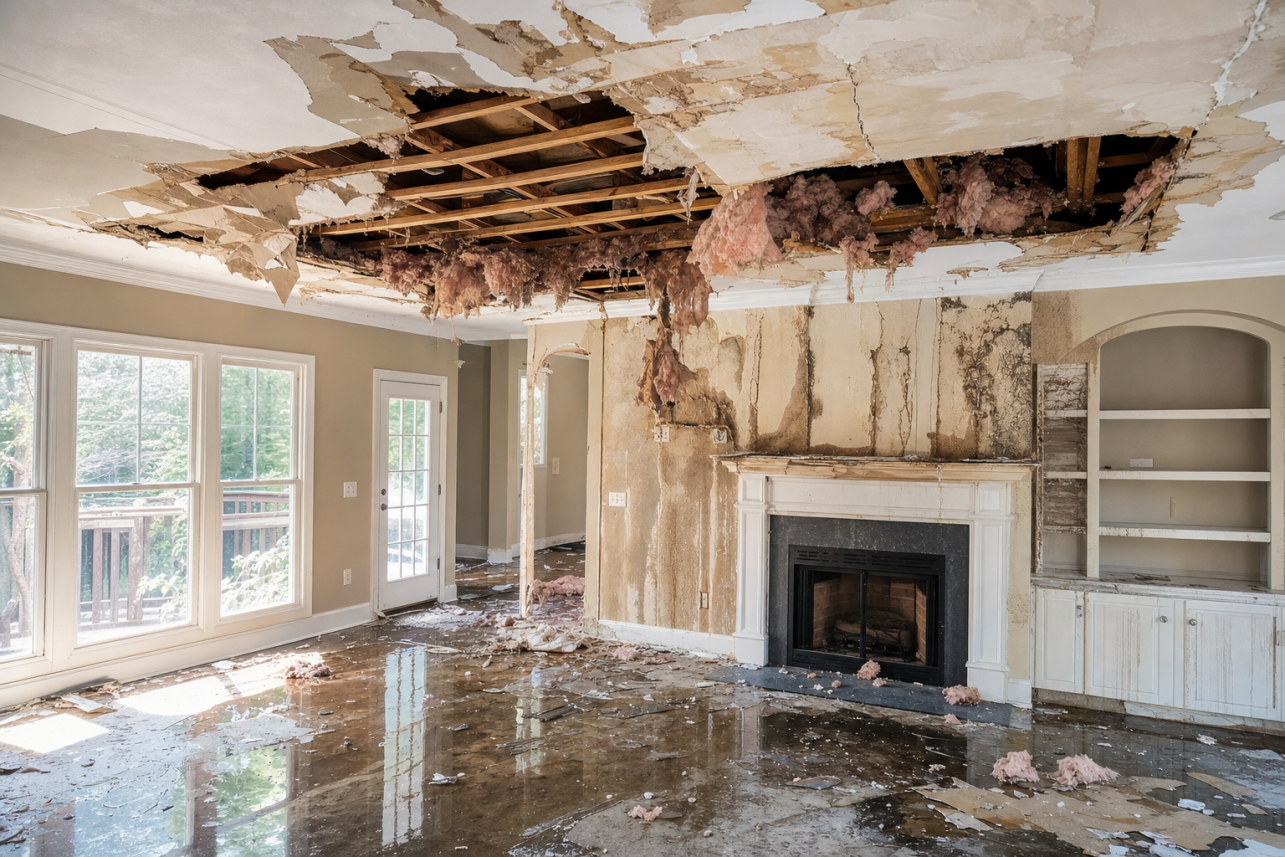
When Should I Contact A Public Adjuster About A Residential Homeowners Claim Raleigh NC Insurers Are About To Inspect?
The best time to call is before the insurance company's adjuster ever sets foot on your property. The carrier's first inspection sets the foundation for the entire claim. What their adjuster photographs, measures, and writes into that initial estimate shapes every payment decision that follows. If damage gets missed or minimized on day one, you spend the rest of the claim trying to correct the record.
When you bring us in early, we document the loss independently, attend the carrier's inspection alongside their adjuster, and make sure the full scope of damage is on the record from the start. That includes things homeowners commonly overlook, like smoke residue inside wall cavities, moisture trapped under flooring, or hail bruising that is not visible from the ground.
That said, it is never too late to get help. We take on claims at every stage, whether you just filed, received an offer that seems low, or got a denial letter. Homeowners across Raleigh call us weeks or even months into a frustrating claim, and we can still re-document the loss and submit supplemental demands.
One practical tip for Wake County homeowners: before any repairs begin, photograph everything and keep damaged materials when you safely can. Your policy requires you to mitigate further damage, such as tarping a hurricane-damaged roof, but do not discard evidence or sign repair contracts under pressure.
We are licensed and bonded in North Carolina, and an initial consultation costs nothing. While no one can guarantee a specific outcome, getting experienced representation early gives your claim its strongest possible start.
How Should I Document Damage Before Filing A Residential Homeowners Claim Raleigh NC Insurers Will Take Seriously?
Thorough documentation is the foundation of a strong claim, and it starts the moment you discover the damage. Photograph and video everything before you move, clean, or repair anything. Capture wide shots of each affected room, then close-ups of individual items, water lines, ceiling stains, charring, or structural cracks.
Next, make reasonable temporary repairs to prevent further damage — tarping a roof opening or shutting off water — and keep every receipt. Your policy requires you to mitigate damage, and those costs are typically reimbursable. Just don't make permanent repairs before the insurer has inspected.
Start a written inventory of damaged contents. For each item, note the brand, model, approximate age, and replacement cost. In our experience with Raleigh homeowners, contents are the most commonly undervalued part of a settlement because policyholders rush this step or skip it entirely.
Finally, keep a claim diary. Log every phone call, email, and visit from the insurance company, including names, dates, and what was said. If a dispute arises later, that record can be invaluable.
When For The Public Adjusters, Inc. is brought in early, we handle much of this for you. We prepare detailed damage estimates using the same software insurance carriers use, build a room-by-room contents inventory, and present the file in a format adjusters can't easily dismiss. Homeowners throughout Wake County often tell us the documentation alone changed the tone of their claim.
What's The Difference Between The Insurance Company's Adjuster And A Public Adjuster Working For A Raleigh Homeowner?
The distinction comes down to one word: loyalty. The adjuster your insurance company sends — whether a staff adjuster or an independent adjuster the carrier hires — works for the insurer. Their estimate protects the company's interests. A public adjuster is licensed to represent only you, the policyholder, and is paid based on what you recover, so our interests align with yours.
That difference matters because coverage disputes are rarely simple. Insurers sometimes read policy language narrowly to limit payouts, and courts have pushed back. In Gaston County Dyeing Machine Co. v. Northfield Insurance Co., 351 N.C. 293 (2000), the North Carolina Supreme Court sided with the insured in a dispute over property damage coverage, rejecting the insurer's restrictive interpretation of when the damage occurred and how the policy applied. Cases like that show carriers don't always get the last word on what a policy covers.
For a typical Raleigh house fire, burst pipe, or hurricane loss, the carrier's adjuster may spend an hour or two on site. We often spend far longer — opening walls where appropriate, moisture-mapping, cataloging contents, and identifying hidden damage the first inspection missed.
You're never required to accept the insurance company's first estimate. North Carolina law gives you the right to hire your own licensed representative, and For The Public Adjusters, Inc. steps into that role so you're negotiating from documented facts, not the carrier's numbers.
Is For The Public Adjusters, Inc. Licensed To Handle Homeowners Claims In North Carolina?
Yes. For The Public Adjusters, Inc. is licensed and bonded in North Carolina, which is a legal requirement for anyone negotiating a Residential Homeowners Claim Raleigh NC policyholders file on a damaged home. The North Carolina Department of Insurance licenses public adjusters, and that licensing exists to protect you — it means we're accountable to the state, carry a bond, and must follow strict rules about contracts, fees, and conduct.
Before hiring anyone to help with your claim, verify their license. Unlicensed "claim consultants" and storm-chasing contractors who offer to negotiate with your insurer are a real problem in Wake County after major weather events, and using one can jeopardize your claim. A quick check with the Department of Insurance confirms who is legitimate.
It's also worth understanding what we handle and what we don't. Our work covers damage to homes, buildings, and their contents — fire and smoke, water and pipe bursts, hurricane and tornado damage, hail, theft, and similar residential property losses. We do not handle claims involving motor vehicles, cell phones, health insurance, or life insurance.
One honest note: no reputable adjuster will promise you a specific dollar outcome, and neither do we. What we can commit to is a licensed, bonded professional reviewing your policy, documenting your loss thoroughly, and negotiating on your behalf so the settlement reflects what your coverage actually provides. That's the standard we hold ourselves to on every Raleigh claim we take.
My Raleigh Home Was Damaged In A Hurricane. Does That Change How My Homeowners Claim Gets Handled?
Hurricane claims are among the most complicated residential losses we see, and Raleigh is no stranger to them — Fran in 1996 and Florence in 2018 both left lasting damage across Wake County. The complexity comes from the mix of perils involved. A single storm can produce wind-driven roof damage, fallen trees, rain intrusion, and rising floodwater, and your policy treats each one differently.
Here's the critical distinction: damage from hurricane winds and wind-driven rain entering through a storm-created opening is typically covered under a standard homeowners policy. Rising water — flooding — is not. Flood coverage comes separately through the National Flood Insurance Program (floodsmart.gov) or a private flood policy, and FEMA (fema.gov) may offer disaster assistance after federally declared events.
Insurers sometimes blur that line in their favor, attributing wind damage to flooding to shift the loss onto an exclusion or a separate policy with lower limits. Sorting out causation — what the wind did versus what the water did — is where an experienced Raleigh public adjuster earns their keep. We document the sequence of damage, apply the correct policy provisions, and push back when the carrier's allocation doesn't match the evidence.
Hurricane claims may also involve separate wind/hail deductibles, which in North Carolina are often a percentage of your dwelling coverage rather than a flat amount. We review your specific policy so you know exactly what applies before you accept any settlement figure. If your storm loss includes both wind and flood components, contact us early — the documentation gathered in the first days often decides how the claim resolves.
Can For The Public Adjusters, Inc. Reopen A Residential Homeowners Claim Raleigh NC Insurers Have Already Closed Or Settled?
In many situations, yes. Closing a claim file does not always mean the matter is finished. If you accepted a payment and later discovered additional damage, or if the settlement did not reflect the true cost of repairs at Raleigh-area labor and material prices, a supplemental claim can often be filed.
Our team reviews your policy, the insurer's estimate, and the actual scope of damage to your home. We frequently find items the carrier's estimate missed entirely — matching requirements for roofing and siding, code-upgrade costs common in older Wake County homes, hidden water damage inside wall cavities, and undervalued contents.
Timing matters. North Carolina generally allows three years to bring a breach-of-contract action on an insurance policy, and individual policies contain their own deadlines for supplements and proof of loss. The sooner we review your file, the more options remain open.
We cannot promise a specific outcome — no honest adjuster can — but we can tell you quickly whether your settlement appears low and whether reopening the claim makes sense. The initial review costs you nothing, and because we are licensed and bonded in North Carolina, we handle the negotiation directly with your carrier so you are not restating your case alone. If a claim was underpaid by thousands of dollars, a supplemental recovery can make a real difference in how your home gets rebuilt.
Does My Homeowners Policy Cover Hotel Stays And Living Expenses While My Raleigh House Is Being Repaired?
Most homeowners policies sold in North Carolina include Additional Living Expenses coverage, often called ALE or Loss of Use. If a covered loss — a kitchen fire, a burst pipe, hurricane damage — makes your home unfit to live in, ALE pays the reasonable increase in your living costs while repairs are completed.
That can include hotel or short-term rental costs, restaurant meals above your normal grocery spending, pet boarding, laundry, and extra mileage if your temporary housing is farther from work or school. In a market like Raleigh, where short-term rental rates have climbed sharply, this coverage is worth real money.
The problem we see constantly is underuse. Families sleep in a smoke-damaged house or crowd in with relatives because the carrier never clearly explained the benefit, or cut off ALE payments before repairs were actually finished. Insurers sometimes tie ALE to their own repair timeline rather than the realistic one, which matters when Wake County contractors are booked out for months after a major storm.
When we handle a homeowners claim in Raleigh, we document habitability from day one, track every eligible expense, and push back when a carrier tries to end ALE prematurely. Keep every receipt from the first night you are displaced — even small expenses add up over a months-long rebuild. While we never guarantee what any policy will pay, making sure Loss of Use coverage is fully claimed is one of the most overlooked ways policyholders leave money on the table.
Will Hiring A Public Adjuster Make My Insurance Company Treat My Raleigh Homeowners Claim Unfairly?
No — and North Carolina law gives you strong protection on this point. Carriers owe every policyholder a duty of good faith, and courts in this state have held insurers accountable when they mishandle property claims. In Gray v. North Carolina Insurance Underwriting Association, the North Carolina Supreme Court allowed homeowners to pursue bad-faith and unfair-practices claims after their insurer refused to fairly pay for hurricane damage to their coastal houses — a decision that put carriers on notice that lowballing and stonewalling property owners carries real legal risk.
In practice, bringing in a licensed representative usually improves how a Residential Homeowners Claim Raleigh NC policyholders file gets handled, not the reverse. The insurance company's adjuster knows the file will now be reviewed by someone who reads policies for a living, measures damage independently, and documents everything in writing. Estimates tend to get more careful, and communication tends to get more responsive.
We are licensed and bonded in North Carolina, and we work within the same claims process your carrier follows — inspections, proof of loss, appraisal when needed. There is nothing adversarial about a homeowner exercising the rights written into the policy they pay for.
We cannot guarantee any particular settlement figure, and we are careful never to promise one. What we can do is make sure your claim is presented completely, priced accurately for the Raleigh market, and pursued persistently until every covered dollar has been fairly considered.

Water Damaged My Crawl Space And Foundation In Raleigh — Is That A Homeowners Claim Or A Flood Claim?
It depends entirely on where the water came from, and the distinction determines which policy responds. A standard homeowners policy typically covers sudden, accidental water discharge — a burst supply line, a failed water heater, an overflowing appliance. Surface water rising from heavy rain, an overflowing creek, or storm runoff is generally considered flood, which homeowners policies exclude.
Flood coverage comes through the National Flood Insurance Program (floodsmart.gov) or a private flood policy. If a storm pushed rising water into your crawl space and you carry NFIP coverage, that claim follows federal rules with its own deadlines and proof-of-loss requirements. FEMA (fema.gov) also offers disaster assistance when a federal disaster is declared for Wake County.
Here is where it gets complicated: many Raleigh losses involve both. A hurricane can drive rain through a damaged roof (homeowners coverage) while runoff floods the crawl space (flood coverage). Carriers sometimes label everything "flood" to shift the loss away from the homeowners policy. Sorting out causation correctly — and documenting it before evidence is cleaned up — is often the difference between a paid claim and a denied one.
Our adjusters inspect the water paths, moisture readings, and structural damage to establish what each policy actually owes. Crawl-space losses in particular hide mold, insulation damage, and ductwork contamination that first estimates routinely miss. We cannot promise a specific result, but we can make sure the cause of loss is documented accurately and each claim is presented to the right insurer with full supporting evidence.
Local Relevance
Raleigh homes face a specific mix of risks. Hurricane remnants track inland through Wake County more often than newcomers expect, bringing wind-driven rain, roof damage, and downed trees. The City of Oaks earns its nickname — and mature oaks coming through roofs are a claim type we know intimately, just as we do with a tree fell on house claim in Morrisville next door.
Humid summers, hard summer thunderstorms, and the occasional winter ice storm add water intrusion and pipe-freeze losses to the list. Older homes inside the Beltline often carry aging roofs and original plumbing, which insurers love to blame instead of the storm or the sudden failure that actually caused the loss.
Flooding is its own category. Standard homeowners policies exclude flood, so if rising water from a creek or heavy rain event damaged your home, that claim runs through your flood policy instead — and the Federal Emergency Management Agency administers that program. We handle flood insurance claims alongside fire, water, smoke, tree, vandalism, and car-hits-home claims throughout Raleigh and Wake County.
Raleigh's dense mature-oak canopy combined with inland hurricane remnants and violent summer thunderstorms means tree-strike and wind-driven water claims tend to dominate here — and because many inside-the-Beltline homes have older roofs, insurers often try to shift blame from the storm to "pre-existing wear," a dispute that careful documentation usually wins.
Get A Free Review Of Your Raleigh Homeowners Claim
Before you accept the insurance company's number — or their denial — let a licensed, bonded public adjuster read your policy and inspect the damage. The review is free, we explain everything in plain English, and you decide whether representation makes sense. No pressure, no empty promises.
Call us: (919) 400-6440
Helpful Resources
- NCDOI Public Adjusters Guide
- Federal Emergency Management Agency (FEMA)
- North Carolina Department of Insurance — State regulator that licenses public adjusters and assists consumers
- FloodSmart, the National Flood Insurance Program — Official federal resource on flood insurance coverage
Last updated: September 30, 2026