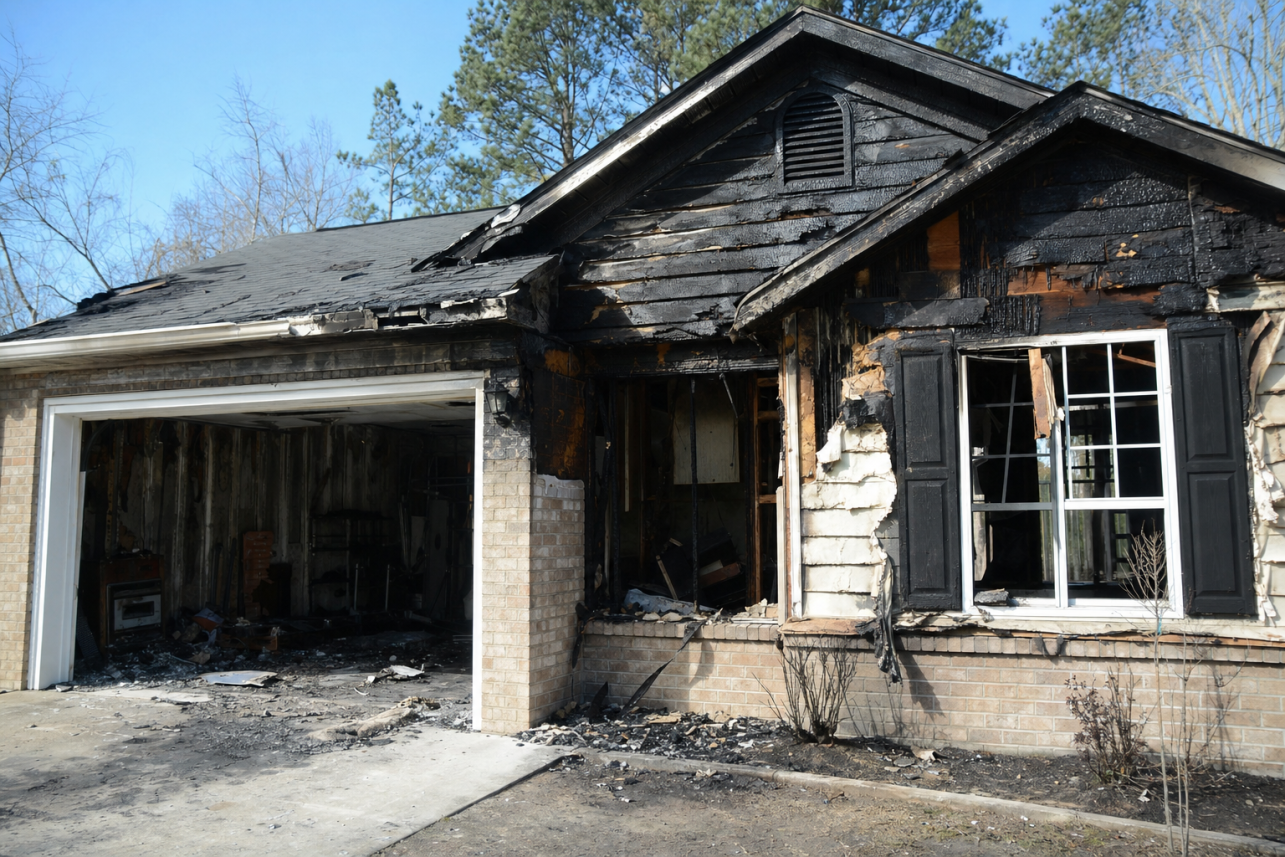
If your insurer has turned your fire loss into an Arson Homeowners Claim Fuquay-Varina investigation, the most important thing to know is this: an accusation is not a denial, and you have rights under North Carolina law. Do not give recorded statements or sit for an examination under oath without preparation, keep every document, and do not let the company stall your claim indefinitely. For The Public Adjusters, Inc. is licensed and bonded, and we represent homeowners — never the insurance company — when a fire claim turns adversarial.
What This Service Is
When a house fire happens in Fuquay-Varina, most homeowners expect their insurance company to help. Instead, some find themselves treated like suspects. The insurer sends out a cause-and-origin investigator, questions the family’s finances, and quietly shifts from paying the claim to building a case against it.
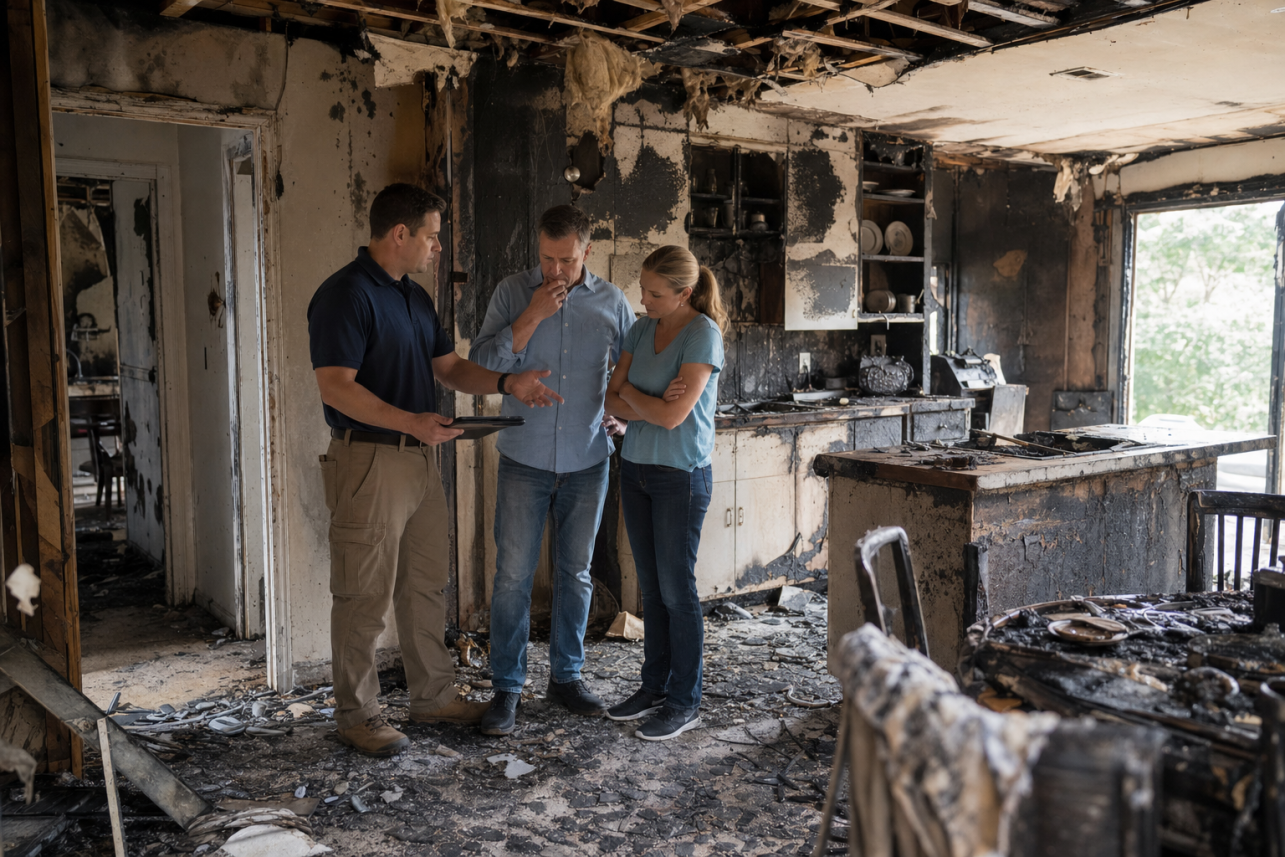
Our job is to stand on your side of that table. As public adjusters, we document the full scope of your fire, smoke, and water damage, prepare the personal property inventory and proof of loss the policy requires, and push back when the carrier delays payment or suggests you had a motive. We handle the claim itself — and when a dispute needs to go further, we work alongside Insurance Dispute Lawyers in Raleigh so the legal and adjusting sides move together.
Fire investigations are supposed to follow science, not suspicion. The National Fire Protection Association publishes the widely accepted methodology fire investigators are expected to use, and when a carrier’s investigator skips steps or jumps to conclusions, that becomes a real weakness in their position. We know how to spot it.
Courts have backed policyholders who push back. In Bi-Economy Market, Inc. v. Harleysville Insurance Co., a New York fire-loss case, the insured prevailed against the insurer after the company’s handling of a building and contents claim caused further harm — a reminder that carriers can be held accountable for how they treat a fire claim, not just whether they eventually pay it. Every claim is different and no one can promise a specific outcome, but you do not have to accept the insurer’s first answer.
Common Problems
The Fire Destroyed Everything — What Am I Actually Owed While They Investigate?
An arson investigation does not erase what your policy promises. You may still be owed the cost to rebuild the structure, replace your contents, and cover temporary housing while your home is unlivable — often called loss of use benefits.
Many families in this situation quietly drain savings on hotels and rentals because the carrier says everything is ‘on hold.’ Meanwhile the mortgage lender still expects payments, and the lender is usually named on any settlement check, which adds another layer to sort out.
We build the full dollar value of your loss item by item, room by room, so that when the investigation ends, you are not left arguing from memory. Homeowners who let the insurer set the numbers routinely end up underpaid, the same problem we see on a Fire Damage Claim Help For Homeowner Cary NC file where no accusation was ever made.
The Insurer Suspended My Arson Homeowners Claim Fuquay-Varina And Wants Me Under Oath — What Now?
This is the moment most homeowners feel the ground shift. The company suspends payment ‘pending investigation,’ asks for bank records, tax returns, and a list of your debts, and then schedules an examination under oath — sworn testimony their lawyer will comb through later.
You generally must cooperate with reasonable requests, but cooperation does not mean walking in blind. Innocent people hurt their own claims every day by guessing at answers, misremembering timelines, or signing broad authorizations they never read.
Understand the two tracks, too: a fire marshal’s criminal inquiry and the insurer’s civil claim decision are separate things. Being cleared criminally does not force the insurer to pay, and a claim denial is not a criminal charge. We help you keep both tracks straight, meet every policy deadline, and document that any delay is theirs, not yours — because a carrier that drags its feet in bad faith can be answerable for it under North Carolina law.
Should I Fight This Myself, Hire A Lawyer, Or Bring In A Public Adjuster?
Going it alone against a carrier’s investigator, in-house counsel, and desk adjuster is a mismatch, plain and simple. They handle accused-arson files every week; you are living through your first one while displaced from your home.
A good public adjuster does three things a homeowner cannot easily do: values the entire loss correctly, manages the paperwork and deadlines that trip people up, and recognizes when an investigation has crossed from fact-finding into pressure tactics. The NCDOI Public Adjusters Guide explains how public adjusters are licensed in North Carolina and what they may charge — read it, and verify anyone you consider hiring.
Lawyers matter when litigation looms, and we bring them in at the right moment rather than the expensive one. We have guided families through the same accusation on an Arson Homeowners Claim Help in Apex and an Arson Homeowners Claim in Clayton, and the pattern of pressure is remarkably consistent from one carrier to the next.

Our Process
Protect Your Position Immediately
Before anything else, we review your policy, identify every coverage that applies — dwelling, contents, loss of use, debris removal — and lock down the evidence. That means photographs, the fire department report, witness information, and a preserved scene where possible.
We also make sure you stop volunteering unprepared statements. From this point forward, communication with the carrier is documented and deliberate.
Build The Independent Case
The insurer’s investigator works for the insurer. Where the cause-and-origin findings look thin or predetermined, we help arrange an independent fire investigator to review the evidence against accepted fire-science methodology.
At the same time, we prepare your sworn proof of loss and a detailed personal property inventory. When you are the one under scrutiny, precise, verifiable documentation is your best defense.
Push The Claim To Resolution
We present the full, documented value of your loss and hold the carrier to the timelines and duties your policy and North Carolina law impose. If the company delays, lowballs, or denies without a supportable basis, we escalate — including complaints to regulators and coordination with counsel when needed.
We are licensed and bonded, we cannot and will not promise a specific dollar result, but we can promise the insurer will no longer be negotiating against someone who is alone.
| Approach | What Typically Happens | Risk to the Homeowner |
|---|---|---|
| Handle the accusation alone | You face the SIU, recorded statements, and an Examination Under Oath without preparation, relying on the insurer’s own fire investigator’s conclusions. | High — innocent statements get twisted, deadlines pass, and evidence at the fire scene is demolished before anyone independent examines it. |
| Hire a Fuquay-Varina public adjuster | An independent origin-and-cause expert reviews the scene, the contents inventory and proof of loss are built professionally, and every carrier communication is documented. | Low — the burden of proving arson stays on the insurer, where North Carolina law puts it, and the claim moves forward instead of stalling. |
| Go straight to litigation | An attorney files suit, which can take years, while the underlying claim documentation may still be incomplete. | Moderate — sometimes necessary, but many accusations collapse earlier once independent fire science and case law like Watson v. USAA are put on the table. |
| Accept the denial and walk away | The insurer’s arson theory stands unchallenged and the mortgage on the damaged home remains due. | Severe — homeowners have won these disputes in court, so surrendering means abandoning money and a reputation you may well be entitled to keep. |
Commonly Overlooked In The Public Adjusting Industry
- The insurer carries the burden of proving arson — Accused homeowners assume they must prove their innocence, when in fact the carrier must prove incendiary origin, motive, and opportunity — and many quietly fold when pressed to do it.
- NFPA 921 compliance by the carrier’s fire investigator — Flashover and post-flashover burning create patterns that look like accelerant pours, and investigators who skip the scientific method reach arson conclusions that don’t survive expert scrutiny.
- Spoliation of the fire scene — Homeowners let the carrier’s contractor demolish and haul debris before an independent expert examines it, destroying the very evidence that could disprove the accusation.
- The innocent co-insured doctrine — Spouses and co-owners accept blanket denials without knowing courts in cases like Watson v. USAA and Steigler v. INA have paid innocent policyholders even when a co-insured set the fire.
- The sworn proof of loss deadline — Families focus so hard on fighting the accusation that they miss the policy’s filing deadline, handing the insurer a second, purely procedural reason to deny.
- Retroactive additional living expenses — When carriers cut off hotel and rental payments during an arson investigation, few homeowners realize those months of displacement costs are often recoverable once the theory collapses.
- The difference between a recorded statement and an Examination Under Oath — People treat both as casual conversations, not realizing the EUO is sworn testimony that will be compared word-for-word against everything they said earlier.
- Smoke and soot damage in untouched rooms — While everyone argues about how the fire started, corrosive soot residue quietly ruins electronics, HVAC systems, and contents in rooms that never burned — and it rarely makes the carrier’s first estimate.
Case Studies
Case Study #1
Situation: A family off Judd Parkway in Fuquay-Varina lost most of their kitchen and attic to a nighttime fire. The Fuquay-Varina Fire Department extinguished it quickly, but the insurer’s Special Investigations Unit opened a file within days.
Problem: The carrier’s fire investigator reported ‘irregular burn patterns’ near the stove and flagged the family’s recent credit card debt as a possible motive. The insurer demanded an Examination Under Oath and three years of bank statements, and stopped paying additional living expenses while the family stayed in a Holly Springs hotel.
Investigation: We brought in an independent origin-and-cause expert who followed NFPA 921, the recognized standard for fire investigation. He documented the scene before the carrier’s contractor could demolish it, photographed the electrical service, and pulled the appliance for lab examination.
Findings: The ‘pour patterns’ the insurer cited were actually flashover artifacts — a known error NFPA 921 specifically warns against. The lab traced ignition to a failed connection inside the range’s terminal block. There was no accelerant residue in any of the debris samples.
Solution: We submitted the expert report, prepared the homeowners for their Examination Under Oath, and reminded the carrier in writing that North Carolina law places the burden of proving arson on the insurer, not the policyholder. We also rebuilt the contents inventory room by room with pre-fire photos the family had in cloud storage.
Outcome: The insurer withdrew the arson theory, reinstated the additional living expense payments retroactively, and settled the dwelling and contents claim. Every case is different and results vary, but this family kept their home and their reputation.
Lesson: Flashover can mimic accelerant patterns, and an under-trained fire investigator can turn an accident into an accusation. Getting an independent NFPA 921 expert on scene before demolition is often the single most important move an accused homeowner can make.
Case Study #2
Situation: A woman near the Varina downtown district was going through a separation when her detached garage and part of her home burned. Investigators determined the fire was intentionally set — and evidence pointed to her estranged husband, who was still named on the policy.
Problem: The insurance company denied her entire homeowners claim, arguing that because a named insured committed arson, no one on the policy could recover. She was told, in effect, that his crime erased her coverage on a house she was still paying for.
Investigation: We reviewed the exact policy language against North Carolina’s standard fire policy requirements and researched the innocent co-insured doctrine. We also documented her separation timeline, her lack of access to the property that night, and law enforcement records showing she was a victim, not a participant.
Findings: Courts across the country have protected innocent co-insureds in exactly this situation. In Watson v. United Services Automobile Association, the Minnesota Supreme Court held that an innocent spouse could recover under the fire policy after the other spouse intentionally set fire to the home. In Steigler v. Insurance Company of North America, the Delaware Supreme Court likewise allowed an innocent wife to recover her interest after her husband’s arson.
Solution: We presented the denial team with a coverage position letter citing that line of authority, her documented separation, and her insurable interest in the dwelling. We prepared a full sworn proof of loss for her interest in the home and contents rather than letting the deadline lapse during the dispute.
Outcome: The carrier reversed course and paid her share of the loss rather than test the innocent co-insured argument in court. Results always depend on the specific policy and facts, but she was not punished for someone else’s crime.
Lesson: A denial letter is an argument, not a verdict. Innocent co-insureds have won these fights in courtrooms — Watson and Steigler prove it — and homeowners should never assume the first denial is the final word.
| What the Insurer Does | What It Usually Signals | Smart Next Step |
|---|---|---|
| Sends a reservation of rights letter | The company is paying to investigate while preserving its right to deny — the claim is officially under suspicion. | Keep cooperating in writing, but get independent representation before giving any further statements. |
| Requests a recorded statement | Adjusters are building a transcript they can compare against your later Examination Under Oath, line by line. | Don’t wing it. Review your policy and timeline first, and have someone experienced help you prepare. |
| Demands an Examination Under Oath | The SIU is escalating — an EUO is sworn testimony, and refusing outright can void coverage under most policies. | Attend, but prepare thoroughly; you’re entitled to preparation and to have counsel or your adjuster involved. |
| Asks for bank records and tax returns | They’re hunting for a financial motive, one of the three legs of an arson defense along with opportunity and incendiary origin. | Provide what the policy reasonably requires, with context — debt alone doesn’t prove arson, and courts have said so. |
| Schedules demolition or debris removal | Critical fire-cause evidence is about to disappear, which can cripple your ability to disprove their theory. | Object in writing and get your own NFPA 921 origin-and-cause expert on scene before anything is removed. |
| Stops paying additional living expenses | The carrier is applying financial pressure while the investigation drags on. | Document every displacement cost and demand written justification — ALE often owes retroactively if the accusation fails. |
| Issues a denial citing intentional acts | The insurer believes it can prove arson by a preponderance of evidence — but that’s their burden to carry in court. | Don’t accept it as final. Innocent policyholders prevailed in Watson v. USAA and Steigler v. INA; get the denial reviewed. |
Reviews
After our house fire on the south side of town, the insurance company’s investigator basically treated me like a suspect. They wanted my tax returns, my bank records, everything. For The Public Adjusters brought in their own fire expert who proved the fire started in the panel box. They sat with me through the Examination Under Oath prep and never once let the carrier push us around. The claim got paid, and more importantly, my name got cleared.
Marcus T., Fuquay-Varina
The SIU letter accusing us of setting our own fire was the scariest mail I’ve ever opened. We had lived in that Fuquay house for eleven years. This team explained that the insurer has to prove arson, not the other way around, and they documented every single item we lost down to my grandmother’s china. It took months, but they never went quiet on us, and the settlement covered the rebuild and our rental in the meantime.
Danielle R., Wake County
My only complaint is that I didn’t call them sooner — I gave a recorded statement alone before I hired them, and untangling a few things I said under stress took extra work. Once For The Public Adjusters took over, they got a real NFPA 921 investigation done before the carrier’s contractor gutted the evidence. Licensed, bonded, and honest about what they could and couldn’t promise. The arson allegation was dropped.
Kevin O., Willow Spring
Frequently Asked Questions
What Should I Do First If My Insurer Accuses Me Of Setting The Fire During An Arson Homeowners Claim Fuquay-Varina?
Stay calm and stop volunteering information. An arson accusation is a legal defense the insurance company is building, and everything you say in recorded statements can be used to support a denial. Politely acknowledge requests, then get professional representation before you respond in depth.
Start preserving evidence immediately. Photograph the damage from every angle, keep receipts for temporary housing and emergency repairs, and do not throw anything away — even badly burned contents. The fire scene itself matters too; if the insurer’s investigators have examined it, you have the right to have your own experts do the same.
Request a complete copy of your policy in writing, including all endorsements. Carriers in Wake County are required to provide it, and the exact wording of the intentional-acts exclusion and your duties after loss will shape every step that follows.
Finally, cooperate — but on the record and with guidance. North Carolina policies require reasonable cooperation, and refusing outright can hurt you. What you should not do is sit for an examination under oath or sign sworn proof-of-loss documents without preparation. Our team at For The Public Adjusters, Inc. is licensed and bonded, and we work only for the policyholder, never the carrier. We help Fuquay-Varina homeowners document the loss, respond to investigators properly, and push back when an accusation is built on speculation rather than evidence.
Does The Insurance Company Have To Prove Arson, Or Do I Have To Prove My Innocence?
In North Carolina, the burden sits squarely on the insurance company. When a carrier raises arson as a defense in an Arson Homeowners Claim Fuquay-Varina, it must prove — by the greater weight of the evidence — that the fire was intentionally set and that you were connected to it. You do not have to prove you didn’t do it.
The controlling authority is Bryant v. Nationwide Mutual Fire Insurance Co., 313 N.C. 362 (1985). In that case, a North Carolina homeowner’s house was destroyed by fire and the insurer denied the claim, alleging the insured burned it. The Supreme Court of North Carolina sided with the policyholder on the key legal question, holding that arson is an affirmative defense the insurer must plead and prove. Suspicion, financial difficulty, or an undetermined fire cause is not enough on its own.
That matters here in Wake County because many accusations rest on circumstantial theories: the origin couldn’t be determined, the homeowner was behind on a mortgage, or an accelerant-detection dog alerted at the scene. Each of those can be challenged with independent cause-and-origin experts and a properly documented claim file.
Our role is to make sure the evidence actually supports payment — a thorough inventory of contents, accurate structural estimates, and expert reports that address the carrier’s theory head-on. We never guarantee an outcome, but we make certain the insurer is held to the burden the law places on it, not the other way around.
The Carrier Wants An Examination Under Oath About My Fuquay-Varina House Fire. Do I Have To Go, And Should I Go Alone?
Most North Carolina homeowners policies do require you to sit for an examination under oath (EUO) if the carrier demands one, and refusing can give the insurer grounds to deny the claim for failure to cooperate. So yes, you generally must attend — but you should never walk in unprepared.
An EUO in a suspected-arson investigation is nothing like a routine claim interview. A defense attorney hired by the insurance company will question you under oath about your finances, your whereabouts before the fire, prior claims, your mortgage status, and the contents you’re claiming. Inconsistent or careless answers, even innocent ones, become exhibits in a denial letter.
Before any examination, your claim file should already be in order. That means a complete, itemized contents inventory with values and documentation, records supporting your whereabouts, and your own expert’s cause-and-origin findings where the carrier’s report is disputed. Preparation is where accused homeowners win or lose these investigations.
You are entitled to have representation, and many policyholders bring an attorney for the examination itself. As your public adjuster in Fuquay-Varina, we handle the claim side: assembling the documentation the questions will target, coordinating with your counsel if you retain one, and making sure the sworn proof of loss you submit is accurate and complete. Small errors in that sworn document are one of the most common tools carriers use to justify a denial, so precision matters.
How Can For The Public Adjusters, Inc. Help A Fuquay-Varina Homeowner Who’s Been Accused Of Burning Their Own Home?
We level the playing field. When a carrier suspects arson, it deploys special investigations unit (SIU) adjusters, cause-and-origin engineers, and defense attorneys. A homeowner facing that alone is badly outmatched. As licensed and bonded public adjusters, we represent only you — never the insurance company.
Our work on a suspected-arson fire loss in the Fuquay-Varina area typically includes securing an independent cause-and-origin expert to review or challenge the insurer’s fire investigation, building a room-by-room contents inventory with replacement values, preparing detailed structural repair estimates, and documenting additional living expenses while you’re displaced from your home near downtown, South Lakes, or anywhere else in southern Wake County.
We also manage the paper war. Accusation-driven claims come with heavy document demands — bank records, tax returns, phone records, mortgage statements. We help you respond completely and on time, because missed deadlines and incomplete responses are exactly what denial letters are built on.
North Carolina law is on the honest policyholder’s side: as the state Supreme Court confirmed in Bryant v. Nationwide, the insurer bears the burden of proving an intentional fire. Our job is to hold them to it with evidence, not arguments. We can’t promise a specific dollar result — no honest adjuster can — but we can promise your claim will be documented, valued, and presented the way the policy and the law require. If your situation also involves flood or water intrusion alongside the fire, we’ll point you to FEMA and NFIP resources for that portion of the loss.
Will My Insurer Still Pay For Temporary Housing During An Arson Homeowners Claim Fuquay-Varina Investigation?
In most cases, yes — your additional living expense (ALE) coverage does not automatically shut off just because the carrier has opened an arson investigation. Until the insurer formally denies the claim, most policies obligate them to keep the claim moving, and that includes reasonable housing, meals above your normal costs, and related expenses while your home is uninhabitable.
That said, some carriers slow-walk ALE payments during a fraud investigation, hoping financial pressure pushes the homeowner into a quick, low settlement or a misstep during questioning. Document everything: keep receipts for your hotel or rental, save every email, and put every request to the adjuster in writing.
If the carrier cuts off ALE without a formal denial letter explaining the policy basis, that decision can be challenged. North Carolina’s Unfair Claim Settlement Practices statute requires insurers to conduct reasonable investigations and communicate promptly, and an accusation alone is not a denial.
Our team handles this regularly for Fuquay-Varina and Wake County families. We track your ALE entitlement day by day, submit expense documentation in the format carriers cannot easily dispute, and push back in writing when payments stall. As a licensed and bonded firm, we cannot promise a specific outcome, but we can make sure the carrier follows the policy and the law while the investigation runs its course — instead of using the investigation itself as a pressure tactic against you.
What Kind Of Evidence Does The Insurance Company Use To Accuse A Homeowner Of Arson, And How Is It Challenged?
Carriers typically build an arson accusation on three legs: proof the fire was intentionally set (incendiary origin), motive (usually financial trouble like debt, foreclosure risk, or a recent policy increase), and opportunity (you were present or had access). If any leg is weak, the accusation can collapse.
The origin-and-cause investigator the insurer hires works for the insurer. Their report may lean on burn patterns, accelerant claims, or eliminated causes that an independent fire expert would read very differently. Modern fire science under NFPA 921 has discredited many older ‘arson indicators,’ and a qualified independent investigator can expose those flaws.
Courts have held insurers to their burden on this. In McGory v. Allstate Insurance Co., 527 So. 2d 632 (Miss. 1988), a homeowner’s fire claim was denied on arson grounds, but the court sided with the insured because the carrier’s circumstantial evidence of motive and opportunity fell short of proving the policyholder actually set the fire. The lesson for a Fuquay-Varina homeowner is that suspicion is not proof.
We help level the field: we review the carrier’s expert report, coordinate independent origin-and-cause analysis when warranted, document your whereabouts and finances accurately, and make sure the structure and contents damage is fully valued so the claim is decided on facts, not assumptions.
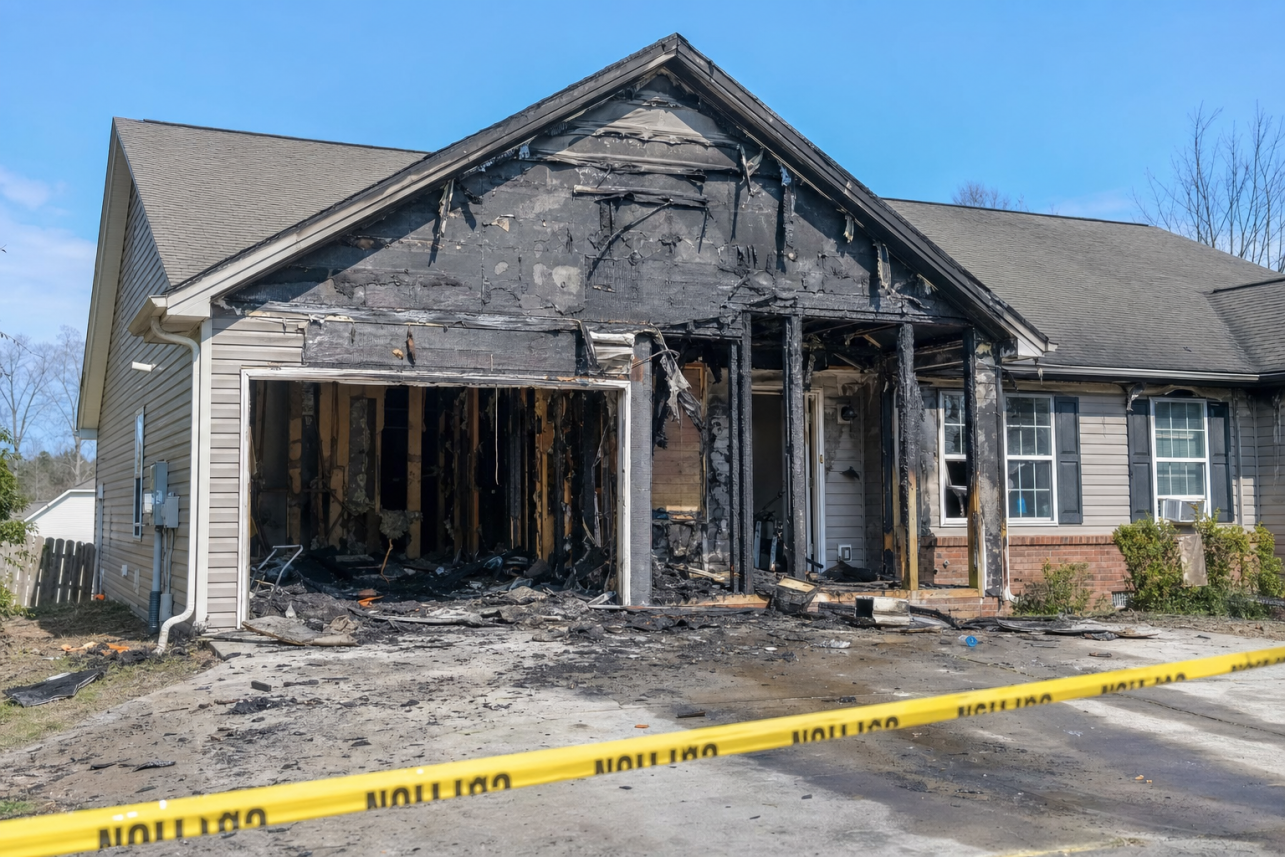
The Fire Marshal In Wake County Listed My Fire As ‘undetermined.’ Can The Insurer Still Deny My Claim For Arson?
An ‘undetermined’ finding from the Fuquay-Varina fire department or a Wake County fire investigator does not stop a carrier from raising an arson defense — but it makes the insurer’s job much harder, and that works in your favor.
The public investigator’s job is to find the cause. The insurance company’s hired expert has a different incentive, and it is not unusual for the carrier’s investigator to call a fire ‘incendiary’ after the public authority could not determine a cause. When those two conclusions conflict, the disagreement itself becomes powerful evidence for the homeowner.
Remember that in a civil arson defense, the insurer must prove its case — typically incendiary origin plus your motive and opportunity. An official ‘undetermined’ finding directly undercuts the first element. Request a copy of the fire department report and any state investigator’s report right away, before memories fade and the scene changes.
Also important: do not authorize demolition or major cleanup until both sides have documented the scene. Destroying evidence, even innocently, can be used against you.
As your public adjuster in Fuquay-Varina, we preserve and photograph the scene, obtain the official reports, compare them against the carrier’s expert findings, and inventory every damaged item of contents so the claim’s value is established even while the cause dispute plays out. We are licensed and bonded, and while no one can guarantee a result, an ‘undetermined’ official finding is a meaningful fact we make sure the carrier cannot ignore.
How Long Does An Arson-Accusation Fire Claim Take To Resolve, And What Deadlines Should I Watch In North Carolina?
Expect a fraud-flagged fire claim to take longer than a routine one — often six months to a year or more, depending on whether the carrier demands an examination under oath, financial records, or independent expert reports. That timeline is frustrating, but rushing can hurt you more than waiting.
Two deadlines matter most. First, your policy almost certainly contains a proof of loss requirement, often due within 60 days of the carrier’s request. Missing it or filing an incomplete, inconsistent proof of loss hands the insurer ammunition, so it must be accurate to the dollar. Second, North Carolina’s standard fire policy language and most homeowner policies impose a contractual deadline to file suit — commonly within one to three years of the loss. If negotiations drag, that clock keeps running.
During an Arson Homeowners Claim Fuquay-Varina homeowners should respond to every reasonable carrier request promptly and in writing, because unexplained silence gets characterized as ‘failure to cooperate,’ which is itself a denial ground under most policies.
For The Public Adjusters, Inc. manages the calendar for you: we prepare a detailed, defensible proof of loss covering the dwelling, contents, and additional living expenses; we respond to document demands on time; and we keep a written record showing you cooperated at every step. That paper trail protects you whether the claim settles at the adjusting stage or ends up in front of a Wake County jury deciding whether the carrier ever proved its accusation.
The Insurer’s Special Investigations Unit Keeps Calling Me. Should I Keep Talking To Them Without Representation?
Be careful. Once a fire claim is referred to a Special Investigations Unit, the carrier is no longer just adjusting your loss — it is building a file. Everything you say in those calls can be compared against your recorded statement, your examination under oath, and your written proofs of loss. Small, innocent inconsistencies about times, whereabouts, or the condition of the home are exactly what denial letters are built on.
You do have a duty under your policy to cooperate, so refusing all contact is not the answer. The smarter move for a Fuquay-Varina homeowner is to route communication through a licensed representative, keep everything in writing where possible, and answer only what is asked — accurately and without guessing.
As a licensed and bonded public adjusting firm, For The Public Adjusters, Inc. manages that communication for policyholders across Wake County. We help you satisfy your cooperation duties without volunteering statements that get twisted later. If the SIU requests documents, we make sure the requests are reasonable, relevant, and answered consistently.
One practical tip: keep a log of every call, letter, and email, including dates, names, and what was discussed. If the investigation later becomes a coverage dispute, that log can show you cooperated fully — which matters, because failure to cooperate is a separate denial ground insurers sometimes add on top of an arson accusation.
Can The Carrier Deny My Arson Homeowners Claim Fuquay-Varina Just Because I Was Behind On My Mortgage Or In Debt?
No — financial trouble alone is not proof of arson, and it is not a lawful basis to deny an Arson Homeowners Claim Fuquay-Varina by itself. Insurers frequently point to a pending foreclosure, credit card debt, a recent job loss, or a home listed for sale as evidence of ‘motive.’ But motive is only one leg of the arson defense. In North Carolina, the insurer generally must also show the fire was incendiary in origin and that the insured had the opportunity to set it or arrange it.
Plenty of honest Fuquay-Varina families carry debt. If financial stress were enough to deny fire claims, almost no fire claim would ever be paid. Courts recognize this, which is why carriers who rely on motive alone take on real risk when the dispute reaches a jury.
What you should do is get ahead of the narrative. Gather your mortgage statements, bank records, and any documentation showing the home was maintained, insured appropriately, and not over-insured relative to its value. If your coverage limits roughly match replacement cost, that undercuts the theory that you stood to profit from the fire.
Our team reviews the carrier’s stated reasons line by line and pushes back where the ‘motive’ evidence is thin or mischaracterized. We cannot guarantee any specific outcome — no honest firm can — but we can make sure a denial built on your bank balance instead of actual fire-scene evidence does not go unchallenged.
Have Homeowners Actually Won In Court After Being Accused Of Setting Their Own Fire?
Yes, and it happens more often than insurance companies would like policyholders to know. A frequently cited example is Weiss v. United Fire and Casualty Co., 197 Wis. 2d 365 (1995). United Fire denied a fire loss on a building, alleging the insured was responsible for the blaze. The insured fought back, a jury rejected the insurer’s arson defense, and the Wisconsin Supreme Court upheld the verdict for the policyholder — including a finding that the insurer had acted in bad faith in how it investigated and denied the claim.
The lesson from cases like Weiss applies directly to a homeowner in Fuquay-Varina facing an arson accusation: an insurer’s suspicion is not the final word. When a carrier’s investigation is one-sided — when it ignores alternative causes, cherry-picks facts, or leans on financial motive without solid origin-and-cause evidence — juries and judges can and do side with the insured.
Most accused homeowners never need a courtroom, though. A well-documented, professionally presented claim often resolves the accusation during the adjustment process. That means an independent origin-and-cause review, a complete contents inventory, a clean timeline of your whereabouts, and consistent, documented cooperation.
For The Public Adjusters, Inc. builds that record from day one, so if your Wake County fire claim ever does end up in front of a lawyer or a jury, the evidence is already organized in your favor. We never promise a specific result, but a strong file changes how carriers behave.
How Do I Document My Contents And Belongings During An Arson Homeowners Claim Fuquay-Varina Without Helping The Insurer’s Accusation?
Documentation is where accused homeowners either protect themselves or hand the carrier ammunition, so treat your contents inventory in an Arson Homeowners Claim Fuquay-Varina as evidence, not paperwork.
Start by photographing everything at the fire scene before anything is moved — burned items included. Insurers sometimes argue that valuables were removed before the fire, which they treat as a sign of a planned loss. Photos showing electronics, jewelry boxes, family heirlooms, and everyday possessions in the debris directly rebut that theory.
Next, build your inventory room by room. For each item, note the brand, approximate purchase date, purchase price, and replacement cost. Pull receipts, bank and credit card statements, Amazon and store order histories, and pre-loss photos or videos from your phone. Old holiday photos taken inside your home are surprisingly powerful — they show what was actually there.
Be accurate, not aggressive. Overstating values or listing items you cannot support gives the carrier a separate fraud argument even if the arson theory collapses. Consistency between your inventory, your recorded statement, and any examination under oath is critical.
Our adjusters prepare contents inventories for fire losses throughout Fuquay-Varina and the rest of Wake County, and we know the level of detail carriers demand when arson is alleged. We help you value items correctly under your policy’s replacement-cost or actual-cash-value terms, and we make sure the inventory tells the same story as the rest of your claim file.
Does Hiring A Public Adjuster Make Me Look Guilty During An Arson Homeowners Claim Fuquay-Varina Investigation?
No, and any suggestion otherwise is a pressure tactic. Hiring licensed representation for a fire claim is no different than hiring an accountant for an audit or an attorney for a contract dispute. It signals that you take the process seriously and intend to comply with your policy duties correctly, not that you have something to hide.
In fact, homeowners who navigate an arson accusation alone are far more likely to make innocent mistakes the carrier can use against them, like giving inconsistent estimates of contents values or missing a documentation deadline. A licensed, bonded public adjuster keeps every submission accurate, complete, and on time.
Courts have repeatedly held that insurers must actually prove an arson defense, not just imply it. In Osbon v. National Union Fire Insurance Co., 632 So.2d 1158 (La. 1994), the insurer denied a homeowner’s fire claim on suspicion of arson, but the court found the carrier’s circumstantial evidence of motive and opportunity fell short, and the insured recovered for the destroyed home. Cases like that exist because policyholders pushed back with organized, well-documented claims.
For The Public Adjusters, Inc. works these accusation cases across Wake County, including neighborhoods off Judd Parkway and out toward Willow Spring. We document the loss independently, manage communication with the carrier’s investigators, and hold the insurer to the burden of proof North Carolina law places on it. We never guarantee a specific outcome, but we make certain your side of the file is complete and defensible.
My Spouse Is The One The Insurer Suspects. Can I Still Recover As An Innocent Co-Insured On Our Fuquay-Varina Fire Claim?
Possibly, yes. This is known as the innocent co-insured doctrine, and it matters in accusation cases where the carrier points at only one person named on the policy. The answer depends heavily on your policy’s exact wording, so the first step is a careful read of the intentional-acts and concealment provisions in your specific contract.
Courts have sided with innocent spouses in home fire cases. In Hedtcke v. Sentry Insurance Co., 109 Wis. 2d 461 (1982), a fire destroyed the family home and the insurer refused to pay the wife because it suspected her estranged husband set the blaze. The Wisconsin Supreme Court held that her interest in the property could not automatically be wiped out by his alleged wrongdoing, and she was permitted to pursue recovery for her share.
The analysis often turns on whether the policy excludes losses caused by “an insured” versus “the insured,” and how state law treats each phrasing. In separation and divorce situations, which come up more often than people expect in these files, your ownership interest in the Fuquay-Varina property also matters.
If you are the co-insured being lumped into an accusation you had nothing to do with, do not accept the denial at face value. We review the policy language, separate your interest from the accused party’s, document your dwelling and contents losses independently, and press the carrier to evaluate your claim on its own merits rather than by association.
Could I Face Criminal Charges Too, Or Is The Insurer’s Accusation A Separate Matter?
They are two different tracks, and understanding the difference protects you. A criminal arson charge can only come from law enforcement, meaning the Fuquay-Varina Fire Department’s investigation, the Wake County fire marshal, or the SBI, and prosecutors must prove guilt beyond a reasonable doubt. An insurer accusing you during an Arson Homeowners Claim Fuquay-Varina is a civil coverage dispute, where the carrier must prove its arson defense by a lower standard, typically a preponderance or greater weight of the evidence.
Here is why that matters practically. An insurance company can deny a claim on arson grounds even if you are never arrested and never charged. The reverse is also true: the absence of criminal charges does not automatically force the carrier to pay, though it significantly weakens their position and is powerful evidence in your favor.
Everything you say in the insurance process, including recorded statements and examinations under oath, can potentially be shared with law enforcement. That is why anything beyond routine claim handling deserves careful preparation, and why some homeowners also consult a criminal defense attorney as a precaution even when charges seem unlikely.
Our role sits on the civil side. We handle the property claim itself: the dwelling estimate, the contents inventory, additional living expenses, and communication with the adjusters and investigators the carrier assigns. We coordinate with your attorney when one is involved, so the insurance claim moves forward without creating exposure on the criminal side. Keeping those two tracks organized is often the difference between a stalled file and a resolved one.
The Insurance Company Sent Me A Non-Waiver Agreement And A Sworn Proof Of Loss. Should I Sign Them?
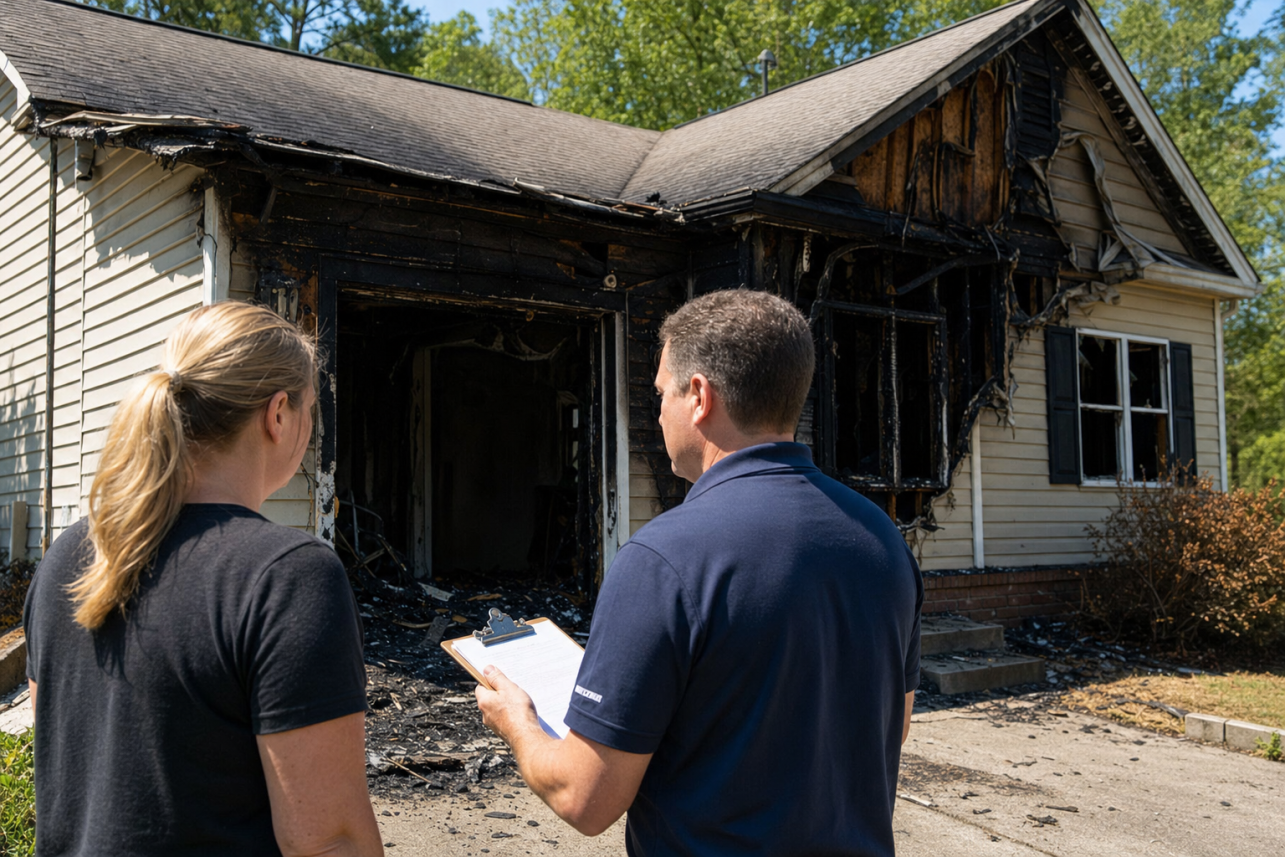
Do not sign anything until you understand exactly what it does, because both documents carry real consequences in an accusation case.
A non-waiver agreement, or reservation of rights letter, is the carrier telling you it will keep investigating and paying certain things without giving up its right to later deny the claim entirely. Signing one is common, but the wording varies, and some versions ask you to concede more than the law requires. Have it reviewed before you agree to anything.
The sworn proof of loss is even more critical. It is a notarized statement of your damages, and in suspected-arson files the insurer’s Special Investigations Unit will comb through it looking for any inflated figure, misremembered purchase date, or overlooked item to build a material misrepresentation defense. An honest mistake on a rushed proof of loss has sunk otherwise valid fire claims. North Carolina policies also impose a deadline for submitting it after the carrier demands one, so ignoring the form is not an option either.
This is precisely where a Fuquay-Varina public adjuster earns their keep. We prepare the proof of loss from documented evidence: our own dwelling estimate, a room-by-room contents inventory with replacement pricing, and receipts for your additional living expenses. Every number is supportable before it goes out the door.
If your fire also caused water or flooding issues from suppression efforts or storm exposure afterward, note that separate flood coverage runs through the NFIP, and FEMA’s resources at fema.gov can help you sort out what falls under which program.
Local Relevance
Fuquay-Varina has grown fast, and its housing reflects that: older frame homes around the historic downtown sit alongside waves of newer subdivisions built during Wake County’s boom. That mix matters in a fire investigation, because aging wiring, renovations in progress, and homes briefly vacant between owners are all conditions investigators scrutinize — and sometimes misread as suspicious.
We see the same dynamics across the Triangle, whether it is an Arson Insurance Claim in Durham or a fire loss closer to home. Local homeowners also face a practical squeeze: with the area’s tight housing market, temporary rentals are expensive, which makes prompt loss-of-use payments even more critical while a claim sits under investigation.
For families elsewhere in eastern Wake County dealing with a straightforward fire loss rather than an accusation, our Fire Damage Insurance Claim Help Knightdale work follows the same principle: document everything, and make the carrier pay what the policy actually owes.
Because so much of Fuquay-Varina’s housing stock is either pre-boom construction near downtown or fast-built newer subdivisions, fire investigators often fixate on electrical causes in older homes and financial motive in newly purchased ones — early, independent documentation of the scene tends to be the single biggest factor in keeping an honest homeowner’s claim on track.
Accused After A Fire? Don’t Face The Insurance Company Alone
If your insurer in Fuquay-Varina has suspended your fire claim, demanded your financial records, or scheduled an examination under oath, the time to get representation is now — not after you’ve already testified. For The Public Adjusters, Inc. is licensed and bonded, and your consultation costs nothing.
Call us: (919) 400-6440
Helpful Resources
- National Fire Protection Association (NFPA)
- NCDOI Public Adjusters Guide
- North Carolina Department of Insurance consumer help — State regulator for insurance complaints and adjuster licensing
Serving Fuquay-Varina · Wake
Last updated: September 26, 2026