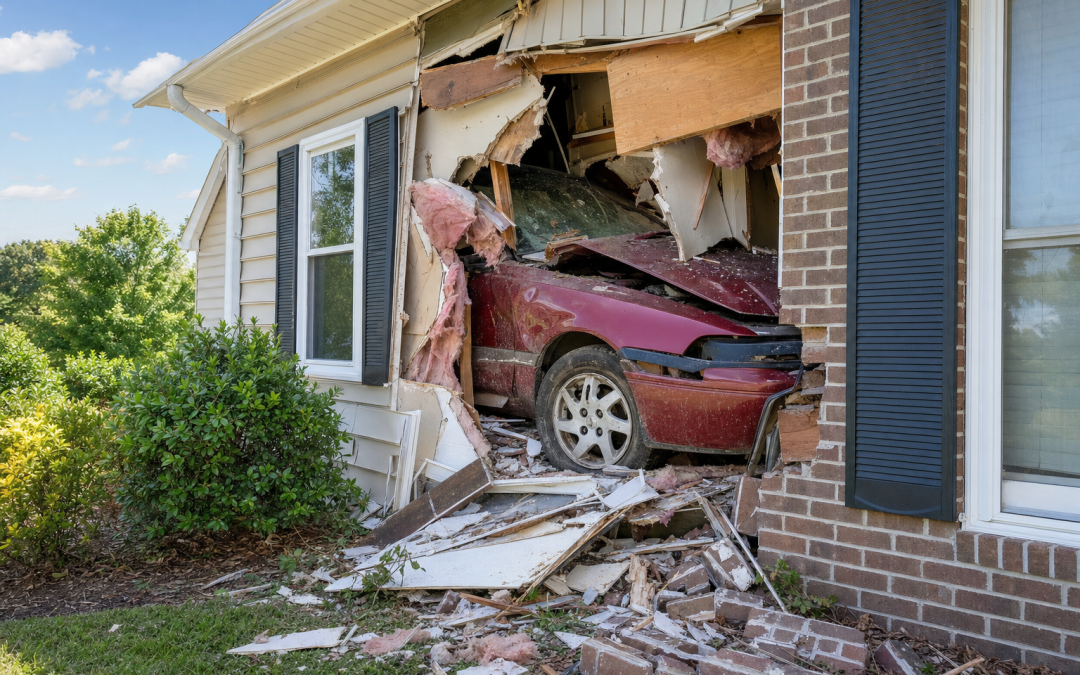
A Car Hit My House in NC — Who Actually Pays for the Repairs?
If a car hit my house in NC, two policies can pay for the repairs: the driver’s auto liability insurance and your own homeowners insurance. In most cases, filing under your homeowners policy first gets structural repairs moving much faster, and your insurer then pursues the driver’s carrier through a process called subrogation.
Key takeaways
- If a car hit my house in NC, you don’t have to wait on the driver’s insurer — your own homeowners policy covers vehicle impact and can start repairs now.
- The at-fault driver’s liability carrier must investigate fault first, which can leave your wall tarped over for weeks or months with no obligation to pay quickly.
- File under your homeowners policy, let your insurer subrogate against the driver’s carrier, and you’ll often get your deductible back when subrogation succeeds.
- NC drivers may carry only minimum property-damage liability limits, which can fall well short of real structural repair costs — another reason your own policy is the stronger first move.
- A licensed public adjuster can document structural, contents, and additional living expense damage so your homeowners claim reflects the full scope of loss.
It feels backwards, we know. The driver caused the damage, so the driver’s insurance company should write the check — right? Eventually, yes, that’s usually where the money comes from. But “eventually” is the problem. The driver’s liability carrier owes you nothing until it finishes its own investigation, confirms its policyholder was at fault, and verifies coverage was in force. That can take weeks or months while your home sits with a hole in the wall, exposed framing, and water getting in every time it rains.
The “Their Insurance Handles Everything” Myth
Homeowners across the Triangle hear the same reassurances at the scene: the driver apologizes, hands over an insurance card, and promises their company will take care of it. Here is why waiting on that promise is risky:
- No duty of good faith to you. The driver’s insurer owes contractual duties to its own policyholder — not to you. You are a third-party claimant, and it can investigate at its own pace.
- Liability disputes stall everything. If the driver claims a medical emergency, a mechanical failure, or blames another vehicle, payment can be delayed or denied entirely.
- Policy limits may fall short. Minimum property damage liability limits in North Carolina may not come close to covering serious structural damage to a home.
- Your home can’t wait. Open walls invite water intrusion, mold, pests, and further structural problems — and failing to protect the property can even complicate your own claim later.
How the Two Policies Actually Work Together
Your homeowners policy covers vehicle impact as a standard peril, so you can open a claim with your own carrier right away, get the property secured, and start repairs on a reasonable timeline. Once your insurer pays, it steps into your shoes and pursues the at-fault driver’s carrier to recover what it paid — and, in most cases, your deductible along with it. A licensed professional such as a Public Adjuster in Garner can help you document the full scope of structural damage before anything gets covered up by emergency repairs.
The sections below walk through exactly how homeowners coverage applies, how subrogation returns your deductible, and what to do in the first hours after impact. If you’re elsewhere in the region, the same principles apply — homeowners working with a Public Adjuster near Archer Lodge NC face the very same choice between waiting on the driver’s carrier and moving forward under their own policy. Moving forward is almost always the smarter path.
Why Shouldn’t I Just Wait on the Driver’s Insurance Company After a Car Hit My House?
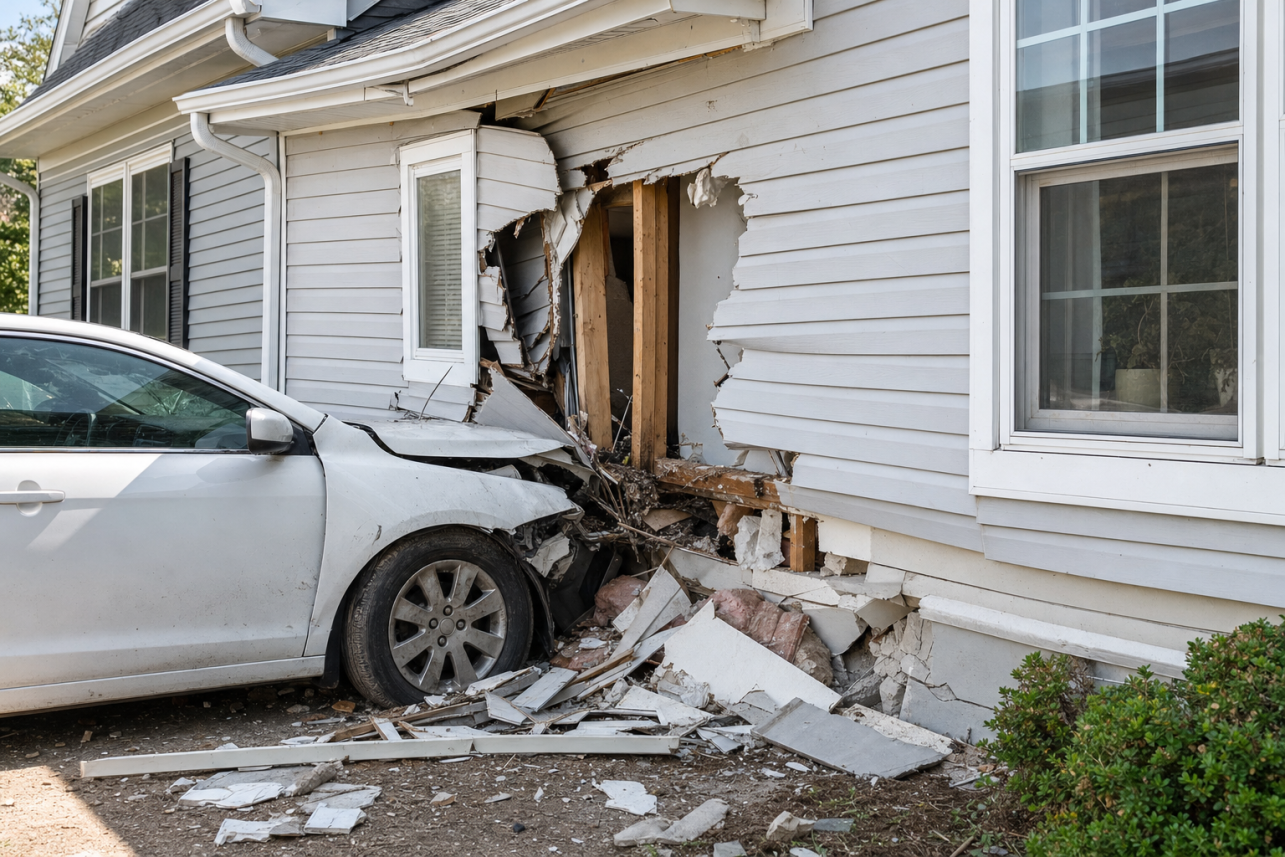
Because the at-fault driver’s liability insurer owes its legal duties to its own policyholder — not to you. It has no contract with you, no deadline to pay you, and every incentive to investigate slowly. Waiting on that carrier can leave your damaged wall exposed for weeks or months while fault is sorted out.
It feels logical: the driver caused the damage, so the driver’s insurance should pay. Eventually, it often does. But “eventually” is the problem. A liability carrier’s first job is protecting its insured from a claim, which means it is allowed to take its time confirming coverage, questioning who was behind the wheel, and deciding whether its policyholder was actually at fault. If a car hit my house were a first-party claim, deadlines and good-faith duties would apply. As a third-party claimant, you have far less leverage.
Common Ways the Liability Carrier Slows Things Down
- Liability investigations — statements, police reports, and recorded interviews can stretch out for weeks before anyone talks about paying you.
- Coverage disputes — if the driver was unlicensed, intoxicated, borrowing the car, or fleeing a scene, the carrier may issue a reservation of rights or deny coverage outright.
- Fault disputes — the insurer may argue its driver wasn’t negligent, leaving you to prove otherwise before a dime is offered.
- Lowball structural estimates — a liability adjuster has little reason to scope your foundation, framing, or hidden damage generously.
Meanwhile, Your House Keeps Getting Worse
A vehicle strike rarely stays a “dry” loss in North Carolina. Heading into cold, wet fall weather, a tarped-over wall or breached foundation soaks up rain, wind-driven moisture, and leaf debris. Open framing invites rot, mold, and pests, and insurers on both sides may later argue that the worsening damage was your failure to mitigate — not their responsibility. Homeowners who’ve worked with a Public Adjuster in Garner on vehicle-impact losses often learn this the hard way: the structure deteriorated faster than the liability claim moved.
North Carolina law does hold insurers accountable when they mishandle a homeowner’s claim. In Gray v. North Carolina Insurance Underwriting Association, the North Carolina Supreme Court allowed homeowners to pursue bad-faith and unfair-practices claims against an insurer that badly underpaid a hurricane-damaged home. But notice the key fact: that was the homeowners’ own insurer. Those protections flow from your policy — which is exactly why filing with your homeowners carrier first is usually the faster, stronger path.
If a vehicle has crashed into your home and the driver’s carrier is already “still investigating,” a licensed Public Adjuster in Fuquay-Varina NC can help you document the structural damage properly now, before weather and time erase the evidence.
Does Homeowners Insurance Cover a Car Hitting Your House? What NC Policyholders Should Know When a Car Hit My House
Yes. Vehicle impact is a named covered peril on standard North Carolina homeowners policies. If a car hit my house, my own policy typically pays to repair the dwelling, detached structures, and damaged belongings — and can cover extra living costs if the home is unlivable — subject to the policy deductible.
That short answer matters because many homeowners assume the driver’s policy is their only path to repairs. In reality, your own homeowners policy is usually the fastest and most reliable source of funds, and it responds regardless of who was behind the wheel or whether that driver was insured at all.
What Parts of the Policy Apply
- Dwelling coverage (Coverage A): Pays to repair the structure itself — walls, foundation, framing, brick veneer, windows, and attached features like a porch or garage.
- Other structures (Coverage B): Covers detached garages, fences, sheds, and mailboxes struck in the same incident.
- Personal property (Coverage C): Furniture, electronics, and other contents crushed or damaged by the impact or by debris.
- Additional living expenses (Coverage D): If the impact makes your home unsafe to occupy, reasonable increases in living costs — such as temporary lodging — may be covered while repairs are made.
Every policy has its own language and limits, so it pays to have someone read yours closely. A licensed Public Adjuster in Chapel Hill NC can review the declarations page and endorsements to confirm exactly which coverages apply to a vehicle-impact loss.
Yes, You’ll Front the Deductible — Temporarily
Filing with your own carrier means your deductible is subtracted from the payout in the short term. That stings, but it is usually recoverable later through subrogation, which the next section covers. The trade-off is speed: your home gets stabilized and repaired now instead of sitting open to weather while liability gets sorted out.
Your Insurer Owes You a Duty the Driver’s Insurer Doesn’t
Here is the key legal distinction. Your homeowners carrier has a contract with you, and under North Carolina law it must investigate and handle your claim promptly and in good faith. The driver’s liability carrier has no contract with you and owes you no such duty. North Carolina courts take the insurer’s obligation seriously — in Gray v. North Carolina Insurance Underwriting Association, the state Supreme Court upheld a verdict for homeowners whose insurer mishandled their property damage claim, confirming that carriers face real consequences for unfair claim handling.
If the damage is significant — structural cracking, compromised load-bearing walls, or hidden damage behind brick or siding — consider having the loss independently documented before accepting the carrier’s estimate. Homeowners in eastern Wake County often work with a Public Adjuster in Knightdale NC to make sure the full scope of structural damage is captured, not just what’s visible from the street.
What Is Subrogation and How Do I Get My Deductible Back When a Car Hit My House?
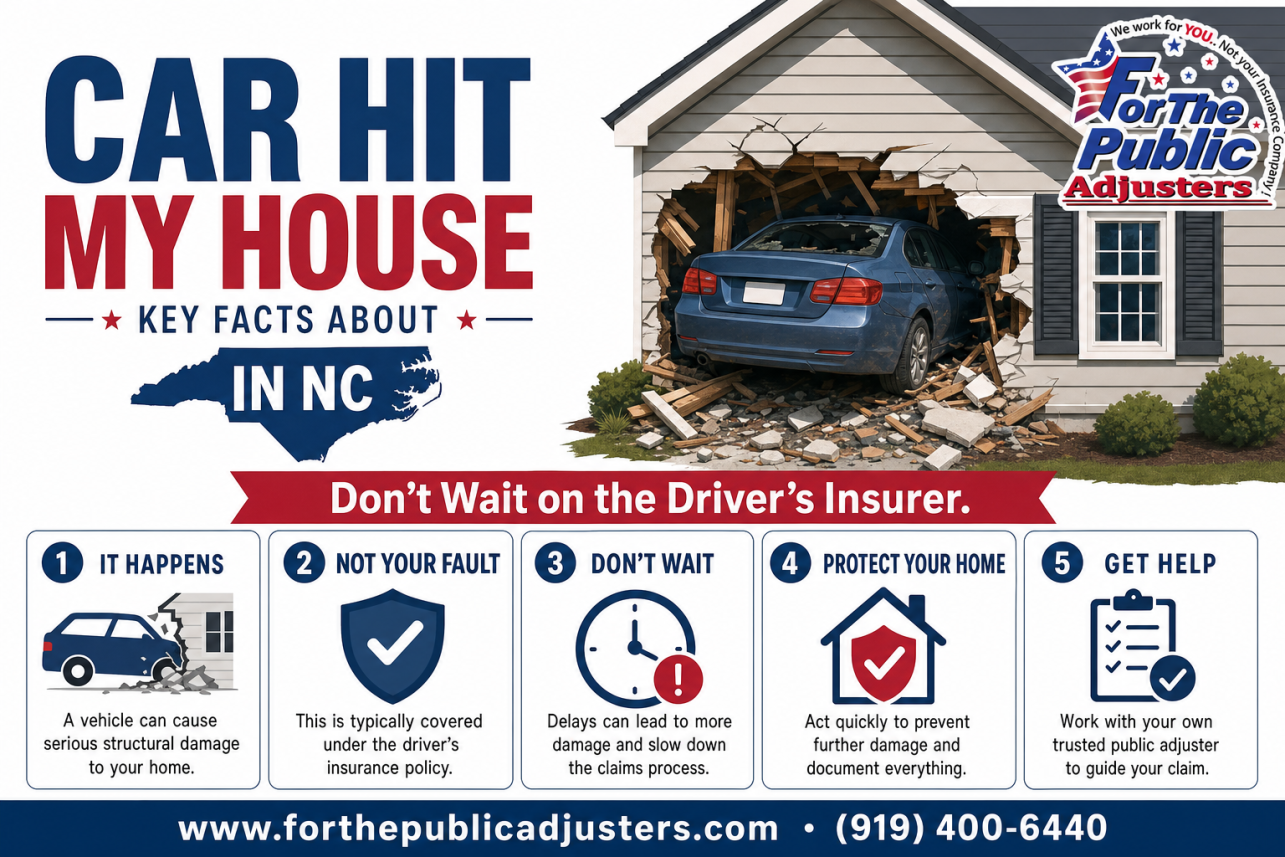
Subrogation means your homeowners insurer pays your claim first, then steps into your shoes and pursues the at-fault driver’s liability carrier to recover what it paid. When your insurer recovers from the driver’s company, it typically reimburses your deductible — so you can start repairs now without permanently absorbing that out-of-pocket cost.
In plain terms, subrogation is the insurance industry’s way of sorting out who ultimately pays — after you’ve been taken care of. That order of operations matters. Instead of your family waiting weeks or months while two insurance companies argue over fault, your own policy funds the structural repairs, and the companies settle up behind the scenes.
How the Subrogation Process Works, Step by Step
- You file with your homeowners insurer. Your carrier inspects the damage, adjusts the claim, and pays under your dwelling coverage, minus your deductible.
- Your insurer pursues the driver’s liability carrier. Using the police report and evidence of fault, your company demands reimbursement for what it paid you.
- Your deductible rides along with that demand. Insurers are generally expected to include your deductible in their recovery effort and pass it back to you when they collect.
- You receive reimbursement. If the recovery is successful, your deductible comes back to you — often months later, but it comes back.
Why This Beats Waiting on the Driver’s Carrier
When a car hit my house is the sentence you’re typing into a search bar at midnight, the last thing you want is a hole in your wall exposed to weather while a liability adjuster “investigates coverage.” Subrogation lets your home get secured and repaired on your timeline, not theirs. Homeowners who work with a public adjuster in Knightdale NC often learn about this option only after losing valuable time waiting on the at-fault driver’s insurer.
What You Should Do to Protect Your Deductible Recovery
- Keep a copy of the police or crash report — it establishes fault for the subrogation demand.
- Get the driver’s name, insurance carrier, and policy number if available, and give it to your homeowners adjuster.
- Ask your insurer, in writing, to confirm it will pursue your deductible as part of its subrogation recovery.
- Follow up periodically — subrogation files can sit idle, and a polite written inquiry keeps yours moving.
One caution: subrogation only reimburses what your insurer actually paid. If your claim is undervalued at the start, the shortfall follows you through the entire process. Having your damage properly documented and valued — the kind of work a public adjuster in Clayton NC handles for policyholders — helps ensure the amount being recovered reflects your real repair costs, not a lowball first estimate.
What Should I Do Right Away After a Car Hit My House?
After a car hits your house, make sure everyone is safe and call 911, get the police report and the driver’s insurance details, photograph all damage before cleanup, tarp and board the opening, notify your own homeowners insurer promptly, and save every receipt for emergency repairs and temporary housing.
Those first few hours matter more than most homeowners realize. The steps you take — and the evidence you preserve — shape how smoothly both insurance claims go later. Here is a practical plan to follow.
Step 1: Safety First, Then Call 911
Get everyone out of the damaged area, including pets. A vehicle strike can crack load-bearing walls, rupture gas lines, or sever electrical wiring, so do not re-enter a badly damaged room until first responders or a professional says it is safe. Always call 911, even for a seemingly minor impact, because the official police report becomes a key piece of documentation.
Step 2: Collect Information at the Scene
- The driver’s name, contact information, and insurance carrier and policy number
- The responding officer’s name and the police report number
- Names and phone numbers of any witnesses
- The vehicle’s make, model, and license plate
Step 3: Document Everything Before Cleanup
Before anyone moves debris, take extensive photos and video of the vehicle’s position, the structural damage, broken contents, and any skid marks or landscaping damage. Shoot wide shots and close-ups. Once cleanup begins, that evidence is gone forever, and thorough documentation protects you if the insurers later dispute the scope of damage. Homeowners who work with a public adjuster in Knightdale NC often learn that the photos taken in the first hour become the backbone of a well-supported claim.
Step 4: Secure the Opening Quickly
Your policy requires you to take reasonable steps to prevent further damage. Board up or tarp the hole in your wall or roof right away — especially heading into fall storms and cold snaps, when rain, wind-driven moisture, and freezing temperatures can turn a structural problem into a water and mold problem the insurer may argue was preventable.
Step 5: Notify Your Own Homeowners Carrier Promptly
Report the loss to your own insurer the same day if possible. Prompt notice protects your rights under the policy and gets the repair process moving without waiting on the driver’s carrier. If you feel uncertain about documenting the claim or interpreting your coverage, a licensed and bonded professional such as a public adjuster near Apex NC can review the damage and the policy on your behalf.
Step 6: Keep Every Receipt
- Emergency board-up, tarping, and debris removal
- Temporary fencing or shoring
- Hotel stays and meals if your home is unlivable
- Any materials you purchase yourself
These out-of-pocket costs are typically reimbursable under your policy, but only if you can prove them. A simple folder or phone photo album of receipts can recover money you would otherwise lose.
What If My Own Insurer Delays or Underpays After a Car Hit My House?
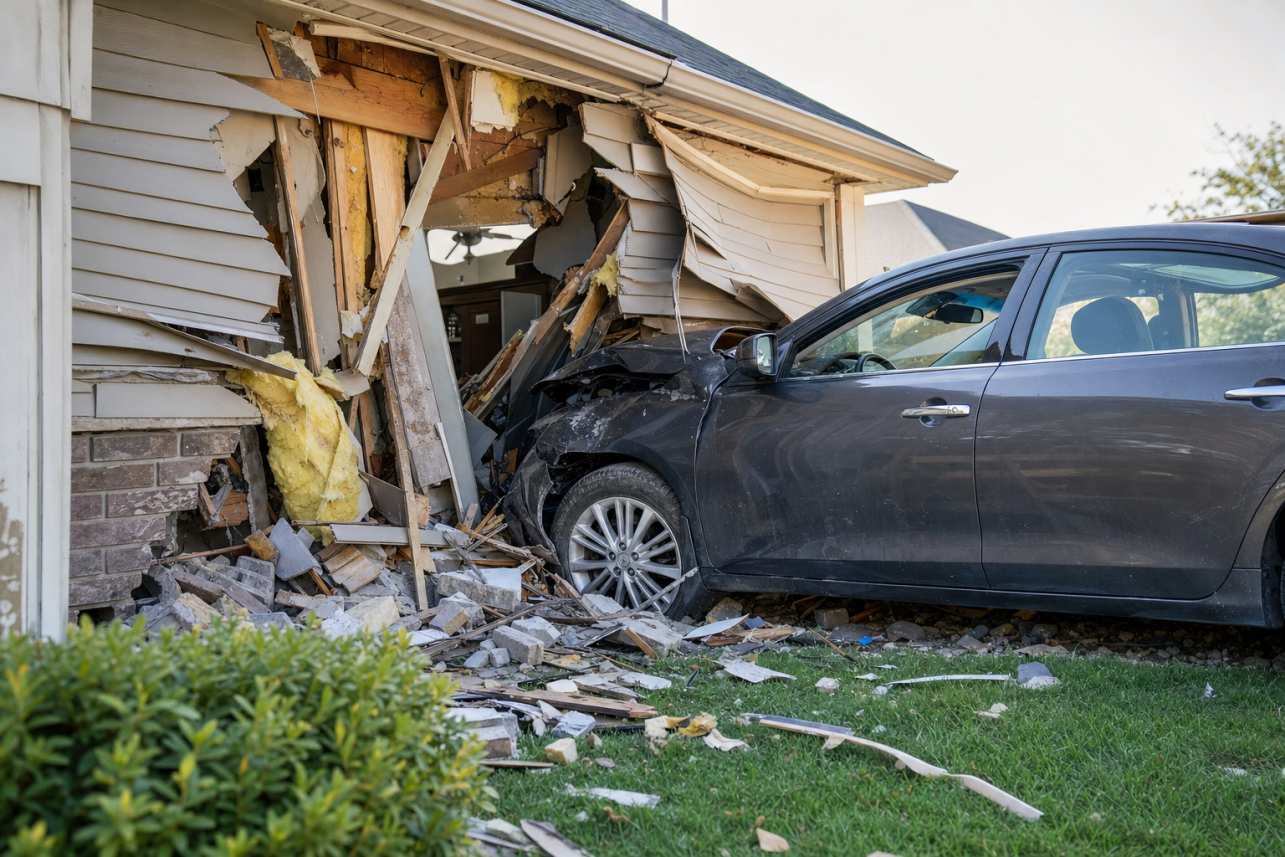
If your homeowners insurer drags its feet or lowballs the structural repairs after a car hit my house situation, you are not stuck. North Carolina law requires carriers to handle claims fairly, and you can push back with documentation, a complaint to the state insurance department, a licensed public adjuster, or legal action if necessary.
Vehicle-impact claims are deceptively complicated. A car that punches through a wall can crack foundations, shift load-bearing framing, damage plumbing and wiring, and compromise the structure in ways a quick visual estimate will miss. When an adjuster writes an estimate for patching drywall and siding but ignores engineering concerns, that is underpayment — even if the check arrives quickly.
Your Leverage Under North Carolina Law
North Carolina’s unfair claim settlement practices statute prohibits insurers from failing to promptly investigate claims, refusing to pay without a reasonable basis, or offering substantially less than a claim is worth to force a lower settlement. North Carolina courts have backed homeowners who fought back: in Gray v. North Carolina Insurance Underwriting Association, the North Carolina Supreme Court upheld a verdict for policyholders whose home was damaged in a hurricane after the carrier was found to have acted in bad faith in handling the claim. The case stands as a reminder that insurers in this state face real consequences for unreasonable claim conduct.
Practical Steps When the Claim Stalls
- Put everything in writing. Request the carrier’s position, the estimate, and the reason for any delay in writing, and keep copies.
- Get an independent repair scope. A structural engineer or experienced contractor can document hidden damage the insurer’s estimate missed.
- File a complaint with the North Carolina Department of Insurance. The DOI’s Consumer Services Division reviews complaints about claim delays and handling, and a formal complaint often gets a stalled file moving.
- Bring in a licensed public adjuster. A public adjuster works for you — not the carrier — documenting the full scope of damage and negotiating the claim on your behalf. If you’re in Johnston County, a Public Adjuster in Clayton NC can review the carrier’s estimate and identify what it leaves out.
- Know the appraisal and legal options. Many policies include an appraisal clause for disputes over the amount of loss, and bad-faith conduct may support legal remedies beyond the policy limits.
Don’t Accept the First Number as Final
An initial estimate is a starting point, not a verdict. The National Association of Insurance Commissioners encourages policyholders to ask questions, request re-inspections, and dispute estimates that don’t reflect actual repair costs. Wake County homeowners who feel outmatched can lean on a licensed and bonded Public Adjuster in Apex NC to handle that negotiation. No one can promise a specific outcome, but a properly documented, professionally presented claim is far harder for a carrier to delay or underpay.
Car Hit My House in NC: Waiting on the Driver’s Insurer vs. Filing Your Homeowners Claim First
| Factor | Waiting on Driver’s Liability Carrier | Filing Your Homeowners Policy First |
|---|---|---|
| Who the insurer answers to | The at-fault driver — they owe you no contractual duty until liability is accepted | You — your policy is a direct contract requiring prompt handling of your claim |
| Typical timeline to start repairs | Often weeks to months while fault, coverage, and limits are ‘investigated’ | Repairs can begin as soon as your claim is documented and coverage is confirmed |
| Your out-of-pocket exposure | Nothing up front, but you absorb delays, secondary damage, and possible low limits | Your deductible — often recovered later through your insurer’s subrogation |
| Policy limits available | May be capped at NC minimum property-damage limits, which can be far below structural repair costs | Your dwelling and contents limits, which are typically sized to your home’s value |
| Who fights for reimbursement | You, alone, negotiating with someone else’s insurer | Your insurer pursues the driver’s carrier through subrogation on your behalf |
Hypothetical Example: From Tarped-Over Wall to Repairs Underway
Illustrative example
Consider a composite scenario drawn from situations we commonly see: a driver loses control and crashes into the brick corner of a Raleigh family’s home, breaching the wall into the living room. The driver’s liability carrier opens an ‘investigation,’ and three weeks pass with nothing but a tarp between the family and the weather. Rather than keep waiting, the homeowners file under their own policy, and with the structural, contents, and temporary-housing damages properly documented, repairs are approved and underway within weeks, with the insurer pursuing the driver’s carrier through subrogation.
North Carolina courts have a history of holding insurers to their coverage promises in property-damage disputes — in Gaston County Dyeing Machine Co. v. Northfield Insurance Co. (N.C. 2000), the state Supreme Court sided with the policyholder on a contested property-damage coverage question — a reminder that your policy’s promises are enforceable. This example is illustrative only; every claim is different, and no specific outcome can ever be guaranteed.
Frequently Asked Questions
A car hit my house in NC — do I have to wait for the driver’s insurance to pay before repairs start?
No, and waiting is usually the costliest mistake. Your homeowners policy covers vehicle impact damage regardless of who was at fault, so you can file with your own insurer right away and get structural repairs moving. The driver’s liability carrier can take weeks or months to accept fault, and nothing requires you to wait on them. Your insurer can pursue the driver’s carrier afterward through subrogation.
Will my homeowners insurance rates go up if I file a claim when a car hits my house?
A vehicle strike is a not-at-fault, sudden event, which insurers treat differently than claims you could have prevented. While no one can promise your premium will never change, the practical risk of waiting months for the driver’s carrier — a tarped wall, water intrusion, mold, and growing repair costs — is usually far greater than any rate concern. Ask your agent how your specific insurer handles not-at-fault property claims.
How do I get my deductible back after my homeowners insurance pays for car damage to my house?
When your insurer recovers money from the at-fault driver’s liability carrier through subrogation, it is generally required to reimburse your deductible from that recovery, in proportion to what it collects. You don’t have to chase the driver yourself — your insurer does the pursuing. Keep in mind recovery isn’t guaranteed and depends on the driver having coverage or assets, but in clear-liability vehicle strikes, deductible reimbursement is a common outcome.
What should I do first after a car crashes into my house?
Make sure everyone is safe and call 911 so a police report is created — that report becomes key evidence later. Don’t enter rooms near the impact until the structure is checked. Get the driver’s name and insurance information if possible, photograph everything before anything is moved, arrange emergency board-up or tarping to prevent further damage, and notify your homeowners insurer promptly. Keep every receipt for emergency work.
How long does it take to repair a house after a car hits it?
It depends on the damage. A cosmetic brick or siding repair may take days once approved, while a compromised load-bearing wall or foundation can take months, including engineering review, permits, and reconstruction. The bigger variable is which path you choose: filing under your own homeowners policy typically starts the clock in days, while waiting on a liability investigation by the driver’s carrier can add months before repairs even begin.
Who pays for a hotel if my house is unlivable after a car hits it?
Most homeowners policies include Additional Living Expenses (ALE) or loss-of-use coverage, which pays reasonable extra costs — a hotel, temporary rental, added meals — while your home is uninhabitable from a covered loss. This is another strong reason to file under your own policy first: the driver’s liability carrier owes you nothing until it accepts fault, which can leave you paying out of pocket for weeks. Save all receipts.
What happens if the driver who hit my house is uninsured or it was a hit-and-run?
Your homeowners policy still covers the structural damage — vehicle impact is a standard covered peril, and coverage doesn’t depend on identifying or collecting from the driver. This is exactly why relying on the at-fault driver is risky: if they’re uninsured, unknown, or disputing fault, you could wait indefinitely. File the police report, document the scene, and open your homeowners claim so repairs aren’t held hostage to someone else’s situation.
Do I need a structural engineer after a car hits my house?
Often, yes. Vehicle impacts can shift framing, crack foundations, or damage load-bearing walls in ways that aren’t visible from the surface. An independent structural assessment protects you in two ways: it ensures repairs address hidden damage, not just the cosmetic hole, and it documents the full scope before anything is patched over. Insurers sometimes scope these losses as simple siding or brick repairs when the real damage runs deeper.
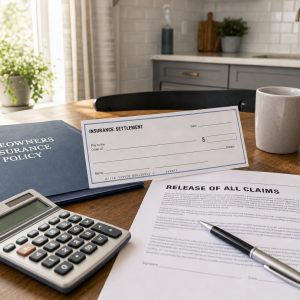
Should I accept a quick settlement check from the driver’s insurance company?
Be careful. Early offers are often made before anyone has assessed hidden structural damage, and cashing a check tied to a release can end your claim even if cracks, settling, or water damage appear later. Get a complete repair scope — ideally with a structural evaluation — before accepting anything. You’re never obligated to take the first number, and your own homeowners claim remains available while you evaluate what the damage truly costs.
What mistakes do homeowners make after a vehicle hits their home?
The big ones: waiting on the driver’s liability carrier instead of filing their own claim, skipping the police report, cleaning up or repairing before photographing everything, accepting the insurer’s scope without an independent damage assessment, and ignoring hidden structural or water damage behind a patched wall. Another is tossing receipts for board-up, tarping, and temporary housing — those are reimbursable under most policies, but only if you can document them.
Arson Homeowners Claim help near you
Related local pages
A vehicle crashed into your home and the insurance process feels stalled? Our licensed and bonded NC public adjusters will review your homeowners claim for free and explain your options — no pressure, no obligation. Get in touch.
Last updated: October 29, 2026