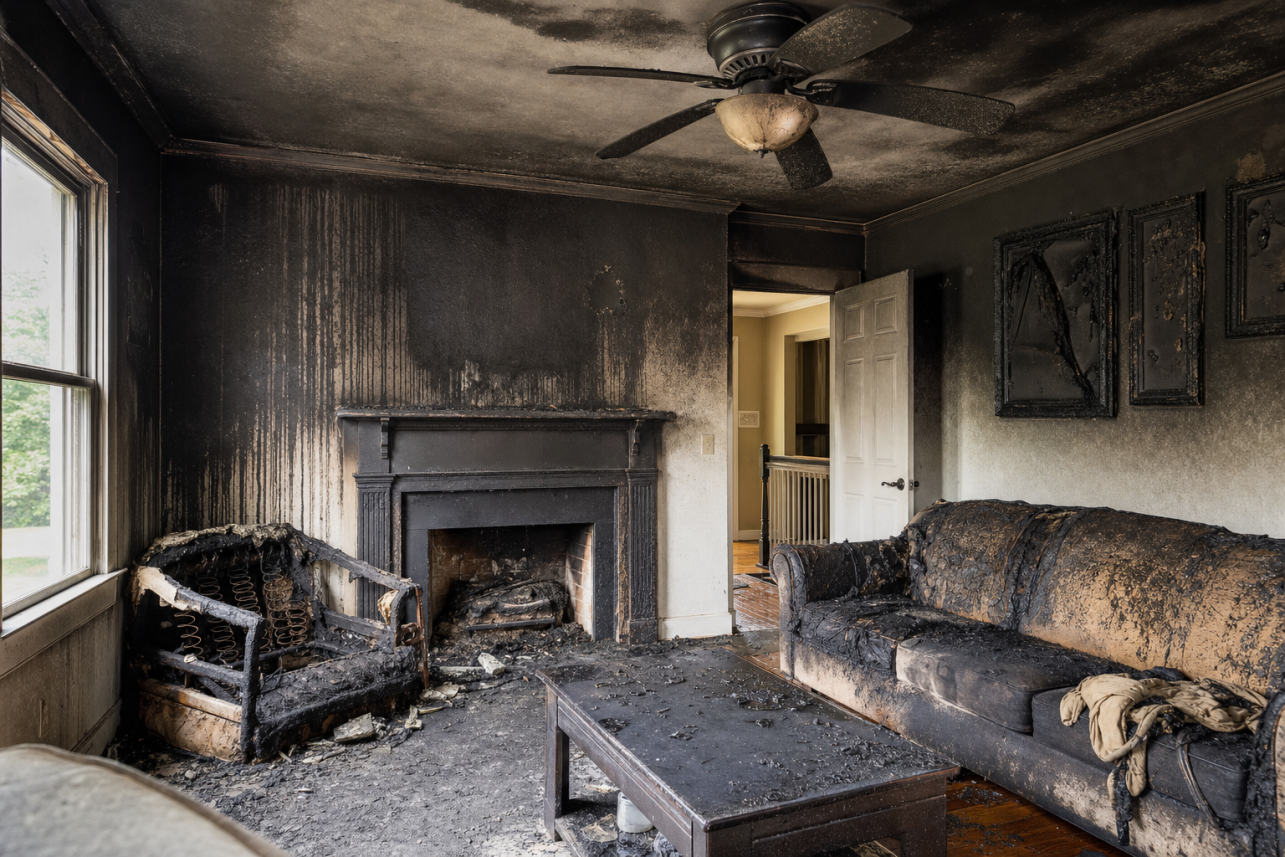
Smoke Damage Claim help Knightdale NC homeowners need after a grease fire starts with one truth: the flames are rarely the biggest loss — the smoke is. Hot, greasy smoke travels through your entire home in minutes, coating walls, cabinets, clothing, electronics, and the inside of your ductwork with acidic residue. For The Public Adjusters, Inc. is a licensed and bonded public adjusting firm that works only for you, the policyholder — documenting the full scope of smoke damage and negotiating with your insurance company on your behalf.
What This Service Is
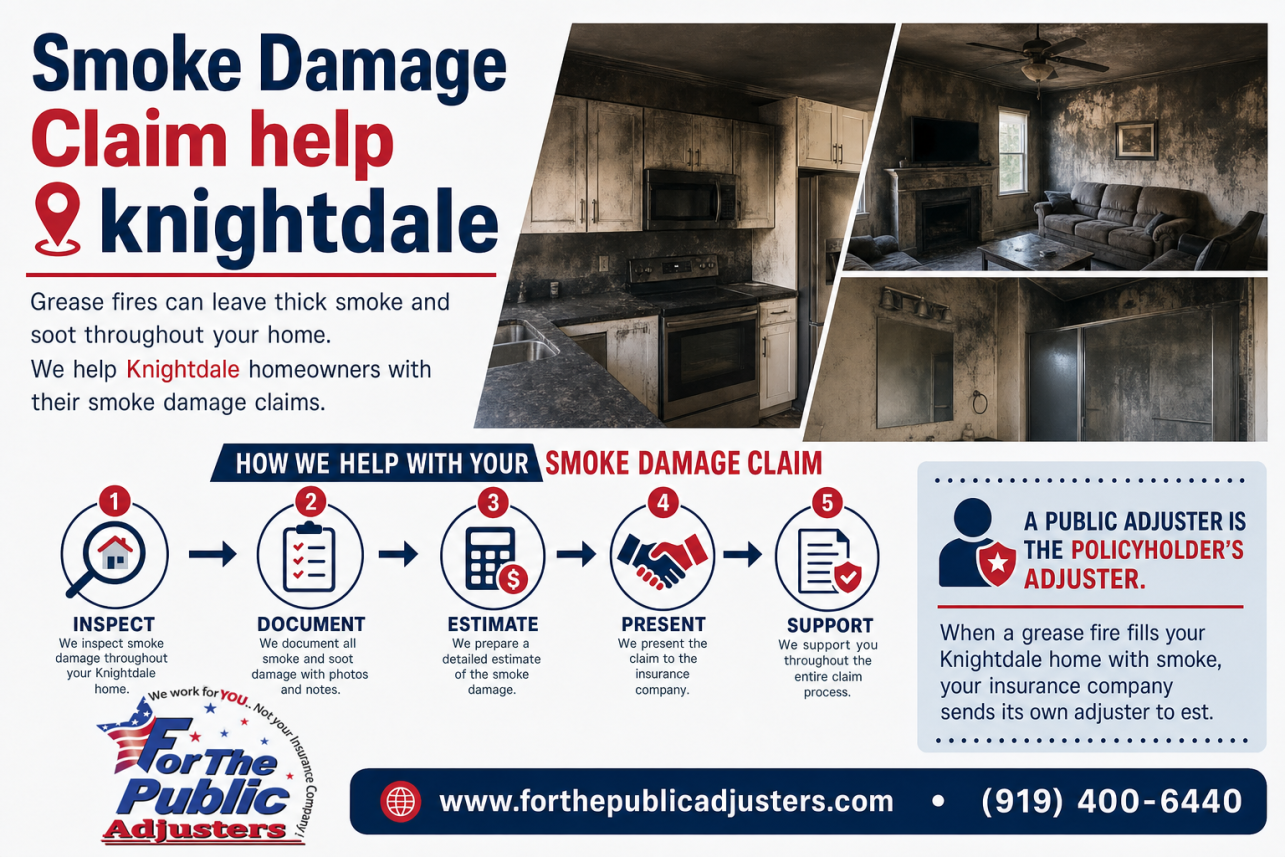
A public adjuster is the policyholder’s adjuster. When a grease fire fills your Knightdale home with smoke, your insurance company sends its own adjuster to estimate the loss — and that person works for the insurer, not for you.
Our team does the opposite. We inspect your property independently, document every room the smoke reached (not just the kitchen where the fire started), inventory your damaged belongings, prepare the proof of loss paperwork your policy requires, and negotiate the settlement directly with the carrier.
Grease fire smoke is especially destructive. It carries vaporized cooking oils and protein residue that bond to paint, drywall, fabric, and HVAC components, and the odor is notoriously difficult to remove. Cooking is the leading cause of home fires in the United States, according to the National Fire Protection Association, so insurers see these claims constantly — and they know exactly how to price them low when a homeowner doesn’t push back with documentation.
We handle residential smoke and fire claims, related water damage from firefighting efforts, and commercial business claims throughout Wake County. We never guarantee a specific dollar outcome — no honest adjuster can — but we make sure nothing gets left out of your claim.
Common Problems
My Insurance Offer Barely Covers Repainting The Kitchen — What About Everything Else The Smoke Ruined?
This is the most common problem we see after a grease fire. The insurer’s estimate covers the visibly charred cabinets and a coat of paint, but ignores the soot inside your ductwork, the odor absorbed into carpet and upholstery two rooms away, and the residue etching into electronics and appliances.
There’s also the actual cash value trap. Many first offers pay the depreciated value of your damaged contents — what your five-year-old sofa was worth used — rather than the replacement cost your policy may actually entitle you to once items are replaced. Depreciation deductions on both contents and repair labor can quietly strip thousands from a settlement.
Courts have pushed back on this practice. In Hicks v. State Farm Fire & Casualty Co., a federal appeals court sided with homeowners, holding that the insurer could not depreciate labor costs when calculating actual cash value payments on property claims. Policyholders can win these fights — but only when the claim is documented and argued correctly.
My Claim Keeps Stalling — The Insurer Wants More Paperwork, More Inspections, More Time
Delay is a tactic as much as a process. After a grease fire, you may be living with a smoke-saturated house — or paying out of pocket for a hotel — while the carrier requests another inspection or another form. Meanwhile, your policy has deadlines for filing a proof of loss, and missing them can jeopardize the entire claim.
Smoke claims stall for another reason: hidden damage. Soot inside wall cavities, attic insulation, and HVAC systems doesn’t show up in a quick walkthrough, so the insurer’s estimate and your restoration contractor’s reality never match — and the file bounces back and forth.
We take over that back-and-forth entirely. We track every deadline, submit complete documentation the first time, push for your temporary living expense coverage to be paid promptly, and escalate through the North Carolina Department of Insurance complaint process when a carrier drags its feet unreasonably. If a dispute hardens into a legal fight, we can connect you with insurance dispute attorneys.
Smoke Damage Claim Help Knightdale NC: How Do You Know Who To Actually Trust After A Grease Fire?
Start with licensing. In North Carolina, public adjusters must be licensed by the state, and the NCDOI Public Adjusters Guide explains exactly what a legitimate public adjuster can and cannot do for you. Anyone who dodges the licensing question shouldn’t be near your claim.
Be cautious of contractors or ‘consultants’ who show up uninvited after a fire promising a specific settlement number. No one can guarantee what an insurer will pay, and anyone who does is telling you what you want to hear.
Can you handle the claim yourself? Legally, yes. But smoke claims are among the most technical property losses there are — grease fire residue behaves differently than wood smoke, odor remediation is expensive, and a complete contents inventory can run to hundreds of line items. A good public adjuster earns their fee by finding damage and coverage you would never have known to claim. For The Public Adjusters, Inc. is licensed, bonded, and paid only as a percentage of what your claim recovers — our interests are aligned with yours.
Our Process
Full-Home Smoke Inspection And Documentation
We inspect far beyond the kitchen — walls, ceilings, closets, attic spaces, ductwork, and contents in every room the smoke reached. We photograph and record everything, because a grease fire’s acidic residue keeps corroding surfaces for weeks, and damage that isn’t documented early often gets denied later.
Contents Inventory, Valuation, And Proof Of Loss
We build a room-by-room inventory of damaged belongings — clothing, furniture, electronics, appliances — and value each item under your policy’s terms, flagging where replacement cost applies instead of depreciated value. Then we prepare and file the formal proof of loss correctly and on deadline, so the carrier has no procedural excuse to delay or deny.
Negotiation And Settlement
We present the documented claim to your insurance company, respond to their adjuster’s estimate line by line, and negotiate until the settlement reflects the true scope of the loss — including odor removal, HVAC cleaning, secondary water damage from firefighting, and your additional living expenses. You approve every decision; we do the arguing.
| What Happens | Filing on Your Own | With For The Public Adjusters |
|---|---|---|
| Scope of inspection | Carrier’s adjuster typically inspects the kitchen and visibly damaged areas only | Full-home inspection including HVAC, wall cavities, attic insulation, and contents |
| Protein smoke residue | Often missed entirely — it’s nearly invisible and odor is dismissed as ‘cleanable’ | Documented with wipe testing and included in the remediation scope |
| Estimate detail | Broad allowances like ‘clean and paint kitchen’ | Line-item estimate covering odor treatment, matching materials, and replacement where cleaning fails |
| Additional living expenses | Rarely offered unless you know to ask | Calculated and claimed for the full period the home is unusable |
| Negotiation | You against a trained claims professional | Licensed NC adjuster advocating for you at every step |
| Typical outcome | First offers on grease fire losses frequently cover a fraction of real costs | Settlements built on documented damage, not the carrier’s first pass |
Commonly Overlooked In The Public Adjusting Industry
- Protein residue in rooms far from the kitchen — Grease fire smoke is nearly invisible and doesn’t leave black soot, so carrier adjusters routinely skip rooms that ‘look fine’ but are coated in odor-causing film.
- HVAC system contamination — If the air handler was running during the fire, residue spread through every duct — but ductwork is out of sight and rarely opened during a standard inspection.
- Line-of-sight cabinet matching — Carriers often pay to replace only the burned cabinets, ignoring that new sections will never match the old ones visible right beside them.
- Attic insulation above the fire — Nobody climbs into the attic during a quick kitchen inspection, yet insulation directly over the range absorbs smoke and keeps releasing odor into the home.
- Additional living expense coverage — Homeowners assume they only qualify if the house burned down, when odor remediation and cabinet demolition can make a kitchen unusable for weeks.
- Appliance gasket and internal odor absorption — A refrigerator that wipes clean on the outside can hold burnt-grease odor in its seals and insulation forever, but it gets marked ‘clean only’ on the estimate.
- Corrosive film on electronics — Oily smoke residue slowly corrodes circuit boards, so devices that work today fail months later — after the claim is closed.
- Fair rental value for landlords — Rental property owners are almost never told their policy pays for lost rent during remediation, so the coverage sits unclaimed.
Case Studies
Case Study #1
Situation: A family off Smithfield Road in Knightdale had a grease fire flare up on their gas range while cooking dinner. The flames were out in under two minutes, but the entire first floor filled with thick, oily smoke.
Problem: Their insurance carrier sent a field adjuster who estimated the loss at $4,800 — essentially a kitchen repaint and a cleaning service visit. The homeowners could still smell burnt grease in the hallway and upstairs bedrooms weeks later, and their HVAC vents had a visible film on the registers.
Investigation: We performed a full walk-through with a protein residue wipe test on surfaces in every room, not just the kitchen. We inspected the ductwork, attic insulation above the kitchen, cabinet interiors, and soft goods like upholstery and drapes. We also documented odor migration through the return-air system.
Findings: Protein-based smoke residue — the kind grease fires produce — had traveled through the HVAC system and coated surfaces in four rooms the carrier’s adjuster never entered. The cabinet boxes closest to the range had absorbed odor into the particleboard and could not be sealed or cleaned. Attic insulation directly above the kitchen was contaminated.
Solution: We prepared a line-item estimate covering duct cleaning and sealing, cabinet replacement rather than cleaning, insulation removal and replacement, thermal fogging and ozone treatment, and cleaning or replacement of affected contents. We submitted the residue test results and photo documentation with a formal supplement demand.
Outcome: The claim settled at $52,300 — more than ten times the original estimate. The family also received additional living expenses for the nine days the odor remediation and cabinet work made the kitchen unusable.
Lesson: Protein smoke from a grease fire is nearly invisible but travels everywhere the air goes. If the estimate only covers the room where the fire happened, it is almost certainly incomplete.
Case Study #2
Situation: A landlord who owns a rental duplex near Knightdale Station Park had a tenant leave a pan of oil unattended. The fire scorched the range hood and a section of upper cabinets before the tenant extinguished it.
Problem: The carrier accepted the claim but classified most of the loss as ‘cleanable,’ offering roughly $7,200. Meanwhile the tenant was threatening to break the lease over the lingering odor, and the landlord faced lost rental income the initial offer did not address at all.
Investigation: We reviewed the policy and confirmed it included fair rental value coverage the landlord did not know existed. We then brought in documentation of the smoke residue on the ceiling, in the adjoining unit’s shared wall cavity, and inside the microwave, dishwasher, and refrigerator gaskets — all items the carrier had marked as clean-only.
Findings: The shared wall cavity between units had smoke intrusion through an electrical penetration, meaning the neighboring unit was also affected. Appliance gaskets and internal components held odor that cleaning could not remove. The ‘cleanable’ cabinets had heat-blistered finishes that would never match after refinishing.
Solution: We rewrote the scope to include appliance replacement, cabinet replacement to match line-of-sight sections, wall cavity remediation in both units, full odor treatment, and a fair rental value claim covering the vacancy period.
Outcome: Final settlement came in at $41,600 plus three months of documented lost rent. The tenant stayed, and both units were fully remediated.
Lesson: Rental property owners routinely leave fair rental value money on the table because nobody tells them the coverage exists. A grease fire’s real cost includes the income you lose while the property is uninhabitable.
| Item Affected by Grease Fire Smoke | Usually Cleanable? | What It Depends On |
|---|---|---|
| Painted walls and ceilings | Sometimes | Protein residue often bleeds through paint; sealing with a stain-blocking primer is required before repainting, and heavily coated drywall may need replacement |
| Kitchen cabinets | Rarely near the fire | Particleboard and MDF absorb odor permanently; heat-blistered or warped finishes can’t be restored, and partial replacement creates mismatch issues the policy should cover |
| HVAC ductwork | Yes, with professional cleaning | If smoke ran through the system while it was on, every duct run needs cleaning and the filter, coil, and blower should be inspected |
| Attic insulation above the kitchen | No | Fiberglass and blown insulation trap odor and residue and cannot be cleaned — removal and replacement is the standard |
| Appliances (fridge, dishwasher, microwave) | Sometimes | Gaskets, seals, and internal components hold protein odor; anything storing food is usually a replacement item |
| Upholstered furniture and mattresses | Sometimes | Light exposure may respond to ozone or hydroxyl treatment; heavy exposure means replacement, especially for items children sleep on |
| Clothing and soft contents | Usually | Specialty smoke-restoration laundering works for most textiles, but the cleaning cost belongs in your claim |
| Electronics | Case by case | Oily smoke film on circuit boards causes corrosion over time; professional evaluation should be claimed even if items seem to work now |

Reviews
Our insurance company offered us $3,900 after a grease fire in our kitchen, and I honestly almost took it. For The Public Adjusters found smoke residue in rooms we didn’t even think to check — inside our closets, on our kids’ mattresses, in the ductwork. The final settlement covered new cabinets, full duct cleaning, and a hotel stay during the odor treatment. Night and day difference.
Danielle R., Knightdale
The carrier’s adjuster spent maybe twenty minutes at my house and said everything was ‘surface cleaning.’ Three months later my house still smelled like burnt oil every time the AC kicked on. These guys did residue testing, proved the smoke got into the HVAC system, and reopened the claim. Wish I had called them the day of the fire instead of waiting.
Marcus T., Wake County
A stovetop grease fire ruined more than we realized — the heat warped our cabinet faces and the smoke odor soaked into everything upholstered. Our adjuster from For The Public Adjusters walked us through the whole claim, handled every call with the insurance company, and got the settlement up from $6,100 to a number that actually paid for the repairs. Only wish the process with the carrier itself moved faster, but that wasn’t their fault.
Priya K., Knightdale
Frequently Asked Questions
Where Can I Get Smoke Damage Claim Help Knightdale NC After A Kitchen Grease Fire?
For The Public Adjusters, Inc. provides Smoke Damage Claim help knightdale NC homeowners can rely on after a grease fire, even when the flames were put out quickly and the visible damage seems limited to the stove area.
Grease fires are deceptive. The fire itself may last thirty seconds, but the smoke it produces is protein-based and oily, which means it bonds to painted drywall, cabinet interiors, HVAC ductwork, and soft goods throughout the home. It often carries a faint but persistent odor rather than heavy black soot, so insurance adjusters frequently underestimate the true scope.
Our team inspects your Knightdale home room by room, documenting soot residue with wipe tests, checking the ductwork that likely pulled smoke into bedrooms and closets, and cataloging contents like clothing, upholstery, and electronics that absorbed contamination.
We then prepare and negotiate the claim directly with your insurance carrier on your behalf. That includes the estimate for cleaning or replacing finishes, proper odor remediation such as thermal fogging or ozone treatment, and additional living expenses if you need to stay elsewhere during the work.
We serve Knightdale neighborhoods from Widewaters and Planters Walk to homes off Smithfield Road and Old Faison Road, along with the rest of Wake County. The initial consultation and inspection are free, and we only get paid a percentage of what we recover for you, so there is no upfront cost to find out what your claim is actually worth.
My Insurance Company Says The Grease Fire Damage Is Just Cosmetic. Should I Accept Their Offer?
Not before an independent review. Carriers routinely classify grease fire smoke as a cleaning issue, offering a few thousand dollars for wipe-downs and a coat of paint. In our experience handling these claims across Knightdale and Wake County, that number is often a fraction of the real cost.
Protein smoke from burning cooking oil is different from ordinary fire soot. It is nearly invisible on light surfaces but chemically aggressive, discoloring finishes over time and embedding odor deep into porous materials. Painting over it without proper sealing means the smell returns in weeks, especially during humid North Carolina summers when the house heats up.
A thorough claim should account for several things the first offer usually misses. Cabinet boxes near the range often need replacement, not just cleaning, because heat opens the wood grain and locks in residue. Duct systems that circulated smoke need professional cleaning. Contents like clothing, mattresses, and window treatments may require specialty restoration or replacement. Electronics exposed to corrosive residue can fail months later.
As licensed public adjusters, we work for you, not the insurance company. We re-scope the loss with proper testing, build a line-item estimate that reflects real Knightdale contractor pricing, and negotiate until the settlement matches the actual damage.
If you have already received an offer, we can review it at no charge. In many cases we reopen or supplement claims that homeowners assumed were closed, and the difference in recovery is often significant. You generally have a limited window under your policy to dispute a settlement, so it pays to act quickly.
What Should I Do In The First 48 Hours After A Grease Fire In My Knightdale Home?
The first two days shape the outcome of your entire claim, so a few careful steps make a real difference.
First, do not throw anything away, including the burned pan, damaged cabinets, or scorched contents. Insurers can deny portions of a claim they cannot inspect. Photograph everything from multiple angles before anyone cleans or moves it, including rooms far from the kitchen where smoke traveled.
Second, avoid aggressive DIY cleaning. Wiping protein-based soot with household cleaners can smear it and set stains permanently into drywall and cabinet finishes, which can also give the carrier grounds to argue the damage was worsened after the loss. Ventilate the home, but leave the deep cleaning to professionals.
Third, report the loss to your insurance company promptly, but keep your initial statement factual and brief. Do not guess at causes or estimate damage amounts on that first call, because early statements can be used to limit the claim later.
Fourth, keep every receipt. If the home is uncomfortable to live in because of odor, most policies cover additional living expenses for hotels, meals above your normal costs, and even pet boarding, but only with documentation.
Finally, consider bringing in a Knightdale public adjuster before the insurance company’s adjuster inspects. When we are involved from the start, we manage the inspection, control the documentation, and set the scope of loss correctly the first time rather than fighting to expand it later. That early involvement is usually where our clients see the biggest gains.
How Much Does Professional Smoke Damage Claim Help Knightdale NC Cost, And How Long Does The Process Take?
For The Public Adjusters, Inc. works on contingency, so Smoke Damage Claim help knightdale NC residents receive from us costs nothing upfront. Our fee is a percentage of the insurance settlement we recover, and if we recover nothing, you owe nothing. The initial inspection and policy review are always free.
Because our fee comes from the settlement, our interests align with yours. Industry studies and our own case history consistently show that professionally adjusted fire and smoke claims settle for substantially more than homeowner-handled claims, typically enough to more than offset the fee.
Timelines vary with the severity of the grease fire and how the carrier responds. A straightforward smoke claim on a Knightdale home, where the damage is limited to the kitchen and adjacent rooms, often resolves in 30 to 60 days from the date we submit our documented estimate. Claims involving cabinet replacement, whole-house odor remediation, extensive contents inventories, or an initial lowball offer we must dispute can run 90 days or longer.
North Carolina insurance regulations require carriers to acknowledge claims and respond to settlement demands within set timeframes, and we hold them to those deadlines. We handle every call, email, and inspection so you are not chasing an adjuster while trying to get your household back to normal.
Throughout the process, you receive regular updates and approve every decision. Nothing settles without your sign-off. If a grease fire has left your home smelling of smoke, call us for a free assessment and an honest read on what your claim should be worth.
Why Does Smoke From A Grease Fire Spread So Far Beyond My Knightdale Kitchen?
Grease fires burn hot and fast, and the smoke they produce is different from ordinary wood or paper smoke. Burning cooking oil creates a protein-based residue that is nearly invisible, extremely sticky, and carries a strong odor that penetrates porous materials throughout the home.
Your HVAC system makes it worse. Most Knightdale homes, whether in older neighborhoods off First Avenue or newer builds near Widewaters, have central air that pulls smoke into the ductwork within minutes. From there, residue gets pushed into bedrooms, closets, and attic spaces that never saw a flame.
Protein smoke also bonds to painted surfaces, cabinet interiors, insulation, and even the inside of electronics. You may not see heavy black soot, but run a clean white cloth along a ceiling two rooms away and it will often come back yellowed with an oily film.
This is exactly why so many grease fire settlements come in low. The insurance company’s initial estimate frequently covers only the kitchen, ignoring contaminated ducts, attic insulation, soft goods, and odor-sealed wall cavities elsewhere in the house. A thorough claim documents the full path the smoke traveled, not just the burn area.
When our team inspects a Knightdale home after a stovetop fire, we test surfaces room by room and document HVAC contamination with photos and readings the carrier cannot dismiss. That documentation is usually the difference between a kitchen-only payout and a settlement that actually restores the whole house.
Does Homeowners Insurance In Wake County Cover A Grease Fire I Accidentally Started Myself?
Yes, in almost every case. Accidental fires, including grease fires caused by an unattended pan or an overheated fryer, are covered perils under standard homeowners policies written in North Carolina. Negligence is not the same as intent, and carriers cannot deny a claim simply because the fire started with your own cooking.
That said, adjusters sometimes use the cause of the fire to soften you up. Homeowners in Knightdale have told us they felt embarrassed about starting the fire and accepted a low first offer because they assumed they were partly at fault. You are not. Your policy exists precisely for accidents like this.
Watch for two things in how the carrier handles it. First, make sure the claim is coded as a fire loss, not a lesser cleaning claim, because fire losses trigger broader coverage for smoke, odor, and contents. Second, confirm your Additional Living Expenses coverage is activated if the kitchen is unusable, since a home without a working kitchen may qualify you for meal reimbursement or temporary housing even if you can still sleep there.
The rare exceptions involve intentional acts or vacant properties, neither of which applies to a family cooking dinner off Smithfield Road. If your carrier hints at reduced payment because you caused the fire, that is a red flag worth a second opinion. We review Wake County policies at no charge and can tell you quickly whether the carrier is honoring the full scope of your coverage.
What Does Smoke Damage Claim Help Knightdale NC Include When The Fire Never Spread Past The Stove?
Professional Smoke Damage Claim help knightdale NC covers far more than the scorched area around your range. Even a fire contained to a single pan can justify a substantial claim once the smoke damage is fully documented.
Our process starts with a complete inspection of the property, not just the kitchen. We check ceilings, wall cavities near the range hood, cabinet interiors, the attic, and every register and return in the HVAC system. Protein residue from burning oil migrates fast, and carriers routinely miss it because it does not photograph like black soot.
Next, we build a line-item estimate using the same software insurance companies use, pricing everything from duct cleaning and odor sealing to cabinet refinishing or replacement, appliance testing, contents cleaning, and repainting. For a typical Knightdale grease fire, our scope often runs two to three times longer than the carrier’s initial estimate.
We also handle your contents inventory. Clothing, upholstered furniture, and anything porous within the smoke path may need professional cleaning or replacement, and each item must be documented with age, condition, and replacement cost to be paid correctly.
Finally, we manage all communication with the insurance company: submitting documentation, attending re-inspections at your home, and negotiating until the settlement matches the real scope of loss. You never have to argue with an adjuster yourself. From first inspection to final check, homeowners in Knightdale and surrounding Wake County towns work with one local team that answers the phone when they call.
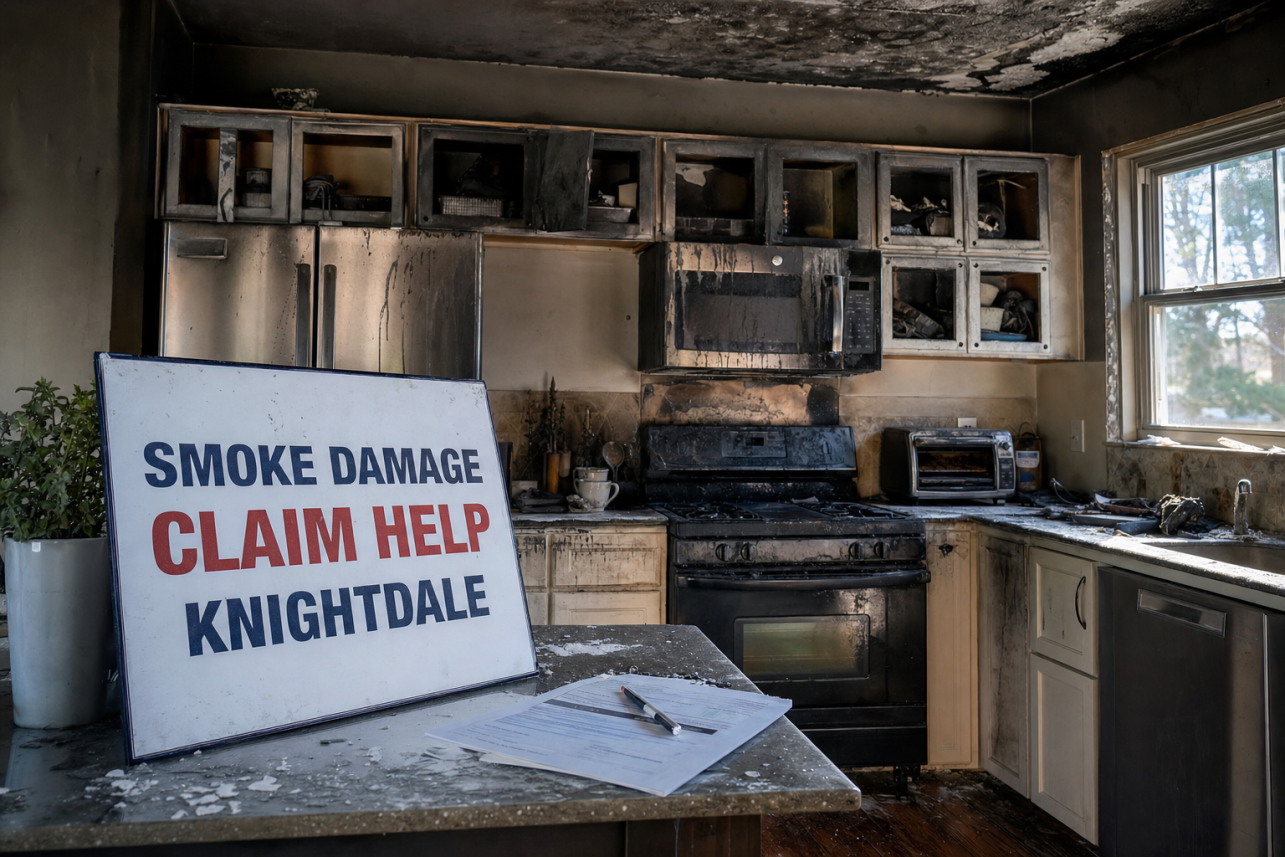
My Grease Fire Happened Months Ago And I Already Got Paid. Is It Too Late To Reopen The Claim In Knightdale?
Probably not. North Carolina generally gives policyholders three years from the date of loss to pursue a fire claim, and most policies allow supplemental claims when new damage is discovered after the original payment. Cashing the first check almost never closes the door, despite what some adjusters imply.
Grease fire damage is notorious for revealing itself late. Homeowners in Knightdale call us months after a kitchen fire because the smoke odor returns every time the heat kicks on, paint starts yellowing near the ceiling, or cabinets that were wiped down begin releasing a rancid smell in summer humidity. These are classic signs of protein residue that was never properly remediated, and they support a supplemental claim.
The key is documentation. We inspect the home, identify what the original settlement missed, and compare the carrier’s estimate against the actual scope of damage. Common gaps include contaminated ductwork, unsealed wall cavities, attic insulation, and contents that were cleaned once but never deodorized.
Before reopening anything, gather your claim number, the carrier’s original estimate, and receipts for any repairs you paid for out of pocket. If contractors quoted you more than the insurance payment covered, those quotes become evidence too.
Our Wake County team reviews closed grease fire claims at no cost. If the numbers show you were underpaid, we prepare the supplemental demand and negotiate directly with the carrier. If the original settlement was fair, we tell you that honestly and you owe nothing. Either way, you deserve to know before the filing window closes.
Will A Grease Fire Claim Cover The Smoke That Got Into My HVAC System And Ductwork?
In most cases, yes — and this is one of the most commonly underpaid parts of a Knightdale grease fire claim. When a pan ignites on the stove, your kitchen exhaust rarely captures everything. The HVAC return pulls smoke-laden air into the ductwork, and within minutes the system redistributes greasy residue through every supply vent in the house.
Grease fire smoke is especially problematic because it carries protein residue — a nearly invisible, sticky film that clings to duct interiors, the blower assembly, and the evaporator coil. Insurance carriers often approve a basic duct cleaning and call it done, but standard cleaning frequently fails to remove protein contamination. If the residue stays, the odor returns every time the system runs, particularly on humid Wake County summer days.
When we handle a smoke claim in Knightdale, we push for proper HVAC scope: hydroxyl or thermal fog treatment where appropriate, coil cleaning or replacement, filter media, and in heavier cases, duct replacement rather than cleaning. We document contamination with residue testing so the carrier can’t dismiss it as pre-existing dust.
One detail many homeowners miss: if your thermostat, smoke detectors, or kitchen appliances were exposed, those electronics may also be compensable. Smoke residue is corrosive to circuit boards, and failures often show up weeks later. We list these items in the claim upfront so you’re covered if they fail after settlement.
How Do I Prove Smoke Damage To My Furniture, Clothing, And Personal Belongings After A Grease Fire?
Documentation is everything, and the standard of proof is lower than most Knightdale homeowners assume. You do not need every item to look visibly charred. You need to demonstrate exposure, and grease fire smoke exposes far more than people realize.
Start with a room-by-room inventory. Photograph upholstered furniture, closets full of clothing, drapes, bedding, mattresses, and anything porous — these absorb protein smoke residue and hold odor even when they look clean. Wipe a white cloth across surfaces in rooms away from the kitchen; a yellowish or gray film is physical evidence the carrier can’t argue with.
For textiles, get a written assessment from a restoration dry cleaner. Some items can be restored through ozone treatment or specialty cleaning; others, like leather goods and certain synthetics, absorb odor permanently and should be listed as total losses at replacement cost, not thrift-store value.
Don’t throw anything away until it’s documented and, ideally, until the adjuster has seen it or you have photos, receipts, and model numbers. Discarded items without documentation are the single biggest source of denied contents claims we see in Wake County.
As your public adjuster, we prepare the full contents inventory for you — typically hundreds of line items with accurate replacement pricing — because carriers routinely undervalue self-prepared lists. Homeowners who submit a handwritten page of ‘couch, clothes, curtains’ leave thousands on the table. A properly itemized inventory is often the difference between a partial payment and a full contents settlement.
Can Renters And Landlords In Knightdale Both Get Smoke Damage Claim Help Knightdale NC After A Grease Fire?
Yes — and after a rental-property grease fire, there are usually two separate claims, under two separate policies, and both parties benefit from Smoke Damage Claim help knightdale NC because the interests rarely line up neatly.
If you’re the tenant, your renters policy covers your personal belongings — clothing, furniture, electronics — plus loss of use if smoke contamination makes the unit unlivable during cleaning. That loss-of-use coverage can pay for a comparable rental or hotel in the Knightdale area while restoration happens. Many tenants never claim it because they don’t realize it exists.
If you’re the landlord, your dwelling policy covers the structure: cabinets, walls, ceilings, flooring, ductwork, and built-in appliances. You may also have lost rental income coverage while the unit is uninhabitable. One caution — your carrier may attempt subrogation against the tenant, and the tenant’s carrier may dispute the cause. That crossfire can stall both claims for months if nobody is managing it.
We’ve represented tenants and property owners across Wake County in these situations. We document the smoke migration path, separate structure damage from contents damage so nothing falls between the two policies, and keep each claim moving independently.
One important note for landlords: if the tenant’s grease fire contaminated adjacent units in a duplex or townhome, those units may also be claimable, including odor remediation for neighboring tenants. Get every affected space inspected before any cleaning starts, because pre-cleaning documentation is what supports the full scope.
The Restoration Company Already Cleaned My House, But It Still Smells Like Smoke. What Are My Options?
This happens constantly with grease fires, and you have more options than you’ve probably been told. Persistent odor after cleaning is evidence the approved scope was insufficient — not proof that you have to live with it.
Grease fires produce protein smoke, which behaves differently from wood or paper smoke. The residue is nearly invisible, penetrates deep into porous materials, and reactivates with heat and humidity. That’s why the smell fades in cool weather and roars back on a hot Knightdale afternoon. Surface wiping and a single ozone treatment often can’t touch residue that has soaked into unsealed cabinet interiors, subfloor, insulation, or the paper facing of drywall.
First, understand your claim is not necessarily closed. If odor persists, that’s an unresolved covered loss. You can request a supplement for additional remediation — sealing and repainting with odor-blocking primer, removing and replacing insulation above the kitchen, replacing rather than cleaning cabinets, or treating wall cavities that were never opened.
Second, get independent verification. A restoration hygienist can test for residual contamination, giving you objective evidence rather than a smell-based argument the carrier will wave off.
When a Knightdale homeowner comes to us at this stage, we review what the carrier originally approved, identify what was skipped, and file a documented supplement. Carriers frequently approve the cheapest scope first and only pay for proper remediation when someone pushes back with evidence. Even if you’ve cashed a check, most NC policies allow supplemental claims when covered damage remains — don’t assume the first payment was the last word.
Should I Let The Insurance Company’s Adjuster Inspect First, Or Get Smoke Damage Claim Help Knightdale NC Before That Visit?
Ideally, bring in your own representation before the carrier’s adjuster ever walks through the door. The insurer’s adjuster works for the insurance company, and their first inspection often sets the tone for the entire claim. If they miss smoke residue in your attic insulation, inside cabinet interiors, or behind appliances, that omission gets baked into the initial estimate.
When you have a Knightdale public adjuster present for that first inspection, nothing gets glossed over. We walk the property with the carrier’s representative, point out protein residue on surfaces they might call “clean,” and document odor migration into rooms far from the kitchen. Grease fire smoke is notoriously easy to underestimate on a quick visual walkthrough because the film it leaves is often nearly invisible.
If the carrier’s adjuster has already inspected, don’t panic. We can still request a re-inspection, submit our own detailed estimate, and challenge any lowball findings. Wake County homeowners have that right under their policy, and carriers routinely revise offers when confronted with thorough documentation.
Either way, do not sign anything beyond the basic claim acknowledgment, and do not accept a quick settlement check labeled “final” until the full scope of damage is known. Odor and residue from a stovetop fire frequently reveal themselves weeks later, especially when humid North Carolina summers reactivate smells in fabrics and drywall. Getting professional eyes on the loss early costs you nothing upfront and typically changes the outcome significantly.
Will My Policy Pay For A Hotel Or Rental While My Knightdale Home Is Being Cleaned After A Grease Fire?
In most cases, yes. Nearly every homeowners policy written in North Carolina includes Loss of Use coverage, sometimes called Additional Living Expenses or ALE. If smoke residue and odor make your home uninhabitable, or if remediation work like duct cleaning, sealing, and repainting forces you out temporarily, the policy should cover reasonable extra costs.
That includes hotel stays, a short-term rental, increased food costs from eating out, pet boarding, and even added mileage if you’re commuting farther to work or getting kids to school. The key word is “extra” — the carrier pays the difference between your normal living costs and what you’re spending because of the fire.
Here’s where Knightdale homeowners get shortchanged: carriers often argue that a grease fire only affected the kitchen, so the house is technically livable. But if the odor is throughout the home, the HVAC system is contaminated, or your family includes young children or anyone with asthma, staying in the house may not be reasonable or safe. We push back on those livability arguments with air quality documentation and remediation timelines.
Keep every receipt from day one, even before your claim is approved. Document why you left, when, and what the restoration schedule looks like. As part of the claim work our team handles, we build the ALE portion alongside the property damage estimate so nothing gets left off. Families in Wake County have recovered thousands in living expenses they didn’t realize their policy owed them.
What Is Protein Smoke Residue, And Why Do Insurance Adjusters Keep Missing It After Grease Fires?
Protein residue is the specific byproduct of burning grease, cooking oil, and food. Unlike the black soot from a structural fire, protein smoke leaves a thin, greasy, nearly colorless film. You often can’t see it, but you can smell it — a pungent, rancid odor that clings to paint, wood, fabric, and plastic and gets worse with heat and humidity.
That invisibility is exactly why carrier adjusters underestimate grease fire losses. They walk through a Knightdale kitchen, see white cabinets that still look white, and write a small estimate for wiping down surfaces and repainting one wall. Meanwhile, the residue has coated the inside of upper cabinets, penetrated unsealed wood trim, settled into HVAC returns, and bonded to ceiling paint two rooms away.
Protein residue also corrodes over time. It’s mildly acidic, and left untreated it can discolor metal fixtures, yellow painted surfaces, and permanently embed odor into porous materials. Standard household cleaning won’t remove it — proper remediation usually requires specialized degreasing agents, sometimes sealing and repainting, and often replacement of items that can’t be salvaged.
When we handle a grease fire loss in Wake County, we test surfaces throughout the home, not just where damage is visible. That documentation is what forces the carrier to pay for full remediation instead of a surface wipe-down. If your insurer’s estimate treats an aggressive kitchen fire like a minor cleaning job, that gap between what protein residue actually requires and what they offered is usually worth thousands of dollars.
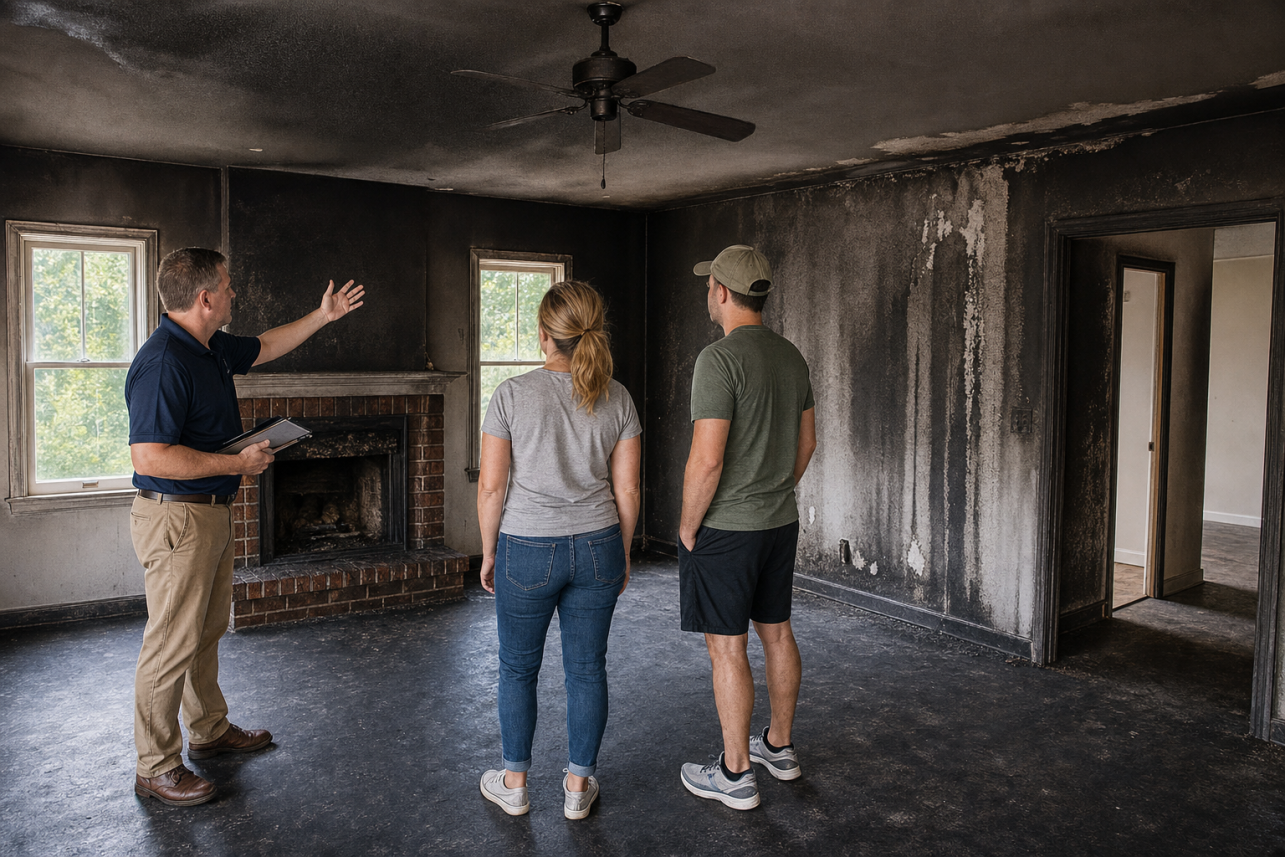
My Grease Fire Claim Was Underpaid And The Carrier Won’t Budge. What Can I Actually Do About It In Wake County?
You have more leverage than the insurance company wants you to think. An underpaid grease fire settlement is not the end of the road, and North Carolina policyholders have several formal paths to challenge it.
First, we reopen the negotiation with evidence. That means a room-by-room estimate built on actual remediation costs in the Knightdale market, residue testing results, contents inventories, and photos the carrier’s adjuster never took. Most underpayments get corrected at this stage because the original estimate simply missed damage.
If the carrier still refuses, nearly every policy contains an appraisal clause. Appraisal is a formal dispute process where you and the insurer each hire an independent appraiser, and those two select a neutral umpire. It’s faster and far cheaper than a lawsuit, and it frequently resolves disputes over smoke remediation scope, contents values, and odor treatment. You can also file a complaint with the North Carolina Department of Insurance, which carriers take seriously.
This is exactly the situation where Smoke Damage Claim help knightdale NC from For The Public Adjusters, Inc. changes outcomes. We know which arguments carriers use to minimize grease fire losses — “cosmetic only,” “cleaning is sufficient,” “pre-existing odor” — and we know how to dismantle each one with documentation.
One warning: don’t cash a check marked “full and final settlement” if you plan to dispute, and watch your policy’s deadlines. Most policies give you a limited window to invoke appraisal or file suit, so acting within months of the underpayment, not years, protects your options.
Local Relevance
Knightdale has grown fast over the past two decades, and that shows in its housing: large newer subdivisions with open floor plans sit alongside older established neighborhoods closer to the town center. That mix matters after a kitchen fire.
Open-concept layouts, common in newer Knightdale homes, give smoke a clear path from the stove to the living room, upstairs bedrooms, and the HVAC return in minutes. Older homes bring their own issues — original ductwork, plaster, and finishes that absorb odor deeply and cost more to restore than a carrier’s standard estimate assumes.
Our humid North Carolina summers make it worse. Moisture in the air helps soot and grease residue bond into porous materials, and odor that seems faint in the first days after a fire often intensifies as humidity rises. The U.S. Fire Administration’s home cooking fire safety guidance underscores how quickly unattended cooking becomes a whole-house event — and in Wake County, we see the aftermath of that regularly.
We serve Knightdale, the surrounding Wake County communities, and homeowners and business owners throughout the Raleigh area.
Many newer Knightdale homes were built with open floor plans and centrally located HVAC returns, which means a stovetop grease fire often contaminates the entire duct system before the flames are even out — so any settlement that skips a professional HVAC inspection and cleaning is almost certainly incomplete.
Had A Grease Fire In Your Knightdale Home? Talk To Us Before You Accept The Insurer’s Number
The first offer after a smoke loss is rarely the full story. For The Public Adjusters, Inc. is licensed and bonded, works only for policyholders, and gets paid only when your claim does. Let us inspect the damage, document what the insurer’s adjuster missed, and handle the negotiation — while you focus on getting your home back.
Call us: (919) 400-6440
Helpful Resources
- U.S. Fire Administration – Home Cooking Fire Safety
- National Fire Protection Association (NFPA)
- NCDOI Public Adjusters Guide
- U.S. Fire Administration cooking fire safety — Federal guidance on preventing and responding to kitchen and grease fires
- North Carolina Department of Insurance — State regulator overseeing insurers and public adjuster licensing in NC
Serving Knightdale · Wake
Last updated: August 20, 2026