
The Quick Answer: Why Tree Damage Insurance Claims Get Low-Balled
A tree damage insurance claim often comes in low because the adjuster scopes only the visible impact zone — usually a patch of broken shingles — while missing cracked rafters, shifted trusses, damaged decking, and water intrusion beneath the surface. The first offer reflects what the adjuster could see quickly, not the full structural damage a heavy tree actually causes.
Key takeaways
- A tree strike can crack rafters, split decking, and shift the ridge beam even when surface shingle damage looks minor.
- Desk adjusters who scope only the visible impact area routinely miss structural and attic damage that belongs in a tree damage insurance claim.
- Water-soaked attic insulation is a covered consequence of the impact opening and should be documented before it dries or grows mold.
- A licensed public adjuster’s on-site inspection — including attic access and framing checks — often substantially increases a low initial estimate.
- In North Carolina, homeowners can dispute a lowball estimate with supplemental documentation rather than accepting the first offer.
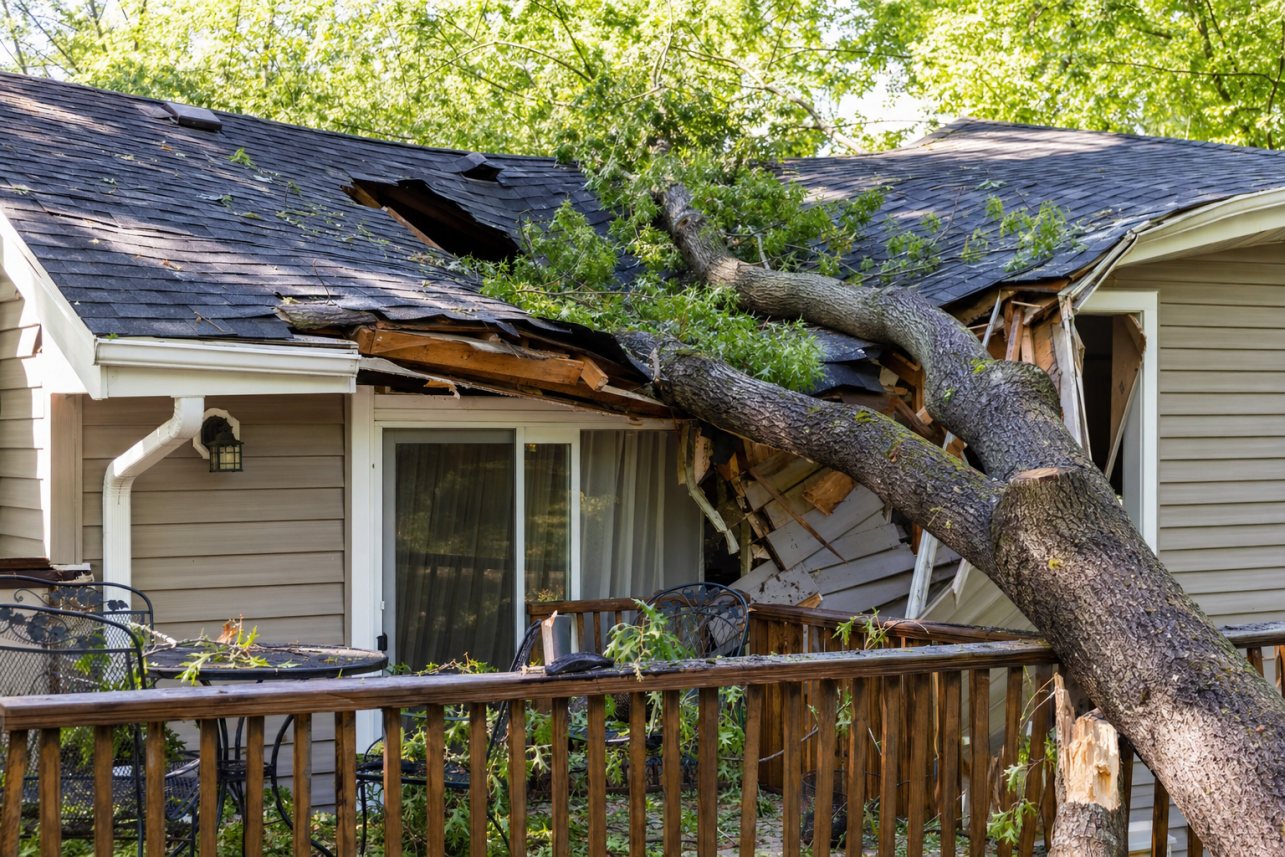
Here’s a scenario that plays out across North Carolina every fall storm season. A mature oak, softened by weeks of rain and pushed over by a gusty cold front, comes down on a home in Wake or Johnston County. The trunk punches through the roof over a bedroom. The homeowner files a claim, a tree crew removes the debris, and the insurance adjuster walks the roof a few days later. The estimate that arrives covers new shingles over the hole, a bit of felt paper, and maybe a sheet or two of plywood. On paper, the roof looks handled. In reality, the estimate may have addressed only the most obvious layer of the problem.
Why First Offers Miss So Much
A tree that weighs several tons doesn’t just tear shingles — it transfers force through the entire roof system. But several things work against a complete first estimate:
- Speed of the inspection. During fall storm season, adjusters are handling high claim volumes and often spend limited time on each roof.
- Debris is already gone. Once the tree is removed, the visual evidence of how hard it hit — and where the load spread — is much harder to see.
- Structural damage hides inside. Cracked rafters, crushed trusses, and separated connections live in the attic, not on the shingle surface, and are easy to skip without a thorough interior inspection.
- Water damage develops later. Even a briefly open roof lets rain into insulation, drywall, and framing, and that moisture problem often isn’t obvious on day one.
That last point matters more than most homeowners realize. Once rain gets past the roof deck, it behaves like any other water loss — soaking ceilings, running down wall cavities, and setting the stage for mold. The documentation standards that apply to a water damage insurance claim in Rolesville apply just as much to the hidden moisture a fallen tree leaves behind.
It’s Not Always Bad Faith — But It Is Your Problem
A low first offer isn’t necessarily the insurance company acting in bad faith. It’s often the predictable result of a fast, surface-level scope written under seasonal pressure. But the burden of proving the full extent of the damage falls on you, the policyholder. That’s why many homeowners bring in their own representation — a licensed public adjuster in Garner or elsewhere in the Triangle — to inspect the attic, framing, and decking before accepting a settlement that only pays for shingles.
The rest of this article breaks down exactly what hidden damage to look for, why insurers scope claims this narrowly, and what to do if your offer came in too low.
What Hidden Damage Can a Fallen Tree Cause Beyond the Shingles?
A fallen tree can crack rafters, split roof decking, shift the ridge beam, tear the underlayment, and soak attic insulation — structural and moisture damage that never shows up in photos of the shingle surface. Each of these problems affects the safety of your home and the true cost of a proper repair.
When a tree hits a roof, the impact force travels well past the point of contact. Shingles are just the visible skin. The framing underneath absorbs the blow, and that’s exactly where a photo-only review falls short.
Structural Damage the Camera Never Sees
- Cracked or fractured rafters. A rafter can crack along its length without visibly sagging right away. A compromised rafter can no longer carry snow, wind, or the weight of new roofing materials safely.
- Split roof decking. The plywood or plank decking under the shingles often splits at the impact point and along the seams between panels. Nailing new shingles into split decking gives them nothing solid to hold onto.
- A shifted ridge beam. A heavy trunk landing near the peak can knock the ridge out of alignment. Even a small shift changes how the entire roof structure distributes load, and it can telegraph stress into walls and ceilings over time.
- Torn underlayment. The waterproof layer beneath the shingles frequently tears far beyond the visible hole. If only the punctured shingles are replaced, the roof can leak through those hidden tears during the next hard rain.
The Water Damage That Follows the Impact
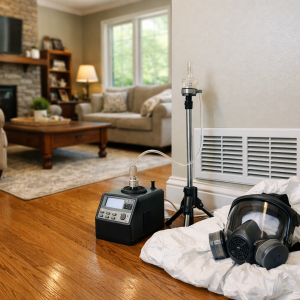
Almost every tree strike opens the roof to rain, even briefly, before a tarp goes on. Water that reaches the attic soaks insulation, and wet insulation loses its ability to insulate and becomes a breeding ground for mold against the drywall below. This moisture side of the loss is often the most undervalued part of a tree damage insurance claim, which is why homeowners frequently pair the structural claim with a water damage insurance claim in Rolesville and surrounding areas when the attic and ceilings are affected.
Why does each item matter? Because a repair that skips them isn’t really a repair. New shingles over split decking will fail prematurely. A shifted ridge left uncorrected can create rot pockets and future leaks. Wet insulation left in place can lead to mold remediation costs that dwarf the original roofing bill. Homeowners in rural Chatham County have run into this exact pattern, which is one reason a public adjuster for water damage near Bear Creek will insist on getting into the attic — not just onto the roof — before agreeing to any settlement figure.
The bottom line: if no one has physically inspected the framing and attic from the inside, the full scope of your loss hasn’t been documented yet.
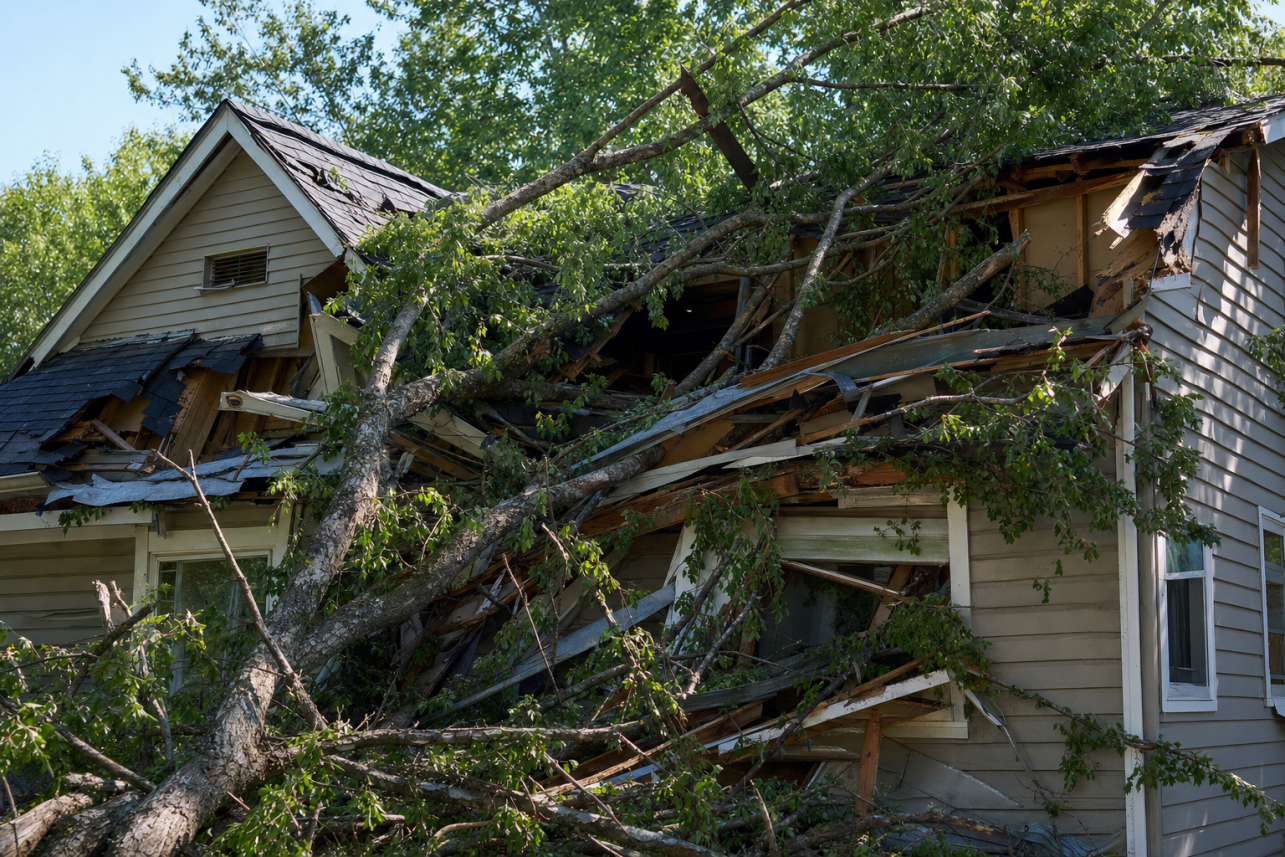
Why Did the Insurance Company Only Pay for New Shingles?
Most low tree damage insurance claim payouts come down to how the loss was inspected, not bad faith. Desk adjusters working from photos, quick drive-by inspections, and software-generated estimates tend to capture only the visible surface damage — the shingles — while missing structural and interior damage hidden underneath the roof covering.
When a tree hits a roof, the insurance company assigns an adjuster to assess the damage. But the way that assessment happens has changed a great deal in recent years, and the process itself often narrows the scope of what gets paid.
Desk Adjusting and Drive-By Inspections
Many carriers now handle claims remotely. A desk adjuster may never set foot on your property. Instead, they rely on:
- Photos submitted by you or your contractor — which usually show the tree and the shingle damage, not the cracked rafters or shifted decking beneath
- Brief exterior inspections — a field adjuster or third-party inspector may spend only a short time on site and never enter the attic
- Aerial or satellite imagery — useful for measuring a roof, but incapable of revealing framing damage or moisture intrusion
None of this means the adjuster is acting in bad faith. It simply means the estimate reflects what was documented — and what was documented was often just the roofing surface.
Software-Driven Estimates Follow the Photos
Insurance estimates are typically built in standardized estimating software. The program prices whatever line items the adjuster enters. If the file only shows shingle damage, the estimate only includes shingle replacement. Sheathing, framing repairs, insulation, drywall, and interior water damage never make it into the scope because no one documented them. That same water intrusion can worsen over time, which is why a water damage claims adjuster in Knightdale so often finds problems weeks after a storm that the original estimate never addressed.
You Have the Right to Disagree With the Scope
Under a standard North Carolina homeowners policy, the carrier’s first estimate is not the final word. Policyholders have the right to:
- Submit additional documentation, inspection reports, or contractor findings
- Request a re-inspection of the property
- Ask for a supplement when hidden damage is discovered during repairs
- Invoke the policy’s appraisal provision when there is a genuine dispute over the amount of loss
The key is documentation. An insurer generally cannot pay for damage no one has shown them. That’s where professional representation matters — for example, a water damage adjuster in Mebane can inspect the attic, decking, and interior finishes and build the evidence needed to reopen a narrow scope. A shingle-only estimate is a starting point, not a settlement you’re required to accept.
How Can a Public Adjuster Help With a Tree Damage Insurance Claim?
A public adjuster helps with a tree damage insurance claim by performing an independent, top-to-bottom inspection — attic, decking, framing, and interior — documenting hidden damage the carrier’s adjuster missed, and building a line-item estimate that supports the true scope of covered repairs. They then negotiate directly with the insurer on your behalf.
To see what that looks like in practice, consider how one North Carolina homeowner’s claim turned around after a re-inspection. The carrier’s original estimate covered little more than replacing the shingles at the point of impact. The public adjuster started where the insurance company’s adjuster never went: the attic.
What the Re-Inspection Uncovered
- Attic access: From inside the attic, the adjuster could see cracked rafters and fractured roof decking directly beneath the impact zone — damage invisible from a ladder outside.
- Moisture meter readings: Elevated moisture levels in the decking and insulation showed that water had been entering through the compromised roof since the storm, not just at the visible hole.
- Structural photographs: Every cracked rafter, split truss member, and saturated area was photographed and mapped to its location on the roof plan, creating evidence the carrier could not dismiss as speculation.
- A line-item estimate: Instead of a lump-sum shingle allowance, the adjuster prepared a detailed estimate covering decking replacement, rafter repair, insulation removal, interior drywall, and proper drying — substantially increasing the covered repair amount.
That documentation changed the conversation. Rather than arguing opinions, the homeowner’s representative presented measurable readings and photographs tied to specific policy coverages. The same approach applies when a leak spreads into living spaces — the kind of situation where an insurance water damage claim in Raleigh often involves damage far beyond what’s visible on a ceiling.
North Carolina Law Backs Up Policyholders
North Carolina courts have made clear that insurers cannot simply low-ball a settlement without consequence. In Gray v. North Carolina Insurance Underwriting Association, the North Carolina Supreme Court allowed a homeowner’s bad-faith claim to proceed after the insurer offered an unreasonably low settlement for hurricane damage to the dwelling. The case underscores that carriers in NC have a duty to deal fairly with policyholders — and that an unreasonably low payout can expose them to liability beyond the policy itself.
A public adjuster’s job is to make sure it never gets that far: thorough documentation and a well-supported estimate usually resolve the dispute without litigation. Homeowners dealing with tree impacts and the water intrusion that follows can get similar water damage insurance claim help in Chapel Hill and surrounding communities. The key is having someone on your side who knows where hidden damage lives — and how to prove it.
What Should You Do If Your Tree Damage Insurance Claim Comes In Too Low?
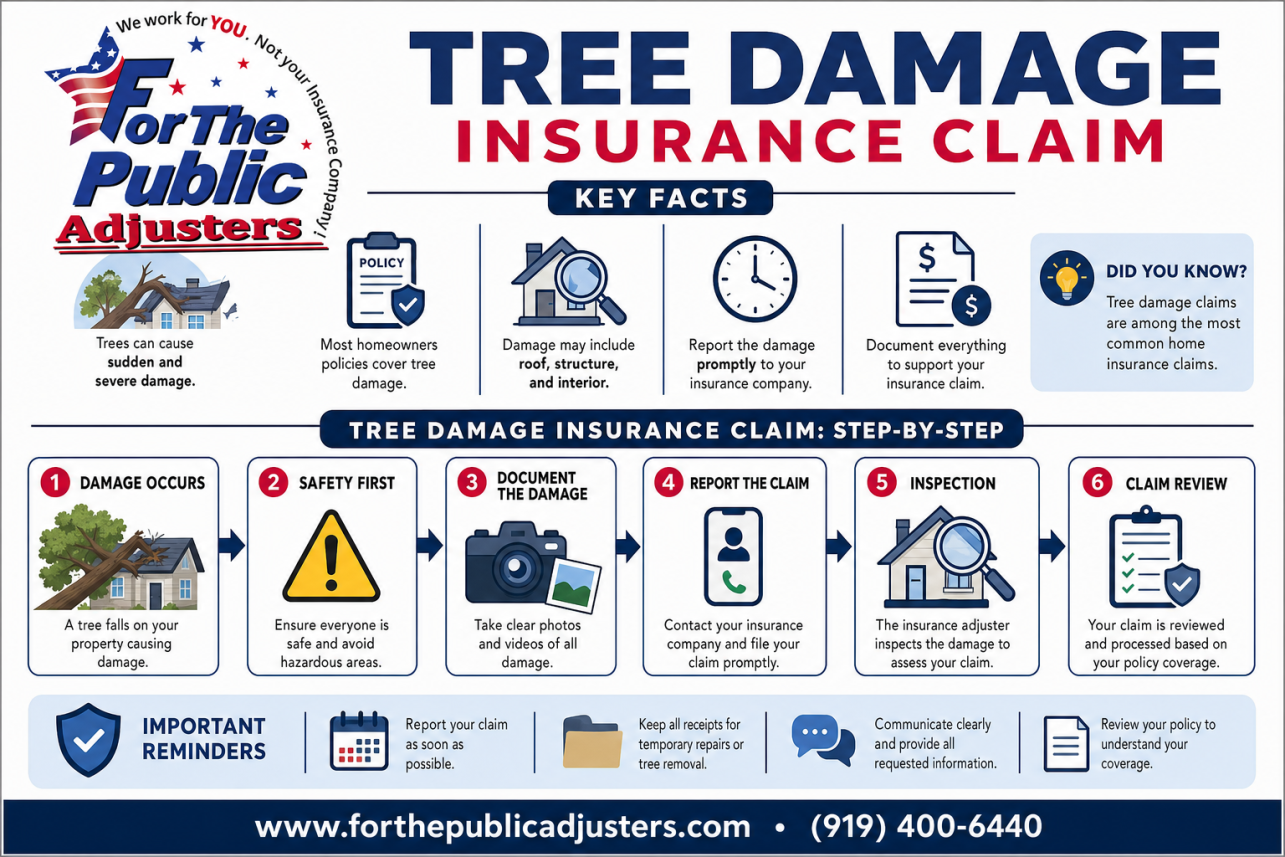
If your tree damage insurance claim comes in low, act quickly: preserve all evidence, inspect (or have someone inspect) the attic and decking, request the insurer’s complete estimate in writing, document everything with photos and notes, and consider hiring a licensed public adjuster to reassess the full scope of damage before you accept payment.
A low first offer is not the end of the road. In North Carolina, you generally have the right to dispute an estimate, submit additional documentation, and have the claim re-evaluated. The steps below give you a practical order of operations.
Step 1: Preserve Evidence Before Winter Weather Sets In
Once cold rain, ice, or snow arrives, hidden damage gets worse and harder to attribute to the tree. Keep tarps in place, save receipts for emergency repairs, and do not let anyone haul away damaged materials or cut up the tree beyond what safety requires until everything is photographed.
Step 2: Get Into the Attic — Safely
Many low estimates are written from the ground or the rooftop only. Cracked rafters, shifted trusses, daylight through the decking, and moisture staining often only show up from inside the attic. If you are not comfortable or able to do this safely, hire a qualified contractor or inspector to document it. Water intrusion that starts small can become the kind of loss we see in an insurance water damage claim in Raleigh — slow, hidden, and expensive if it goes unaddressed.
Step 3: Request the Insurer’s Full Estimate in Writing
Ask for the complete line-item estimate, not just the payment summary. This shows exactly what the adjuster included — and, more importantly, what was left out, such as decking replacement, structural framing, insulation, or interior repairs. If you feel the insurer is not handling the claim fairly, you can also file a complaint or request assistance from the North Carolina Department of Insurance.
Step 4: Document Everything
- Photograph the roof, attic, ceilings, and the tree itself from multiple angles.
- Keep a written log of every call, email, and inspection, with dates and names.
- Save all repair invoices, tarping receipts, and contractor assessments.
Step 5: Know When to Bring In a Licensed Public Adjuster
If the gap between the insurer’s estimate and your contractor’s assessment is significant, or the carrier refuses to account for hidden structural or moisture damage, a licensed public adjuster can prepare an independent, documented estimate and negotiate directly with the insurance company on your behalf. Public adjusters are licensed professionals who represent the policyholder, not the insurer — the National Association of Public Insurance Adjusters is a good resource for understanding the role. Homeowners in rural areas are not out of reach either; for example, a public adjuster in Silk Hope NC can handle claims well outside the major metros.
One honest caveat: every claim is different, and no adjuster can guarantee a specific outcome or settlement amount. What a thorough, well-documented reassessment does is ensure your claim reflects the full damage — so any settlement is based on complete information, not a quick exterior glance.
Tree Damage Insurance Claim: Desk Adjuster Scope vs. Full Structural Inspection
| Damage Area | Typical Desk Adjuster Scope | Full On-Site Inspection Finds |
|---|---|---|
| Roof surface | Shingle replacement over the impact zone only | Fractured decking, split sheathing panels beyond the visible hole |
| Framing | Often not inspected at all | Cracked or broken rafters, shifted or stressed ridge beam |
| Attic and insulation | Rarely accessed | Water-soaked insulation, wet framing, early moisture staining |
| Interior finishes | Noted only if ceiling stains are visible | Hidden moisture in ceiling cavities detected with meters or thermal imaging |
Illustrative Example: The Estimate That Stopped at the Shingles
Illustrative example
In this hypothetical composite scenario, a mature oak fell onto a Raleigh-area home during a storm, and the insurer’s desk adjuster — working from photos — scoped only shingle replacement over the impact zone. The homeowner, uneasy about a sagging ceiling line, brought in a public adjuster who physically entered the attic and inspected the framing. That inspection documented cracked rafters, split roof decking radiating from the strike point, a shifted ridge beam, and saturated attic insulation. The supplemented tree damage insurance claim, backed by photos, moisture readings, and a contractor’s structural assessment, resulted in a covered repair estimate several times the original offer. The takeaway: no tree-strike claim should be settled without someone actually looking inside the attic.
Frequently asked questions
Why was my tree damage insurance claim estimate so low?
Low estimates usually happen because the initial inspection was limited. Desk adjusters and quick rooftop visits often scope only visible damage, like broken shingles at the impact point, while missing structural damage underneath — cracked rafters, split decking, or a shifted ridge beam. Insurers also apply depreciation, use their own pricing software, and may exclude related repairs unless they’re specifically documented. A more thorough inspection frequently reveals covered damage the first estimate never included.
How do I know if there’s hidden damage under my roof after a tree fell on it?
Check the attic first. Look for cracked or splintered rafters, gaps where decking has split, daylight showing through, sagging along the ridge line, and wet or compressed insulation. Inside the home, watch for new ceiling cracks, doors that suddenly stick, or water stains appearing days later. A heavy tree impact transfers force well beyond the strike point, so damage often extends across framing members that look fine from outside.
Can I dispute a low insurance estimate for tree damage to my roof?
Yes. You can request a re-inspection, submit your own contractor or engineer reports documenting damage the insurer missed, and ask for a revised estimate in writing. If the insurer won’t budge, options include hiring a public adjuster, invoking the appraisal clause in your policy if there’s a dispute over the amount, or consulting an attorney. Keep everything in writing and don’t cash any check marked as final settlement without understanding what that means.
Is it worth hiring a public adjuster for a tree damage claim?
It often is when the damage is significant and the insurer’s estimate seems to cover only surface repairs. Public adjusters work for you, not the insurance company, and typically charge a percentage of the recovered amount, so they’re paid from the increase they help secure. For small claims near your deductible, the fee may not be worthwhile. For structural damage — cracked framing, shifted beams, saturated insulation — their documentation can substantially change the outcome.
How long do I have to file a tree damage claim in North Carolina?
Report the damage to your insurer as soon as reasonably possible — most policies require prompt notice, and delays give the company grounds to question the claim. Your specific policy will state deadlines for filing proof of loss and for taking legal action, and those contractual deadlines can be shorter than state statutes of limitation. Check your policy’s conditions section, and if a deadline is approaching, get your notice in writing immediately.
Does homeowners insurance cover the cost of removing the tree from my roof?
Generally yes, when the tree damaged a covered structure. Removing the tree from the house is usually treated as part of the covered loss, and policies often include a separate, capped amount for debris removal from the property. Coverage is much more limited if a tree falls in the yard without hitting anything. Review your policy’s debris removal provision and keep itemized receipts, because removal costs are frequently underestimated in initial scopes.
Should I get my own contractor estimate before accepting the insurance settlement?
Yes. An independent estimate from a licensed roofing contractor or structural engineer gives you a baseline to compare against the insurer’s scope. If your contractor finds cracked rafters, split decking, or ridge movement the adjuster missed, that written documentation becomes the basis for a supplemental claim. Never sign a final release or begin permanent repairs based solely on the insurer’s estimate if a qualified contractor says it won’t cover a complete, code-compliant repair.
What is a supplemental claim and how does it work for roof damage?
A supplemental claim is a request for additional payment after the initial settlement, based on damage or costs discovered later — common with tree strikes, where hidden structural damage surfaces once repairs begin. You submit documentation such as photos, contractor findings, and revised estimates, and the insurer reviews and adjusts the claim. Most policies allow supplements, but there are time limits, so document everything during demolition and notify your insurer promptly when new damage is found.
What mistakes do homeowners make after a tree falls on their house?
Common mistakes include accepting the first estimate without an independent inspection, throwing away the tree or debris before it’s documented, making permanent repairs before the insurer approves the scope, skipping the attic inspection where structural damage hides, and cashing a settlement check without confirming whether it closes the claim. Another big one: not photographing everything immediately. Take wide shots and close-ups of the tree, roof, attic, and interior before anything is moved.
Will my homeowners insurance pay for water damage that shows up weeks after the tree hit?
Usually yes, if the water intrusion traces back to the tree impact — for example, rain entering through split decking or a compromised ridge before repairs were complete. The key is documenting the connection: soaked insulation, staining patterns, and moisture readings tied to the breach point. Insurers may resist if they can argue the damage came from neglect or a preexisting leak, so report new water damage immediately and have it inspected while the cause is clear.
Water Damage Claim help near you
- Water Damage Claim Help Bynum
- Water Damage Insurance Claim Help Bennett
- Water Insurance Claim Siler City
Related local pages
If a fallen tree damaged your home and the insurer’s estimate feels too small, we can help. Our licensed and bonded NC public adjusters inspect, document, and negotiate on your behalf — contact us today for a free claim review. Get in touch.
Last updated: September 4, 2026