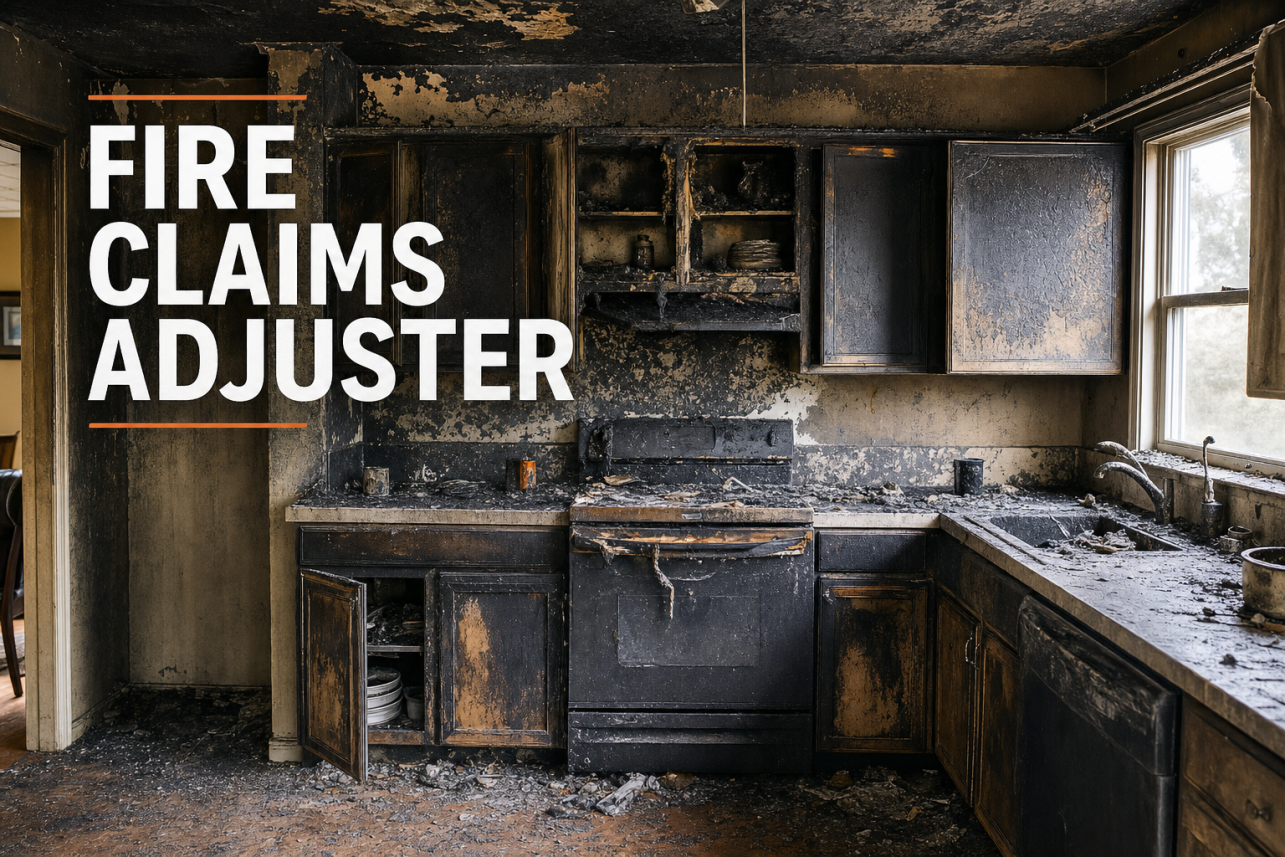
A fire claims adjuster Fuquay-Varina NC homeowners can call after a house fire is a licensed public adjuster who works for you, not the insurance company. For The Public Adjusters, Inc. documents the full extent of your fire, smoke, and firefighting water damage, prepares the proof of loss, and negotiates the settlement on your behalf. We are licensed and bonded, and we handle everything from partial kitchen fires to total losses across Wake County.
What This Service Is
After a fire, your insurance company sends its own adjuster to estimate the damage. That person is paid by the insurer. A public adjuster is the licensed professional you hire to represent your side of the claim.
Our job starts with a complete property loss assessment. That means the obvious burn damage, but also the things insurers routinely miss: soot that traveled through the HVAC system, smoke odor absorbed into framing and insulation, and water damage from the fire hoses that soaked walls and floors two rooms away from the flames.
We build a room-by-room contents inventory of your personal belongings, prepare structural repair estimates, and assemble the proof of loss documentation your policy requires. Then we handle the negotiation. The North Carolina Department of Insurance explains in its NCDOI Public Adjusters Guide how public adjusters are licensed and what they may charge, so you can verify our standing before you ever sign anything.
We also help you claim additional living expenses — the hotel, rental, and extra meal costs your family incurs while your home is uninhabitable. Those costs add up fast, and many policyholders never realize their policy covers them.
Common Problems
The Insurance Company’s Offer Won’t Come Close To Covering My Repairs
This is the most common call we get. The insurer’s estimate covers repainting and drywall, but the contractor’s real bid is two or three times higher once smoke remediation, electrical inspection, and code-required upgrades are included.
Part of the gap is depreciation. If your policy pays replacement cost, the insurer often issues an actual cash value payment first — the depreciated amount — and you have to complete repairs and submit documentation to recover the rest. Miss a step and that money stays with them.
Courts have sided with policyholders on these shortfalls. In Windridge of Naperville Condominium Association v. Philadelphia Indemnity Insurance Co., the court ruled the insurer had to replace all of the buildings’ damaged siding so the repair actually matched — not just patch the sections it wanted to pay for. That principle matters in fire claims too: a proper settlement restores your home, not a piecemeal version of it.
My Fire Claim Is Stalled, Underpaid, Or Denied — What Now?
Delays and disputes usually trace back to documentation. If the insurer’s file doesn’t show the full scope of damage, the claim sits, or it settles low. Hidden problems make this worse — heat-weakened trusses, charred framing behind intact drywall, and soot inside ductwork rarely appear in a quick walkthrough.
A denial or lowball figure is not the end of the claim. North Carolina policyholders have the right to dispute the insurer’s findings, submit their own estimates, and demand a written explanation of what was excluded and why.
We re-open that conversation with evidence: engineering-level scope documents, photographs, moisture readings from firefighting water, and a defensible line-item estimate. When an insurer drags its feet without justification, we document that pattern too, because unreasonable claim handling has consequences under state law.
Do I Really Need A Fire Claims Adjuster Fuquay-Varina NC, Or Can I Handle It Myself?
You can file a fire claim yourself, and for a very small loss that may be fine. But a significant house fire produces one of the most complicated claims in property insurance: structure, contents, smoke, water, temporary housing, and code upgrades all at once.
Ask yourself honestly: do you know how to inventory every damaged item with age and replacement value, challenge depreciation deductions, or spot when a policy’s ordinance-and-law coverage should pay for bringing an older home up to current code? That’s daily work for us.
When hiring anyone, verify their North Carolina license, confirm they’re bonded, and ask how their fee works — reputable public adjusters charge a percentage of the recovery, never upfront cash. We can’t promise a specific dollar outcome, and you should walk away from anyone who does. What we can promise is that your claim will be fully documented and professionally negotiated.

Our Process
Free Policy Review And Damage Inspection
We start by reading your actual policy — coverage limits, deductible, replacement cost provisions, and additional living expenses. Then we inspect the property top to bottom, including the areas fire crews soaked and the spaces smoke reached that the flames never touched.
Documentation And Proof Of Loss
We photograph everything, build a complete contents inventory, obtain structural repair estimates, and prepare the sworn proof of loss your insurer requires. This file is the foundation of the claim — the stronger it is, the harder it is to underpay.
Negotiation And Settlement
We present the claim, meet the insurance company’s adjuster on site, and negotiate line by line until the settlement reflects the true cost of restoring your home and replacing what you lost. You stay informed at every stage, and nothing settles without your approval.
| What Happens | Filing on Your Own | With Our Team on Your Side |
|---|---|---|
| Damage scope | You rely on the carrier’s adjuster, who works for the insurance company and often scopes only visible fire damage | Independent inspection covering hidden smoke, soot, heat, and water-suppression damage — including HVAC and attic spaces |
| Contents inventory | You list what you remember losing, usually missing 30-50% of items | Room-by-room documented inventory with replacement pricing for every item |
| Additional living expenses | Many homeowners never claim hotel, food, or mileage costs they’re owed | ALE tracked and submitted from day one so displacement costs come back to you |
| Negotiation | First offer is often accepted because you don’t know what’s disputable | Every line item negotiated with documentation, lab results, and contractor pricing |
| Timeline pressure | Carrier deadlines and proof-of-loss requirements are easy to miss | All deadlines managed and every submission built to policy requirements |
| Typical result | Settlements frequently fall well short of true rebuild cost | Clients regularly recover multiples of the initial carrier offer |
Commonly Overlooked In The Public Adjusting Industry
- Soot contamination inside HVAC ductwork — Carrier adjusters rarely open the duct system, so contamination that spreads odor and health risks through the whole house never makes it into the scope.
- Heat damage to roof decking and trusses above the fire room — Charring gets checked, but structural lumber weakened by heat without visible char is missed unless someone inspects the attic with the framing in mind.
- Water damage from fire suppression — Everyone focuses on the burn area while hundreds of gallons of hose water soak subfloors, wall cavities, and lower-level ceilings that mold later.
- Code-upgrade coverage for older Fuquay-Varina homes — Wake County requires rebuilds to meet current code, and the ordinance-or-law coverage that pays for those upgrades is almost never volunteered by the carrier.
- Protein and synthetic smoke residue on ‘undamaged’ contents — Clothing, mattresses, and electronics absorb corrosive residue that isn’t visible, so they get left off the contents claim until they fail or reek months later.
- Additional living expenses beyond the hotel bill — Increased food costs, extra mileage, pet boarding, and laundry service are all reimbursable displacement costs, but policyholders rarely know to track them.
- Matching requirements for flooring, siding, and cabinetry — Carriers pay to patch the damaged section, but when continuous materials can’t be matched, the policyholder may be owed full replacement of the run — a distinction low offers quietly ignore.
- Depreciation holdback and how to recover it — Many homeowners never realize the recoverable depreciation withheld from the first check is theirs to claim once repairs are complete, and carriers don’t chase them to pay it.
Case Studies
Case Study #1
Situation: A family on Judd Parkway in Fuquay-Varina came home to a kitchen fire that started in a countertop appliance. Flames were contained to the kitchen, but smoke traveled through the HVAC returns into every bedroom upstairs.
Problem: The carrier’s adjuster scoped the loss as a ‘kitchen-only’ claim and offered $28,400 — enough to replace cabinets and repaint the kitchen, with a light cleaning allowance for the rest of the house. The family could still smell smoke in closets two weeks later.
Investigation: We brought in an industrial hygienist to take surface wipe samples and air quality readings on the second floor. We also opened the HVAC system and documented soot residue coating the ductwork, blower assembly, and attic insulation above the kitchen.
Findings: Lab results confirmed char and soot contamination in all three bedrooms, the ductwork, and the blown-in attic insulation. The kitchen subfloor also showed heat damage the original scope never addressed, and the adjacent dining room drywall had absorbed protein smoke that cleaning alone would not remove.
Solution: We rebuilt the estimate line by line — full duct replacement, attic insulation removal and reinstall, sealing and repainting affected drywall, subfloor replacement, and pack-out cleaning of contents including clothing and mattresses. We presented the lab data alongside the revised scope and negotiated directly with the carrier’s desk adjuster.
Outcome: The claim settled at $147,600 — more than five times the original offer. The family also recovered eleven weeks of additional living expenses they hadn’t known their policy covered.
Lesson: Smoke doesn’t stop where the flames did. If a fire touched your HVAC system, the whole house is part of the claim, and a carrier scope that ignores ductwork is leaving real money on the table.
Case Study #2
Situation: A small business owner near downtown Fuquay-Varina had an electrical fire in the ceiling of her retail shop overnight. The fire department knocked it down quickly, but water from suppression soaked the sales floor, inventory, and point-of-sale equipment.
Problem: The insurance company issued a partial payment for structural repairs but disputed the inventory loss, arguing she couldn’t prove the value of destroyed stock. They also denied most of her business interruption claim, saying she could have reopened within three weeks.
Investigation: We reconstructed her inventory using supplier invoices, bank statements, and her POS system’s cloud backup — records the carrier never asked her to pull. We also documented the actual repair timeline, including the county permit and inspection schedule and the lead time on replacement electrical panels.
Findings: The inventory loss was documentable at $61,000, nearly triple the carrier’s estimate. The realistic reopening timeline was fourteen weeks, not three — the carrier’s number ignored permitting, electrical rough-in inspection, and the fact that smoke-damaged inventory couldn’t legally be sold.
Solution: We submitted a fully supported proof of loss with the inventory reconstruction, a repair-timeline analysis backed by contractor scheduling letters, and a business interruption calculation built from two years of her actual monthly revenue.
Outcome: The carrier revised the settlement to cover the full inventory value and thirteen weeks of lost income. Total recovery came to $212,000 against an initial combined offer of roughly $74,000.
Lesson: Business fire claims are won on documentation. Carriers reject what they can’t verify — but a policyholder almost always has more proof available than they realize, if someone knows where to look.
| Decision You’re Facing | Best Move | Why It Matters to Your Claim |
|---|---|---|
| Carrier wants a recorded statement right away | Politely delay until you understand your policy and the full damage | Early statements lock you into damage descriptions made before hidden smoke and water damage is found |
| Contractor offers to ‘handle the insurance’ for you | Decline — contractors can’t legally negotiate your claim in NC | Only a licensed adjuster can advocate on claim value; contractors have an incentive to match the carrier’s low scope |
| You’re tempted to start cleaning up | Photograph and video everything first, then only prevent further damage | Discarded or cleaned items are nearly impossible to get paid for later |
| First settlement check arrives fast | Don’t treat it as final — it’s usually an advance on an incomplete scope | Cashing it doesn’t end the claim, but accepting it as full settlement without review often does |
| House smells like smoke but ‘looks’ fine | Request professional soot and air testing before signing off | Odor means contamination in ducts, insulation, or wall cavities the carrier’s scope likely excluded |
| You’re paying for a hotel out of pocket | Keep every receipt and submit under additional living expenses | ALE coverage reimburses displacement costs, but only what you document |
| Claim has stalled or been underpaid | Bring in a public adjuster — even months after the fire | Claims can be reopened and supplemented in NC well after the initial payment |

Reviews
After our garage fire spread into the attic, State Farm’s adjuster offered us $41,000 and acted like that was generous. For The Public Adjusters found smoke damage in rooms the insurance company never even walked into and got our settlement to just over $130,000. They handled every call so I didn’t have to argue with anyone.
Melissa T., Fuquay-Varina
The thing nobody tells you after a house fire is how confusing the paperwork is. These folks explained our dwelling coverage, contents coverage, and ALE in plain English, then built a contents inventory of everything we lost — over 900 items. The carrier paid nearly double their first contents offer. Worth every penny of their fee.
Darnell W., Wake County
Our claim had been sitting for four months with the insurance company going quiet on us. Within six weeks of hiring this team, we had a supplemental payment for the smoke-damaged ductwork and a check for the hotel costs we’d been covering out of pocket. Only wish we’d called them the week of the fire instead of waiting.
Karen and Jim S., Fuquay-Varina
Frequently Asked Questions
What Does A Fire Claims Adjuster Fuquay-Varina NC Homeowners Hire Actually Do For Me?
A public adjuster works exclusively for you, the policyholder, not the insurance company. When For The Public Adjusters, Inc. takes on a fire loss in Fuquay-Varina, we start by reading your entire policy, including endorsements most homeowners never look at, so we know exactly what coverage you paid for.
From there, we document the loss the way carriers require it to be documented. That means a room-by-room inventory of damaged contents, moisture and smoke residue testing, structural damage assessments, and a line-item repair estimate built in the same estimating software the insurance company uses. Fire losses involve more than charred material — smoke penetrates HVAC ducts, insulation, and wall cavities, and we make sure those hidden damages are included.
We also handle every conversation with the carrier’s adjuster, attend all inspections at your property, and negotiate the settlement on your behalf. If you’ve been displaced, we manage your Additional Living Expenses claim so your temporary housing in Wake County is covered while repairs are underway.
The difference is significant. The insurance company’s adjuster is trained to settle claims efficiently for the carrier. A fire claims adjuster Fuquay-Varina NC families bring in themselves is trained to identify everything the policy owes — and in our experience, that gap between the first offer and the full documented loss is often substantial, especially on kitchen fires, electrical fires, and total losses where smoke damage extends far beyond the burn area.
How Much Does It Cost To Hire A Public Adjuster After A House Fire In Fuquay-Varina?
For The Public Adjusters, Inc. works on a contingency fee, which means we’re paid a percentage of the insurance settlement we recover for you. There are no upfront costs, no hourly billing, and no retainer. If we don’t recover money for you, you don’t owe us anything.
North Carolina regulates public adjusting, and our fee agreement is put in writing before any work begins, so you know exactly what the percentage is and how it applies to your claim. The fee typically comes out of the settlement proceeds as they’re issued by the carrier.
Homeowners sometimes worry that the fee will leave them with less money than handling the claim alone. In practice, the opposite is usually true on fire losses. Fire claims are among the most complex property claims because they involve structure, contents, smoke and soot remediation, code upgrades, and living expenses all at once. When each of those categories is fully documented and negotiated, the total recovery is frequently far higher than the carrier’s initial offer — often enough that the fee is more than covered by the difference.
We’re happy to review your claim at no charge first. If you’re in Fuquay-Varina or anywhere in Wake County and you’ve already received an estimate from your insurance company, bring it to us. We’ll compare it against a proper scope of your fire and smoke damage and tell you honestly whether hiring us makes financial sense for your situation.
My Insurer Already Sent Their Own Adjuster. Why Would I Need A Fire Claims Adjuster Fuquay-Varina NC Residents Hire Independently?
The adjuster your insurance company sends is an employee or contractor of the carrier. They may be courteous and professional, but their job is to evaluate the claim on behalf of the company that has to pay it. That’s a built-in conflict of interest that North Carolina law addresses by licensing public adjusters to represent policyholders directly.
On fire losses, this matters more than almost any other claim type. Carrier adjusters frequently scope only visible fire damage and apply standard cleaning allowances for smoke. But soot is acidic and corrosive — it damages wiring, electronics, plumbing fixtures, and metal surfaces over time. Smoke odor embedded in framing and insulation often can’t be cleaned; those materials need replacement. Older Fuquay-Varina homes, including many in the downtown historic area, also trigger code-upgrade costs when repairs are made, and ordinance-and-law coverage is routinely overlooked in first offers.
When you hire a fire claims adjuster Fuquay-Varina NC policyholders can put on their own side of the table, you get an independent scope of damages, a defensible contents inventory, and someone who knows how to push back when the carrier’s estimate falls short.
You can bring us in at any stage — before you file, after a low offer, or even after a denial. That said, the earlier we’re involved, the more we can control the documentation and prevent problems rather than fix them later. There’s no obligation to have us take a look at where your claim stands.
How Long Will My Fire Damage Claim Take, And What Should I Do In The First Few Days After The Fire?
Timelines vary with the severity of the loss. A contained kitchen fire with smoke damage might resolve in a couple of months, while a major structural fire in Wake County can take six months to a year, particularly when contents inventories are large or the carrier disputes the scope. North Carolina requires insurers to acknowledge and respond to claims within set timeframes, and part of our job is holding them to those deadlines so your claim doesn’t stall.
In the first few days, focus on a handful of things. First, don’t throw anything away — even destroyed items are evidence of your loss and belong on the contents inventory. Second, take wide photos and video of every room before any cleanup begins. Third, keep receipts for everything: hotel stays, meals, clothing, pet boarding. Your Additional Living Expenses coverage reimburses these, but only if they’re documented.
Be cautious about signing anything early. Restoration contractors and carrier representatives often show up quickly after a fire in Fuquay-Varina, and some documents — like assignments of benefits or early settlement releases — can limit your options later.
Your policy does require you to take reasonable steps to prevent further damage, such as tarping a roof or boarding openings, and those emergency costs are typically reimbursable. Once For The Public Adjusters, Inc. is involved, we coordinate that mitigation, build your documentation from day one, and manage the claim’s pace so delays sit with the carrier, not with you.
Can A Fire Claims Adjuster Fuquay-Varina NC Property Owners Trust Still Help If My Claim Was Already Underpaid Or Denied?
Yes, and this is actually one of the most common situations we handle. In North Carolina, most fire claims can be reopened or supplemented as long as you are within the policy’s deadline for filing suit, which is typically three years but can vary by policy. A denial or a low settlement offer is rarely the final word.
When we take on a previously settled or denied claim, we start by pulling the carrier’s estimate apart line by line. Underpayments in fire losses usually hide in a few predictable places: missed smoke and soot contamination in walls, insulation, and HVAC ductwork; lowballed demolition and debris removal; and omitted code-upgrade costs that Wake County requires when you rebuild.
We then build our own documented estimate, often with contractor and hygienist support, and present the supplement to the insurer with the evidence attached. If the carrier accepted the claim but disputes the amount, we can also invoke the appraisal clause in your policy, a formal dispute-resolution process that resolves pricing disagreements without a lawsuit.
One important note: cashing an initial settlement check almost never closes your claim in North Carolina unless you signed a full release. Many Fuquay-Varina homeowners assume the first check is all they get. In our experience, first offers on significant fire losses frequently miss substantial covered damage, so a second look costs you nothing and often recovers real money.
Does My Homeowners Policy Cover Smoke And Soot Damage In Rooms The Fire Never Touched?
In almost every case, yes. Smoke, soot, and heat damage are covered perils under standard North Carolina homeowners policies whenever they result from a fire, even in rooms far from where the flames burned. The problem is that this damage is invisible to a quick walkthrough, and insurance company estimates routinely miss it.
Soot is acidic and continues corroding metals, electronics, and finishes for weeks after the fire is out. Smoke odor penetrates drywall, attic insulation, carpet padding, and the entire HVAC system. If your ducts ran during the fire, contamination likely spread through the whole house, which is common in the vented crawlspace and forced-air homes typical of Fuquay-Varina neighborhoods.
When our team documents a fire loss, we test surfaces in every room, not just the burn area. We frequently find chloride and soot residue two floors away from the origin point. That testing is what turns “clean and paint” into a properly scoped claim covering duct cleaning or replacement, insulation removal, sealing, and full content restoration.
If the carrier’s estimate only addresses the charred rooms, that is a red flag your claim is being underscoped. You have the right to hire your own experts, and an independent adjuster working for you can bring in an industrial hygienist to document contamination the insurer’s estimate ignored. That documentation is often the difference between a partial cleanup and a home that actually smells and tests clean when the work is done.
How Do I Document Everything I Lost In The Fire, Especially Items That Burned Completely?
The contents inventory is where most homeowners leave money on the table, because insurers require an itemized list of your personal property and few people can reconstruct an entire household from memory after a traumatic loss.
Start with photos and video of every room, closet, drawer, and the garage, even if things look destroyed. Then work systematically: pull old photos and videos from your phone, check Amazon, Target, and Walmart order histories, review credit card statements, and look at holiday and birthday photos where belongings appear in the background. Family members often remember items you forget.
For items burned beyond recognition, you do not need receipts. North Carolina claims practice allows reasonable proof, and your sworn statement combined with purchase records, photos, or even consistent room-by-room reconstruction is generally sufficient. Do not undervalue things; list what it costs to replace each item today, not what you paid years ago, if you carry replacement-cost coverage.
As your fire claims adjuster Fuquay-Varina NC families work with directly, For The Public Adjusters, Inc. handles this process for you. We use room-by-room inventory methods developed over hundreds of fire losses, price every item at current replacement cost, and track the depreciation the carrier withholds so you recover it once items are replaced.
One critical warning: do not throw anything away until it is documented, and do not let a cleaning company haul off contents without a signed inventory. Once debris leaves the property, proving what you owned becomes far harder.

Will My Insurance Pay For A Place To Stay While My Fuquay-Varina Home Is Being Rebuilt?
Yes. Nearly every homeowners policy includes Additional Living Expenses coverage, often called ALE or Loss of Use, which pays the extra costs of living elsewhere while your home is uninhabitable after a fire. Renters policies include a similar benefit.
ALE covers more than just a hotel room. It pays for temporary rental housing, the difference in your food costs if you are eating out instead of cooking, pet boarding, laundry service, additional mileage if your temporary housing adds commute distance to work or your kids’ schools, and storage for salvaged belongings. The standard is your normal standard of living, so a family displaced from a four-bedroom home should not be forced into an extended-stay single room for a year.
Rental inventory around Fuquay-Varina, Holly Springs, and southern Wake County can be tight, and comparable short-term rentals often cost more than a mortgage payment. Insurers sometimes push families toward inadequate housing or cut off ALE before the rebuild is actually finished. We push back on both, and we document why comparable local housing costs what it costs.
Keep every receipt from day one, including that first night in a hotel and the toiletries you bought because everything smelled like smoke. ALE is reimbursement-based, so undocumented spending is unrecoverable spending.
Also know that ALE has a policy limit, often 20 to 30 percent of your dwelling coverage or a time limit like 12 or 24 months. A public adjuster in Fuquay-Varina can help you budget that benefit so it lasts through the entire reconstruction, not just the first few months.
How Do I Know A Fire Claims Adjuster Fuquay-Varina NC Homeowners Hire Is Properly Licensed?
In North Carolina, public adjusters must be licensed through the North Carolina Department of Insurance, and you can verify any license number directly on the Department’s website in about two minutes. Before you sign anything, ask for the adjuster’s license number and check it yourself. A legitimate professional will offer it without hesitation.
For The Public Adjusters, Inc. is fully licensed to represent policyholders across the state, including here in Wake County. That licensing matters because it means the state regulates our conduct, our contracts, and our fees. It also means we owe our duty to you, the policyholder, not to the insurance company.
Be cautious of anyone who shows up at a fire scene in Fuquay-Varina offering to “handle everything” but who is actually a contractor, a roofer, or an out-of-state operator. In North Carolina, contractors are not permitted to negotiate your insurance claim on your behalf. Only a licensed public adjuster or an attorney can legally do that.
When you interview a fire adjuster, ask three things: their NC license number, how many fire losses they have handled in the Triangle area, and whether they will personally inspect your property rather than working from photos. Fire and smoke damage claims are among the most complex property losses, so local experience with Wake County rebuilding costs and code requirements makes a measurable difference in your settlement.
Will My Insurance Pay For Code Upgrades When My Fuquay-Varina Home Is Rebuilt After A Fire?
It depends on your policy, and this is one of the most commonly missed pieces of money in fire claims. Fuquay-Varina enforces current North Carolina building code on repairs and rebuilds, which often requires upgrades your original home never had. Older homes near downtown or in established neighborhoods off Judd Parkway may need updated wiring, hardwired smoke detectors, arc-fault breakers, egress windows, or modern framing and insulation standards.
Standard replacement cost coverage only pays to put back what existed before the fire. The extra cost of meeting today’s code comes from a separate coverage, usually called Ordinance or Law coverage. Many policies include it at 10 percent of your dwelling limit, but some carriers exclude it or set it very low, and insurance company estimates frequently omit these costs entirely.
When we review a fire loss in Fuquay-Varina, we read the full policy to confirm exactly what ordinance and law coverage exists, then build the code-upgrade costs into the claim from the start. We also work with the town’s inspections department requirements so the estimate reflects what a permit-approved rebuild will actually cost, not a theoretical repair that would never pass inspection.
If your carrier’s estimate says nothing about electrical upgrades, permit fees, or engineering requirements, that is a strong sign the claim has been undervalued. Those items can add tens of thousands of dollars on a significant fire loss, and you are entitled to recover them if your policy provides the coverage.
Should I Use The Restoration Contractor My Insurance Company Recommends After A Fire?
You are never required to use the contractor your insurer suggests, and it is worth thinking carefully before you do. In North Carolina, you have the right to choose your own contractor. Carrier-preferred vendors work within pricing agreements set by the insurance company, which can create pressure to keep repair scopes narrow and costs low.
After a fire, the scope of work is everything. Smoke and soot travel through HVAC systems, wall cavities, and attic spaces, so a proper fire restoration often involves far more than the visibly burned rooms. A contractor working from the insurer’s limited estimate may only be paid to clean and repaint areas that actually need full remediation, sealing, or replacement.
Our role as a Fuquay-Varina public adjusting firm is to establish the complete, documented scope of damage first, before repair pricing gets locked in. Once the claim reflects everything the fire actually affected, you can hire any qualified, licensed contractor you trust, whether that is a local Wake County builder or a specialized fire restoration company.
One more caution: do not sign an assignment of benefits or a broad work authorization at the fire scene. Emergency board-up and water extraction are reasonable to authorize quickly, but full reconstruction contracts should wait until the claim value is properly established. Signing too early can limit your options and hand control of your settlement to someone whose interests may not match yours.
Does A Fire Claims Adjuster Fuquay-Varina NC Businesses Can Hire Handle Commercial Fire Losses Too?
Yes. For The Public Adjusters, Inc. represents both homeowners and business owners, and commercial fire claims in Fuquay-Varina come with challenges that residential claims do not. Beyond the building itself, a business loss typically involves damaged inventory, equipment, tenant improvements, and, most critically, lost income while you cannot operate.
Business interruption coverage is where commercial fire claims are most often underpaid. Calculating lost income requires financial documentation, realistic restoration timelines, and a defensible projection of what your business would have earned. Insurers frequently dispute these numbers or push for the shortest possible period of restoration. We prepare that portion of the claim with the same rigor as the property damage itself.
For shops and restaurants along Main Street, offices near Highway 401, or warehouse and light-industrial spaces around town, we also address details owners tend to overlook: smoke contamination of stock that looks untouched, HVAC and duct cleaning, signage, refrigeration losses, and extra expenses paid to keep operating from a temporary location.
If you lease your space, the claim gets more layered, since the landlord’s policy covers the building while yours covers contents, improvements you paid for, and your income. Sorting out which policy owes what is something we handle regularly.
Whether the loss is a kitchen fire that closed you for a week or a structure fire that gutted the building, our fee is contingent on what we recover for you, so there is no upfront cost to have the claim professionally managed.
Is A Fire Claims Adjuster Fuquay-Varina NC Homeowners Hire Worth It For A Smaller Kitchen Or Garage Fire?
Yes, and smaller fires are often where a fire claims adjuster Fuquay-Varina NC families work with earns their fee fastest. Insurers tend to treat a contained kitchen or garage fire as a quick, low-dollar claim, but the real damage usually reaches far beyond the burn line.
Smoke and soot travel through your HVAC system into every room. Grease fires deposit protein residue that bonds to cabinets, drywall, and finishes and can’t simply be wiped down. Heat can warp framing, compromise wiring, and damage plumbing behind walls that look fine at a glance. A carrier’s initial estimate on a kitchen fire in a Fuquay-Varina home might come in at $15,000 to $25,000 when the properly documented scope is two or three times that.
We’ve handled losses off Judd Parkway and in neighborhoods like South Lakes and Ballentine where a ‘minor’ fire required full HVAC duct cleaning, replacement of adjacent cabinetry to match, and repainting well beyond the fire room because sealed-in odor kept returning.
Our review costs you nothing up front. If the insurer’s number is fair, we’ll tell you. If it isn’t — which is common on partial losses — we document the full scope, including hidden and consequential damage, and negotiate from there. On smaller claims, that gap between the first offer and the true cost of restoration is frequently the difference between a proper repair and paying out of pocket to finish the job.
The Fire Department’s Water And Foam Damaged Parts Of My House The Fire Never Reached. Is That Covered?
Yes. Water, foam, and chemical suppressant damage caused while fighting a fire is covered under your fire loss — it’s considered a direct result of the covered peril, not a separate water claim. This matters, because firefighting water damage is often more extensive than the burn damage itself.
When crews from the Fuquay-Varina Fire Department knock down a second-floor fire, hundreds of gallons of water can cascade through ceilings, insulation, subfloors, and wall cavities below. Hardwood floors cup and buckle. Drywall wicks moisture upward. Insulation compresses and loses its rating. And in Wake County’s humid climate, saturated materials left in place can develop mold within 48 to 72 hours.
Carrier estimates frequently undervalue this portion of the loss. They may allow for drying equipment but skip flooring replacement, or pay to dry wall cavities without addressing soaked insulation that should be removed. We use moisture mapping and thermal imaging to document exactly where water traveled, so nothing gets dismissed as pre-existing or cosmetic.
One practical tip: don’t let anyone pressure you into signing off on ‘dry-out complete’ paperwork until moisture readings genuinely confirm it. Premature sign-offs give insurers a reason to deny later mold or warping damage. As your public adjuster in Fuquay-Varina, we make sure the water side of your fire loss is scoped as thoroughly as the burn side — because your policy covers both, and you paid premiums for both.
I Already Cashed The First Check From My Insurance Company. Can A Fire Claims Adjuster Fuquay-Varina NC Residents Use Still Reopen My Claim?
In most cases, yes. Cashing an initial payment almost never closes your claim or waives your rights under a North Carolina homeowners policy. That first check is typically an actual cash value payment or an advance — not a final settlement — unless you signed a specific release, which is rare in standard fire claims.
A fire claims adjuster Fuquay-Varina NC policyholders bring in after that first payment starts by reviewing what the check actually represented. Was it ACV with recoverable depreciation still owed? Did it cover structure but ignore contents? Was additional living expense included? Homeowners around Fuquay-Varina frequently discover the initial payment addressed only a fraction of their entitled recovery.
From there, we prepare a supplemental claim: a detailed estimate documenting damage the original scope missed, a full contents inventory, and support for costs like code-required upgrades under Wake County’s current building standards. Supplemental claims on fire losses are routine, and insurers are obligated to consider properly documented additional damage.
Timing does matter. North Carolina policies impose deadlines for recovering depreciation and filing suit — often within a set period from the date of loss, depending on your policy language. So while cashing a check rarely hurts you, waiting too long afterward can. If you’re sitting on a payment that feels light, have it reviewed now rather than after repairs stall. We regularly recover meaningful additional funds on claims homeowners assumed were finished.

What’s The Difference Between Actual Cash Value And Replacement Cost On My Fire Claim, And How Do I Get The Full Amount?
Actual cash value (ACV) is the depreciated worth of what burned — your ten-year-old roof at ten-year-old prices. Replacement cost value (RCV) is what it costs to actually rebuild or replace with new materials today. Most homeowners policies in the Fuquay-Varina area are RCV policies, but insurers don’t hand over the full amount at once.
Here’s how it works: the carrier first pays ACV, holding back depreciation. You only recover that held-back amount — called recoverable depreciation — after you complete repairs or replacements and submit proof, usually invoices or receipts. Miss the policy deadline for completing work and claiming it, and thousands of dollars stay with the insurance company permanently.
Two problems come up constantly. First, insurers sometimes apply aggressive depreciation, treating well-maintained finishes as if they were worn out. Second, if the initial ACV payment is too low, homeowners can’t afford to start repairs, which means they never trigger the depreciation recovery they’re owed. It becomes a trap.
Our team challenges inflated depreciation line by line, documents the actual age and condition of damaged materials, and tracks every deadline so recoverable depreciation doesn’t expire. With construction costs in Wake County climbing steadily, the gap between depreciated value and true replacement cost has never been wider. Getting the RCV your policy promises — not just the ACV the carrier offers first — is one of the most valuable things we do on fire losses in this area.
Local Relevance
Fuquay-Varina has grown from a small Wake County railroad town into one of the fastest-growing communities south of Raleigh, which means the housing stock here spans everything from older downtown homes with aging wiring to brand-new subdivisions built in the last decade. Both ends of that range see fire claims — older electrical systems and chimneys on one side, and kitchen and dryer fires on the other, which the National Fire Protection Association consistently identifies as leading causes of home fires nationwide.
Older Fuquay-Varina homes raise a specific claims issue: building code upgrade requirements. If a fire damages a home built decades ago, the repairs often must meet today’s code — updated wiring, egress, and materials the insurer may resist paying for unless your policy’s ordinance-and-law coverage is properly invoked.
Our team knows how Wake County permitting and inspection realities affect repair timelines and costs, and we build those realities into the claim rather than letting the insurer estimate as if it were a simple patch job. We also handle related losses common here — smoke damage claims, water damage from firefighting, tree damage, and even arson and vandalism claims when investigations complicate the process.
Because so much of the Fuquay-Varina area was built in recent growth waves, many homes have open floor plans and lightweight engineered framing — layouts where smoke spreads farther and heat can compromise structural members faster than in older compartmentalized houses, so a thorough post-fire structural assessment often uncovers damage well beyond the visible burn area.
Had A Fire? Talk To Us Before You Accept The Insurer’s Number
For The Public Adjusters, Inc. is licensed and bonded, and the consultation costs you nothing. Let us review your policy, inspect the damage, and tell you honestly where your claim stands before you sign anything.
Call us: (919) 400-6440
Helpful Resources
- NCDOI Public Adjusters Guide
- National Fire Protection Association (NFPA)
- North Carolina Department of Insurance — State regulator that licenses public adjusters and assists consumers
- U.S. Fire Administration — Federal fire safety and prevention resource for homeowners
Serving Fuquay-Varina · Wake
Last updated: August 16, 2026