
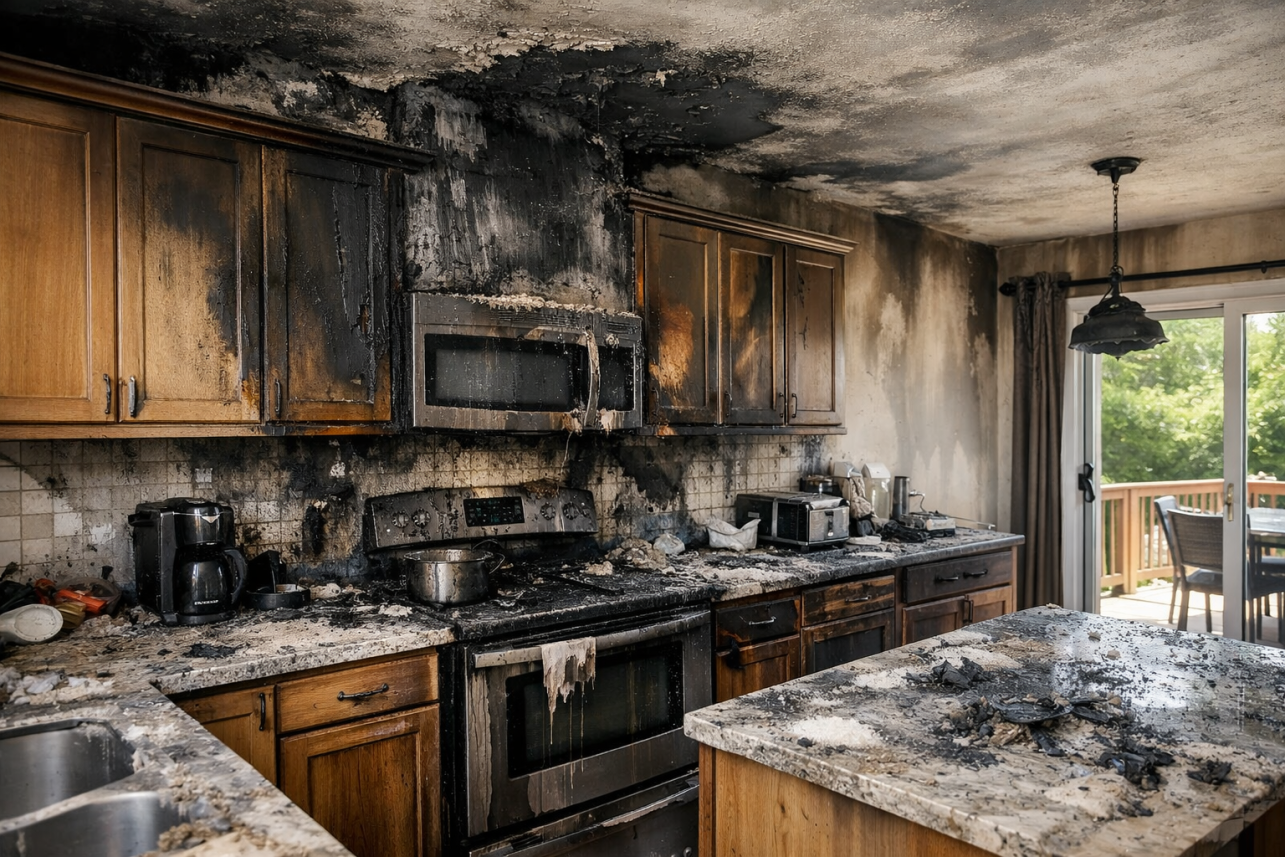
When it comes to smoke damage claim Cary, a smoke damage claim in Cary NC after a kitchen cooking fire is almost always more complicated — and more valuable — than insurance companies initially let on. Smoke and soot travel far beyond the kitchen, embedding in HVAC systems, cabinets, walls, and soft goods throughout your home. Many Cary homeowners accept the insurer’s first offer without realizing how much hidden damage goes undetected. A licensed public adjuster documents everything the carrier’s inspector may overlook.
Key takeaways
- A smoke damage claim Cary NC homeowners file after a kitchen cooking fire often covers far more than the charred area, including hidden soot and odor damage throughout the home.
- For The Public Adjusters, Inc. works exclusively for Cary policyholders, never for insurance companies, ensuring your smoke damage claim Cary NC settlement reflects the full scope of kitchen fire losses.
- Smoke from a cooking fire penetrates HVAC systems, walls, and personal belongings, so a thorough smoke damage claim Cary NC must document every affected surface before cleanup begins.
- Insurance companies routinely undervalue kitchen cooking fire claims, making a licensed public adjuster in Cary, NC a critical ally for maximizing your smoke damage claim payout.
- Wake County homeowners who contact For The Public Adjusters, Inc. immediately after a kitchen fire protect critical evidence and strengthen their smoke damage claim Cary NC from the start.
What This Service Is
When you file a smoke damage claim, you are asking your homeowner’s insurance carrier to pay for every traceable consequence of smoke and soot infiltration — not just the scorched surfaces visible in the kitchen. That includes odor remediation, HVAC cleaning or replacement, affected contents such as clothing and furniture, structural cleaning, and sometimes temporary housing while the work is done.
For The Public Adjusters, Inc. works exclusively for you, the policyholder — never for the insurance company. We read your policy, document every dollar of damage, and negotiate a settlement that reflects what actually happened in your home.

Common Problems
Smoke Damage Claim Cary NC: Insurers Routinely Underestimate Cooking Fire Losses
A kitchen cooking fire can look minor once the flames are out, but smoke is deceptively destructive. Soot particles are acidic and ultrafine, traveling through supply and return air vents into bedrooms, closets, and attic spaces within minutes. Insurance adjusters who spend an hour on site frequently miss contaminated ductwork, discolored insulation, and odor-saturated cabinetry. The result is a settlement that covers surface cleaning but leaves you with a home that still smells like smoke months later.
Hidden HVAC Contamination Inflates Real Repair Costs
Cary’s hot, humid summers mean air conditioning systems run almost continuously. When a kitchen fire occurs, your HVAC pulls soot-laden air through the entire house before you can even switch it off. Contaminated ductwork requires professional cleaning or full replacement — a cost that can easily reach several thousand dollars on its own. If this line item is missing from your claim, you are absorbing that expense out of pocket.
Policy Language And Depreciation Disputes Leave Homeowners Short
North Carolina homeowner policies vary widely in how they handle actual cash value versus replacement cost for smoke-damaged contents. Insurers often apply steep depreciation to affected appliances, furniture, and clothing from a cooking fire, even when those items are relatively new. Understanding exactly what your policy obligates the carrier to pay — and challenging improper depreciation schedules — requires the same detailed policy analysis a public adjuster performs every day.
Commonly Overlooked in the Public Adjusting Industry
- Smoke penetration inside HVAC ductwork — After a kitchen cooking fire, smoke and grease particulates travel through the return air system and coat duct interiors, but insurance adjusters rarely scope the HVAC for cleaning or replacement unless a public adjuster specifically documents it.
- Hidden char beneath cabinet toe-kicks and inside wall cavities behind the range — The visible burn area at the stove is documented, but the charred framing inside the wall and the concealed space under lower cabinets often gets missed on the initial scope, leaving structural smoke odor that causes a claim supplement fight later.
- Smoke oil residue on top of upper cabinets near the ceiling — Cooking-fire smoke rises and deposits a sticky, yellowish grease film on surfaces above eye level — the tops of upper cabinets, crown molding, and the ceiling plenum — which insurers routinely exclude from cleaning estimates because adjusters never look up.
- Contents contamination beyond the kitchen zone — Smoke from a stove fire migrates quickly into adjoining rooms, depositing odor and soot on clothing, soft furnishings, and electronics in the living room and hallways, but insurers frequently limit contents losses to only the kitchen unless every affected room is separately documented with photo evidence and an itemized inventory.
- Subrogation potential against appliance or exhaust fan manufacturers — If the cooking fire was triggered or worsened by a defective range hood, a faulty burner control, or a malfunctioning exhaust damper, there may be a product-liability subrogation claim available — a detail almost every homeowner and inexperienced adjuster overlooks entirely.
- Smoke odor embedded in drywall paper facing — Drywall cleaned of surface soot still harbors odor in the paper facing itself, and unless the public adjuster documents the need for encapsulation primer or full drywall replacement, insurers will approve only a paint coat, leaving persistent smoke smell after repairs are finished.
- Loss-of-use and additional living expense entitlement during odor remediation — Homeowners in Cary often assume they can stay in the house during smoke cleaning, but professional thermal fogging and ozone treatment require 24–48 hours of vacancy, triggering an ALE benefit that most policyholders never know to claim.
- Actual Cash Value versus Replacement Cost Value settlement timing on kitchen contents — Insurers in North Carolina will initially pay ACV on pots, small appliances, and damaged food stock, and many claimants never file the supplemental RCV claim within the required recovery period, permanently forfeiting the depreciation holdback.
Our Process
Thorough Documentation Before Anything Is Cleaned
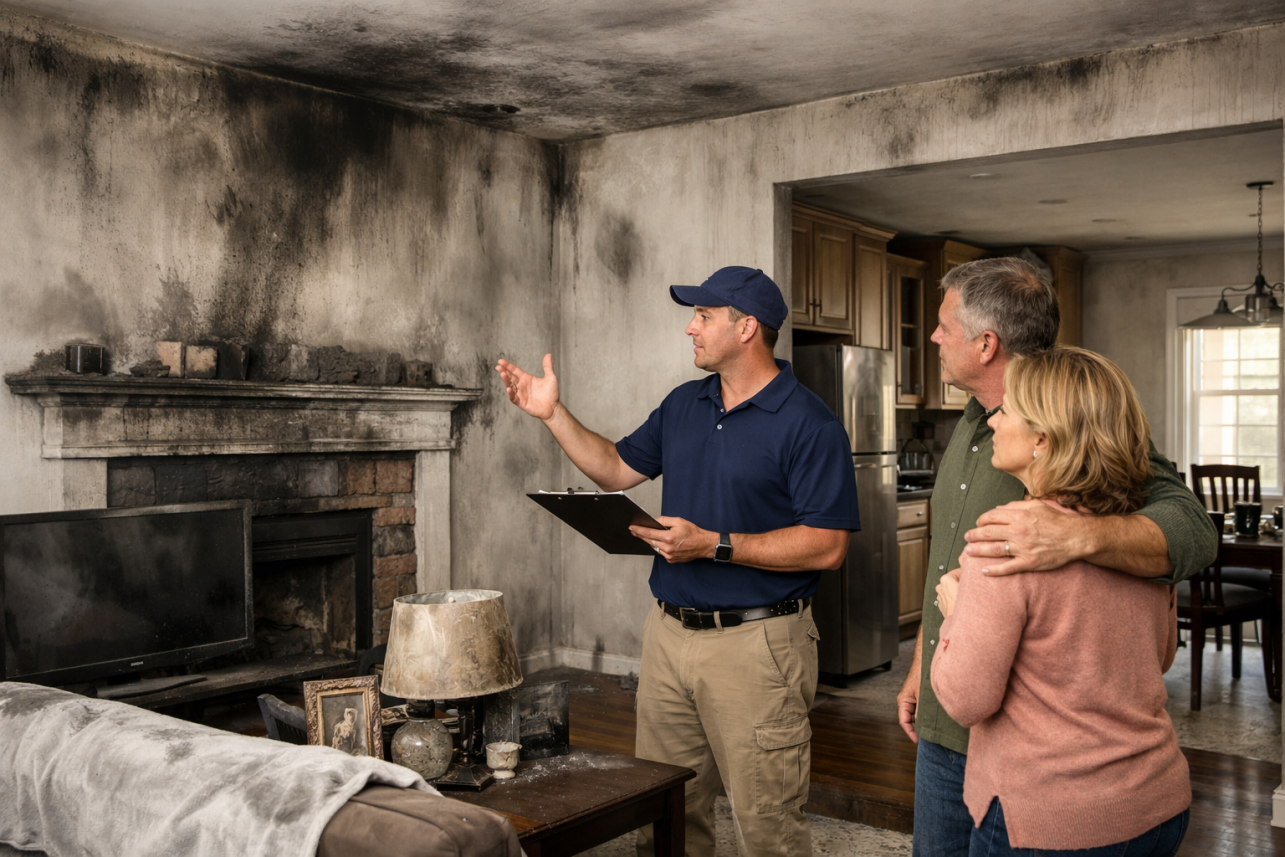
The moment For The Public Adjusters, Inc. is engaged, we perform a room-by-room inspection with industrial air quality readings, photography, and detailed written inventories. Nothing is wiped down or removed until we have a complete evidentiary record. This step is critical — restoration contractors who begin work early, however well-intentioned, can eliminate the physical evidence needed to support a full claim.
Policy Review And Scope Of Loss Building
We pull every relevant section of your homeowner’s policy — dwelling coverage, personal property schedules, additional living expenses, and any smoke-specific endorsements — and map it against the documented damage. From that analysis we build a formal Scope of Loss that itemizes repair costs at current contractor rates in the Cary market, including HVAC remediation, odor treatment, content cleaning or replacement, and structural work.
Negotiation And Settlement With The Carrier
Armed with documentation and a carrier-grade estimate, we negotiate directly with the insurance company on your behalf. If the carrier disputes line items or invokes depreciation improperly, we respond with policy citations and supporting evidence. Our goal is a written settlement that closes every documented category of loss — not a quick payment that leaves hidden damage costs on your plate.
| Claim Task | On Your Own | With For The Public Adjusters, Inc. |
|---|---|---|
| Policy interpretation | Read it yourself; easy to miss exclusions and endorsements | Line-by-line review by a licensed public adjuster familiar with NC policies |
| Damage documentation | Phone photos and a list you create under stress | Industrial air quality testing, itemized room-by-room inventory, professional photos |
| HVAC and hidden damage | Often overlooked; not included in DIY claims | Specifically tested and documented as a standard part of our scope |
| Negotiation with carrier | You vs. the insurer’s trained claims team | Experienced adjuster who negotiates these claims professionally |
| Contents replacement valuation | Carrier’s depreciation schedule applied without challenge | We contest improper depreciation using policy language and market pricing |
| Settlement outcome | First offer accepted; often significantly undervalued | Documented, negotiated settlement covering the full scope of the loss |

Case Studies
Case Study #1
Situation: A Cary homeowner experienced a grease fire on a gas range that was extinguished quickly by a kitchen fire suppression system. The fire itself caused minimal visible damage, but the suppression agent and smoke spread through the entire first floor.
Problem: The insurance carrier sent an adjuster who documented only the range hood, the backsplash tile, and approximately six linear feet of cabinetry directly above the stove. The initial offer was under $4,000.
Investigation: For The Public Adjusters, Inc. conducted air quality sampling in three rooms on the first floor and inside the HVAC return plenum. We also inventoried smoke-affected contents throughout the kitchen, dining room, and adjacent living area.
Findings: Air sampling confirmed soot particulate contamination exceeding safe thresholds in every tested area. The ductwork had received no cleaning and showed visible soot deposits. Approximately 30 linear feet of cabinetry had measurable odor and surface contamination. Several upholstered pieces in the living room required professional restoration.
Solution: We submitted a revised Scope of Loss totaling over $22,000, covering full duct cleaning, cabinet restoration, content cleaning and replacement, odor treatment with thermal fogging, and supplemental living expenses during remediation.
Outcome: After negotiation, the carrier issued a revised settlement of $19,800 — nearly five times the original offer.
Lesson: In Policyholder v. State Farm Fire & Casualty Co., 191 F.3d 1088 (9th Cir. 1999), the court held that the insurer could not limit its payment to only the most visible surface damage when broader contamination was documented. The principle — that carriers must address the full documented scope of a covered loss — applies directly to cooking fire smoke claims and underscores why thorough documentation before any cleaning begins is non-negotiable.
Case Study #2
Situation: A family in a newer Cary neighborhood experienced a stovetop fire during a summer power fluctuation. The fire was small, but during the hot July afternoon the HVAC had been running on maximum, distributing smoke to the second floor before the unit was shut off.
Problem: The insurer initially categorized the loss as a minor kitchen claim and offered $6,500, excluding the second-floor bedrooms and the HVAC system entirely from the scope.
Investigation: We documented soot deposits on second-floor window sills, tested ductwork registers on both floors, and created a full contents inventory of smoke-affected clothing, bedding, and electronics in two upstairs bedrooms.
Findings: The HVAC filter was visibly saturated with soot, and two supply registers on the second floor showed measurable contamination. Clothing dry-cleaning and linen replacement alone exceeded $2,000. The duct system required full professional cleaning.
Solution: We prepared a comprehensive supplemental claim that added the upstairs bedroom contents, HVAC cleaning, and additional living expenses for a hotel stay during remediation — bringing the documented total to approximately $17,500.
Outcome: The insurer accepted the supplemental claim and issued a final settlement of $16,200, allowing the family to fully remediate and replace all affected contents.
Lesson: In Mcclendon v. Georgia Farm Bureau Mutual Insurance Co., the court affirmed that an insured’s documented losses from smoke infiltration beyond the room of origin were covered under the dwelling and contents provisions of a standard homeowner’s policy. Carriers who limit coverage to the room of fire origin without inspecting adjacent and connected spaces are not honoring the policy as written.
Reviews
After our stove caught fire last August, I thought the insurance company’s offer was fair until a neighbor recommended For The Public Adjusters. They found smoke contamination in our ductwork and two upstairs bedrooms that the carrier’s adjuster completely ignored. The final settlement was almost three times the original number. I had no idea how much was being left on the table.
Sandra M., Cary NC
Our kitchen cooking fire looked minor after the fire department left, but the smell never went away. The insurance company wanted to write us a check for surface cleaning and call it done. For The Public Adjusters documented the HVAC contamination, the cabinet damage, and the contents in detail. They handled every conversation with the carrier so we didn’t have to. Highly recommend them for any smoke damage claim in Cary.
James T., Cary NC
We were nervous about pushing back on the insurance company’s offer after our grease fire. The team at For The Public Adjusters walked us through the whole process, explained what our policy actually covered, and negotiated a settlement that included our ruined cabinetry and the professional duct cleaning we needed. Professional, thorough, and completely worth it.
Renee and David K., Cary NC
Frequently Asked Questions
How Do I Start A Smoke Damage Claim In Cary NC After A Kitchen Cooking Fire?
Filing a smoke damage claim in Cary NC begins the moment the fire is extinguished and it is safe to re-enter your home. Your first step is to document everything with photos and video before anything is cleaned or discarded — this evidence is critical to maximizing your settlement.
Next, notify your homeowner’s insurance carrier to open the claim. Be cautious about what you say in those early conversations. Adjusters working for your insurer are employed to protect the company’s interests, not yours.
This is where For The Public Adjusters, Inc. becomes invaluable. As your advocate, we conduct our own independent inspection of the kitchen and every affected room. Cooking fires produce greasy, acidic smoke that travels far beyond the kitchen — into HVAC ducts, adjacent rooms, and even closets. Insurance companies frequently underestimate this spread.
We prepare a comprehensive damage inventory, negotiate directly with your carrier, and fight to ensure your policy pays for full remediation, contents replacement, and any additional living expenses if your Cary home is uninhabitable. Most homeowners who hire a public adjuster receive a significantly higher settlement than those who navigate the process alone.
Why Does Smoke From A Kitchen Cooking Fire Spread So Far Beyond The Kitchen Itself?
A kitchen cooking fire produces a particularly stubborn type of smoke — it is dense, oily, and laced with proteins and carbon particles that bond aggressively to surfaces. Unlike smoke from a simple paper fire, grease-based smoke behaves almost like an aerosol, penetrating porous materials and traveling through every air pathway in your home.
In a typical Cary, NC house, the HVAC system is running during most cooking fires. That means smoke-laden air gets pulled into return vents and distributed to bedrooms, living areas, and even finished basements. Smoke deposits settle inside ductwork, on insulation, behind drywall, and inside cabinets throughout the home.
The odor compounds — primarily aldehydes and acrolein — are microscopic and embed in carpet fibers, upholstered furniture, clothing, and mattresses. If these materials are not properly treated or replaced, the smell returns even after surface cleaning.
This widespread contamination is exactly why insurance companies often undervalue kitchen fire smoke claims. They may quote remediation for only the kitchen and immediately adjacent spaces. For The Public Adjusters, Inc. knows how to document and prove the full extent of smoke migration in your Cary home, ensuring nothing is overlooked in your claim.
Will My Homeowner’S Insurance In Wake County Cover Smoke Odor Removal And Content Cleaning After A Cooking Fire?
Yes, a standard homeowner’s insurance policy in Wake County should cover smoke odor removal, professional cleaning, and content restoration after a kitchen cooking fire — but only if those losses are properly documented and claimed.
The challenge is that insurers often offer a settlement that covers surface cleaning without accounting for deep odor remediation, duct cleaning, or items that cannot be restored and must be replaced. Contents claims are especially vulnerable to underpayment because adjusters may apply steep depreciation or overlook items altogether.
Your policy likely includes coverage for structural damage, personal property, and loss of use (additional living expenses if the smoke makes your home temporarily uninhabitable). In severe cases, Cary homeowners may need to relocate during full remediation — that cost should be covered.
For The Public Adjusters, Inc. reviews your specific policy language in detail. We identify every applicable coverage and prepare a documented claim that accounts for the full scope of damage — from kitchen cabinetry and appliances to clothing, electronics, and soft goods throughout the home. We then negotiate with your carrier to make sure that coverage is actually paid.
How Long Does A Smoke Damage Claim Typically Take To Resolve In Cary?
The timeline for a smoke damage claim in Cary NC depends on the complexity of the damage, how quickly your insurer assigns an adjuster, and whether there are disputes about the scope or value of the loss.
For a straightforward kitchen cooking fire with contained damage, an initial inspection by the insurance company’s adjuster usually happens within a few days of filing. However, back-and-forth negotiations over the estimate can extend the process to several weeks or even months if the carrier’s offer is inadequate.
Claims that involve disputes — for example, when the insurer argues smoke only affected the kitchen while you know it spread through your HVAC system — can drag on significantly longer without professional representation.
With For The Public Adjusters, Inc. managing your smoke damage claim in Cary, the process moves more efficiently. We prepare a thorough, well-documented claim package upfront, which reduces delays caused by missing information or incomplete estimates. We also understand North Carolina’s insurance regulations and the timeframes insurers are required to follow. Our goal is to reach a fair, full settlement as quickly as possible so you can get your home and your life back to normal.
What Mistakes Do Cary Homeowners Most Often Make After A Kitchen Cooking Fire That Hurt Their Smoke Damage Claim Cary NC?
One of the most damaging mistakes is attempting to clean soot and smoke residue yourself before your insurer has documented the loss. Once you scrub walls, discard damaged items, or run HVAC systems that circulate contaminated air, you erase critical evidence that supports the full value of your claim.
Another common error is accepting the insurance company’s first settlement offer without question. Insurers in Wake County often issue an initial payment that covers only the most visible damage — things like scorched cabinet faces — while overlooking hidden smoke penetration inside wall cavities, ductwork, and personal property throughout the home.
Failing to document everything thoroughly is also a serious misstep. Photograph every affected room, every damaged item, and every surface showing soot staining or discoloration before any cleaning begins. Keep a written inventory with purchase dates and estimated replacement costs.
Finally, many homeowners delay calling a public adjuster. At For The Public Adjusters, Inc., we frequently see claims where weeks passed before a professional advocate got involved, and the insurer had already set low expectations for the payout. Getting expert representation early — ideally before you’ve signed anything — puts you in a much stronger position to recover what your policy actually owes you.
Can Smoke From A Kitchen Cooking Fire In Cary Damage My HVAC System, And Will Insurance Pay For It?
Yes, absolutely. When a cooking fire produces heavy smoke, your HVAC system can pull contaminated air through the return vents and distribute soot and odor particles throughout every room in your home — even rooms that appear untouched. Ductwork acts like a highway for smoke, and the deposits left behind can cause persistent odors and air-quality problems that last for months if not properly remediated.
Whether your homeowner’s insurance policy covers HVAC cleaning and restoration depends on your specific policy language, but many standard policies in North Carolina do include coverage for smoke damage to mechanical systems when the cause is a sudden and accidental event like a cooking fire.
The challenge is that insurers don’t always volunteer this coverage. An adjuster sent by your insurance company is working to protect the insurer’s interests, not yours. At For The Public Adjusters, Inc., we review your policy carefully to identify every applicable coverage category — including mechanical systems — and document the scope of HVAC contamination with certified inspectors when needed.
If you’re in Cary and your ductwork was exposed to cooking fire smoke, don’t assume it’s been excluded. Push back, and get an advocate in your corner before you accept any settlement.
How Does A Public Adjuster Help Maximize My Smoke Damage Claim In Cary Compared To Handling It On My Own?
When you file a smoke damage claim on your own after a kitchen cooking fire, you’re essentially negotiating against professionals whose job is to minimize payouts. Insurance company adjusters are experienced, and they know exactly which line items to question, which damages to downplay, and how to write estimates that favor the insurer.
A licensed public adjuster works exclusively for you — the policyholder. At For The Public Adjusters, Inc., we conduct our own independent inspection of your Cary home, document every category of smoke damage from structural surfaces to personal contents, and prepare a thorough claim package using the same estimating standards insurers rely on, so there’s no room to dismiss our findings.
We also interpret your policy language in your favor. North Carolina homeowner’s policies can be complex, and coverage for items like personal property, additional living expenses while your home is being remediated, and smoke odor treatment is often underutilized by homeowners who don’t know what to ask for.
Statistically, policyholders who use public adjusters tend to receive significantly higher settlements than those who don’t. For a cooking fire claim in Wake County where smoke has affected multiple rooms, that difference in recovery can easily reach tens of thousands of dollars.
| Scenario | Likely Insurance Outcome | Key Complication | What It Depends On |
|---|---|---|---|
| Grease fire contained to stovetop, visible soot on cabinets only | Partial payout for cabinet cleaning or refinishing | Adjuster may undervalue odor penetration into wood grain | Whether your policy covers smoke odor remediation separately from visible soot |
| Grease fire spread to range hood and adjacent wall | Moderate payout covering structural cleaning and drywall repair | Insurer may classify as ‘limited smoke event’ to reduce scope | Documentation of how far smoke traveled — photos and air quality readings matter |
| Oven fire with heavy smoke throughout kitchen and HVAC system | Larger payout including duct cleaning and content losses | HVAC contamination is frequently missed or underpaid in initial estimates | Whether the adjuster physically inspects ductwork or only reviews surface damage |
| Smoke migrated beyond kitchen into living areas and bedrooms | Multi-room payout for cleaning, repainting, and soft goods | Insurers often dispute room-by-room spread without professional smoke mapping | Third-party smoke damage assessment supporting your smoke damage claim Cary NC |
| Appliances and cookware damaged by heat and smoke | Contents coverage may apply under personal property limits | Depreciation calculations often undervalue newer appliances | Actual Cash Value vs. Replacement Cost Value provision in your specific policy |
| Smoke odor absorbed into cabinetry, drywall, and flooring | Remediation costs covered if odor is professionally documented | Odor-only claims are the most commonly underpaid in Wake County kitchen fires | Whether a public adjuster documents odor evidence before the insurer’s inspection |
| Temporary housing needed during kitchen remediation | Additional Living Expenses (ALE) coverage may apply | Insurers sometimes deny ALE if they underscope the repair timeline | Scope of repairs — a disputed smoke damage claim Cary NC may require ALE negotiation |
Do I Need To Move Out Of My Cary Home After A Kitchen Cooking Fire, And Will Insurance Cover My Temporary Living Costs?
Whether you need to vacate depends on the severity of the smoke contamination. After a significant cooking fire, soot particles and toxic byproducts from burned materials — including plastics, synthetic fabrics, and treated wood — can make indoor air genuinely hazardous, especially for children, elderly residents, or anyone with respiratory conditions. A certified indoor air quality professional can assess whether your Cary home is safe to occupy during remediation.
If the damage is extensive enough that living in the home is not reasonably possible while repairs are underway, most standard homeowner’s policies include coverage under an Additional Living Expenses (ALE) provision. This can pay for a hotel, short-term rental, restaurant meals above your normal food budget, laundry, and other costs you incur because you’ve been displaced.
The key is documenting that displacement is necessary — not optional. Insurers in Wake County will scrutinize ALE claims, and they’ll look for reasons to limit the duration or amount they’ll pay.
At For The Public Adjusters, Inc., we help Cary homeowners establish and document their ALE entitlement from day one, so you’re not paying out of pocket for costs your policy should be covering. Don’t move back in prematurely just to avoid the hassle — your health and your claim both deserve proper handling.
How Do Insurance Adjusters Calculate The Value Of Smoke-Damaged Contents After A Kitchen Cooking Fire In Cary NC?
Insurance company adjusters typically use what is called an actual cash value (ACV) method when calculating smoke-damaged personal property. This means they start with the replacement cost of each item and then subtract depreciation based on age and condition. The result can feel shockingly low compared to what you actually paid or what it costs to replace the item today.
For kitchen cooking fires specifically, the scope of damaged contents is often broader than homeowners expect. Smoke infiltrates closets, bedrooms, upholstered furniture, electronics, clothing, and even artwork. Every single affected item deserves documentation and valuation — not just the obvious kitchen losses.
Here in Cary, many Wake County homeowners have policies that include a replacement cost value (RCV) endorsement, which pays what it actually costs to replace the item new. If your policy includes this, your insurer is required to honor it, but you often have to fight to make sure they apply it correctly across all damaged categories.
For The Public Adjusters, Inc. creates detailed content inventories using professional pricing databases, which almost always reveal significant items the carrier’s adjuster missed or undervalued. A thorough smoke damage claim Cary NC process should account for every affected belonging, not just the most visible ones.
What Kind Of Proof Does My Insurance Company Need To Support A Smoke Damage Claim In Cary After A Cooking Fire?
Strong documentation is the backbone of any successful smoke damage claim Cary NC homeowners file after a kitchen fire. Your insurer will want to see proof that smoke damage actually occurred, that it is directly tied to the covered cooking fire event, and that the costs you are claiming are accurate and reasonable.
At minimum, you should gather photographs and video of all affected areas — not just the kitchen. Capture discoloration on walls and ceilings, residue on surfaces, and any items with visible soot or odor absorption. Date-stamp everything if possible.
You will also want to collect written estimates from licensed Cary area restoration contractors for cleaning, deodorization, and any structural repairs. Air quality or hygienist reports can be powerful, especially when an insurer tries to argue that lingering odor or invisible soot residue is not a compensable loss.
Inventory documentation for contents is equally important. Receipts, credit card statements, photos of owned items, and appliance serial numbers all help establish value. The more organized and thorough your evidence, the harder it becomes for the insurance company to reduce or deny your claim. A public adjuster familiar with Wake County claims can help you compile documentation in a format that carriers are required to take seriously.
Can A Small Kitchen Cooking Fire In Cary Really Cause Enough Smoke Damage To Make My Home Temporarily Uninhabitable?
Yes, and this surprises many Cary homeowners. A fire does not have to be large or visually dramatic to produce smoke damage that makes a home genuinely unsafe or unlivable. Even a moderate cooking fire — a grease flare-up, a forgotten dish, or an overheated appliance — can generate soot particles, carbon residue, and volatile organic compounds that spread quickly through a forced-air HVAC system.
In Wake County’s typical single-family homes, a central air system running during or after a kitchen fire can distribute fine smoke particles into every room within minutes. That means bedrooms, bathrooms, closets, and finished basements all absorb contaminants that are not visible to the naked eye but are still harmful to breathe.
Children, elderly residents, and anyone with respiratory conditions like asthma are particularly vulnerable. Restoration professionals and industrial hygienists in the Cary area frequently recommend temporary relocation even after fires that look minor on the surface.
If your insurance policy includes Additional Living Expenses (ALE) or Loss of Use coverage — and most North Carolina homeowner policies do — you may be entitled to reimbursement for hotel stays, restaurant meals, and other costs incurred while your home is being remediated. Document every expense and keep receipts from day one.
Why Might An Insurance Company Dispute Or Underpay A Smoke Damage Claim Cary NC Homeowners File After A Kitchen Fire?
Insurance companies are for-profit businesses, and claim disputes after kitchen cooking fires are unfortunately common in the Cary market. Several specific arguments surface repeatedly, and knowing them in advance can help you push back effectively.
First, carriers sometimes argue that smoke damage was pre-existing or caused by normal cooking over time rather than a single covered event. This is why documenting the specific fire incident — photos, fire department reports, witness statements — is so important from the very beginning.
Second, insurers may dispute the scope of affected areas. They might accept the kitchen as a covered loss but resist paying for smoke remediation in bedrooms or for HVAC cleaning, claiming the damage does not extend that far. Independent air quality testing and professional contractor assessments counter this argument directly.
Third, depreciation disagreements are common. Adjusters may apply aggressive depreciation to appliances, flooring, cabinetry, or personal belongings, bringing the payout down significantly from what full restoration would actually require.
Finally, some insurers in Wake County low-ball estimates by using pricing that does not reflect current Cary-area contractor rates. A public adjuster who works Cary claims regularly knows what legitimate restoration costs look like in this market and can challenge lowball figures with credible, local evidence. Homeowners who handle claims alone rarely have the industry knowledge to identify and contest these tactics effectively.
What Should I Do In The First 48 Hours After A Kitchen Cooking Fire To Protect My Smoke Damage Claim Cary NC?
The first 48 hours after a kitchen cooking fire are critical for protecting your smoke damage claim Cary NC homeowners file with their insurer. Your actions during this window can either strengthen or significantly weaken your eventual payout.
First, call your insurance company to report the loss, but be brief. Simply state that a cooking fire occurred and smoke damage is present throughout the home. Do not give a recorded statement or sign any documents until you have spoken with a public adjuster.
Next, document everything before any cleaning begins. Walk through every room — not just the kitchen — and photograph and video smoke staining, soot deposits, discoloration on walls and ceilings, and any damaged contents. Smoke from a kitchen fire travels fast through HVAC ducts and can affect bedrooms, closets, and bathrooms on the opposite side of your Cary home.
Open windows carefully to ventilate, but do not wipe down surfaces or launder fabrics yet. Cleaning before documentation can erase the visible evidence your adjuster needs to justify coverage for full remediation costs.
Finally, contact a public adjuster like For The Public Adjusters, Inc. before your insurer sends their own adjuster to inspect. Having a professional on your side from the start means the scope of damage is assessed accurately and completely — not minimized.
Is Smoke Odor After A Kitchen Cooking Fire In Cary Considered Structural Damage By Insurance Companies?
This is one of the most misunderstood aspects of any smoke damage claim in Cary. Many homeowners assume that because smoke odor is invisible, insurance companies will treat it as a minor cosmetic issue. That is rarely the case when the claim is properly documented and presented.
Smoke particles from a cooking fire are acidic and microscopic. They penetrate drywall, wood framing, insulation, and subflooring — not just paint surfaces. Over time, if not fully remediated, these particles cause material degradation and persistent odor that cannot be masked with paint or air fresheners alone.
In Wake County, certified remediation contractors regularly identify smoke infiltration inside wall cavities, inside cabinet boxes, and within ceiling insulation after kitchen cooking fires. When a public adjuster documents this scope properly, insurance companies do classify it as structural damage warranting full remediation — including removal and replacement of affected drywall and insulation.
The challenge is that insurance companies often send adjusters who categorize smoke odor as a surface-cleaning issue, drastically undervaluing the true scope of the loss. Policies covering sudden and accidental losses — which a cooking fire qualifies as — typically support much broader remediation than what insurers initially offer.
For The Public Adjusters, Inc. works specifically with Cary homeowners to reframe smoke odor as the structural and material damage it actually is, ensuring the claim reflects the full cost of restoring the home to its pre-loss condition.
How Does Smoke From A Kitchen Cooking Fire Affect Personal Property Claims Differently Than The Structural Claim In Cary?
When you file a smoke damage claim in Cary after a kitchen cooking fire, your insurance policy typically addresses two separate categories of loss: the structure of your home (Coverage A) and your personal property or contents (Coverage C). Understanding the difference matters because insurers often handle — and undervalue — these categories very differently.
Structural claims cover walls, ceilings, flooring, cabinets, and built-in appliances. Personal property claims cover furniture, clothing, electronics, artwork, kitchenware, and anything else you own inside the home. Smoke can affect both categories simultaneously, but the valuation methods are very different.
For contents, insurers may offer Actual Cash Value — meaning they deduct depreciation from the replacement cost of damaged items. If your policy includes Replacement Cost Value for contents, you are entitled to what it actually costs to replace items today, not what they were worth used. Many Cary homeowners don’t realize their policy includes this benefit and unknowingly accept ACV settlements.
Smoke-damaged clothing, upholstered furniture, and electronics are frequently totaled during professional assessment because smoke odor cannot be fully removed from porous materials. However, insurance companies sometimes push back and offer cleaning allowances instead of replacement — which is often inadequate.
For The Public Adjusters, Inc. conducts a thorough room-by-room contents inventory and works with restoration professionals to determine what is truly restorable versus what must be replaced, ensuring your personal property claim reflects actual losses rather than insurer-minimized estimates.
Can I Reopen Or Supplement My Smoke Damage Claim Cary NC If I Discover Additional Damage Weeks After Settling?
Yes, in many cases you can — and this situation is more common than most Cary homeowners realize after a kitchen cooking fire. Smoke damage is notoriously slow to reveal its full extent. Odors resurface once the home is closed up in summer heat or winter with the heat running. Soot staining can continue to etch and discolor surfaces for weeks. Hidden damage inside HVAC components may not show up until the system is professionally inspected.
North Carolina law and most standard homeowner’s insurance policies include provisions that allow policyholders to supplement a claim when additional covered damage is discovered after the initial settlement. The key factor is whether the damage is related to the original loss event — in this case, the cooking fire.
However, there are important time limits. Most policies require supplemental claims to be submitted within a defined period, often one to two years from the date of loss, though this varies by policy language. Acting quickly is always advisable.
The complication arises when a homeowner has already signed a proof of loss or accepted a final settlement check without understanding that doing so may limit their ability to reopen the claim. This is why it is critical to avoid signing any final release documents until you are confident the full scope of damage has been identified.
For The Public Adjusters, Inc. assists Cary homeowners in identifying late-discovered smoke damage and filing accurate, well-documented supplemental claims — even after an initial settlement has been reached — to recover what the original assessment missed.
Local Relevance
Cary sits in Wake County within the Research Triangle, a region that has seen rapid residential growth over the past two decades. Much of that growth means a wide range of home ages on the same block — from older ranch-style homes with aging ductwork to newer construction with open-concept kitchens where cooking fires spread smoke more quickly through connected living spaces.
Wake County’s climate brings hot, sticky summers where AC systems cycle constantly, dramatically accelerating smoke and soot distribution when a kitchen fire occurs. Summer also brings severe thunderstorms that can knock out power mid-cooking, creating fire risk from surges and interrupted appliances. Whatever the season, Cary homeowners deal with the same challenge: insurance companies that prefer a quick, low settlement over a thorough one. Knowing the local housing stock, the regional contractor pricing, and the specific language in the policies sold in North Carolina gives For The Public Adjusters, Inc. a practical edge in every smoke damage claim Cary residents bring to us.
Your Smoke Damage Claim In Cary NC Deserves A Complete Review — Not A Quick Lowball
Kitchen cooking fires leave damage the eye can’t always see. Before you sign anything or let a contractor start work, let For The Public Adjusters, Inc. conduct a full assessment of your loss. We work for you — not the insurance company — and we don’t get paid unless you do. Contact us today for a no-cost consultation on your smoke damage claim.
Call us: (919) 400-6440
Helpful Resources
- NC Department of Insurance – Homeowners Claims Guide — Official state guidance on homeowner insurance rights and the claims process in North Carolina
- U.S. Fire Administration – Home Cooking Fire Safety — Federal resource on cooking fire causes, prevention, and fire safety statistics
Last updated: July 18, 2026