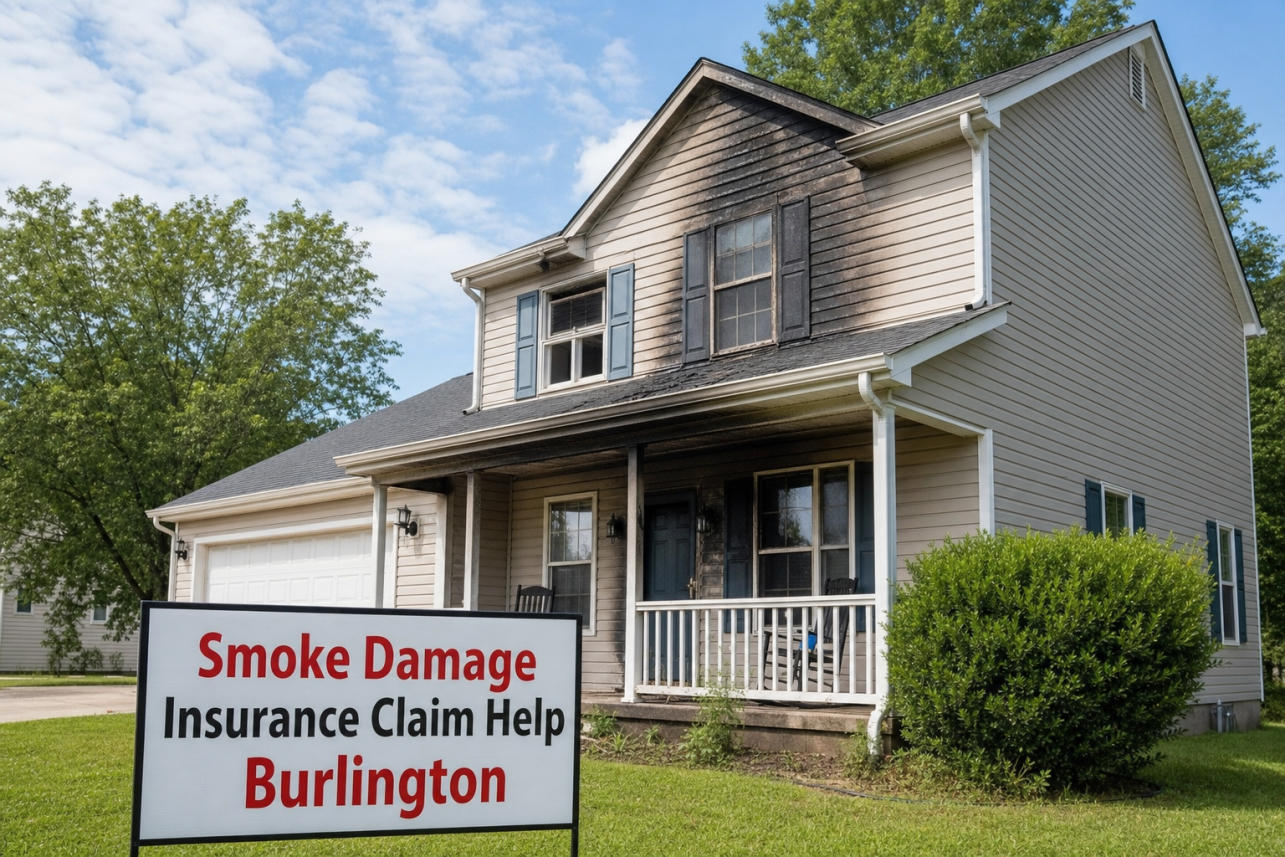
Smoke damage insurance claim help Burlington policyholders can rely on comes from For The Public Adjusters, Inc., a licensed and bonded firm that works for you — not the insurance company. Even a small kitchen fire can push soot and odor through walls, ductwork, and closets three rooms away, and carriers routinely pay only for the visible damage. We assess the full scope of the loss, document it professionally, and negotiate directly with your insurer so nothing gets left off the estimate.
What This Service Is
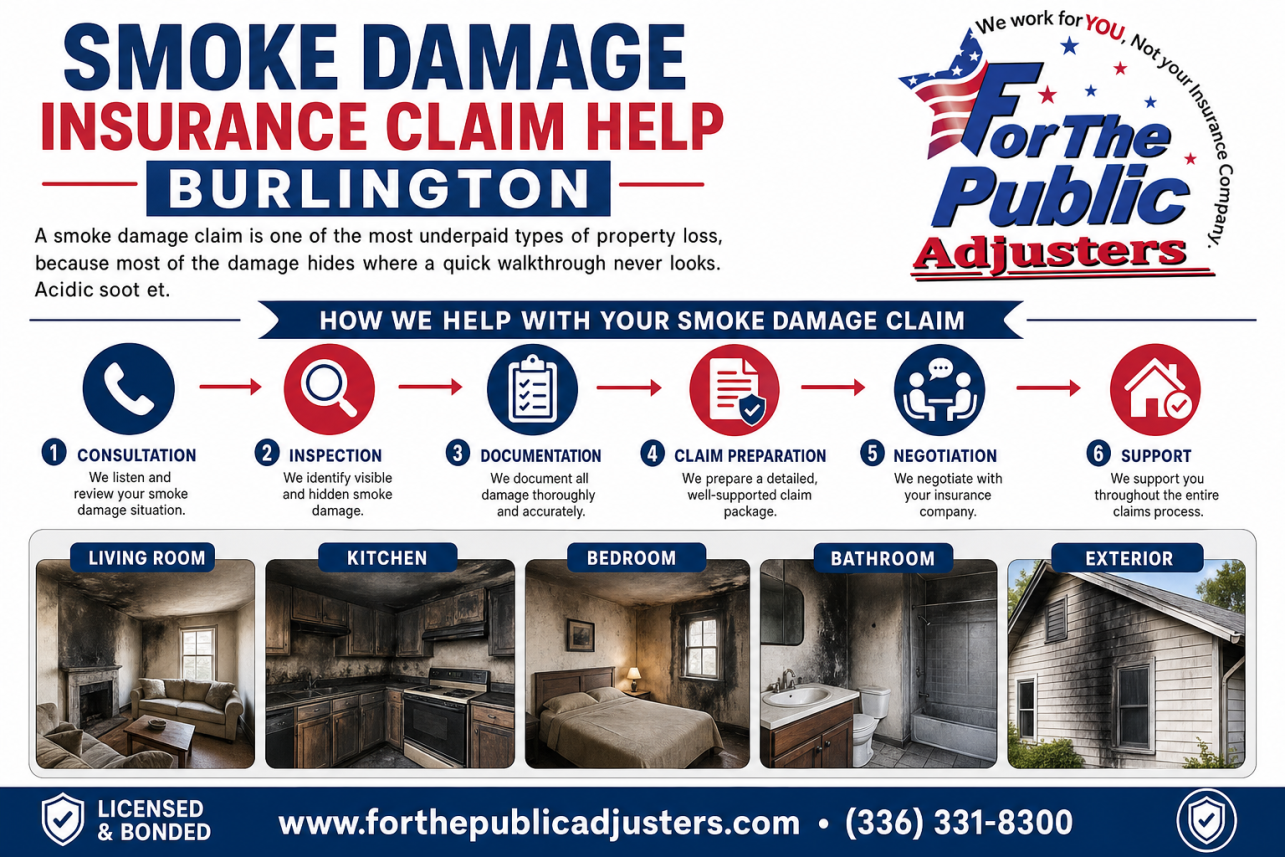
A smoke damage claim is one of the most underpaid types of property loss, because most of the damage hides where a quick walkthrough never looks. Acidic soot etches metal fixtures, discolors paint over weeks, and settles inside electronics and appliances. Odor binds to drywall, insulation, upholstery, and the inside of your heating and cooling system, which then recirculates it through the whole house.
As your public adjuster, we handle the claim from start to finish. That means a room-by-room damage assessment, laboratory-grade attention to residue on surfaces and inside wall cavities, a complete inventory and valuation of damaged belongings, and a properly prepared proof of loss filed within your policy's deadlines. If firefighters used water to knock the fire down, we document that secondary water damage too — it is part of the same covered event.
We also make sure your policy is applied correctly. That includes coverage for temporary living expenses if the home is not safely livable, the difference between depreciated value and full replacement cost on your contents, and code-related costs when repairs trigger upgrades. Our compensation is a percentage of what the insurer pays, so our interests align with yours. We handle smoke and fire losses alongside water, tree, vandalism, and other residential and commercial claims across Alamance County.
Common Problems
Will Insurance Pay To Replace What Smoke Ruined — Or Just Wipe It Down?
This is where most settlements go wrong. Carriers often write estimates for surface cleaning when materials actually need replacement — soot-saturated insulation, odor-locked carpet pad, and clothing that never fully loses the smell.
There is also the depreciation question. Many policies first pay actual cash value — the used, depreciated worth of your belongings — and only release the rest after you replace items. Homeowners who don't understand that two-step process routinely leave the recoverable depreciation on the table.
We build a personal property inventory item by item, with realistic replacement pricing, and push back on cleaning-only line items when the material genuinely cannot be restored. The goal is a settlement that reflects what it actually costs to make you whole, not the carrier's first draft.
Denied Or Lowballed? Real Smoke Damage Insurance Claim Help Burlington Homeowners Can Use
Insurers frequently deny or minimize smoke claims by arguing the residue is 'pre-existing soiling,' that odor is not physical damage, or that damage in distant rooms is unrelated to the fire. Others simply delay — asking for document after document until you accept whatever is offered.
A denial or a low offer is not the end of the claim. Courts have sided with policyholders when carriers underpay property losses; in Windridge of Naperville Condominium Association v. Philadelphia Indemnity Insurance Co., a federal appeals court upheld the insured's position that the building had to be restored to a uniform, pre-loss condition rather than patched piecemeal — the same principle that matters when an insurer wants to repaint one wall of a smoke-stained room.
We re-open the conversation with evidence: photographs, residue documentation, a corrected scope of repair, and a properly supported proof of loss. Then we negotiate the settlement on your behalf, and if the dispute continues, we help you use the appraisal and complaint options available to North Carolina policyholders.
Can I Handle The Claim Myself, And What Should I Look For In A Public Adjuster?
You can file on your own, and for a very small loss that may be fine. But smoke losses are technical: hidden penetration into wall cavities, contaminated ductwork, damaged electronics, and policy language about coverage limits and depreciation all give the carrier's adjuster the advantage over a homeowner reading a policy for the first time.
In North Carolina, public adjusters must be licensed, and the NCDOI Public Adjusters Guide explains exactly what we are permitted to do for policyholders — worth reading before you hire anyone. Ask any adjuster for their license, their bond, and examples of smoke or fire claims they have handled.
A good public adjuster does the work you cannot see: measuring, inventorying, pricing, filing, and negotiating. For The Public Adjusters, Inc. is licensed and bonded, and we only get paid from what the insurer pays you. We cannot promise a specific outcome — no honest adjuster can — but we can promise the claim will be fully documented and professionally argued.
Our Process
Free Damage Review And Policy Read-Through
We walk the property and inspect the areas insurers skip — attic insulation, duct interiors, closets, and rooms far from the fire's origin. At the same time, we read your policy carefully so we know your coverage limits, deadlines, and what additional living expense money is available if you need to stay elsewhere during repairs.
Full Documentation And Proof Of Loss
We photograph and record every affected surface, test for soot residue, and build a complete contents inventory with replacement values. Firefighting water damage, HVAC contamination, and damaged electronics all go into the file. Then we prepare and file the sworn proof of loss correctly and on time, so a paperwork technicality never becomes the carrier's excuse.
Negotiation And Settlement
We present the documented claim to your insurance company, respond to their adjuster's estimate line by line, and negotiate the settlement on your behalf. If the carrier's number stays unreasonably low, we advise you on the dispute options in your policy and under North Carolina law, and we stay with the claim until it is resolved.
| What Happens | Filing on Your Own | With For The Public Adjusters, Inc. |
|---|---|---|
| Damage scope | Carrier scopes visible soot near the fire's origin only | Full-property inspection including ducts, wall cavities, insulation, and contents |
| Odor and residue proof | Your word against the adjuster's opinion | Independent lab testing and wipe sampling that carriers can't dismiss |
| Contents inventory | A rushed list you build from memory | Item-by-item documented inventory with restore-vs-replace justification |
| Additional living expenses | Often unclaimed or underclaimed | Tracked and submitted from day one, including displacement during remediation |
| Negotiation | First offer is usually the final offer | Revised estimates, supplements, and appraisal leverage when the carrier lowballs |
| Your time | Weeks of calls, paperwork, and disputed line items | We handle the entire claim while you focus on your family or business |
Commonly Overlooked In The Public Adjusting Industry
- Corrosion damage that appears weeks after the fire — Acidic soot residue slowly etches metal fixtures, appliances, and electronics, so damage that isn't visible at the first inspection gets left out of the settlement entirely.
- Soot inside the HVAC ducts and air handler — Carrier adjusters rarely open registers or scope ductwork, and a contaminated system quietly re-spreads smoke residue through every cleaned room.
- Attic and wall-cavity insulation as an odor reservoir — Insulation absorbs smoke and can't be cleaned, but because it's hidden behind drywall and above ceilings, nobody prices its removal and replacement.
- The difference between protein, synthetic, and natural soot — Each residue type requires a different cleaning method and some force full sealing and repainting, yet most estimates apply one generic cleaning line item to everything.
- Additional living expense coverage during remediation — Homeowners assume ALE only applies when the house burned, not realizing displacement during fogging, ozone treatment, or duct work is usually covered too.
- Smoke claims when the fire was in a neighboring unit — Policyholders are often told 'it wasn't your fire' and walk away, even though smoke is a named covered peril under most homeowners and commercial policies.
- Testing costs as a recoverable claim expense — Independent hygienist and lab testing that proves contamination is frequently reimbursable under the policy, but nobody submits the invoices.
- Matching requirements for partial repairs — When smoke-stained walls or flooring can't be matched to the undamaged sections, North Carolina claim practice often supports replacing the larger area — a detail carriers won't volunteer.
Case Studies
Case Study #1
Situation: A family in the Glen Raven area of Burlington had a kitchen fire that was extinguished quickly, but smoke traveled through the ductwork and settled throughout the two-story home. The visible fire damage was limited to one wall and the cabinets above the range.
Problem: The insurance carrier's adjuster scoped the loss as a 'kitchen-only' claim and offered $18,400, covering cabinet replacement and a light cleaning of adjacent rooms. The offer ignored soot in the HVAC system, smoke odor absorbed into attic insulation, and residue on contents in upstairs bedrooms.
Investigation: Our team performed a room-by-room inspection using wipe sampling on walls, ceilings, and inside supply registers. We documented chloride and soot residue on surfaces two floors away from the kitchen and pulled attic insulation samples that still carried heavy odor weeks after the fire.
Findings: Lab results confirmed corrosive protein and synthetic soot residue throughout the duct system and on electronics, textiles, and painted surfaces in every room. The attic insulation was acting as an odor reservoir, meaning cleaning alone would never resolve the smell.
Solution: We re-scoped the claim to include full HVAC cleaning and partial duct replacement, attic insulation removal and replacement, thermal fogging and hydroxyl treatment, sealing and repainting of affected surfaces, and pack-out cleaning of contents. We presented the lab data and photo documentation to the carrier with a revised estimate.
Outcome: The claim settled at $94,700 — more than five times the original offer — including additional living expenses for the three weeks the family needed to be out of the home during remediation.
Lesson: Smoke doesn't stay where the fire was. If the carrier's scope stops at the room of origin, the settlement almost certainly does too, and the odor and corrosion problems come back months later at the homeowner's expense.
Case Study #2
Situation: A small commercial property owner near downtown Burlington had a neighboring unit catch fire. His own space never burned, but smoke poured through shared wall cavities and the ceiling plenum into his retail store, contaminating inventory and fixtures.
Problem: His carrier initially questioned whether he had a covered loss at all, since there was no fire in his unit, and the first offer covered only surface cleaning of the sales floor — about $6,200. His smoke-damaged inventory was excluded as 'undamaged but odorous.'
Investigation: We reviewed the policy language on smoke as a covered peril and brought in an independent hygienist to test the merchandise, the drop-ceiling cavity, and the shared wall assembly. We also documented lost business income from the days the store was closed.
Findings: Testing showed soot particulate embedded in soft goods and packaging that could not be restored to sellable condition. The ceiling cavity held heavy residue that would recontaminate the space if only the visible surfaces were cleaned. The policy clearly covered smoke damage and business interruption.
Solution: We prepared a detailed contents inventory with salvage-versus-replace determinations item by item, a structural remediation scope including the plenum and wall cavities, and a business income calculation supported by prior-year sales records.
Outcome: The claim resolved at $71,300 covering unsellable inventory at replacement cost, full structural remediation, and eleven days of lost income — versus the original $6,200 offer.
Lesson: Smoke from someone else's fire is still a covered loss under most policies. Business owners in shared buildings should never accept a denial or a cleaning-only offer without having the policy language and the contamination independently evaluated.
| Situation | What Usually Works | What It Depends On | Common Carrier Mistake |
|---|---|---|---|
| Soot on painted walls and ceilings | Dry-sponge cleaning, then sealing primer and repaint | Type of soot — protein and synthetic residues smear and often force sealing | Paying for 'washing' only, so stains and odor bleed back through |
| Smoke odor that won't go away | Source removal plus thermal fogging or hydroxyl treatment | Whether insulation, ducts, or wall cavities are holding residue | Approving deodorizing spray while the contaminated materials stay in place |
| Soot in the HVAC system | Full duct cleaning; replacement if flex duct is contaminated | Whether the system ran during or after the fire | Skipping ducts entirely, which recontaminates the whole house |
| Clothing, bedding, and soft goods | Specialty ozone or wet-cleaning by a textile restorer | Fiber type and residue chemistry — some items can't be saved | Offering a flat 'cleaning allowance' instead of replacing ruined items |
| Electronics and appliances | Professional evaluation before any power-on | Corrosive chloride residue that destroys circuit boards over months | Declaring them fine because they still turn on today |
| Smoke from a neighbor's fire | File under your own policy — smoke is typically a covered peril | Your policy language and documented residue in your unit | Telling you it's 'not your fire' and denying or delaying the claim |
| Attic insulation smells like smoke | Removal and replacement, not treatment | Insulation absorbs and re-releases odor; it can't be cleaned | Excluding the attic because no one looked up there |
Reviews
After our garage fire, State Farm's adjuster said the smoke smell in our living room and bedrooms would 'air out.' It didn't. For The Public Adjusters had testing done that proved soot was in our ductwork and insulation. Our settlement went from $22,000 to over $80,000 and the house actually got fixed right. I can't imagine going through that claim alone.
Denise M., Burlington NC
The fire was two doors down in our townhome row, but the smoke ruined everything in our closets and the kids' rooms. Our carrier tried to say it was 'odor only' and not covered. This team knew exactly which policy provisions applied and got our contents claim paid. They handled every call with the insurance company so we didn't have to.
Marcus T., Alamance County
I run a small boutique off Church Street and a kitchen fire in the restaurant next door left smoke residue on most of my inventory. The insurer offered basic cleaning and nothing for merchandise. For The Public Adjusters documented every item, brought in an independent tester, and recovered my lost stock plus the income I lost while closed. Worth every penny of their fee.
Sharon K., Burlington
Frequently Asked Questions
How Does Smoke Damage Insurance Claim Help Burlington Homeowners Actually Get Paid More On Their Claims?
Smoke damage is one of the most underpaid types of property loss in North Carolina, largely because so much of it is invisible at first glance. Insurance company adjusters often note visible soot on walls and stop there, missing smoke residue inside HVAC ductwork, attic insulation, wall cavities, electronics, and soft goods like clothing and upholstery.
When For The Public Adjusters, Inc. handles a smoke loss in Burlington, we document everything the carrier's adjuster is likely to overlook. That includes chemical testing for soot and char residue, moisture and odor assessments, and a room-by-room contents inventory. Smoke from a kitchen fire, a neighboring structure fire, or even a nearby brush fire off NC-62 behaves differently depending on what burned, and the cleaning protocols and costs vary dramatically.
We then prepare a detailed estimate using the same pricing software carriers use, so there is no argument about whether our numbers are realistic for Alamance County contractors and restoration companies. From there, we negotiate directly with your insurer on your behalf.
The difference in outcome can be substantial. A carrier's first offer on a smoke loss often covers surface cleaning and a coat of paint. A properly documented claim accounts for duct cleaning or replacement, sealing and priming, contents restoration or replacement, additional living expenses if odor makes the home temporarily unlivable, and code-required upgrades. Homeowners who bring in a licensed public adjuster early typically recover significantly more than those who accept the initial estimate.
My Insurance Company Says The Smoke Odor Will Go Away On Its Own. Should I Accept Their Settlement Offer?
No, not without an independent review. "The odor will dissipate" is one of the most common ways carriers minimize smoke claims, and it is rarely accurate. Smoke particles are acidic and continue damaging surfaces long after the fire is out. Soot etches metal fixtures, discolors countertops, corrodes wiring inside electronics, and embeds in porous materials like drywall, carpet padding, and insulation.
In Burlington's humid summers, trapped smoke residue often gets worse, not better. Humidity reactivates odor compounds, which is why a house that seemed tolerable in March can become unbearable by July. If the settlement only pays for deodorizing spray and a paint job, you will likely be living with the problem — and paying for the real fix — out of your own pocket.
Before you sign anything or cash a settlement check, have the loss independently evaluated. For The Public Adjusters, Inc. reviews the carrier's estimate line by line and compares it against what proper smoke remediation actually requires: thermal fogging or ozone treatment, sealing framing with odor-blocking primer, HVAC decontamination, and testing to confirm the home is truly clean.
One more important point for North Carolina policyholders: accepting a payment does not always close your claim. In many cases you can reopen or supplement a claim if new damage is discovered, subject to your policy's deadlines. We regularly help Alamance County homeowners who accepted a low offer months earlier and are still fighting lingering odor and staining. The sooner you call, the more options you have.
What Does It Cost To Hire A Public Adjuster In Burlington For A Smoke Claim, And How Do Fees Work?
For The Public Adjusters, Inc. works on contingency, which means there is no upfront cost and no hourly billing. Our fee is a percentage of the insurance settlement we recover for you, agreed to in writing before we begin. If we do not recover money for you, you owe us nothing.
North Carolina regulates public adjusters through the Department of Insurance, and our fee agreements comply with state law. You will see the exact percentage in plain language before you sign, with no hidden charges and no surprises when the claim settles.
Homeowners sometimes hesitate at the idea of sharing a percentage of their settlement, which is understandable. But the math usually works strongly in the policyholder's favor. Smoke losses are technical claims, and the gap between a carrier's first offer and a fully documented settlement is often tens of thousands of dollars on a typical Burlington home. Even after our fee, clients routinely net far more than they would have accepted on their own.
There is also the time factor. A smoke claim done right involves inventorying contents, coordinating testing, meeting the carrier's adjuster, writing estimates, and answering rounds of requests for documentation. We handle all of that so you can focus on your family and getting back into your home.
If you are unsure whether your claim is worth pursuing, we offer a free review of your loss and your policy. We will tell you honestly whether professional representation makes sense for your situation, whether the fire happened in downtown Burlington, Glen Raven, or anywhere else in Alamance County.
How Soon After A Fire Should I Get Smoke Damage Insurance Claim Help Burlington Residents Can Rely On?
Call as early as you can — ideally before the insurance company's adjuster inspects the property. The first few days after a fire shape the entire claim, and decisions made in that window are hard to undo later. For smoke damage insurance claim help Burlington homeowners can count on, For The Public Adjusters, Inc. can typically be on site quickly anywhere in Alamance County.
Here is why timing matters so much. Soot becomes harder to remove and more destructive with every passing day, so early documentation captures the full scope of damage before cleanup begins. If restoration crews or well-meaning family members start scrubbing walls before the loss is documented, you may lose the evidence needed to prove the true extent of the smoke penetration.
Early involvement also lets us guide your first conversations with the carrier. What you say in a recorded statement, how the loss is described, and which coverages you invoke — dwelling, contents, additional living expenses, ordinance and law — all affect what gets paid. Many Burlington homeowners do not realize their policy pays for hotel stays and meals while the home is uninhabitable, or that smoke-damaged clothing and electronics are covered contents.
That said, it is never too late to get help. If your claim is already open, stalled, underpaid, or even denied, we can step in at any stage. North Carolina policies have deadlines for proof of loss and legal action, so do not wait indefinitely, but do not assume a bad offer is final either. A free claim review will tell you exactly where you stand.
What Kinds Of Smoke Damage Do Burlington Insurance Adjusters Most Often Miss Or Undervalue?
The most commonly overlooked damage is the kind you can't see from the doorway. Smoke residue migrates through HVAC systems, and in many Burlington homes — especially older houses near downtown and in neighborhoods like Glen Raven and Elon's edges — ductwork carries soot into rooms that never saw flames. Carrier adjusters frequently skip duct inspection entirely.
Protein smoke from kitchen fires is another big one. It leaves almost no visible residue but bonds to painted surfaces, cabinet interiors, and fabrics, causing a persistent odor that returns months later, particularly in our humid North Carolina summers. Insurers often write these off with a light cleaning allowance when full sealing and repainting is warranted.
We also routinely find undervalued damage to attic insulation, which absorbs smoke like a sponge and cannot be cleaned — it has to be removed and replaced. Electronics, clothing, mattresses, and upholstered furniture are frequently lumped into a lowball 'cleaning' line item when corrosive soot has already compromised them.
Finally, there's acidic soot etching on window glass, metal fixtures, and appliance finishes. If it isn't documented within the first weeks, the carrier may later argue it was pre-existing wear. When our team inspects a smoke-affected property in Alamance County, we test surfaces room by room, photograph residue patterns, and use that documentation to support every line of the estimate — which is why our claims tend to include damage the first adjuster never wrote down.
My Smoke Claim In Burlington Was Denied Or Underpaid. Can Smoke Damage Insurance Claim Help Burlington Policyholders Even After The Insurer Has Made A Decision?
Yes. A denial or a low settlement is rarely the end of the road, and this is actually one of the most common situations where smoke damage insurance claim help Burlington homeowners bring to us makes the biggest difference. In North Carolina, you generally have three years from the date of loss to pursue a property claim, though your specific policy may set shorter deadlines for certain steps — so acting quickly still matters.
When we take over a denied or underpaid claim, we start by pulling apart the carrier's estimate and denial letter line by line. Underpayments usually trace back to thin documentation: no soot testing, no odor assessment, missing contents inventory, or unit prices that don't reflect actual restoration costs in Alamance County.
We then reopen or supplement the claim with new evidence — surface testing results, photographs, contractor scopes, and a corrected estimate built on the same pricing software the insurers themselves use. Carriers respond to documentation, not frustration, and a properly supported supplement is difficult for them to dismiss.
If the carrier still refuses a fair number, your policy almost certainly contains an appraisal clause, which lets a neutral umpire resolve the dispute without a lawsuit. We guide clients through that process regularly.
Even if you've already cashed a partial payment, you typically haven't waived your right to pursue the rest of what's owed. Bring us the denial letter and the carrier's estimate, and we'll tell you honestly whether the claim is worth reopening.
What Should I Document Before Cleaning Up Smoke Damage In My Burlington Home?
Document everything before you touch anything — this is the single most valuable thing you can do for your claim. Once soot is wiped away or items are thrown out, the evidence goes with them, and carriers pay based on what can be proven.
Start with wide photos of every room, then close-ups of soot lines on walls, ceilings, and window sills. Photograph the insides of closets, cabinets, and drawers, because smoke penetrates enclosed spaces and adjusters often assume it didn't. Open the HVAC returns and photograph any residue on the grilles and filter.
For contents, photograph items where they sit before moving them. Clothing, bedding, electronics, children's toys, and food in the pantry all matter. If something must be discarded for health reasons, photograph it thoroughly first and keep a written list with approximate purchase dates and values.
Save every receipt if you're staying elsewhere — hotels along Huffman Mill Road or University Drive, restaurant meals, laundry, even pet boarding. These fall under your policy's additional living expenses coverage, and Alamance County families routinely leave thousands unclaimed simply because receipts weren't kept.
Also keep a log of every phone call with your insurer: date, who you spoke with, and what was said. If the carrier sends its own adjuster out, note what they inspected and what they skipped. When For The Public Adjusters, Inc. steps in, that record helps us identify exactly where the carrier's evaluation fell short and build the supplement to correct it.

Does Homeowners Insurance In North Carolina Cover Smoke Damage If The Fire Happened At A Neighbor's Property?
In most cases, yes. Standard North Carolina homeowners policies treat smoke as a covered peril whether the fire started in your kitchen or three doors down. If a neighboring house fire, brush fire, or even a nearby commercial fire pushed smoke into your home, you can file a claim under your own policy — you don't have to wait on the neighbor's insurer.
These 'secondary smoke' claims are exactly where policyholders get shortchanged, though. Because there's no burned structure at your address, carrier adjusters tend to do a quick walkthrough, see no charring, and offer a modest cleaning allowance. Meanwhile, soot has infiltrated your ductwork, attic insulation, soft furnishings, and closets, and the odor will resurface every humid Burlington summer if it isn't professionally remediated.
Coverage questions can also arise around wildfire or agricultural smoke, which some policies handle differently than smoke from a hostile fire. The policy language matters, and we read it closely before the carrier gets a chance to interpret it in their own favor.
This is where professional smoke damage insurance claim help Burlington residents can call on becomes valuable even for a fire that wasn't yours. Our team documents the contamination properly, prices the remediation at real local rates, and pursues the full scope your policy owes. And if the neighbor is ultimately liable, your carrier can recover its payout from theirs through subrogation — that's their fight, not yours. Your job is simply to get your home fully restored.
Does Smoke Damage Insurance Claim Help Burlington Property Owners With Contents Like Clothing, Electronics, And HVAC Systems, Or Just The Structure?
Contents are often where the biggest money gets left on the table, and yes, we handle them thoroughly. Smoke residue is corrosive and acidic. It works its way into fabrics, upholstery, mattresses, and closets full of clothing, and it etches circuit boards inside TVs, computers, and kitchen appliances. Electronics that seem fine today can fail months later because of that corrosion.
Your HVAC system deserves special attention in Alamance County homes. Ductwork acts like a highway for smoke, pulling soot into every room and coating the interior of the ducts, the blower, and the coils. If the ducts are not professionally cleaned or replaced, your system will redistribute odor and contaminants every time it runs. Insurers frequently approve a basic duct cleaning when full remediation or replacement is actually warranted.
When we take on a claim, we build a room-by-room contents inventory with photographs, model numbers, and replacement pricing. We also push for proper testing of electronics rather than a quick visual inspection. For textiles, we document which items can be restored through specialty cleaning and which are a total loss, because insurers often assume everything can simply be laundered.
Structure, contents, and additional living expenses are three separate buckets in most homeowners policies. Our job is to make sure every bucket is fully accounted for, not just the walls and ceilings the carrier's adjuster photographed on a twenty-minute walkthrough.
How Long Does A Smoke Damage Claim Usually Take To Settle In Burlington, And Can A Public Adjuster Speed It Up?
A straightforward smoke claim in North Carolina can settle in 30 to 60 days, but claims involving significant soot penetration, contents inventories, or disputes over odor remediation often stretch to four months or longer. Timelines drag when the carrier requests repeated documentation, sends multiple adjusters, or lowballs the first estimate and forces a back-and-forth.
A Burlington public adjuster typically shortens that process in a counterintuitive way: by front-loading the work. When the carrier receives a complete, professionally documented claim package on day one, with a detailed scope of damage, testing results, contents inventory, and line-item pricing, there is far less room for delay tactics. Adjusters respond faster to claims that are hard to dispute.
North Carolina also gives policyholders leverage. Insurers operating here are expected to acknowledge and investigate claims promptly, and unreasonable delays can be raised with the NC Department of Insurance. We know when a carrier is genuinely processing your file and when it is stalling, and we escalate accordingly.
One honest caveat: if your claim was already underpaid or mishandled before we got involved, reopening and correcting it takes time. We would rather take an extra few weeks and recover the full value of your loss than rush you into a settlement that will not cover proper smoke remediation. Most Alamance County clients tell us the process felt faster once we took over simply because they were no longer chasing the insurance company themselves.
I Own A Rental Property Or Small Business In Burlington. Do You Handle Commercial And Landlord Smoke Claims Too?
Yes. For The Public Adjusters, Inc. represents landlords, commercial property owners, and business tenants throughout Burlington and the surrounding Alamance County communities, including Graham, Elon, and Mebane. Commercial smoke claims are frequently more complex than residential ones, which makes professional representation even more valuable.
For landlords, the wrinkle is lost rental income. If smoke from a kitchen fire or a neighboring unit makes your rental uninhabitable, most landlord policies include loss-of-rents coverage. Carriers often understate how long remediation will take, which cuts your income reimbursement short. We document realistic restoration timelines so that coverage pays for the full vacancy period, not an optimistic guess.
For business owners, business interruption is usually the largest and most contested part of the claim. Smoke contamination in a restaurant, retail shop, or office along Church Street or near downtown can shut you down for weeks. Proving your lost income requires financial records, seasonal sales analysis, and a defensible projection, and insurers scrutinize every number. We prepare that documentation properly the first time.
Commercial smoke losses also raise questions residential claims do not: inventory and stock contamination, code-upgrade requirements when repairs trigger current Burlington building standards, and equipment that absorbed odor or soot. Whether the loss is a mixed-use building on South Main or a single rental house, we scope the entire claim, present it to the carrier, and negotiate until the settlement reflects what you actually lost.
Will Filing A Smoke Damage Claim Raise My Insurance Rates, And Is It Worth Getting Smoke Damage Insurance Claim Help Burlington Homeowners Can Trust Before Deciding?
This is one of the most common worries we hear, and getting honest answers before you file is exactly why smoke damage insurance claim help Burlington policyholders seek out matters so much. Here is the straightforward picture.
In North Carolina, a single fire or smoke claim rarely triggers a dramatic premium increase on its own, especially when the loss was not caused by negligence. Rates are influenced by claim frequency, claim type, and your overall history. One legitimate smoke loss is very different from a pattern of small claims. Fire-related claims also stay on your CLUE report for up to seven years, which is worth knowing, but it applies whether your claim is paid fairly or poorly.
The real math is simple. Proper smoke remediation in a Burlington home, including soot removal, sealing, odor treatment, duct cleaning, and contents restoration, commonly runs well into five figures. A modest premium adjustment over a few years is a fraction of what you would spend paying for remediation out of pocket, or living with contamination that damages your health and your home's resale value.
Where many homeowners go wrong is filing quickly, accepting a low first offer, and ending up with a claim on their record and not enough money to fix the problem. That is the worst of both worlds. We evaluate your loss before anything is filed, tell you candidly whether the claim is worth pursuing, and if it is, we build it so the payout justifies the record. That evaluation costs you nothing.
Can Smoke Damage Insurance Claim Help Burlington Homeowners After A Small Kitchen Fire, Even If The House Looks Mostly Clean?
Yes, and kitchen fires are actually one of the most underpaid claim types we see in Alamance County. Protein smoke from burned food or grease leaves an almost invisible residue, but it bonds to painted surfaces, cabinet interiors, and ductwork with a persistent odor that ordinary cleaning will not remove.
Insurance carriers frequently look at a kitchen fire, see minimal charring, and write an estimate for a wipe-down and a coat of paint. That estimate almost never accounts for sealing and repainting affected rooms, cleaning or replacing HVAC components that circulated the smoke, or deodorizing soft goods like upholstery and drapes.
When our team reviews a kitchen fire loss in Burlington, we test surfaces throughout the home, not just the room where the fire started. Smoke follows air pathways, and in the ranch homes and two-story houses common in neighborhoods off Church Street and around Lake Cammack, residue often turns up in bedrooms and closets far from the kitchen.
We then build a line-item scope of repairs that documents every affected surface and system, and we negotiate directly with your carrier using that evidence. Homeowners who accept the first offer on a kitchen fire routinely leave thousands of dollars unclaimed, then discover the odor returns weeks later when humidity rises. Getting a professional review before you settle costs you nothing up front and protects you from paying out of pocket later.
My Insurance Company Wants Me To Use Their Preferred Restoration Contractor. Do I Have To Agree?
No. Under North Carolina law, you have the right to choose your own contractors for smoke and fire restoration. The carrier's preferred vendor program exists primarily to control the insurer's costs, and those contractors answer to the insurance company that sends them steady referrals, not to you.
That matters because the scope of work drives the size of your settlement. A vendor working from the carrier's estimate has little incentive to flag additional damage, such as soot inside wall cavities, contaminated attic insulation, or residue in your ductwork. If it is not in their scope, it does not get done, and it does not get paid.
As your public adjuster in Burlington, we prepare an independent scope of loss first, before any contractor is locked in. That way the repair plan reflects what your home actually needs, and you can get competitive bids from restoration companies you trust, whether they are based here in Alamance County or in the greater Triad.
If you have already let the preferred vendor start work and the results are disappointing, do not panic. We regularly step into claims mid-stream, document what was missed or done poorly, and reopen negotiations with the carrier. You are also not obligated to sign the vendor's work authorization on the spot; take time to read it, because some of those agreements assign your insurance proceeds directly to the contractor.
Will My Policy Pay For A Hotel Or Rental If Smoke Makes My Burlington Home Unlivable?
Most homeowners policies include Additional Living Expenses coverage, often labeled Loss of Use or Coverage D, and it applies when smoke contamination makes your home uninhabitable. That includes situations where there is no visible fire damage but the air quality or odor makes staying unsafe or unreasonable, especially for children, elderly family members, or anyone with asthma or other respiratory conditions.
ALE typically covers hotel stays, short-term rentals, extra mileage if you are commuting from Greensboro or Mebane, increased food costs, pet boarding, and even laundry expenses beyond what you would normally spend. The key word is 'additional' — it pays the difference between your normal living costs and what you are spending because of the loss.
The problem we see with Burlington claims is that carriers pressure families to move back in too soon, before deodorization and duct cleaning are actually complete. Once you are back in the house, the ALE clock effectively stops, even if the smell returns or cleaning drags on.
Our adjusters document habitability with surface testing and contractor timelines so the carrier cannot cut off your living expenses prematurely. We also help you track receipts properly from day one, because insurers routinely deny ALE reimbursements that are not documented. If you were told your home is 'fine to live in' while it still reeks of smoke, get a second opinion before you accept that determination.
Do I Need Professional Smoke Testing, Or Is A Visual Inspection Enough For My Claim?
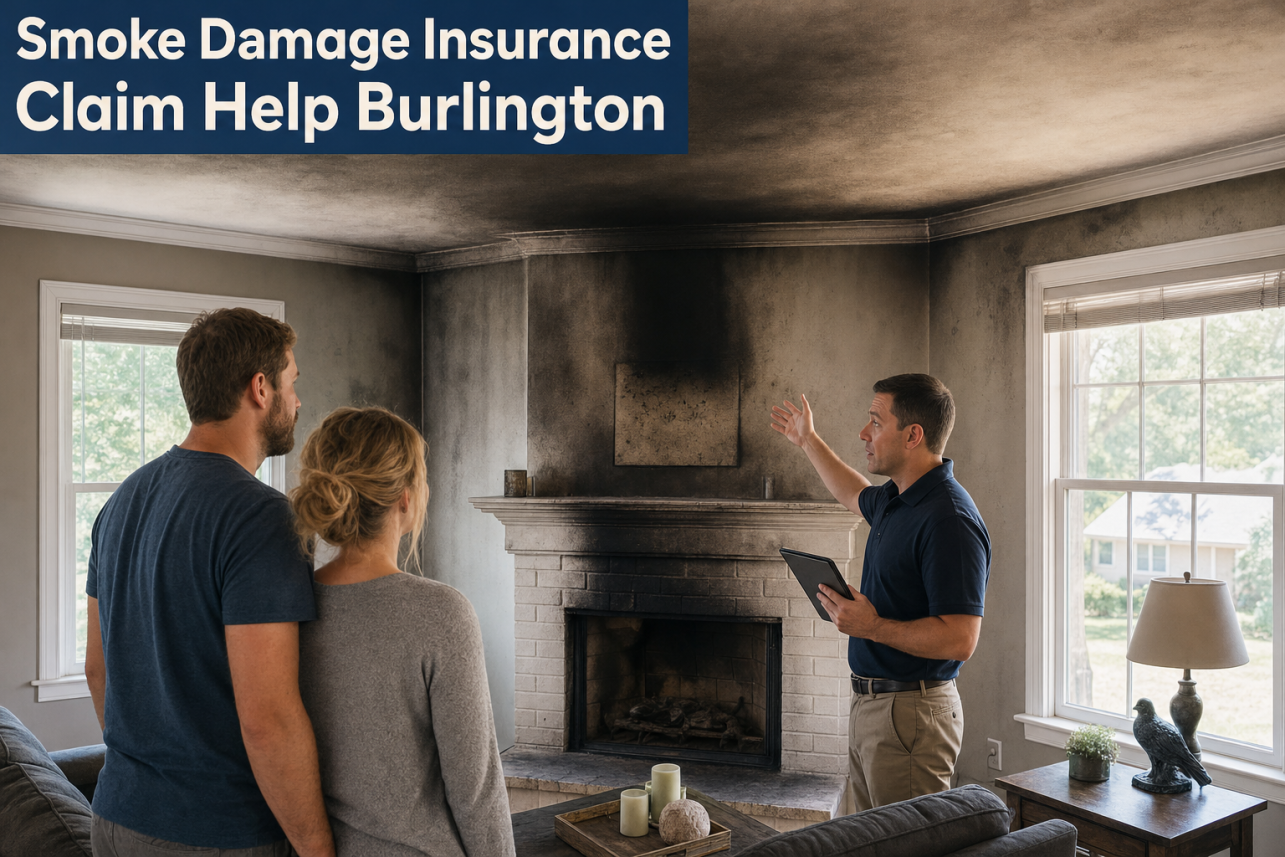
For anything beyond the most minor loss, testing makes a significant difference, and it is one of the tools we lean on when providing smoke damage insurance claim help Burlington families need to prove the full extent of contamination. Visual inspections miss most of what smoke actually does to a home.
Soot particles measure a fraction of a micron and settle inside wall cavities, electronics, insulation, and HVAC systems where no adjuster can see them. Chloride residues from burned plastics are corrosive and quietly damage wiring, appliances, and metal fixtures for months after the fire. An insurance company adjuster doing a twenty-minute walkthrough will not catch any of that.
We use surface sampling and, when warranted, bring in an independent industrial hygienist to test air quality and collect lab-analyzed samples. Those lab results turn a dispute of opinions into a matter of documented fact. When a carrier's adjuster says a room is 'unaffected' and a certified lab report shows combustion byproducts on the surfaces, the negotiation changes completely.
Testing is especially important in older homes around Burlington's historic districts, where balloon framing and plaster walls give smoke extra pathways to travel and hide. It also matters for resale: undisclosed smoke contamination can surface during a buyer's inspection years later. Our fee structure covers coordinating this testing as part of managing your claim, so you get the evidence without hunting down specialists yourself. If your carrier settled based on a visual inspection alone, there is a good chance the claim was undervalued.
Local Relevance
Burlington's housing stock reflects its history as a textile mill town, and many neighborhoods here are filled with homes built in the early and mid twentieth century. Those older houses — with plaster walls, original hardwood, balloon-framed cavities, and aging wiring — absorb smoke differently than new construction, and residue can travel through wall and floor cavities in ways a quick inspection misses.
The National Fire Protection Association has long identified cooking as the leading cause of home fires nationwide, and that pattern holds true in Alamance County: most of the smoke claims we see start in the kitchen, then contaminate the whole house through the HVAC system. North Carolina's humid climate compounds the problem, because moisture in the air keeps smoke odor active in porous materials long after visible cleanup is done.
We serve homeowners and business owners throughout Burlington, Graham, and the surrounding Alamance County communities, handling smoke losses alongside fire, water, tree damage, and vandalism claims for both residences and commercial buildings.
In Burlington's older mill-era homes, smoke often migrates through uninsulated wall cavities and original ductwork into rooms nowhere near the fire, and the Piedmont's humid summers tend to reactivate that trapped odor months later — which is why we insist on documenting hidden penetration before the insurer closes the claim, not after.
Get A Free Smoke Damage Claim Review In Burlington
Before you accept the insurance company's estimate — or give up after a denial — let a licensed, bonded public adjuster look at your loss. For The Public Adjusters, Inc. reviews your policy and damage at no cost, and we only get paid when your claim does.
Request Your Free Claim Review
Call us: (336) 331-8300
Helpful Resources
- NCDOI Public Adjusters Guide
- National Fire Protection Association (NFPA)
- U.S. Fire Administration home fire safety resources — Federal fire prevention and post-fire guidance for homeowners
- North Carolina Department of Insurance — State regulator licensing public adjusters and handling consumer complaints
Serving Burlington · Alamance
Last updated: July 29, 2026