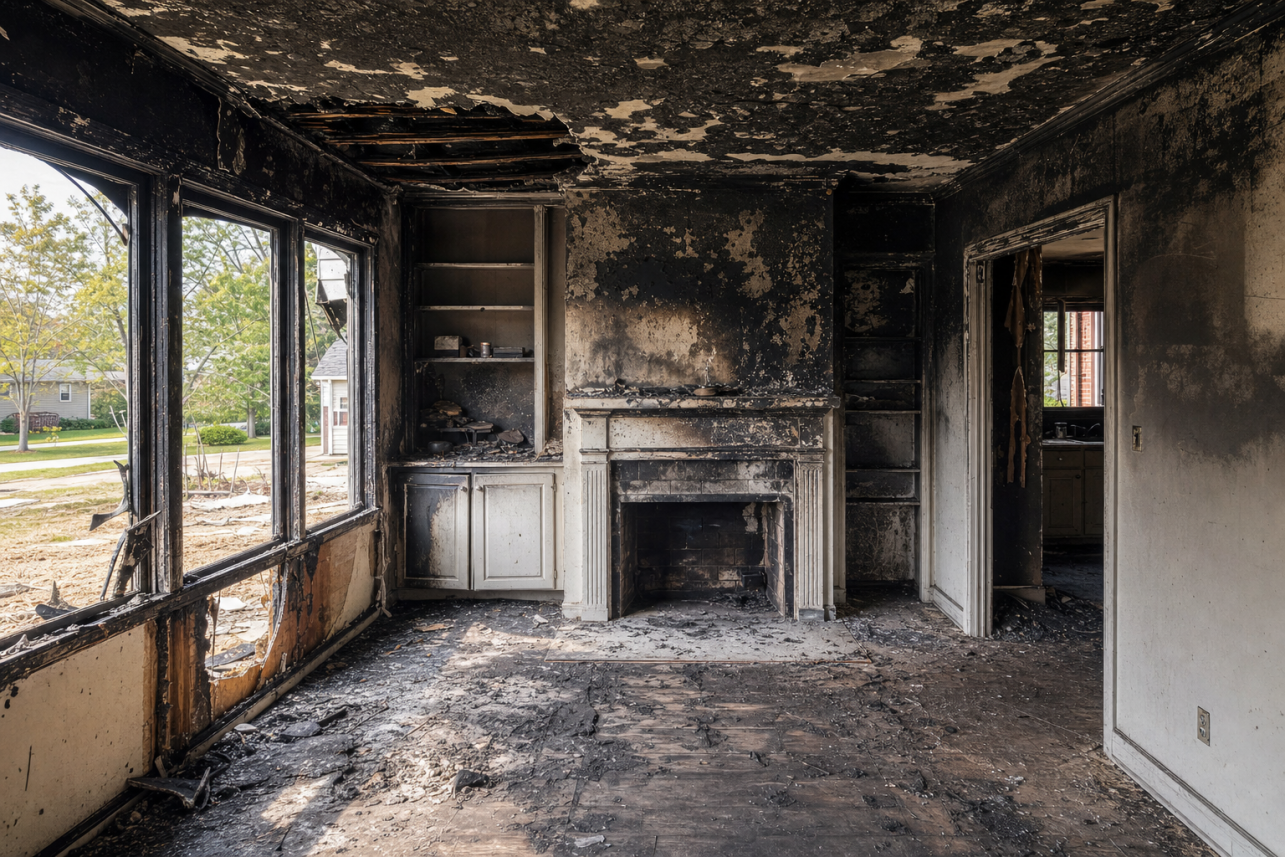
A fire damage insurance claim adjuster Clayton policyholders hire — known as a public adjuster — works exclusively for you, not your insurance company, to document the full extent of your fire loss and negotiate the settlement your policy actually allows. For The Public Adjusters, Inc. is licensed and bonded in North Carolina and handles fire, smoke, and related water damage claims for homeowners and business owners throughout Clayton and Johnston County. If the insurer's offer feels too low, or your claim is stalled or denied, an independent adjuster on your side can change the conversation.
What This Service Is
After a fire, your insurance company sends its own adjuster to estimate your loss. That adjuster is paid by the insurer. A public adjuster is the opposite: a licensed professional who represents only the policyholder in preparing, documenting, and negotiating the claim.
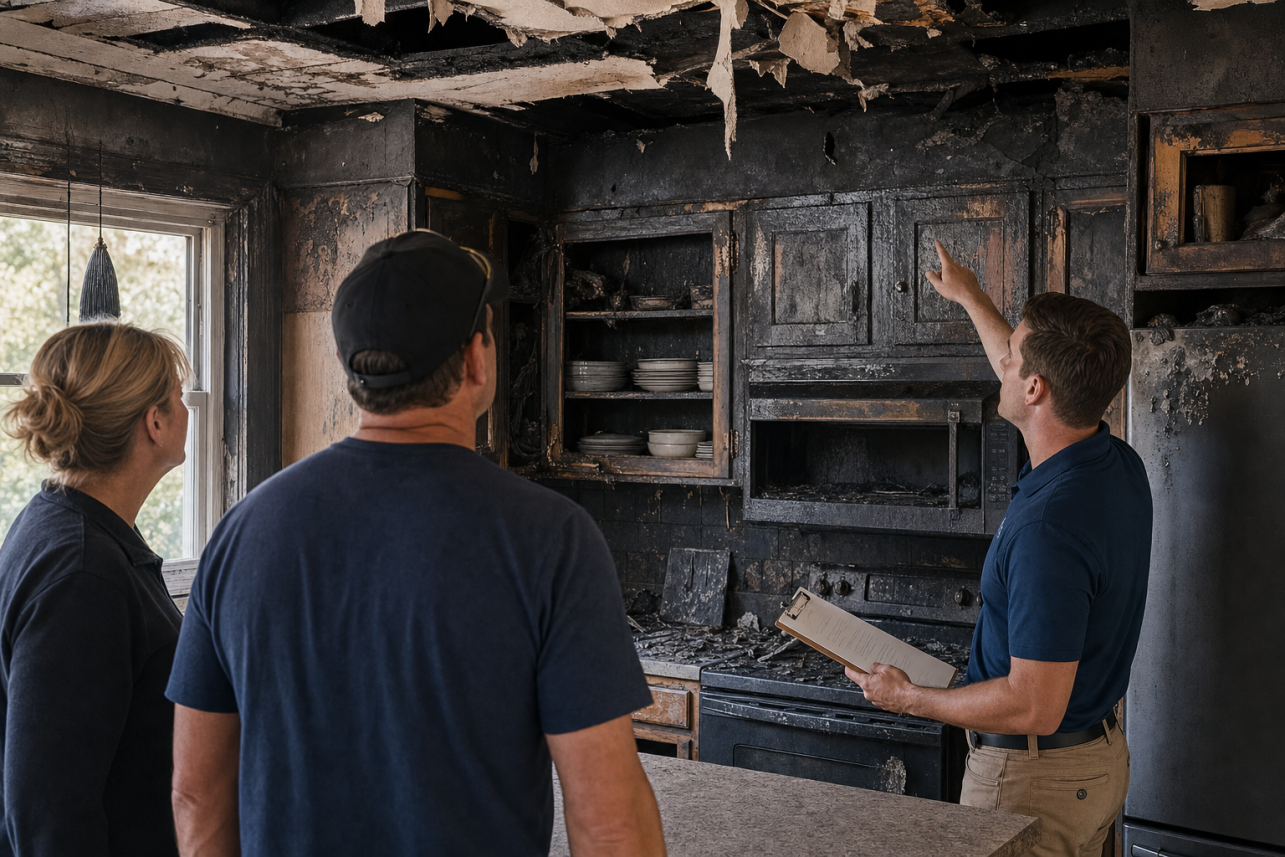
For a fire loss, that means far more than photographing charred rooms. We assess structural damage the insurer's inspection may have missed, document smoke and soot that traveled into rooms the flames never touched, and account for the water damage left behind by firefighting efforts — which is often as destructive as the fire itself.
We also build a complete inventory of your personal belongings, because contents are one of the most commonly underpaid parts of a fire claim. And we make sure your policy's living-expense coverage is used correctly, so temporary housing while your home is repaired comes out of the insurer's pocket, not yours.
The North Carolina Department of Insurance publishes guidance for consumers on public adjusters through the NCDOI Public Adjusters Guide, and it confirms what matters most: a public adjuster must be licensed in this state and works under a written contract for the policyholder alone. That is exactly how we operate.
Common Problems
The Insurance Company's Offer Won't Come Close To Covering The Rebuild — What Is My Claim Really Worth?
Low first offers are common after a fire. Insurers often estimate repairs using depreciated values, meaning they subtract for the age of your roof, cabinets, or flooring before paying. If your policy pays replacement cost, some of that money can be recovered — but only if the claim is documented and pursued correctly.
Estimates also frequently skip real costs: bringing older wiring or framing up to current building code during repairs, cleaning smoke residue from HVAC systems, and replacing contents damaged by soot and odor rather than flame.
We rebuild the numbers from scratch — structure, contents, and living expenses — and measure them against your actual policy limits, so you know what the claim is worth before you accept anything. We never guarantee a specific outcome, but we make sure nothing your policy owes you gets quietly left off the estimate.
My Fire Claim Is Delayed, Disputed, Or Denied — What Can I Actually Do?
Stalled claims usually come down to documentation and pressure. Insurers may request repeated proof-of-loss forms, question the cause of the fire, or simply let weeks pass between responses. Meanwhile you're paying for temporary housing and watching hidden damage — warped framing, saturated insulation, corroding wiring — get worse.
You are not stuck. Policyholders have real rights, and courts have enforced them. In Guessford v. Pennsylvania National Mutual Casualty Insurance Company, a homeowner whose fire-damaged house was repeatedly underpaid pursued the insurer in court and prevailed, with the case standing as a reminder that carriers can be held accountable for unreasonable claim handling.
Our job is to make that kind of fight unnecessary: we submit complete, professionally prepared documentation the insurer can't easily dispute, respond to every request on time, and escalate through negotiation or the appraisal process when the carrier drags its feet.
Do I Need A Fire Damage Insurance Claim Adjuster Clayton Residents Can Trust, Or Can I Handle This Myself?
You can file a fire claim yourself, and for very small losses that may be fine. But a serious house fire produces one of the most complex claims in all of property insurance: structure, smoke, water from the fire hoses, contents, and months of living expenses, all under one policy with different limits and rules for each.
The insurer handles claims like yours every day. Most homeowners handle one in a lifetime. That imbalance is where underpayments happen — not usually through bad faith, but through gaps in what gets documented.
When choosing a public adjuster, verify the license with the North Carolina Department of Insurance, ask specifically about fire claim experience, and get the fee agreement in writing before signing. For The Public Adjusters, Inc. is licensed and bonded, works on your claim from first inspection through final settlement, and answers to no one but you.
Our Process
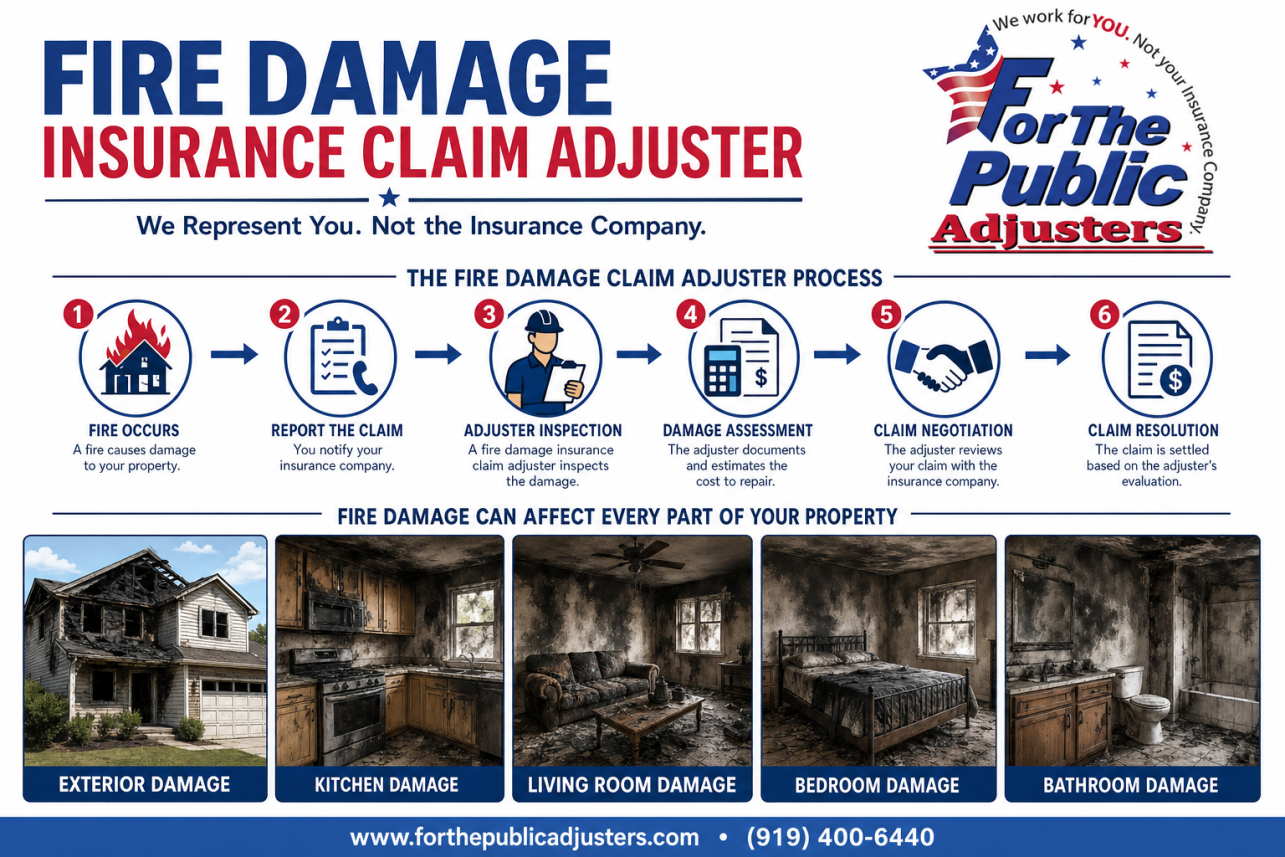
Free Policy And Damage Review
We start by reading your actual policy — coverage limits, deductible, replacement cost provisions, living expense allowances — and inspecting the property. Many Clayton homeowners are surprised to learn what their policy covers once someone reads it for their benefit rather than the insurer's.
Full Documentation Of The Loss
We prepare a detailed structural repair estimate, a room-by-room contents inventory with values, and documentation of smoke, soot, and firefighting water damage. This becomes your proof of loss — the formal record your settlement is built on, done right the first time.
Negotiation Through Final Settlement
We present the claim, handle every call and letter from the insurance company, and negotiate on your behalf. If the carrier disputes the numbers, we push back with evidence — through supplemental claims, re-inspections, or the appraisal process — until the claim is resolved.
| What Happens After the Fire | Filing on Your Own | With Our Clayton Team |
|---|---|---|
| Damage documentation | Carrier's adjuster inspects once, often under an hour, and writes the estimate that favors the insurer | Multi-day inspection with soot testing, hygienist reports, and cavity-by-cavity documentation of hidden smoke and heat damage |
| Contents inventory | You list burned items from memory on a blank spreadsheet, usually undervaluing by 40% or more | Room-by-room photographed inventory of every item, priced at actual replacement cost |
| Additional living expenses | Carrier reserves a few months and pressures you to move back early | ALE negotiated for the full realistic rebuild timeline, including comparable local housing |
| Code upgrades and hidden costs | Ordinance-or-law coverage often never mentioned, leaving code-required electrical and detector upgrades unpaid | Johnston County permit requirements built into the claim from day one |
| Negotiation leverage | You argue alone against a licensed professional who does this daily | A licensed NC public adjuster negotiating with documented evidence, on a contingency fee — we're paid only from what we recover |
Commonly Overlooked In The Public Adjusting Industry
- Soot migration through HVAC returns into rooms far from the fire — Carrier adjusters inspect what they can see, and soot inside duct runs and behind supply registers is invisible without testing.
- Char on framing above the ceiling of the fire room — Nobody opens the drywall during a quick inspection, so structurally compromised trusses and joists get 'cleaned' instead of replaced.
- Ordinance-or-law coverage for code-required rebuild upgrades — Johnston County permits trigger current electrical and smoke-detector code, but this coverage is a separate policy provision most homeowners never know to invoke.
- Heat damage to PEX plumbing and wire insulation in unburned areas — Both materials degrade at temperatures a fire easily reaches two rooms away, yet they look normal until they fail months later.
- Additional living expenses calculated on the real rebuild timeline — Carriers reserve ALE based on optimistic schedules, and families run out of housing money when the rebuild hits the inevitable permit and material delays.
- Depreciation holdback that's recoverable after repairs — Replacement-cost policies pay depreciation back once work is done, but the carrier won't remind you to file for it and deadlines quietly expire.
- Contents inventoried at replacement cost rather than garage-sale value — Homeowners undervalue their own belongings out of guesswork and fatigue, and the carrier happily accepts the low number.
- Corrosion damage to electronics and appliances from acidic soot — A TV that powers on today can fail in six months from chloride residue, and by then the claim is closed unless it was documented up front.
Case Studies
Case Study #1
Situation: A family on the east side of Clayton, near Flowers Plantation, suffered a kitchen fire that spread into the attic before Clayton Fire Department knocked it down. The home was a 2,400-square-foot two-story built in 2009, insured with a major national carrier.
Problem: The carrier's staff adjuster inspected for forty minutes and issued an estimate of $61,000, treating the loss as a kitchen rebuild with light smoke cleaning elsewhere. The family knew the smell of smoke reached every closet upstairs, but the estimate paid for wiping surfaces, not removing contaminated insulation or ductwork.
Investigation: Our team spent two full days in the home. We pulled attic insulation samples, opened wall cavities adjacent to the kitchen chase, ran the HVAC system with particle testing, and had a certified industrial hygienist document soot and char residue on framing above the fire room.
Findings: Soot had migrated through the return-air system into every conditioned room. Char was present on roof trusses two rooms away from the origin, and the blown-in attic insulation was contaminated across roughly 1,800 square feet. The original estimate also omitted code-required arc-fault breakers and hardwired smoke detectors mandated when Johnston County permits the rebuild.
Solution: We rebuilt the claim line by line: full duct replacement, attic insulation removal and reinstall, sealing and encapsulation of charred framing, pack-out and cleaning of contents, code-upgrade coverage under the policy's ordinance-or-law provision, and fourteen months of additional living expenses instead of the four the carrier had reserved.
Outcome: The claim settled at $247,000 — roughly four times the initial offer — plus a separate contents settlement of $38,000. The family stayed in a comparable rental in Clayton through the entire rebuild rather than moving twice.
Lesson: A fire's visible damage is rarely the whole loss. Smoke and soot travel through HVAC systems and wall cavities, and an estimate written in under an hour almost never accounts for what's hiding behind the drywall.
Case Study #2
Situation: A small business owner operating a hair salon in a leased strip-center space off NC-42 in Clayton had an electrical fire start in a neighboring unit overnight. Her space took heavy smoke and heat damage through the shared attic plenum, though flames never entered her suite.
Problem: Because there was no visible burn inside her unit, the carrier classified it as a 'smoke odor' loss and offered $9,800 for cleaning. Her business income claim was denied outright on the theory that the space was usable. Meanwhile, every fabric chair, product on the shelves, and drop-ceiling tile reeked of smoke, and clients wouldn't book.
Investigation: We documented heat distortion on light fixtures and PVC plumbing above the ceiling grid, proving temperatures in her plenum exceeded 200 degrees. We inventoried and photographed 340 line items of contents, obtained her prior twelve months of booking revenue, and requested the fire marshal's report tying the origin to the adjacent tenant.
Findings: Heat damage above the ceiling meant wiring, ductwork, and ceiling components required replacement, not cleaning. Protein and synthetic soot residue on porous contents made most inventory unsellable. Her lease made her responsible for interior improvements, which triggered the tenant-improvements coverage the carrier had never mentioned.
Solution: We reopened the claim under three coverages: business personal property, tenant improvements and betterments, and business income with extra expense. We priced a proper strip-out of the ceiling and plenum, full contents replacement at retail, and lost income based on documented bookings — not the carrier's flat industry average.
Outcome: Final settlement came to $118,500 across all coverages, including four and a half months of business income. She reopened in the same location with new fixtures and retained most of her client base.
Lesson: For tenants, the fire doesn't have to start in your unit for you to have a substantial claim. Heat and smoke damage above a drop ceiling — and the lease clauses that make you responsible for interior finishes — are exactly where carriers underpay commercial losses.
| Decision You'll Face | Safe Move | Costly Mistake | What It Depends On |
|---|---|---|---|
| Signing the first settlement check | Have the offer reviewed before cashing anything marked 'full and final' | Depositing it and unknowingly closing the claim | Whether the check language releases the carrier from further payment under NC law |
| Letting the carrier's preferred contractor start demo | Get an independent scope documented before anything is torn out or hauled away | Losing the physical evidence that proves hidden damage | Once charred framing and contaminated insulation are gone, you can't prove they existed |
| Throwing away smoke-damaged belongings | Photograph, list, and store everything until the contents claim is settled | Tossing items the week after the fire | The carrier can dispute any item you can't show; a dumpster full of evidence pays nothing |
| Giving a recorded statement | Answer factually but request preparation time and know your policy first | Guessing at values, causes, or timelines on the record | Statements are used to limit payouts; an offhand guess becomes the carrier's ceiling |
| Moving back in early | Wait for air quality clearance and completed soot remediation | Reoccupying to 'save' ALE money before cleaning is verified | Soot residue is corrosive and a respiratory hazard, especially for kids and anyone with asthma |
| Accepting 'cleaning' for heat-exposed wiring | Insist on inspection of wiring, ductwork, and plumbing above the fire area | Painting over rooms with compromised electrical behind the walls | Heat above roughly 194°F degrades wire insulation even when the wall surface looks fine |
| Deciding when to bring in a public adjuster | Call before the carrier's inspection, or immediately after a low offer or denial | Waiting until you've signed releases or the rebuild has started | The earlier the loss is documented independently, the stronger every later negotiation becomes |
Reviews
Our insurance company offered $54,000 after a garage fire spread into our bonus room. For The Public Adjusters found smoke contamination in our ductwork and attic that the company adjuster never even looked at. Final settlement was over $180,000. They handled every phone call and every document while we focused on our kids. Worth every penny of their fee.
Marcus T., Clayton NC
After a lightning strike caused an electrical fire in our attic, the carrier kept saying most of the house just needed 'odor treatment.' These folks brought in a hygienist, tested everything, and proved soot was in all our HVAC lines. They also caught that our policy covered code upgrades for the rewiring, which added a lot to the settlement. Communication was excellent the whole ten weeks.
Denise W., Flowers Plantation
I run a small machine shop near Clayton and had a fire in my compressor room. Insurance denied my business income claim at first. This team rebuilt the whole claim, documented my equipment losses piece by piece, and got the income claim paid too. Only knock is the process took about three months, but honestly that was the carrier dragging its feet, not them. I'd have accepted a fraction of what they recovered.
Jerry P., Johnston County
Frequently Asked Questions
What Does A Fire Damage Insurance Claim Adjuster Clayton Homeowners Hire Actually Do For Me?
A fire damage insurance claim adjuster Clayton residents bring in works exclusively for you, the policyholder — not the insurance company. That distinction matters. The adjuster your carrier sends is paid by the insurer, and their job is to settle the claim at the lowest defensible number. Our job at For The Public Adjusters, Inc. is the opposite: to document, value, and negotiate the full amount your policy actually owes you.
In practice, that means we handle the entire claim from start to finish. We inspect the property, including hidden smoke, soot, and water damage from firefighting efforts that carrier adjusters frequently miss. We inventory your damaged contents room by room, price structural repairs at real Johnston County contractor rates, and calculate additional living expenses if your family has to relocate during repairs.
We also manage all communication with the insurance company — the letters, the deadlines, the requests for documentation, the examinations under oath if it comes to that. Most Clayton homeowners have never filed a major fire claim before. The insurer does this every day. Hiring your own licensed adjuster levels that playing field.
We work on a contingency fee, meaning we're paid a percentage of what we recover for you. If your claim doesn't pay, neither do we. That aligns our incentive with yours: the stronger your settlement, the better we do.
How Much More Can A Public Adjuster In Clayton Recover On A Fire Claim Compared To Handling It Myself?
While every claim is different, studies of insurance settlements have shown that policyholders represented by public adjusters routinely recover significantly more than those who go it alone — often several times the initial offer on large fire losses.
The gap comes from what gets missed. After a house fire in Clayton, the visible burn damage is only part of the loss. Smoke penetrates HVAC ductwork, insulation, and wall cavities. Soot is acidic and corrodes electronics, plumbing fixtures, and wiring over weeks and months. The water and foam used to extinguish the fire cause their own damage, including mold risk in North Carolina's humid climate. Carrier adjusters working through a high caseload frequently scope only the obvious damage.
There's also the contents side. Most homeowners underestimate what they own. A properly prepared inventory — down to the pantry items, clothing, tools in the garage, and kids' belongings — often doubles or triples the contents portion of a settlement.
Finally, there's policy knowledge. Your policy likely includes coverage for code upgrades, debris removal, landscaping, additional living expenses, and loss of use that insurers won't volunteer. We read your specific policy line by line and claim everything it entitles you to.
Because we work on contingency, our fee typically comes out of the additional money we recover, not out of your pocket. For most Johnston County fire losses, homeowners net more with representation even after our fee.
When Should I Call For The Public Adjusters, Inc. After A Fire In Johnston County — Before Or After The Insurance Company's Adjuster Visits?
Before, whenever possible. The earliest days of a fire claim shape everything that follows, and decisions made in the first week are hard to undo later.
Here's why timing matters. Your policy requires you to mitigate further damage — boarding up openings, tarping the roof, addressing water from fire suppression. It also requires you to give the insurer prompt notice and cooperate with their investigation. But nothing requires you to accept their scope of damage, sign their contractor's authorization, or give a recorded statement without preparation. Homeowners in Clayton often agree to things in those first stressful days that limit their claim, simply because they didn't know they had a choice.
If we're involved before the carrier's adjuster inspects, we can document the loss thoroughly first — photographs, moisture readings, a preliminary scope — so nothing gets cleaned up, thrown away, or overlooked before it's recorded. We can also be present at the inspection to make sure hidden smoke and structural damage is included in their scope from day one.
That said, it is never too late to call. We regularly take over claims that have stalled, been underpaid, or been denied. In North Carolina, you generally have time to dispute a settlement, and supplemental claims can reopen losses where new damage is discovered. If you've already received an offer that feels low for your Clayton home, we'll review it at no cost and tell you honestly whether we can improve it.
How Does The Fire Damage Insurance Claim Adjuster Clayton Process Work With Your Firm, And What Does It Cost?
Working with a fire damage insurance claim adjuster Clayton families can trust starts with a free, no-obligation consultation. We'll walk your property — whether it's a home near downtown Clayton, out toward Flowers Plantation, or anywhere in Johnston County — review your policy, and give you a straight assessment of your claim's real value.
If you decide to hire us, we sign a clear contingency agreement. Our fee is a percentage of the settlement, regulated under North Carolina law, and there are no upfront costs, hourly bills, or hidden charges. If we recover nothing, you owe nothing.
From there, we take over the heavy lifting. We prepare a detailed structural estimate using professional estimating software at current local labor and material pricing. We build a complete contents inventory with replacement values. We document additional living expenses if you're displaced. Then we submit the full claim package to your carrier and negotiate directly with their adjusters.
You stay informed at every step — we explain each offer, each carrier response, and each decision point in plain language, and nothing settles without your approval. Most fire claims resolve within a few months, though complex or disputed losses can take longer. Throughout it all, you deal with us instead of fielding calls from the insurance company while trying to put your life back together.
The first conversation costs you nothing, and you'll leave it knowing exactly where your claim stands.
My Insurance Company Already Made An Offer On My Fire Claim — Can A Fire Damage Insurance Claim Adjuster Clayton Still Help Me?
Yes, and this is actually one of the most common situations we see at For The Public Adjusters, Inc. An initial offer is rarely the final word. Under North Carolina law, you generally have three years from the date of loss to pursue your claim, and most policies allow supplemental claims when additional damage or costs are documented.
When a Clayton homeowner brings us an existing offer, we start by reviewing the carrier's estimate line by line against your actual policy language. Fire settlements are frequently short in predictable places: smoke and soot contamination in rooms the fire never touched, code-upgrade costs required by Johnston County permitting, HVAC systems that circulated soot through the ductwork, and contents that were listed at depreciated values far below replacement cost.
We then build our own independent estimate using detailed scoping, moisture and soot testing where appropriate, and current local contractor pricing — not the national pricing databases carriers often default to, which don't always reflect what rebuilding actually costs in the Clayton and Raleigh-area market.
If the gap between the offer and the documented loss is significant, we negotiate directly with the carrier's adjuster, and if necessary invoke the appraisal clause in your policy to resolve the dispute. Even if you've already accepted a partial payment, that usually doesn't close the claim, so it's worth having the file reviewed before you sign any release or consider the matter finished.
How Do You Handle Hidden Smoke And Soot Damage In Clayton Homes After A Fire?
Hidden smoke damage is where fire claims most often get shortchanged, so we treat it as a priority from day one. Soot particles are microscopic and acidic — they travel through open floor plans and HVAC ductwork and settle inside wall cavities, attic insulation, electronics, and soft goods rooms away from the actual burn area.
Our inspection goes well beyond a visual walkthrough. We check duct systems, pull outlet covers to look inside wall cavities, examine attic insulation, and when the situation warrants it, recommend third-party testing for soot residue and protein or synthetic smoke contamination. This matters because carriers sometimes approve cleaning when full replacement is actually required — soot-saturated insulation, for example, cannot be effectively cleaned and will continue off-gassing odor.
In Clayton's climate, humidity compounds the problem. Moisture accelerates the corrosive effect of soot on metal fixtures, appliances, and wiring, which means damage can worsen in the weeks after the fire if it isn't documented and addressed quickly.
We photograph and inventory everything, room by room, and tie each finding to specific policy coverage — structure, contents, and additional living expenses if odor makes the home temporarily unlivable. When the carrier's estimate ignores contamination in "undamaged" rooms, we push back with lab results and detailed documentation rather than opinion. That evidence-based approach is typically what turns a partial smoke-cleaning allowance into a settlement that covers the real scope of restoration your home needs.
Will My Clayton Fire Claim Cover Temporary Housing And Living Expenses While My Home Is Repaired?
In most cases, yes. Nearly every homeowner's policy includes Additional Living Expenses coverage — sometimes called Loss of Use or Coverage D — which pays the extra costs you incur when fire damage makes your home unlivable. The problem is that many families in Johnston County never collect the full benefit because they don't know what qualifies or how to document it.
ALE typically covers a comparable rental home or extended-stay hotel, the difference between your normal grocery bill and eating out, additional mileage if your temporary housing lengthens your commute, pet boarding, laundry services, and even storage for salvaged belongings. The key word is "additional" — the carrier owes the difference between your normal cost of living and what displacement actually costs you.
We help Clayton families set this up correctly from the start. That means securing housing comparable to your home — a family displaced from a four-bedroom house shouldn't be squeezed into a one-bedroom hotel suite for eight months — and keeping a clean paper trail of every receipt so nothing gets rejected later.
We also watch the timeline. ALE runs until repairs are reasonably complete, and when a carrier drags out approvals or underpays the rebuild, the displacement period stretches with it. Part of our job is documenting that any delay sits with the insurer, not with you, so your living-expense coverage isn't cut off before you can actually move back home. It's one more reason having an advocate managing the whole claim pays off.
How Long Does A Fire Damage Insurance Claim Adjuster Clayton Residents Hire Typically Need To Settle A Claim?
Most fire claims we handle for Clayton homeowners resolve within three to six months, though the range is wide. A contained kitchen fire with limited smoke spread might settle in six to ten weeks, while a total loss involving structure, contents, code upgrades, and extended displacement can take six months or longer. The severity of the loss and the carrier's responsiveness drive the timeline more than anything else.
A common worry is that bringing in a public adjuster slows things down. In our experience it's usually the opposite. Claims stall when documentation is incomplete — the carrier requests more photos, a revised inventory, or contractor estimates, and each round trip adds weeks. Because we deliver a complete, professionally scoped claim package up front, there's far less back-and-forth.
North Carolina also gives you leverage on timing. Once a carrier receives a properly documented proof of loss, state regulations require them to respond and act on the claim in a reasonably prompt manner, and we hold them to that standard. When an insurer sits on a file, we escalate — in writing — and if needed we can involve the North Carolina Department of Insurance.
One honest caveat: sometimes the fastest settlement isn't the right one. A quick lowball payout that leaves you short on rebuilding costs isn't a win. Our goal for every Johnston County family is the full amount the policy owes, recovered as efficiently as the facts allow — and we keep you informed at every stage so you're never guessing where things stand.
Does A Fire Damage Insurance Claim Adjuster Clayton Homeowners Work With Also Handle Water And Chemical Damage From Firefighting Efforts?
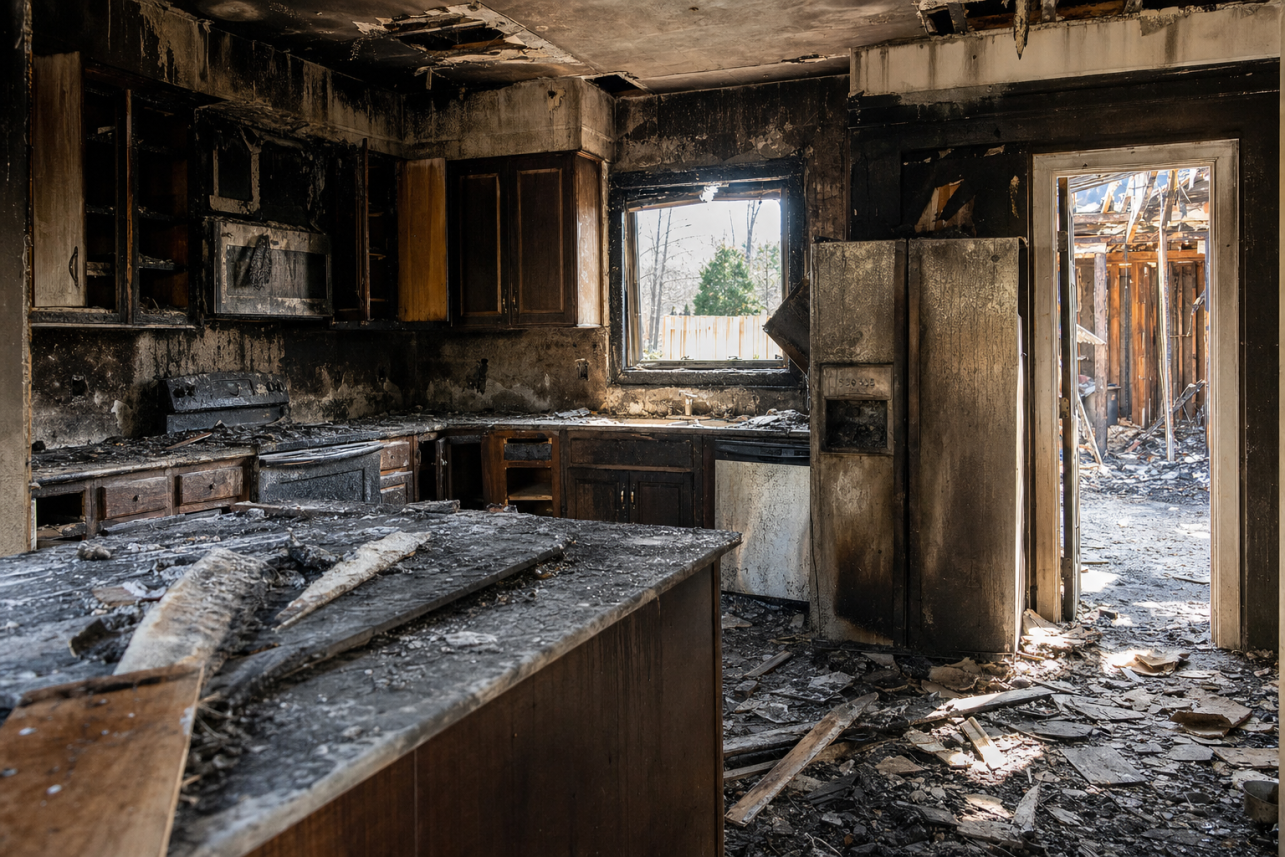
Yes, and it's often one of the most undervalued parts of a fire loss. When Clayton Fire Department or a Johnston County crew extinguishes a house fire, thousands of gallons of water and sometimes chemical suppressants go into your home. That water saturates drywall, insulation, subflooring, and framing far beyond the burn area — and under your homeowners policy, it's covered the same way the fire itself is.
The problem is that carrier adjusters frequently scope only the charred rooms and treat water intrusion as an afterthought. Within days, saturated materials in a humid North Carolina climate start growing mold, warping hardwoods, and wicking moisture up wall cavities.
When we inspect a fire loss, we use moisture meters and thermal imaging to map exactly how far the water traveled, then we document it before drying and demolition erase the evidence. We also account for chemical residue from extinguishers and foam, which can corrode HVAC components, appliances, and electronics even in rooms the fire never touched.
All of that goes into the estimate we build and negotiate with your carrier. If firefighting water reached your crawlspace — common in older Clayton homes off Main Street and in established neighborhoods like Riverwood — we make sure the insurer pays to address it properly, not just spot-dry the visible areas. One loss, one claim, full scope.
How Do You Document My Personal Belongings And Contents After A House Fire In Clayton?
Contents are usually the most tedious and most underpaid portion of a fire claim, because the burden of proof sits entirely on you. Your insurer will hand you a blank inventory spreadsheet and expect you to list every item, its age, and its replacement cost — while you're displaced and stressed. Most homeowners give up partway through and leave real money behind.
We take that job off your plate. Our team photographs and catalogs the loss room by room, including items reduced to ash that you might not remember owning — the contents of kitchen drawers, closets, the garage, holiday decorations in the attic. We use pricing research to establish accurate replacement values rather than accepting the carrier's depreciated lowball figures.
We also separate items correctly into categories: destroyed, restorable through professional cleaning, and smoke-affected. Textiles, upholstery, and electronics with soot exposure often qualify for cleaning or replacement even when they look intact, and we make sure those aren't skipped.
For Johnston County families with heirlooms, firearms, jewelry, or collections, we review your policy's special limits and scheduled endorsements so nothing gets capped that shouldn't be. If your policy pays replacement cost, we also track the recoverable depreciation process so you actually collect the second payment after items are replaced. A thorough inventory routinely adds tens of thousands of dollars to a fire settlement — it's worth doing right the first time.
Is A Fire Damage Insurance Claim Adjuster Clayton Residents Hire Required To Be Licensed In North Carolina, And How Do I Verify Yours?
Yes. In North Carolina, public adjusters must be licensed through the North Carolina Department of Insurance, pass a state examination, carry a surety bond, and complete continuing education to keep that license active. Anyone offering to negotiate your fire claim for a fee without that license is operating illegally — and unfortunately, out-of-state operators sometimes canvass Johnston County neighborhoods after major fires.
Verifying us takes two minutes. Visit the NC Department of Insurance website and use the agent and adjuster lookup tool, or call the Department directly and ask about For The Public Adjusters, Inc. We'll also show you our license and provide our license number in writing before you sign anything, because state law and basic transparency both require it.
A few red flags to watch for after a fire in Clayton: anyone who shows up unsolicited demanding an immediate signature, contractors offering to "negotiate with your insurance company" (that's unlicensed adjusting in North Carolina), and anyone unwilling to put their fee in a written contract. State regulations also give you a window to cancel a public adjusting contract, which we explain up front.
Licensing matters because fire claims involve real legal and financial stakes — coverage interpretation, appraisal clauses, recoverable depreciation, code-upgrade provisions. You want someone accountable to the state regulator handling that, not a salesperson. We've built our reputation across Clayton and the greater Johnston County area on doing this the right way, and verification is always encouraged.
Should I Let My Insurance Company's Preferred Contractor Set The Repair Price For My Clayton Fire Claim?
Be careful here. Carriers often steer fire loss customers toward their "preferred vendor" or managed repair program, presenting it as a convenience. What they don't emphasize is that the contractor's estimate frequently becomes the ceiling of your settlement — and that contractor's ongoing business depends on keeping the insurer happy, not you.
Preferred-vendor estimates on fire losses commonly cut corners in predictable ways: cleaning charred framing instead of replacing it, painting over smoke-stained surfaces without proper sealing, skipping HVAC duct decontamination, and ignoring the code upgrades Johnston County inspections will actually require before you can reoccupy the home. When the work fails or the smell of smoke returns six months later, reopening the claim is an uphill battle.
You have the right under North Carolina law to choose your own contractor. What you need is a claim valuation independent of anyone with a stake in minimizing it. That's exactly what we provide — a detailed, line-item scope of repairs built from our own inspection, current local construction pricing, and Clayton's permitting and code requirements.
We then negotiate that scope with your carrier so the settlement funds a genuine restoration, and you hire whichever qualified contractor you trust to perform it. Keeping the estimate, the negotiation, and the construction in separate, independent hands is the single best structural protection you have in a fire claim. Before you sign a work authorization with any insurer-referred vendor, let us review your policy and inspect the loss — that conversation costs you nothing.
My Kitchen Fire Seems Small — Is A Fire Damage Insurance Claim Adjuster Clayton Homeowners Trust Really Worth It For A Partial Loss?
Partial losses are where homeowners most often get shortchanged, so yes. A kitchen fire that looks contained rarely is. Grease smoke travels through HVAC ductwork, protein residue bonds to painted surfaces two rooms away, and heat can compromise cabinet boxes, wiring behind walls, and even roof sheathing above the range without leaving obvious char.
Insurance carriers frequently scope these claims as a clean-and-paint job. We routinely find that a proper scope includes duct cleaning or replacement, cabinet replacement rather than refinishing, electrical inspection, and sealing or replacing odor-saturated drywall and insulation. The difference between those two scopes on a Clayton home can easily run into tens of thousands of dollars.
There's also a matching issue that comes up constantly in newer Johnston County subdivisions. If your kitchen has continuous flooring or cabinetry that runs into adjacent rooms, North Carolina policy language and repair standards often support replacing enough material to achieve a uniform appearance — not just patching the burned section.
Because public adjusters work on a percentage of what's recovered, a small claim that stays small costs you very little. But in our experience, 'small' fires almost never stay small once the damage is properly documented. A free initial review costs you nothing, and it tells you quickly whether the carrier's estimate is realistic or whether you're about to absorb repair costs your policy should be paying.
What Should I Avoid Doing After A House Fire In Clayton Before My Claim Is Reviewed?
The first 72 hours after a fire shape the entire outcome of your claim, and a few common mistakes can cost you significantly.
Don't throw anything away — even items that seem obviously ruined. Burned contents are evidence of your loss, and once they're in a dumpster, proving their existence and value becomes an uphill battle. Photograph everything in place first, and keep damaged items until the claim is documented.
Don't give a recorded statement to the insurance company without preparation. Adjusters for the carrier are trained to ask questions that can limit your claim, and offhand answers about the fire's cause, your home's condition, or your belongings can be used to reduce or dispute coverage later.
Don't sign anything from restoration companies or contractors who show up at your door. Fire chasers work Clayton neighborhoods quickly after a loss, and some contracts assign your insurance benefits to them or lock you into inflated pricing. Emergency board-up and water extraction are fine — signing a full restoration contract on day one is not.
Don't accept the carrier's first estimate as the final word, and don't cash a check marked 'final settlement' without understanding what you're releasing.
Do secure the property, keep receipts for every hotel night and meal, and notify your carrier promptly — your policy requires timely notice. Then get an independent professional reviewing the loss on your behalf before the insurance company's version of the damage becomes the official record.
My Fire Claim Was Denied Or Badly Underpaid — Can A Fire Damage Insurance Claim Adjuster Clayton Residents Rely On Still Turn That Around?
In many cases, yes. A denial or lowball payment is the insurance company's position, not the final legal word on your claim, and North Carolina policies build in mechanisms to challenge it.
The first step is a line-by-line review of the denial letter and the carrier's estimate against your actual policy language. Denials in fire claims often hinge on disputed cause, alleged vacancy, or claimed late notice — and carriers sometimes apply exclusions more broadly than the policy actually allows. Underpayments usually trace back to an incomplete scope: missed smoke migration, ignored code-upgrade costs, or contents valued at garage-sale prices instead of replacement cost.
When a fire damage insurance claim adjuster Clayton property owners hire re-documents the loss with a full independent estimate, photographs, moisture and soot testing, and a detailed contents inventory, carriers frequently reopen and revise their position. If they won't, most North Carolina homeowner policies contain an appraisal clause — a formal dispute process where each side appoints an appraiser and disagreements go to a neutral umpire. We regularly represent policyholders through appraisal, and it resolves many disputes without litigation.
Timing matters. North Carolina's statute of limitations and your policy's own suit-limitation clause put deadlines on challenging a claim decision, so don't sit on a denial letter. Bring us the denial, the carrier's estimate, and your policy, and we'll tell you honestly whether the decision can be fought and what recovery is realistic. Many of the strongest results we've achieved for Johnston County families started as claims another adjuster had already closed.

Do You Handle Fire Claims For Businesses And Rental Properties In Clayton And The Rest Of Johnston County?
Yes. For The Public Adjusters, Inc. represents commercial property owners, landlords, and business tenants throughout Clayton, Smithfield, Garner-adjacent areas, and the rest of Johnston County — and commercial fire claims are often where professional representation matters most.
A business fire involves layers a residential claim doesn't. Beyond the building itself, you're dealing with business personal property, tenant improvements, inventory, equipment, and — critically — business interruption coverage. Lost income claims require documented financials, projected revenue, and continuing-expense calculations, and carriers scrutinize every number. An underprepared interruption claim can cost a Clayton business far more than the building damage itself.
For landlords, we handle loss-of-rents coverage, tenant displacement issues, and the code-upgrade costs that frequently apply when older rental properties along the Highway 70 corridor are rebuilt to current Johnston County standards. Ordinance-and-law coverage is one of the most commonly overlooked line items in these claims.
We also sort out the coverage boundaries between a landlord's policy and a tenant's policy after a fire — who owns the improvements, whose insurance responds to what, and how to keep the two claims from stalling each other.
The fee structure works the same as our residential engagements: a contingency percentage of the recovery, with no upfront cost. If your restaurant, shop, office, or rental property in the Clayton area has suffered fire or smoke damage, we'll review the loss, both policies if applicable, and your carrier's response before you commit to anything.
Local Relevance
Clayton has grown fast, and its housing reflects that: established neighborhoods near the historic downtown sit alongside newer subdivisions built during the town's expansion as part of the greater Raleigh area. Fire claims play out differently in each. Older homes often trigger code-upgrade costs during repairs — updated wiring, framing, and materials the insurer's first estimate may not include. Newer homes with open floor plans let smoke and soot spread quickly through connected living spaces and HVAC systems, so contamination often extends well beyond the room where the fire started.
Johnston County's humid climate adds urgency after any fire here. The water used to extinguish a house fire soaks into framing, insulation, and drywall, and in our humidity that moisture invites mold quickly if drying and demolition are delayed while the claim sits unresolved.
The National Fire Protection Association has long identified cooking as the leading cause of home fires nationwide, and kitchen fires are among the most common losses we see in Clayton households. They look contained at first, but heat, smoke, and grease residue routinely travel far beyond the kitchen — one more reason a thorough, independent damage assessment matters before you accept any settlement.
Because so much of Clayton's housing was built during the area's rapid growth, many homes share tightly connected open layouts and shared attic and ductwork runs — which means smoke and soot from even a small fire often contaminate far more of the house than the insurer's initial walkthrough acknowledges. Insist on a full-house assessment, including HVAC and attic spaces, before agreeing to any repair scope.
Get A Second Opinion Before You Accept The Insurer's Number
If your home or business in Clayton has been damaged by fire, don't sign off on a settlement you haven't independently verified. For The Public Adjusters, Inc. is licensed and bonded in North Carolina, and the initial claim review costs you nothing. Let us read your policy, inspect the damage, and tell you honestly where your claim stands.
Request Your Free Claim Review
Call us: (919) 400-6440
Helpful Resources
- NCDOI Public Adjusters Guide
- National Fire Protection Association (NFPA)
- U.S. Fire Administration home fire safety resources — Federal fire prevention and recovery guidance
- North Carolina Department of Insurance consumer services — State regulator overseeing insurance and adjuster licensing
Last updated: August 12, 2026