
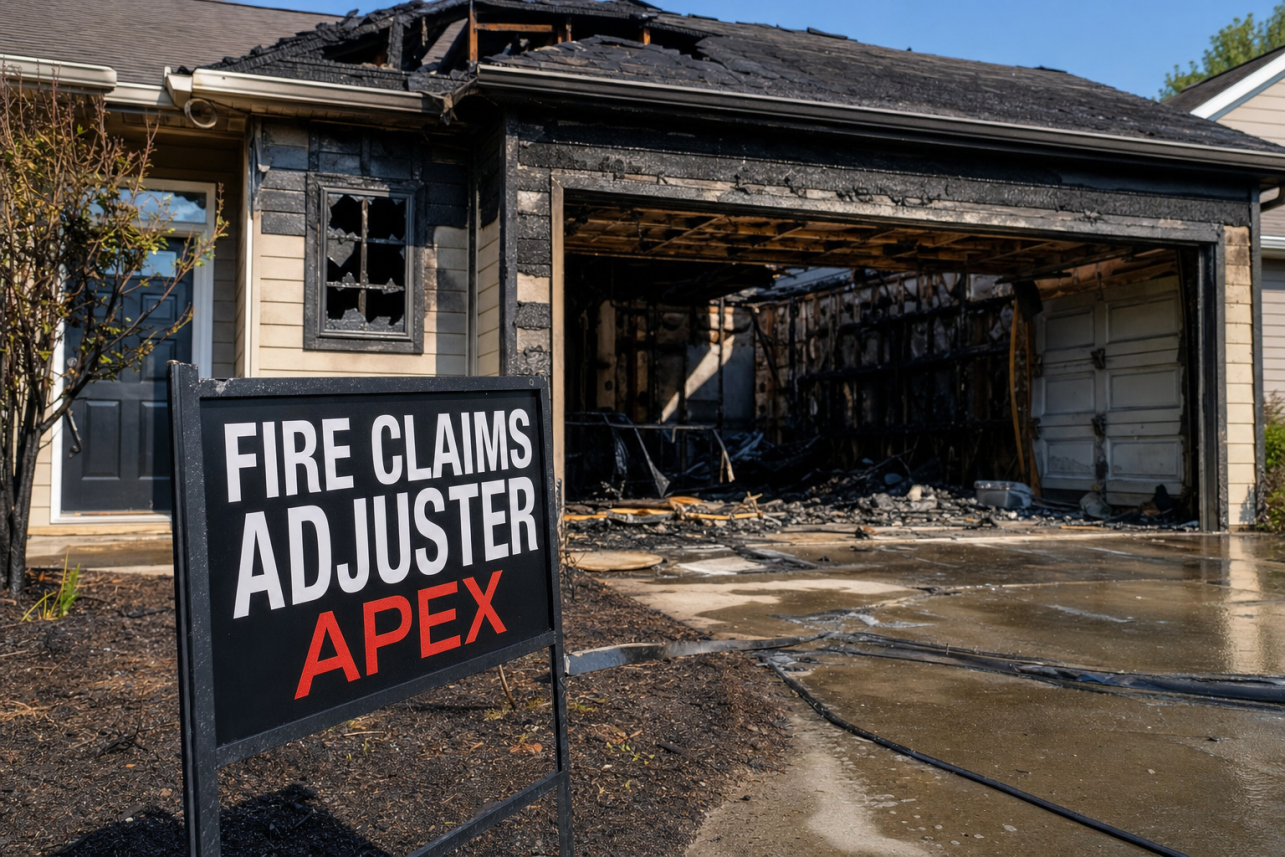
If your insurance company has lowballed, delayed, or denied your house fire claim, a licensed fire claims adjuster apex NC homeowners can put on their side — For The Public Adjusters, Inc. — works only for you, never for the insurer. We document the full scope of your fire, smoke, and soot damage, prepare the proof of loss your policy requires, and negotiate directly with the insurance company on your behalf. We are licensed and bonded, and we only get paid when your claim gets paid.
What This Service Is?
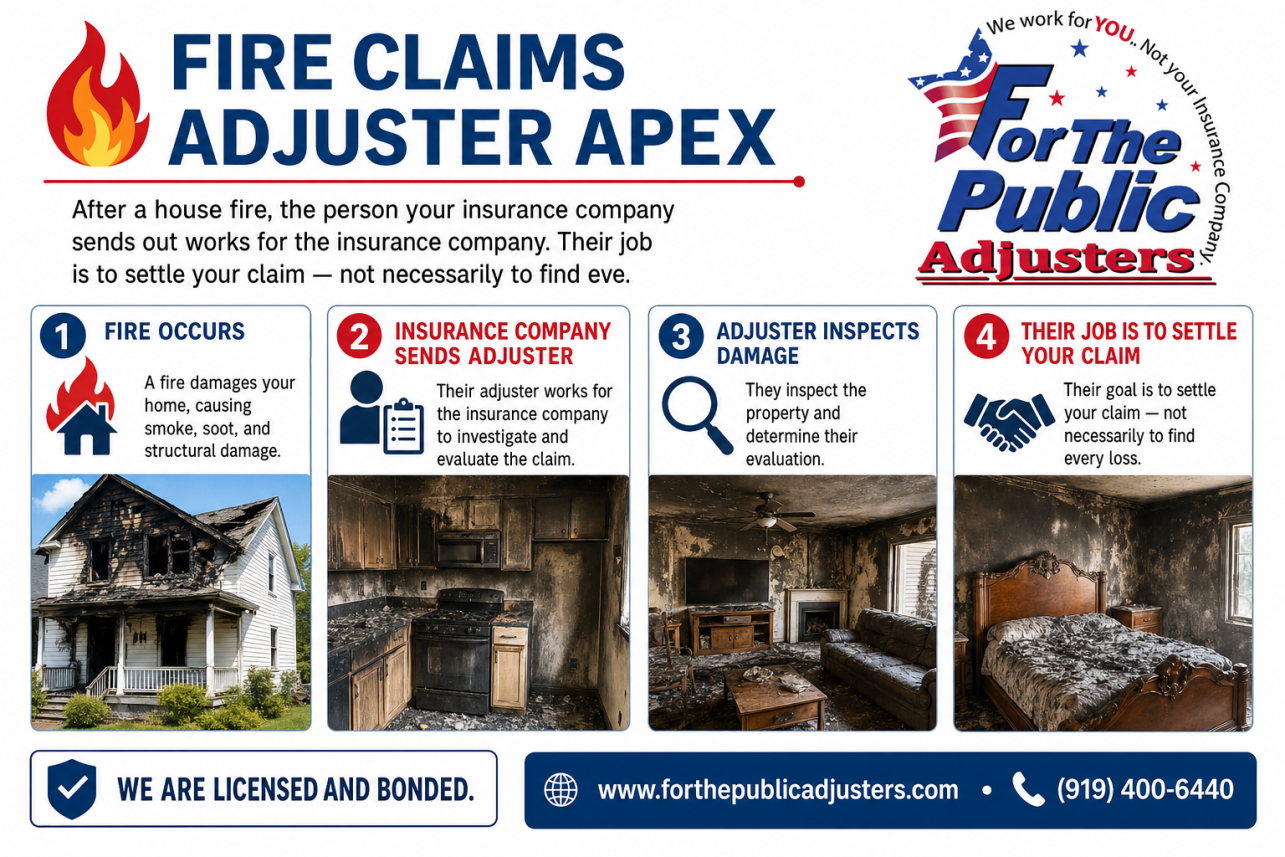
After a house fire, the person your insurance company sends out works for the insurance company. Their job is to settle your claim — not necessarily to find every dollar of damage in your home. A public adjuster flips that arrangement. We represent you, the policyholder, and only you.
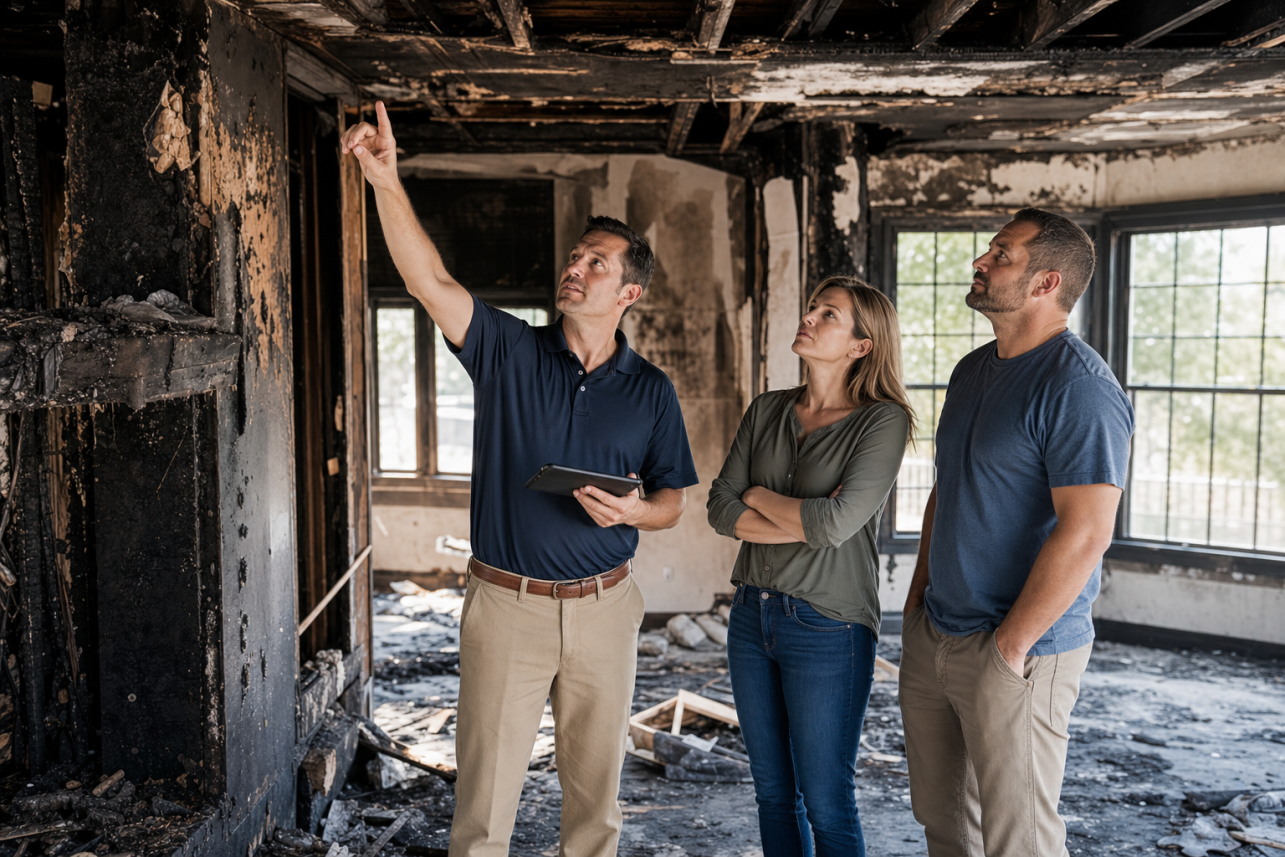
Our team inspects your Apex home top to bottom, including the damage that is easy to miss: soot that has traveled through the HVAC system into rooms far from the fire, smoke odor absorbed into insulation and framing, and water damage left behind by firefighting efforts. We build a room-by-room inventory of your personal belongings, prepare a detailed repair estimate, and assemble the proof of loss documentation your policy demands.
We also read your policy the way an advocate reads it. That means checking whether you are owed replacement cost or only depreciated actual cash value, whether additional living expenses coverage should be paying for your temporary housing right now, and whether your policy covers the building code upgrades Wake County will require when you rebuild. The North Carolina Department of Insurance publishes the NCDOI Public Adjusters Guide, which explains how licensed public adjusters like us are regulated in this state — it is worth reading before you hire anyone, including us.
One thing we will never do is guarantee a specific dollar outcome. No honest adjuster can. What we can do is make sure your claim is fully documented, professionally presented, and aggressively negotiated. Note that we handle property claims only — homes, buildings, and their contents — not vehicle, health, or life insurance matters.
Common Problems
The Insurance Company’s Offer Won’t Come Close To Rebuilding My Home
This is the single most common call we get from Apex homeowners. The insurer’s estimate looks official, but when you hand it to a contractor, the numbers don’t cover the actual cost of repairs — sometimes by a wide margin.
Low offers usually come from three places. First, depreciation: the insurer pays the used value of your ten-year-old roof or kitchen instead of what it costs to replace it, even when your policy entitles you to replacement cost once the work is done. Second, missed damage: smoke and soot contamination in rooms the fire never touched, and water damage inside walls from the hoses that put the fire out. Third, skipped code upgrades: when an older Apex home is rebuilt, current building codes often require electrical, plumbing, or structural work the original house never had, and many policies include coverage for exactly that.
We rebuild the estimate from scratch, item by item, so the negotiation starts from what repairs actually cost — not from the insurer’s software output. Your deductible still applies, but nothing else should quietly disappear from your settlement.
My Fire Claim Is Stalled, Denied, Or The Adjuster Keeps Disputing The Damage
Weeks of silence, repeated requests for the same paperwork, a new company adjuster every month — these delays are exhausting when you’re paying out of pocket for a hotel or rental while your home sits damaged. If your policy includes additional living expenses coverage, those temporary housing costs should be the insurer’s problem, not yours, and we push to get that coverage flowing early.
When a claim is denied or seriously underpaid without a sound basis, North Carolina law gives policyholders real leverage. In Gray v. North Carolina Insurance Underwriting Association, the North Carolina Supreme Court sided with homeowners whose storm-damaged property claim had been unreasonably handled, holding that an insurer’s unfair claim settlement conduct can support significant additional damages. Insurers know cases like that exist — which is why a well-documented, professionally presented claim tends to get taken seriously.
Our role is to remove the excuses. We answer the document requests, supply the proof of loss, track every deadline, and keep the file moving so the insurer can’t run out the clock on you.
How Do I Choose A Fire Claims Adjuster Apex NC Homeowners Can Actually Trust?
Start with licensing. North Carolina requires public adjusters to be licensed, and you can verify any adjuster through the North Carolina Department of Insurance. We are licensed and bonded, and we encourage you to check before you sign anything with anyone.
Next, ask how they get paid. A legitimate public adjuster works on a percentage of the recovered claim — no recovery, no fee. Be cautious of anyone demanding large upfront payments or promising a specific settlement number. Nobody can guarantee what an insurance company will pay.
Can you handle the claim yourself? Some homeowners do. But a house fire claim involves a structural repair estimate, a full contents inventory, depreciation calculations, code upgrade provisions, and formal proof of loss requirements — all while you’re displaced and stressed. A good adjuster has done this hundreds of times; you may only do it once. Ask any candidate how they document smoke and soot damage, how they handle contents inventories, and whether they’ll walk your home with your contractor. The answers tell you quickly who does this work seriously.
Our Process
Free Policy And Claim Review
We start by reading your actual homeowner’s policy — coverage limits, deductible, replacement cost versus actual cash value provisions, additional living expenses, and code upgrade coverage. Then we review anything the insurer has already sent you, including any offer or denial letter, and give you an honest assessment of where your claim stands. There is no cost or obligation for this review.
Full Damage Documentation And Proof Of Loss
We inspect the entire home, not just the burn area — soot in ductwork, smoke odor in framing and insulation, hidden structural damage, and the water damage firefighting leaves behind. We build a complete room-by-room inventory of your personal property and a line-item repair estimate. Everything is assembled into the formal proof of loss your policy requires, filed correctly and on time.
Negotiation And Settlement
We present the documented claim to your insurance company, meet their adjuster at the property, and negotiate every disputed line item on your behalf. If additional damage surfaces during repairs — which happens often in fire losses — we supplement the claim rather than letting you absorb the cost. You stay informed at every step, and you make the final decision on any settlement.
| What Happens | Handling It Yourself | With For The Public Adjusters |
|---|---|---|
| Damage scope | Based on the carrier’s inspection, often limited to visibly burned areas | Independent room-by-room inspection including smoke, soot, odor, and HVAC contamination |
| Contents inventory | You list items from memory, usually undervalued and incomplete | Detailed inventory with replacement-cost pricing and depreciation properly challenged |
| Policy knowledge | Coverage like ordinance-or-law and matching provisions often go unclaimed | Every endorsement identified and invoked where it applies |
| Negotiation | You accept or dispute the carrier’s number with no leverage | Documented estimates, lab results, and proof of loss drive the settlement upward |
| Additional living expenses | Frequently cut off before the rebuild is finished | ALE documented and extended for the actual repair timeline |
| Your time | Dozens of hours of calls, paperwork, and inspections while displaced | We manage the claim start to finish while you focus on your family |
Commonly Overlooked In The Public Adjusting Industry
- HVAC duct contamination after a contained fire — Soot travels invisibly through return vents into every room, but carrier adjusters rarely open a single duct during inspection.
- Water and chemical damage from firefighting itself — Homeowners focus on the burn zone while thousands of gallons of water and extinguishing agents quietly saturate floors, insulation, and walls below.
- Matching provisions for cabinets, flooring, and siding — Insurers price patch repairs, but when materials are discontinued the policy often requires full replacement to achieve a uniform match.
- Ordinance-or-law coverage for Wake County code upgrades — Carriers seldom volunteer this endorsement, so mandated electrical, plumbing, and structural upgrades get paid out of the homeowner’s pocket.
- Protein smoke residue from kitchen fires — It’s nearly invisible and doesn’t smell like a typical fire, so it gets left off estimates even though it corrodes finishes and permanently stains surfaces.
- Depreciation applied to items that don’t depreciate — Carriers routinely depreciate labor, artwork, and recently installed materials, and few homeowners know those deductions can be challenged.
- Additional living expenses beyond the initial hotel stay — ALE covers rent comparable to your home, pet boarding, mileage, and food differentials, but most families claim only the first week’s hotel bill.
- Smoke odor sealed inside wall cavities and attic insulation — Surface cleaning passes a visual check, but odor trapped in insulation and framing reappears months later — after the claim is closed.
Case Studies
Case Study #1
Situation: A family in the Scotts Mill neighborhood of Apex had a kitchen fire that started in a range hood. The flames were contained to the kitchen, but smoke traveled through the HVAC system into every room of the two-story home.
Problem: Their carrier’s adjuster scoped the loss as a ‘kitchen-only’ claim and offered $38,000. The estimate ignored smoke and soot damage in the upstairs bedrooms, the contaminated ductwork, and the family’s temporary housing needs beyond 30 days.
Investigation: Our team performed a room-by-room inspection with soot wipe tests on walls, ceilings, and inside supply vents. We documented protein and dry smoke residue on second-floor surfaces and hired an industrial hygienist to sample the duct system.
Findings: Lab results confirmed combustion byproducts throughout the HVAC system and measurable soot deposits in rooms the carrier never entered. The kitchen cabinets were also a discontinued line, meaning matching required full replacement, not the partial repair the insurer priced.
Solution: We rewrote the estimate to include full duct cleaning and partial replacement, whole-home cleaning and sealing, cabinet replacement to achieve a uniform match under the policy’s matching provisions, and extended additional living expenses documented with actual Apex-area rental comps.
Outcome: The claim settled at $167,400 — more than four times the original offer — and the family’s ALE coverage was extended through the full nine-month rebuild.
Lesson: Fire damage almost never stops where the flames stopped. Smoke follows air pathways, and an insurer who only scopes what’s visibly burned is scoping a fraction of the real loss.
Case Study #2
Situation: A homeowner near Apex Nature Park suffered an attic fire caused by an electrical fault. The roof was opened by the fire department, and rain entered before the home could be tarped.
Problem: The insurance company tried to split the loss, arguing the water damage was a separate ‘maintenance issue’ and delayed payment for months. They also depreciated the roof heavily and disputed the cost of code-required upgrades to the electrical panel.
Investigation: We pulled the fire department’s incident report showing firefighting operations caused the roof openings, photographed the water migration path from attic to ceilings below, and obtained Wake County permit records showing the rebuild would trigger current electrical code compliance.
Findings: The water intrusion was a direct and continuous result of the covered fire — not a maintenance failure. The policy also carried ordinance-or-law coverage the carrier had never mentioned, which applied squarely to the mandated panel and wiring upgrades.
Solution: We presented a unified proof of loss tying the water damage to the fire event, invoked the ordinance-or-law endorsement with permit documentation, and challenged the depreciation schedule using the roof’s actual installation date from county records.
Outcome: The carrier withdrew its ‘separate cause’ position, paid the full roof and interior water restoration, and funded $22,000 in code upgrades. Total recovery reached $214,000 against an initial reserve of roughly $90,000.
Lesson: Insurers often try to carve a fire loss into pieces so parts of it fall outside coverage. Documented cause-and-effect, plus knowing every endorsement on the policy, keeps the claim whole.
| Situation or Decision | Best Move | Why It Protects Your Claim |
|---|---|---|
| Carrier’s first offer arrives within days | Don’t sign anything yet — get an independent scope | Early offers are built on incomplete inspections; accepting can waive supplemental damage |
| Insurer asks for a recorded statement | Politely delay until you understand your policy | Casual answers about cause or condition can be used to limit or deny coverage |
| Smoke smell but no visible fire damage in a room | Have soot wipe tests done before cleaning | Once surfaces are wiped, proof of contamination is gone and the room gets excluded |
| Restoration company shows up at the fire scene | Don’t sign work authorizations under pressure | Contractor assignments can lock you into their pricing and complicate your payout |
| Rebuild requires permits and code upgrades | Check for ordinance-or-law coverage first | Wake County code compliance costs may be covered — but only if claimed properly |
| ALE checks stop before repairs finish | Document the rebuild timeline and demand extension | Carriers routinely cut off living expenses early; the policy usually allows more |
| Offer feels low but you’re exhausted | Get a free claim review from an Apex public adjuster | A second opinion costs nothing and typical underpayments run tens of thousands |
| Claim already settled but damage keeps appearing | Ask about reopening as a supplemental claim | Most policies allow supplements; hidden smoke and structural damage surfaces for months |
Reviews
After our garage fire, State-appointed adjusters offered us barely enough to reframe the structure. For The Public Adjusters found smoke damage in our master bedroom closet and HVAC lines that nobody else even checked. Our settlement ended up almost three times the first offer, and they handled every phone call with the insurance company so we didn’t have to.
Melissa T., Apex
The insurer kept saying our contents list was ‘insufficient’ and stalled for two months after our house fire off Olive Chapel Road. This team inventoried everything room by room, priced replacements properly instead of garage-sale values, and got our additional living expenses extended when the rebuild ran long. I honestly didn’t know a fire claims adjuster in Apex could make that much difference.
Darnell W., Apex
We had a chimney fire right before the holidays and the carrier’s estimate ignored soot in the ductwork completely. These adjusters brought in a hygienist, documented everything, and negotiated a settlement that covered full duct replacement and repainting the entire main floor. Worth every penny of the fee — we netted far more than we would have on our own.
Karen and Bill S., Apex
Frequently Asked Questions
Why Should I Hire A Fire Claims Adjuster Apex NC Homeowners Can Trust Instead Of Relying On My Insurance Company’s Adjuster?
The adjuster your insurance company sends works for the insurer, not for you. Their job is to settle your claim at the lowest defensible number. A licensed public adjuster works exclusively for you, the policyholder, and is paid only when you get paid.
After a house fire in Apex, the gap between an insurer’s first offer and the true cost of repairs is often significant. Smoke damage hides in wall cavities and HVAC ductwork. Structural charring gets labeled ‘cosmetic.’ Contents losses get depreciated aggressively. We document all of it independently, using our own inspections, moisture and soot testing referrals, and line-item estimates built on current Wake County construction pricing.
For The Public Adjusters, Inc. handles the entire claim: reading your policy for every coverage you’re owed, preparing the proof of loss, meeting the insurer’s adjuster on site, and negotiating supplements when hidden damage surfaces during repairs. You stay focused on your family and temporary housing while we fight the paperwork battle.
Insurers also respect claims that are professionally documented. When they know a knowledgeable advocate is checking their math, lowball tactics tend to disappear quickly. If your fire loss in Apex feels overwhelming, or the settlement offer feels wrong, that instinct is usually correct. A free claim review costs you nothing and can reveal exactly how much money is being left on the table before you sign anything or cash a check that closes your claim.
How Much Does It Cost To Hire A Public Adjuster In Apex After A House Fire?
For The Public Adjusters, Inc. works on contingency, which means there are no upfront fees, no hourly billing, and no retainer. Our fee is a percentage of the settlement we recover for you, agreed to in writing before we start. If we don’t recover money, you don’t owe us anything.
North Carolina regulates public adjusting, and our fee structure complies fully with state licensing requirements. Everything is disclosed in a clear contract you review before signing, so there are never surprises.
Here’s the practical math homeowners in Apex should consider: industry studies and our own case files consistently show that professionally represented fire claims settle for substantially more than claims policyholders handle alone. Even after our fee, most clients net far more than they would have accepted on their own, often tens of thousands of dollars more on a serious fire loss.
That difference comes from finding damage the insurer’s adjuster missed, correctly applying coverages like additional living expenses and code-upgrade provisions, and pushing back on improper depreciation of your contents. It also comes from experience negotiating with the same carriers, over and over, on the same types of losses.
We offer a free, no-obligation review of your fire damage claim whether it’s brand new, stalled, underpaid, or already denied. You’ll know exactly where you stand and what we believe your claim is actually worth before you commit to anything.
My Insurance Company Already Made An Offer On My Apex Fire Damage Claim. Is It Too Late To Fight It?
In most cases, no. Receiving an offer, or even receiving a partial payment, does not automatically close your claim. In North Carolina, you generally retain the right to dispute the settlement, submit supplemental claims for newly discovered damage, and reopen underpaid claims within the timeframes set by your policy and state law.
This matters because fire damage in Wake County homes routinely reveals itself in stages. Contractors open a wall and find charred framing. Smoke odor returns months later because ductwork was never properly cleaned. Electrical systems exposed to heat begin failing. The insurer’s initial estimate rarely accounts for any of this.
When we take over an underpaid claim, we start with a complete independent inspection and a line-by-line comparison against the carrier’s estimate. We identify what was missed, what was undervalued, and which policy provisions weren’t applied, then we submit a documented demand and negotiate directly with the insurance company.
One caution: be careful before signing any release or full-and-final settlement document, and watch the deadlines in your policy for disputing payments and filing proof of loss. Those clocks matter.
If you’re in Apex and something about your offer feels low, bring us the estimate and your policy. The review is free, and we’ll tell you honestly whether the offer is fair or whether there’s meaningful money still owed to you. Many of our strongest recoveries started as claims the homeowner almost accepted.
What Does A Fire Claims Adjuster Apex NC Service Actually Do During The Claim Process?
From the first phone call, we take over the burden of the claim so you’re not negotiating with a billion-dollar insurer alone. Here’s what that looks like for an Apex homeowner after a fire.
First, we review your full policy, not just the declarations page, to identify every coverage that applies: dwelling, other structures, personal property, additional living expenses, debris removal, and ordinance-or-law coverage for bringing repairs up to current Apex and Wake County building codes.
Next, we conduct a thorough independent inspection. Fire losses involve more than visible burn damage; we document smoke and soot migration, heat damage to wiring and plumbing, water damage from firefighting efforts, and contamination of insulation and HVAC systems. We photograph, measure, and inventory everything, including a detailed room-by-room contents list.
Then we prepare the estimate and proof of loss using professional-grade software and real local repair pricing, and we present it to your insurance company. We attend every carrier inspection, respond to every request, and counter every attempt to depreciate, exclude, or minimize your damage.
If the insurer resists, we negotiate, escalate, and document until the number reflects what your policy actually promises. When hidden damage appears during reconstruction, we file supplements so you’re not paying out of pocket.
Throughout, you get straight answers and regular updates. Our clients in Apex tell us the biggest relief isn’t just the larger settlement, it’s having someone in their corner who knows exactly how insurers operate and refuses to let them cut corners.
How Long Does A Fire Damage Claim Take To Settle In Apex, And Can A Public Adjuster Speed It Up?
Most fire claims in Wake County take anywhere from two to six months to settle, though larger losses or disputed claims can stretch past a year. Insurance companies are required under North Carolina law to acknowledge your claim promptly and act in good faith, but ‘prompt’ rarely feels prompt when your family is displaced from your home.
A fire claims adjuster apex NC homeowners hire early can absolutely shorten that timeline. The single biggest cause of delay is incomplete documentation. When the carrier receives a partial inventory or a vague repair estimate, they respond with requests for more information, and every request resets the clock. We deliver a complete, line-item claim package from the start, which removes the insurer’s most common excuse for stalling.
We also know the deadlines that apply to your carrier and hold them to those dates in writing. If the insurance company drags its feet, we escalate through the proper channels, including the North Carolina Department of Insurance when necessary.
One thing to understand: our goal is a full settlement, not just a fast one. Occasionally, pushing back on a lowball offer adds a few weeks to the process. In our experience, Apex homeowners who accept a quick first offer often discover months later that it did not come close to covering actual rebuilding costs in this market, where contractor demand across western Wake County keeps prices high. A slightly longer negotiation that recovers tens of thousands of additional dollars is almost always the better outcome.
What Should I Do In The First 48 Hours After A House Fire In Apex Before The Insurance Company Gets Involved?
The first two days after a fire shape the entire claim, so the steps you take matter. Once the Apex Fire Department clears the property, do not throw anything away, even items that look like total losses. Damaged belongings are evidence of your claim’s value, and disposing of them before documentation can cost you real money.
Photograph and video everything, room by room, before any cleanup begins. Capture wide shots and close-ups, including smoke staining on walls, ceilings, and inside cabinets. Smoke and soot travel far beyond the burn area, and carriers routinely underestimate that damage.
Secure the property to prevent further loss. Your policy requires reasonable steps to protect the home, so board up openings and tarp the roof if needed, and keep every receipt. Those emergency costs are typically reimbursable.
Be careful what you sign. Restoration companies and carrier representatives often show up quickly, and some documents assign your benefits or lock you into a contractor before you know the full scope of damage. It is fine to say you need time to review anything put in front of you.
Finally, start a written log of every conversation with your insurer, including names, dates, and what was said. When homeowners in Apex call us before giving their recorded statement to the carrier, we can prepare them properly and take over communication from that point forward. Early involvement gives us the strongest position to fight for full value later.
My Fire Claim Was Denied Or Badly Underpaid. Can A Fire Claims Adjuster Apex NC Residents Recommend Still Turn It Around?
Yes, in most cases a denial or underpayment is not the end of your claim. It is a negotiating position, and insurance companies count on Apex homeowners not knowing that.
When we take on a denied or underpaid fire claim, we start by reading your policy line by line, because carriers frequently cite exclusions that do not actually apply to your loss. Then we re-inspect the property ourselves. Underpayments almost always trace back to an incomplete scope: missed smoke penetration in the HVAC system, structural charring behind walls that was never opened up, or contents inventories the homeowner rushed through under stress.
From there, we build a supplemental claim backed by detailed estimates that reflect real rebuilding costs in Apex and greater Wake County, not the outdated pricing software numbers carriers lean on. We submit that package in writing and negotiate directly with the insurance company on your behalf.
If the carrier still refuses to pay fairly, North Carolina policies include an appraisal provision that lets us move the dispute to a neutral process, and we prepare claims with that option in mind from day one.
Timing matters. North Carolina generally gives you three years from the date of loss to pursue a property claim, but the sooner we get involved, the more evidence we can preserve. We have reopened claims months after a homeowner accepted a payment they believed was final and recovered significant additional funds. Before you accept a denial as the last word, have someone review it who works for you, not the insurer.
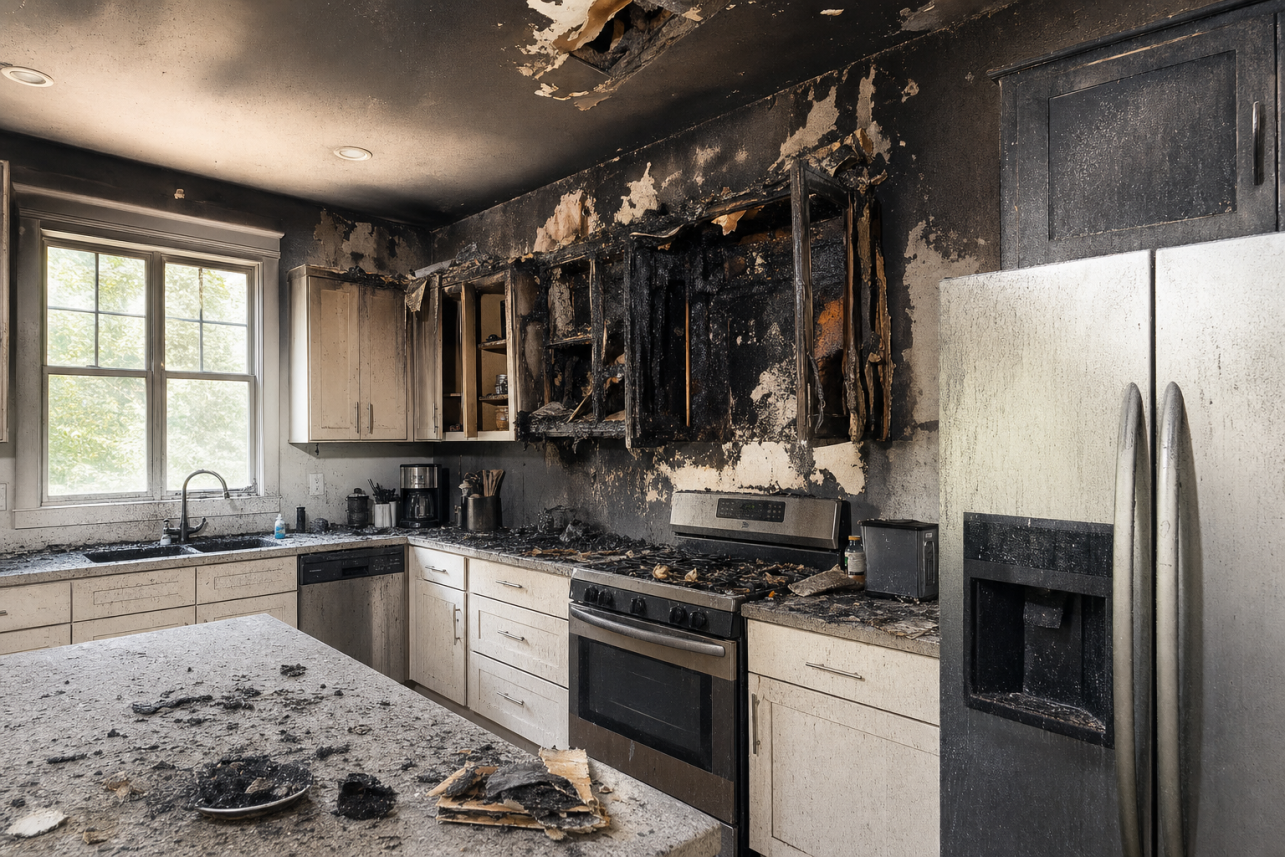
Does Homeowners Insurance Cover Temporary Housing While My Apex Home Is Repaired After A Fire, And How Do I Make Sure I Get It?
Almost every homeowners policy includes Additional Living Expense coverage, often called ALE or Loss of Use, and it is one of the most underused benefits after a fire. It pays the extra costs of living elsewhere while your home is uninhabitable: hotel stays, a rental house, restaurant meals beyond your normal grocery spending, added commuting mileage, pet boarding, even laundry service if you lost your washer and dryer.
The key word is ‘extra.’ The carrier covers the difference between your normal living costs and what displacement actually costs you. In Apex, where rental inventory is tight and short-term housing near good schools commands a premium, that difference adds up fast. Families displaced from neighborhoods off Apex Peakway or near downtown often face rental rates well above what the insurer initially wants to approve.
To protect this coverage, keep every receipt from day one and track your pre-fire monthly expenses so the comparison is documented. Get the carrier’s ALE approval in writing, including the monthly amount and duration, before signing a lease.
Watch the time limits. ALE typically runs for a set period or until repairs are complete, whichever comes first, and insurers sometimes cut it off by claiming repairs should already be done. As your Apex public adjuster, we push back on artificial deadlines, document why the rebuild timeline is what it is, and fight to keep your family housed until your home is genuinely ready. Displaced homeowners should never have to pay out of pocket for a covered loss.
My Insurance Company Says The Smoke And Soot Damage In My Apex Home Is ‘cosmetic.’ Can A Fire Claims Adjuster Apex NC Homeowners Hire Prove Otherwise?
Yes, and this is one of the most common fights we take on. Insurers frequently label smoke and soot damage as surface-level to justify a quick cleaning allowance instead of proper remediation or replacement. In reality, soot is acidic and corrosive, and smoke penetrates drywall, insulation, HVAC ductwork, and framing cavities where a visual inspection never reaches.
When For The Public Adjusters, Inc. handles a claim, we document what the carrier’s adjuster skipped. That often means chemical sponge testing, moisture and odor assessments, inspecting attic spaces and duct runs, and bringing in independent industrial hygienists when contamination is disputed. In Apex homes with open floor plans and shared HVAC systems, smoke migration to ‘undamaged’ rooms is the rule, not the exception.
We then translate that evidence into a detailed scope of repair using the same estimating software carriers use, line by line. If your policy owes for full remediation, sealing, or replacement of affected materials, we push until the estimate reflects it.
The difference matters long after the check clears. Homes that are wiped down instead of properly remediated often develop recurring odor, HVAC contamination, and health complaints months later, when it is much harder to reopen the claim. Getting the smoke damage scoped correctly the first time protects both your settlement and your family. If your carrier is calling serious contamination cosmetic, get a second opinion before you sign anything or accept payment as final.
How Do I Document All My Personal Belongings Destroyed In A House Fire, And Can A Public Adjuster In Apex Help With The Contents Inventory?
The contents inventory is where most Apex homeowners leave the most money on the table. After a fire, your insurer will hand you a blank spreadsheet and ask you to list every item you owned, with age, quantity, and value, while you are displaced and overwhelmed. Most people recall a fraction of what they actually lost.
Our team takes over that process. We walk the loss room by room, photograph and catalog remaining debris, and use structured memory-jogging techniques, going through closets, kitchen drawers, garages, and storage areas category by category. We also pull from receipts, bank statements, Amazon and store order histories, and old photos on your phone to rebuild what the fire erased.
Just as important, we price items correctly. Carriers often apply aggressive depreciation to reach a low actual cash value figure. We challenge unreasonable depreciation, document replacement cost accurately, and make sure you understand how to recover the depreciation holdback once you replace items, which many homeowners never claim at all.
A thorough inventory routinely runs into the thousands of line items for an average Wake County home. The difference between a rushed self-prepared list and a professionally built one is frequently tens of thousands of dollars. If your fire happened recently, resist the pressure to submit a quick partial list just to get a check moving. Once the carrier settles contents based on an incomplete inventory, adding to it later becomes an uphill battle.
My Insurer Wants A Recorded Statement About The Fire. Should I Give One Before Talking To A Fire Claims Adjuster Apex NC Residents Work With?
Be careful here. A recorded statement is a normal part of many fire investigations, and refusing to cooperate can hurt your claim. But how and when you give it matters enormously, because everything you say becomes part of the claim file and can be used to limit or deny coverage.
We strongly recommend talking to a licensed public adjuster before you sit for any recorded statement or examination under oath. Innocent misstatements, guessing at answers you do not actually know, or casually estimating values on the spot can create contradictions the carrier later uses against you. Fire claims in particular draw scrutiny, and insurers sometimes probe for anything that supports an arson or misrepresentation defense, even when the cause was clearly accidental.
When For The Public Adjusters, Inc. is involved, we prepare you for the interview, help you understand what is genuinely required versus a fishing expedition, and make sure your factual answers are consistent with the documented evidence. We cannot answer for you, but you never have to face the process uninformed.
One more point: a recorded statement is different from an examination under oath, which is a formal proceeding, often with the carrier’s attorney present. If your insurer has requested an EUO on an Apex fire loss, that is a signal the claim is being treated as contested, and you should get professional representation immediately, before the date is scheduled, not after.
The Rebuild Estimate From My Insurance Company Doesn’t Include Wake County Code Upgrades. Am I Entitled To That Money?
In most cases, yes, if your policy includes ordinance or law coverage, and the majority of standard homeowners policies in North Carolina do. This is one of the most frequently underpaid parts of fire claims in Apex, and carriers rarely volunteer it.
Here is the issue. When your home is rebuilt after a fire, the repairs must meet the current North Carolina building code as enforced by Wake County and the Town of Apex, not the code that existed when the house was built. Older homes in established Apex neighborhoods often need upgraded electrical panels and wiring, modern smoke and carbon monoxide detector systems, updated egress requirements, energy code compliance, and sometimes structural changes. None of that is optional, and none of it is cheap.
Insurance company estimates commonly price a like-for-like rebuild of what burned, ignoring these mandatory upgrades entirely. Your public adjuster’s job is to identify the applicable code requirements, coordinate with your contractor on what the permit office will actually require, and add every legitimate ordinance and law cost to the claim under the correct coverage.
We review your specific policy language first, because ordinance and law coverage is usually capped at a percentage of your dwelling limit, often 10 percent, and some policies carry more. Then we make sure the settlement uses it. If you have already received an estimate that reads like a simple copy of your old home, have it reviewed before repairs begin. Discovering a five-figure code shortfall mid-rebuild is a painful and avoidable mistake.
My Insurer Paid ‘actual Cash Value’ And Is Holding Back Depreciation On My Apex Fire Claim. Can A Fire Claims Adjuster Apex NC Homeowners Hire Recover That Money?
Yes, and this is one of the most common ways Apex homeowners leave money on the table. Most policies in Wake County are replacement cost value (RCV) policies, but insurers initially pay only actual cash value — the depreciated amount — and hold the rest until repairs are complete.
The problem is twofold. First, insurers often over-depreciate. A five-year-old architectural shingle roof or hardwood flooring in an Apex home should not be depreciated as if it were at the end of its life. We routinely challenge depreciation schedules line by line and recover thousands in the initial payment alone.
Second, many homeowners never collect the recoverable depreciation at all because they don’t know the deadlines or the documentation the carrier requires. Most policies give you a limited window — often 180 days to two years — to complete repairs and submit proof. Miss it, and that money is gone.
A fire claims adjuster apex NC families work with tracks those deadlines, submits contractor invoices and completion documentation in the format the carrier demands, and pushes back when the insurer stalls on releasing the holdback. For The Public Adjusters, Inc. handles this entire process, including disputes where the carrier claims the repairs ‘don’t match’ the original estimate. If you’ve already received an ACV check and aren’t sure what you’re still owed, have us review the settlement worksheet before you sign anything or cash a check marked as final payment.
The Fire Department’s Water And The Demolition Caused More Damage Than The Fire Itself. Does My Insurance Cover That In Apex?
Almost always, yes — and this is where many Apex fire claims get badly underpaid. Water damage from firefighting efforts, broken windows and doors from forced entry, and holes cut in the roof for ventilation are all considered part of the fire loss. Your carrier owes for the entire chain of damage the fire caused, not just what the flames touched.
The complication is how fast secondary damage spreads. Thousands of gallons of water soak into drywall, insulation, subfloors, and framing. In North Carolina’s humidity, mold can begin growing within 48 to 72 hours. Insurance adjusters sometimes classify that growth as a separate, excluded ‘mold claim’ rather than a consequence of the covered fire loss. That’s a fight worth having, and one we win regularly.
We document moisture readings, saturation patterns, and hidden water migration behind walls and under floors before drying and demolition erase the evidence. That documentation is what forces the carrier to pay for full tear-out and replacement rather than a cheap surface-level drying job that leads to problems a year later.
If your home in Apex took heavy water damage during the fire response, don’t let the insurance company split the claim into pieces or blame the fire department. The whole loss traces back to one covered event, and For The Public Adjusters, Inc. builds the claim that way from day one.
My Mortgage Company Is Listed On My Fire Claim Check And Won’t Release The Funds. How Does A Public Adjuster In Apex Help With That?
This catches most Apex homeowners off guard. If you have a mortgage, your lender is named on the policy as a loss payee, which means claim checks for structural damage are made out to both you and the mortgage company. You can’t simply cash them — the lender endorses the funds into an escrow account and releases money in stages as repairs progress.
Each lender has its own requirements: signed contractor agreements, W-9s, lien waivers, inspection reports, and sometimes in-person draw inspections before each disbursement. If the paperwork is wrong or incomplete, funds sit frozen while your contractor waits and your home sits damaged. We’ve seen Wake County rebuilds stall for months over a single missing form.
As your representative, we coordinate the entire funds-control process. We make sure the insurance settlement is documented in a way the lender’s loss-draft department will accept, help schedule draw inspections, and keep the release schedule aligned with your contractor’s payment milestones so work never stops for lack of funds.
We also make sure the settlement itself is large enough before it ever reaches the lender. An underpaid claim creates a gap between what the mortgage company releases and what the rebuild actually costs — and that gap comes out of your pocket. For The Public Adjusters, Inc. fights the carrier for the full number first, then manages the lender process so the money actually flows to your rebuild.
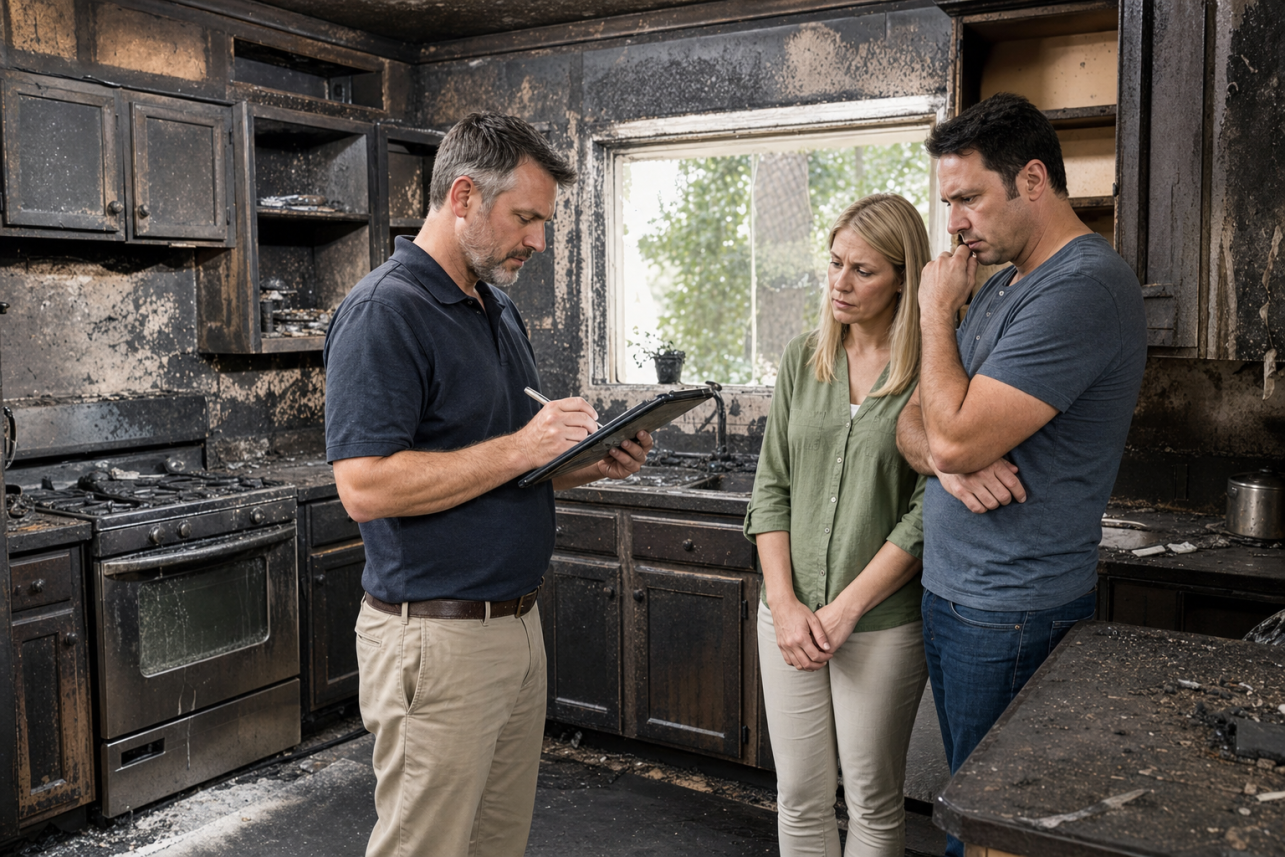
The Insurance Company And I Can’t Agree On My Fire Settlement Amount. Can A Fire Claims Adjuster Apex NC Residents Rely On Invoke The Appraisal Clause?
Yes. Nearly every homeowners policy issued in North Carolina contains an appraisal clause, and it’s one of the most powerful tools available when negotiations stall. Appraisal is a formal dispute-resolution process built into your policy: you select an appraiser, the insurance company selects one, and the two choose a neutral umpire. Any amount agreed to by two of the three becomes binding on the carrier.
For Apex homeowners stuck with a lowball fire settlement, appraisal often means the difference between a carrier’s take-it-or-leave-it number and a fair award — without the cost and years of litigation. We’ve seen appraisal awards come in at two or three times the insurer’s original offer on fire and smoke losses.
That said, appraisal should be a deliberate strategy, not a first move. It resolves the amount of the loss, not coverage disputes, so invoking it at the wrong time can backfire. Our team builds the strongest possible claim through documentation and negotiation first, then invokes appraisal when the carrier refuses to move on a well-supported number.
We also frequently serve as the homeowner’s appraiser or prepare the detailed estimate the appraiser relies on — the scope of repairs, code-required upgrades under Wake County requirements, smoke remediation protocols, and contents valuations. If your fire claim in Apex has hit a wall, have us review your policy’s appraisal provision before you accept a number you know is short.
Local Relevance
Apex has grown fast, and its housing stock shows it. Much of the town is newer construction from the last few decades, while the historic downtown area includes homes that are considerably older. That mix matters after a fire. Older homes frequently trigger building code upgrade requirements when repairs begin — updated wiring, plumbing, and structural standards the original construction never met — and whether your policy pays for those upgrades can swing a settlement significantly.
Newer Apex homes bring their own issue: open floor plans and shared HVAC systems let smoke and soot travel throughout the house, so contamination routinely extends far beyond the room where the fire started. Insurers’ initial estimates often stop at the visibly burned area. Ours don’t.
Cooking fires remain the leading cause of home fires nationally, according to the National Fire Protection Association, and Wake County kitchens are no exception. A kitchen fire may look contained, but smoke residue, melted wiring behind walls, and water from suppression can affect the whole structure. We serve homeowners throughout Apex and the surrounding Wake County communities, and we also handle related residential losses — smoke damage, water damage, tree damage, and vandalism claims among them.
Because so many Apex homes were built in recent decades with open-concept layouts and central HVAC, smoke and soot from even a small contained fire often spread through the entire house — which is why initial insurer estimates limited to the burn room tend to understate the real scope of loss here.
Get A Free Review Of Your Fire Claim Before You Accept Anything
If your home in Apex has fire, smoke, or firefighting water damage, don’t sign the insurer’s offer until someone on your side has read your policy and inspected your loss. For The Public Adjusters, Inc. is licensed and bonded, and the initial claim review costs you nothing. We only get paid when your claim gets paid.
Call us: (919) 400-6440
Helpful Resources
- NCDOI Public Adjusters Guide
- National Fire Protection Association (NFPA)
- North Carolina Department of Insurance consumer resources — State regulator where you can verify adjuster licenses and get claim help
Last updated: August 28, 2026