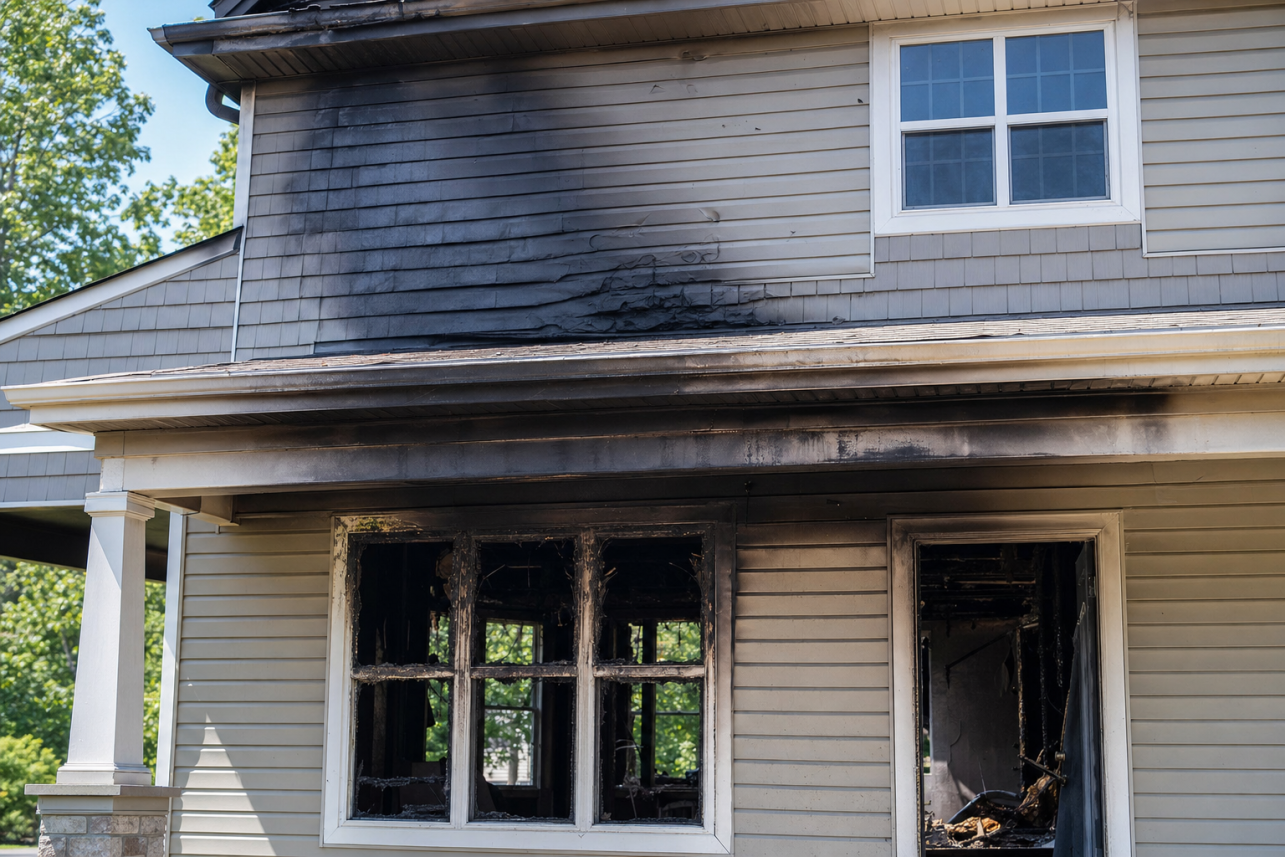
If a cooking fire left an odor you cannot scrub out, professional smoke damage claim help Fuquay Fuquay-Varina NC policyholders can turn to starts with For The Public Adjusters, Inc. Protein smoke from burned food is nearly invisible, but it bonds to paint, cabinets, fabrics, and ductwork throughout the house. We document that damage properly, prepare your claim, and negotiate with your insurance company on your behalf. We are licensed and bonded, and we work only for you — never for the insurer.
What This Service Is
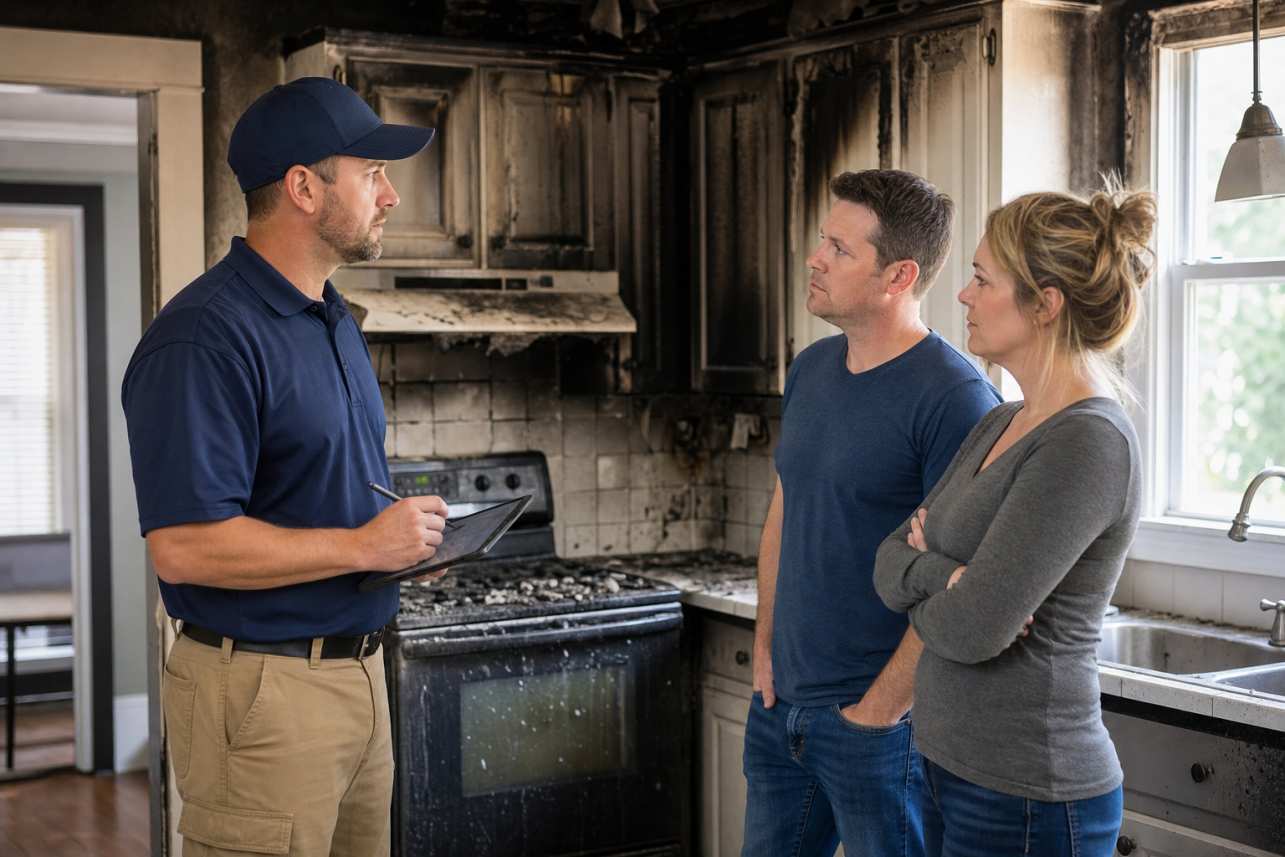
When food burns on the stove — a pot of chicken left too long, grease that scorched, a roast forgotten in the oven — it releases what restorers call protein smoke. Unlike the black soot from a structure fire, protein residue is a thin, greasy, almost invisible film. You often can’t see it, but the smell is penetrating and it does not fade on its own.
A public adjuster is a state-licensed professional who represents you, the policyholder, in an insurance claim. Your insurance company’s adjuster works for the insurer. We work for you. For protein smoke claims, that means inspecting every room, not just the kitchen; testing surfaces for residue; inventorying affected contents like clothing, upholstery, and mattresses; and pricing the actual cost of proper cleaning, sealing, and odor removal.
Protein smoke claims are among the most underpaid losses we see, because the damage hides from a quick visual walkthrough. We handle these same claims across Wake County, including smoke damage insurance claims in Holly Springs, and the pattern is consistent: what the carrier first offers rarely reflects what the home actually needs.
Common Problems
The Whole House Smells — So Why Is The Insurance Offer Only Covering The Kitchen?
This is the most common complaint we hear after a cooking fire. The insurer’s adjuster walks through, sees a scorched stovetop and stained cabinets, and writes an estimate for repainting one room. But protein smoke travels on air currents and through your HVAC system, coating surfaces two floors away.
A lowball offer often also leans on depreciation — paying you the reduced ‘actual cash value’ of damaged items now and holding back the rest. Courts have pushed back on aggressive depreciation. In Sproull v. State Farm Fire & Casualty Co., the Illinois Supreme Court sided with the policyholder in a property damage dispute, ruling the insurer could not depreciate labor costs when calculating an actual cash value payment.
You should also understand your policy’s coverage limits for contents and additional living expenses before you accept anything. If cleaning fails and items must be replaced, that changes the numbers significantly. We calculate personal property losses item by item, not by a rough per-room allowance.
Smoke Damage Claim Help Fuquay Fuquay-Varina NC When The Claim Stalls, Gets Cut, Or Gets Denied
Protein smoke claims get denied or delayed for a predictable reason: the damage doesn’t photograph well. An insurer may say the loss is ‘cosmetic,’ question whether the odor is really from the fire, or simply let weeks pass without a decision while the smell keeps you out of your own living room.
Meanwhile, deadlines run against you. Policies require timely notice and often a sworn proof of loss within a set window, and missing those dates gives the carrier an easy reason to say no. There’s also the water angle — if the fire department or your extinguisher soaked cabinets and flooring, that secondary damage belongs in the claim too, and it’s frequently left out.
We respond with evidence: surface testing, a documented odor trail, HVAC inspection results, and a complete, properly filed proof of loss. That’s how we approach disputed losses across the Triangle, including smoke damage claims in Cary, and it changes the conversation from your word against theirs to documentation the insurer has to answer.
Can I Handle This Myself, Or Do I Actually Need Someone On My Side?
You can file the claim yourself, and for a genuinely minor loss that may be fine. The problem with protein smoke is that homeowners can’t see what they’re negotiating over. If you don’t know the residue is inside your ductwork, on your electronics, and absorbed into every soft surface upstairs, you can’t ask to be paid for it — and the carrier won’t volunteer it.
A good public adjuster does four things: finds the full scope of damage, values it correctly (including whether items should be cleaned or replaced), handles the paperwork and deadlines, and negotiates the settlement. In North Carolina, public adjusters are licensed by the state — the NCDOI Public Adjusters Guide explains the role and confirms that we represent policyholders, not insurance companies.
Ask any adjuster you’re considering about their license, their bond, and their specific experience with cooking-fire and odor claims. We’re happy to answer all three. If a claim ultimately needs litigation, we also work alongside insurance dispute lawyers, though most claims resolve well before that point.

Our Process
Full-Home Smoke Assessment And Documentation
We inspect every room, closet, and the HVAC system — not just the kitchen. Protein residue hides on ceilings, inside cabinets, behind furniture, and in duct runs. We document everything with photos, notes, and testing, building the property damage record your claim will stand on. We also flag secondary water damage from firefighting efforts so nothing is left off the estimate.
Contents Inventory, Valuation, And Proof Of Loss
We create a detailed inventory of affected belongings — clothing, furniture, mattresses, electronics, and appliances that pulled smoky air through their vents. Each item is valued with your policy’s terms in mind, including how replacement cost and depreciation apply. Then we prepare and file the sworn proof of loss correctly and on time, which protects your claim from technical denials.
Negotiation Through Final Settlement
We present the documented claim to your insurer and negotiate each disputed line — cleaning versus replacement, odor sealing, duct cleaning, temporary living expenses if the home isn’t livable. We are licensed and bonded, and while no one can promise a specific outcome, our job is to make sure the settlement reflects the real, documented loss rather than a quick walkthrough estimate. Homeowners in nearby communities like Garner call us for the same reason: they want someone at the table who answers to them.
| What Gets Evaluated | Carrier Adjuster Alone | With For The Public Adjusters, Inc. |
|---|---|---|
| Invisible protein residue | Often missed — scope based on visible soot only | Chemical sponge and swab testing on all surfaces, room by room |
| HVAC and ductwork contamination | Rarely inspected; odor blamed on ‘lingering smell’ | Air handler, plenum, and duct runs tested and included in the scope |
| Odor as physical damage | Frequently denied as ‘not physical damage’ | Lab-verified residue documented to establish covered physical loss |
| Contents, soft goods, and mattresses | Lumped into a small cleaning allowance | Itemized inventory with cleaning, deodorizing, or replacement per item |
| Additional living expenses | Paid only if the homeowner knows to ask | Displacement documented daily and claimed in full under the policy |
| Cabinet and appliance finish etching | Overlooked because damage develops over weeks | Refinishing or replacement included before residue permanently etches |
Commonly Overlooked In The Public Adjusting Industry
- Chemical sponge testing on visually clean surfaces — Protein residue is nearly colorless, so anyone scoping by eye alone will conclude a room is undamaged when it’s actually coated.
- Return-air plenum and duct interior contamination — Carrier adjusters rarely open the HVAC system, yet it’s the reason odor keeps reappearing in rooms far from the kitchen.
- Progressive etching of cabinet finishes and stainless steel — The acidic protein film degrades finishes over weeks, so damage that wasn’t visible at inspection gets disputed as ‘pre-existing’ later.
- Odor documented as physical damage rather than a smell — Without lab-verified residue results, carriers deny the largest part of the claim by calling it a subjective odor complaint.
- Contents inside closed cabinets, drawers, and closets — People assume closed doors protected their belongings, but protein film migrates through gaps and settles on everything inside.
- Additional living expenses during odor remediation — Homeowners stay with family and never claim displacement costs because nobody tells them their policy pays for it.
- The damage DIY scrubbing does to the claim itself — Wiping protein residue with the wrong cleaners smears and sets it, destroying evidence and worsening the loss before it’s documented.
- Insulation and attic contamination above the kitchen — Smoke rises through can lights and penetrations into the attic, and blown insulation holding odor is almost never inspected or scoped.
Case Studies
Case Study #1
Situation: A family off Judd Parkway in Fuquay-Varina left a pot of chicken simmering, stepped outside, and returned to a kitchen full of thin, greasy haze. There was no fire, no flames, and almost nothing visible on the walls — just a persistent burnt-protein odor that spread through the HVAC system into every bedroom.
Problem: Their insurance carrier sent an adjuster who noted ‘minimal visible soot’ and offered roughly $2,100 for a kitchen wipe-down and one coat of paint. The family knew something was wrong because the smell returned within days of cleaning, and their toddler’s room upstairs smelled worse than the kitchen.
Investigation: Our adjuster performed chemical sponge testing on painted surfaces, cabinet interiors, and ductwork registers throughout the home. Protein residue is nearly invisible but shows up clearly under proper testing. We also inspected the attic air handler and pulled swab samples from soft goods, insulation, and the return-air plenum.
Findings: Protein film had migrated through the ductwork and coated surfaces in all seven rooms, including closet contents and mattresses. The residue had begun etching the finish on kitchen cabinets and the stainless appliances. The HVAC system itself was contaminated and recirculating odor with every cycle.
Solution: We documented the full scope with photos, lab-supported residue testing, and a line-item estimate covering thermal fogging, sealing and repainting affected rooms, full duct cleaning, cabinet refinishing, contents cleaning, and replacement of items that could not be deodorized. We then negotiated directly with the carrier’s adjuster and their re-inspection team.
Outcome: The claim settled at $67,400 — more than thirty times the original offer — including additional living expenses while the odor remediation and refinishing were completed.
Lesson: Protein smoke from cooking is the most underpaid type of smoke loss in Wake County because it hides from the naked eye. If the settlement is based only on what an adjuster can see, it will almost always be a fraction of the real damage.
Case Study #2
Situation: A retired couple near downtown Fuquay-Varina had a broiler fire that self-extinguished when they smothered it. The oven was ruined and the kitchen ceiling showed light discoloration, but the couple’s biggest complaint was an odor so strong they couldn’t sleep in the house.
Problem: The carrier approved oven replacement and kitchen cleaning but denied the odor-related portions, stating that ‘odor alone is not physical damage’ and that the smell would dissipate. Three weeks later the couple was still staying with their daughter in Holly Springs, paying out of pocket.
Investigation: We brought in an independent industrial hygienist to sample surfaces in the living room, hallway, and both bedrooms. We also reviewed the couple’s policy language on ensuing loss and additional living expenses, and documented the timeline of their displacement day by day.
Findings: Testing confirmed protein residue on surfaces well beyond the kitchen, which legally qualifies as physical damage under the policy — not merely ‘odor.’ The denial letter had mischaracterized the loss, and the policy’s ALE provision clearly covered their displacement costs.
Solution: We submitted a formal rebuttal with the lab results, a corrected scope including sealing, repainting, contents deodorization, and HVAC decontamination, and a documented ALE claim for the weeks the home was uninhabitable. We requested a re-inspection with the carrier’s adjuster present alongside our team.
Outcome: The carrier reversed the odor denial, paid $41,800 for remediation and repairs, and reimbursed $6,300 in additional living expenses the couple had already spent.
Lesson: Carriers often frame protein contamination as ‘just a smell’ to sidestep coverage. Lab-verified residue turns a subjective odor complaint into objective, provable physical damage — and that changes everything about how the claim gets paid.
| Your Situation | Likely Extent of Damage | Smart Next Step |
|---|---|---|
| Burnt food, odor gone within a day or two | Usually surface-level; may not exceed your deductible | Clean thoroughly yourself; a claim likely isn’t worth filing |
| Odor keeps returning after repeated cleaning | Protein residue has bonded to walls, ceilings, or duct interiors | Stop scrubbing — DIY cleaning smears residue; get a professional assessment before filing |
| Smell present in rooms far from the kitchen | HVAC has circulated contamination house-wide | Have the full home tested; the real scope is far bigger than the kitchen |
| Cabinets, counters, or appliances look dull or yellowed | Residue is actively etching finishes and metal | Document with photos now — this damage worsens weekly and carriers dispute late claims |
| Carrier offered a small kitchen-only payment | Offer almost certainly reflects visible damage only | Don’t cash the check as final; have the scope independently reviewed first |
| Carrier denied the claim as ‘odor only’ | Denial likely mischaracterizes provable physical damage | Get lab-supported residue testing and file a formal rebuttal |
| Family experiencing headaches or irritation in the home | Contamination levels may make the home temporarily uninhabitable | Track every displacement expense — additional living expense coverage may apply |

Reviews
A grease fire on my stovetop lasted maybe ninety seconds, but the smell took over my whole house. My insurance company offered me $1,800 and told me to open the windows. For The Public Adjusters tested every room and proved the protein residue had spread through my ducts. Final settlement was over $50,000 and my home actually smells like home again. I had no idea smoke damage claim help Fuquay Fuquay-Varina NC homeowners could get made this much difference.
Denise M., Fuquay-Varina
We burned a roast and thought it was no big deal until the odor wouldn’t leave and our cabinets started looking dull and yellowed. The carrier’s adjuster spent fifteen minutes in the house. This team spent three hours, swab-tested surfaces I never would have thought of, and found contamination in bedrooms upstairs. They handled every call with the insurance company so we didn’t have to argue with anyone. Worth every penny of their fee.
Carlos R., Wake County
After a kitchen fire, our insurer denied the odor portion of our claim outright. These adjusters brought in a hygienist, documented protein residue throughout the house, and got the denial reversed. They also caught that we were owed living expenses for the month we couldn’t stay there — money we’d already given up on. Honest, thorough, and they know how Fuquay-Varina claims actually get paid.
Angela T., Fuquay-Varina
Frequently Asked Questions
What Is Protein Smoke Damage From Cooking, And Why Do I Need Smoke Damage Claim Help Fuquay Fuquay-Varina NC Homeowners Can Rely On?
Protein smoke damage happens when meat, grease, or other food burns on the stove or in the oven. Unlike a wood fire, protein smoke leaves an almost invisible, greasy film that bonds to painted walls, cabinets, HVAC ductwork, and even the inside of closets. You may not see soot, but you will smell a persistent, rancid odor that ordinary cleaning cannot remove.
Insurance companies often lowball these claims precisely because the damage is hard to see. An adjuster may glance at your kitchen, note that nothing looks charred, and offer a few hundred dollars for cleaning. In reality, proper remediation often requires sealing or repainting surfaces, deep-cleaning or replacing soft goods, and treating the duct system throughout the home.
That is where professional smoke damage claim help Fuquay Fuquay-Varina NC residents can trust makes the difference. For The Public Adjusters, Inc. works only for you, not the insurance company. We document the contamination with proper testing and inspection methods, build a detailed scope of the affected areas, and negotiate directly with your carrier.
Homeowners in Wake County who handle these claims alone frequently accept settlements that cover a fraction of the true restoration cost. Having a licensed public adjuster on your side levels the playing field from day one, and our fee comes from the settlement we recover, so there is no upfront cost to get an honest assessment of what your claim is really worth.
My Insurance Company Says A Burnt-Food Incident Is Just A Cleaning Issue. Is That True?
No, and this is one of the most common tactics we see with cooking-related smoke losses in Fuquay-Varina. Protein residue is not ordinary dirt. It is a fine, oily mist that penetrates porous materials and travels through your home’s air handling system, settling far from the kitchen where the incident happened.
Wiping down counters will not touch residue that has bonded to ceiling paint, migrated into attic insulation via return vents, or absorbed into upholstery, carpet, and clothing. The telltale sign is odor that keeps coming back weeks later, especially on humid North Carolina days or when the HVAC kicks on. That recurring smell is proof the contamination was never fully addressed.
Proper remediation typically involves specialized degreasers, thermal fogging or hydroxyl treatment for odor, sealing and repainting affected surfaces, and duct cleaning. Depending on the severity, cabinets may need refinishing and soft goods may need professional restoration or replacement. That scope is dramatically different from a general cleaning estimate.
When a carrier calls it “just cleaning,” they are often trying to close the file cheaply. Our team inspects the entire home, not just the kitchen, and documents everywhere the residue traveled. We then present the insurance company with a defensible, line-item scope they cannot easily dismiss. If you have already received a low offer, do not cash the check until you have had the loss independently evaluated. In most cases, the claim can still be reopened and supplemented.
How Does The Claim Process Work With A Public Adjuster In Fuquay-Varina After A Kitchen Smoke Loss?
The process starts with a free consultation. We come to your home in Fuquay-Varina or anywhere in Wake County, inspect the loss, and give you an honest opinion on whether hiring us makes financial sense. Protein losses from cooking are frequently underestimated, so it usually does, but we will tell you either way.
If you hire us, we take over communication with your insurance carrier. We handle the notice of loss if it has not been filed, meet the company adjuster on site, and walk them through the full extent of the contamination room by room. We document everything with photos, moisture and residue findings, and a detailed repair and cleaning estimate written in the same estimating software insurers use.
From there, we negotiate. Carriers respond differently when a licensed professional presents a properly supported scope instead of a homeowner asking for fairness. We also handle contents inventories, which matter enormously in cooking losses because clothing, bedding, curtains, and furniture absorb protein odor and often need restoration or replacement.
Throughout the claim, you make the decisions and we do the work. Most residential smoke claims in this area resolve within several weeks to a few months depending on the carrier and the size of the loss. Our fee is a percentage of the settlement, paid only when you get paid, so our interests are fully aligned with maximizing your recovery.
How Much Does Smoke Damage Claim Help Fuquay Fuquay-Varina NC Families Need Actually Cost, And Is It Worth It For A Smaller Cooking Fire?
For The Public Adjusters, Inc. works on contingency, meaning you pay nothing out of pocket. Our fee is a percentage of the insurance settlement, and if we recover nothing, you owe nothing. The initial inspection and claim review are always free, so getting smoke damage claim help Fuquay Fuquay-Varina NC homeowners deserve costs nothing to explore.
Is it worth it for a “small” loss? Almost always with protein damage, because these claims are small only on the surface. A pot of chicken left on the burner for an hour can contaminate a 2,500 square foot home. We regularly see initial insurance offers of $1,000 to $3,000 on losses that properly scope out at ten times that amount once wall sealing, repainting, duct treatment, odor remediation, and contents restoration are included.
Even after our fee, clients typically net far more than they would have accepted on their own. Just as important, a correct settlement means the odor actually gets eliminated. Underfunded cleanups lead to homes that smell like burnt grease for years, which becomes a real problem at resale.
If you have had a cooking incident anywhere in Fuquay-Varina, Holly Springs, or the surrounding Wake County area, let us look before you accept the carrier’s number. There is no obligation, and you will at least know whether the offer on the table reflects what the restoration will genuinely cost.
Why Does My Fuquay-Varina Home Still Smell Weeks After I Cleaned Up A Burnt-Food Incident?
Protein smoke is different from the smoke you see after a wood or paper fire. When meat, grease, or poultry burns on a stovetop, it releases a nearly invisible, greasy residue made of vaporized fats and proteins. That film bonds to paint, cabinet finishes, ceiling texture, and even the inside of your HVAC ductwork.
Ordinary household cleaning almost never removes it. You can wipe the visible surfaces, run air fresheners, and open every window in the house, and the odor still returns—especially on humid Wake County days when moisture reactivates the residue. That lingering smell is proof the contamination is still present, not a sign you cleaned poorly.
Proper remediation typically requires professional degreasing agents, sealing or refinishing of affected surfaces, duct cleaning, and sometimes thermal fogging or hydroxyl treatment to neutralize odor at the molecular level. Insurers frequently underestimate this scope because the damage is hard to see with the naked eye.
This is exactly where our team earns its keep. We document protein residue with wipe tests and detailed inspections, then build a claim that reflects the true cost of remediation—not just a surface wipe-down. If your home still smells after a kitchen smoke event, the loss is likely larger than your insurance company has acknowledged, and you have every right to pursue the full scope of repairs your policy covers.
What Should I Document Before Cleaning Up If I Want Smoke Damage Claim Help Fuquay Fuquay-Varina NC Insurers Will Take Seriously?
Document everything before you touch anything. Insurance companies evaluate protein smoke losses largely on evidence, and once surfaces are wiped down, that evidence disappears.
Start with wide photos of every affected room—kitchen, adjoining living spaces, hallways, and upstairs areas where smoke traveled. Then take close-ups: the yellowish film on cabinet doors, discoloration on ceilings near vents, residue on light fixtures, window blinds, and electronics. Run your finger across a high surface and photograph the streak it leaves.
Video helps too. Walk the home slowly, narrating what you smell and where the odor is strongest. Note the date, the cooking incident that caused it, and whether the fire department responded. Keep the burnt cookware—don’t throw it away, because it establishes the origin of the loss.
Save receipts for anything you buy afterward: air purifiers, cleaning supplies, hotel stays if the odor made the home unlivable, and takeout meals if the kitchen was unusable. Additional living expense coverage often applies, but only with documentation.
Finally, resist the urge to deep-clean before an inspection. Ventilate for safety, but leave the residue in place until it has been photographed and, ideally, tested. When For The Public Adjusters, Inc. handles a cooking-smoke loss in the Fuquay-Varina area, we perform our own inspection and residue sampling early, precisely because that untouched evidence is what forces carriers to acknowledge the real scope of the damage.
Will My Insurer Pay To Clean The HVAC System, Cabinets, And Personal Belongings After Protein Smoke, Or Just Repaint The Kitchen?
A properly presented claim should cover far more than a coat of paint. Protein residue is drawn through your home’s air handler within minutes of a stovetop incident, coating duct interiors, the blower assembly, and the coil. Every time the system runs afterward, it redistributes odor and contamination. Duct cleaning and often coil cleaning are legitimate, coverable line items.
Cabinets are another commonly shorted category. The greasy film penetrates finishes, and inside boxes and drawers hold odor. Depending on severity, the correct scope may be full degreasing and refinishing—or replacement if the finish is permanently compromised. Adjusters working for the carrier frequently write these up as a simple wipe-down, which does not resolve the problem.
Personal property matters too. Upholstered furniture, mattresses, clothing, drapes, and children’s soft toys absorb protein odor and may need specialty ozone or wet-cleaning treatment through a contents restoration company. Electronics can suffer from the corrosive film settling on circuit boards.
Here in Fuquay-Varina, we routinely see initial carrier estimates that address the kitchen alone while ignoring the rest of the house the smoke actually reached. As your public adjuster, we inspect every room, test surfaces beyond the kitchen, inventory affected contents item by item, and negotiate a scope that matches how protein smoke actually behaves. The difference between a repaint-the-kitchen settlement and a full remediation settlement is often tens of thousands of dollars.
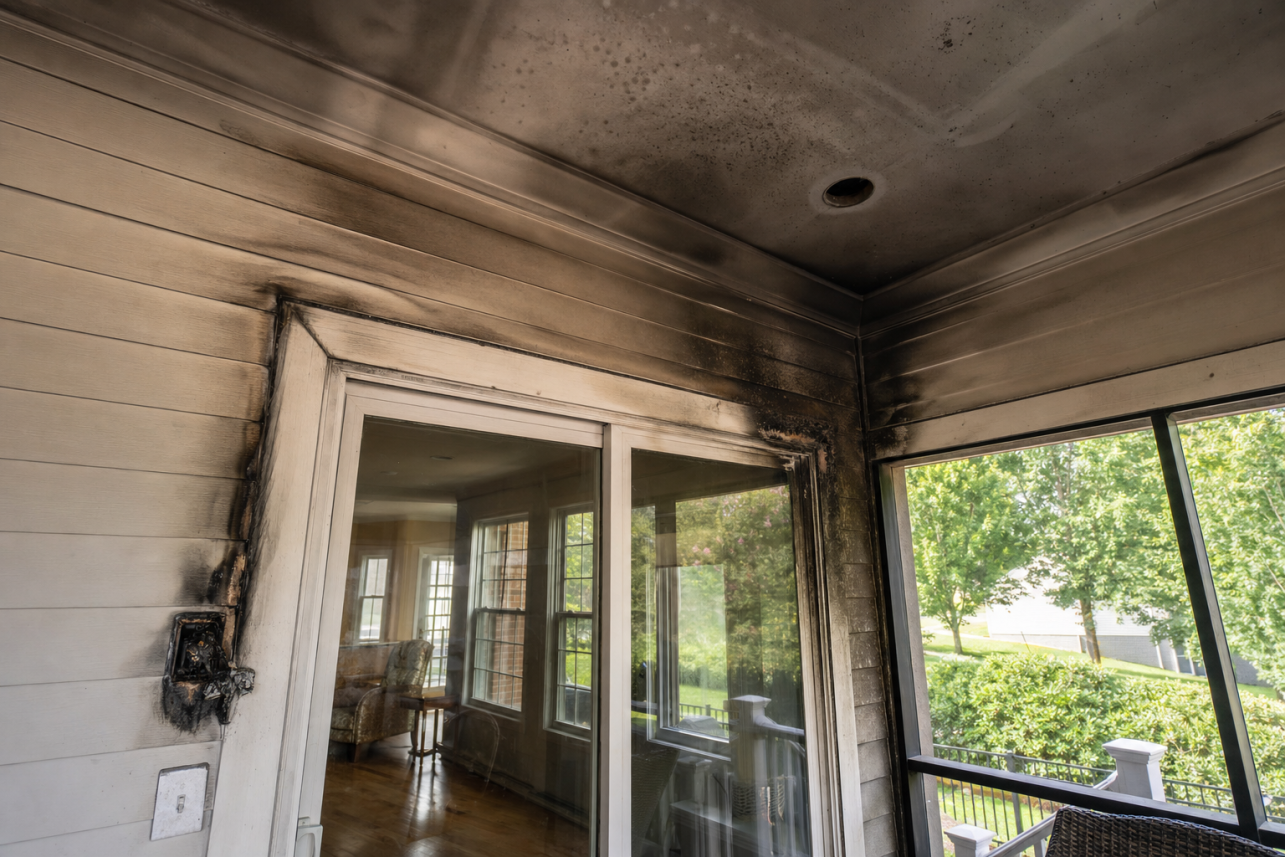
I Already Got A Lowball Offer Or A Denial. Is It Too Late To Get Help With A Cooking Smoke Claim In Wake County?
No—an initial denial or low offer is usually the beginning of the process, not the end. In North Carolina, most homeowners policies allow you to dispute the carrier’s position, submit supplemental documentation, and reopen the claim well after the first decision, as long as you act within your policy’s deadlines and the state’s statute of limitations.
Protein smoke claims are among the most commonly underpaid losses we see because the damage is subtle. A field adjuster spends twenty minutes in your kitchen, sees no charring, and writes a small cleaning estimate. That does not mean the carrier’s number is final or correct.
When we take over a previously denied or underpaid file, we start fresh: a full inspection, surface residue testing, odor assessment, and a room-by-room scope from contractors experienced in protein smoke remediation. We then present that evidence formally and negotiate directly with the carrier. If needed, North Carolina policies typically include an appraisal provision that lets us push disputed valuations to a neutral process.
Bring us your denial letter, the carrier’s estimate, and any photos from the date of loss. Reviewing them costs you nothing, and we only get paid a percentage of what we recover for you. The smoke damage claim help Fuquay Fuquay-Varina NC homeowners get from For The Public Adjusters, Inc. frequently turns a token cleaning payment into a settlement that funds real remediation—so don’t accept the first number, and don’t assume a denial is the last word.
Does Homeowners Insurance In Fuquay-Varina Actually Cover Protein Smoke From A Cooking Incident?
In most cases, yes. The standard HO-3 policies written throughout Wake County cover sudden and accidental losses caused by fire and smoke, and a burnt-food event on the stove qualifies even if there were no visible flames. Protein smoke is a byproduct of combustion, which is exactly what your policy is designed to respond to.
The confusion starts when adjusters treat the loss as ordinary household grime because protein residue is nearly invisible. It leaves a thin, greasy amber film on walls, cabinets, ductwork, and soft goods, along with a stubborn odor that intensifies in humidity — something Fuquay-Varina summers make painfully obvious.
Coverage typically extends well beyond the kitchen. Dwelling coverage applies to structural cleaning and refinishing, personal property coverage applies to affected contents like upholstery and clothing, and additional living expenses can apply if the home is temporarily unlivable during remediation.
Where claims go wrong is in the scope. An insurer may acknowledge coverage but only price out a light wipe-down of the kitchen, ignoring the way HVAC systems distribute protein residue through every conditioned room. A Fuquay-Varina public adjuster reads your specific policy language, documents the full spread of contamination, and holds the carrier to what the contract actually promises rather than what a rushed inspection assumes.
How Long Does Smoke Damage Claim Help Fuquay Fuquay-Varina NC Homeowners Hire Usually Take From Start To Settlement?
Most protein smoke claims we handle in Fuquay-Varina resolve within 30 to 90 days, though the timeline depends on the carrier, the extent of contamination, and whether the insurer disputes the scope. A straightforward claim with a cooperative adjuster can move faster; a lowballed or partially denied claim takes longer because we have to build the evidence to overturn it.
The first week is the most important. That’s when we inspect the home, take surface samples and photographs, test areas beyond the kitchen, and document odor and residue before any cleaning disturbs the evidence. From there, we prepare a detailed estimate covering structural cleaning, HVAC decontamination, contents, and sealing or refinishing where the residue has bonded to finishes.
North Carolina law gives insurers deadlines to acknowledge and respond to claims, and we track every one of them. If a carrier drags its feet, we escalate in writing and keep the file moving.
One thing worth knowing: hiring representation early almost always shortens the process, not lengthens it. Homeowners who spend two months arguing alone and then seek smoke damage claim help Fuquay Fuquay-Varina NC professionals provide often start from a weaker position, because evidence has been cleaned away and lowball positions have hardened. Bringing us in before the carrier’s first inspection means the claim is documented correctly from day one, which is the single biggest factor in a fast, full settlement.
Can We Stay In Our House During Protein Smoke Cleanup, Or Will Insurance Pay For Us To Relocate?
It depends on how far the residue and odor have spread, but many families underestimate how disruptive proper remediation is. Thorough protein smoke cleanup involves degreasing every affected surface, running hydroxyl or ozone treatments, cleaning or replacing HVAC components, and sometimes sealing and repainting. Ozone treatment in particular requires the home to be vacated entirely while it runs.
If the work makes your home uninhabitable — even for a few days — your policy’s additional living expense coverage should pay for a hotel or short-term rental, plus increased costs for meals and other necessities. Around Fuquay-Varina, that might mean a stay near Main Street or in nearby Holly Springs while crews work.
The catch is that carriers rarely volunteer this coverage on a cooking smoke loss. If the insurer has scoped the claim as a minor kitchen cleaning, they’ll argue the home was livable the entire time. That’s why the remediation scope and the displacement claim have to be built together, with documentation showing why occupancy wasn’t safe or practical.
There’s also a health angle worth raising. Lingering combustion residue can aggravate asthma and allergies, and families with young children or elderly members shouldn’t be breathing it during aggressive cleaning. When we handle a kitchen smoke loss in Fuquay-Varina, we document these conditions specifically so the ALE portion of the claim is supported by evidence, not just a request the adjuster can wave off.
If I File A Claim For A Burnt-Food Smoke Loss, Will My Rates Go Up Or Will It Count Against Me Later?
It’s a fair concern, and the honest answer is that any paid claim can appear on your CLUE report, which insurers reference at renewal. A single cooking-related smoke claim rarely triggers non-renewal on its own, but it may influence pricing for a few years depending on your carrier and claim history.
Here’s the math that matters, though. Proper protein smoke remediation in a Fuquay-Varina home — structural degreasing, duct cleaning, contents restoration, odor treatment, and refinishing — routinely runs from several thousand dollars into five figures. A modest premium adjustment is almost always smaller than paying that out of pocket, especially when the residue keeps releasing odor for months if it’s cleaned incorrectly.
What you should avoid is the worst of both worlds: filing a claim, accepting a lowball payment that covers a fraction of real costs, and still taking the rate impact. If the loss is going on your record either way, it should be paid in full.
One more point — asking questions doesn’t equal filing. Talking with For The Public Adjusters, Inc. before you decide costs nothing and creates no claim record. We can inspect the damage, estimate the true remediation cost, and tell you frankly whether the loss justifies a claim. For genuinely minor incidents, we’ll say so. For losses that spread through the HVAC system and contents, we’ll show you what a properly documented claim in Wake County should actually recover.
Protein Smoke Residue Is Nearly Invisible, So How Do You Actually Prove It Exists To My Insurance Company?
This is the single biggest hurdle in cooking-smoke claims, and it is why so many Fuquay-Varina homeowners get denied at first. Protein residue from burnt food does not leave black soot like a structure fire. It settles as a thin, yellowish, greasy film that you often cannot see but can absolutely smell.
We prove it several ways. First, we use chem-sponge and wipe testing on painted walls, cabinet interiors, ductwork, and light fixtures, which shows the residue transferring onto white media the insurance adjuster can see with their own eyes. Second, we document how the film behaves: it smears rather than dusts off, which distinguishes it from ordinary household grime.
When a claim is disputed, we can also bring in independent industrial hygienists to collect surface samples for lab analysis. A lab report confirming protein-based combustion residue is very difficult for a carrier to argue with, and it converts the conversation from your word versus theirs into documented evidence.
Finally, we map where the residue traveled. Kitchen smoke in a typical Fuquay-Varina home gets pulled through return-air vents and redistributed everywhere the HVAC blows, so we test rooms far from the kitchen too. That widened scope is often the difference between a small cleaning payment and a settlement that actually restores your home. If your carrier has told you there is nothing there, do not accept that before independent testing is done.
My Insurance Company Wants To Send Its Own Preferred Restoration Vendor. Should I Still Get Smoke Damage Claim Help Fuquay Fuquay-Varina NC Homeowners Use, Or Just Let Their Contractor Handle It?
You are never required to use your carrier’s preferred vendor, and with protein smoke specifically, we urge caution before you do. Preferred vendors work within pricing agreements and scope guidelines set by the insurance company. Their incentive is to keep the job small, and protein residue is easy to under-scope because it hides in places a quick walkthrough never checks.
We regularly see program contractors in Wake County quote a wipe-down of kitchen surfaces and a coat of paint, while ignoring HVAC duct cleaning, cabinet interiors, insulation above the kitchen, and odor-sealed contents like upholstery and clothing. When the smell returns weeks later, the claim is often already closed.
Getting independent smoke damage claim help Fuquay Fuquay-Varina NC residents can trust changes that dynamic. As your public adjuster, we build the scope of loss ourselves, based on where testing shows residue actually traveled, not on what a vendor’s program allows. You then choose your own restoration contractor, one who answers to you.
A practical middle path: let the insurer’s vendor do emergency stabilization if needed, but do not sign a work authorization for full restoration until an independent scope exists. Once you sign, you have effectively accepted their version of how big the loss is. We review those documents for Fuquay-Varina clients before anything is signed, at no obligation, so you understand exactly what you are agreeing to.
Are There Deadlines For Filing A Cooking-Smoke Claim In North Carolina, And What If I Discovered The Damage Late?
Yes, and they matter. Most North Carolina homeowners policies require prompt notice of a loss, and the standard suit-limitation period in NC property policies is three years from the date of loss. Miss that window and you can lose your rights entirely, even with a legitimate claim.
Late discovery is common with protein smoke, and it is a real complication. Many Fuquay-Varina families clean up a burnt-food incident themselves, assume it is handled, and only realize months later that the odor is embedded in ductwork, cabinets, and soft goods. Carriers sometimes use that delay to argue you failed to give timely notice or that the damage came from something else.
The good news is that late notice is not an automatic bar in North Carolina. The insurer generally has to show the delay actually prejudiced its investigation. We help our clients overcome late-notice pushback by reconstructing the timeline: the date of the incident, photos, receipts for cleaning products or air purifiers you bought, and testing that ties the residue to a single protein-combustion event.
Our advice is simple. If you had a significant cooking-smoke event in your home, report it and get an independent assessment now, even if you think you missed your chance. We have opened and successfully resolved claims for Wake County homeowners months after the original incident. Waiting longer only makes the carrier’s argument stronger and yours weaker.
I’m A Landlord With A Rental In Fuquay-Varina Where A Tenant Had A Cooking-Smoke Incident. Can You Help With That Claim Too?
Absolutely, and landlord claims for protein smoke come with their own wrinkles that we handle regularly. Your dwelling or landlord policy covers the structure, permanently installed items like cabinets and HVAC, and typically loss of rental income while the unit is uninhabitable. Your tenant’s belongings fall under their renters policy, not yours, so the two claims run on separate tracks.
The loss-of-rents coverage is where landlords most often get shortchanged. Proper protein-smoke remediation, including duct cleaning, sealing, and odor treatment, can put a Fuquay-Varina rental out of service for weeks. We document the realistic remediation timeline and your market rent so the income portion of the claim reflects the actual downtime, not an optimistic guess from the carrier’s desk adjuster.
We also address the causation question early. Some carriers try to shift responsibility to the tenant and drag their feet while pursuing subrogation. That is between the insurance companies; it should not delay your payment, and we push back when it does.
If you own the property but live elsewhere, distance makes it even harder to challenge a quick vendor walkthrough that misses hidden residue. We serve as your local eyes on the ground in Wake County, run the inspections and testing, and manage the claim through settlement. Many of our landlord clients across the Fuquay-Varina and Holly Springs area never have to make the trip at all, and the same service is available for condo owners working alongside an HOA master policy.
Local Relevance
Fuquay-Varina has grown fast, which means a real mix of housing — older homes near the historic downtown areas alongside newer subdivisions built in the last two decades. That mix matters for protein smoke. Newer, tightly sealed homes trap cooking smoke and circulate it efficiently through central HVAC, while older homes let residue settle into plaster, original trim, and hardwoods that deserve careful restoration rather than a coat of paint.
Cooking fires are the leading cause of home fires nationally, according to the U.S. Fire Administration – Home Cooking Fire Safety resources, and busy, growing family communities like Fuquay-Varina see their share of them. Add central North Carolina’s humid summers — which make embedded odors noticeably worse — and a ‘minor’ kitchen incident can turn into a whole-home problem.
We serve Fuquay-Varina and all of Wake County, and we handle the same cooking-fire and odor losses for neighbors across the Triangle, from smoke damage claim help in Knightdale to smoke damage insurance claim help in Durham. When you call, you’re getting a local team that already knows how area carriers handle these claims.
Fuquay-Varina’s newer subdivisions tend to feature open floor plans with kitchens flowing directly into living areas, which means a single burned-food incident often contaminates the home’s main living space and the upstairs via the return-air system. Insurers frequently scope these losses as one-room events, so a room-by-room odor and residue inspection is worth insisting on before you accept any estimate.
That Smell Isn’t Going Away On Its Own
If a cooking fire left your Fuquay-Varina home smelling like smoke weeks later, the damage is real and your policy likely covers more than you’ve been offered. For The Public Adjusters, Inc. is licensed and bonded, and your consultation costs nothing. Let us look before you sign anything.
Call us: (919) 400-6440
Helpful Resources
- U.S. Fire Administration – Home Cooking Fire Safety
- NCDOI Public Adjusters Guide
- U.S. Fire Administration home cooking fire safety — Federal guidance on preventing cooking fires
- NFPA cooking fire safety resources — Nonprofit fire-safety education on kitchen fires
Serving Fuquay-Varina · Wake
Last updated: August 28, 2026