

If you are searching for Insurance Dispute Lawyers Raleigh, pause before signing a legal retainer — most underpaid or disputed property claims can be resolved by a licensed public adjuster without litigation, and usually faster. For The Public Adjusters, Inc. is licensed and bonded in North Carolina and represents only the policyholder, never the insurance company. If your claim genuinely requires an attorney, we will tell you so and hand over a fully documented file that makes the legal case stronger.
What This Service Is
A public adjuster is a state-licensed claims professional who works exclusively for you, the policyholder. We read the policy, document the damage, prepare a line-item estimate, and negotiate directly with the insurance company’s adjuster. An attorney, by contrast, is built for litigation — filing suit, discovery, depositions, and courtroom advocacy.
The North Carolina Department of Insurance licenses public adjusters, and its NCDOI Public Adjusters Guide explains exactly what we may and may not do on your behalf, including the caps on our fees. That regulatory framework exists because most claim disputes are really documentation and valuation disputes — not legal disputes.
Litigation is sometimes the right tool. North Carolina policyholders have won in court: in Gray v. North Carolina Insurance Underwriting Association, the North Carolina Supreme Court allowed a homeowner whose hurricane-damaged property claim was mishandled to pursue bad-faith remedies against the insurer. But cases like that take years. Our job is to resolve the dispute before it ever gets there — whether it is a fire insurance claim dispute in Pittsboro or an underpaid water loss in a Raleigh ranch home.
Common Problems
What Does A Lawyer Cost Compared To A Public Adjuster — And Is My Claim Even Worth It?
Attorneys handling property claims typically charge contingency fees of a third or more, or bill hourly, and litigation adds expert-witness and court costs on top. Public adjuster fees in North Carolina are capped by state regulation and are usually a modest percentage of the recovery.
On a mid-sized residential loss — say a kitchen fire or a burst supply line — the math often favors the adjuster route decisively. You keep more of the settlement, and the claim closes in weeks or months rather than years. We cannot promise a specific outcome, but we can promise the fee structure will be transparent before you sign anything.
My Claim Was Denied Or Lowballed — Do I Have To Sue To Fix It?
Usually not. Most denials and underpayments trace back to incomplete documentation, a rushed inspection, or a misread policy provision — all of which can be corrected without a courtroom. We reopen and supplement claims regularly, from a water damage claim help in Bynum file that missed hidden moisture to smoke losses where contents were never inventoried.
Most homeowner policies also contain an appraisal clause, a built-in dispute mechanism that resolves valuation disagreements without a lawsuit. The National Association of Insurance Commissioners (NAIC) encourages policyholders to understand these policy rights before escalating. A public adjuster can invoke and manage appraisal for you; a lawsuit should be the last resort, not the first move.
Insurance Dispute Lawyers Raleigh Vs. A Public Adjuster: Who Do I Actually Need First?
Start with the public adjuster in almost every property claim. If the fight is about how much the damage is worth, what the scope of repairs should be, or whether the carrier’s estimate is complete — that is adjusting work, not legal work.
Call an attorney first only when the dispute is purely legal: an outright coverage denial based on a policy exclusion, a suspected bad-faith pattern, or a suit-limitation deadline about to expire. Even then, a professionally built claim file is the foundation any good lawyer needs. When we hand a file to counsel, the damages are already documented, photographed, and estimated line by line — which is exactly why smart attorneys refer clients to us, too.
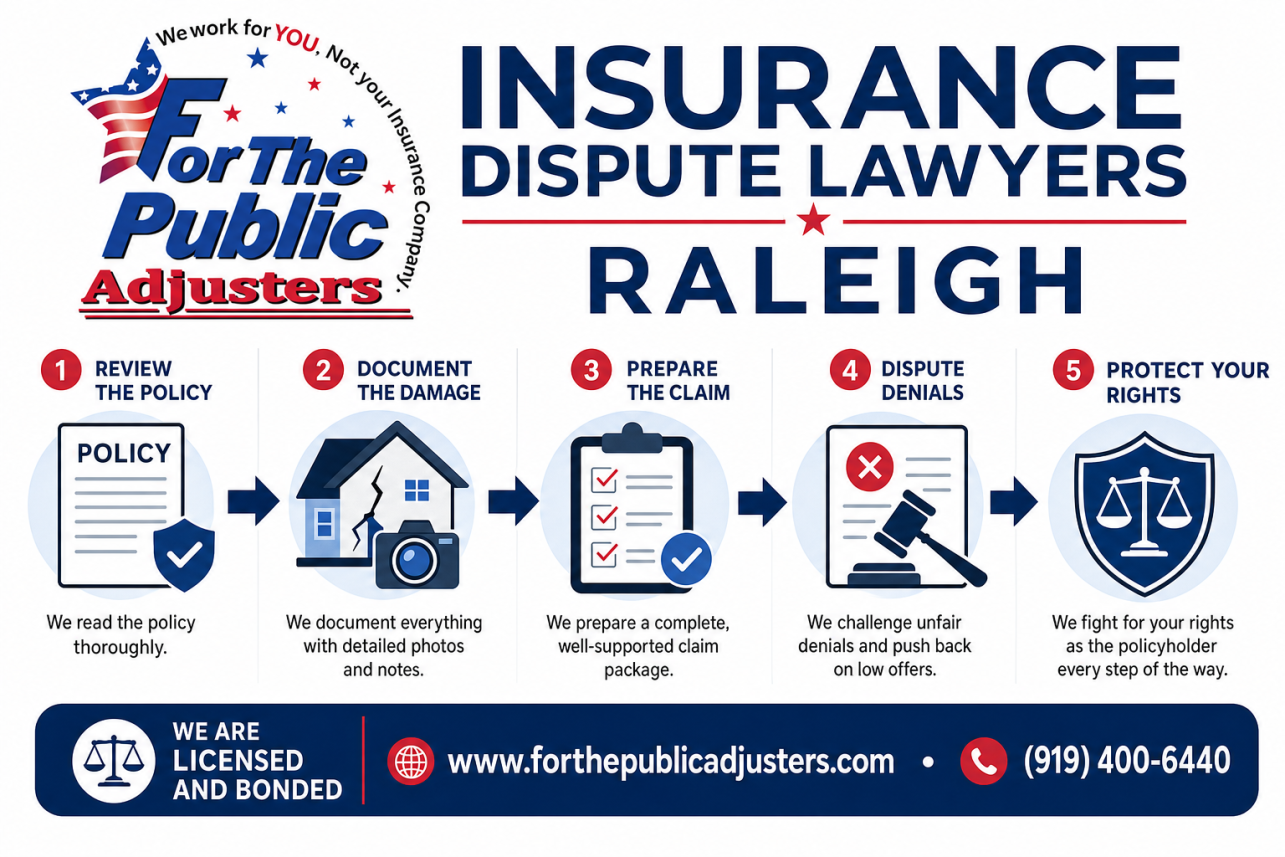
Our Process
Free Policy And Claim Review
We read your full policy — declarations, endorsements, exclusions — and compare it against what the carrier has paid or denied. Many disputes end here, because the gap between what is owed and what was offered becomes obvious once someone actually reads the contract.
Independent Documentation And Estimate
We inspect the property ourselves, photograph and measure the damage, test for hidden moisture or smoke migration, and build a line-item repair estimate using professional estimating software. This is the evidence the carrier’s one-visit inspection almost always misses, whether it is a fire loss, a tree through the roof, or a slow water intrusion.
Negotiate, Invoke Appraisal, Or Escalate
We present the documented claim and negotiate directly with the insurer’s adjuster. If the carrier will not move, we can invoke the appraisal clause. And in the rare case that truly needs litigation, you walk into an attorney’s office with a complete, defensible file — the strongest possible starting position.
| Factor | Public Adjuster First | Lawyer First |
|---|---|---|
| Typical cost structure | Percentage of the recovered claim only; no hourly billing | Contingency fee plus case costs, or hourly rates that accrue win or lose |
| Speed to resolution | Supplements and appraisal often resolve claims in weeks to months | Litigation in Wake County courts commonly runs a year or longer |
| What they actually do | Inspect, document, estimate, and negotiate the damage itself | Argue legal questions of coverage, bad faith, and contract breach |
| Best fit | Underpaid, delayed, or poorly documented home, building, and contents claims | True bad-faith conduct, final denials that survive appraisal, or approaching suit deadlines |
| Effect on your claim file | Builds the evidence record that any future lawsuit would rely on | Works from whatever documentation already exists — strong or weak |
| Relationship with the carrier | Keeps the claim in negotiation, preserving settlement flexibility | Filing suit typically hardens the carrier’s position and ends informal talks |
Commonly Overlooked In The Public Adjusting Industry
- The appraisal clause buried in the policy’s conditions section — Most policyholders jump straight to lawyers without realizing their own contract already contains a faster, cheaper dispute-resolution mechanism for pricing disagreements.
- The contractual suit-limitation deadline — Many North Carolina property policies shorten the time you have to file suit, and months spent arguing informally can quietly run out that clock.
- Matching requirements for discontinued materials — Carriers routinely pay to patch a section of roofing or flooring when discontinued product lines mean a uniform result requires replacing far more.
- Building code upgrade coverage (ordinance or law) — Older Raleigh homes often need code-mandated upgrades during repair, and this coverage sits unused because nobody itemizes the code-driven costs.
- Hidden moisture behind walls after hurricane or pipe losses — Surface-dry drywall can conceal saturated framing and insulation that only thermal imaging and moisture meters reveal, and quick carrier inspections rarely include either.
- A complete, priced contents inventory — Grieving or overwhelmed families accept lump-sum contents offers, when a room-by-room itemization with replacement pricing often multiplies that number.
- The carrier adjuster’s own file notes and inspection scope — Denials issued without an actual inspection happen more often than people think, and nobody catches it unless someone requests and reads the claim file.
- Separate NFIP proof-of-loss deadlines on flood claims — Federal flood policies run on their own strict timelines independent of your homeowner claim, and missing the proof-of-loss window can forfeit recovery — FEMA’s NFIP resources spell these out.
Case Studies
Case Study #1
Situation: A homeowner in North Raleigh’s Bedford neighborhood suffered major roof and interior damage when a tornado spun off a spring storm system moving through Wake County. Water intrusion ruined ceilings, hardwood floors, and insulation in the attic.
Problem: The carrier’s staff adjuster spent twenty minutes on site and issued an estimate of $31,400 — roughly a third of what local contractors said the repairs would actually cost. The homeowner, frustrated and convinced she was being lowballed, started calling litigation attorneys.
Investigation: Before signing a contingency-fee agreement with a law firm, she brought in our team for a second opinion. We performed a full moisture-mapped inspection, opened the attic and wall cavities the carrier’s adjuster never looked at, and documented hidden saturation with thermal imaging and lab-confirmed microbial sampling.
Findings: The carrier’s estimate omitted code-required roof decking replacement, matched-material considerations for the discontinued shingle line, drying and remediation of two saturated wall assemblies, and the full contents inventory. The true documented loss came to just over $118,000.
Solution: We prepared a line-item estimate with photographic proof for every entry, submitted a formal supplement, and invoked the appraisal clause in her policy — a dispute-resolution tool built into most North Carolina homeowner policies that does not require a lawsuit.
Outcome: The appraisal panel awarded $109,700, settled in under four months. No attorney was ever retained, no contingency fee on top of legal costs was paid, and no lawsuit clock was ever started.
Lesson: Most underpaid claims are documentation disputes, not legal disputes. A Raleigh public adjuster can often resolve the gap through supplements and appraisal long before litigation becomes necessary — and if a lawyer is eventually needed, the file we build becomes the backbone of that case.
Case Study #2
Situation: A small commercial property owner near Five Points in Raleigh had a kitchen fire spread smoke and soot through a leased restaurant space and the two office suites above it. Business contents, building finishes, and HVAC ductwork were all affected.
Problem: The carrier accepted the fire itself but denied the smoke and soot damage to the upper floors, arguing it was ‘pre-existing soiling.’ The owner’s first instinct was to sue, and he had already scheduled a consultation with an insurance dispute attorney.
Investigation: We asked him to let us evaluate the file first. Our team pulled the policy language, hired an independent industrial hygienist to sample surfaces on all three floors, and traced the soot pathways through the shared duct system with photographs and lab results tying the residue chemically to this specific fire.
Findings: The hygienist’s report confirmed combustion byproducts consistent with the kitchen fire on every floor. We also identified that the carrier had never inspected the upper suites at all before denying — a fact documented in their own adjuster’s notes obtained during the claim process.
Solution: We presented the sampling data, the duct-tracing evidence, and a rebuttal citing North Carolina precedent favoring insureds on property-damage coverage — including Gaston County Dyeing Machine Co. v. Northfield Insurance Co., 351 N.C. 293 (2000), where the North Carolina Supreme Court sided with the insured on coverage for property damage the carrier had tried to exclude.
Outcome: The carrier reversed the partial denial and paid the full documented loss of $241,000 across building and contents, without a single court filing. The attorney consultation was canceled.
Lesson: Carriers frequently deny what they never actually inspected. Independent testing and a properly built claim file often overturn a denial faster and cheaper than a lawsuit — and when a case does go to court, North Carolina insureds have won, as Gaston County Dyeing shows.
| Your Situation | Best First Move | Why It Matters |
|---|---|---|
| Settlement offer feels too low | Public adjuster | Underpayment is usually a documentation gap; a re-scoped estimate and supplement often close it without legal fees |
| Claim delayed with no explanation | Public adjuster | Formal written demands and North Carolina’s fair claims handling standards frequently break logjams before litigation is needed |
| Denial based on cause of loss (e.g., ‘seepage’ vs. sudden pipe burst) | Public adjuster, then attorney if denial stands | Independent testing and expert reports can overturn factual denials; a lawyer inherits a stronger file if they can’t |
| Carrier accepted the claim but disputes the repair price | Public adjuster and the policy’s appraisal clause | Appraisal is a built-in dispute tool that resolves pricing disagreements without a courtroom |
| Clear bad-faith conduct in writing | Attorney, with an adjuster documenting damages | Bad-faith claims are legal questions, but the damage valuation still needs professional documentation |
| Suit-limitation deadline in your policy is months away | Attorney immediately, adjuster in parallel | Missing a contractual filing deadline can end your rights entirely — that clock outranks everything |
| Flood damage under an NFIP policy | Public adjuster familiar with federal flood rules | NFIP claims follow strict federal deadlines and proof-of-loss requirements; start with FEMA and FloodSmart.gov resources and get help fast |
| Final denial that survived appraisal and appeals | Attorney | At that point the dispute is genuinely legal — and North Carolina insureds have prevailed, as in Gaston County Dyeing Machine Co. v. Northfield Insurance Co., 351 N.C. 293 (2000) |
Reviews
After Hurricane damage tore up our roof and flooded two bedrooms, our insurance company offered us less than half of what repairs cost. I was one phone call away from hiring a lawyer when a contractor told me to talk to a public adjuster first. For The Public Adjusters re-documented everything the carrier missed and used the appraisal clause instead of a lawsuit. We settled in fourteen weeks. I’m glad someone explained the order of operations before I signed a legal retainer.
Marcus T., Wakefield Plantation
Our claim for a burst pipe was denied as ‘long-term seepage,’ which was flat wrong — it happened over one weekend while we were out of town. I had already Googled insurance dispute lawyers in Raleigh, but their team reviewed the file free and found the carrier never even took moisture readings. Their documentation got the denial reversed without going to court. They were honest that if it hadn’t worked, they’d have referred us to an attorney with the file ready to go.
Deirdre H., Cameron Village area
House fire in our garage, and the contents inventory the insurance company accepted was maybe a quarter of what we lost. These folks itemized over 600 contents entries with replacement pricing and pushed the settlement up dramatically from the first offer. What stood out was their advice: exhaust the policy’s own dispute tools before paying attorney fees. That single piece of guidance saved us a lot of money. Only wish we’d called them the week of the fire instead of month three.
Sam & Priya K., North Hills
Frequently Asked Questions
Should I Hire Insurance Dispute Lawyers Raleigh Offers, Or Start With A Public Adjuster First?
For most home, building, and contents claims in Raleigh, starting with a licensed public adjuster is the smarter first move. A public adjuster documents your damage, prepares a detailed estimate, and negotiates directly with the insurance company — often resolving the dispute without litigation ever becoming necessary.
Attorneys are essential when a claim involves bad faith, a formal denial that won’t budge, or complex coverage questions. But litigation can take years, and attorney contingency fees are typically higher than public adjuster fees. If the real problem is that the carrier’s estimate missed damage or underpriced repairs, an adjuster can usually fix that faster and at lower cost.
There’s also a practical reason courts reward strong documentation. In Sproull v. State Farm Fire & Casualty Co. (Illinois Supreme Court, 2021), homeowners prevailed against their insurer over the improper depreciation of labor costs in actual cash value payments on a property claim — a win built on careful analysis of how the loss was calculated. That same detailed, line-item approach is exactly what a public adjuster brings to your file from day one.
At For The Public Adjusters, Inc., we’re licensed and bonded, and we work Wake County claims involving fire, smoke, water, hail, hurricane, and tornado damage. If your claim genuinely needs a courtroom, the file we build becomes powerful evidence for your attorney. Either way, you lose nothing by having a professional damage assessment first — and you often gain significant leverage.
What Does A Raleigh Public Adjuster Do That An Attorney Typically Doesn’t?
A public adjuster and an attorney solve different problems. An attorney argues law; a public adjuster proves damage. Most underpaid claims in Wake County aren’t legal disputes at all — they’re documentation disputes, and that’s adjusting work.
When we take on a Raleigh property claim, we inspect the home or building ourselves, photograph and measure every affected area, inventory damaged contents room by room, and build a repair estimate using the same pricing platforms carriers use. Then we meet the insurance company’s adjuster on site and negotiate line by line.
Most attorneys don’t climb into attics after a tornado tears through shingles and decking, or catalog smoke-damaged contents after a kitchen fire. They rely on experts to do that — and public adjusters are frequently the experts they call. Hiring the adjuster first simply removes the middle step.
Courts have shown how much valuation details matter. In Sproull v. State Farm (2021), policyholders won because the insurer had depreciated labor when calculating what a damaged home was worth — the kind of line-item issue an adjuster is trained to catch immediately.
One note on scope: we handle claims for homes, commercial buildings, and personal property only. We do not work on motor vehicle, health, life, or cell phone claims. For flood losses, coverage runs through the National Flood Insurance Program, and resources at FEMA.gov and FloodSmart.gov explain how those claims differ from standard homeowners policies. We can still assist with documenting flood damage to your structure and contents.
When Does A Wake County Property Claim Actually Need A Lawyer Instead Of An Adjuster?
Some situations genuinely call for legal counsel, and an honest adjuster will tell you when you’ve reached that point. You likely need an attorney if the carrier has issued a final written denial and refuses to reconsider, if there’s evidence of bad faith claim handling, if the dispute turns on policy interpretation rather than damage value, or if the insurer accuses you of misrepresentation or fraud.
Coverage-interpretation fights are where courts step in. In Gaston County Dyeing Machine Co. v. Northfield Insurance Co. (North Carolina Supreme Court, 2000), the insured prevailed when our state’s highest court took a policyholder-friendly view of how property damage and occurrences should be read under the policy language. Cases like that show North Carolina courts will hold insurers to the coverage they sold — but getting there took years of litigation.
That’s why sequence matters. If your Raleigh claim is underpaid rather than denied — say the carrier’s estimate after Hurricane Florence-style storm damage missed the roof decking, interior water intrusion, and contents — a public adjuster can often close that gap through negotiation and, when needed, the appraisal clause built into most policies. Appraisal resolves valuation disputes without a lawsuit.
If negotiation and appraisal fail, everything we’ve built — photos, measurements, estimates, correspondence — hands your attorney a litigation-ready file. We’re licensed and bonded, and while no one can promise a specific outcome, a thoroughly documented claim always negotiates from a stronger position than an undocumented one.
How Much Do Insurance Dispute Lawyers Raleigh Charge Compared To A Public Adjuster?
The fee structures are quite different, and the gap matters when you’re rebuilding after a fire or hurricane. Attorneys handling first-party property disputes typically work on contingency, commonly in the range of a third of the recovery or more, and litigation adds costs for expert witnesses, depositions, and filing fees. Cases can run one to three years or longer in Wake County courts.
Public adjusters in North Carolina charge a percentage of the claim settlement, generally a smaller share than attorney contingency fees, and the negotiation process usually moves in weeks or months rather than years. There are no court costs, no depositions, and no expert-witness bills — the adjuster is the expert.
The practical takeaway: exhaust the lower-cost, faster path first. If For The Public Adjusters, Inc. can resolve your underpaid fire, water, hail, hurricane, or tornado claim through documentation and negotiation, you keep more of your settlement and get repairs started sooner. If the carrier still won’t pay fairly, you’ve lost nothing — your fully documented claim file makes any subsequent legal case stronger, as policyholder wins like Sproull v. State Farm demonstrate about the power of detailed loss valuation.
We’re licensed and bonded, and we’re upfront about what we can and can’t do. We never guarantee a specific dollar outcome — no ethical adjuster or attorney can — but we can promise a professional, thoroughly documented claim presented by someone who works only for you, not the insurance company.
Can A Raleigh Public Adjuster Settle My Claim Without Ever Involving Insurance Dispute Lawyers Raleigh?
In most cases, yes. The majority of underpaid or denied property claims in Wake County never need to reach litigation. A licensed public adjuster documents the loss, prepares a detailed estimate, and negotiates directly with the insurance carrier on your behalf — often resolving disputes over fire damage, hurricane damage, water losses, or damaged contents at the claim level.
Attorneys generally become necessary only when a carrier refuses to move despite solid documentation, denies coverage outright, or acts in bad faith. Starting with a public adjuster means the factual groundwork — photos, moisture readings, line-item estimates, contents inventories — is already built before any lawyer gets involved. That record often makes legal escalation unnecessary, and if it does become necessary, it makes the attorney’s job faster.
North Carolina courts have shown they will hold carriers accountable when the evidence is there. In Gray v. North Carolina Insurance Underwriting Association, the homeowners’ hurricane-damaged coastal property was underpaid, and the insureds ultimately prevailed, with the North Carolina Supreme Court allowing their bad-faith and unfair-practices claims to go forward against the carrier. Cases like that started with strong documentation of the physical damage.
For The Public Adjusters, Inc. is licensed and bonded, and we work claims from first inspection through final negotiation. If your claim genuinely requires litigation, we can hand a fully documented file to counsel — but many Raleigh policyholders find the dispute resolves well before that point. We can’t promise a specific outcome, but we can promise your claim will be professionally documented and aggressively presented.
What Should I Do First After Fire Or Hurricane Damage To My Raleigh Home — Before Calling Anyone?
Protect the property from further damage first. Board broken windows, tarp roof openings after a hurricane or tornado, and shut off water if plumbing failed. North Carolina policies require you to mitigate, and carriers use failure to mitigate as a reason to reduce payments.
Second, document everything before cleanup. Photograph and video each room, the exterior, and damaged contents — closets, cabinets, attic, crawlspace. Keep receipts for tarps, temporary housing, and emergency repairs. These become part of your additional living expense and mitigation reimbursement claim.
Third, be careful with the recorded statement. Adjusters for the carrier may call quickly and ask questions designed to narrow coverage. You’re not required to guess at causes or values on the spot. It’s reasonable to say you’re still assessing the damage.
Fourth, bring in your own representation before the carrier’s estimate becomes the anchor for the whole claim. A Raleigh public adjuster works only for you, inspects independently, and prepares an estimate the carrier must respond to line by line. That’s very different from accepting the insurer’s number and arguing upward later.
If your loss involves flooding, note that flood damage is typically handled under a separate NFIP policy rather than your homeowners policy. FEMA (fema.gov) and the National Flood Insurance Program (floodsmart.gov) publish claim guidance worth reading early, because NFIP claims have strict proof-of-loss deadlines.
For The Public Adjusters, Inc. handles home, building, and contents claims throughout Wake County. We do not handle vehicle, health, life, or cell phone claims.
Has A North Carolina Policyholder Actually Won In Court Against An Insurance Company Over Property Damage?
Yes, and one of the most cited examples came out of a hurricane claim. In Gray v. North Carolina Insurance Underwriting Association, homeowners whose coastal house was damaged by Hurricane Fran received a payment far below their documented loss. They pursued the carrier, and the North Carolina Supreme Court ruled in 2000 that the insureds could pursue bad-faith refusal to settle and unfair claim practices under North Carolina’s Unfair and Deceptive Trade Practices Act — exposure that can mean treble damages for a carrier.
Why does that matter to a Raleigh homeowner deciding between an adjuster and an attorney? Because the Gray plaintiffs won on the strength of what the physical evidence showed versus what the carrier paid. Every successful policyholder case rests on a documented gap between the real damage and the insurer’s number.
That gap is exactly what a public adjuster establishes. Detailed scope sheets, contractor-grade estimates, contents inventories, and code-upgrade documentation create the record. If the carrier pays fairly, the dispute ends there. If it doesn’t, that same record becomes the backbone of a legal claim, and Insurance Dispute Lawyers Raleigh policyholders retain will have far stronger footing because of it.
No one — adjuster or attorney — can guarantee a result like Gray, and we never promise a specific recovery. What the case demonstrates is that North Carolina law gives well-documented policyholders real leverage, and that leverage starts with a thorough, independent assessment of the damage to your home, building, or contents.
My Raleigh Claim Involves Flood Damage — Does The Adjuster-First Approach Still Apply?
It does, but flood claims run on different rails, and that changes the strategy. Flood damage in Wake County is usually covered by a separate policy through the National Flood Insurance Program rather than your standard homeowners policy. NFIP claims come with strict requirements, including a signed, sworn proof of loss typically due within 60 days of the flood — a deadline that catches many policyholders off guard.
Because NFIP disputes are governed by federal rules, litigation options are narrower than in a standard homeowners dispute. That makes getting the claim documented correctly the first time even more important. A public adjuster can inspect the flooded structure, separate flood damage from non-flood damage (which matters when a storm causes both), inventory ruined contents, and prepare the proof of loss so nothing is left off.
Start with the official resources too: FEMA’s flood claim guidance at fema.gov and the NFIP’s policyholder pages at floodsmart.gov explain deadlines, appeals, and what your specific flood policy covers.
Where an insurance dispute attorney in Raleigh typically enters a flood matter is after a formal denial or a rejected proof of loss — and even then, the appeal or suit is built on the documentation assembled during the claim. Skipping the documentation stage and going straight to counsel usually means paying someone to reconstruct evidence that should have been captured while the damage was fresh.
For The Public Adjusters, Inc. is licensed and bonded and handles flood-damaged homes, buildings, and contents across Raleigh and Wake County. We can’t guarantee a particular payout, but we can make sure your flood claim meets every NFIP requirement on time.
What Are The Warning Signs That My Raleigh Property Claim Is Heading Toward A Real Dispute?
Most policyholders sense trouble before the denial letter ever arrives. Common red flags include a carrier adjuster who inspects your fire, hurricane, or water damage in twenty minutes, repeated requests for documents you already sent, an estimate that covers a fraction of what local Raleigh contractors quote, or long stretches of silence after you follow up.
Another signal is language shifting from ‘covered’ to ‘under investigation.’ When a carrier starts citing exclusions for damage that was clearly caused by a sudden event — a kitchen fire, a burst pipe, hurricane debris through the roof — you should get an independent professional reviewing the file immediately.
This is exactly why the adjuster-first approach matters. A licensed and bonded public adjuster can document the loss, rebuild the estimate line by line, and push back on the carrier’s numbers before positions harden. Many disputes in Wake County resolve at this stage without any courtroom.
When carriers refuse to deal fairly even with full documentation, courts have sided with homeowners. In Guessford v. Pennsylvania National Mutual Casualty Insurance Co., a homeowner whose house sustained serious structural damage sued after the insurer repeatedly lowballed and delayed his claim. A federal jury found the carrier acted in bad faith and awarded the policyholder damages well beyond the original claim value. Cases like that only succeed because the loss was thoroughly documented early — the kind of groundwork a public adjuster does from day one.
Is For The Public Adjusters, Inc. Licensed For Wake County Claims, And How Is That Different From What Insurance Dispute Lawyers Raleigh Handle?
Yes. For The Public Adjusters, Inc. is licensed and bonded to represent policyholders on property claims throughout Raleigh and Wake County. That license comes from the state’s insurance regulators and authorizes us to negotiate directly with your carrier on your behalf — something no contractor or friend-of-a-friend can legally do.
Attorneys operate under a different license entirely. Insurance Dispute Lawyers Raleigh policyholders hire are licensed to practice law, which means they can file suit, take depositions, and argue in front of a judge. What most cannot do is climb your roof after a hurricane, run moisture readings behind your drywall, or write a Xactimate estimate that matches what Raleigh-area contractors actually charge.
Think of it as two different toolboxes. Ours is built for measuring, documenting, and negotiating the loss itself — fire, smoke, water, hurricane, tornado, and theft claims on homes, commercial buildings, and their contents. An attorney’s toolbox is built for litigation once negotiation has genuinely failed.
We do not handle claims involving motor vehicles, health, life, or cell phones — our work is strictly real property and contents. For most Wake County homeowners, starting with the adjuster’s toolbox resolves the claim faster and preserves every legal option if court later becomes necessary.
Will Hiring A Public Adjuster First Hurt My Position If I Eventually Need To Sue My Insurance Company?
No — in most disputes it strengthens it considerably. Everything a public adjuster produces during the claim becomes evidence if the matter ever reaches litigation: the photographs taken before repairs began, the moisture logs, the itemized contents inventory, the detailed repair estimate, and the written record of every carrier response.
Litigators consistently say the hardest property cases are the ones where the homeowner accepted the carrier’s inspection as the only record of the loss. Once debris is hauled off and walls are rebuilt, the physical evidence is gone. A Raleigh public adjuster preserves that record while it still exists.
There is also a strategic advantage. If a carrier ignores a professionally documented claim, delays without explanation, or pays far below a defensible estimate, that conduct itself can support a bad-faith or unfair claims practices argument in North Carolina. The adjuster’s paper trail shows the insurer had every fact it needed and still refused to pay fairly.
And if you later retain one of the Insurance Dispute Lawyers Raleigh policyholders turn to, that attorney inherits a fully organized file instead of starting from scratch — which typically means lower legal costs and a faster path through discovery. Nothing about hiring us first waives any legal right, deadline, or remedy. We simply build the case the lawyer would otherwise have to reconstruct months later, often after the evidence is gone.
How Long Does The Adjuster-First Route Take On A Raleigh Claim Compared To Going Straight Into Litigation?
The timelines are dramatically different. When we take on a fire, hurricane, or water damage claim in Raleigh, the documentation and negotiation phase typically runs a few weeks to a few months, depending on the size of the loss and how responsive the carrier is. North Carolina rules also require insurers to acknowledge and respond to claims within set timeframes, which keeps pressure on the process.
Litigation is a different animal. A lawsuit against an insurance carrier in Wake County can easily take a year or more between filing, discovery, expert reports, mediation, and a trial date. Even homeowners who ultimately prevail — as the policyholder did in Guessford v. Pennsylvania National, where a jury found the insurer had failed to fairly evaluate a documented home damage claim — spend years getting there.
That is the practical logic behind starting with a public adjuster. If a properly documented claim can be settled at the negotiation table, you may be repairing your home while a lawsuit would still be in its opening motions. If it cannot, nothing has been lost: the file we build transfers directly to counsel, and no deadline under your policy or state law has been sacrificed.
We cannot promise any specific outcome or dollar amount — no honest professional can. What we can control is how completely your loss is documented and how quickly the carrier is forced to respond to real numbers instead of its own.
My Insurer Underpaid My Raleigh Claim Rather Than Denying It — Is That A Job For Insurance Dispute Lawyers Raleigh Or A Public Adjuster?
Underpayment is the most common problem we see in Wake County, and it is exactly where a public adjuster should come in first. A lowball offer usually means the carrier’s estimate missed damage, used depreciated pricing incorrectly, or overlooked code-upgrade costs — all documentation problems, not legal ones.
For The Public Adjusters, Inc. re-inspects the property, writes an independent line-item estimate, and negotiates directly with the carrier using your policy language. In many underpayment situations, the gap closes once the insurer sees a professionally documented scope of loss it can’t easily dismiss.
An attorney becomes the right move when the carrier refuses to budge even after solid documentation, or when it acts in bad faith. Courts do hold insurers accountable in those situations. In DENC, LLC v. Philadelphia Indemnity Insurance Company, a North Carolina property owner sued after its carrier refused to properly pay for the collapse of a breezeway at an Elon apartment building. The Fourth Circuit affirmed judgment for the insured in 2021, including penalties for the insurer’s unfair claim handling.
The practical takeaway: build the file first with an adjuster. If your claim ends up in front of Raleigh attorneys later, you’ll hand them a documented, defensible loss instead of a shoebox of receipts. We are licensed and bonded, and while no one can promise a specific outcome, starting with proper documentation gives every underpaid claim its strongest footing.
Can The Appraisal Clause In My Policy Resolve A Wake County Claim Dispute Without Going To Court?
Often, yes. Most homeowner and commercial property policies issued in North Carolina contain an appraisal provision. When you and the insurance company agree the loss is covered but disagree on the amount, either side can invoke appraisal. Each party selects its own appraiser, those two select an umpire, and any decision agreed to by two of the three sets the amount of loss.
Appraisal is faster and far less expensive than litigation. For a Raleigh homeowner arguing over the cost to rebuild after a kitchen fire or a hurricane-damaged roof, it can resolve a five-figure dispute in weeks rather than the year or more a lawsuit typically takes in Wake County courts.
Here’s why the adjuster-first approach matters: appraisal outcomes turn on documentation. The appraiser working from a detailed, photograph-supported, line-item estimate almost always presents the stronger case to the umpire. For The Public Adjusters, Inc. prepares that scope of loss before appraisal is ever invoked, so if negotiation stalls, you enter the process prepared rather than scrambling.
Appraisal has limits. It resolves disputes about how much, not whether coverage exists. If the carrier denies the claim outright or accuses you of misrepresentation, that’s a coverage dispute, and a Raleigh insurance attorney belongs in the conversation. But for the majority of local disagreements — pricing, scope, and depreciation — appraisal backed by a well-documented file resolves the matter without a single court filing.
What Documentation Should I Have Ready Before Contacting Insurance Dispute Lawyers Raleigh About My Property Claim?
If your claim reaches the point where attorneys make sense, the strength of your file determines nearly everything — settlement leverage, timeline, and whether the case is even worth taking. This is a major reason to bring in a public adjuster early, because we build that file as part of the claim itself.
At minimum, you should have: your complete policy including endorsements, the carrier’s denial or payment letters, every written communication with the insurer, dated photos and video of the damage from before mitigation and after, receipts for emergency repairs and additional living expenses, and an independent estimate of the full loss.
The independent estimate is where most Raleigh policyholders fall short. The carrier’s estimate is not neutral evidence — it’s the other side’s number. When For The Public Adjusters, Inc. handles a claim, we produce a room-by-room, line-item scope of loss with unit pricing, moisture readings where relevant, and a contents inventory for damaged personal property. Attorneys tell us this is the single most valuable document a policyholder can hand them.
Well-built files change outcomes. In DENC, LLC v. Philadelphia Indemnity, the North Carolina insured’s thorough evidence of building damage and the carrier’s claim-handling failures supported a judgment for the policyholder, affirmed on appeal in 2021. Whether your dispute settles at the negotiation table or moves to counsel, the documentation created in the first weeks after your loss is what carries it — which is why the adjuster-first sequence works.

My Insurance Company Keeps Delaying My Hurricane Damage Claim In Raleigh — Should I Bring In An Adjuster Or Go Straight To Litigation?
Delay is frustrating, but it’s rarely a reason to file suit immediately. Start with a public adjuster, because delay tactics usually collapse under organized pressure — and if they don’t, you’ll have built the paper trail an attorney needs anyway.
North Carolina’s Unfair Claims Settlement Practices statute requires insurers to acknowledge communications promptly and act reasonably promptly on claims. When For The Public Adjusters, Inc. takes over a stalled hurricane claim in Raleigh, we put every request in writing, set documented deadlines, and reference the specific policy provisions and statutory duties the carrier is brushing past. Insurers respond differently when a licensed, bonded professional is tracking every missed date.
Hurricane claims in Wake County stall for predictable reasons: overwhelmed carrier adjusters after a storm, disputes over whether roof and interior water damage came from the storm itself, and slow engineering reports. An independent inspection and estimate answers those questions on your timeline instead of theirs.
If documented pressure still produces nothing — months of silence, shifting excuses, repeated re-inspections with no payment — the delay itself may amount to bad faith, and that’s when a Raleigh attorney adds real leverage. North Carolina courts have punished carriers for unfair claim handling on building losses, as the insured’s win in DENC, LLC v. Philadelphia Indemnity demonstrates.
One caution: if any portion of your storm damage involves rising water or flooding, that falls under separate flood coverage. Review your flood policy and the resources at FEMA.gov and FloodSmart.gov, since NFIP claims follow their own federal rules and deadlines.
Local Relevance
Raleigh sits far enough inland to escape direct coastal hits, but hurricane remnants still cross Wake County regularly — anyone who lived here through Fran remembers what tropical winds do to the City of Oaks. Falling trees, torn roofing, and the water intrusion that follows generate some of the most disputed claims we see, and carriers often scope only the visible limb damage while missing cracked framing or saturated decking underneath.
The housing stock adds another layer. Inside-the-Beltline neighborhoods hold homes from the mid-1900s with plaster walls, original hardwoods, and dated plumbing, while the suburbs stretch out in newer builds — two very different repair-cost realities that a generic insurance estimate rarely captures. We handle these disputes across the Triangle, from Raleigh proper to clients working with our public adjuster in Garner just down US-70, and beyond into Orange County where tree damage insurance claim help near Carrboro follows the same storm patterns.
Raleigh’s mature willow oaks and pines are beloved until a tropical remnant or summer thunderstorm drops one on a roof — and in our experience these tree-strike claims are frequently underscoped, because the visible limb damage gets paid while cracked rafters and compromised roof decking underneath go unnoticed until a public adjuster orders the tarp pulled back.
Talk To A Licensed Public Adjuster Before You Hire A Lawyer
Get a free, no-obligation review of your denied or underpaid property claim from For The Public Adjusters, Inc. We are licensed and bonded in North Carolina, we work only for policyholders, and if your case genuinely needs an attorney, we will tell you honestly — with a documented claim file ready to go.
Call us: (919) 400-6440
Helpful Resources
- NCDOI Public Adjusters Guide
- National Association of Insurance Commissioners (NAIC)
- North Carolina Department of Insurance — State regulator that licenses public adjusters and handles consumer complaints
- National Association of Insurance Commissioners — National consumer resource on policy rights and claim disputes
Last updated: September 14, 2026