If you’re searching for a fire damage claims adjuster apex Selma property owners can call after a house or business fire, For The Public Adjusters, Inc. works exclusively for you — never the insurance company. We are licensed and bonded, and we handle the entire claim: documenting structural damage, inventorying your lost belongings, and negotiating the settlement. Our fee comes from the recovery, so there is no cost to have your loss reviewed.
What This Service Is
A public adjuster is a licensed professional who represents the policyholder in a property insurance claim. The adjuster your insurance company sends works for the insurer. We work for you.
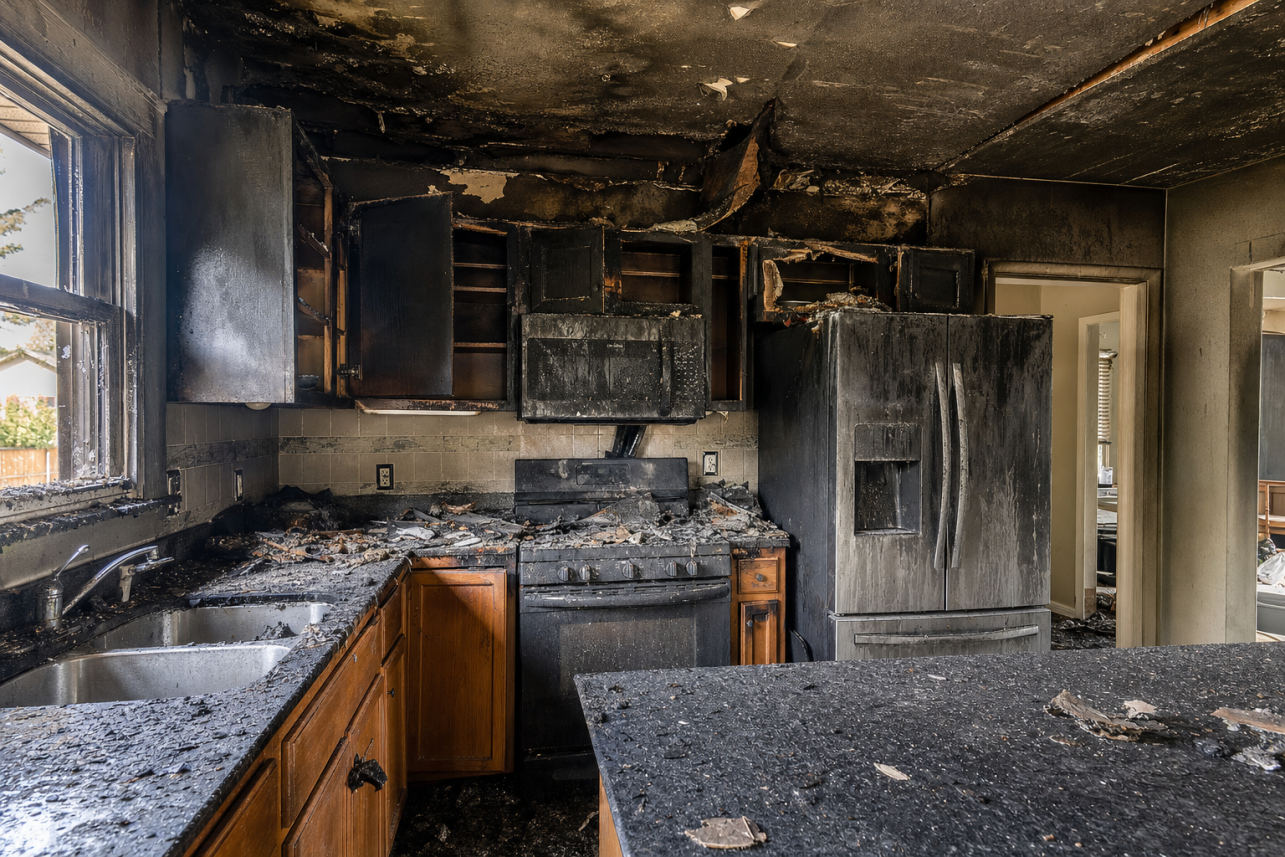
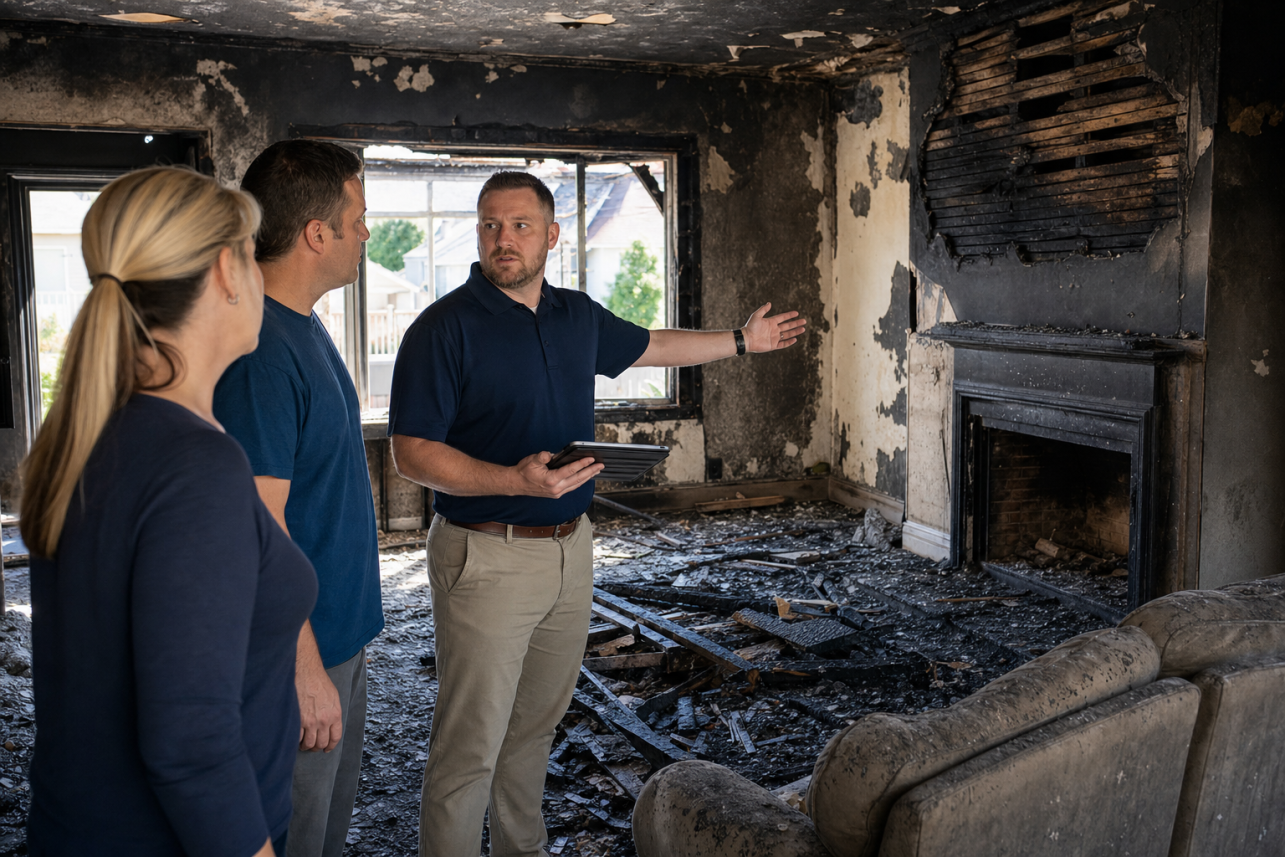
After a fire, most of the damage is not obvious. Smoke and soot travel through wall cavities and duct systems, heat can weaken framing behind surfaces that look fine, and the water used to put the fire out often soaks flooring, insulation, and drywall two rooms away. We assess all of it, not just the charred area.
We also read your policy line by line — coverage limits, your deductible, whether you’re owed replacement cost or a depreciated actual cash value payment, and whether the policy pays for temporary housing while you’re displaced. It’s the same disciplined approach our fire claims adjuster in Apex clients see, applied to your Selma property.
Then we build the claim: repair estimates, a room-by-room contents inventory, proof of loss paperwork, and the negotiation that follows. We handle residential fires, commercial fires, and the smoke and water damage that come with them.
Common Problems
Why Is The Insurance Company’s Offer So Much Lower Than What Repairs Actually Cost?
Low first offers usually come from an incomplete scope. The insurer’s estimate may cover the burned room but skip smoke cleaning throughout the house, code-required electrical upgrades, or the water damage from firefighting that soaked the floor below.
Depreciation is another quiet reducer. Many policies first pay actual cash value — the depreciated worth of your ten-year-old roof or kitchen — and only release the rest after repairs. If nobody explains that, you may accept a fraction of what the policy actually owes.
We rebuild the estimate from the ground up, item by item, and compare it against your coverage limits. When the numbers don’t match reality, we present the evidence and push the settlement toward the true cost of putting your property back.
My Fire Claim Is Dragging On, Underpaid, Or Denied — What Can I Actually Do?
You are not stuck with the insurer’s first answer. A claim can be disputed, supplemented, or reopened when new damage is documented. Delays, repeated document requests, and lowball positions are negotiating tactics, not final rulings.
North Carolina courts have backed policyholders who push back. In Guessford v. Pennsylvania National Mutual Casualty Insurance Company, a North Carolina homeowner whose house suffered serious structural damage fought his insurer’s inadequate payments in federal court and prevailed, with the court allowing his bad faith and unfair claim practices arguments to go forward against the carrier.
Most disputes never need a courtroom, though. Thorough documentation and a properly supported proof of loss resolve the majority of underpayments — the same way we approach a fire insurance claim dispute in Raleigh. When a claim truly requires litigation, we can connect you with insurance dispute attorneys.
Do I Need A Fire Damage Claims Adjuster Apex Selma Owners Can Trust, Or Can I Handle The Claim Myself?
You can file on your own — many people do. The problem is that a fire claim is really several claims at once: structure, contents, smoke, water, and additional living expenses. Miss one, and that money is simply never offered.
A good public adjuster does three things you’d struggle to do alone: finds hidden damage a walkthrough misses, values your personal property using a defensible inventory instead of guesswork, and negotiates from documented evidence rather than emotion. The North Carolina Department of Insurance publishes guidance on public adjusters through its NCDOI Public Adjusters Guide — verify that anyone you hire is licensed, as we are, and works on a transparent fee from the recovery.
We serve all of Johnston County, and our public adjuster in Clayton NC team handles losses across the county line as well. Ask any adjuster you interview about local fire losses they’ve settled — specifics tell you who actually does this work.
Our Process
Free Review Of Your Policy And Your Loss
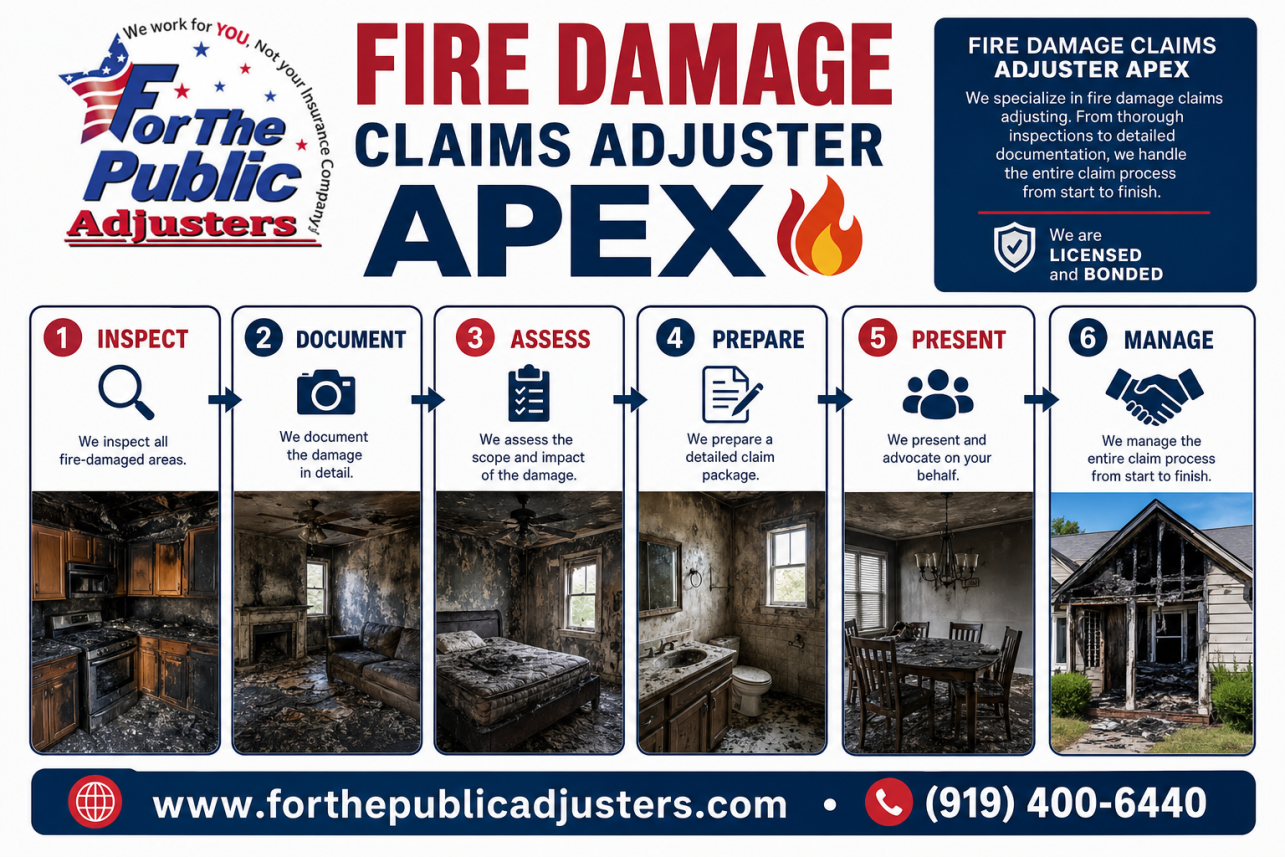
We start by reading your actual policy — coverage limits, deductible, replacement cost versus actual cash value provisions, and additional living expenses coverage that pays for a rental or hotel while your home is uninhabitable. Then we walk the property and identify every category of damage, including smoke residue and firefighting water intrusion the first inspection likely missed.
Full Documentation And Proof Of Loss
We prepare a detailed structural repair estimate, photograph and catalog damage room by room, and build a contents inventory that assigns real value to your personal property. We also flag code upgrade costs — older electrical, plumbing, or framing that must be brought up to current standards during repairs. Everything is assembled into a properly supported proof of loss, the formal document your claim ultimately rests on.
Negotiation And Settlement
We present the documented claim to your insurer, meet their adjuster on site, and answer every challenge with evidence. If the carrier delays, underpays, or denies, we escalate through supplements and formal dispute channels. We never promise a specific dollar outcome — no honest adjuster can — but we make certain your claim is presented fully, so nothing covered goes unpaid for lack of documentation.
| What Happens | Filing On Your Own | With a Licensed Public Adjuster |
|---|---|---|
| Damage scope | Based on what you and the carrier’s adjuster can see | Room-by-room inspection including smoke, soot, odor, ductwork, and hidden heat damage |
| Contents inventory | You list items from memory, often under time pressure | Full itemized inventory with replacement-cost documentation for every category |
| Estimate and negotiation | You respond to the carrier’s numbers | An independent estimate is written and negotiated on your behalf by a licensed, bonded professional |
| Additional living expenses | Frequently underclaimed or forgotten | Tracked and submitted throughout displacement, including housing, meals, and mileage |
| Code upgrades and depreciation | Ordinance-or-law coverage and recoverable depreciation often go unclaimed | Coverage parts identified and invoked so eligible money is actually recovered |
| Your time | Dozens of hours managing calls, paperwork, and disputes while displaced | The claim is managed for you while you focus on your family or business |
Commonly Overlooked In The Public Adjusting Industry
- Soot inside HVAC ductwork and behind supply registers — Nobody looks inside the ducts during a walk-through, so contaminated systems get ‘cleaned’ on paper when they actually need replacement.
- Protein smoke residue on surfaces that look clean — Protein smoke from kitchen fires is nearly invisible but bonds to paint and cabinetry, and estimates written by eye miss it entirely.
- Char and heat stress on framing above the burn area — Attic rafters and joists weaken from heat without obvious burning, and carriers rarely send anyone up to check.
- Ordinance or law coverage for code-required rebuilding — Johnston County code upgrades like panel replacements are covered under a policy part most homeowners never know exists, so it goes unclaimed.
- Recoverable depreciation left uncollected after repairs — Carriers hold back depreciation until work is done, and policyholders who don’t submit final invoices simply forfeit that money.
- Additional living expenses beyond the hotel bill — Extra mileage, meals above normal grocery costs, pet boarding, and laundry are all reimbursable, but people stop tracking after the first week.
- Water and chemical damage from firefighting efforts — Everyone focuses on the burn, while saturated drywall, insulation, and flooring from hose water quietly grow into a mold problem the estimate never priced.
- Non-restorable porous contents billed as ‘cleanable’ — Mattresses, upholstery, and children’s clothing absorb smoke permanently, but cleaning is cheaper than replacement so that’s what gets written.
Case Studies
Case Study #1
Situation: A family on the east side of Selma had a kitchen fire that started in a countertop appliance and spread into the cabinets, attic chase, and HVAC ductwork before the Selma Fire Department knocked it down.
Problem: The insurance company’s staff adjuster scoped only the visibly charred kitchen and offered a settlement that covered cabinet replacement and repainting two rooms. It ignored smoke and soot migration through the duct system into every bedroom, and it priced contents cleaning instead of replacement for items that had absorbed protein smoke.
Investigation: We performed a room-by-room inspection with a particle counter and swab testing, pulled supply registers to document soot inside the duct runs, and photographed heat damage to attic framing above the kitchen. We also inventoried the contents item by item, separating cleanable hard goods from porous items like mattresses, upholstery, and children’s clothing.
Findings: Soot residue was present in all seven rooms, the ductwork required full replacement rather than cleaning, two attic rafters showed char that a structural repair contractor would not certify without sistering, and roughly 60 percent of the soft contents could not be restored to pre-loss condition.
Solution: We rebuilt the claim under the policy’s dwelling, contents, and additional living expense coverages, submitted the testing data and contractor certifications with the revised estimate, and negotiated directly with the carrier’s large-loss desk on behalf of the family.
Outcome: The carrier reopened the file and issued a supplemental settlement several times the original offer, including duct replacement, structural repairs, full contents replacement for non-restorable items, and housing costs while the home was uninhabitable.
Lesson: Smoke travels far beyond the burn area, and the first estimate after a house fire almost always reflects what was easy to see, not what the policy actually owes. Courts have recognized this dynamic too — in Mosley v. Pacific Specialty Insurance Co. (2020), a California appellate court sided with homeowners after their insurer tried to deny a fire loss at a rental property, reversing the ruling in the carrier’s favor and letting the insureds’ claim proceed.
Case Study #2
Situation: A small commercial building owner near downtown Selma, in the heart of Johnston County’s antique district, suffered an electrical fire that burned through a rear storage room and left heavy smoke damage across the retail floor and inventory.
Problem: The carrier accepted the fire but disputed the business’s inventory valuation, claiming the owner’s records were insufficient, and it applied depreciation aggressively to the building repairs, leaving a gap of tens of thousands of dollars between the payout and the actual cost to reopen.
Investigation: We reconstructed the inventory using supplier invoices, point-of-sale reports, and consignment agreements common to antique dealers, then brought in an electrician and a commercial contractor to scope code-required electrical upgrades that the carrier’s estimate had omitted entirely.
Findings: The rebuilt inventory ledger supported a contents value far above the carrier’s number, and Johnston County’s current electrical code required a panel upgrade and rewiring of the affected circuits — costs recoverable under the policy’s ordinance or law coverage that had never been triggered in the carrier’s estimate.
Solution: We submitted a documented proof of loss with the reconstructed inventory, invoked the ordinance or law coverage with the county code citations attached, and negotiated the recoverable depreciation schedule so the owner could actually collect it as repairs were completed.
Outcome: The claim settled with the ordinance or law coverage fully applied, the inventory paid on the documented figures, and business interruption coverage extended through the actual reopening date rather than the carrier’s original estimated repair window.
Lesson: Commercial fire claims are won or lost on documentation and on knowing every coverage part in the policy. An owner who accepts the carrier’s first inventory number and first repair scope is often leaving code-upgrade money and business income on the table.
| Situation | Best Next Step | Why It Matters |
|---|---|---|
| Fire is out, home unsafe to enter | Wait for fire department clearance, then photograph everything before touching it | Untouched documentation is your strongest evidence of the loss condition |
| Carrier asks for a recorded statement right away | You may pause and get representation first | Statements given under stress are often used later to narrow the claim |
| Insurer’s adjuster offers a quick early settlement | Get an independent scope before signing anything | Early offers rarely include hidden smoke, duct, and structural damage |
| Smoke smell in rooms with no visible damage | Request soot testing and duct inspection | Soot migration is real damage the policy covers, but only if documented |
| You’re displaced and paying for a hotel and meals | Save every receipt from day one | Additional living expense coverage reimburses these, but only with records |
| Contractor says repairs need electrical or code upgrades | Check the policy for ordinance-or-law coverage | Code-required work is often covered but is almost never volunteered by the carrier |
| Claim denied or lowballed and you feel stuck | Bring in a public adjuster to reopen or supplement the claim | Policyholders can and do prevail — in Mosley v. Pacific Specialty Ins. Co. (2020), homeowners won on appeal after their fire claim was wrongly denied |
| Fire also caused water or flooding issues from firefighting | Document water damage separately; for actual flood events, see FEMA and the NFIP at floodsmart.gov | Fire-suppression water damage is typically covered under the fire policy, while flood is a separate program |
Reviews
Our house off Ricks Road had a chimney fire in January and the insurance company’s first check wouldn’t have covered half the repairs. For The Public Adjusters found smoke damage in rooms we didn’t even think to check and documented everything with photos and testing. The final settlement let us rebuild properly instead of patching. Worth every bit of their fee.
Marcus T., Selma
After a garage fire spread into our attic, the carrier kept going back and forth on what was ‘cleanable’ versus what needed replacing. This team took over all the calls, wrote their own detailed estimate, and handled the contents inventory line by line — over 400 items. They were patient explaining every step, and the outcome was dramatically better than where we started.
Denise W., Johnston County
I run a small shop downtown and had smoke damage from a fire in the neighboring unit. The insurer initially said my loss was minor. Their adjuster documented soot in my inventory and HVAC system and pushed the claim through with real evidence. Communication was solid, though I’ll admit the process still took a couple of months. Result was fair and I’d hire them again.
Ray P., Selma
Frequently Asked Questions
What Does A Fire Damage Claims Adjuster Apex Selma Policyholders Hire Actually Do For Them?
When you bring in a fire damage claims adjuster apex Selma homeowners and business owners rely on, you get a licensed professional who works exclusively for you — never for the insurance company. For The Public Adjusters, Inc. documents the full scope of your loss, including structural damage, smoke and soot infiltration, water damage from firefighting efforts, and destroyed contents.
We start by reviewing your policy line by line to identify every coverage that applies: dwelling, other structures, personal property, and additional living expenses if your Selma home is uninhabitable. Many Johnston County policyholders don’t realize that smoke odor absorbed into HVAC systems, insulation, and framing is a compensable loss even when flames never touched those areas.
From there, we prepare a detailed, itemized estimate using the same industry software insurers use, then negotiate directly with the carrier’s adjuster on your behalf. Courts have recognized how much is at stake when carriers mishandle fire losses. In Bi-Economy Market, Inc. v. Harleysville Insurance Co., the New York Court of Appeals sided with a business owner whose building and contents were destroyed by fire, holding the insurer could be liable for consequential damages after it delayed and underpaid the claim — a loss that ultimately drove the business under.
We are licensed and bonded, and while no adjuster can promise a specific outcome, our job is to make sure nothing about your fire loss is overlooked or undervalued.
How Soon After A House Fire In Selma Should I Contact A Public Adjuster?
The best time to call is before you give the insurance company a recorded statement or accept their first estimate. The days immediately after a fire in Selma are when critical evidence exists — char patterns, smoke staining, and damaged contents that may later be discarded during cleanup.
For The Public Adjusters, Inc. recommends reaching out within the first week if possible. Early involvement lets us photograph and inventory everything, secure the property against further damage as your policy requires, and set up your additional living expense claim correctly from day one. If your family is displaced to temporary housing in Johnston County or nearby, those costs are typically covered, but they must be documented properly.
That said, it is rarely too late to get help. If you’ve already filed and received a settlement offer that seems low, we can review it. Insurance estimates frequently miss hidden damage — smoke residue inside wall cavities, heat-warped roofing, or contamination of ductwork. Policyholders have prevailed in court when carriers cut corners on fire losses; in Bi-Economy Market v. Harleysville, the insured recovered after the carrier paid only a fraction of the fire loss and dragged out the process for over a year.
Our team is licensed and bonded, and we handle the claim so you can focus on your family. We can’t guarantee any particular result, but we can make certain your loss is fully documented and professionally presented before you sign anything final.
Will A Selma Fire Claim Cover Smoke, Soot, And Water Damage — Not Just What Burned?
In most cases, yes. A standard homeowners or commercial property policy in North Carolina covers the entire chain of damage a fire causes, not just the rooms that burned. That includes smoke and soot that traveled through your home, heat damage to siding and windows, and the water or chemical damage left behind by firefighting efforts.
This is one of the biggest gaps we see in initial insurance estimates for Selma and Johnston County properties. A kitchen fire might be contained to one room, yet soot particles migrate through the HVAC system into bedrooms, closets, and attic spaces. Clothing, upholstery, mattresses, and electronics can absorb corrosive residue that shortens their life or ruins them outright.
For The Public Adjusters, Inc. brings in the documentation needed to prove these secondary losses: contents inventories, cleaning and restoration protocols, and testing where appropriate. Water used to extinguish the fire often saturates subfloors and drywall, creating conditions for mold if it isn’t addressed — and that remediation belongs in your claim too.
Courts take these losses seriously. In the Bi-Economy Market case, the destroyed inventory and building damage from a fire — and the insurer’s failure to pay promptly and fully — led the court to allow the policyholder to pursue damages beyond the policy limits. We’re licensed and bonded, and while no one can promise a specific payout, we work to ensure every category of fire-related damage is in front of your carrier.
How Does The Fire Damage Claims Adjuster Apex Selma Process Work With For The Public Adjusters, Inc?
The fire damage claims adjuster apex Selma process begins with a free consultation and policy review. We sit down with you, go through your declarations page and endorsements, and explain in plain language what coverages apply to your specific loss in Johnston County.
Next comes documentation. We inspect the property thoroughly — structure, roof, mechanical systems, and contents — and build a room-by-room inventory of damaged personal property. For a fire loss, this stage matters enormously because burned and smoke-damaged items are often hauled away before they’re ever counted.
Then we prepare a complete, itemized claim package and present it to your insurance carrier. We attend the insurer’s inspections, respond to their requests, and negotiate on your behalf through to settlement. If disputes arise over the value of the loss, we can guide you through the appraisal provision in your policy.
Policyholders who push back on lowball fire settlements have history on their side. In Bi-Economy Market, Inc. v. Harleysville, the insured business owner whose building and stock were destroyed by fire won the right to pursue consequential damages after the insurer underpaid and delayed. That decision reflects why thorough documentation and persistence matter.
For The Public Adjusters, Inc. is licensed and bonded and works on your side from the first inspection to the final payment. We never promise a specific dollar amount — no honest adjuster can — but we do promise that your Selma fire claim will be presented completely and professionally.
How Much Does It Cost To Hire A Public Adjuster For A Fire Claim In Selma?
For The Public Adjusters, Inc. works on a contingency fee, which means our compensation is a percentage of the settlement your insurer pays — there is no upfront cost and no hourly billing. If the claim does not pay, you owe nothing for our adjusting work.
That structure matters for Selma homeowners because fire losses often involve structure repairs, smoke and soot remediation, contents inventories, and additional living expenses all at once. Documenting each of those categories properly takes time most policyholders simply do not have while they are displaced.
Many families in Johnston County find that a professionally prepared and negotiated claim addresses damage the initial insurer estimate overlooked — hidden soot in HVAC ducts, heat-damaged wiring behind walls, or contents that must be replaced rather than cleaned. We never guarantee a specific dollar outcome, because every policy and every loss is different. What we do promise is a thorough, documented presentation of everything your policy entitles you to claim.
We are licensed and bonded, and our fee agreement is put in writing before any work begins, so you know exactly what to expect. During your free initial consultation we will review your policy, look at the damage, and tell you honestly whether hiring us makes financial sense for your situation. If a claim is small or straightforward, we will say so.
Can A Fire Damage Claims Adjuster Apex Selma Homeowners Trust Help If My Claim Was Already Underpaid Or Denied?
Yes. A significant portion of our work involves claims that were already filed, and either underpaid, delayed, or denied outright. As long as the claim has not been fully and finally settled with a signed release, there is usually room to reopen the conversation with your insurance carrier.
We start by reviewing the insurer’s estimate line by line against the actual damage at your property. Fire losses in older Selma homes frequently reveal shortfalls: smoke odor treated as cosmetic, code-required electrical upgrades omitted, or contents depreciated far below realistic replacement cost.
From there we prepare a supplemental claim backed by photographs, moisture readings, contractor scopes, and a room-by-room contents inventory. That documentation gives the carrier a factual basis to revise its position, and it gives you leverage you did not have arguing on your own.
Policyholders should also know the courts have backed insureds in property disputes. In Gaston County Dyeing Machine Co. v. Northfield Insurance Co., 351 N.C. 293 (2000), the North Carolina Supreme Court sided with the insured on coverage for property damage after the carriers tried to limit the loss to a single occurrence — a reminder that an insurer’s first answer is not always the final word.
We cannot promise a specific result on any reopened claim, but we can promise your file will be presented completely and professionally, which is often what an underpaid claim was missing the first time.
What Should I Document Before The Insurance Company Inspects My Fire-Damaged Home In Johnston County?
Before any inspection, photograph and video everything — every room, every wall, the attic, the crawl space, and the exterior. Capture damage that seems minor, like light soot film on kitchen cabinets or a smoke smell in closets, because those items are easy for a carrier’s adjuster to miss or dismiss.
Do not throw anything away yet, even items that are clearly destroyed. Burned contents are physical evidence of your loss, and your policy likely requires you to give the insurer a chance to inspect them. Set damaged belongings aside in a garage or storage area if you need to clear living space.
Start a simple log of every expense from the day of the fire: hotel nights, restaurant meals, replacement clothing, pet boarding, mileage. These fall under additional living expenses in most homeowner policies, and receipts are what get them paid.
Also gather your policy declarations page, any endorsements, mortgage information, and the fire department’s incident report from the Selma Fire Department or the responding Johnston County station. If you have pre-loss photos of your home — holiday pictures work well — pull those together too, because they establish the condition and contents of the house before the fire.
When our team handles your claim, we take over this documentation and build the full inventory ourselves. But anything you preserve in those first days makes the claim stronger.

Is A Public Adjuster Different From The Adjuster My Insurance Company Sends After A Fire?
Completely different, and the distinction matters more after a fire than almost any other loss. The adjuster your carrier sends is employed by or contracted to the insurance company. Their estimate reflects the carrier’s interests and its pricing guidelines. A public adjuster is licensed by the state to represent one party only: you, the policyholder.
When a fire damage claims adjuster apex Selma residents hire from For The Public Adjusters, Inc. inspects your home, we are measuring, scoping, and pricing the loss on your behalf. That includes categories carrier adjusters routinely undervalue — smoke penetration into insulation and ductwork, heat damage to roofing and framing, water damage from firefighting efforts, and the true replacement cost of your contents.
We also read your policy the way it should be read: identifying ordinance-and-law coverage for code upgrades, additional living expense limits, and debris removal provisions that many homeowners never know exist. Then we negotiate directly with the carrier so you are not fielding calls while trying to rebuild your life.
We are licensed and bonded, and our only client in the claim is you. One note on scope: we handle claims for homes, buildings, and their contents. We do not handle motor vehicle, health, or life insurance claims. If your loss also involved flooding, that typically falls under a separate flood policy, and resources like FEMA (fema.gov) and the National Flood Insurance Program (floodsmart.gov) explain how those claims work.
How Long Does A Fire Damage Claim Typically Take To Settle In Selma?
Timelines vary widely depending on the size of the loss, the condition of the structure, and how the insurance company responds. A smaller kitchen fire with limited smoke spread might resolve in a couple of months, while a total loss on a Selma home can take six months or longer when structural estimates, contents inventories, and additional living expense claims all have to be documented and negotiated.
North Carolina requires insurers to acknowledge claims promptly and to investigate in good faith, but delays still happen — often because the carrier’s estimate is incomplete or the contents inventory gets disputed line by line. That back-and-forth is usually where policyholders lose weeks.
When our team handles a Selma fire loss, we front-load the work: full scope of damage, smoke and soot testing where warranted, a room-by-room contents inventory, and supporting documentation before the carrier ever pushes back. Complete, well-organized claims are harder to delay and easier to settle.
We also track every deadline in your policy, from proof-of-loss requirements to appraisal windows, so nothing lapses while you focus on your family and your home. We can’t promise a specific settlement date or amount — no honest adjuster can — but we can make sure the claim moves as fast as the facts allow and that you aren’t the one chasing the insurance company for answers. Most delays we see in Johnston County come from incomplete claims, and that’s a problem thorough preparation solves.
Does My Policy Pay For A Place To Stay While My Selma Home Is Repaired After A Fire?
In most homeowner policies, yes. The coverage is called Additional Living Expenses, or ALE, and it pays the reasonable increase in your cost of living while your home is uninhabitable — a rental house, an extended-stay hotel, extra mileage if you’re commuting farther, even boarding for pets in some policies.
The key word is “increase.” If your normal grocery bill was $600 a month and eating out during displacement pushes it to $900, the $300 difference is typically what’s claimable. Insurers scrutinize these expenses closely, so receipts and a simple monthly log matter enormously.
As a fire damage claims adjuster apex Selma families rely on, For The Public Adjusters, Inc. helps you set up that documentation from day one, calculates a realistic displacement budget based on actual rental costs in Johnston County, and pushes back when carriers try to cut ALE off before repairs are genuinely finished. That last point matters: some insurers stop paying when they think repairs *should* be done, not when the home is actually livable again.
We also watch your policy’s ALE limits — usually a percentage of your dwelling coverage or a set time period — so we can pace the claim and prioritize repairs accordingly. Families displaced by fire in Selma often leave thousands of dollars of legitimate ALE unclaimed simply because nobody told them what qualified. Keeping every receipt from the first night onward is the single most valuable habit you can build after a fire.
Have Policyholders Actually Won In Court Against Insurers Who Lowballed Fire Losses?
Yes, and one of the most cited examples is Elberon Bathing Co. v. Ambassador Insurance Co., decided by the New Jersey Supreme Court in 1979. A fire destroyed the insured’s building, and the dispute went to appraisal, where the award came in far below what the policyholder believed the building was worth.
The policyholder challenged the appraisal, and the court sided with the insured — holding that valuing a fire loss requires considering all relevant evidence of the property’s actual value, not a narrow formula that conveniently favors the carrier. The flawed award was set aside, and the case became a foundation of the “broad evidence rule” that courts across the country still reference in building and contents disputes today.
Why does a decades-old case matter to a homeowner in Selma? Because it confirms two things we see constantly: insurance company valuations are not the final word, and policyholders who document and fight their position can prevail. Courts have repeatedly recognized that carriers don’t get to define “actual cash value” however they please.
Our job as your public adjuster is to build the kind of thoroughly documented valuation that wins these disputes — ideally through negotiation or the appraisal process, long before anyone needs a courtroom. For The Public Adjusters, Inc. is licensed and bonded, and while no one can guarantee a specific outcome, history shows that well-supported fire claims backed by real evidence carry serious weight.
Can A Fire Damage Claims Adjuster Apex Selma Business Owners Hire Handle Commercial Fire Losses Too?
Absolutely. Commercial fire claims in Selma and across Johnston County are often more complex than residential ones, and they’re where professional representation tends to make the biggest difference.
A business fire loss usually involves several coverages at once: the building itself, business personal property like equipment and inventory, improvements and betterments if you lease your space, and business interruption coverage that replaces lost income while you’re shut down. Each has its own valuation rules, its own documentation requirements, and its own opportunities for the carrier to underpay.
Business interruption is the piece owners most often get wrong on their own. Calculating lost income requires financial records, seasonal sales analysis, and projections of what the business would have earned — Selma retailers near the antique district, for example, may have revenue patterns tied to event weekends that a generic carrier formula completely misses. Continuing expenses like payroll and rent during the shutdown also need to be captured correctly.
Our team documents the physical loss, works with your accountant or bookkeeper on the income claim, and negotiates every coverage as a coordinated whole rather than letting the insurer settle the easy parts and stall on the rest. We handle smoke and soot contamination of stock, code-upgrade costs on older commercial buildings, and equipment valuation disputes regularly.
One note on scope: we handle claims for buildings, homes, and their contents. We do not handle claims involving motor vehicles, cell phones, health, or life insurance. If your fire loss touches your building, your inventory, or your income stream, that’s exactly what we do.
Should I Accept The Insurance Company’s First Settlement Offer After A House Fire In Selma?
Not before someone who works for you has reviewed it line by line. First offers on fire losses are frequently built from a quick walkthrough and a software estimate, and they often miss hidden damage — charred framing behind drywall, smoke residue in HVAC ductwork, heat-damaged wiring, and contents ruined by soot in rooms the fire never touched.
Once you cash a check tied to a full release, reopening the claim becomes much harder. A Selma public adjuster compares the offer against your actual policy limits, code-upgrade coverage, and a room-by-room scope of repairs before you sign anything.
Courts have recognized how costly a lowballed fire settlement can be. In Bi-Economy Market, Inc. v. Harleysville Insurance Co. (New York, 2008), a fire destroyed a family-owned market’s building and contents. The insurer delayed and underpaid, the business collapsed, and the court ruled the policyholder could recover consequential damages beyond the policy itself because the insurer failed to handle the claim in good faith. That decision underscores why an independent review matters before you accept any figure.
For The Public Adjusters, Inc. is licensed and bonded, and we prepare our own detailed estimate for Johnston County fire losses rather than relying on the carrier’s numbers. We can’t promise a specific dollar outcome — no honest adjuster can — but we can make sure the offer you’re weighing reflects everything your policy actually owes, not just what was easy to see on a first visit.
How Are My Personal Belongings Valued After A Fire, And Can A Fire Damage Claims Adjuster Apex Selma Residents Hire Improve That Number?
Contents are usually the most underpaid part of a residential fire loss, and yes, this is exactly where an experienced advocate earns their fee. Most Johnston County homeowners policies pay contents in two stages: first the actual cash value (replacement cost minus depreciation), then the withheld depreciation after you replace the items.
The problem is the inventory itself. Carriers often ask grieving homeowners to list every possession from memory, then apply aggressive depreciation to whatever makes the list. Items that melted, or that suffered smoke and soot contamination without burning — clothing, upholstered furniture, electronics, mattresses — get missed or undervalued constantly.
A fire damage claims adjuster apex Selma families work with builds the inventory professionally: photographing debris, pulling purchase records and card statements, pricing true replacement cost from current retailers, and challenging depreciation percentages that don’t match how you actually cared for your things. Smoke-damaged items that can’t be safely cleaned should be paid as total losses, not “cleaning allowances.”
We also track the second payment. Many Selma policyholders never collect their recoverable depreciation because nobody explained the deadline or the documentation required. Our team manages that paperwork so money you’re entitled to doesn’t quietly expire.
For The Public Adjusters, Inc. handles homes, buildings, and contents claims — we don’t work vehicle, cell phone, health, or life claims — so the contents inventory after a fire is core to what we do every week. We can’t guarantee a particular result, but a complete, well-documented inventory almost always tells a very different story than a rushed list made under stress.
What Happens If The Insurer Disputes The Cause Of The Fire Or Drags Out My Johnston County Claim?
Cause-and-origin disputes are one of the most stressful turns a fire claim can take. The carrier may hire its own fire investigator, request an examination under oath, or demand extensive financial records. None of that means you did anything wrong — but it does mean the company is building a file, and you should be building one too.
A public adjuster in Selma helps you respond carefully and on time. We organize your documents, coordinate with the fire marshal’s findings, and make sure the physical evidence at your Johnston County property is preserved rather than discarded during cleanup. Removing debris too early can destroy the very proof that supports your claim.
Delay is its own form of denial. If weeks pass without an inspection, an estimate, or a coverage decision, we document every missed deadline in writing. North Carolina policyholders have leverage when a carrier fails to act reasonably, and a well-papered timeline is what makes that leverage real. The Bi-Economy Market decision mentioned above — where a fire-loss policyholder recovered damages caused by the insurer’s delay itself — shows courts take slow-walked fire claims seriously.
Throughout the process, your policy still obligates you to mitigate damage: board-up, tarping, and drying out water used to extinguish the fire. We help you do that in a way that protects both your home and your claim.
If a cause dispute has already surfaced on your loss, get representation before your examination under oath, not after. What’s said in that proceeding shapes everything that follows.

Does A Fire Damage Claims Adjuster Apex Selma Homeowners Hire Also Deal With The Mortgage Company After Settlement?
Yes, and it’s a bigger piece of the puzzle than most people expect. When your home is mortgaged, fire settlement checks for the structure are made out to both you and your lender. The mortgage company then holds the funds in escrow and releases them in draws as repairs progress — usually requiring inspections, contractor documentation, and signed forms at each stage.
Homeowners around Selma are often stunned to learn the money isn’t simply handed over. If the paperwork stalls, your rebuild stalls with it, even after the insurance company has paid. We help you understand your lender’s draw schedule, assemble the documentation each release requires, and keep the repair timeline moving.
There’s also the depreciation piece. Structure payments typically start at actual cash value, with recoverable depreciation released once repairs are completed and documented. Coordinating that final payment with the lender’s last draw and your contractor’s final invoice takes organization — miss a deadline or a form and money gets stuck.
As your representative on the claim itself, For The Public Adjusters, Inc. focuses on the insurance side: scoping the full loss, negotiating the settlement, and documenting completion so withheld funds are released. We’re licensed and bonded, and while we never guarantee a specific outcome, we do make sure no required step is skipped between the fire and the finished repair.
If your loss also involved flooding from a separate weather event, note that flood damage falls under the National Flood Insurance Program — FEMA and NFIP resources at fema.gov explain how those claims work alongside your homeowners policy.
Local Relevance
Selma’s housing stock reflects its history as a Johnston County railroad town — plenty of homes here date back decades, with the older wiring, original framing, and layered renovations that come with age. That matters after a fire in two ways: aging electrical systems are a common ignition source, and older construction often triggers code upgrade requirements the insurer’s first estimate quietly leaves out.
The National Fire Protection Association consistently identifies cooking and heating as leading causes of home fires, and eastern North Carolina’s pattern holds true here — kitchen fires in summer, space heater and chimney fires when winter cold snaps arrive. Add the region’s humidity, and firefighting water that isn’t dried quickly turns into a secondary mold and rot problem inside walls.
We know Johnston County claims because we work them regularly, from Selma and Smithfield out to our fire damage insurance claim adjuster in Clayton cases along the US-70 corridor. We also serve the broader Triangle, including clients of our Public Adjuster Raleigh NC office, so we see how different carriers handle fire losses across the region — and we use that knowledge on your behalf.
Many Selma-area homes were built long before modern electrical codes, so fire repairs often legally require panel, wiring, or framing upgrades — costs that are frequently covered under a policy’s ordinance-or-law provision but rarely volunteered in the insurer’s first estimate. Having someone who knows to claim them can meaningfully change what an older Johnston County home actually recovers.
Had A Fire In Selma? Get Your Claim Reviewed Before You Accept Anything
Before you sign off on the insurance company’s estimate, let a licensed and bonded public adjuster look at your policy and your damage — at no cost. For The Public Adjusters, Inc. handles fire, smoke, and firefighting water losses across Selma and Johnston County, and we only get paid from what we recover for you.
Request Your Free Claim Review
Call us: (919) 400-6440
Helpful Resources
- National Fire Protection Association (NFPA)
- NCDOI Public Adjusters Guide
- National Fire Protection Association home fire safety resources — Leading nonprofit authority on fire causes and prevention
- North Carolina Department of Insurance consumer services — State regulator overseeing insurers and adjuster licensing
Last updated: September 18, 2026