What Happens When an Insurer Underpays a Fire Claim in North Carolina?
An underpaid fire claim in North Carolina is not the end of the road: state law lets policyholders challenge unfair claim handling, demand proper documentation of the insurer’s decision, and, in cases of unfair or deceptive practices, pursue damages beyond the policy payout — as one North Carolina building owner proved by taking its insurer to trial and winning. If your fire insurance claim in North Carolina was underpaid, you don’t have to accept the insurer’s number. Ask for the adjuster’s estimate in writing, document every item they missed, and dispute it with your own estimate or the policy’s appraisal clause. A licensed public adjuster can help. Act quickly: NC generally allows three years from the fire to sue.
Key takeaways
- In Country Club of Johnston County v. United States Fidelity & Guaranty Co., the North Carolina Court of Appeals upheld a verdict against an insurer that unfairly handled a fire claim on a burned clubhouse.
- North Carolina’s Chapter 75 allows courts to treble (triple) damages when an insurer’s claim handling amounts to unfair and deceptive trade practices.
- Unfair claim settlement practices under N.C. Gen. Stat. 58-63-15(11), such as failing to promptly and fairly pay a clear claim, can serve as the basis for a Chapter 75 verdict.
- An underpaid fire claim is not the end of the road — North Carolina policyholders have real legal and professional avenues to pursue the full benefits their policy promises.
- Documenting the building, contents, and every communication with the carrier is what turns a disputed fire claim into a provable one.
When a fire destroys part or all of a home or commercial building, most owners assume the insurance company will simply pay what the policy promises. Unfortunately, that is not always how it plays out. Lowball repair estimates, undervalued contents, disputed smoke and water damage, and delayed payments are all common ways a fire claim ends up short. The good news is that North Carolina gives policyholders real leverage.
North Carolina Law Is on the Policyholder’s Side
North Carolina’s unfair claim settlement practices statutes prohibit insurers from, among other things, failing to promptly and fairly investigate claims or refusing to pay without a reasonable basis. When an insurer crosses that line, a policyholder may have claims that go beyond simple breach of contract — including, in some situations, treble (triple) damages under the state’s unfair and deceptive trade practices law. A well-known example is Country Club of Johnston County, Inc. v. United States Fidelity & Guaranty Co., where a North Carolina property owner whose clubhouse burned took its insurer to court over the handling of the fire claim and prevailed — a case we break down in the next section. Owners dealing with fire losses in that same area often turn to a fire damage claims adjuster in Selma to make sure their loss is fully documented before a dispute ever reaches that stage.
Why This Matters Right Now: Heating Season Fire Risk
Fall and winter bring a predictable rise in residential fires, which makes fair claim handling especially important this time of year. Common cold-weather causes include:
- Space heaters placed too close to bedding, curtains, or furniture
- Chimney and fireplace fires from creosote buildup
- Furnace and heating system malfunctions
- Overloaded circuits and aging electrical wiring under heavier winter loads
More fires mean more claims — and more opportunities for insurers to miss damage, undervalue repairs, or overlook smoke contamination throughout a home. If you suspect your settlement does not reflect the true cost of putting your property back the way it was, getting experienced fire damage claim help in Garner or wherever you live can make a measurable difference in how your claim is documented and presented.
The rest of this article walks through the Johnston County case, how treble damages work, how to spot an underpaid fire claim, and the practical steps you can take to pursue the full amount your policy allows.
What Happened in the Country Club of Johnston County Fire Case?
In Country Club of Johnston County v. United States Fidelity & Guaranty Co., a fire destroyed the club’s North Carolina clubhouse, and the insurer refused to pay the full value of the loss. The policyholder sued, a jury found the carrier acted in bad faith, and the North Carolina Court of Appeals upheld the win.
The Fire and the Dispute
The case began the way many underpaid fire claim stories do. A fire tore through the country club’s clubhouse in Johnston County, causing a major loss to the building and its contents. The club had a valid policy with United States Fidelity & Guaranty Co. and expected its carrier to make good on the coverage it had paid for. Instead, a dispute arose over how much the loss was actually worth, and the insurer withheld benefits the club believed it was plainly owed under the policy.
Rather than accepting a figure that fell short of its real loss, the club took the matter to court. Johnston County property owners still face these same valuation fights today, which is why experienced help such as a fire damage claims adjuster near Selma can be so important when a carrier’s number doesn’t match the damage.
The Trial: A Jury Sides With the Policyholder
At trial, the evidence showed more than a simple disagreement over numbers. The jury found that the insurer had:
- Breached the insurance contract by failing to pay what the policy required
- Acted in bad faith in refusing to pay the claim
- Engaged in aggravated conduct in how it handled the loss
The jury returned a verdict for the country club, awarding the unpaid policy benefits and additional damages because of the insurer’s conduct in withholding payment.
The Appeal: The Court of Appeals Upholds the Win
The insurer appealed, arguing the verdict should not stand. The North Carolina Court of Appeals disagreed and upheld the policyholder’s victory. The court confirmed a principle that matters to every home and building owner in the state: when an insurer refuses in bad faith to pay a valid fire claim, it can be held liable for far more than the original policy amount.
Why This Case Matters to You
This decision is a reassuring reminder that North Carolina law does not leave policyholders powerless. A carrier that lowballs or withholds fire benefits takes a real legal risk, and courts here have shown they will hold insurers accountable. Most owners, of course, would rather get the claim valued and paid correctly before litigation ever becomes necessary. Having your loss professionally documented early — the kind of work a fire claims adjuster in Apex performs for homeowners and building owners — often makes the difference between a fair settlement and a fight.
Can I Get Treble Damages for an Underpaid Fire Claim in NC?
Yes, in some cases. North Carolina’s Unfair and Deceptive Trade Practices Act (Chapter 75) allows courts to triple the damages when an insurer handles a fire claim unfairly. When an insurance company violates the state’s unfair claim settlement practices statute, that conduct can qualify as an unfair trade practice — opening the door to treble damages.
This is not a theoretical remedy. It is the same legal path the owner in the Country Club of Johnston County clubhouse fire case used, and the North Carolina Court of Appeals upheld the result. The case stands as real proof that an underpaid fire claim can turn into a trebled judgment against the insurer when the carrier’s conduct crosses the line.
How Chapter 75 Works in Plain Language
Chapter 75 of the North Carolina General Statutes prohibits unfair or deceptive acts in commerce. Insurance is commerce, and the courts have made clear that claim handling falls within it. If a policyholder proves the insurer committed an unfair or deceptive act that caused financial harm, the statute directs the court to triple the actual damages. In many cases, the court may also award attorney’s fees.
The Bridge: NC’s Unfair Claim Settlement Practices Statute
The connection between a bad claim experience and treble damages usually runs through N.C. Gen. Stat. § 58-63-15(11), which lists unfair claim settlement practices. North Carolina courts have held that conduct violating this statute can be an unfair trade practice as a matter of law — meaning the policyholder does not have to separately prove the insurer acted in bad faith to recover under Chapter 75. Examples of prohibited conduct include:
- Misrepresenting policy provisions or coverage to the insured
- Failing to attempt a prompt, fair settlement once liability is reasonably clear
- Forcing the policyholder to sue to recover amounts clearly owed by offering substantially less than the claim is worth
- Failing to promptly explain the basis for a denial or lowball offer
Document everything. If you later need to show a pattern of unfair handling, your records of estimates, letters, and phone calls become the evidence. Working with a licensed fire claim adjuster in Wake Forest early on helps build that documented record while the claim is still open.
What Treble Damages Look Like in Practice
If a jury finds your actual loss from the insurer’s unfair conduct was a given amount, Chapter 75 triples it. In the clubhouse fire case, that multiplication turned a significant shortfall into a judgment several times larger — a powerful deterrent against lowballing. Keep in mind that no one can promise this outcome; each case turns on its own facts, the policy language, and the insurer’s specific conduct.
Before litigation ever becomes necessary, having your loss independently documented matters. A fire damage claims adjuster near Selma can value the structure and contents loss properly, which often resolves the underpayment without anyone setting foot in a courtroom.
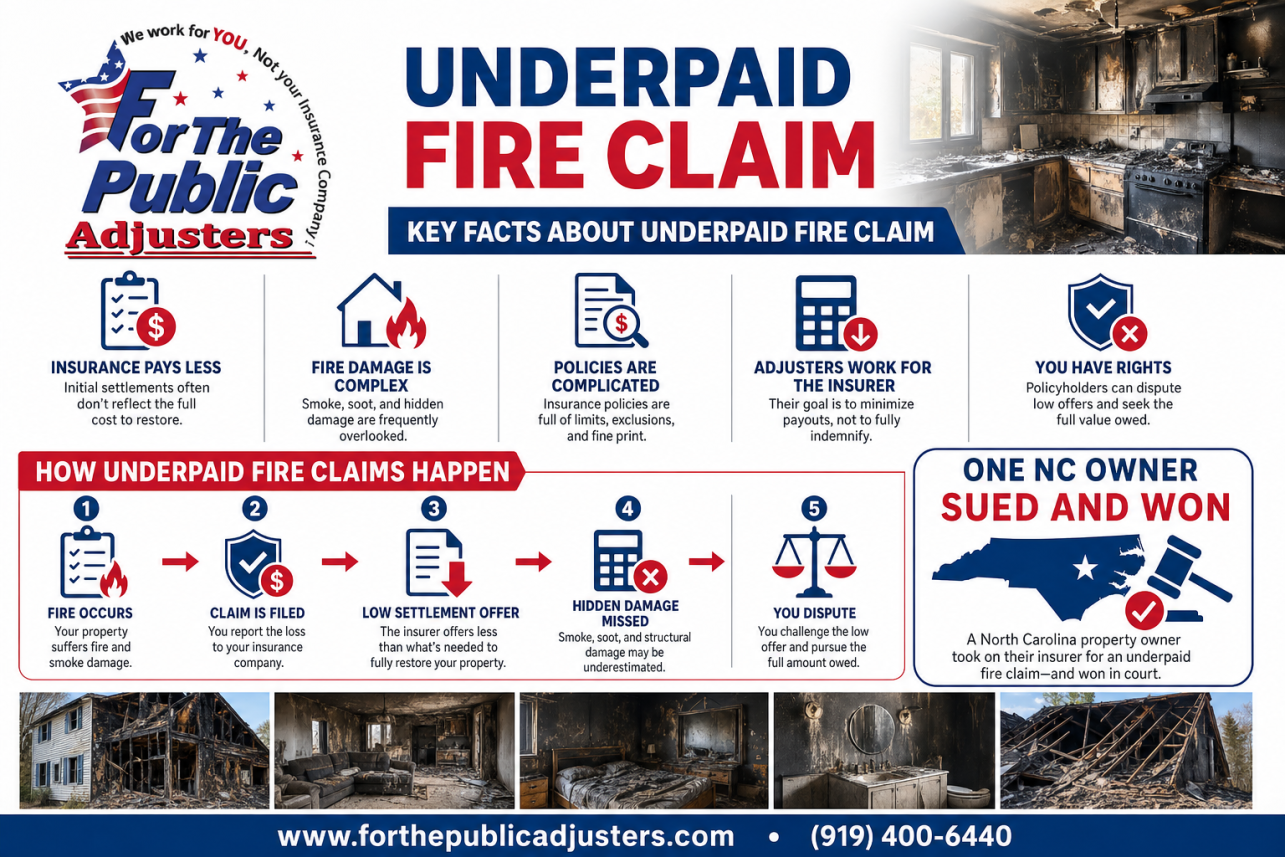
How Do I Know If I Have an Underpaid Fire Claim?
You likely have an underpaid fire claim if your insurer’s structure estimate falls well below actual contractor bids, your contents payout was heavily depreciated, smoke and soot damage was ignored, responses are slow, or the adjuster’s explanations keep changing. Any one of these red flags is reason to question the settlement before you accept it.
Fire losses are complicated, and underpayment rarely announces itself. It usually hides in the details of the estimate. Fall and winter are when we see this most, because fireplace, chimney, and space-heater fires spike as temperatures drop — and these fires often cause damage that spreads far beyond the obvious burn area.
Red Flags That Point to an Underpaid Fire Claim
- Lowball structure estimates. If the insurer’s repair figure is dramatically lower than quotes from reputable local contractors, something was missed — framing, insulation, wiring, or code-required upgrades are common omissions after a chimney fire.
- Heavily depreciated contents payouts. Some insurers apply aggressive depreciation to furniture, clothing, and electronics, then make it hard to recover the holdback. Check whether your policy pays replacement cost and whether you were told how to claim it.
- Ignored smoke and soot damage. A space-heater fire contained to one bedroom can still push smoke through the HVAC system into every room. If your estimate only covers the room that burned, odor, soot residue, and duct contamination may have been left out entirely. Getting smoke damage claim help in Rolesville or anywhere in the Triangle starts with documenting that hidden contamination before it’s painted over.
- Slow responses and stalled inspections. Weeks of silence, repeated requests for documents you already sent, or multiple adjusters cycling through your file often signal a claim that isn’t being handled fairly.
- Shifting explanations. If the reason for a low payment changes each time you ask — first it’s depreciation, then a policy exclusion, then “pending review” — treat that as a warning sign and get everything in writing.
Compare the Paperwork, Not Just the Check
Ask for the insurer’s complete itemized estimate and compare it line by line against independent contractor bids and your own contents inventory. North Carolina courts have shown they will hold insurers accountable when the numbers don’t add up — the Johnston County country club fire case discussed above is proof that policyholders who push back with documentation can prevail.
If you’re not sure whether your settlement is fair, a second opinion costs you nothing but time. A licensed fire claim adjuster in Wake Forest can review your estimate, inspect the damage firsthand, and identify items the insurance company’s figures left out. Trust your instincts: if the payout doesn’t feel like enough to actually rebuild and replace what you lost, it probably isn’t — and you have every right to question it.
What Should I Do If My Fire Insurance Claim Is Underpaid?
If your fire insurance claim is underpaid, start by reviewing your policy, then put every disagreement in writing, obtain an independent estimate of the damage, and formally dispute the insurer’s figures. If the gap remains, bring in a licensed professional or attorney before accepting any final settlement or signing a release.
Taking these steps in order protects your rights and builds the paper trail you may need later. North Carolina courts have shown they will hold insurers accountable when an insured can prove the claim was handled unfairly. In Gray v. North Carolina Insurance Underwriting Association, the North Carolina Supreme Court upheld a verdict for property owners whose storm-damaged homes were underpaid, confirming that unfair claim settlement practices can expose an insurer to significant liability. Documentation is what makes cases like that winnable.
Step 1: Re-Read Your Policy Carefully
Pull your full policy, not just the declarations page. Pay attention to dwelling coverage, contents coverage, additional living expenses, debris removal, and code upgrade provisions. Many underpayments come from coverages the adjuster simply never applied.
Step 2: Put Everything in Writing
From this point forward, communicate by email or letter whenever possible. If you speak by phone, follow up with a short written summary. Request the insurer’s complete estimate and a written explanation for any amounts they reduced or denied.
Step 3: Get an Independent Estimate
Don’t rely solely on the insurance company’s numbers. Have a reputable contractor, restoration company, or licensed public adjuster inspect the property and prepare a line-item estimate. Fire losses often involve hidden smoke, heat, and water damage that a quick carrier inspection misses. Property owners working with a fire claim adjuster in Wake Forest often discover covered damage the original estimate left out entirely.
Step 4: Dispute the Figures Formally
- Send a written dispute letter comparing the insurer’s estimate to your independent estimate, line by line.
- Invoke the appraisal clause if your policy includes one — it’s a formal process for resolving disagreements about the amount of loss.
- File a complaint with the North Carolina Department of Insurance if the carrier is unresponsive or unreasonable.
Step 5: Know When to Bring in Help
If the insurer won’t move after a documented dispute, it’s time for professional support. A public adjuster can manage the claim and negotiation on your behalf, and an attorney may be appropriate if bad faith is involved. Homeowners in Johnston County — where the fire case discussed earlier arose — can get local guidance from a public adjuster in Smithfield NC before deciding how to proceed.
Above all, don’t cash a check marked “final payment” or sign a release while you still dispute the amount. An underpaid fire claim can usually be reopened and corrected — but only if you haven’t given up your rights.

How Can a Public Adjuster Help With an Underpaid Fire Claim?
A licensed, bonded public adjuster works only for the policyholder — never the insurance company. On an underpaid fire claim, they independently measure and document the damage, build a complete contents inventory, review your policy for overlooked coverages, and negotiate directly with the carrier to pursue a fair, fully supported settlement.
That independence matters. The adjuster your insurer sends works for the insurer. A public adjuster is licensed by the North Carolina Department of Insurance and owes their duty to you. As cases like the Country Club of Johnston County decision discussed earlier show, carriers do not always get the number right the first time — and policyholders who push back with solid documentation are often in a far stronger position.
What a Public Adjuster Actually Does
- Independent damage scoping: A room-by-room inspection of structural damage, smoke and soot penetration, and water damage from firefighting efforts — items that quick carrier estimates frequently miss.
- Detailed contents inventories: Cataloging damaged personal property item by item, with values and documentation, rather than relying on a rushed lump-sum figure.
- Policy review: Identifying coverages such as additional living expenses, code-upgrade provisions, and debris removal that may not have been applied to your claim.
- Estimate comparison: Lining up the carrier’s numbers against an independent estimate so every gap is visible and defensible.
- Negotiation: Presenting the documented claim to the insurer and handling the back-and-forth so you are not negotiating alone against a professional claims department.
This kind of detailed rebuild of a claim is exactly the work involved in fire damage claim help in Garner and similar losses across the Triangle, where smoke and water damage often extend well beyond the burn area itself.
Honest Expectations — No Guarantees
Be cautious of anyone who promises a specific result. No reputable public adjuster can guarantee what an insurer will ultimately pay. What a licensed, bonded adjuster can do is make sure your claim is fully documented, every applicable coverage is invoked, and your rights under North Carolina law are protected throughout the process. The National Association of Insurance Commissioners encourages policyholders to verify any adjuster’s license before signing an agreement — a quick step that protects you from unlicensed operators who sometimes appear after large fires.
Most public adjusters work on a contingency fee, a percentage of the settlement, so their interests align with yours. If you believe your payout fell short, having a professional handle something like a fire insurance claim in Mebane NC can level the playing field — turning a frustrating dispute into a documented, professionally presented case for the payment your policy actually provides.
Underpaid Fire Claim: Your Options as a North Carolina Policyholder
| Option | How It Works | Best For |
|---|---|---|
| Accept the carrier’s offer | Sign the release and take the payment as presented | Only when the offer genuinely covers the documented loss |
| Hire a public adjuster | A licensed professional documents and negotiates the claim on your behalf | Owners who want expert help before the claim becomes a legal fight |
| Request appraisal | A policy-based process where each side names an appraiser to resolve value disputes | Disagreements over the amount of loss, not coverage itself |
| Litigation under Chapter 75 | Sue the carrier for unfair and deceptive practices, as in Country Club of Johnston County v. USF&G | Cases where the insurer’s conduct in handling the claim was unfair or deceptive |
Illustrative Example: A Restaurant Owner’s Fire Claim Turned Around
Illustrative example
Consider a hypothetical, composite example: a small-town North Carolina restaurant owner suffers a kitchen fire that damages the building’s structure and destroys much of the contents. The carrier’s first offer covers only surface repairs and ignores smoke damage throughout the building and a large portion of the contents inventory. With professional help, the owner compiles a room-by-room contents list, independent repair estimates, and a clear record of every call and letter with the adjuster. Faced with thorough documentation and the precedent set by cases like Country Club of Johnston County v. USF&G, the carrier reopens the claim and pays a substantially more complete settlement. Every claim is different and outcomes are never guaranteed, but this composite shows how preparation and persistence can change the conversation.
Frequently asked questions
What can I do if my insurance company underpaid my fire claim?
You have real options. Start by requesting the carrier’s estimate and a written explanation of what was paid and why, then compare it against your policy and independent repair estimates. You can dispute the valuation, invoke the appraisal clause if your policy has one, hire a licensed public adjuster, or consult an attorney. North Carolina courts have sided with policyholders before — in Country Club of Johnston County v. United States Fidelity & Guaranty Co., a clubhouse owner took its insurer to trial over a fire claim and won.
Can I sue my insurance company in North Carolina for underpaying a fire claim?
Yes. North Carolina policyholders can bring claims for breach of contract and, where the insurer’s conduct is unfair or deceptive, under Chapter 75 of the General Statutes. In Country Club of Johnston County v. United States Fidelity & Guaranty Co., the owner of a burned clubhouse sued its carrier and the North Carolina Court of Appeals upheld an unfair and deceptive trade practices outcome. Every case turns on its own facts, so have a professional review yours.
What are treble damages in a North Carolina insurance dispute?
Treble damages means the court multiplies the actual damages by three. Under Chapter 75 of the North Carolina General Statutes, if an insurer’s claim handling amounts to an unfair or deceptive trade practice, the policyholder’s proven damages can be trebled. That is what made the Country Club of Johnston County fire case so significant — it showed carriers can face far more than the withheld benefits when they mishandle a claim.
How do I know if my fire claim settlement is too low?
Compare the insurer’s estimate line by line against independent contractor bids, a full inventory of damaged contents, and your policy’s coverage for things like smoke damage, code upgrades, debris removal, and additional living expenses or lost business income. Common red flags include missing rooms or items, depreciation that seems excessive, and pricing well below local repair costs. If the numbers don’t add up, a licensed public adjuster can prepare an independent damage estimate.
How long do I have to dispute an underpaid fire claim in North Carolina?
Deadlines come from two places: your policy, which often sets time limits for filing suit or demanding appraisal, and North Carolina law, which sets statutes of limitation for contract and unfair trade practice claims. Because these deadlines vary and can pass quickly, read your policy carefully and get professional advice as soon as you suspect the payment is short. Acting early also preserves evidence like photos, receipts, and the damaged property itself.
Is it worth hiring a public adjuster for a fire claim?
For significant fire losses, it often is. A licensed public adjuster works only for you — not the insurance company — documenting the full scope of structure, smoke, and contents damage and negotiating with the carrier on your behalf. Most work on a percentage of the recovery, so costs are tied to results. No one can guarantee a specific outcome, but professional documentation frequently uncovers damage and coverage the carrier’s first estimate missed.
What’s the difference between hiring a public adjuster and suing my insurance company?
A public adjuster handles the claim itself — documenting damage, valuing the loss, and negotiating payment under your policy. A lawsuit is a legal remedy, usually handled by an attorney, when negotiation fails or the insurer’s conduct crosses into bad faith or unfair practices. Many disputes resolve through adjusting or appraisal without court. The Country Club of Johnston County case shows litigation can succeed, but it’s typically the step you take after other efforts fall short.
What mistakes do people make after a fire loss that hurt their claim?
The most common missteps: accepting the first check as final without comparing it to independent estimates, throwing away damaged items before they’re documented, giving recorded statements without preparation, missing policy deadlines, and overlooking coverages like additional living expenses, business interruption, or code-upgrade costs. Another big one is assuming the insurer’s adjuster works for you — they represent the carrier. Document everything, keep receipts, and get your own professional assessment before settling.
What should I expect step by step when disputing a fire insurance payout?
Typically: first, request the carrier’s full estimate and a written explanation of the payment. Second, gather your own evidence — contractor bids, a contents inventory, photos. Third, submit a documented supplemental claim or demand for reconsideration. Fourth, if the gap remains, invoke appraisal under the policy or bring in a public adjuster or attorney. Litigation is the final step, and as the Country Club of Johnston County case shows, North Carolina policyholders have prevailed there.
How long does it take to resolve a disputed fire claim?
It depends on the path. Supplemental claims supported by solid documentation may resolve in weeks to a few months. The appraisal process often takes several months. Litigation can take a year or longer, especially if the case goes to trial and appeal, as happened in Country Club of Johnston County v. USF&G. Strong, organized documentation from the start is the best way to shorten the timeline, whichever route you take.
Fire Damage Claim help near you
- Fire Damage Claim Haw River NC
- Fire Damage Claims Adjuster Apex Selma
- Fire Damage Insurance Claim Adjuster Rolesville
Related local pages
If you believe your fire claim was underpaid or unfairly delayed, contact our licensed and bonded NC public adjusters for a free claim review today. Get in touch.
Last updated: October 27, 2026