If you need tree damage insurance claim help Carrboro homeowners can rely on, For The Public Adjusters, Inc. represents you — not the insurance company — from the first inspection through the final settlement check. We document the full scope of roof, structural, and interior damage, prepare the proof of loss, and negotiate directly with your insurer. We are licensed and bonded, and we work only for policyholders.
What This Service Is
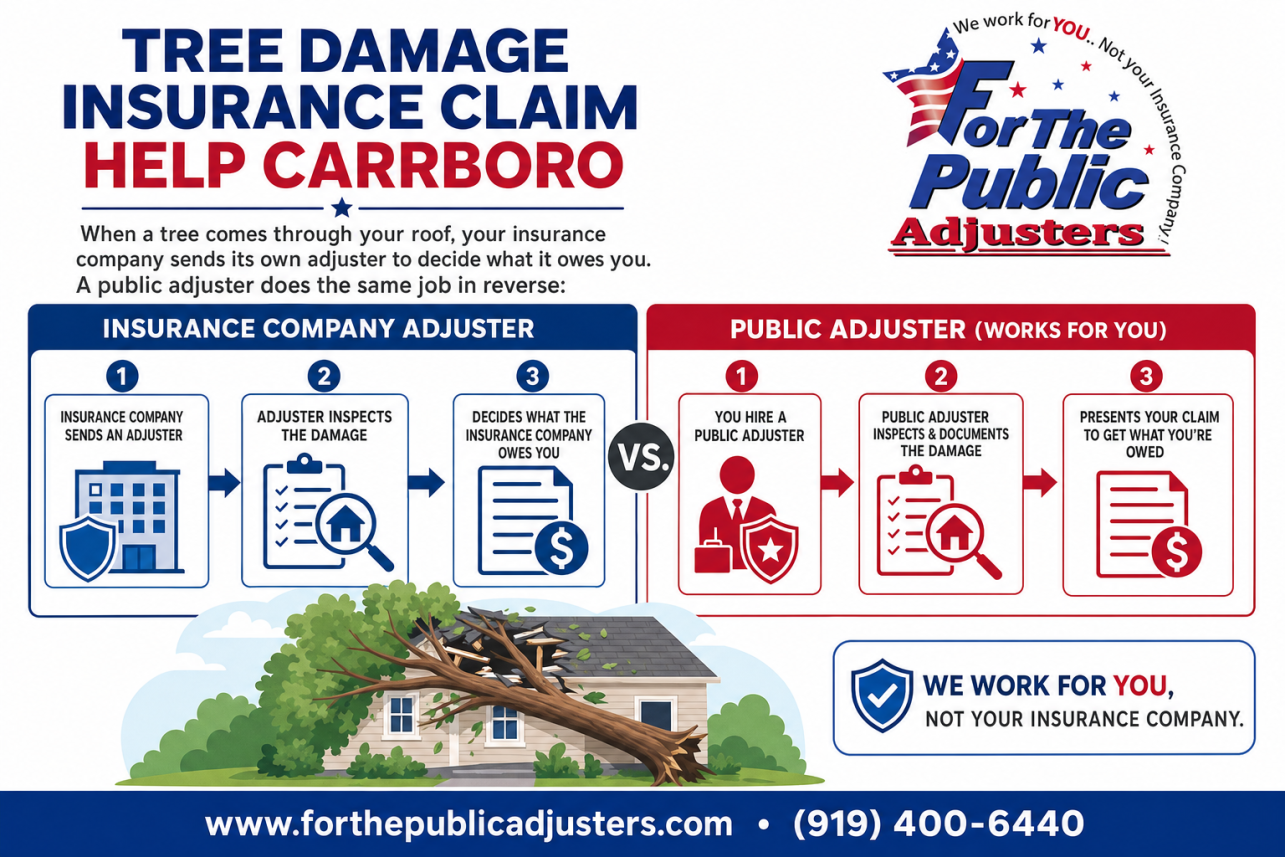
When a tree comes through your roof, your insurance company sends its own adjuster to decide what it owes you. A public adjuster does the same job in reverse: we work for you, the policyholder, and build an independent claim that reflects what the damage actually costs to repair.
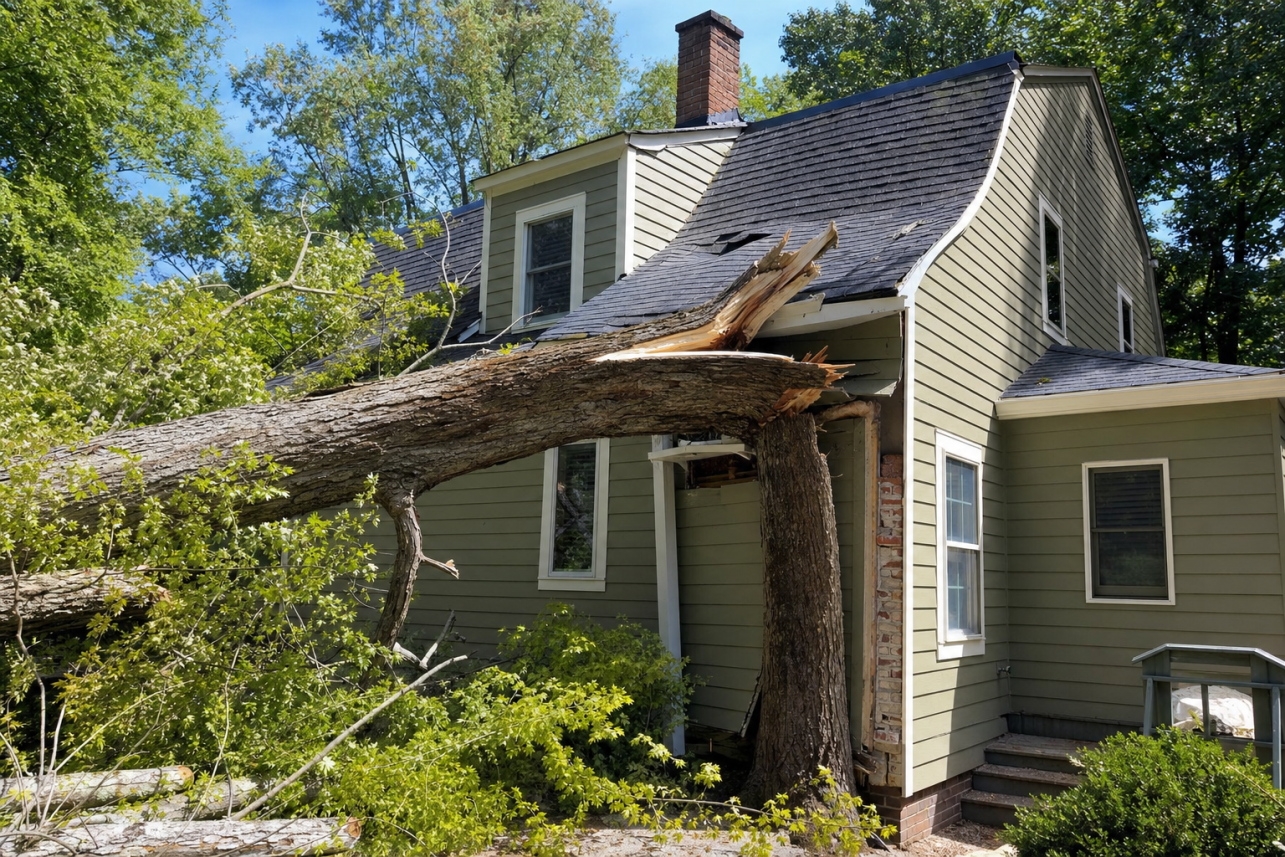
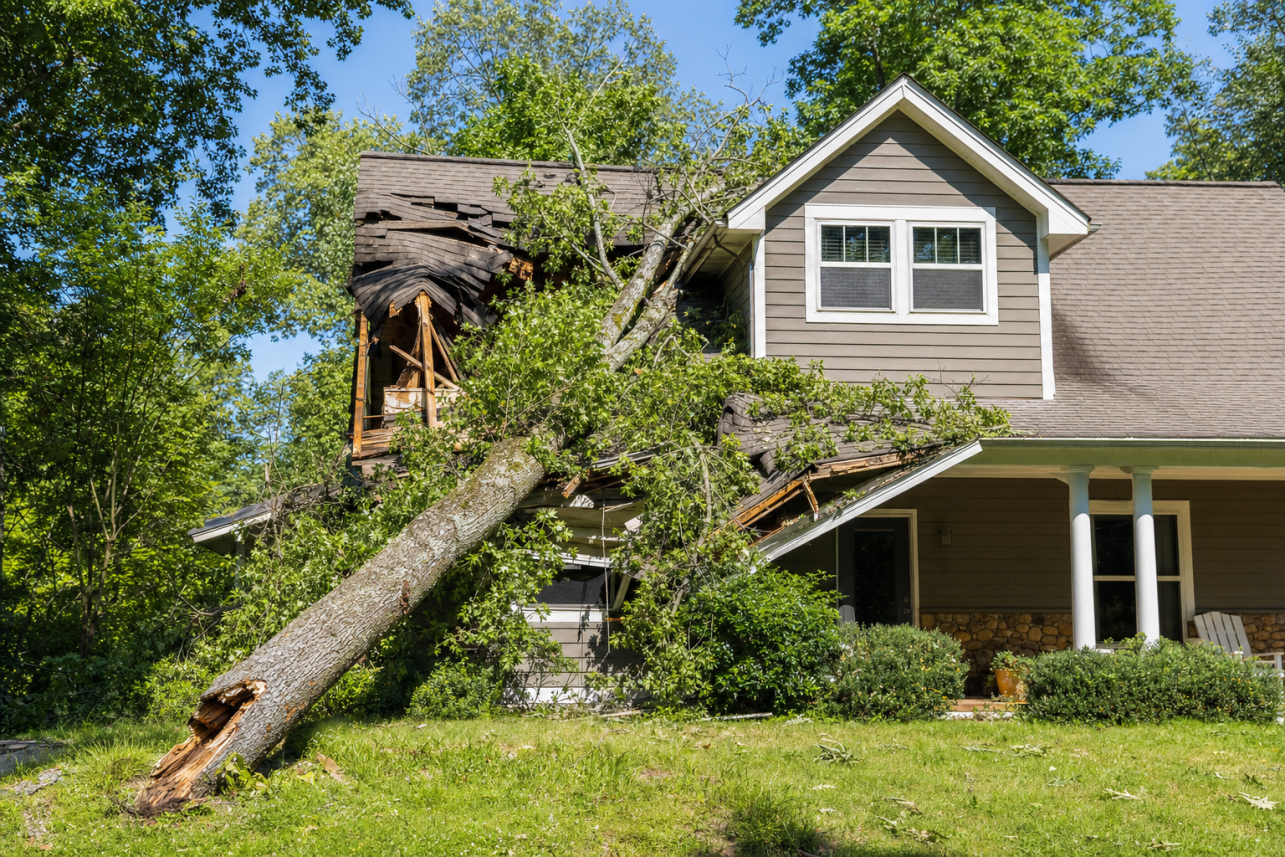
That matters with tree losses because the visible damage is rarely the whole story. A trunk that punches through shingles can crack rafters, shift framing, and open the house to rain that soaks insulation, ceilings, and flooring. We assess the structure, the water intrusion, damaged contents, tree removal costs, and — if the home is unlivable — the additional living expenses your policy may owe while you're out.
We also read your policy the way it deserves to be read. Coverage for tree removal, debris hauling, and emergency tarping is often there but limited or overlooked. Deductibles, exclusions, and the difference between actual cash value and replacement cost all change what lands in your pocket, and we walk you through each of them in plain English. The North Carolina Department of Insurance licenses public adjusters, and the NCDOI Public Adjusters Guide explains exactly what we are permitted to do on your behalf — negotiate, document, and advocate as your representative.
Alongside tree losses we handle related residential and commercial claims, including water damage from roof breaches, hurricane and tornado damage, fire and smoke claims, and flood claims through the National Flood Insurance Program.
Common Problems
Will Insurance Pay To Remove The Tree And Fix Everything — Or Just Part Of It?
This is the most common surprise. Many policies cap tree removal at a fixed dollar amount, and a large hardwood on a roof can cost far more than that cap to crane off safely. Removal of the tree is also a separate question from repairing what it crushed.
Then there's how you get paid. If your insurer settles on an actual cash value basis, it subtracts depreciation from your roof and finishes — meaning you receive less than it costs to actually rebuild, at least until repairs are complete. Add your deductible and out-of-pocket costs climb fast.
We itemize every category your policy responds to: removal, structural repair, interior water damage, damaged contents, temporary protection, and living expenses if you're displaced. The Insurance Information Institute notes that homeowners policies generally cover trees that damage an insured structure — the fight is usually over how much, not whether.
Denied Or Lowballed? Tree Damage Insurance Claim Help Carrboro Homeowners Actually Need
Insurers deny or underpay tree claims for predictable reasons: they call the tree diseased or dead before the storm, blame poor maintenance, limit the scope to visible roof damage, or argue the water intrusion was pre-existing. Sometimes the carrier's adjuster spends twenty minutes on site and misses cracked framing entirely.
You do not have to accept the first number. Policyholders can dispute the estimate, demand a re-inspection, and negotiate — and courts have long held insurers accountable when they wrongly refuse to pay. In Gruenberg v. Aetna Insurance Co., a landmark 1973 California Supreme Court decision, a building owner whose fire loss claim was denied won the right to hold his insurers liable for handling the claim in bad faith, a principle that shaped policyholder rights nationwide.
If your neighbor's tree fell on your house, the claim usually still goes through your own policy first — another point of confusion insurers rarely explain. We sort out that liability question, rebuild the documentation, and press the dispute so a low offer doesn't quietly become the final one. Mind your deadlines, too: policies set time limits for filing and for submitting proof of loss.
Can't I Just Handle The Claim Myself?
You can, and for a small, clean loss you might be fine. But a tree strike is rarely small or clean. The insurance company's adjuster inspects on the carrier's behalf, using the carrier's pricing, and most homeowners have no independent estimate to compare against.
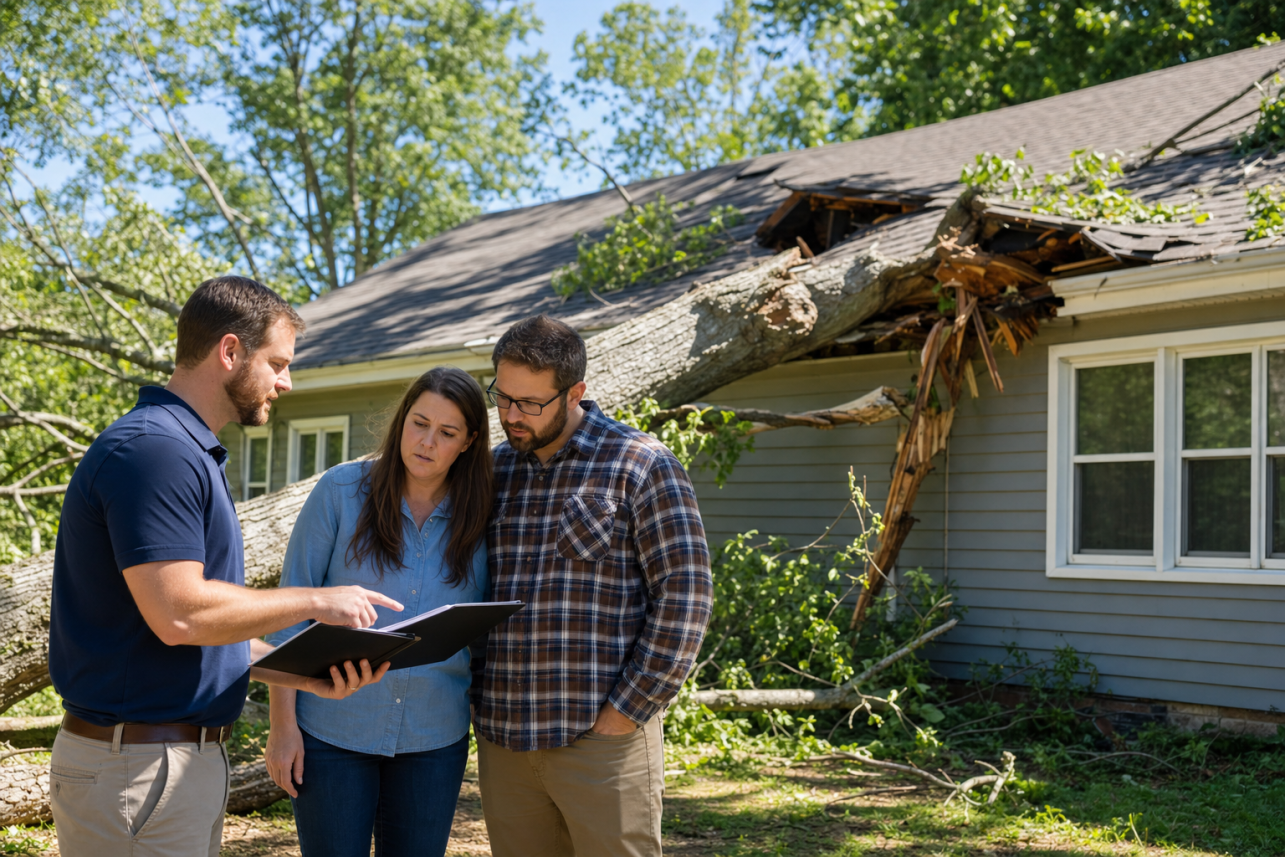
A good public adjuster changes that balance. We climb into the attic, moisture-map interior walls, photograph everything before it's hauled away, and produce a line-item estimate the insurer has to answer. We also handle the calls, forms, and follow-ups that otherwise eat your evenings for months.
When you're choosing help, verify licensing with the North Carolina Department of Insurance, ask how the adjuster is paid, and ask who actually inspects your home. Be honest with yourself about the tradeoff: our fee comes from the settlement, and while we can never guarantee an outcome, our entire job is making sure the claim reflects your real loss rather than a drive-by estimate.
Our Process
Emergency Protection And Policy Review
First, we help you stop the bleeding. Getting the roof tarped and the tree stabilized is both urgent and usually your duty under the policy — insurers can reduce payment for damage you could have prevented. Keep every receipt; emergency repairs are typically reimbursable.
At the same time, we read your full policy: coverage limits, tree removal provisions, exclusions, deductible, and whether you have replacement cost or actual cash value coverage. That tells us exactly what your claim can include before anyone puts a number on paper.
Independent Inspection And Documentation
We perform our own scope-of-damage inspection — roof, framing, attic, interior walls, flooring, and contents — and document everything with photos, measurements, and moisture readings. Hidden structural damage from the impact is the most commonly missed item, so we look where the carrier's adjuster often doesn't.
From that inspection we build a detailed, line-item repair estimate and prepare your proof of loss so nothing is left off the claim from day one.
Negotiation And Settlement
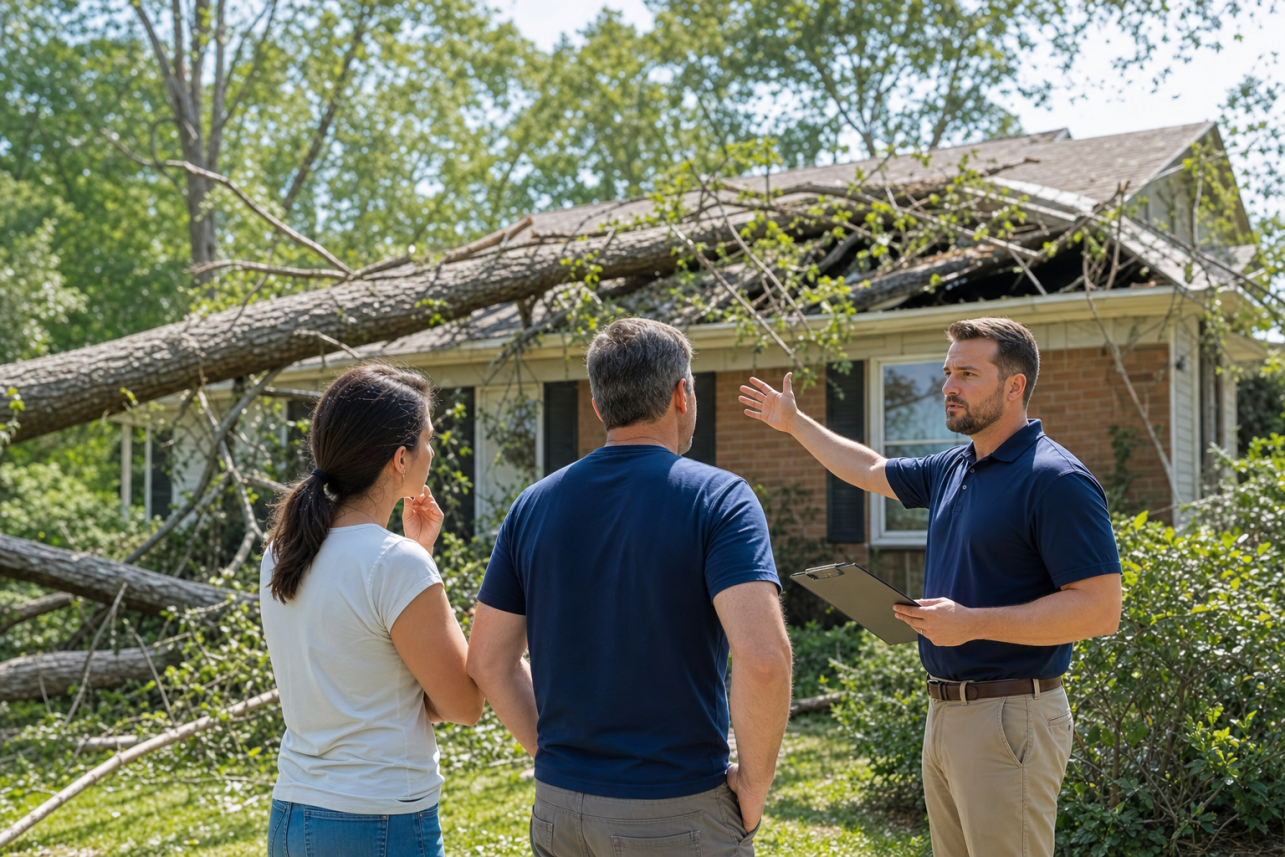
We present the claim to your insurer, attend the carrier's inspection alongside their adjuster, and challenge any estimate that undervalues the loss. When the numbers don't match, we push the dispute item by item — pricing, depreciation, scope — until the offer reflects the documented damage.
You stay informed at every step, and nothing settles without your approval. We cannot promise a specific dollar figure — no honest adjuster can — but we make sure the insurer answers for every documented item.
| What Happens | Filing on Your Own | With For The Public Adjusters |
|---|---|---|
| Damage documentation | Carrier's adjuster photographs visible damage in one visit, often 20–30 minutes | Full inspection with moisture mapping, attic and structural review, and engineering support when framing is hit |
| Tree removal payment | Often limited to the $500–$1,000 debris cap regardless of actual cost | Removal argued under dwelling coverage when the tree damaged a covered structure — frequently the full cost |
| Hidden and water damage | Usually missed until repairs open the roof, then fought as a 'new claim' | Documented up front so soaked insulation, cracked rafters, and interior migration are in the original scope |
| Neighbor's tree disputes | Homeowner bounced between two insurers, often for months | First-party claim pushed forward immediately while notice evidence supports recovery of the deductible |
| Settlement negotiation | Take the first offer or argue alone against a trained adjuster | Line-item estimate, reinspections, and negotiation handled by licensed NC adjusters |
| Your time investment | Dozens of calls, emails, and contractor coordination | We manage the claim; you approve the outcome |
Commonly Overlooked In The Public Adjusting Industry
- Tree removal billed under the dwelling coverage instead of the debris cap — Carriers default to the $500–$1,000 debris limit, and most homeowners never learn that removal from a damaged covered structure is owed under the full dwelling limit.
- Cracked rafters and trusses hidden above the insulation — A field adjuster standing in the yard or peeking into the attic hatch rarely crawls the decking where the limb actually transferred its impact load.
- Water intrusion during the hours before the roof was tarped — The stain on the ceiling is documented, but the saturated insulation and wet wall cavities two rooms away don't show up without moisture meters.
- Discontinued shingles that make a patch repair impossible to match — Estimates get written for a few squares of shingles without anyone checking whether the product line still exists, which changes the claim from a repair to a slope or full replacement.
- Code-required electrical upgrades when the service mast is pulled down — Reconnection in Orange County can trigger panel and grounding upgrades that only get paid if ordinance or law coverage is claimed explicitly.
- Documenting the neighbor's prior notice of a hazardous tree — Old texts, emails, or HOA complaints about a dying tree are the difference between eating your deductible and recovering it, but nobody thinks to preserve them until it's too late.
- Stump grinding, root damage to hardscape, and lawn restoration — Estimates stop at cutting up the trunk, leaving the stump, the heaved walkway, and the equipment ruts across the yard entirely off the claim.
- Additional living expense coverage while the home is unsafe — Homeowners assume ALE only applies to total losses, so nights in a hotel and restaurant meals during a kitchen or roof rebuild go unclaimed.
Case Studies
Case Study #1
Situation: A homeowner on Shelton Street in Carrboro had a mature willow oak split during a summer thunderstorm, dropping a limb the size of a small tree through the roof over their kitchen and into the attic framing.
Problem: The insurance carrier's field adjuster wrote an estimate for patching the roof decking and replacing a few squares of shingles, plus $500 toward tree removal. The offer ignored the cracked rafters, the water that had poured in overnight before tarping, and the fact that the remaining shingles were a discontinued product that couldn't be matched.
Investigation: We brought in a structural engineer to document the fractured rafters and a moisture-mapping inspection to trace water migration into the kitchen ceiling, wall cavities, and hardwood floors. We also pulled the shingle manufacturer's discontinuation notice and photographed the mismatch issue across the roof plane.
Findings: Three rafters were structurally compromised, insulation was saturated across roughly 400 square feet of attic, and the kitchen ceiling drywall showed elevated moisture readings well beyond the visible stain. North Carolina's line-of-sight and matching considerations supported full-slope replacement rather than a patch.
Solution: We prepared a detailed, line-item estimate covering structural repairs, full roof replacement on the affected slopes, interior drywall, paint, flooring, and code-required upgrades, then presented the engineering report and moisture documentation to the carrier and negotiated through two rounds of reinspection.
Outcome: The claim settled at $87,400 — more than six times the carrier's initial $13,900 offer — and the homeowner also recovered additional living expenses for the two weeks the kitchen was unusable.
Lesson: A tree strike is almost never just a roofing claim. Hidden structural and water damage routinely doubles or triples the real repair cost, and it only gets paid if someone documents it before repairs begin.
Case Study #2
Situation: A rental property owner near Carrboro's Plaza district had a neighbor's dying pine fall across the fence line during an ice storm, crushing a detached carport, taking down the electrical service mast, and damaging two tenant vehicles.
Problem: The carrier initially denied most of the claim, arguing the tree belonged to the neighbor and the owner should pursue the neighbor's liability policy. Meanwhile the neighbor's insurer denied liability, claiming no prior notice the tree was hazardous. The owner was stuck between two companies, with tenants threatening to break their leases.
Investigation: We reviewed both policies and the correspondence, obtained an arborist's post-loss assessment of the failed pine, and collected the owner's dated emails from eight months earlier asking the neighbor to address the visibly dead tree. We also documented the code requirement to upgrade the electrical service upon reconnection.
Findings: Under North Carolina practice, the property owner's own policy owed for damage to their structures regardless of whose tree fell — the 'act of God' argument only affected the liability side. The dated emails, however, established the neighbor had prior notice of a hazard, which reopened the negligence claim for the deductible and uncovered items.
Solution: We forced the first-party claim forward with the owner's carrier, itemizing the carport rebuild, service mast and panel upgrade, fencing, and debris removal, while simultaneously packaging the notice evidence for a subrogation and liability demand against the neighbor's insurer.
Outcome: The owner's carrier paid $42,600 for the structures and code upgrades, and the neighbor's liability insurer later reimbursed the $2,500 deductible plus the tenants' vehicle damage. Total recovery exceeded $51,000 on a claim that started as a near-total denial.
Lesson: When a neighbor's tree falls on your property in Orange County, don't let two insurers point at each other while you get nothing. The claims usually run in parallel — but only if someone builds the evidence for both.
| Scenario | Who Typically Pays | What It Depends On |
|---|---|---|
| Your healthy tree falls on your house | Your homeowner's policy | Wind, ice, and storm causes are covered perils; removal is owed when a covered structure is damaged |
| Neighbor's tree falls on your house | Your policy first; neighbor's liability insurer possibly second | Whether the neighbor had prior notice the tree was dead or hazardous — dated emails or arborist letters change everything |
| Your tree falls on the neighbor's property | Their policy, unless you were negligent | If they can prove you knew the tree was dying, your liability coverage may owe their deductible and more |
| Tree falls in the yard, hits nothing | Often not covered, or capped at $500–$1,000 | Most policies only pay removal if a covered structure, fence, or driveway access was damaged or blocked |
| Tree crushes your fence, shed, or carport | Your policy under 'other structures' coverage | Other structures limits are usually 10% of dwelling coverage — large detached buildings can exceed the cap |
| Tree takes down your electrical service mast | Your policy, plus code-upgrade coverage | Whether your policy includes ordinance or law coverage for the panel and service upgrades reconnection requires |
| Tree damage from a rotted, long-dead tree on your lot | Possibly denied | Carriers argue neglect; an arborist's opinion on whether decay was visible from the ground is often decisive |
| Vehicle crushed in the driveway | Auto comprehensive coverage, not homeowner's | Comprehensive must be on the auto policy; the homeowner's carrier will not pay for cars |

Reviews
A red oak came down on our house off Old Fayetteville Road during Tropical Storm remnants last fall. Our insurer offered $9,200 and called it done. For The Public Adjusters found cracked trusses and soaked insulation the company adjuster never even looked at. Final settlement was over $54,000. They handled every call with the carrier so I didn't have to.
Marcus T., Carrboro
The carrier tried to cap our tree removal at $500 even though the trunk was still resting on our garage. Sherri's team knew the policy language cold — since the tree damaged a covered structure, removal was owed under the dwelling coverage, not the debris cap. That one distinction was worth thousands. I'd never have known to argue it myself.
Deborah L., Carrboro
Our neighbor's pine crushed our back porch and fence near Wilson Park. Two insurance companies spent a month blaming each other while we had a tarp for a roof. Within three weeks of hiring this team we had an approved scope from our own carrier and they later recovered our deductible from the neighbor's insurer. Only reason for 4 stars instead of 5 is I wish we'd called them on day one instead of week five.
James and Priya K., Carrboro
Frequently Asked Questions
How Does Tree Damage Insurance Claim Help Carrboro Homeowners Actually Work After A Storm?
When a tree comes down on your Carrboro home, we step in as your licensed public adjuster and manage the claim from start to finish. Unlike the adjuster your insurance company sends, we work exclusively for you, the policyholder.
The process starts with a free review of your policy and the damage. Around Carrboro, we see a lot of mature willow oaks, pines, and sweetgums that fail during ice storms and summer thunderstorms, and the damage often goes far beyond the obvious hole in the roof. We document everything: crushed framing, punctured decking, damaged gutters, cracked drywall, fencing, and water intrusion that follows a breach in the roof line.
From there, we prepare a detailed, line-item estimate using the same estimating software carriers use, submit the claim, and handle every inspection, phone call, and negotiation. If the carrier's first offer is low, and it usually is, we push back with documentation, photos, and code requirements specific to Orange County.
You stay informed at every step, but you don't have to argue with a claims department or interpret policy language on your own. Our fee is a percentage of what we recover for you, so we only get paid when you do. For most homeowners, that means a significantly larger settlement even after our fee, and a far less stressful few months while the repairs come together.
Does My Homeowners Policy Cover Tree Removal, Or Just The Damage To My House?
This is one of the most common points of confusion we untangle for Carrboro homeowners, and the answer depends on where the tree landed and what your specific policy says.
If the tree struck a covered structure, your house, garage, deck, or fence, most policies cover both the repair of that structure and the removal of the tree from it. That removal can be expensive: getting a crane into a tight lot off Estes Drive or near downtown Carrboro to lift a 60-foot oak off a roof can run into the thousands, and carriers often try to lump it into a small sublimit.
If the tree fell in your yard without hitting anything, coverage is much more limited. Many policies pay only $500 to $1,000 for debris removal, and some pay nothing unless the tree blocked a driveway or a handicap-access route. We read your policy carefully to find every applicable coverage, including debris removal, landscaping allowances, and additional living expenses if the home is unlivable.
There's also the neighbor question. If your neighbor's tree fell on your house, your own policy typically responds first, though there are situations involving documented negligence, like a known dead tree, where recovery from the neighbor's carrier is possible.
Before you accept the insurance company's interpretation of what's covered, let us review the policy. The difference between their reading and the actual language is often where the money is.
The Insurance Company Already Made Me An Offer. Can I Still Get Tree Damage Insurance Claim Help Carrboro Residents Can Rely On?
Yes. Receiving an offer, or even cashing a first check, does not close your claim in North Carolina. We provide tree damage insurance claim help Carrboro property owners can use at any stage, including after a settlement offer, a partial payment, or an outright denial.
First offers on tree claims are frequently incomplete. The carrier's adjuster may spend twenty minutes on site, note the visible roof damage, and miss structural issues entirely. Impact from a heavy tree can crack rafters and trusses, shift wall framing, and open gaps that let water in for weeks afterward. We routinely find covered damage the initial inspection never touched.
When we take on a claim that's already been paid, we conduct our own inspection, often with contractors or engineers when the damage warrants it, and prepare a supplement documenting everything the original estimate left out. That includes matching requirements for roofing and siding, local building code upgrades required in Orange County, and proper pricing for labor and materials in the Triangle market, which carriers frequently underestimate.
North Carolina generally gives you three years from the date of loss to pursue a property claim, though your policy may set specific deadlines for certain steps, so it's smart to act quickly. Bring us the carrier's estimate and your policy, and we'll tell you honestly whether reopening or supplementing the claim is worth it. If the numbers are fair, we'll say so. If they're not, we'll fight for the rest.
What Should I Do In The First 48 Hours After A Tree Hits My Carrboro Home?
The first two days shape the entire claim, so a few smart moves matter enormously.
First, make sure everyone is safe and stay out of any area where the structure looks compromised. A tree resting on a roof can shift, and downed limbs near power lines around Carrboro's older neighborhoods are genuinely dangerous. Call Duke Energy if lines are involved.
Second, document everything before anything is moved. Take wide photos and close-ups of the tree on the structure, interior damage, and water intrusion. Video walking the property is even better. Once a tree service hauls the trunk away, you lose your best evidence of the impact's severity.
Third, take reasonable steps to prevent further damage, such as tarping the roof opening, because your policy requires mitigation. Keep every receipt for tarps, tree removal, and emergency repairs; these costs are typically reimbursable.
Fourth, be careful about what you sign. Some tree and restoration companies that show up after storms push assignment-of-benefits agreements or inflated emergency contracts. Read anything before signing it.
Finally, report the loss to your carrier, but keep your description factual and brief. You are not required to give a recorded statement on the spot or speculate about causes.
Calling a public adjuster in Carrboro before the carrier's inspection is ideal, because we can document the loss properly and be present when their adjuster arrives. But whenever you call, the earlier we're involved, the stronger your claim will be.
How Much Does Tree Damage Insurance Claim Help Carrboro Homeowners Cost, And How Do Public Adjusters Get Paid?
For The Public Adjusters, Inc. works on a contingency basis, which means there is no upfront fee and no hourly billing. Our fee is a percentage of the settlement we recover for you, and North Carolina law caps and regulates what licensed public adjusters can charge. If we don't recover anything, you don't owe us anything.
That structure matters because it puts us on the same side of the table as you. The larger and more complete your settlement, the better the outcome for both of us. Insurance company adjusters, by contrast, are paid by the carrier regardless of what you receive.
In practice, homeowners who hire a public adjuster for tree and storm losses frequently net more even after the fee is deducted. That's because tree strikes tend to hide damage that a quick carrier inspection misses: cracked rafters and trusses under an intact-looking roof, sheathing fractures, torn flashing, punctured gutters, and interior water intrusion that shows up weeks later.
When we take on a Carrboro tree damage claim, we document every one of those items, price the repairs at real Orange County contractor rates rather than software defaults, and negotiate line by line. Before you sign anything, we'll review your policy and the damage at no charge and tell you honestly whether professional representation makes financial sense for your situation. If the claim is small and straightforward, we'll say so.
My Neighbor's Tree Fell On My Carrboro Property. Whose Insurance Pays For The Damage?
This surprises most people: in nearly every case, your own homeowners policy pays, not your neighbor's. Under North Carolina law, a healthy tree that falls during a storm is considered an act of nature, and the owner of the tree generally isn't liable. Your insurer covers the damage to your home, then you pay your deductible.
There's an important exception. If the tree was visibly dead, diseased, or leaning, and your neighbor knew or should have known it was a hazard, their liability coverage may come into play. That's a negligence argument, and it requires evidence, such as photos of prior rot, arborist reports, or written notice you sent the neighbor before the storm.
In older Carrboro neighborhoods off Estes Drive and near downtown, mature willow oaks and pines sit close to property lines, so these cross-boundary situations come up constantly after strong storms roll through Orange County. We see the same thing along the wooded lots toward Calvander and White Cross.
When we handle these claims, we sort out which policy applies, document any evidence of pre-existing decay while it still exists, and pursue subrogation angles that could get your deductible reimbursed. Don't let the tree get hauled away before the trunk and root ball are photographed. Rot in the core of a fallen trunk can be the difference between paying your deductible and recovering it.
The Tree Only Clipped My Roof And The Insurer Says The Damage Is Cosmetic. Is It Worth Fighting?
Usually, yes. "Cosmetic" is one of the most overused words in tree claim denials, and a glancing strike can cause serious structural damage that isn't visible from the ground or even from a quick walk on the shingles.
When a limb or trunk impacts a roof edge, the force transfers through the decking into the rafters and trusses below. We routinely find cracked truss chords, split rafters, and fractured sheathing in Carrboro attics after the carrier's adjuster spent fifteen minutes outside and called it a few damaged shingles. Impact can also break the seal on surrounding shingles, which won't leak today but will fail in the next hard rain.
The stakes go beyond this repair. If hidden framing damage isn't documented and paid now, a leak six months later becomes a fight over whether it's "new" damage or neglect, and neglect isn't covered.
Our team inspects from the attic side, moisture-maps interior ceilings and walls, and brings in structural documentation when the framing is compromised. We then present the carrier with evidence they can't wave off as cosmetic. Many of our strongest recoveries in Orange County started as claims the homeowner was told were barely worth the deductible. A free second look costs you nothing, and if the damage genuinely is minor, we'll tell you that too.
How Long Does Tree Damage Insurance Claim Help Carrboro Residents Hire Actually Take To Get A Claim Paid?
Under North Carolina insurance regulations, carriers must acknowledge your claim promptly and either pay or deny it within a reasonable time after receiving proof of loss. In practice, a well-documented tree claim in Carrboro typically resolves in 30 to 90 days. Poorly documented claims, or claims where the homeowner and carrier keep going back and forth over scope, can drag on for six months or longer.
Professional representation usually shortens that timeline rather than extending it. The single biggest cause of delay is incomplete documentation: the carrier requests more photos, another inspection, a contractor estimate, then disputes that estimate. We eliminate those cycles by submitting a complete, itemized proof of loss upfront, with measurements, photographs, moisture readings, and line-item pricing the carrier's software can be checked against.
A few local factors affect timing. After a major storm hits Orange County, adjuster availability tightens and tree services book out for weeks, so getting your claim documented early puts you ahead of the backlog. Claims involving structural framing repairs may also need engineering input, which adds a couple of weeks but usually adds far more in settlement value.
When homeowners come to us seeking tree damage insurance claim help Carrboro carriers take seriously, we set expectations at the first meeting and keep the pressure on with documented follow-ups. If a carrier stalls past regulatory timeframes, we know exactly how to escalate, including complaints to the North Carolina Department of Insurance when warranted.
My Insurer Denied The Claim Because They Say The Tree Was Dead Or Diseased. Can Tree Damage Insurance Claim Help Carrboro Homeowners Overturn That?
Yes, and this denial is one of the most common reasons homeowners call us. Insurers frequently invoke a maintenance or neglect exclusion, arguing the tree was visibly rotten and you should have removed it before it fell. That argument only holds up if they can actually prove the decay was obvious to a reasonable homeowner before the storm.
In practice, many trees in Orange County fail because of internal rot, root plate saturation from heavy rain, or wind stress that no one could see from the ground. A healthy-looking willow oak can be hollow at the core. When we take on a denied claim, we often bring in a certified arborist to examine the stump and root ball, document the failure mode, and produce a report that directly rebuts the insurer's assumption.
We also pull weather data for the date of loss. If straight-line winds or a named storm moved through Carrboro that day, wind becomes the proximate cause of loss, and wind is a covered peril under virtually every homeowners policy sold in North Carolina.
A denial letter is the insurer's opening position, not the final word. North Carolina gives you the right to dispute it, and our team handles that dispute for you, from the arborist evidence through the re-inspection and negotiation. Do not haul the stump away or grind it before someone qualified documents it, because that stump is often the single best piece of evidence you have.
Beyond The Obvious Hole In The Roof, What Hidden Damage Should I Be Looking For After A Tree Strike?
The visible impact point is rarely the full story, and it is where insurance adjusters tend to stop looking. When a mature oak or pine hits a house, the force transfers through the entire structure, and the most expensive damage is often the damage you cannot see from the driveway.
Start with the roof deck. A limb strike can fracture decking and rafters several feet away from the puncture, and shingles that look intact may have broken seals or crushed mats that will leak within a year. Inside the attic, look for cracked trusses, shifted framing, and daylight where there should be none.
Then check the walls and foundation lines near the impact. Fresh drywall cracks, doors that suddenly stick, and separation at crown molding can all signal that the frame racked when the tree landed. In older Carrboro homes near downtown and in neighborhoods with big canopy trees, plaster cracking is a frequent tell.
Do not forget systems and exterior items: gutters, fascia, chimney flashing, HVAC condensers clipped by limbs, fencing, and detached structures like sheds or carports. Each of these is a separate line item the carrier should pay for.
When a public adjuster in Carrboro inspects for you, we document every one of these items with photos and measurements before the estimate is written. Damage that never makes it into the claim file never gets paid, so the thoroughness of that first inspection often determines the size of your settlement.
My Settlement Check Mentions Depreciation And 'actual Cash Value.' Why Didn't I Get The Full Replacement Cost?
Most homeowners policies in North Carolina pay tree-related structural claims in two stages, and this trips up a lot of people. The first check is the actual cash value, meaning the replacement cost of your roof, siding, or framing minus depreciation for age and wear. If your roof was fifteen years old, that deduction can be substantial.
Here is the part insurers rarely explain clearly: if you have replacement cost coverage, most of that depreciation is recoverable. Once you complete the repairs and submit invoices, the carrier owes you the difference between what they held back and what you actually spent, up to the approved amount. Homeowners who never file for that second payment leave real money on the table, and it happens constantly.
Problems arise when the carrier's replacement cost figure was too low to begin with. If their estimate prices a roof replacement at rates no licensed Orange County contractor will actually work for, then even full recovery of depreciation leaves you short. That is where we earn our fee, by rebuilding the estimate with accurate local labor and material pricing before the depreciation math ever gets applied.
We also watch the deadlines. Policies typically give you a limited window, often 180 days to two years depending on the language, to complete repairs and claim recoverable depreciation. Our team tracks those dates, prepares the documentation, and pushes the supplemental payment through so the final number reflects what the repair genuinely costs, not what the insurer hoped it would.
The Shingles On My Roof Are Discontinued And The Insurer Only Wants To Patch The Damaged Section. What Are My Options?
This is the matching dispute, and it comes up constantly with tree claims on Carrboro homes built in the 1990s and 2000s, when many shingle lines that have since been discontinued were installed. The insurer wants to pay for a small repair area; you are left with a roof that looks visibly patched and may be harder to sell.
North Carolina does not have a statute forcing carriers to replace undamaged sections for matching, but that is far from the end of the argument. Many policies contain language about repairing with materials of like kind and quality, and if a genuinely matching shingle no longer exists, a patch does not satisfy that obligation. Independent third-party verification that your shingle is discontinued, which we obtain through industry databases, is often the pivot point in these negotiations.
There is also a practical angle: roofers frequently find that tying new shingles into an aged, brittle field causes additional breakage, which expands the repair scope legitimately. A careful test square and documented brittleness can turn a patch into a slope replacement, and sometimes a full roof.
When you bring in tree damage insurance claim help Carrboro homeowners have used on this exact issue, the negotiation shifts from your word against the desk adjuster's to a documented technical dispute the carrier has to answer. For The Public Adjusters, Inc. has settled matching disputes across Orange County, and in our experience insurers move significantly once discontinuation and brittleness are proven rather than merely claimed. Do not accept the patch offer until someone has actually run those tests.
A Tree Crushed My Fence, Shed, And Deck In Carrboro — Are Detached Structures Covered Too?
In most cases, yes. Standard homeowners policies include "other structures" coverage — usually 10% of your dwelling limit — that applies to fences, detached garages, sheds, gazebos, and similar structures on your Orange County property. If a pine comes down across your fence line and takes out a shed in the process, both should be claimable.
The complication is how insurers value these items. Fences in older Carrboro neighborhoods are often custom-built or use materials that have aged together, and carriers frequently want to pay for replacing only the crushed sections. That leaves you with a patchwork fence in mismatched materials. There are strong arguments, backed by policy language and repair standards, for full-run replacement when a partial fix would be visibly inconsistent.
Decks are another sticking point. A carrier may call a deck attached to the house part of the dwelling, or classify it as another structure — and that classification changes which limit applies and how much money is available. We review the policy definitions carefully because the difference can be thousands of dollars.
Also worth knowing: trees, shrubs, and landscaping themselves carry a separate sub-limit, often 5% of the dwelling coverage with a per-tree cap around $500. That cap applies to replacing the plant, not to removing debris or repairing what it hit. A Carrboro public adjuster can map each piece of damage to the correct coverage so nothing gets lumped into the wrong bucket and underpaid.
Can I Have The Tree Removed Before The Insurance Adjuster Shows Up, Or Will That Hurt My Claim?
You can — and sometimes you must — but document everything first. Your policy actually requires you to prevent further damage, so if a trunk is resting on a compromised roof or blocking your only driveway access, removing it or having it stabilized is reasonable and expected. What you cannot do is erase the evidence.
Before any crew touches the tree, photograph it from every angle: where it fell from, where it landed, the point of impact, the root ball or break point, and the full scene from the street. Take video walking the property. If the trunk shows the tree was healthy when it fell, capture that too, because carriers sometimes later argue the tree was dead or rotten.
Keep every invoice from the tree service, and ask them to itemize removal from the structure separately from general yard cleanup. Those line items are treated differently under most policies, and a lumped-together bill makes it easier for the carrier to shortchange the reimbursement.
If the situation isn't an emergency, it's often smarter to wait until the damage has been inspected — either by the carrier's adjuster or by your own representative. When homeowners call us for tree damage insurance claim help Carrboro crews haven't yet cleared, we can inspect the scene intact, which almost always strengthens the claim. Either way, save cut sections of the trunk if disease or decay might become an issue. Physical evidence beats arguments every time.
The Tree Made My House Unlivable. Will Insurance Pay For A Hotel Or Rental While Repairs Are Done?
Yes, this falls under Additional Living Expenses (ALE), sometimes called Loss of Use coverage, and it's one of the most underused parts of a homeowners policy. If a tree strike leaves your home without a safe roof, working power, or intact plumbing, the carrier owes the reasonable extra costs of living elsewhere while repairs are made.
ALE covers more than a hotel bill. It includes rental housing, increased mileage if you're commuting from farther away, pet boarding, laundry costs if you lose your washer and dryer, and the difference between your normal food budget and eating out. The key word is "additional" — you're reimbursed for costs above what you'd normally spend.
In a tight rental market like Carrboro and Chapel Hill, especially near the university, comparable short-term housing can be expensive and scarce. Carriers sometimes push families toward cheaper options far from work and schools. You're entitled to housing that maintains your normal standard of living, not just the least expensive vacancy in Orange County.
Keep every receipt from day one, even for small expenses. Also watch the timeline: ALE runs only for the reasonable period needed to repair the home, so if the carrier drags out approval of the structural claim, your displacement costs climb while they debate. Part of what a public adjuster does is keep the repair claim moving so the ALE clock works in your favor, and document delays that are the insurer's fault rather than yours.
What Documentation Should I Gather Before Getting Tree Damage Insurance Claim Help Carrboro Homeowners Typically Need?
The stronger your file, the faster and larger your settlement — so start collecting evidence immediately, even before you decide whether to bring in a professional.
Start with the scene itself. Photos and video of the tree in place, the impact points, interior ceilings and walls below the strike, and anything crushed underneath. Date-stamped images matter because Carrboro sees damage from multiple weather events — hurricane remnants, summer thunderstorms, winter ice — and carriers occasionally try to attribute damage to an earlier, unclaimed storm.
Next, paperwork. Locate your full policy, including the declarations page and all endorsements, not just the summary card. Save the tree service invoice, any emergency tarping or board-up receipts, and contractor estimates if you've gotten them. If neighbors or a passing arborist saw the tree fall or commented on its condition beforehand, note their names.
Then, a damage inventory. Walk every room and list affected contents — furniture, electronics, clothing — with approximate purchase dates and values. Don't throw damaged items away until they've been documented and, ideally, inspected.
When clients come to us for tree damage insurance claim help Carrboro carriers will take seriously, we build on this foundation with our own inspection, moisture readings, and a line-item repair estimate written in the same software insurers use. But even homeowners handling a claim alone benefit enormously from this discipline. A claim backed by dated photos, organized receipts, and a written inventory is very hard for an adjuster to lowball, and very easy to escalate if they try.
Local Relevance
Carrboro is one of the most tree-covered towns in the Triangle, and that canopy is exactly why tree claims are so common here. Mature oaks, poplars, and pines tower over homes from the old mill-village neighborhoods near downtown to wooded lots on the edge of town, and many of those houses date back decades — with roof framing that takes real damage when a heavy limb or trunk lands on it.
Summer is the high season for these losses across Orange County. Severe afternoon thunderstorms roll through with straight-line gusts, and from June through November the remnants of hurricanes and tropical storms can push through the Piedmont with soaking rain and wind that topples whole trees. After several wet days, the region's clay soil holds water and root systems lose their grip — which is why healthy-looking trees come down in storms that don't seem extreme.
We work these claims throughout Carrboro, Chapel Hill, and the rest of Orange County, and we know how local carriers' adjusters tend to scope them. If a storm has put a tree on your home this season, the documentation you gather in the first few days shapes everything that follows — and that's where we come in.
Carrboro's dense mature hardwood canopy sits in Piedmont clay soil that saturates quickly during summer thunderstorm stretches, so whole-tree root failures onto homes are often more common here than simple broken limbs — and a full trunk strike tends to mean hidden framing damage that a quick rooftop inspection will miss.
A Tree Is On Your House — Let's Handle The Claim Right
For The Public Adjusters, Inc. is licensed and bonded, and we work only for policyholders — never the insurance company. Call before you accept the carrier's first offer, and we'll review your policy and damage at no obligation.
Call us: (919) 400-6440
Helpful Resources
- NCDOI Public Adjusters Guide
- Insurance Information Institute (III)
- North Carolina Department of Insurance — State regulator that licenses public adjusters and assists consumers
- Ready.gov hurricane preparedness — Federal guidance on preparing for hurricanes and tropical storms
Last updated: July 29, 2026