
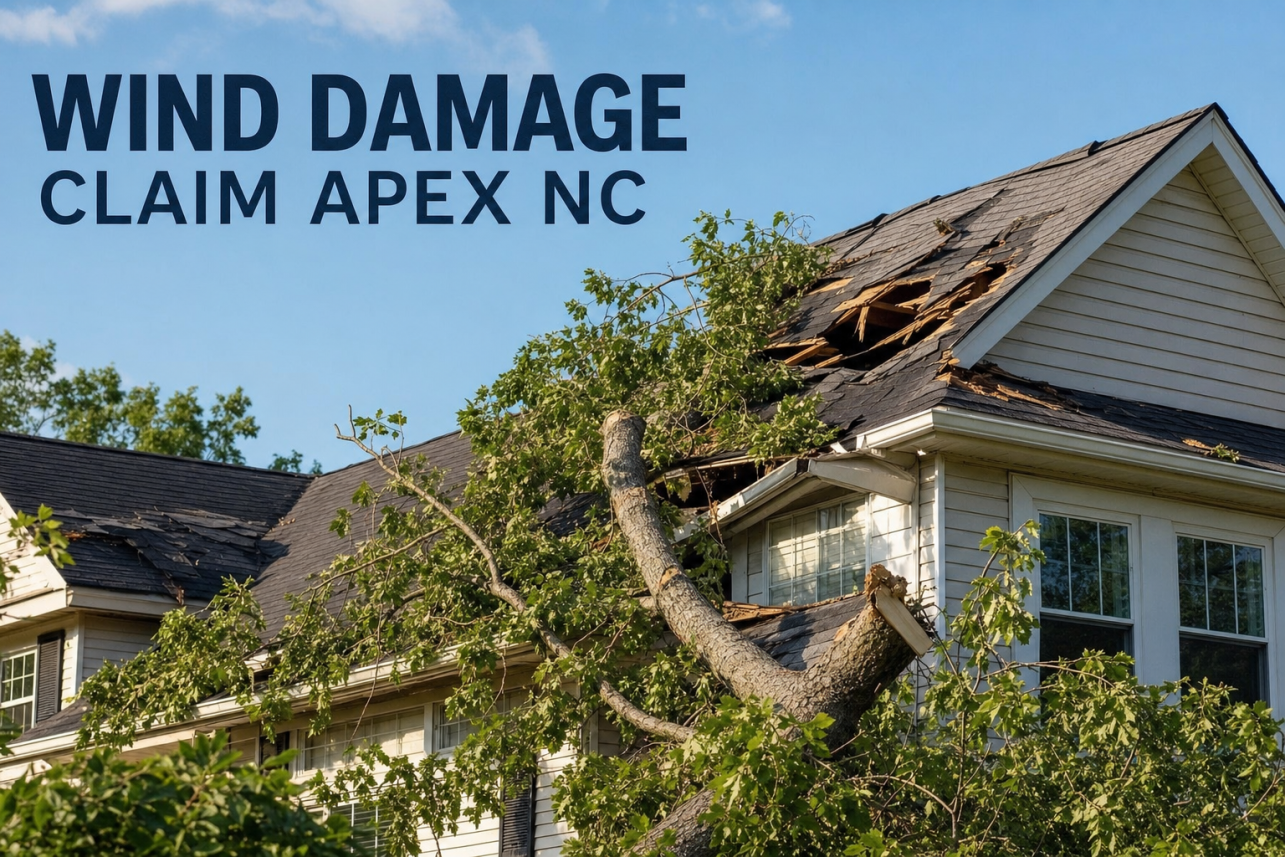
When hurricane remnants or a tornado damage your roof or home, For The Public Adjusters, Inc. manages your Wind Damage Claim Apex NC from first inspection through final settlement — working for you, not the insurance company. We document the storm damage, prepare a detailed repair estimate, and negotiate directly with your carrier. We are licensed and bonded in North Carolina, and we only get paid when your claim gets paid.
What This Service Is
A public adjuster is a licensed claims professional who represents the policyholder — never the insurance company. When a tropical system or tornado hits Apex, your insurer sends its own adjuster to assess the damage. That person works for the carrier. We do the same job from the other side of the table, on your behalf.
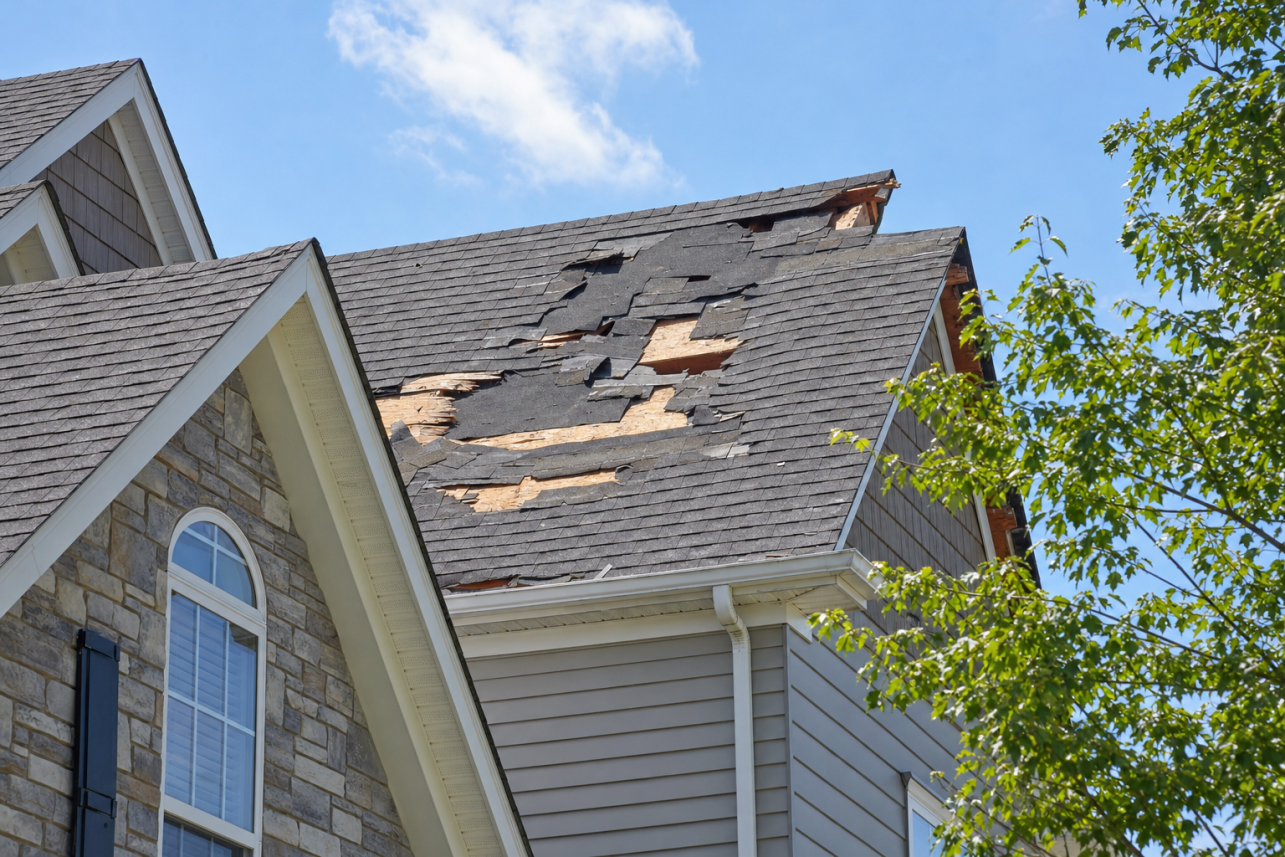
For wind claims, that means a top-to-bottom damage assessment: lifted and creased shingles, torn flashing, damaged siding, broken windows, and the interior water stains that follow wind-driven rain through a compromised roof. We also review your homeowners policy before anything is filed, so you know your coverage limits, your deductible, and whether a separate windstorm deductible applies to your claim.
From there we build a line-item repair estimate, submit the claim with full documentation, and negotiate the settlement. If a storm already pushed a tree through your roof, that overlaps with our tree damage work as well — the same documentation standards apply whether we're in Wake County or handling a Wind Damage Claim in Cary NC one town over. The Insurance Information Institute explains that wind is one of the most common homeowners perils in the Southeast, yet wind claims are also among the most frequently disputed — which is exactly why independent representation matters.
Common Problems
Why Did My Insurance Claim For Wind Damage To My Roof Come In So Low?
Lowball offers on roof claims usually come from two places: scope and depreciation. The carrier's estimate may cover a patch repair when the whole slope needs replacement, or it may miss the decking, underlayment, flashing, and interior damage entirely.
Then there's depreciation. If your policy pays actual cash value first, the insurer deducts for the age of your roof — and some carriers have tried to depreciate labor costs too, not just materials. Policyholders have pushed back and won: in Sproull v. State Farm Fire & Casualty Co., the Illinois Supreme Court sided with the homeowner, ruling the insurer could not depreciate labor when calculating an actual cash value payment on a storm-damaged home.
We read your policy, identify whether you have replacement cost coverage, and make sure depreciation is applied correctly — and recovered where the policy allows. We never guarantee a specific dollar outcome, but we do make sure nothing covered gets left off the estimate.
What If My Wind Damage Claim Apex NC Gets Denied As Wear And Tear?
This is the most common fight we see in Apex. Many roofs here went on during the building boom of the late '90s and 2000s, and carriers lean on that age to label tornado or hurricane damage as ordinary deterioration. A denial letter is not the end of your claim.
The answer is evidence. We tie the damage to a specific storm event, photograph the directional pattern wind leaves on shingles, and document creasing and seal failure that gradual aging simply doesn't produce. Fresh storm damage looks different from a roof that wore out, and a thorough inspection proves it.
We also watch for delay tactics — endless document requests, re-inspections, and silence past the point of reason. We handled similar carrier pushback on a wind damage claim help in Burlington matter, and the pattern is familiar: the file moves once the documentation makes denial hard to defend. If the dispute still won't resolve, we can bring in appraisal or refer you toward insurance dispute attorneys.
Do I Need A Wind Damage Public Adjuster, Or Can I Handle The Claim Myself?
You can file on your own, and for small, undisputed claims that may be fine. The trouble starts when the carrier's number doesn't match your contractor's, when the claim drags for months, or when you're told the damage isn't covered. At that point you're negotiating against professionals who do this every day.
A good public adjuster levels that field. Look for someone licensed by the state — the NCDOI Public Adjusters Guide explains how North Carolina regulates public adjusters and what they're permitted to charge — and ask how they document damage and build estimates. Anyone promising a specific payout should raise a red flag; no honest adjuster can guarantee a result.
We work on contingency, so our interest is aligned with yours. We also handle fire, smoke, water, and tree damage claims, so if the same storm dropped a limb through a neighbor's house, the way we built a tree damage home insurance claim in Mebane shows how we approach those too.
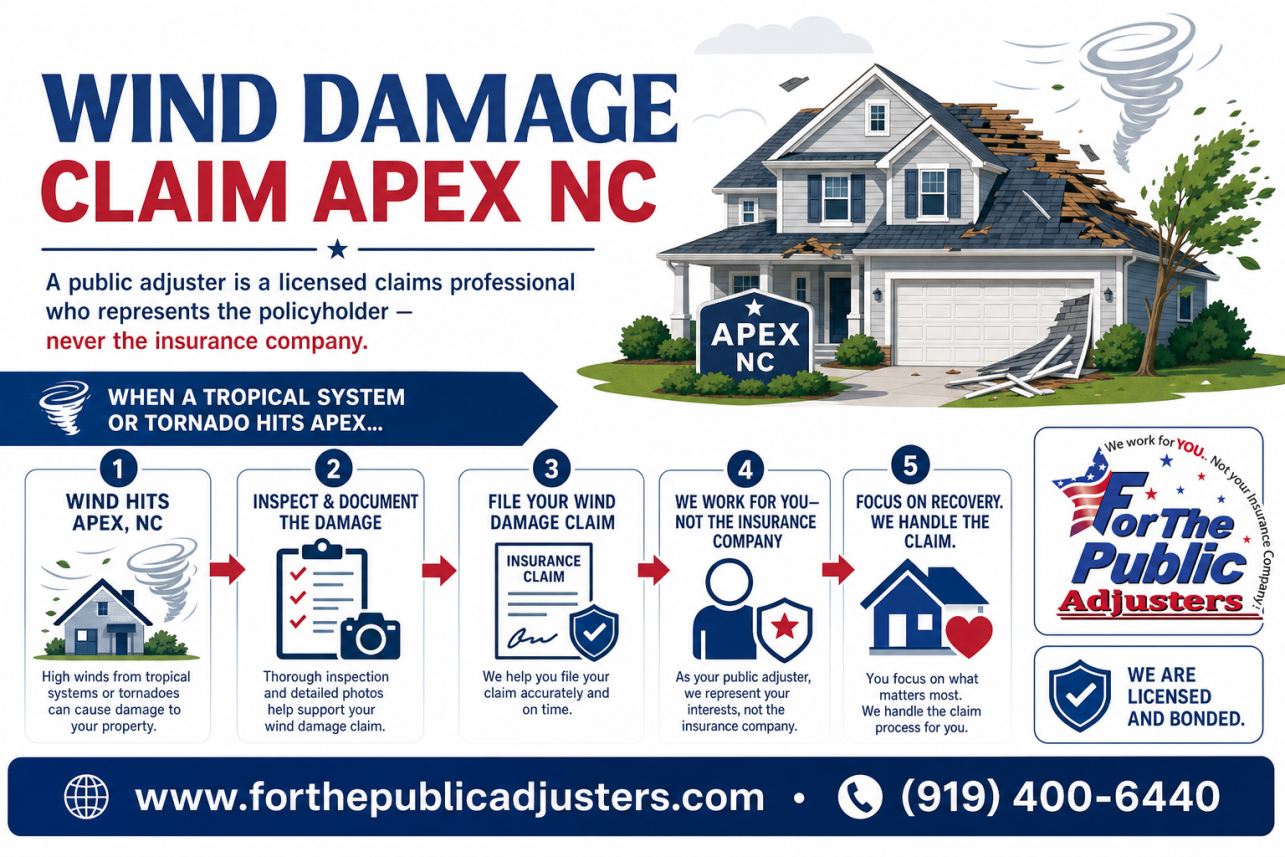
Our Process
Policy Review And Free Damage Inspection
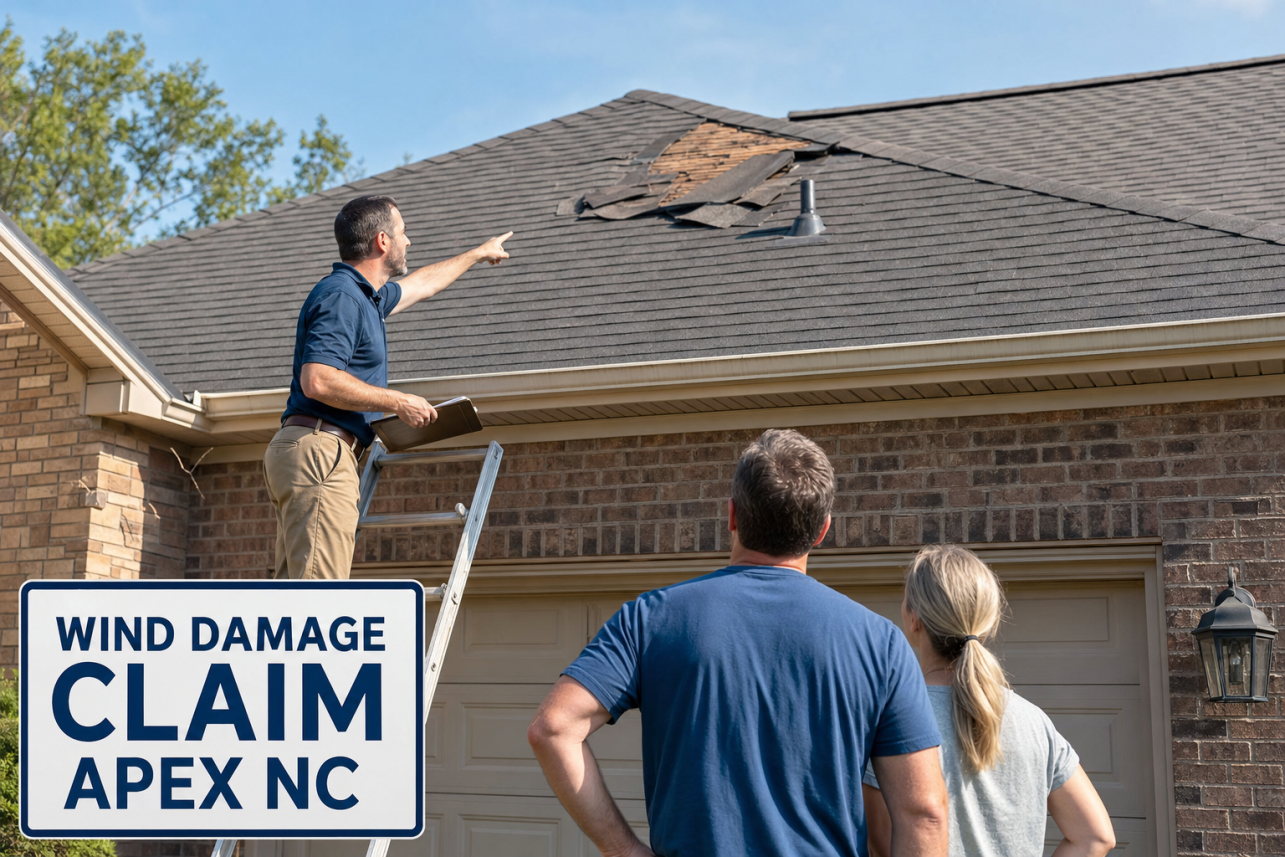
We start by reading your homeowners policy — coverage limits, exclusions, your deductible, and whether a separate windstorm deductible applies. Then we inspect the property ourselves: roof, siding, gutters, windows, attic, and interior ceilings where wind-driven rain often shows up weeks later. You'll know what you're actually entitled to claim before anything is filed.
Documentation And A Complete Repair Estimate
We photograph everything, note the storm date, and pull weather records that tie your damage to the hurricane or tornado event. Then we build a line-item estimate covering structure, contents, and emergency protection — including reasonable temporary repairs like tarping, which your policy typically expects you to make to prevent further damage. Keep those receipts; they're part of the claim.
Negotiation, Supplements, And Settlement
We present the claim to your carrier, meet their adjuster on site, and negotiate the settlement on your behalf. If hidden damage surfaces once repairs begin — rotted decking under the shingles is a classic example — we file a supplemental claim rather than letting you absorb the cost out of pocket. We stay on the file until it closes, and we watch every filing deadline along the way.
| Claim Step | On Your Own | With Our Team |
|---|---|---|
| Damage inspection | You rely on the carrier's adjuster, who may spend 20 minutes on a roof inspection and photograph only visible missing shingles. | Slope-by-slope roof documentation, seal-strip and crease testing, attic moisture mapping, and collateral damage review of gutters, siding, and soft metals. |
| Proving the cause | Insurer may label hurricane or tornado damage as 'wear and tear' or 'pre-existing,' and you have no counter-evidence. | NWS wind data, storm reports, dated photos, and uplift-pattern analysis that ties the damage to the specific storm event. |
| The estimate | You compare the carrier's number to one contractor bid and hope they match. | A complete line-item estimate including code upgrades, matching, debris removal, and interior build-back — the items most often left out. |
| Negotiation | You argue your own case against trained claims professionals. | A licensed and bonded public adjuster negotiates with documented evidence, with precedent like Grace v. Lititz Mutual on the policyholder's side when causation is disputed. |
| Your time | Weeks of phone calls, paperwork, and re-inspections squeezed around work and family. | We manage the file start to finish and keep you informed at each stage. |
Commonly Overlooked In The Public Adjusting Industry
- Broken shingle seal strips on slopes that look intact — Unsealed shingles can't resist the next storm, but they only show up when someone physically lifts and tests them — which drive-by inspections never do.
- Ordinance-and-law (code upgrade) coverage — Wake County code requirements for decking, underlayment, and ventilation add real cost to a hurricane roof replacement, and carrier estimates frequently price the roof as if codes never changed.
- Collateral damage to soft metals — Dented gutters, downspouts, window wraps, and HVAC condenser fins prove the storm's severity and are claimable, yet most homeowners never think to photograph them.
- The separate hurricane or named-storm deductible — Many North Carolina policies apply a percentage deductible for named storms instead of the flat dollar amount, and policyholders often discover it only when the check arrives short.
- Hidden uplift to roof decking and framing — A tornado-strength gust can crack or shift sheathing under shingles that stayed in place, and it's invisible until the attic is inspected or the roof is opened.
- Matching of siding and roofing materials — Discontinued shingle lines and vinyl siding profiles mean a 'repair' can leave a visibly mismatched home, and the matching issue must be raised before work starts, not after.
- Additional Living Expense entitlements — Families displaced after a tornado often pay for hotels and meals out of pocket without realizing the policy reimburses those costs — but only with receipts.
- Misclassifying wind-driven rain as flood — Rain that enters through a storm-created opening is a covered wind loss, while rising water belongs to a flood policy through the NFIP, and carriers sometimes blur that line in their favor.
Case Studies
Case Study #1
Situation: A family on a wooded lot near Apex Community Park came to us after the remnants of a late-season hurricane pushed a tornado-warned band of storms across western Wake County. Their roof lost shingles across two slopes, and a section of ridge vent was gone entirely.
Problem: Their insurer sent a field adjuster who approved a small repair for the visibly missing shingles only, about $4,100. The estimate ignored creased shingles, lifted flashing, and water staining that appeared on an upstairs ceiling ten days after the storm. The family was told the staining was 'pre-existing wear.'
Investigation: Our licensed and bonded team performed a full roof inspection with slope-by-slope photo documentation, lifted test shingles to check for broken seal strips, and used moisture meters in the attic and the affected bedroom. We also pulled NWS storm reports confirming rotation and damaging wind gusts over Apex on the date of loss.
Findings: More than 60% of the shingles on the windward slopes had broken adhesive seals or creasing, meaning they could no longer perform in the next storm. The attic sheathing showed fresh water tracking directly below the missing ridge vent, tying the interior damage to the storm, not to age.
Solution: We prepared a line-item estimate for full replacement of the damaged slopes, interior repairs, and code-required upgrades, then presented the causation evidence to the carrier. We pointed to the principle affirmed in Grace v. Lititz Mutual Insurance Co., a hurricane case where the policyholder prevailed because the insurer could not prove its excluded cause, which supported our position on the disputed ceiling damage.
Outcome: The carrier reinspected with our documentation in hand and issued a revised settlement many times the original repair figure, covering the roof slopes, the interior work, and ordinance-and-law items the first estimate skipped entirely.
Lesson: A tornado or hurricane doesn't have to rip a roof off to total it. Broken seal strips and creased shingles are real storm damage, and they're exactly what a quick drive-by inspection misses.
Case Study #2
Situation: The owner of a small commercial building off US-1 in Apex contacted us after hurricane remnants drove sustained winds and torrential rain through the area. Wind peeled back a section of the membrane roof, and rain poured into two tenant suites overnight before a tarp could be placed.
Problem: The insurer's engineer attributed the membrane failure to 'deterioration and improper installation' and the interior saturation to 'surface water,' effectively denying both the roof and the contents inside. The owner was facing tenant complaints and a six-figure repair bill with a denial letter in hand.
Investigation: We retained independent documentation of the peel pattern, which showed classic wind uplift starting at the perimeter edge metal, not at seams where installation defects would appear. We timestamped the interior intrusion against hourly wind data showing when gusts peaked over Apex, and we inventoried the damaged tenant contents item by item.
Findings: The edge metal had been torn loose by wind, creating the opening through which rain entered. That made the interior loss wind-driven rain through a storm-created opening, a covered peril, rather than rising surface water, which would fall to a flood policy through the NFIP.
Solution: We rebutted the engineer's report point by point and cited Corban v. United Services Automobile Association, the Hurricane Katrina decision where the court sided with the policyholders on how wind and water causes must be separated, with the insurer bearing responsibility for proving what its exclusion actually caused. We submitted a complete estimate for the roof system, interior build-back, and business contents.
Outcome: The denial was reversed. The carrier paid for the full membrane roof replacement, interior restoration of both suites, and the documented contents, and the owner kept both tenants in place through the repairs.
Lesson: When wind creates the opening and rain follows it in, that is a wind loss, not a flood loss. The distinction is worth real money, and it has to be proven with evidence, not accepted from a one-sided engineer report. If rising water is ever part of your loss, that portion belongs with a flood policy — FEMA and the National Flood Insurance Program are the right resources for that piece.
| Storm Damage Scenario | What the Outcome Hinges On | Smart Next Step |
|---|---|---|
| Shingles missing or lifted after a hurricane band | Whether the remaining shingles still have intact seal strips — unsealed shingles are damaged even if they look fine from the ground. | Get a full roof inspection documented before any repairs; don't accept a 'patch only' estimate on sight. |
| Tree or large limb on the roof or structure | Whether structural framing, decking, and connected systems (HVAC, electrical mast) were affected, not just the shingle layer. | Photograph everything before the tree is removed, then have the hidden structure inspected after removal. |
| Ceiling stains appearing days after the storm | Whether the water entered through a storm-created opening — that links the interior loss to the wind event. | Moisture-map the attic and walls promptly; delayed staining is routinely misread as a maintenance issue. |
| Insurer says the damage is wear and tear | Who carries the burden of proof — courts in hurricane cases like Grace v. Lititz Mutual have put the burden on the insurer for excluded causes. | Request the denial in writing and have an independent causation review done before accepting it. |
| Wind-driven rain vs. rising water in the same storm | Wind-driven rain through a storm opening is a wind peril; rising surface water is flood, covered only through a flood policy such as the NFIP (floodsmart.gov / fema.gov). | Separate the two losses with evidence and timing; file the flood portion, if any, under your flood policy. |
| New roof section doesn't match the old one | North Carolina matching considerations and your policy's language on uniform appearance. | Raise matching before repairs begin — it's far harder to resolve after a mismatched slope is installed. |
| Home unlivable after a tornado touchdown | Whether your policy includes Additional Living Expense coverage and how losses are documented. | Keep every receipt for lodging, meals above normal costs, and mileage from day one. |
| Settlement offer seems low but you're exhausted | Whether the estimate includes code upgrades, tear-off, flashing, interior finishes, and contents — not just surface materials. | Have the estimate reviewed line by line before cashing anything; a review costs nothing but a conversation. |

Reviews
After the tornado warning night in April, we had shingles in the yard and a wet ceiling, and our insurance company offered barely enough to patch one slope. For The Public Adjusters found creased and unsealed shingles across the whole front of the roof that their adjuster never touched. The revised settlement covered a proper roof and the ceiling repair. I would never handle a storm claim alone again.
Marcus T., Scotts Mill neighborhood
Hurricane remnants dropped a huge oak limb through our screened porch and pulled gutters and fascia off the back of the house. The first estimate ignored the porch structure entirely. This team documented everything, including the bent HVAC unit the limb clipped, and walked the carrier's adjuster through it line by line. The difference in the payout was significant, and they explained every step in plain English.
Deborah L., near downtown Apex
My HOA situation made my wind claim complicated — the carrier kept saying the roof was the association's problem and the interior water damage was 'maintenance.' For The Public Adjusters sorted out exactly what my policy covered, proved the water came in through storm-torn flashing, and got my interior claim paid. Honest about what they could and couldn't control, which I appreciated.
Rajan P., Apex townhome owner
Frequently Asked Questions
What Does A Public Adjuster Do For A Wind Damage Claim Apex NC Homeowners File After A Hurricane Or Tornado?
When a hurricane or tornado tears through Apex, your insurance company sends its own adjuster to inspect the damage. That adjuster works for the insurer. A public adjuster works only for you, the policyholder.
For The Public Adjusters, Inc. starts by reading your full policy, including endorsements and exclusions most homeowners never see. We then document every category of storm damage — torn or lifted shingles, broken trusses, water intrusion through breached roofing, damaged siding, fencing, outbuildings, and destroyed contents inside the home.
We prepare a detailed, line-item estimate using the same software insurers use, then negotiate directly with the carrier on your behalf. We are licensed and bonded in North Carolina, and we handle the meetings, re-inspections, and paperwork so you can focus on your family and your home.
Courts have repeatedly affirmed that policyholders can push back and win. In Corban v. United Services Automobile Association (Mississippi Supreme Court, 2009), a homeowner whose house was destroyed during Hurricane Katrina prevailed when the court ruled the insurer could not deny covered wind losses simply because flooding also contributed to the damage. That principle — the insurer must pay for the covered wind damage it owes — is at the heart of what we fight for on every claim.
We cannot guarantee any specific outcome or dollar amount; no honest adjuster can. What we can promise is a thorough, professionally documented claim presented by someone whose only client is you.
My Apex Home Was Hit By A Tornado, And The Insurer Says Part Of The Damage Is Pre-Existing Wear. Can You Help?
Yes — this is one of the most common disputes we see in Wake County after tornado events, including the kind of rotating storms that have cut across the Triangle in past outbreaks like April 2011.
Insurers often attribute roof and structural damage to 'age,' 'wear and tear,' or 'improper installation' rather than to the storm. The difference matters enormously, because wear is excluded while sudden storm damage is covered. Distinguishing the two requires evidence, not opinions.
Our team inspects the property in person, photographs damage patterns consistent with tornado-force winds — directional shingle creasing, uplifted decking, racked framing, impact marks from windborne debris — and compares them against pre-storm condition records, weather data, and neighboring properties. We also document interior damage that follows a breach, such as wet insulation, stained ceilings, warped flooring, and ruined furniture and contents.
When the carrier's position doesn't match the evidence, we challenge it through supplements, re-inspections, and the dispute options built into your policy, such as appraisal. Policyholders who stand their ground often prevail; the Corban decision after Hurricane Katrina is a leading example of a homeowner defeating an insurer's attempt to shrink a covered storm loss.
We never promise a particular result, but we do make sure your claim is supported by the kind of documentation that is hard for an insurer to dismiss. If you're in Apex or anywhere in Wake County, we can typically inspect quickly after a storm.
After A Hurricane, How Do You Separate Wind Damage From Flood Damage On My Claim?
This question decides who pays what, so it deserves a careful answer. A standard homeowners policy in North Carolina covers hurricane wind damage — subject to your deductible, which is often a separate, higher hurricane or named-storm deductible. Flooding from rising water is excluded and is covered only if you carry a separate flood policy through the National Flood Insurance Program (NFIP) or a private flood carrier.
After a hurricane moves through Apex, both perils can hit the same house. Wind peels back the roof and rain pours in from above, while runoff or a swollen creek pushes water in at ground level. Insurers sometimes try to assign as much damage as possible to the flood exclusion.
We document the physical evidence that separates the two: water lines, the direction of water staining, roof breaches, debris patterns, and the timeline of the storm itself. In Corban v. USAA, the court held that an insurer remains responsible for the wind damage its policy covers even when flooding contributed to the total loss — a ruling that protects homeowners in exactly this situation.
If you suffered flood damage and carry an NFIP policy, we recommend reviewing your coverage and claim rights at FEMA.gov and FloodSmart.gov, the official NFIP site. Please note that we handle property claims only — we do not work on claims involving motor vehicles, health, life insurance, or cell phones. For the home, the structure, and your contents, that's where we come in.
How Much Does It Cost To Hire For The Public Adjusters, Inc. For A Wind Damage Claim Apex NC Property Owners Are Disputing?
We work on a contingency fee, which means our fee is a percentage of the insurance recovery, agreed to in writing before we begin. There is no hourly billing and no upfront charge for our standard claim work. If the claim recovery doesn't happen under the terms of our agreement, you don't owe our fee.
For many Apex homeowners, the real question is whether hiring us is worth it. Hurricane and tornado claims are complicated: hurricane deductibles, ordinance-and-law coverage for code upgrades, contents inventories, additional living expenses while you're displaced — each of these is an area where undocumented losses simply go unpaid. Our job is to find, document, and present every dollar your policy actually owes you.
We are licensed by the North Carolina Department of Insurance and bonded, and our contract spells out the fee percentage clearly so there are no surprises. We encourage you to read it carefully and ask questions before signing.
To be clear and honest: we never guarantee a specific settlement amount or outcome. Every loss, policy, and carrier is different. What history shows is that well-documented, well-argued claims fare better — and when carriers overreach, courts have sided with homeowners, as in the Corban hurricane decision where the policyholder defeated the insurer's attempt to avoid paying for covered storm damage to the home.
If your property in Apex or elsewhere in Wake County was damaged by a hurricane or tornado, a free initial review of your claim and policy costs you nothing.
How Long Do I Have To File A Wind Damage Claim Apex NC Insurers Will Still Accept After A Hurricane Or Tornado?
Most homeowners policies in North Carolina require "prompt notice" of a loss, and the state generally allows three years from the date of damage to bring a lawsuit on a property policy — though some policies shorten that window by contract, so read yours carefully. The practical answer is simpler: report hurricane or tornado damage as soon as you safely can.
Wind losses in Apex get harder to prove the longer you wait. Shingle creasing, lifted flashing, and racked framing from a tornado's rotational winds can be masked by follow-up weather, and insurers often argue that delayed damage is wear and tear rather than storm-related.
When you bring us a Wind Damage Claim Apex NC deadlines become part of our job to manage. We track your policy's notice requirements, proof-of-loss deadlines, and any suit-limitation clause, then document the loss quickly with photos, moisture readings, and roof inspections tied to the storm date.
Courts have sided with policyholders who pushed back on causation disputes after major wind events. In Corban v. United Services Automobile Association (Mississippi Supreme Court, 2009), a Hurricane Katrina homeowner won a key ruling that wind damage occurring before any later flooding remained covered, and the insurer could not use an anti-concurrent causation clause to erase it. That principle — wind damage is wind damage, regardless of what happened afterward — is exactly the kind of argument we build into claims here in Wake County. We are licensed and bonded, and while no one can promise a specific result, acting early gives your claim its strongest footing.
The Insurance Company Already Inspected My Tornado-Damaged Roof In Apex And Made A Low Offer. Is It Too Late To Bring You In?
No. In most cases you can dispute, supplement, or reopen a claim even after the carrier's adjuster has inspected and issued a payment, as long as your policy's deadlines haven't expired. Accepting an initial check in North Carolina does not usually mean you've accepted it as final payment — many of the tornado claims we handle in Apex start exactly this way.
The first thing we do is compare the insurer's estimate against the actual scope of damage. Carrier adjusters working a storm backlog often miss things tornado winds cause: broken roof decking fasteners, racked gable walls, interior cracking from structural movement, and contents damaged when wind-driven rain entered through roof openings.
We then prepare our own detailed estimate using the same industry pricing software insurers use, backed by photographs, measurements, and when needed, reports from engineers or roofing specialists. That documentation becomes the basis for a supplemental demand or, if necessary, the appraisal process built into most policies.
Policyholders who challenge lowball wind estimates do win. In Broussard v. State Farm Fire & Casualty Co., a Mississippi couple whose home was destroyed during Hurricane Katrina took their insurer to court after a denial, and a jury awarded them full policy benefits for the wind destruction of their home. Litigation is a last resort — most of our Wake County claims resolve through negotiation — but that case shows carriers can be held to the policy they sold. We're licensed and bonded, we work only for you, and we can't guarantee a specific dollar outcome, but we can make sure every item of damage is on the table.
What Should I Document Right After A Tornado Or Hurricane Hits My Home In Apex Before Anyone Starts Repairs?
Start with wide photographs of every side of the house, then move closer: the roof from the ground, each damaged elevation, broken windows, fence lines, and any debris field showing the wind's path. Debris direction can actually help prove tornado rotation versus straight-line wind, which matters when the carrier questions causation.
Inside, photograph every room with storm damage — water stains on ceilings, cracked drywall, shifted door frames, and wet flooring. Open closets and attics; wind-driven rain often travels far from the entry point. For contents, photograph damaged furniture, electronics, and belongings where they sit before moving anything, then keep the items if safely possible rather than discarding them.
You're required to protect the property from further damage, so tarping a roof or boarding windows is appropriate — but save every receipt, because reasonable emergency measures are typically reimbursable. Don't authorize permanent repairs or sign contracts with storm-chasing contractors before the loss is fully documented. Once a roof is replaced, the evidence is gone.
Also jot down the date and approximate time of the storm. The National Weather Service's Raleigh office surveys tornado tracks through Wake County, and their reports can corroborate your claim with wind speeds and confirmed paths near Apex.
When homeowners in Apex hire us early, we handle this documentation professionally — moisture mapping, itemized contents inventories, and roof inspections — so nothing is lost before the insurer's adjuster arrives. If a hurricane also caused flooding, note that flood loss falls under a separate NFIP policy; FEMA and FloodSmart.gov explain that process, and we'll help you keep the wind and flood claims properly separated.
Does My Homeowners Policy Cover Both The Structure And My Belongings If A Hurricane Or Tornado Damages My Apex House?
In most cases, yes — a standard North Carolina homeowners policy covers wind damage from hurricanes and tornadoes under several coverage parts. Coverage A pays for the dwelling itself, Coverage B for detached structures like sheds and fences, Coverage C for personal property, and Coverage D for additional living expenses if the home is unlivable during repairs.
That last one surprises many Apex families. If a tornado tears off part of your roof and you have to stay in a hotel or rental while repairs are made, those reasonable extra costs are typically covered. We routinely find that carriers underpay or ignore this coverage entirely.
Contents claims deserve just as much attention as the roof. Wind-driven rain entering through storm openings can ruin furniture, clothing, and electronics, and you're generally entitled to compensation at replacement cost if your policy includes it — not just depreciated value. We build room-by-room inventories so belongings aren't settled with a vague lump sum.
Two important limits: many Wake County policies carry a separate wind or named-storm deductible, often a percentage of your dwelling coverage rather than a flat amount, which changes the math on your payout. And flooding — including hurricane storm surge or rising water — is excluded from homeowners policies; that requires a separate flood policy through the National Flood Insurance Program, with resources available at FEMA.gov.
As licensed and bonded adjusters working solely for policyholders, we read your specific policy, apply the correct deductibles, and pursue every coverage your premiums paid for. No one can guarantee a particular settlement, but a complete claim is always stronger than a partial one.
How Does The Hurricane Or Wind Deductible Affect A Wind Damage Claim Apex NC Homeowners File?
Many homeowners policies written in Wake County carry a separate wind or hurricane deductible, and it often works very differently from your standard deductible. Instead of a flat dollar amount, it is usually a percentage of your dwelling coverage — typically 1% to 5%. On a home insured for $450,000, a 2% wind deductible means the first $9,000 of hurricane or tornado damage comes out of your pocket.
That math matters, because insurers sometimes apply the wrong deductible or apply a percentage deductible to losses it should not govern. Part of our job on a wind damage claim in Apex is reading the deductible endorsement line by line and confirming it was triggered correctly for your specific storm event.
We also make sure the full scope of damage is on the estimate. When a carrier undervalues a roof, siding, or interior water intrusion from a tornado or hurricane, a steep percentage deductible can swallow a lowballed payout entirely. A properly documented, accurately priced claim is often the difference between a check and a denial letter that says your loss 'fell below the deductible.'
Bring us your declarations page and we will walk you through exactly which deductible applies, how it is calculated, and what that means for your recovery. We never guarantee a specific outcome, but we do make sure the numbers your insurer uses are the right ones.
My Insurer Will Only Pay To Patch Part Of My Tornado-Damaged Roof, But The Shingles Won't Match. What Are My Options?
This is one of the most common disputes we handle after tornadoes move through Apex and surrounding Wake County neighborhoods. The carrier approves a repair for the slope that took the direct hit, but the replacement shingles are discontinued or visibly different from the rest of the roof. You end up with a patchwork roof that hurts your home's value.
Courts have sided with policyholders on this exact issue. In Cedar Bluff Townhome Condominium Association v. American Family Mutual Insurance Co., the Minnesota Supreme Court ruled in 2014 that the insured was entitled to replacement of all building siding — not just the storm-damaged panels — because matching materials were no longer available. The reasoning in matching cases like that one is frequently persuasive when we negotiate roof and siding disputes here in North Carolina.
Our approach starts with documentation. We verify whether your shingle line has been discontinued, obtain manufacturer and supplier statements, and have the roof evaluated for hidden wind damage the field adjuster may have missed — lifted tabs, broken seals, and fastener pull-through often don't show up in a quick drive-by inspection.
Then we present the carrier with a complete, supported scope. Many partial-repair offers turn into full-slope or full-roof settlements once the matching problem and the true extent of wind damage are properly documented. Every policy and every roof is different, so we review your specific language before advising you on the strongest path forward.
What If I Disagree With My Insurance Company's Settlement Offer After A Hurricane Hits My Apex Home?
You are not required to accept the first number your insurer puts in front of you. Most North Carolina homeowners policies include an appraisal provision, which lets either side demand an independent valuation when the dispute is about the amount of loss. Each party selects an appraiser, the two appraisers choose an umpire, and the resulting award resolves the pricing disagreement without a lawsuit.
Before invoking appraisal, though, it usually pays to challenge the estimate directly. We re-inspect the property, prepare our own line-item estimate using current Wake County labor and material pricing, and identify everything the carrier's adjuster missed — attic damage, wind-driven rain intrusion, racked framing, and damaged gutters and fencing are common omissions after hurricanes and tornadoes.
Policyholders who push back with evidence often prevail, and courts have backed them. In Corban v. United Services Automobile Association, the Mississippi Supreme Court ruled in 2009 for a homeowner after Hurricane Katrina, holding that the insurer bore the burden of proving an exclusion applied before it could deny covered wind damage. That burden-of-proof principle is a powerful tool when a carrier shortcuts its investigation.
As licensed and bonded public adjusters, we represent only you — never the insurance company. We cannot promise a specific dollar result, but we can make sure your hurricane loss is measured completely and your policy rights, including appraisal, are used to full effect.
Will My Policy Pay For A Hotel And Living Expenses While My Home Is Being Repaired After A Wind Damage Claim Apex NC Residents Experience During A Tornado?
In most cases, yes. If a tornado or hurricane makes your home unfit to live in, the Additional Living Expenses (ALE) or Loss of Use portion of your homeowners policy covers the reasonable increase in your costs while repairs are underway. That typically includes hotel or short-term rental costs, the difference in food expenses when you cannot cook at home, extra mileage, pet boarding, and even laundry costs.
The key word is 'increase.' The carrier pays the amount your displacement costs exceed your normal living expenses, so detailed records matter. We tell Apex families to keep every receipt from day one — lodging invoices, restaurant bills, storage fees — and we organize those records into a documented ALE claim the insurer cannot easily dispute.
Two problems come up constantly. First, carriers sometimes pressure families to move back in before repairs are genuinely complete, cutting ALE off early. Second, if structural repairs drag on because of contractor backlogs after a major storm — common in Wake County following widespread tornado damage — you may need to fight for an extension of benefits. We handle both situations regularly.
ALE limits are usually a percentage of your dwelling coverage or a set time period, so we review your specific policy to confirm what is available. No outcome can be guaranteed, but when the displacement is properly documented and the repair timeline is justified, insurers generally have little room to deny these costs. If you were forced out of your home by a tornado or hurricane, call us before you accept the carrier's first ALE calculation.
A Tree Fell On My Roof During A Hurricane. Is That Covered Under A Wind Damage Claim Apex NC Homeowners Can File?
Yes, in most standard homeowners policies, a tree brought down by hurricane-force winds that strikes your house, garage, or other covered structure is a covered peril. The policy typically pays for structural repairs, interior damage caused by the opening in the roof, and at least a portion of the tree removal itself.
Where Apex homeowners run into trouble is in the details. Many policies cap tree removal at $500 to $1,000 per tree, and insurers sometimes argue that a tree lying in your yard — but not touching a structure — is not covered at all. The condition of the tree before the storm can also become a dispute point, with carriers claiming rot or disease rather than wind caused the fall.
Our team documents the wind event itself, including National Weather Service reports for Wake County, and ties the damage directly to the storm. We photograph the point of impact, measure structural deflection, and make sure interior water intrusion from the breach is included in the estimate, not just the visible roof hole.
It is also worth knowing that North Carolina courts have historically construed ambiguous policy language in favor of the policyholder. In Gaston County Dyeing Machine Co. v. Northfield Insurance Co., 351 N.C. 293 (2000), the North Carolina Supreme Court ruled for the insured where property damage coverage language was unclear. We cannot promise any specific outcome, but we can make sure every covered dollar is properly claimed and supported.
My Detached Garage And Fence Were Destroyed By A Tornado In Apex. Are Those Covered The Same Way As My House?
Detached structures are usually covered, but under a different part of your policy than the main dwelling. Most homeowners policies list the house under Coverage A and detached structures — garages, sheds, fences, gazebos — under Coverage B, which is often capped at 10% of your dwelling limit.
That cap matters after a tornado. If your home is insured for $400,000, you may have only $40,000 available for everything that isn't attached to the house. A destroyed two-car garage plus 200 feet of fencing can exhaust that limit quickly, so the way each item is valued becomes critical.
When we handle a tornado loss in Apex, we inventory every detached structure separately, document its pre-storm condition using photos, permits, and neighborhood imagery where available, and price replacement at current Wake County construction costs rather than outdated figures. We also check whether items like fencing shared with a neighbor, retaining walls, or in-ground features were damaged by wind-driven debris, since those are frequently left off the carrier's estimate entirely.
One more detail many homeowners miss: contents stored inside a detached garage — tools, lawn equipment, bicycles — fall under your personal property coverage, not Coverage B. Those need their own itemized inventory. As licensed and bonded public adjusters, we build that inventory with you so nothing covered gets overlooked, though we never guarantee a specific settlement amount.
My Insurer Sent An Engineer Who Says The Hurricane Didn't Cause My Roof Damage. What Can I Do?
You are not required to accept the carrier's engineering report as the final word. These reports are prepared by firms hired and paid by the insurance company, and after major hurricanes in North Carolina it is common to see conclusions blaming 'wear and tear,' 'thermal cracking,' or 'improper installation' instead of wind.
The first step is getting an independent evaluation. We work with licensed engineers and roofing consultants who inspect the roof themselves rather than relying on the carrier's photos. Lifted shingle tabs, broken sealant bonds, creased mats, and displaced flashing all tell a story about wind uplift that a thorough inspection can document.
We also pull the weather data. Recorded wind speeds, storm tracks through Wake County, and damage patterns on neighboring Apex homes help establish that a hurricane — not age — caused the loss. If the carrier still refuses to move, your policy likely contains an appraisal clause that lets a neutral umpire resolve the dispute without litigation.
Policyholders who push back are not powerless. North Carolina law construes coverage disputes with ambiguous policy language in the insured's favor, a principle the state Supreme Court applied for the property owner in Gaston County Dyeing Machine Co. v. Northfield Insurance Co. We cannot promise your dispute will end the same way, but a well-documented counter to the engineer's report frequently changes the conversation.

What Is Recoverable Depreciation, And How Does It Affect What I'm Paid On A Wind Damage Claim Apex NC Insurers Approve?
If you have a replacement cost policy, your insurer typically pays a Wind Damage Claim Apex NC homeowners file in two stages. First you receive the actual cash value — the replacement cost minus depreciation for age and condition. Then, after repairs are completed, you can recover the depreciation that was withheld.
Here's a real-world example. Say your tornado-damaged roof costs $28,000 to replace and the carrier applies $9,000 in depreciation. Your first check is $19,000 minus your deductible. Once you complete the work and submit invoices, you claim the remaining $9,000 in recoverable depreciation.
Problems arise in several places. Carriers sometimes apply aggressive depreciation percentages that don't reflect the actual condition of your roof before the hurricane or tornado. Some homeowners never realize a second payment exists and leave thousands unclaimed. And policies impose deadlines — often 180 days to two years — to complete repairs and request the holdback, so delays can forfeit money you were owed.
We review how depreciation was calculated line by line, challenge figures that don't match your home's documented condition, and track every deadline in your policy so the recoverable portion is actually claimed. We also confirm whether your policy pays replacement cost or only actual cash value, because that distinction alone can change the outcome of your claim by tens of thousands of dollars. As always, we make no guarantees about final amounts — only that the claim will be documented and pursued properly.
Local Relevance
Apex sits far enough inland that hurricanes arrive as remnants rather than landfalls — but anyone who lived through Fran knows those remnants can flatten trees and strip roofs across the Triangle. Add the narrow but violent tornado paths that cut through Wake County in spring, and wind is one of the most common reasons Apex homeowners end up filing a claim.
The town's growth works against homeowners in another way. Whole neighborhoods here were built in the same few years with similar builder-grade roofing, so when a storm hits, carriers see a wave of claims on roofs of the same age and lean hard on 'wear and tear' to thin the pile. Tornado damage is also famously uneven — one street gets hammered while the next is untouched — so 'nobody else on your street filed' means nothing about your roof.
We work claims throughout Wake County, so if you have family dealing with the same storm nearby, a public adjuster in Cary NC from our team can inspect their property too. If flooding was part of your loss, note that flood damage falls under separate coverage administered through the Federal Emergency Management Agency (FEMA), and we can help you sort which policy responds to which damage.
Much of Apex went up in the late '90s through the mid-2000s with builder-grade shingles and minimal flashing, and those roofs are now exactly the age where carriers argue 'wear and tear' on every wind claim — which is why pinning the damage to a documented storm date is often the difference between a denial and a covered replacement.
Storm Damage To Your Apex Home? Get A Second Opinion Before You Settle
If a hurricane remnant or tornado damaged your roof and the insurance company is dragging its feet, denying coverage, or offering less than the repairs cost, call For The Public Adjusters, Inc. We're licensed and bonded in North Carolina, the inspection is free, and we don't get paid unless your claim does.
Call us: (919) 400-6440
Helpful Resources
- NCDOI Public Adjusters Guide
- Insurance Information Institute (III)
- Federal Emergency Management Agency (FEMA)
- North Carolina Department of Insurance — state regulator that licenses public adjusters and assists consumers
- Insurance Information Institute — consumer education on homeowners and windstorm coverage
Last updated: October 14, 2026