If you need help with a Residential Homeowners Claim Morrisville NC policyholders can hire For The Public Adjusters, Inc. to document the damage, prepare the claim, and negotiate directly with the insurance company on their behalf. We are licensed and bonded public adjusters who work only for you, never for the insurer. Whether your claim was denied, delayed, or settled for less than your contractor says the repairs will cost, we review the policy and the damage and build the case the carrier should have paid in the first place.
What This Service Is
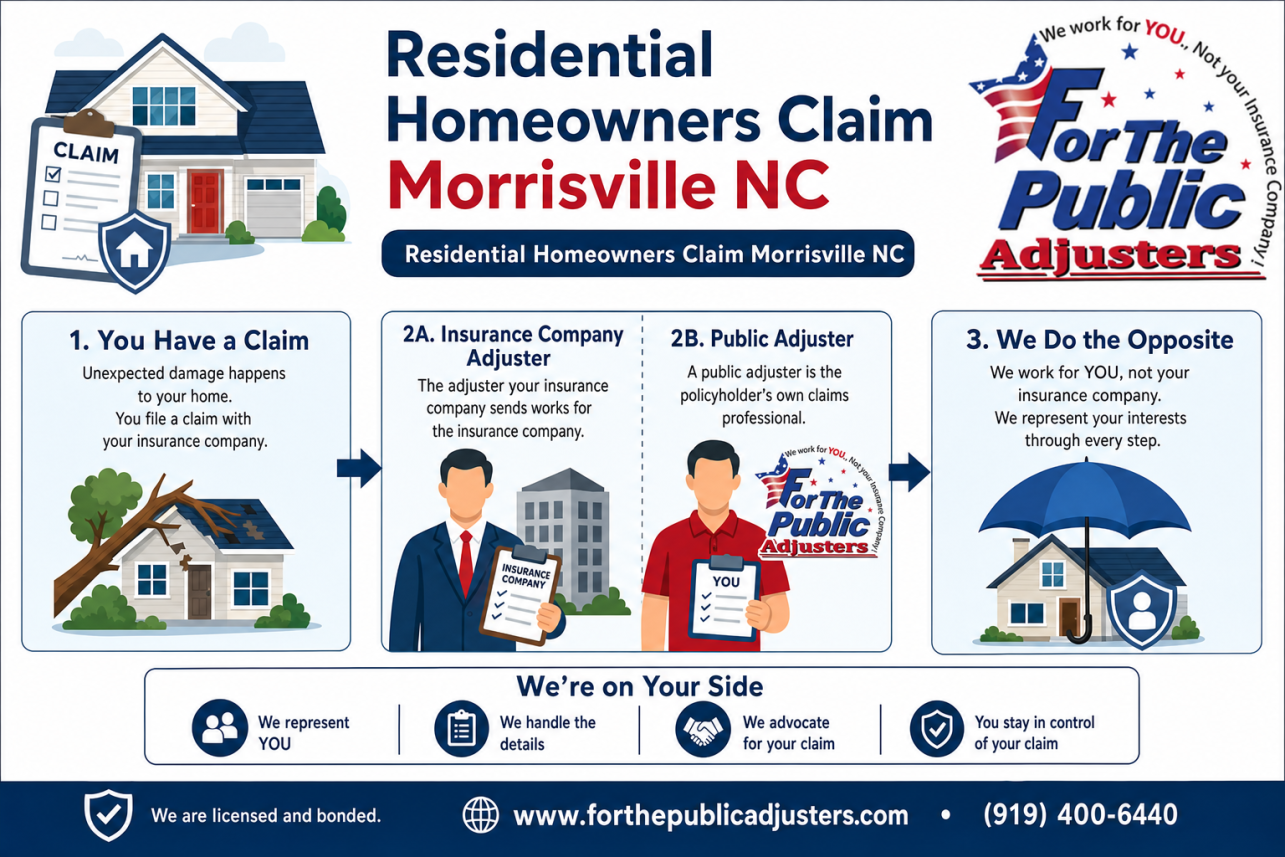
A public adjuster is the policyholder's own claims professional. The adjuster your insurance company sends works for the insurance company. We do the opposite: we inspect the damage ourselves, read your homeowners policy line by line, prepare the estimate and the proof of loss, and negotiate the settlement with the carrier.
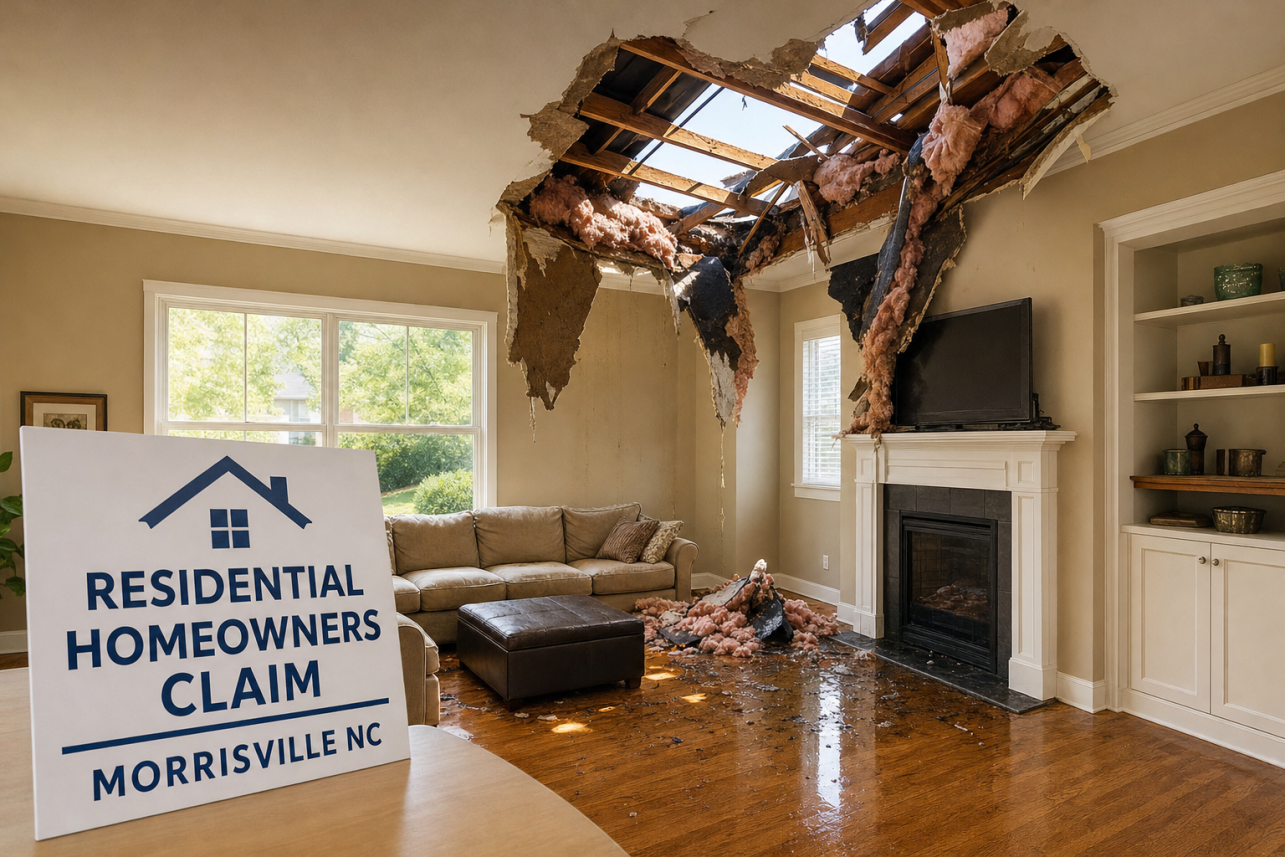
For Morrisville homeowners, that typically means water damage from burst pipes or roof leaks, fire and smoke damage, tree strikes, vandalism, and storm damage from hurricane remnants or hail. We handle residential claims throughout Wake County, including a steady volume of Residential Homeowners Claim Cary work right next door, so we know how the carriers active in this market evaluate and dispute local losses.
North Carolina requires public adjusters to be licensed, and the NCDOI Public Adjusters Guide explains how the profession is regulated and what a policyholder should expect from the relationship. We work on a percentage of the recovery, so our interest is aligned with yours from day one. We do not handle claims involving cell phones, motor vehicles, health, or life insurance — only property damage to homes, buildings, and their contents.
Common Problems
Why Is The Insurance Company's Check So Much Smaller Than My Contractor's Estimate?
This gap is the single most common reason Morrisville homeowners call us. Carrier estimates often use lower labor rates than Triangle contractors actually charge, leave out code-required work, and apply heavy depreciation deductions to arrive at an actual cash value payout instead of full replacement cost.
Depreciation is a frequent battleground. In Sproull v. State Farm Fire & Casualty Co., the Illinois Supreme Court sided with the policyholder and held that the insurer could not depreciate labor costs when calculating the actual cash value of storm damage to his home. Courts take these disputes seriously, and so should you.
We rebuild the estimate from scratch using real local repair pricing, make sure your deductible is applied correctly, and identify coverage the first offer ignored — including additional living expenses if you had to live elsewhere during repairs. A lowball first offer is a starting point, not a verdict.
Denied Residential Homeowners Claim Morrisville NC: What Are Your Options?
A denial letter is not the end of the claim. Many denials rest on arguable positions — the carrier calls a roof leak "wear and tear," blames water damage on "long-term seepage," or claims you missed a filing deadline or didn't submit adequate proof of loss documentation.
You have the right to challenge all of it. We re-inspect the property, pull weather records to tie the damage to a specific storm date, gather moisture readings and photographs, and submit a documented supplemental claim or formal dispute. If you've been getting denied home insurance claim help nowhere, a professional re-presentation of the evidence often changes the conversation.
Delays matter too. North Carolina sets expectations for how insurers must handle and respond to claims, and a payout that drags on for months without explanation is something we push back on in writing, with deadlines attached.
Should I Fight The Insurance Company Myself, Or Hire A Public Adjuster?
You can handle your own claim, and for small, uncontested losses that may be fine. But once a claim involves a denial, a significant underpayment, or complicated damage like smoke infiltration or water inside wall cavities, you are negotiating against trained professionals who do this every day.
A good public adjuster levels that field. Look for a North Carolina license, bonding, a fee that comes only from what is recovered, and real experience with your type of loss. Ask how they document damage and whether they prepare their own line-item estimates rather than just arguing over the carrier's.
We serve all of western Wake County — many clients find us while searching for a roof damage claim adjuster near me after a hailstorm — and our Residential Homeowners Claim Apex work covers the same builder-era neighborhoods and the same carriers you are dealing with here.
Our Process
Free Policy And Damage Review
We start by reading your actual homeowners policy — coverage limits, exclusions, your deductible, and whether you have replacement cost or actual cash value coverage. Then we inspect the damage ourselves. You will know where you stand before you owe us anything, and we will tell you honestly if the claim is not worth pursuing.
Documentation And Independent Estimate
We photograph and measure everything, trace hidden damage like moisture behind drywall or smoke residue in HVAC systems, and build a line-item repair estimate at real local pricing. We prepare the proof of loss and supporting records the carrier requires, with the same thoroughness we apply to Smoke Damage Claim Help in Rolesville and water losses across the region. Strong documentation is what separates a paid claim from a disputed one.
Negotiation And Settlement
We present the claim to the insurance company, respond to their adjuster's pushback point by point, and negotiate the settlement on your behalf. If new damage surfaces during repairs, we file a supplemental claim rather than letting you absorb the cost out of pocket. We cannot promise a specific dollar outcome — no honest adjuster can — but we make sure every covered dollar of loss is on the table and defended.
| Who You're Dealing With | Who They Work For | How They're Paid | What That Means for Your Claim |
|---|---|---|---|
| Insurance company staff adjuster | The insurance carrier | Salary from the carrier | Their job is to settle the claim within the carrier's guidelines, not to maximize your recovery |
| Independent adjuster | Hired by the carrier | Fee paid by the carrier | Despite the name, they are the carrier's representative, not yours |
| Restoration contractor | Themselves | Paid from your repair budget | Can estimate repairs but cannot legally negotiate your claim in North Carolina |
| Public adjuster (our team) | You, the policyholder | Percentage of the recovered settlement | Licensed and bonded to document, prepare, and negotiate your claim on your behalf |
| Attorney | You, the policyholder | Hourly or contingency fee | Typically needed only if the claim moves into litigation or bad faith territory |
Commonly Overlooked In The Public Adjusting Industry
- Labor depreciation buried in the carrier's estimate — Carriers often depreciate labor along with materials even though courts have sided with homeowners on this — in Lammert v. Auto-Owners (2019), the Tennessee Supreme Court ruled labor cannot be depreciated on storm-damaged homes, yet few policyholders ever check for it.
- Matching of continuous flooring, siding, and roofing — Adjusters pay to patch the damaged section without accounting for the fact that a patch in a continuous surface will never match, which can make the homeowner — not the carrier — eat the cost of a uniform repair.
- Ordinance and law (code upgrade) coverage — Older Morrisville homes often need electrical, plumbing, or structural work brought up to current Wake County code during repairs, and carriers rarely volunteer this coverage even when the policy includes it.
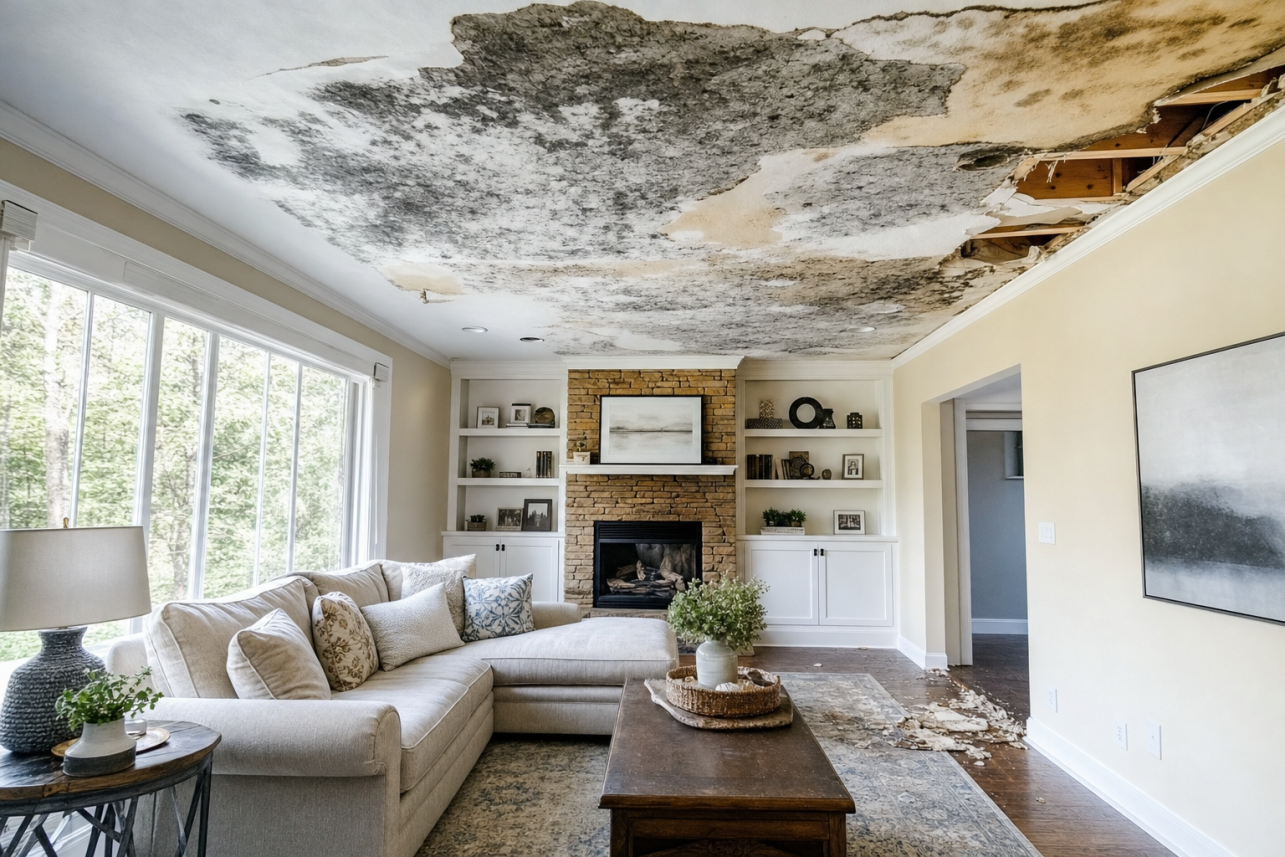
- Moisture trapped behind baseboards, cabinets, and in subfloors — Visual-only inspections miss it, and once drying equipment runs for a week the evidence disappears — leading to mold and rot the carrier later calls a 'maintenance issue.'
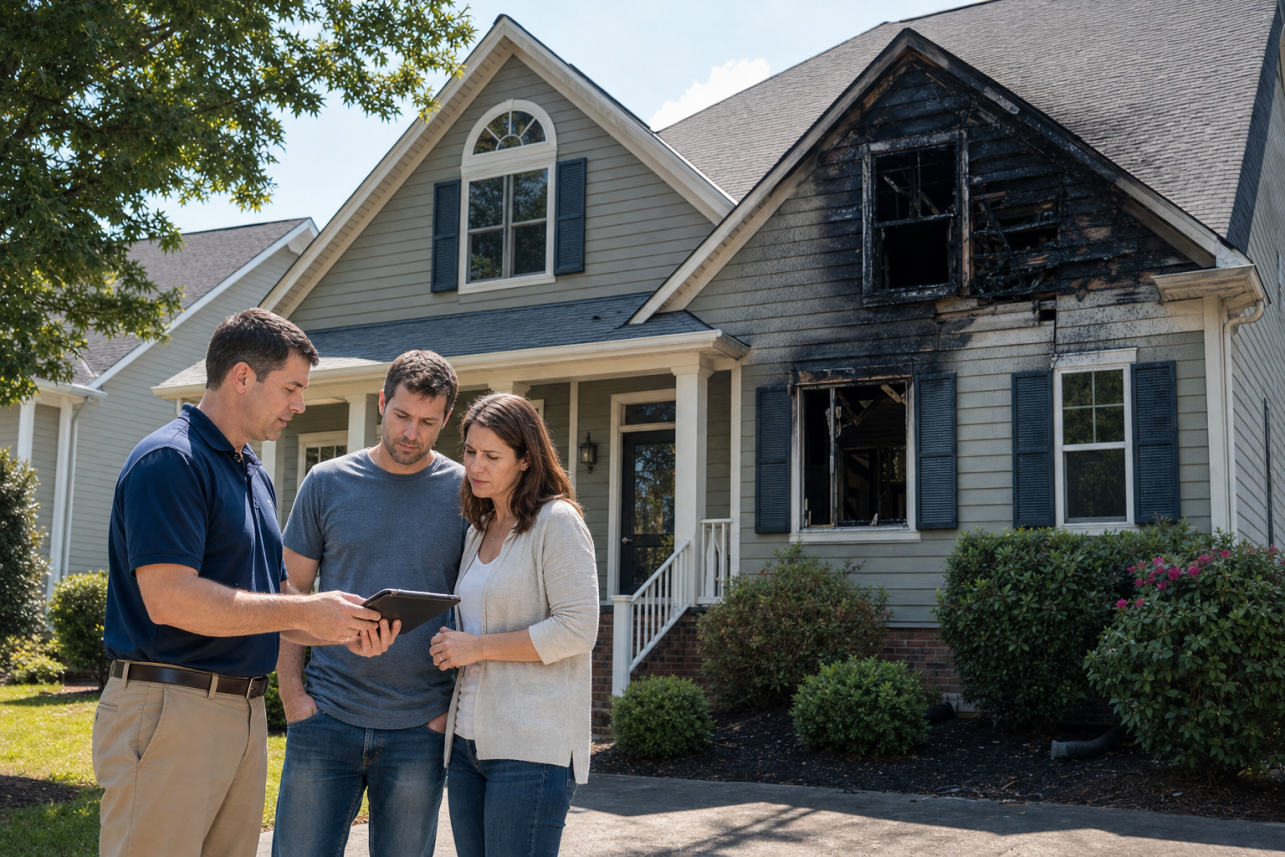
- Soot and odor contamination in HVAC ducts after a fire — The system runs during or after the fire and distributes residue through the whole house, but duct decontamination almost never appears on a carrier's first estimate.
- Additional living expenses (ALE) during repairs — Many homeowners never claim hotel stays, meals, or temporary rentals because the carrier doesn't mention the coverage exists, even when the home is clearly unlivable.
- A complete, line-item contents inventory — Carriers offer quick lump-sum contents allowances that feel convenient but routinely pay a fraction of what a documented room-by-room inventory with replacement pricing recovers.
- The flood exclusion in standard homeowners policies — Rising water is excluded from virtually every homeowners policy, so a homeowner without a separate NFIP flood policy through FEMA's program can be left with nothing — a distinction worth confirming before the next storm season, not after.
Case Studies
Case Study #1
Situation: A family in the Breckenridge neighborhood of Morrisville discovered water pooling under their kitchen island after a supply line to the dishwasher failed while they were at work. By the time they got home, water had traveled across the hardwood floor and into the adjoining dining room and hallway.
Problem: Their carrier's field adjuster inspected quickly, measured only the visibly wet flooring, and issued a payment for drying equipment plus replacement of roughly 120 square feet of hardwood. The estimate ignored the continuous flooring running through the first level and applied heavy depreciation to both materials and labor.
Investigation: Our team brought in a moisture meter and thermal imaging and mapped the water migration room by room. We pulled baseboards in the dining room and found elevated moisture readings in the drywall and subfloor well beyond the area the carrier had scoped. We also documented that the hardwood was a continuous, site-finished installation with no transition strips.
Findings: The wet subfloor had begun to cup, meaning spot repairs were not feasible. Because the flooring was continuous through the kitchen, dining room, hallway, and foyer, a patch would never match in grain, stain, or finish. The carrier had also depreciated labor costs, which courts have repeatedly pushed back on — in Lammert v. Auto-Owners (Mutual) Insurance Co. (Tennessee Supreme Court, 2019), homeowners with storm-damaged houses won on exactly this issue when the court held labor cannot be depreciated when calculating actual cash value.
Solution: We prepared a full Xactimate estimate covering sand-and-refinish of the entire continuous floor system, subfloor replacement in the saturated areas, drywall and baseboard repairs, and proper contents handling. We submitted a detailed demand package with moisture maps, photos, and flooring documentation, then negotiated directly with the carrier's adjuster.
Outcome: The carrier reinspected with us present and issued a revised settlement several times larger than its original payment, covering the full first-floor flooring scope, subfloor work, and repainting. The family was able to hire the contractor they actually wanted instead of settling for a patch job.
Lesson: The first check after a water loss in a Morrisville home is rarely the full story. Hidden moisture and continuous-flooring issues are where underpayments hide, and a policyholder has every right to challenge the carrier's scope before accepting it.
Case Study #2
Situation: A couple near Town Hall Drive had a grease fire on their stovetop. The flames were out within minutes, but smoke rolled through the open floor plan and the HVAC system ran during the fire, pulling soot throughout the house.
Problem: The insurance company's estimate treated it as a minor kitchen loss: new cabinets above the range, some painting, and a general cleaning allowance. It offered nothing for the HVAC system, almost nothing for contents, and no additional living expenses even though the home smelled of smoke in every room.
Investigation: We performed a room-by-room inspection with white-glove soot wipes, documented residue on walls, ceilings, and inside closets two rooms away, and had the ductwork inspected. We also walked the homeowners through a complete contents inventory rather than the carrier's rough lump-sum allowance.
Findings: Soot and protein residue had contaminated the duct system, attic insulation above the kitchen, soft goods, and electronics far beyond the kitchen. Smoke odor sealed into painted surfaces required sealing primer, not just washing. The couple's clothing and upholstered furniture needed professional restoration or replacement, and the home was not reasonably livable during remediation.
Solution: We assembled a complete claim package: structural estimate including duct cleaning and sealing, insulation replacement, thermal fogging and odor sealing throughout, a line-item contents inventory with supporting receipts and photos, and a documented additional living expense claim for temporary housing in the Morrisville area.
Outcome: After a joint reinspection, the carrier approved whole-home smoke remediation, HVAC decontamination, the full contents inventory, and weeks of additional living expenses it had never offered. The final settlement was a multiple of the original kitchen-only estimate.
Lesson: Fire claims are really smoke claims. The visible char is the smallest part of the loss, and homeowners who accept a kitchen-only scope often end up living with odor and contamination the policy should have paid to remove.
| Your Situation | Smart First Step | What the Outcome Usually Depends On |
|---|---|---|
| Damage looks close to or below your deductible | Get a professional repair estimate before filing anything | Whether hidden damage (moisture, soot, subfloor) pushes the real cost well past the deductible |
| Carrier's settlement offer seems low | Request the full estimate and have it reviewed line by line before cashing any check | How much of the scope was missed — depreciation, matching, code upgrades, and labor are common gaps |
| Claim was denied outright | Ask for the denial in writing citing the specific policy language | Whether the cited exclusion actually applies to your documented cause of loss |
| Fire or smoke loss, any size | Do not clean or discard anything until the loss is fully documented | Quality of the contents inventory and whether smoke migration beyond the burn area is proven |
| Water loss from plumbing or appliances | Get moisture readings throughout, not just where it looks wet | Whether migration into walls, subfloors, and adjoining rooms is mapped before drying removes the evidence |
| Hurricane or tornado damage | Photograph everything before temporary repairs, then make reasonable emergency repairs and keep receipts | Proper separation of covered perils and whether the full scope is documented before cleanup |
| Flood damage (rising water) | Contact your NFIP flood carrier or FEMA — a standard homeowners policy excludes flood | Whether you carry a separate flood policy through the National Flood Insurance Program; resources at FEMA.gov and FloodSmart.gov |
| Carrier accuses you of delay or incomplete proof of loss | Confirm every deadline in your policy in writing and respond on time | Meeting sworn proof-of-loss and documentation deadlines, which carriers use to limit or deny payment |

Reviews
A washing machine hose burst upstairs while we were away for the weekend and water came through the ceiling into our living room. Our insurance company offered about a third of what repairs actually cost. For The Public Adjusters found wet insulation and subfloor damage the first adjuster never checked, documented everything, and negotiated a settlement that covered the ceiling, flooring, and repainting. I honestly didn't know policyholders could have their own adjuster until a neighbor mentioned them.
Danielle R., Morrisville
After a spring hailstorm damaged our roof and gutters, the carrier kept saying the dents were 'cosmetic' and only approved a handful of shingles. This team documented the hail strikes per test square, pulled the storm data for our address off Davis Drive, and got the claim reopened. The carrier ended up approving a full roof replacement and the gutter work. They also caught that labor had been depreciated incorrectly on the first estimate.
Marcus T., Wake County
We had a small electrical fire in the garage that left smoke damage through half the house. The insurance estimate basically covered paint. For The Public Adjusters handled the contents inventory, the odor remediation scope, and even our hotel costs while the work was done. They were upfront that they couldn't promise a specific number, but they fought for every legitimate line item and it showed in the final settlement. Professional, licensed, and worth every penny of their fee.
Priya S., Morrisville
Frequently Asked Questions
What Does A Public Adjuster Do For A Residential Homeowners Claim Morrisville NC Policyholders File?
When you file a Residential Homeowners Claim Morrisville NC insurance carriers assign their own adjuster — someone who works for the company, not for you. A public adjuster works exclusively on your side of the table.
For The Public Adjusters, Inc. reviews your full policy, including endorsements and exclusions most homeowners never read, so you understand what coverage you actually purchased. We then document the damage to your home and contents in detail: photographs, moisture readings where relevant, line-item repair estimates using current Wake County labor and material pricing, and a complete contents inventory.
From there, we prepare and present the claim, handle correspondence with the carrier, attend inspections alongside the company adjuster, and negotiate on your behalf. If the insurer's estimate misses damaged areas — a common issue with water losses behind walls or smoke residue in HVAC systems — we push back with documentation rather than opinion.
We are licensed and bonded in North Carolina, and we work on claims involving homes, buildings, and personal contents. We do not handle claims involving cell phones, motor vehicles, health, or life insurance. We also never promise a specific dollar outcome, because every policy and every loss is different. What we do commit to is a thorough, professionally documented claim presented the way carriers are required to evaluate it — something very few homeowners in Morrisville have the time or the training to do on their own.
What Types Of Home Damage Do You Handle For Morrisville Homeowners?
We handle residential property losses throughout Morrisville and the rest of Wake County, including water damage from burst pipes, water heater failures, and appliance leaks; fire and smoke damage; hail damage to roofing and siding; and wind damage caused by hurricanes and tornadoes, which track through the Triangle more often than many homeowners expect.
Water losses are the most common claim we see in Morrisville neighborhoods like Breckenridge, Kitts Creek, and Savannah. These claims are frequently underpaid because hidden moisture inside wall cavities and under flooring gets missed during the carrier's initial inspection. Fire claims bring their own complications — smoke and soot contamination of contents, ductwork, and insulation is routinely underscoped.
Flood damage is a special category. Standard homeowners policies exclude flood, so rising-water losses are typically covered under a separate policy through the National Flood Insurance Program. If your home took on floodwater, FEMA (fema.gov) and the NFIP's FloodSmart site (floodsmart.gov) explain that coverage, and we can help you understand how a flood policy claim differs from a standard homeowners claim.
To be clear about what we do not do: we never handle claims involving cell phones, motor vehicles, health insurance, or life insurance. Our work is homes, buildings, and the contents inside them. If your loss falls in that category, a Morrisville public adjuster from our team can evaluate whether professional representation makes sense for your situation — at no obligation.
Have Homeowners Actually Won Disputes Against Their Insurance Companies?
Yes, and some of those wins reshaped how carriers must handle property claims. A notable example is Corban v. United Services Automobile Association, decided by the Mississippi Supreme Court in 2009 after Hurricane Katrina destroyed the Corbans' home.
USAA argued that because flood waters eventually struck the property, it could avoid paying for the hurricane wind damage that occurred first. The court sided with the homeowners. It ruled that once wind causes damage, the insured's right to payment for that damage vests immediately — and critically, the court held that the insurance company bears the burden of proving an exclusion applies. The insurer cannot simply point to excluded flood damage and refuse to pay for covered wind destruction.
Why does a Gulf Coast case matter to a homeowner in Morrisville? Because the same dynamics play out here. When a hurricane or tornado moves through Wake County and a home suffers both covered and arguably excluded damage, carriers sometimes lean on the exclusion to minimize the whole claim. Corban is a reminder that policyholders who document their loss carefully and understand the legal burden of proof can prevail.
That documentation is exactly what we build for Morrisville homeowners: a timeline of the loss, evidence of what caused each element of damage, and a claim file that holds up under scrutiny. We can't guarantee any particular result — no honest adjuster can — but a well-documented claim gives you the strongest possible position from day one.
When Should I Contact For The Public Adjusters, Inc. About A Residential Homeowners Claim Morrisville NC Residents Are Preparing To File?
The honest answer is: as early as possible, ideally before you file. The statements you make in your first call to the carrier, the photos you take, and the mitigation steps you complete in the first 72 hours all shape how the claim unfolds. Getting professional guidance before those steps happen is far easier than repairing mistakes afterward.
That said, it is never too late to bring us in. Many Morrisville homeowners call after receiving an estimate that won't come close to covering actual repair costs, or after a denial letter arrives. We review the carrier's position, re-inspect the property, and build a documented response. Underpaid claims can often be reopened and supplemented, and denials can be challenged with new evidence.
In North Carolina, deadlines matter. Your policy sets time limits for filing suit and for submitting proof of loss, so sitting on a disputed claim can quietly close your options. A quick review of your policy and the carrier's correspondence tells us where you stand.
Our initial consultation is free. We'll look at your damage, your policy, and the insurer's estimate if one exists, and tell you plainly whether we believe representation would add value. We're licensed and bonded, we work on a contingency basis, and we make no promises about specific outcomes — only that your claim will be prepared and presented with the thoroughness Wake County homeowners deserve.
How Much Does It Cost To Hire A Public Adjuster For A Residential Homeowners Claim Morrisville NC Homeowners Need Help With?
For The Public Adjusters, Inc. works on a contingency fee basis, which means our fee is a percentage of the settlement your insurance company pays. If there is no recovery, you owe us nothing for our adjusting work. There are no upfront charges, no hourly billing, and no hidden administrative fees.
This structure matters for Morrisville families because it aligns our interests with yours. We only do well when your claim is documented thoroughly and paid fairly, so we have every reason to pursue the full scope of damage — not just the obvious items the insurance company's adjuster noted on a quick walkthrough.
It is also worth knowing that North Carolina regulates public adjusters. We are licensed by the North Carolina Department of Insurance and bonded, and our fee agreement is put in writing before any work begins, so you can review it carefully and ask questions.
Many homeowners in Wake County find that professional representation pays for itself. Policyholders often overlook covered damage — matching materials, code upgrade costs, hidden water intrusion behind walls, or additional living expenses while repairs are underway. We cannot promise a specific dollar outcome, and we never will, but we can promise a complete, well-documented claim presented under the actual terms of your policy. That thoroughness is frequently the difference between a rushed estimate and a settlement that truly reflects what it costs to restore a home in today's Triangle construction market.
My Insurance Company Already Made Me An Offer — Can A Morrisville Public Adjuster Still Get Involved?
Yes, in most cases. An initial offer is rarely the final word. As long as your claim has not been formally closed by a signed release and the policy's deadlines have not expired, a public adjuster in Morrisville can review the carrier's estimate, re-inspect the property, and negotiate a supplemental payment for anything that was missed or undervalued.
We see this scenario constantly in Wake County neighborhoods. A homeowner in Breckenridge or Kitts Creek accepts a first check for a kitchen fire or a burst supply line, starts getting contractor bids, and discovers the insurance estimate will not come close to covering the actual repairs. That gap is exactly where we go to work.
Our process starts with a careful comparison of the carrier's scope against the real damage. We look for omitted trades, understated material quantities, missing overhead and profit, uninspected areas like attics and crawl spaces, and contents that were never inventoried. We also check whether North Carolina's matching considerations were applied — if damaged flooring or siding cannot be matched, the undamaged portions may need to be addressed too.
One important caution: do not sign a full and final release or a document waiving your rights before having it reviewed. Cashing a check labeled as a partial or undisputed payment is usually fine, but a release can end the claim permanently. If you are unsure what you have signed or what deadlines apply, bring us the paperwork and we will walk through it with you at no cost.
Does My Homeowners Policy Cover Flood Damage At My Morrisville Home, And What Should I Do If It Floods?
Standard homeowners policies in North Carolina almost never cover flooding — meaning rising surface water from heavy rain, overflowing creeks, or storm runoff. That surprises many people in Morrisville, where low-lying areas near Crabtree Creek and Indian Creek can see significant water during tropical systems and intense summer downpours.
Flood coverage is typically purchased separately through the National Flood Insurance Program (NFIP) at floodsmart.gov, or through a private flood carrier. If you are unsure whether your property sits in a mapped flood zone, FEMA's Flood Map Service Center at msc.fema.gov lets you look up your address, and after a federally declared disaster you can find assistance information at fema.gov.
Here is the critical distinction for your homeowners claim: water damage from inside the home — a failed water heater, a burst pipe, an overflowing appliance — is a completely different type of loss and is often covered under a standard policy. Insurers sometimes blur that line, characterizing covered water damage as excluded flood or seepage. Determining the true cause and path of the water is one of the most important things we do.
If water enters your home, document everything with photos and video before cleanup, take reasonable steps to prevent further damage, keep receipts for emergency services, and report the loss promptly. Then call us. We will help identify which policy responds, what the exclusions actually say, and how your residential claim should be presented. We handle homes, buildings, and contents — we do not handle auto, health, life, or cell phone claims.
What Happens If My Insurer And I Disagree About The Amount Of A Residential Homeowners Claim Morrisville NC Policies Cover?
Most homeowners policies include an appraisal clause — a built-in dispute resolution tool for disagreements about the amount of loss. Either side can invoke it. Each party selects an appraiser, the two appraisers choose an umpire, and an agreement by any two of the three sets the loss amount. It is usually faster and far less expensive than a lawsuit.
North Carolina's highest court has backed policyholders on how broad appraisal can be. In Accardi v. Hartford Underwriters Insurance Co. (N.C. 2020), homeowners suffered water damage and disputed whether undamaged portions of their home needed replacement so repaired materials would match. The insurer argued that was a coverage question outside appraisal, but the North Carolina Supreme Court sided with the insureds, holding the appraisal process could resolve it. That decision strengthened the hand of homeowners across the state, including right here in Morrisville, in disputes over matching and repair scope.
Appraisal is just one path. Before it ever gets that far, we build the disagreement into a documented negotiation — detailed estimates, photographs, moisture readings, contents inventories, and engineering or contractor input where needed. A well-supported supplement often resolves the gap without formal proceedings.
We cannot guarantee any particular result, and no honest adjuster can. What we provide for a Residential Homeowners Claim Morrisville NC families are counting on is professional representation: a licensed, bonded advocate who understands your policy, local repair costs in Wake County, and the procedures — including appraisal — that protect your rights when the carrier's number falls short.
What Documentation Should I Gather Before Starting A Residential Homeowners Claim Morrisville NC Insurers Will Actually Take Seriously?
Start with your full policy — the declarations page plus every endorsement, since those endorsements often change coverage limits for things like water damage or roofing in ways Morrisville homeowners don't expect.
Next, document the damage before you clean anything up. Take wide shots of each affected room, then close-ups of individual items. Video walkthroughs with narration are even better. If a hurricane or tornado caused the loss, photograph the exterior, the roofline, and any debris patterns, because carriers in Wake County frequently dispute whether storm forces or 'wear and tear' caused the damage.
Keep every receipt tied to the loss: emergency tarping, water extraction, hotel stays, and meals if you're displaced under your Additional Living Expenses coverage. A simple folder or phone photo album works fine.
Finally, build a contents inventory. List each damaged item with its age, where you bought it, and roughly what it cost. Old photos from birthdays or holidays at your home can prove you owned items you no longer have receipts for.
When we take over a homeowners claim in Morrisville, we build this documentation package for you — a detailed line-item estimate, a professionally prepared contents inventory, and supporting photos. Carriers respond differently when the file in front of them is organized to the same standard their own adjusters use. The earlier you start documenting, the stronger your position, so even if you haven't called us yet, start photographing now.
Are You Licensed To Handle Homeowners Claims In North Carolina, And Why Does That Matter?
Yes. For The Public Adjusters, Inc. is licensed and bonded in North Carolina, which is a legal requirement for anyone negotiating an insurance claim on a policyholder's behalf in this state.
That matters more than most Morrisville homeowners realize. Contractors, roofers, and water mitigation companies are not permitted to negotiate your claim with the insurance company — only a licensed public adjuster or an attorney can do that. If someone unlicensed offers to 'deal with your insurance for you,' that's a red flag, and it can actually complicate your claim.
Licensing also means accountability. The North Carolina Department of Insurance regulates public adjusters, caps how our contracts are structured, and gives you a clear avenue for recourse. The bond requirement adds a second layer of financial protection for the policyholder.
Courts have long recognized that policyholders deserve professional representation because insurers don't always play fair. In Gruenberg v. Aetna Insurance Co. (1973), the insured's building suffered fire damage, the carrier refused to pay and accused him of arson, and the court ruled the insurer breached its duty of good faith and fair dealing — a landmark win for property owners that still shapes how claims disputes are handled today.
When you hire us for a residential claim in Morrisville, you're getting a regulated, bonded professional whose only client is you. The carrier's adjuster works for the insurance company. We work for the homeowner, and the state licenses us to do exactly that.
How Long Does A Homeowners Insurance Claim In Morrisville Usually Take To Settle?
It depends on the complexity of the loss, but here's a realistic picture for Wake County homeowners.
Straightforward claims — a contained kitchen fire or a single-room pipe burst — often resolve in 30 to 90 days when they're documented thoroughly from day one. Larger losses involving structural damage, extensive contents, or displacement from the home commonly run three to six months, sometimes longer if the carrier disputes scope or pricing.
After a major regional event like a hurricane moving through the Triangle, timelines stretch because carriers are flooded with claims and field adjusters are overloaded. Morrisville saw this dynamic after Hurricane Fran tore through Wake County in 1996, and it repeats after every major storm season.
North Carolina law does impose some structure. Once you submit a proof of loss and the carrier accepts the claim, payment is expected within a reasonable time, and unreasonable delay can expose the insurer to bad-faith liability. In Gruenberg v. Aetna, a fire-damage case, the court confirmed insurers owe policyholders a duty of good faith throughout the claim — including timely handling.
The biggest cause of delay we see isn't the carrier's calendar; it's incomplete files. Missing photos, vague estimates, and undocumented contents give the insurer reasons to request more information, and every request resets the clock.
Our job is to eliminate those delays by delivering a complete, professionally prepared claim package the first time, then pressing the carrier at every deadline. We can't promise a specific settlement date or amount, but we can keep your claim moving instead of sitting in a queue.
My Claim Was Underpaid After A Hurricane — Is It Too Late To Reopen It In Morrisville?
In most cases, no. If you accepted a payment but the money didn't actually cover your repairs, you generally have the right to submit a supplemental claim for the difference, as long as you're within your policy's deadline and North Carolina's statute of limitations.
This comes up constantly after hurricanes move through the Triangle. The carrier's adjuster does a quick inspection, pays for visible roof and ceiling damage, and misses hidden issues — saturated insulation, damage inside wall cavities, or structural problems that only surface months later. Cashing that first check usually does not close the door on recovering more.
Time limits do apply, though. Policies typically require supplemental claims within a set window, and North Carolina law limits how long you have to bring a lawsuit on a property policy. The sooner you act, the more options you have.
Courts have sided with homeowners in exactly these disputes. Policyholder wins like Gruenberg v. Aetna, where a building owner recovered after his fire claim was wrongfully denied, established that carriers must handle property claims in good faith — underpaying and hoping the homeowner won't push back can violate that duty.
When we reopen a Residential Homeowners Claim Morrisville NC carriers have shorted, we re-inspect the property, document everything the first adjuster missed, and submit a supplemental demand with full supporting evidence. One note: if your damage involved flooding rather than hurricane wind and rain, that falls under separate flood coverage through the NFIP, and FEMA has its own appeal process with different deadlines — we can help you sort out which claim covers what.
Will Filing A Residential Homeowners Claim Morrisville NC Insurers Process Count Against Me Or Raise My Premiums?
It's a fair worry, and the honest answer is: it depends on the type of loss and your claim history. In North Carolina, insurers generally cannot penalize you for a single weather-related claim such as hurricane or tornado damage, since those are considered acts of nature rather than negligence. Rate changes tied to regional storm activity affect entire areas of Wake County, not just homes that filed claims.
What matters more is how the claim is handled. A poorly documented or repeatedly reopened claim can create complications, while a thorough, well-supported claim filed once and settled properly usually does not. That's one reason Morrisville homeowners bring us in early — we build the file correctly the first time.
It's also worth remembering what you've been paying premiums for. Walking away from a legitimate fire, water, or storm loss to avoid a hypothetical rate increase often costs far more than any premium adjustment ever would. If your roof was damaged in a hurricane or your kitchen suffered a fire, the policy exists for exactly that moment.
We're happy to review your situation before you decide whether filing makes sense. For The Public Adjusters, Inc. is licensed and bonded in North Carolina, and we'll give you a straight assessment of your damage, your policy language, and whether the loss is worth pursuing — with no pressure either way.
What's The Difference Between Actual Cash Value And Replacement Cost, And Why Does It Matter For My Settlement?
These two terms often determine whether a Morrisville homeowner gets fully paid or shortchanged. Replacement cost value (RCV) is what it costs to repair or rebuild with materials of like kind and quality today. Actual cash value (ACV) is that same figure minus depreciation for age and wear. Most carriers pay ACV first, then release the withheld depreciation after repairs are completed — but only if you follow the policy's deadlines and documentation rules.
Where homeowners get hurt is in how depreciation is calculated. Some insurers depreciate not just materials but also labor, which can slash a settlement dramatically. Courts have pushed back on this practice. In Sproull v. State Farm Fire & Casualty Co. (Illinois Supreme Court, 2021), the policyholder prevailed when the court ruled that labor costs could not be depreciated in actual cash value calculations, because labor does not wear out the way shingles or drywall do.
For a Residential Homeowners Claim Morrisville NC policyholders file, we scrutinize every depreciation line the carrier applies, verify the repair pricing reflects actual Wake County contractor rates rather than outdated software defaults, and track the recoverable depreciation so none of it is left on the table.
We can't promise a specific dollar outcome — no honest adjuster can — but we can make sure the math is done correctly and that you're not absorbing depreciation your policy never required you to accept.
Do You Handle Tornado And Hurricane Damage Claims For Homes In Morrisville And Wake County?
Yes. Hurricane and tornado losses are among the most common residential claims we handle in this part of Wake County. Morrisville sits far enough inland that homeowners sometimes assume hurricanes are a coastal problem, but storms like Fran and Florence proved that hurricane-force conditions reach the Triangle — toppling trees onto roofs, driving rain into attics, and tearing shingles and siding from homes in neighborhoods from Breckenridge to Kitts Creek.
Tornado damage presents its own challenges. The destruction is often concentrated and severe on one part of the structure, while hidden damage — a racked frame, lifted decking, compromised trusses — goes unnoticed by a carrier's quick exterior inspection. We document the full scope, including structural issues that only show up when you know where to look.
One important distinction: wind-driven rain entering through storm damage is typically covered under your homeowners policy, but rising floodwater is not. Flood losses fall under separate National Flood Insurance Program coverage, and if your home took on floodwater during a storm, resources at fema.gov and floodsmart.gov explain how NFIP claims work. We can help you sort out which policy responds to which damage, since major storms frequently cause both.
After a hurricane or tornado, carriers are flooded with claims and adjusters move fast — sometimes too fast. Having your own licensed, bonded representative documenting the loss helps ensure nothing gets missed in the rush.
My Insurer Denied Part Of My Fire Claim, Saying The Smoke Damage Was 'cosmetic.' Is That Worth Fighting?
Often, yes. Smoke and soot damage is one of the most underestimated parts of a residential fire loss, and labeling it cosmetic is a common way claims get minimized. Soot is acidic and corrosive — it penetrates HVAC ductwork, insulation, electronics, textiles, and porous building materials. What looks like surface staining can involve lingering odor and contamination that proper remediation protocols require addressing, not just repainting.
Policyholders who challenge these determinations are not powerless. In Fire Insurance Exchange v. Superior Court (Altman) (California Court of Appeal, 2004), homeowners prevailed on the principle that an insurer must pay the cost to repair damaged property to its pre-loss condition, not merely to a condition the carrier deems adequate. Courts have repeatedly recognized that policyholders are entitled to genuine restoration, and that principle applies with equal force to smoke-affected contents and structures.
For homeowners in Morrisville, we re-inspect the property, often with independent testing for soot and char residue, and document damage the carrier's adjuster dismissed. We then prepare a detailed estimate covering structure, contents, and additional living expenses if the home isn't safely habitable during cleanup.
We can't guarantee a denial will be reversed, but partial denials based on a cosmetic label frequently don't survive a properly documented challenge. If any portion of your fire or smoke claim was denied or reduced, it costs nothing to have us review the carrier's position and your policy language before you accept it.
Local Relevance
Morrisville's housing stock is a product of the Triangle's rapid growth: large numbers of homes built from the late 1990s through the mid-2000s, many now carrying original builder-grade shingles and flashing. That is exactly the age where carriers start calling storm damage "wear and tear," so documenting the storm date and the hail or wind event is critical to a roof claim here.
The local weather pattern does not help. Humid summers feed pop-up thunderstorms and hail, hurricane remnants push inland from the coast, and spring tornado activity — including the 2011 outbreak that crossed Wake County — cuts narrow damage paths where one street is hit hard and the next is untouched. "Nobody else on my street filed" means very little in this area.
Water is the other constant. Fast development around Morrisville and RTP means more pavement and more runoff than older drainage was designed for, and some homes flood outside mapped high-risk zones. Standard homeowners policies exclude flood, which is covered separately through the National Flood Insurance Program — a distinction many owners discover only after the water is in the house. We handle these same claim patterns across the county, including Residential Homeowners Claim Raleigh NC files, and knowing how each carrier behaves locally is a real advantage at the negotiating table.
Much of Morrisville sits on the Triassic Basin, where clay soils drain poorly and shrink and swell with the seasons — so cracked slabs, sticking doors, and settlement that out-of-area adjusters dismiss as "age" often tie back to soil movement and water intrusion. Knowing which side of that soil line a house sits on can change how a foundation or water damage claim gets documented and argued.
Get A Free Claim Review Before You Accept The Insurance Company's Number
If your Morrisville home has water, fire, smoke, or storm damage — or your claim has already been denied, delayed, or underpaid — talk to us before you sign anything. For The Public Adjusters, Inc. is licensed and bonded in North Carolina, the review costs nothing, and we only get paid from what we recover for you.
Call us: (919) 400-6440
Helpful Resources
- NCDOI Public Adjusters Guide
- National Flood Insurance Program (NFIP)
- North Carolina Department of Insurance — State regulator overseeing insurers and licensed public adjusters
Serving Morrisville · Wake
Last updated: October 27, 2026