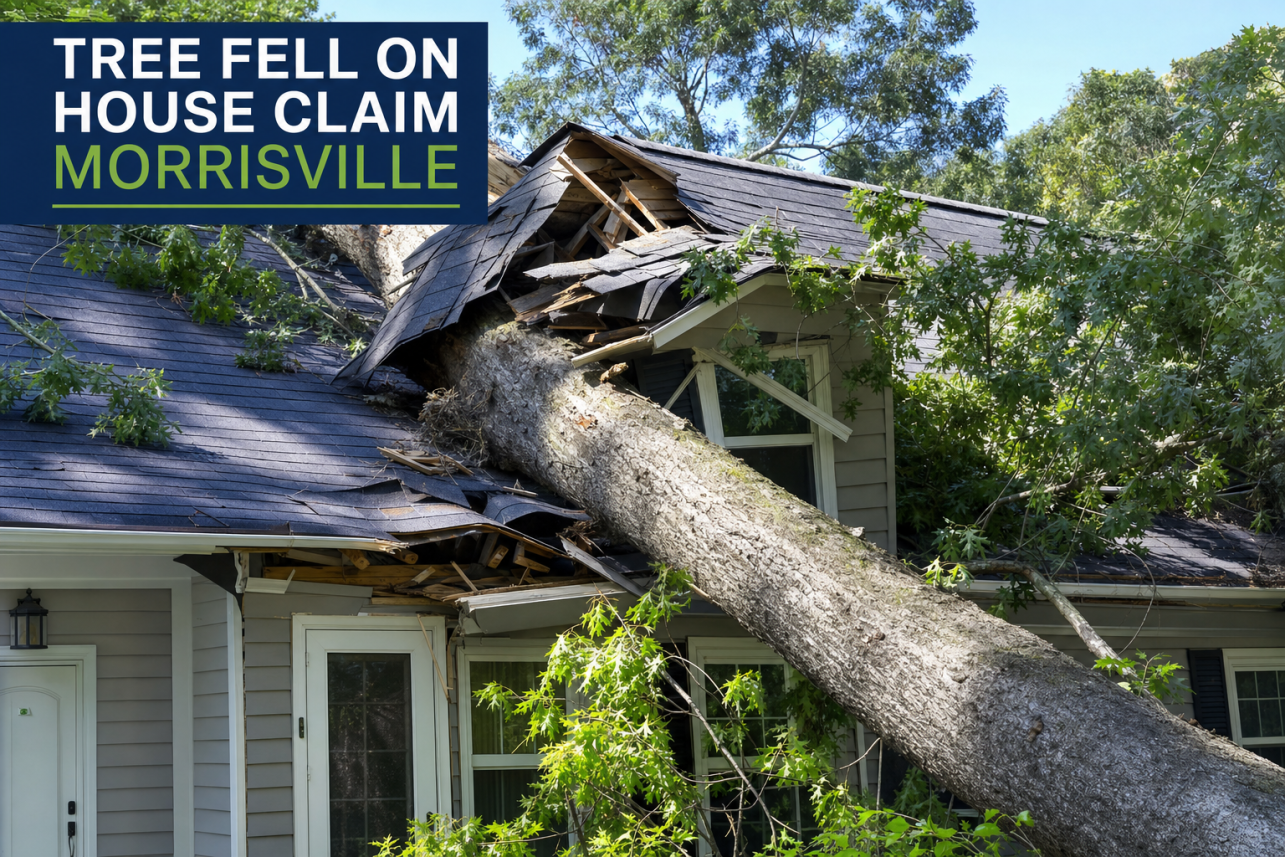
If you need help with a Tree Fell On House Claim Morrisville homeowners are typically covered for the damage a fallen tree does to the structure, plus at least part of the removal — but the first payment is often far less than the real repair cost. For The Public Adjusters, Inc. works only for you, the policyholder, never the insurance company. We document the full scope of damage, prepare the claim, and negotiate the settlement so you are not left paying out of pocket for a covered loss.
What This Service Is
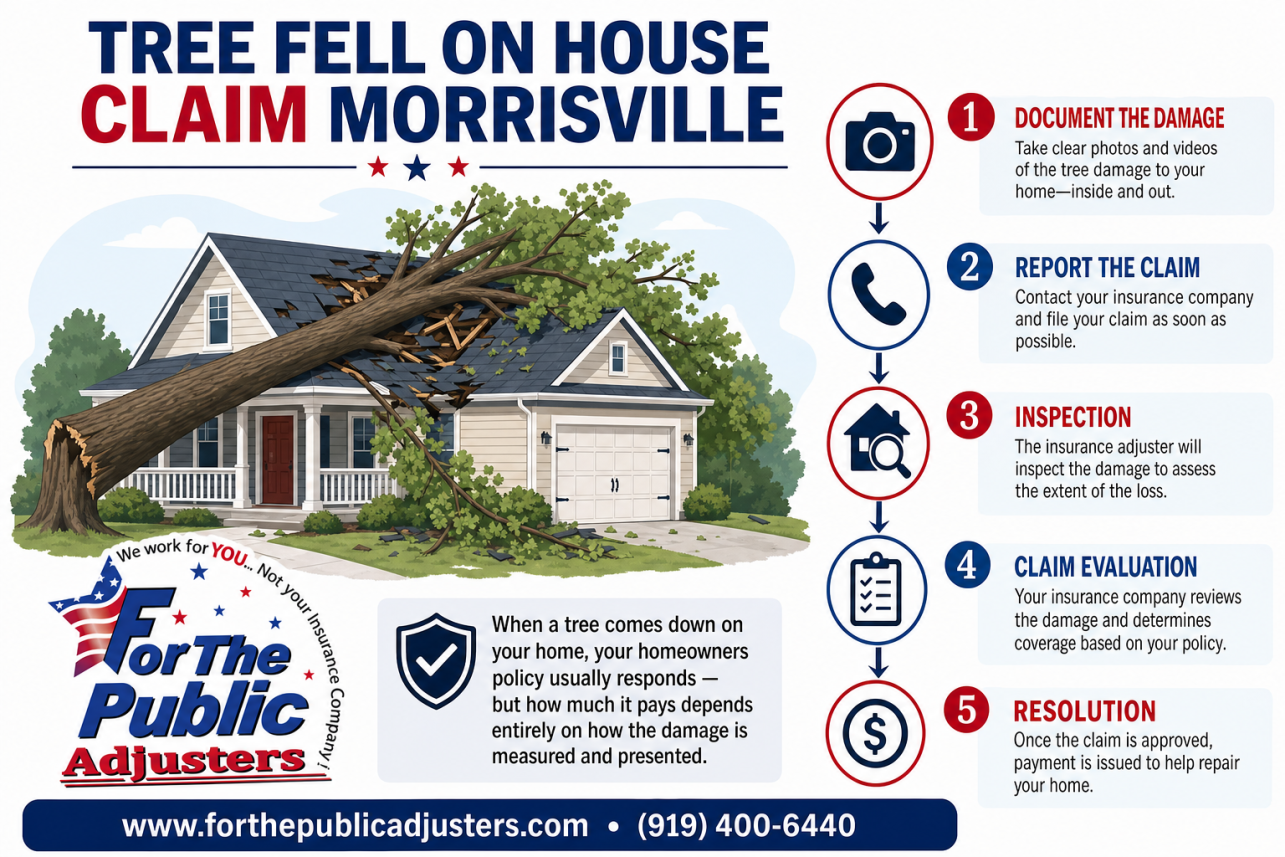
When a tree comes down on your home, your homeowners policy usually responds — but how much it pays depends entirely on how the damage is measured and presented. A public adjuster is a state-licensed professional who represents you, not the insurer, through that process.
The insurance company sends its own adjuster to inspect your home. That inspection often catches the obvious hole in the roof but misses what matters most: cracked rafters and trusses under the decking, shifted framing, water that soaked insulation and drywall in the hours before a tarp went up, and interior finishes that will never match after a partial repair. The North Carolina Department of Insurance publishes its NCDOI Public Adjusters Guide precisely because policyholders have the right to their own licensed representation in this process.
We read your policy line by line, measure and photograph every affected area, build a complete repair estimate, and handle the back-and-forth with the carrier. The same careful approach we bring to a tree damage insurance claim help in Cary applies here in Morrisville — the difference between a quick payout and a fair one is almost always in the documentation.
Common Problems
Will My Policy Pay To Remove The Tree, Or Just Patch The Roof?
Most homeowners policies cover repairing the structure the tree hit, and they typically contribute toward removing the tree itself — but removal coverage often carries its own limit that runs out fast when a crane is involved.
There is also a big difference between actual cash value and replacement cost. If the carrier applies depreciation to your roof, you can be paid for a fifteen-year-old roof while facing the bill for a brand-new one. Your deductible comes off the top either way.
And if your home is unlivable while repairs happen, additional living expenses coverage should pay for temporary housing. Many families never claim it because no one told them it existed. We make sure every coverage in your policy is actually put to work.
Why Was My Tree Fell On House Claim Morrisville Underpaid Or Denied?
The most common reasons are an incomplete inspection, a repair estimate built on the cheapest possible scope, or a dispute over whether the damage came from the tree or a pre-existing condition. Sometimes the carrier argues a neighbor’s tree is the neighbor’s problem — when in most cases your own policy is the one that responds.
Policyholders who push back can win. In Guessford v. Pennsylvania National Mutual Casualty Insurance Co., a North Carolina homeowner whose house suffered serious structural damage took the insurer to federal court over its handling of the claim, and a jury sided with the homeowner — awarding substantially more than the carrier had been willing to pay.
You do not have to accept the first number. On a tree damage house claim in Holly Springs and on claims across Wake County, we routinely find covered damage the carrier’s estimate simply left out. Deadlines apply to filing and disputing claims, so acting early protects your options.
Should I Fight The Insurance Company Myself, Or Hire A Public Adjuster?
You can handle a claim yourself, and for a small, simple loss that may be fine. But a tree through the roof is rarely simple. Hidden structural damage requires a trained eye, and carriers negotiate claims every day — most homeowners do this once in a lifetime.
A good public adjuster is licensed and bonded, works on your behalf only, and is paid from the recovery rather than upfront. Ask any adjuster you interview for their license, their experience with fallen-tree losses specifically, and references.
What we actually do is the unglamorous work that moves numbers: measuring, photographing, pricing every trade from framing to paint, filing the proof of loss correctly, and negotiating in writing. No honest adjuster can guarantee a specific result — but you should never have less documentation than the company deciding what to pay you.
Our Process
Protect The Home And Review Your Policy
First, the house gets protected — tarping, board-up, and emergency water mitigation are typically covered, and keeping receipts matters. Then we sit down with your actual policy, not a summary, and identify every coverage that applies: dwelling, debris removal, contents, and additional living expenses.
Document The Full Scope Of Damage
We inspect well beyond the point of impact: roof decking, rafters, attic framing, ceilings, walls, insulation, and anything water touched before the tarp went up. From that inspection we build a detailed, line-item repair estimate. The Insurance Information Institute notes that fallen-tree damage to the structure is a standard covered peril — the fight is almost never about coverage, it is about scope and price. This is exactly how we approach every tree damage insurance claim in Durham and throughout the Triangle.
Present The Claim And Negotiate The Settlement
We submit the documented claim, meet the carrier’s adjuster on site, and answer their pushback with evidence — photos, measurements, and pricing. If the carrier delays, disputes the estimate, or acts in bad faith, we escalate through the proper channels, including working alongside insurance dispute attorneys when a claim needs to go further.
| Damage Item | Typical Carrier First Offer | What Proper Documentation Recovers |
|---|---|---|
| Roof structure | Shingle patch over the impact hole | Engineered rafter/truss repair plus decking and full-slope replacement when shingles can’t be matched |
| Tree and debris removal | Flat $500–$1,000 allowance | Full removal costs when the tree damaged a covered structure, including crane fees |
| Interior water damage | Often omitted entirely | Ceiling, insulation, drywall, and flooring traced with moisture mapping |
| Hidden structural movement | Not inspected | Racked framing, cracked top plates, and shifted load paths identified by an engineer |
| Fences, gutters, HVAC, driveway | Missed or lumped into one small line | Each item documented and priced separately under the correct coverage |
| Additional living expenses | Rarely mentioned | Hotel and meal costs paid when the home is unsafe to occupy |
Commonly Overlooked In The Public Adjusting Industry
- Fractured rafters and trusses under an intact-looking roof — Impact forces travel through framing, and a carrier adjuster standing on the ground or walking shingles will never see a cracked truss inside the attic.
- The debris removal sub-limit versus structure-damage coverage — Carriers routinely apply the small tree-removal cap even when the tree hit the house, which triggers much broader coverage most homeowners never know exists.
- Shingle matching and discontinued roofing lines — Insurers pay to patch the hole, but if matching shingles no longer exist, North Carolina claims practice often supports replacing the full slope or roof.
- Moisture that migrated beyond the visible ceiling stain — Water follows framing and insulation sideways, so the wet area is almost always larger than the stain a quick inspection records.
- Damage to gutters, fascia, soffit, and the electrical service mast — Falling limbs strike these on the way down, and they get skipped because everyone is focused on the hole in the roof.
- Additional living expenses from day one of displacement — Homeowners eat hotel and food costs themselves because no one tells them ALE coverage starts the moment the home becomes unsafe.
- Preserving photo evidence before the tree crew arrives — Removal crews work fast after a storm, and once the tree is hauled off, proving the size and position of the impact becomes nearly impossible.
- Foundation and slab cracking from ground impact — A large trunk striking near the house can crack slabs and footings, but nobody checks below grade when all eyes are on the roof.
Case Studies
Case Study #1
Situation: A homeowner in the Breckenridge neighborhood of Morrisville had a mature oak come down across the rear roofline during a summer thunderstorm. The tree punched through the decking over the master bedroom and cracked two roof trusses.
Problem: The insurance carrier’s first offer covered shingle replacement over the impact zone and a flat $500 for tree removal — despite the policy carrying a higher debris removal allowance. It ignored the structural damage entirely and made no allowance for interior water intrusion.
Investigation: Our adjuster brought in a licensed structural engineer to evaluate the trusses and used moisture mapping to trace water migration into the bedroom ceiling, insulation, and one interior wall. We also photographed the tree’s diameter and documented removal invoices to invoke the correct debris removal limits.
Findings: Two trusses were fractured beyond field repair and required engineered sistering. Moisture readings confirmed saturation in the attic insulation and drywall well beyond the visible stain. The carrier’s estimate had also priced shingles that were discontinued, triggering a matching issue across the entire rear slope.
Solution: We prepared a line-item estimate covering engineered truss repair, full rear-slope replacement due to shingle discontinuation, interior drywall and insulation replacement, and the policy’s full debris removal benefit. We then negotiated directly with the carrier’s field adjuster and desk examiner.
Outcome: The settlement increased from the initial $11,400 offer to $67,800 — enough to fully restore the structure, replace the rear roof slope, and complete the interior repairs without out-of-pocket shortfalls beyond the deductible.
Lesson: When a tree lands on a roof, the visible hole is rarely the full loss. Structural members, hidden moisture, and shingle matching often represent the majority of the claim value, and none of it shows up in a quick drive-by inspection.
Case Study #2
Situation: A family near Morrisville Carpenter Road had a neighbor’s pine fall onto their attached garage during an ice event, collapsing a section of the roof and crushing the gutter line and a portion of the driveway slab.
Problem: The carrier told the homeowners to pursue the neighbor’s insurance instead, delaying the claim for weeks. When they finally accepted it, the estimate excluded the driveway damage and treated the garage roof as a small patch repair.
Investigation: We reviewed the policy language and confirmed the homeowners’ own carrier owed coverage regardless of whose tree fell — negligence questions belong to subrogation, not to the policyholder. We then documented the collapsed framing, measured the slab cracking against pre-loss photos, and got a contractor evaluation of the roof system.
Findings: The garage roof structure had racked, meaning framing repairs — not a shingle patch — were required. The driveway cracking radiated directly from the impact point, tying it to the loss. The weeks of delay had also allowed melting ice to soak the garage ceiling drywall.
Solution: We filed a documented supplement covering framing reconstruction, full garage roof replacement, driveway slab section replacement, and the water-damaged interior. We also cited the policy provisions the carrier had misapplied when it initially pointed the family toward the neighbor.
Outcome: The claim settled at roughly four times the carrier’s opening figure, and the family recovered their deductible months later when the carrier subrogated against the neighbor’s insurer.
Lesson: Whose tree it was almost never determines whose policy pays first. Homeowners who accept a ‘go ask your neighbor’ answer lose weeks of leverage while hidden damage gets worse.
| Your Situation | Do This First | Why It Matters to Your Claim |
|---|---|---|
| Tree is still on the roof | Get an emergency tarp and photograph everything before removal | Once the tree is gone, proof of how it sat on the structure disappears with it |
| Water is coming inside | Move belongings, document with video, and mitigate — but keep damaged materials | Policies require reasonable mitigation, and discarded materials become ‘unproven’ damage |
| Neighbor’s tree caused the damage | File with YOUR insurer, not theirs | Your policy pays first; negligence gets sorted out later through subrogation |
| Carrier offered a quick settlement | Don’t sign or cash anything until hidden damage is inspected | Fast offers are priced off visible damage only, and structural issues surface later |
| Tree fell but only hit the yard | Check your policy’s tree debris provision before assuming coverage | Removal is usually only covered when a structure is hit or a driveway is blocked |
| Roof looks fine after removal | Have the decking and framing inspected anyway | Impact damage often fractures rafters and decking without visible shingle damage |
| Claim was underpaid or denied | Request the estimate in writing and get an independent review | You can reopen or supplement a claim, but you need documentation to counter their file |
| Home is unsafe to stay in | Keep every hotel and meal receipt from day one | Additional living expense coverage only pays what you can prove |

Reviews
A sweetgum went through our roof over the kitchen in April. Our insurance company offered barely enough to tarp and patch. For The Public Adjusters found broken rafters and water damage the company adjuster never even looked for. Final settlement covered a full structural repair and new kitchen ceiling. Cannot recommend them enough for anyone in Wake County dealing with tree damage.
Danielle R., Morrisville
The carrier capped our tree removal at $500 when the crane alone cost $2,800. These adjusters knew exactly which policy provisions applied because the tree was on the structure, not just in the yard. That distinction alone changed the payout completely. They handled every call with the insurance company so I didn’t have to.
Marcus T., Kitts Creek
After a pine crushed the corner of our house, we got two very different stories from our insurer. For The Public Adjusters documented everything — engineering report, moisture readings, matching shingles — and turned a lowball offer into a settlement that actually rebuilt our home. The process took a couple of months but they kept us informed the whole way.
Priya S., Morrisville
Frequently Asked Questions
How Do I File A Tree Fell On House Claim Morrisville Homeowners Can Actually Win?
A Tree Fell On House Claim Morrisville homeowners file starts the moment the tree comes down, and the first 48 hours matter more than most people realize. Before you touch anything, photograph the tree exactly where it landed, the point of impact on the roof or wall, and any interior damage like cracked ceilings, wet insulation, or shifted framing.
Next, take reasonable steps to prevent further damage. Insurers in North Carolina expect you to mitigate, which usually means a professional tarp job on the roof. Keep every receipt for tarping, tree removal from the structure, and emergency board-up. These are typically reimbursable under your policy.
Do not rush to have the entire tree hauled away before the insurance company or your adjuster documents it. The species, size, and condition of the tree can affect how the claim is evaluated, especially if the carrier tries to argue the tree was dead or diseased beforehand.
Then report the loss to your carrier, but be careful with recorded statements. Stick to facts: the date, what fell, what was hit. Avoid guessing at causes or dollar amounts.
Finally, get an independent damage assessment before accepting the carrier’s estimate. Tree impacts frequently cause hidden structural damage, cracked rafters, compromised trusses, and roof decking fractures that a quick carrier inspection misses. Our team inspects Morrisville homes from the attic down, documents everything the carrier’s adjuster overlooked, and negotiates directly with the insurer so the settlement reflects the real cost of repairs, not a patch job.
Does Homeowners Insurance Cover Tree Removal And Roof Repair After A Tree Hits My Morrisville Home?
In most cases, yes, but with important limits. When a tree strikes an insured structure in Morrisville, whether it is your house, an attached garage, or a fence, standard homeowners policies cover both the repair of the damaged structure and the removal of the tree from that structure.
The catch is in the details. Many policies cap tree removal at $500 to $1,000 per tree, and some only pay removal costs if the tree damaged a covered structure or blocked a driveway or handicap access. If a tree falls in your yard and hits nothing, removal often is not covered at all.
Coverage for the structure itself is usually far more generous. Roof replacement, framing repairs, drywall, insulation, and interior finishes damaged by the impact or by rain entering through the opening should all be covered. Where homeowners get shortchanged is in scope: carriers frequently approve shingle patches when the impact fractured decking or rafters underneath, which requires much more extensive work.
Who owned the tree also matters less than people think. If your neighbor’s healthy oak fell onto your house during a storm, your own policy typically responds first. The exception is negligence, if the neighbor knew the tree was dead or dying and ignored it, their liability coverage may come into play.
Because Wake County saw significant storm activity in recent years, carriers have gotten stricter on these losses. Having a licensed public adjuster review your policy language and the carrier’s estimate before you accept payment often uncovers thousands of dollars in missed coverage.
The Insurance Company Says The Tree Was Already Dead And Denied My Claim. What Can I Do?
This is one of the most common denial tactics we see with tree damage claims in Morrisville, and it is very often beatable. Carriers argue that a dead or diseased tree falling is the result of poor maintenance rather than a covered peril like wind. But the burden of proving that exclusion applies rests on the insurance company, not on you.
Start by preserving evidence. If any portion of the tree remains, photograph the trunk cross-section, root ball, and branches. Healthy sapwood, green cambium, and attached leaves or needles all contradict a claim that the tree was dead. An arborist’s report can be decisive here, and it is an expense a public adjuster can help coordinate.
Weather data matters too. We pull National Weather Service records and local wind reports for the Morrisville and RDU area on the date of loss. If sustained winds or gusts were strong enough to topple healthy trees, that supports wind as the proximate cause, which is covered under virtually every homeowners policy in North Carolina.
Also look closely at the denial letter itself. Carriers sometimes deny based on a drive-by inspection or photos alone, without any arborist evaluation of their own. A denial without supporting evidence is vulnerable to challenge.
Our team handles these disputes regularly. We reopen the claim, submit contrary evidence, invoke the appraisal clause when appropriate, and escalate to the North Carolina Department of Insurance if the carrier acts in bad faith. Many denied tree claims settle for full value once the homeowner has professional representation.
Why Should I Hire A Public Adjuster For A Tree Fell On House Claim Morrisville Insurers Are Lowballing?
Because tree strikes are among the most underpaid property losses in Wake County. When we handle a Tree Fell On House Claim Morrisville carriers initially lowballed, the gap between the first offer and the final settlement is often substantial, and the reason is almost always hidden damage.
A falling tree delivers a concentrated impact that travels through the structure. The carrier’s adjuster may spend twenty minutes on your roof, count damaged shingles, and write an estimate for a patch. What that estimate misses: fractured roof decking, cracked or split rafters and trusses, shifted wall plates, separated flashing, and interior framing stress that shows up as drywall cracks weeks later.
A public adjuster works only for you, never for the insurance company. We inspect from the attic, document structural damage with photos and moisture readings, and write a line-item estimate using the same software carriers use, so there is no arguing over pricing methodology. We also capture costs homeowners forget, like code-upgrade requirements when Morrisville permitting rules demand modern materials, temporary housing if the home is unsafe, and debris removal within policy limits.
Then we handle every conversation with the carrier. No confusing calls, no pressure to sign a quick release, no accepting a check that will not cover a licensed contractor’s actual bid.
For The Public Adjusters, Inc. works on contingency, so there is no upfront cost, and our fee comes from the improved settlement. If we cannot add value after reviewing your claim, we will tell you honestly. A free policy and damage review costs you nothing and frequently changes the outcome entirely.
My Neighbor’s Tree Fell On My Morrisville House. Whose Insurance Pays For The Damage?
In most cases, your own homeowners policy pays — even though the tree belonged to your neighbor. North Carolina follows the general rule that a tree falling during a storm is an “act of God,” so each property owner files with their own carrier for damage on their own lot.
The exception is negligence. If your neighbor knew the tree was dead, diseased, or leaning dangerously and did nothing about it, their liability coverage may be on the hook. Proving that takes evidence: prior written complaints, photos of visible rot or fungal growth, or an arborist’s report documenting the tree’s condition before it fell.
We see this scenario constantly in Wake County neighborhoods like Breckenridge and Kitts Creek, where mature loblolly pines sit close to property lines. Our first step is documenting the fallen tree before it’s hauled away — trunk cross-sections showing decay are powerful evidence that disappears fast once cleanup crews arrive.
If negligence is provable, we pursue the neighbor’s carrier, which can mean recovering your deductible and avoiding a claim on your own policy record. If it isn’t, we make sure your own insurer pays the full value of the loss, including debris removal, structural repairs, and additional living expenses if the home isn’t safe to occupy.
Either way, don’t let the two insurance companies point fingers at each other while you wait. A Morrisville public adjuster manages both sides of that conversation so the repairs move forward on your timeline, not theirs.
How Long Does A Tree Fell On House Claim Morrisville Insurers Handle Usually Take To Settle?
A straightforward claim — limb through the roof, no structural issues — typically settles in 30 to 60 days. Larger losses involving a trunk strike, cracked framing, or interior water damage often stretch to 90 days or longer, especially after a major storm when carriers are flooded with claims across the Triangle.
North Carolina requires insurers to acknowledge a claim promptly and to pay undisputed amounts without unreasonable delay, but “reasonable” leaves a lot of room. Delays usually come from three places: the carrier waiting on an engineer’s report, disputes over the repair scope, or slow supplemental payments once hidden damage is found during repairs.
When For The Public Adjusters, Inc. handles the file, we compress that timeline by getting ahead of the adjuster. We document the roof decking, trusses, and interior damage before the carrier’s inspector arrives, submit a complete repair estimate rather than waiting for theirs, and push for an advance payment on emergency tarping and tree removal within the first week.
One factor Morrisville homeowners underestimate: contractor availability. After an ice storm or a summer thunderstorm rolls through Wake County, reputable roofers and framers book out for weeks. Getting the claim scoped correctly the first time — instead of fighting over supplements for three months — is often the difference between repairs finished by the next season and a tarp on your roof through the holidays.
If your claim has already dragged past 60 days without a clear explanation, that’s a sign it needs professional pressure.
What Should I Do In The First 48 Hours After A Tree Hits My House In Morrisville?
First, make sure everyone is safe and stay out of any room under the impact zone. A trunk strike can crack rafters and load-bearing walls in ways that aren’t visible from below. If power lines are involved, call Duke Energy before anyone approaches the tree.
Second, document everything before anything is moved. Photograph the tree on the house from every angle, the point of impact, interior ceilings and walls, and the base of the trunk. Video walkthroughs help too. This evidence becomes critical if the carrier later questions how the damage happened.
Third, prevent further damage — your policy actually requires it. Get the roof tarped and openings boarded, and keep every receipt. Emergency mitigation costs are reimbursable, and skipping this step gives the insurer grounds to deny water damage that occurs afterward.
Fourth, be careful about tree removal contracts. After storms, out-of-town crews canvass Morrisville and Cary neighborhoods quoting inflated prices or asking homeowners to sign over insurance benefits. Never sign an assignment of benefits, and get the removal cost in writing first, because most policies cap debris removal and you’ll want that money spent wisely.
Finally, report the loss to your carrier — but stick to facts. Say a tree fell and struck the home; don’t speculate about the tree’s health or cause. Recorded statements made in those first stressful hours are frequently used to limit payouts later.
If the damage is significant, call us before the insurance company’s adjuster inspects. Starting with a complete, professionally documented claim beats fighting for supplements later.
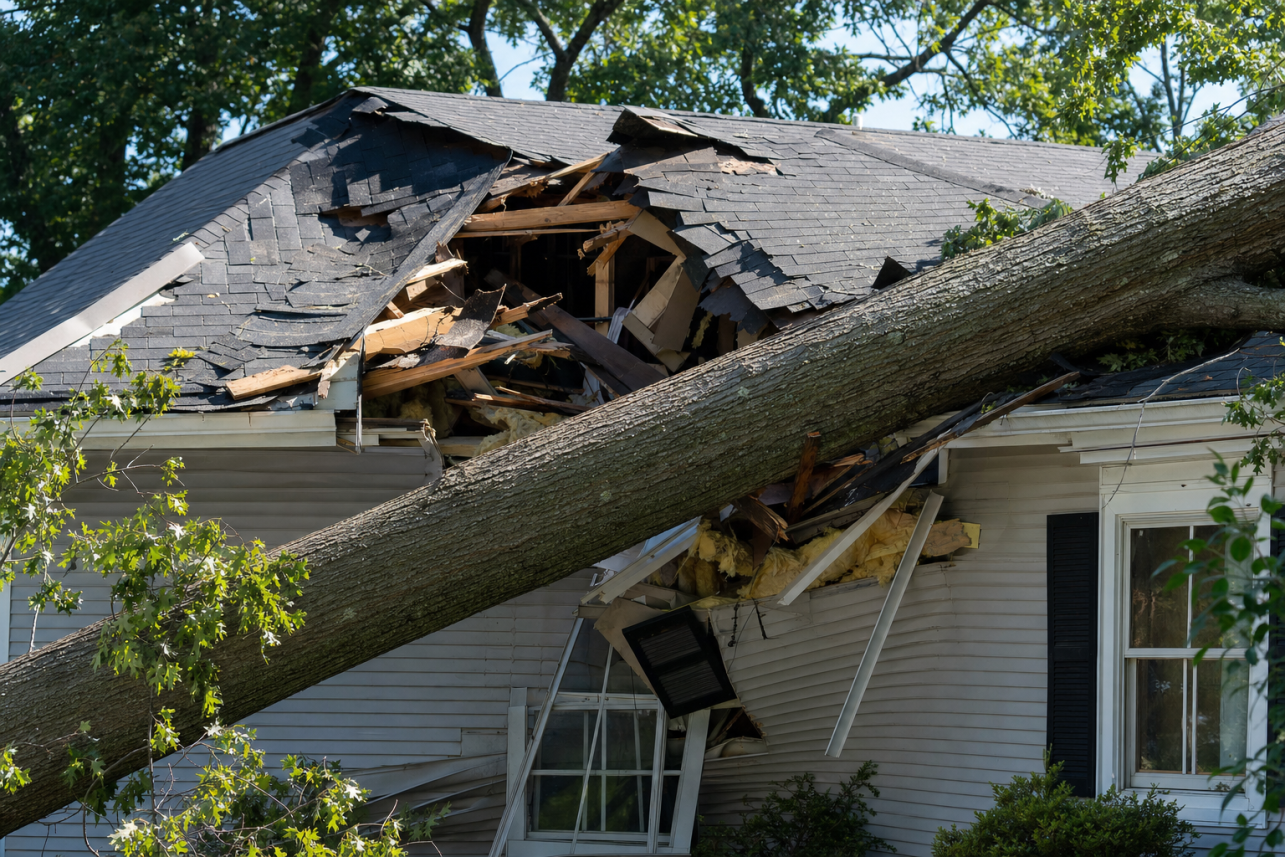
What Hidden Damage Do Insurance Adjusters Miss When A Tree Falls On A Roof?
Almost everything below the shingles. The carrier’s adjuster often inspects from the exterior, notes the visible puncture, and writes an estimate for a patch. Tree strikes rarely work that way — the force of a falling oak or pine transfers through the entire roof system.
The most commonly missed items we find on these claims in Morrisville include cracked or split rafters and trusses several feet from the impact point, fractured roof decking that flexes underfoot, separated ridge lines, and drywall cracks where the frame shifted. Chimneys and gable walls can rack out of plumb from a single hard strike.
Water is the second wave. Even a well-installed tarp leaks over weeks of Wake County rain, and moisture in the attic insulation leads to mold that carriers try to exclude if it isn’t documented early. We use moisture readings and attic inspections to tie every bit of water damage back to the original loss.
Matching matters too. North Carolina claims practice generally supports replacing materials so the repair matches the rest of the home — if your discontinued shingle can’t be matched on one slope, the argument for replacing the full roof or elevation is real money, often tens of thousands of dollars the initial estimate ignores.
This is exactly why homeowners bring us in on a Tree Fell On House Claim Morrisville carriers have scoped too narrowly. Our inspection includes the attic, the framing, and the interior, and our estimates reflect what a licensed contractor will actually charge to restore the home — not what a software program suggests.
How Much Does It Cost To Hire A Public Adjuster For A Tree Fell On House Claim Morrisville Homeowners Are Filing?
For The Public Adjusters, Inc. works on a contingency fee, which means you pay nothing upfront and nothing out of pocket. Our fee is a percentage of the settlement we recover for you, so we only get paid when you do. If we don’t improve your outcome, you owe us nothing.
In North Carolina, public adjuster fees are regulated by the Department of Insurance, and the percentage is agreed to in writing before any work begins. There are no hidden charges, no hourly billing, and no surprise invoices after the claim closes.
Homeowners sometimes worry the fee will eat into their payout. In practice, the opposite usually happens. When a tree crushes a roofline, the carrier’s first offer often covers shingles and little else, ignoring cracked trusses, shifted framing, damaged decking, and interior water intrusion. Our job is to document every dollar of covered damage, and the difference between the initial offer and a properly scoped settlement typically far exceeds our fee.
We also handle everything the claim demands: the inspections, the estimates written in the same software carriers use, the policy analysis, and every phone call and letter to the insurance company. For a Morrisville homeowner juggling work, kids, and a tarped roof, that time savings alone is significant. Before you sign anything with your insurer, it costs nothing to have us review your policy and damage, and that free consultation often reveals coverage the carrier never mentioned.
I Already Accepted A Settlement For Tree Damage To My Morrisville Home. Can The Claim Be Reopened?
In many cases, yes. Accepting a payment from your insurance company is not the same as closing the door on your claim forever. In North Carolina, you generally have up to three years from the date of loss to pursue additional amounts owed under your policy, and most policies allow supplemental claims when new or missed damage is discovered.
This matters because tree impacts are notorious for hidden damage. A settlement paid quickly after the storm often covers the visible roof hole but misses fractured rafters, compromised load-bearing walls, damaged HVAC ductwork in the attic, and moisture that later becomes mold. If your contractor opened the roof and found more damage than the carrier paid for, that is exactly the situation a supplemental claim addresses.
When we take on an underpaid Tree Fell On House Claim Morrisville residents already settled, we start by comparing the carrier’s estimate against the actual scope of repairs. We document the gap with photos, moisture readings, and structural evidence, then present a supplemental demand supported by line-item pricing.
One caution: check whether you signed a release. Full releases are rare in standard homeowner claims, but if you signed one, bring it to us and we’ll review it at no charge. Cashing a check alone almost never waives your rights. The sooner you act, the stronger the supplement, so don’t let repairs finish and evidence disappear before someone documents what the first adjuster missed.
Will My Insurance Pay For A Hotel Or Rental While My House Is Being Repaired After A Tree Strike?
If the damage makes your home unsafe or unlivable, most homeowners policies include Additional Living Expense coverage, often called ALE or Loss of Use. This pays the reasonable extra costs of living elsewhere while covered repairs are underway: hotel stays, a short-term rental, restaurant meals above your normal grocery spend, pet boarding, even added mileage if your temporary housing is farther from work in the RTP area.
The key word is uninhabitable. A tree through the roof over a bedroom, exposed electrical, no functioning kitchen, or structural instability generally qualifies. Carriers sometimes push back if only part of the house is damaged, arguing you can live around the repairs. We counter that with contractor and engineer documentation showing why occupancy is unsafe or unreasonable during the work.
Two practical tips for Morrisville homeowners. First, keep every receipt from day one, including that first emergency hotel night near the airport, because ALE reimburses actual documented expenses. Second, get the carrier’s ALE authorization in writing before committing to a long-term rental, since rates in Wake County can exceed what an adjuster initially approves.
ALE has limits, usually a dollar cap or a time cap such as twelve or twenty-four months, so the pace of the repair matters. When carriers drag out approvals, families burn through ALE waiting. Part of our job is pushing the structural claim forward quickly so your displacement, and the cost of it, stays as short as possible.
Should I Use The Insurance Company’s Preferred Contractor To Repair My Tree-Damaged Roof?
You are never required to. In North Carolina, the choice of contractor belongs to the homeowner, and we generally advise against automatically accepting the carrier’s preferred vendor for major structural work like a tree strike.
Here’s why. Program contractors get steady referrals from the insurance company, which creates pressure to keep repair scopes within whatever the carrier has approved. If the approved estimate covers patching the decking but the trusses are actually cracked, a contractor loyal to the carrier’s number may work around the problem rather than fight for the fix. An independent Morrisville-area contractor answers only to you.
A tree impact is a structural event, not just a roofing job. Depending on the size of the tree and where it hit, proper repair can involve a structural engineer’s evaluation, framing replacement, matching requirements for shingles and siding under your policy, and Town of Morrisville permits and inspections. You want a contractor experienced with insurance restoration who will document everything they open up.
When For The Public Adjusters handles a Tree Fell On House Claim Morrisville families bring to us, we coordinate directly with your chosen contractor so the repair scope and the insurance estimate match line for line. That alignment is what prevents the nightmare scenario: a settlement that runs out mid-repair. Get at least two independent estimates, verify licensing and general liability insurance, and never sign an assignment of benefits or a contract with blank pricing before the claim scope is settled.
Will Filing A Tree Fell On House Claim Morrisville Raise My Insurance Premiums Or Get Me Dropped?
A single weather-related claim rarely gets a policy cancelled in North Carolina, and tree strikes are almost always classified as weather losses. When a storm blows a tree onto your roof, that is considered an act of nature, not negligence, and insurers treat it differently than a liability or water-damage claim caused by lack of maintenance.
That said, premiums across Wake County have risen after major storm seasons regardless of who files. If your neighbors all filed claims after the same windstorm and you did not, you will likely see the same rate adjustment anyway. Absorbing tens of thousands of dollars in structural repairs to avoid a modest premium bump is almost never the right math.
Where homeowners actually get into trouble is filing small, frequent claims or letting a claim sit open and unresolved. A well-documented, professionally presented claim that closes cleanly is far less of a red flag than a messy one that drags on with disputes and supplements.
We help Morrisville homeowners weigh this before filing. If the damage is genuinely minor and close to your deductible, we will tell you honestly that a claim may not be worth it. But when a tree has punctured the roof deck, cracked framing, or compromised trusses, the repair costs almost always dwarf any premium concern. Our job is to make sure the claim is documented and valued correctly the first time, so it settles fully and closes without lingering issues on your claims history.
The Tree Is Still Sitting On My Roof. Should I Have It Removed Before The Insurance Adjuster Inspects?
Do not let a tree crew haul everything away before the damage is thoroughly documented. Once the tree is gone, you lose the single best piece of evidence showing the point of impact, the direction of force, and the weight that came down on your structure. Insurers use that evidence to evaluate framing, truss, and decking damage.
That does not mean you have to live under a tree for weeks. Your policy requires you to prevent further damage, so emergency mitigation is expected. The right approach is to photograph and video everything first: the full tree, where it entered or crushed the roofline, interior ceilings below the impact, and any visible cracks in walls or framing. Then have the tree cut back only enough to tarp the roof and secure the home.
Keep the trunk section that hit the house on the property if possible, especially if the insurer might later argue the tree was rotten or dead. A cross-section of healthy wood can defeat that denial argument outright.
Save every invoice from the tree service and tarping crew, because emergency removal and mitigation costs are typically reimbursable under your policy. When we handle a Tree Fell On House Claim Morrisville homeowners bring to us, one of the first things we do is build a photo and measurement record before cleanup finishes. If the tree is already gone, we can still work with crane operator records, tree service invoices, and impact evidence in the structure itself, but earlier is always stronger.
My Settlement Mentions Recoverable Depreciation. What Does That Mean For My Tree Damage Payout?
Most homeowners policies in the Morrisville area pay claims on a replacement cost basis, but they do it in two stages, and this trips up a lot of people. The first check you receive is the actual cash value: the full repair cost minus depreciation for the age and condition of your roof, siding, or interior finishes. The depreciation that was held back is called recoverable depreciation.
You get that second payment only after you complete the repairs and submit proof, usually contractor invoices, to the insurance company. Miss the policy deadline, often 180 days to two years depending on your carrier, and the insurer keeps that money.
Here is where it matters on a tree strike. If a 15-year-old roof takes a direct hit, the carrier might depreciate the roofing materials by 40 percent or more. On a $30,000 roof, that is $12,000 held back. Homeowners who do not understand the process sometimes look at the first check, decide they cannot afford repairs, and never recover that balance.
Depreciation calculations are also negotiable. Carriers frequently over-depreciate, apply depreciation to labor when the policy language does not support it, or depreciate items like structural framing that do not wear out the way shingles do. Reviewing those line items is a routine part of how we handle tree damage claims for Wake County homeowners, and correcting them regularly adds thousands of dollars to the final settlement. Never assume the depreciation figure on your estimate is fixed.
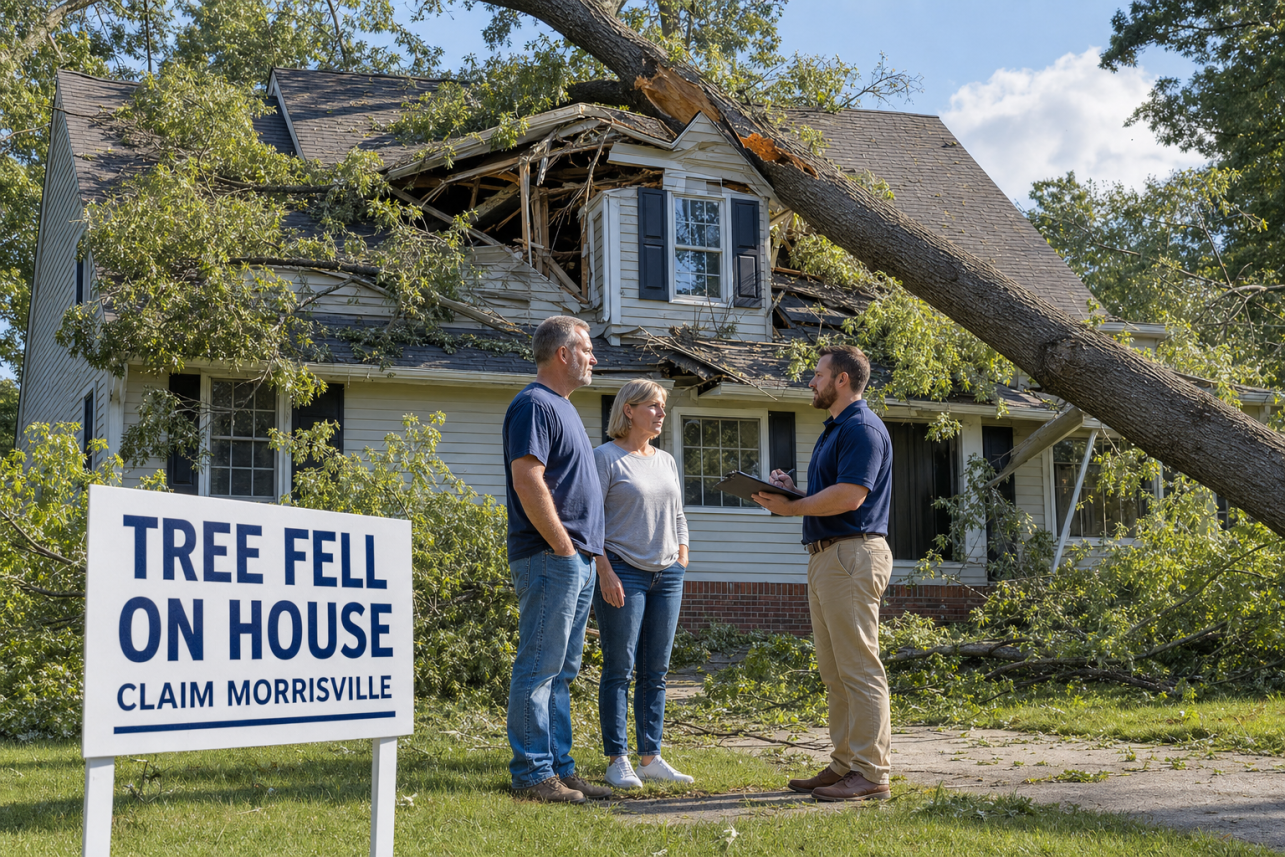
The Falling Tree Also Crushed My Fence, Shed, And Deck. Are Detached Structures Covered Under The Same Claim?
Yes, but they are paid from a different bucket of your policy, and that distinction matters. Damage to your house itself falls under Coverage A, your dwelling limit. Fences, detached garages, sheds, gazebos, and sometimes decks that are not attached to the home fall under Coverage B, other structures, which is typically capped at 10 percent of your dwelling coverage.
In practice, one tree coming down in a Morrisville backyard often damages several of these at once: it clips the roof, flattens a fence run, and lands on the shed. Each item needs to be scoped and valued separately, and adjusters working quickly frequently miss detached structures entirely or lump them into a lowball allowance.
A few specifics worth knowing. Fencing is often underpaid because carriers price only the visibly broken panels, when matching stain, age, and construction may justify replacing a full run. Attached decks usually fall under the dwelling limit, not Coverage B, which affects how much money is available. And if the shed contained tools, mowers, or stored belongings, those are personal property under Coverage C and need their own inventory.
When we prepare a Tree Fell On House Claim Morrisville insurers are reviewing, we document every structure the tree touched, assign each loss to the correct coverage, and itemize contents separately. Getting the coverage categories right from the start prevents the carrier from exhausting one limit while ignoring damage that belonged under another, and it is one of the most common places we find money the initial estimate left out.
Local Relevance
Morrisville sits in the heart of Wake County’s tree canopy — tall loblolly pines and mature hardwoods surround the subdivisions built during the area’s rapid growth over the past few decades. That greenery is part of why people love living here, and it is also why fallen-tree losses are one of the most common serious claims in this part of the Triangle.
Our region’s biggest tree threats come in clusters: summer thunderstorms with saturated ground, winter ice storms that load limbs beyond what they can bear, and the remnants of hurricanes pushing inland from the coast. Anyone who has lived in the Triangle long enough remembers how much tree damage Hurricane Fran did to this area in 1996 — pines through roofs from Raleigh to Chapel Hill.
Because a single storm system tends to sweep the whole region, we handle these losses across neighboring communities as well, from a tree fell on house insurance in Chapel Hill matter to claims in Cary, Apex, and Durham. When adjusters are stretched thin after a big storm, inspections get rushed — and rushed inspections are where underpayment starts.
Morrisville’s loblolly pines are tall, heavy, and relatively shallow-rooted, and the clay soils common here hold water — so after several days of rain, otherwise healthy pines often uproot whole rather than snapping, driving the full weight of the tree into the roof structure. That is why damage in this area frequently extends into rafters and framing well beyond the visible hole, and why an impact-point-only estimate tends to come in short.
A Tree Is On Your House. Don’t Face The Insurance Company Alone.
For The Public Adjusters, Inc. is licensed and bonded, and we work only for policyholders — never for insurance companies. Before you sign off on the carrier’s estimate or accept a check, let us review your claim at no obligation. The sooner the damage is properly documented, the stronger your position.
Call us: (919) 400-6440
Helpful Resources
- NCDOI Public Adjusters Guide
- Insurance Information Institute (III)
- North Carolina Department of Insurance — State regulator overseeing insurers and public adjuster licensing
- Insurance Information Institute — Consumer education on homeowners coverage and claims
Serving Morrisville · Wake
Last updated: September 12, 2026