
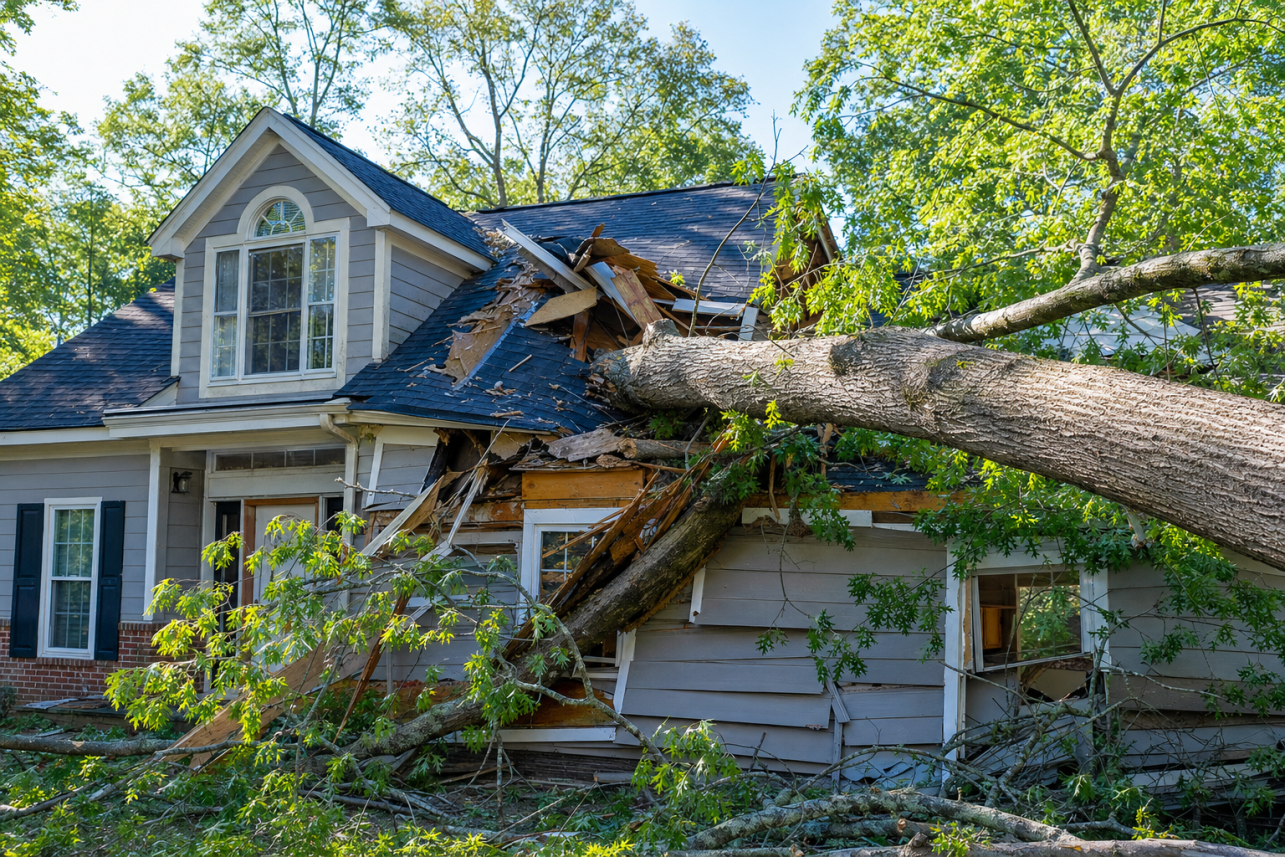
If you're searching for tree fell on house insurance chapel hill answers, here is the short version: your homeowners policy generally covers damage a fallen tree does to your roof, structure, and belongings, plus at least part of the removal cost — but the amount you're first offered is often far less than the real cost to repair. For The Public Adjusters, Inc. works only for the policyholder, not the insurance company. We document the full scope of the damage, prepare the claim properly, and negotiate the settlement so you aren't left paying out of pocket for repairs your policy should cover.
What This Service Is
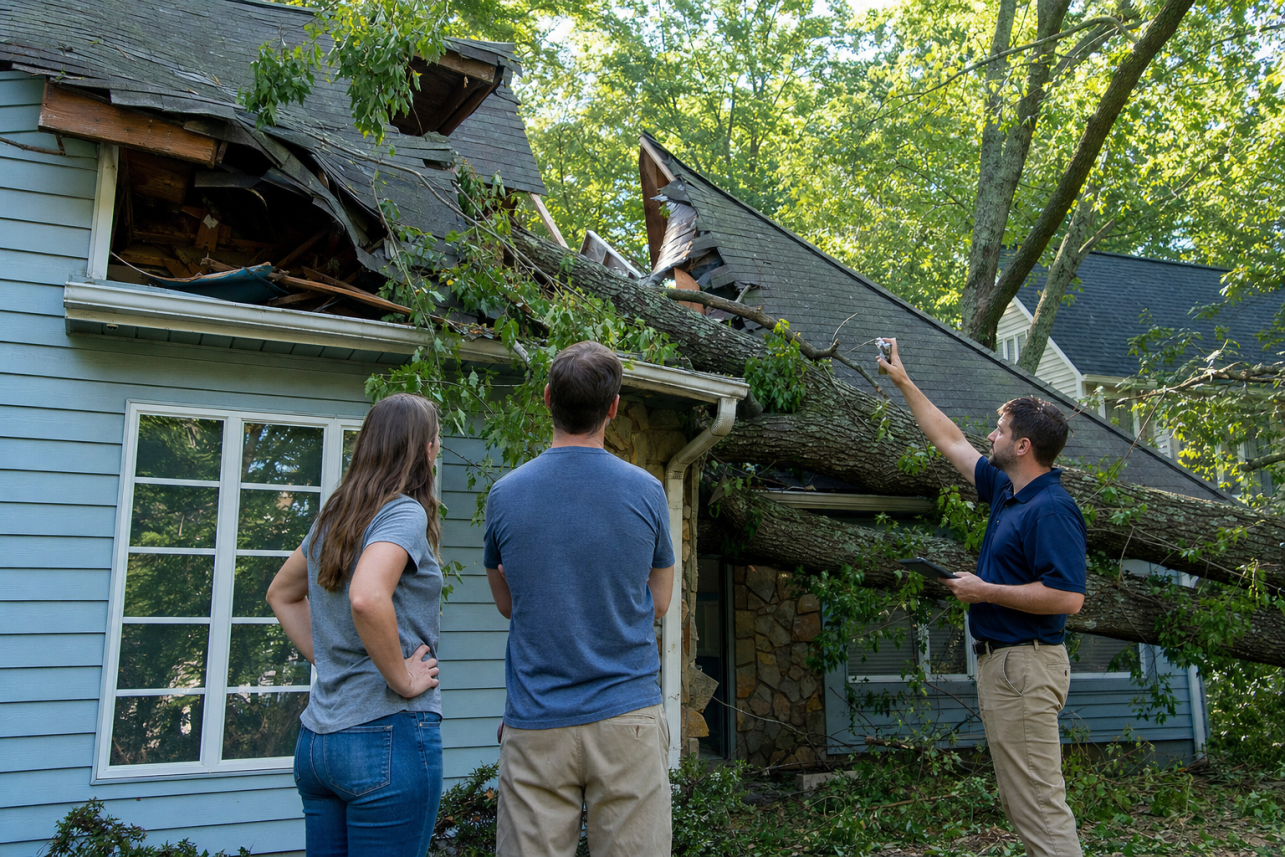
When a tree lands on your home, you actually have two problems: the damage itself, and the claim. The claim is our job. A public adjuster is a licensed professional who represents you — the homeowner — through the entire insurance claim, from the first inspection to the final settlement check.
That matters because the adjuster your insurance company sends works for the insurance company. Their inspection often stops at what's visible: the hole in the roof, the crushed gutter. But a falling tree transfers enormous force into a house. Rafters crack, walls shift, ceilings sag weeks later, and rainwater that entered through the opening soaks insulation and framing you can't see from the driveway.
For The Public Adjusters, Inc. builds the complete picture. We assess structural damage, water intrusion, damaged contents, tree removal costs, and the cost of temporary protection like tarping. If your home isn't safe to live in, we make sure your claim includes the additional living expenses your policy provides for hotels or a rental while repairs happen.
We handle the paperwork the insurer requires — including the sworn proof of loss — meet their adjuster on site, challenge low estimates line by line, and negotiate the settlement. We are licensed and bonded, and our fee comes from the recovery, so our interests are aligned with yours from day one. The North Carolina Department of Insurance publishes guidance in its NCDOI Public Adjusters Guide explaining exactly this role, and we work within those rules on every claim.
Common Problems
What Will My Policy Actually Pay — The Roof, The Structure, Removing The Tree?
Most homeowners policies cover damage to the dwelling and your belongings when a tree falls on the house, and they typically contribute toward getting the tree off the structure. The Insurance Information Institute notes that coverage generally applies whether it was your tree or a neighbor's — though if the neighbor's tree was visibly dead or neglected, their insurer may ultimately bear the cost.
The fights are usually over amount, not coverage. Insurers may pay actual cash value — the depreciated worth of your fifteen-year-old roof — instead of what it truly costs to replace it, and the difference can be thousands of dollars.
Your deductible comes off the top, and tree removal is often capped at a modest limit. Knowing exactly what your policy language entitles you to is half the battle, and it's the first thing we review.
Why Tree Fell On House Insurance Chapel Hill Claims Get Denied Or Underpaid
The most common problem we see is a fast, shallow inspection. The insurer's adjuster prices the visible roof patch and misses cracked rafters, shifted framing, and water damage spreading inside walls. The result is a check that won't come close to funding real repairs.
Other claims stall over paperwork — a missed proof of loss deadline, or a demand for documentation the homeowner didn't know to keep. Some are denied outright on exclusions, such as an argument that the tree was rotten and the damage was 'neglect.'
You do not have to accept a lowball number or a denial as final. North Carolina courts have sided with homeowners: in Guessford v. Pennsylvania National Mutual Casualty Insurance Co., a North Carolina homeowner whose storm-damage claim was repeatedly underpaid took the insurer to court and prevailed. Disputing the scope of damage, in writing and with evidence, is a normal and legitimate part of the process — and it's what we do every day.
Can I Handle The Claim Myself, Or Should I Hire Someone?
You can file the claim yourself, and for a small, simple loss that may be fine. But a tree through the roof is rarely simple. It combines structural damage, water damage, contents losses, removal costs, and possibly living expenses — each with its own documentation and its own way of being undervalued.
A good public adjuster is licensed by the state, bonded, works only on the policyholder's side, and puts everything in writing. Be cautious of anyone who promises a specific dollar outcome — no honest professional can guarantee what an insurer will pay, and we never do.
What we can do is make sure nothing is missed, nothing is missed on deadline, and every dollar of documented damage is presented and negotiated professionally. Homeowners typically call us either right after the loss or after receiving an offer that felt wrong — both are good times to get a second set of eyes.

Our Process
Secure The Home And Document Everything
First, safety and evidence. We help you arrange emergency tarping and board-up so rain doesn't multiply the damage — reasonable temporary protection is generally reimbursable under your policy, so keep every receipt.
Then we document: photos and video of the tree, the impact points, interior damage, and damaged belongings before anything is hauled away. This record is the backbone of the entire claim.
Build The Full Claim, Not The Quick One
We perform a thorough scope-of-damage inspection — roof, framing, ceilings, walls, electrical, and hidden moisture — and prepare a detailed, line-item estimate of repair costs.
We assemble your contents inventory, tree removal costs, and any additional living expenses, then prepare and submit the proof of loss and supporting paperwork on time and in the form your insurer requires.
Negotiate The Settlement On Your Behalf
We meet the insurance company's adjuster at your home, walk them through the damage they may have missed, and challenge any undervalued line items — including improper depreciation on materials that should be paid at replacement cost.
If the insurer's position doesn't move, we escalate through the dispute options your policy and North Carolina law provide. You stay informed at every step, and you make the final call on any settlement.
| What Happens After the Tree Hits | Insurance Company's Adjuster | For The Public Adjusters, Inc. |
|---|---|---|
| Who they work for | Employed or paid by the insurance company | Licensed to represent only you, the policyholder |
| Structural damage inspection | Often a visual look at the impact point only | Engineer-supported inspection of trusses, rafters, and decking beyond the visible hole |
| Hidden water damage | Frequently limited to visible stains | Moisture mapping in attic, walls, and floors over days, not minutes |
| Tree removal costs | Often capped at $500–$1,000 policy sublimits without question | Documents crane and access costs, and applies the correct coverage when the tree damaged the dwelling |
| Shingle and material matching | Patches the damaged slope with mismatched materials | Pursues full replacement when matching materials are discontinued |
| Negotiation and appeal | None — you accept the offer or fight alone | Full supplement, re-inspection, and appraisal support until the claim is paid fairly |
Commonly Overlooked In The Public Adjusting Industry
- Fractured trusses and rafters beyond the impact point — The shock of a falling tree travels through the framing, and carriers' adjusters usually only inspect the hole they can see from the attic hatch.
- Crane and heavy-equipment costs buried under the tree removal sublimit — Adjusters apply the $500–$1,000 debris sublimit to everything, when removal required to repair the dwelling is actually part of the structural claim.
- Water migration into wall cavities during the hours before tarping — Rain entering through a roof breach runs down inside walls to lower floors, and single-visit moisture checks miss it before stains appear.
- Discontinued shingle lines and North Carolina matching considerations — Carriers price a small patch, but if the shingles can't be reasonably matched, the argument for a full slope or roof replacement is often never raised.
- Code-required upgrades to older Chapel Hill and Orange County homes — Repairs must meet current building code, and ordinance-or-law coverage that pays for those upgrades sits unused in most policies because nobody claims it.
- Damaged electrical service masts and weatherheads — A tree that clips the service line often bends the mast and stresses the panel, but adjusters focused on the roof rarely scope electrical work at all.
- Additional living expenses during reconstruction — Homeowners don't realize their policy pays for hotels, rentals, and increased costs while the house is unlivable, and carriers seldom volunteer it.
- Documenting a neighbor's prior notice about a hazardous tree — Emails, letters, or arborist reports proving the neighbor knew the tree was dying can recover your deductible, but the evidence disappears if nobody preserves it early.
Case Studies
Case Study #1
Situation: A retired couple in the Coker Hills neighborhood of Chapel Hill had a mature willow oak crash through their roof during a July thunderstorm. The tree punched through the ridge line, crushed two roof trusses, and rain poured into the attic and master bedroom for several hours before a tarp could be placed.
Problem: Their carrier's adjuster inspected quickly and offered roughly $28,000 — enough to patch the roof opening and repaint the bedroom, but nothing for the fractured trusses, saturated insulation, or the hardwood floors that were already cupping. The estimate also capped tree removal at $1,000 despite a crane being required.
Investigation: We brought in a structural engineer to evaluate the truss system, documented moisture readings in the attic, wall cavities, and flooring over a two-week span, and pulled the crane operator's invoice showing why removal cost what it did. We also photographed hidden framing damage the carrier's adjuster never accessed.
Findings: Four trusses, not two, were compromised, and the ridge board was split eight feet beyond the visible impact point. Moisture mapping showed water had traveled inside wall cavities down to the first floor. The carrier's estimate used a per-square patch price instead of accounting for matching the 15-year-old architectural shingles, which were discontinued.
Solution: We prepared a complete Xactimate estimate including full roof replacement under North Carolina's matching considerations, engineered truss repairs, insulation and drywall replacement on two floors, hardwood refinishing, and code-required upgrades. We then presented the engineer's report and moisture logs to the carrier and requested a re-inspection with our team present.
Outcome: The claim settled at $147,600 — more than five times the original offer — including additional living expenses for the six weeks the couple stayed elsewhere during reconstruction.
Lesson: When a tree hits a roof, the visible hole is rarely the full story. Framing, moisture migration, and shingle matching are where carriers routinely underpay, and they are exactly where documentation wins.
Case Study #2
Situation: A homeowner near Southern Village had a neighbor's dying pine fall across her property line in a windstorm, landing on her garage roof and taking down the service mast and part of a fence. Her neighbor's insurer denied any responsibility, and her own carrier issued a $9,400 payment.
Problem: The payment ignored the electrical mast and panel damage, paid nothing toward the fence, and applied depreciation so aggressively that the actual check barely covered debris removal. The homeowner also believed — wrongly, as her carrier told her — that the neighbor's policy should pay, and she'd lost three weeks chasing the wrong company.
Investigation: We reviewed both policies, obtained the arborist records showing the neighbor had been notified in writing that the pine was dead — a fact that changes the negligence analysis in North Carolina. We had a licensed electrician document the mast, weatherhead, and panel damage, and we re-measured the garage roof and fence line.
Findings: The garage roof decking was cracked in three sections beyond the impact zone, the electrical service required a full mast and panel replacement to meet current Orange County code, and the fence loss had simply been left out of the carrier's scope. The prior written notice about the dead tree opened a viable liability recovery against the neighbor's carrier for the deductible and uncovered items.
Solution: We supplemented the first-party claim with the electrician's report, corrected roof measurements, and code-upgrade documentation, then pursued the neighbor's insurer separately with the arborist notice as evidence of negligence.
Outcome: Her own carrier's payment rose from $9,400 to $41,200, and the neighbor's insurer reimbursed her $2,500 deductible and paid $3,800 toward landscaping the first policy excluded. Total recovery exceeded $47,000.
Lesson: Who pays when a neighbor's tree falls depends on whether the owner knew the tree was hazardous. Your own policy usually pays first, but prior written notice can put the deductible and excluded items back in your pocket.
| Scenario | Who Usually Pays | What It Depends On |
|---|---|---|
| Your healthy tree falls on your house in a storm | Your homeowner's policy | Wind, lightning, and ice are covered perils; your deductible applies |
| Neighbor's healthy tree falls on your house | Your policy, not theirs | An 'act of God' isn't the neighbor's fault; your carrier pays and rarely recovers |
| Neighbor's dead or visibly hazardous tree falls on your house | Your policy first, then their insurer may reimburse | Whether the neighbor had prior notice — written notice or arborist records are key evidence |
| Tree falls in the yard but doesn't touch a structure | Often little or nothing | Most policies only cover removal ($500–$1,000) if the tree blocks a driveway or hits a covered structure |
| Tree hits your detached garage, shed, or fence | Your policy under 'other structures' coverage | That coverage is typically capped at 10% of your dwelling limit — check it before agreeing to a payout |
| Tree damages your car in the driveway | Your auto policy, not homeowner's | You need comprehensive coverage on the vehicle; the home policy won't respond |
| Carrier says the tree was rotten so damage is 'wear and tear' | Should still be your policy | Whether wind was the proximate cause of the failure — an arborist opinion often defeats this denial |

Reviews
A red oak came through our kitchen ceiling in April and our insurance company offered $19,000. For The Public Adjusters found broken rafters and wet insulation the first adjuster never even looked at. We ended up settling for over $90,000 and they handled every call with the carrier. I never had to argue with anyone myself.
Karen M., Chapel Hill
Our carrier said the tree that hit our house was 'wear and tear' because the trunk had some rot — basically trying to deny the whole claim. This team brought in an arborist, proved the tree failed from storm wind, and got the denial overturned. The difference was our entire roof and two bedrooms rebuilt. Worth every penny of their fee.
David and Priya R., Orange County
The insurance estimate after a pine crushed our screened porch and back roof was insultingly low — it didn't even include the crane we needed to lift the tree off. For The Public Adjusters rewrote the whole scope, documented the code upgrades Chapel Hill requires, and roughly tripled the settlement. Only reason it's not done sooner was the carrier dragging their feet, not them.
Tom L., Chapel Hill NC
Frequently Asked Questions
What Should I Do First When Filing A Tree Fell On House Insurance Chapel Hill Claim?
Your first priority is safety. If the tree has broken through the roof or compromised the structure, get everyone out and have Duke Energy or OWASA check for downed lines or damaged utility connections before re-entering.
Once it's safe, document everything before anything is moved. Photograph the tree where it landed, the point of impact, interior water intrusion, and any damaged belongings. In Chapel Hill, where mature willow oaks and loblolly pines routinely exceed 80 feet, the impact damage often extends well beyond what's visible from the ground — cracked rafters, shifted framing, and torn flashing hide under an intact-looking roofline.
Next, take reasonable steps to prevent further damage. Tarping the roof and boarding openings are covered as mitigation expenses under most policies, so keep every receipt. Do not authorize full tree removal or permanent repairs until the damage has been properly documented and scoped.
Then notify your carrier — but be careful with recorded statements. What you say in that first call can shape the entire claim. Many Orange County homeowners contact us before or immediately after reporting the loss so we can manage the inspection, prepare an independent damage estimate, and negotiate directly with the insurance company's adjuster. As licensed public adjusters, we work exclusively for you, not the carrier, and our goal is a settlement that reflects the true cost of repairs in the Chapel Hill market, not a lowball figure based on generic pricing software.
Does Homeowners Insurance Cover A Tree That Falls On My Chapel Hill Home?
In most cases, yes — as long as the tree fell due to a covered peril. Standard HO-3 policies cover damage from wind, ice, lightning, and the weight of snow, which accounts for the majority of tree strikes we see across Chapel Hill, Carrboro, and the rest of Orange County. Summer thunderstorms, remnants of tropical systems, and winter ice storms are the usual culprits here.
Coverage typically includes the structure itself, attached features like gutters and decks, damaged personal property inside, and the cost of removing the tree from the dwelling. Debris removal for a tree that hit an insured structure is usually covered, though policies often cap removal at $500 to $1,000 per tree — a number that rarely reflects real crane and removal costs for the large hardwoods common in older neighborhoods near Franklin Street or Southern Village.
Where claims get complicated is causation. If the carrier argues the tree was dead, diseased, or rotted before it fell, they may deny the claim on neglect grounds. We push back on those denials regularly, often with arborist documentation showing the tree was viable until the storm event.
It also doesn't matter whose tree it was in most cases. If your neighbor's oak lands on your roof, your own policy typically responds first. Your carrier may then pursue the neighbor's insurer if negligence can be proven, which can help recover your deductible.
Why Is The Insurance Company's Estimate So Much Lower Than My Contractor's Quote?
This is the single most common frustration we hear from homeowners after a tree strike, and there are several reasons for the gap.
Carrier adjusters typically write estimates using standardized pricing software with regional averages that lag behind what roofers, framers, and crane operators actually charge in the Triangle. Labor and material costs in Chapel Hill have climbed sharply, and older homes — especially the mid-century houses in neighborhoods like Glen Lennox or Coker Hills — often require custom materials and code upgrades that generic estimates miss entirely.
Second, insurance company inspections are frequently visual and brief. A large pine punching through a roof can crack trusses, shift load-bearing walls, and open pathways for water that soaks insulation and wiring. If the adjuster only scopes the visible hole and a few shingles, tens of thousands of dollars in structural and hidden damage never make it into the estimate.
Third, depreciation and overhead-and-profit deductions are often applied aggressively or incorrectly, shrinking the actual check you receive.
When we take over a claim, we perform our own detailed inspection, bring in engineers or arborists when needed, and build a line-item estimate that matches real repair costs. We then negotiate with the carrier using that documentation. It's very common for our clients' final settlements to come in substantially higher than the initial offer — and North Carolina law gives you the right to dispute and reopen an underpaid claim.
How Can A Public Adjuster Help With Tree Fell On House Insurance Chapel Hill Claims, And What Does It Cost?
A public adjuster is a state-licensed claims professional who represents you — the policyholder — rather than the insurance company. When you hire For The Public Adjusters, Inc. after a tree fell on house insurance Chapel Hill claim, we take over the entire process so you're not negotiating against trained carrier adjusters on your own.
That starts with a full policy review to identify every coverage that applies: dwelling, other structures, personal property, debris removal, code upgrade coverage, and additional living expenses if the home is unlivable during repairs. Many Orange County homeowners don't realize their policy will pay for temporary housing, meals, and even pet boarding while a roof or structural repair is underway.
We then document the loss thoroughly — moisture readings, structural assessments, photo and video evidence — and prepare an independent, line-item repair estimate. We attend every inspection, handle all communication with the carrier, and negotiate until the settlement reflects the actual cost of restoring your home, not the insurer's opening number.
As for cost, we work on contingency. There are no upfront fees; we're paid a percentage of the recovered settlement, and only when you get paid. If we don't increase your recovery, you owe us nothing, which means our interests are aligned with yours from day one.
If a tree has come down on your home anywhere in Chapel Hill or the surrounding Orange County area, call us before you accept any offer. Even claims that have already been underpaid or denied can often be reopened and resolved properly.
What Happens With A Tree Fell On House Insurance Chapel Hill Claim When The Tree Belonged To My Neighbor?
This surprises a lot of Chapel Hill homeowners: in most cases, your own homeowners policy pays for the damage, not your neighbor's. North Carolina follows the general rule that a tree falling due to a storm, wind, or ice is considered an 'act of God,' so the property owner where the tree landed files the claim with their own carrier.
There's an important exception. If the tree was visibly dead, diseased, or leaning dangerously and your neighbor knew about it — or should have known — their liability coverage may be responsible instead. Document everything: photos of the trunk showing rot or fungus, any prior emails or texts you sent warning them, even statements from an arborist. Around older Chapel Hill neighborhoods like Coker Hills and Greenwood, mature oaks and pines with hidden decay are a common source of these disputes.
If negligence applies, your insurer may still pay your claim first and then pursue the neighbor's carrier through subrogation, which can eventually get your deductible refunded. Don't wait on that process to start your own claim, though — repairs and mitigation need to happen quickly regardless of who ultimately pays.
We review these situations for Orange County homeowners regularly. Getting the liability question right at the beginning can mean the difference between eating your deductible and recovering every dollar, so it's worth having someone examine the evidence before positions harden on either side.
Does My Policy Cover Tree Removal And Debris Cleanup, Or Only The Repairs To The House Itself?
Most homeowners policies cover both, but the limits work differently and this is where Chapel Hill claims often get shortchanged. Removing the portion of the tree that's on your roof or structure is typically covered as part of the dwelling repair, because you can't fix the roof until the tree is off it. That removal cost should not be capped at a small sublimit.
Debris removal for the rest of the tree — the trunk and limbs lying in your yard — is usually subject to a separate limit, often $500 to $1,000 per tree with a cap per occurrence. Adjusters sometimes lump everything under that small sublimit, which is wrong when the tree damaged a covered structure. Crane work, which is frequently necessary for the large hardwoods common around Chapel Hill and Carrboro, can run several thousand dollars on its own.
Also check whether the tree blocked your driveway or a handicap-access ramp; many policies extend debris coverage in those situations even when the tree didn't hit the house.
Keep every invoice from the tree service, and ask them to itemize the work: what was required to protect the structure versus general yard cleanup. That breakdown gives you leverage to argue the bulk of the cost belongs under your full dwelling coverage rather than the small debris sublimit. It's a subtle distinction that routinely adds real money to a settlement.
How Long Do I Have To File A Claim In North Carolina, And How Long Will The Process Take?
Your policy itself sets the first deadline: nearly all require 'prompt' notice of the loss, which in practice means you should report the damage within days, not weeks. Waiting can give the carrier grounds to argue that delays worsened the damage — a real risk in Chapel Hill, where a tarped roof can leak through several rounds of Piedmont thunderstorms before repairs begin.
North Carolina law generally gives you three years to file suit over a breached insurance contract, but don't confuse that litigation deadline with the claim itself. Some policies also impose shorter contractual deadlines for submitting a sworn proof of loss or completing repairs to recover full replacement cost, sometimes as little as 180 days to two years. Read those provisions carefully.
As for timeline: a straightforward claim where a tree punctured the roof might resolve in four to eight weeks. Claims involving structural damage, engineering inspections, or disputes over scope commonly stretch three to six months. After major wind events, when every carrier in Orange County is flooded with claims, expect delays at every stage.
You can shorten the process by having complete documentation ready from day one — dated photos, a detailed contractor estimate, mitigation receipts — and by responding to carrier requests in writing promptly. When a claim stalls without explanation, that's often the point where bringing in professional representation gets things moving again, because carriers know a represented claim is being watched closely.
The Insurer Already Paid My Claim, But My Contractor Found Hidden Structural Damage. Is It Too Late To Reopen A Tree Fell On House Insurance Chapel Hill Claim?
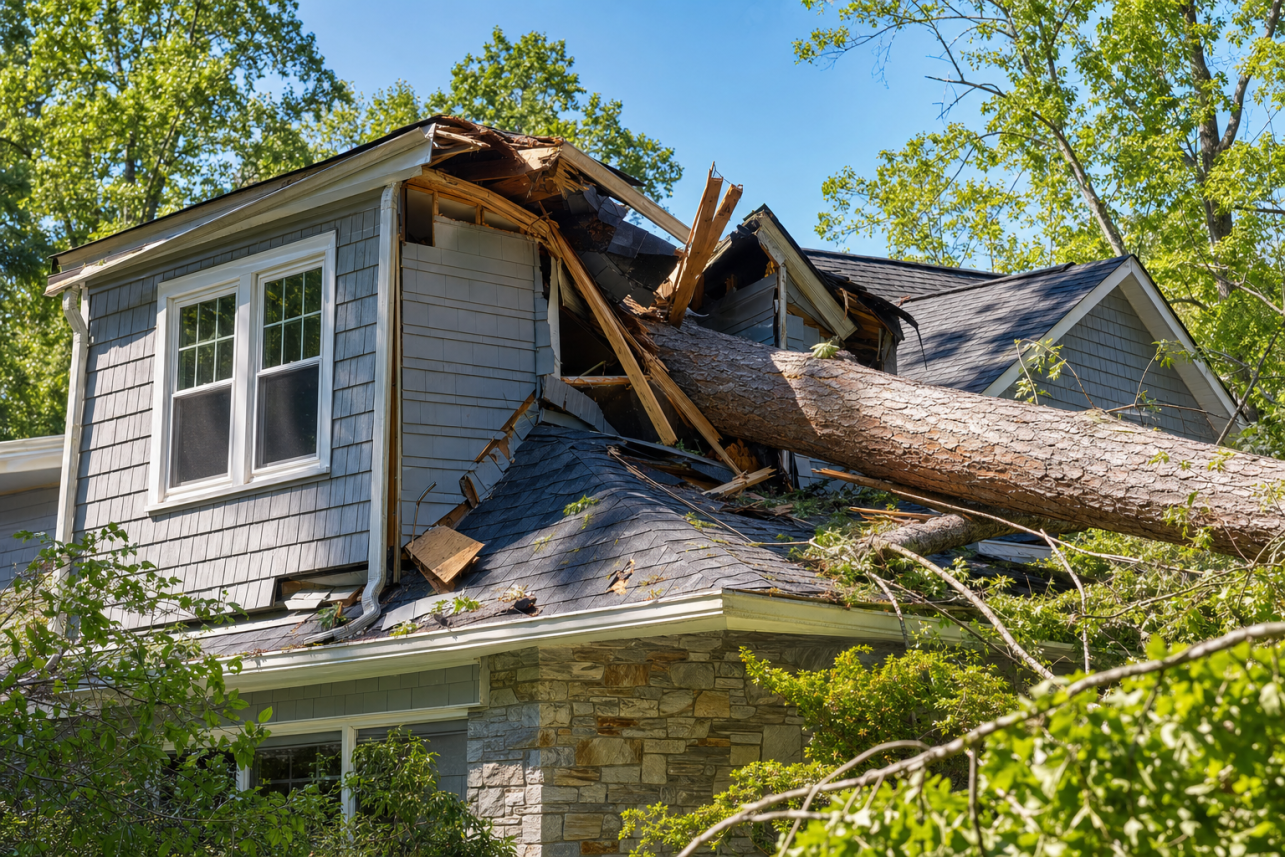
No — in most cases you can absolutely reopen or supplement it. Accepting an initial payment does not close the door on additional money, and with tree impacts, hidden damage is the rule rather than the exception. A large oak or loblolly pine coming through a roof transfers enormous force into rafters, trusses, and load-bearing walls that a quick exterior inspection will never catch.
Common discoveries once repairs begin include cracked rafters, shifted framing, damaged ceiling joists, compromised sheathing well beyond the visible hole, and water intrusion inside wall cavities from rain that got in before tarping. Any of these can justify a supplemental claim.
Here's how to handle it: stop work in the affected area if possible, photograph everything before it's covered up, and get your contractor to write a detailed description of what was found and why it's connected to the tree strike. Then submit a written supplement request to your carrier referencing your original claim number. In North Carolina you generally have up to three years from the loss to pursue what you're owed, though policy conditions on proof of loss can be shorter, so move quickly.
Carriers sometimes push back on supplements, arguing the damage is pre-existing or wear and tear. This is exactly where a Chapel Hill public adjuster earns their fee — connecting the newly discovered damage to the original event with proper documentation and negotiating the additional payment. We've reopened claims months after homeowners thought they were finished, often recovering more in the supplement than the original settlement.
Can The Insurance Company Deny My Tree Fell On House Insurance Chapel Hill Claim By Saying The Tree Was Dead Or Rotten?
They can try, and in Orange County this is one of the most common denial tactics we see. Insurers argue that a dead, dying, or visibly decayed tree was a maintenance issue you should have addressed, which shifts the loss from a covered 'sudden and accidental' event to excluded neglect.
Here's the problem with that argument: the burden is often heavier than adjusters admit. Many of the mature willow oaks and pines around Chapel Hill look healthy from the ground even when interior decay exists. If a certified arborist never flagged the tree and there were no obvious warning signs, a neglect-based denial is frequently overreach.
When we handle a tree fell on house insurance Chapel Hill claim that's been denied on these grounds, we start by documenting the tree itself before it's hauled away. Photographs of the trunk cross-section, root ball, and break point matter enormously. We often bring in an independent arborist to evaluate whether decay was actually detectable to a reasonable homeowner.
We also examine what actually caused the failure. If a storm with 50 mph gusts came through, wind is the proximate cause of loss, and North Carolina courts have generally recognized that a covered peril acting on a weakened tree is still a covered event.
If you've received a denial letter citing the tree's condition, don't accept it as final. Request the insurer's inspection notes and photos, preserve whatever remains of the tree, and get an independent opinion before the evidence disappears into a chipper.
The Tree Damage Made My Home Unlivable. Will Insurance Pay For A Hotel Or Rental While Repairs Happen?
In most cases, yes. Nearly every homeowners policy written in North Carolina includes Additional Living Expenses coverage, sometimes called Loss of Use or Coverage D. It pays the reasonable increase in your living costs when a covered loss makes your home uninhabitable.
That includes hotel stays, short-term rentals, restaurant meals beyond your normal grocery budget, pet boarding, extra mileage if you're temporarily farther from work or your kids' schools, and even laundry costs if your temporary housing lacks a washer. The key word is 'increase' — the insurer pays the difference between your normal expenses and your displaced expenses.
In Chapel Hill, this coverage matters more than people realize. Rental inventory near UNC is tight and expensive, especially during the academic year, and a structural repair after a large oak comes through the roof can take four to eight months once permits, engineering, and contractor scheduling are factored in. We've seen families pushed toward Durham or Hillsborough just to find comparable temporary housing.
Two warnings from experience. First, insurers often approve only a few weeks of ALE upfront and make you fight for extensions, so keep every receipt from day one. Second, adjusters sometimes claim a home is 'partially habitable' when a tree has opened the roof, meaning tarped rooms, no HVAC, or moisture intrusion. If your family can't safely live there, push back with documentation — photos, moisture readings, and a contractor's statement about safety.
A Chapel Hill public adjuster can calculate your full displacement costs and hold the carrier to the realistic repair timeline, not the optimistic one in their file.
My Settlement Mentions 'recoverable Depreciation.' What Does That Mean For My Repair Check?
It means the insurance company is holding back part of your money until repairs are actually completed — and understanding how it works can be worth thousands.
Most Chapel Hill homeowners carry replacement cost value (RCV) policies. When a tree crushes your roof and gutters, the insurer calculates the full replacement cost, then subtracts depreciation based on the age and condition of the damaged materials. A 15-year-old architectural shingle roof might get depreciated 40 to 50 percent. Your first check reflects only the actual cash value: replacement cost minus that depreciation, minus your deductible.
The depreciated amount is 'recoverable' — you get it back once you complete the repairs and submit invoices proving what you spent. Many homeowners never claim it. They either don't understand the process, miss the policy's deadline for completing repairs, or accept the first check as final payment. That's money left on the table, and carriers rarely chase you down to hand it over.
A few practical points for tree-damage claims in this area. Keep every invoice from your roofer, framer, and tree service. Make sure the insurer's depreciation was calculated fairly in the first place; we regularly find carriers applying depreciation to labor, which North Carolina insurance regulators have questioned, or using unrealistic lifespans for materials.
Also check whether your estimate is complete before recovering depreciation. Once you sign off and collect the holdback, reopening the claim for missed structural damage gets harder. Our team reviews the full scope first, then makes sure every recoverable dollar comes back to you.
Should I Even File A Claim For Tree Damage, Or Will It Raise My Rates For Something Minor?
It's a fair question, and the honest answer depends on the real scope of the damage — which is rarely what it appears from the ground.
If a limb dented a piece of gutter and the repair costs less than or slightly above your deductible, filing may not make sense. Claims stay on your CLUE report for up to seven years, and even a small paid claim can affect your premium or how a future insurer views you. In North Carolina, wind and hail deductibles on some policies run 1 to 2 percent of dwelling coverage, so on a $500,000 Chapel Hill home you might be absorbing the first $5,000 to $10,000 anyway.
But here's the trap: tree impacts almost always cause more damage than is visible. A trunk that 'just clipped the roof' can crack rafters, shift trusses, separate flashing, and open pathways for water that shows up as ceiling stains months later. What looks like a $2,000 repair frequently turns into a $20,000 structural claim once someone gets into the attic.
Our advice for anyone weighing a tree fell on house insurance Chapel Hill decision: get the damage professionally assessed before you decide anything. Have a contractor or public adjuster inspect the attic, roof decking, and framing — not just the shingles. Many public adjusters, including our team at For The Public Adjusters, Inc., will evaluate the damage at no charge so you can make the filing decision with real numbers.
One more thing: don't wait too long. If you delay filing and hidden water damage worsens, the carrier may argue the deterioration was your failure to mitigate.
The Tree Only Damaged Part Of My Roof. Can A Tree Fell On House Insurance Chapel Hill Claim Cover Replacing The Whole Roof So The Shingles Match?
Often, yes — but you usually have to fight for it. When a large oak or pine punches through one slope of a roof, insurers frequently write an estimate to patch only the damaged section. The problem is that shingles fade in the Carolina sun, and older lines get discontinued, so a patched slope on a fifteen-year-old roof in Chapel Hill can look like an obvious repair from the street.
North Carolina does not have a strict matching statute the way some states do, but many policies contain language requiring repairs to result in a reasonably uniform appearance, and the Department of Insurance has weighed in on matching disputes. If the existing shingles can't be matched, there is a real argument that the carrier owes for a full slope or full roof replacement.
The key is documentation. We photograph the roof, obtain letters from suppliers confirming the shingle is discontinued or that no reasonable match exists, and cite the specific policy provisions that support uniform appearance. In neighborhoods with HOAs — Southern Village, Meadowmont, and similar communities in Orange County — architectural guidelines can add further support, since a mismatched roof may not even be permitted.
Homeowners who accept the first patch-only estimate often leave thousands of dollars on the table. Before you sign anything, have the matching question evaluated by someone who negotiates these claims for a living.
Will My Insurer Pay Me Back For The Emergency Tarp And Board-Up I Had Done Right After The Tree Hit?
In almost every case, yes. Standard homeowners policies not only allow emergency mitigation — they require it. Your policy obligates you to take reasonable steps to protect the property from further damage, and the carrier is obligated to reimburse reasonable costs for doing so. Tarping a punctured roof, boarding a broken window, and covering exposed framing all fall squarely under that duty.
This matters in Chapel Hill because a tree strike is rarely followed by dry weather. Piedmont storm systems often arrive in waves, and an open roof deck can soak insulation, drywall, and hardwood floors within hours. Water intrusion that happens because you didn't mitigate can actually be excluded, so acting fast protects both your home and your claim.
Keep every invoice and receipt, including materials if you did the work yourself. Photograph the damage before the tarp goes on and again after. If a local tree service or roofer handled the emergency work, ask for an itemized bill rather than a lump-sum figure — adjusters push back far less on documented line items.
One caution: some emergency contractors ask homeowners to sign an assignment of benefits or a contract committing them to the full repair. Read those documents carefully before signing anything under stress. You're entitled to emergency protection now without giving up control of your claim later. If a carrier balks at reimbursing legitimate mitigation costs, that's usually a sign the rest of the claim deserves a closer look too.
The Falling Tree Also Crushed My Shed, Fence, And The Car In The Driveway. Which Policy Covers What?
Damage like this typically gets split across different coverages, and knowing where each piece belongs is essential when handling tree fell on house insurance chapel hill claims that involve more than the house itself.
Your dwelling coverage (Coverage A) pays for the home and anything attached to it — the roof, an attached garage, an attached deck. Detached structures like sheds, fences, freestanding carports, and detached garages fall under other structures coverage (Coverage B), which is usually capped at 10% of your dwelling limit. On older Chapel Hill properties with extensive fencing, workshops, or outbuildings, that cap can run out quickly, so the valuation of each structure matters.
The car is different. A tree falling on a vehicle is not a homeowners claim at all — it goes through the comprehensive portion of your auto policy, with its own separate deductible. If you carry liability-only auto coverage, unfortunately the vehicle damage typically isn't covered.
Contents inside a crushed shed — mowers, tools, bicycles — fall under personal property coverage (Coverage C), and you'll need an inventory with approximate ages and replacement costs for each item.
Because a single fallen oak can trigger three or four coverage categories with different limits and depreciation rules, these multi-structure losses are where carriers most often underpay. We routinely find that the other structures and contents portions were barely scoped at all in the initial estimate. A full, coverage-by-coverage review before settlement is the best way to make sure nothing gets left out.
Do I Have To Use The Contractor My Insurance Company Recommends For The Repairs?
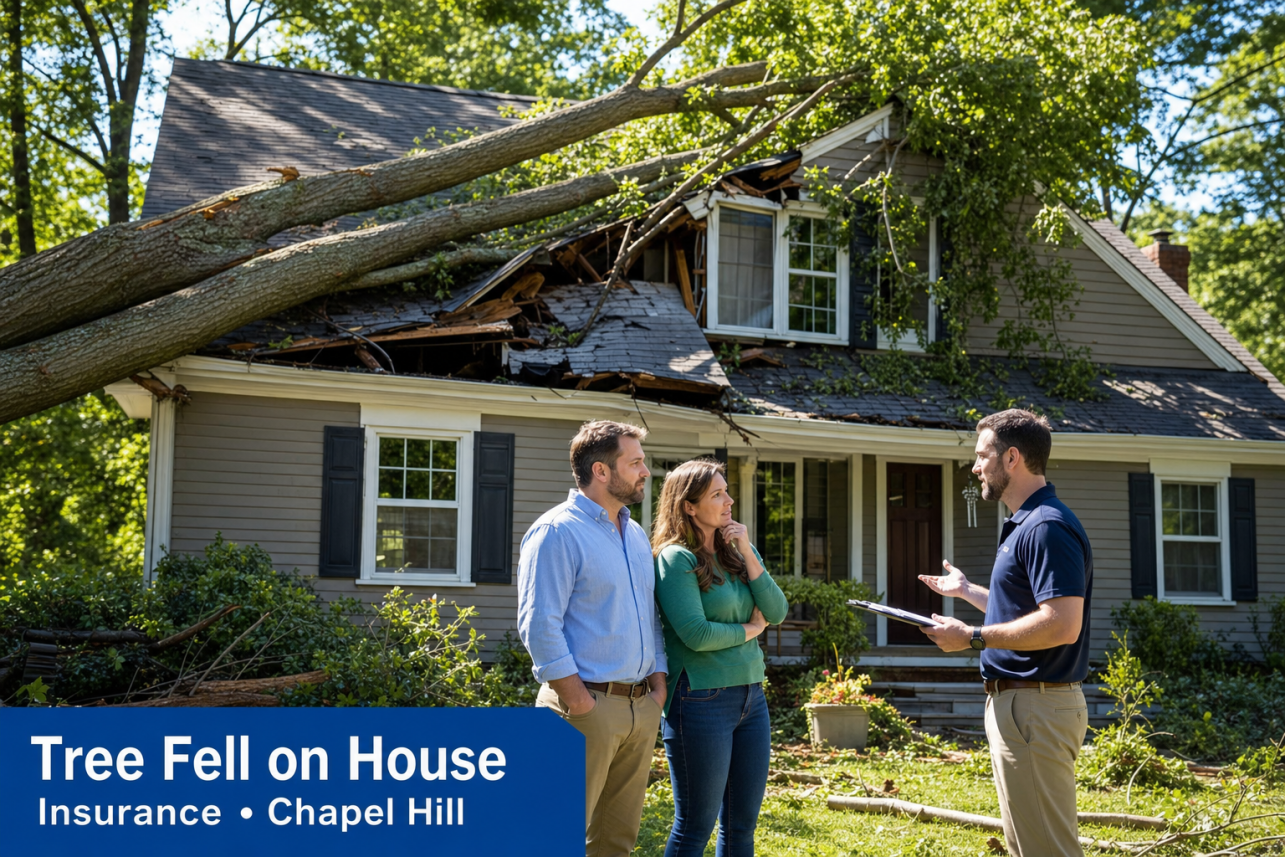
No. In North Carolina, you have the right to choose your own contractor. Carriers often steer homeowners toward preferred vendor programs, and while those contractors aren't automatically bad, they work under pricing agreements with the insurance company — which creates an obvious tension when the scope of your repair is being decided.
A contractor beholden to the carrier's price list has little incentive to flag additional damage, argue for code-required upgrades, or push back on an inadequate scope. An independent Chapel Hill builder who works for you answers only to you, and their estimate becomes powerful evidence if the carrier's numbers come in low.
There's also a local dimension. Repairs after major tree damage in Orange County frequently trigger permit requirements and current building-code compliance — updated hurricane clips, sheathing nailing patterns, or electrical upgrades in older homes near the historic districts. Your policy's ordinance or law coverage should pay for those code-driven costs, but preferred vendors working from a carrier's baseline scope often omit them entirely.
Our advice: get your own detailed, line-item estimate from a reputable local general contractor before agreeing to anyone the insurer suggests. Compare it against the adjuster's estimate item by item. Gaps in framing repair, structural engineering, interior finishes, and code upgrades are where most of the money hides.
As a Chapel Hill public adjuster, we build the scope independently, document every code requirement, and negotiate directly with the carrier — so you can hire the contractor you actually trust and get the repair paid for at real market prices.
Local Relevance
Chapel Hill's tree canopy is one of the best things about living here — and one of the biggest risks to its houses. Towering willow oaks and loblolly pines shade neighborhoods all over Orange County, and many of them stand within striking distance of homes built decades ago.
The weather does the rest. Remnants of Atlantic hurricanes push through the Triangle carrying soaking rain and gusts, and the region's clay-heavy soil loses its grip on shallow root systems once it's saturated — whole trees uproot rather than snap. Winter ice storms load limbs until they fail, often onto roofs.
Older Chapel Hill homes add another layer: original framing, plaster interiors, and aging roofs mean a tree strike often causes more structural and water damage than a quick exterior inspection reveals. That's exactly the kind of claim that gets underpaid when no one is advocating for the homeowner. We know these houses, this weather, and how local claims actually get resolved.
In Chapel Hill, many tree-on-house losses happen not in the storm's strongest gusts but a day or two after heavy tropical-remnant rain, when the area's clay soil is saturated and mature oaks and pines uproot in only moderate wind — so if a tree comes down in calm weather, document the ground conditions too, because insurers sometimes question these 'fair weather' failures.
A Tree Hit Your Home? Get Your Own Adjuster Before You Settle
Whether the tree is still on your roof or you've already received an offer that doesn't add up, talk to us first. For The Public Adjusters, Inc. is licensed and bonded, we work only for policyholders, and the initial claim review for Chapel Hill and Orange County homeowners costs you nothing.
Call us: (919) 400-6440
Helpful Resources
- NCDOI Public Adjusters Guide
- Insurance Information Institute (III)
- North Carolina Department of Insurance — State regulator overseeing insurance claims and public adjuster licensing in NC
- Insurance Information Institute – homeowners insurance — Consumer education on what homeowners policies cover, including fallen trees
Serving Chapel Hill · Orange
Last updated: August 14, 2026