A fire damage insurance claim adjuster Rolesville homeowners hire works for you — not for the insurance company — when a house fire turns into a complicated, underpaid, or stalled claim. For The Public Adjusters, Inc. is licensed and bonded in North Carolina, and we handle the entire claim: documenting the structure, inventorying your contents, proving smoke and water damage the carrier’s adjuster missed, and negotiating the settlement on your behalf. You pay nothing up front, and you keep control of your own claim from start to finish.
What This Service Is
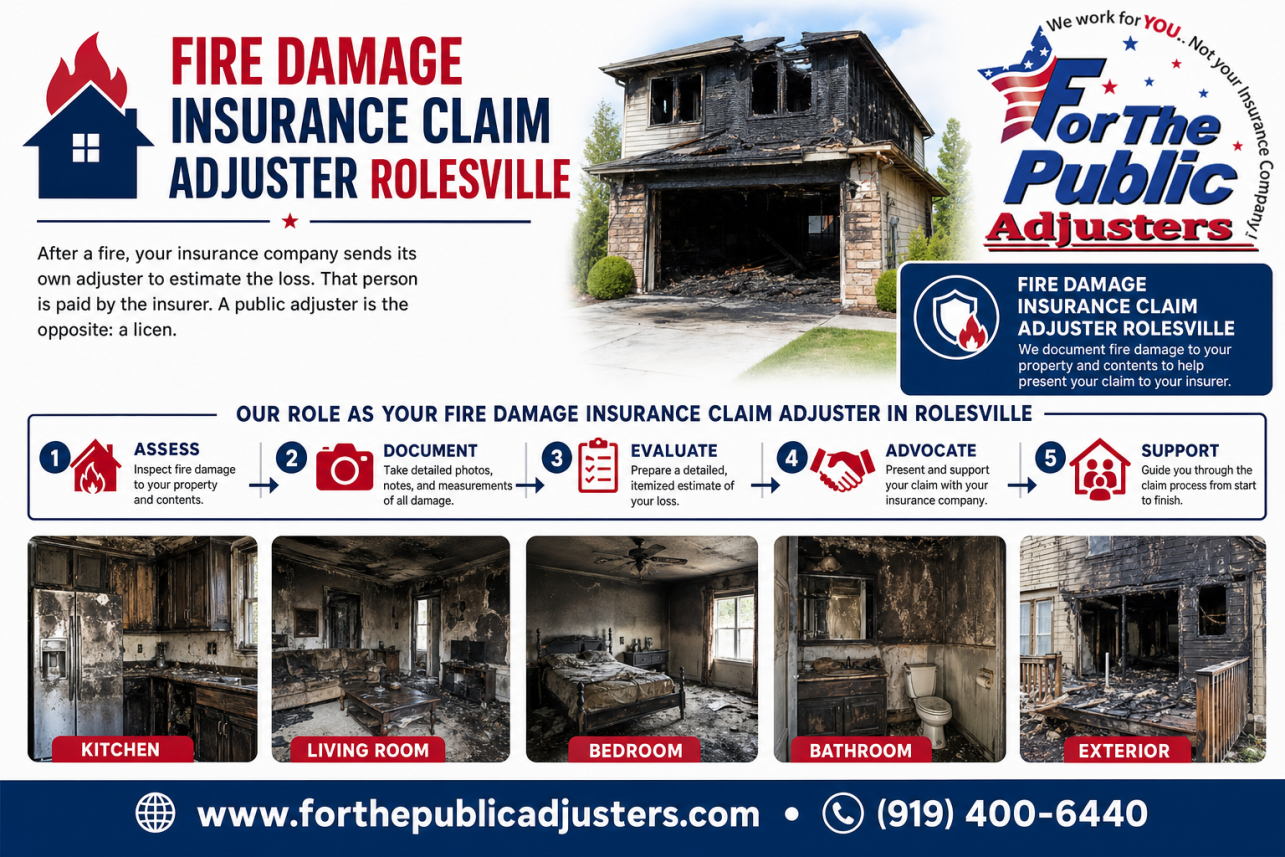
After a fire, your insurance company sends its own adjuster to estimate the loss. That person is paid by the insurer. A public adjuster is the opposite: a licensed professional who represents only the policyholder, reads your policy line by line, and builds an independent assessment of everything the fire actually cost you.
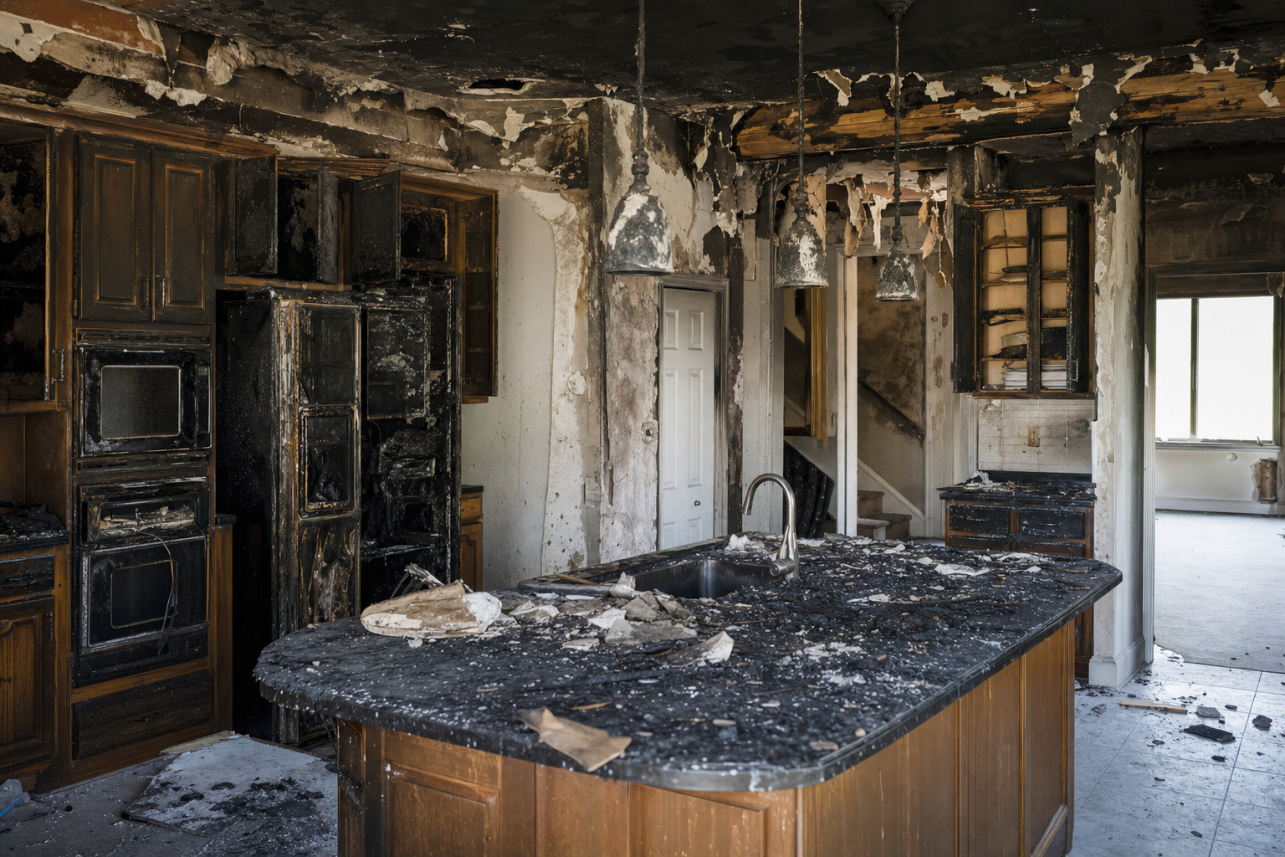
That matters more than most people realize. Fire losses are rarely just the burned room. Smoke and soot travel through ductwork into closets, attics, and finishes on the far side of the house. The water and chemicals used to put the fire out soak into subfloors and wall cavities, where hidden damage shows up weeks later as warping or mold. A thorough claim accounts for all of it — structural repairs, contents, cleaning, code-required upgrades during rebuilding, and the cost of living somewhere else while your home is unlivable.
We prepare that full picture, submit the proof of loss documentation your policy requires, and negotiate directly with the carrier. It is the same work our team does as a fire damage claim adjuster in Cary NC and across the Triangle, and it frequently changes the outcome of a claim in a meaningful way. We never promise a specific dollar result — no honest adjuster can — but we make sure nothing covered gets left off the table.
Common Problems
Why Is The Insurance Company’s Offer So Much Lower Than My Contractor’s Repair Estimate?
This is the single most common call we get after a Rolesville house fire. The carrier’s estimate often prices repairs at rates no local contractor will actually work for, skips items like soot cleaning of HVAC systems, and applies heavy depreciation deductions to your contents and finishes.
There is also the difference between replacement cost and actual cash value. Many policies pay the depreciated amount first and only release the rest after you rebuild — and if nobody tracks that second payment, it quietly never arrives. Building code upgrades required during reconstruction are another frequently missed coverage.
We rebuild the estimate from scratch, room by room, at real-world pricing, and document why every line belongs in the claim. The gap between a first offer and a properly documented loss is often substantial.
My Claim Is Stalled, Disputed, Or Was Denied — What Now?
Delays and disputes are not a dead end. If the carrier is dragging its feet, questioning the cause of the fire, or refusing parts of the loss, you have real options — starting with a documented, formal response rather than another unreturned phone call.
North Carolina courts have backed policyholders in these fights. In Gray v. North Carolina Insurance Underwriting Association, the North Carolina Supreme Court allowed homeowners whose damaged homes were underpaid to pursue their insurer for unfair claims settlement practices — and the homeowners prevailed. Carriers know cases like that exist, which is exactly why professional pressure works.
We handle disputed and reopened claims regularly, including work on a fire insurance claim dispute in Raleigh just down the road. When a claim crosses into bad-faith territory, we also work alongside insurance dispute attorneys so nothing falls through the cracks.
Do I Really Need A Fire Damage Insurance Claim Adjuster Rolesville Homeowners Can Trust, Or Can I Handle It Myself?
You can file a fire claim yourself, and for a very small, simple loss that may be fine. But a whole-house fire claim means a structural repair estimate, a complete contents inventory with values and receipts, negotiating additional living expenses for temporary housing, and meeting policy deadlines — all while your family is displaced.
The NCDOI Public Adjusters Guide explains what a licensed public adjuster is and confirms adjusters must be licensed by the state — a good first check on anyone you consider hiring. Ask about their North Carolina license, their bond, their fee (a percentage of the recovery, never money up front), and whether they will handle the carrier directly so you don’t have to.
A good adjuster earns their fee by finding covered damage you would never have known to claim — hidden structural damage, smoke residue in unburned rooms, water intrusion from firefighting — and by keeping the deductible, depreciation, and coverage limits calculations honest.
Our Process
Free Policy And Damage Review
We start by reading your actual policy — coverage limits, deductible, additional living expenses, code upgrade coverage — and walking the property with you. Fires in occupied homes deserve a careful look beyond the burn area, because smoke, soot, and firefighting water almost always spread damage farther than it first appears. There is no cost or obligation for this review.
Full Documentation And Proof Of Loss
Next we build the claim: a detailed structural estimate at real local pricing, a complete contents inventory of your personal property, photographs, moisture readings, and cleaning protocols for smoke-affected rooms. This is the same methodical documentation our fire claims adjuster in Apex work relies on, and it becomes your formal proof of loss — the document the insurer must respond to.
Negotiation And Settlement
We present the claim, meet the carrier’s adjuster on site, and negotiate every disputed line item until the settlement reflects your documented loss. We track the recoverable depreciation owed after repairs and push back on delays in writing. You approve every decision; we simply do the fighting so you can focus on getting your family home.
| What Happens | Handling the Claim Yourself | With For The Public Adjusters, Inc. |
|---|---|---|
| Damage assessment | You rely on the carrier’s adjuster, who works for the insurance company and typically documents only visible damage | Independent inspection including hidden smoke, soot, water, and electrical damage, backed by testing and licensed-trade estimates |
| Contents inventory | You list what you remember, often from a fee-driven vendor’s rushed walkthrough | Room-by-room itemized inventory with replacement-cost pricing, including closed closets, cabinets, and stored items |
| Additional living expenses | Often underclaimed or cut off early because homeowners don’t know what qualifies | Hotel, rental, meals, mileage, and pet boarding tracked and claimed for the full displacement period the policy allows |
| Negotiation | You against a professional claims department, usually accepting the first or second offer | Documented supplemental demands negotiated by licensed adjusters until the settlement matches the actual loss |
| Your time | Dozens of hours of calls, paperwork, and inspections during the worst months of your life | We manage the entire claim; you approve decisions and focus on your family |
| Cost | Free upfront, but underpaid fire claims commonly leave tens of thousands uncovered | A percentage of the recovery — no fee unless the settlement improves |
Commonly Overlooked In The Public Adjusting Industry
- Soot migration through the HVAC return system — Carrier adjusters inspect rooms with visible damage, but the return ducts pull soot into bedrooms and closets on the opposite side of the house where nobody looks.
- Heat-damaged wiring inside undamaged-looking walls — Wire insulation degrades at temperatures well below what chars drywall, so circuits can be a fire hazard even when the wall surface passes a visual inspection.
- Water damage from firefighting efforts — Everyone focuses on the burn, but hundreds of gallons of hose water soak insulation, subfloors, and lower levels, and it’s often missing from the fire estimate entirely.
- Contents inside closed cabinets, closets, and drawers — Smoke penetrates closed storage, but quick walkthrough inventories only count what’s sitting out in the open.
- Ordinance and law (code upgrade) coverage — Rebuilding to current Wake County code costs more than replacing what was there, and this coverage sits unused because homeowners don’t know to invoke it.
- The full additional living expense entitlement — Carriers rarely volunteer that mileage, pet boarding, laundry, and increased meal costs qualify, so families claim the hotel and leave the rest on the table.
- Protein smoke residue from kitchen fires — It’s nearly invisible but bonds to surfaces and causes lingering odor, so ‘minor’ cooking fires get written up as a repaint when they need full cleaning or replacement of finishes.
- Depreciation recovery deadlines — Replacement-cost policies hold back depreciation until repairs finish, and homeowners forfeit thousands by missing the window to submit final invoices.
Case Studies
Case Study #1
Situation: A family on Granite Falls Boulevard in Rolesville had a kitchen fire that started in a range hood and spread into the attic before the fire department contained it. The visible damage was limited to the kitchen and the ceiling above it, and the carrier’s adjuster inspected within a week.
Problem: The insurance company’s initial estimate came in at $41,000 — enough to gut the kitchen and patch the ceiling, but nothing for smoke migration through the HVAC system, soot in the wall cavities, or the melted electrical wiring the fire crew’s thermal camera had flagged. The family was being pushed to accept and start repairs.
Investigation: We brought in a hygienist to take air and surface samples in rooms the carrier never entered, opened up wall cavities adjacent to the kitchen, and had a licensed electrician trace the branch circuits that ran through the burned truss bays. We also pulled the fire department’s incident report, which documented water application into the attic.
Findings: Soot residue tested positive in three bedrooms on the far side of the house, carried through the shared return duct. Two circuits showed heat-damaged insulation inside the walls, and the attic insulation was saturated with contaminated water the carrier’s estimate never mentioned. The HVAC system itself needed full duct cleaning and coil replacement.
Solution: We rebuilt the claim room by room with photo documentation, lab results, and licensed-trade estimates, then presented it as a supplemental demand with the code-upgrade coverage the policy actually included for the rewiring.
Outcome: The claim settled at $138,600 — more than three times the original offer — including additional living expenses for the extra months the family needed to stay out of the home while the electrical and HVAC work was done properly.
Lesson: Fire damage almost never stops where the char stops. If nobody tests the air, opens the walls, or traces the wiring, the settlement only pays for what’s visible — and the homeowner inherits the rest.
Case Study #2
Situation: The owner of a rental property near downtown Rolesville had a garage fire caused by a lithium battery charger. The detached garage was a total loss and heavy smoke pushed into the main house through an open breezeway door.
Problem: The carrier classified the house damage as ‘light smoke odor,’ offered an ozone treatment and repainting of two rooms, and disputed the garage’s replacement cost, valuing it as a basic shell when it had been finished as a workshop with insulation, drywall, and a subpanel. The owner also lost rental income while the tenant relocated, and the carrier initially denied the loss-of-rents portion.
Investigation: We documented the garage’s finished condition using the owner’s photos, the tenant’s move-in inspection video, and county permit records showing the subpanel installation. Inside the house, we ran surface wipe tests on textiles, cabinetry interiors, and closet contents rather than accepting a visual-only assessment.
Findings: Protein and soot residue was present on soft goods and inside closed cabinets throughout the first floor — well beyond a paint-and-ozone fix. The garage valuation was short by the entire cost of the electrical work, insulation, and interior finishes, and the policy’s fair-rental-value coverage clearly applied because the tenant’s lease was disrupted by a covered loss.
Solution: We submitted a documented replacement-cost estimate for the garage as it actually existed, a contents cleaning and replacement inventory for the house, and a loss-of-rents calculation tied to the signed lease.
Outcome: The settlement moved from roughly $28,000 to $96,400, including nine months of covered rental income, full contents cleaning, and a garage rebuilt to its pre-loss finished condition.
Lesson: Carriers value what they can see on inspection day. Permits, photos, lease documents, and lab testing are what turn ‘light smoke’ into the claim the policy was written to cover.
| Decision Point | Safest Move | What It Depends On | What’s at Risk If You Get It Wrong |
|---|---|---|---|
| Signing the restoration contractor’s contract at the scene | Wait — don’t sign anything the night of the fire beyond emergency board-up | Whether the contract assigns your claim benefits or locks in one vendor | You can lose control of your own claim and settlement funds |
| Accepting the carrier’s first offer | Decline until hidden damage is independently assessed | Whether ducts, wiring, and wall cavities have been tested and opened | Repairs run out of money mid-project with no supplement filed |
| Throwing away burned contents | Photograph and inventory everything before disposal | Whether the carrier has documented or waived inspection of contents | Denied contents payments for items you can no longer prove existed |
| Cleaning smoke damage yourself | Leave soot alone until it’s documented and tested | The residue type — wet smoke and protein soot smear and set with wrong cleaning | Permanent staining plus a carrier argument that damage was pre-existing or worsened by you |
| Staying in the home to save ALE money | Only if air quality testing clears it | Soot and combustion byproduct levels, especially with kids or breathing issues | Health exposure, and it can undercut the habitability portion of your claim |
| Filing a small kitchen fire claim at all | Get the full scope estimated before deciding | Whether real damage exceeds your deductible once smoke migration is counted | Filing for a few thousand when the true loss is far larger — or vice versa |
| Hiring a public adjuster | Earlier is better, ideally before the carrier’s inspection | Claim size, complexity, and how far apart you are from the carrier’s number | Positions and estimates lock in that are much harder to reopen later |
Reviews
After our attic fire off Rogers Road, the insurance company’s adjuster spent maybe 40 minutes at the house and offered us a number that wouldn’t have covered the roof, let alone the smoke damage downstairs. For The Public Adjusters found soot in our ductwork and heat damage to wiring we had no idea about. The final settlement was almost triple the first offer. I wouldn’t handle a fire claim without them.
Marcus T., Rolesville
Our kitchen fire seemed ‘small’ until we realized the smell was in every closet in the house. The carrier kept saying cleaning was enough. This team brought in testing, documented everything room by room, and got our contents claim paid properly — including clothes and furniture the first estimate completely ignored. They also fought for our hotel and meal costs while we couldn’t live at home.
Deana W., Wake County
As a landlord, my biggest fear after the garage fire was the lost rent, and sure enough the carrier tried to deny it. These adjusters used the lease and permit records to prove what I was actually owed. Communication was steady the whole way — I always knew where the claim stood. Took a few months, but the result was worth every bit of their fee.
Rob H., Rolesville
Frequently Asked Questions
Why Should I Hire A Fire Damage Insurance Claim Adjuster Rolesville Homeowners Can Call Before Contacting My Insurance Company?
Timing matters more than most people realize. A fire damage insurance claim adjuster Rolesville property owners bring in early can document the loss before cleanup crews, weather, or the insurer’s own inspection alter the scene. Once smoke residue is wiped away or charred materials are hauled off, proving the full extent of damage becomes much harder.
Your insurance company’s adjuster works for the carrier. Our team at For The Public Adjusters, Inc. works only for you. We prepare a detailed inventory of structural damage, smoke and soot contamination, personal property losses, and additional living expenses before you give a recorded statement or sign anything.
In Wake County, we regularly see fire losses where hidden damage — smoke inside HVAC ductwork, heat-warped framing behind intact drywall, water damage from firefighting efforts — gets missed on the carrier’s first estimate. Catching those items up front means one properly documented claim instead of a string of supplements the insurer can push back on.
There is no obligation to file a claim the moment you call us. Many Rolesville homeowners simply want an honest assessment of what their loss is actually worth before the insurance company sets the narrative. That initial review costs you nothing, and it often changes the outcome by tens of thousands of dollars.
How Much Does A Public Adjuster In Rolesville Charge For A Fire Claim?
For The Public Adjusters, Inc. works on a contingency fee, which means we are paid a percentage of what the insurance company actually pays on your claim. If your settlement doesn’t improve, you don’t owe us for improving it. There are no upfront costs, hourly rates, or retainers.
North Carolina regulates public adjuster fees, and the exact percentage is spelled out in writing before we start any work on your Rolesville property. You’ll never be surprised by the number.
Here’s why the fee usually pays for itself many times over. Fire claims are among the most complex losses in the industry. A single house fire on a street off Main Street or near Rolesville Road can involve structural repairs, smoke remediation throughout the home, contents cleaning or replacement, code-upgrade costs required by Wake County inspections, and months of additional living expenses while you’re displaced.
Insurance carriers routinely underpay one or more of those categories — not always maliciously, but because their adjusters handle high volumes and move fast. Our job is to slow the process down, document every line item, and negotiate from evidence. When homeowners compare the carrier’s initial offer to the final settlement we secure, the fee is rarely the part they remember.
What Does The Fire Claim Process Look Like For A Rolesville Home, From The First Call To Settlement?
It starts with a free inspection of your property. We walk the entire structure, photograph and measure the damage, test for smoke and soot migration into areas that look untouched, and review your policy line by line so you know exactly what coverage you’re working with.
From there, we build the claim. That includes a full repair estimate written in the same estimating software insurance carriers use, a room-by-room contents inventory with replacement values, and documentation of your additional living expenses — hotel stays, meals, mileage, and temporary housing if your family is displaced from Rolesville during repairs.
Once the claim package is submitted, we handle every conversation with the insurance company. We attend the carrier adjuster’s inspection alongside them, respond to their requests for documentation, and challenge any lowball line items with photos, measurements, and local Wake County contractor pricing rather than opinions.
Most fire claims we manage resolve through negotiation, though your policy also includes an appraisal provision we can invoke if the carrier refuses a fair number. Throughout the process, you receive regular updates and plain-English explanations — no jargon, no guessing where things stand.
Timelines vary with the severity of the fire, but a well-documented claim almost always moves faster than one where the homeowner is chasing the carrier for answers. Our goal is a complete settlement the first time, so you can rebuild without going back for supplement after supplement.
My Insurance Company Already Sent An Adjuster And Made An Offer. Is It Too Late To Get Help With My Fire Damage Claim?
No — and this is actually one of the most common situations we handle. As long as your claim hasn’t been closed with a final release signed, a fire damage insurance claim adjuster Rolesville residents hire independently can review the carrier’s offer, identify what was missed, and reopen negotiations.
Underpaid fire claims tend to follow patterns. The carrier’s estimate might cover repainting a smoke-damaged room but skip sealing and priming, which means the odor returns within months. It might allow cleaning for contents that industry standards say must be replaced. It often shortchanges code upgrades that Wake County requires when older homes are rebuilt, and it frequently underestimates how long a family will need temporary housing.
When we take over a claim mid-stream, we start by comparing the insurer’s estimate against our own independent inspection. Every discrepancy gets documented with photos, testing results, and current local pricing. Then we submit a supplemental claim and negotiate directly with the carrier so you’re no longer fielding their calls yourself.
Even claims that were paid and closed can sometimes be reopened in North Carolina if new damage is discovered within the policy’s time limits, though acting quickly always strengthens your position. If you’re holding an offer that feels too low to actually rebuild your home, bring it to For The Public Adjusters, Inc. for a no-cost review. We’ll tell you honestly whether the number is fair or whether there’s real money still on the table.
What Hidden Fire And Smoke Damage Does A Fire Damage Insurance Claim Adjuster Rolesville Property Owners Hire Typically Find That The Insurance Company Misses?
Fires almost always cause more damage than what you can see in the burn area. Smoke and soot travel through HVAC ductwork, wall cavities, and attic spaces, coating surfaces far from the flames. Acidic soot residue keeps corroding metals, electronics, and finishes for weeks after the fire is out.
When our team inspects a Rolesville home, we go well beyond a visual walkthrough. We check inside duct runs, behind cabinetry, under insulation, and inside the electrical panel. Heat exposure can compromise wiring insulation, PEX plumbing, and roof sheathing even when those materials look intact from the outside.
We also test for protein and synthetic smoke residues that carriers frequently overlook. Odor embedded in framing, subfloor, and drywall often requires sealing or full replacement, not just cleaning, and that difference can change a claim’s value dramatically.
In newer Wake County subdivisions, we frequently find that builder-grade materials like engineered trusses and OSB sheathing were heat-stressed and need engineering evaluation before a repair scope is finalized. Carrier adjusters rarely order those evaluations on their own.
Contents are another common gap. Clothing, upholstered furniture, mattresses, and electronics exposed to smoke often cannot be safely restored, yet initial carrier estimates routinely list them as cleanable. We inventory, photograph, and price every item so nothing gets quietly left off the settlement. Finding this hidden damage early is usually where the largest recovery gains come from.
Will My Insurance Cover A Hotel Or Rental House In Rolesville While My Fire-Damaged Home Is Being Repaired?
In most cases, yes. Nearly every homeowner’s policy includes Additional Living Expenses coverage, sometimes called Loss of Use. It pays the extra costs you incur living elsewhere while your home is uninhabitable, including temporary housing, increased mileage, pet boarding, laundry, and the difference in food costs.
The key word is “extra.” ALE covers costs above your normal monthly spending, so keeping receipts from day one matters. We help Rolesville families set up a simple tracking system right away so nothing is missed when it’s time to submit expenses to the carrier.
Rental availability near Rolesville can be tight, especially for families who need to stay close to schools in the Wake Forest and Rolesville area. Carriers sometimes push families into hotels far from home or approve a housing budget that doesn’t reflect actual local rental rates. Part of our job is documenting comparable local rents so the carrier funds housing that genuinely matches what you lost.
ALE is also tied to the repair timeline. If the carrier drags out the structural claim, your temporary housing period stretches with it, and some policies cap ALE at twelve or twenty-four months. We push both parts of the claim forward together so you’re not squeezed against that limit.
If you were already displaced and paying out of pocket before calling us, don’t worry. Those expenses can usually still be recovered as long as they’re documented, and we’ll help you reconstruct them.
How Long Does A Fire Claim In Rolesville Usually Take To Settle, And What Slows It Down?
A well-documented partial fire loss in Rolesville often settles in two to four months. A major loss or total loss can run six months to a year, especially when structural engineering, code-upgrade disputes, or contents inventories are involved. North Carolina law requires insurers to acknowledge and respond to claims within set timeframes, and we hold carriers to those deadlines.
The biggest delays usually come from incomplete documentation. If the carrier’s estimate and the contractor’s estimate don’t match line for line, the file bounces back and forth for weeks. We prepare a detailed, itemized estimate in the same format carrier adjusters use, which removes most of that back-and-forth.
Contents inventories are another common bottleneck. Insurers often ask homeowners to list every damaged item with age, purchase price, and replacement cost — an overwhelming task after a fire. Our team handles that inventory professionally, which keeps the claim moving instead of stalling on your kitchen table.
Local permitting can also affect the timeline. Repairs in Rolesville go through Wake County or town permitting, and rebuilds must meet current North Carolina building code. When code upgrades add cost, carriers sometimes resist paying under the ordinance-or-law portion of the policy. We document code requirements up front so that fight happens early, not at the end.
Our goal is simple: keep pressure on the carrier at every stage so you’re never the one waiting without answers.

What Should I Do In The First 48 Hours After A House Fire In Rolesville To Protect My Claim?
First, take care of your family and don’t re-enter the home until the fire department clears it. Once it’s safe, your policy requires you to take reasonable steps to prevent further damage — tarping the roof, boarding openings, and shutting off water if pipes were compromised. Keep every receipt, because emergency mitigation is a covered expense.
Second, photograph and video everything before anything is moved or thrown away. Wide shots of every room, close-ups of damaged items, the exterior, and the attic if accessible. Do not discard damaged belongings yet, even ones that seem ruined. The carrier has a right to inspect them, and premature disposal is one of the most common ways homeowners hurt their own claims.
Third, be careful about what you sign. Restoration companies and roofers often show up quickly after a Wake County fire, and some ask you to sign assignments or work authorizations that lock you in before any scope or price is established. Sign only what’s needed for emergency board-up and mitigation.
Fourth, when you notify your insurer, report the loss but keep it factual and brief. Recorded statements given in the emotional first days often get used later to narrow coverage.
Calling a fire damage insurance claim adjuster Rolesville residents can reach immediately — before the carrier’s inspection — lets us document the loss properly from the start. For The Public Adjusters, Inc. can be on site quickly, and the claims that start right almost always finish stronger.
Do I Need A Fire Damage Insurance Claim Adjuster Rolesville Residents Recommend For A Small Kitchen Fire, Or Only For Major Losses?
Even a so-called small kitchen fire in a Rolesville home is rarely small once you account for everything it actually damaged. Smoke and soot travel through HVAC ductwork, settle inside cabinets, and coat attic insulation, and protein residue from cooking fires bonds to painted surfaces and is notoriously hard to remove.
Insurance carriers often treat these claims as quick cleanup jobs, offering a few thousand dollars for wiping down surfaces and repainting one wall. In our experience handling fire losses across Wake County, the true scope frequently includes duct cleaning or replacement, cabinet refinishing or replacement, contents cleaning, and odor remediation with thermal fogging or ozone treatment. Those items can multiply the claim’s real value several times over.
A fire damage insurance claim adjuster Rolesville homeowners hire will document that full scope before the carrier locks in a low estimate. We photograph soot patterns, test for residue in adjacent rooms, and inventory every affected item, from the toaster that caused the fire to the clothing two rooms away that now smells like smoke.
Because For The Public Adjusters, Inc. works on a percentage of the recovery, smaller claims still make sense to review. Many clients call us for a free evaluation first; if the carrier’s offer is genuinely fair, we tell them so. But for kitchen fires in particular, the gap between the first offer and the properly documented claim is often the largest we see, precisely because carriers assume homeowners will not push back on a ‘minor’ loss.
My Mortgage Company’s Name Is On The Fire Claim Check. How Does That Work, And Can A Public Adjuster In Rolesville Help?
If you have a mortgage on your Rolesville home, your lender is almost certainly listed on your insurance policy as a loss payee. That means fire claim checks for structural damage will be made out to both you and the mortgage company, and you cannot cash them without the lender’s endorsement.
Most lenders route these funds through a loss draft department. They hold the money in escrow and release it in stages as repairs progress, usually requiring a signed contract with your contractor, a W-9, periodic inspections, and lien waivers. For larger fire losses, expect three or more disbursements tied to completion milestones.
This process trips up a lot of homeowners. Delays in getting inspections scheduled or paperwork submitted can stall your rebuild for weeks, and contractors in the Rolesville and Wake Forest area often will not start major work without a deposit the lender has not released yet.
As your Rolesville public adjuster, we help coordinate this from the start. We make sure the settlement is structured correctly between dwelling, contents, and additional living expenses, because contents and ALE checks typically come to you alone, not the lender. We also help you understand what documentation the loss draft department will demand so you can submit it promptly and keep funds moving.
One important note: recoverable depreciation is often withheld until repairs are complete. We track those holdbacks and pursue them for you, because unclaimed depreciation is one of the most common ways homeowners leave money on the table after a fire.
How Do You Document And Value Everything I Lost In The Fire, Including Personal Belongings?
Contents documentation is where most fire claims fall short, and it is one of the most valuable things a fire damage insurance claim adjuster Rolesville families work with can do for you. Your carrier will ask for a detailed personal property inventory, and if you leave items off, you simply will not be paid for them.
We start with a room-by-room walkthrough of your Rolesville home, photographing and cataloging everything that is visible, even items that are burned beyond recognition. Charred remains still tell a story: a melted frame indicates a TV, warped rails indicate a bed. We record brand, model, age, and condition wherever possible.
For items that were destroyed completely, we work with you to reconstruct the inventory using bank and credit card statements, Amazon and retailer order histories, old photos and videos on your phone, and even social media posts showing rooms in the background. Most families own far more than they think, and a typical household inventory runs into the thousands of line items.
Valuation matters just as much as the list itself. We price items at true replacement cost using current retail sources, not the depressed values carriers sometimes assign. We also flag high-value categories like jewelry, firearms, and collectibles that may have special policy sub-limits, so nothing gets miscategorized.
Finally, we separate cleanable items from total losses. Carriers sometimes insist smoke-damaged contents can be restored when they cannot, and we push back with documentation. The result is an inventory your insurer can verify but cannot easily undercut.
What Happens If My Fire Claim Is Denied Or The Insurance Company Accuses Me Of Causing The Fire?
A denial is not the end of your claim, and neither is an uncomfortable investigation. Fire losses trigger more scrutiny than almost any other claim type, and carriers in North Carolina routinely request recorded statements, examinations under oath, and origin-and-cause investigations before paying.
Common denial reasons include alleged misrepresentation on the application, claims the fire was intentionally set, arguments that the home was vacant, or assertions that you failed to cooperate with the investigation. Many of these denials do not hold up when challenged with proper documentation and a clear reading of the policy language.
Our team reviews the denial letter line by line against your actual policy. We gather counter-evidence, which may include the fire department’s incident report, an independent origin-and-cause expert’s findings, utility records, and witness statements. In Wake County, fire investigation reports are obtainable and often contradict the carrier’s theory.
If you are asked to give an examination under oath, do not go in unprepared. While we are not attorneys and will refer you to fire-loss counsel when litigation is genuinely needed, a Rolesville fire claim adjuster on your side ensures your documentation, timeline, and inventory are airtight before you ever answer questions on the record.
Many denied and disputed claims settle once the carrier sees the policyholder is professionally represented and the evidence is organized. If you have received a denial, a reservation of rights letter, or a request for an examination under oath anywhere in the Rolesville area, call us before you respond. Timing and preparation make a real difference in the outcome.
What Is The Difference Between The Insurance Company’s Adjuster And A Fire Damage Insurance Claim Adjuster Rolesville Homeowners Hire On Their Own?
The adjuster your insurance company sends works for the insurance company. They are trained, often skilled, and frequently polite — but their job is to settle your claim within the carrier’s guidelines. Their loyalty is to their employer, not to you.
A public adjuster works exclusively for the policyholder. At For The Public Adjusters, Inc., we are licensed by the state to represent homeowners, and we are legally and ethically obligated to pursue the settlement your policy actually entitles you to. We read the same policy, inspect the same fire scene, and write our own independent estimate — and those two estimates rarely match.
The gap usually comes from scope, not dishonesty. A carrier adjuster handling dozens of files may spend an hour at your Rolesville home and miss smoke penetration in the attic insulation, heat damage to roof decking, or contamination in the HVAC system. We spend the time to document all of it, room by room.
There is also a negotiation difference. When the carrier’s adjuster makes an offer, most homeowners simply accept it because they do not know what a fair number looks like. We do. We know Wake County repair costs, current material prices, and how North Carolina policies handle fire and smoke losses, and we push back with documentation until the numbers reflect reality. You still own the claim — we just level the playing field.
My Fire Claim Was Paid At ‘actual Cash Value.’ What Is Recoverable Depreciation, And How Do I Get The Rest Of My Money?
This is one of the most common points of confusion we untangle for homeowners after a fire. Most North Carolina homeowner policies pay in two stages. First, the carrier issues an actual cash value (ACV) payment — the cost to repair or replace, minus depreciation for age and wear. Later, after you complete the repairs or replace the items, you can recover that withheld depreciation, called recoverable depreciation.
Here is the problem: many families never collect it. The carrier is not going to chase you down to pay more money. If you do not submit proof of completed repairs and replacement receipts within the policy’s deadline — often 180 days to two years depending on the language — that money is simply forfeited.
Depreciation on a significant fire loss in Rolesville can easily run into tens of thousands of dollars, especially on roofing, cabinetry, flooring, and contents. We track every dollar the carrier withholds, keep the paperwork organized, and submit the recoverable depreciation claims as the work is finished so nothing is left behind.
We also challenge the depreciation itself. Carriers sometimes apply aggressive depreciation schedules — depreciating a five-year-old roof as if it were fifteen, or applying wear-and-tear deductions to items that were nearly new. Our team documents the actual age and condition of what you lost and negotiates those percentages down, which raises both your initial check and your final one.
The Fire Started At My Neighbor’s House And Spread To Mine. Whose Insurance Pays, And Do I Still Need My Own Adjuster?
This happens more often than people expect, particularly in newer Rolesville neighborhoods where homes sit close together. The short answer: you file first under your own homeowner’s policy, and yes, professional representation still matters — arguably more.
Your own policy responds to the damage regardless of where the fire originated. Waiting to pursue the neighbor’s carrier directly can leave you living in a damaged home for months while liability is sorted out. So we open the claim with your insurer, document every bit of fire, smoke, and heat damage, and negotiate your settlement just as we would for any fire loss.
Here is where it gets interesting. If your neighbor was negligent — an unattended grill, faulty wiring they knew about, an illegal burn — your insurance company can pursue their carrier through a process called subrogation to recover what it paid you. When subrogation succeeds, you can often get your deductible reimbursed as well. Thorough documentation on the front end makes that recovery far more likely.
Smoke and heat damage from a neighboring fire is also notoriously underestimated. Radiant heat can warp vinyl siding, craze window glass, and damage roofing on the exposed side of your home, while smoke infiltrates soffits, attic spaces, and ductwork. As your Rolesville public adjuster, we inspect for all of it, because the carrier’s first look at a ‘secondary’ fire loss is almost always too quick and too shallow.

Should I Sign A Contract With A Restoration Company Before My Fire Claim Is Settled?
Be careful here — this decision trips up more Rolesville fire victims than almost anything else. There is a difference between emergency mitigation and full restoration, and signing the wrong paperwork too early can cost you real money.
Emergency mitigation — board-up, tarping, water extraction from firefighting efforts, securing the property — should happen right away. Your policy requires you to protect the home from further damage, and those costs are covered. Signing a limited work authorization for that is normal and necessary.
Full restoration contracts are another matter. Some contractors who show up at fire scenes push homeowners to sign broad agreements, sometimes with an assignment of insurance benefits, before anyone knows what the claim is actually worth. If you commit to a contractor before the scope and settlement are established, you may end up locked into repairs based on the insurance company’s low estimate — and stuck paying the difference out of pocket.
Our advice as a fire damage insurance claim adjuster Rolesville families rely on: handle emergency mitigation immediately, then let us establish the full scope of damage and negotiate the settlement before you commit to a restoration contract. Once the claim reflects everything — structural repairs, smoke remediation, HVAC cleaning, contents, code upgrades — you can hire any licensed contractor you choose, with enough money in hand to do the job right. You are never required to use the contractor your insurance company recommends, no matter how it is presented to you.
Local Relevance
Rolesville is one of Wake County’s fastest-growing towns, with newer subdivisions surrounding an older core of established homes. That mix matters after a fire. Newer construction often uses engineered lumber and open floor plans that let smoke and heat travel quickly through a home, while older houses can hide dated wiring and construction details that complicate repair estimates.
Kitchen fires remain the leading cause of home fires nationally according to the National Fire Protection Association, and that holds true in growing residential communities like Rolesville, where most losses we see start in the kitchen or laundry area and spread smoke damage far beyond it. Humid North Carolina summers add another wrinkle: water used to extinguish a fire can feed mold in wall cavities within days if the claim and drying work stall.
We serve homeowners and business owners throughout Rolesville, Wake Forest, and the surrounding county, and our work as a fire damage public adjuster in Durham and across the Triangle means we know how the carriers operating in this market handle — and underpay — local fire losses.
Because so much of Rolesville’s housing stock was built in the last two decades, fires here often damage builder-grade finishes and open-concept spaces where smoke reaches nearly every room — yet first insurance estimates tend to price only the visibly burned area, so a careful whole-home inspection frequently uncovers significant covered damage the initial offer left out.
Had A Fire In Rolesville? Talk To Us Before You Accept An Offer
The first settlement offer is rarely the full story of your loss. For The Public Adjusters, Inc. is licensed and bonded in North Carolina, and we review fire claims for Rolesville homeowners at no cost and no obligation. If we can add real value to your claim, we’ll show you exactly how before you sign anything.
Call us: (919) 400-6440
Helpful Resources
- NCDOI Public Adjusters Guide
- National Fire Protection Association (NFPA)
- North Carolina Department of Insurance — State regulator that licenses public adjusters and assists consumers
Serving Rolesville · Wake
Last updated: September 11, 2026