
A Fire Damage Adjuster Morrisville homeowners can rely on is a licensed public adjuster who works for you — not the insurance company — after a house or business fire. For The Public Adjusters, Inc. inspects the property, documents every category of loss including smoke, soot, and water from firefighting, and negotiates the settlement with your insurer on your behalf. We are licensed and bonded, and we only get paid based on what your claim recovers.
What This Service Is
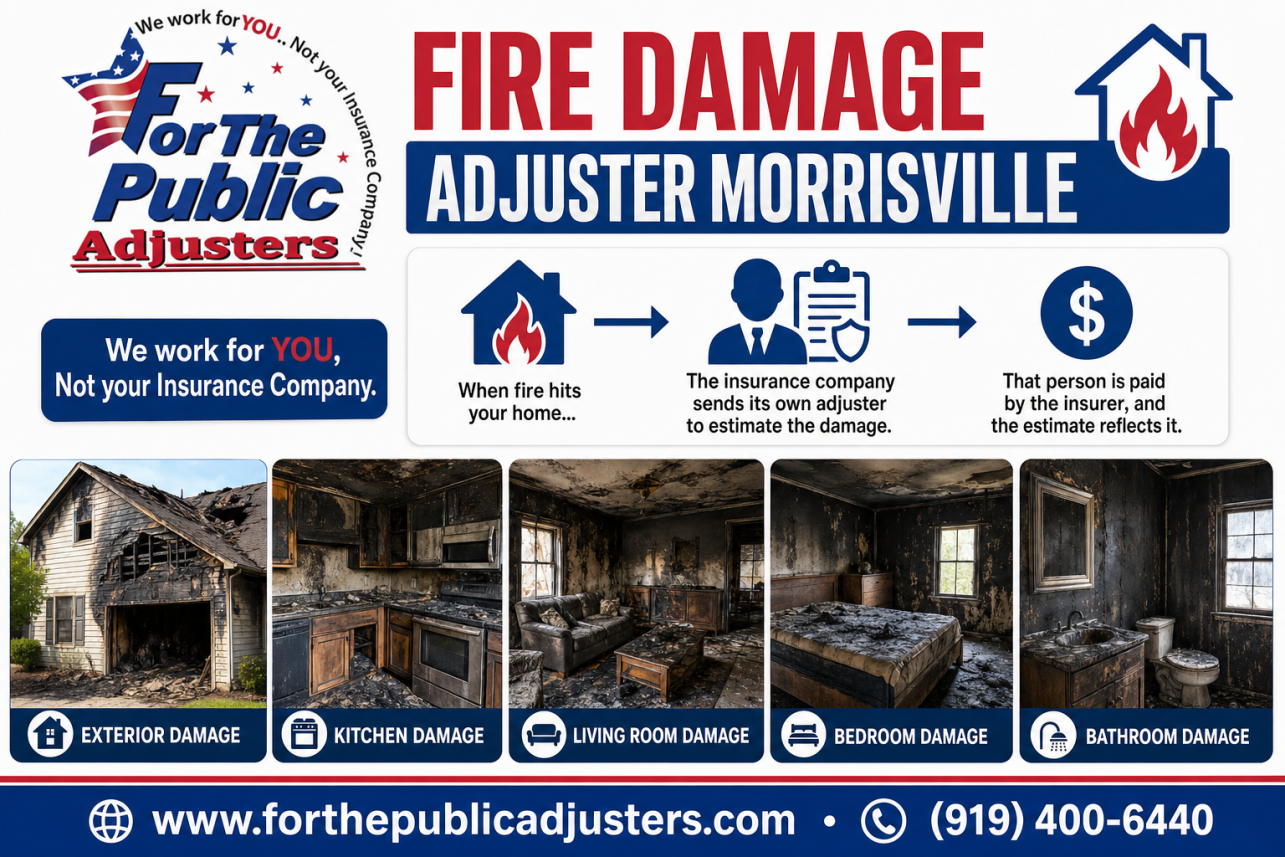
When fire hits your home, the insurance company sends its own adjuster to estimate the damage. That person is paid by the insurer, and the estimate reflects it. A public adjuster is the licensed professional on the other side of the table — hired by the policyholder, answerable only to the policyholder.
Our work starts with a full property loss assessment. That means the obvious burn damage, but also the things a quick walkthrough misses: soot pulled through the HVAC system into rooms the fire never touched, smoke odor absorbed into drywall and insulation, and water damage from firefighting soaked into subfloors and wall cavities. In many Morrisville fires, the water and smoke losses end up larger than the flame damage itself.
We then build the claim the way your policy actually pays it. We prepare a room-by-room contents inventory of your personal property, a structural repair estimate that includes required building code upgrades, and the documentation for temporary housing and additional living expenses while you can’t live at home. We also handle the sworn proof of loss paperwork your insurer requires, and we negotiate directly with the company’s adjuster until the settlement reflects the real cost of putting your life back. The same approach works whether it’s a townhome kitchen fire or a fire insurance claim dispute in Raleigh that has already gone sideways.
North Carolina regulates this work closely. The NCDOI Public Adjusters Guide explains what public adjusters may and may not do, and it confirms your right as a policyholder to hire your own representative on a claim. We follow that guidance to the letter.
Common Problems
The Insurance Company’s Offer Won’t Come Close To Rebuilding My House
This is the most common call we get. The insurer’s estimate uses depreciated values — what your ten-year-old roof or kitchen was worth used, not what it costs to replace. If your policy pays replacement cost, that depreciation is often recoverable, but only if the claim is documented and pursued correctly.
Low offers also come from what gets left out: smoke remediation in untouched rooms, code-required upgrades during rebuild, and hidden structural damage behind walls. Courts have sided with homeowners in exactly these situations. In Dickerson v. Lexington Insurance Co., a Louisiana homeowner whose damaged house was drastically underpaid won at trial, and the federal appeals court upheld the award — including penalties against the insurer for its bad-faith handling of the claim. We can never guarantee a specific outcome, but we can make sure your claim is built to withstand that kind of fight.
Fire Damage Adjuster Morrisville: What Do I Do When The Claim Stalls Or Gets Denied?
Delayed responses, repeated document requests, and partial denials are pressure tactics as often as they are paperwork problems. Insurers know a family paying out of pocket for a hotel and meals will eventually accept less just to move on.
We take over that communication entirely. We track deadlines, respond to every request in writing, and challenge denials point by point against your actual policy language and coverage limits. When an insurer’s conduct crosses into bad faith, we work with insurance dispute lawyers to escalate. We handled a similar standoff for a client through our fire damage claim adjuster Cary NC office, where a stalled claim moved once every disputed item was documented and formally re-submitted.
Can’t I Just Handle The Fire Claim Myself?
You can — and for a very small loss, you might be fine. But a serious fire claim is really five claims in one: structure, contents, smoke and soot, water damage from firefighting, and living expenses. Each has its own documentation rules, and money you fail to claim is money the insurer keeps.
A good public adjuster earns their fee by finding covered damage you didn’t know to claim and by pricing repairs at real contractor rates rather than the insurer’s software numbers. When you’re comparing help, verify the license with the North Carolina Department of Insurance, confirm bonding, and ask how they build a contents inventory. Our fire claims adjuster Apex team follows the same documentation standard on every loss, large or small.
Our Process
Free Inspection And Policy Review
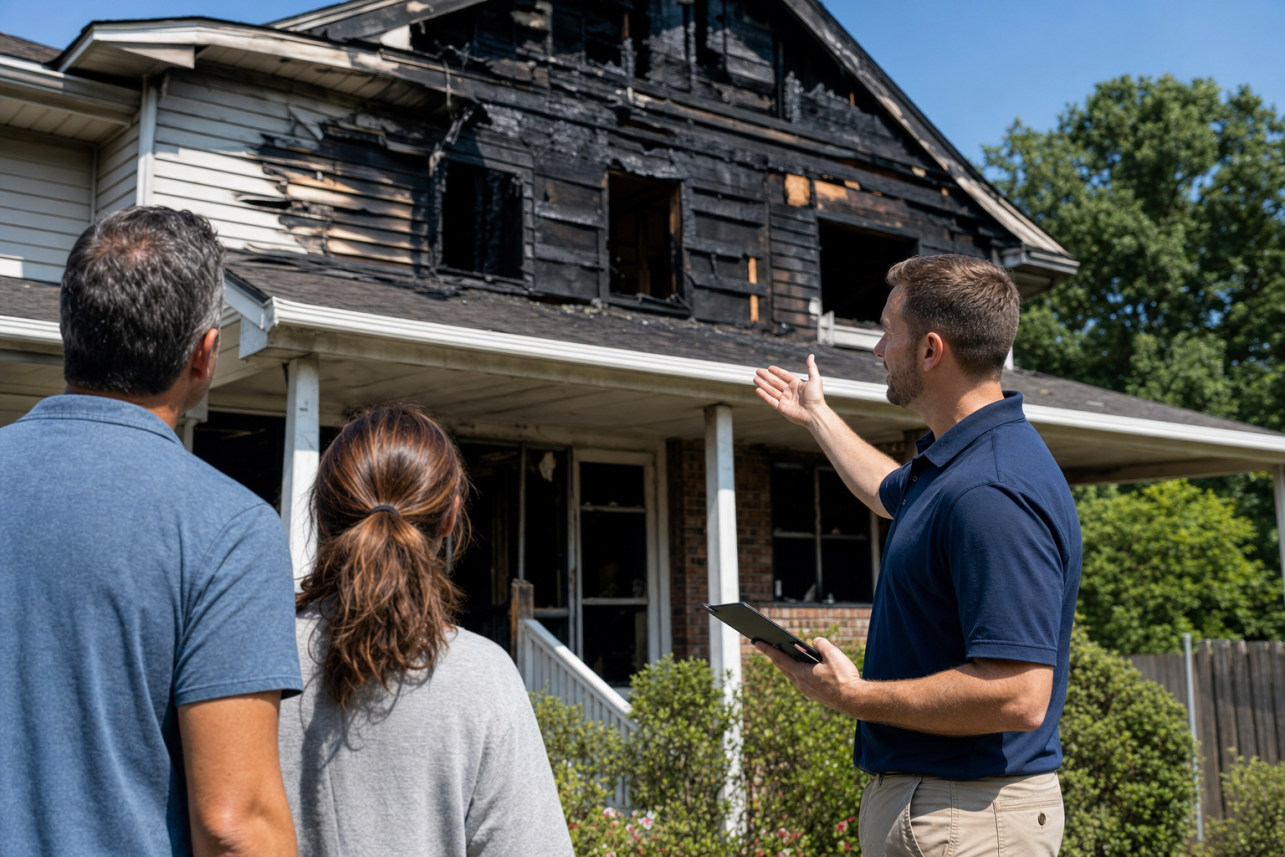
We walk the property, photograph and map every affected area, and read your policy in full — coverage limits, deductible, additional living expenses, and code upgrade coverage. You’ll know what your policy actually provides before anyone talks numbers.
Documentation And Proof Of Loss
We build the structural repair estimate, complete the contents inventory of damaged personal property, and document smoke, soot, and firefighting water damage — including moisture readings and testing where hidden damage is likely. Then we prepare and submit the sworn proof of loss on your behalf.
Negotiation And Settlement
We meet the insurance company’s adjuster at the property, defend every line item, and negotiate until the settlement reflects the documented loss. If the insurer digs in unfairly, we coordinate with insurance dispute attorneys to protect your position. You stay informed at every step.
| What’s Involved | Filing on Your Own | With For The Public Adjusters, Inc. |
|---|---|---|
| Damage scope | Limited to what the carrier’s adjuster documents in one walkthrough | Independent room-by-room inspection, including hidden smoke, soot, and heat damage |
| Contents inventory | Homeowner builds the list from memory, items get missed or undervalued | Detailed itemized inventory with photos and replacement-cost pricing |
| Estimate accuracy | Carrier’s pricing software, often below actual Wake County contractor costs | Line-item estimates verified against real local rebuild bids |
| Negotiation | You argue policy language against trained claims professionals | A licensed adjuster who works only for you handles every negotiation |
| Alternate living expenses | Often cut short or partially reimbursed | Documented and extended to match the true restoration timeline |
| Your time | Dozens of hours of calls, paperwork, and meetings | We manage the claim start to finish while you focus on your family |
Commonly Overlooked In The Public Adjusting Industry
- Soot contamination inside HVAC ductwork — Ducts are out of sight, so carrier scopes often skip them even though central air spreads soot into every room of the house.
- Smoke absorption in attic insulation — Insulation acts like a sponge for smoke odor, but nobody climbs into the attic during a quick field inspection.
- Heat damage to wiring behind undamaged-looking walls — Copper wiring degrades at temperatures well below what chars drywall, so it fails inspection later even when the wall surface looks fine.
- Firefighting water and overhaul damage — Homeowners assume only burned areas are covered, when the water, broken windows, and torn-open ceilings from suppression are part of the same fire loss.
- Depreciation holdback and recoverable depreciation — Many policyholders never realize the carrier owes them the withheld depreciation once repairs are completed, and they simply never claim it.
- Code upgrade coverage during rebuild — Wake County building codes have changed since most homes were built, and ordinance-or-law coverage that pays for required upgrades goes unclaimed because no one asks.
- Full contents inventory including closets, storage, and garage — After the trauma of a fire, homeowners list what they remember, which is typically a fraction of what they actually owned.
- Alternate living expenses beyond the first offer — Carriers approve a short displacement window up front, and families don’t know they can extend it when the rebuild inevitably takes longer.
Case Studies
Case Study #1
Situation: A family in the Breckenridge neighborhood of Morrisville had a kitchen fire that started in a countertop appliance. The flames were contained to the kitchen, but smoke traveled through the HVAC system into every room of the two-story home.
Problem: The insurance carrier’s adjuster scoped only the kitchen and adjacent hallway, offering roughly $28,000. The estimate ignored soot contamination in the ductwork, smoke odor absorbed into insulation and soft goods, and heat damage to cabinets two rooms away.
Investigation: Our team performed a room-by-room inspection with particle testing, pulled samples from the attic insulation, and had the duct system inspected by a certified HVAC contractor. We documented protein and soot residue on surfaces the carrier’s scope never mentioned.
Findings: Soot had migrated through the returns into all twelve rooms. The attic insulation tested positive for smoke contamination, the kitchen subfloor showed heat warping, and contents damage — clothing, upholstery, electronics — was significantly undervalued in the carrier’s contents worksheet.
Solution: We rebuilt the estimate line by line using contractor-verified pricing, added full duct cleaning and insulation replacement, prepared a detailed contents inventory with the homeowner, and presented the supplemental claim with photo documentation and lab results.
Outcome: The claim settled at just over $112,000 — roughly four times the original offer — including alternate living expenses for the family during the eight-week restoration.
Lesson: Smoke does not stay where the fire happened. In Morrisville homes with central air, contamination almost always extends far beyond the burn area, and the first estimate rarely accounts for it.
Case Study #2
Situation: The owner of a small retail suite off Morrisville Carpenter Road suffered an electrical fire that started behind a wall after business hours. Sprinklers activated and the fire department opened up walls and ceilings during overhaul.
Problem: The carrier tried to split the loss, arguing the water and demolition damage from firefighting was separate from the fire itself and applying policy language narrowly. They also pushed back on business interruption, claiming the shop could reopen in three weeks.
Investigation: We reviewed the commercial policy word by word, brought in an electrical contractor to trace the wiring damage beyond the visible burn, and worked with the owner’s bookkeeper to document actual revenue, payroll, and continuing expenses.
Findings: Firefighting damage is a covered consequence of fire under the policy — the carrier’s split-loss position had no basis. Wiring damage extended through two additional walls, and a realistic rebuild timeline from three licensed contractors was eleven weeks, not three.
Solution: We submitted a unified claim covering fire, water, and overhaul damage, backed the extended timeline with contractor bids and permit lead times from the Town of Morrisville, and built a business interruption calculation from two years of financials.
Outcome: The final settlement covered the full eleven-week closure, complete electrical rewiring of the affected walls, and all firefighting-related demolition — more than double the carrier’s initial position.
Lesson: Carriers sometimes try to carve a single fire loss into pieces to shrink the payout. Every consequence of the fire, including what the fire department had to do to stop it, belongs in the claim.
| Situation | What You Should Do | Why It Matters to Your Claim |
|---|---|---|
| First 24–48 hours after the fire | Secure the property, keep receipts for hotels and meals, and don’t throw anything away | Discarded items can’t be documented, and early receipts anchor your alternate living expense claim |
| Carrier asks for a recorded statement | Ask to schedule it and consider having representation first | Casual answers about the fire’s origin or timeline can be used to limit or delay coverage |
| Carrier sends its adjuster to inspect | Have your own adjuster present or inspect first | The carrier’s scope becomes the baseline — anything missed then must be fought for later |
| You receive a quick settlement offer | Do not sign a release until the full scope is known | Hidden smoke, structural, and duct contamination often surface weeks later and may be waived by a signed release |
| Restoration company pushes a contract at the scene | Slow down and review before signing | Assignment-of-benefits contracts can hand control of your claim to a vendor with different interests |
| Smoke odor lingers after cleaning | Request testing of insulation, ducts, and soft goods | Odor means contamination remains, and remediation of those materials is a covered cost |
| Business interrupted by a commercial fire | Preserve financial records and document every lost day | Business interruption payouts are only as strong as the revenue and expense documentation behind them |
Reviews
After our garage fire, the insurance company offered an amount that wouldn’t have covered half the rebuild. For The Public Adjusters found smoke damage in our attic and master bedroom that the carrier’s adjuster walked right past. Our final settlement was almost triple the first offer. Worth every penny.
Denise H.
We had a dryer fire in our Morrisville townhome and had no idea how to handle the contents inventory — hundreds of items. Their team sat with us for two afternoons cataloging everything with photos and replacement pricing. The carrier accepted the inventory almost in full. I couldn’t have done that alone.
Rajiv M.
The stress after a house fire is hard to describe. They handled every call with the insurance company, met the field adjuster at the property so I didn’t have to, and got our alternate living expenses extended when the rebuild ran long. My only regret is not calling them the day after the fire instead of waiting a month.
Carol T.
Frequently Asked Questions
What Does A Fire Damage Adjuster Morrisville Homeowners Hire Actually Do For Me?
A licensed public adjuster works exclusively for you, the policyholder — never for the insurance company. After a fire, your insurer sends its own adjuster whose job is to protect the carrier’s bottom line. Our team levels that playing field.
We start with a full inspection of your Morrisville property, documenting structural damage, smoke and soot infiltration, water damage from firefighting efforts, and losses to personal belongings. Smoke damage in particular is routinely underestimated; it migrates through HVAC systems, wall cavities, and insulation in ways a quick walkthrough misses.
From there, we review your policy line by line to identify every coverage that applies — dwelling, contents, additional living expenses, code upgrade coverage, and debris removal among them. We then prepare a detailed, itemized claim with photographs, moisture readings, contractor estimates, and inventory documentation.
Finally, we handle all communication and negotiation with the insurance company on your behalf. That includes meeting their adjuster on site, responding to requests for documentation, and pushing back when the carrier’s estimate falls short of actual repair costs in Wake County, where construction pricing has climbed significantly in recent years.
For The Public Adjusters, Inc. manages the entire process so you can focus on your family and getting back into your home. Most clients tell us the biggest relief is simply having an experienced advocate who knows what a fire claim should be worth and won’t accept less.
How Much Does It Cost To Hire A Public Adjuster In Morrisville After A House Fire?
For The Public Adjusters, Inc. works on a contingency basis, which means there is no upfront cost and no hourly billing. Our fee is a percentage of the settlement we recover for you, agreed to in writing before any work begins. If we don’t recover money for you, you don’t owe us a fee.
This structure matters for a simple reason: our interests are aligned with yours. The better your settlement, the better the outcome for both of us. There’s no incentive to rush a claim or accept a lowball offer just to close a file.
Homeowners sometimes worry that a fee will leave them with less than if they’d handled the claim alone. In our experience with fire losses in Morrisville and across Wake County, the opposite is almost always true. Professionally documented fire claims consistently settle for substantially more than claims handled by policyholders on their own — often enough that the increase far exceeds our fee.
Fire claims are especially prone to underpayment because they involve so many moving parts: structural repairs, smoke remediation, contents inventories, temporary housing, and building code upgrades required by the Town of Morrisville. Missing even one category can cost thousands.
We’re happy to review your situation in a free, no-obligation consultation. We’ll look at your damage and your policy, tell you honestly whether we can add value, and explain our fee clearly before you sign anything. There are no hidden charges and no surprises at settlement.
The Insurance Company Already Sent Their Adjuster. Is It Too Late To Bring In A Fire Damage Adjuster Morrisville Residents Trust?
No — it is not too late, and this is one of the most common situations we handle. You can hire your own advocate at nearly any stage of a fire claim: right after the fire, after the carrier’s adjuster has inspected, after you’ve received an estimate, or even after a settlement offer you believe is too low.
Many Morrisville homeowners call For The Public Adjusters, Inc. precisely because something felt off. Maybe the insurer’s estimate doesn’t come close to what local contractors are quoting for repairs. Maybe smoke damage in adjacent rooms was dismissed as “cleanable” when the odor keeps returning. Maybe your contents inventory was cut without explanation.
When we take over an active claim, we conduct our own independent inspection and compare our findings against the carrier’s scope of work. Fire claims almost always have gaps: overlooked smoke penetration behind walls, HVAC contamination, damaged electrical wiring, and code-required upgrades that North Carolina building standards mandate during reconstruction.
We then submit a supplemental claim backed by documentation and negotiate directly with the insurance company to close the difference. Even claims that have already been paid can sometimes be reopened if new damage is discovered, provided you’re within your policy’s time limits.
The one caution is speed. Policies contain deadlines for proof of loss and supplemental claims, so the sooner you get a professional review, the more options you have. If you’re anywhere in the Morrisville area and unsure about your settlement, a free second opinion costs you nothing.
How Long Does A Fire Damage Insurance Claim Take In Wake County, And Where Do We Live In The Meantime?
Timelines vary with the severity of the fire, but most residential fire claims we handle in the Morrisville area resolve within two to six months. Smaller kitchen fires with contained smoke damage can settle faster; total losses or claims involving disputed coverage can take longer, especially if the carrier drags its feet on inspections or documentation requests.
Our involvement typically shortens the process rather than extending it. Insurance companies delay most often when documentation is incomplete or a claim is disorganized. Because we submit a fully supported claim package from the start — repair estimates, contents inventories, photographs, and expert reports — there’s less back-and-forth and fewer excuses for delay.
As for housing, most homeowner policies include Additional Living Expenses (ALE) coverage, sometimes called Loss of Use. This pays for temporary housing, extra meal costs, laundry, pet boarding, and increased commuting expenses while your home is uninhabitable. It’s one of the most underused coverages we see.
We help Morrisville families set up ALE properly from day one, whether that means a comparable rental near RTP for work commutes, a hotel stay, or an extended-stay arrangement while repairs proceed. We also track those expenses so the carrier reimburses everything you’re owed, not just what’s convenient for them.
Throughout the claim, For The Public Adjusters, Inc. keeps you informed at every milestone: inspection, estimate submission, negotiation, and payment. You’ll always know where things stand and what happens next, which takes a great deal of stress out of an already difficult season.
My Fire Was Small And Mostly Contained To The Kitchen. Do I Still Need A Fire Damage Adjuster Morrisville Homeowners Would Call For A Bigger Loss?
Yes, and honestly, kitchen and other “small” fires are where we see some of the biggest gaps between what insurers pay and what the loss actually costs. Smoke and soot travel through the entire HVAC system of a home, and Morrisville’s newer, tightly sealed construction in neighborhoods like Breckenridge and Kitts Creek can trap corrosive residue in ductwork, insulation, and wall cavities far from the flames.
A carrier adjuster looking at charred cabinets may write an estimate for the kitchen alone. What that estimate often misses: protein smoke residue on ceilings two rooms away, contaminated attic insulation, soot in the ducts, and the odor sealing and repainting required to actually make the home livable again.
We also see suppression damage undervalued. Water from extinguishing the fire soaks subfloors and drywall, and if it is not documented quickly, the carrier may later dispute whether resulting mold or warping is related to the fire.
Our team documents the full footprint of the loss, including testing for soot migration, before demolition or cleaning erases the evidence. On smaller fires, that documentation frequently doubles or triples the initial estimate, because the structure damage was never the expensive part. The cleaning, contents, and code-required upgrades were.
So the size of the flames is not the right measure. The size of the smoke path is, and that is almost always bigger than it looks.
What Should I Do In The First 48 Hours After A House Fire In Morrisville, Before Anyone Inspects The Damage?
First, do not sign anything beyond what the fire department requires. Restoration contractors and carrier vendors often show up within hours, and signing a work authorization or an assignment of benefits on the spot can limit your options before you understand the claim.
Second, secure the property, because your policy requires you to protect it from further damage. Board-up and tarping are covered expenses, so keep every receipt. If you need emergency mitigation, you can authorize it, but ask for an itemized scope in writing first.
Third, photograph and video everything before anything is moved, cleaned, or thrown away. Walk every room, open closets and cabinets, and capture the smoke staining on ceilings and walls. In Wake County, fire investigators and carrier adjusters may not arrive for days, and evidence disappears fast once cleanup starts.
Fourth, start a notebook. Log every phone call, every name, every promise made. Save hotel and meal receipts immediately, since additional living expense coverage begins the night of the fire, not the day the claim is approved.
Finally, report the claim promptly but keep your initial statement factual and brief: date, time, and what you observed. You are not obligated to speculate about cause or estimate your own damages.
If you bring in a Morrisville public adjuster during this window, we take over the documentation, coordinate mitigation on your terms, and make sure nothing gets discarded that you will need to prove your contents claim later.
How Do You Prove The Value Of Everything I Lost In The Fire? Most Of My Belongings Are Gone Or Unrecognizable?
This is one of the hardest parts of any fire claim, and it is where policyholders lose the most money when they handle it alone. Insurers require a detailed contents inventory, item by item, with age, condition, and replacement cost. Most people give up partway through and settle for a fraction of what they owned.
We rebuild your inventory systematically. We start with a room-by-room walkthrough, physical or from photos, prompting your memory with detailed checklists: what was in each drawer, each closet shelf, each garage cabinet. People consistently underestimate what they owned until they are guided through it. A typical Morrisville household holds far more than the owners initially list.
Then we mine your records. Amazon order histories, credit card statements, old photos and videos on your phone, even social media posts often prove ownership of items you forgot existed. For high-value items like jewelry, tools, or electronics, we document brand and model so the carrier cannot substitute cheap equivalents.
We also price everything at true local replacement cost, not the depreciated figures carriers default to, and we track the recoverable depreciation you are owed once you replace items. Many Wake County homeowners never collect that second payment because nobody explained they were entitled to it.
Finally, we push back on unrealistic depreciation. A three-year-old sofa is not worth twenty percent of its price. Fighting those line items across hundreds of entries is tedious, but it is often worth tens of thousands of dollars on a total-loss contents claim.

Does A Fire Damage Adjuster Morrisville Policyholders Hire Also Handle Disputes Over Code Upgrades And Rebuilding Requirements?
Yes, and in Morrisville this matters more than most homeowners realize. When you rebuild after a fire, the Town of Morrisville and Wake County will require the reconstruction to meet current North Carolina building code, not the code in effect when your home was built.
For homes built in the 1990s and early 2000s, common in areas off Morrisville-Carpenter Road and Church Street, that can mean upgraded electrical panels, arc-fault breakers, hardwired smoke and carbon monoxide detectors, updated egress requirements, and current energy code insulation. None of that was in your house before the fire, and carriers do not volunteer to pay for it.
Most homeowner policies include ordinance or law coverage that pays for exactly these code-required upgrades, typically ten to twenty-five percent of your dwelling limit. But carriers frequently omit it from their estimates entirely, and contractors discover the shortfall mid-rebuild when the permit inspector flags the work.
We identify code-upgrade exposure before the estimate is finalized. We review your policy for the ordinance or law endorsement, coordinate with your contractor and the local permitting office, and build those costs into the claim from the start rather than fighting a supplement battle months later.
We also handle matching disputes, like when the carrier wants to replace siding or roofing on one elevation and leave mismatched materials on the rest of the home. North Carolina claims practices give policyholders real arguments here, and knowing how to make them is a large part of what our team does every day.
The Flames Never Reached Most Of My House, But Everything Smells Like Smoke. Will A Fire Damage Adjuster Morrisville Families Work With Fight For Smoke And Soot Damage Too?
Absolutely, and this is one of the most underpaid parts of fire claims we see in Wake County. Smoke and soot travel through your HVAC system, settle into drywall, insulation, carpet padding, and even the inside of electronics and cabinets far from the actual burn area.
Insurance carriers often approach smoke damage as a cleaning problem. They’ll write an estimate for wiping down surfaces and running an air scrubber for a few days. In reality, protein and synthetic soot are acidic and continue corroding metal fixtures, wiring, and appliances long after the fire is out. Odor trapped in porous materials frequently cannot be removed no matter how many times it’s cleaned.
Our job is to document the true extent of contamination. That can include hygienist testing, combustion byproduct sampling, and inspecting duct systems that quietly redistributed soot into every room. When testing shows contamination, replacement of affected materials is often owed, not just cleaning.
We also push back when carriers try to clean items that will never smell or perform the same again, like mattresses, upholstered furniture, or a refrigerator with soot in the compressor housing. In many Morrisville fire losses we’ve handled, the smoke and soot portion of the claim ends up larger than the structural burn damage itself. Don’t let anyone tell you the parts of your home the flames never touched aren’t part of your loss.
I Already Accepted A Check From My Insurance Company, But The Money Isn’t Close To Covering The Repairs. Can My Claim Be Reopened?
In most cases, yes. Cashing a claim check does not automatically close your claim or waive your rights, despite what many homeowners assume. Unless you signed a full release, that payment is typically an initial or undisputed amount, and you can pursue a supplemental claim for the difference.
The first thing we do is review the paperwork you signed and the carrier’s estimate line by line. Fire estimates written early in a claim almost always miss things: hidden framing damage found once demolition starts, smoke contamination in wall cavities, electrical systems compromised by heat, and current Wake County construction pricing that outpaces the carrier’s software rates.
North Carolina policies give you a window to pursue additional amounts, and there are contractual deadlines that matter, so the sooner you act the better. We reinspect the property, build a complete independent estimate, and present the supplement with the documentation the carrier needs to approve it.
We regularly take on Morrisville fire claims after a homeowner has already been paid something. It’s common for the final settlement after our involvement to be substantially higher than the original check, because the first payment was based on what was visible during a single walkthrough, not what the rebuild actually requires. If contractors are telling you the insurance money won’t finish the job, that’s the signal to have the claim professionally re-evaluated before you spend your own savings to close the gap.
My Insurance Company Recommended A Preferred Restoration Contractor. Should I Use Them, Or Does That Conflict With Hiring A Fire Damage Adjuster Morrisville Policyholders Rely On?
You’re never required to use the carrier’s preferred vendor, and it’s worth understanding the relationship before you sign anything. A Fire Damage Adjuster Morrisville homeowners bring in works for you and only you. A carrier’s program contractor, on the other hand, gets steady referral volume from the insurance company and has agreed to work within the carrier’s pricing and scope guidelines.
That arrangement isn’t automatically bad, but it creates an obvious tension. If the contractor’s estimate matches the carrier’s estimate, ask yourself whether that’s because the scope is truly complete or because the contractor built it to fit what the insurer already approved. In fire losses especially, we see program estimates that skip hidden damage, undersize smoke remediation, and omit code-required upgrades.
Our recommendation for the North Carolina homeowners we represent: get your own independent estimates from contractors who answer to you, and let us establish the full scope of damage first. Once the claim is properly valued, you can hire whichever builder you trust, whether that’s a Triangle-area restoration firm you found yourself or, in some cases, even the preferred vendor working from the corrected scope.
Also be careful with paperwork. Some restoration agreements include assignment-of-benefits language or authorize work before the claim value is settled. We review those documents for our clients before anything is signed, because the order of operations matters: settle the scope and the money first, then rebuild.
The Fire Started In My Neighbor’s Townhome And Spread To Mine. Whose Insurance Pays, And How Does That Change My Claim?
This comes up often in Morrisville, where attached townhomes and condos make up a big share of the housing stock in neighborhoods off McCrimmon Parkway, Davis Drive, and around Town Hall Drive. The short answer: you file with your own insurance company first, regardless of where the fire started.
Your policy covers your unit and belongings on a no-fault basis. Waiting for your neighbor’s carrier to accept liability could leave you displaced for months with nothing paid. File your own claim, get your repairs and living expenses moving, and let your carrier pursue reimbursement from the responsible party’s insurer afterward through subrogation. When that recovery happens, you may even get some or all of your deductible back.
Townhome and condo fires add a second layer of complexity: the line between what your policy covers and what the HOA’s master policy covers. Depending on your association’s documents, the master policy may be responsible for the structure down to the studs, or down to the original finishes, with your policy picking up everything inside. Carriers on both sides frequently point at each other, and the homeowner gets stuck in the middle.
We read the HOA declarations alongside both policies, establish who owes what, and make sure nothing falls through the crack between the two. We also document smoke and heat damage that migrated through shared walls and attic spaces, which is routinely missed when adjusters only look at the unit where the fire began.
The Firefighters Caused A Lot Of Water Damage Putting Out The Fire. Is That Covered, Or Only The Burn Damage Itself?
Water damage from firefighting efforts is almost always covered under the same claim as the fire itself. In insurance terms, the fire is the proximate cause of loss, so everything that flowed from it — water from hoses, holes cut in the roof for ventilation, doors forced open by the fire department — belongs in your settlement.
The problem is that this damage is frequently undervalued. Water from fire suppression soaks into subfloors, wall cavities, and insulation, and in Morrisville’s humid climate, saturated materials can develop mold within days if they aren’t dried or removed quickly. An insurance company’s estimate often covers surface drying but skips the demolition and replacement of materials that can’t actually be saved.
When our team inspects a fire loss in Wake County, we use moisture readings and thermal imaging to document how far the water traveled, not just what’s visibly wet. We’ve handled claims where the burn damage was limited to one room but the water damage affected three floors, including a finished basement two levels below the fire.
Make sure the mitigation happens fast and is documented thoroughly, because delayed drying gives the carrier an opening to argue that resulting mold was a maintenance issue rather than part of the fire claim. A Morrisville public adjuster who catches this early can keep the entire scope — fire, smoke, water, and secondary damage — inside one properly valued claim instead of letting pieces of it get carved out and denied.
My Fire Claim Was Denied And The Insurer Mentioned An ‘investigation.’ Can A Fire Damage Adjuster Morrisville Property Owners Hire Help Fight A Denial?
Yes, and this is one of the situations where professional representation matters most. Carriers deny fire claims for several reasons: suspected intentional acts, alleged misrepresentation on the application, vacancy exclusions, or claims that the fire’s cause falls outside coverage. Each of these has specific legal and factual requirements the insurer must meet — and they often can’t.
The first step is getting the denial in writing with the exact policy language the carrier is relying on. North Carolina requires insurers to state the basis for a denial, and vague or shifting explanations are a red flag we know how to challenge.
If the carrier launched a cause-and-origin investigation, you have the right to your own expert. We regularly work with independent fire investigators who review the same evidence — burn patterns, electrical components, the fire department’s incident report — and frequently reach different conclusions than the insurer’s hired examiner.
Vacancy denials are common in the Morrisville area given how many homes here are owned by relocating tech workers or held between tenants. Most policies define vacancy narrowly, often requiring 60 consecutive days without occupancy, and carriers sometimes apply the exclusion to homes that don’t actually meet that definition.
A denial is the insurance company’s position, not the final word. We build a documented rebuttal, invoke appraisal or other policy remedies where appropriate, and coordinate with policyholder attorneys when a claim needs to escalate. Many denied fire claims in Wake County ultimately get paid — but rarely without someone pushing back with evidence.
I Own A Rental Property Near The Morrisville-Cary Line That Had A Fire. Is The Claim Handled Differently Than For My Own Home?
Landlord fire claims involve the same fundamentals but several important differences, and Morrisville has a large rental market — from townhome investors near McCrimmon Parkway to owners leasing to Research Triangle Park commuters — so we handle these often.
First, your dwelling policy typically covers the structure but not your tenant’s belongings; those fall under the tenant’s renters insurance. However, appliances, fixtures, window treatments, and anything you supplied as the landlord belong in your claim, and these items are easy to overlook.
Second, instead of additional living expenses, landlord policies carry loss of rents coverage. This pays the fair rental value while the unit is uninhabitable, and given how long fire rebuilds can run, that lost income adds up quickly. We document local market rents and the realistic repair timeline so the carrier can’t cut this coverage off prematurely.
Third, subrogation is a bigger factor. If the tenant caused the fire — an unattended stove, a candle, an overloaded circuit — your carrier may pursue the tenant’s insurer to recover what it pays. That process shouldn’t reduce or delay your settlement, but carriers sometimes drag their feet while sorting out fault.
Finally, out-of-state and out-of-area owners are at a disadvantage because they can’t easily attend inspections or monitor the property. Our team serves as your local eyes on the ground, attending every inspection, documenting the full scope of damage, and managing the claim so you aren’t trying to negotiate a Wake County fire loss from another city.

How Does The Insurance Company Decide If My House Is A Total Loss, And What Happens If I Disagree With Their Numbers?
A structure is generally treated as a total loss when the cost to repair approaches or exceeds the cost to rebuild, or when local building officials determine the remaining structure can’t safely be repaired. There’s no single magic percentage — it comes down to a detailed comparison of repair scope versus replacement cost, which is exactly where disputes happen.
Carriers have a financial incentive to classify a badly burned home as repairable, because a repair estimate is almost always lower than a full rebuild. But partial rebuilds on fire-damaged framing carry real risks: charred structural members that pass a visual check may have lost load capacity, and smoke permeation in wall cavities can resurface for years. We bring in structural engineers when the repair-versus-rebuild question is genuinely close.
Valuation matters too. In Morrisville, construction costs have climbed sharply, and carrier estimates built on outdated regional pricing software often fall well short of what Wake County contractors actually charge. A Fire Damage Adjuster Morrisville homeowners bring in will build an independent estimate using real local labor and material costs, then compare it line by line against the carrier’s numbers.
If the two sides still disagree on the amount of loss, most North Carolina policies include an appraisal provision — a formal process where each side selects an appraiser and a neutral umpire resolves the difference. It’s often faster and cheaper than litigation, and we’ve used it successfully to close significant gaps on fire losses. Never accept a total-loss or repair determination without an independent review of the math behind it.
Local Relevance
Morrisville has grown fast, and most of its housing stock is relatively new — townhomes, condos, and single-family homes built over the past few decades. That newer construction changes how fires behave. Open floor plans and shared central HVAC systems let smoke and soot travel far beyond the room where the fire started, which is exactly the damage insurance estimates most often shortchange.
Townhome fires here raise another wrinkle: shared walls. Damage can cross into a neighbor’s unit, and sorting out which policy pays for what — and preserving subrogation rights when someone else’s negligence caused the fire — takes careful handling from day one.
Kitchen fires remain the leading cause of home fires nationally according to the National Fire Protection Association, and busy RTP-area households are no exception. Whether it’s a cooking fire in a Morrisville townhome or a larger structure loss, we serve all of Wake County and beyond — including clients who found us through our fire damage public adjuster Durham work just up the road. Homeowners in nearby communities can also reach a public adjuster in Garner through our team.
Because so many Morrisville homes are newer builds with tightly sealed envelopes and shared central air, smoke and soot from even a small kitchen fire often spread through the duct system into every room — so a thorough claim here usually needs HVAC and whole-house soot documentation, not just an estimate for the burned area.
Had A Fire In Morrisville? Talk To Us Before You Accept An Offer
The inspection and policy review cost you nothing, and you’re under no obligation. For The Public Adjusters, Inc. is licensed and bonded in North Carolina, and we only get paid based on what your claim recovers. Before you sign anything from your insurance company, find out what your claim is really worth.
Call us: (919) 400-6440
Helpful Resources
- National Fire Protection Association (NFPA)
- NCDOI Public Adjusters Guide
- North Carolina Department of Insurance — state regulator where you can verify public adjuster licenses
Serving Morrisville · Wake
Last updated: September 4, 2026