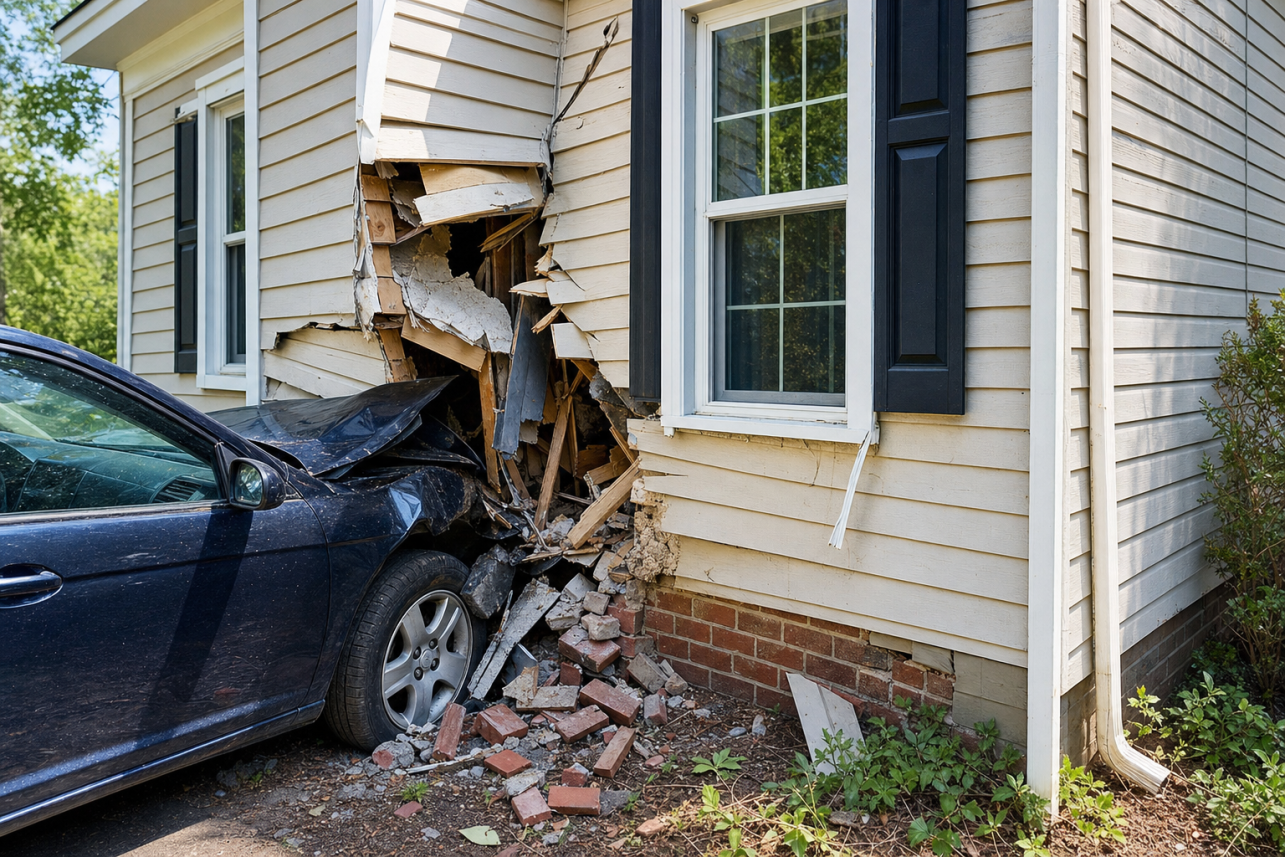
If you need help with a Car Hits Home Claim Morrisville NC, the short answer is this: you can file against the driver's auto liability policy, your own homeowners policy, or both — and a licensed public adjuster can document the full damage and negotiate on your behalf. Vehicle-into-building losses are among the most underpaid residential claims because insurers frequently miss hidden structural damage behind the visible hole. For The Public Adjusters, Inc. is licensed and bonded in North Carolina, and we work only for you, never for the insurance company.
What This Service Is
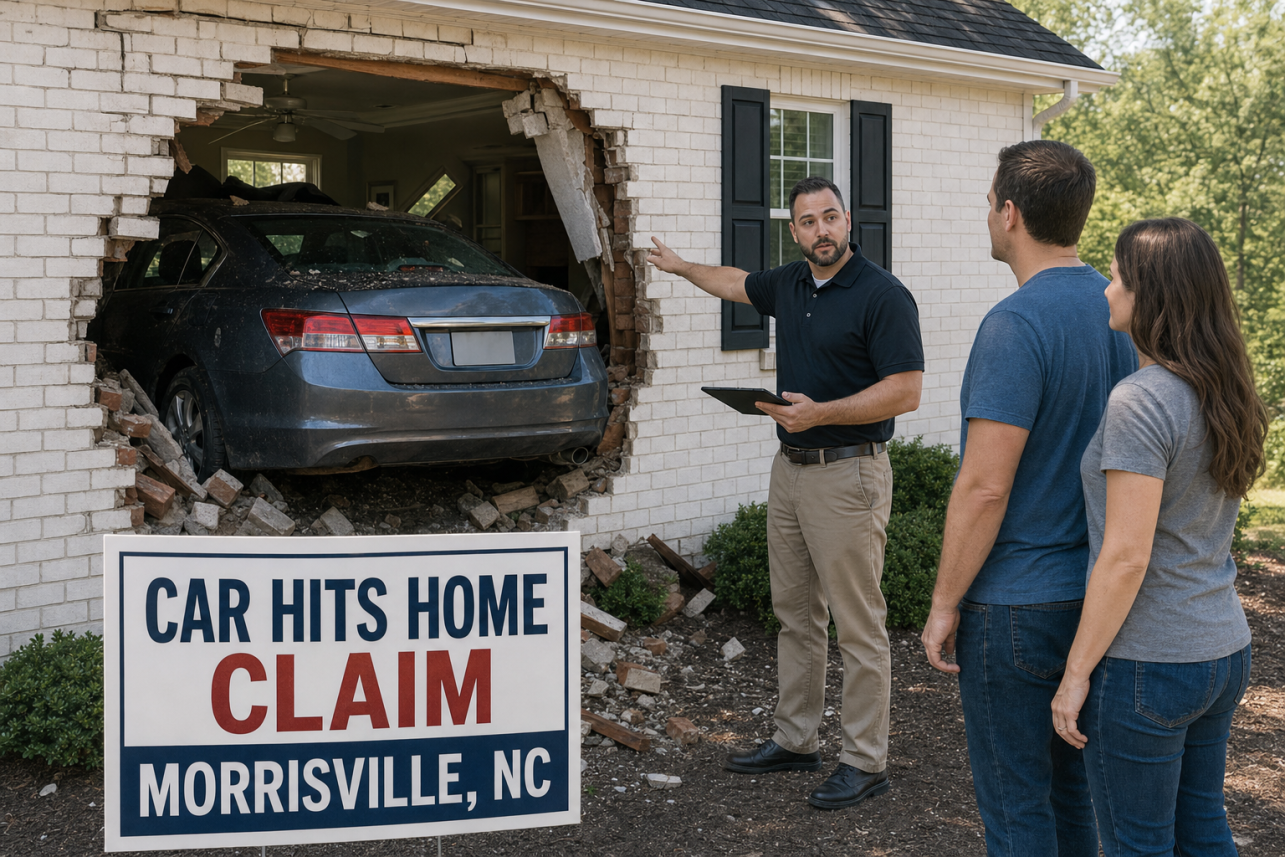
When a car leaves the road and strikes a house, the damage rarely stops at the siding. The impact can crack brick veneer, shift framing, damage a load-bearing wall, and transfer force into the foundation — problems a quick drive-by inspection will not catch.
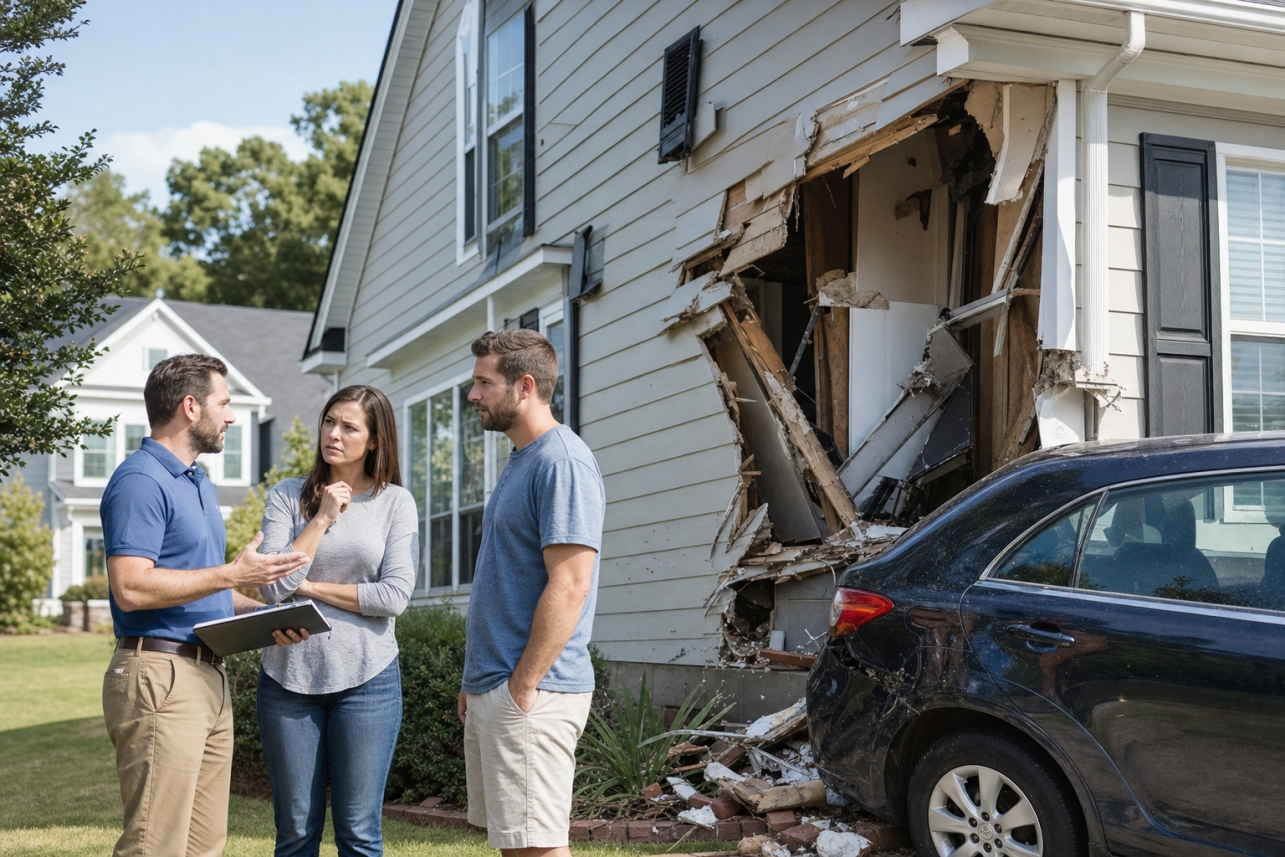
Our job as your public adjuster is to assess the structure from the point of impact outward, build a complete repair cost estimate, and present it to the insurers involved. That usually means dealing with the at-fault driver's auto carrier and your own homeowners carrier at the same time, and making sure neither one uses the other as an excuse to delay.
We handle the paperwork, the documentation, the engineering questions, and the negotiation. The North Carolina Department of Insurance publishes its NCDOI Public Adjusters Guide explaining exactly how our role works: we represent the policyholder, our fee comes from the recovery, and we are licensed by the state to do this work. We handle these losses across the Triangle, including every Car Hits Home Claim Raleigh NC homeowners bring us.
Common Problems
Why Is The Payout On A Car Hits Home Claim Morrisville NC So Low?
The most common complaint we hear is a home insurance adjuster low ball offer that covers the hole in the wall and nothing else. The insurer prices a patch — some siding, a few studs, drywall, paint — while ignoring cracked footings, racked framing, or the fact that your discontinued siding can no longer be matched.
Depreciation deductions make it worse. If your settlement is calculated on actual cash value instead of replacement cost, you may be offered what your twenty-year-old wall was 'worth,' not what it costs to rebuild it. Building code upgrade requirements add real money too, because Wake County will not let a contractor rebuild to 1990s standards.
Courts have backed homeowners on exactly this kind of underpayment. In Windridge of Naperville Condominium Association v. Philadelphia Indemnity Insurance Co., the insured won when the court held the carrier had to replace undamaged siding so the repaired building would actually match — not just patch the damaged panels. We build estimates with that principle in mind, the same way we do on every Car Hits Home Claim Apex NC we handle next door.
The Driver's Insurer And My Insurer Keep Pointing At Each Other — Now What?
This is the classic obstacle in a vehicle-into-home loss. The at-fault driver's auto carrier drags its feet on liability determination, your homeowners carrier says 'wait for them,' and meanwhile you have a tarp over a hole in your house and the home insurance adjuster is not responding.
Here is what most homeowners do not realize: you do not have to wait. You can file under your own homeowners policy immediately, get the repairs moving, and let your insurer recover from the driver's carrier afterward through subrogation — which can even return your deductible to you.
Whether yours is a state farm home insurance claim or a policy with any other carrier, the mechanics are the same: deadlines, documentation, and persistence. We coordinate both companies so the delay tactics stop working, just as we do on each Car Hits Home Insurance Claim in Durham that crosses our desk.
Should I Handle This Myself Or Hire A Public Adjuster?
You can handle it yourself, and for a truly minor scrape some people do. But a vehicle strike is a structural event. If the impact touched a load-bearing wall, shifted the foundation, or left your home declared uninhabitable, the gap between a self-managed settlement and a professionally documented one tends to be substantial.
A good public adjuster does three things you cannot easily do alone: performs a proper structural damage assessment with the right experts, writes a line-item estimate the carrier cannot wave away, and negotiates from documented evidence rather than hope. We also track your temporary housing costs and other out-of-pocket expenses under loss of use coverage, which homeowners routinely forget to claim.
Ask any adjuster you consider whether they are licensed and bonded in North Carolina, whether their fee comes only from the recovery, and whether they have handled vehicle-impact losses specifically. If you are weighing options nearby, our Public Adjuster Cary NC work shows how we approach these claims across western Wake County. We never guarantee a specific outcome — no honest adjuster can — but we do guarantee your claim will be fully documented and professionally argued.

Our Process
Emergency Stabilization And Full Inspection
First, the opening in your home gets secured — emergency board-up and tarping are covered expenses, and we make sure they are claimed. Then we inspect well beyond the impact zone: framing, foundation, roof lines, plumbing and electrical runs inside the damaged wall. Impact force travels, and the damage you can see is rarely all of it.
Build The Real Estimate
We prepare a line-item repair cost estimate that includes structural repairs, code-required upgrades, material matching, and contents damage. When your contractor's number and the carrier's number are thousands apart, this document is what settles contractor estimate disputes. We also calculate what depreciation is being withheld and how to recover it.
Negotiate With Every Insurer Involved
We present the claim to your homeowners carrier and the at-fault driver's auto carrier, manage the back-and-forth, and respond to every pushback with documentation. If a claim denial or underpayment stands after negotiation, we advise you on appraisal and other options under your policy. You approve every decision; we do the fighting.
| Damage Area | Typical Carrier First Estimate | What Full Documentation Often Reveals |
|---|---|---|
| Exterior wall at impact point | Patch siding or brick at the visible hole | Full elevation veneer or siding replacement for structural integrity and matching |
| Foundation and footing | Often not inspected at all | Cracked or displaced footings requiring engineered underpinning or repair |
| Framing and load path | One or two studs replaced | Racked walls, shifted headers, cracked trusses rooms away from the impact |
| Interior finishes | Drywall patch in one room | Separation cracks, door misalignment, and flooring gaps across adjoining rooms |
| Secondary damage (plumbing, electrical) | Treated as a separate maintenance issue | Ruptured lines and damaged wiring included as part of the same occurrence |
| Contents in the impact zone | Rough lump-sum allowance | Itemized inventory with replacement cost pricing, often several times the allowance |
Commonly Overlooked In The Public Adjusting Industry
- Foundation and footing inspection beyond the impact wall — Impact forces travel through the structure into the footing, and nobody digs or checks slab elevations when the hole in the wall is the obvious photo.
- Diminished structural capacity in brick veneer that looks repairable — Cracked veneer loses its tie connections to the framing, so patching the visible bricks leaves a wall that no longer performs the way it was built to.
- Code upgrade coverage (ordinance or law) for rebuilt walls — Wake County will require the repaired section to meet current code, and the extra cost is covered by many policies but almost never included in a first estimate.
- The subrogation file against the at-fault driver's insurer — Homeowners often skip the police report or lose the driver's insurance details at the scene, which can cost them their deductible reimbursement months later.
- Ensuing water, gas, or electrical damage treated as the same occurrence — Carriers sometimes try to split a sheared pipe or damaged wiring into a separate maintenance issue, cutting the payable scope of a single covered event.
- Door, window, and floor alignment in rooms away from the impact — A shifted frame shows up as sticking doors and gapping trim two rooms over, and those symptoms get dismissed as pre-existing unless measured and documented early.
- Additional living expenses when the home is unsafe to occupy — If an engineer deems the wall unstable, hotel and meal costs may be covered, but policyholders rarely know to track those receipts from day one.
- Matching requirements for siding, brick, and roofing on the damaged elevation — Discontinued materials often mean an entire elevation must be replaced to achieve a reasonable match, a scope issue first estimates routinely ignore.
Case Studies
Case Study #1
Situation: A Morrisville homeowner near Town Hall Drive heard a crash at 2 a.m. when a sedan left the road, jumped the curb, and struck the corner of their brick-veneer home. The vehicle pushed in the brick, cracked the foundation corner, and shifted a load-bearing wall in the garage.
Problem: The homeowner's insurance carrier sent an adjuster who scoped only the visible brick damage and offered a settlement that covered masonry patching and little else. The carrier's estimate ignored the cracked footing, the racked garage door opening, and interior drywall separation two rooms away from the impact point.
Investigation: Our team brought in a structural engineer to evaluate the load path from the point of impact. We documented foundation displacement with laser levels, photographed hairline cracks radiating through the slab, and measured the garage header, which had dropped nearly an inch on one side.
Findings: The impact had transferred force through the brick veneer into the footing and up through the framing. Repairs required partial foundation underpinning, reframing of the garage wall, full brick veneer replacement on that elevation to match, and interior drywall and trim work — far beyond a cosmetic patch.
Solution: We prepared a detailed line-item estimate backed by the engineer's report and presented it to the carrier. We also coordinated the subrogation documentation so the homeowner's carrier could pursue the driver's auto liability insurer, protecting the homeowner's deductible recovery.
Outcome: The carrier reissued its estimate based on the engineering findings, and the revised settlement was several times the original offer. The homeowner's deductible was later reimbursed through subrogation against the at-fault driver's policy.
Lesson: Vehicle impacts transmit force well beyond the point of contact. An estimate written from the curb almost never captures structural damage hidden behind brick, drywall, and slab. Courts have long recognized that carriers must pay the full measure of a covered loss — in Bi-Economy Market, Inc. v. Harleysville Insurance Co., 10 N.Y.3d 187 (2008), the insured won against its carrier after a building and contents loss was underpaid and delayed, with the court holding the insurer liable for consequential damages flowing from its failure to promptly and fully pay the claim.
Case Study #2
Situation: A family in the Breckenridge area of Morrisville had a pickup truck back through their attached garage wall after the driver mistook the accelerator for the brake. The wall collapsed inward, destroying stored contents, crushing a water heater, and rupturing a supply line that flooded the garage and adjacent laundry room.
Problem: Two carriers pointed at each other. The driver's auto liability insurer wanted to wait for the homeowner's carrier to act first, and the homeowner's carrier initially tried to separate the water damage from the impact damage, suggesting the plumbing leak was a maintenance issue rather than a direct result of the collision.
Investigation: We photographed the sheared supply line still attached to the displaced water heater, establishing that the flooding was caused by the impact, not wear. We inventoried every damaged content item with purchase records and replacement pricing, and documented moisture migration into the laundry room walls with meter readings.
Findings: The water damage was unambiguously part of the same covered occurrence — a single chain of events starting with the vehicle strike. The contents inventory, which the homeowner had initially estimated at a few thousand dollars, documented substantially more in tools, seasonal storage, and appliances once itemized properly.
Solution: We presented the claim as one occurrence under the homeowner's policy with full structural, water mitigation, and contents documentation, then supplied the complete file to support subrogation against the driver's liability carrier so the two insurers could sort out reimbursement between themselves rather than at the homeowner's expense.
Outcome: The homeowner's carrier accepted the full occurrence, paid for wall reconstruction, water mitigation, drywall and flooring replacement in the laundry room, and the documented contents. The family did not have to wait on the liability carrier's timeline to begin repairs.
Lesson: When a car hits a house, the resulting water, electrical, or gas damage is part of the same loss — don't let anyone carve it out as 'maintenance.' And never accept the advice to wait for the at-fault driver's insurer before filing under your own policy; that delay only hurts the policyholder.
| Scenario | Which Policy Typically Responds First | What It Depends On |
|---|---|---|
| Identified at-fault driver with active liability coverage | Your homeowner's policy, with subrogation against the driver's auto insurer afterward | Filing under your own policy usually gets repairs started faster; your carrier recovers from theirs and your deductible can be reimbursed |
| Hit-and-run driver who was never identified | Your homeowner's policy only | You'll likely absorb the deductible unless the driver is later found; a police report is essential to the claim file |
| Driver was uninsured | Your homeowner's policy | Subrogation against an uninsured person rarely recovers much; thorough documentation of your own claim matters most |
| You or a household member drove into your own home | Your homeowner's policy, subject to its vehicle-damage provisions | Policy language varies on damage caused by vehicles owned or operated by an insured — read the exclusions carefully before assuming anything |
| Commercial vehicle (delivery truck, contractor van) hit the home | Your homeowner's policy first, or the company's commercial liability policy directly | Commercial carriers sometimes pay promptly, but a direct liability claim gives you fewer policyholder protections than your own policy does |
| Impact caused a fire or ruptured a gas or water line | Your homeowner's policy covers the entire chain of damage as one occurrence | The ensuing fire or water damage should not be separated from the impact — it is one covered event, not a maintenance claim |
Reviews
A car ran off Morrisville Carpenter Road and hit the front corner of our house. Our insurance company's first estimate only covered the siding and one wall stud. For The Public Adjusters brought in an engineer who found the sill plate and band joist were shifted. The final settlement covered real structural repairs, not a cosmetic patch. They also handled all the back-and-forth with the driver's insurance so we got our deductible back.
Derrick M., Morrisville
When a delivery van hit our garage, I had no idea whether to file with our insurer or the driver's. This team explained the whole process in plain English, documented everything the day they arrived, and found cracked roof trusses that nobody else had even looked at. The claim took longer than I hoped, but they kept pushing and kept me informed at every step. Worth every penny of their fee.
Anita R., Shiloh area
A teen driver took out our porch columns and part of the foundation wall. The first offer from insurance wouldn't have covered half the masonry work. For The Public Adjusters measured everything, matched the brick properly in the estimate, and got the porch roof included because the columns were load-bearing. Honest, licensed, and they never overpromised — they just documented the loss correctly and the numbers followed.
James and Priya K., Morrisville
Frequently Asked Questions
What Should I Do Immediately After A Vehicle Crashes Into My House In Morrisville?
A Car Hits Home Claim Morrisville NC homeowners file starts the moment of impact, so your first priority is safety. Get everyone away from the damaged area, call 911, and ask the responding officer to write a full report. That police report becomes a cornerstone of your property claim, documenting the driver, the time, and the point of impact.
Next, photograph everything before anything is moved — the vehicle position if it is still on scene, cracked brick or siding, shifted framing, broken windows, and any damaged belongings inside. If the Town of Morrisville or Wake County inspections office tags the structure as unsafe, keep a copy of that notice as well.
Arrange emergency board-up or shoring to protect the home from further damage, and keep every receipt. Your policy requires you to mitigate, and those costs are generally reimbursable under the claim.
Then notify your homeowners insurance carrier and get a claim number. Before you accept any quick settlement or sign repair authorizations, consider having a licensed professional review the damage. For The Public Adjusters, Inc. is licensed and bonded, and we document structural impact damage so the carrier sees the full scope — not just the hole in the wall, but the foundation, framing, and utility lines behind it.
Who Pays When A Car Hits My Home — My Homeowners Policy Or The Driver's Auto Insurance?
Often both policies come into play, and understanding the order matters. Your homeowners policy covers vehicle impact to the dwelling as a named peril, which means you can file with your own carrier right away rather than waiting weeks for the driver's auto liability insurer to accept fault. Your carrier then pursues the at-fault driver's insurer through subrogation, and if they recover, you may get some or all of your deductible back.
Filing under your own policy is usually faster for a Morrisville homeowner because you have a direct contractual relationship with your insurer. Dealing directly with the driver's liability carrier can mean recorded statements, fault disputes, and delays — especially if the driver was uninsured or fled the scene.
One important distinction: as public adjusters, we handle the damage to your home, other structures, and personal contents. We do not handle any portion of the motor vehicle claim itself — the car, injuries, or medical bills fall outside what we do by law and by license.
Where we add value is on the property side: measuring the full structural scope, pricing repairs at realistic Wake County construction costs, and negotiating with the carrier on your behalf. While no one can guarantee a specific outcome, having a professional document the loss thoroughly puts you in a far stronger position than relying on the insurer's estimate alone.
What Kinds Of Damage Do Insurance Adjusters Commonly Miss After A Vehicle Strikes A House?
Vehicle impacts transfer enormous force through a structure, and the visible hole is rarely the whole story. In Morrisville neighborhoods with brick veneer construction, the impact often cracks mortar joints well beyond the strike zone and can shift the wall off its ties. Behind the veneer, wall studs, top plates, and headers may be racked or split even when drywall looks merely cracked.
Foundations are another frequent blind spot. A car striking a garage or crawlspace wall can crack footings or displace block courses, problems that only show up with careful inspection. Impacts also commonly damage plumbing lines, electrical runs, and gas piping inside the wall cavity — hazards that demand licensed trade inspections, not a visual once-over.
Contents matter too. Furniture, electronics, and stored belongings near the impact zone are often crushed or contaminated by debris, and they belong in the claim.
North Carolina courts have shown they will hold insurers to their coverage promises on property losses. In Gaston County Dyeing Machine Co. v. Northfield Insurance Co., 351 N.C. 293 (2000), the North Carolina Supreme Court ruled in favor of the insured, rejecting the insurer's narrow reading of property damage caused by a sudden accident. That principle — that carriers must honor the reasonable scope of a covered loss — is exactly why thorough documentation of every damaged component is so important before you settle.
How Does The Car Hits Home Claim Morrisville NC Process Work With For The Public Adjusters, Inc?
It begins with a no-obligation review of your damage and your policy. We read the actual coverage language — dwelling limits, other structures, contents, loss of use — and explain what applies to a vehicle-impact loss in plain terms before you commit to anything.
If we take the claim, we perform a detailed inspection of the strike zone and everything connected to it: framing, foundation, veneer, roof lines above the impact, and utilities running through the damaged walls. We prepare a line-item estimate using current Wake County labor and material pricing, inventory damaged contents, and document loss-of-use costs if your family cannot safely occupy the home during repairs.
From there, we handle the carrier communications. We attend the insurance company adjuster's inspection, point out damage they might otherwise overlook, respond to their estimate with our documentation, and negotiate the settlement on your behalf. You stay informed at every step, but you are no longer the one arguing scope and pricing with a claims office.
We work on a contingency basis, so our fee comes from the settlement rather than out of pocket up front. We are licensed and bonded in North Carolina, and while no adjuster can promise a specific dollar outcome, our job is to make sure nothing covered gets left out of your claim. For homeowners in Morrisville dealing with the cha
How Long Does A Car Hits Home Claim Morrisville NC Typically Take To Settle?
Most vehicle-into-structure claims in Morrisville resolve in 60 to 120 days, though the timeline depends heavily on the scope of damage and how quickly liability is sorted out. North Carolina law requires insurers to acknowledge a claim promptly and to pay undisputed amounts within a reasonable time, but structural claims often stall during the engineering and estimating phases.
The biggest delays we see come from disputed structural reports. When a vehicle strikes a load-bearing wall or foundation, the carrier may send its own engineer, and that report frequently minimizes hidden damage. Getting an independent structural assessment early keeps the file moving and gives you leverage.
Town of Morrisville permitting can also affect the schedule. Repairs to framing, foundations, gas lines, or electrical systems require permits and inspections through Wake County and the town, and your settlement needs to account for code-required upgrades under your ordinance or law coverage.
When For The Public Adjusters, Inc. manages a claim like this, we front-load the documentation — photographs, moisture and crack mapping, engineering input, and a line-item estimate — so the carrier has less room to delay. We are licensed and bonded, and while no one can promise a specific outcome or dollar figure, thorough documentation submitted early is the single best way to shorten the timeline and support full payment for the repairs your home actually needs.
What Does It Cost To Hire A Morrisville Public Adjuster After A Vehicle Crashes Into My House?
Public adjusters in North Carolina work on a contingency fee, meaning the fee is a percentage of the insurance settlement rather than an hourly rate or upfront charge. If there is no recovery, there is typically no fee. The percentage is agreed to in writing before any work begins, and North Carolina regulates public adjuster contracts to protect policyholders.
For a home struck by a vehicle, that structure matters. These claims often involve two coverage sources — your homeowners policy and the at-fault driver's liability coverage — plus supplemental categories homeowners overlook, like additional living expenses if the house is unsafe to occupy, debris removal, landscaping, and code-upgrade costs. A professional who knows where that money lives usually identifies damage and coverage the first carrier estimate missed.
Courts have repeatedly sided with policyholders who pushed back on underpayment. In Sproull v. State Farm Fire & Casualty Co. (2021), the Illinois Supreme Court ruled that the insurer could not depreciate labor costs when calculating actual cash value on a property claim — a significant win for homeowners facing shortchanged structural settlements.
For The Public Adjusters, Inc. is licensed and bonded, and we review the carrier's estimate line by line against our own inspection. We never guarantee a specific result, but we can promise the claim will be documented, valued, and negotiated the way a fully informed policyholder would demand. For many Wake County homeowners, the difference between the first offer and a properly documented claim far exceeds the fee.
What Happens If The Driver Who Hit My Morrisville Home Was Uninsured Or Fled The Scene?
A hit-and-run or an uninsured driver does not leave you without options. Your homeowners policy covers vehicle impact to your dwelling as a named peril, regardless of who was driving or whether they were ever identified. You file under your own policy, pay your deductible, and your carrier pursues the driver later through subrogation if one is found.
File a police report with the Morrisville Police Department immediately, even for a hit-and-run. The report documents the date and cause of loss, which your insurer will require, and it preserves any chance of identifying the driver through paint transfer, debris, or neighborhood camera footage — increasingly common in Morrisville subdivisions with doorbell and security cameras.
The risk in these situations is accepting a rushed, surface-level estimate from your own carrier. Impact damage travels. A strike to brick veneer can crack the wythe behind it, shift framing, rack window and door openings, and damage plumbing or gas lines inside the wall. Insist on an inspection that opens up the affected area rather than one based on exterior photos alone.
If the driver is later identified, your deductible may be recoverable through your carrier's subrogation effort. We help homeowners document the full scope of structural, interior, and contents damage so that both the initial settlement and any later recovery reflect what the collision actually did to the home. We handle the building and contents side of the loss — not vehicle damage itself, which falls outside our services.

Can I Dispute A Low Insurance Settlement On A Vehicle-Impact Claim To My House?
Yes. A carrier's first estimate on a Car Hits Home Claim Morrisville NC is a starting position, not a final verdict. North Carolina policyholders have several tools: submitting a supplemental claim with new documentation, invoking the appraisal clause in the policy, filing a complaint with the North Carolina Department of Insurance, or pursuing litigation when a carrier acts in bad faith.
Policyholders win these disputes regularly when the facts are documented. In Sproull v. State Farm Fire & Casualty Co. (Ill. 2021), the court held that an insurer improperly reduced a homeowner's property payout by depreciating labor, confirming that carriers cannot shrink structural settlements through aggressive accounting. The lesson applies directly to vehicle-impact claims, where lowball estimates often depreciate labor-heavy trades like masonry and framing.
The most common underpayments we see in Wake County involve hidden structural movement. A sedan hitting a garage wall at even 15 mph transmits force through the top plate into roof trusses, yet many initial estimates cover only the visible brick and siding. An independent engineer's report and a trade-by-trade estimate frequently reveal a much larger scope.
Before accepting any settlement, compare the carrier's estimate against actual contractor bids for the full repair, including permits and code upgrades required by the Town of Morrisville. If there is a gap, you have the right to challenge it. We prepare the documentation, handle the negotiation, and, where appropriate, represent you in the appraisal process — always with the understanding that outcomes depend on the policy and the evidence, never on promises.
Does A Car Hits Home Claim Morrisville NC Cover Temporary Housing If My House Is Unsafe To Occupy?
In most cases, yes. If a vehicle impact leaves your home uninhabitable — a breached exterior wall, a compromised load path, exposed gas or electrical lines — your homeowners policy's Additional Living Expense (ALE) coverage typically pays for comparable temporary housing while repairs are made.
ALE can cover more than a hotel room. It often includes short-term rental costs, increased meal expenses, pet boarding, extra mileage if you're displaced far from Morrisville, and even laundry costs that exceed your normal spending. The key word is 'additional' — it reimburses costs above what you'd normally pay to live in your own home.
Where homeowners run into trouble is documentation and duration. Insurers sometimes argue the home is 'partially habitable' to limit ALE, even when a tarped wall opening in a Wake County winter is clearly unreasonable for a family. We document the habitability question with photos, contractor statements, and code considerations, then track every displacement expense so nothing is left on the table.
If the at-fault driver's auto liability carrier is involved, displacement costs may ultimately be recovered from that policy as well. Our role is to make sure the full scope — structure, contents, and living expenses — is presented and supported, so you aren't paying out of pocket for a loss someone else caused. Keep every receipt from day one; it matters more than most policyholders realize.
Should I Hire A Structural Engineer After A Vehicle Strikes My Morrisville House?
Very often, yes — and on serious impacts we insist on it. A vehicle can transfer thousands of pounds of force through brick veneer, studs, sill plates, and footings. Damage that looks cosmetic at the surface can hide shifted framing, cracked foundations, or racked wall sections several feet from the point of impact.
Many of Morrisville's newer townhomes and single-family homes near Town Hall Drive, Morrisville Parkway, and the Airport Boulevard corridor sit close to busy roads, so impact losses here are more common than people assume. These homes frequently have engineered trusses and shear walls where hidden damage changes the entire repair scope.
An independent structural engineer's report does two things for a Car Hits Home Claim Morrisville NC. First, it establishes the true extent of damage before repairs begin, so the estimate reflects reality rather than a quick visual walkthrough. Second, it carries weight with the insurance carrier — a stamped engineering report is far harder to dispute than a contractor's opinion alone.
As licensed and bonded public adjusters, we coordinate the engineering inspection, incorporate the findings into a detailed line-item estimate, and present the full scope to the insurer. If the carrier's adjuster scoped the loss as 'patch and paint' when the wall actually needs rebuilding from the foundation up, the engineering report is often what turns the claim around. The cost of the inspection is small compared to the risk of living in a structurally compromised home.
Have North Carolina Policyholders Actually Won In Court When An Insurer Underpaid A Building Damage Claim?
Yes, and the case law matters because it shapes how carriers must interpret their own policies. A leading example is Gaston County Dyeing Machine Co. v. Northfield Insurance Co., 351 N.C. 293 (2000), decided by the North Carolina Supreme Court.
In that case, the insurer denied coverage for extensive property damage, arguing policy exclusions applied. The Supreme Court sided with the insured, holding that ambiguous policy language must be construed in favor of the policyholder and that the damage was covered. The insured recovered for the loss, and the decision reinforced a bedrock principle in North Carolina: when an insurance policy can reasonably be read two ways, the reading that favors coverage wins.
That principle applies directly to vehicle-impact losses in Morrisville. Carriers sometimes lean on exclusions, depreciation methods, or narrow scope interpretations to reduce a payout on structural damage. Knowing that North Carolina courts require ambiguities to be resolved for the policyholder gives us real leverage during negotiation — most disputes settle long before a courtroom because the carrier knows how the law reads.
To be clear, we are public adjusters, not attorneys, and no one can guarantee a specific outcome on any claim. What we can do is build the kind of documented, policy-grounded claim file that holds up under scrutiny. When a Wake County homeowner's wall, foundation, or contents are damaged and the first offer doesn't reflect the real cost of repair, the law and the evidence are the tools that move the number.
Does For The Public Adjusters, Inc. Handle The Damage To My Car Too, Or Only The House?
We handle the property side only — the structure, attached features like porches and garages, landscaping and hardscape, and your personal contents inside the home. We do not handle motor vehicle claims of any kind, so if your own parked car was damaged in the incident, that portion goes through your auto carrier or the at-fault driver's auto policy separately.
In practice, that division works in your favor. Vehicle-into-building losses in Morrisville usually involve two or three insurance policies at once: your homeowners policy, the driver's auto liability coverage, and sometimes an umbrella policy. The building and contents portion is almost always the largest and most complicated part, and it's the part carriers most often underscope.
Our work on a Car Hits Home Claim Morrisville NC covers the full property loss: documenting the impact zone and hidden structural damage, inventorying crushed or debris-damaged contents room by room, pricing the repair with current Wake County labor and material costs, and negotiating directly with the adjusters on the other side. We also track which policy should pay what, so your homeowners carrier pursues subrogation against the driver's insurer correctly.
We work on a contingency basis and we're licensed and bonded in North Carolina. While we never promise a specific dollar outcome, separating the vehicle claim from the property claim — and putting an experienced advocate on the property side — is the cleanest way to make sure the biggest part of your loss gets the attention it deserves.
Does A Car Hits Home Claim Morrisville NC Cover Detached Structures Like Garages, Fences, And Brick Mailboxes?
Usually, yes. Most homeowners policies written in North Carolina include Coverage B, often called "Other Structures," which protects detached garages, fences, retaining walls, sheds, and even brick mailbox columns. When a vehicle leaves the road and strikes anything on your property, that coverage typically responds alongside the main dwelling coverage.
The catch is the limit. Coverage B is commonly capped at 10% of your dwelling limit, and carriers sometimes lump all the damaged items together under one lowball estimate. In Morrisville neighborhoods off Davis Drive, Morrisville-Carpenter Road, and Church Street, we regularly see impacts that take out a fence run, crack a driveway, gouge landscaping, and damage the home itself — each of those should be scoped and valued separately.
There is also the driver's liability policy to consider. If the motorist was at fault, their auto liability coverage can pay for property damage without your policy limits coming into play, which matters when a long stretch of fencing or a masonry wall pushes costs past your Coverage B cap.
Our team documents every damaged item on the property, matches it to the correct coverage, and pursues the policy or policies that owe for it. We prepare the claim; we never promise a specific dollar outcome, because every policy and loss is different. One note on scope: we handle the building, structures, and contents only — damage to any vehicle, including the one that hit your home, is outside the services we provide.
Will Filing A Claim After A Vehicle Crashes Into My Morrisville House Raise My Homeowners Premiums?
It can, but often less than homeowners fear — and sometimes not at all. When the at-fault driver's auto liability insurance pays for the damage, many carriers treat the loss as non-chargeable because you did not cause it and your policy did not pay. That is one reason it matters to identify the responsible auto insurer early and push the recovery in the right direction.
If your homeowners policy does pay — for example, when the driver was uninsured, underinsured, or unknown — the claim will appear on your CLUE report, the industry database insurers check at renewal. A single not-at-fault structural loss rarely triggers non-renewal in Wake County, but it can influence pricing for several years.
What you should never do is skip the claim to protect your premium when there is real structural damage. Vehicle impacts can shift sill plates, crack foundations, and rack wall framing in ways that get dramatically more expensive if left unrepaired. An unreported, unrepaired loss can also create problems when you sell the home or file a future claim.
As a Morrisville public adjuster, we help you weigh the numbers before anything is filed. If the documented damage is modest and close to your deductible, we will tell you honestly that a claim may not make sense. If the damage is significant — and with vehicle impacts it usually is — we build the file so the carrier pays what the policy actually owes, and we pursue subrogation angles that can keep the loss off your record.
Can For The Public Adjusters, Inc. Reopen A Vehicle-Impact Claim That My Insurer Already Paid Or Closed?
In most cases, yes. A closed claim is not a dead claim. North Carolina policies allow supplemental payments when additional covered damage is discovered, and the statute of limitations on property insurance disputes generally gives you three years — though your specific policy language controls, so we review it first.
We see this constantly with vehicle strikes. The carrier pays for the visible hole, the siding, and some drywall, then closes the file. Months later the homeowner notices doors that won't latch, cracks spreading from window corners, or a floor that slopes toward the impact wall. Those are classic signs of structural movement the original estimate never addressed. We bring in engineers when needed, re-scope the entire loss, and present a documented supplement.
North Carolina courts have backed policyholders who challenged inadequate payments on building losses. In Gaston County Dyeing Machine Co. v. Northfield Insurance Co., 351 N.C. 293 (2000), the North Carolina Supreme Court sided with the insured on how property damage coverage applied, rejecting the insurers' narrow reading and affirming that carriers cannot shrink coverage after the loss through strained interpretations. That principle — the policy means what it says, read in the insured's favor when ambiguous — is the backbone of every reopened file we handle.
We are licensed and bonded in North Carolina, and we work on a contingency basis, so reopening a claim carries no upfront cost. We cannot guarantee any particular recovery, but if covered damage was missed or underpaid, we know how to document it and pursue it.
What Should I Document Before The Insurance Company's Adjuster Inspects My Home After A Car Impact?
The first 48 hours shape the entire Car Hits Home Claim Morrisville NC outcome, so document aggressively before anyone touches the damage. Start with wide photos showing the vehicle's path — tire marks in the yard, the point of impact, debris spread — then move to close-ups of every crack, gap, and displaced material, inside and out.
Get the Morrisville Police Department or Wake County crash report number. That report identifies the driver, their insurer, and the circumstances, and it becomes critical evidence whether you claim against their auto liability policy or your own homeowners coverage.
Walk the interior slowly. Photograph cracks at drywall seams, doors and windows that stick or won't close, separated crown molding, and any new gaps where walls meet floors or ceilings. These symptoms, even rooms away from the impact, suggest the frame shifted. Date-stamp everything, because new cracks that appear over the following weeks need a documented baseline to compare against.
Keep every receipt — emergency board-up, tarps, a hotel night if the home wasn't safe. Do not throw away damaged materials until the claim is resolved, and do not sign repair contracts or accept a quick settlement check before the full scope of damage is known.
Ideally, call us before the carrier's adjuster arrives. We inspect the property ourselves, build an independent scope, and attend that inspection with you so nothing gets waved off as "cosmetic" or pre-existing. Homeowners who walk in with complete documentation negotiate from strength; those who rely on the carrier's ten-minute walkthrough usually don't.
Local Relevance
Morrisville sits in one of the busiest corridors in the Triangle, wedged between RDU and Research Triangle Park. Commuter traffic moves fast through residential areas, and many neighborhoods built during the late-1990s and 2000s boom sit close to collector roads with short setbacks. That combination is exactly how vehicles end up in living rooms.
Much of that housing stock is wood-framed with vinyl siding or brick veneer over slab or crawlspace foundations — construction that absorbs a vehicle impact badly. Siding lines and brick colors from that era are often discontinued, which raises the matching question on nearly every claim, and Morrisville's HOA appearance standards can actually strengthen the case for replacing a full elevation rather than patching one section.
The Insurance Information Institute notes that homeowners policies generally cover vehicle damage to your dwelling even when the driver is uninsured or flees the scene — important here, because hit-and-run strikes on corner lots and cul-de-sac entrances are more common than people think. We serve Morrisville, Cary, Apex, Raleigh, and the surrounding Wake County towns, along with claims like a Car Hits Home Claim in Elon farther west.
Western Wake, including much of Morrisville, sits on Triassic Basin clay that shrinks, swells, and drains poorly — so when a vehicle strikes a home here, insurers often blame resulting foundation cracks on 'pre-existing settling.' Knowing the local soil and documenting the impact path is frequently what separates a full structural payout from a cosmetic patch.
A Car Hit Your House? Get Your Own Adjuster Before You Accept Anything
Before you sign off on the insurance company's number, let us look at the damage for free. For The Public Adjusters, Inc. is licensed and bonded in North Carolina, we work on your side only, and our fee comes from the recovery — not your pocket up front. One conversation will tell you whether the offer on the table reflects what it actually takes to rebuild your Morrisville home.
Call us: (919) 400-6440
Helpful Resources
- NCDOI Public Adjusters Guide
- Insurance Information Institute (III)
- North Carolina Department of Insurance — State regulator overseeing insurance claims and licensed public adjusters in NC
- Insurance Information Institute guidance on settling claims — Consumer education on the property claim settlement process
Serving Morrisville · Wake
Last updated: October 23, 2026