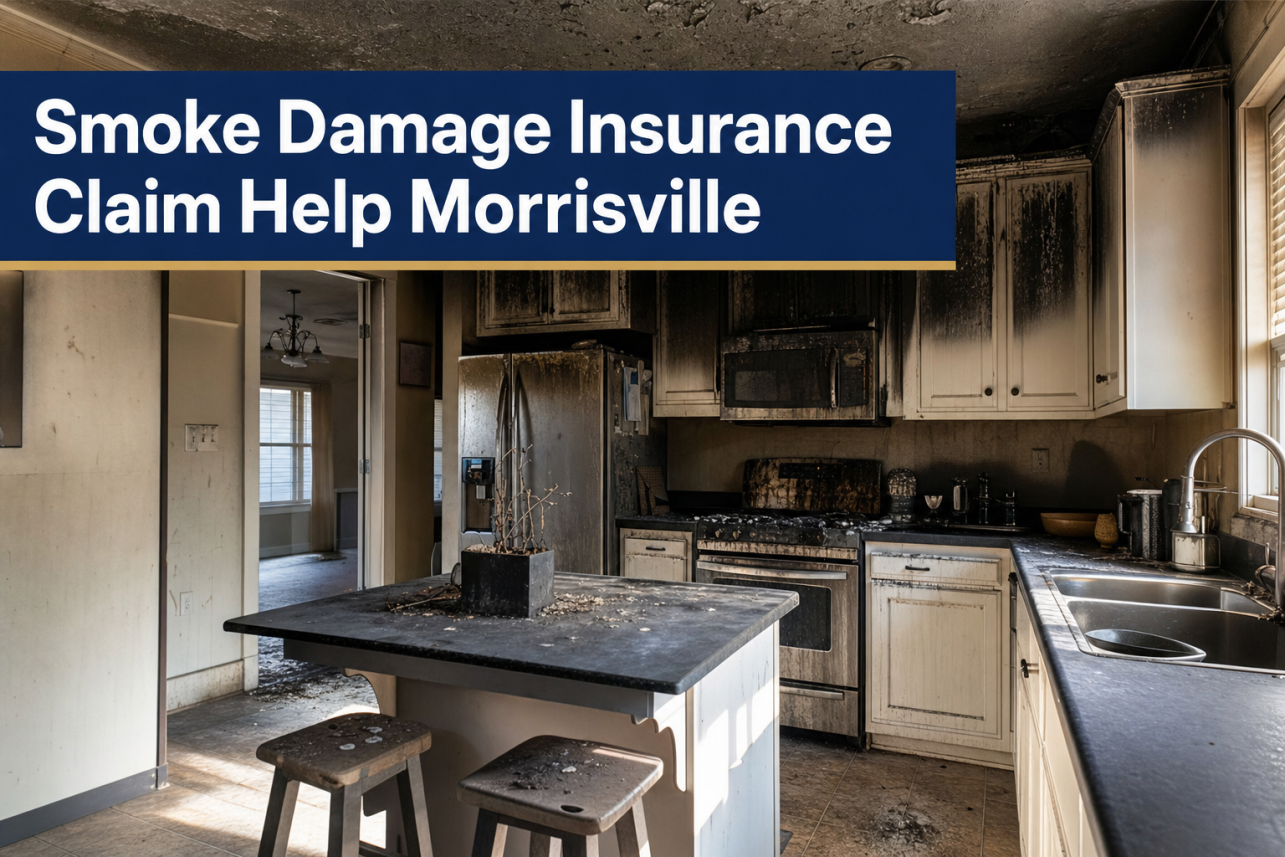
For The Public Adjusters, Inc. provides smoke damage insurance claim help Morrisville homeowners can rely on when soot, odor, and residue spread far beyond the room where a fire started. We are licensed and bonded public adjusters who work only for you, the policyholder — never for the insurance company. We document the full extent of the damage, prepare the claim, and negotiate directly with your insurer so the settlement reflects what cleanup and restoration actually cost in Wake County.
What This Service Is
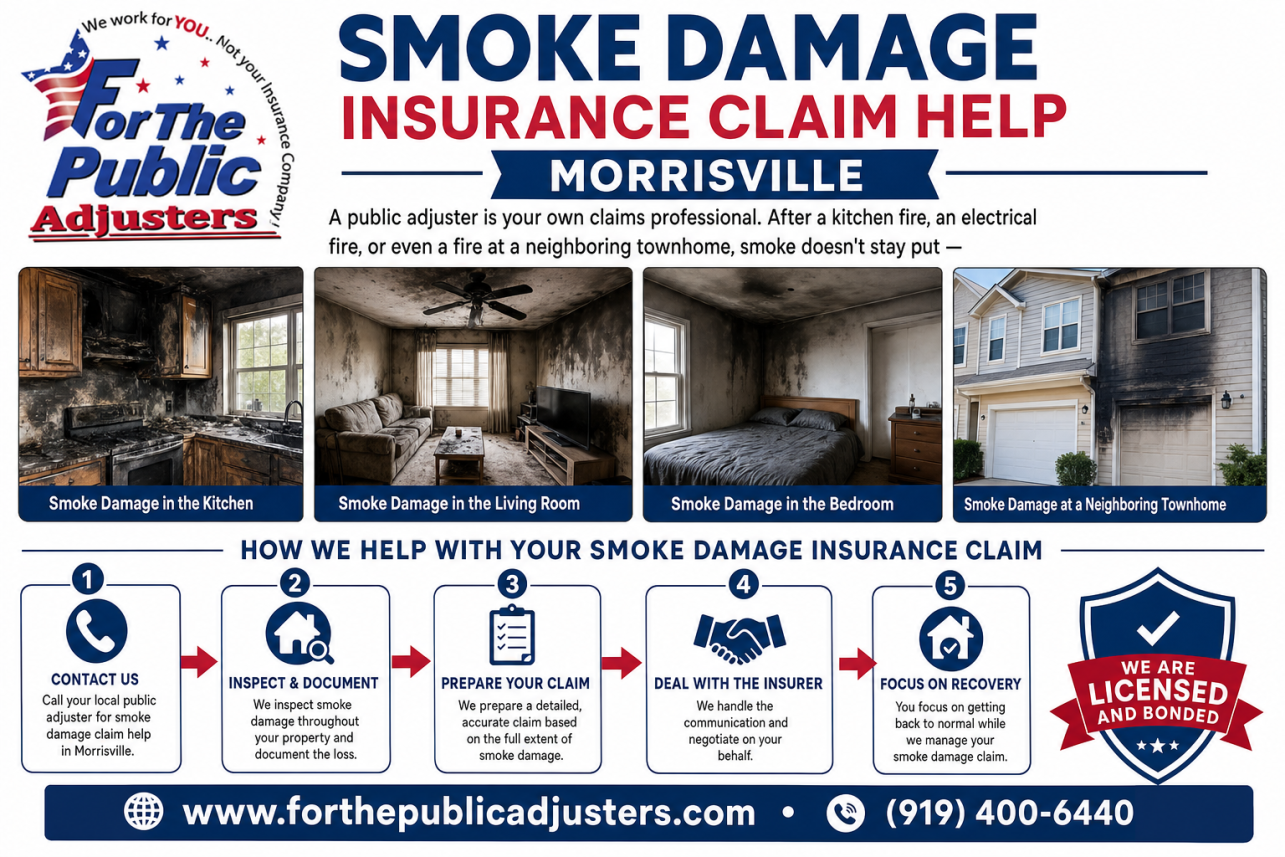
A public adjuster is your own claims professional. After a kitchen fire, an electrical fire, or even a fire at a neighboring townhome, smoke doesn’t stay put — it travels through open floor plans, rides your HVAC ductwork, and settles into closets, attic insulation, electronics, and fabrics on the opposite side of the house.
The insurance company sends its own adjuster to estimate the loss. Our job is different. We inspect on your behalf, identify hidden smoke damage the first walkthrough often misses, build a room-by-room contents inventory, prepare the proof of loss, and negotiate the settlement. The National Fire Protection Association has long noted that cooking is the leading cause of home fires — and those “small” kitchen fires routinely produce smoke and soot damage worth far more than the initial estimate suggests.
We handle these claims across the Triangle, from a smoke damage claim in Cary next door to full structure fires. If flames caused structural damage too, that becomes a combined fire and smoke claim, and we manage both together — including the secondary water damage firefighters leave behind.
Common Problems
Why Is The Insurer’s Offer So Much Lower Than My Cleaning And Restoration Estimates?
This is the most common call we get. The insurance company’s estimate often prices a surface wipe-down when the loss actually requires soot and residue removal from ducts, sealing and repainting, odor treatment, and replacement of porous items that can’t be saved.
Depreciation is another quiet gap. If your policy pays actual cash value first, the insurer deducts for age and wear, and many homeowners never collect the recoverable depreciation they’re owed after repairs. We track those dollars and pursue the full replacement cost your policy allows.
Contents are frequently undervalued too. Clothing, electronics, appliances, and furniture absorb smoke, and a proper personal property loss calculation — not a lump-sum guess — usually changes the number significantly. We’ve seen the same pattern on nearly every smoke damage insurance claim help in Durham case we’ve handled: the first offer rarely reflects the real scope.
Smoke Damage Insurance Claim Help Morrisville: What To Do When Your Claim Is Denied, Delayed, Or Disputed
Denials and stall tactics are common with smoke losses because the damage is easy to minimize. An insurer may claim the residue is “pre-existing soiling,” argue odor isn’t physical damage, or simply let weeks pass between responses while your family lives with the smell.
You don’t have to accept the first answer. Policies contain claim filing deadlines and proof of loss requirements, and missing them can hurt you — but a denial itself is often just an opening position, not a final word.
We reopen and dispute underpaid and denied smoke claims regularly. With proper documentation — lab-style residue evidence, photographs, HVAC inspection findings, and a detailed inventory — many disputed claims are resolved through negotiation. If a carrier still won’t move, we work alongside insurance dispute lawyers when litigation becomes the right path.
Should I Just Handle The Claim Myself, Or Is Hiring A Public Adjuster Worth It?
You can file yourself, and for a truly minor loss that may be fine. The problem is that smoke damage is exactly the kind of claim where do-it-yourself goes wrong: the damage hides inside wall cavities, ductwork, and insulation, and once you accept a settlement, reopening the claim gets much harder.
The NCDOI Public Adjusters Guide explains what public adjusters do and confirms that North Carolina requires us to be licensed — which we are, and bonded. A good public adjuster inspects before you sign anything, works on a contingency basis so our interests align with yours, and never asks for money up front.
Ask any adjuster you’re considering about their experience with smoke specifically. Cleaning standards, odor remediation methods, and contents valuation are their own specialty — different from a straightforward fire damage claim help in Garner file where the damage is visible to everyone.
Our Process
Free Inspection And Smoke Damage Assessment
We start with a no-cost, no-obligation inspection of your Morrisville home or business. We look where smoke actually goes: HVAC returns and ductwork, attic insulation, wall cavities, closets, electronics, and appliances.
We also flag the secondary water damage that firefighting often causes, and note any health-related concerns from lingering soot so remediation is scoped correctly from day one.
Documentation, Contents Inventory, And Proof Of Loss
We photograph and document every affected area, build a complete room-by-room contents inventory with values, and prepare the formal proof of loss your policy requires — filed correctly and on time.
This is where most self-filed claims fall short. Thorough property damage documentation is the foundation of every dollar recovered later, and we also review your policy’s coverage limits and your right to temporary living expenses if the home isn’t livable.
Negotiation And Settlement
We present the claim to your insurer and negotiate on your behalf, backed by our documentation and an independent view of the damage. Courts have repeatedly sided with policyholders on scope disputes — in Windridge of Naperville Condominium Association v. Philadelphia Indemnity Insurance Co., the Seventh Circuit ruled the insurer had to pay to replace undamaged building siding so repairs would actually match, rejecting the carrier’s patch-only position.
We can’t guarantee a specific outcome — no honest adjuster can — but we make sure your claim is fully documented, professionally presented, and pressed until it’s fairly resolved.
| What Happens in the Claim | Handling It Yourself | With For The Public Adjusters |
|---|---|---|
| Damage documentation | Photos of visible soot; hidden contamination in ducts, walls, and insulation usually missed | Hygienist testing, room-by-room soot mapping, and lab results the carrier can’t dismiss |
| Scope of repairs | You rely on the carrier’s estimate, which typically covers cleaning and paint only | Independent scope including HVAC, insulation, wall cavities, and contents replacement where cleaning fails |
| Contents inventory | A memory-based list, often undervalued and missing smoke-permeated textiles and electronics | Itemized inventory with replacement-cost pricing and odor/salvage testing documentation |
| Negotiation leverage | One offer, take it or fight alone through appeals | Licensed adjuster negotiating with evidence, policy language, and supplemental claim rights |
| Typical outcome | First offers on smoke losses commonly cover a fraction of true remediation cost | Wake County smoke claims we handle regularly settle for multiples of the initial offer |
Commonly Overlooked In The Public Adjusting Industry
- Soot inside HVAC ductwork and the air handler — It’s invisible without opening the system, so carrier estimates skip it and the odor returns every time the heat or AC runs.
- Protein smoke residue from kitchen fires — It leaves almost no visible staining, so adjusters call the loss cosmetic even though it bonds to surfaces and defeats normal cleaning.
- Contaminated attic insulation — Nobody climbs into the attic during a quick inspection, yet blown-in insulation absorbs smoke like a sponge and keeps re-releasing odor.
- Corrosion damage to electronics and appliances — Acidic soot slowly eats circuit boards and metal contacts, so devices that work today fail months after the claim is closed.
- The supplemental claim provision in the policy — Most homeowners assume a closed claim is final and never learn they can reopen it when hidden smoke damage surfaces later.
- Additional living expense coverage during remediation — Carriers rarely volunteer that hotel stays, meals, and pet boarding are reimbursable while the home is being fogged and sealed.
- Odor testing before accepting ‘clean and salvage’ on textiles — Carriers push cleaning because it’s cheaper than replacement, but smoke-permeated clothing, mattresses, and upholstery often can’t pass an odor test afterward.
- Smoke intrusion claims from a neighboring unit’s fire — Owners assume the neighbor’s insurance handles it and delay filing under their own policy, burning through their notice deadline.
Case Studies
Case Study #1
Situation: A family on Church Street in Morrisville had a kitchen grease fire that was extinguished within minutes. The flames never left the stove area, but smoke traveled through the return-air vents into every room on both floors.
Problem: The insurance carrier’s adjuster scoped the loss as a ‘minor kitchen incident’ and offered $8,400 — enough to repaint the kitchen and clean the range hood. The estimate ignored the HVAC system, the upstairs bedrooms, and the closets full of clothing that smelled like a campfire.
Investigation: We brought in an industrial hygienist to take surface wipe samples and air quality readings throughout the home. We opened the supply ducts, pulled switch plates to inspect wall cavities, and documented soot residue on contents room by room with photos and a full inventory.
Findings: Lab results confirmed protein and grease-based soot residue in every room, including inside the ductwork and attic insulation. Protein smoke is nearly invisible but bonds to painted surfaces and fabrics, and standard cleaning does not remove the odor. The insulation and duct liner were unsalvageable.
Solution: We rewrote the scope to include full HVAC duct replacement, attic insulation removal and replacement, thermal fogging and sealing of wall cavities, professional contents cleaning for salvageable items, and replacement of textiles that failed odor testing. We presented the lab data alongside the revised estimate and negotiated directly with the carrier’s adjuster.
Outcome: The claim settled at $94,700 — more than eleven times the original offer — plus additional living expenses for the six weeks the family stayed elsewhere during remediation.
Lesson: The size of the fire tells you almost nothing about the size of the smoke loss. Protein smoke from a kitchen fire can contaminate an entire home while looking nearly clean to the naked eye, and carriers routinely scope only what they can see.
Case Study #2
Situation: A townhome owner near Town Hall Drive suffered smoke intrusion when the neighboring unit caught fire. Firefighters ventilated the burning unit by opening shared attic space, pushing heavy smoke into her home even though her walls never burned.
Problem: The carrier initially argued the damage was ‘cosmetic’ and offered wall washing and one coat of paint. Two months after that cleaning, the odor returned every time the heat kicked on, and the homeowner’s asthma worsened. The carrier then claimed the file was closed.
Investigation: We reopened the claim under the policy’s supplemental claim provisions and documented the recurring odor with a certified remediation contractor. We inspected the shared attic, the party wall cavity, and the HVAC air handler, all of which had been skipped in the original scope.
Findings: Soot had settled deep in the blown-in attic insulation and inside the air handler cabinet. Every heating cycle was re-aerosolizing smoke particulate into the living space. The original ‘clean and paint’ scope had sealed odor into the walls without removing the source above them.
Solution: We built a supplemental claim covering attic insulation removal, HEPA vacuuming and sealing of framing, replacement of the air handler and flexible ductwork, and re-cleaning of contents that had been re-contaminated. We supported it with the contractor’s moisture and particulate readings and a timeline showing the carrier’s original scope caused the recurrence.
Outcome: The supplemental claim paid an additional $61,200 on top of the original $9,800 settlement, and the carrier covered a hotel stay during the second remediation.
Lesson: A closed claim is not a dead claim. Most policies allow supplemental claims when hidden damage surfaces later, but you need documented proof that the new damage traces back to the original loss — and you need to act before policy deadlines run out.
| Your Situation | Best Next Step | What It Depends On | Deadline Pressure |
|---|---|---|---|
| Fire just happened, smoke throughout the home | Call before giving a recorded statement or accepting emergency-only payments | Early documentation drives the entire claim; evidence degrades fast | High — mitigation and notice duties start immediately |
| Carrier offered a settlement that seems low | Get an independent scope before signing anything | Whether hidden damage (ducts, insulation, contents) was included in their estimate | Moderate — don’t cash checks marked ‘full and final’ |
| Smoke odor returned after cleaning | Reopen the claim as a supplemental with new documentation | Your policy’s supplemental claim window and proof the odor traces to the original loss | High — supplemental deadlines are often one year or less |
| Smoke came from a neighbor’s fire, not yours | File under your own policy; don’t wait on the neighbor’s carrier | Your dwelling and contents coverage apply regardless of where the fire started | High — your notice deadline runs from the date of loss |
| Business smoke loss with lost income | Document interruption losses daily and get help scoping both property and income claims | Business interruption coverage terms and quality of revenue records | High — income losses must be tied to specific dates |
| Claim was denied or closed | Have the denial letter and policy reviewed before the appeal window closes | The stated denial reason and whether the carrier’s inspection was actually thorough | Very high — appeal and suit-limitation clocks are running |

Reviews
After an electrical fire in our garage, State Farm offered us $12,000 and said the smoke smell in the house would ‘air out.’ For The Public Adjusters had a hygienist test our home and found soot in the ductwork and both kids’ bedrooms. Final settlement was over $70,000 and the odor is actually gone. I can’t imagine having handled this alone.
Denise W.
The fire was in the restaurant two doors down from my Morrisville office, but smoke ruined my inventory and made the space unusable for weeks. My carrier kept saying it wasn’t my fire so it wasn’t a real claim. These guys knew exactly which policy provisions applied, documented the business interruption losses, and got both the property and lost income covered. Worth every penny of their fee.
Marcus T.
We tried handling our claim ourselves for two months and got nowhere — the adjuster kept lowballing the contents cleaning. For The Public Adjusters redid the entire contents inventory with photos and replacement pricing, and pushed back on the carrier’s ‘clean everything’ approach for items that clearly couldn’t be salvaged. Settlement nearly tripled. Only wish we had called them the day of the fire.
Priya R.
Frequently Asked Questions
What Does Smoke Damage Insurance Claim Help Morrisville Actually Include?
When you hire For The Public Adjusters, Inc., we take over the entire claim on your behalf. That starts with a room-by-room inspection of your Morrisville home or business, documenting smoke residue on walls, ceilings, HVAC ductwork, insulation, and contents that carriers frequently overlook or undervalue.
Smoke behaves differently than fire. It travels through wall cavities, settles into soft goods, and leaves acidic residue that continues corroding metals and electronics for weeks. We document all of it with photos, moisture and residue testing referrals, and detailed contents inventories so nothing gets left off the estimate.
From there, we prepare a full scope of loss using the same estimating software insurance companies use, then handle every phone call, email, and adjuster meeting with your carrier. If the insurer’s estimate comes in low, we negotiate line by line until the settlement reflects what proper cleaning, sealing, repainting, and replacement actually cost in Wake County.
We also review your policy for coverage you may not know you have, such as additional living expenses if odor makes your home temporarily unlivable, or code-upgrade coverage for older Morrisville homes. In short, smoke damage insurance claim help Morrisville means you have a licensed professional on your side of the table instead of facing the insurance company alone.
My Fire Was Small And Mostly Contained. Is A Morrisville Public Adjuster Still Worth It For Smoke Damage Alone?
In many cases, yes, and smaller fires are often where policyholders lose the most money. Carriers tend to treat contained kitchen or garage fires as minor cleanup jobs, offering a quick wipe-down and repaint. But smoke and soot rarely stay in one room.
A small stovetop fire in a Morrisville townhome can push protein smoke through the entire HVAC system, coating ductwork and depositing an invisible film on furniture, clothing, and electronics two floors away. Protein smoke in particular is nearly invisible but carries a persistent odor that ordinary cleaning will not remove. If the ducts are not professionally cleaned and the affected surfaces sealed with the right primers, the smell returns every time the heat kicks on.
Our team at For The Public Adjusters, Inc. knows what to test, where soot hides, and how to document damage the carrier’s adjuster may miss on a 30-minute walkthrough. We routinely find that the true scope of a “minor” smoke loss is several times the insurer’s first offer once ductwork, contents cleaning, odor remediation, and repainting are properly accounted for.
Because public adjusters in North Carolina work on a percentage of the recovery, there is no upfront cost to you. If the claim is genuinely small and the carrier’s offer is fair, we will tell you that honestly during a free review. Either way, you will know exactly where you stand before signing anything.
The Insurance Company Already Sent Their Adjuster To My Morrisville Property. Is It Too Late To Get Help With My Smoke Claim?
No, it is not too late. Most of the clients who call us for smoke damage insurance claim help Morrisville do so after the carrier’s adjuster has already inspected, and often after receiving an estimate or check that felt far too low. You can bring in a public adjuster at almost any stage of an open claim.
Remember that the adjuster your insurance company sends works for the insurance company. Their job is to close the file within the carrier’s guidelines. Our job at For The Public Adjusters, Inc. is the opposite: we represent only you, the policyholder.
If you have already received an offer, we start by comparing the carrier’s estimate against a complete scope of the actual smoke damage. Common gaps include HVAC duct cleaning, contents that need specialized ozone or thermal fogging treatment, attic insulation that absorbed odor, and sealing coats before paint. We then submit a supplemental claim with documentation supporting every added line item.
Even if you have cashed a check, most policies allow supplemental claims when additional covered damage is documented, provided you are within the policy’s deadlines. North Carolina claims also carry time limits, so the sooner you call, the more options we have. A quick, free file review will tell you whether your settlement is fair or whether there is meaningful money still on the table.
How Long Does A Smoke Damage Claim Take In Morrisville, And What Will It Cost Me To Hire For The Public Adjusters, Inc.?
Timelines vary with the size of the loss and how the carrier responds. A straightforward smoke claim on a Morrisville home might resolve in four to eight weeks once we submit our documentation. Larger losses involving contents inventories, temporary housing, or disputed scope can run several months, especially if the carrier requests re-inspections.
What we can promise is that having a professional managing the file usually shortens the back-and-forth. We submit complete, well-documented estimates the first time, respond to carrier requests promptly, and push back immediately when deadlines slip. North Carolina insurers are expected to acknowledge and act on claims within reasonable timeframes, and we hold them to it.
On cost, we work on contingency. Our fee is a percentage of the settlement we recover for you, agreed to in writing before we start. There are no upfront charges, no hourly billing, and no fee if there is no recovery. The initial consultation and policy review are free.
For most policyholders, that structure pays for itself. Industry studies and our own case history in Wake County consistently show that professionally adjusted claims settle for significantly more than claims policyholders handle alone, even after the fee. Just as important, you get your time back: instead of chasing adjusters and deciphering estimate line items, you can focus on getting your household or business back to normal while we handle the claim.
What Kinds Of Smoke Damage Do Morrisville Insurance Companies Most Often Underpay Or Overlook?
The most commonly missed items are the ones you can’t see at a glance. Smoke residue migrates through HVAC systems, so ductwork, air handlers, and returns often need professional cleaning or replacement — yet many initial estimates skip them entirely. In Morrisville homes with open floor plans, soot travels far beyond the room where the fire occurred.
Porous materials are another frequent gap. Insulation in attics and wall cavities absorbs smoke odor permanently and usually cannot be deodorized. Carpet padding, upholstered furniture, mattresses, and clothing often require replacement rather than cleaning, but carrier estimates frequently allow only a cleaning line item.
Protein smoke from kitchen fires is especially tricky. It leaves a nearly invisible film on cabinets, walls, and finishes that discolors surfaces over time and carries a persistent odor. Adjusters working quickly can miss it because it doesn’t look like the black soot people expect.
We also see chronic underpayment on electronics, which corrode from acidic soot residue even when they appear to work, and on smoke-affected contents stored in closets, garages, and crawl spaces that were never inventoried. Finally, additional living expenses get shortchanged when families are told the home is livable despite lingering odor and air-quality concerns.
When we handle a smoke claim in Morrisville, we document every one of these categories with testing, photographs, and a room-by-room inventory before negotiating. That thoroughness is usually the difference between a settlement that covers real restoration and one that leaves you paying out of pocket.
How Do I Get Smoke Damage Insurance Claim Help Morrisville Homeowners Can Actually Trust, And What Should I Look For?
Start by verifying licensing. In North Carolina, public adjusters must be licensed through the Department of Insurance, and you can confirm any adjuster’s status online in minutes. Anyone offering smoke damage insurance claim help Morrisville residents can rely on should provide their license number without hesitation — we do.
Next, ask about smoke-specific experience. Smoke claims are technically different from water or wind claims. A qualified adjuster should be able to explain the difference between wet smoke, dry smoke, and protein residue, and describe how they document odor and soot migration with testing rather than guesswork.
Be cautious of anyone who shows up unsolicited right after a fire, pressures you to sign on the spot, or promises a specific dollar amount before reviewing your policy. Legitimate professionals review your coverage first, explain your deductible and policy limits, and set realistic expectations.
Also confirm how they’re paid. Reputable public adjusters in Wake County work on a contingency fee — a percentage of what they recover for you — with no upfront cost. Get that percentage in writing before signing anything.
Finally, ask for local references. For The Public Adjusters, Inc. has represented homeowners throughout Morrisville and the surrounding Triangle area, and we’re happy to walk you through recent smoke claims we’ve settled, what the carrier initially offered, and what the final payment was. A trustworthy adjuster welcomes those questions because the track record speaks for itself.
Will Filing A Smoke Damage Claim Raise My Homeowners Insurance Rates In Morrisville?
It’s a fair concern, and the honest answer is: possibly, but usually less than people fear — and rarely enough to justify absorbing a large loss yourself. Fire and smoke claims are treated as non-weather perils, and a single claim may modestly affect your premium at renewal. However, North Carolina’s competitive homeowner insurance market means you can shop coverage if your current carrier’s renewal pricing is unreasonable.
Here’s the practical math we walk Morrisville homeowners through. A legitimate smoke loss often involves duct cleaning, insulation replacement, repainting with odor-sealing primer, contents cleaning, and sometimes temporary relocation. That regularly totals tens of thousands of dollars. A premium increase of a few hundred dollars a year doesn’t come close to that number.
What you should avoid is filing small, borderline claims that fall near your deductible — those offer little payout and still land on your claim history. Part of our job is reviewing your policy and the actual scope of damage before anything is filed, so you can make an informed decision. If the damage genuinely doesn’t justify a claim, we’ll tell you.
One more point: your rates are affected by the claim itself, not by how much you recover. Whether you accept the carrier’s first offer or negotiate a full settlement, the claim on your record is the same. That’s exactly why underclaiming makes no sense — if you’re going to have the claim in your history either way, you should be paid everything the policy owes you.
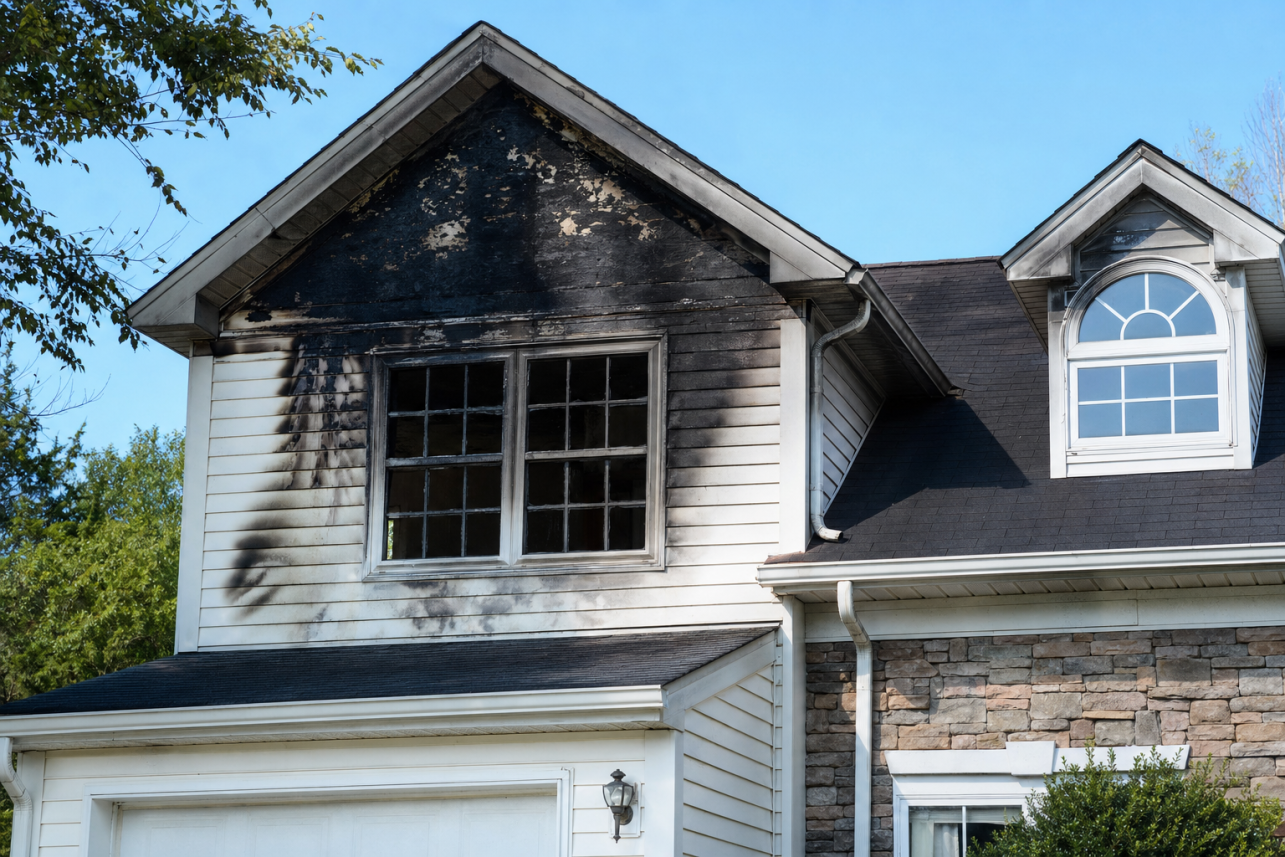
My Neighbor’s House Fire Caused Smoke Damage To My Morrisville Home. Whose Insurance Covers It, And Can You Help?
Yes, we handle these situations regularly, and they confuse a lot of homeowners in Wake County. The short answer: your own homeowners policy is typically the fastest path to payment, even though the fire started next door.
Smoke intrusion from a neighboring fire is a covered peril under most standard policies. You file with your own carrier, they pay for cleaning, deodorization, and any damaged contents, and then your insurer may pursue reimbursement from your neighbor’s insurance company through a process called subrogation. If subrogation succeeds, you can often recover your deductible as well.
Some homeowners try to claim directly against the neighbor’s liability coverage instead. That’s possible, but it requires proving the neighbor was negligent — a leaky liability claim can drag on for months while your home still smells like smoke. Filing your own claim gets restoration started now.
Documentation is critical in these cases because carriers sometimes argue the smoke damage is minor or pre-existing. We photograph soot deposits, arrange odor and residue testing when needed, and inventory affected contents room by room — including items inside closets and cabinets where smoke settles unnoticed. Morrisville’s townhome and closely spaced subdivision layouts mean neighboring-fire smoke claims are more common here than people realize.
For The Public Adjusters, Inc. manages the entire process: reviewing your policy, preparing the claim, meeting the carrier’s adjuster at your property, and negotiating until the settlement reflects the true cost of making your home smell and feel like yours again.
Should I Clean Up Smoke Residue Myself Before Filing My Claim In Morrisville?
No — and this is one of the most costly mistakes we see homeowners make. Wiping down walls, running box fans, or shampooing carpets before your damage is documented can destroy the very evidence that proves the extent of your loss. Once residue is gone, the insurance company has every reason to argue the damage was minor.
Smoke residue is also chemically tricky. Protein smoke from kitchen fires, wet smoke from smoldering fires, and dry smoke from fast-burning fires each require different cleaning agents and techniques. Using the wrong household cleaner can smear soot deeper into drywall, grout, and unsealed wood, turning a cleanable surface into one that needs full replacement — often at your expense if the insurer disputes causation.
Instead, take photos and video of every affected room, including inside closets, cabinets, and HVAC vents. Save damaged items rather than throwing them away, even if they seem ruined. Mitigate only what’s necessary to prevent further harm, like covering broken windows.
Then bring in For The Public Adjusters, Inc. before restoration work begins. We document the full scope of contamination — including odor absorption in soft goods and residue inside wall cavities and ductwork — so the claim reflects what proper remediation actually costs in Wake County. Professional smoke restoration here routinely runs into five figures, and you only get paid for what gets documented first.
Does Smoke Damage Insurance Claim Help Morrisville Cover My Belongings, Or Just The Structure Of My Home?
Smoke damage insurance claim help Morrisville homeowners receive from our team covers both — and the contents portion is often where the biggest money gets left on the table. Your policy typically has separate coverage for the dwelling (Coverage A) and personal property (Coverage C), and each needs its own detailed claim.
Smoke and soot penetrate far beyond what you can see. Clothing, bedding, upholstered furniture, mattresses, and window treatments absorb odor at a molecular level and frequently need specialized ozone or thermal deodorization — or full replacement when treatment fails. Electronics are especially vulnerable because soot is acidic and conductive; a TV or computer that works today may fail months later from corrosion on circuit boards.
Insurers often offer a flat cleaning allowance or a quick lump sum for contents. That almost never reflects reality. We build a room-by-room inventory of your Morrisville home, item by item, with replacement values researched for each piece — down to kitchen goods, kids’ toys, and items stored in the attic or garage.
We also distinguish between what can genuinely be restored and what should be replaced, because insurers push cleaning even when restoration companies privately admit odor will return. If your family has been displaced, we pursue Additional Living Expenses too, covering temporary housing and increased costs while your home is uninhabitable. The structure claim gets you back in the house; the contents claim makes it livable again.
My Smoke Damage Claim Was Already Denied Or Came Back Way Too Low. Can For The Public Adjusters, Inc. Still Step In?
Yes, in most cases we can. A denial or lowball payment is rarely the end of the road — it’s usually the beginning of a better-documented claim. North Carolina policies generally allow you to dispute the insurer’s findings, submit supplemental claims, and invoke appraisal when there’s a disagreement over the amount of loss.
The first thing we do is get the denial or settlement letter and the carrier’s estimate, then compare them against your actual policy language. Denials for smoke damage often lean on vague reasoning — ‘pre-existing condition,’ ‘maintenance issue,’ or claims that residue is merely cosmetic. Those arguments frequently collapse when confronted with proper testing, such as soot sampling that ties the contamination directly to your fire event.
Underpayments usually come from scope, not rates. The carrier’s estimate might allow for wiping down walls when the drywall actually needs sealing and repainting, or skip duct cleaning entirely even though the HVAC system circulated soot through the whole house. We re-inspect your Morrisville property, rebuild the estimate line by line, and present the supplement with documentation the insurer can’t easily dismiss.
Timing matters, though. Policies contain deadlines for disputing decisions and filing suit, and waiting too long can close your options. If you’ve received a denial or a settlement that doesn’t come close to real repair costs in Wake County, call us for a free claim review before you cash any check labeled ‘final payment.’
How Do I Know If Smoke Got Into My HVAC System Or Inside My Walls In Morrisville?
If your HVAC system was running during or shortly after the fire, assume it pulled in smoke — because it almost certainly did. Return vents act like vacuums during a fire event, drawing soot into ductwork, coating the blower, evaporator coil, and filter housing, and then redistributing contamination to rooms that never saw a flame. This is one of the most commonly overlooked items when Morrisville homeowners handle a smoke claim on their own.
Warning signs include a smoky odor that intensifies when the heat or AC kicks on, gray or black streaking around supply registers, and soot buildup on the filter. But absence of visible signs doesn’t mean the system is clean. Proper verification requires inspecting inside the duct runs and air handler, and sometimes lab testing of wipe samples.
Wall cavities are similar. Smoke travels through outlet openings, gaps around plumbing, and top plates into stud bays and attic spaces, where soot settles on insulation. Contaminated insulation can’t be cleaned — it has to be removed and replaced, a line item insurers rarely volunteer to pay.
When you hire us for smoke damage insurance claim help Morrisville carriers take seriously, we document these hidden areas with borescope inspections, thermal imaging where useful, and photographic evidence from inside the ductwork itself. That documentation is the difference between an insurer paying for a surface wipe-down and paying for the full remediation your home actually needs to be safe and odor-free.
What Should I Document Right After Smoke Damage Before I Call For Smoke Damage Insurance Claim Help Morrisville?
Start with photos and video before anything gets touched. Walk every room, including closets, attics, and crawl spaces, and capture soot on walls, ceilings, window sills, and inside cabinets. Smoke residue settles unevenly, so film areas that look clean too — laboratory testing often reveals contamination the eye misses.
Next, make a quick written list of anything with visible film, discoloration, or odor: furniture, electronics, clothing, mattresses, and kids’ items. Don’t throw anything away yet, even things that seem ruined. Insurers frequently dispute contents claims when the items were discarded before inspection.
Save every receipt from day one. Hotel stays, restaurant meals, replacement clothing, air purifiers — these can fall under your policy’s additional living expenses coverage, but only if you can prove them. Keep a simple log of every phone call with your carrier, including dates, names, and what was said.
Finally, request a complete certified copy of your policy in writing. Many Morrisville homeowners have never seen the full document with endorsements, and coverage details buried there often determine what a smoke claim is actually worth.
When you reach out for smoke damage insurance claim help Morrisville residents can rely on, all of this material gives our team a running start. For The Public Adjusters, Inc. builds your claim on evidence, and the more you preserve in those first days, the harder it is for the carrier to minimize what smoke really did to your home.
Can For The Public Adjusters, Inc. Handle Smoke Claims For Morrisville Rental Properties, Condos, Or Businesses?
Yes. Smoke claims aren’t limited to owner-occupied houses, and neither is our work. We represent landlords, condo owners, and commercial policyholders throughout Morrisville and the rest of Wake County.
For rental properties, the claim often has two layers: the physical damage and the lost rental income while units are uninhabitable. Loss-of-rents coverage is one of the most commonly underpaid parts of a landlord’s policy, because carriers push aggressive timelines for how quickly a smoke-affected unit “should” be ready to lease again. We document realistic remediation schedules and fight for the full income period.
Condos add another wrinkle. Your HOA’s master policy typically covers the building’s structure, while your individual policy covers interior finishes, betterments, and contents. Sorting out where one policy ends and the other begins is exactly where condo smoke claims get shortchanged, and it’s something a Morrisville public adjuster deals with regularly.
For businesses, smoke contamination can affect inventory, equipment, and — critically — business interruption income. A restaurant or retail shop near a fire can lose weeks of revenue even if the flames never touched the space. Those losses are claimable under most commercial policies, but they require detailed financial documentation that carriers scrutinize hard.
Whatever the property type, the approach is the same: we read the actual policy language, build a complete damage and loss inventory, and negotiate directly with the insurance company so you can focus on tenants, residents, or customers instead of paperwork.
The Smoke Smell Came Back Weeks After Cleanup. Can My Morrisville Claim Be Reopened Or Supplemented?
This happens more often than people expect, and yes — in most cases you can pursue a supplemental claim. Smoke odor that returns after cleaning is usually a sign the original scope was too shallow. Residue trapped in wall cavities, insulation, ductwork, or subflooring off-gasses when humidity rises, which is why many homeowners in the Triangle notice it strongest during warm, muggy stretches.
A closed claim is not necessarily a finished claim. If new or previously undiscovered damage tied to the same loss comes to light, you generally have the right to submit supplemental documentation and request additional payment. The key is proving the odor stems from the original fire, not something new, and that the initial remediation was insufficient.
That’s where professional representation earns its keep. Our team can arrange independent testing for soot and combustion byproducts, document the areas the first cleanup missed, and present a supplemental demand backed by evidence rather than complaints about a smell. Carriers dismiss vague odor reports; they respond to lab results and detailed scopes of repair.
Timing matters, though. North Carolina policies include deadlines for supplemental claims and suit limitations, so don’t wait a full season hoping the smell fades. If you’re in Morrisville and living with an odor your settlement was supposed to fix, have For The Public Adjusters, Inc. review the original claim file. We frequently find that the first estimate covered surface cleaning only, leaving thousands of dollars in legitimate remediation on the table.
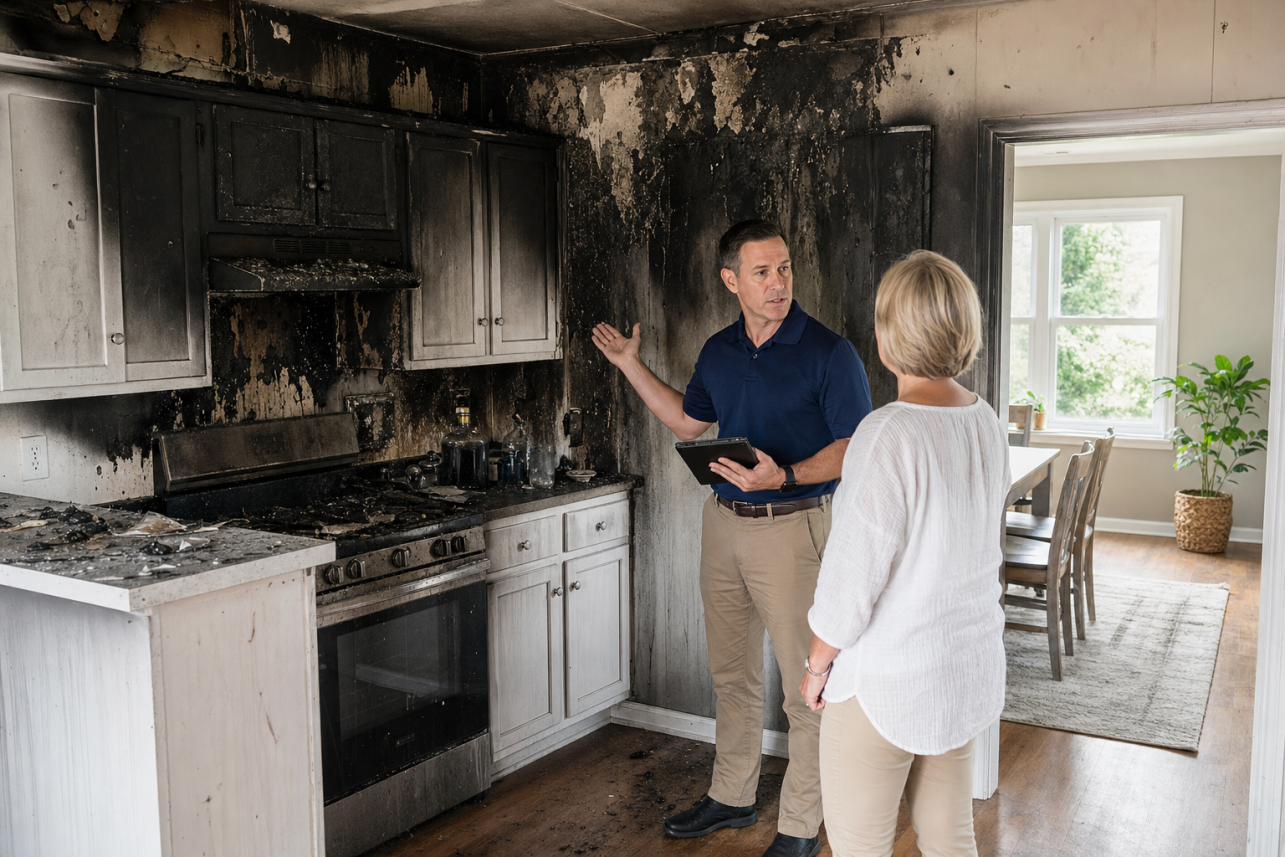
Will My Insurance Pay For Us To Stay Somewhere Else During Smoke Remediation, And Can Smoke Damage Insurance Claim Help Morrisville Families Get That Covered?
In most cases, yes. Nearly every homeowners policy includes Additional Living Expenses coverage, often called ALE or loss of use. If smoke contamination makes your home unsafe or unreasonably uncomfortable to live in — strong odor, soot-laden air, HVAC contamination — ALE can pay for a hotel or short-term rental, extra meals, laundry, pet boarding, and even added commuting costs.
The catch is that carriers frequently downplay whether a smoke-damaged home is truly uninhabitable. Because the structure looks intact, adjusters may argue you can stay put while crews work around you. That position ignores the reality of living with airborne soot particles, which is a genuine health concern for children, older adults, and anyone with asthma or respiratory sensitivity.
This is exactly the kind of dispute where smoke damage insurance claim help Morrisville homeowners deserve makes a measurable difference. For The Public Adjusters, Inc. documents air quality concerns, remediation timelines, and the practical impossibility of occupying the home during ozone treatments or thermal fogging — processes that themselves require vacancy.
ALE pays the difference between your normal living costs and your temporary ones, so keep receipts for everything and note your usual monthly spending for comparison. Coverage runs until repairs are reasonably complete or your policy limit is reached, whichever comes first.
One warning: don’t move out without notifying your carrier and establishing the claim basis first. Displacement expenses are far easier to recover when they’re documented and justified from the start, and our team can set that up properly before you book anything.
Local Relevance
Morrisville sits in the heart of Wake County’s growth corridor near RDU, and much of its housing stock — townhomes, condos, and single-family homes — was built in the last few decades. That matters for smoke claims in two ways. Newer open-concept layouts give smoke a clear path from the kitchen to bedrooms upstairs, and attached townhome construction means a neighbor’s fire can leave soot and odor throughout your unit even when flames never touch it.
The area’s humid climate compounds the problem. Moisture in the air interacts with acidic soot residue, which can accelerate corrosion and etching on metals, electronics, and finishes if cleanup is delayed — one more reason a fast, thorough damage assessment protects your claim.
We work throughout western Wake County, including a nearby smoke damage insurance claim in Holly Springs or smoke damage claim help in Knightdale, so we know how local carriers and their adjusters typically price these losses in this market.
Morrisville’s housing is dominated by tightly built, energy-efficient construction from the last few decades, and that tightness cuts both ways after a fire: it tends to trap smoke odor indoors and push soot through shared HVAC systems, so residue often turns up in rooms and units far from the source. Insisting on a duct and whole-home inspection — not just a walkthrough of the burned room — is frequently what separates a fair settlement from a lowball one here.
Smoke In Your Morrisville Home? Get A Free Claim Review First
Before you accept the insurance company’s number — or sign anything — let a licensed and bonded public adjuster look at your loss. For The Public Adjusters, Inc. inspects for free, explains exactly what your policy covers, and only gets paid when you do. There’s no cost to find out where your claim really stands.
Call us: (919) 400-6440
Helpful Resources
- National Fire Protection Association (NFPA)
- NCDOI Public Adjusters Guide
- North Carolina Department of Insurance — State regulator overseeing insurance and public adjuster licensing
Serving Morrisville · Wake
Last updated: September 1, 2026