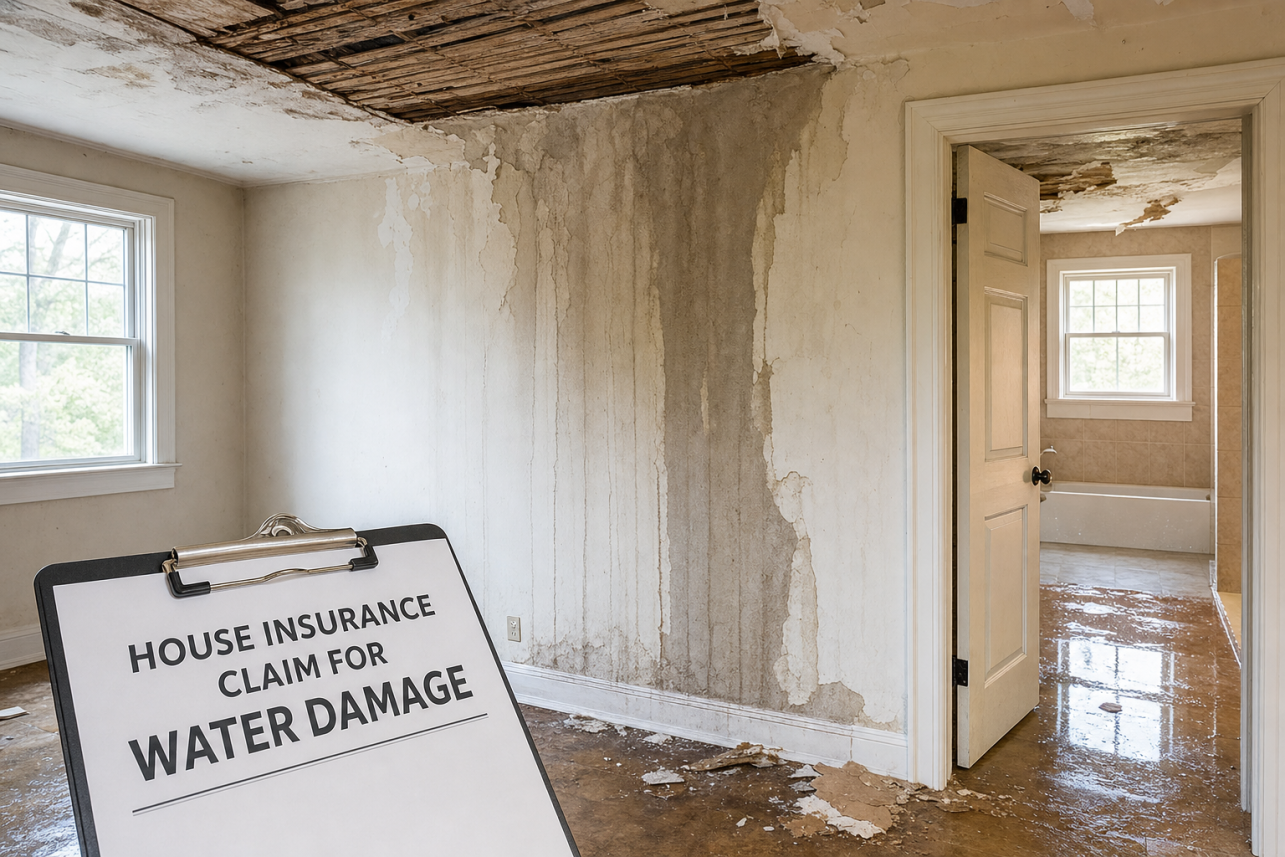
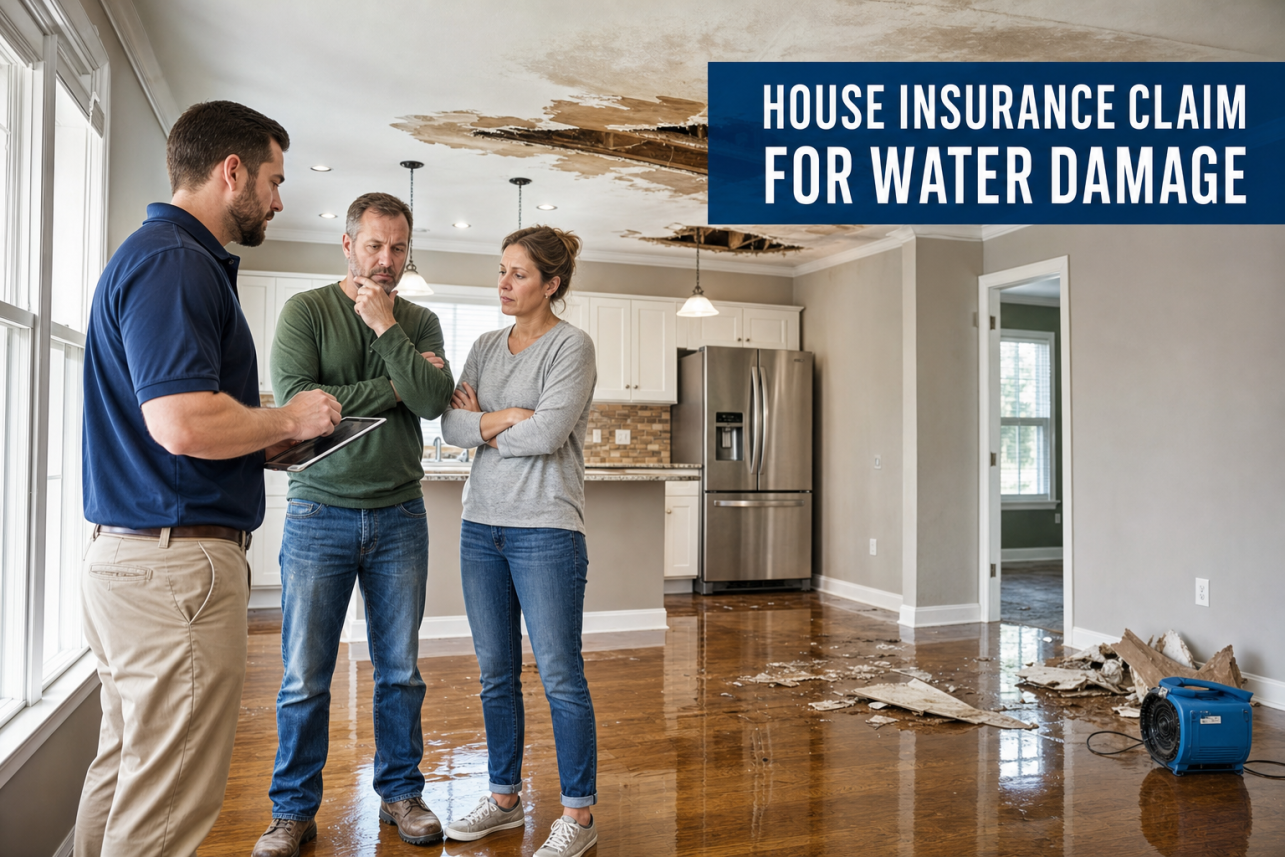
If you need help with a house insurance claim for water damage Morrisville homeowners can hire For The Public Adjusters, Inc. to document the loss, prepare the claim, and negotiate directly with the insurance company on your behalf. We work only for you — never for the insurer — and we are licensed and bonded in North Carolina. Water losses are among the most underpaid claims because so much of the damage hides inside walls, under flooring, and in crawl spaces, and our job is to make sure none of it gets left out of your settlement.
What This Service Is
A public adjuster is a licensed professional who represents the policyholder — not the insurance company — during a property claim. When a pipe bursts behind your kitchen wall, a water heater lets go in the garage, or a roof leak soaks the ceiling and insulation above your bedroom, your insurer sends its own adjuster to assess the damage. That person works for the carrier.
We do the opposite. Our team inspects the damage independently, measures moisture in materials the naked eye can’t judge, prepares a detailed repair estimate, assembles the proof of loss paperwork your policy requires, and negotiates the settlement. We handle disputes over what the policy covers, how depreciation is applied, and whether the payout reflects what repairs actually cost in the Triangle.
One distinction matters up front: a homeowners policy typically covers sudden water damage from inside the home — a burst pipe, an appliance failure, a roof leak after a storm. Rising water from outside is a flood, and that falls under a separate flood policy through the National Flood Insurance Program. We handle both types of claims, but knowing which policy applies is often the first fight, and we make sure your loss is presented under the right coverage.
Common Problems
Why Is My House Insurance Claim For Water Damage Morrisville Payout So Much Lower Than The Repair Estimate?
This is the most common call we get. The insurer’s first offer often pays for drying out a room and patching drywall, while your contractor’s estimate includes tearing out soaked insulation, replacing warped flooring, and treating for mold. The gap usually comes from depreciation — the carrier deducting for the age of your materials and paying ‘actual cash value’ instead of the full replacement cost, even when your policy entitles you to more once repairs are done.
Low offers also leave out hidden damage: moisture wicked up inside wall cavities, subfloors that will cup and buckle weeks later, and cabinets damaged from behind. We document all of it, item by item, so the settlement reflects the true scope of repair, not just what was visible on the day of the inspection. Emergency mitigation costs — the water extraction and drying you paid for out of pocket in the first 48 hours — belong in the claim too, and we make sure they’re included.
My Claim Was Denied Or The Insurance Company Keeps Stalling — What Can I Do?
Denials in water claims usually lean on policy exclusions: the carrier calls the damage ‘long-term seepage’ instead of a sudden loss, or labels interior water damage a flood so it falls outside the homeowners policy. Delays are just as damaging, because standing moisture breeds mold and the insurer may later blame you for that secondary damage.
You have real leverage. Courts have long held that insurers must handle claims in good faith — in Gruenberg v. Aetna Insurance Co., the California Supreme Court ruled in favor of a policyholder whose insurer wrongfully refused to pay after his building burned, establishing that a carrier’s bad-faith refusal to pay a legitimate property claim is itself grounds for liability. We build the documented record — photos, moisture readings, plumber reports, timelines — that makes a denial hard to defend, and when a dispute needs to escalate, we work alongside insurance dispute lawyers.
Should I Just Deal With The Insurance Company Myself, Or Is Hiring A Public Adjuster Worth It?
For a small, clearly covered loss with a fair first offer, you may not need us. But water claims are rarely simple. The insurer’s adjuster inspects once, often early, before hidden moisture and structural issues reveal themselves — and you’re expected to know your coverage limits, your deductible, and the proof of loss deadlines in your policy.
A good public adjuster levels that field. Look for a North Carolina license, bonding, and fees that come only from the settlement — never large upfront charges. The NCDOI Public Adjusters Guide published by the North Carolina Department of Insurance explains exactly what public adjusters may and may not do, and we encourage every Morrisville homeowner to read it before signing with anyone, including us. We will never promise a specific dollar outcome — no honest adjuster can — but we will make sure your claim is complete, documented, and taken seriously.

Our Process
Free Claim Review And Independent Inspection
We start by reviewing your policy and the loss itself — the burst pipe, the failed water heater, the roof leak. Then we inspect your home independently, using moisture meters to trace water into walls, subfloors, and crawl spaces where damage hides. If your claim was already denied or underpaid, we review the carrier’s estimate line by line to find what was missed.
Documentation And A Complete Repair Estimate
We photograph everything, inventory damaged contents room by room, and build a repair estimate that reflects real Wake County contractor pricing. We prepare the proof of loss and supporting paperwork your policy requires, so the insurer can’t stall the claim over missing documentation. Your out-of-pocket costs — emergency water extraction, drying equipment, temporary repairs — get folded into the claim.
Negotiation And Settlement
We present the claim to your insurer, attend their adjuster’s re-inspection, and negotiate every disputed line item — depreciation, mold remediation, structural repairs, contents reimbursement. You approve any settlement before it’s final. If the carrier refuses to deal fairly, we can bring in insurance dispute attorneys to escalate.
| What Happens | Filing Alone | With For The Public Adjusters |
|---|---|---|
| Damage documentation | Phone photos of visible damage only | Moisture mapping, thermal imaging, and hidden damage documented before demolition |
| Estimate scope | Carrier’s adjuster writes the scope; you accept or argue blind | Independent line-item estimate covering flooring continuity, cabinets, code upgrades, and contents |
| Policy interpretation | Denial language like ‘seepage’ or ‘wear and tear’ often goes unchallenged | Exclusions tested against evidence; sudden-discharge coverage argued with expert support |
| Negotiation | One homeowner vs. a trained claims department | Licensed NC adjuster negotiating carrier to carrier-level |
| Typical timeline | Months of back-and-forth, often stalled | Structured demands and deadlines that keep the claim moving |
| Cost to you | Free, but frequently underpaid by thousands | Contingency fee — we only get paid from what we recover for you |
Commonly Overlooked In The Public Adjusting Industry
- Continuous flooring runs and matching provisions — Carriers routinely pay to replace only the wet boards, ignoring that Morrisville homes often have hardwood flowing seamlessly through several rooms that can’t be patched without a visible mismatch.
- Moisture wicked into cabinet toe kicks and boxes — Particleboard cabinet bases absorb water invisibly from below, and by the time swelling shows, the first estimate has already been written without them.
- Preserving the failed pipe, fitting, or appliance part — Contractors throw the broken part in the dumpster during demo, destroying the single best piece of evidence that the discharge was sudden and covered.
- Wet insulation and vapor barriers in the crawlspace — Most of Morrisville’s older homes sit on crawlspaces nobody inspects after a leak, so saturated insulation quietly breeds mold under the house.
- Code-upgrade coverage on repairs — Wake County code requirements can force upgraded materials or methods during rebuild, and homeowners rarely know their policy includes ordinance-or-law money to pay for them.
- Signing an assignment or contract with a restoration company too early — A contract based on the carrier’s low estimate can lock the homeowner into an undersized scope before anyone has challenged it.
- Depreciation holdback and recoverable depreciation deadlines — Homeowners cash the first actual-cash-value check without realizing thousands in withheld depreciation must be claimed within a policy deadline after repairs are done.
- Elevated humidity re-wetting dried materials — In North Carolina’s climate, drywall and subfloor that measured dry in April can read wet again by July if drying was rushed, and reopening a closed claim is far harder than documenting it right the first time.
Case Studies
Case Study #1
Situation: A family in the Breckenridge neighborhood of Morrisville came home from a weekend at the coast to find their second-floor supply line to the washing machine had burst. Water had run for nearly two days, soaking the laundry room, hallway, and the kitchen ceiling below.
Problem: Their carrier’s adjuster inspected quickly and issued an estimate of $11,400 — enough to dry the structure and patch drywall, but nothing for the hardwood flooring that had cupped throughout the downstairs, and nothing for the kitchen cabinets that had wicked water up through their toe kicks.
Investigation: Our team brought in moisture meters and a thermal camera and documented elevated readings inside the cabinet boxes and under the site-finished oak flooring. We also pulled the manufacturer specs on the cabinets to establish that the particleboard boxes could not be dried and reused.
Findings: The hardwood ran continuously through the kitchen, dining room, and foyer with no transition strips, meaning a spot repair would leave an unmatchable seam. The cabinet bases had delaminated, and hidden moisture behind the kitchen backsplash put the wall assembly at risk for mold under North Carolina’s humidity.
Solution: We prepared a line-item estimate covering full replacement of the continuous hardwood run, cabinet replacement with matching uppers per the policy’s matching considerations, antimicrobial treatment, and code-required updates. We then presented the documentation package to the carrier and negotiated directly with their desk adjuster.
Outcome: The claim settled at $67,800 — nearly six times the original offer — and the family completed a full restoration rather than a patchwork repair.
Lesson: Water travels farther than it looks. If the first estimate only covers the room where the leak happened, moisture mapping almost always tells a bigger story.
Case Study #2
Situation: A homeowner near Town Hall Drive in Morrisville discovered a slow leak from a corroded copper fitting behind the master bathroom wall. By the time staining appeared on the baseboard, the wall cavity, subfloor, and adjacent closet were saturated.
Problem: The insurance company denied the claim, calling it ‘long-term seepage’ excluded under the policy. The homeowner was facing an estimated $40,000 in repairs with no payout at all.
Investigation: We retained a licensed plumber to cut out and preserve the failed fitting, then had it evaluated. We reviewed the policy language line by line, focusing on the distinction between gradual deterioration of the pipe itself and the sudden release of water once the fitting failed.
Findings: The plumber’s report showed pinhole corrosion that had breached suddenly, not a slow weep over months. The staining pattern and moisture readings were consistent with a recent, rapid discharge. The policy excluded repairing the pipe but covered the resulting water damage — a distinction the carrier’s denial letter glossed over.
Solution: We filed a formal rebuttal with the expert report, photo documentation, and cited policy provisions, then requested a reinspection with the carrier’s adjuster on site alongside our team.
Outcome: The denial was reversed. The carrier paid $38,200 for demolition, drying, subfloor replacement, tile work, and repainting — everything except the roughly $300 pipe repair itself, exactly as the policy intended.
Lesson: A denial letter is an opening position, not a final answer. The difference between ‘seepage’ and ‘sudden discharge’ is often worth the entire claim, and it turns on evidence most homeowners never think to preserve.
| Scenario | Best First Move | What the Outcome Depends On |
|---|---|---|
| Burst pipe, water still flowing | Shut off the main, then photograph everything before cleanup | Proof of sudden discharge vs. long-term leak; preserved evidence of the failed part |
| Slow leak found behind a wall | Have a plumber cut out and keep the failed fitting; don’t discard it | Whether the failure was sudden — the fitting itself is often the deciding evidence |
| Carrier’s estimate seems low | Get an independent scope before signing anything or cashing final checks | Hidden moisture, continuous flooring runs, and matching provisions the first estimate skipped |
| Claim denied as ‘seepage’ or ‘maintenance’ | Request the denial in writing and call a public adjuster before accepting it | Policy wording on resulting damage; expert evidence of how fast the water released |
| Restoration contractor wants a signed contract now | Wait until the claim scope is settled or reviewed | Whether the contract locks you into the carrier’s undersized estimate |
| Mold appearing after drying | Document it immediately and report as part of the same claim | Mold sublimits in your policy and proof it stems from the covered water event |
| Water damaged contents and furniture | Inventory items with photos and don’t throw anything out yet | Personal property coverage limits and replacement-cost vs. actual-cash-value terms |
Reviews
Our water heater failed in the garage and flooded into the finished bonus room. State Farm’s first check wouldn’t have covered half the flooring. For The Public Adjusters found moisture in walls their adjuster never even tested and got our settlement raised from $8,900 to over $31,000. Worth every penny of their fee.
Denise K., Morrisville NC
We had a dishwasher supply line leak that ruined our kitchen floor and part of the crawlspace insulation. I tried handling the claim myself for six weeks and got nowhere. These folks took over, documented everything with meters and photos, and settled it in about a month. They knew exactly what the carrier was leaving out — like the continuous flooring that ran into the dining room.
Rajiv M., Breckenridge
After a toilet supply line burst upstairs, our carrier tried to call the damage pre-existing and lowballed us badly. For The Public Adjusters pushed back with actual evidence and got the ceiling, hardwoods, and repainting fully covered. My only wish is that I’d called them the day it happened instead of three weeks in.
Carol T., near Church Street
Frequently Asked Questions
How Long Do I Have To File A House Insurance Claim For Water Damage Morrisville Homeowners Can Still Get Paid On?
Most homeowner policies written in North Carolina require you to report a loss “promptly” and file formal proof of loss within a set window, often 60 days from the date the insurer requests it. On top of that, North Carolina law generally gives you three years to bring legal action on a property claim, though your specific policy can shorten that timeline.
The practical answer, however, is much shorter. Water damage gets worse by the hour. Drywall wicks moisture upward, hardwood floors cup within days, and mold can begin colonizing in as little as 48 to 72 hours in our humid Wake County climate. Insurers frequently deny or reduce claims by arguing the homeowner failed to mitigate the damage quickly.
If you discover water damage in your Morrisville home, document everything immediately with photos and video, stop the water source, and call us before you accept any settlement figure. We often see homeowners who waited weeks to report a slow leak under a kitchen sink or behind a shower wall, only to have the carrier label it “long-term seepage” and deny the entire claim.
Even if some time has passed, don’t assume you’re out of options. For The Public Adjusters, Inc. has reopened and successfully negotiated claims that homeowners believed were dead. Bring us your policy and your timeline, and we’ll tell you honestly whether your claim is still viable and what it should actually pay.
What Types Of Water Damage Does A Typical Morrisville Homeowner’s Policy Actually Cover?
Coverage hinges on one question: was the water damage sudden and accidental, or gradual? A burst supply line behind your washing machine, a water heater that fails overnight, a pipe that freezes and splits during a January cold snap, or an HVAC condensate overflow are typically covered events under standard homeowner policies in North Carolina.
What’s usually excluded is groundwater flooding, sewer backup (unless you purchased an endorsement), and damage from slow leaks the carrier claims you should have noticed. That last category is where Morrisville homeowners get hurt most. Insurers routinely send out engineers who attribute damage to “wear and tear” or “long-term seepage” to justify a denial.
Here’s what many people don’t realize: even when the failed component itself isn’t covered, the resulting damage often is. Your policy may not pay to replace a corroded pipe, but it should pay to tear out and replace the soaked drywall, insulation, flooring, and cabinetry that pipe ruined, plus the cost of accessing the leak.
Homes in neighborhoods like Breckenridge, Kitts Creek, and Savannah are now old enough that polybutylene remnants, aging PEX fittings, and original water heaters are failing regularly. We review your specific policy language, including endorsements and exclusions, and build the claim around what the contract actually says rather than what the adjuster tells you over the phone. The difference between those two things is frequently tens of thousands of dollars.
Why Would I Hire A Public Adjuster Instead Of Just Working With My Insurance Company’s Adjuster?
The adjuster your insurance company sends works for the insurance company. They are trained, paid, and evaluated by the carrier, and their scope of damage almost always reflects that. A public adjuster works exclusively for you, the policyholder, and is licensed by the North Carolina Department of Insurance to represent your interests.
With water losses specifically, the gap between the carrier’s estimate and the real cost of repairs is often enormous. Company adjusters commonly miss moisture trapped inside wall cavities, under vinyl plank flooring, and beneath cabinets. They may approve drying only, when the industry standard calls for removing saturated materials. They frequently omit code-required upgrades, matching costs for flooring that runs continuously through open floor plans common in Morrisville homes, and proper containment for mold remediation.
Our team documents the loss with moisture mapping, thermal imaging, and a line-item estimate built the same way contractors actually price work in the Triangle market. Then we negotiate directly with the carrier so you never have to argue with them yourself.
We work on contingency, meaning we’re paid a percentage of what we recover for you. If we don’t increase your settlement, hiring us costs nothing. On water claims, independent studies and our own case files consistently show represented homeowners recover substantially more than those who accept the first offer. When your largest asset is soaked, having a licensed professional on your side of the table simply changes the outcome.
My Insurer Already Denied My House Insurance Claim For Water Damage Morrisville — Is It Too Late To Fight Back?
No. A denial is the carrier’s opening position, not a final verdict, and denied water claims are some of the most common cases we overturn for Wake County homeowners.
Start by requesting the denial in writing with the specific policy language the insurer relied on. Carriers frequently deny water losses by citing gradual-damage exclusions, alleged lack of maintenance, or anti-concurrent-causation clauses. These arguments often collapse under scrutiny when the actual evidence, such as plumber invoices, moisture readings, and the condition of the failed component, points to a sudden failure.
When For The Public Adjusters, Inc. takes on a denied house insurance claim for water damage, we re-inspect the property ourselves, bring in independent experts when the cause of loss is disputed, and file a formal, documented rebuttal. If the carrier still won’t move, North Carolina policies include an appraisal provision that lets us force a binding valuation process without going to court.
Timeliness matters. Preserve the damaged materials if you safely can, or at minimum photograph everything thoroughly before repairs. Keep every email, letter, and estimate the insurer sent you. Don’t cash a check marked “full and final settlement” without understanding what rights you may be giving up.
We’ve helped homeowners near Town Hall Drive, Church Street, and out toward Carpenter turn flat denials into five-figure recoveries. Bring us the denial letter and your policy, and we’ll give you a straight answer about whether your claim can be revived, at no cost for the review.
What Should I Do In The First 24 Hours After Finding Water Damage In My Morrisville Home?
Your first job is to stop the source and stay safe. Shut off the main water supply if a pipe or supply line failed, and cut power to any affected rooms if water is near outlets or your panel. Then start documenting before you touch anything.
Take wide photos of each room, close-ups of damaged materials, and video that shows how far the water traveled. In Morrisville homes, water often migrates under LVP flooring and behind baseboards, so photograph baseboards, door casings, and the lowest points of drywall even if they look dry.
You do have a duty under your policy to mitigate further damage, which means extracting standing water and running drying equipment is reasonable. But do not throw anything away and do not authorize demolition or full reconstruction yet. Insurers frequently dispute what was damaged once the evidence is gone.
Call your insurer to report the loss promptly, but keep your description factual and brief: what happened, when you found it, and which rooms are affected. Avoid guessing at causes, because a wrong guess can be used to deny coverage later.
Finally, get an experienced Morrisville public adjuster involved early. When we’re brought in before the insurer’s first inspection, we can document hidden moisture with meters and thermal imaging, control the scope conversation from day one, and prevent the lowball estimates that are much harder to fix after the fact.
How Much Does It Cost To Hire For The Public Adjusters For A House Insurance Claim For Water Damage Morrisville Homeowners Are Filing?
We work on a contingency fee, which means you pay nothing upfront and nothing out of pocket. Our fee is a percentage of the settlement we recover for you, and it’s spelled out clearly in a written agreement before we do any work. If we don’t recover money for you, you don’t owe us anything.
North Carolina regulates public adjusters through the Department of Insurance, including licensing requirements and rules governing our contracts, so the terms you sign are transparent and protected by state law.
Homeowners understandably ask whether the fee is worth it. In our experience handling water losses across Wake County, the answer usually comes down to scope. Insurance company estimates for water damage routinely miss items like matching flooring that runs continuously through open floor plans, proper drywall flood cuts, code-required upgrades, and adequate drying and containment costs. Recovering those items typically adds far more to the settlement than our fee subtracts.
There’s also the time factor. A house insurance claim for water damage Morrisville families handle on their own can consume weeks of phone calls, estimate disputes, and paperwork while they’re also living through repairs. We take all of that off your plate.
If you’re unsure whether your claim is large enough to justify hiring us, call for a free review. We’ll look at your damage and your policy honestly, and if you’d genuinely do fine on your own, we’ll tell you that too.
What Documentation Do I Need To Build A Strong Water Damage Claim In Morrisville?
Strong claims are built on evidence gathered early and organized well. Start with photos and video of everything: the source of the water, each affected room, damaged contents, and any visible staining or swelling on floors, walls, and cabinetry.
Keep the physical evidence too. If a supply line burst or a water heater failed, save the failed part. Insurers sometimes want to inspect it, and in some cases it supports a subrogation claim against a manufacturer that can protect your claims history.
Save every receipt connected to the loss — emergency water extraction, dehumidifier rentals, hotel stays if the home was unlivable, even meals if your policy includes additional living expenses. For Morrisville homeowners displaced during repairs, ALE coverage is often underused simply because nobody tracked the costs.
A contents inventory matters more than most people expect. List damaged belongings room by room with approximate age and replacement cost. Photos of items before disposal are essential, because adjusters routinely reduce contents payments when there’s no proof.
Finally, get moisture documentation. Water travels invisibly through subfloors and wall cavities, and a moisture meter reading or thermal image taken in the first days establishes damage the carrier can’t later dismiss as pre-existing.
When For The Public Adjusters handles your claim, we compile all of this for you — professional moisture mapping, a line-item repair estimate written in the same software insurers use, and a documented contents inventory — so the carrier is responding to evidence, not negotiating against your memory.

The Insurance Company Already Sent A Check, But It Won’t Cover My Repairs — Can You Still Step In?
Yes, and this is one of the most common situations we handle in Morrisville. Cashing a claim check almost never closes your claim. In most cases it’s simply a payment toward the loss, and you retain the right to submit supplemental documentation and pursue additional money.
Underpayment on water losses usually follows a pattern. The carrier’s estimate allows for drying and a small drywall patch but ignores continuous flooring, meaning you’d end up with mismatched planks running through your kitchen and living area. It might price contractor rates from years ago that no Wake County contractor will actually work for. Or it skips required steps like antimicrobial treatment, baseboard replacement, and paint matching across full walls.
Our process starts with a side-by-side review. We inspect the property ourselves, write an independent line-item estimate, and compare it against what the insurer paid. The gaps are often substantial — it’s not unusual for our scope to be two or three times the original estimate on a significant water loss.
From there, we submit a supplemental claim with supporting documentation and negotiate directly with the carrier. If the insurer still won’t move, your policy likely includes an appraisal clause, a formal dispute process where each side selects an appraiser and disagreements go to a neutral umpire. We guide homeowners through that as well.
The key deadline to watch is your policy’s suit limitation period, so don’t sit on a short check for months. Bring us the estimate and the payment letter, and we’ll tell you quickly whether there’s more money on the table.
How Long Does The Process Take Once You Handle My House Insurance Claim For Water Damage Morrisville Property Owners Are Filing?
Most water damage claims we manage for Morrisville homeowners resolve in 30 to 90 days, though the timeline depends on the severity of the loss and how the insurer responds. A straightforward claim — say, a burst supply line in a Breckenridge or Kitts Creek home with clear documentation — can often settle in about a month.
Larger losses take longer. If water traveled through multiple floors, saturated hardwoods, or compromised drywall and insulation, we typically need moisture mapping, contractor estimates, and sometimes engineering reports before the numbers are defensible. Building that file properly usually adds a few weeks up front but prevents months of back-and-forth later.
North Carolina also gives insurers specific deadlines. Under state regulations, carriers must acknowledge your claim promptly and either pay, deny, or explain their position within a reasonable timeframe after receiving proof of loss. When an insurer drags its feet, we document every delay and push back using those requirements.
Here’s the honest trade-off: working with us sometimes adds time on the front end because we scope the full loss instead of accepting a quick, low first offer. But that thoroughness is exactly what closes the gap between what the carrier wants to pay and what your repairs actually cost in Wake County’s current construction market. We keep you updated at every stage so you’re never left wondering where things stand.
Is Mold From Water Damage Covered Under My Morrisville Homeowner’s Policy?
It depends on how the mold got there, and this is where a lot of Wake County claims go sideways. If mold results directly from a covered water loss — a pipe break, an appliance failure, a sudden roof leak during one of our heavy summer storms — most policies provide some coverage for remediation. The catch is that many carriers cap mold coverage at $5,000 or $10,000, which disappears fast once you’re removing drywall and treating framing.
If the mold grew because of long-term neglect or a slow leak the insurer argues you should have caught, they’ll likely deny it. That’s a gray area we fight in constantly. Morrisville’s humidity means mold can bloom within 48 to 72 hours of a legitimate, sudden loss — and we push back hard when adjusters try to reframe fresh mold as a ‘maintenance issue.’
Our job is twofold. First, we document the timeline: moisture readings, photos, plumber invoices, and remediation reports that tie the mold directly to the covered event. Second, we scope the remediation properly, because carriers often approve surface cleaning when the situation actually requires containment, HEPA filtration, and material removal per industry standards.
If you’ve found mold after a water event in your home, don’t paint over it or tear it out yourself before it’s documented. Call us first so the evidence supports your claim instead of undermining it.
Will Filing A Water Damage Claim Raise My Insurance Premiums Or Get Me Dropped?
This is one of the most common worries we hear from homeowners in Morrisville, and the honest answer is: a single claim rarely causes a dramatic premium jump or a non-renewal, but claim history does matter in North Carolina.
Here’s how it typically works. Water losses get reported to the CLUE database, which insurers check when pricing your policy. One well-documented, legitimately covered loss usually has a modest effect. Multiple water claims within a few years is where carriers start getting nervous, because repeat water losses are a red flag for underwriting.
That’s why we advise Wake County homeowners to think strategically. If you have $2,000 in damage and a $1,500 deductible, filing may not make sense. But if you’re facing $25,000 in flooring, cabinetry, and drywall repairs, absorbing that out of pocket to protect a premium is almost never the right math. Part of our job is helping you make that call before anything gets filed.
One more important point: in North Carolina, an insurer generally cannot cancel or non-renew you simply for hiring a public adjuster or for asserting your rights under the policy. Advocating for a fair settlement on a legitimate loss is exactly what your coverage exists for. We’ve represented plenty of local families through a full water claim who kept their same carrier at renewal without issue — the key is one properly handled claim, not a string of small ones.
The Insurer’s Estimate Uses ‘actual Cash Value’ — How Does That Affect A House Insurance Claim For Water Damage Morrisville Homes Typically See?
Actual cash value, or ACV, is one of the most misunderstood pieces of a house insurance claim for water damage Morrisville homeowners deal with — and it’s often where thousands of dollars quietly disappear.
Here’s the short version. Most Wake County homeowner policies pay claims in two stages. First, the carrier pays ACV: the replacement cost of your damaged flooring, drywall, or cabinets minus depreciation for age and wear. Then, after you actually complete the repairs, you can recover that withheld depreciation — called recoverable depreciation — by submitting invoices proving the work was done.
The problem is that many homeowners never collect the second payment. They see the ACV check, assume that’s the final settlement, and pay the difference out of pocket. On a significant water loss involving hardwoods and custom cabinetry — common in Morrisville homes built in the last twenty years — that gap can easily run $10,000 or more.
Depreciation itself is also negotiable. We routinely find carriers over-depreciating materials, applying 50% depreciation to five-year-old flooring or depreciating labor when the policy doesn’t allow it. We audit every line of the estimate against your policy language and current local pricing.
When For The Public Adjusters manages your claim, we track both payments, challenge inflated depreciation, and make sure you meet the deadlines for recovering the holdback — most policies give you a limited window after the loss to complete repairs and claim it. Don’t leave that money on the table.
I Just Discovered Hidden Water Damage Behind A Wall — Can I Still File A House Insurance Claim For Water Damage Morrisville Insurers Will Take Seriously?
Yes, and hidden damage is one of the most common situations we handle in Morrisville. Slow leaks behind walls, under kitchen cabinets, or beneath second-floor bathrooms often go unnoticed for weeks until you spot staining, warped trim, or a musty smell.
The key issue insurers focus on is whether the leak was ‘sudden and accidental’ versus long-term neglect. A carrier may argue you should have caught it sooner and deny on that basis. That argument is beatable, but it requires evidence: the damage has to be documented properly, and the timeline of discovery has to be established clearly.
Do not tear out drywall or discard damaged materials before everything is photographed and, ideally, inspected. We frequently bring in moisture-mapping tools and leak-detection specialists to prove where the water traveled and how the loss actually occurred. That technical documentation is often the difference between a denial and a full payout.
Many newer homes in Morrisville — particularly in communities built over the last fifteen to twenty years — have PEX or copper supply lines running through interior walls and ceilings, so concealed leaks are common here. If you’ve just found the damage, call us before you call the carrier. How the loss is first reported shapes the entire claim, and we can make sure it’s framed accurately from day one.
If My Home Is Unlivable During Repairs, Will Insurance Pay For A Hotel Or Rental In The Morrisville Area?
In most cases, yes. Nearly every standard homeowner’s policy includes Additional Living Expenses coverage, sometimes called Loss of Use. If a covered water loss makes your home uninhabitable — flooring ripped out, no working kitchen or bathroom, industrial dryers running for days — ALE pays the reasonable extra costs of living elsewhere.
That can include a hotel near Park West Village or RDU, a short-term rental, restaurant meals beyond your normal grocery budget, pet boarding, and even added commuting mileage. The standard is your normal standard of living, so a family of five isn’t expected to squeeze into a single hotel room for six weeks.
Here’s what most homeowners miss: carriers rarely volunteer this coverage, and they often lowball what counts as ‘reasonable’ in a market like Wake County, where short-term housing isn’t cheap. Keep every receipt from day one, even for small purchases, because ALE is reimbursed based on documented expenses.
When we manage a house insurance claim for water damage Morrisville families are relying on, we build the ALE demand alongside the structural claim so nothing gets left out. We also push back when insurers try to cut off ALE before repairs are genuinely complete — a common tactic when a claim drags on. If the carrier caused the delay, you shouldn’t absorb the cost of it.
My Morrisville Home Took On Water During A Heavy Storm — Is That Covered, Or Do I Need Separate Flood Insurance?
It depends entirely on how the water got in, and this distinction decides more claims than almost anything else.
If rain entered through a roof damaged by wind, a wind-broken window, or storm-torn siding, that’s typically covered under your homeowner’s policy as storm damage. If water backed up through a sump pump or drain, that’s covered only if you carry a water backup endorsement, which many Wake County homeowners have without realizing it.
But if rising surface water entered at ground level — the kind of flash flooding we see near Crabtree Creek and low-lying areas off Morrisville-Carpenter Road during tropical systems — that’s flood damage, and it’s excluded from standard homeowner’s policies. Flood losses require a separate FEMA NFIP policy or private flood coverage.
Here’s where it gets complicated: many storm losses involve both. Wind opens the roof, rain pours in from above, and groundwater seeps in below. Insurers love mixed-cause losses because they can attribute everything to the excluded flood peril and pay little or nothing.
Our job in these cases is to separate the causes with evidence — weather data, water lines, damage patterns, and expert reports — so every dollar of the covered portion gets paid. If a storm loss in Morrisville has left you unsure which policy applies, have us review the damage before you accept the carrier’s version of what happened.

I Live In A Morrisville Townhome And Water Came From My Neighbor’s Unit — Whose Insurance Pays?
This comes up constantly in Morrisville, where townhome communities like those around Town Hall Drive, Breckenridge, and Kitts Creek make up a big share of the housing stock. The answer involves three possible policies: yours, your neighbor’s, and the HOA’s master policy.
As a general rule, your own HO-6 or homeowner’s policy is your first line of recovery for damage inside your unit — your flooring, drywall, cabinets, and personal belongings — regardless of where the water started. Your insurer may then pursue your neighbor’s carrier through subrogation if the neighbor was negligent, such as ignoring a known leak.
The HOA’s master policy typically covers shared structural elements, and depending on whether your association carries ‘bare walls’ or ‘all-in’ coverage, the line between HOA responsibility and yours can shift dramatically. Reading the association’s declarations and bylaws is essential, and most homeowners have never seen them.
The trap is that all three insurers may point at each other while your home sits torn open. We’ve seen townhome owners wait months while carriers argue over responsibility. When we take on a claim like this, we identify every policy in play, file against the correct ones simultaneously, and keep the pressure on so finger-pointing doesn’t stall your repairs. If a neighbor’s water heater, washing machine line, or upstairs bathroom has damaged your unit, get the coverage picture sorted out before you accept any carrier’s first answer about whose problem it is.
Local Relevance
Morrisville sits in the heart of the Triangle, and most of its housing stock went up during the area’s rapid growth from the 1980s onward. That means a wave of homes now reaching the age where original water heaters, supply lines, and washing machine hoses fail — often suddenly, and often while owners are at work in RTP. Slab-built homes here can hide plumbing leaks under the foundation for weeks before they surface.
The climate does its part too. Central North Carolina’s humid summers mean any water intrusion turns into a mold problem fast, and heavy thunderstorms and the occasional tropical remnant push water through aging roofs and flashing. Winter cold snaps, though brief, catch pipes in unconditioned garages and crawl spaces off guard. When rising water from outside is involved, that’s a flood claim handled under National Flood Insurance Program coverage rather than your homeowners policy — a distinction that decides whether your claim gets paid, and one we sort out for Wake County homeowners regularly.
We also handle related residential claims across Morrisville and Wake County, including fire, smoke, tree damage, and vandalism losses.
Because so many Morrisville homes were built during the Triangle’s late-1980s-through-2000s boom, a large share are now hitting the 20-to-35-year mark when original polybutylene-era plumbing, water heaters, and roof systems tend to fail — so water losses here often involve both the sudden event and pre-existing wear, which insurers frequently use to reduce or deny payment unless the claim is documented carefully from day one.
Get A Second Opinion On Your Water Damage Claim
Whether your claim was denied, the offer won’t cover repairs, or you’re just starting the process, For The Public Adjusters, Inc. will review your Morrisville claim at no cost and tell you honestly whether we can help. We’re licensed and bonded in North Carolina, and we only get paid from the settlement we help you recover.
Call us: (919) 400-6440
Helpful Resources
- NCDOI Public Adjusters Guide
- National Flood Insurance Program (NFIP)
- North Carolina Department of Insurance — State regulator overseeing insurers and public adjuster licensing
Serving Morrisville · Wake
Last updated: August 17, 2026