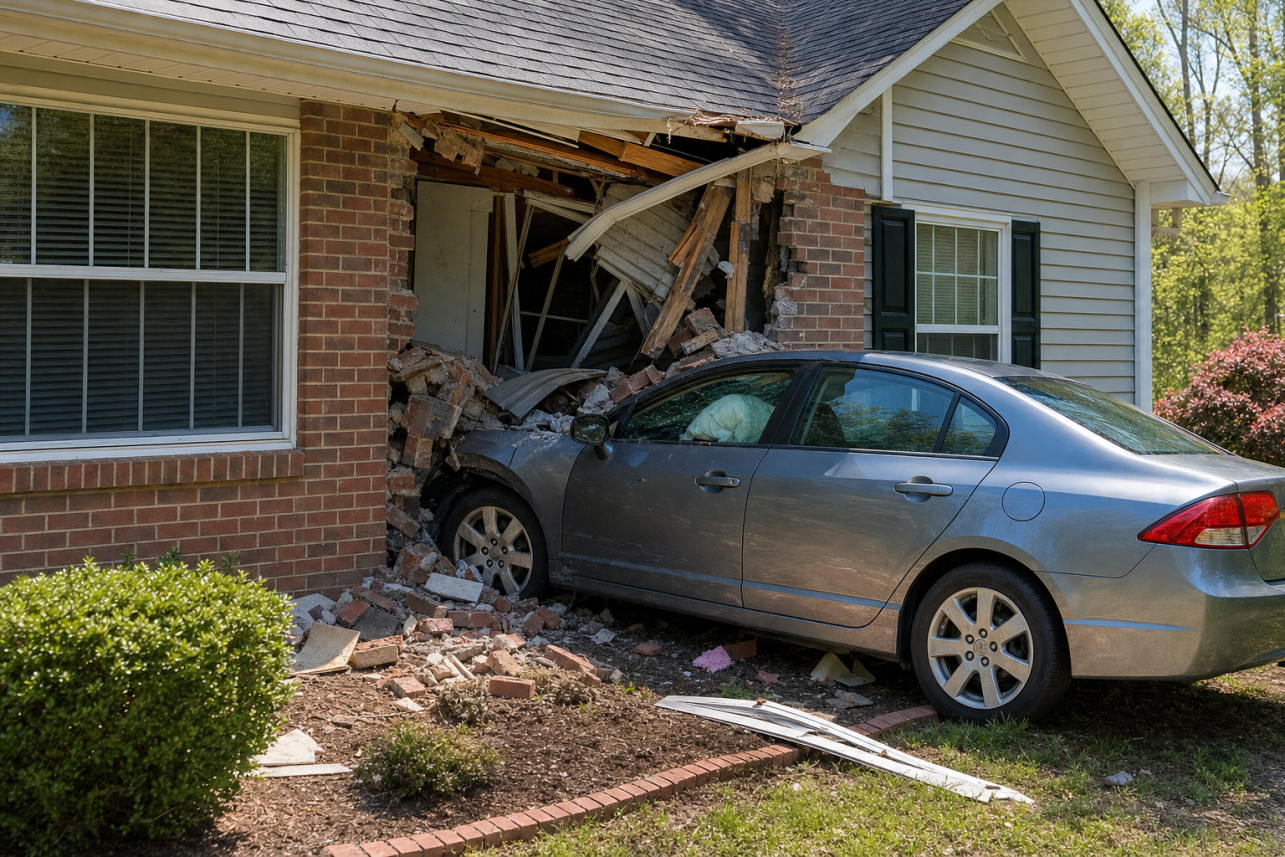
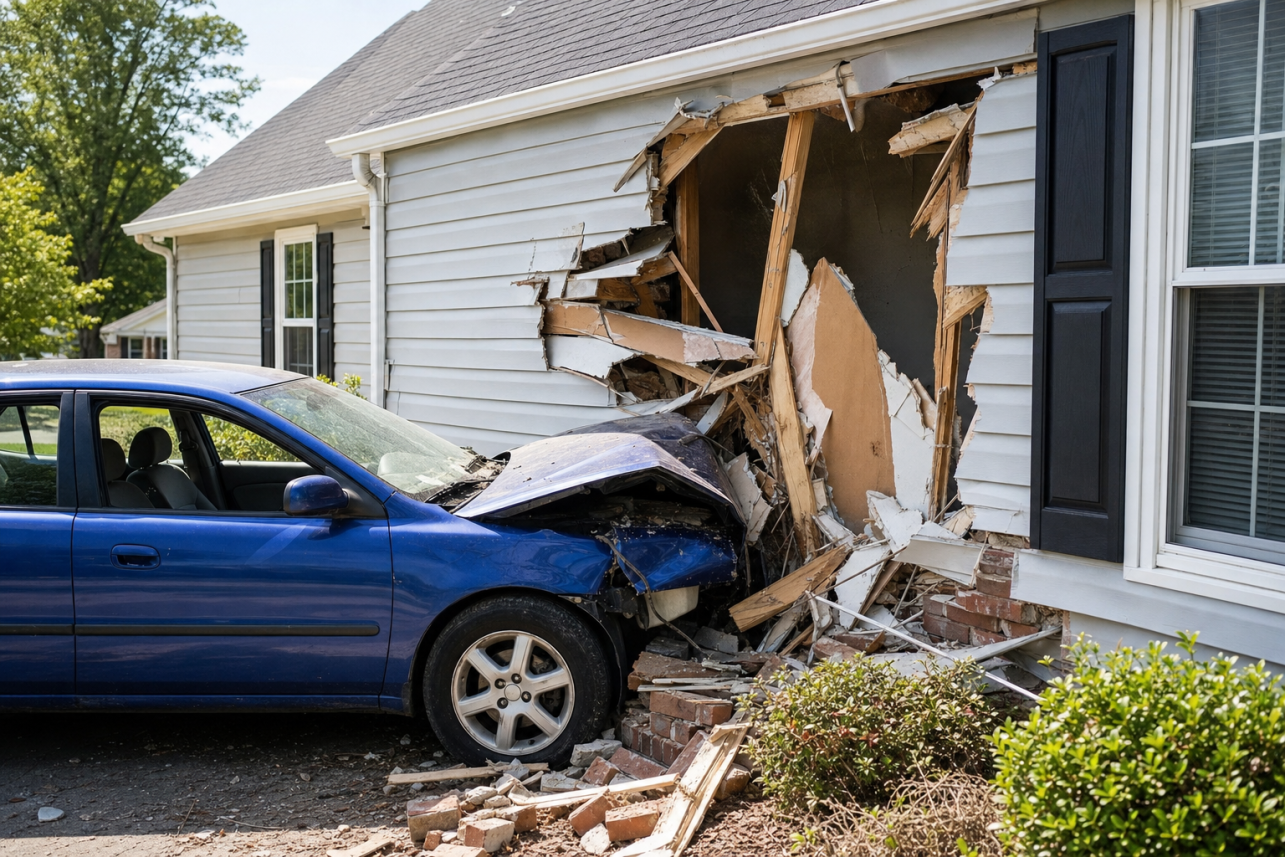
If a vehicle has crashed into your house, a Car Hits Home Claim Garner NC is the insurance claim that pays to repair the structure, replace damaged belongings, and cover your living expenses if you can't stay home — and it usually involves two insurance companies at once. The at-fault driver's auto liability coverage should ultimately pay, but your own homeowners policy often moves first. For The Public Adjusters, Inc. is a licensed and bonded public adjusting firm that works only for the homeowner, documenting the full damage and negotiating with both carriers so the repair estimate reflects what the rebuild actually costs in Garner.
What This Service Is
A vehicle-into-house claim looks simple from the curb, but the damage rarely stops at the hole in the wall. The impact can crack brick veneer well beyond the point of contact, shift a load-bearing wall, crush plumbing or wiring inside the wall cavity, and even disturb the foundation or slab. A proper structural assessment — often with an engineer — is the difference between a cosmetic patch and a repair that actually makes the house sound again.
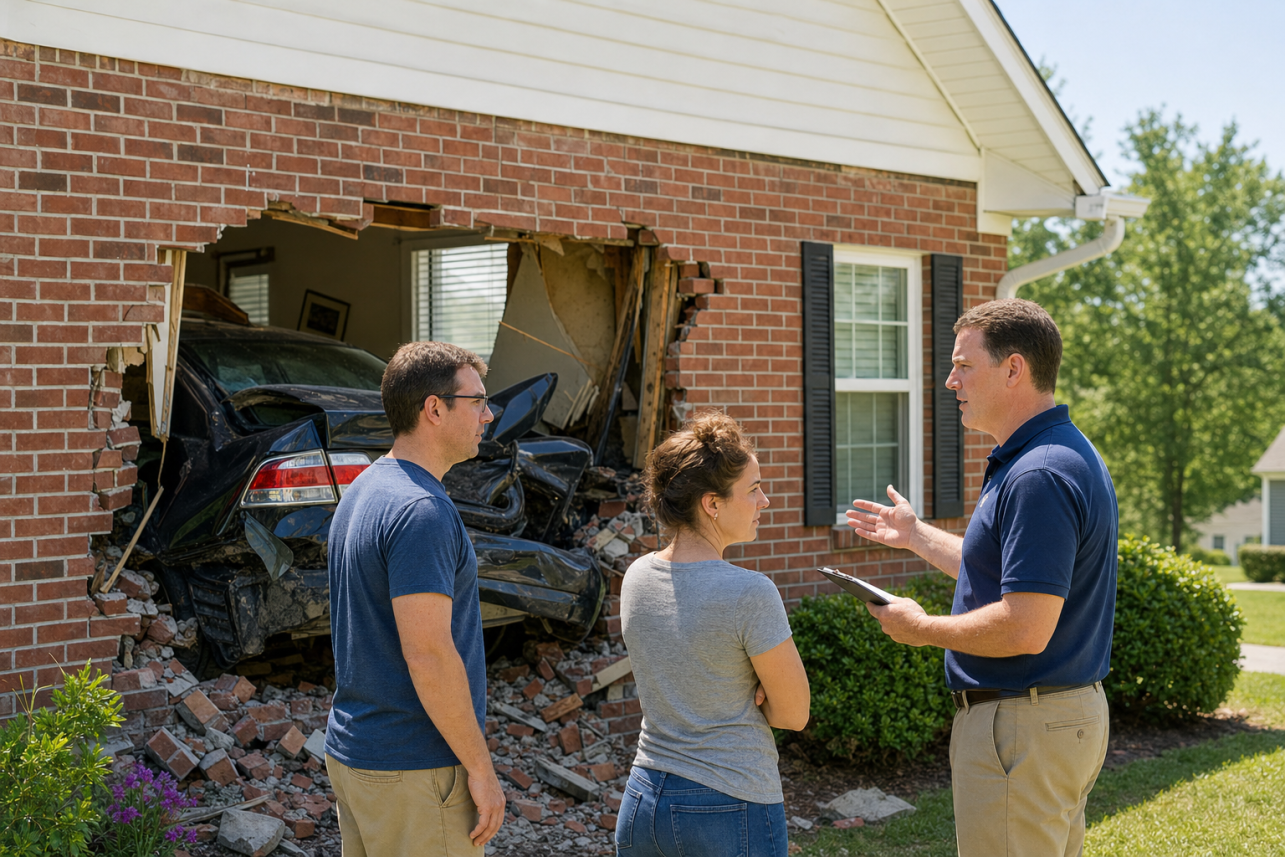
Our job as your public adjuster is to represent you, not the insurance company. We document everything the carriers' adjusters might miss, prepare a detailed repair cost estimate, account for building code upgrade requirements on older construction, and handle the back-and-forth between your homeowners insurer and the driver's auto insurer. We handle the same situations across the Triangle, from a Car Hits Home Claim in Raleigh NC to vehicle impacts in Johnston County, alongside fire, water, smoke, tree, and vandalism claims.
One thing we never do is guess at liability for you or promise a specific payout. What we do is make sure nothing gets left out of the claim — because once you sign off on a settlement, reopening it is an uphill fight. The NCDOI Public Adjusters Guide explains exactly what licensed public adjusters in North Carolina can and cannot do, and we work strictly within those rules.
Common Problems
Will The Driver's Insurance Pay For Everything — Or Am I Stuck With Part Of The Bill?
The at-fault driver's auto liability coverage is supposed to pay for your property damage settlement. In practice, your homeowners policy often pays first, then your insurer chases the driver's carrier to get reimbursed — a process called subrogation, which can also recover your deductible.
The traps are in the details. Carriers may offer actual cash value (what your damaged materials are worth used, after depreciation deductions) instead of replacement cost (what it costs to rebuild today). They may skip code-required upgrades, lowball temporary housing costs, or ignore loss of use coverage entirely while your home is unlivable.
We build the claim around what the repair genuinely costs in today's Garner market, including engineering, matching materials, and your out-of-pocket expenses — so you aren't quietly absorbing costs that insurance should pay.
Why Is My Car Hits Home Claim Garner NC Stuck Between Two Insurance Companies?
This is the most common complaint we hear: the home insurance adjuster is not responding, the auto carrier says liability determination is "still under review," and weeks pass while plywood covers your wall. Each company hopes the other moves first, and you're the one living with the delay.
Meanwhile deadlines matter. Emergency board-up and tarping has to happen fast to prevent secondary water damage, and you're expected to document everything before repairs begin.
When a home insurance adjuster's low ball offer finally arrives, homeowners often assume that's the end of it. It isn't — courts have repeatedly sided with policyholders, as in State Farm Fire & Casualty Co. v. Simmons, where the Texas Supreme Court upheld a verdict for homeowners after their fire claim was wrongfully denied. You have the right to dispute an adjuster's number, and we manage that dispute for you with documentation, not frustration.
Should I Just Accept The Insurance Company's Estimate, Or Hire Someone To Check It?
People search for "which home insurance company denies the most claims," but the honest answer is that underpayment is a bigger risk than outright denial on vehicle-impact claims. The first estimate is frequently written from a quick walk-around that never opens a wall.
A good public adjuster earns their fee by finding what that walk-around missed: cracked framing behind drywall, foundation damage, shifted headers, crushed ductwork, and contractor estimate disputes over what "matching" really requires. The Insurance Information Institute notes that homeowners can hire their own licensed public adjuster to represent them in the claim process — the carrier's adjuster, by definition, works for the carrier.
If you're comparing options, look for a North Carolina license, bonding, and specific experience with structural impact claims. Our neighbors chose us as the Best Public Adjuster in Garner NC for exactly these situations, and we're glad to walk you through a claim review before you sign anything.

Our Process
Free Claim Review And Immediate Damage Documentation
We start by reviewing your homeowners policy and the facts of the crash, then photograph and document the scene before anything is moved or repaired. If the opening in your wall needs emergency board-up, we make sure that cost is captured in the claim rather than coming out of your pocket.
Independent Structural Assessment And Repair Estimate
We bring in the right inspections to assess framing, load-bearing walls, veneer, and foundation — not just the visible hole. From that, we build a line-item repair cost estimate at replacement cost, including code upgrade requirements common in older Garner homes. We handled a vehicle-impact loss this way on a Car Hits Home Insurance Claim in Durham, where the hidden framing damage was worth more than the visible repair.
Negotiation With Both Carriers Through Settlement
We present the documented claim to your homeowners insurer and coordinate with the at-fault driver's auto carrier, pushing the subrogation process so your deductible comes back where possible. If you've been displaced, we pursue loss of use and temporary housing costs until your home is livable again. You approve every step; nothing settles without your sign-off.
| What Happens | Homeowner Alone | With For The Public Adjusters |
|---|---|---|
| Structural inspection | Carrier's adjuster scopes visible impact damage only | Independent engineer checks foundation, framing, and load paths beyond the impact point |
| Which insurance pays | Homeowner left guessing between their policy and the driver's liability carrier | Both carriers coordinated so coverage is pursued without delays or finger-pointing |
| Estimate scope | Often limited to siding, brick, or drywall patching | Full engineered repair scope including matching materials, code upgrades, and hidden damage |
| Deductible recovery | Rarely pursued; homeowner absorbs the cost | Subrogation against the at-fault driver's carrier documented and supported |
| Dispute resolution | Homeowner accepts the offer or argues alone | Appraisal clause and documented causation used to challenge underpayment |
| Contents and ALE | Smoke, debris, or displacement losses frequently left off the claim | Room-by-room inventory and additional living expense claims fully documented |
Commonly Overlooked In The Public Adjusting Industry
- Foundation and footing displacement beyond the impact wall — Field adjusters scope what the eye can see, and a foundation that shifted an inch underground never shows up without an engineer's measurements.
- Racked framing in rooms away from the point of impact — Impact force travels through a home's frame, so doors that stick and drywall cracks two rooms over get dismissed as pre-existing wear.
- Subrogation to recover the homeowner's deductible — Carriers pursue their own recovery from the at-fault driver but rarely volunteer that the homeowner's deductible can ride along with it.
- Sheared or stressed utility lines inside the struck wall — Gas fittings, water supply lines, and wiring hidden in the wall cavity can be damaged without leaking on day one, surfacing weeks after the claim closes.
- Matching of brick, siding, or stone across the full elevation — Insurers prefer to patch the hole, but discontinued materials often mean the whole elevation must be replaced for a uniform repair — the exact issue the insured won in Windridge v. Philadelphia Indemnity.
- Code upgrade (ordinance or law) costs on older Garner homes — Rebuilding a wall section in a home built decades ago triggers current Wake County building code requirements that the original estimate almost never includes.
- Additional living expenses when part of the home is unsafe — Homeowners assume ALE only applies to total losses, so they absorb hotel and meal costs the policy would have covered.
- Smoke, soot, or debris damage to contents from secondary fire or dust — The carrier focuses on the structure, and personal property contaminated by the event gets left off the claim unless it is inventoried room by room.
Case Studies
Case Study #1
Situation: A family on Vandora Springs Road in Garner woke to a pickup truck that had left the roadway overnight and struck the corner of their brick home, crushing the garage wall and shifting the front porch slab.
Problem: The homeowner's insurer sent a field adjuster who scoped only the visible brick damage and the garage door, estimating roughly $18,400. The estimate ignored possible foundation displacement and did not address the at-fault driver's liability carrier at all, leaving the family unsure which policy should even pay.
Investigation: Our Garner public adjuster team brought in a structural engineer to evaluate the impact zone. We measured wall plumb, checked the sill plate and band joist for lateral shift, and documented hairline cracking that had telegraphed through interior drywall two rooms away from the point of impact.
Findings: The engineer confirmed the impact had pushed the garage foundation wall inward nearly an inch and cracked the footing. Interior framing had racked, which explained doors that no longer latched. The original estimate had captured less than a third of the true repair scope.
Solution: We prepared a complete engineered repair estimate, coordinated between the homeowner's property carrier and the driver's liability insurer so coverage was not bounced between them, and invoked the appraisal clause when the carrier resisted the foundation scope.
Outcome: The claim resolved at a figure several times the original offer, covering foundation repair, masonry rebuild with matching brick, interior repairs, and temporary shoring. The family did not pay out of pocket beyond their deductible, which was later recovered through subrogation against the driver's carrier.
Lesson: Vehicle-into-building losses almost always involve hidden structural movement beyond the point of impact. Courts have recognized that insurers must account for the full, uniform repair — in Windridge of Naperville Condominium Ass'n v. Philadelphia Indemnity Ins. Co. (7th Cir. 2019), the building owner prevailed when the court held the insurer had to replace undamaged matching materials so the repaired structure was consistent, not patched.
Case Study #2
Situation: A retired couple near White Oak Crossing in Garner had a sedan jump the curb and slam into their den, breaking through vinyl siding, sheathing, and two wall studs, and knocking their heating unit off its pad.
Problem: The carrier approved the wall repair but denied the HVAC damage and the couple's smoke-damaged contents — the impact had ruptured a gas line fitting, and the brief flare scorched furniture and curtains. The insurer called the HVAC and contents damage 'unrelated to the vehicle impact.'
Investigation: We photographed the displaced equipment pad, obtained the fire department incident report confirming the gas line rupture was caused by the collision, and had an HVAC contractor document the bent refrigerant lines and cracked heat exchanger housing. We also completed a room-by-room contents inventory with pre-loss values.
Findings: Every item of damage traced directly back to the single impact event: the car struck the wall, the wall movement sheared the gas fitting, and the flare caused the smoke and soot damage. North Carolina law supports recovery for the full chain of damage flowing from a covered cause of loss.
Solution: We assembled a causation package linking each damaged item to the collision and presented it with repair estimates, the fire report, and contractor statements. When the carrier's desk adjuster still balked at contents, we requested a re-inspection with a senior claims examiner present.
Outcome: The carrier reversed its position on both the HVAC system and the contents, and the final settlement included wall reconstruction, equipment replacement, smoke remediation, and cleaned or replaced personal property.
Lesson: When a vehicle strikes a house, the damage rarely stops at the wall. Document the entire chain of events immediately — the precedent in cases like Accardi v. Hartford Underwriters Ins. Co. shows courts will side with the policyholder when the carrier tries to artificially narrow a covered loss to only its most obvious damage.
| Situation | Immediate Step | What It Depends On | Who Typically Pays |
|---|---|---|---|
| Wall or foundation visibly cracked or shifted | Keep everyone out of the room and request emergency shoring | Whether load-bearing elements were struck; an engineer should confirm before repairs | Your homeowner's policy first, then subrogation against the driver's carrier |
| Driver identified and insured | Get the police report number and the driver's insurer details | NC liability limits may not cover full structural repairs | Driver's liability carrier, with your policy covering any gap |
| Hit-and-run driver, no one identified | File the police report immediately and notify your carrier | Your dwelling coverage applies; the police report protects your claim | Your homeowner's policy |
| Gas, water, or electrical line damaged by the impact | Call utilities to shut off service before anything else | Secondary damage like fire or water loss is part of the same covered event | Same claim — all damage flowing from the impact should be included |
| Home unsafe to occupy | Ask your carrier about additional living expense coverage in writing | Whether a building official or engineer deems the home uninhabitable | ALE coverage under your homeowner's policy |
| Carrier's estimate seems low or denies hidden damage | Do not sign a release; get an independent damage assessment | Scope disputes can be resolved through documentation or the appraisal clause | Carrier, once full damage is proven |
| Brick or siding can't be matched to the rest of the home | Document the mismatch with photos of the full elevation | NC matching arguments are strengthened by cases like Windridge v. Philadelphia Indemnity, where the insured building owner won | Carrier, for a uniform repair of the affected elevation |
Reviews
A delivery van backed into the corner of our house off Timber Drive and our insurance company offered barely enough to patch the siding. For The Public Adjusters brought out an engineer who found the impact had cracked our crawlspace foundation wall. The final settlement covered everything, including matching brick for the whole elevation. I never would have known to push for that on my own.
Melissa R., Garner
After a car crashed into our garage on Aversboro Road, we were stuck between our homeowner's carrier and the driver's insurance, each pointing at the other. This team sorted out who owed what, handled the subrogation paperwork, and we even got our deductible back. The porch header and the door frame damage the first adjuster missed were all included in the end.
Darnell W., Garner
Honest and thorough. A pickup hit our rental property in Garner and the insurer's first estimate didn't include the shifted plumbing under the slab or the cracked tile inside. For The Public Adjusters documented it all and the payout nearly tripled. The only reason it took a couple months was the carrier dragging its feet, not them.
Karen T., Wake County
Frequently Asked Questions
What Steps Should I Take Right After A Vehicle Strikes My House, And How Do I Start A Car Hits Home Claim Garner NC?
First, make sure everyone is safe and call 911. A police report documents the driver, their insurance information, and the circumstances of the impact — all of which matter later. If the structure looks unstable, stay out until the Town of Garner's inspections department or a structural engineer confirms it is safe to enter.
Next, photograph everything before any cleanup begins: the point of impact, cracked brick or siding, shifted framing, damaged interior walls, and any personal property that was crushed or knocked over. Keep receipts for emergency board-up, temporary shoring, and any hotel stays if you cannot occupy the home.
Then notify your homeowner's insurer and request a copy of your full policy, not just the declarations page. This is the point where many Garner homeowners call us. As licensed and bonded public adjusters, we document the structural and contents damage, prepare the estimate, and negotiate with the carrier on your behalf.
One important note: we handle the damage to your home, other structures, and contents only. We do not handle claims for the vehicle itself, since motor vehicle claims fall outside what public adjusters in North Carolina are permitted to work on. The driver's auto carrier and your homeowner's carrier may both be involved, and sorting out which policy responds — and in what order — is a big part of what we do for Wake County homeowners.
Why Is Hidden Structural Damage Such A Big Issue When A Car Crashes Into A Garner Home?
A vehicle impact delivers thousands of pounds of force into a wall system that was never designed to absorb it. The visible hole is often the smallest part of the loss. Energy travels through the framing, so we routinely find cracked top plates, racked studs, separated brick veneer ties, shifted sill plates, and foundation cracks several feet away from the point of impact.
In Garner neighborhoods with brick-veneer construction — common in subdivisions off Timber Drive, Aversboro Road, and White Oak — the veneer can delaminate from the sheathing well beyond the obvious damage. Carrier adjusters working quickly often scope only what they can see, which leads to estimates that cover patching a hole rather than rebuilding a compromised wall assembly.
We bring in structural engineers when warranted and insist the scope reflect what Wake County building code requires for the repair, including permits and inspections through the Town of Garner. North Carolina policies typically include ordinance-or-law coverage that pays for code-required upgrades, and that coverage is frequently overlooked in the first estimate.
Interior damage matters too. Drywall cracks in adjacent rooms, doors that no longer close, and gaps at crown molding are all signs the structure moved. We document those conditions early, because if they surface months later it becomes much harder to tie them to the impact. Thorough documentation up front protects your claim and your home's long-term value.
Whose Insurance Pays When A Driver Hits My House — Theirs Or Mine?
Usually both policies can come into play, and the order matters. The at-fault driver's auto liability coverage should ultimately pay for the damage to your home, but North Carolina's minimum property-damage liability limits are often far below the real cost of rebuilding a wall, re-tying brick veneer, and repairing interior finishes. If the driver is uninsured, fled the scene, or carries minimal limits, your own homeowner's policy becomes the primary path to getting the repairs funded.
Many homeowners file through their own carrier first for speed, then the carrier pursues the driver's insurer through subrogation — which can also recover your deductible. The catch is that your own carrier's estimate sets the ceiling on what gets repaired, so an undervalued scope hurts you even when someone else was at fault.
That is where professional representation on a Car Hits Home Claim Garner NC makes a measurable difference. We prepare a complete, line-item estimate covering structure, contents, debris removal, engineering, permits, and loss of use if you had to relocate during repairs. We negotiate directly with the adjusters so the settlement reflects the full scope, not a quick patch.
To be clear about our role: we are licensed and bonded to represent you on the damage to your home and belongings. We cannot make promises about a specific dollar outcome — no honest adjuster can — but we can make sure nothing in your loss goes undocumented or unargued.
My Insurer Only Wants To Repair The Damaged Section Of Wall, And The New Brick And Siding Won't Match. Do I Have To Accept That?
Not necessarily, and courts have sided with homeowners on exactly this issue. In Windridge of Naperville Condominium Association v. Philadelphia Indemnity Insurance Company, the insurer wanted to replace damaged siding on only some elevations of the buildings, leaving a visible mismatch. The federal appeals court ruled for the insured, holding that where replacement materials cannot reasonably match, the policy can require replacing the broader wall surfaces so the building is restored to its pre-loss condition. That reasoning applies directly to building and structure claims like yours.
Matching is a constant fight after vehicle impacts in Garner. Brick runs are often discontinued, and vinyl or fiber-cement siding fades, so a patched section stands out permanently. A patchwork repair can reduce your home's market value — something carriers rarely volunteer to address.
When we handle a vehicle-impact loss in Wake County, we document the existing materials, obtain written confirmation from suppliers when a brick or siding line is discontinued, and build the matching argument into the estimate from day one. We also review your specific policy language, because matching provisions vary by carrier and form.
We never guarantee a particular result, but we do make sure the matching issue is raised, documented, and negotiated rather than quietly ignored. If the carrier still refuses a reasonable scope, we help you understand your options under North Carolina's appraisal and dispute provisions before you accept a settlement you'll regret.
How Long Does A Car Hits Home Claim Garner NC Typically Take To Resolve?
Most vehicle-impact claims in Garner resolve in 60 to 120 days, but the timeline swings widely depending on how thoroughly the damage is documented up front. A straightforward porch or garage strike with a cooperative insurer can wrap up faster. A claim involving foundation shift, cracked load-bearing walls, or a liability dispute between two carriers often runs longer.
The biggest delays we see come from incomplete initial scoping. If the first inspection misses damage behind the brick veneer or in the framing, the claim gets reopened with supplements, and every supplement adds weeks. Under North Carolina law, insurers must acknowledge claims promptly and act in good faith, but 'prompt' still leaves plenty of room for back-and-forth.
When a driver's liability carrier is involved alongside your homeowners policy, coordination between the two can also stall payment. Your own carrier may pay first and then pursue the at-fault driver's insurer through subrogation, which keeps your repairs moving while they sort out reimbursement behind the scenes.
As licensed and bonded public adjusters serving Wake County, we work to compress that timeline by delivering a complete, documented scope of damage early — structural engineering reports, code-upgrade requirements under the current North Carolina Residential Code, and a line-item repair estimate. We can't promise a specific outcome or settlement date, but a well-built claim file gives the insurer far fewer reasons to delay, and it puts you in a stronger position if the carrier disputes any part of the loss.
Can I Recover Hotel And Living Expenses If The Crash Makes My Garner House Unsafe To Occupy?
In most cases, yes. If a vehicle strike leaves your home uninhabitable — a breached exterior wall, compromised framing, exposed electrical, or a condemned-until-repaired notice from Wake County inspections — your homeowners policy's Additional Living Expenses (ALE) or Loss of Use coverage generally applies.
ALE pays the reasonable increase in your living costs while you can't live at home. That typically includes a hotel or short-term rental, extra mileage if you're displaced farther from work or your kids' schools, pet boarding, laundry costs, and the difference between restaurant meals and your normal grocery budget. It does not replace your mortgage or normal expenses — only the increase caused by the loss.
The common fight here is over habitability. Carriers sometimes argue a home with a tarped wall and no heat in January is still livable. We document conditions with photos, inspection reports, and contractor letters so the uninhabitable determination is supported rather than just claimed.
Two practical tips: keep every receipt from day one, even before coverage is confirmed, and get the insurer's ALE authorization in writing with a clear end date you can extend if repairs run long. Vehicle-into-home repairs frequently take longer than first estimated once hidden framing damage surfaces, and you don't want your housing funds cut off mid-rebuild.
If the at-fault driver's liability carrier is handling the claim instead, displacement costs can be pursued there as part of your damages. We help Garner homeowners track and present those expenses so nothing reasonable gets left out.
What Does A Public Adjuster Actually Do On A Vehicle-Into-House Claim, And How Are You Paid?
On a Car Hits Home Claim Garner NC homeowners are typically dealing with two insurance companies, a structural engineer, a contractor, and a building inspector all at once — while living in a damaged house. A public adjuster represents you, not the insurance company, through all of it.
For The Public Adjusters, Inc. starts by independently scoping the full loss: the obvious impact damage, plus the hidden issues vehicle strikes cause — shifted sill plates, cracked footings, racked framing, damaged plumbing or wiring inside the wall cavity, and contents destroyed in the collapse zone. We photograph and inventory damaged personal property room by room, because contents losses are routinely undervalued when homeowners list them from memory.
We then prepare a detailed, line-item estimate using the same software carriers use, review your policy for every applicable coverage — dwelling, other structures, contents, debris removal, ordinance-and-law for code upgrades, and loss of use — and negotiate directly with the adjusters on the other side. If the at-fault driver's carrier disputes liability or lowballs, we document the file to support your position.
We work on a contingency fee, a percentage of the settlement, so our interests align with yours and there's no upfront cost. We're licensed and bonded in North Carolina. One honest caveat: no adjuster can guarantee a specific result, and anyone who promises you a number before investigating the loss should be treated with caution. What we can promise is a thoroughly documented claim presented by someone who handles these losses professionally.
The Insurance Company's Estimate Seems Far Too Low For The Damage To My Garner Home. What Are My Options?
You are never required to accept the first offer, and on vehicle-impact losses the first estimate is frequently incomplete. Initial carrier estimates often cover only visible damage — the hole in the wall — while omitting structural repairs, code-required upgrades, matching materials, and contents.
Your first option is a documented rebuttal. A detailed independent estimate, backed by an engineer's report and contractor pricing specific to the Raleigh-Garner market, often moves the number substantially. Carriers respond to evidence, and many disputes resolve at this stage.
If negotiation stalls, most North Carolina homeowners policies include an appraisal clause. Each side appoints an appraiser, the appraisers select an umpire, and the panel sets the amount of loss — a faster, cheaper path than litigation for a pure pricing dispute.
Courts have repeatedly sided with policyholders who pushed back on inadequate building-damage settlements. In Cedar Bluff Townhome Condominium Association v. American Family Mutual Insurance Company, 857 N.W.2d 290 (Minn. 2014), the insurer wanted to replace only the directly damaged siding panels; the court upheld the appraisal award requiring the carrier to pay for replacing siding on all buildings so the property was restored to a reasonably uniform, pre-loss condition. The policyholder won because partial, mismatched repair was not true indemnity — a principle directly relevant when a car tears through one section of your home's exterior.
We help Garner homeowners evaluate which path fits their situation, build the supporting file, and represent them through appraisal when needed. We can't guarantee a particular outcome, but a low estimate is a starting point, not a verdict.
Does Ordinance And Law Coverage Apply To A Car Hits Home Claim Garner NC, And Why Does It Matter?
Ordinance and law coverage can be one of the most valuable — and most overlooked — parts of a vehicle-impact claim in Garner. When a car tears through a wall built decades ago, Wake County will not let you rebuild to the old standard. Current North Carolina building code may require upgraded framing connections, updated electrical in the damaged wall, modern egress requirements, or engineered repairs to load-bearing elements.
Standard dwelling coverage only pays to put back what was there. The extra cost of meeting today's code comes from your ordinance and law coverage, which many adjusters quietly leave out of their estimates. On older Garner homes near Main Street or in established neighborhoods like Van Story Hills, those code-driven costs can add thousands of dollars to a proper repair.
We review your policy's ordinance and law limits, work with the Town of Garner's inspections department requirements, and make sure every code-mandated upgrade is itemized and claimed. Courts have repeatedly held insurers accountable for shortchanging building repairs — in Bi-Economy Market, Inc. v. Harleysville Insurance Co., 10 N.Y.3d 187 (2008), the court sided with a policyholder whose building claim was badly underpaid, allowing recovery of consequential damages beyond the policy limits because the insurer failed to handle the claim in good faith.
As licensed and bonded public adjusters, we cannot promise a specific outcome, but we can make certain no covered code cost is left off the table when your home is rebuilt.
The Driver Who Hit My Garner House Was Uninsured Or Fled The Scene. Am I Out Of Luck?
No. This is one of the most common fears homeowners have after an impact, and it is usually unfounded. Your homeowner's policy covers vehicle damage to your dwelling regardless of whether the driver is ever identified, carries insurance, or has enough coverage to pay.
In a hit-and-run on a Garner street — and we see them along Timber Drive, Aversboro Road, and near the US-70 corridor — you simply file under your own policy. Get a Garner Police Department report number right away, because your insurer will want it, and it protects you if the driver is found later.
If the driver is identified but uninsured or underinsured, your homeowner's carrier still pays your covered damages first. The carrier may then pursue the driver through subrogation to recover what it paid. If they recover money, you may get some or all of your deductible back.
One important note: we handle the damage to your home, structure, and contents only. Any claim for damage to vehicles themselves falls outside what we do, and you would address that separately with the appropriate auto carrier.
The real risk in these situations is not coverage — it is scope. Carriers sometimes treat an uninsured-driver loss as a quick patch job. We document the full structural, interior, and contents damage so your own policy pays what it actually owes, not just what is visible from the curb.
What Should I Document Before Cleanup Crews Or Contractors Touch Anything At My Garner Home?
Documentation made in the first hours after impact often decides how a Car Hits Home Claim Garner NC gets paid, so resist the urge to clean up quickly. Once debris is hauled off, evidence of the true damage goes with it.
Photograph and video everything before anything moves: the vehicle's resting position if it is still there, the point of impact, cracked or shifted walls, damaged framing visible through the breach, and every damaged piece of furniture or personal property. Shoot wide shots for context and close-ups for detail. Include interior rooms adjacent to and above the impact point, since force travels through a structure.
Save physical evidence where practical. Broken brick, splintered studs, and crushed contents can support the engineering analysis later. Keep the police report number, the driver's information if available, and receipts for anything you spend on emergency board-up or temporary shoring — those costs are typically reimbursable as reasonable emergency measures.
Your policy actually requires you to protect the property from further damage, so board-up and tarping are appropriate. Permanent repairs are not, until the insurer and your representative have inspected.
When we take over a vehicle-into-house loss in Garner, we build the file the way a carrier's own experts would: measured scope, photo logs, moisture readings where plumbing was struck, and structural documentation. Thorough early records close the door on later disputes about what the crash really did to your home.
Is It Too Late To Bring In A Public Adjuster If I Already Filed My Car Hits Home Claim Garner NC And Received A Check?
In most cases, no — accepting an initial payment does not end your claim. North Carolina policies generally allow supplemental claims when additional covered damage is discovered, and vehicle-impact losses are notorious for exactly that. Cracked footings, racked framing, and separated connections often show up weeks after the first check is cashed.
We regularly take over claims in Garner that were already 'settled.' We re-inspect the property, compare the carrier's estimate against the actual scope of damage, bring in structural engineers when the impact zone warrants it, and file a documented supplement for everything that was missed or underpaid.
There are deadlines, though. Your policy contains time limits for filing suit and completing repairs for replacement-cost recovery, so the sooner you call, the more options you keep. Check your settlement paperwork carefully — read anything labeled a release before signing, because a release is different from an ordinary claim payment.
Policyholders who push back on lowball building settlements have strong precedent behind them. In State Farm Fire & Casualty Co. v. Simmons, 963 S.W.2d 42 (Tex. 1998), the court upheld a verdict for homeowners after their insurer mishandled and wrongfully denied a residential fire loss, confirming that carriers owe a duty of good faith in investigating home damage claims.
As a licensed and bonded firm working on a percentage of what is recovered, we only benefit when you do. We can't guarantee a particular result, but a professional re-inspection costs you nothing to request.
Will My Policy Cover A Detached Garage, Fence, Or Carport That A Vehicle Struck On My Garner Property?
In most cases, yes. Standard homeowners policies in North Carolina include Coverage B, often called "Other Structures," which protects detached garages, fences, carports, storage buildings, and similar improvements that aren't attached to your dwelling. Vehicle impact is a covered peril under nearly every HO-3 policy sold in Wake County.
The catch is the limit. Coverage B is typically capped at just 10% of your dwelling coverage. If a driver takes out a large detached garage or a long run of fencing in one of Garner's established neighborhoods, that limit can run out faster than homeowners expect.
There's also a valuation issue. Adjusters sometimes price fencing or outbuildings at depreciated actual cash value when the policy actually owes replacement cost, or they measure only the broken sections rather than what's genuinely needed to restore the structure. A Garner public adjuster reviews the policy language, measures the full scope of damage, and prepares an independent estimate before you accept a settlement.
One important note: For The Public Adjusters, Inc. handles the damage to your home, buildings, and contents only. We do not handle claims for the vehicle itself — that stays between the driver and their auto carrier. But everything the car destroyed on your property, from the brick veneer to the backyard fence, falls squarely within what we do. We're licensed and bonded in North Carolina, and we work exclusively for policyholders, never for insurance companies.
How Do Deductibles And Subrogation Work In A Car Hits Home Claim Garner NC?
When you file a Car Hits Home Claim Garner NC through your own homeowners policy, your deductible comes off the top of the settlement. That surprises many homeowners, since the crash clearly wasn't their fault. The good news is that the money isn't necessarily gone for good.
After your carrier pays your claim, it has the right of subrogation — meaning it can pursue the at-fault driver's auto liability insurer to recover what it paid out. When that recovery succeeds, North Carolina practice is that your deductible should be reimbursed to you, typically in proportion to what your insurer collects.
Here's where homeowners get shortchanged: subrogation only recovers what was documented. If your insurer's estimate missed cracked foundation footings, shifted framing, or damaged plumbing behind the impact wall, those costs never enter the subrogation demand, and you absorb them. That's one more reason the initial scope on a vehicle-impact claim needs to be thorough, not rushed.
You may also have the option of filing directly against the driver's liability carrier instead of your own policy, which avoids the deductible entirely — though liability carriers often move slowly and dispute fault or scope. We help Garner homeowners weigh both routes based on the driver's limits, the damage, and how quickly repairs need to start.
We can't promise a specific outcome on any claim, but we can make sure every dollar of damage is documented so nothing is left out of either the settlement or the recovery effort.
A Car Crashed Through My Wall And Damaged Furniture, Electronics, And Other Belongings Inside. Are My Contents Covered Too?
Yes. Vehicle impact is a named peril for personal property under standard homeowners policies, so furniture crushed by debris, electronics knocked from shelves, flooring gouged by the vehicle, and belongings soaked when a crash ruptures a supply line are all typically compensable under Coverage C.
The practical problem is proof and valuation. Carriers often ask Garner homeowners to produce a room-by-room inventory with ages, brands, and purchase prices — a daunting task when half a living room is under rubble. Then many policies pay actual cash value first, holding back depreciation until you actually replace each item and submit receipts. Homeowners who don't understand that two-step process frequently leave recoverable depreciation on the table.
We build the contents inventory for you, photograph and catalog damaged items before they're hauled away, research replacement pricing, and track the recoverable depreciation so it gets paid. On a crash into a Garner house, we also look for commonly missed contents items: window treatments, area rugs, wall art, and items stored inside walls of impact, like garage shelving contents.
Courts have repeatedly backed policyholders who push back on lowball property settlements. In Cedar Bluff Townhome Condominium Ass'n v. American Family Mutual Insurance Co. (Minn. 2014), the insurer wanted to replace only damaged siding panels with mismatched material; the court sided with the insured, holding the policy required a reasonable match across the building. The same principle — restoring you to your pre-loss condition, not a patched-together version of it — applies to both your structure and your belongings here in Garner.

Do I Have To Use The Contractor My Insurance Company Recommends To Repair My Garner Home?
No. In North Carolina, you have the right to choose your own licensed contractor. Insurance companies often steer homeowners toward "preferred vendor" programs, and while some of those contractors do fine work, they're writing estimates inside the carrier's pricing guidelines — not necessarily to the full scope your home needs.
Vehicle-impact repairs are specialized. A crash into a brick or framed house in Garner can involve foundation work, load-bearing wall reconstruction, engineered repairs, and matching masonry or siding that's been discontinued. You want a contractor experienced in structural impact repair, and you want their scope compared line by line against the insurer's estimate before work begins.
That comparison is where we earn our fee on a Car Hits Home Claim Garner NC. We prepare an independent damage assessment, flag everything the carrier's estimate missed or underpriced, and negotiate the difference with the insurance company directly. Your contractor builds; we fight for the settlement that funds the build properly.
One caution: never sign a contractor's assignment-of-benefits or a broad work authorization before you understand what the insurer actually owes. If the settlement is short and you've already committed to a contract price, the gap comes out of your pocket.
As licensed and bonded public adjusters serving Garner and the rest of Wake County, we work only for you, the policyholder. We can't guarantee a particular dollar figure — no one honestly can — but we can make sure the claim reflects the real cost of putting your home back the way it was.
Local Relevance
Garner sits at the crossroads of some of Wake County's busiest commuter routes, with US 70 and I-40 traffic feeding neighborhoods where homes were built close to the road. When a driver loses control — rain-slicked pavement, a missed curve, a medical event — the houses nearest those corridors take the hit, and brick-veneer construction common here tends to crack far beyond the point of impact.
Much of Garner's housing stock went up in the building boom of the late 1990s through the mid-2000s. Those homes often need code upgrades during structural repairs, which many first estimates simply leave out. And because eastern Wake sits on Piedmont red clay, an impact that disturbs a slab or footing deserves real scrutiny, not a quick patch.
We work these claims across the Triangle every week, from a Car Hits Home Claim in Morrisville NC to vehicle impacts in Clayton and Fuquay-Varina. Homeowners in neighboring towns also reach us through our Public Adjuster Apex NC office page, but Garner claims get the same local attention — we know what rebuilds actually cost here.
Many Garner subdivisions from the late-'90s building boom back directly onto fast-moving connector roads with little setback, so when a vehicle leaves the roadway it often strikes a garage wall or bedroom corner — and because eastern Wake's red clay slabs transfer impact differently than framed crawlspace homes, we always check the foundation on these claims, not just the hole in the wall.
A Car Hit Your House? Get Your Own Adjuster Before You Sign Anything
For The Public Adjusters, Inc. is licensed and bonded in North Carolina and works only for homeowners — never for the insurance company. Call us for a free review of your vehicle-impact claim in Garner before you accept the carrier's first number. There's no obligation, and we only get paid when your claim does.
Call us: (919) 400-6440
Helpful Resources
- NCDOI Public Adjusters Guide
- Insurance Information Institute (III)
- North Carolina Department of Insurance consumer resources — State regulator guidance for policyholders
- Insurance Information Institute — Nonprofit insurance education resource
Last updated: November 21, 2026