

For Fire insurance Claim help siler city homeowners can actually lean on, For The Public Adjusters, Inc. works for you — not the insurance company — documenting your full loss and negotiating the settlement on your behalf. We handle the inspection, the contents inventory, the repair estimates, and the paperwork your insurer demands. You focus on your family; we handle the claim from first notice to final payment.
What This Service Is
A public adjuster is a licensed, bonded professional who represents the policyholder in an insurance claim — the opposite of the adjuster your insurance company sends, who works for the insurer. After a house fire in Siler City, we read your policy line by line, inspect every room the fire, smoke, and firefighting water touched, and build a complete claim: structural repair estimates, a room-by-room inventory of your personal belongings, and the temporary housing costs your policy owes you while you can’t live at home.
Fire losses are rarely just fire losses. Soot travels through ductwork into rooms that never saw a flame, and the water used to put the fire out soaks into subfloors and wall cavities where damage hides for months. We account for all of it — the same way our fire damage public adjuster Durham team does across the Triangle — so nothing gets left off the claim.
We also handle related residential and commercial losses, including smoke damage, water damage, tree damage, and vandalism claims. If your claim has already been denied or lowballed, we can step in mid-claim, review what was paid, and pursue the difference.
Common Problems
Why Is The Insurance Company’s Offer So Much Lower Than What Repairs Actually Cost?
Low offers usually come from three places: the insurer’s estimate missed damage, it priced repairs below what Chatham County contractors actually charge, or it paid you actual cash value — the depreciated worth of your property — instead of the replacement cost your policy may entitle you to once repairs are done.
Older Siler City homes add another layer. When fire damages part of a structure, local building codes often require the repaired sections to be brought up to current standards, and that upgrade cost is frequently covered by your policy but left out of the first offer. We rebuild the estimate from scratch and claim what the policy actually provides.
Courts have long backed policyholders in these fights. In Salamey v. Aetna Casualty & Surety Co., a federal appeals court upheld a fire-loss homeowner’s recovery for destroyed contents even after the insurer challenged the claim — a reminder that a well-documented loss carries real weight.
My Fire Claim Keeps Dragging On — What’s Actually Holding It Up?
Delays usually trace back to documentation the insurer says it’s still waiting on: a signed proof of loss, a contents inventory, receipts, repair estimates, or answers to follow-up questions. Every incomplete item restarts the clock, and meanwhile you’re paying out of pocket for a place to stay.
Some delays cross the line into bad faith — unreasonable stalling, ignored correspondence, or shifting explanations for why payment hasn’t come. The NCDOI Public Adjusters Guide explains how licensed public adjusters operate in North Carolina, and the Department of Insurance also accepts complaints against insurers who won’t move a claim forward.
We’ve untangled stalled claims all over this region, including a fire insurance claim dispute in Pittsboro just up Highway 64. Getting complete, organized documentation in front of the insurer — and holding them to response deadlines — is usually what breaks the logjam.
Do I Really Need Fire Insurance Claim Help Siler City, Or Can I Deal With The Insurer Myself?
You can handle a claim yourself, and for small, simple losses many people do. But a serious house fire involves structural estimates, depreciation calculations, code-upgrade coverage, additional living expenses, and a contents inventory that can run to thousands of items. Miss any of it and that money simply doesn’t get claimed.
Remember that the adjuster your insurer sends is trained, experienced, and paid by the insurance company. A public adjuster levels that field. When you’re choosing one, verify the license, confirm they’re bonded, ask how fees work (typically a percentage of the settlement — nothing up front), and make sure they’ll personally inspect your property rather than working from photos.
No honest adjuster will guarantee a specific dollar outcome — be wary of anyone who does. What we can promise is a thorough loss assessment and a claim presented the way insurers are required to evaluate it. Our public adjuster Pittsboro NC office serves all of Chatham County, so help is minutes away, not hours.
Our Process
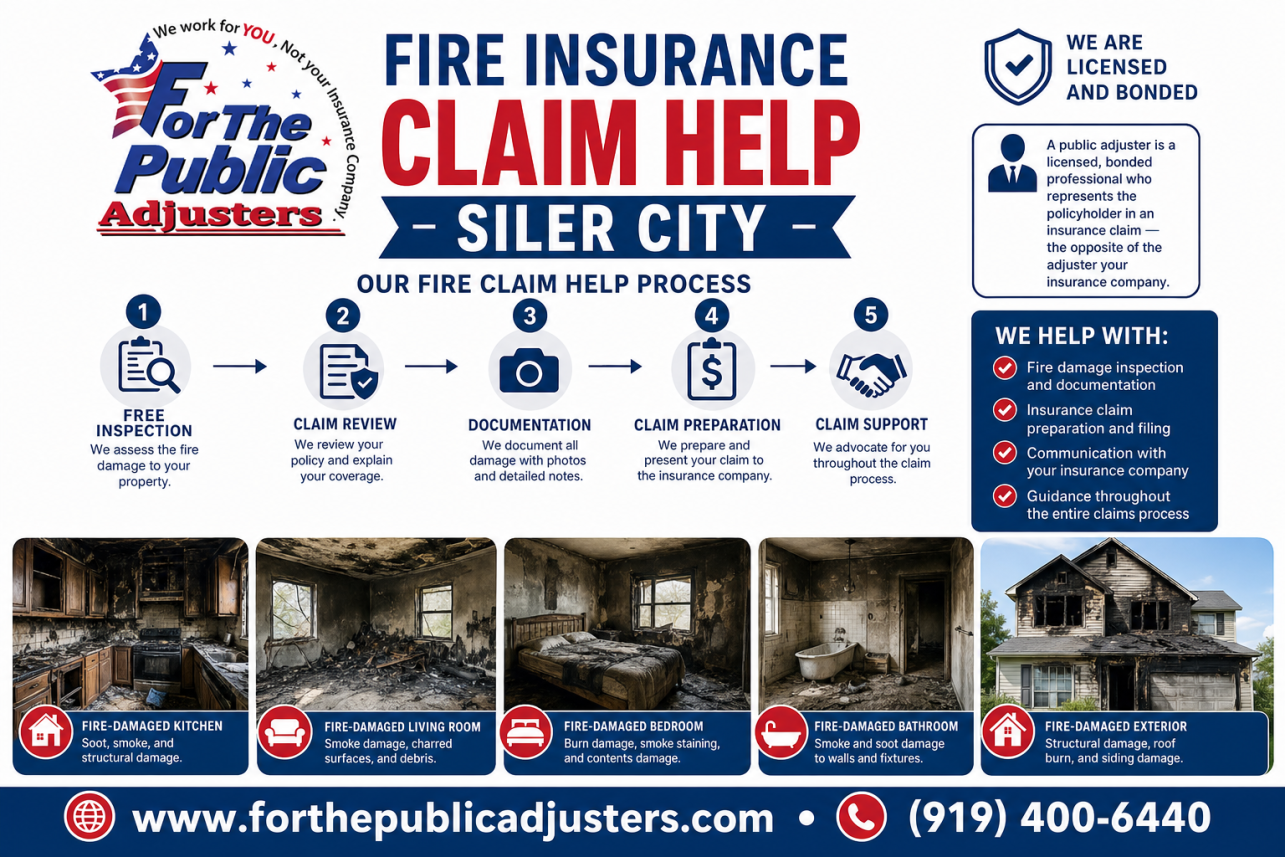
Free Policy Review And Full Property Inspection
We start by reading your actual policy — coverage limits, deductible, replacement cost provisions, additional living expenses, and code-upgrade coverage. Then we inspect the property top to bottom, including attic spaces, ductwork, and wall cavities where hidden smoke and water damage lives. You’ll know exactly where your claim stands before you owe us anything.
Documentation, Inventory, And Proof Of Loss
We photograph and measure everything, build a detailed room-by-room contents inventory with replacement values, and prepare repair estimates at real local pricing. We also assemble your temporary housing and living expense records. Then we prepare and submit the formal proof of loss so the insurer has zero excuse to stall on missing paperwork.
Negotiation And Settlement
We meet the insurance company’s adjuster on site, walk them through the damage they missed, and negotiate every line item — including recoverable depreciation once repairs are underway. If the insurer digs in, we escalate through appraisal or, when necessary, coordinate with insurance dispute lawyers. The same approach resolved a hard-fought fire insurance claim dispute in Raleigh for one of our policyholders.
| What Happens | Filing on Your Own | With For The Public Adjusters |
|---|---|---|
| Damage documentation | You rely on the carrier’s adjuster, who works for the insurance company and often scopes only visible burn damage | Independent inspection with smoke testing, moisture readings, and structural review of hidden damage |
| Estimate accuracy | Carrier estimates commonly use outdated pricing and omit code upgrades and matching requirements | Line-by-line estimate built on current Chatham County contractor pricing, including code and matching items |
| Contents and inventory | You list what you remember; undocumented items are often denied | Room-by-room inventory reconstructed from receipts, photos, and records the carrier must respond to |
| Living expenses during rebuild | Many homeowners never claim the additional living expense coverage they already paid for | ALE tracked and billed monthly so temporary housing, meals, and mileage are fully paid |
| Negotiation | One offer, take it or fight alone | Documented rebuttals, expert reports, and appraisal invoked when the carrier won’t move |
| Your time | Dozens of hours of calls, forms, and follow-ups while displaced | We handle the carrier; you handle getting your life back |
Commonly Overlooked In The Public Adjusting Industry
- Soot contamination inside HVAC ductwork — Ducts pull smoke through the whole house during a fire, but carrier adjusters rarely open a register or order testing, so the entire system gets left off the estimate.
- Code upgrade coverage (ordinance or law) — Older Siler City homes must be rebuilt to current code — updated wiring, egress, smoke detection — and that extra cost is covered, but only if someone claims it.
- Matching of undamaged materials — When flooring, siding, or cabinets can’t be matched, coverage may extend to continuous areas, yet estimates almost always price a patch instead of a proper match.
- Heat damage without visible charring — Radiant heat warps roof decking, vinyl windows, and appliance components that look fine in photos, so untested items get marked ‘clean and reuse.’
- Additional living expense left unclaimed — Displaced families pay for hotels and restaurant meals out of pocket, not realizing the policy reimburses those costs from the first night.
- Water and firefighting damage as part of the fire claim — Thousands of gallons of suppression water soak subfloors and wall cavities, but adjusters scoping ‘fire damage’ often skip moisture mapping entirely.
- Depreciation you can recover later — Replacement-cost policies hold back depreciation until repairs are complete, and policyholders who never file for the holdback forfeit real money.
- Contents cleaning versus replacement math — Carriers push cleaning smoke-damaged textiles and electronics even when cleaning costs approach replacement, leaving owners with items that fail or smell within months.
Case Studies
Case Study #1
Situation: A family on the west side of Siler City had a kitchen fire that spread into the attic before the Chatham County fire crews could knock it down. The home was a 1970s ranch with original plaster walls and hardwood floors throughout.
Problem: The insurance company’s adjuster spent forty minutes on site, scoped the kitchen and part of the attic, and issued an estimate of $61,000. The offer ignored smoke penetration into the HVAC ductwork, soot embedded in the plaster three rooms away, and the fact that the matching hardwood was no longer manufactured.
Investigation: We brought in an industrial hygienist to run wipe samples in every room, documented soot residue inside the supply ducts and wall cavities, and pulled moisture readings where fire suppression water had soaked the subfloor. We also photographed char on attic framing members the carrier’s estimate listed as ‘clean and paint.’
Findings: Lab results confirmed combustion byproducts in rooms the carrier called unaffected. Two attic rafters were structurally compromised, not cosmetically damaged. Because the flooring could not be reasonably matched, North Carolina’s matching considerations supported replacing continuous flooring throughout the connected living areas rather than patching one room.
Solution: We rebuilt the estimate line by line using local contractor pricing, added full duct cleaning and encapsulation, rafter sistering per an engineer’s letter, and continuous flooring replacement. We presented the hygienist’s report and engineering documentation with the revised claim and negotiated directly with the carrier’s large-loss adjuster.
Outcome: The claim settled at $187,400 — more than three times the original offer — plus an additional loss-of-use payment covering the family’s rental in Pittsboro during the seven-month rebuild.
Lesson: Smoke and soot travel far beyond the burn area, and a quick walkthrough almost never captures it. Independent testing turns ‘it looks fine’ into documented, payable damage.
Case Study #2
Situation: The owner of a small poultry-supply business off Highway 64 near Siler City suffered an electrical fire in a storage building that held inventory and equipment. The fire was contained, but heat and smoke damaged stock throughout the structure.
Problem: The carrier accepted the building claim but disputed the contents, arguing the owner couldn’t prove what inventory existed before the fire. They also denied business interruption, claiming operations could continue from the main building. Their combined offer was $34,000 against real losses well over six figures.
Investigation: We reconstructed the inventory using supplier invoices, QuickBooks records, delivery receipts, and photos from the owner’s phone taken weeks before the fire. We interviewed his two employees about stocking patterns and had a salvage expert evaluate heat-damaged equipment the carrier had listed as cleanable.
Findings: The paper trail supported roughly $96,000 in destroyed inventory. The salvage expert confirmed that heat exposure had warped calibrated feeding equipment beyond safe use, making ‘cleaning’ a fiction. Sales records showed a measurable revenue drop directly tied to the lost stock, contradicting the carrier’s business interruption denial.
Solution: We submitted a documented contents inventory with sourcing for every line item, the salvage report, and a business interruption calculation prepared from twenty-four months of financials. When the carrier stalled, we invoked the appraisal provision in the policy to force valuation forward.
Outcome: Before the appraisal hearing, the carrier settled: $94,200 for contents, full equipment replacement, and $41,000 in business interruption — a total recovery of just under $170,000.
Lesson: Commercial fire claims are won on documentation. If you can rebuild the paper trail, a ‘you can’t prove it’ denial rarely survives, and the appraisal clause is powerful leverage most owners never use.
| Situation | What to Do | Why It Matters to Your Claim |
|---|---|---|
| First 24 hours after the fire | Secure the property, report the claim, and photograph everything before anything is moved | Policies require you to protect the property from further damage, and untouched-scene photos are your strongest evidence |
| Carrier offers a quick early check | You can accept an advance, but don’t sign anything marked ‘full and final’ | Early checks are often a fraction of the real loss; signing a release can end your claim permanently |
| Home has visible smoke odor beyond the burn area | Request professional soot and hygienist testing before agreeing to a scope | Soot in ducts, insulation, and wall cavities is real damage carriers routinely leave out of estimates |
| You’re displaced from the home | Save every hotel, meal, and mileage receipt from day one | Additional living expense coverage pays these costs, but only what you can document |
| Carrier says items are ‘cleanable,’ not replaceable | Get an independent restoration or salvage opinion in writing | Heat-damaged electronics, appliances, and finishes often fail later; a written expert opinion shifts the burden back to the insurer |
| Offer feels low but you can’t say why | Have the estimate reviewed line by line before accepting | Missing code upgrades, matching, and overhead-and-profit lines commonly understate claims by 30% or more |
| Claim is denied or stalled for months | Invoke the policy’s appraisal clause or bring in a licensed public adjuster | North Carolina policies include dispute tools most policyholders never use — delay favors the carrier |
| Fire involved a rental or business property | Pull financial records immediately for a business interruption or lost-rent claim | Income losses are payable but must be proven with pre-loss financials, which get harder to assemble over time |


Reviews
After our house fire on Third Avenue, the insurance company offered us barely enough to gut the kitchen. For The Public Adjusters found smoke damage in rooms we didn’t even know were affected — they had it tested, not guessed at. Our final settlement was almost triple the first offer, and they handled every call with the adjuster so we didn’t have to.
Danielle R.
The carrier tried to say most of my shop’s fire damage was ‘cleanable.’ These folks brought in their own experts, documented everything, and proved the equipment was ruined by heat. They also got my business interruption paid, which the insurer had flat-out denied. Worth every penny of the fee — I’d have left six figures on the table without them.
Marcus T.
We were overwhelmed after our fire — living in a hotel, no idea what our policy actually covered. They explained our additional living expense coverage on day one and made sure the insurance company paid for our temporary housing the whole rebuild. The only reason it’s not five stars is the process still took months, but that was the insurance company dragging its feet, not them. They fought the whole way.
Sheila and Ray P.
Frequently Asked Questions
How Does Fire Insurance Claim Help Siler City Homeowners Get A Fair Settlement After A House Fire?
When you hire For The Public Adjusters, Inc. for Fire insurance Claim help siler city residents can rely on, we take over the entire claims process so the insurance company is no longer grading its own homework. Insurers use their own adjusters to estimate your damage, and those estimates routinely miss smoke penetration in wall cavities, HVAC contamination, and structural charring hidden behind finishes.
Our team documents everything independently. We photograph and inventory every damaged item, order testing for soot and char where needed, and build a line-item estimate using the same software carriers use — so we can challenge their numbers item by item.
We also handle the paperwork most Chatham County homeowners have never seen before: the sworn proof of loss, additional living expense logs, and contents inventories that can run into the hundreds of pages. Missing a deadline or undervaluing your contents list can cost you thousands, and once you sign a release, that money is usually gone for good.
From the first inspection at your property in Siler City through the final payment, we negotiate directly with the carrier’s adjuster on your behalf. You approve every decision, but you don’t have to argue with anyone. In our experience, professionally prepared fire claims routinely settle significantly higher than the insurer’s first offer — often enough to cover our fee many times over.
What Should I Do In The First 48 Hours After A Fire At My Siler City Home Or Business?
First, do not throw anything away, even items that look like total losses. Your contents claim depends on proving what you owned, and burned or smoke-damaged belongings are your evidence. Photograph rooms from multiple angles before anyone touches anything.
Second, secure the property. Your policy requires you to prevent further damage, so board-ups and tarping are your responsibility — but keep every receipt, because those costs are reimbursable. If the fire department cut holes in the roof or walls, document that too, since it is covered as part of the loss.
Third, be careful what you sign. Restoration contractors and carrier representatives often show up quickly in Chatham County after a reported fire, and some of the paperwork they present assigns your claim rights or locks you into their pricing. You are never required to use the company your insurer recommends.
Fourth, start an additional living expense file immediately. If your home is uninhabitable, your policy typically pays for a hotel, a rental, meals above your normal grocery costs, and even pet boarding. Those receipts add up fast and are easy to lose in the chaos.
Finally, call a public adjuster in Siler City before you give a recorded statement to the carrier. What you say in that first call can shape the entire claim. We offer free initial consultations, review your policy, and tell you honestly whether professional representation makes sense for your loss.
How Much Does It Cost To Hire A Public Adjuster For A Fire Claim In Chatham County?
For The Public Adjusters, Inc. works on contingency, which means there is no upfront cost and no hourly billing. Our fee is a percentage of what the insurance company pays on your claim, agreed to in writing before we start. If you recover nothing, you owe nothing.
North Carolina law caps public adjuster fees and requires licensed adjusters to disclose them clearly in the contract, so you will know the exact percentage before you sign. There are no hidden charges for inspections, estimates, or negotiation time.
The practical question most Siler City homeowners ask is whether the fee is worth it, and the honest answer depends on the claim. On a small, straightforward loss where the carrier is already paying fairly, we will tell you that during the free consultation — we turn down claims where we cannot add value.
On significant fire losses, the math usually works strongly in the policyholder’s favor. Fire claims involve structure, contents, smoke remediation, code-upgrade coverage, and additional living expenses, and carriers frequently underpay several of those categories at once. Recovering the full value of a contents inventory alone can add tens of thousands of dollars to a settlement.
Because our fee comes from the recovery, our interests are aligned with yours: the more we document and negotiate, the better the outcome for both of us. Call us before accepting any settlement offer, and we will review the carrier’s estimate at no charge.
My Insurance Company Already Sent An Adjuster And Made An Offer. Is It Too Late To Get Fire Insurance Claim Help Siler City Policyholders Can Trust?
No — as long as you have not signed a full release or accepted a final settlement, it is not too late. Fire insurance Claim help siler city property owners seek out often begins exactly at this stage, after the carrier’s first offer arrives and it feels too low. In many cases, that instinct is correct.
The adjuster who inspected your property works for the insurance company, and initial estimates frequently omit smoke damage to attic insulation, contamination inside ductwork, damaged electrical wiring, and the cost of matching undamaged materials to new ones. They may also apply aggressive depreciation to your contents, cutting your payout well below replacement cost.
When we take over a claim mid-stream, we start by comparing the carrier’s estimate against our own independent inspection of your property. We identify every line item that was missed or underpriced, then submit a supplemental claim with photographs, measurements, and documentation the carrier cannot easily dismiss.
Even partially paid claims can often be reopened. If you already cashed a check, that usually counts as partial payment, not a final settlement — North Carolina policyholders generally retain the right to pursue the remaining amounts owed under the policy.
Bring us the carrier’s estimate, your policy, and any correspondence, and we will review everything at no cost. If the offer is genuinely fair, we will tell you. If it is short — and after a serious fire in Siler City, first offers usually are — we will show you exactly where and fight for the difference.
What Does Fire Insurance Claim Help Siler City Residents Receive Actually Include From Start To Finish?
When you hire For The Public Adjusters, Inc., we take over the entire claim so you can focus on your family and your property. The work starts with a thorough review of your policy, because most homeowners in Siler City have coverages they don’t know exist, like ordinance and law coverage, debris removal allowances, and additional living expense benefits.
Next, we document the loss ourselves. That means a room-by-room inventory of damaged contents, moisture and smoke testing, photographs, and a detailed structural estimate built line by line, not the rounded-off numbers insurers often use. Smoke and soot travel far beyond the burn area, and we make sure hidden damage inside walls, ductwork, and attic spaces is captured.
From there, we prepare and submit the claim package, handle every call and letter from the insurance company, meet their adjuster on site, and negotiate the settlement. If the carrier disputes the scope or pricing, we push back with documentation, not opinions.
We also manage the additional living expense side of the claim, so if your home near downtown or out toward Silk Hope is unlivable, your temporary housing and increased costs are paid by the insurer, not out of your pocket. You stay informed at every step, but the burden of proving the loss shifts from you to us. That is the real value of professional claim help: an experienced advocate whose only job is maximizing your recovery.
How Long Does A Fire Claim In Siler City Usually Take To Settle, And Can A Public Adjuster Speed It Up?
Most fire claims in Chatham County take anywhere from two to six months to resolve, though a total loss or a disputed claim can stretch longer. North Carolina requires insurers to acknowledge claims promptly and pay undisputed amounts within a reasonable time, but ‘reasonable’ leaves a lot of room, and delays are common when documentation is incomplete.
A Siler City public adjuster shortens the timeline in a few practical ways. First, we submit a complete, professionally documented claim the first time, which eliminates the back-and-forth requests for more information that stall so many files. Second, we know what carriers need to authorize payments, so we format estimates and inventories the way their systems process them.
Third, we pursue advance payments early. Most policies allow the insurer to release funds for emergency repairs, contents, and living expenses before the full claim settles. Homeowners rarely ask for these advances, but we request them as a standard part of our process so you have money moving while negotiations continue.
Finally, when a carrier drags its feet, we escalate. We document every delay in writing and, when necessary, reference the North Carolina Department of Insurance complaint process, which tends to get files moving. Speed matters, but not at the expense of a fair number. Our goal is the fastest path to a full settlement, not a quick lowball payment that leaves you short when rebuilding costs come in.
Does Smoke And Soot Damage Count In A Fire Claim Even If My House Didn’t Burn?
Yes. Smoke, soot, and even the water and chemicals used to put out a fire are all covered perils under nearly every homeowner policy sold in North Carolina, whether the fire started in your home or a neighboring structure. Many of the fire claims we handle around Siler City involve homes where the flames never touched the living space, yet the property suffered tens of thousands of dollars in damage.
Smoke is acidic and travels through HVAC systems, wall cavities, and insulation. It etches metal fixtures, corrodes wiring and electronics, permeates drywall and soft goods, and leaves odors that surface again months later when humidity rises, something Chatham County summers guarantee. Soot also poses genuine health concerns, especially for children and anyone with respiratory issues.
The problem is that insurance company adjusters often approve surface cleaning only. Wiping down walls does not remove contamination that has penetrated porous materials. Proper remediation frequently requires sealing or replacing drywall, cleaning or replacing ductwork, thermal fogging, and professional content restoration.
We document smoke and soot damage with testing and detailed inspection, then build an estimate that covers full remediation, not a cosmetic cleanup. If your insurer has told you a light cleaning is sufficient, get a second opinion before you accept. Once you sign off and cash the check, reopening the claim becomes much harder, and lingering odor or corrosion problems become your expense instead of theirs.
Where Can I Find Fire Insurance Claim Help Siler City Business Owners Can Rely On For Commercial Fire Losses?
For The Public Adjusters, Inc. provides Fire insurance Claim help siler city business owners can count on for commercial losses, and these claims are considerably more complex than residential ones. A commercial fire policy typically includes building coverage, business personal property, business income, extra expense, and sometimes equipment breakdown, and each coverage has to be documented and claimed separately.
The business income portion is where owners lose the most money without professional representation. Insurers calculate lost income using your financial records, and their accountants work to minimize the projection. We prepare the income claim using your sales history, seasonal trends, and growth trajectory so the number reflects what you actually would have earned during the closure, not a conservative estimate.
We also handle the physical loss with the same rigor as a residential claim: complete inventories of stock, equipment, and fixtures, structural estimates built to local rebuild costs, and documentation of code upgrade requirements, which matter for older commercial buildings along East Raleigh Street and throughout the downtown corridor.
For businesses tied to Siler City’s manufacturing and food-processing economy, downtime is the real threat, so we push for advance payments and extra expense funds that let you set up temporary operations quickly. Whether you run a restaurant, a shop, a warehouse, or a farm operation elsewhere in Chatham County, we manage the claim while you manage the business. A free policy review and damage consultation is the best first step, and there is no obligation to hire us afterward.
Will My Insurance Pay For A Place To Stay While My Siler City Home Is Being Repaired After A Fire?
In most cases, yes. Nearly every homeowner’s policy includes Additional Living Expenses coverage, sometimes called Loss of Use, which pays for temporary housing and the extra costs of living away from home while repairs are underway.
The catch is that many families in Chatham County never collect everything they’re owed under this coverage. ALE isn’t just a hotel room. It can include a rental house comparable to your own, increased grocery and restaurant costs, extra mileage if you’re now driving farther to work or school, pet boarding, laundry, and storage fees for salvaged belongings.
Insurers rarely volunteer this list. They typically reimburse only what you submit, so if you don’t track and claim an expense, it simply goes unpaid. We help our Siler City clients set up a documentation system from day one, saving every receipt and logging every fire-related cost so nothing slips through.
We also push back when carriers try to cut ALE off too early. If your home isn’t genuinely livable, or repairs are delayed through no fault of yours, you’re generally entitled to continued coverage up to your policy limits. Rental inventory around Siler City and greater Chatham County can be tight, and we make sure the carrier accounts for real local housing costs rather than a lowball daily rate. If you’ve been displaced by a fire, don’t guess at what’s covered. Have someone who reads policies for a living confirm exactly what your Loss of Use provision entitles you to.
How Do I Document All My Destroyed Belongings For A Fire Claim When Everything Burned?
This is one of the hardest parts of any fire loss, and it’s where policyholders leave the most money on the table. Insurance companies require a detailed personal property inventory, item by item, often with age, purchase price, and replacement cost. After a devastating fire, reconstructing that from memory feels impossible.
It isn’t, but it takes a method. We start by walking clients through their home room by room, mentally opening every drawer, closet, and cabinet. Photos on your phone, old social media posts, bank and credit card statements, Amazon order histories, and receipts stored in email all become evidence. Family members and friends who visited your home can help fill gaps.
We also know the categories people consistently forget: garage and shop tools, holiday decorations in the attic, pantry contents, clothing and shoes counted piece by piece, kids’ toys, linens, and small kitchen items that add up to thousands of dollars. A typical Siler City household owns far more than the first draft of any inventory reflects.
Then there’s valuation. Carriers often apply aggressive depreciation to reduce what they pay upfront. We challenge unreasonable depreciation schedules and make sure you understand how to recover the withheld amount when your policy includes replacement cost coverage.
A thorough, well-organized inventory can double or even triple a contents payout compared to a rushed list scribbled under stress. Take your time, get help, and don’t sign off on a contents settlement until you’re confident the inventory is truly complete.
My Fire Claim Was Denied Or Badly Underpaid. Can Fire Insurance Claim Help Siler City Policyholders Still Fight The Decision?
Yes, and this is exactly the situation where Fire insurance Claim help siler city residents turn to often makes the biggest difference. A denial or a low settlement offer is the insurance company’s position, not the final word. North Carolina policyholders have real options to challenge both.
The first step is understanding why the carrier denied or underpaid. Common reasons include disputes over the cause of the fire, allegations of insufficient documentation, arguments that damage was pre-existing, or narrow readings of policy language around smoke, soot, and structural repairs. Many of these positions don’t hold up once the loss is properly documented and the policy is read in full.
We reopen and rebuild claims from the ground up. That means a fresh, independent inspection of your property, a line-item repair estimate that reflects actual Chatham County construction costs, a complete contents inventory, and a written challenge to the specific reasons the carrier gave for its decision. When the evidence is strong, insurers frequently reverse course rather than defend a weak position.
If they still won’t move, most policies include an appraisal provision, a formal dispute process that resolves disagreements over the amount of loss without going to court. We guide clients through that process regularly.
Timing matters, though. Policies contain deadlines for disputing decisions and filing suit, so don’t sit on a denial letter. Bring us the carrier’s correspondence, your policy, and any estimates you’ve received, and we’ll give you an honest assessment of whether the decision can be overturned and what your claim is genuinely worth.
What’s The Difference Between Actual Cash Value And Replacement Cost On A Fire Claim, And Why Does It Matter So Much?
These two terms decide how much money actually lands in your pocket, and confusion about them costs Siler City fire victims real dollars every year.
Replacement cost value, or RCV, is what it costs to rebuild your home or replace your belongings with new materials and items of similar kind and quality, at today’s prices. Actual cash value, or ACV, is that same number minus depreciation for age and wear. On an older home or well-used furniture, the gap between the two can be enormous.
Here’s what trips people up. Even with a replacement cost policy, most carriers initially pay only the ACV amount. The depreciation is held back until you actually complete repairs or replace the items, then you submit proof and recover the difference. If you never file for that recoverable depreciation, or miss the policy’s deadline to do so, the insurance company simply keeps it.
We make sure clients understand exactly which coverage they carry, how much depreciation is being withheld, whether that depreciation calculation is even reasonable, and what steps and deadlines apply to recovering it. We also challenge inflated depreciation, like a carrier claiming a five-year-old roof has lost half its value.
This is a core part of the Fire insurance Claim help siler city homeowners receive from our team: reading the policy line by line so the payout reflects what you’re truly owed, not just the first check the carrier finds convenient to write. Before you accept any settlement, know whether you’re looking at an ACV number or the full replacement figure.
We Only Had A Small Kitchen Fire. Do I Still Need Fire Insurance Claim Help Siler City Adjusters Offer, Or Should I Just File On My Own?
Small kitchen fires are one of the most commonly underpaid losses we see in Siler City, precisely because they look minor. The flames may have been contained to the stove area, but soot travels through your HVAC system within minutes, coating ductwork, attic insulation, closets, and soft goods two rooms away. Protein smoke from a grease fire is nearly invisible but leaves an odor that never fully comes out of untreated drywall and cabinetry.
Insurance carriers often scope these claims as a wipe-down and a coat of paint. A proper scope frequently includes duct cleaning or replacement, cabinet replacement rather than refinishing, sealing and repainting affected surfaces, and cleaning or replacing textiles and electronics exposed to corrosive soot residue.
The gap between those two scopes on a Chatham County kitchen fire can easily run $15,000 to $40,000. That’s the difference a licensed public adjuster identifies before you accept a settlement.
Our advice: don’t assume a fire is too small to matter. Let us inspect it first. For The Public Adjusters, Inc. will tell you honestly if the loss is genuinely minor and not worth pursuing further, or if the carrier’s estimate is missing thousands of dollars in legitimate damage. That evaluation costs you nothing, and it protects you from signing off on a repair budget that won’t actually restore your kitchen.
My Siler City House Was Built Decades Ago. Will My Fire Claim Cover Bringing It Up To Current Building Code During Repairs?
This is a critical question for Siler City, where many homes date back fifty years or more. When fire damage forces repairs on an older house, Chatham County building inspections will require the rebuilt portions to meet today’s code, not the code in place when the home was built. That can mean upgraded electrical wiring, modern smoke detection, current framing and insulation standards, and sometimes structural changes.
Whether insurance pays for those upgrades depends on whether your policy includes ordinance or law coverage, sometimes called code upgrade coverage. Many policies carry it as a percentage of your dwelling limit, often 10 percent, but carriers rarely volunteer that it applies. They’ll estimate repairs as if you could rebuild to the old standard, which the county simply won’t permit.
A fire claim specialist reviews your full policy, identifies the ordinance coverage, and builds the code-required work into the claim from the start. We also coordinate with local contractors familiar with Chatham County permitting so the estimate reflects what an inspector will actually demand.
If your policy lacks this coverage entirely, we’ll tell you that upfront and look for other provisions that may absorb part of the cost. Either way, you shouldn’t discover mid-rebuild that your settlement is $20,000 short because nobody accounted for a required electrical panel upgrade or fire-blocking that didn’t exist in the original construction.
Why Is My Mortgage Company’s Name On My Fire Claim Check, And How Do I Actually Get The Money Released?
If you have a mortgage on your Siler City home, your lender is listed on your homeowners policy as a loss payee, so any significant fire settlement check will be made out to both you and the mortgage company. You can’t just deposit it. The lender holds the funds in escrow and releases them in draws as repairs progress, usually after their own inspections.
This catches a lot of fire victims off guard. You may be waiting on your lender’s paperwork while your contractor is waiting on a deposit, and every week of delay is another week your family lives with the damage. Each mortgage servicer has its own draw process, required forms, contractor documentation, and inspection schedule, and none of it moves quickly on its own.
As part of representing Chatham County policyholders, we help manage that lender process alongside the insurance claim itself. That means getting the servicer’s loss-draft packet completed correctly the first time, providing the adjuster’s estimate and contractor agreements they require, and pushing for timely inspections so draws release on schedule.
We also structure the claim so contents payments and additional living expense funds, which typically are not subject to the mortgage endorsement, come directly to you rather than getting tangled in escrow. For The Public Adjusters, Inc. has walked hundreds of homeowners through this exact bottleneck, and knowing the sequence in advance is the single best way to keep your rebuild moving.

The Fire On My Property Also Damaged My Barn, Shed, And Fencing. Does A Chatham County Fire Claim Cover Detached Structures Too?
Yes, and this matters a great deal for rural Siler City properties, where a fire that starts in a workshop or spreads across a field can take out far more than the house. Most homeowners policies include Coverage B, other structures, which typically equals 10 percent of your dwelling limit and applies to barns, detached garages, sheds, well houses, carports, and fencing.
The problem is that carriers frequently underscope these structures. A pole barn gets priced as a basic shed. Board fencing gets measured short. Equipment stored inside, tools, tractors, mowers, tack, gets treated as an afterthought or wrongly excluded. On larger Chatham County properties, the difference between a careless scope and a thorough one can reach tens of thousands of dollars.
There are also traps to know. Structures used for business purposes, like a barn housing a farm operation, may face coverage limitations that need to be addressed carefully and honestly with the carrier. Farm equipment often has sub-limits. And rebuilding agricultural structures to current standards raises the same code questions as the main house.
This is exactly where Fire insurance Claim help siler city property owners can count on makes a measurable difference. We walk the entire property, document every affected structure and its contents, apply the correct coverage sections and sub-limits, and present the carrier with a complete claim rather than letting them settle around the house and quietly shortchange everything else on your land.
Local Relevance
Siler City’s housing stock reflects its history as a working mill town — many homes here date back decades, with the older wiring, wood framing, and balloon-style construction that let fire and smoke travel fast and hide damage in wall cavities. When these homes burn, the repair conversation almost always involves bringing rebuilt sections up to today’s building code, and that’s exactly where first insurance offers tend to fall short.
According to the National Fire Protection Association, cooking and heating equipment remain leading causes of home fires nationwide, and that pattern holds in Chatham County — space heaters and aging kitchen circuits in older houses are a recurring story in the claims we see here. Winter fires are followed by another problem: the water used to extinguish them soaks into hardwood floors and crawl spaces, and in our humid climate that moisture breeds mold if it isn’t claimed and remediated quickly.
We serve all of Chatham County, from Siler City east through Pittsboro and water damage claim help Bynum residents have called on after burst pipes and storm losses. When hurricane remnants push through the Piedmont, we handle those tree-on-house and wind claims too — but fire remains the loss that changes families’ lives fastest, and it’s where thorough claim work matters most.
Many Siler City homes were built during the town’s mill-era growth, and in houses of that age, fire and smoke often travel through open wall cavities and shared attic spaces into rooms far from the flames — so a claim scoped only to the visibly burned area tends to miss a meaningful share of the real loss.
Talk To A Siler City Public Adjuster Before You Accept The Insurer’s Number
For The Public Adjusters, Inc. is licensed and bonded, and the initial policy review and inspection cost you nothing. Whether your fire claim is brand new, stalled, or already underpaid, we’ll tell you honestly where it stands and what your policy actually provides. The sooner we document the loss, the stronger your position.
Call us: (919) 400-6440
Helpful Resources
- National Fire Protection Association (NFPA)
- NCDOI Public Adjusters Guide
- North Carolina Department of Insurance — State regulator overseeing insurers and public adjuster licensing
- U.S. Fire Administration — Federal fire-safety and prevention resource
Serving Siler City · Chatham
Last updated: September 2, 2026