
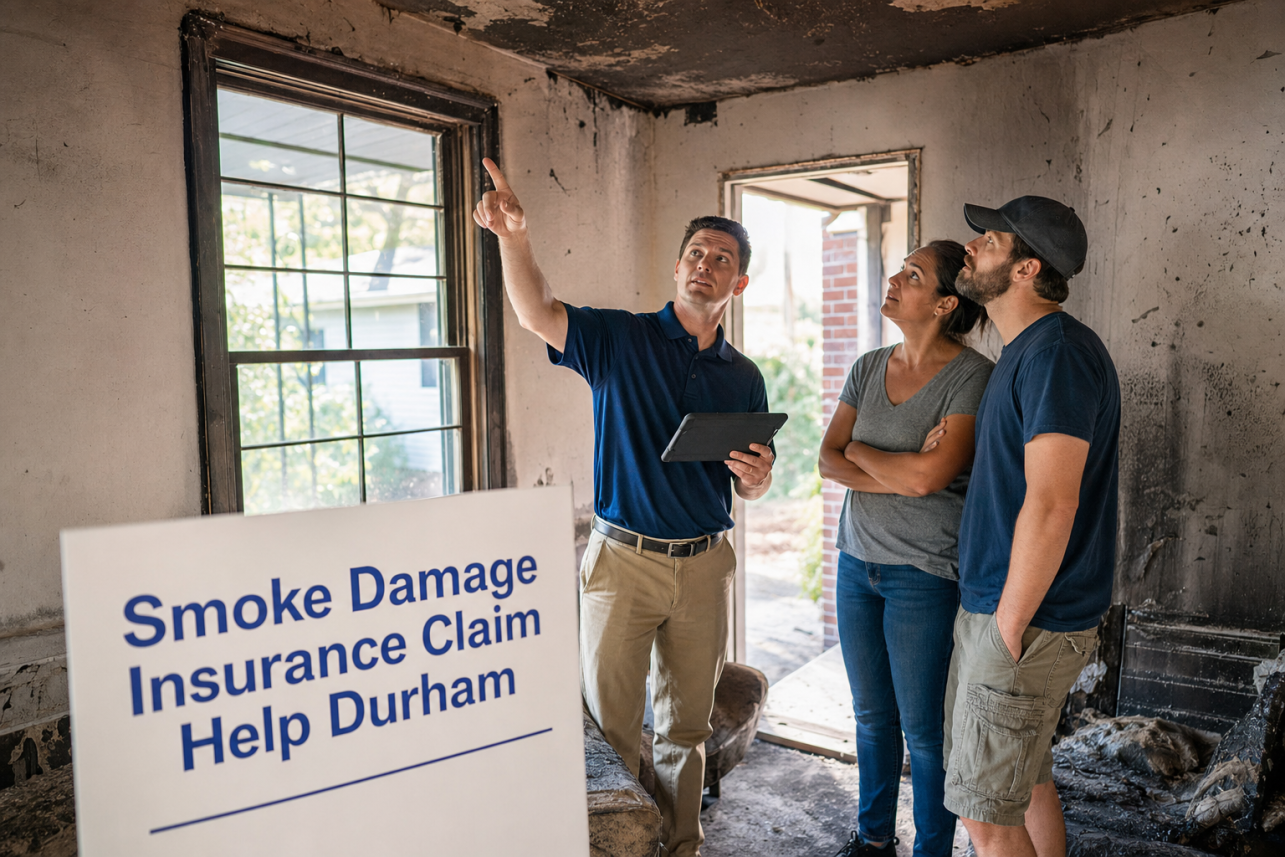
If you need smoke damage insurance claim help Durham homeowners can rely on, For The Public Adjusters, Inc. represents you — not the insurance company — from the first inspection through final settlement. Smoke travels far beyond the room where a fire starts, and insurers frequently underestimate what it takes to properly clean, deodorize, and restore a home. As licensed and bonded public adjusters, we document the full extent of the loss, prepare the proof of loss, and negotiate on your behalf.
What This Service Is
A smoke damage claim is often more complicated than the fire that caused it. Even a small kitchen fire or a lightning strike during one of our summer thunderstorms can push soot and acidic residue through your ductwork into rooms that never saw a flame. That residue settles inside walls, on electronics, in upholstery, and in your HVAC system — and if it isn't found and priced correctly, your settlement won't cover the real cost of restoration.
As your public adjuster, we work only for you. We assess the damage room by room, test surfaces for soot and residue, inventory and value your personal property, and account for things insurers commonly skip — odor removal, duct cleaning, damaged wiring and appliances, and the water damage firefighters leave behind. Then we prepare the claim documentation and negotiate the settlement with your insurance company.
The NCDOI Public Adjusters Guide explains exactly what a licensed public adjuster in North Carolina can do for a policyholder, and we work within those rules on every claim. We also handle related losses — fire damage, water damage, tree strikes, and residential and commercial claims of all kinds — so if your loss involves more than smoke, one team manages all of it.
Common Problems
Why Is The Insurance Company's Offer So Much Lower Than The Real Cost Of Cleanup?
Insurers often price smoke losses as a surface cleaning job — wipe the walls, repaint, done. Real restoration is far more expensive: soot bonds to porous materials, odor penetrates insulation and framing, and electronics corroded by acidic residue may need replacement, not a wipe-down.
There's also the question of how your things are valued. If your insurer pays actual cash value, they deduct depreciation from everything — your five-year-old sofa is worth a fraction of what a new one costs. Many policies let you recover that depreciation later, but only if the claim is documented and pursued correctly. We build a detailed contents inventory with realistic values so nothing gets written off for less than your policy allows, and we make sure additional living expense coverage is used if you can't stay in the home.
The Adjuster Missed Damage, The Claim Is Dragging On — What Can I Actually Do?
The most common problems we see in Durham smoke claims are hidden damage and delay. The insurance company's adjuster spends an hour on site, misses soot inside wall cavities and the HVAC system, and the estimate that follows reflects only what was visible. Weeks later, the smell comes back and the insurer says the claim is closed.
You have more leverage than you think. Policyholders have won when insurers wrongly refuse to pay — in Gruenberg v. Aetna Insurance Co., a business owner whose property burned sued after his insurer denied the claim, and the court held that an insurance company can be held liable for handling a claim in bad faith. Most disputes never need to reach a courtroom, though. A thorough independent damage assessment, a properly filed proof of loss, and persistent negotiation resolve most underpaid or stalled claims. We also watch every deadline in your policy so a slow insurer never runs out your clock.
Where Can I Get Honest Smoke Damage Insurance Claim Help Durham Homeowners Actually Benefit From?
You can handle a claim yourself, and for a very small loss that may be fine. But smoke claims involve building science, contents valuation, policy language, and negotiation — and the insurer's adjuster does this every day while you're doing it once, under stress, possibly displaced from your home.
When you're comparing help, ask three things. Is the adjuster licensed with the North Carolina Department of Insurance? Do they represent you exclusively, rather than working for insurers or a restoration contractor with its own interests? Will they put the full scope of damage in writing before negotiating? For The Public Adjusters, Inc. is licensed and bonded, works only for policyholders, and is paid from the recovery — so our interests are aligned with yours. We never promise a specific dollar outcome, because no honest adjuster can; what we promise is a complete, well-documented claim and a professional fighting your corner.
Our Process
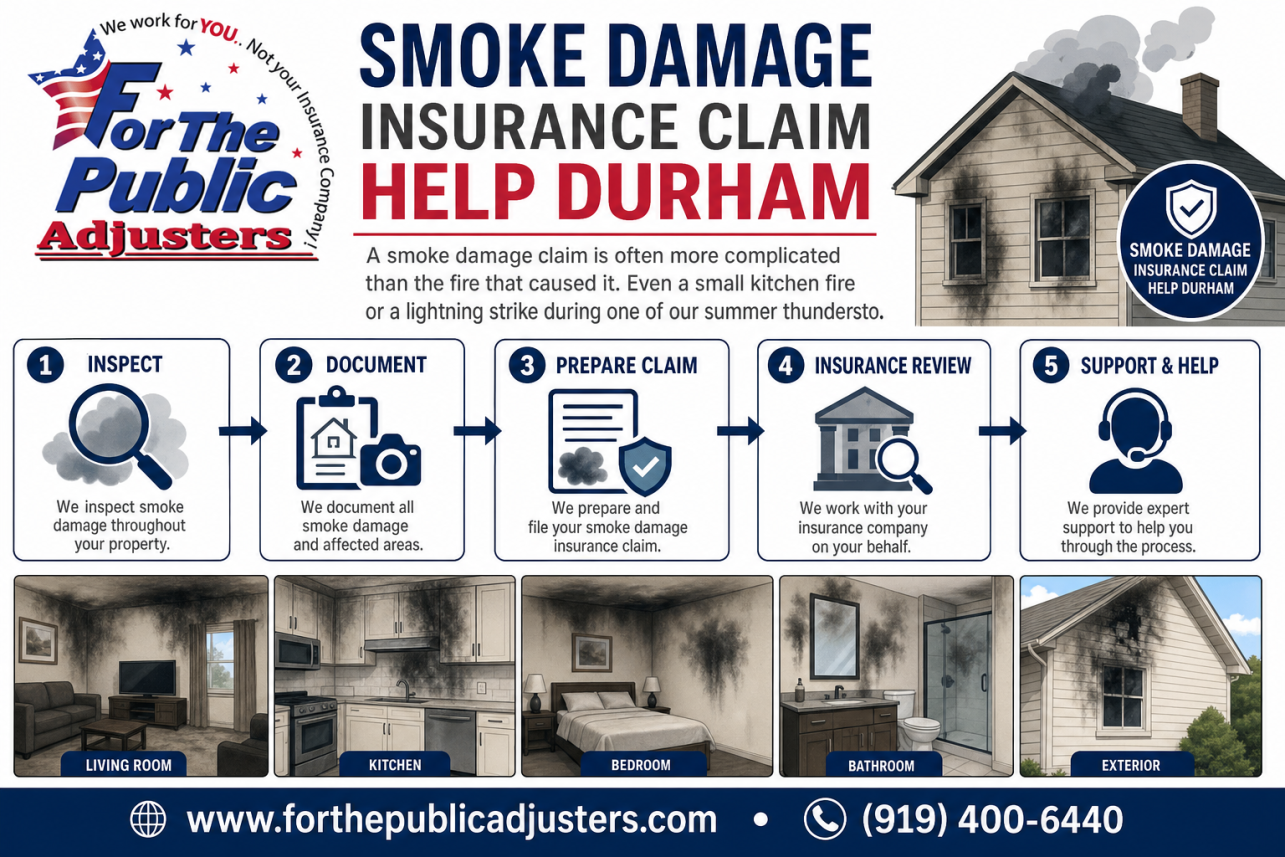
Free Claim Review And Full Smoke Damage Assessment
We start by reading your policy so you know exactly what coverage you have — dwelling, contents, additional living expenses, and your limits. Then we inspect the property thoroughly, including places the insurer's adjuster rarely checks: duct interiors, attic spaces, wall cavities, wiring, and appliances. Smoke residue hides, and finding it early is what separates a full settlement from a partial one.
Documentation, Inventory, And Proof Of Loss
We photograph and record every affected area, build a room-by-room inventory of damaged personal property with supportable values, and price the structural work including odor removal and secondary water damage from firefighting. Then we prepare and file the formal proof of loss your policy requires, correctly and on time. This paperwork is where most do-it-yourself claims lose money.
Negotiation And Settlement
We present the documented claim to your insurance company and handle every meeting, phone call, and counter-offer. If they send their own experts, we're there. If they delay or dispute the scope, we push back with evidence. You stay informed at every step, and you make the final decision on any settlement.
| What Happens | Filing On Your Own | With For The Public Adjusters |
|---|---|---|
| Who scopes the damage | The carrier's adjuster, who works for the insurance company | An independent scope built for you, often with hygienist testing |
| Hidden smoke migration (ducts, attic, wall cavities) | Usually missed — only visible soot gets scoped | Inspected, sampled, and documented before settlement talks begin |
| Contents and soft goods | Lumped into a small cleaning allowance | Full inventory with cleaning-vs-replacement decisions item by item |
| Additional living expenses / lost income | Often unclaimed because owners don't know it's covered | Calculated and claimed from day one |
| Negotiating power | You against a trained claims professional | A licensed NC public adjuster negotiating on equal footing |
| Typical outcome | Fast, low first offer accepted under pressure | Documented claim that reflects the true cost to restore your property |
Commonly Overlooked In The Public Adjusting Industry
- Soot inside the HVAC system and air handler — It's invisible from the living space, so carrier adjusters rarely open ducts — yet the system recirculates contamination into every room.
- Protein smoke from kitchen fires — It leaves almost no visible residue, so a claim gets scoped as minor even though the greasy film and odor are among the hardest damages to remove.
- Attic insulation as an odor reservoir — Nobody checks the attic after a first-floor fire, but insulation soaks up smoke and releases it for years, especially in humid North Carolina summers.
- Corrosion damage to electronics that still power on — Acidic soot on circuit boards causes failures weeks or months later, long after the claim has been closed and the file forgotten.
- Additional living expense coverage during cleanup — Policyholders assume ALE only applies to fire-destroyed homes, so they live in a contaminated house without ever claiming hotel and meal costs they're owed.
- Smoke intrusion from a neighboring property's fire — Owners are told the loss 'happened next door' and walk away, not realizing smoke is a covered peril under their own policy regardless of where the fire started.
- Post-remediation clearance testing — Without wipe samples or air testing after cleaning, there's no proof the home is actually clean — and no leverage to reopen the claim when the odor returns.
- Statutory deadlines and proof-of-loss requirements under NC policies — Homeowners spend weeks getting cleaning quotes and unknowingly blow past documentation deadlines that carriers later use to reduce or deny payment.
Case Studies
Case Study #1
Situation: A family in the Woodcroft area of Durham had a kitchen fire that was extinguished within minutes. The flames barely spread, but smoke traveled through the HVAC returns and coated every room on the first floor.
Problem: The carrier's adjuster scoped the loss as a 'light cleaning' claim and offered $9,400 — enough to wipe down walls and deodorize, but nothing for the ductwork, insulation, soft goods, or the protein residue baked onto cabinet finishes.
Investigation: We brought in an industrial hygienist to take surface wipe samples and air quality readings throughout the home, including inside the supply and return ducts. We also documented the odor and residue in closets and attic spaces the carrier's adjuster never opened.
Findings: Lab results confirmed soot and protein residue well beyond the kitchen, including char particulate inside the duct system and attic insulation acting as an odor reservoir. Cleaning alone would not have resolved the contamination.
Solution: We rebuilt the scope line by line: full duct replacement, attic insulation removal and replacement, sealing and repainting of affected surfaces, cabinet refinishing, contents inventory with proper cleaning-versus-replacement decisions, and additional living expenses during the work.
Outcome: The claim settled at $86,700 — more than nine times the original offer — and the family did not move back in until post-remediation testing came back clean.
Lesson: Smoke doesn't stop where the fire stopped. If the scope only covers rooms with visible soot, the settlement is almost certainly incomplete.
Case Study #2
Situation: The owner of a small retail shop near Ninth Street in Durham suffered smoke intrusion when a fire broke out in the adjoining unit. Her space never burned, but smoke poured through shared wall cavities and the ceiling plenum overnight.
Problem: Her carrier initially questioned whether she had a covered loss at all, arguing the fire happened 'on someone else's property.' They then delayed while inventory sat absorbing odor, and offered nothing for business interruption.
Investigation: We pulled the policy language on smoke as a named peril, documented the shared plenum with photos and a contractor's inspection, and created a full inventory of contaminated merchandise with pre-loss sales records to establish business income figures.
Findings: The policy clearly covered smoke damage regardless of where the fire originated. The plenum inspection showed heavy soot deposits directly above her sales floor, and roughly $40,000 in clothing and paper goods was unsellable due to embedded odor.
Solution: We presented a documented claim covering structural cleaning and sealing, full merchandise replacement at retail cost basis per the policy, and a business interruption calculation covering the eleven weeks she was closed.
Outcome: The carrier paid $147,000 across property, contents, and lost income — after starting from a position of denying coverage entirely.
Lesson: Coverage for smoke doesn't depend on where the fire started. Delay is the carrier's friend and the policyholder's enemy, because odor damage compounds while paperwork sits.
| Item or Material | Usually Cleanable? | What It Depends On | What Carriers Often Get Wrong |
|---|---|---|---|
| Painted drywall and ceilings | Sometimes | Type of residue — dry soot may clean; protein or wet smoke usually needs sealing and repainting | Approving a wash-down when odor is embedded in the paint film |
| HVAC ductwork | Rarely | Whether soot reached flex duct interiors and the air handler; testing tells you | Skipping duct inspection entirely because no fire touched the system |
| Attic and wall insulation | No | Insulation absorbs odor permanently and cannot be effectively cleaned | Leaving it in place, so the smell returns every humid Durham summer |
| Mattresses, upholstery, clothing | Sometimes | Porosity and residue type; protein smoke rarely comes out of soft goods | Paying a flat 'contents cleaning' allowance instead of itemizing replacement |
| Kitchen cabinets and wood finishes | Sometimes | Whether residue penetrated the finish; refinishing often costs near replacement | Approving degreaser cleaning on finishes that are permanently discolored |
| Electronics and appliances | Sometimes | Corrosive soot on circuit boards causes failures weeks later | Declaring them fine because they powered on the day of inspection |
| Children's items, food, medications | No | Health guidance is replacement, period, for anything ingestible or mouthed | Omitting these categories from the contents estimate altogether |
Reviews
After a garage fire, our insurance company said the smoke smell in the house was 'pre-existing.' For The Public Adjusters brought in testing that proved otherwise and got our whole HVAC system and attic insulation covered. The final settlement was almost five times the first offer. I wouldn't have known where to start on my own.
Marcus T., Durham NC
Our neighbor's fire filled our home with smoke and the carrier treated it like we just needed some candles and a wipe-down. This team documented soot in places I never would have looked — inside closets, behind the fridge, in the ducts. They handled every call with the adjuster so I didn't have to. Worth every penny of the fee.
Denise W., Hope Valley
I needed smoke damage insurance claim help Durham homeowners could actually trust, and a contractor friend pointed me here. They caught that my contents were undervalued by tens of thousands and that the 'cleaning' estimate ignored my kids' mattresses and clothing entirely. Settlement more than tripled. Only wish I'd called them the day of the fire instead of three weeks in.
Jamal R., Durham
Frequently Asked Questions
How Do I Know If I Need Smoke Damage Insurance Claim Help Durham Homeowners Can Actually Trust?
If your insurer's estimate feels low, your claim is stalling, or the adjuster who visited spent twenty minutes walking through a home that smells like a campfire, that's usually the moment to bring in a licensed public adjuster. Smoke claims are among the most commonly underpaid losses in North Carolina because so much of the damage is invisible at first glance.
Smoke residue migrates through HVAC ductwork, settles inside wall cavities, and bonds to porous materials like drywall, insulation, carpet padding, and unsealed wood. Carrier adjusters often scope only what they can see, which is why initial estimates frequently cover cleaning when the situation actually calls for sealing, replacement, or full duct remediation.
Another red flag is odor that returns after cleaning. Durham's humid summers reactivate smoke odor trapped in building materials, and if your settlement only paid for surface cleaning, you'll be living with that smell every August. A public adjuster documents the loss with residue testing, moisture and odor mapping, and a line-item estimate the carrier has to respond to in writing.
For The Public Adjusters, Inc. works exclusively for policyholders, never for insurance companies. We handle claims across Durham County, from older homes near Trinity Park with plaster walls that absorb smoke deeply, to newer construction in South Durham where synthetic materials produce especially corrosive residue. If you're unsure whether your payout is fair, a policy and estimate review costs you nothing and takes less than an hour.
What Does A Durham Public Adjuster Do Differently On A Smoke Claim Than My Insurance Company's Adjuster?
The core difference is who we represent. The adjuster your carrier sends works for the insurance company. A public adjuster is licensed by the North Carolina Department of Insurance to work only for you, the policyholder, and our fee comes from the recovery we negotiate, so our interests are aligned with yours.
On smoke losses specifically, that difference shows up in the scope. We use residue sampling to distinguish between protein smoke, wet smoke, and dry smoke, because each type demands a different remediation protocol and a different price. We inspect attics, crawl spaces, ductwork, and contents, then build a room-by-room estimate using the same software carriers use, so there's no arguing over format, only over what's actually damaged.
We also read your policy line by line. Many Durham homeowners don't realize their coverage includes additional living expenses if odor makes the home temporarily unlivable, or contents cleaning and replacement for clothing, upholstery, and electronics corroded by acidic soot. Carrier adjusters rarely volunteer those coverages; we claim them.
Finally, we manage the entire back-and-forth: documentation, supplements, appraisal demands if negotiations stall, and deadlines under North Carolina claim-handling rules. You get updates in plain English instead of adjuster jargon. Most clients tell us the biggest relief isn't even the larger settlement, it's not having to fight the insurance company while also trying to get their house and life back in order.
How Much More Can I Recover With Smoke Damage Insurance Claim Help Durham Residents Hire Professionals For?
Every loss is different, so no honest adjuster will promise a specific number. But there's a reason underpayment is so common on smoke claims: the damage that costs the most is the damage that's hardest to see, and initial carrier estimates routinely miss it.
The biggest gaps we find in Durham claims are HVAC contamination, which can run into five figures when full duct cleaning or replacement is warranted; smoke penetration into insulation and wall cavities, which requires demolition and rebuild rather than wipe-downs; and contents losses, where families accept a lowball allowance because inventorying every smoke-damaged item feels overwhelming. We prepare that inventory for you, with replacement-cost pricing.
We also frequently recover additional living expenses that were never offered, code-upgrade costs on older Durham homes where repairs trigger current building requirements, and proper odor remediation using thermal fogging or ozone treatment instead of the basic cleaning the first estimate assumed.
Our fee is a percentage of what we recover, agreed to in writing before we start, and capped under North Carolina law. If we don't add value, you owe nothing. In practice, professionally documented smoke claims settle for substantially more than the carrier's opening number, which is exactly why insurers write those opening numbers the way they do.
For The Public Adjusters, Inc. offers a free review of your policy and any estimate you've already received, so you can see the gap for yourself before deciding whether smoke damage insurance claim help Durham policyholders rely on makes sense for your situation.
My Kitchen Fire Was Small, But The Smoke Odor Spread Through My Whole House. Will Insurance Cover Cleaning Rooms The Fire Never Touched?
In most cases, yes. Your homeowner's policy covers direct physical loss from smoke, and smoke doesn't respect room boundaries. A small stovetop fire can push protein smoke, which is nearly invisible but intensely odorous, through every level of a home in minutes, especially when the HVAC system is running.
The challenge is proof. Carriers often limit small-fire settlements to the kitchen itself, arguing the rest of the house just needs airing out. That position falls apart with proper documentation. Residue wipe tests on surfaces two rooms away, photographs of soot filming on ceiling fans and return-air vents, and odor assessments all establish that the loss extends well beyond the point of origin.
Protein smoke is particularly stubborn in Durham's climate. Humidity reactivates the odor months later, and it bonds to paint, cabinetry, and fabrics in ways that ordinary cleaning won't fix. Proper remediation may mean sealing and repainting, cleaning or replacing ductwork, and professionally treating soft contents like curtains, rugs, and clothing.
As your Durham public adjusters, we scope the entire structure, not just the room where the fire started, and we present the carrier with testing and estimates they can't dismiss with a walkthrough. We've handled whole-house smoke claims from kitchen fires across Durham County, and the pattern is consistent: what starts as a few thousand dollars for kitchen cleaning often becomes a properly funded, whole-home remediation once the damage is documented correctly. Don't accept a kitchen-only settlement until someone working for you has inspected everything.
How Soon After A Fire Should I Get Smoke Damage Insurance Claim Help Durham Public Adjusters Recommend Acting Fast — Why?
The short answer: within the first few days if possible. Smoke residue is acidic, and it keeps damaging your home the longer it sits. Soot etches glass, corrodes metal fixtures, pits chrome, and permanently yellows painted surfaces and countertops. What was cleanable on day two may be a replacement item by week three.
There is also a documentation reason to move quickly. In our experience with Durham homes — from older properties near Trinity Park to newer builds out toward Brier Creek — insurance carriers scope smoke losses early and rarely revisit them voluntarily. If soot in your ductwork, attic insulation, or closets isn't documented before cleanup begins, it becomes very hard to prove later.
North Carolina policies also impose duties on you after a loss, including protecting the property from further damage and reporting the claim promptly. Waiting weeks to act can give the carrier grounds to reduce what it pays.
That said, if your fire happened months ago and you feel the settlement was too low, don't assume it's too late. NC generally allows three years to pursue a property claim dispute, and supplemental claims are common. We regularly reopen underpaid smoke losses for Durham homeowners. The earlier we're involved, the more leverage you have — but later is still far better than never.
What Does It Cost To Hire For The Public Adjusters For A Smoke Claim In Durham?
We work on contingency, which means there is no upfront cost and no hourly billing. Our fee is a percentage of the insurance settlement we recover for you, and North Carolina caps public adjuster fees by law, so you're protected from excessive charges. If we don't recover anything, you owe us nothing.
The practical question most Durham homeowners ask is whether the fee is worth it. On smoke losses specifically, the answer is usually yes — because smoke claims are among the most commonly underpaid property claims. Carriers often approve surface cleaning and repainting while overlooking contaminated HVAC systems, soot absorbed into insulation and soft goods, odor sealing, and full contents inventories. Those overlooked items frequently exceed the original offer several times over.
Before you sign anything, we review your policy and inspect the damage. If we honestly believe your carrier's offer is fair and there's little for us to add, we'll tell you that. Taking on a claim where we can't improve the outcome doesn't help you or us.
You'll get a written agreement stating the exact percentage before we start, as North Carolina regulations require. There are no hidden charges, no fees on money the carrier already paid you before we were hired (in most cases), and no cost for the initial consultation and inspection anywhere in Durham County.
My Insurance Company Already Sent A Check For My Smoke Damage, But It Seems Low. Can You Still Help?
Yes, and this is one of the most common situations we handle. Accepting or even depositing a claim check in North Carolina does not typically close your claim or waive your right to seek more, unless you signed a full release — which is rare in standard property claims. Check your paperwork, but in most cases the claim can be supplemented.
Smoke losses are underpaid for predictable reasons. The carrier's adjuster often scopes only the rooms nearest the fire, prices basic cleaning instead of proper soot remediation, skips HVAC and duct contamination, and undervalues contents like clothing, upholstered furniture, mattresses, and electronics that absorbed smoke. Odor that returns on humid Durham summer days is a classic sign the original scope was too shallow.
When you hire us after a payment, we start by comparing the carrier's estimate line by line against the actual damage. We document what was missed — often with photos, moisture and residue testing, and contractor pricing that reflects real Durham-area labor and material costs, not database defaults. Then we file a supplemental claim demanding the difference.
Homeowners who came to us for smoke damage insurance claim help Durham carriers had already 'settled' have frequently recovered substantially more than the first check. The key is acting before you've completed repairs with your own money and before evidence is cleaned away, though even then we can often rebuild the claim from records and remaining damage.
Will My Insurance Pay To Clean Or Replace My HVAC System After Smoke Got Into The Ducts?
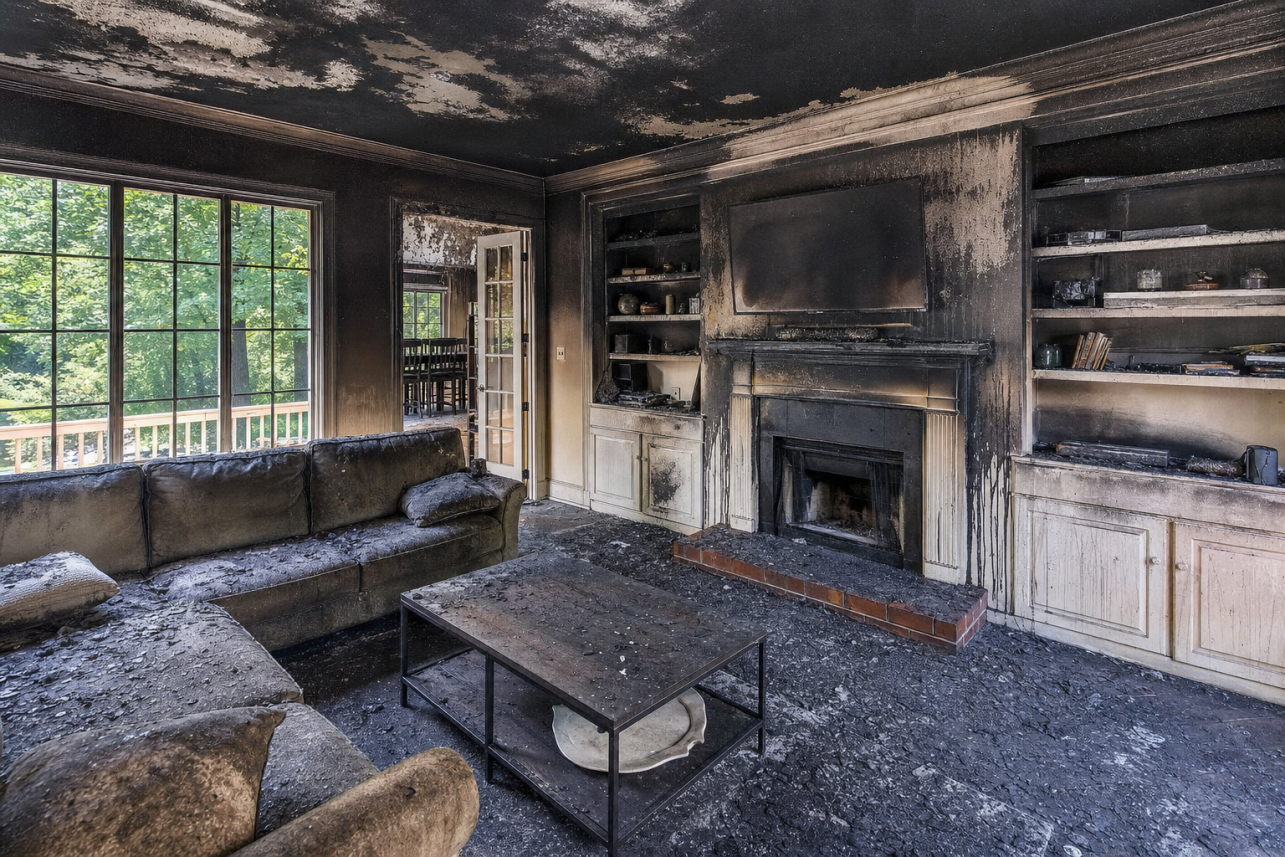
It should, if your policy covers the fire — but this is one of the most frequently missed items on smoke claims, and it matters a lot in Durham where nearly every home relies on central heating and air.
Here's the problem. When a fire produces smoke, your HVAC system often keeps running and pulls soot into the return, through the air handler, and out into every supply duct. The system then redistributes contamination each time it cycles on. If your ducts aren't professionally cleaned — or replaced when flex duct is too contaminated — you'll smell smoke every time the AC kicks on in July, and soot will keep resettling on surfaces you already paid to clean.
Carrier adjusters routinely omit this. They rarely open the air handler, inspect the evaporator coil, or scope the duct runs in the crawlspace or attic, which is where most Durham homes hide them. Their estimate covers wiping walls and washing carpets while the contaminated system quietly undoes the work.
When we handle a smoke loss, we document the HVAC system specifically: photos inside returns and supplies, residue sampling where useful, and evaluations from licensed mechanical contractors. If duct board or flex duct absorbed odor and can't be restored, we push for replacement, not just cleaning, and we include the cost of sealing, filtration, and post-remediation testing. That single category can add thousands to a settlement — and more importantly, it's the difference between a house that's actually restored and one that still smells like the fire a year later.
A Fire At My Neighbor's House Filled My Durham Home With Smoke. Can I Still Get Smoke Damage Insurance Claim Help Durham Policies Actually Cover This?
Yes, and this comes up more often than people realize in Durham's tighter neighborhoods — Old North Durham, Trinity Park, Watts-Hillandale — where homes sit close together. Smoke that migrates from a neighboring structure fire and damages your property is generally a covered peril under your own homeowners policy, even though the fire never touched your house.
The complication is proof. Because there's no visible burn damage on your property, insurance carriers often minimize these claims or attribute the odor and residue to something pre-existing. That's exactly the situation where professional smoke damage insurance claim help Durham homeowners can rely on makes a measurable difference.
We document the contamination with residue sampling and photographic evidence, tying the soot chemistry back to the neighboring fire. We map how smoke entered — attic vents, soffits, window seals, HVAC intakes — and how far it traveled through your home. Then we build a scope of loss that includes cleaning, sealing, odor remediation, and contents restoration.
One more point: you file against your own policy, not your neighbor's. Your carrier may later pursue subrogation against the neighbor's insurer, but that's their problem, not yours. Your job is proving the extent of your damage, and our job is making sure that proof is thorough enough that the carrier can't undervalue it. Don't let anyone tell you a neighbor's fire isn't your claim to make — it absolutely is.
Should I Clean Up The Soot Myself Before The Insurance Adjuster Comes Out?
No — and this is one of the most costly mistakes we see Durham homeowners make. It feels natural to start wiping down walls and washing fabrics, but cleaning before your loss is fully documented destroys the evidence your claim depends on.
Soot residue is proof. The pattern of staining shows how smoke moved through your home, which rooms it reached, and how heavily each area was affected. Once you wipe it away, the carrier's adjuster sees a clean surface and scopes the claim accordingly. We've handled claims in Hope Valley and North Durham where well-meaning cleanup cost families thousands in unrecognized damage.
There's a second problem: DIY cleaning often makes smoke damage worse. Wet-wiping protein or synthetic soot can smear it into paint, drywall, and grout, turning a cleanable surface into one that needs replacement. Ordinary household cleaners don't neutralize acidic soot residue, which continues corroding metals, electronics, and finishes.
What should you do instead? Photograph everything — every room, every surface, open every closet and drawer. Keep damaged items rather than throwing them out; carriers can deny payment for contents they never got to inspect. Do only what's needed to prevent further damage, like covering openings or shutting down the HVAC so ducts don't spread residue.
Then bring in a public adjuster before the carrier's inspection. We document the loss in its untouched state, and remediation happens afterward, on a properly funded scope — not out of your pocket.
Does Insurance Cover My Clothing, Furniture, And Electronics That Absorbed Smoke — Or Just The House Itself?
Your personal property is covered under a separate part of your policy — usually Coverage C — and on smoke losses, contents are frequently the largest undervalued portion of the entire claim.
Smoke is invasive. It penetrates upholstery, mattresses, drapes, clothing, books, and area rugs. It leaves corrosive residue inside electronics, appliances, and musical instruments, where circuit boards can fail weeks after the fire. Carriers routinely offer a lump-sum "cleaning allowance" for contents that's a fraction of what proper restoration or replacement actually costs in Durham.
When we handle contents on a smoke claim, we build a room-by-room inventory of every affected item — not a rough estimate, but an itemized list with descriptions, quantities, and replacement values. We separate what can genuinely be restored from what can't. Some items, like smoke-saturated mattresses or particleboard furniture, hold odor no matter how they're treated, and we push the carrier to replace rather than clean them.
We also watch the depreciation math. If you carry replacement cost coverage, you're entitled to recover the depreciation the carrier initially withholds once items are replaced — money many homeowners never collect because nobody explained the process.
Don't discard anything until it's documented, and don't accept a flat contents payout without an inventory behind it. In our experience handling smoke losses across Durham County, a properly documented contents claim often comes back two to three times higher than the carrier's first offer.
How Long Does A Smoke Damage Claim Take In Durham, And Will Insurance Pay For Us To Live Elsewhere In The Meantime?
Timelines vary with the size of the loss and how the claim is handled. A well-documented, professionally presented smoke claim in Durham typically resolves in six to twelve weeks. Poorly documented claims — or claims where the homeowner and carrier go back and forth over scope — can drag on six months or longer. North Carolina requires insurers to acknowledge and respond to claims promptly, and part of our role is holding carriers to those obligations so your file doesn't sit idle.
As for living expenses: if smoke contamination makes your home uninhabitable — strong odor, unsafe air quality, active remediation work — your policy's Additional Living Expense coverage should pay for comparable temporary housing, plus the increase in your normal costs like meals and mileage. Carriers sometimes argue a smoke-damaged home is still "livable" to avoid ALE payouts. We counter that with air quality documentation and remediation schedules showing why occupancy isn't reasonable.
Keep every receipt from day one: hotels, short-term rentals, restaurant meals, laundry, pet boarding. ALE reimburses actual documented costs, so gaps in receipts are gaps in recovery.
The honest answer is that smoke damage insurance claim help Durham families bring in early usually shortens the timeline, not lengthens it. When the carrier receives a complete, professionally documented scope up front, there's less to dispute — and disputes are what stretch claims out. For The Public Adjusters manages the deadlines, the ALE tracking, and the negotiation so you can focus on getting your household back to normal.
What Documentation Do I Need For Smoke Damage Insurance Claim Help Durham Adjusters Say Makes Or Breaks A Claim?
The strongest smoke claims are built on evidence gathered early, before cleaning or repairs disturb anything. Start with wide photos of every affected room, then close-ups of soot lines on walls, ceilings, window sills, and inside cabinets and closets. Smoke residue often hides in places carriers won't look unless you point it out.
Next, keep a running inventory of damaged contents — clothing, upholstery, electronics, artwork, and anything porous. Note the item, approximate age, and replacement cost. Receipts help, but they aren't required; photos and reasonable estimates carry real weight.
Save every receipt tied to the loss: hotel stays, restaurant meals, laundry services, air purifiers, and emergency cleaning. Under most North Carolina homeowner policies, these fall under additional living expenses or mitigation costs and are reimbursable.
Where our team adds the most value is the documentation homeowners can't easily produce themselves. We arrange third-party testing for soot and char particles, hydrocarbon residue, and chloride contamination on metals and electronics. That lab data is often the difference between a carrier paying to "wipe down" a home and paying to properly remediate it.
When residents call For The Public Adjusters for smoke damage insurance claim help Durham carriers can't easily dispute, this is exactly what we assemble: a documented, tested, line-item claim file. If you've already cleaned some areas, don't panic — call us anyway. There is almost always residue remaining in HVAC systems, attics, and wall cavities that still proves the scope of loss.
My Insurance Company Says The Smoke Residue In My Durham Home Is Just Cosmetic And Only Offered A Light Cleaning. Can That Decision Be Challenged?
Yes, and this is one of the most common disputes we handle in Durham County. Carriers frequently classify smoke damage as "cosmetic" or "light soot" because it justifies a small cleaning allowance instead of full remediation. That classification is an opinion, not a fact — and it can absolutely be challenged with evidence.
Smoke is corrosive and acidic. Left in place, it etches metal fixtures, degrades electronics, and permanently discolors finishes. Odor compounds penetrate drywall, insulation, and framing, which is why a surface wipe-down so often fails and homeowners end up smelling smoke months later, especially during humid Durham summers when trapped odors reactivate.
To overturn a lowball scope, we bring in independent industrial hygienists to test surfaces and air quality throughout the home. Lab results showing combustion byproducts in rooms the carrier called "unaffected" are difficult for any insurer to dismiss. We then write a remediation scope based on industry standards — sealing, thermal fogging, duct cleaning, or selective demolition where residue penetrated materials — and negotiate from documentation rather than opinion.
North Carolina policyholders also have the right to dispute a scope of loss, invoke appraisal in many policies, and be represented by a licensed public adjuster throughout. You are not obligated to accept the first assessment.
If your insurer's cleaning estimate feels disconnected from what you're actually living with, that instinct is usually correct. A second, independent evaluation costs you nothing upfront and often changes the outcome dramatically.
I Own Rental Property Near Duke And NCCU That Had Smoke Damage. Does A Landlord's Claim Work Differently, And Can You Help With Lost Rent?
Landlord claims follow the same basic process but involve coverages many Durham property owners overlook — and that's where money gets left behind.
First, your dwelling policy covers the structure, but a landlord policy typically also includes fair rental value or loss-of-rents coverage. If smoke contamination makes a unit uninhabitable, or a tenant lawfully breaks the lease because of it, your policy should pay the rent you lose during remediation. Carriers rarely volunteer this; we calculate it based on your actual lease terms and Durham market rents and put it into the claim.
Second, landlord policies cover owner-supplied contents — appliances, window treatments, furnished-unit furniture — but not the tenant's belongings, which fall under their renters policy. Sorting out which items belong to which claim matters near Duke and NCCU, where furnished student rentals blur those lines.
Third, rental properties face building-code triggers. If remediation opens walls in an older Trinity Park or Walltown property, Durham inspections may require code upgrades, and ordinance-or-law coverage should pay for them.
When landlords come to For The Public Adjusters for smoke damage insurance claim help Durham rental owners can rely on, we document the unit, coordinate with tenants for access, quantify lost rent month by month, and manage the carrier so the property gets back on the market faster. Every week a unit sits contaminated is real income lost, so we push carriers on timelines as hard as we push on dollar amounts. Multi-unit and single-family rentals both qualify, and we handle claims for out-of-state owners regularly.
My Settlement Statement Shows A Big Deduction For Depreciation. Do I Ever Get That Money Back On A Smoke Damage Claim?
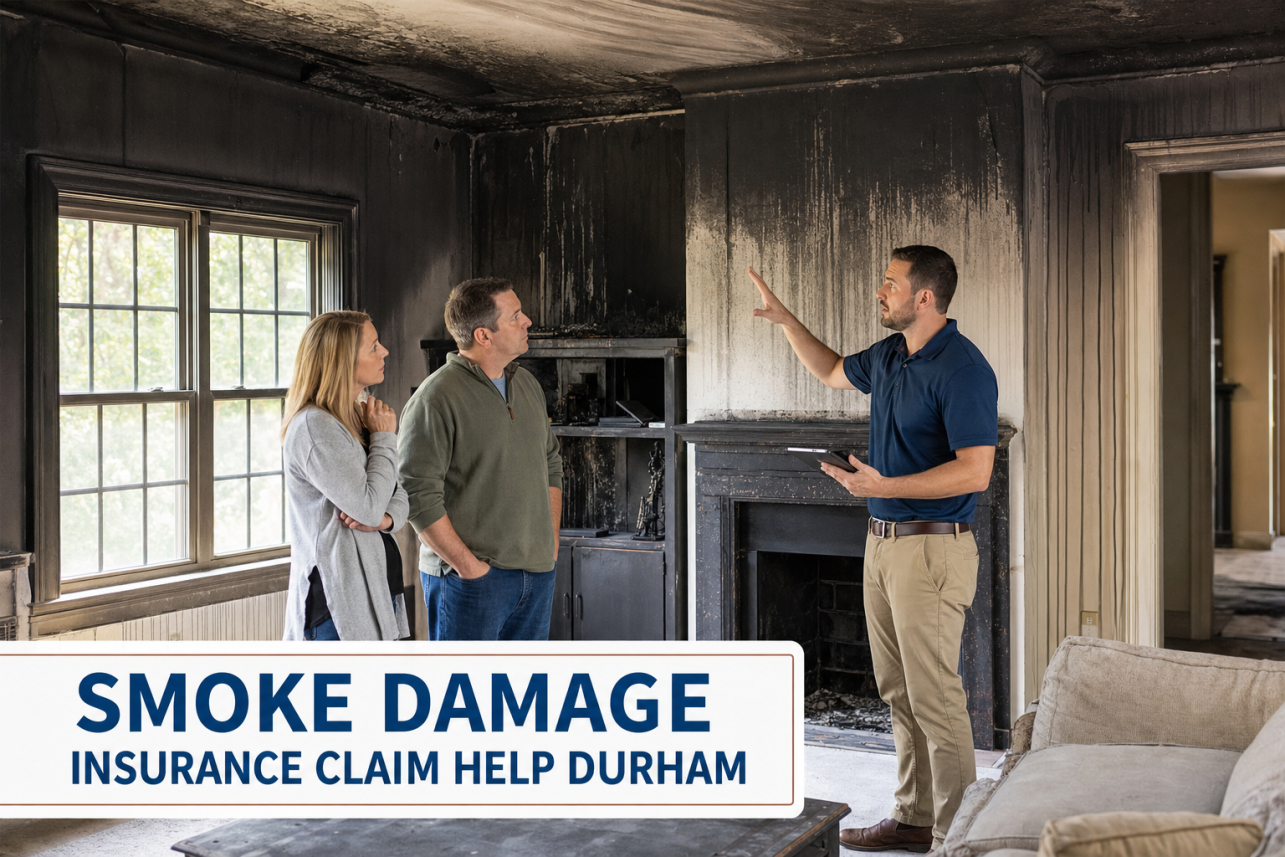
In most cases, yes — and misunderstanding this costs Durham homeowners thousands of dollars every year.
If you carry replacement cost coverage, which most North Carolina homeowner policies include, your insurer initially pays actual cash value: the replacement cost minus depreciation for age and wear. The withheld depreciation is called recoverable depreciation, and you're entitled to it once you actually complete the repairs or replace the damaged items.
Here's where smoke claims get tricky. Depreciation is applied line by line — to your smoke-stained ceiling paint, your soot-damaged carpet, your contaminated furniture, your HVAC components. Carriers sometimes apply aggressive depreciation percentages, and if you never submit proof of completed work, that held-back money is simply never paid. Insurers do not chase you down to release it.
Our role has two parts. First, we challenge excessive depreciation up front; a five-year-old sofa should not be depreciated like a fifteen-year-old one, and some items like certain building materials shouldn't be heavily depreciated at all. Second, we track every dollar of withheld depreciation, help you document completed repairs and replacement purchases with invoices and receipts, and formally demand the release of those funds.
Watch your deadlines, too. Many policies require repairs to be completed within a set period — often 180 days to a year from the loss — to recover depreciation. On a large smoke remediation in an older Durham home, that window can close faster than you'd expect. If your statement shows a depreciation holdback and no one explained how to recover it, bring it to us before the clock runs out.
Local Relevance
Durham's housing stock works against you in a smoke loss. Many neighborhoods here are filled with homes built in the early and mid-1900s — mill houses, bungalows, and tobacco-era construction with balloon framing, plaster walls, and original wood that absorbs smoke odor deeply and releases it slowly. What looks clean in a quick inspection can smell like fire again on the first humid August afternoon.
Summer adds its own risks. Severe thunderstorms roll through the Triangle regularly this time of year, and lightning strikes are a real cause of house fires here, along with cooking fires year-round — the National Fire Protection Association has long identified cooking as the leading cause of home fires nationwide. And when firefighters do their job, the water they use often causes as much damage as the smoke, which is why we document both together.
Durham County homeowners also face our region's humidity, which accelerates corrosion on smoke-exposed electronics and metal fixtures and makes fast, complete documentation even more important. If a hurricane remnant or tropical system complicates your loss with wind or tree damage on top of the fire, we handle those claims too.
In Durham's older neighborhoods, homes with original plaster, hardwood, and balloon framing tend to trap smoke odor far deeper than modern drywall construction — so a settlement priced for a quick surface cleaning often falls short, and our region's summer humidity has a way of pulling that hidden odor back out months later.
Talk To A Durham Public Adjuster Before You Accept An Offer
Once you sign a settlement, reopening it is hard. Before you accept your insurance company's number — or if your smoke claim has been delayed, underpaid, or denied — get a free review from For The Public Adjusters, Inc. We're licensed and bonded in North Carolina, we work only for policyholders, and we know what smoke really does to Durham homes.
Call us: (919) 400-6440
Helpful Resources
- NCDOI Public Adjusters Guide
- National Fire Protection Association (NFPA)
- North Carolina Department of Insurance — State regulator that licenses public adjusters and assists consumers
Last updated: July 28, 2026