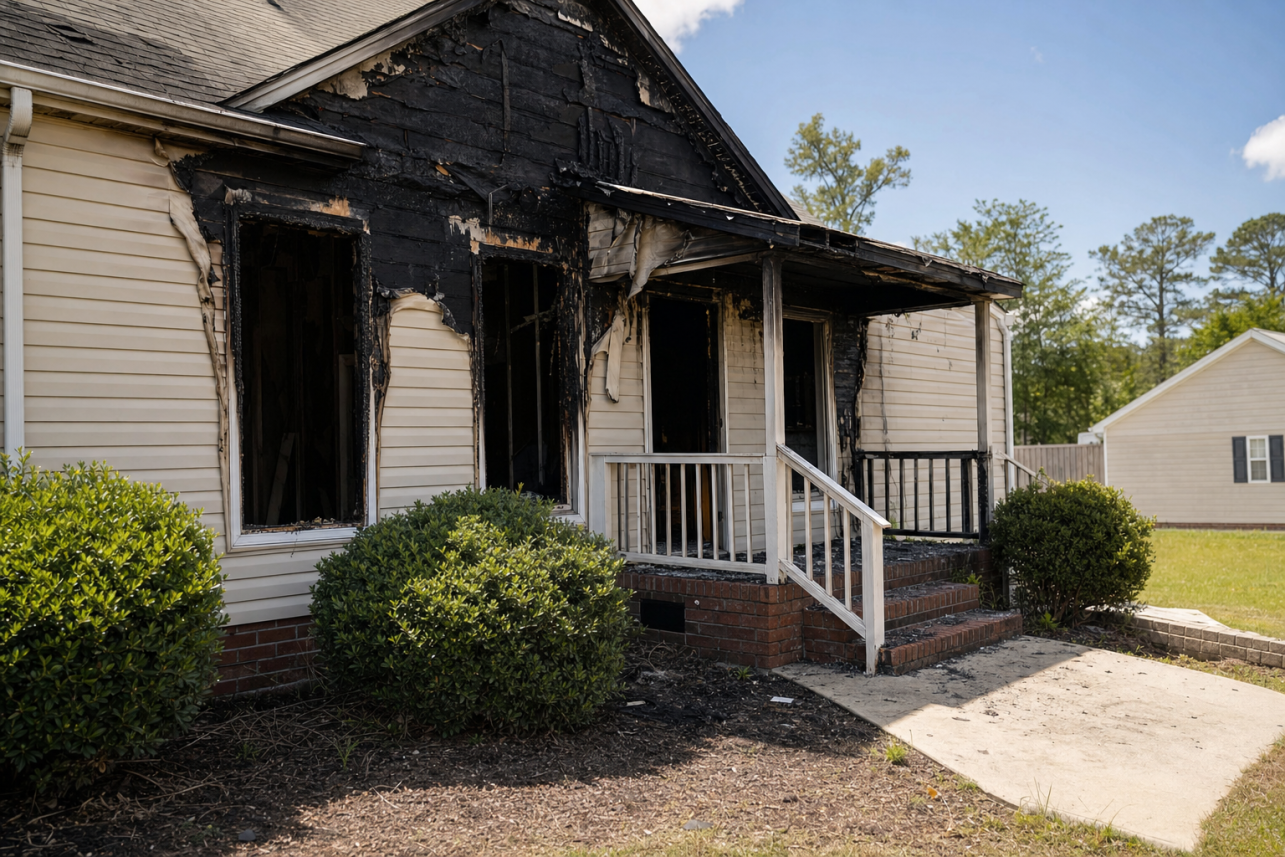
A public adjuster Bahama NC property owners can call is a licensed claims professional who works for you — not the insurance company — when your home or building suffers fire, water, smoke, tree, or storm damage. For The Public Adjusters, Inc. documents the full scope of your loss, prepares the estimate, and negotiates directly with your insurer’s adjuster. We are licensed and bonded, and we only get paid when your claim gets paid.
What This Service Is
When you file a property claim, the insurance company sends its own adjuster to evaluate the damage. That adjuster is trained, experienced, and works for the carrier. Most homeowners face that process alone, without anyone measuring, documenting, or pricing the loss from their side of the table.
A public adjuster levels that field. We inspect the damage ourselves, photograph and document everything, inventory damaged contents, prepare a detailed repair estimate, and handle the negotiation from start to finish. In North Carolina, public adjusters must be licensed, and the NCDOI Public Adjusters Guide is a good starting point for understanding what a legitimate adjuster can and cannot do for you.
For The Public Adjusters, Inc. handles residential and commercial claims across northern Durham County — fire and smoke damage, water damage, tree damage, hurricane and tornado losses, vandalism, arson claims where the homeowner is the innocent victim, vehicle-into-home damage, and flood claims including NFIP policies. We do not handle auto, health, life, or cell phone claims — property losses are all we do.
Common Problems
Is Hiring A Public Adjuster Bahama NC Worth The Fee?
Public adjusters work on a contingency percentage of the settlement, so there is no upfront cost and no fee if nothing is recovered. The real question is whether the carrier’s first offer reflects the true cost of repairs — and on significant losses, it frequently does not.
Insurance estimates often miss hidden damage: smoke residue inside wall cavities, water that migrated under flooring, structural issues behind an impact point where a tree came through the roof. A thorough, independently prepared estimate captures those items before you accept a number. We never guarantee a specific result, but we do guarantee your loss will be fully documented and professionally presented.
My Claim Was Underpaid, Delayed, Or Denied — Now What?
You are not stuck with the insurer’s first answer. Policyholders have the right to dispute a settlement, submit their own estimate, and invoke the appraisal process most policies contain. Courts have backed insureds who pushed back: in Windridge of Naperville Condominium Association v. Philadelphia Indemnity Insurance Co., the building owner prevailed against its insurer over storm-damaged siding, with the court holding the carrier owed for replacing undamaged panels so the repaired building would match.
A disputed claim is usually won on documentation. We re-inspect the property, identify what the carrier’s estimate omitted or underpriced, and present the corrected scope in the format insurance adjusters are required to respond to.
How Do I Know I’m Hiring The Right Claims Help — Or Whether I Can Handle It Myself?
You can absolutely file a claim yourself, and for small, straightforward losses that may be reasonable. For larger fires, major water losses, or structural damage, the policy language, building-code requirements, and pricing software the carrier uses put an unrepresented homeowner at a real disadvantage.
Before hiring anyone, verify the license. North Carolina requires public adjusters to be licensed, and the state publishes consumer guidance on exactly what to expect from one. Ask how the adjuster is bonded, how the fee works, and who will actually inspect your property. For The Public Adjusters, Inc. is licensed and bonded, and the person documenting your loss is a claims professional — not a salesperson.
Our Process
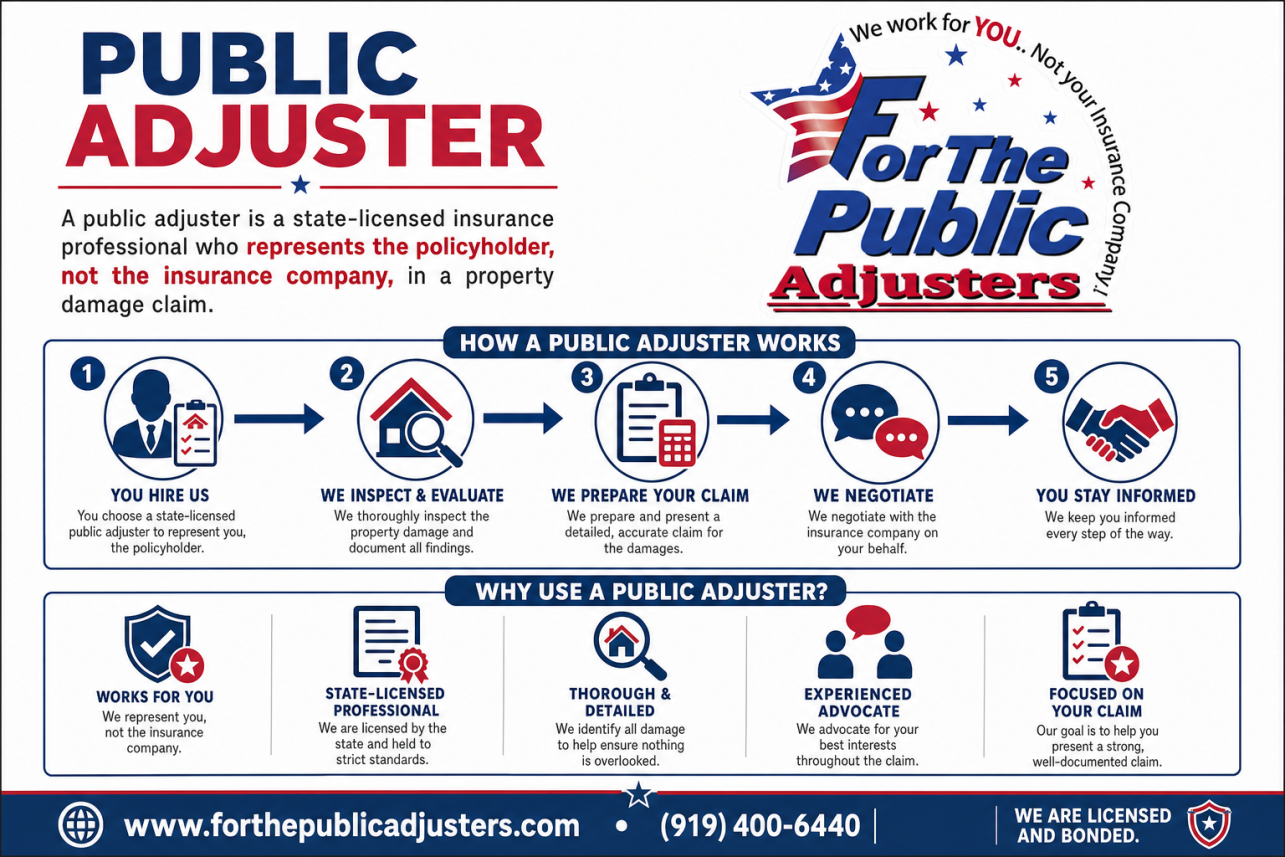
Free Inspection And Policy Review
We walk your property in person — attic to crawlspace — and review your policy’s coverages, endorsements, and deadlines. You get an honest assessment of whether your claim justifies representation before you sign anything.
Full Documentation And Estimate
We photograph and measure the damage, inventory contents room by room, and build a line-item repair estimate using the same pricing platforms carriers use. Hidden damage — moisture behind walls, smoke in HVAC systems, compromised framing — gets found and included.
Negotiation And Settlement
We present the claim, meet the insurance company’s adjuster on site, and handle every phone call, email, and supplement until the claim is resolved. You stay informed at each step and make the final decision on any settlement offer.
| What Happens | Filing the Claim Yourself | With Our Team on Your Side |
|---|---|---|
| Damage documentation | Whatever the carrier’s adjuster chooses to photograph in one visit | Full inspection, moisture mapping, contents inventory, and engineering support when needed |
| Estimate accuracy | Carrier writes its own estimate using its own pricing and scope | Independent line-item estimate built to what repairs actually cost in Durham County |
| Policy interpretation | You’re expected to know exclusions, deadlines, and duties on your own | We read the policy first and hold the carrier to its exact language |
| Negotiation | One offer, often positioned as final | Supplements, rebuttals, and appraisal when the carrier won’t move |
| Your time | Weeks of calls, emails, and paperwork on top of repairing your home | We handle communication and documentation while you focus on your family |
| Cost | Free, but underpaid claims routinely leave five figures on the table | Percentage fee paid only from what we recover — no recovery, no fee |
Commonly Overlooked In The Public Adjusting Industry
- Matching requirements for discontinued shingles and siding — Carriers price a patch repair without checking whether the material is still made, and homeowners don’t know North Carolina claims practice often supports replacing the full slope or elevation when a match is impossible.
- Additional living expenses beyond the first hotel bill — Policyholders don’t realize ALE covers the ongoing difference in meals, mileage, laundry, and pet boarding for the entire displacement, so they only submit the first receipt.
- Smoke residue inside HVAC ductwork after a fire — It’s invisible from the living space, so carrier estimates routinely stop at repainting walls while contaminated ducts keep circulating odor for years.
- Code-upgrade (ordinance or law) coverage on older Bahama homes — Rural properties built decades ago often need electrical, framing, or septic-related upgrades during rebuild, and carriers won’t volunteer that a separate coverage exists to pay for them.
- Moisture trapped in wall cavities and under subfloors — Surface readings look dry within days, so quick carrier inspections miss saturation that becomes mold and warped flooring months after the claim closes.
- Depreciation holdback that’s recoverable after repairs — Homeowners see the first actual-cash-value check as the full payment and never file for the withheld recoverable depreciation they’re owed once work is complete.
- Detached structures, fencing, and well houses on larger lots — Carrier adjusters focus on the dwelling, and on acreage properties around Bahama the barns, run-in sheds, and long fence lines damaged by the same storm simply never make the estimate.
- Policy deadlines for proof of loss and appraisal demands — These clocks run quietly in the background, and missing one can forfeit leverage or the entire claim even when the damage is legitimate.
Case Studies
Case Study #1
Situation: A family on a wooded five-acre property off Bahama Road came home after a July thunderstorm to find a mature oak had crushed the rear corner of their home, taking out part of the roof structure, a bedroom wall, and the deck.
Problem: The insurance carrier’s initial estimate covered tarping, a partial roof repair, and drywall patching — about $28,400. It ignored the cracked rafters, the shifted wall plate, and the fact that the damaged shingles had been discontinued years earlier, making a patch-match impossible.
Investigation: Our adjuster documented the structure over two site visits, brought in a structural engineer to evaluate the rafter and top-plate damage, and pulled the shingle manufacturer’s discontinuation notice. We also moisture-mapped the interior, finding wet insulation the carrier’s adjuster never opened a wall to check.
Findings: The framing damage extended six feet beyond what was visible, saturated insulation and sheathing created a documented mold risk, and North Carolina matching considerations meant a full roof slope replacement was the only reasonable repair given the discontinued product.
Solution: We prepared a line-item estimate with engineering documentation attached, submitted a formal supplement, and negotiated directly with the carrier’s field adjuster and desk reviewer over roughly six weeks.
Outcome: The claim settled at $96,700 — more than three times the original offer — covering full structural repair, a complete roof replacement on the affected slopes, interior rebuild, and additional living expenses while the bedroom was uninhabitable.
Lesson: Tree-strike claims almost always hide structural damage behind the drywall. If the carrier’s estimate was written from the yard and a ladder, it’s incomplete.
Case Study #2
Situation: The owner of a small horse-boarding operation near Lake Michie had a pipe burst in the tack room and attached office during a hard January freeze, flooding roughly 900 square feet before it was discovered.
Problem: The carrier denied the bulk of the claim, arguing the building was ‘unoccupied’ and inadequately heated, and offered only $6,100 for surface drying. The owner was facing tens of thousands in flooring, subfloor, and contents losses on her own.
Investigation: We reviewed the policy’s vacancy and freeze provisions word by word, gathered utility records proving the heat was on and functioning, and documented that the space was in active daily use for the boarding business. We inventoried damaged tack, saddles, and office equipment with replacement pricing.
Findings: The policy’s freeze exclusion required a failure to maintain heat — which the utility records disproved. The ‘unoccupied’ argument didn’t hold either, since the structure was used daily. The contents loss alone exceeded $19,000, none of which the carrier had itemized.
Solution: We submitted a written rebuttal to the coverage position citing the exact policy language, attached the utility records and occupancy evidence, and filed a complete structural and contents estimate demanding the denial be reversed.
Outcome: The carrier withdrew the denial within three weeks. Final settlement came to $54,300, covering subfloor replacement, full remediation, the contents inventory, and business interruption for the office.
Lesson: A denial letter is a legal argument, not a final answer. When the carrier misreads its own policy language, documented evidence can force a complete reversal.
| Your Situation | Handle It Yourself? | Bring in an Adjuster? | What It Depends On |
|---|---|---|---|
| Small claim under your deductible or barely above it | Usually yes | Rarely worth it | Whether repair quotes actually stay under the deductible once walls are opened |
| Carrier’s estimate feels low but you’re not sure | Risky | Yes — get a free claim review first | How far the estimate is from real contractor pricing in northern Durham County |
| Claim denied outright | Almost never | Yes, immediately | Whether the denial cites policy language that the facts actually support |
| Fire or smoke loss with contents damage | No | Yes | Contents inventories and smoke migration are where carriers underpay most |
| Storm or tree damage with possible structural issues | No | Yes | Hidden framing damage requires engineering documentation the carrier won’t fund |
| Claim stalled with no response for 30+ days | Frustrating and slow | Yes | NC has fair claims handling standards; documented pressure moves stalled files |
| Carrier already paid and you cashed the check | Depends | Worth asking | Most policies allow supplements after payment — cashing a check rarely closes the claim |
| Business or farm property loss with income interruption | No | Yes | Business interruption math is complex and carriers rarely calculate it in your favor |
Reviews
After hail went through our neighborhood off Stagville Road, our insurer offered to replace two slopes of the roof and call it done. For The Public Adjusters found impact damage on all four slopes plus dented gutters and window wraps the first adjuster never photographed. Our settlement more than doubled and the whole roof got replaced. Worth every penny of their fee.
Denise M., Bahama
We had smoke damage through half the house after a kitchen fire and honestly had no idea what we were entitled to. They inventoried everything, room by room, including smoke residue in the HVAC ducts that the carrier’s estimate completely skipped. They also got our hotel and meal costs covered for the six weeks we were displaced. I’d never fight a fire claim without them again.
Carl T., Durham County
Our water damage claim sat with the insurance company for almost two months with no movement. Within three weeks of hiring this team, we had a revised estimate that included the hardwood floors and cabinets the carrier had tried to ‘clean and save’ even though they were warped. Only reason it’s not a perfect experience is the process still took longer than I hoped, but that was the carrier dragging, not them.
Rachel P., Bahama
Frequently Asked Questions
What Does A Public Adjuster Bahama NC Homeowners Can Hire Actually Do For Me?
A public adjuster works exclusively for you, the policyholder — never for the insurance company. When you file a claim, your insurer sends its own adjuster to assess the damage, and that person’s job is to protect the carrier’s bottom line. Our job at For The Public Adjusters, Inc. is the opposite: we document, value, and negotiate your claim to secure the full amount your policy entitles you to.
In practical terms, that means we inspect your Bahama property in detail, photograph and measure every area of damage, review your policy line by line, and prepare a professional estimate using the same software insurance companies use. We then handle all communication and negotiation with the carrier so you are not pressured into a quick, low settlement.
This matters in northern Durham County because many properties here sit on wooded lots off Bahama Road, Quail Roost, and the roads around Lake Michie. Wind and fallen-tree damage from storms is common, and hidden issues — roof decking damage, water intrusion behind siding, attic moisture — are frequently missed on a fast carrier inspection.
Homeowners often assume the insurance company’s first offer is final. It rarely is. Studies of claims outcomes consistently show that policyholders with professional representation recover significantly more than those who negotiate alone. If your loss involves fire, storm, water, or smoke damage, having an advocate who knows both the policy language and local repair costs in the Bahama and Rougemont area levels the playing field.
How Much Does It Cost To Hire A Claims Adjuster In Bahama, And When Do I Pay?
For The Public Adjusters, Inc. works on a contingency-fee basis, which means you pay nothing upfront and nothing out of pocket. Our fee is a percentage of the settlement we recover for you, and it is only collected when the insurance company actually pays your claim. If we recover nothing, you owe nothing.
In North Carolina, public adjuster fees are regulated by the Department of Insurance, and contingency percentages must be disclosed clearly in a written contract before any work begins. You will know exactly what the arrangement is before you sign anything — no surprises later.
Many Bahama homeowners worry that a fee will eat into their recovery. In our experience, the opposite is true. Because we identify damage the carrier’s adjuster overlooked, apply the correct policy coverages, and price repairs at real Durham County contractor rates rather than lowball estimates, the final settlement is typically far higher than the initial offer — even after our fee is accounted for.
There is also a time cost to consider. Handling a claim yourself means weeks of phone calls, paperwork, deadlines, and inspections. We take all of that off your plate so you can focus on your family and your property. For a homeowner off Stagville Road or near Lake Michie dealing with a tree through the roof, that alone is often worth the call. The initial consultation and claim review are always free, so you can find out where you stand with no obligation.
The Insurance Company Already Made Me An Offer — Can A Bahama Public Adjuster Still Help?
Yes, and this is one of the most common situations we handle. Receiving an offer does not mean your claim is closed. In North Carolina, you generally have the right to dispute a settlement, submit supplemental claims for damage that was missed, and even reopen claims within the time limits set by your policy — often up to three years from the date of loss, depending on the policy language.
When a homeowner in the Bahama or Rougemont area brings us an existing offer, we start with a free review. We compare the carrier’s estimate against the actual damage at your property and against your policy’s coverages. It is remarkably common to find entire categories left out: code-upgrade coverage, matching requirements for roofing and siding, water mitigation, tree removal, detached structures like barns and workshops, or additional living expenses if you had to leave your home.
Rural Durham County properties are especially prone to underpaid claims because outbuildings, long driveways, wells, and wooded lots create damage scenarios that a quick suburban-style inspection misses. A downed oak that clipped your roof may also have damaged gutters, fascia, the septic area, or a fence line the first adjuster never walked.
If the numbers do not add up, we prepare a documented supplemental claim and negotiate directly with the carrier on your behalf. Many of our largest recoveries have come from claims the homeowner believed were already settled. Before you cash a check you are unsure about, it costs nothing to have us look at it.
What Types Of Property Claims Does For The Public Adjusters, Inc. Handle In The Bahama Area?
We handle the full range of residential and commercial property claims that affect homeowners in Bahama and the surrounding northern Durham County communities, including Rougemont, Timberlake, and north Durham.
Storm and wind damage is the most frequent claim type here. Severe thunderstorms and the remnants of tropical systems moving up through the Piedmont regularly bring down the mature hardwoods that make this area beautiful — and expensive to insure against. We handle roof damage, tree impact claims, siding and gutter damage, and hail losses.
Water and fire losses are the other major categories. Burst pipes, water heater failures, and appliance leaks cause hidden damage inside walls and under floors that carriers routinely underestimate. Fire and smoke claims are among the most complex we handle, involving structure, contents, smoke residue throughout the home, and additional living expenses while you are displaced. We also work lightning strike claims, which are more common on the open, elevated lots around Lake Michie and the Flat River area than many people realize.
For properties with acreage, we regularly document damage to detached garages, barns, workshops, fencing, and wells — items that first inspections often skip entirely.
Whether your loss happened yesterday or your claim has been dragging on for months, a public adjuster Bahama NC property owners can reach quickly makes a real difference in the outcome. We inspect promptly, document thoroughly, and negotiate until the settlement reflects what your policy actually promises. Call us for a free, no-obligation review of your situation.
How Long Will My Claim Take With A Public Adjuster Bahama NC Homeowners Trust Handling It?
Every claim is different, but most residential claims we handle in the Bahama area resolve within 30 to 90 days from the date we take over. Simpler claims — a single-room water loss or a straightforward roof claim after a hail event — often settle on the shorter end. Larger fire losses or claims involving structural damage can run longer, especially if engineering reports are needed.
A few local factors affect timing. After a major storm rolls through northern Durham County, carriers get flooded with claims and their response times slow down. We stay on top of adjuster reassignments and follow-up deadlines so your file doesn’t sit at the bottom of a stack.
It’s worth noting that hiring representation does not automatically slow a claim down. In many cases it speeds things up, because we submit complete, well-documented estimates the first time. Claims stall most often when documentation is thin and the carrier keeps requesting more information piece by piece.
North Carolina also requires insurers to acknowledge claims and respond to communications within specific timeframes, and we hold them to those obligations. If a carrier drags its feet without justification, we escalate — first through their internal channels, and if necessary through a complaint to the NC Department of Insurance.
When you call For The Public Adjusters, Inc., we’ll review your specific loss and give you an honest timeline estimate up front, not a vague promise. We’d rather set realistic expectations than tell you what you want to hear.
My Claim Was Already Denied Or Underpaid — Is It Too Late To Bring In Help?
No, and this is one of the most common situations we walk into for Bahama and northern Durham County homeowners. A denial or a low settlement offer is not the end of the road. In most cases, your policy gives you the right to dispute the carrier’s position, request a re-inspection, and submit additional documentation.
The first thing we do is pull your denial letter or settlement breakdown alongside your full policy. Denials often hinge on how the carrier characterized the damage — calling storm damage “wear and tear,” for example, or attributing water intrusion to a maintenance issue rather than a covered event. Those characterizations can be challenged with proper evidence.
For underpaid claims, we build our own line-item estimate of the loss and compare it against the carrier’s. It’s common to find missed items entirely: matching requirements for siding or shingles, code-upgrade costs, detached structures, or damaged contents that were never inventoried.
Timing does matter, though. North Carolina policies typically include deadlines for supplementing a claim or filing suit, often tied to the date of loss. If your denial is recent, you almost certainly have options. If it’s been a year or more, call us anyway — we’ll tell you honestly whether there’s still a viable path.
There’s no charge to have us review a denied or underpaid claim. If we don’t believe we can recover more for you, we’ll say so plainly rather than take on a file that won’t help you.
What’s The Difference Between The Insurance Company’s Adjuster And A Public Adjuster In Bahama?
The difference comes down to one thing: who signs the paycheck. The adjuster your insurance company sends works for the carrier. Even the friendliest, most professional company adjuster has a job description that includes controlling claim costs. A Bahama public adjuster works exclusively for you, the policyholder, and is paid only from what you recover.
That difference shows up in the details. A carrier’s adjuster might spend twenty minutes on your roof and write an estimate from a few photos. We take the time to document everything — attic moisture readings after a roof leak, hidden smoke residue after a fire, damage to outbuildings and fencing that rural properties around Bahama often have and carriers often overlook.
It also shows up in policy interpretation. Homeowners policies are dense legal contracts, and carriers interpret gray areas in their own favor. We read the same policy looking for every coverage that applies to your loss: ordinance and law coverage, additional living expenses, debris removal, matching provisions, and more.
There’s a third category worth mentioning: independent adjusters. Despite the name, they’re contractors hired by the insurance company, not by you. Only a licensed public adjuster represents the policyholder’s interests.
In North Carolina, public adjusters must be licensed by the Department of Insurance, pass an examination, and carry a bond. You can verify any license through the NCDOI website before signing anything — and we’d encourage you to do exactly that with anyone you’re considering, including us.
What Should I Do Right After Storm Or Fire Damage Before A Public Adjuster Bahama NC Families Rely On Arrives?
The steps you take in the first 24 to 48 hours can significantly affect your settlement, so here’s the practical order of operations we give every homeowner who calls us.
First, make sure everyone is safe and the property is secure. If there’s a fire loss, wait for the fire department to clear re-entry. For storm damage, watch for downed lines — the wooded roads around Bahama and the Lake Michie area see plenty of tree-related power issues after big wind events.
Second, take photos and video of everything before you touch it. Wide shots of each room, close-ups of specific damage, the exterior from all sides. You cannot over-document. This becomes the baseline evidence for your entire claim.
Third, make reasonable temporary repairs to prevent further damage — tarping a roof, shutting off water, boarding a broken window. Your policy actually requires this, and it covers the cost. Keep every receipt. What you should not do is start permanent repairs or throw anything away, even ruined contents. Damaged items are evidence.
Fourth, be careful with the recorded statement. Your carrier will call quickly and ask detailed questions. You’re required to report the loss, but you’re not required to speculate about causes or accept their framing on a recorded line.
Ideally, call us before that conversation happens. For The Public Adjusters, Inc. can take over communication with the carrier from day one, be present for the company adjuster’s inspection, and make sure nothing said early on undermines your claim later.
Is My Claim Big Enough To Justify Hiring A Public Adjuster Bahama NC Residents Recommend?
It depends less on the size of the loss and more on the gap between what you’re owed and what the carrier wants to pay. A hail claim on a Bahama farmhouse roof might look modest on paper, but once you account for matching requirements, decking replacement, and code upgrades under Durham County permitting, the real number can be double or triple the first estimate.
As a rough guide, claims under a few thousand dollars usually aren’t worth a contingency fee — we’ll tell you that honestly during a free review rather than take a file we can’t improve. Where representation consistently pays for itself is on structural claims: wind and hail damage, fallen trees, fire and smoke losses, and water damage from burst pipes, which we see often in older homes off Bahama Road and around the Lake Michie area.
The honest test is this: get your carrier’s estimate, then let us walk the property. If we can’t find meaningful money the insurance company missed, you’ll know quickly and you’ll owe nothing for the inspection. If we can — and on structural losses in northern Durham County we usually do — the fee comes out of the additional recovery, not out of your pocket up front.
Many homeowners assume adjusters only handle six-figure fire losses. In reality, mid-sized claims in the $15,000 to $75,000 range are where underpayment is most common, because carriers know most policyholders won’t push back.
Do I Need To Be Home In Bahama During The Inspection, And What Should I Have Ready?
You don’t have to be present for every step, but the first inspection goes best when you are. You know your property — where the water came in, which rooms smelled like smoke, what the roof looked like before the storm. Fifteen minutes of walking the house with you often surfaces damage a checklist inspection would miss.
Before we arrive, gather whatever you can find of the following: your full insurance policy (the declarations page plus the actual policy language, not just the summary), any claim number and correspondence from your carrier, photos or video of the damage, and receipts for emergency repairs like tarping or water extraction. If you have pre-loss photos of the home — even holiday pictures showing the roofline or interior — those are surprisingly valuable for proving prior condition.
Don’t worry if you’re missing pieces. We can request a certified copy of your policy directly from the insurer, and we document everything ourselves with photos, measurements, and moisture readings where relevant.
For rural properties around Bahama with outbuildings, barns, fencing, or long gravel drives, make sure we can access those structures too. Detached structures are covered under most homeowners policies, and they’re one of the most commonly overlooked items in northern Durham County claims. Plan on the first visit taking one to two hours for a typical home, longer for larger properties or significant fire losses.
Will Hiring A Claims Adjuster Of My Own Make My Insurance Company Raise My Rates Or Cancel My Policy?
No. Your premium is driven by the claim itself — the type of loss, its cause, and your claims history — not by who represents you during it. Filing a wind claim affects your record the same way whether you handle it alone or bring in professional help. North Carolina law also prohibits carriers from retaliating against a policyholder for exercising rights that are written into the policy, and hiring your own representative is exactly that.
Think of it the way carriers do internally: the insurance company sends its own adjuster, often backed by engineers and preferred contractors, to evaluate your loss. You have the identical right to bring in a licensed professional who works only for you. Carriers deal with policyholder representatives every day; it’s a normal part of the claims process, not a red flag.
What actually hurts homeowners in Durham County is the opposite problem — accepting a lowball settlement, running out of money mid-repair, and then filing a supplemental claim or a second claim later. Multiple claims on your record can genuinely affect renewals. One claim, documented thoroughly and settled correctly the first time, is the cleaner outcome.
If a carrier does non-renew a policy after a large loss, that decision is based on the size and nature of the loss itself. Getting fully paid for that loss doesn’t change the math against you — it just means you’re not the one absorbing the shortfall.
How Do I Verify That A Public Adjuster Bahama NC Homeowners Hire Is Actually Licensed In North Carolina?
North Carolina requires anyone negotiating insurance claims on behalf of a policyholder to hold a public adjuster license issued by the NC Department of Insurance. Verifying that license takes about two minutes and is the single most important step before signing anything.
Go to the Department of Insurance website and use the licensee lookup tool, or call the department directly. Search by the individual’s name or the company name and confirm the license is active and specifically designated for public adjusting — an agent’s or contractor’s license is not the same thing. For The Public Adjusters, Inc. will provide license numbers up front; any legitimate firm will do the same without hesitation.
Beyond the license, ask a few practical questions. How many claims like yours have they handled in Durham County? Will the person signing your contract be the person actually working your file? What is the fee percentage, and is it capped by the contract in writing? North Carolina also caps public adjuster fees by statute, so anyone quoting a number well above the norm should raise questions.
Be especially careful after major storms roll through the Bahama and Rougemont area. Out-of-state operators sometimes canvass neighborhoods door to door, and some aren’t licensed here at all. A contractor who offers to “handle your claim” is another warning sign — in North Carolina, contractors cannot legally negotiate your insurance settlement. Verify first, sign second, and you’ll avoid nearly every problem homeowners run into.
What Happens Step By Step After I Sign With A Public Adjuster Bahama NC Property Owners Work With?
The process starts with a full damage inspection at your property, whether you’re off Bahama Road, near Lake Michie, or out toward the Person County line. We document everything — roofing, siding, interior water paths, contents, even hidden damage the insurance company’s adjuster may have missed.
Next, we review your policy line by line. Most homeowners in northern Durham County have never read their full policy, and coverages like code upgrades, debris removal, and additional living expenses often go unclaimed. We identify every provision that applies to your loss.
From there, our team builds a detailed, itemized estimate using the same industry pricing software insurers use. We submit it with photos, moisture readings, and supporting documentation, then handle every call, email, and inspection request from the carrier. You’re copied on communications, but you’re no longer the one arguing.
When the insurer responds, we negotiate. If their figures fall short, we push back with evidence, request re-inspections, and escalate through the proper channels until the settlement reflects the true cost of repairs in our area — not a lowball number pulled from outdated pricing.
Finally, we review the settlement with you before anything is finalized, so you understand exactly what each payment covers. Most clients find the biggest relief is simply having someone local who knows how Bahama homes are built managing the fight from day one.
Can For The Public Adjusters, Inc. Handle Claims On Rural Properties, Farms, And Homes Around Lake Michie?
Yes, and rural claims are honestly where a Bahama public adjuster earns their keep. Properties in northern Durham County often include detached garages, barns, workshops, well houses, fencing, and long gravel drives — structures that insurance company adjusters frequently undervalue or skip entirely during a quick inspection.
We make sure every insured structure on your property is documented and included in the claim. That means measuring outbuildings, photographing fence lines damaged by fallen pines, and accounting for equipment and contents stored outside the main house. Other structures coverage exists in most policies for exactly this reason, but it only pays if someone itemizes the damage properly.
Wooded lots around Lake Michie and along the Flat River corridor bring their own claim issues. Tree strikes are one of the most common losses we see here, and they often cause hidden structural damage — cracked rafters, shifted framing, torn roof decking under shingles that look fine from the ground. We inspect for all of it.
Well and septic considerations matter too. If damage affects your water supply line, pump house, or access to these systems, we identify whether your policy responds and build those costs into the estimate.
Rural properties take longer to inspect and document than a subdivision home, and that extra time is exactly what carrier adjusters rarely give. We do, because that thoroughness is usually where the difference in your settlement comes from.
My Contractor’s Repair Estimate Is Much Higher Than What My Insurer Offered — Can Your Team Help Close That Gap?
This is one of the most common reasons Bahama homeowners call us, and yes, it’s a gap we close regularly. When a reputable local contractor quotes real repair costs and the carrier’s offer comes in thousands lower, the problem is almost never your contractor — it’s how the insurance estimate was written.
Carrier estimates frequently use regional pricing averages that don’t reflect actual labor and material costs in Durham County, omit line items like debris hauling or matching materials, and apply depreciation aggressively. They may also scope the job too narrowly — paying to patch a roof section, for example, when the damage genuinely requires full replacement.
Our job is to rebuild the estimate correctly. We inspect the property ourselves, compare the carrier’s scope against the actual damage, and write a line-by-line estimate that documents why each item is necessary. We can also work directly with your contractor to make sure their scope and ours align, which strengthens the claim considerably.
Then we present that documentation to the insurer and negotiate. Carriers respond differently when the pushback comes from a licensed North Carolina public adjuster with photos, measurements, and code citations rather than a frustrated homeowner forwarding a contractor’s quote.
One important note: don’t sign a final release or accept a closing payment before the gap is resolved. As long as the claim is open — or can be reopened under your policy’s terms — we have room to negotiate a settlement that actually funds the repairs your home needs.
What Options Are Left If My Insurance Company Still Refuses To Pay Fairly After Negotiation?
Negotiation resolves most claims, but when a carrier digs in, you’re not out of options — and a public adjuster Bahama NC homeowners hire should know every one of them. The first tool is usually the appraisal clause built into most North Carolina homeowner policies.
Appraisal is a formal dispute process. You select an appraiser, the insurer selects one, and the two choose a neutral umpire. Any amount two of the three agree on becomes binding. It’s faster and far cheaper than a lawsuit, and carriers often improve their offers once appraisal is invoked because they know an independent umpire will review the numbers. We prepare the documentation that makes your position strong going into that process.
Before appraisal, we can also request re-inspections, escalate to claim supervisors, and file complaints with the North Carolina Department of Insurance when a carrier’s conduct crosses the line — such as unreasonable delays or ignoring documented damage.
If the dispute involves coverage itself rather than the dollar amount — the insurer saying the loss isn’t covered at all — that may require an attorney, and we can tell you honestly when you’ve reached that point. We work alongside policyholder attorneys when needed and hand over a fully documented file, which saves you significant legal groundwork.
The practical takeaway for Bahama families: a low offer or even a denial is a position, not a verdict. There is a defined path for challenging it, and having your own licensed adjuster who has already built the evidence makes every step of that path stronger.
Local Relevance
Bahama sits in the wooded, rural northern end of Durham County, where homes tend to be spread out on large lots surrounded by mature hardwoods and pines. That tree canopy is beautiful — and it is exactly why tree damage claims are so common here after summer thunderstorms, tropical remnants moving up from the coast, and the occasional ice event.
The housing stock is a mix: older farmhouses that have stood for generations alongside newer construction, many on well and septic systems far from a hydrant. Distance from fire response can mean a kitchen or electrical fire does more damage before it is contained, which makes thorough fire and smoke claim documentation especially important out here.
Low-lying parcels near creeks feeding the Lake Michie watershed can also see flooding that standard homeowners policies exclude. If you carry flood coverage, those claims run through the National Flood Insurance Program under its own rules and proof-of-loss deadlines — a process we handle regularly for policyholders.
Because so many Bahama properties are heavily wooded acreage rather than subdivision lots, storm losses here often involve multiple trees down at once — and carriers frequently pay only for the tree that struck the structure while overlooking debris removal, fencing, outbuildings, and secondary roof damage that the policy may actually cover. Having every point of impact documented before cleanup begins tends to make a real difference in what gets paid.
Storm, Fire, Or Water Damage In Bahama? Get A Second Opinion Before You Settle
For The Public Adjusters, Inc. offers free claim inspections throughout northern Durham County. We are licensed, bonded, and paid only from what your claim recovers — so there is no risk in finding out where your claim really stands.
Call us: (919) 400-6440
Helpful Resources
- NCDOI Public Adjusters Guide
- National Flood Insurance Program (NFIP)
- North Carolina Department of Insurance — State regulator with consumer guidance on public adjusters
- FEMA flood insurance resources — Official information on NFIP flood coverage and claims
Our services in this city
Service pages for this city are coming soon.
Last updated: August 21, 2026