If you need help with a Commercial Business Claim Burlington NC business owners can hire For The Public Adjusters, Inc. to document the damage, prepare the proof of loss, and negotiate directly with the insurance company on your behalf. We are licensed and bonded, and we work only for you — never for the insurer. From fire and water damage to lost income while your doors are closed, we build the claim the way your policy actually requires so nothing gets left out.
What This Service Is
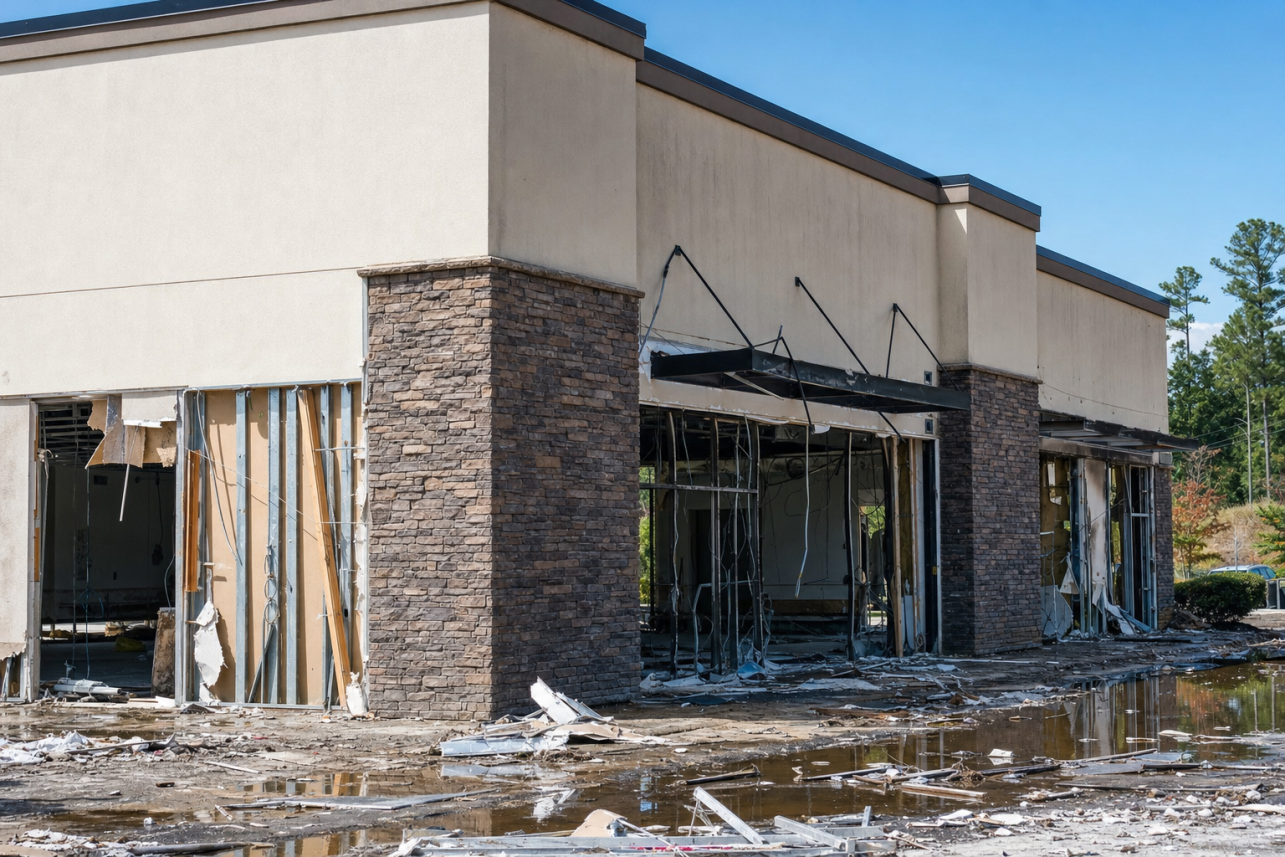
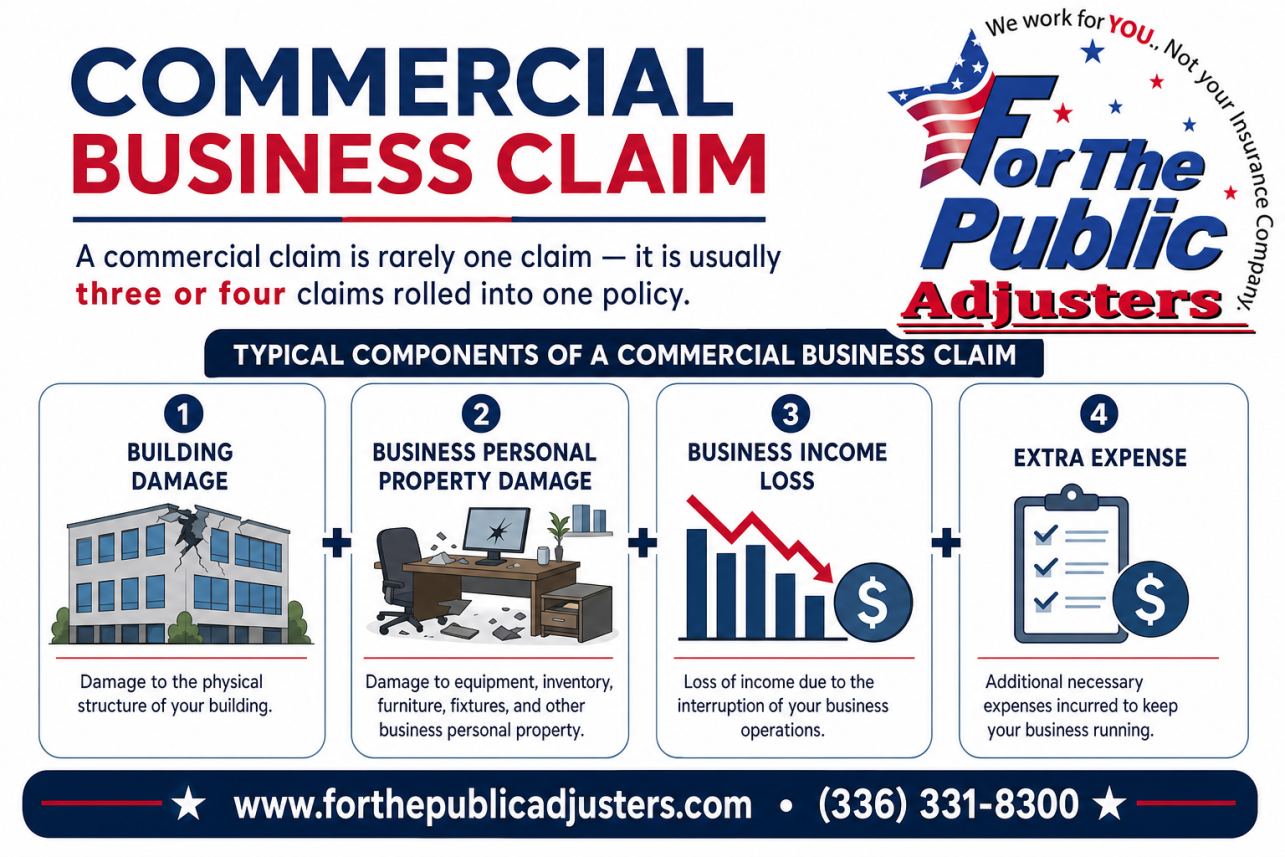
A commercial claim is rarely one claim — it is usually three or four claims rolled into one policy. There is the physical damage to your building, the damage to equipment and inventory, the income you lose while you cannot operate, and the extra costs you take on just to stay open, like renting temporary space or equipment.
Most owners handle the building portion and never realize their policy may also pay for lost income and those extra expenses. The Insurance Information Institute has long noted that business interruption coverage is one of the least understood parts of a commercial policy, and in our experience it is also the part insurers scrutinize hardest.
As your Burlington public adjuster, we read the full policy, identify every coverage that applies, measure the true scope of damage, calculate the business income loss from your actual financial records, and present a documented claim the carrier has to answer. We handle commercial losses across Alamance County and the surrounding Piedmont — the same work our Public Adjuster Elon team performs for businesses just up the road.
We do not handle claims involving cell phones, motor vehicles, health, or life insurance. Buildings, contents, and business losses are what we do.
Common Problems
Why Is The Insurance Offer So Much Lower Than My Contractor’s Estimate?
This is the most common call we get. The insurance company’s adjuster writes a scope of damage, prices it with their software, and often values items at actual cash value — the depreciated amount — rather than what it actually costs to replace them today.
Older commercial buildings make this worse. If your rebuilding estimate includes bringing electrical, plumbing, or fire systems up to current code, the carrier may leave those costs out unless someone pushes back with policy language and documentation.
Inventory and equipment get shortchanged the same way. A ten-year-old commercial oven still produces revenue every day, but on paper the insurer may value it near zero. We rebuild these valuations line by line, using invoices, replacement quotes, and your own records, so the settlement reflects your real loss — after your deductible, not padded around it.
What Happens When A Commercial Business Claim Burlington NC Insurers Delay Or Deny?
Delays are not always accidental. Every week your claim sits unresolved is a week of lost revenue for you and held money for the carrier. Repeated document requests, rotating adjusters, and vague coverage-review letters are patterns we know how to break through.
A denial or a bad-faith lowball is not the end of the road. In Guessford v. Pennsylvania National Mutual Casualty Insurance Co., a federal court sitting in North Carolina allowed the policyholder’s bad-faith and unfair-practices claims to proceed after the insurer spent years making low offers on a fire-damaged property — a reminder that carriers can be held accountable when they undervalue a documented loss.
We respond to denials with evidence: a corrected scope of damage, a properly filed proof of loss, and financial documentation the insurer cannot wave away. When a dispute needs legal firepower, we work alongside insurance dispute attorneys. Documentation standards matter on every loss type — it is the same discipline our fire damage insurance claim adjuster in Elon applies to structure fires.
Can I Just Handle The Claim Myself, Or Do I Really Need A Public Adjuster?
You can file the claim yourself, and for a small, simple loss that may be fine. But a commercial claim asks you to be a policy expert, a construction estimator, and a forensic accountant at the same time — while you are also trying to keep a business alive.
The North Carolina Department of Insurance licenses public adjusters specifically because policyholders are entitled to their own representative; the NCDOI Public Adjusters Guide explains that a public adjuster works for the insured, not the insurance company. That is the whole distinction. The adjuster the carrier sends is paid by the carrier.
When you evaluate anyone for this work, ask three things: are they licensed in North Carolina, are they bonded, and can they show you how they calculate business income loss — not just building damage. If they only talk about drywall and roofing, they are leaving your biggest coverage on the table. We cannot guarantee any specific outcome, but we can guarantee your claim will be fully documented and professionally presented.
Our Process
Policy Review And Full Damage Assessment
We start by reading your entire commercial property policy — coverages, limits, exclusions, and the deadlines buried in the conditions section. Then we inspect the loss ourselves and build an independent scope of damage, including hidden damage like smoke residue in HVAC systems or water migration behind walls that a quick walkthrough misses.
Documentation, Proof Of Loss, And Income Calculation
We photograph and inventory damaged contents, obtain replacement pricing for equipment, and prepare the sworn proof of loss the policy requires. For the income portion, we work from your sales records, tax filings, and payroll to calculate what the closure actually cost you — including extra expenses you incurred to keep serving customers.
Negotiation Through To Settlement
We present the complete claim package to the carrier and negotiate every disputed line item, from depreciation holdbacks to code-upgrade costs. If the insurer stalls or disputes coverage, we escalate with supporting documentation and, when needed, coordinate with counsel. Our regional team — including our public adjuster in High Point NC — handles commercial negotiations across the Triad every year.
| What’s at Stake | Filing Alone | With For The Public Adjusters, Inc. |
|---|---|---|
| Damage scope | Limited to what the carrier’s adjuster chooses to inspect | Independent inspection covering structure, contents, equipment, and hidden damage |
| Business income loss | Often waived or badly underestimated by owners | Documented from your own financials and modeled over the true restoration period |
| Policy interpretation | Carrier explains its own contract to you | We read coextensive coverages — ordinance & law, extra expense, spoilage — you may not know you have |
| Negotiation leverage | You against trained claims professionals | Licensed NC adjusters who negotiate commercial losses daily |
| Your time | Weeks pulled away from running the business | You run the business; we run the claim |
| Typical result | First offer, sometimes with quiet underpayment | Documented, supplemented settlement reflecting the full covered loss |
Commonly Overlooked In The Public Adjusting Industry
- Extra expense coverage for temporary operations — Owners assume the policy only pays for repairs, so they never claim the cost of leasing temporary space or equipment to keep serving customers.
- The period of restoration versus the actual repair timeline — Carriers calculate lost income on an optimistic repair schedule, and few owners realize permitting, contractor availability, and code work legally extend that window.
- Ordinance and law coverage on older Burlington buildings — Pre-1980s mill and retail buildings often need code upgrades during repair, and that coverage sits unused because no one on the carrier’s side volunteers it.
- Chloride corrosion on machinery after a fire — Smoke residue silently corrodes electronics and bearings for weeks, so equipment that ‘looks fine’ at settlement fails months later with no claim left open.
- Continuing expenses during the shutdown — Payroll for key staff, loan payments, and lease obligations continue while you’re closed, but income worksheets frequently omit them because owners only report lost sales.
- Depreciation holdback that’s actually recoverable — Businesses accept the actual cash value check without realizing most policies release the withheld depreciation once repairs are completed and documented.
- Proof-of-loss deadlines in NC commercial policies — The sworn proof of loss has a strict deadline that can bar recovery, and busy owners miss it because the carrier isn’t obligated to remind them.
- Seasonal revenue in the income calculation — A flat monthly average understates losses for businesses whose revenue peaks — a restaurant closed during graduation season at Elon loses far more than the yearly average suggests.
Case Studies
Case Study #1
Situation: A family-owned furniture manufacturer off Anthony Road in Burlington suffered a fire in its finishing room on a Saturday night. Sprinklers contained the flames, but smoke and soot traveled through the shared ductwork into the showroom and warehouse.
Problem: The carrier’s adjuster scoped only the finishing room and offered $84,000. The estimate ignored soot contamination on finished inventory, corrosion risk to CNC equipment, and made no allowance for business income during the shutdown.
Investigation: We brought in an industrial hygienist to test surfaces throughout the building, documented chloride residue on machinery bearings, and pulled two years of production and sales records to model the true income interruption under the policy’s business income form.
Findings: Soot contamination extended roughly 14,000 square feet beyond the fire room. Three CNC routers required professional decontamination to preserve manufacturer warranties, and 212 finished pieces were unsellable due to odor absorption in upholstery and lacquer finishes.
Solution: We rebuilt the claim from the ground up: a line-item structural scope, a contents inventory with replacement cost documentation, equipment restoration bids, and a business income calculation covering the realistic 11-week restoration period rather than the carrier’s assumed three weeks.
Outcome: The claim settled at $612,000 — more than seven times the original offer — including full business income and extra expense to run temporary finishing operations at a leased space in Graham.
Lesson: Smoke travels far beyond what the eye sees, and insurers rarely test for it. Independent contamination testing done early is often the single biggest driver of a fair commercial fire settlement.
Case Study #2
Situation: A strip-center restaurant near Huffman Mill Road took water damage when a supply line burst above the kitchen overnight. Water ran for hours through the ceiling, walk-in cooler area, and dining room before staff arrived.
Problem: The carrier accepted the claim but paid only for drying and drywall, denying the flooring and cabinetry as ‘pre-existing wear.’ They also refused business income, arguing the restaurant could have reopened in five days with partial repairs.
Investigation: We documented moisture readings the carrier’s vendor never recorded, obtained the Alamance County health department’s requirements for reopening a commercial kitchen after water intrusion, and secured contractor bids reflecting code-required work.
Findings: Moisture had wicked under the commercial vinyl into the slab, requiring full flooring replacement to prevent microbial growth. The health department would not permit reopening until the kitchen ceiling, insulation, and affected prep surfaces were fully restored — a six-week timeline, not five days.
Solution: We filed a formal supplement with the moisture mapping, health code citations, and a business income worksheet built from POS records showing the restaurant’s actual daily revenue, including the lost spring catering season.
Outcome: The carrier reversed its position and paid an additional $147,000 in building repairs plus $96,000 in business income and extra expense — money the owner had been told he wasn’t entitled to.
Lesson: Regulatory reopening requirements are part of your covered loss. A restaurant can’t legally reopen just because the carpet is dry, and the policy’s business income clock should reflect that reality.
| Type of Loss | Coverages Usually in Play | Biggest Underpayment Risk | Act Within |
|---|---|---|---|
| Fire or smoke damage | Building, contents, business income, ordinance & law | Soot contamination beyond the burn area goes untested and unpaid | First 72 hours — before cleanup destroys evidence |
| Burst pipe / water intrusion | Building, contents, business income, extra expense | Moisture under flooring and inside walls dismissed as ‘pre-existing’ | 24–48 hours for moisture documentation |
| Storm or hail roof damage | Building, interior water damage, code upgrade coverage | Patch-repair offers when full replacement is required | Before temporary repairs alter the roof |
| Restaurant / food service shutdown | Spoilage, business income, extra expense, equipment | Business income period cut short of health-department reopening timeline | Photograph spoiled inventory before disposal |
| Equipment or machinery damage | Contents, equipment breakdown, business income | Carrier pays cleaning when full decontamination or replacement is warranted | Before restarting equipment — restarting can void claims |
| Tenant vs. landlord losses | Betterments & improvements, lease-obligation coverage | Each policy pointing to the other, leaving the tenant unpaid | Review the lease and both policies before recorded statements |
| Theft or vandalism | Contents, building glass, business income | Inventory losses denied for insufficient documentation | File the police report and inventory immediately |

Reviews
Our warehouse roof failed during a storm and the insurance company offered barely enough to patch it. For The Public Adjusters found interior racking damage and inventory losses their adjuster never even looked at. Final settlement was almost four times the first offer, and we stayed open the whole time.
Marcus T., Burlington NC
I own a salon and had no idea business income coverage even applied to my water damage claim. They pulled my booking records, calculated what I actually lost during the eight weeks I was closed, and got the carrier to pay it. I would never handle a Commercial Business Claim Burlington NC insurers push back on without them again.
Denise W., Elon NC
The fire at my convenience store was overwhelming — inventory, coolers, cigarettes, lottery equipment, all of it. Their team inventoried everything, dealt with the carrier’s forensic accountant, and handled the examination under oath prep. Settled fairly without a lawsuit. Worth every penny of the fee.
Raj P., Alamance County
Frequently Asked Questions
How Does The Process Work When I File A Commercial Business Claim Burlington NC?
When you contact For The Public Adjusters, Inc. about a Commercial Business Claim Burlington NC, we start with a free review of your policy and a walkthrough of your damaged property, whether that’s a retail space on South Church Street, a warehouse near the industrial corridor off I-40/85, or an office building downtown.
From there, we document everything the insurance company will want to see and plenty they might overlook. That includes structural damage, damaged inventory and equipment, code-upgrade requirements under Alamance County building standards, and business interruption losses while your doors are closed.
We then prepare a detailed, itemized claim package and submit it to your carrier on your behalf. We handle all communication with the insurance company’s adjuster, attend every inspection, and push back when their estimate comes in low, which it often does on commercial losses.
Most Burlington business owners are surprised by how much of the process we take off their plate. You keep running your company; we handle the negotiation. Our fee is a percentage of the settlement we recover, so we only get paid when you do. There are no upfront costs, and if we review your situation and believe you’re better off handling it yourself, we’ll tell you that honestly. Timelines vary by carrier and complexity, but having a licensed public adjuster involved from day one typically shortens the back-and-forth and leads to a materially larger settlement.
What Types Of Commercial Losses Do You Handle For Burlington Businesses?
We handle nearly every category of commercial property loss that affects businesses in Burlington and the surrounding Alamance County area, including Graham, Elon, Mebane, and Gibsonville.
Fire and smoke damage claims are among the most complex we see, because smoke infiltration into HVAC systems, inventory, and finishes is routinely undervalued by carriers. Water losses are just as common here, from burst pipes during January cold snaps to roof failures during the heavy thunderstorms that roll through the Piedmont in spring and summer.
Wind and hail claims are frequent as well. Burlington sits in a region that takes real storm damage, and flat commercial roofs, membrane systems, and older metal roofs on manufacturing and warehouse buildings are especially vulnerable. We also handle theft and vandalism losses, vehicle-into-building impacts along busy corridors like Huffman Mill Road, and equipment breakdown claims where coverage applies.
Beyond physical damage, we pursue business interruption and extra expense claims, which are often the largest and most disputed part of a commercial loss. Calculating lost income for a restaurant, medical practice, or textile operation requires financial documentation most owners don’t realize their policy demands.
If your carrier has already denied or underpaid a claim, we can review the file and, where the policy supports it, reopen the claim or invoke the appraisal clause. Every commercial policy is different, so the first step is always a no-cost policy review to confirm what coverage you actually have.
My Insurance Company Already Sent An Adjuster. Why Would I Need A Public Adjuster In Burlington Too?
The adjuster your insurance company sent works for the insurance company. That’s not a criticism of the individual, it’s simply who signs their paycheck. Their job is to settle your claim within the carrier’s guidelines, and those guidelines are built to protect the carrier’s bottom line.
A licensed public adjuster works exclusively for you, the policyholder. When For The Public Adjusters, Inc. takes on a commercial loss in Burlington, we build an independent estimate of the damage rather than accepting the carrier’s numbers. On commercial properties, the gap between the two figures is often substantial, sometimes six figures on larger losses.
Commercial claims also involve layers a staff adjuster may not fully develop: business interruption calculations, co-insurance penalties, ordinance and law coverage for code upgrades required by Alamance County inspections, and depreciation disputes on older buildings. Missing any one of these can cost you significant money.
There’s also the time factor. Documenting a commercial loss properly, responding to carrier requests, and negotiating line items is essentially a second full-time job. Most Burlington business owners we work with tell us the hours we saved them were worth as much as the additional settlement dollars.
It costs nothing to have us review the carrier’s estimate against your policy. If their offer is fair, we’ll say so. If it isn’t, and it frequently isn’t, we’ll show you exactly where the shortfall is before you sign anything.
How Much Does Hiring For The Public Adjusters, Inc. Cost, And Is A Commercial Business Claim Burlington NC Worth The Fee?
We work on contingency, which means our fee is a percentage of the settlement we actually recover for you. There are no upfront costs, no hourly billing, and no fee at all if there’s no recovery. For a Commercial Business Claim Burlington NC, the percentage is agreed upon in writing before we start, and North Carolina law regulates how public adjuster contracts must be structured, so everything is transparent from day one.
Whether it’s worth it comes down to simple math. Industry studies and our own case files consistently show that professionally represented commercial claims settle for significantly more than claims handled by the policyholder alone. When the increase in your settlement exceeds the fee, and it does in the vast majority of commercial cases we accept, you come out ahead financially while doing far less work.
Consider what’s typically left on the table without representation: undervalued business interruption income, missed extra expense coverage, depreciation that should have been recoverable, code-upgrade costs, and damaged inventory the carrier’s adjuster never inventoried line by line.
We’re also selective. If we review your loss and the carrier’s offer is already fair, we’ll tell you to take it rather than sign a contract we can’t add value to. That honesty is why so much of our Burlington and Alamance County work comes from referrals by past clients, attorneys, and local contractors. The initial policy review and damage consultation are always free, so you can make an informed decision with no obligation.
How Long Does A Commercial Business Claim Burlington NC Typically Take To Settle?
Most commercial claims we handle in Burlington resolve in 60 to 120 days, though the timeline depends heavily on the size of the loss and how the carrier responds. A straightforward roof and interior water loss at a retail space on South Church Street might close in two months, while a fire loss with business interruption at a manufacturing facility near the North Carolina Industrial Center can take six months or longer.
North Carolina law requires insurers to acknowledge claims promptly and pay undisputed amounts within 30 days of agreement, but disputes over scope and pricing are what actually drag claims out. That is where our involvement changes the pace. We prepare a complete, documented estimate up front, which removes the back-and-forth that stalls most commercial files.
We also push for advance payments early in the process. If your Alamance County business needs funds for emergency mitigation, temporary relocation, or payroll, we request partial payments rather than waiting for one final check.
One honest caveat: a Commercial Business Claim Burlington NC that has already been underpaid or denied before we get involved usually takes longer to correct than one we manage from day one. Reopening a closed file means rebuilding documentation the carrier should have credited the first time. If you call us within the first week after a loss, we can typically shave weeks off the total timeline and secure a noticeably stronger settlement.
Can You Help If My Burlington Commercial Claim Was Already Denied Or Underpaid?
Yes, and this is one of the most common reasons Alamance County business owners call us. A denial or a low settlement offer is rarely the end of the road. In North Carolina, you generally have three years from the date of loss to pursue a property claim, though your specific policy may shorten that window, so acting quickly still matters.
When we take over an underpaid file, we start with a forensic review of the carrier’s estimate. We routinely find missing line items: code-upgrade costs required by Burlington’s building inspections department, undervalued commercial roofing systems, overlooked HVAC contamination after smoke exposure, and business income losses calculated from incomplete financials.
For denials, we examine the stated reason against the actual policy language. Carriers sometimes deny wind or hail damage as “wear and tear,” which is a frequent issue with older flat and metal roofs on commercial buildings along the Maple Avenue and Alamance Road corridors. Independent engineering reports and detailed moisture mapping often reverse those decisions.
We then submit a supplemental claim or formal dispute backed by our own documentation, and if needed, we invoke the appraisal clause in your policy, a binding process that resolves pricing disagreements without litigation. Many of our largest recoveries for Burlington businesses came from claims the owner had nearly given up on. Bring us the denial letter and the carrier’s estimate, and we will tell you honestly whether there is money left on the table.
What Documentation Do I Need For A Business Interruption Claim In Burlington?
Business interruption is usually the most underpaid part of a Commercial Business Claim Burlington NC, largely because the burden of proof sits on the policyholder. The carrier will not calculate your lost income for you in your favor; you have to prove it.
The core documents we assemble for Burlington clients include 24 to 36 months of profit-and-loss statements, federal and state tax returns, monthly sales records, payroll registers, and any contracts or purchase orders that were cancelled or delayed because of the loss. If your business is seasonal, like landscaping companies busy in spring or retailers dependent on holiday traffic near Alamance Crossing, we build projections that reflect those cycles rather than a flat monthly average.
We also document continuing expenses that your policy covers during the shutdown: rent or mortgage, utilities, insurance premiums, and payroll for key employees you need to retain. Extra expense coverage, which pays for costs like temporary space or expedited equipment shipping, requires its own paper trail of invoices and receipts.
One detail many owners miss is the “period of restoration.” Carriers often cut off lost income at the date repairs could theoretically have been finished, not when your revenue actually recovers. We push back with realistic contractor timelines and, where the policy allows, extended period of indemnity coverage that continues payments while customers return.
Start keeping records the day of the loss. Even a simple daily log of what you spent and what you lost strengthens the claim significantly.

What Should I Do In The First 48 Hours After Damage To My Burlington Business?
The first two days shape the entire outcome of a commercial claim, so here is the sequence we recommend to every business owner in Alamance County.
First, make the property safe and stop further damage. Your policy requires reasonable mitigation, so tarp the roof, shut off water at the source, and board broken openings. Keep every receipt, because these emergency costs are reimbursable. Do not, however, authorize permanent repairs or sign a contractor’s assignment-of-benefits agreement before the loss is documented.
Second, photograph and video everything before anything is moved or discarded. Wide shots of each room, close-ups of damaged inventory and equipment, serial numbers, and the source of the damage itself. If a storm caused the loss, note the date and time; local weather data from the Burlington-Alamance Regional Airport station often becomes evidence later.
Third, report the loss to your carrier to preserve your rights, but keep the initial notice factual and brief. Avoid speculating about causes or values on a recorded call, because early statements get quoted back during negotiations.
Fourth, protect damaged property rather than throwing it away. The insurer has a right to inspect, and discarded evidence is a common reason claims get disputed.
Calling a public adjuster in Burlington during this window costs you nothing to consult and lets us document the scene properly before the carrier’s adjuster arrives. Claims we enter within the first 48 hours consistently settle faster and higher than ones we join mid-dispute.
Is For The Public Adjusters, Inc. Licensed To Handle A Commercial Business Claim Burlington NC, And Who Regulates That Work?
Yes. Public adjusters in North Carolina are licensed and regulated by the North Carolina Department of Insurance under Chapter 58 of the General Statutes. Every adjuster who represents you on a Commercial Business Claim Burlington NC must hold an active NC public adjuster license, carry the required bond, and follow strict rules on contracts, fees, and conduct.
That licensing matters more than most business owners realize. It means our contract with you must be in writing, must disclose our fee clearly, and gives you a legally protected right to cancel within a set window if you change your mind. It also means we answer to a state regulator, not just to you.
Before you sign with anyone — us included — you can verify their license directly on the NC Department of Insurance website in about two minutes. We encourage every Burlington and Alamance County business owner to do exactly that, because after major storms this area sometimes sees out-of-state ‘consultants’ who are not licensed to negotiate claims in North Carolina.
Working with an unlicensed representative can jeopardize your claim and leaves you with no regulatory recourse if something goes wrong. When you hire our firm, you get licensed professionals who know the North Carolina commercial policy forms, the local carriers writing business coverage in Alamance County, and the documentation standards those carriers expect. That combination of state accountability and local experience is exactly what you want handling a six- or seven-figure loss.
I Lease My Commercial Space In Burlington. Is The Damage My Landlord’s Claim Or Mine?
Usually it’s both, and sorting out which policy pays for what is one of the most common problems we untangle for Burlington tenants. Your landlord’s policy typically covers the building shell — the roof, exterior walls, and base structure. Your commercial policy typically covers your business personal property, inventory, equipment, tenant improvements and betterments, and your lost income.
The gray area is almost always the build-out. If you paid for the interior finishes, HVAC upgrades, custom counters, or specialized wiring in your space along South Church Street or in a Glen Raven industrial suite, those improvements may be insured under your policy even though they’re attached to the landlord’s building. Carriers on both sides often try to push those costs onto the other policy, and the tenant gets caught in the middle.
Your lease matters too. Many Alamance County commercial leases include waiver of subrogation clauses and specific insurance obligations that affect who can recover what. We read the lease alongside both policies before we build the claim, so nothing falls into the gap between them.
As your representative, we document your losses separately from the landlord’s, present them under the correct coverage parts, and coordinate with the landlord’s claim when the two overlap. That keeps your recovery from being delayed while the building owner’s claim drags on — a critical point when your reopening date depends on it.
Will Filing A Large Commercial Claim Raise My Premiums Or Put My Policy At Risk?
It’s a fair concern, but it shouldn’t stop you from claiming what your policy owes. You’ve paid premiums specifically so coverage is there when a fire, storm, or water loss hits your Burlington operation. Choosing not to file — or deliberately underclaiming — rarely saves you money in the long run.
Here’s the reality on pricing. Commercial premiums are driven mostly by your industry, building characteristics, coverage limits, and regional loss trends across North Carolina, not by a single legitimate claim. Widespread events like the hailstorms and severe wind that periodically move through Alamance County affect rates market-wide whether you file or not. Absorbing a $200,000 loss yourself to avoid a possible premium increase is almost never the better math.
What can genuinely hurt you is a poorly handled claim: inflated or unsupported figures, missed deadlines, or a file full of inconsistencies. Those are the things that create friction with a carrier. Our job on a Commercial Business Claim Burlington NC is the opposite — a thoroughly documented, accurately valued, professionally presented claim that the insurer can verify line by line.
Non-renewal is a separate question, and carriers do occasionally reassess accounts after large losses. If that happens, a clean, well-documented claim file actually helps you when shopping the market, because a new underwriter can see exactly what happened and that it was resolved properly. We’re glad to talk through these tradeoffs before you commit to anything.
What If We Find More Damage After The Settlement — Can A Burlington Commercial Claim Be Reopened?
In many cases, yes. Discovering hidden damage months later is common with commercial buildings, especially the older brick and mill-style structures around downtown Burlington and along the rail corridor. Moisture trapped in wall cavities, roof decking that looked sound during the initial inspection, or electrical damage that only shows up under full operating load can all surface well after the first check arrives.
Most commercial policies allow supplemental claims when new, related damage is discovered, as long as you’re within the policy’s time limits and the damage traces back to the original covered event. In North Carolina, those deadlines are set by your policy language and applicable statutes, so the clock matters — the sooner newly found damage is documented, the stronger your position.
One important caution: signing a full release or a settlement agreement worded as final payment can close the door on supplements. Before you cash a check tied to any release, have someone read what you’re actually agreeing to. We review those documents for Alamance County business owners regularly, and the difference between a routine payment and a binding final release is often a single paragraph.
If you’ve already settled and then uncovered rotted sheathing during a renovation or persistent leaks after the next heavy rain, call us. We’ll assess whether the new damage connects to the original loss, document the causation properly, and present the supplemental claim to your carrier. Recovering additional funds after an initial settlement is one of the things our Burlington clients ask us to do most often.
Are There Deadlines I Need To Know About Before Filing A Commercial Business Claim Burlington NC?
Yes, and missing them can cost you the entire recovery. Most commercial property policies require “prompt” notice of loss, and many spell out hard deadlines — some as short as 60 days to submit a signed, sworn proof of loss after the carrier requests one.
North Carolina also imposes a contractual limitations period for filing suit on a property claim, typically three years from the date of loss under the standard fire policy language, though your specific policy can modify that. Business interruption coverage adds its own clock, since the period of restoration is measured and capped by the policy.
Here in Alamance County, we see two common deadline traps. The first is the business owner who reports damage quickly but then lets the claim drift for months while dealing with contractors, tenants, and daily operations — only to get a proof-of-loss demand with a tight window attached. The second is hidden damage discovered later, such as slow water intrusion behind walls in an older downtown Burlington building, where the carrier argues the loss date is earlier than you think.
Our team calendars every deadline in your policy the day we take over the file, submits notice and documentation on time, and puts everything in writing so the carrier cannot claim late reporting. If a deadline is approaching and you have not started yet, call us immediately — we can often preserve your rights with a same-day notice letter while the full documentation comes together.
Should I Accept The Insurance Company’s First Settlement Offer On My Burlington Commercial Claim?
Almost never without an independent review first. A first offer is a starting position built from the carrier’s own inspection, and in our experience with Burlington and Alamance County commercial losses, initial offers routinely miss significant categories of damage and coverage.
Common gaps we find: code-upgrade costs that older buildings along the downtown corridor and the mill-conversion properties trigger the moment repairs begin, undervalued business personal property because the desk adjuster used generic pricing instead of actual replacement quotes, and business income calculations that ignore seasonality or ongoing payroll obligations. Roofing scope is another frequent shortfall — carriers often approve patch repairs on commercial membrane or metal roofs when matching and manufacturer warranty requirements actually support full replacement.
Accepting a low offer does not always end the claim, but it makes everything harder. Once you cash a check and sign a release, reopening the file becomes a fight. Even without a release, the carrier will treat its first scope as the baseline and force you to prove every dollar above it.
Before you sign anything, let us compare the offer against your policy language and a properly documented scope of loss. We prepare our own line-item estimate, our own business income worksheet, and our own inventory valuation, then negotiate from that position. If the offer turns out to be fair, we will tell you that too — but for mid-size commercial losses, the gap between the first offer and the final documented settlement is often substantial.
Can My Business Keep Operating While The Claim Is Being Worked On, Or Do I Have To Shut Down?
In most cases you can and should keep operating to whatever extent is safe — and doing it correctly can actually strengthen your recovery. Most commercial policies include extra expense coverage, which pays the reasonable costs of continuing operations after a loss: temporary space, equipment rental, expedited shipping, overtime, even generator fuel.
The key is documentation and coordination. Every dollar you spend to stay open needs to be tracked, tied to the loss, and communicated to the carrier before or as it happens. We have helped Burlington restaurants run limited menus out of temporary kitchens, helped a distributor shift inventory to short-term warehouse space off I-40/85, and helped retail tenants relocate temporarily without forfeiting business income benefits.
What you should not do is make permanent repairs or dispose of damaged property before the loss is fully documented. Your policy requires you to protect the property from further damage — tarping a roof, extracting standing water, boarding openings — but tearing out and rebuilding before the scope is agreed gives the carrier room to dispute what was actually damaged. Photograph everything, keep damaged materials when practical, and save every receipt.
We also structure the repair timeline around your operations, sequencing work so revenue-producing areas come back first. Staying partially open reduces your business income loss, which sounds like it helps the carrier — but a well-documented mitigation effort builds credibility and typically leads to a faster, cleaner settlement of the remaining loss.

What Happens If We Can’t Agree With The Carrier On The Value Of The Loss?
Disagreement over value is common on larger losses, and your policy builds in a mechanism for it: the appraisal clause. Either side can invoke appraisal when the dispute is about the amount of the loss rather than whether coverage applies. Each party selects its own appraiser, the two appraisers choose a neutral umpire, and any award agreed to by two of the three is binding on the dollar amount.
Appraisal can be a powerful tool for Alamance County business owners because it takes the valuation fight away from the carrier’s desk adjuster and puts it in front of people who actually inspect the property and price the repairs. But it should not be your first move. A thoroughly documented Commercial Business Claim Burlington NC — with a line-item estimate, engineer or contractor support, and complete business income records — resolves most disputes through negotiation without the added cost of appraisal.
When negotiation stalls, we advise clients on whether appraisal makes strategic sense for their specific gap. On a dispute over a few thousand dollars, the appraiser and umpire fees may not be justified. On a six-figure gap over a roof system, machinery, or an income calculation, appraisal frequently returns far more than it costs.
If the dispute is about coverage itself — an exclusion, a denial, a policy interpretation — appraisal does not apply, and we coordinate with policyholder attorneys when that becomes necessary. Most files never get that far; strong documentation early usually prevents the standoff entirely.
Local Relevance
Burlington’s commercial building stock tells the story of a textile town that kept growing. Downtown and along the older corridors, many businesses operate out of brick buildings and converted mill-era structures with aging roofs, original wiring, and plumbing that predates modern code — all of which complicate both the damage and the claim when fire or water strikes.
The Piedmont climate adds its own risks. Humid summers feed severe thunderstorms, hurricane remnants track inland off the coast and can flood low-lying commercial properties, and winter ice occasionally brings down power lines and tree limbs onto buildings. When flooding follows one of those tropical systems, coverage questions get complicated fast — the same issues we untangle providing flood damage claim help in Mebane next door.
For an Alamance County business, a forced closure hits harder than the building damage itself. Restaurants, retailers, medical offices, and light manufacturers here run on tight margins, and every week of lost revenue matters. That is why we push the income and extra-expense portions of a claim as hard as the bricks-and-mortar portion.
Many of Burlington’s older commercial buildings, especially the mill-era and mid-century structures near downtown, carry rebuilding costs that far exceed what an insurer’s standard estimate assumes — code upgrades to wiring, sprinklers, and accessibility often become the single largest disputed item, so owners here should insist those costs are addressed in writing before accepting any settlement.
Your Business Can’t Afford An Undervalued Claim
Every day your claim stalls is revenue you don’t get back. For The Public Adjusters, Inc. is licensed and bonded in North Carolina, and we represent you — not the insurance company. Call before you accept the carrier’s offer, and let us review your policy and your loss at no obligation.
Call us: (336) 331-8300
Helpful Resources
- NCDOI Public Adjusters Guide
- Insurance Information Institute (III)
- North Carolina Department of Insurance — State regulator that licenses public adjusters and assists consumers
- Insurance Information Institute on business interruption coverage — Educational resource explaining business interruption insurance
Serving Burlington · Alamance
Last updated: September 12, 2026