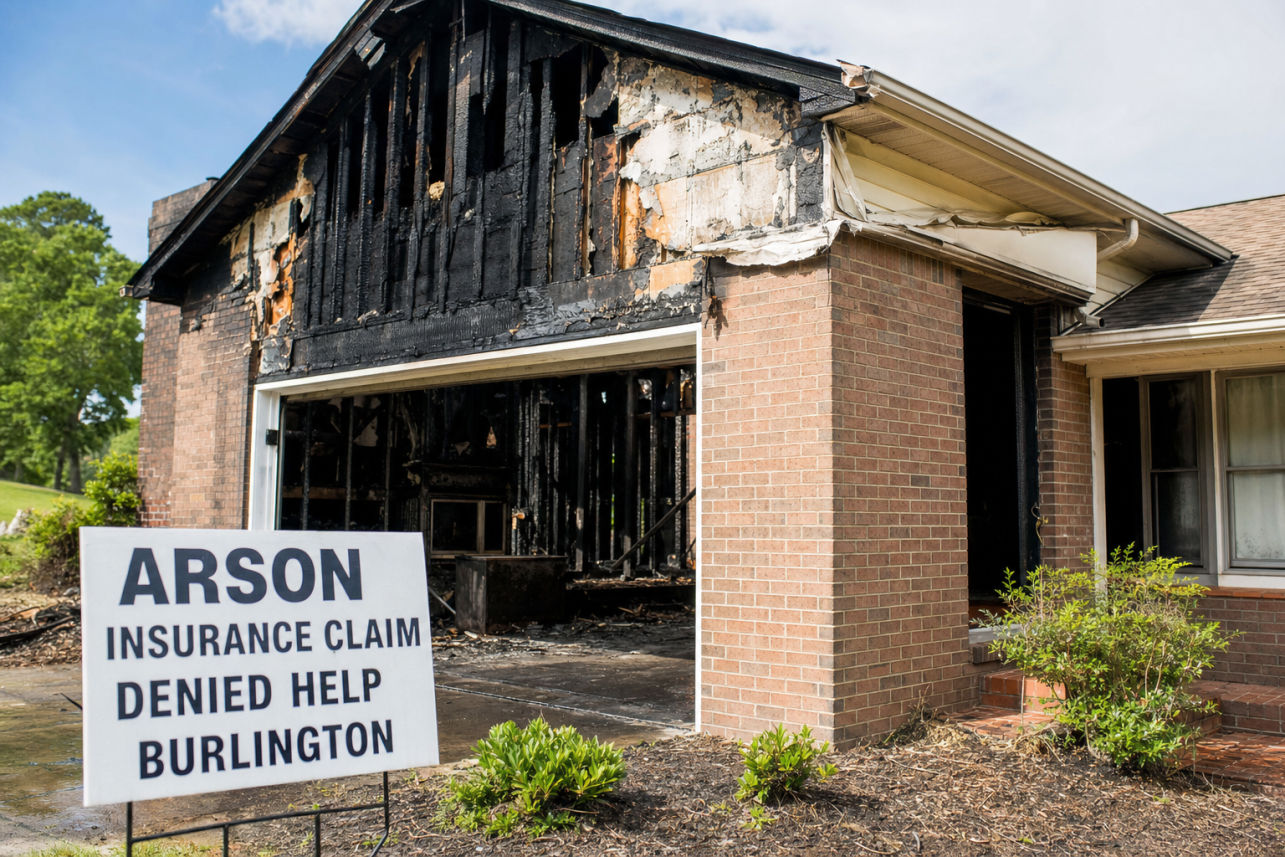
If you're searching for arson insurance claim denied help Burlington homeowners can actually rely on, the most important thing to know is this: an accusation is not proof. When an insurer denies a fire claim by blaming the policyholder, it carries the legal burden of proving the fire was intentionally set and that you had motive and opportunity — suspicion alone is not enough. For The Public Adjusters, Inc. is a licensed and bonded public adjusting firm that reviews the denial, challenges the insurer's fire investigation, and re-documents your loss so the claim can be fought on the evidence, not on assumptions.
What This Service Is
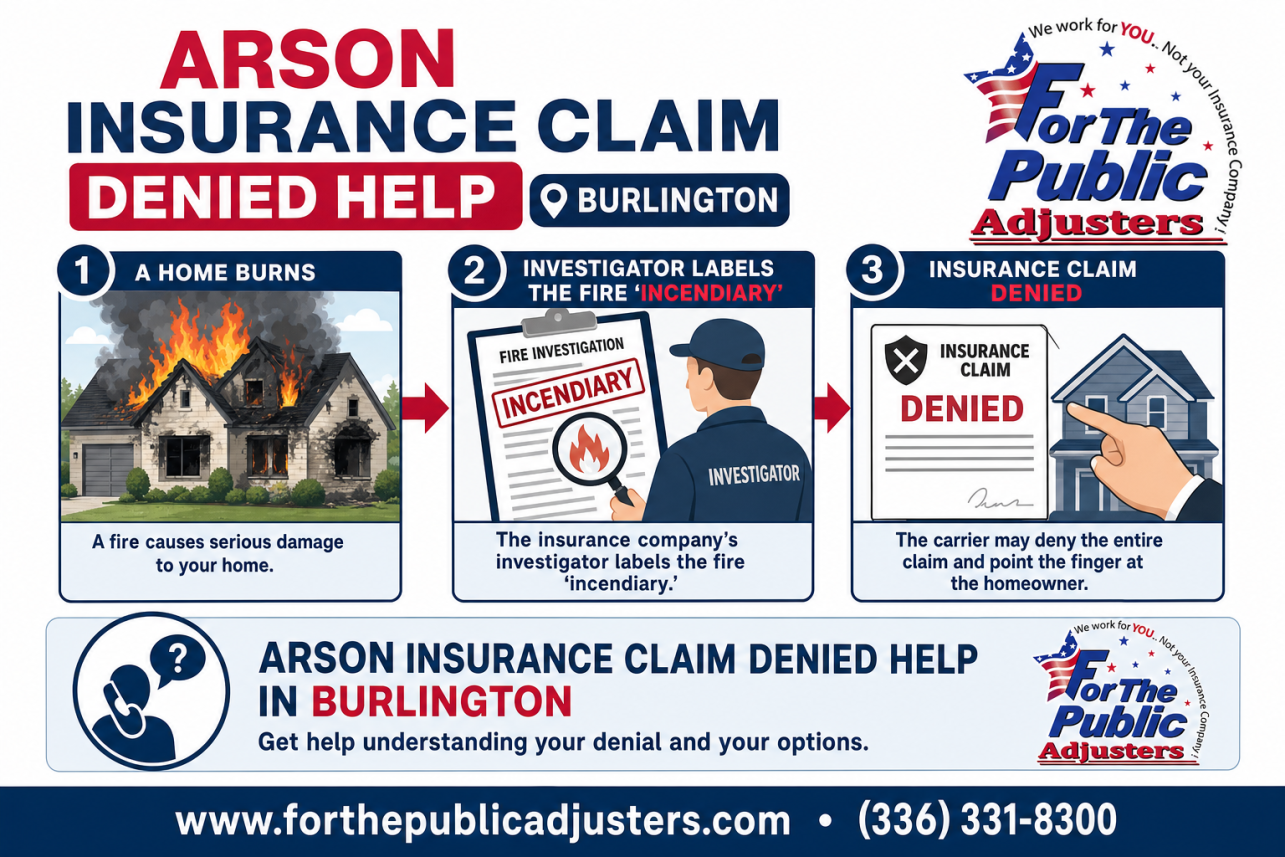
When a home burns and the insurance company's investigator labels the fire 'incendiary,' the carrier may deny the entire claim and point the finger at the homeowner. That denial letter is devastating — but it is the beginning of a dispute, not the end of one.
A public adjuster works only for the policyholder, never for the insurance company. In an arson-denial case, that means dissecting the carrier's cause-and-origin report, comparing its methods against the standards the National Fire Protection Association publishes for fire investigations, and identifying where the insurer relied on assumption instead of evidence. Investigators are supposed to rule out accidental causes — electrical faults, appliance failures, heating equipment — before calling a fire intentional, and in older homes that process is often rushed.
Courts across the country, including in North Carolina, have consistently held that an insurer defending a claim on arson grounds must prove its case — typically an incendiary origin, plus the insured's motive and opportunity — by actual evidence. Policyholders have won these disputes when the carrier's file couldn't support its own conclusion. Our job is to build the record that exposes those gaps.
Alongside the arson dispute itself, we document the full scope of the loss: structural fire damage, smoke damage throughout the home, water damage from firefighting efforts, and destroyed contents. Even when a denial is overturned, carriers frequently undervalue these items, and we handle fire, smoke, and water documentation together so nothing is left off the estimate.
Common Problems
What Is My Fire Claim Actually Worth — And What Does Fighting The Denial Cost Me?
A total or near-total fire loss in Alamance County can involve the dwelling, detached structures, every room of contents, smoke remediation, water extraction, and months of additional living expenses while you're displaced. Denied policyholders often never see a real estimate because the carrier stopped adjusting the moment it alleged arson.
We prepare that full valuation ourselves, line by line, so you know what the claim is worth before anyone negotiates. Public adjusters in North Carolina work on a percentage of what is recovered, subject to state rules — there's no hourly bill, and if nothing is recovered, you don't owe an adjusting fee. We never guarantee an outcome, but you will always know the true measure of your loss.
Arson Insurance Claim Denied Help Burlington: What Do I Do When The Denial Letter Blames Me?
First, do not accept the denial as final, and do not give a recorded statement or examination under oath without preparation. Insurers must do more than show a fire looks suspicious — they must prove it.
Request the complete claim file, the cause-and-origin report, and any lab results. We review whether the investigator actually eliminated accidental causes, whether burn patterns were interpreted correctly, and whether the 'motive' claimed — usually financial hardship — holds up. The NCDOI Public Adjusters Guide is a useful starting point for understanding your rights as a policyholder and how licensed adjusters may represent you in a dispute like this. Deadlines matter after a denial, so the sooner the file is reviewed, the more options remain open.
Should I Hire A Public Adjuster, An Attorney, Or Fight The Arson Accusation Myself?
Going it alone against a carrier's fire investigator and legal team rarely ends well — you're disputing technical findings without the tools to challenge them. Attorneys are essential if litigation becomes necessary, and we work alongside counsel when a case heads that direction.
A public adjuster's role comes first: rebuilding the factual record. That means independent cause analysis, complete contents inventories, photographs, receipts, and a documented estimate of the loss. A good adjuster in a Burlington arson dispute should be licensed in North Carolina, bonded, experienced specifically with fire and smoke losses, and willing to explain — in plain language — exactly where the insurer's investigation falls short.
Our Process
Denial And Policy Review
We start with the denial letter, your full policy, and the insurer's stated grounds. Many arson denials also lean on alleged misrepresentation or late notice, and each ground has to be answered separately. We identify what the carrier must prove and what it has actually produced.
Independent Investigation And Documentation
We examine the fire scene evidence, the carrier's cause-and-origin conclusions, and the elimination (or non-elimination) of accidental causes common in older Burlington homes — aging wiring, space heaters, and appliance failures. At the same time, we document the complete loss: structure, smoke, firefighting water damage, and contents.
Rebuttal, Negotiation, And Next Steps
We present a written rebuttal with supporting evidence and a full damage estimate, then push the claim toward reopening and fair settlement. If the carrier won't move, we advise on appraisal where valuation is the dispute, or coordinate with fire-loss attorneys when the accusation itself must be litigated.
| What Has to Happen | Homeowner Alone | With For The Public Adjusters |
|---|---|---|
| Challenging the carrier's fire investigator | Most homeowners have no way to evaluate whether NFPA 921 methodology was followed | We retain independent cause-and-origin experts who audit the carrier's report for negative corpus, unconfirmed canine alerts, and skipped lab work |
| Examination under oath (EUO) | Answering alone, often unaware that statements will be mined for inconsistencies later | Full preparation beforehand, document organization, and representation so the record works for you, not against you |
| Preserving the fire scene | Debris often cleared before evidence is documented, destroying the ability to rebut the arson theory | Immediate scene-preservation demands, spoliation letters, and independent photography before demolition |
| Rebutting the 'motive' narrative | Debt, a listing, or a recent policy increase gets framed as guilt with no counter-story | Documented innocent explanations — contractor estimates, relocation records, timelines — assembled into a formal rebuttal |
| Deadlines and proof of loss | Missed sworn proof of loss deadlines can sink even a winnable case | Every contractual deadline tracked and met while the dispute proceeds |
| Leverage | A denial letter often feels final | Reconsideration demands backed by expert reports and, where warranted, coordination with fire-loss attorneys on bad-faith exposure |
Commonly Overlooked In The Public Adjusting Industry
- Unconfirmed canine accelerant alerts — Carriers cite the dog's alert as proof, but many denials quietly omit that lab testing of debris samples never confirmed any accelerant — a gap most homeowners never think to check.
- Negative corpus reasoning in the carrier's fire report — Investigators sometimes call a fire 'incendiary' simply because they couldn't find an accidental cause, a method NFPA 921 rejects but that goes unchallenged unless someone reads the report critically.
- The sworn proof of loss deadline running during the dispute — Homeowners assume a denial pauses the policy's contractual deadlines, but missing the proof of loss or suit limitation date can kill a case the carrier was otherwise losing.
- Innocent accelerant sources in the burn area — Gas cans, mower fuel, paint thinner, and lamp oil legitimately stored in garages and basements explain accelerant traces, yet SIU reports frequently never address them.
- Demolition destroying the rebuttal evidence — Cities and lenders push for quick cleanup after a fire, and once the scene is gone, no independent expert can ever contradict the carrier's origin theory.
- The gap between suspicion and proof under North Carolina law — Carriers must prove intentional loss by a preponderance of evidence, not just point to debt or a recent listing, but families treat the accusation as if it were a verdict.
- Additional living expenses cut off during the investigation — Many policies keep ALE obligations alive until a claim is properly denied, yet families move in with relatives and stop tracking costs the carrier still owes.
- Prior recorded statements resurfacing at the examination under oath — The day-one recorded call, given in shock and without preparation, gets combed for inconsistencies months later — and almost no one reviews their own transcript before the EUO.
Case Studies
Case Study #1
Situation: A homeowner off South Church Street in Burlington came home from a weekend in Wilmington to find their detached garage and part of the kitchen destroyed by fire. The fire marshal's report noted an accelerant pattern near the garage door, and within three weeks the insurer sent a reservation of rights letter.
Problem: The carrier's Special Investigations Unit scheduled an examination under oath and began building a case around motive, pointing to a recent HELOC the family had taken out. Six months later, the claim was formally denied on grounds of suspected intentional loss — with no arrest, no charge, and no criminal finding against anyone in the household.
Investigation: We pulled the full fire marshal file through a public records request, hired an independent cause-and-origin investigator, and reconstructed the family's whereabouts with cell records, gas station receipts, and a hotel folio from the coast. We also examined the carrier's own investigation notes obtained during the claim file review.
Findings: The accelerant claim rested on a canine alert that was never confirmed by lab analysis of debris samples — a critical gap, since NC courts and fire science standards under NFPA 921 treat unconfirmed canine alerts as unreliable. The garage also housed a lawn mower and two gas cans, an innocent explanation the SIU report never addressed. The 'motive' HELOC was for a planned bathroom remodel, documented by a signed contractor estimate dated two months before the fire.
Solution: We assembled a rebuttal package: the lab-testing gap, the alibi timeline, the innocent accelerant sources, and the pre-fire remodel paperwork. We presented it to the carrier with a demand for reconsideration and made clear the family was prepared to pursue bad-faith remedies under North Carolina law if the denial stood on evidence that thin.
Outcome: The insurer reversed the denial and paid the dwelling, contents, and additional living expenses claims in full — just under $214,000 — roughly ninety days after our rebuttal was submitted. The family avoided litigation entirely.
Lesson: An arson accusation is only as strong as its lab work. If a carrier denies based on a canine alert without confirmed debris analysis, that denial can often be dismantled — but only if someone actually reads the file and knows what's missing.
Case Study #2
Situation: A retired couple in the Glen Raven area of Alamance County suffered a total-loss house fire that started in an electrical panel area of an older home. Because the husband had reported financial hardship on a recent hardship deferral with the mortgage company, the insurer flagged the claim as suspicious from day one.
Problem: The carrier's origin-and-cause expert concluded the fire was 'incendiary' after eliminating other causes in his opinion, and the claim was denied for material misrepresentation and intentional loss. The couple's own agent stopped returning calls, and the mortgage company began pressing them on the unpaid balance for a house that no longer existed.
Investigation: We brought in a licensed electrical engineer and a second fire investigator to re-examine the scene before demolition. We photographed and preserved the panel remains, documented aluminum branch wiring in the 1968-built home, and cross-referenced the county permit history showing no panel upgrade had ever been performed.
Findings: The carrier's expert had used a 'negative corpus' approach — calling the fire intentional simply because he couldn't identify an accidental cause — a method explicitly rejected by NFPA 921. Our engineer identified arcing signatures consistent with a failed connection at an aluminum-to-copper splice, a well-documented fire hazard in homes of that era. The alleged misrepresentation was a minor inventory discrepancy on contents, not the cause of loss.
Solution: We filed a detailed rebuttal challenging the negative corpus methodology, submitted the engineer's arc-mapping report, and separated the small contents discrepancy from the intentional-loss accusation, correcting the inventory with receipts and photos. We also looped in the mortgage company so foreclosure pressure paused while the dispute was resolved.
Outcome: After an appraisal-style negotiation, the carrier withdrew the intentional-loss defense and settled the dwelling claim at policy limits, with contents paid at 94% of the corrected inventory. Total recovery exceeded $327,000, and the mortgage was satisfied from the proceeds.
Lesson: 'We couldn't find an accidental cause' is not proof of arson, and financial hardship is not a crime. Preserving the fire scene before demolition is often the single most important decision a denied homeowner makes.
| Your Situation Right Now | Biggest Risk If You Wait | Smartest Immediate Move |
|---|---|---|
| SIU has requested an examination under oath | Unprepared answers become the backbone of the denial | Do not schedule the EUO until you have representation and your documents organized |
| Denial letter cites accelerants or 'incendiary origin' | The evidence supporting a rebuttal gets demolished with the debris | Demand scene preservation in writing and get an independent fire investigator out before cleanup |
| Carrier points to your finances as motive | The motive story hardens into the official narrative | Gather documents that explain the finances innocently — estimates, medical bills, relocation records — before the carrier finishes its file |
| Fire marshal ruled cause 'undetermined' but insurer still denied | Homeowners assume undetermined means unwinnable | An undetermined official finding actually weakens the carrier's arson theory — this is often the strongest rebuttal posture |
| You already gave a recorded statement without help | Small inconsistencies get characterized as misrepresentation | Request a copy of your statement and have it reviewed before answering anything further |
| Mortgage company is pressing while the claim sits denied | Foreclosure proceedings on a burned house | Notify the lender that the denial is in active dispute — most will pause while a documented challenge is underway |
| Denial is more than a few months old | North Carolina's contractual suit limitation clock is running | Have the policy's suit limitation period checked immediately; rebuttal and legal deadlines must run in parallel |
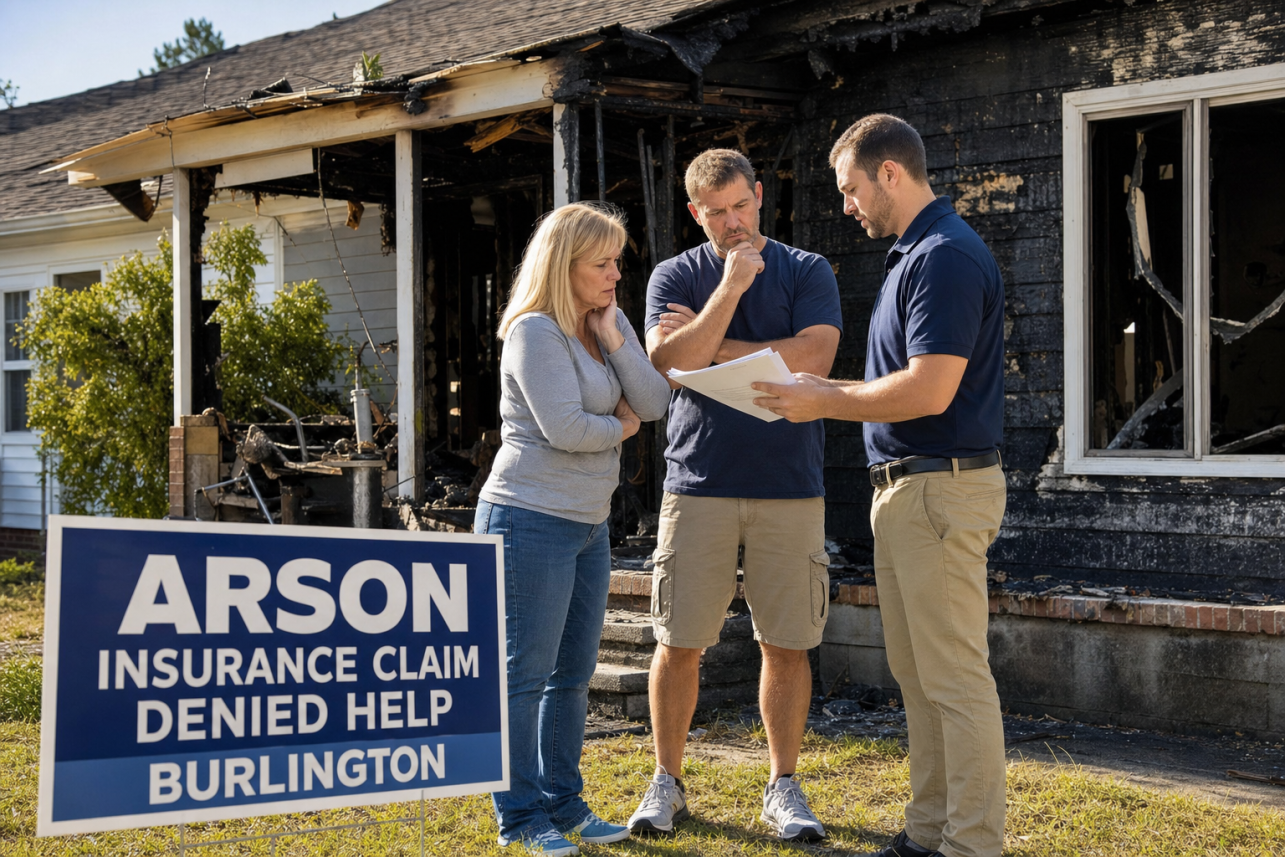
Reviews
State Farm's SIU basically treated my wife and me like criminals after our house fire on Rauhut Street. They kept bringing up our credit card debt like it proved we torched our own home. For The Public Adjusters got our arson insurance claim denied help Burlington case turned around — their fire investigator found the space heater cord that started it, something the carrier's guy never even bagged as evidence. Denial reversed, claim paid.
Marcus T., Burlington NC
After the fire at my rental property near Elon, the insurance company denied everything and said the burn patterns looked 'set.' I was terrified. This team requested the fire marshal's full file, showed the lab never confirmed any accelerant, and sat with me through the examination under oath so I didn't get twisted up by trick questions. Eleven months of stress ended with a full settlement. I only wish I'd called them before the EUO instead of after the denial letter.
Denise W., Alamance County
Our claim was denied because we'd listed the house for sale two months before the fire — apparently that made us suspects. For The Public Adjusters documented that the listing was for a job relocation to Greensboro, rebuilt our contents inventory room by room, and pushed back on the carrier's 'expert' report line by line. We got paid, but honestly the biggest thing was having someone who'd fought arson denials before and wasn't intimidated by the SIU. Four stars only because the process still took eight months — none of that was their fault.
Jerry and Pam H., Burlington
Frequently Asked Questions
My Insurer Denied My Fire Claim And Accused Me Of Arson. Where Can I Get Arson Insurance Claim Denied Help Burlington Homeowners Can Actually Trust?
Start by understanding what the denial letter actually says. When a carrier denies a fire loss on suspicion of arson, it must point to specific policy language, usually the intentional acts exclusion, and it carries the burden of proving three things: that the fire was intentionally set, that you had a motive, and that you had the opportunity. Suspicion alone is not proof.
For The Public Adjusters, Inc. provides arson insurance claim denied help Burlington property owners need when the finger is pointed at them. We start by requesting the carrier's complete claim file, including the cause-and-origin report, the SIU (Special Investigation Unit) notes, and any examination under oath transcripts. In many Alamance County cases, we find the investigation was rushed or leaned entirely on circumstantial factors like a recent financial hardship or a lapsed listing on the home.
From there, we can bring in an independent fire origin expert to re-examine the scene evidence, challenge conclusions that ignored electrical or accidental causes, and document your alibi and timeline. We also prepare a full, itemized valuation of the structure and contents so that when the denial is overturned, you are positioned to recover the full amount, not a lowball figure.
One important note: if the Burlington Fire Department or the North Carolina SBI has an open criminal inquiry, you should speak with an attorney before giving any recorded statement. We coordinate with legal counsel regularly and know when that referral needs to happen. The consultation with our team costs nothing, and we only get paid if we recover money for you.
Why Would An Insurance Company Blame Me For A Fire At My Own Burlington Home?
It usually comes down to money and pattern-matching. Fire losses are among the most expensive claims a carrier pays, so nearly every significant house fire in Alamance County gets routed to the insurer's Special Investigation Unit. Those investigators are trained to look for 'red flags,' and unfortunately many of those flags describe ordinary people going through ordinary hardship.
Common triggers include a recent job loss or bankruptcy, a home listed for sale that didn't move, a mortgage in arrears, a policy that was recently increased, or the family being conveniently away when the fire started. None of these prove anything, but combined with an ambiguous cause-and-origin finding, they give the carrier a basis to deny under the intentional acts exclusion.
The problem is that fire science is frequently misapplied. Indicators once treated as proof of accelerant use, like deep charring, pour patterns, or crazed glass, have been discredited or shown to occur in accidental fires, especially post-flashover. An adjuster or investigator working from outdated assumptions can wrongly label an electrical or appliance fire as incendiary.
As a Burlington public adjuster firm, we've seen carriers blame homeowners when the real cause was aging wiring in a pre-1980s home off Church Street, a space heater failure during a January cold snap, or a lithium battery charging in a garage. Our job is to force the insurer to prove its accusation with actual evidence rather than assumptions, and to rebuild the factual record showing what really happened.
What Should I Do First If My Fire Claim Was Denied On Suspicion Of Arson In Burlington?
First, preserve everything. Do not authorize demolition, debris removal, or repairs at the property until the scene has been independently documented. In an arson-based denial, the physical evidence is your best defense, and once it's gone, you can't get it back. Photograph every room, keep damaged appliances and electrical components, and secure the property against further loss as your policy requires.
Second, request the denial in writing along with the specific policy provisions the carrier relied on. Under North Carolina law, insurers must state the basis for a denial. Also request a certified copy of your full policy. You'd be surprised how often the exclusion cited doesn't actually apply as written.
Third, be careful with statements. If the carrier demands an examination under oath, you generally must comply to preserve coverage, but you're entitled to preparation and representation. Anything you say can be used to justify the denial or, worse, shared with law enforcement if the Burlington Fire Marshal's office is still investigating.
Fourth, get your own experts involved quickly. For The Public Adjusters, Inc. can retain an independent cause-and-origin investigator to examine the scene before evidence deteriorates, then build a rebuttal to the carrier's conclusions. North Carolina's statute of limitations and your policy's suit-limitation clause both put a clock on your rights, sometimes as short as one to three years from the date of loss, so waiting is the most expensive mistake a homeowner can make. A free consultation costs you nothing and tells you exactly where your case stands.
How Does Arson Insurance Claim Denied Help Burlington From A Public Adjuster Differ From Just Hiring A Lawyer?
They're different tools, and in a serious arson accusation you may eventually need both. A public adjuster works the facts and the numbers; an attorney works the legal claims. Knowing which one your situation calls for, and when, can save you months and a great deal of money.
Our role at For The Public Adjusters, Inc. is to attack the factual foundation of the denial. We review the carrier's cause-and-origin report for methodology errors under NFPA 921, the standard fire investigators are supposed to follow. We document your whereabouts, your financial picture, and the property's condition before the fire to dismantle the 'motive and opportunity' narrative. We also prepare the complete damage valuation, structure, contents, and additional living expenses, so the claim is ready to pay in full if the denial is reversed.
Many accusatory denials collapse under this kind of scrutiny without a lawsuit ever being filed, because the carrier's file often can't support the accusation once it's challenged by qualified experts. That resolution path is typically faster and less costly than litigation, and our fee is a percentage of what we recover, nothing upfront.
When litigation or a bad-faith claim becomes necessary, or if criminal exposure exists, we bring in attorneys we work with regularly and hand them a fully developed, expert-supported file. That preparation makes legal action far stronger. For homeowners across Burlington, Graham, Elon, and the rest of Alamance County, starting with our free claim review is the practical first step, and we'll tell you honestly if your case needs counsel from day one.
What Evidence Does An Insurer Actually Need To Prove Arson Before Denying My Fire Claim In Burlington?
More than most homeowners realize. In North Carolina, an insurance company can't deny a fire claim on suspicion alone. To sustain an arson defense, the carrier generally has to show three things: the fire had an incendiary origin, you had a motive, and you had the opportunity to set it or arrange it. If any leg of that stool is weak, the denial is vulnerable.
In practice, we see Alamance County denials built on thin circumstantial evidence — a recent refinance, a late mortgage payment, or an origin-and-cause report that labels the fire 'undetermined' but leans toward incendiary anyway. Financial stress is not proof of arson, and 'undetermined' is not the same as intentional.
When we take on one of these cases, we request the carrier's complete investigation file, the fire marshal's report from the Burlington Fire Department or the county fire investigator, and the origin-and-cause expert's findings. Then we look for gaps: accelerant tests that came back negative, alternative ignition sources that were never ruled out, or witness statements that were taken out of context.
If the evidence doesn't meet the legal standard, we document exactly why and press the carrier to reverse its position. Many arson denials collapse under that kind of scrutiny because they were never built to survive a real challenge — they were built to discourage a homeowner from fighting back.
The Insurance Company Wants Me To Sit For An Examination Under Oath After My Burlington House Fire. Should I Be Worried?
You should be careful, not panicked. An examination under oath (EUO) is a formal, recorded interview conducted by the carrier's attorney, and in suspected-arson cases it's usually where the insurer tries to build its denial. Everything you say can be used to support a fraud or misrepresentation defense — and in North Carolina, refusing to appear can itself be grounds for denial.
So you generally must attend, but you should never walk in unprepared. The questions will dig into your finances, your whereabouts on the day of the fire, prior claims, your mortgage status, and every item on your contents inventory. Innocent inconsistencies — guessing at a purchase date, misremembering a bank balance — get twisted into 'material misrepresentations.'
Before any EUO, our team helps Burlington homeowners assemble accurate documentation: bank records, receipts, photos, and a properly prepared personal property inventory, so answers are grounded in records rather than memory. We also coordinate with your attorney when one is involved, since a lawyer can attend the EUO with you.
One more thing: don't confuse a casual recorded statement with an EUO. Carriers sometimes take an early recorded statement days after the fire, when you're exhausted and displaced, then use it against you later. If a fire at your Alamance County home is being treated as suspicious, get professional guidance before you give any statement — recorded or sworn.
How Long Does It Take To Get Arson Insurance Claim Denied Help Burlington Homeowners Can Rely On, And Is There A Deadline To Fight The Denial?
Start immediately, because the clock is already running. Most North Carolina homeowner policies require lawsuits over fire losses to be filed within a set period — often three years from the loss under state law, though some policies attempt shorter contractual limits. Beyond that, evidence in an arson case degrades fast: burn debris gets hauled away, witnesses move, and the fire scene itself may be released or demolished.
When a Burlington or Alamance County homeowner calls us after a denial, we typically begin with a same-week review of the denial letter, the policy, and whatever investigation documents exist. From there, the timeline depends on the case. Some denials get reversed in two to four months once we present a documented rebuttal — an independent origin-and-cause opinion, financial records disproving motive, and a properly valued estimate of the loss. Contested cases that require appraisal or coordination with litigation counsel can run six to twelve months or longer.
Here's what matters most: preserve everything now. Don't authorize demolition, don't discard burned contents, and don't sign releases the carrier sends you. Photograph the scene, keep every letter and email, and write down your timeline of events while it's fresh.
Getting arson insurance claim denied help Burlington families can actually count on starts with that first review — and the earlier we see the file, the more options you have. There's no fee for us to evaluate a denial, so waiting gains you nothing and can cost you the claim.
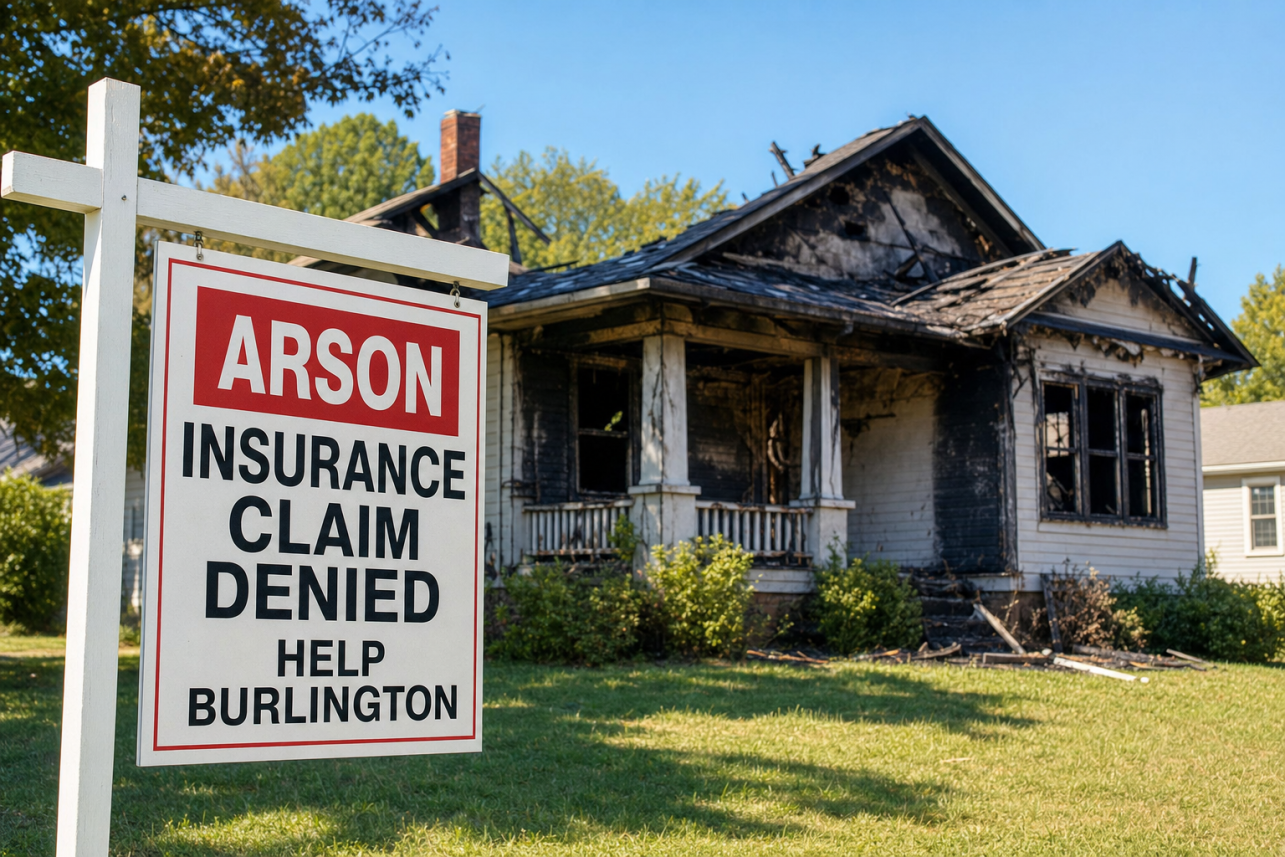
Can A Denied Fire Claim Be Reversed If My Insurer Already Labeled It Arson, Or Is It Too Late Once They've Made That Accusation?
It is absolutely not too late. A denial letter is the carrier's position, not a final ruling — and arson-based denials are reversed more often than people think, precisely because the burden of proof sits on the insurance company, not on you.
We've worked with homeowners across Burlington, Graham, and the surrounding Alamance County area whose claims were denied even though no criminal charges were ever filed. That detail matters: if the local fire marshal and law enforcement investigated and declined to charge you, the carrier is standing on a civil accusation it must still prove with real evidence.
Reversing a denial usually means rebuilding the case from the ground up. We commission or review independent origin-and-cause analysis, challenge the carrier's expert where the science is weak, and assemble financial documentation that dismantles the supposed motive. Just as important, we prepare a complete, professionally documented valuation of the structure and contents loss — because when the denial falls, you want the full claim paid, not a lowball settlement offered to make you go away.
Carriers also know that a wrongful arson accusation exposes them to bad-faith liability under North Carolina law, which gives a well-documented rebuttal real leverage. As public adjusters, we work on contingency, so we only get paid when you recover. If your claim was denied and you were blamed for the fire, have the file reviewed before you accept the carrier's version of events.
The Fire Marshal Ruled The Cause Of My Fire 'undetermined,' But My Insurer Still Blames Me. Can They Deny The Claim Anyway, And Is There Arson Insurance Claim Denied Help Burlington Residents Can Use In This Situation?
An 'undetermined' finding from the Burlington Fire Department or the Alamance County fire marshal is actually a problem for your insurer, not for you. To deny a claim on arson grounds in North Carolina, the carrier must prove three things: the fire was intentionally set, you had a motive, and you had the opportunity. An undetermined cause ruling undercuts that first element badly.
What often happens is the insurance company hires its own private origin-and-cause investigator, who reaches a more convenient conclusion than the public officials did. Those private reports deserve hard scrutiny. We regularly find they ignore NFPA 921 investigation standards, skip over accidental causes like electrical faults, or rely on debunked burn-pattern myths.
For The Public Adjusters, Inc. provides exactly the kind of arson insurance claim denied help Burlington homeowners need here. We compare the official report against the carrier's private findings, bring in independent cause-and-origin experts when the science is shaky, and document the accidental explanations the insurer conveniently overlooked.
An undetermined ruling means the door is wide open to challenge the denial. Do not accept the carrier's version of events as final just because they put it in a letter. The burden of proof sits with them, and in our experience, denials built on top of an undetermined official finding are among the most winnable cases we handle in Alamance County.
The Police And Fire Investigators Cleared Me, But The Insurance Company Still Denied My Burlington Fire Claim As Arson. How Is That Even Legal?
It feels backwards, but it is legal — because criminal arson charges and a civil insurance denial run on two different tracks with two different standards of proof. Prosecutors in Alamance County must prove arson beyond a reasonable doubt. An insurer only needs to convince a civil court by a preponderance of the evidence, which is a much lower bar.
So yes, a carrier can decline your claim even after the district attorney passes on charges or investigators clear you entirely. That said, being cleared is powerful ammunition for your side, and a good Burlington public adjuster will use it aggressively.
When we take on these cases, we obtain the official investigation records, witness statements, and lab results, then force the insurer to explain what evidence they have that trained fire investigators and law enforcement did not find. Often the honest answer is: very little beyond financial suspicion, which North Carolina courts have repeatedly said is not enough on its own.
We also look closely at whether the denial letter cites specific policy language and specific facts, as the law requires, or just vague references to 'material misrepresentation' or 'intentional acts.' Vague denials issued after you have been cleared can expose the carrier to bad-faith liability, which changes the negotiation dramatically.
Being cleared criminally does not automatically get your claim paid — but it makes the insurer's position much weaker, and we know how to press that advantage.
How Much Does It Cost To Hire A Public Adjuster To Fight An Arson Accusation In Burlington, And What If I've Already Lost Everything In The Fire?
For The Public Adjusters, Inc. works on contingency, which means we charge no upfront fee and no hourly rate. Our fee is a percentage of what we actually recover for you. If we do not turn the denial around and get you paid, you owe us nothing for our adjusting work. That structure matters enormously after a total loss, when families in Burlington are often paying for temporary housing out of pocket while the mortgage on a burned house keeps coming due.
Compare that with defending an arson accusation alone. Origin-and-cause experts, forensic accountants, and attorneys billing hourly can cost thousands before you see a dime of recovery. Our contingency model shifts that financial risk off your shoulders and puts it on ours — we only get paid when you do.
There is another practical benefit: because our fee comes from the recovery, we are motivated to maximize every part of your claim, not just the obvious structure damage. That includes contents, additional living expenses, code-upgrade coverage, and debris removal — categories insurers routinely underpay even when they eventually reverse a denial.
If your case ultimately requires litigation, we work alongside North Carolina counsel and our documentation becomes the backbone of the legal file. Most accusation-based denials we handle in Alamance County resolve without a lawsuit, though, because a well-built factual record forces carriers to reassess. Call us for a free review of your denial letter — it costs nothing to find out where you stand.
Will Fighting An Arson Denial Affect My Mortgage, And Who Protects The Lender's Interest While I Look For Arson Insurance Claim Denied Help Burlington Homeowners Depend On?
This is one of the most urgent and least understood parts of these cases. Your mortgage does not pause because the house burned or because the claim was denied. Lenders expect payments to continue, and a prolonged dispute can push homeowners toward default on a property they cannot even live in.
Here is the critical piece of good news: under the standard mortgage clause in most North Carolina homeowner policies, your lender's right to payment is separate from yours. Even if the insurer accuses you of setting the fire, the carrier often still owes the mortgage company its share of the loss. That payment can keep foreclosure at bay while your portion of the claim is fought out.
When you come to us for arson insurance claim denied help Burlington lenders take notice too — we notify the mortgagee, confirm the carrier is honoring the mortgage clause, and document everything so the lender knows the denial is being actively contested. That communication alone has stopped foreclosure referrals for clients in Alamance County.
We also help you present hardship documentation to your servicer to request forbearance during the dispute, since federal servicing rules give you options after a disaster loss.
Do not let the insurer's accusation cost you the property twice — once to fire and once to foreclosure. Protecting your equity and your standing with the lender is part of the job, not an afterthought, and it should start the same week the denial letter arrives.
My Insurer Says I Had A 'financial Motive' Because I Was Behind On My Mortgage. Is That Enough To Deny My Burlington Fire Claim As Arson?
No. Financial difficulty alone is not proof of arson, and North Carolina courts have made clear that an insurer needs more than a motive to justify denial. To sustain an arson defense, the company generally must show three things: that the fire was incendiary in origin, that you had a motive, and that you had the opportunity to set it. Missing the third element, or relying on a shaky origin finding, sinks their case.
We see this pattern constantly in Alamance County. A homeowner falls behind after a job loss or medical bills, a fire happens, and suddenly the carrier treats the debt as evidence of guilt. Thousands of Burlington families carry mortgage stress, and none of that makes them arsonists.
What matters is how the financial picture is presented. Insurers often cherry-pick your records during the investigation, highlighting late payments while ignoring that you had equity in the home, current homeowners coverage you'd been paying faithfully, or personal property you'd never have destroyed. A public adjuster reframes that record, documents the true value of what you lost, and forces the carrier to prove incendiary origin with actual forensic evidence rather than assumptions.
If you've received a denial letter citing your finances, don't panic and don't argue with the adjuster on your own. Request the complete claim file, preserve every document about the fire, and get a professional review of the denial before your policy's suit-limitation clock runs out.
I Was Out Of Town When My House Burned, But The Insurer Still Denied My Claim. Is There Arson Insurance Claim Denied Help Burlington Homeowners Can Get When They Have A Solid Alibi?
Yes, and an alibi is often the strongest weapon you have. When a carrier denies a fire claim on arson grounds, it must typically show you had the opportunity to set the fire or that you arranged for someone else to do it. If you were in Raleigh for work, visiting family in Greensboro, or documented on a hotel receipt three states away, the insurer's opportunity argument becomes an unsupported theory.
Carriers get around this by claiming you 'procured' the fire through a third party. That's a serious allegation, and it requires evidence: phone records, payments, communications. Speculation isn't enough, though denial letters rarely admit how thin the file really is.
For The Public Adjusters, Inc. builds the timeline for you. We gather cell tower data, receipts, toll records, security footage, and witness statements that lock down where you were. We also examine the carrier's origin-and-cause report, because if their investigator can't reliably prove the fire was intentionally set in the first place, your whereabouts almost don't matter.
Burlington homeowners are sometimes told an alibi 'doesn't change anything.' That's simply not how the burden of proof works. The insurer denied you; the insurer must back it up. If you're searching for arson insurance claim denied help Burlington residents have used successfully, an alibi-based case is one of the most winnable situations we handle. Bring us your denial letter and your travel documentation, and we'll tell you honestly how strong your position is.
The Insurance Company Suspects My Ex-Spouse Set The Fire, Not Me. Can They Still Deny My Share Of The Claim On Our Burlington Home?
This is one of the most misunderstood areas of fire loss, and the answer depends heavily on your policy language. Under what's known as the innocent co-insured doctrine, an insured who had nothing to do with a fire may still be able to recover their interest in the property even if another named insured is accused of setting it.
North Carolina policies vary. Older forms sometimes barred everyone on the policy if any insured committed fraud or arson. Many modern policies, and the standard fire policy provisions, are read to protect the innocent party's separate insurable interest. Carriers know most homeowners never read that fine print, so blanket denials get issued even when the innocent spouse has a legitimate claim.
This comes up often in separation and divorce situations across Alamance County, where a fire during a contentious split triggers immediate suspicion. If you were living apart, had a protective order, or can show you had no knowledge of or involvement in the fire, your recovery may survive even if the carrier maintains its accusation against your ex.
The key steps are proving your ownership interest, documenting your separation from the accused party, and valuing your share of the dwelling and contents correctly. For The Public Adjusters, Inc. provides the arson insurance claim denied help Burlington families need in exactly these situations, analyzing the policy language, asserting your innocent co-insured rights, and negotiating your portion of the loss so one person's accusation doesn't wipe out your entire financial recovery.

The Insurer's Fire Investigator Wrote A Report Saying The Fire Was 'intentionally Set.' Can That Conclusion Actually Be Challenged?
Absolutely, and challenging it is often the heart of overturning a wrongful denial. Origin-and-cause reports are opinions, not facts, and they're only as good as the methodology behind them. Fire investigation is governed by NFPA 921, the national standard, and reports that skip its scientific method, ignore alternative causes, or rely on debunked burn-pattern myths can be dismantled.
Here's what many Burlington homeowners don't realize: the investigator who wrote that report was hired and paid by your insurance company. That doesn't make every finding wrong, but it does mean the conclusions deserve independent scrutiny. Common weaknesses we find include failure to rule out electrical causes in older Alamance County homes, misreading pour patterns that modern science attributes to flashover, and 'negative corpus' reasoning, meaning calling a fire arson simply because no accidental cause was identified.
A public adjuster working your denial can bring in an independent, NFPA 921-compliant origin-and-cause expert to re-examine the scene, the debris, the wiring, and the carrier's own photographs. When the fire marshal's findings conflict with the insurer's private investigator, that contradiction becomes powerful leverage.
Timing matters. If your fire scene still exists, do not authorize demolition or cleanup until independent experts have documented it, because destroying the scene can weaken your rebuttal. If the scene is already gone, the carrier's file, photos, and lab reports can still be audited. Either way, a paid opinion is not the final word on your claim, and it can be met with better science.
Local Relevance
Burlington grew up around the textile industry, and much of Alamance County's housing stock reflects it — mill-era bungalows, mid-century frame houses, and older neighborhoods where original wiring, aging panels, and space heating are still common. Those are exactly the accidental fire causes that a rushed investigation can overlook before labeling a fire intentional.
The area also sees its share of vacant and inherited properties, and fires in unoccupied homes draw immediate suspicion from carriers even when vandalism — not the owner — is to blame. We handle vandalism claims alongside arson disputes for that reason, because the two accusations often travel together in a single denial.
Burlington's humid climate adds another layer: fire scenes left open to summer moisture deteriorate quickly, and delayed claims can compound fire damage with mold and water intrusion. A local adjuster who can document the scene promptly protects both the evidence and the remaining structure. For The Public Adjusters, Inc. serves Burlington, Graham, Mebane, and the surrounding Alamance County communities, and we're licensed and bonded in North Carolina.
Many Burlington-area homes date to the city's textile-mill era, and older wiring and heating systems in those houses produce accidental fires that can superficially resemble intentional ones — which is why a denied arson claim here so often turns on whether the insurer's investigator genuinely ruled out age-related electrical causes before blaming the homeowner.
Ready To Get Started?
Reach out today for a free, no-obligation conversation about your situation.
Call us: (336) 331-8300
Helpful Resources
- NCDOI Public Adjusters Guide
- Federal Emergency Management Agency (FEMA)
- National Flood Insurance Program (NFIP)
- Insurance Information Institute (III)
- National Association of Insurance Commissioners (NAIC)
- Weather Underground
- The Weather Channel
- Hurricane Center
- National Fire Protection Association (NFPA)
- American Red Cross Fire Prevention
- U.S. Fire Administration – Home Cooking Fire Safety
Serving Burlington · Alamance
Last updated: July 29, 2026