
You Found the State Farm Claims Number — Now Pause
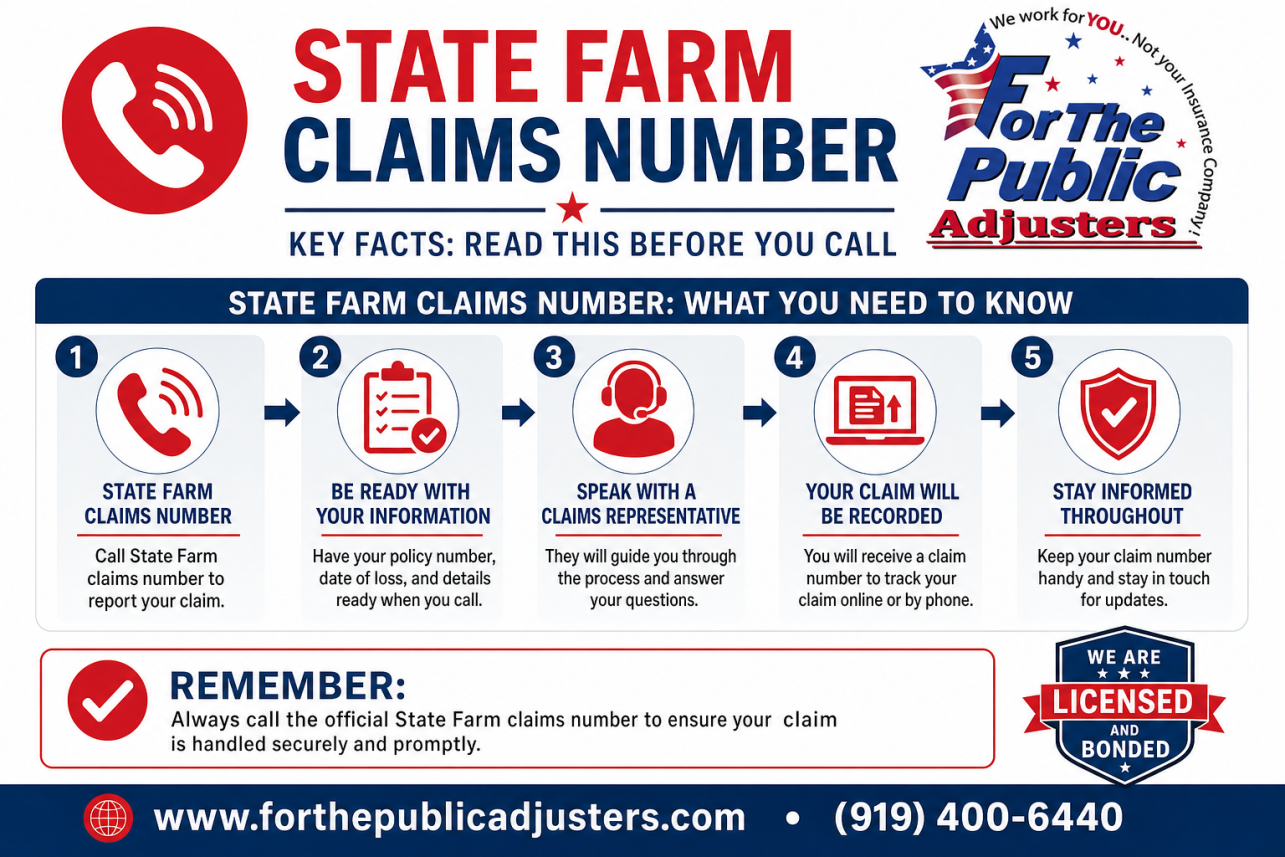
Finding the State Farm claims number is easy to find when you have an insurance claim— it’s 800-732-5246. HOWEVER, before you dial, understand this: your first call starts the official claim record, and everything you say can shape how your damage is valued. Taking a short pause to prepare often makes a real difference in the outcome.
Key takeaways
- Before you dial the State Farm claims number, know that what you say on that first call can shape how your entire claim is handled.
- A Florida legislative (OPPAGA) study found policyholders who used public adjusters typically received significantly larger settlements than those who filed alone.
- In State Farm v. United States ex rel. Rigsby, the U.S. Supreme Court upheld a whistleblower verdict after two former adjusters exposed how Hurricane Katrina home damage was misclassified to shift costs away from State Farm.
- Federal investigations after Hurricane Sandy revealed altered engineering reports used to deny or underpay homeowners’ structural damage claims, prompting court-ordered reviews.
- A licensed public adjuster works only for you, not the insurance company, and documents your home and contents damage before the insurer’s adjuster sets the narrative.
If you’re a North Carolina homeowner searching for that number right now, chances are something just happened. Fall storms, heavy rain, downed trees from early cold snaps, a fire, or a burst pipe after the first freeze — this is the season when home claims spike across the state. You’re stressed, you want the damage fixed, and calling the insurance company feels like the obvious first step. It usually is a necessary step. It just shouldn’t be an uninformed one.
Why the First Call Matters More Than You Think
When you call, you’re not chatting with a neutral helper — you’re giving a recorded statement to a company whose adjuster works for the insurer, not for you. State Farm’s own history shows why caution is warranted. After Hurricane Katrina, two whistleblower sisters who worked as claims adjusters testified that engineering reports were manipulated to shift covered wind damage onto flood policies, and a jury found State Farm liable for fraud in that case — a verdict that reached the U.S. Supreme Court. After Hurricane Sandy, congressional scrutiny and litigation revealed altered engineering reports that minimized what homeowners were owed. These are documented events, not rumors, and they’re a reminder that the person answering your call is protecting the company’s bottom line.
What NC Homeowners Should Know Before Dialing
- You’re on the record immediately. Casual guesses about the cause of damage can be used to limit or deny coverage later.
- The insurer’s estimate is a starting point, not the final word. Initial offers frequently miss hidden damage behind walls, under roofing, and in contents.
- You have the right to your own representation. A licensed, bonded public adjuster works only for you, documenting the full scope of your loss before the insurer defines it for you.
Homeowners in the Triangle and surrounding counties don’t have to navigate this alone. If you’re in Johnston County, speaking with a Public Adjuster in Clayton NC before or shortly after that first call can help you understand what your policy actually covers and how your damage should be documented.
The same goes for policyholders farther west — a Public Adjuster in Moncure NC can review your situation before the insurer’s adjuster ever sets foot on your property. No one can promise a specific result, but going into your claim informed and represented puts the process on far more even footing. The rest of this article walks you through exactly what to expect when you call — and what to do first.

What Happens When You Call the State Farm Claims Number?
When you call the State Farm claims number, you reach an intake representative who opens a claim file, asks detailed questions about the loss, and often records the call. Your answers are used to categorize the claim, assign a company adjuster, and set the framework State Farm will use to evaluate — and potentially limit — your payout.
That first phone call feels routine, but it is actually the beginning of the evidence in your claim file. Everything you say can be quoted back later, so it helps to understand each step before you dial.
Step 1: The Recorded Intake Interview
The representative will ask what happened, when it happened, what was damaged, and what condition the property was in beforehand. These calls are frequently recorded. Innocent guesses — “the roof was probably already a little worn” or “I’m not sure when it started” — can later be used to argue the damage was pre-existing, gradual, or excluded. You are not required to speculate. It is perfectly acceptable to say, “I don’t know yet; the damage is still being assessed.”
Step 2: How Your Words Categorize the Claim
The words you choose can determine which coverage — and which limits, deductibles, and exclusions — apply. Describing water damage as “flooding” versus a sudden pipe burst, or fire damage as “smoke” versus “structural,” can steer the file down very different paths. Homeowners dealing with serious losses, like the fires a fire damage insurance claim help Knightdale team handles, often learn this only after the claim has already been narrowly categorized.
Step 3: The Adjuster Assignment
After intake, State Farm assigns an adjuster — a staff adjuster or an independent adjuster paid by the company. Here is the part many policyholders miss:
- The company adjuster works for State Farm, not for you. Their job is to resolve the claim within the insurer’s guidelines.
- They document what supports the company’s position. You are responsible for documenting everything else.
- Their first estimate is a starting point, not a final word — though it is often presented as one.
History shows why this matters. In State Farm Fire & Casualty Co. v. United States ex rel. Rigsby, a case arising from Hurricane Katrina, two claims adjusters — the Rigsby sisters — exposed how flood versus wind damage was categorized in ways that shifted costs away from State Farm. A jury found against the insurer, and the U.S. Supreme Court upheld the whistleblowers’ verdict in 2016. How a loss gets labeled at intake is not a technicality; it can decide who pays.
Because the deck is arranged before you even hang up, many homeowners choose to consult a licensed, bonded public adjuster in Clayton NC or elsewhere before making that first call, so someone who works only for the policyholder is guiding what gets said and documented from day one.
Does State Farm Really Lowball Homeowners Claims?
State Farm’s claims practices have been challenged in court, and homeowners have won. The Supreme Court upheld a whistleblower verdict against State Farm over Hurricane Katrina claims, altered engineering reports surfaced after Hurricane Sandy, and in Broussard v. State Farm, Mississippi homeowners prevailed at trial after their wind damage was wrongly blamed on flooding.
None of this means every State Farm adjuster acts in bad faith. But before you dial the State Farm claims number, it helps to know that the documented history here is not rumor — it comes from federal court records and sworn testimony. Understanding that history changes how carefully you prepare.
The Rigsby Sisters and Hurricane Katrina
Cori and Kerri Rigsby, two claims adjusters who worked on State Farm files after Hurricane Katrina, alleged that wind damage — covered under homeowners policies — was being reclassified as flood damage so the federal flood program would pay instead of the insurer. Their whistleblower case, State Farm Fire & Casualty Co. v. United States ex rel. Rigsby, went all the way up on appeal, and in 2016 the U.S. Supreme Court unanimously upheld the judgment against State Farm. That distinction between wind and water is exactly the kind of dispute policyholders still face today, much like a flood insurance claim dispute in Raleigh where the cause of loss determines who pays.
Altered Engineering Reports After Hurricane Sandy
After Hurricane Sandy in 2012, litigation and federal court proceedings exposed a troubling pattern in the flood claims process: engineering reports that originally documented storm-related structural damage were revised to attribute the damage to pre-existing conditions or long-term settling. Homeowners received denials based on conclusions the original inspecting engineers never reached. The scandal led to court-ordered review of thousands of Sandy flood claims. The lesson for any policyholder is simple — the first report the insurer relies on is not always the final word.
Broussard v. State Farm: Homeowners Won at Trial
In Broussard v. State Farm, a Mississippi couple lost their home to Hurricane Katrina and had their claim denied on the theory that flooding, not wind, destroyed it. They took State Farm to trial in federal court — and won. The jury found the couple was owed their policy benefits. Although damages were later adjusted on appeal, the core outcome stood: ordinary homeowners with solid evidence prevailed against one of the largest insurers in the country.
What This History Means for You
- Disputes over the cause of damage — wind versus flood, sudden loss versus wear and tear — are where claims most often get undervalued or denied.
- Independent documentation matters, because insurer-hired experts do not always have the last word.
- Policyholders who push back with evidence, and courts that hear them, have repeatedly found in the homeowner’s favor.
That is precisely why many homeowners consult a licensed, bonded advocate — for example, a public adjuster in Chapel Hill NC — before the insurer’s version of events becomes the official record.
How Much More Do Policyholders Recover With a Public Adjuster?
Studies suggest the difference is substantial. Florida’s legislative research office (OPPAGA) found that policyholders who used a public adjuster on 2004–2005 hurricane claims received settlements up to 747% higher than those who handled claims alone. Even on everyday, non-catastrophe claims, represented homeowners recovered several times more — though no adjuster can guarantee a specific result.
The Florida OPPAGA Study: The Numbers Behind the Headline
The most frequently cited data comes from a 2010 report by Florida’s Office of Program Policy Analysis and Government Accountability, an arm of the state legislature — not an industry group with something to sell. Reviewing claims paid through Citizens Property Insurance, the study found:
- On hurricane claims from the 2004–2005 storm seasons, policyholders represented by a public adjuster received payments up to 747% higher than unrepresented policyholders.
- On routine, non-catastrophe claims, represented policyholders still recovered roughly 574% more on average.
Those gaps exist for a simple reason: a public adjuster documents the full scope of damage — structure, contents, code upgrades, and additional living expenses — while an unrepresented homeowner typically accepts whatever the carrier’s adjuster measures. If you live in the Triangle area, a licensed Public Adjuster in Chapel Hill NC can review your policy and damage before you ever pick up the phone.
Why Underpayment Is So Common on Home and Contents Claims
Industry watchdogs and consumer advocates have long documented that first offers on property claims routinely miss covered damage. Hidden water intrusion, undervalued contents, and omitted code-required repairs are among the most common gaps. The courts have seen this pattern too: in United States ex rel. Rigsby v. State Farm, a case arising from Hurricane Katrina homeowner claims, a jury found the insurer had wrongly shifted wind damage onto the federal flood program to avoid paying under its own policies — a verdict the U.S. Supreme Court left standing in 2016. When a carrier’s own claim-handling practices can end up before a jury, it is reasonable for homeowners to want their own expert reviewing the file.
Contents claims are especially vulnerable to underpayment because homeowners rarely have a complete inventory and often accept depreciated values without question. A public adjuster builds that inventory line by line. Homeowners in Wake County, for example, can consult a Public Adjuster in Knightdale NC before signing off on any contents settlement.
The Honest Caveat
No public adjuster — licensed, bonded, or otherwise — can promise you a specific dollar figure or a percentage increase. Every claim turns on its own policy language, documentation, and damage. What the data does show is that professional representation consistently correlates with fuller recoveries, and that homeowners who accept the first number offered often leave covered money on the table.
What Should I Do Before Filing a Home Claim This Fall?
Before you dial the State Farm claims number, document all damage with photos and video, make temporary repairs to prevent further loss, read your policy’s coverage and deadline provisions, and gather receipts and records that prove what you owned. A well-prepared first call sets the tone for your entire claim.
Document Fall’s Most Common Damage Thoroughly
Autumn in North Carolina brings a specific mix of hazards, and each one calls for careful documentation before anyone touches the damage:
- Early freeze pipe bursts: Photograph the broken pipe, the water’s path, and every affected room, ceiling, and floor. Note the date and outdoor temperature, and keep the damaged pipe section if a plumber removes it.
- Chimney and heating-related fires: Capture images of soot patterns, smoke staining, and heat damage in rooms far from the fire’s origin — smoke travels, and so should your camera.
- Hurricane-season storm damage: Late-season tropical systems can still reach the Carolinas into November. Photograph roof damage, water intrusion points, and fallen trees before cleanup begins.
Video walk-throughs are especially valuable because they show damage in context. Narrate as you go, opening closets and cabinets, so nothing is overlooked later. Homeowners who work with a Public Adjuster in Raleigh NC often learn that the evidence captured in the first 48 hours carries the most weight when the insurer’s estimate is challenged.
Secure the Property — But Don’t Over-Repair
Your policy requires you to prevent further damage. Tarp the roof, shut off water to a burst pipe, and board broken windows. Keep every receipt — these emergency costs are typically reimbursable. What you should not do is make permanent repairs or discard damaged materials before the loss is inspected. Throwing away ruined contents or replacing a roof too quickly can destroy the very evidence that supports your claim.
Read Your Policy Before the First Call
Pull out your declarations page and policy booklet. Confirm your deductible, your dwelling and contents limits, and whether you have replacement cost or actual cash value coverage. Look for time limits on reporting the loss and submitting proof of loss. Knowing these terms before you call means you won’t be caught off guard by questions designed to frame your claim narrowly.
Gather Your Evidence First
- Photos, videos, and a written timeline of events
- Receipts, credit card statements, or manuals proving ownership of damaged contents
- Pre-loss photos of your home, if you have them
- Contractor or plumber invoices for emergency work
If the loss is significant, consider having your own damage assessment done before the insurance company’s adjuster arrives. A licensed and bonded Public Adjuster in Durham NC can inspect the property, scope the full extent of the damage, and help you present a complete, well-documented claim from day one — rather than trying to fix an incomplete one later.

When Should I Talk to a Public Adjuster Instead of Calling the State Farm Claims Number?
Speak with a licensed public adjuster before dialing the State Farm claims number whenever your loss is large, complex, or disputed — major fire, storm, or water damage, a denied or delayed claim, a settlement offer that seems low, or a wind-versus-water disagreement. Consultations are typically free, so you lose nothing by asking first.
Situations That Call for Professional Help
- Large losses. Structural fire damage, hurricane or tornado destruction, or a home left uninhabitable involves dozens of moving parts — building estimates, contents inventories, and additional living expenses — that are easy to undervalue.
- Denials. A denial letter is not the final word. Policy language is often more favorable to you than the first reading suggests.
- Lowball offers. If the insurer’s estimate won’t come close to covering repairs, an independent damage assessment gives you documented grounds to push back.
- Wind-vs-water disputes. After hurricanes, insurers sometimes attribute damage to flooding (excluded) rather than wind (covered). This exact issue was at the heart of the Rigsby whistleblower case after Hurricane Katrina, where two former claims adjusters alleged State Farm misclassified wind damage as flood damage — a case that reached the U.S. Supreme Court in State Farm Fire & Casualty Co. v. United States ex rel. Rigsby (2016), where the Court ruled against State Farm and let the whistleblowers’ judgment stand. If flooding is part of your loss, understand how the National Flood Insurance Program interacts with your homeowners policy before you accept anyone’s characterization of the damage.
How a Licensed, Bonded NC Public Adjuster Levels the Playing Field
The insurance company’s adjuster works for the insurance company. A public adjuster is licensed by the North Carolina Department of Insurance and works only for you — the policyholder. That means an independent inspection, a line-by-line estimate of your damage, a complete contents inventory, and a professional who negotiates on your behalf and documents everything in writing. Homeowners working with an experienced Public Adjuster in Raleigh NC get a knowledgeable advocate reviewing the claim before the insurer’s numbers become the baseline.
What a Free Consultation Looks Like
A reputable public adjuster will review your policy, discuss your damage, and give you an honest read on whether professional representation makes sense — all at no cost and with no obligation. If your claim is straightforward, they’ll tell you. If it isn’t, you’ll know what you’re facing before you ever pick up the phone. Property owners across the Triangle, including those searching for a Public Adjuster in Durham NC, can get that review before the claim clock starts. No one can guarantee a specific outcome, but you deserve to make your first call fully informed rather than at a disadvantage.
Calling the State Farm Claims Number Alone vs. With a Public Adjuster on Your Side
| What Happens | Filing on Your Own | Filing with a Public Adjuster |
|---|---|---|
| Who values the damage | State Farm’s staff or independent adjuster, paid by the insurer | A licensed adjuster working solely for you prepares an independent estimate |
| Documentation of home and contents | You photograph and list losses yourself, often missing hidden damage | Professional inspection, detailed inventory, and industry-standard estimating |
| Negotiating the settlement | You respond to the insurer’s first offer, which studies show is often low | Your adjuster negotiates using documented evidence and policy language |
| Cost to you | No fee, but the risk of an undervalued claim falls on you | A regulated percentage fee, typically around 10-20% depending on the state |
Illustrative Example: A Second Opinion Before the First Call
Illustrative example
Consider a hypothetical homeowner — we’ll call her a composite of clients we commonly see — whose roof and interior were damaged after a severe storm. Before calling the State Farm claims number, she contacted a licensed, bonded public adjuster who inspected the property and documented hidden water damage inside wall cavities that a quick walkthrough would have missed. When the insurer’s adjuster arrived, her claim file already included a professional estimate, photos, and a contents inventory. The claim was ultimately resolved for considerably more than the insurer’s initial assessment suggested, though every claim is different and no outcome can ever be guaranteed. The lesson: getting independent representation before that first phone call can help ensure nothing is overlooked.
Frequently asked questions
Where do I find the State Farm claims number and should I call it right away?
The official State Farm claims number is printed on your policy declarations page and listed on statefarm.com and the State Farm mobile app. Before you dial, though, take a breath. That first call is often recorded, and what you say can shape how your claim is handled. Many homeowners benefit from speaking with a licensed public adjuster first so they understand their coverage and the true scope of damage before going on the record.
Should I talk to a public adjuster before filing a claim with State Farm?
It’s often wise, especially for significant home or contents damage. A public adjuster works for you, not the insurance company, and can document the loss, review your policy, and present the claim properly from day one. Company adjusters are trained to protect the insurer’s bottom line. While no one can guarantee a specific outcome, having your own licensed, bonded advocate helps ensure nothing is missed or undervalued before you commit to a recorded statement.
Has State Farm ever been caught lowballing or wrongly denying claims?
Yes. After Hurricane Katrina, whistleblowers Cori and Kerri Rigsby exposed how wind damage was shifted onto federal flood coverage, and in United States ex rel. Rigsby v. State Farm, a fraud verdict against the company was upheld all the way to the U.S. Supreme Court in 2016. In Broussard v. State Farm, Mississippi homeowners also prevailed after their Katrina claim was denied. These cases show why independent representation matters.
What was the Hurricane Sandy engineering report scandal?
After Hurricane Sandy, investigations and congressional hearings revealed that engineering reports on flood-damaged homes had been altered to downplay structural damage, reducing what insurers had to pay. The scandal was so serious that FEMA reopened thousands of claims for review. It’s a powerful reminder that the first inspection report isn’t always the final word, and that homeowners have the right to independent documentation of their damage.
Is hiring a public adjuster worth the cost?
Public adjusters typically charge a percentage of the recovered settlement, so there’s usually no upfront fee. A 2010 study by Florida’s legislative research office (OPPAGA) found policyholders who used public adjusters received substantially larger settlements than those who didn’t, particularly on hurricane claims. Results vary and no outcome can be guaranteed, but on larger or disputed home and contents claims, professional representation often more than pays for itself.
What happens step by step after I call State Farm to report home damage?
You’ll receive a claim number, then be assigned an adjuster who schedules an inspection of your home. The adjuster prepares a damage estimate, and State Farm issues a coverage decision and payment, minus your deductible. It sounds simple, but the insurer’s estimate is only their opinion of your loss. You’re entitled to your own estimates, supplemental claims for missed damage, and independent representation at any point in the process.
What mistakes do people make when calling their insurance company after home damage?
Common missteps include guessing at answers during a recorded statement, speculating about the cause of damage, throwing away damaged items before they’re documented, accepting the first offer as final, and missing hidden damage like moisture behind walls. Another big one: not reading the policy before calling. Take photos and video, keep receipts, say only what you know for certain, and remember you can pause and seek professional guidance at any time.
How long does it take State Farm to pay a homeowners claim?
It depends on the size and complexity of the loss. Straightforward claims may resolve in weeks, while large fires, hurricanes, or disputed losses can take months. Most states have prompt-payment laws requiring insurers to acknowledge, investigate, and pay claims within set timeframes. Thorough documentation from the start usually speeds things up, and a public adjuster can help keep the claim moving and push back if deadlines slip.
Can I hire a public adjuster after State Farm has already made me an offer?
Yes. Accepting an initial payment usually doesn’t close the door on your claim. You can typically file a supplemental claim if additional damage is found or the original estimate fell short, as long as you act within your policy and state deadlines. Many homeowners bring in a public adjuster precisely at this stage, after realizing the first check won’t cover their actual repair costs.
What can I do if State Farm denies or underpays my home claim?
Request the denial and the full estimate in writing, then get an independent assessment of the damage. Options include filing a supplemental claim, invoking the appraisal clause in your policy, complaining to your state insurance department, or pursuing legal action. Homeowners have won in court before—Broussard v. State Farm after Katrina is one example. A denial is the insurer’s position, not necessarily the final answer.
Arson Homeowners Claim help near you
Related local pages
Before you dial, get a free claim review from a licensed and bonded NC public adjuster who works only for you — not the insurance company. Get in touch.
Last updated: October 1, 2026