What Is a Siding Matching Insurance Claim — and Why Does It Matter?
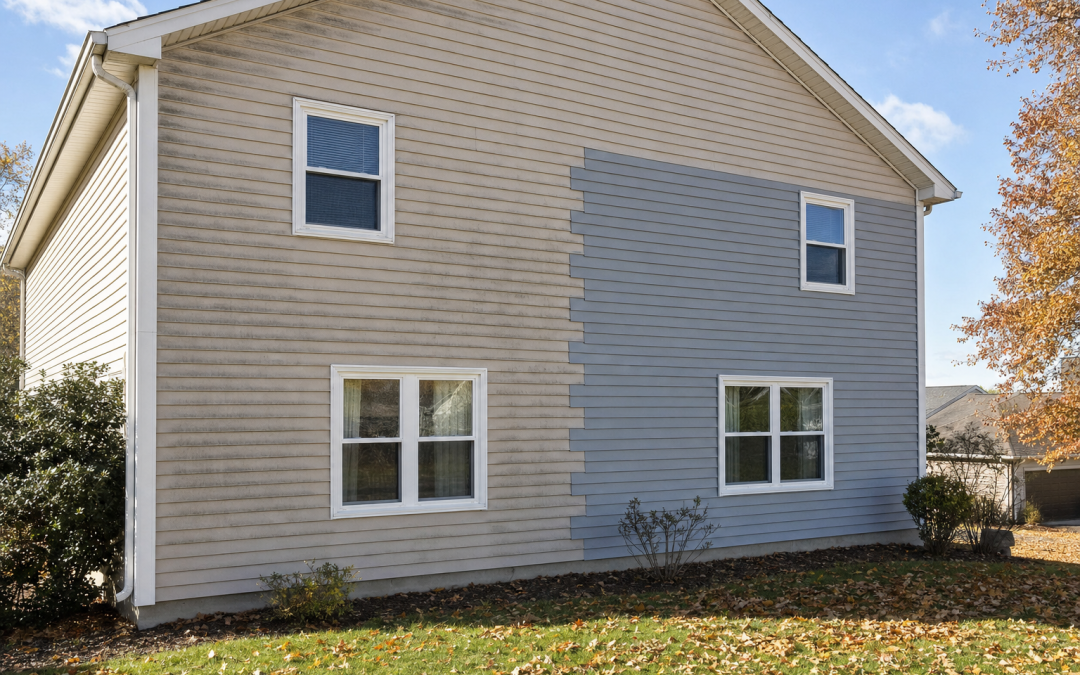
A siding matching insurance claim is a dispute over whether your insurer must replace enough siding (or shingles) so your home looks uniform after storm damage — not just the few pieces that blew off. It matters because paying for only the damaged panels often leaves a visibly mismatched, patchwork exterior that hurts your home’s appearance and value.
Key takeaways
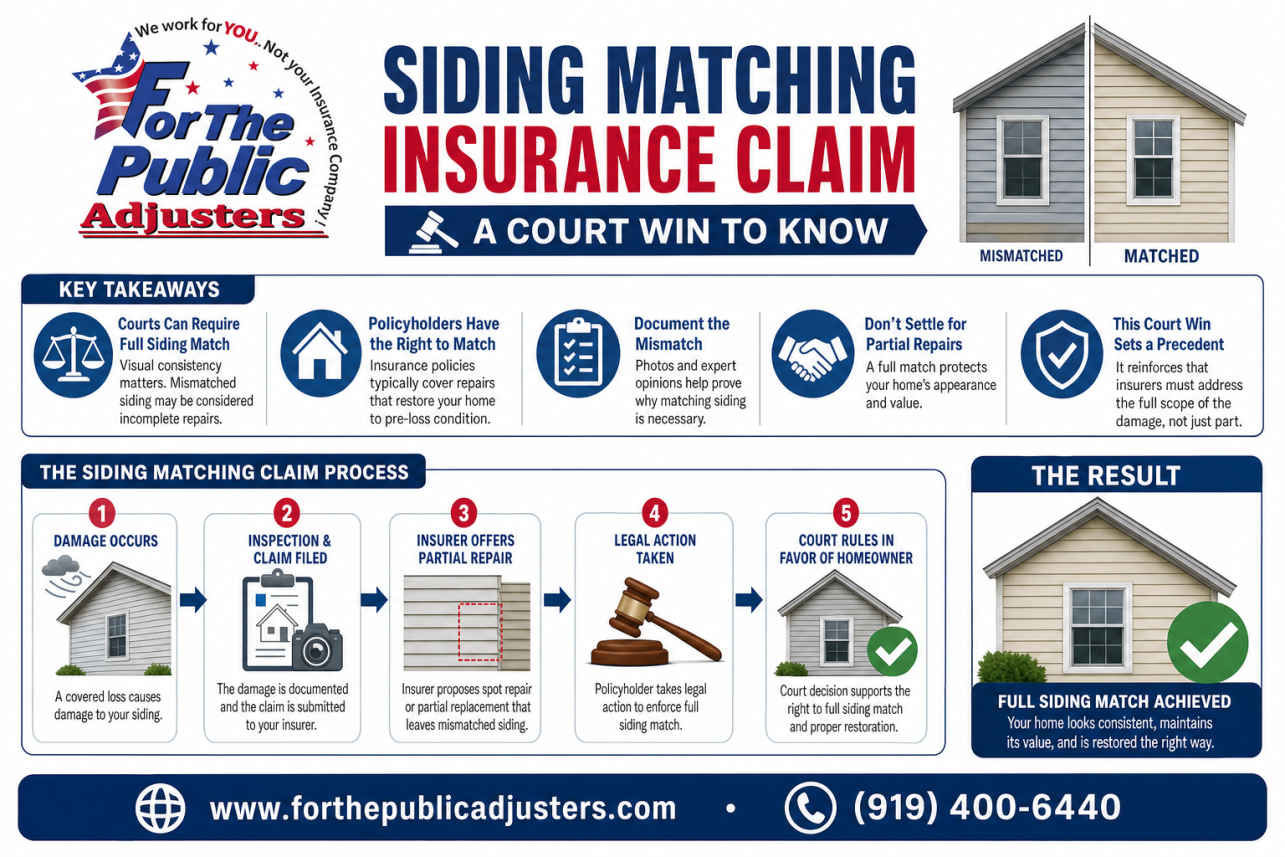
- In Windridge v. Philadelphia Indemnity, the Seventh Circuit ruled the insurer had to replace siding on all sides of the buildings, not just the two storm-damaged sides, because mismatched panels would not restore the property to its pre-loss condition.
- The court treated each building as a whole — meaning ‘direct physical loss’ can include the diminished, mismatched appearance of undamaged sections, not just the panels that blew off.
- For NC homeowners, this reasoning is powerful leverage when a carrier offers to pay for only a handful of shingles or siding panels that no longer match discontinued or weathered materials.
- Matching outcomes depend heavily on policy language, so review your policy for matching endorsements, exclusions, or line-of-sight limitations before accepting a partial repair offer.
- If the original siding or shingles are discontinued and no reasonable match exists, document it in writing from suppliers — that evidence often turns a patch-job estimate into a full replacement claim.
Here’s the problem in plain terms: wind rips a dozen vinyl panels off one wall, or hail bruises a slope of shingles. The carrier agrees the damage is covered, but only prices out the individual pieces that were destroyed. Then reality hits — your siding line was discontinued years ago, or the replacement material has faded differently than what’s still on the house. The “repair” leaves an obvious color and texture mismatch that anyone can spot from the street. The question at the heart of every matching dispute is whether the policy’s promise to repair or replace the damage obligates the insurer to restore a reasonably uniform look, even if that means residing an entire wall or the whole home.
Why Matching Disputes Spike During NC’s Fall Storm Season
Fall wind and hail events across North Carolina generate a wave of these claims every year. Straight-line winds and the remnants of tropical systems tend to strip siding from one or two exposures of a house, which is exactly the scenario that creates a patchwork repair. Homeowners in fast-growing areas — like those working with a Public Adjuster in Clayton NC — often discover their builder-grade siding was discontinued, making a true match impossible without a larger replacement.
What a Mismatched “Repair” Actually Costs You
- Curb appeal and resale value: A two-tone wall is a red flag to buyers and appraisers.
- Incomplete indemnity: Insurance is supposed to put you back where you were before the loss — a checkerboard exterior isn’t that.
- Future claim complications: Mixed materials of different ages can muddy the waters on the next storm claim.
The Court Win Every Homeowner Should Know
The good news: policyholders have fought this fight and won. In a closely watched federal appellate decision — covered in detail in the next section — a court sided with the property owner, holding that replacing only the storm-damaged panels did not satisfy the insurer’s obligation when the result would be a mismatched building. That reasoning has become a key reference point for homeowners pushing back on lowball matching offers, whether they’re in a large metro or a smaller community served by a Public Adjuster near Moncure NC. Understanding that precedent — and how North Carolina approaches matching — is the foundation for turning a patchwork offer into a fair settlement.

What Happened in Windridge v. Philadelphia Indemnity? A Landmark Siding Matching Insurance Claim
In Windridge of Naperville Condominium Association v. Philadelphia Indemnity Insurance Co., a federal appeals court ruled that when storm-damaged siding cannot be matched, the insurer must pay to re-side the entire building — not just the damaged sides — because mismatched panels would not restore the property to its pre-loss condition.
The Facts of the Case
A hail and wind storm struck a condominium complex in Naperville, Illinois, damaging the aluminum siding on the south and west elevations of the buildings. The north and east sides were untouched. The problem? The original siding was no longer manufactured, and no reasonably matching replacement existed on the market.
The condo association argued that replacing siding on only two sides would leave the buildings with a visibly mismatched, patchwork appearance. The insurer, Philadelphia Indemnity, took the position it only owed for the panels that were physically struck by hail and wind — a stance homeowners across the country hear all the time when they file a siding matching insurance claim.
What the Seventh Circuit Decided
The U.S. Court of Appeals for the Seventh Circuit sided with the property owner. The court’s reasoning came down to a few key points:
- The policy promised replacement with “comparable material and quality.” Siding that clearly clashes with the rest of the building is not comparable.
- The “unit of damage” was the building as a whole, not individual panels. Each building suffered damage, so each building had to be restored.
- Pre-loss condition matters. Before the storm, the buildings had a uniform appearance. A two-toned, mismatched result would leave the owner worse off than before the loss — which is exactly what replacement cost coverage is supposed to prevent.
Because no matching siding existed, the only way to truly restore the property was to replace the siding on all sides. The insurer had to pay for the full re-side.
Why This Case Matters to Property Owners
Windridge is one of the most frequently cited decisions in matching disputes because it puts the focus where it belongs: on the condition of the property before the loss, not on counting individual damaged panels. Policyholders and professionals — including any experienced public adjuster in Apex NC — often point to its logic when an insurer offers a spot repair that would leave a home looking obviously pieced together.
It is worth noting that Windridge is a Seventh Circuit decision applying Illinois law, so it is persuasive rather than binding elsewhere. Still, its reasoning gives property owners a powerful framework for pushing back, and a knowledgeable public adjuster in Clayton NC can use that same pre-loss-condition argument when negotiating a mismatched-siding settlement on your behalf.
Why Won’t My Insurance Company Pay to Match My Siding or Shingles? The Core of a Siding Matching Insurance Claim
Insurers often refuse to pay for matching because they interpret the policy to cover only the panels or shingles physically struck by the storm — not the mismatched appearance left behind. They rely on arguments about “direct physical damage,” discontinued products, and limited line-of-sight repairs, all of which the Windridge reasoning pushes back against under replacement-cost coverage.
Understanding the carrier’s playbook is half the battle in a siding matching insurance claim. Here are the four arguments homeowners hear most often, and why each one is weaker than the adjuster makes it sound.
“We Only Owe for Direct Physical Damage”
This is the most common denial. The carrier says hail hit the south and west sides, so it only owes for the south and west sides. The reasoning that prevailed in Windridge counters this directly: when replacing only the damaged elevations leaves the building with two visibly different sidings, the sensible unit of “damaged property” is the siding as a whole — not each individual panel. A repair that leaves the home looking patched together is not a true replacement.
“The Product Is Discontinued, So We’ll Pay for the Closest Match”
When your siding profile or shingle line is no longer manufactured, carriers frequently offer a “comparable” product for just the damaged slope or wall. But if the closest available match is noticeably different in color, texture, or dimension, the mismatch itself undermines the promise of replacement-cost coverage, which is supposed to restore you to your pre-loss condition — including a uniform appearance.
Line-of-Sight Limitations
Some adjusters concede matching within a single “line of sight” — one wall or one roof slope — but refuse to extend it around a corner. This is a compromise position, not a policy requirement, and courts applying Windridge-style reasoning have found that a building-wide mismatch can constitute damage to the structure as a whole. Homeowners working with a public adjuster in Apex, NC often discover the line-of-sight limitation was never actually written into their policy.
Lowball Scopes That Hide the Problem
Finally, many initial estimates simply omit the matching issue altogether — scoping a handful of squares of siding or a bundle of shingles without addressing discontinued products or color fade. Common tactics include:
- Pricing repairs with generic materials that don’t exist in your profile or color
- Ignoring weathering, so new panels stand out against faded originals
- Excluding tear-out, trim, or wrap costs needed for a proper full-elevation replacement
Each of these arguments can be challenged with documentation, manufacturer discontinuation letters, and contractor statements. If your carrier is holding firm, an experienced public adjuster in Clayton, NC can build the record that turns a partial-panel offer into a full, uniform replacement.
Does North Carolina Recognize Matching on a Siding Matching Insurance Claim?
North Carolina has no statute that expressly requires insurers to pay for matching siding or shingles, and there is no definitive appellate ruling on point. But NC courts read ambiguous policy language in the policyholder’s favor, and the pre-loss condition standard gives homeowners a genuine, defensible argument for full matching in many claims.
Because the question isn’t settled by a bright-line rule in North Carolina, matching disputes here usually come down to two things: what your specific policy says, and how persuasively you can argue that mismatched materials fail to restore your home to its pre-loss condition.
Ambiguity Goes to the Policyholder
Under long-standing North Carolina contract principles, when an insurance policy term is reasonably open to more than one interpretation, courts construe it against the insurer that drafted it. Most policies promise to repair or replace “the damaged part” of the property with materials of “like kind and quality” — but they rarely define whether a visibly mismatched wall or roof slope counts as properly repaired. That silence is where policyholders find leverage. Homeowners who work with a public adjuster in Apex NC often discover their policy language supports a broader scope than the carrier’s first estimate suggested.
The Pre-Loss Condition Standard
The core purpose of replacement cost coverage is to put you back where you were before the loss. A strong matching argument frames the question this way:
- Uniform appearance was part of the pre-loss condition. Before the storm, your siding matched. A patchwork repair doesn’t restore that.
- Function isn’t the only measure. A home’s exterior has aesthetic and market value; obvious mismatches can reduce both.
- Discontinued materials strengthen the claim. If your siding profile or shingle line is no longer manufactured, a true “like kind and quality” repair of only the damaged panels may be physically impossible.
Check Your Policy for a Matching Exclusion or Limitation
Some carriers have added endorsements that expressly cap or exclude payments for matching undamaged materials. Read your declarations page and endorsements carefully — if a matching limitation exists, it changes the negotiation. If it doesn’t, the ambiguity argument remains fully available to you. Reviewing these endorsements is exactly the kind of policy analysis a public adjuster in Chapel Hill NC performs before presenting a matching demand to the carrier.
Why Windridge Matters in NC Negotiations
Windridge is not binding on North Carolina courts, but persuasive rulings like it show adjusters and their attorneys that courts elsewhere have accepted the “whole side, not just the damaged panels” reading of standard policy language. Citing that reasoning in a well-documented siding matching insurance claim can shift a negotiation meaningfully — though it never guarantees a particular outcome, and every claim turns on its own policy wording and facts.
What Should I Do If the Carrier Only Offers a Few Panels or Shingles?
Don’t accept a patchwork repair right away. Instead, document every elevation of your home with photos, get a written letter from a contractor confirming the material is discontinued or unmatchable, ask the insurance company to state its position in writing, and hold off on signing any scope of repairs until the matching issue is resolved.
A lowball offer of a few panels or a bundle of shingles is often the opening position in a siding matching insurance claim — not the final word. What you do in the days and weeks after that offer arrives can make or break your ability to push for a full elevation or full replacement. Here’s a practical checklist, especially timely during fall storm season when leaves, rain, and shorter days start hiding damage.
Document Everything Before Weather Hides It
- Photograph all four elevations of the home, not just the damaged side. You need clear before-and-after context showing what the home looked like as a uniform whole.
- Capture close-ups and wide shots. Close-ups show hail hits, cracks, and creasing; wide shots show how visible a mismatched patch would be from the street.
- Do it now. Falling leaves, staining, and additional storms can obscure or complicate the damage picture, giving the carrier room to argue about causation later.
Build a Paper Trail on Matchability
- Get a contractor letter stating whether your siding profile, color, or shingle line is discontinued or cannot be reasonably matched. A supplier’s confirmation that the product is no longer manufactured is powerful evidence.
- Request the carrier’s position in writing. If the adjuster says matching isn’t owed, ask them to cite the specific policy language or endorsement they’re relying on. Vague verbal denials tend to evaporate under scrutiny.
- Keep every estimate, email, and scope sheet. Disputes over matching often turn on what was documented, not what was said on a phone call.
Don’t Sign Off Too Quickly
Signing a repair contract or accepting payment based on a spot-repair scope can make it much harder to reopen the matching question later. Before you agree to anything, it’s worth having someone who negotiates these claims full-time review the file — a public adjuster in Raleigh NC can evaluate whether the carrier’s scope actually restores your home to pre-loss condition.
If the initial offer only covers a handful of panels or shingles on a home with obviously mismatched results, that’s a red flag worth a second opinion. Homeowners east and west of the Triangle face the same tactics, and working with a public adjuster in Durham NC early — before signing anything — preserves your leverage instead of surrendering it.

How Can an NC Public Adjuster Help With a Siding Matching Insurance Claim?
A licensed public adjuster documents your entire elevation, gathers proof that your siding or shingles are discontinued or cannot be reasonably matched, writes a full-scope estimate, and negotiates directly with the insurance company on your behalf. That combination of evidence and advocacy often turns a small “patch” offer into a fair settlement discussion.
Matching disputes are rarely won by arguing on the phone. They are won with documentation the carrier cannot easily dismiss. That is where a licensed and bonded public adjuster earns their keep — building a file that supports a proper siding matching insurance claim from the first inspection forward.
Building the Matching Argument, Step by Step
- Full-scope estimate: Instead of pricing a handful of panels, a public adjuster scopes the continuous elevations affected by the loss, using the same estimating platforms carriers use, so the numbers speak the adjuster’s language.
- Product discontinuation evidence: Letters from manufacturers, distributor confirmations, and contractor statements showing that your exact profile, texture, or color is no longer produced — or that weathering makes new material visibly different.
- Photo and sample documentation: Side-by-side comparisons of proposed replacement material against your existing siding, which often makes the mismatch obvious to anyone reviewing the file.
- Citing favorable authority: Referencing decisions like Windridge and applicable policy language to show why a piecemeal repair may not restore the property to its pre-loss condition.
- Negotiation and follow-through: Handling supplements, re-inspections, and written responses so the burden of pushing the claim forward does not fall on you.
Why Local Knowledge Matters in North Carolina
Carriers respond differently depending on jurisdiction and policy form, so it helps to work with someone who handles these disputes locally. Homeowners searching for a Public Adjuster in Raleigh NC are often dealing with hail or wind losses where only one or two elevations were damaged — exactly the scenario where matching disagreements arise.
The same is true across the Triangle. If you are working through a partial siding or roof loss, a Public Adjuster in Durham NC can inspect the property, review your policy language, and tell you honestly whether a matching argument is worth pursuing before you accept the carrier’s number.
Know Your Rights — and Get a Free Claim Review
Public adjusters in North Carolina are licensed and regulated by the North Carolina Department of Insurance, and you can verify any adjuster’s license before hiring them. For general guidance on how property claims are handled nationally, the National Association of Insurance Commissioners offers consumer resources worth reading.
No one can guarantee a specific outcome on any claim — and you should be wary of anyone who promises one. What a qualified public adjuster can offer is a thorough, honest evaluation of your policy, your damage, and your matching argument. If your carrier is only offering a partial repair, request a free claim review and find out where you actually stand before you sign anything.
Siding Matching Insurance Claim: Partial Repair vs. Full Replacement
| Factor | Carrier’s Partial Repair Offer | Full Replacement (Windridge Approach) |
|---|---|---|
| What gets paid | Only the individual panels or shingles that were physically damaged | All siding needed to restore a uniform, pre-loss appearance |
| Matching outcome | Visible mismatch if original material is discontinued or weathered | Consistent color and profile across the entire structure |
| Effect on property value | Patchwork look can hurt resale value and curb appeal | Restores the home to its pre-loss condition and value |
| Homeowner’s leverage | Weak unless policy language or case law is cited | Strong when matching is impossible and courts read the policy in the insured’s favor |
| Best next step | Get written proof that matching material is unavailable | Present matching evidence and Windridge-style arguments in a supplement or appraisal |
Illustrative Example: A Patch Offer That Became a Full-Side Replacement
Illustrative example
Consider a hypothetical North Carolina homeowner whose vinyl siding was battered by wind-driven hail on the west-facing wall of the house. The carrier’s initial estimate covered only the cracked panels, even though the siding line had been discontinued and no matching color was available. The homeowner obtained written confirmation from two suppliers that no reasonable match existed, then submitted a supplement citing matching case law, including the Windridge decision. After review, the claim was revised to cover replacement of the siding needed to achieve a uniform appearance rather than a visibly patched wall. This scenario is a composite for illustration only, but it reflects how documentation and matching arguments commonly change claim outcomes.
Frequently asked questions
Does the Windridge ruling apply to my siding matching insurance claim in North Carolina?
Not automatically. Windridge is a federal appeals decision from the Seventh Circuit applying Illinois law, so it doesn’t bind North Carolina courts. However, it’s persuasive authority policyholders and attorneys can cite when arguing that repairs must restore the property to its pre-loss condition. Your outcome will depend on your specific policy language, North Carolina law, and how your insurer interprets ‘direct physical loss’ and matching.
What should I do if my insurer only offers to pay for the siding panels that blew off?
Don’t accept the first offer as final. Get written estimates from contractors documenting that matching siding is unavailable or that spot repairs would leave a visible mismatch. Ask the adjuster to explain, in writing, the policy basis for denying full replacement. Then consider requesting appraisal if your policy allows it, filing a complaint with the state insurance department, or consulting a public adjuster or policyholder attorney.
How do I prove my old siding can’t be matched?
Get documentation from siding suppliers or manufacturers stating the product line, color, or profile is discontinued or unavailable. Have a contractor put in writing that available substitutes won’t match in color, texture, or dimension. Photograph the existing siding, including faded areas, and keep samples of the damaged panels. An independent testing service can also compare samples and issue a report insurers often accept as evidence.
How long does a disputed siding matching claim usually take to resolve?
Straightforward claims may resolve in weeks, but matching disputes commonly stretch to several months, especially if the insurer requests inspections, matching reports, or invokes appraisal. If the dispute goes to appraisal or litigation, expect months to a year or more. You can shorten the timeline by documenting the mismatch early, responding promptly to insurer requests, and keeping all communications in writing.
Is it worth hiring a public adjuster or attorney for a siding mismatch dispute?
It often is when the gap between the insurer’s offer and full replacement cost is large. Public adjusters typically work on a percentage of the recovery, and many policyholder attorneys offer free consultations. If the insurer is only paying for a few panels but full replacement runs tens of thousands of dollars, professional help can pay for itself. For small differences, a strong written demand with contractor documentation may be enough.
What is a matching endorsement or matching exclusion in a homeowners policy?
Some insurers add policy language that limits or excludes payment for undamaged materials replaced solely to achieve a uniform appearance. Others sell endorsements that expressly cover matching. Read your policy before a loss occurs and ask your agent whether matching is addressed. If your policy is silent on matching, that ambiguity can work in your favor, since courts often construe unclear policy language against the insurer.
What are the biggest mistakes homeowners make with siding matching claims?
Common mistakes include accepting the first check without realizing it may not be the final payment, letting a contractor patch the damage before documenting the mismatch, throwing away damaged panels that prove the original product, missing the policy deadline to demand appraisal or file suit, and relying on verbal promises from adjusters. Keep everything in writing, photograph before any repairs, and read your policy’s dispute provisions carefully.
Can I use the appraisal process to resolve a siding matching disagreement?
Often yes, if the dispute is about the amount of loss rather than coverage itself. Under most policies, each side hires an appraiser, and the appraisers select an umpire; agreement by any two sets the amount. Some insurers argue matching is a coverage question outside appraisal, so review your policy and consider legal advice before invoking it. Appraisal is usually faster and cheaper than a lawsuit.
Will my insurer pay to replace siding on all four sides if only one side is damaged?
It depends on your policy language, state law, and the facts. Insurers frequently argue they owe only for physically damaged panels, while policyholders argue a patchwork repair doesn’t restore pre-loss condition. Some claims settle with full replacement, others with replacing one full elevation, and others with payment for panels plus a mismatch allowance. Strong documentation that no reasonable match exists significantly improves your position.
Does the matching argument apply to roof shingles too, or just siding?
The same logic applies to shingles, roofing tiles, flooring, and other continuous surfaces: if replacement materials can’t reasonably match, spot repairs may not restore the property to pre-loss condition. Discontinued shingle colors and weathering make roof matching disputes common after hail and wind storms. Document the shingle brand and color, get contractor statements about availability, and push back if the insurer offers to replace only scattered shingles.
Arson Homeowners Claim help near you
Related local pages
Told your carrier will only pay for a few shingles or panels? Get a free claim review from our licensed and bonded NC public adjusters before you accept a mismatched repair. Get in touch.
Last updated: September 21, 2026