
If you’re looking for a public adjuster water damage bear creek homeowners can call after a burst pipe, roof leak, or overflowing water heater, For The Public Adjusters, Inc. works exclusively for you — never the insurance company. We are licensed and bonded, and we prepare, document, and negotiate your water damage claim so the settlement reflects what your home actually needs. You pay nothing out of pocket up front; our role is to make sure the loss is measured honestly before you accept a check.
What This Service Is
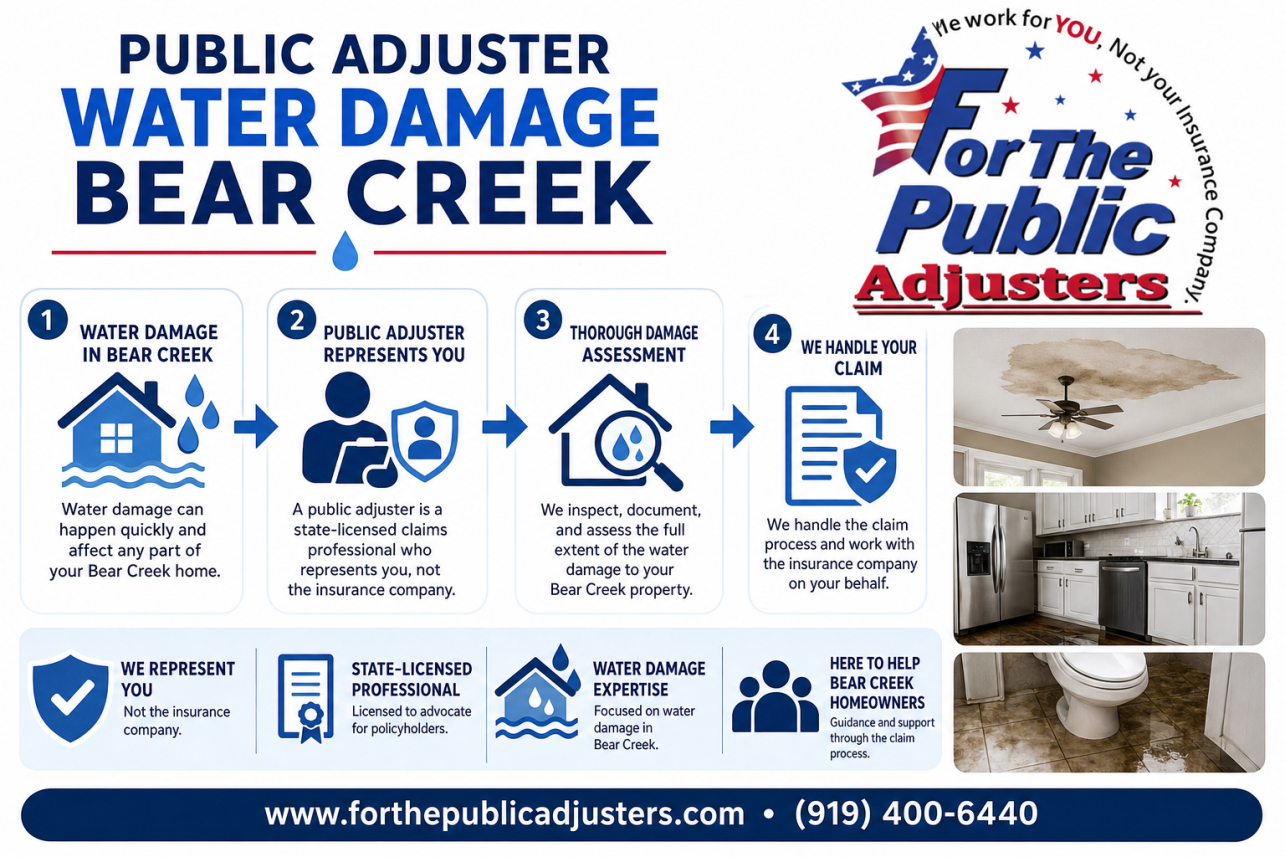
A public adjuster is a state-licensed claims professional who represents the policyholder, not the insurer. When water damages your Bear Creek home, the insurance company sends its own adjuster to measure the loss. That person works for the carrier. We work for you.
Our job starts with a full inspection — not just the wet drywall you can see, but the moisture that has already traveled under flooring, inside wall cavities, and into insulation. Hidden water is where most claims get underpaid, because if it isn’t documented early, the carrier won’t pay for it later.
From there we build the claim itself: a detailed repair estimate, a contents inventory for damaged belongings, proof of loss paperwork, and the policy analysis that shows exactly which coverages apply. Then we negotiate directly with the insurance company on your behalf. As the local Public Adjuster Bear Creek NC team, we handle residential and commercial water losses across Chatham County, along with fire, smoke, tree damage, and flood claims.
Common Problems
Why Is The Insurance Company’s Check So Much Smaller Than My Repair Bids?
This is the most common call we get. The carrier’s estimate came in at a number no local contractor will touch, and now you’re staring at a gap you’d have to pay out of pocket.
Usually the shortfall comes from a few places. The insurer may have paid actual cash value — the depreciated worth of your old flooring and drywall — instead of replacement cost, meaning they deducted for age and wear. They may have missed hidden moisture entirely. Or they priced repairs at rates that don’t reflect what restoration actually costs in rural Chatham County.
Courts have repeatedly sided with policyholders on shortchanged building repairs. In Windridge of Naperville Condominium Association v. Philadelphia Indemnity Insurance Co., the insurer wanted to replace only the storm-damaged sections of a building’s siding; the court ruled the policyholder was entitled to a full, matching repair. The lesson: a partial, patchwork payout is often not what the policy actually owes. We re-estimate the loss line by line and pursue the difference. We can never guarantee a specific outcome, but we can guarantee the damage gets fully counted.
Public Adjuster Water Damage Bear Creek: What If My Claim Is Denied, Delayed, Or Stuck?
Denials and stalls usually trace back to a few arguments carriers love. They may say the leak was ‘long-term seepage’ rather than sudden damage, blame poor maintenance, or point to a policy exclusion you didn’t know existed. Sometimes they simply request document after document until you give up.
One trap worth knowing: flood and water damage are not the same thing to an insurer. Water rising from outside the home — heavy rain pooling, a creek overflowing — falls under flood coverage through the National Flood Insurance Program, not your standard homeowners policy. Filing under the wrong coverage is a fast route to a denial.
We review your policy, identify the correct coverage path, rebut the carrier’s position with documentation, and keep the claim moving on a defined timeline. When a dispute needs legal firepower, we coordinate with insurance dispute lawyers. We’ve reopened underpaid claims for neighbors served by our Public Adjuster in Siler City NC office as well, and a closed claim is not always a finished one.
Should I Just Handle The Claim Myself?
You can — and for a small, straightforward loss, you might come out fine. But water claims are rarely straightforward. Moisture hides, mold starts within days, and the carrier’s adjuster spends maybe an hour in your home before writing the estimate that decides everything.
The North Carolina Department of Insurance publishes guidance on public adjusters precisely because homeowners deserve to know they have the right to their own representation. Its NCDOI Public Adjusters Guide explains how licensing works and what a legitimate adjuster should and shouldn’t do — worth reading before you hire anyone, including us.
What a good public adjuster actually does: verifies licensing and bonding up front, inspects with moisture-detection tools, writes a contractor-grade estimate, handles every call and document, and works on a percentage of the recovery — so our interests line up with yours. If the person you’re vetting can’t explain your policy’s coverage limits and deductible in plain English, keep looking.
Our Process
Free Inspection And Policy Review
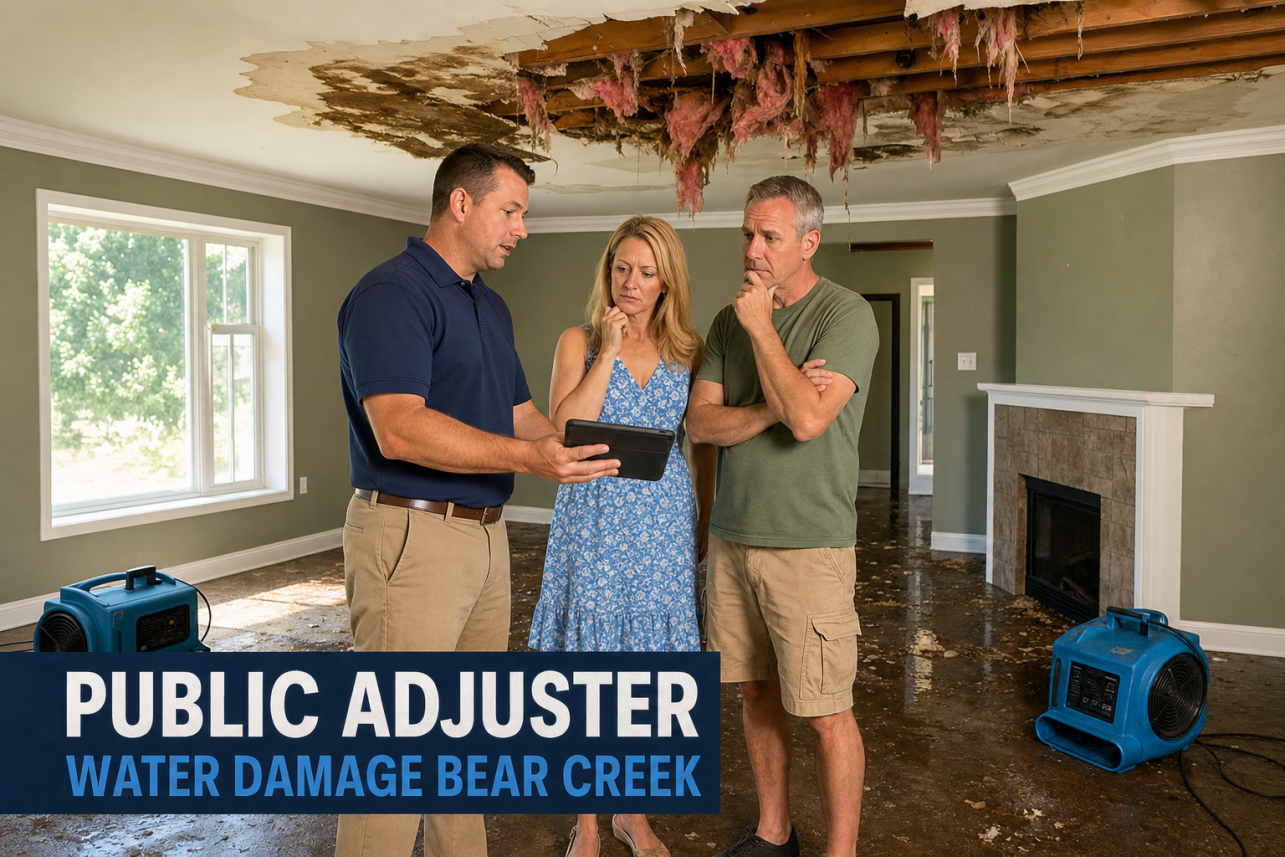
We walk your property and trace the water — not just where it pooled, but where it traveled. Subfloors, wall cavities, insulation, and crawl spaces all get checked, because moisture you can’t see becomes mold you can’t ignore.
At the same time, we read your policy front to back: coverage limits, your deductible, emergency mitigation coverage, contents coverage, and any exclusions the carrier might lean on. You’ll know where you stand before anything is filed.
Documentation And The Claim Package
We photograph and measure everything, build a room-by-room repair estimate at real local pricing, and inventory damaged contents so your belongings are reimbursed, not forgotten. Emergency costs you’ve already paid — water extraction, tarps, drying equipment — go into the claim too.
Then we prepare and submit the proof of loss documentation the policy requires, correctly and on time. Paperwork errors are one of the most common reasons legitimate claims get delayed or denied.
Negotiation And Settlement
We meet the insurance company’s adjuster on site, walk them through our documentation, and challenge every lowball line item — including unfair depreciation deductions that turn replacement cost coverage into a fraction of the repair bill.
We keep negotiating until the offer reflects the documented loss, and we keep you informed at every step. Homeowners we’ve represented from Bear Creek down to our Public Adjuster Goldston NC service area will tell you the same thing: the first offer is rarely the final number.
| What Happens | Handling It Yourself | With For The Public Adjusters |
|---|---|---|
| Damage documentation | Phone photos of visible damage only | Moisture mapping, thermal imaging, and readings inside walls and under floors |
| The estimate | You rely on the carrier’s number | Independent line-item estimate at real Chatham County contractor pricing |
| Policy review | You read what the carrier tells you applies | Full review of endorsements, hidden-leak provisions, and matching coverage |
| Negotiation | One homeowner vs. a trained adjuster | Licensed adjuster advocating for you through reinspection and appeal |
| Typical result | First offer often accepted as final | Documented claims routinely settle for multiples of the initial offer |
| Your time | Weeks of calls, emails, and paperwork | We manage the file; you approve the settlement |
Commonly Overlooked In The Public Adjusting Industry
- Moisture trapped inside wall cavities and under continuous flooring — Carrier adjusters rarely bring moisture meters, so anything that looks dry on the surface gets left off the estimate.
- Matching coverage for continuous hardwood, tile, or cabinetry — Insurers offer to patch the damaged section and ignore that a visible mismatch means the whole connected run may need replacement under the policy.
- Hidden-leak endorsements the homeowner is already paying for — Denial letters cite the seepage exclusion while quietly skipping the endorsement on the same policy that covers concealed leaks.
- Additional living expenses during drying and rebuild — Homeowners don’t realize hotel stays, meals, and even pet boarding can be reimbursable, so they never submit the receipts.
- Proper drying protocols versus cosmetic repairs — It’s cheaper for the carrier to pay for paint than for opening walls, so estimates skip the demolition needed to prevent mold.
- Subfloor and joist damage below the visible floor — Nobody pulls up flooring during a twenty-minute inspection, and saturated subfloor quietly rots for months afterward.
- The mold sublimit clock — Mold from a covered water loss is often capped at a small dollar amount, and delays in the claim eat into that limit fast.
- Depreciation holdback and recoverable depreciation — Many homeowners cash the first actual-cash-value check and never claim the withheld depreciation they’re owed after repairs are done.
Case Studies
Case Study #1
Situation: A family on Bonlee-Bennett Road outside Bear Creek came home from a weekend trip to find their supply line to the second-floor washing machine had burst, sending water through the ceiling into the kitchen and living room below.
Problem: Their carrier’s field adjuster spent forty minutes on site and issued an estimate of $11,400 — enough to replace some drywall and carpet, but nothing for the kitchen cabinets, hardwood flooring, or the moisture trapped in the wall cavities.
Investigation: We brought in thermal imaging and moisture meters and mapped every affected area, including behind the cabinet runs and under the hardwood where readings were still elevated ten days after the loss. We also documented the continuous hardwood flooring that ran from the kitchen into the dining room and hallway.
Findings: Moisture had wicked into the base cabinets and subfloor well beyond what was visible. Because the hardwood was continuous and the original planks were discontinued, a patch repair would have left an obvious mismatch — a matching issue the policy language actually addressed.
Solution: We prepared a line-item estimate covering full cabinet replacement on the affected run, continuous flooring replacement through the connected rooms, proper drying protocols, and pack-out costs. Then we presented the moisture documentation and policy provisions to the carrier and requested reinspection.
Outcome: The claim settled at $67,800 — nearly six times the original offer — plus additional living expenses while the kitchen was out of service.
Lesson: Water travels farther than it looks. If the insurance company’s estimate only covers what’s visible, it almost certainly misses the damage that costs the most to fix.
Case Study #2
Situation: The owner of a small farmhouse near the Rocky River, a few miles from downtown Bear Creek, discovered a slow leak from a corroded copper line in the crawl space that had been running for months before it was found.
Problem: The carrier denied the claim outright, calling it ‘long-term seepage’ excluded under the policy, and pointed to mold on the floor joists as proof the leak was old and therefore not covered.
Investigation: We pulled the plumber’s invoice and photographs, interviewed the plumber about the pinhole failure, and reviewed the policy’s actual wording on hidden water damage. We also had the crawl space professionally assessed to separate recent saturation from older staining.
Findings: The policy contained a hidden-leak provision covering water damage from a leak concealed within walls, floors, or below the structure — exactly this scenario. The denial letter had cited a general exclusion while ignoring the endorsement the homeowner had been paying for.
Solution: We filed a formal rebuttal citing the specific endorsement language, submitted the plumber’s statement and the crawl space assessment, and pushed the file to a desk review with a supervisor rather than accepting the field adjuster’s denial.
Outcome: The denial was reversed. The homeowner recovered $31,200 for structural drying, joist remediation, subfloor replacement, and refinishing the heart-pine floors above.
Lesson: A denial letter is an opinion, not a verdict. Carriers sometimes cite exclusions without applying the endorsements on the same policy — and most homeowners never know to check.
| Type of Water Loss | Usually Covered? | What It Depends On |
|---|---|---|
| Burst supply line or pipe | Yes, almost always | Sudden and accidental losses are core coverage; disputes are usually about scope, not coverage |
| Water heater or appliance failure | Yes, typically | The resulting water damage is covered; the failed appliance itself usually isn’t |
| Hidden leak inside a wall or crawl space | Often, with the right endorsement | Whether your policy includes hidden-leak coverage — carriers frequently deny these as ‘seepage’ anyway |
| Roof leak from storm damage | Usually | Whether the roof opening was caused by a covered peril like wind or fallen limbs |
| Sewer or drain backup | Only with an endorsement | Many Chatham County policies exclude backups unless a rider was added |
| Rising water or flooding from the Rocky River | No, not under homeowners | Surface flooding requires a separate NFIP or private flood policy |
| Long-term drip you knew about | Rarely | Carriers treat known, unaddressed leaks as maintenance neglect |
| Mold following a covered water loss | Often, but capped | Most policies limit mold remediation to $5,000–$10,000 unless it’s tied properly to the covered event |

Reviews
Our water heater failed and flooded half the downstairs. State Farm offered us $9,000 and we knew that wouldn’t touch the flooring alone. For The Public Adjusters documented everything — moisture readings, photos, a real line-item estimate — and the final settlement came in over $40,000. They handled every call with the carrier so we didn’t have to.
Danielle W., Bear Creek
Pipe burst in the ceiling of our rental property off Highway 902 while it sat vacant between tenants. The carrier tried to deny it on the vacancy clause. This team read the policy closer than the insurance company did, proved the exclusion didn’t apply the way they claimed, and got the denial overturned. Worth every penny of the fee.
Marcus T., Chatham County
What impressed me was the drying documentation. The carrier’s guy walked through in twenty minutes and missed water inside two walls. These adjusters came out with meters, found it, and made the insurance company pay to open the walls up and dry them properly instead of painting over a future mold problem. Honest, thorough, and local enough to actually show up.
Renee H., Bear Creek
Frequently Asked Questions
What Does A Public Adjuster Water Damage Bear Creek Assessment Actually Involve?
When you call For The Public Adjusters, Inc., we start with a full walkthrough of your property, not just the room where the water showed up. Water travels through subfloors, wall cavities, and insulation, so we use moisture meters and thermal imaging to trace it everywhere it went.
From there, we document every affected material — drywall, flooring, cabinetry, trim, personal contents — with photos, measurements, and moisture readings. In older homes around Bear Creek and the surrounding Chatham County countryside, hardwood floors and crawl spaces are common trouble spots that insurance company adjusters often undervalue or miss entirely.
Next, we review your policy line by line. Many homeowners don’t realize their coverage may include code upgrades, additional living expenses if the home is unlivable, or mold remediation tied to the water event. We identify every applicable coverage before we build the claim.
Finally, we prepare a detailed, itemized estimate using the same industry-standard pricing software the insurance companies use. That means when we present your claim, the carrier is looking at professional documentation they can’t easily dispute. We then handle all negotiation directly, so you’re never stuck arguing with an insurance adjuster on your own.
The entire assessment costs you nothing upfront. We work on a contingency basis, so our fee comes from the settlement we recover — which keeps our interests fully aligned with yours.
How Is A Bear Creek Public Adjuster Different From The Adjuster My Insurance Company Sends?
This is the most important distinction in the entire claims process. The adjuster your insurance company sends works for the insurance company. Their job is to close your claim quickly and, frankly, to protect the carrier’s bottom line. They may be perfectly polite, but they do not represent you.
A licensed public adjuster works exclusively for the policyholder. When For The Public Adjusters, Inc. takes on your water damage claim, our only client is you. We measure the damage independently, interpret your policy in your favor where the language allows, and negotiate for the maximum settlement your coverage entitles you to.
The difference shows up in the details. Company adjusters frequently spend twenty or thirty minutes on site. We often spend hours, because hidden moisture behind walls or under flooring is where claims get shortchanged. If saturated drywall isn’t documented on day one, the carrier may later deny the cost of replacing it.
Here in Chatham County, we also understand local realities — rural water sources, well and septic considerations, older farmhouse construction, and the actual cost of getting qualified contractors out to homes off the main roads near Bear Creek. Insurance software defaults don’t always reflect those local labor and material costs, and we push back when the numbers are wrong.
Industry studies have repeatedly shown that policyholders represented by public adjusters recover significantly larger settlements than those who go it alone. You have the right to that representation, and your insurer cannot penalize you for using it.
How Soon After Finding Water Damage In My Bear Creek Home Should I Call, And What Should I Do First?
Call as soon as you safely can — ideally the same day you discover the damage. Water claims are time-sensitive in two ways: the damage itself worsens by the hour, and your policy almost certainly requires prompt notice and reasonable steps to prevent further loss.
Before anything else, stop the water if possible. Shut off the supply line or main valve, and cut power to affected areas if outlets or wiring got wet. Then take photos and video of everything — standing water, soaked belongings, water lines on the walls — before you move or discard anything.
You should mitigate the damage, meaning dry things out and prevent mold, but do not make permanent repairs before the loss is fully documented. Keep receipts for everything, including fans, dehumidifiers, tarps, and any emergency service calls. Those costs are typically reimbursable.
Here’s what we strongly recommend: contact us before you give a recorded statement to your insurance company. Innocent phrasing like “it’s been leaking for a while” can be used to deny a claim as long-term seepage rather than sudden damage. We help you report the loss accurately and protect your claim from day one.
For The Public Adjusters, Inc. serves Bear Creek and the surrounding Chatham County area, and we can typically get eyes on your property quickly. Mold can begin developing within 24 to 48 hours in North Carolina’s humidity, so the sooner we document conditions, the stronger your claim will be.
Can A Public Adjuster Help If My Water Damage Claim In Bear Creek Was Already Denied Or Underpaid?
Yes — and this is one of the most common reasons Chatham County homeowners call us. A denial or a lowball settlement offer is not the end of the road. In most cases, you have the right to dispute the carrier’s decision, and a public adjuster water damage Bear Creek claim review often uncovers significant money left on the table.
When we take on a denied or underpaid claim, we start by requesting the carrier’s full estimate and the stated basis for their decision. Then we re-inspect the property ourselves. It’s remarkable how often we find damage the company adjuster never documented — moisture trapped in wall cavities, damaged subfloor under vinyl or hardwood, or contents losses that were never itemized at all.
Common denial reasons like “gradual leakage,” “wear and tear,” or “maintenance issue” are frequently disputable. The difference between a sudden pipe failure and long-term seepage can be worth tens of thousands of dollars, and carriers don’t always get that classification right — or fair.
We then prepare a supplemental claim or formal dispute backed by photos, moisture documentation, and a line-item estimate, and we negotiate directly with the insurance company. If needed, we can invoke the appraisal provision found in most policies, which forces an independent resolution process.
Even if you already accepted a payment, you may still be able to reopen the claim for supplemental damages within your policy’s time limits. Bring us your denial letter or settlement paperwork, and For The Public Adjusters, Inc. will review it at no cost and tell you honestly whether it’s worth pursuing.
How Much Does It Cost To Hire A Public Adjuster Water Damage Bear Creek Homeowners Can Actually Afford?
For The Public Adjusters, Inc. works on a contingency fee, which means you pay nothing upfront and nothing out of pocket. Our fee is a percentage of the settlement we recover for you, agreed to in writing before any work begins. If we don’t recover money, you don’t owe us a fee.
That structure matters for a reason: our interests line up with yours. The only way we get paid more is by documenting your loss thoroughly and negotiating a larger, more accurate settlement. In water losses especially, where hidden moisture behind walls and under flooring is routinely missed, that thoroughness often produces a recovery that far exceeds the fee.
Many Bear Creek and greater Chatham County homeowners are surprised to learn that even after our percentage, they frequently net more than they would have accepted on their own. Water claims are notorious for lowball first offers because carriers price only the visible damage. Once drying protocols, matching materials, code upgrades, and secondary damage like mold prevention are properly scoped, the numbers change significantly.
Before you sign anything, we’ll walk you through the fee agreement line by line, explain how the percentage is calculated, and answer every question. North Carolina licenses and regulates public adjusters, and our contracts comply with those state requirements, so you have real consumer protections built in from day one.
What Kinds Of Water Losses In Bear Creek Does Your Team Typically Handle?
We handle the full range of sudden and accidental water losses common to homes around Bear Creek and rural Chatham County. That includes burst supply lines and pinhole leaks in copper or PEX, water heater failures, washing machine and dishwasher hose ruptures, toilet overflows, and frozen pipe breaks during the cold snaps that catch this area off guard a few times each winter.
We also work storm-driven claims: wind-damaged roofs that let rain into attics and ceilings, wind-driven rain through compromised siding or flashing, and tree strikes that open a home to the weather. Many properties out here sit on crawl spaces, and we regularly document crawl space flooding from failed sump pumps, plumbing leaks, and HVAC condensate problems that go unnoticed until subfloors buckle.
Well pump and pressure tank failures are another local pattern, since so many Chatham County homes rely on private wells rather than municipal water. A failed fitting at the pressure tank can dump hundreds of gallons before anyone notices.
One important distinction: rising surface water and flooding from outside the home usually fall under separate flood insurance, not a standard homeowners policy. Part of our job as your public adjuster is reading your specific policy language, identifying which coverages apply, and making sure every applicable coverage, from dwelling to contents to additional living expenses, is claimed correctly.
How Long Will My Water Damage Claim Take Once A Public Adjuster Gets Involved?
Most water damage claims we handle in the Bear Creek area resolve within 30 to 90 days of our involvement, though the timeline depends on the size of the loss, how quickly the carrier responds, and whether the claim was already disputed when you called us.
Here’s the typical rhythm. In the first week, we inspect the property, take moisture readings, photograph and document everything, and review your policy in detail. Within the next couple of weeks, we prepare a complete, line-item estimate and submit our documentation to your insurance company, then schedule a joint inspection with their adjuster if needed.
North Carolina rules require insurers to acknowledge claims and respond to communications within set timeframes, and we hold carriers to those deadlines. When an insurer drags its feet, we escalate in writing and keep a paper trail that supports you if the dispute goes further.
Complex situations take longer: large losses with structural drying, claims involving mold remediation, or files where the carrier and our estimate are far apart may extend past ninety days, occasionally into appraisal. But hiring representation early usually shortens the process rather than lengthening it, because a properly documented claim gives the carrier fewer reasons to request more information, re-inspect, or stall. Throughout it all, you’ll get regular updates from For The Public Adjusters, Inc., so you’re never left wondering where things stand.
Will Hiring A Public Adjuster For Water Damage In Bear Creek Make My Insurance Company Treat Me Differently?
This is one of the most common worries we hear, and the honest answer is no, not in any way that hurts you. Hiring a public adjuster water damage Bear Creek claim professional is a right protected under North Carolina law, and your insurer cannot cancel your policy, raise your rates, or deny your claim simply because you chose licensed representation.
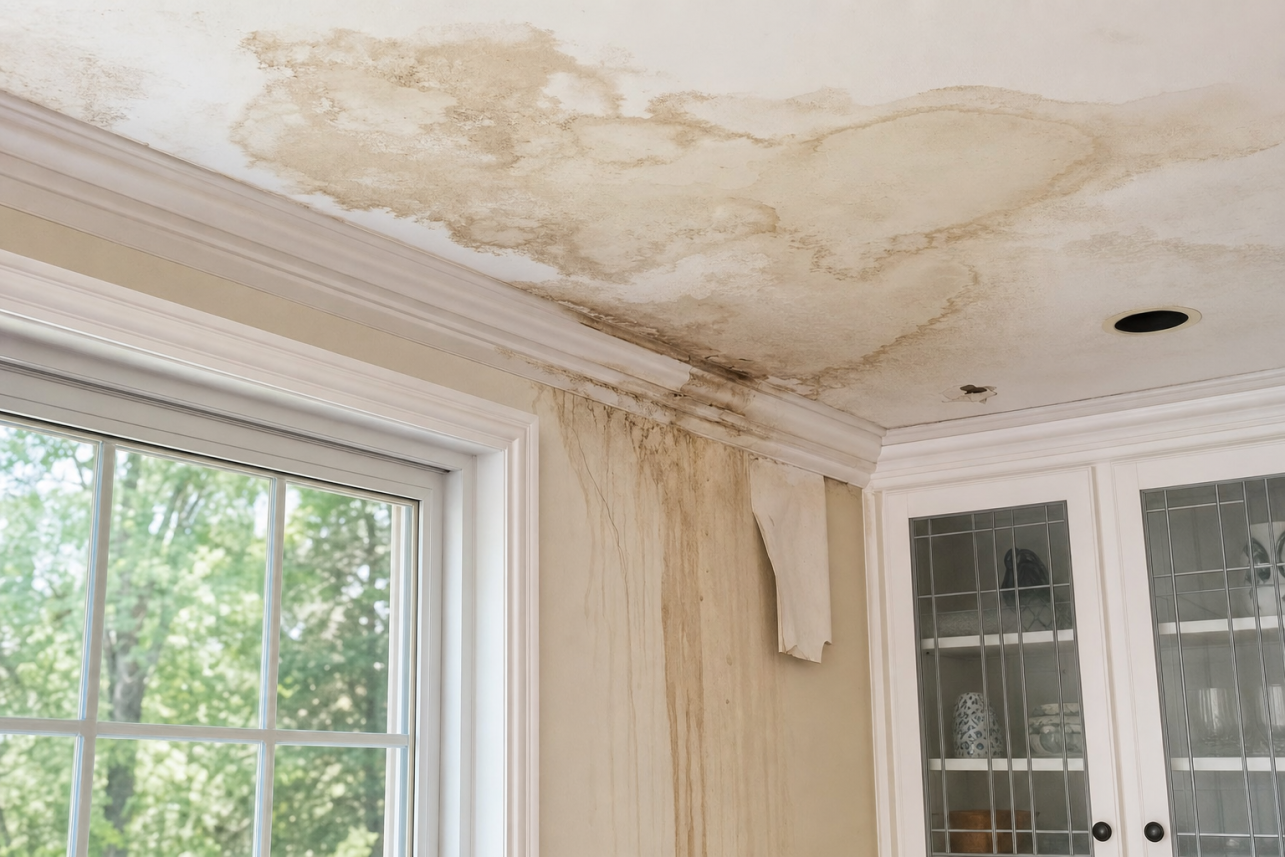
What actually changes is the tone of the file. Once we submit our letter of representation, the carrier communicates through us. You stop fielding calls that feel like interrogations, stop guessing at what documentation they want, and stop signing off on scopes you don’t fully understand. Adjusters on the carrier side generally respond professionally when they know the claim is being documented by someone who speaks their language.
In practice, well-supported claims often move more smoothly. When we hand the insurer a detailed estimate with moisture maps, photos, and policy citations, there’s less back-and-forth and fewer grounds for dispute. Carriers tend to reserve their toughest tactics for unrepresented homeowners.
One thing to know: your rates are influenced by claims history and regional factors, not by whether you hired representation. Filing the claim is what goes on record, and that happens either way. Since you’re filing regardless, it makes sense to file it right. If you’re weighing your options after a pipe burst or storm leak here in Chatham County, call us for a free consultation before you accept any offer.
Does My Homeowners Policy Cover The Water Damage I Found, Or Will It Be Excluded?
Most standard policies cover sudden and accidental water losses — a burst supply line, a failed water heater, an overflowing washing machine, or wind-driven rain that gets in through storm damage. What they typically exclude is gradual damage, like a slow drip that went unnoticed for months, and flood water rising from outside, which requires separate flood coverage.
The problem is that insurers often blur that line. A pipe that failed suddenly still leaves staining that an insurance company adjuster may label ‘long-term seepage’ to justify a denial. We see this constantly with older homes around Bear Creek and rural Chatham County, where plumbing runs through crawl spaces that homeowners rarely inspect.
When we review your loss, we read the actual policy language — not the summary the carrier gives you over the phone. We document the failure point, establish when the loss occurred, and build the argument for coverage using the evidence in your home, plumber invoices, and moisture readings.
If part of your claim genuinely falls under an exclusion, we tell you that honestly before you spend anything. But in our experience, a large share of ‘excluded’ water claims in this area were covered losses that simply weren’t documented or argued correctly. Before you accept a denial letter at face value, let us look at the policy and the damage side by side.
Can A Public Adjuster Water Damage Bear Creek Inspection Find Hidden Moisture And Mold My Insurer Missed?
Yes, and this is often where the biggest dollar differences come from. A public adjuster water damage Bear Creek inspection goes well beyond what a carrier’s adjuster does in a twenty-minute walkthrough. We use moisture meters, thermal imaging, and physical inspection of wall cavities, subfloors, and insulation to map how far the water actually traveled.
Water rarely stays where you can see it. It wicks up drywall, runs along floor joists, and pools under vinyl and laminate flooring. Homes in this part of Chatham County often sit on vented crawl spaces, and moisture that drains down into that space can sit against insulation and framing for weeks before anyone notices.
Mold is the follow-on problem. In North Carolina humidity, mold growth can begin within 24 to 48 hours of a water event. If the insurance company’s estimate only covers drying the visible area, you may be left paying out of pocket for remediation later — or worse, living with contamination you don’t know about.
We document hidden damage with photographs, meter readings, and detailed room-by-room scope notes, then price the full repair using current local labor and material costs. When the carrier’s estimate says ‘dry and paint one wall’ and reality says ‘remove flooring, treat framing, replace insulation,’ that documentation is what forces the numbers to change.
If Water Damage Makes My Home Unlivable, Can You Help With Temporary Housing And Living Expenses?
Yes. Most homeowners policies include Additional Living Expenses coverage, often called ALE or Loss of Use, and it is one of the most underused benefits we see. If a significant water loss makes your home unfit to live in — no usable kitchen, no working bathroom, active drying equipment running in bedrooms — you’re generally entitled to reimbursement for the extra costs of living elsewhere.
That can include hotel stays, a short-term rental, increased mileage if you’re commuting farther, meals above your normal grocery spending, pet boarding, and even laundry costs if your washer and dryer are out of service. Around Bear Creek, temporary rentals are limited, so families sometimes end up in Pittsboro, Siler City, or Sanford — and those added commuting costs count too.
The catch is that carriers rarely volunteer this coverage, and they only pay what you can document. We help you set up a simple system for tracking every eligible expense from day one, and we push back when the carrier tries to cut off ALE before repairs are genuinely complete.
We also make sure the repair timeline the insurer approves is realistic. If they underestimate how long the work takes, they underestimate your living expense payout too. Handling both pieces together is how you avoid paying for your own displacement out of pocket.
A Restoration Company Wants Me To Sign Their Paperwork — Should I Do That Before Talking To A Bear Creek Public Adjuster?
Be careful. Emergency mitigation — extracting standing water and setting drying equipment — is time-sensitive and worth authorizing quickly. But some restoration contracts include an assignment of benefits or open-ended pricing language that can complicate your claim and reduce what ends up in your pocket.
An assignment of benefits hands the contractor rights to your insurance proceeds. Once signed, disputes between the contractor and your carrier can stall your entire claim, and you lose control over decisions about your own home. Other contracts commit you to that company for the full rebuild before anyone knows what the insurer will actually pay.
Our advice for homeowners in Bear Creek and the surrounding Chatham County area: authorize emergency water extraction and drying, keep every invoice, and photograph everything before it’s removed. Then call us before signing anything that goes beyond emergency services. As your public adjuster, we work for you — not the carrier and not the contractor — so we can review any agreement with your interests in mind.
We also coordinate directly with reputable mitigation companies so their drying logs, moisture readings, and equipment records become evidence supporting your claim rather than a source of billing disputes. Handled in the right order, the mitigation work and the insurance claim reinforce each other. Handled in the wrong order, you can end up caught between a contractor demanding payment and an insurer refusing to issue it.
What Documents Does Your Public Adjuster Water Damage Bear Creek Team Need From Me To Get Started?
Less than most homeowners expect. To open your file, we need a copy of your homeowners policy — the full policy, including declarations page and endorsements, not just the summary card. If you can’t find it, we can request a certified copy from your carrier on your behalf.
Beyond that, anything you already have helps: photos or video of the damage, the date you discovered the water, any claim number if you’ve already reported the loss, and receipts for emergency work like water extraction or tarping. If a plumber or restoration company has been out, their invoices and reports are useful too.
Don’t worry if your documentation is thin. Many Bear Creek homeowners call us before they’ve photographed anything, and that’s fine. Our own inspection produces the moisture readings, photographs, and measurements that actually drive the claim value — your early photos simply help establish the timeline.
One thing we do ask: hold onto damaged materials when it’s safe to do so. A section of soaked drywall, buckled flooring, or a failed supply line fitting can be powerful physical evidence. If contaminated water forces you to discard items, photograph them thoroughly first and keep a written list. We’ll organize everything into a documented inventory your insurer can’t easily dispute.
Once You Take Over My Claim, Will I Still Have To Deal With My Insurance Company Directly?
For the most part, no — and that’s one of the biggest reliefs our clients mention. Once you sign our representation agreement, we notify your carrier that all claim communication goes through For The Public Adjusters, Inc. The phone calls, emails, document requests, and scheduling headaches shift to us.
When the company adjuster wants to inspect your home, we attend that inspection with them. We walk them through the damage room by room, point out moisture migration they might otherwise skip, and make sure nothing gets minimized in their report. You’re welcome to be present, but you don’t have to say a word.
There are a few things only you can do. If your policy requires an examination under oath or a signed proof of loss, your signature and testimony are yours alone — but we prepare you thoroughly beforehand so there are no surprises. The final settlement decision is also always yours; we advise, you decide.
That’s the real value of hiring a public adjuster water damage Bear Creek residents can lean on. You get to focus on your family and your home while someone who negotiates these claims every week handles the carrier. Most clients tell us the stress drops the day they hand it off.
How Does Recoverable Depreciation Work On A Water Damage Payout, And Do You Help Me Collect It?
This is where a lot of Bear Creek homeowners unknowingly leave money on the table. If you have a replacement cost policy, your insurer typically pays in two stages. First comes the actual cash value payment — the replacement cost of your flooring, cabinets, and drywall minus depreciation for age and wear. The depreciation they held back is called recoverable depreciation.
To collect it, you generally must complete the repairs and submit proof — contractor invoices, receipts, sometimes photos of finished work — within a deadline set by your policy, often 180 days to a year. Miss that window or skip the paperwork, and the carrier keeps that money. On a significant water loss, recoverable depreciation can be thousands of dollars.
Yes, we absolutely help you collect it. As your Bear Creek public adjuster, we track the deadlines, gather the repair documentation, and submit the recoverable depreciation demand so nothing slips through. We also verify the carrier depreciated items correctly in the first place — insurers sometimes apply aggressive depreciation schedules to materials like hardwood or tile that shouldn’t take that kind of hit.
If your repairs come in higher than the original estimate, we file a supplemental claim for the difference rather than letting you absorb the overage. The goal is a payout that reflects what restoration actually costs in Chatham County, not a spreadsheet average.

Do You Handle Water Damage Claims For Barns, Workshops, And Detached Buildings On Chatham County Properties?
Yes. Properties around Bear Creek often include more than just the house — detached garages, workshops, pole barns, well houses, and storage buildings are common on the larger lots throughout this part of Chatham County. Most homeowners policies cover these under “other structures” coverage, typically set at 10% of your dwelling limit, though endorsements can raise that.
Water losses in outbuildings get overlooked constantly. A burst pipe in a heated workshop, a roof leak soaking stored equipment in a barn, or a failed water line to a well house can cause real financial damage, and carriers frequently lowball these claims because the structures are “just outbuildings.” We document them with the same rigor we apply to your home — moisture readings, itemized contents inventories, and repair estimates based on actual local construction costs.
Contents matter here too. Tools, tractors, equipment, and stored belongings damaged by water may be covered under your personal property limits, and we make sure every item is counted and valued fairly rather than lumped into a vague round number.
One caution: coverage for structures used for business or farming can get complicated under a standard homeowners policy. If you run any operation out of an outbuilding, tell us up front. We’ll review your policy language carefully and, when needed, help you pursue the claim under the correct coverage part so the carrier can’t use a technicality to deny it.
Local Relevance
Bear Creek sits in rural southwestern Chatham County, where many homes are older farmhouses and long-established houses on well-and-septic properties surrounded by woods. Older plumbing, aging water heaters, and original galvanized or polybutylene supply lines mean sudden pipe failures are a real risk here — and in a house with a vented crawl space, a slow leak can soak framing for weeks before anyone notices.
The climate works against you too. North Carolina’s humid summers slow drying and accelerate mold, while the occasional hard winter freeze bursts pipes in uninsulated crawl spaces and outbuildings. Remnants of tropical systems moving inland can dump inches of rain in a day, driving water through aging roofs and, in low-lying spots near the area’s creeks, raising the flood-versus-water-damage coverage question that trips up so many claims.
Because Bear Creek is a small community, out-of-town carrier adjusters often price repairs off generic software rather than what Chatham County contractors actually charge. We correct that. We serve the whole surrounding area as well, from Public Adjuster Bennett NC clients to the west to homeowners near Public Adjuster Silk Hope NC territory to the north.
Many homes around Bear Creek are older houses set over vented crawl spaces, and in this part of Chatham County that combination tends to hide water losses — a supply-line leak can run for weeks under the floor before it shows inside, which is why we always inspect the crawl space with moisture meters before a claim is filed, not after the carrier has already closed it.
Water Damage In Bear Creek? Get A Second Opinion Before You Settle
Whether the pipe burst yesterday or the carrier’s check already arrived and it isn’t enough, talk to us first. For The Public Adjusters, Inc. is licensed and bonded, the inspection is free, and we only get paid when you recover. Let’s find out what your claim is really worth.
Request Your Free Claim Review
Call us: (919) 400-6440
Helpful Resources
- NCDOI Public Adjusters Guide
- National Flood Insurance Program (NFIP)
- Federal Emergency Management Agency (FEMA)
- North Carolina Department of Insurance — State regulator overseeing insurance and public adjuster licensing
Serving Bear Creek · Chatham
Last updated: August 30, 2026