

If you're dealing with an Insurance Water Damage Claim Raleigh insurance companies have denied, delayed, or underpaid, a licensed public adjuster can represent you and negotiate directly with your carrier. For The Public Adjusters, Inc. documents the full scope of your water damage — including what's hidden behind walls and under floors — and builds the proof your insurer has to answer to. We work only for policyholders, never for the insurance company, and we're licensed and bonded in North Carolina.
What This Service Is
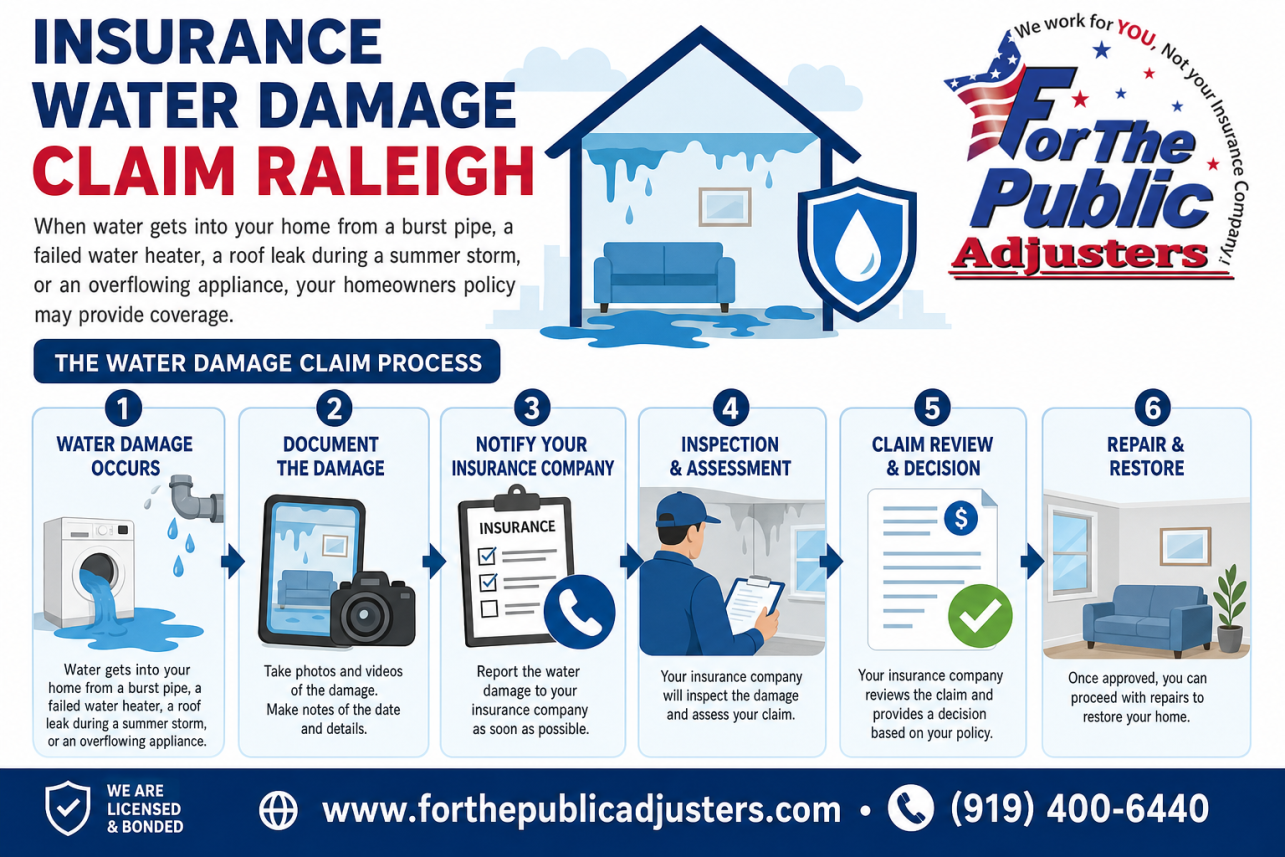
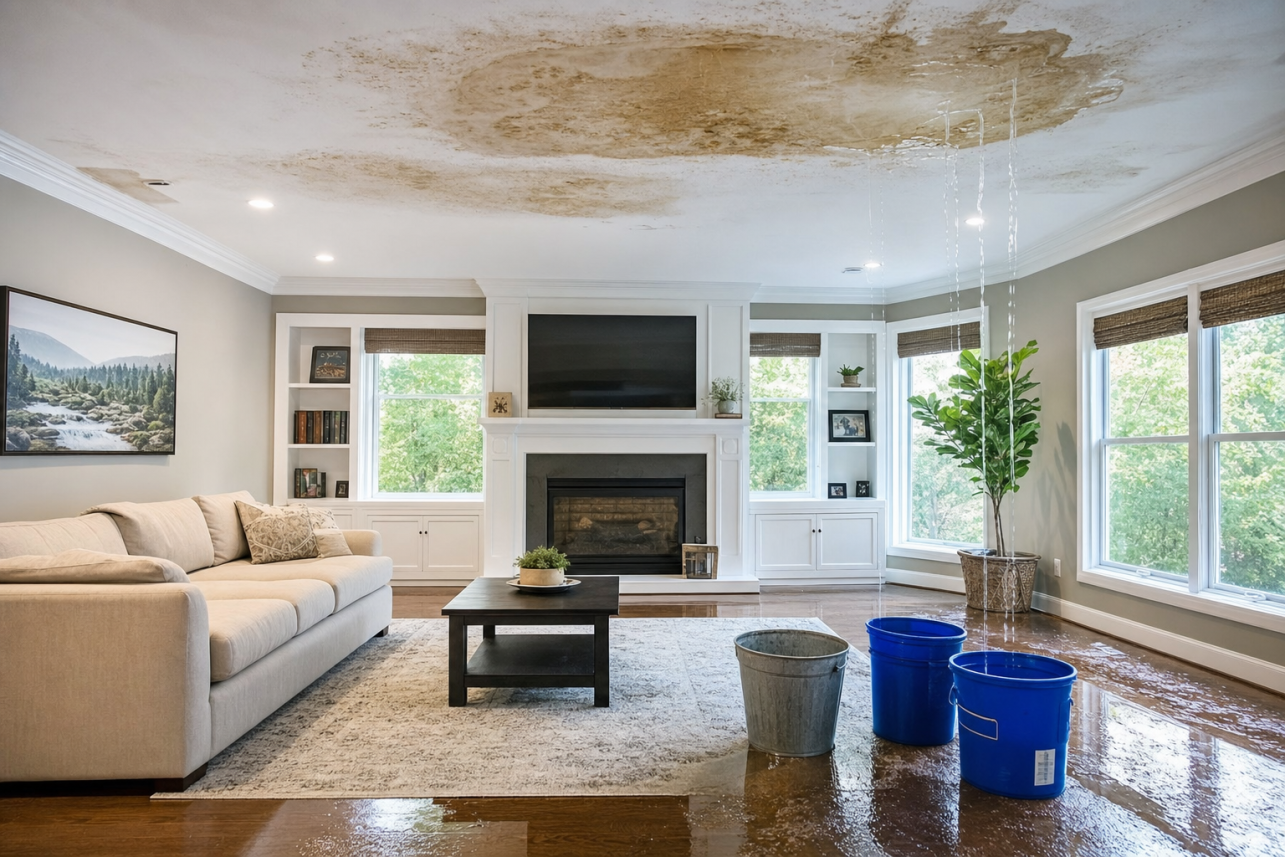
When water gets into your home from a burst pipe, a failed water heater, a roof leak during a summer storm, or an overflowing appliance, your homeowners policy is supposed to respond. The problem is that the adjuster your insurance company sends works for the insurance company. Their estimate often stops at what's visible: the stained ceiling, the buckled floor, the soggy drywall.
A public adjuster works the other side of that equation. We read your policy line by line, inspect the property ourselves, and prepare the repair estimate and proof of loss documentation from the policyholder's perspective. That includes moisture readings inside wall cavities, damaged contents inventories, emergency drying and mitigation costs, and code-required repairs the first estimate skipped.
Water losses are also where the fine print bites hardest. Whether your payout is based on replacement cost or actual cash value — meaning the insurer deducts depreciation — can change your check by thousands of dollars. Whether the water came from inside your plumbing or rose up from outside determines if it's a homeowners claim at all, or a flood claim that belongs under the National Flood Insurance Program instead. We sort those questions out before they're used against you.
One more thing worth knowing: courts have long held that insurers owe policyholders good faith. In Gruenberg v. Aetna Insurance Co., the California Supreme Court ruled in favor of an insured whose property loss claim was wrongfully denied, establishing that an insurance company can be held liable for handling a claim in bad faith. You have real leverage under your policy — the key is knowing how to use it.
Common Problems
Why Is My Water Damage Payout So Much Lower Than The Actual Repair Cost?
This is the most common call we get in Wake County. The insurer's estimate says $9,000; every contractor you talk to says $25,000 or won't touch it at that price. The gap usually comes from three places.
First, depreciation. If your carrier pays actual cash value up front, they subtract for the age of your roof, flooring, or cabinets — and recovering that held-back money later requires paperwork many homeowners never get told about. Second, scope. The insurer's estimate may cover drying and drywall patching but ignore matching flooring across connected rooms, damaged insulation, or subfloor replacement. Third, contents. Water-soaked furniture, rugs, and electronics are often reimbursed at a fraction of what replacing them actually costs.
We rebuild the estimate from scratch, item by item, and negotiate from documentation — not from what the first check happened to say. We can never promise a specific dollar outcome, but we can promise your claim will be measured against the full scope of the loss.
My Insurance Water Damage Claim Raleigh Adjusters Denied — Is That Final?
No. A denial letter is the insurer's position, not a verdict. Water claims get denied for reasons that often don't hold up: the carrier calls a sudden pipe failure "long-term seepage," labels storm-driven roof leak damage as "wear and tear," or invokes a policy exclusion that doesn't actually fit your facts.
The distinction between flooding and water damage trips up many Raleigh homeowners too. Standard policies exclude rising surface water — that's flood coverage through the National Flood Insurance Program — but water from a burst pipe, appliance, or roof opening is a different animal, and insurers sometimes blur the line to their advantage.
A denial can be challenged with better evidence: moisture mapping, plumber and roofer reports, photos, and a properly prepared proof of loss. We review the denial letter against your actual policy language and, where the facts support it, push the claim back open. If you believe your insurer acted improperly, the North Carolina Department of Insurance also accepts consumer complaints — and we can tell you honestly whether your situation warrants one.
Do I Really Need A Public Adjuster, Or Can I Handle The Claim Myself?
Plenty of small, clean losses settle fine without help. Where homeowners get hurt is on larger or messier water losses: multiple rooms affected, water sitting for days before discovery, mold starting in a crawl space, or a dispute already brewing over what caused the damage.
Ask three things before hiring anyone. Are they licensed as a public adjuster in North Carolina — something the NCDOI Public Adjusters Guide explains and lets you verify? Do they work on your side only, with no ties to a restoration contractor pushing repairs? And will they actually inspect and document the loss themselves rather than just forwarding your paperwork?
For The Public Adjusters, Inc. is licensed and bonded, works exclusively for policyholders, and handles everything from residential homeowners claims to commercial business losses. Our fee comes from the settlement we help recover, so our interests line up with yours from day one.
Our Process
Free Policy And Damage Review
We start by reading your actual policy — coverage limits, deductible, exclusions, and whether you have replacement cost or actual cash value coverage. Then we inspect the property, including places the first adjuster likely skipped: wall cavities, subfloors, insulation, and crawl spaces where hidden water damage and early mold growth live. You'll get a straight answer about whether your claim is worth pursuing.
Documentation And Proof Of Loss
We build the file your insurer has to respond to: photographs, moisture readings, a room-by-room repair estimate using industry pricing, a contents inventory for damaged belongings, and receipts for emergency mitigation like water extraction and drying. If a formal proof of loss is required under your policy, we prepare and submit it correctly and on deadline.
Negotiation And Settlement
We present the documented claim to your carrier, attend the insurance adjuster's re-inspection with you, and negotiate every disputed line item. If the insurer's contractor estimate conflicts with real-world repair costs, we resolve that dispute with evidence. You stay informed at every step, and nothing settles without your approval.
| What Happens | Filing on Your Own | With For The Public Adjusters |
|---|---|---|
| Damage documentation | Carrier's adjuster inspects once, often visually only | Thermal imaging, moisture meters, and photo logs before evidence dries out |
| Estimate of repairs | Carrier writes its own estimate using its pricing | Independent line-item Xactimate estimate reflecting actual Raleigh contractor costs |
| Hidden moisture in walls and subfloors | Usually missed until mold appears months later | Mapped and included in the claim from day one |
| Additional living expenses | Rarely mentioned unless you ask | Calculated and claimed for the full displacement period |
| Denials and lowball offers | You accept, argue alone, or hire a lawyer | We rebut with evidence, request re-inspection, and negotiate the supplement |
| Your time investment | Dozens of hours of calls, paperwork, and follow-up | We handle the claim; you approve the settlement |
Commonly Overlooked In The Public Adjusting Industry
- Moisture trapped inside wall cavities and under flooring — Carrier adjusters typically inspect visually and skip invasive testing, so saturation behind drywall and beneath subfloors never makes it into the estimate.
- Flooring and finish matching under North Carolina claim practices — Carriers offer to patch the damaged section, and homeowners don't know they can argue for continuous, matching materials across connected areas.
- Additional living expense (ALE) coverage — Adjusters rarely volunteer that hotel stays, meals, and even pet boarding are claimable while the home is uninhabitable during drying and repairs.
- The proof-of-loss deadline in the policy — Many NC policies require a sworn statement within a set window, and missing it gives the carrier a procedural reason to deny an otherwise valid claim.
- Depreciation holdback and recoverable depreciation — Policyholders cash the first actual-cash-value check without realizing thousands more is owed once repairs are completed and documented.
- HVAC ductwork and insulation in crawl spaces — Water in a crawl space soaks duct insulation and flex duct out of sight, and it's routinely left off estimates until energy bills and air quality suffer.
- Category 2 and 3 water contamination protocols — Gray and black water losses require sanitization and disposal of porous materials, but claims are often priced as if it were clean water to cut costs.
- The right to disagree with the carrier's estimate — Most policyholders treat the insurance company's number as final, not knowing appraisal, supplements, and negotiation are built into the process.
Case Studies
Case Study #1
Situation: A homeowner in Raleigh's Five Points neighborhood came home from a weekend trip to find a second-floor supply line to the washing machine had burst, sending water through the hardwood floors, the kitchen ceiling below, and into the finished basement.
Problem: The insurance carrier's initial estimate was $18,400 — enough to dry the structure and patch drywall, but nothing close to replacing continuous hardwood flooring, matching the custom kitchen cabinetry, or addressing moisture trapped behind the plaster walls of the 1940s home.
Investigation: Our team performed independent moisture mapping with thermal imaging and pin meters, documenting elevated readings in wall cavities the carrier's adjuster never opened. We also pulled the flooring specifications to show the oak ran continuously through three connected rooms.
Findings: Hidden saturation extended six feet beyond the carrier's marked drying zone, the lower cabinets had wicked water into the particleboard boxes, and North Carolina's matching considerations meant the continuous flooring could not be reasonably repaired in a patchwork fashion.
Solution: We prepared a line-item Xactimate estimate reflecting full flooring replacement across connected rooms, cabinet replacement rather than repair, plaster remediation, and additional living expenses while the kitchen was out of service, then negotiated directly with the carrier's claims examiner.
Outcome: The claim settled at $87,200 — more than four and a half times the original offer — including twelve weeks of additional living expenses the family had not known they were entitled to claim.
Lesson: A carrier's first estimate reflects what their adjuster saw in a single walkthrough, not what the water actually did. Independent moisture documentation collected early is often the single biggest factor in what a water loss ultimately pays.
Case Study #2
Situation: A small commercial property owner near downtown Raleigh discovered water intrusion after a hard summer storm pushed rain through failed flashing, damaging tenant office space, drop ceilings, and inventory stored by a ground-floor retailer.
Problem: The carrier denied the bulk of the claim, arguing the loss stemmed from long-term seepage and deferred maintenance rather than the storm — a common basis for denial on Wake County commercial roofs — and offered only $6,100 for interior cosmetic repairs.
Investigation: We commissioned a forensic roofing inspection, pulled NOAA weather data confirming wind-driven rain on the date of loss, and reviewed the owner's maintenance records showing the roof had been inspected and serviced fourteen months earlier.
Findings: The flashing failure was consistent with a single wind event, not gradual deterioration. The carrier's own policy language covered interior water damage when the roof envelope was breached by a covered peril — which the wind event was.
Solution: We filed a formal supplement with the engineering report, weather data, and a rebuttal to the seepage exclusion, and requested re-inspection with the carrier's adjuster on site alongside our team and the roofing consultant.
Outcome: The denial was reversed. The claim settled at $142,000, covering roof repairs, full interior restoration, the retailer's damaged inventory under the owner's policy provisions, and lost rents during the buildout.
Lesson: 'Wear and tear' denials on water losses frequently collapse under real evidence. Weather data, maintenance records, and an independent engineer can turn a denied commercial claim into a fully paid one.
| Type of Water Loss | Typically Covered? | What It Usually Depends On |
|---|---|---|
| Burst supply pipe or failed water heater | Yes, almost always | Sudden and accidental — coverage for the water damage even if the failed part itself isn't paid |
| Washing machine or dishwasher hose failure | Yes | Whether the leak was sudden versus a slow drip the carrier claims you should have noticed |
| Roof leak after a storm | Often yes | Proof the roof was breached by wind or hail — weather data and roof condition are the battleground |
| Slow leak behind a wall discovered late | Contested | How the carrier's 'seepage over 14 days' exclusion is worded and when the leak was reasonably discoverable |
| Sewer or drain backup | Only with an endorsement | Whether you purchased water backup coverage — standard NC policies exclude it |
| Flooding from rising outside water | No, not under homeowners | Requires a separate flood policy through NFIP or private flood insurance |
| Frozen pipe burst in winter | Usually yes | Whether you maintained heat in the home or drained the plumbing — carriers check |
| Mold following a water loss | Limited | Most NC policies cap mold at $1,000–$10,000; fast reporting and proper drying preserve the claim |


Reviews
Our water heater failed while we were at work and flooded half the first floor. State Farm offered us $9,800 and we almost took it. For The Public Adjusters found moisture in walls the insurance adjuster never even tested and got our settlement to just over $52,000. They also caught that we were owed hotel costs. I honestly didn't know public adjusters existed before this.
Melissa T., North Hills
Pipe burst in the crawl space of our rental property in Raleigh and the carrier tried to call it 'long-term seepage' and deny it. These folks documented everything, brought in a plumber's report, and got the denial overturned. Settled for enough to replace the subfloor and ductwork properly instead of a band-aid fix. Worth every penny of their fee.
Daryl W., Cary / Wake County
After a dishwasher leak ruined our kitchen floors, the insurance company said they'd only pay to patch the damaged section — which would have looked terrible since the flooring runs into the living room. Our adjuster from For The Public Adjusters made the matching argument with photos and flooring specs and got the whole continuous floor covered. Communication was excellent the entire time.
Priya R., Brier Creek
Frequently Asked Questions
How Do I File An Insurance Water Damage Claim Raleigh Homeowners Can Actually Win?
Filing a strong Insurance Water Damage Claim Raleigh policyholders can rely on starts with documentation before anything gets cleaned up. Photograph and video every affected area — flooring, baseboards, drywall, cabinets, and personal property — before you move or dry anything. Then stop the source of water and take reasonable steps to prevent further damage, because your policy requires mitigation.
Next, report the loss to your carrier promptly, but be careful with recorded statements. Stick to facts: when you discovered the water, where it came from, and what was affected. Avoid guessing about how long the leak existed, since carriers often use duration to deny claims as 'long-term seepage.'
In Wake County, we see the most disputes over hidden damage — moisture trapped inside wall cavities, under hardwood floors, and beneath vinyl plank flooring that carriers' adjusters miss or minimize. That's why we bring thermal imaging and moisture meters to every inspection, and we scope the loss to North Carolina building code, not just what's visible.
Finally, don't sign off on the carrier's first estimate. Insurer estimates in Raleigh routinely omit code-required drywall replacement, matching flooring across continuous rooms, and proper drying protocols. For The Public Adjusters, Inc. prepares an independent, line-item estimate and negotiates directly with the carrier on your behalf, so the settlement reflects what repairs actually cost in the Triangle market — not what a software program in another state says they should.
Why Was My Water Damage Claim Denied Or Underpaid, And What Can I Do About It?
The most common denial reasons we see in Raleigh are 'wear and tear,' 'long-term seepage,' and 'gradual damage' exclusions. Carriers argue the leak existed for weeks or months, which they claim shifts it from a sudden covered loss to excluded maintenance. Often that conclusion is based on a five-minute walkthrough, not real evidence.
Underpayment is even more common than outright denial. The carrier's adjuster may pay to dry the structure but refuse to replace water-stained drywall, or pay for three damaged planks of flooring while ignoring that matching discontinued hardwood is impossible. Depreciation is another lever — some estimates depreciate materials so aggressively that the check won't cover half the actual repair.
You have options. A denial or lowball offer is not final. North Carolina policyholders can dispute the carrier's findings with new evidence, invoke the appraisal clause in most policies, or bring in a licensed public adjuster to reopen and renegotiate the claim.
For The Public Adjusters, Inc. handles this regularly for Wake County homeowners. We re-inspect the property, document moisture damage the first adjuster missed, obtain plumber or leak-detection reports that establish the loss was sudden, and rebuild the estimate line by line. Many of the claims we take over were initially denied or paid at a fraction of the real cost, and we've recovered meaningful additional money on losses the homeowner assumed were closed. If your claim was denied within the last three years, it's usually still worth a review.
What Does A Public Adjuster In Raleigh Cost, And Is It Worth It For Water Damage?
Public adjusters in North Carolina work on contingency — a percentage of what's recovered from the insurance company. There's no upfront fee and no hourly billing. If we don't recover money for you, you don't owe us anything, which keeps our interests aligned with yours from day one.
Whether it's worth it depends on the size and complexity of the loss. For a genuinely minor incident — a small, contained leak with a few hundred dollars of damage — you may not need professional representation. But water losses are rarely as small as they first appear.
A burst supply line or failed water heater in a Raleigh home typically affects flooring across multiple rooms, drywall, insulation, cabinetry, and sometimes the crawl space or subfloor. Once you account for proper drying, mold prevention, code-compliant repairs, and matching materials, a loss the carrier initially values at $8,000 can legitimately cost $30,000 or more to repair correctly.
That gap is where representation pays for itself. Industry studies and our own case files consistently show represented policyholders recover significantly more than those who negotiate alone — usually far more than the fee. For The Public Adjusters, Inc. also removes the burden of paperwork, deadlines, inspections, and carrier phone calls, which matters when you're living in a torn-up house.
We offer free claim reviews for Wake County homeowners, so you can find out what your claim is actually worth before deciding anything.
How Long Does An Insurance Water Damage Claim Raleigh Take To Settle, And What Deadlines Apply In North Carolina?
A straightforward water loss with a cooperative carrier can settle in 30 to 60 days. Larger or disputed claims — hidden moisture damage, mold development, denied coverage, or major reconstruction — commonly run three to six months, sometimes longer if appraisal or supplemental claims are involved.
Several deadlines matter on your end. Report the loss to your carrier promptly; most policies require notice 'as soon as practicable.' If the insurer sends a proof of loss form, you generally have 60 days to complete and return it — missing that can jeopardize the claim. And in North Carolina, the statute of limitations for suing on a property policy is three years from the date of loss, though many policies attempt to shorten that contractually, so read yours carefully.
The carrier has obligations too. North Carolina's unfair claims settlement practices rules require insurers to acknowledge claims promptly, investigate reasonably, and pay undisputed amounts without unnecessary delay. When a Raleigh adjuster goes silent for weeks or keeps requesting the same documents, that's leverage we use.
Professional representation usually shortens the timeline rather than extending it. For The Public Adjusters, Inc. delivers a complete, documented claim package — moisture readings, photos, a detailed estimate, and supporting reports — early in the process, which cuts down the back-and-forth that stalls most claims. We also track every carrier deadline so nothing lapses while your Wake County home sits mid-repair. If your claim has already dragged past 90 days without resolution, that alone is a reason to have it reviewed.
What Types Of Water Damage Does An Insurance Water Damage Claim Raleigh Policy Typically Cover?
Most homeowners policies in Wake County cover water damage that is sudden and accidental. That includes burst supply lines, a water heater that lets go, a washing machine hose failure, an overflowing toilet, or ice-maker line leaks behind the refrigerator. Wind-driven rain entering through storm damage to your roof is also generally covered.
What's usually excluded is flooding from outside sources — rising creek water, storm surge, or groundwater seeping into a crawl space. In Raleigh neighborhoods near Crabtree Creek or Walnut Creek, that distinction matters, because flood losses require a separate NFIP or private flood policy. Slow, long-term leaks the insurer decides you should have noticed are another common exclusion, and carriers lean on that language hard.
The gray areas are where claims get denied. A pipe that leaked inside a wall for weeks before failing completely might be argued either way, and how the loss is documented and presented often decides the outcome. Mold resulting from a covered water loss may be covered too, though many North Carolina policies cap mold remediation at $5,000 or $10,000 unless you purchased an endorsement.
Before accepting a denial or a low estimate on a water loss, have someone who works on the policyholder's side read your actual policy language. For The Public Adjusters, Inc. reviews Raleigh homeowners' policies at no charge to determine what coverage genuinely applies to your specific loss — not just what the carrier's first letter claims.
What Should I Do In The First 24 Hours After Finding Water Damage In My Raleigh Home?
Stop the water first. Shut off the supply valve at the fixture or the main shutoff, which in most Raleigh homes is near the water meter at the street or where the line enters the house. If water has reached outlets or your panel, cut power to affected rooms before stepping in.
Then document everything before you touch it. Take wide photos of each room, close-ups of damaged materials, and video walking through the affected areas. Photograph the source — the failed pipe, the ruptured hose, the roof opening. Keep the broken part itself; carriers sometimes request it, and throwing it away can hurt your claim.
You do have a duty under your policy to prevent further damage, so reasonable mitigation like extracting standing water and running fans is expected. But be careful about signing broad work authorizations with restoration companies that show up quickly. Some contracts assign your insurance benefits or commit you to costs the carrier may later dispute.
Report the loss to your insurer promptly, but stick to facts: date, time, source, and rooms affected. Avoid speculating about how long the leak existed — an offhand guess like "it might have been leaking a while" can trigger a long-term seepage exclusion.
If the damage is significant, talk to a Raleigh public adjuster before the carrier's adjuster inspects. For The Public Adjusters, Inc. can be on site quickly anywhere in Wake County to document the loss properly from day one, which is far easier than repairing a claim that started off wrong.
The Insurance Company Already Sent Its Own Adjuster — Do I Still Need My Own Representation?
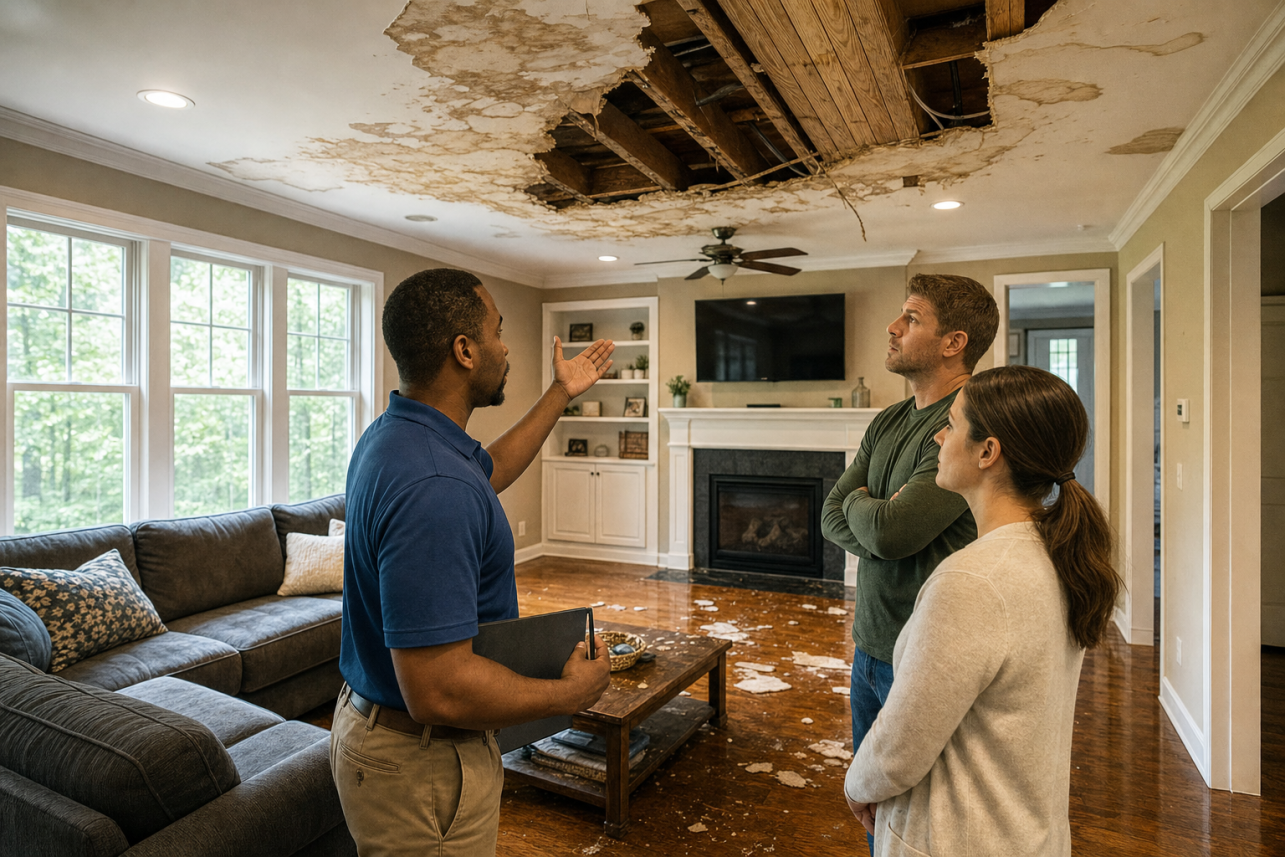
Yes, and this is one of the most misunderstood parts of the process. The adjuster your carrier sends works for the insurance company. They may be courteous and professional, but their estimate is built to protect the insurer's bottom line, not to capture the full scope of your loss.
With water losses in particular, company adjusters routinely miss or minimize hidden damage: saturated insulation inside wall cavities, moisture wicking up drywall above the visible waterline, damaged subfloor under hardwood that looks salvageable, and wet framing that will grow mold if it isn't opened up and dried. In Raleigh's humid climate, moisture trapped in a wall doesn't dry on its own — it festers.
A public adjuster is licensed by the North Carolina Department of Insurance to represent you, the policyholder. That means independent moisture mapping, a line-item estimate using the same software carriers use, and negotiation based on documented evidence rather than a quick visual walkthrough.
The difference shows up in the numbers. Carrier estimates on water losses often cover painting and carpet while ignoring demolition, drying equipment, contents, and code-required upgrades during repair. A properly scoped claim frequently comes back two or three times higher than the initial offer.
You can bring in your own adjuster at any stage — before filing, after a low offer, or even after a denial, as long as you're within policy deadlines. For The Public Adjusters, Inc. offers free claim reviews for Raleigh and Wake County homeowners, so finding out where you stand costs nothing.
Will Filing A Water Damage Claim In Raleigh Raise My Premiums Or Get My Policy Canceled?
It's a fair concern, and the honest answer is: it depends on the size of the loss and your claim history, but fear of a rate increase shouldn't stop you from filing a legitimate Insurance Water Damage Claim Raleigh policyholders have already paid premiums to cover.
In North Carolina, a single claim rarely triggers non-renewal on its own. Carriers look at frequency more than severity — two or three claims in a few years raises flags faster than one significant loss. Water claims do get recorded in the CLUE database, which insurers check at renewal and which follows the property itself, so future buyers' insurers will see it too.
Here's the math that matters: a typical rate increase after a claim might cost you a few hundred dollars a year for three to five years. A serious water loss — soaked flooring, wet drywall, damaged cabinetry, mold remediation — can easily run $20,000 to $60,000 in a Raleigh home. Absorbing that yourself to protect a premium almost never makes financial sense.
One caution: don't call your carrier to "just ask about" a possible claim. Some insurers log inquiries as zero-dollar claims in CLUE even if you never file. If you're unsure whether the damage justifies a claim, get an independent opinion first.
For The Public Adjusters, Inc. can inspect the damage, estimate the real repair cost, and tell you frankly whether filing makes sense. If the loss is barely above your deductible, we'll say so — and if it's substantial, we'll make sure it's paid properly.
Can I Reopen Or Supplement An Insurance Water Damage Claim Raleigh Already Paid Out If The Settlement Was Too Low?
Yes, in most cases. Accepting a first check does not close the door on your claim. If you discover additional damage, receive contractor estimates that exceed the payout, or realize the carrier missed items like wet insulation, subfloor damage, or hidden moisture behind cabinets, you can file a supplemental claim.
This matters a lot with water losses because damage keeps revealing itself. Hardwood floors cup weeks later, drywall shows staining after paint dries, and mold appears in wall cavities the adjuster never opened. In Wake County homes, especially older properties in neighborhoods like Five Points or Cameron Park, plaster and original hardwoods often hide damage that a quick inspection misses.
Timing still matters. North Carolina policies typically require prompt notice of additional damage, and the statute of limitations on the underlying loss keeps running regardless of when you reopen. Do not assume you have unlimited time just because the claim was previously paid.
When For The Public Adjusters, Inc. handles an underpaid Insurance Water Damage Claim Raleigh homeowners bring to us after the fact, we start with a full re-inspection using moisture meters and thermal imaging, compare our findings line by line against the carrier's estimate, and submit a documented supplement with photos, measurements, and current local pricing. Carriers respond very differently to a professionally prepared supplement than to a homeowner simply asking for more money. Bring us your closed or underpaid file and we will tell you honestly whether reopening it is worth pursuing.
What Documentation Do I Need To Prove Water Damage To My Insurance Company?
Strong documentation is the difference between a full recovery and a lowball offer. Start with photos and video of everything before any cleanup: standing water, the source of the leak, damaged flooring, baseboards, furniture, and personal property. Capture wide shots for context and close-ups for detail, and photograph serial numbers on damaged appliances and electronics.
Keep the evidence. If a plumber replaces a burst supply line or a failed water heater, ask them to leave the old part with you and write a brief cause-of-loss statement on their invoice. Carriers in Raleigh routinely dispute the cause of water losses, and that failed component is your proof.
Save every receipt: emergency water extraction, dehumidifier rentals, tarps, hotel stays if the home is uninhabitable, even meals above your normal costs if you are displaced. North Carolina policies typically include additional living expense coverage, but only for what you can document.
Build a room-by-room inventory of damaged contents with descriptions, approximate purchase dates, and replacement costs. Photos of items in place before disposal are essential, because throwing things out without documentation is one of the most common and costly mistakes we see.
Our team also generates evidence homeowners cannot produce on their own: moisture mapping, thermal imaging, drying logs, and detailed repair estimates written in the same software insurance carriers use. That professional-grade file is what compels an adjuster to pay what the loss is actually worth.
My Insurer Says The Leak Was Slow And Gradual, So It Isn't Covered. Is That The End Of My Claim?
No, and this is one of the most common denial tactics we fight in Raleigh. Most homeowner policies exclude damage from long-term seepage or deferred maintenance, so carriers have a financial incentive to label every water loss as gradual. That label is an opinion, not a fact, and it can be challenged.
The key legal and technical distinction is between the cause of the leak and the resulting damage. Even when a pipe corroded slowly over time, the sudden release of water and the resulting damage to floors, drywall, and cabinets is often covered under North Carolina policy language. Many denials collapse once someone actually reads the ensuing-loss provisions and applies them correctly.
Evidence drives these disputes. A plumber's report on the failed component, moisture readings, staining patterns, and sometimes a leak-detection specialist's findings can establish that the damage occurred quickly or that the homeowner could not reasonably have known about a hidden leak. A pinhole leak inside a wall in a Cary Street bungalow or a slab leak in a North Raleigh ranch is invisible until damage appears, and courts and carriers recognize that.
Before accepting a gradual-damage denial, get a second opinion. For The Public Adjusters, Inc. reviews denial letters at no charge, and we regularly overturn these decisions by documenting the true cause and timeline of the loss and holding the carrier to what the policy actually says.
Why Did My Payout For An Insurance Water Damage Claim Raleigh Come In Lower Than My Contractor's Estimate, And What Is Depreciation Withholding?
Two things usually explain the gap: depreciation and pricing. Most homeowner policies in North Carolina pay claims in two stages. The first check reflects actual cash value, which is the replacement cost minus depreciation for age and wear. The withheld depreciation, called recoverable depreciation, is paid after you complete repairs and submit proof, typically invoices or a certificate of completion.
Many Wake County homeowners never collect that second payment because nobody explained the process, or they missed the policy's deadline for completing repairs, often 180 days to one year from the date of loss. That money is yours under the policy, but you have to claim it correctly.
Pricing is the other issue. Carrier estimates are generated from software databases that frequently lag behind what licensed contractors in the Raleigh market actually charge for demolition, drying, flooring, and drywall. Estimates also commonly omit line items entirely: detach-and-reset of cabinets, content manipulation, matching flooring across connected rooms, or code-required upgrades.
When an Insurance Water Damage Claim Raleigh settlement falls short of real repair costs, the fix is a line-by-line rebuttal, not a phone argument. Our team rebuilds the estimate in the same software the carrier uses, documents every missed item with photos and measurements, and negotiates the supplement directly with the insurance company. We also track your recoverable depreciation deadlines so nothing gets forfeited. On water losses, recovering withheld depreciation and missed line items often adds thousands to the final settlement.
Does An Insurance Water Damage Claim Raleigh Policy Cover Flooding, Or Is Flood Damage Something Different?
This is one of the most misunderstood distinctions in property insurance, and it matters a lot in Wake County. Standard homeowners policies cover sudden, accidental water damage that originates inside your home or from above — burst supply lines, water heater failures, appliance leaks, and rain entering through storm-created roof openings.
Flooding is different. If rising surface water enters your home from outside — an overflowing creek near Crabtree Valley, storm runoff pooling against your foundation in a low-lying Southeast Raleigh lot, or hurricane storm surge pushing water in at ground level — that is flood damage, and homeowners policies exclude it. Flood coverage comes only through a separate FEMA flood policy or private flood insurance.
Where it gets contentious is mixed-cause losses. During a tropical system, you might have wind-driven rain through a damaged roof (covered) and groundwater seepage into a crawl space (excluded) in the same event. Insurers sometimes lump everything under the flood exclusion to deny the entire loss, even when a covered cause did most of the damage.
That is where representation on an Insurance Water Damage Claim Raleigh becomes valuable. We inspect the property, trace each water path to its source, and separate covered damage from excluded damage with photographs, moisture mapping, and expert reports when needed. North Carolina courts apply causation rules that can preserve coverage when a covered peril is the efficient cause of loss, so a blanket "it was flooding" denial is often the beginning of the conversation, not the end of it.
Is Mold Caused By The Water Damage Covered, And How Does It Affect My Payout?
Often yes — but only if you connect the mold directly to a covered water loss, and Raleigh's humidity makes that connection urgent. In our climate, mold colonization can begin inside wall cavities within 48 to 72 hours of a pipe burst or roof leak, well before you see anything on the surface.
Most North Carolina homeowners policies exclude mold as a standalone peril but cover it when it results from a covered water event, frequently subject to a sublimit of $5,000 to $10,000. Some policies add mold remediation back through an endorsement with higher limits. Reading those provisions correctly is critical, because carriers sometimes apply the low mold sublimit to work that should actually fall under the full water damage coverage — tear-out, drying, and reconstruction are not mold remediation.
How you frame the damage matters enormously. Removing wet drywall to dry a wall cavity is water mitigation. Treating and clearing microbial growth is remediation. When those get blurred, thousands of dollars of legitimate repair cost can get squeezed under a sublimit where it does not belong.
We document moisture readings, order air quality or surface testing when warranted, and build the timeline showing the mold flowed from the sudden loss — not from long-term neglect, which is the insurer's usual counterargument. Acting fast helps you too: prompt professional drying limits mold growth, protects your family's health, and shows the carrier you met your duty to mitigate. If you can already smell mustiness or see staining, get the inspection scheduled before the growth spreads further.
Water Ruined Part Of My Hardwood Flooring, But The Rest Still Looks Fine. Does The Insurer Have To Replace The Whole Floor So It Matches?
This "matching" dispute comes up constantly in Raleigh water losses, especially in homes with continuous hardwood running through the kitchen, dining room, and hallways, or with discontinued tile and carpet lines. The insurer offers to replace only the boards that got wet; you are left with a visible patch of mismatched flooring in the middle of your main living space.
North Carolina does not have a statute that flatly requires full replacement, but the outcome usually turns on your policy language and the standard of a reasonably uniform appearance. Many policies promise to repair with materials of "like kind and quality." If your flooring was installed fifteen years ago and the exact species, plank width, and stain are no longer available — or new boards simply cannot be blended into aged, sun-patinated wood — a patch does not restore what you had.
The practical argument is often about continuity. When flooring runs unbroken between rooms with no transition strip, industry repair standards support replacing the continuous area rather than creating an artificial seam. Flooring vendor letters confirming the product is discontinued, photographs showing the open floor plan, and contractor statements about blending limitations all strengthen the position.
We build exactly that file for Wake County homeowners and negotiate line by line against the carrier's estimate. The same logic applies to roof shingles, siding, cabinets, and countertops damaged by water. The difference between a patch and a proper matching replacement frequently amounts to $10,000 or more on a single loss, so it is worth contesting rather than accepting the first scope you are handed.
Will My Insurance Water Damage Claim Raleigh Pay For A Hotel Or Rental While My Home Is Being Repaired?
In most cases, yes. Nearly every homeowners policy includes Additional Living Expenses coverage, sometimes called Loss of Use or Coverage D. It pays the extra costs of living elsewhere when a covered water loss makes your home uninhabitable — a hotel near your part of town, a short-term rental, restaurant meals beyond your normal grocery budget, pet boarding, laundry service, and added commuting mileage to work or school.
The key word is "extra." The coverage reimburses the difference between your normal living costs and what you are actually spending while displaced. Keep every receipt from day one, because carriers reimburse documented expenses, not estimates. Coverage D limits typically run 20 to 30 percent of your dwelling limit, which is usually ample for a water loss.
Where disputes arise is the definition of "uninhabitable." If your only bathroom is gutted, the kitchen has no functioning sink, or drying equipment is roaring in the bedrooms around the clock, you have a strong case for displacement even if the house technically has a roof and power. Insurers sometimes push families to stay in homes that are unlivable in any practical sense, or cut off payments before repairs are actually finished.
When we handle a water damage claim for a Raleigh homeowner, we document habitability with photos and the contractor's repair schedule, then push the carrier to authorize housing appropriate for your household size — not a single hotel room for a family of five for three months. If repairs drag on because of the insurer's own delays, we hold them to extending the benefit accordingly.
Local Relevance
Raleigh's climate is hard on houses in ways that end up as water claims. Summers bring heavy, fast-moving thunderstorms that find every weak spot in a roof, and the remnants of hurricanes moving up from the coast can dump inches of rain on the Triangle in a day. Winters are mild but not harmless — the occasional hard freeze catches pipes in crawl spaces and unheated garages, and burst pipe damage from a single cold snap can flood a home in hours.
The housing stock matters too. Wake County has everything from older homes near downtown with original plumbing and vented crawl spaces to newer construction on slabs in fast-growing suburbs. Older galvanized or polybutylene plumbing, aging water heaters, and crawl-space humidity all raise the odds of a slow leak that becomes a serious loss before anyone notices.
And because North Carolina's humidity is relentless from late spring through fall, water that isn't dried out quickly turns into mold fast — which insurers then try to carve out of the claim. Homeowners near creeks and low-lying areas around the city should also know that rising water isn't covered by a standard homeowners policy at all; that's a separate flood policy, and the Federal Emergency Management Agency's flood mapping tools can show you whether your property sits in a mapped flood zone. We handle both standard water claims and NFIP flood claims, so the coverage question gets answered correctly either way.
In Raleigh, many water losses start under the house rather than in it — the region's vented crawl spaces trap summer humidity, so a slow supply-line or drain leak often goes unnoticed until floors cup or mold appears, and by then insurers frequently argue the damage was 'gradual.' Documenting the moment of discovery, with photos and a plumber's report, is often the difference between a paid claim and a denied one here.
Water Damage Claim Denied Or Underpaid In Wake County?
Don't sign off on a settlement that doesn't cover the real repairs. For The Public Adjusters, Inc. is licensed and bonded in North Carolina, and we work only for policyholders. Get a free, no-obligation review of your policy and your claim — before the insurance company closes the file.
Call us: (919) 400-6440
Helpful Resources
- NCDOI Public Adjusters Guide
- Federal Emergency Management Agency (FEMA)
- FloodSmart – National Flood Insurance Program — Official NFIP resource explaining flood coverage
- North Carolina Department of Insurance — State regulator for insurance consumers in NC
Last updated: August 12, 2026