Why Was My Smoke Damage Claim Denied When There’s No Visible Soot?
If your smoke damage claim denied letter says the loss is “just odor” or “cosmetic,” it usually means the adjuster found no visible char or soot and concluded there was no physical damage. That conclusion is often wrong: smoke residue is a real contaminant, and courts have repeatedly recognized odor and residue as genuine physical loss.
Key takeaways
- An insurer calling smoke damage ‘just odor’ is a classification tactic, not a final answer — persistent smoke odor is evidence of physical contamination that can support full remediation coverage.
- Courts have sided with policyholders on this issue: in Farmers Insurance Co. of Oregon v. Trutanich, 858 P.2d 1332 (Or. Ct. App. 1993), the court held that a persistent odor permeating a house was direct physical loss, and the homeowner won coverage for remediation.
- Laboratory testing for char, soot, and combustion byproducts on surfaces and inside HVAC systems can transform a subjective ‘smell complaint’ into objective, documented physical damage.
- In North Carolina and Virginia, a denied or lowballed smoke claim is not the end of the process — policyholders have the right to dispute the classification with independent evidence and professional representation.
- A licensed public adjuster works only for the policyholder, building the chemical, photographic, and hygienist evidence needed to challenge an ‘odor only’ or ‘cosmetic’ denial.
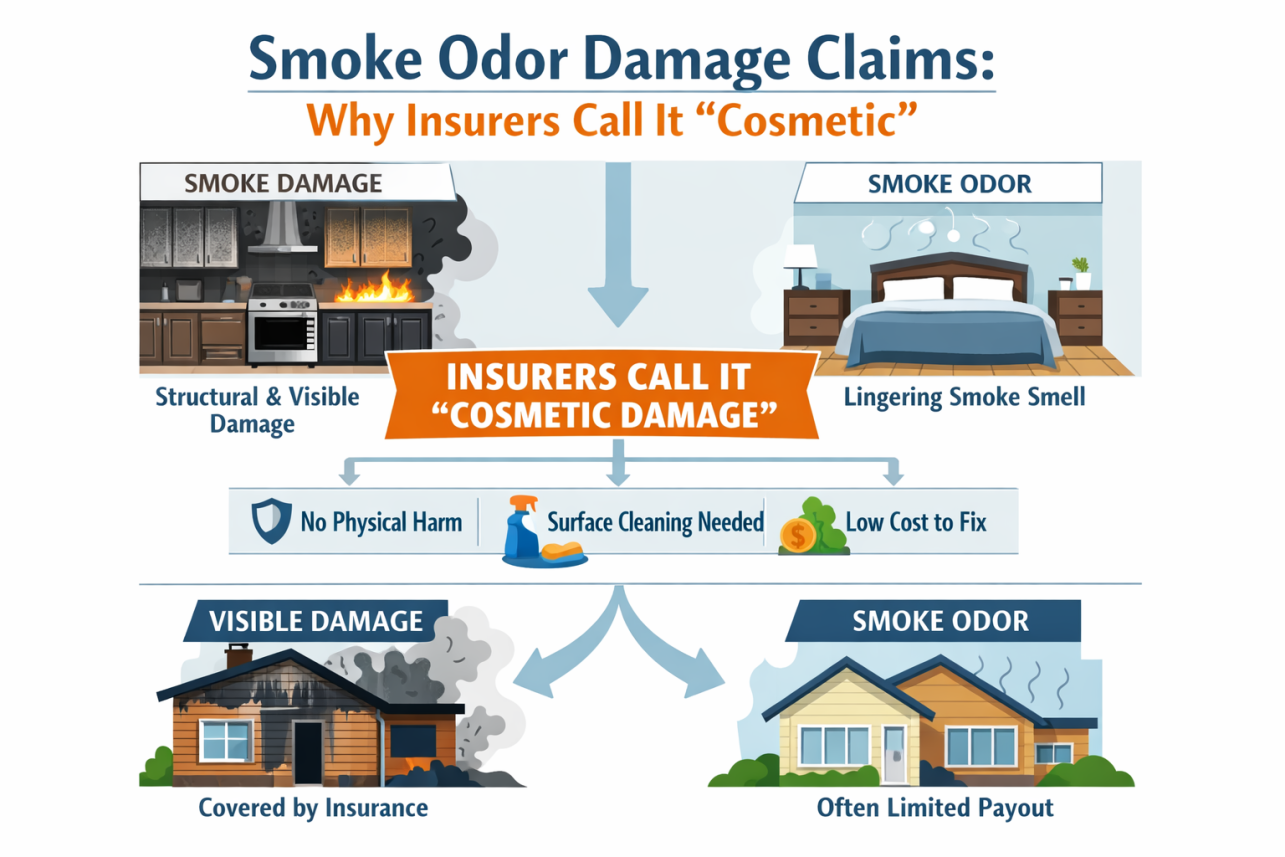
This is what many policyholders call the “odor only” trap. After a nearby fire, a kitchen flare-up, or smoke drifting through your HVAC system, an insurance adjuster walks through, sees no blackened walls, and writes the claim up as a cleaning issue or a cosmetic annoyance. In North Carolina and Virginia, that framing lets the insurer offer a light wipe-down and deodorizer spray instead of paying for the professional remediation your home may actually need — sealing, duct cleaning, content restoration, or replacement of porous materials that have absorbed smoke.
Why the “Cosmetic” Label Is Frequently Wrong
Smoke is not just a smell. It is a mixture of microscopic particulates, acids, and volatile compounds that penetrate drywall, insulation, carpet, upholstery, and ductwork. You cannot always see it, but it is physically present — and it can corrode surfaces and affect indoor air quality over time. Courts have sided with policyholders on this point. In Farmers Insurance Co. of Oregon v. Trutanich, an Oregon appellate court held that a persistent odor that had penetrated a house was physical damage covered under the policy, and the homeowner prevailed against the insurer. The reasoning is straightforward: if a contaminant has physically infiltrated your property and costs money to remove, that is a physical loss, not a cosmetic one. Homeowners pursuing smoke damage insurance claim help in Garner and surrounding Wake County communities run into this exact dispute all the time.
Why Insurers Lean on This Denial
- Lower payouts: Labeling smoke as odor turns a remediation claim into a minor cleaning allowance.
- No visible proof at first glance: Without char, the adjuster’s photos look clean — even when lab testing would tell a different story.
- Policy language ambiguity: Insurers interpret “direct physical loss” narrowly, hoping you won’t push back.
The Good News: Documentation Changes Everything
A denial based on “odor only” is a starting position, not a final answer. Professional particulate and residue testing, moisture and surface sampling, HVAC inspections, and detailed remediation estimates can demonstrate that smoke physically contaminated your home. When that evidence is presented properly, insurers frequently reverse course — and a licensed, bonded public adjuster in Wake Forest NC or your own community can manage that documentation and negotiation for you. While no one can guarantee a specific outcome, the sections below walk you through exactly what evidence carries weight and how to build your case.
Is Smoke Odor Considered Physical Damage Under My Insurance Policy? (When a Smoke Damage Claim Denied as ‘Just Odor’ Is Wrong)
Yes — courts in multiple states have ruled that pervasive smoke odor can qualify as “direct physical loss” under a homeowners policy, even without visible soot. If the odor makes your home less livable or requires professional remediation to remove, that is physical damage, and insurers who deny it face a legal record that runs against them.
What “Direct Physical Loss” Actually Means
Most homeowners policies promise to pay for “direct physical loss to property.” Insurers often argue that odor is intangible — something you smell, not something that damages the structure. But that argument ignores how smoke actually works. Odor exists because smoke particles and residues have physically penetrated your drywall, insulation, HVAC ductwork, carpet padding, and personal property. The smell is the symptom; the contamination embedded in your home is the physical loss.
Court Decisions Where Homeowners Won
Policyholders have taken the “odor isn’t damage” argument to court — and won. Two decisions are cited again and again:
- Farmers Insurance Co. of Oregon v. Trutanich — An Oregon appellate court held that a persistent odor permeating a house constituted direct physical loss to the property. The cost of professionally removing that odor was a covered cost of repairing physical damage, and the insurer was required to pay for remediation.
- Mellin v. Northern Security Insurance Co. — The New Hampshire Supreme Court ruled that a pervasive odor could qualify as physical loss to the home, rejecting the insurer’s position that damage must be visible or structural to be covered. The court recognized that a loss can be physical even when it can’t be seen with the naked eye.
The consistent thread in these rulings: when odor is persistent, permeates the property, and diminishes its use or requires remediation, courts treat it as real, compensable physical damage — not a cosmetic complaint.
What This Means for Your North Carolina Claim
While these cases arose in other states, they represent the reasoning many courts apply to standard “direct physical loss” language — the same language found in most North Carolina homeowners policies. When an adjuster tells you smoke odor isn’t covered, that position is a coverage interpretation, not settled law, and it can be challenged. Homeowners who push back with proper documentation often see denials reconsidered, which is why many turn to professional smoke damage claim help in Knightdale and surrounding communities before accepting a denial as final.
The key is framing your claim correctly from the start: odor remediation, sealing, duct cleaning, and content restoration are repairs to physical damage, not optional deodorizing. A licensed public adjuster who handles a smoke damage insurance claim in Holly Springs or anywhere in the Triangle can present your loss in the policy’s own terms — direct physical loss — supported by the case law insurers hope you never read.

How Do Insurers Justify Calling Smoke Damage ‘Cosmetic’?
Insurers label smoke damage “cosmetic” by relying on quick, visual-only inspections: if the adjuster sees no char, melted materials, or heavy soot streaking, the file gets coded as an odor or appearance issue. That framing lets the company offer minimal remedies — deodorizing sprays, a coat of paint — instead of paying for the deeper remediation your policy actually covers.
The Adjuster Playbook, Step by Step
When a smoke damage claim is denied or minimized, the reasoning usually follows a predictable pattern:
- A walk-through instead of testing. The adjuster looks at walls and ceilings but takes no wipe samples, air samples, or lab swabs that would reveal soot particles and combustion residue.
- “No char, no claim” logic. Because nothing burned inside your home, the insurer argues nothing was physically damaged — ignoring that smoke is made of acidic particles and gases that penetrate materials.
- Lowball scope of repairs. The settlement offer covers repainting, an ozone treatment, or thermal fogging, but excludes drywall, insulation, duct cleaning, and contents restoration.
- Shifting the burden to you. The denial letter invites you to “submit additional evidence,” knowing most homeowners don’t know what testing to obtain.
Why Surface Inspections Miss the Real Damage
Smoke behaves like a gas under pressure during a fire — it is driven into porous materials and cavities a visual inspection can never reach. Residue commonly absorbs into drywall and its paper facing, attic and wall insulation, HVAC ducts and air handlers, carpet padding, upholstered furniture, mattresses, and clothing. Painting over contaminated drywall or spraying deodorizer treats the symptom while the corrosive residue stays behind, which is why odors so often return weeks later — especially when humidity rises or the heat kicks on. Homeowners dealing with this pattern often benefit from an independent damage assessment like the Smoke Damage Insurance Claim Help in Raleigh our team provides, where testing documents what the insurer’s inspection skipped.
Courts have pushed back on this narrow reasoning. In Western Fire Insurance Co. v. First Presbyterian Church, the Colorado Supreme Court held that a building saturated with gasoline vapors suffered a direct physical loss even though the structure showed no visible damage — the contamination itself rendered the property unusable and constituted physical loss. That principle undercuts the “it’s just odor, so it’s just cosmetic” argument insurers lean on.
The Cost of Accepting a Cosmetic-Only Settlement
Taking a paint-and-spray payout carries real consequences. Lingering combustion residue can irritate the lungs, eyes, and skin — a particular concern for children, older adults, and anyone with asthma. And when you sell, North Carolina disclosure obligations and buyer inspections can surface the unresolved contamination, hurting your sale price long after the insurer closed the file. Before signing anything, it’s worth having a licensed Public Adjuster in Durham NC or your local area review the insurer’s scope against what proper smoke remediation actually requires. We’re licensed and bonded, and while no one can promise a specific outcome, a properly documented claim is far harder to dismiss as cosmetic.
What Evidence Proves Smoke Damage You Can’t See — Even After a Smoke Damage Claim Denied Letter?
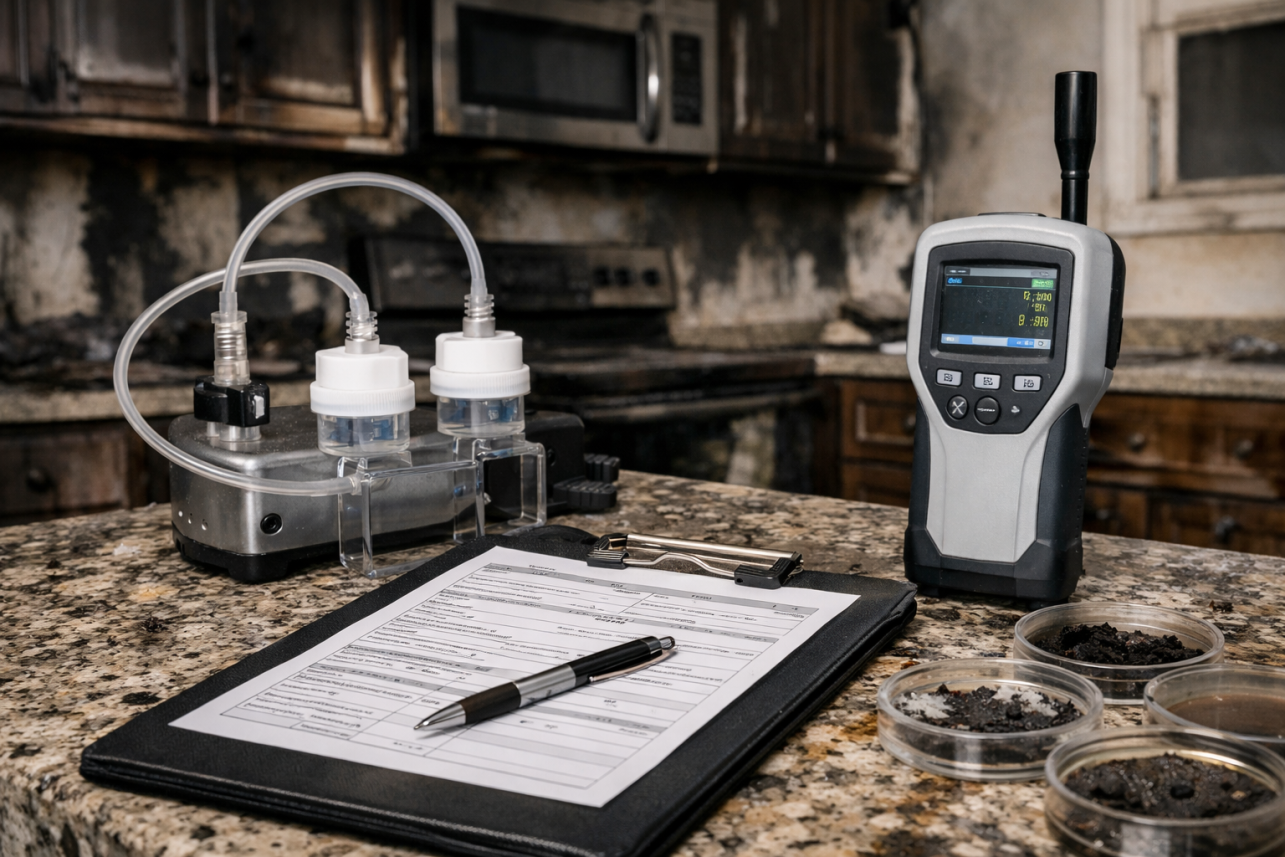
Scientific testing proves invisible smoke damage: VOC air sampling, particulate and wipe tests for combustion byproducts, microscopic lab analysis of char and soot, HVAC duct inspections, industrial hygienist reports, and detailed contents inventories. Together, this chemical paper trail transforms “it just smells” into documented, measurable physical contamination an insurer must address.
When an adjuster shrugs and says the odor will fade, objective data is your strongest counterargument. Smoke residue is made of real particles and chemicals — many too small to see — and each type of test captures a different piece of that evidence.
The Testing That Builds a Chemical Paper Trail
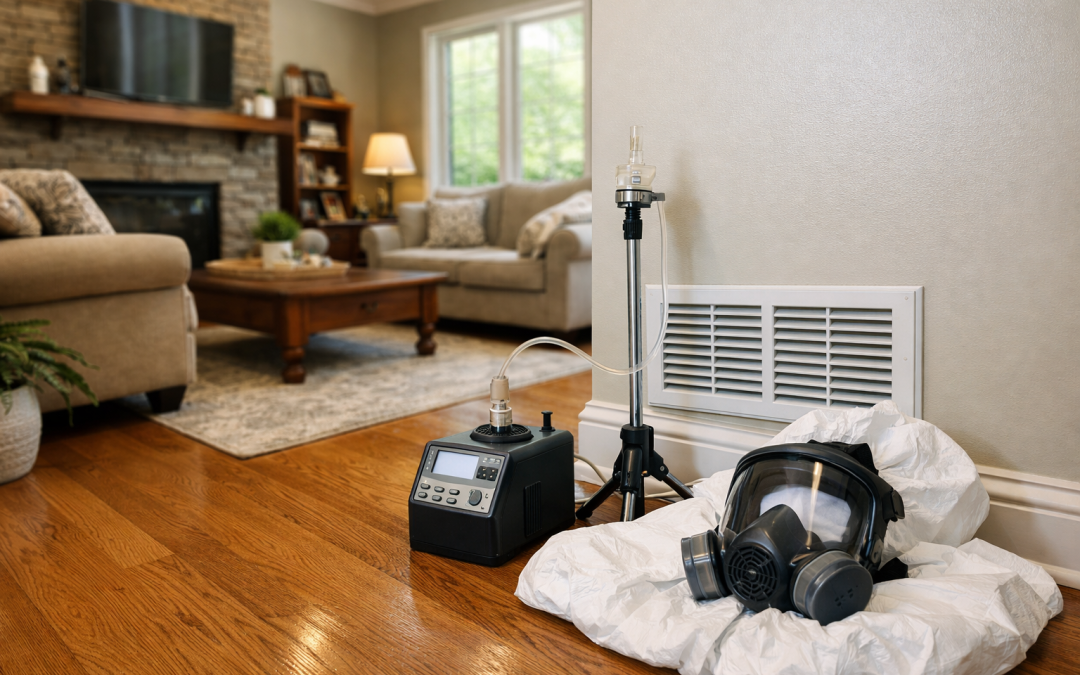
- VOC air sampling: Measures volatile organic compounds released by smoke residue that continue off-gassing into your home’s air. The U.S. EPA’s indoor air quality resources recognize combustion byproducts as genuine indoor pollutants, not mere nuisances.
- Particulate and wipe testing: Surface samples collected from walls, ceilings, and contents can reveal char, ash, and soot particles even when surfaces look clean to the naked eye.
- Microscopic lab analysis: Accredited laboratories examine samples under magnification to confirm combustion byproducts — distinguishing fire-related residue from ordinary household dust.
- HVAC duct inspections: Ductwork acts like a filter during a fire, trapping soot and redistributing it every time the system runs. Documented contamination here often proves damage spread far beyond the fire’s origin.
- Industrial hygienist reports: A credentialed third-party expert interprets the lab data and ties it to health and habitability standards, giving your claim professional weight an insurer can’t easily dismiss.
- Contents inventories: Room-by-room documentation of affected furniture, textiles, and electronics — porous items absorb smoke chemicals and often can’t be fully restored.
Why This Evidence Changes the Conversation
Courts have repeatedly recognized that contamination you can smell but not see is real physical damage. In Farmers Insurance Co. of Oregon v. Trutanich, the Oregon Court of Appeals held that a persistent odor that permeated a house constituted physical damage to the property — a ruling policyholders and their representatives still point to when insurers try to write off odor as cosmetic. Assembling this kind of proof is exactly the work a licensed and bonded professional handles when providing smoke damage insurance claim help in Durham and surrounding communities.
Documentation deadlines matter, so testing should happen before cleaning or repairs disturb the evidence. If your claim has stalled, a public adjuster in Raleigh NC can coordinate the sampling, hygienist reports, and inventories needed to present a complete, science-backed claim. And if you believe your insurer is acting in bad faith, you can also file a complaint with the North Carolina Department of Insurance. While no one can promise a specific outcome, hard evidence gives your claim the foundation it deserves.
Smoke Damage Claim Denied as ‘Odor Only’? How the Evidence Compares
| Insurer’s ‘Odor Only’ Position | What the Science Actually Shows | How a Public Adjuster Documents It |
|---|---|---|
| No visible char or soot means no physical damage | Smoke particles are microscopic and penetrate porous materials even when surfaces look clean | Independent industrial hygienist sampling and lab analysis of walls, insulation, and soft goods |
| Odor is temporary and will air out | Combustion byproducts bond to building materials and off-gas for months or years | Time-stamped odor documentation, VOC readings, and follow-up inspections showing persistence |
| Cleaning visible areas is sufficient | HVAC systems, wall cavities, and attic insulation trap smoke residue and recontaminate the home | Duct inspections, cavity testing, and a full remediation scope of work from qualified contractors |
| Odor is a cosmetic or comfort issue, not a covered loss | Courts, including Farmers Ins. Co. of Oregon v. Trutanich, have recognized pervasive odor as direct physical loss | A documented claim package citing physical contamination, supported by testing and expert reports |
Illustrative Example: Turning a ‘Just Odor’ Denial Into Documented Physical Damage
Illustrative example
In this hypothetical composite scenario, a North Carolina homeowner’s house filled with smoke from a neighboring structure fire, and the insurer denied the claim as ‘odor only’ because no charring was visible. A public adjuster arranged independent testing, which found combustion residues on interior surfaces, inside the HVAC system, and within attic insulation. Armed with lab results, hygienist reports, and a detailed remediation scope, the adjuster challenged the cosmetic classification as inconsistent with the physical evidence and with case law like Farmers Ins. Co. of Oregon v. Trutanich, where a court found pervasive odor to be direct physical loss. The insurer reopened the claim and approved a substantially broader remediation scope than its original position allowed. Every claim is different and outcomes vary, but thorough documentation is what moves an ‘odor’ dispute onto factual ground.
Frequently asked questions
Can I fight a smoke damage claim denied for having no visible soot or char?
Yes. A denial letter is not the final word — it is the insurer’s opinion, and opinions can be challenged with evidence. Courts have repeatedly recognized that damage does not have to be visible to be real. Request the denial in writing, ask exactly which policy language was applied, preserve the affected materials, and get independent documentation before cleaning anything. Many ‘odor only’ denials are reversed once objective proof of smoke residue is presented.
Is smoke odor legally considered physical damage to a home?
Courts have found that it can be. In Mellin v. Northern Security Insurance Co., the New Hampshire Supreme Court ruled that a pervasive odor could constitute physical loss to a home even without visible alteration. Similarly, in Western Fire Insurance Co. v. First Presbyterian Church, the court held that vapor infiltration making a building unusable was a direct physical loss — and the insured church won. These decisions undercut the argument that no soot means no damage.
How much does it cost to hire a public adjuster after a smoke claim denial?
Most public adjusters work on contingency, meaning the fee is a percentage of what the insurer ultimately pays — there is typically no upfront cost, and no fee if there is no recovery. Fee percentages vary by state and by firm, so ask for the rate in writing before signing. We are licensed and bonded, and while no one can guarantee a specific outcome, professional documentation often changes how an insurer values the claim.
How long does it take to overturn a smoke damage denial?
It varies with the strength of your evidence and how the insurer responds. Straightforward disputes — where testing clearly shows smoke residue the original adjuster missed — can resolve in a matter of weeks after the supplemental documentation is submitted. Claims requiring appraisal, a Department of Insurance complaint, or litigation can take several months or longer. Getting objective testing done early, before anything is cleaned or repainted, usually shortens the timeline considerably.
What should I do first after my smoke damage claim is denied?
Ask for the denial in writing with the specific policy provisions cited — insurers must explain their reasoning. Then preserve the evidence: do not repaint, deep clean, or replace odor-saturated materials yet, because doing so destroys the proof you need. Photograph everything, keep a written log of when and where the odor is strongest, and get an independent inspection. Only after the damage is documented should remediation begin.
Will cleaning the smoke smell myself hurt my insurance claim?
It can seriously hurt it. If you scrub, repaint, or run ozone treatments before the damage is independently documented, the insurer may argue there is no longer any evidence of a covered loss — and you cannot recreate it. Household cleaning also rarely removes smoke residue absorbed into insulation, ductwork, and porous materials, so the odor often returns after the claim is closed. Document first, remediate second.
Do I need a lawyer or a public adjuster for a denied smoke damage claim?
It depends on where the dispute stands. A public adjuster is typically the right first step when the disagreement is about the scope and value of the damage — building the evidence, estimating full remediation, and negotiating with the carrier. An attorney becomes appropriate if the insurer refuses to budge despite strong evidence or has acted in bad faith. Many policyholders start with a public adjuster and add legal counsel only if negotiations stall.
How long do I have to dispute a denied smoke damage claim in North Carolina?
Two clocks matter. State law sets a statute of limitations for suing on the policy, but your policy itself may contain a ‘suit limitation’ clause that shortens the window — sometimes significantly. Read that provision carefully, because missing it can end an otherwise valid claim. Internal appeals and supplemental claims should be started as soon as possible while evidence is fresh. When in doubt, get your denial reviewed promptly rather than waiting.
What mistakes cause smoke claims to get labeled ‘cosmetic’ or ‘odor only’?
The most common ones: describing the loss to the insurer only as a ‘smell’ rather than as contamination of building materials; allowing a brief visual-only inspection to stand as the final word; cleaning or airing out the home before documentation; and accepting a small deodorizing payment that closes the claim. Insurers write denials based on the record in front of them — if the file only mentions odor, the denial will too.
Smoke Damage Claim help near you
- Smoke Damage Claim Elon
- Smoke Damage Insurance Claim Help Garner
- Smoke Damage Claim Help Wake Forest
Related local pages
If your insurer is calling real smoke damage a ‘cosmetic’ problem, you don’t have to accept that answer alone. Our licensed and bonded public adjusters serve homeowners across North Carolina, and we know how to document what your nose already knows. Contact us today for a free claim review — we’ll give you an honest assessment of where your claim stands and what evidence could strengthen it. Get in touch.
Last updated: September 23, 2026