
For The Public Adjusters, Inc. provides water damage claim help Bynum property owners can rely on when a burst pipe, roof leak, or water heater failure damages their home and the insurance company’s response falls short. As licensed and bonded public adjusters, we work for you — not the insurer — documenting the full scope of damage, preparing the proof of loss, and negotiating the settlement. If your claim has been delayed, underpaid, or denied, we can step in at any stage.
What This Service Is
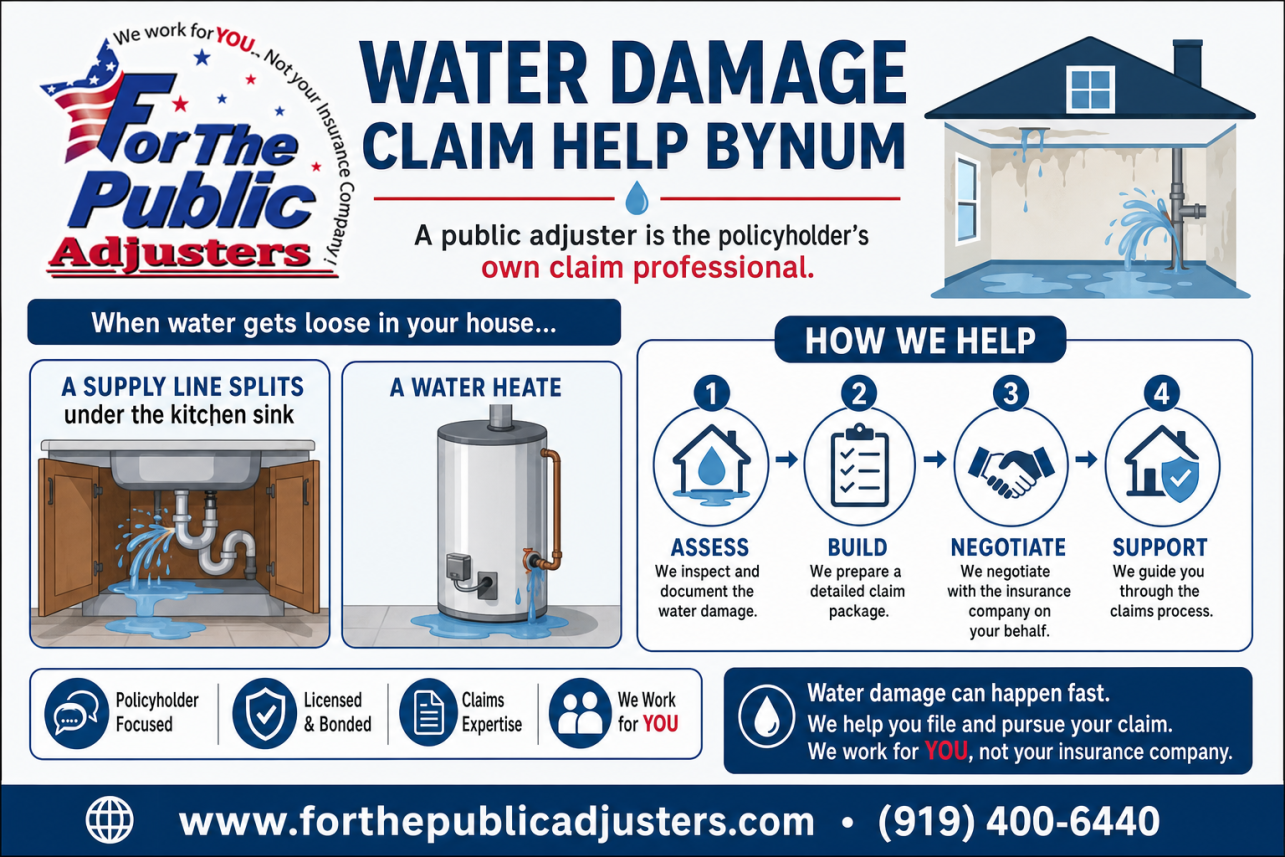
A public adjuster is the policyholder’s own claim professional. When water gets loose in your house — a supply line splits under the kitchen sink, a water heater lets go in the crawl space, or rain finds its way through an aging roof — your insurance company sends its own adjuster to measure the loss. That person works for the insurer.
We do the opposite. We read your actual policy, inspect the damage ourselves, find the moisture the first inspection missed, and build a complete, documented claim with a repair estimate that reflects real local costs. Then we negotiate directly with the insurance company on your behalf.
We handle residential and commercial water losses across Chatham County, from Bynum down to a public adjuster water damage Bear Creek claim and everything in between. The NCDOI Public Adjusters Guide explains how public adjusters are licensed in North Carolina and what we’re permitted to do for policyholders — we work strictly within those rules, and our fee comes from the recovery, so our interests line up with yours.
Common Problems
Why Is The Insurance Check So Much Lower Than My Contractor’s Estimate?
This is the most common call we get. The insurer’s estimate often prices the visible damage only — the wet drywall you can see — while your contractor priced what it actually takes to put the house back: subfloor replacement, matching flooring, proper drying, paint, trim.
Depreciation is another quiet reason. Many settlements start at actual cash value, meaning the insurer deducts for the age of your flooring or cabinets and only releases the held-back amount after repairs. Homeowners who don’t know that often leave that money on the table.
We rebuild the estimate line by line, apply your policy’s replacement cost provisions correctly, and push back on lowball pricing. We can’t promise a specific dollar outcome — no honest adjuster can — but we make sure nothing covered goes unclaimed.
Water Damage Claim Help Bynum Owners Need When A Claim Stalls Or Gets Denied
Denials and delays usually hinge on wording. Insurers may argue the leak was ‘long-term seepage,’ blame poor maintenance, or point to a policy exclusion. Sometimes they’re right — often they’re stretching.
Courts have long recognized that policyholders can hold insurers accountable for mishandling home damage claims. In Anderson v. Continental Insurance Co. (1978), the Wisconsin Supreme Court allowed homeowners whose property damage claim was wrongly shorted to pursue the insurer for bad faith — a landmark that shaped how first-party claims are treated nationwide.
Our job is to reopen the file with evidence: moisture readings, photos, plumber reports, and a proof of loss the insurer can’t wave away. When a dispute needs legal muscle, we coordinate with insurance dispute lawyers. We recently took over a stalled water insurance claim in Siler City after the homeowner spent months getting nowhere alone.
Should I Just Handle The Claim Myself, Or Is A Public Adjuster Worth It?
For a small, straightforward loss where the insurer pays fairly and fast, you may not need us — and we’ll tell you that honestly in a free review.
Hire help when the numbers are significant, when there’s hidden damage under floors or inside walls, when mold is spreading, or when the insurer’s offer won’t come close to covering repairs. Those claims turn on documentation and policy knowledge most homeowners simply don’t have time to acquire mid-crisis.
Judge any adjuster the same way: verify their North Carolina license, ask what they’ll document that the insurer didn’t, and expect a clear written fee agreement. We’re licensed, bonded, and paid only from what we recover — the same standard we apply whether it’s a water damage insurance claim help Bennett file or a mill house here in Bynum.
Our Process
Free Claim Review And Policy Read-Through
We start by looking at your policy, the damage, and anything the insurer has already said or paid. You’ll get a straight answer about whether we can add value. This costs nothing, and there’s no obligation.
Full Documentation And Proof Of Loss
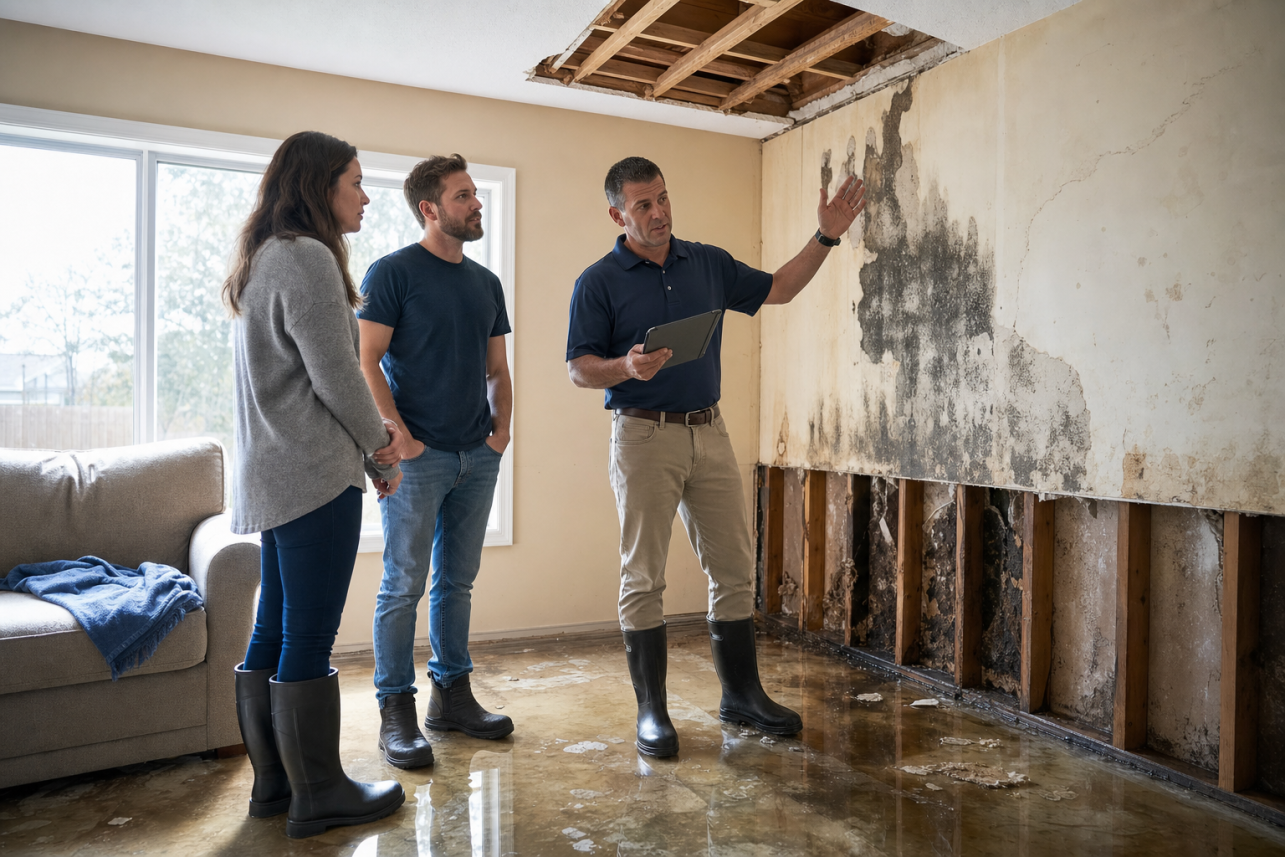
We inspect the property ourselves — moisture mapping, photos, and a room-by-room scope that includes the damage hiding in crawl spaces, wall cavities, and subfloors. We also inventory damaged contents, from furniture to keepsakes, because contents reimbursement is routinely underpaid. Then we prepare the formal proof of loss and a repair estimate built on real local pricing.
Negotiation And Settlement
We present the claim, meet the insurance company’s adjuster on site, and negotiate until the settlement reflects your actual covered loss. If repairs uncover more damage, we supplement the claim rather than letting you eat the cost. We keep you informed at every step — the same approach our public adjuster Gulf NC clients see across Chatham County.
| Claim Stage | Handling It Yourself | With For The Public Adjusters, Inc. |
|---|---|---|
| Damage documentation | Phone photos of visible damage only | Moisture mapping, thermal imaging, and room-by-room logs that hold up in disputes |
| Scope of loss | Relies on the carrier’s adjuster to find everything | Independent scope covering hidden wall, subfloor, and cavity moisture |
| Estimate | Accepting the carrier’s number or guessing at contractor bids | Line-by-line estimate built in the same software carriers use |
| Negotiation | One homeowner vs. trained claims staff | Licensed adjuster negotiating with documented evidence |
| Denials and lowball offers | Often accepted as final | Formal rebuttals, re-inspections, and appraisal when needed |
| Your time | Weeks of calls, emails, and paperwork | We manage the claim start to finish; you approve decisions |
Commonly Overlooked In The Public Adjusting Industry
- Moisture trapped inside wall cavities and under flooring — Carrier adjusters typically scope only what’s visible, and drywall can read dry on the surface while insulation behind it stays saturated for weeks.
- The matching rule for continuous flooring and finishes — Insurers offer to patch one room, missing that discontinued or unmatchable materials often obligate them to replace everything in the connected line of sight.
- Ordinance-or-law coverage for code-required upgrades — Repairs in older Chatham County homes frequently trigger electrical or plumbing code updates, and this coverage sits unused because nobody asks for it.
- Additional living expenses during drying and rebuild — Homeowners assume ALE only applies to total losses, so they eat hotel and meal costs the policy would have reimbursed.
- Deadlines buried in the policy’s duties-after-loss section — Proof-of-loss and documentation deadlines can quietly weaken a claim, and carriers rarely volunteer reminders before they pass.
- Contents inventory beyond the obvious ruined items — Water-damaged items in closets, under beds, and in low cabinets get missed in the rush, and unlisted contents are never paid.
- The ‘gradual damage’ reclassification tactic — A sudden pipe failure gets labeled a slow leak to trigger an exclusion, and without plumber reports or moisture data the label sticks.
- Recoverable depreciation left unclaimed — Many policyholders never realize the holdback on their first check is collectible after repairs, leaving thousands with the insurer permanently.
Case Studies
Case Study #1
Situation: A family in a 1940s mill house near the Haw River in Bynum came home from a weekend trip to find their kitchen ceiling sagging and water pooled across the hardwood floors. A supply line to the upstairs bathroom had failed sometime Friday night.
Problem: Their carrier’s field adjuster spent twenty minutes on site, scoped the kitchen ceiling and a small patch of flooring, and issued an estimate of $6,400. It ignored the wall cavities, the original heart-pine flooring that could not be patch-matched, and the moisture already wicking into adjacent rooms.
Investigation: We brought in thermal imaging and moisture meters and mapped readings room by room. We documented elevated moisture in three wall assemblies the carrier never opened, tested the subfloor, and pulled the plumbing failure report to establish the loss was sudden and accidental, not gradual seepage the policy would exclude.
Findings: The water had traveled under the flooring into the dining room and hallway. Because the heart pine ran continuously through those spaces and matching stock is essentially unavailable, the policy’s line-of-sight and matching provisions supported replacing the connected flooring, not patching one room. We also identified code-required electrical upgrades triggered by the ceiling repair.
Solution: We rebuilt the estimate in the same pricing software the carrier used, line by line, with photo documentation and moisture logs attached to every disputed item. We then requested a re-inspection and walked the carrier’s adjuster through each reading on site.
Outcome: The claim settled at $47,900 — more than seven times the original offer — including full flooring replacement, wall cavity drying and rebuild, and the code upgrade allowance under ordinance-or-law coverage.
Lesson: A quick visual scope almost always misses where water actually went. Moisture doesn’t stop at the room where you can see damage, and in older Bynum homes with continuous original materials, that difference can be tens of thousands of dollars.
Case Study #2
Situation: The owner of a small retail building on Bynum Road discovered water intrusion after a heavy Chatham County storm. Water had entered through flashing at a roof-to-wall junction and soaked insulation, drywall, and inventory in a back storage room.
Problem: The insurer denied the claim outright, calling it ‘wear and tear and long-term seepage’ based on some pre-existing staining. The owner was facing roughly $30,000 in repairs plus lost inventory with no payment at all.
Investigation: We hired an independent building consultant to inspect the flashing and correlated the damage pattern with rainfall data from the storm date. We separated the old cosmetic staining, which was dry and stable, from the fresh saturation, which our moisture readings showed was recent and consistent with a single wind-driven rain event.
Findings: The flashing had been displaced by wind — a covered peril — during the storm in question. The denial had lumped a small area of historic staining together with the new loss and used it to reject everything, including inventory damage that clearly occurred on the storm date.
Solution: We filed a formal rebuttal with the engineering findings, weather data, and a segregated estimate that carved out the minor pre-existing area and documented everything else as storm-related. We also submitted a business personal property inventory with purchase records for the damaged stock.
Outcome: The carrier reversed the denial and paid $38,200 covering roof repair, interior rebuild, drying, and the inventory loss. The owner reopened the storage area within six weeks.
Lesson: A denial letter is a position, not a verdict. When a carrier blames ‘seepage’ or ‘wear and tear,’ independent evidence tying the damage to a specific covered event is often enough to turn the entire claim around.
| Water Damage Scenario | Typically Covered? | What It Depends On |
|---|---|---|
| Burst pipe or failed supply line | Usually yes | Whether the failure was sudden; carriers try to reclassify slow leaks as excluded ‘gradual’ damage |
| Water heater or appliance failure | Usually yes (resulting damage) | The water damage is covered even when the appliance itself isn’t; how long it leaked matters |
| Roof leak from storm or wind | Often yes | Proof the roof was damaged by a covered peril, not just aged out — inspection timing is critical |
| Slab leak under the foundation | Partially | Access and tear-out to reach the pipe is often covered; the pipe repair itself usually isn’t |
| Sewer or drain backup | Only with an endorsement | Whether you purchased backup coverage and the limit chosen — many Bynum policies carry only $5,000 |
| River or surface flooding (Haw River) | No — homeowners policies exclude it | Requires a separate flood policy; the source of the water, not the damage, controls |
| Long-term hidden leak with mold | Frequently disputed | When you reasonably could have discovered it; documentation of discovery date is decisive |
| Frozen pipe burst | Usually yes | Whether heat was maintained or pipes drained if the home was vacant — carriers check |
Reviews
Our water heater let go while we were at work and the insurance company offered us barely enough to replace the drywall. For The Public Adjusters found moisture in two rooms the insurance adjuster never even checked and got our settlement more than tripled. They handled every call with the carrier so we didn’t have to.
Melissa T., Bynum
After a pipe burst under our slab, we were told part of the damage was ‘gradual’ and wouldn’t be covered. This team knew exactly how to document the sudden failure and pushed back with actual evidence. The difference between the first offer and the final check paid for the whole flooring replacement.
Daniel R., Chatham County
I called them a week after the flood in my laundry room because the claim process was overwhelming me. They took over the paperwork, met the carrier’s adjuster on site, and caught mold starting behind the baseboards before it became a bigger fight. Honest, patient, and worth every penny of their fee.
Karen W., Bynum
Frequently Asked Questions
How Does Water Damage Claim Help Bynum Homeowners Actually Get From For The Public Adjusters, Inc.?
When you call us after a pipe burst, roof leak, or appliance failure, we start with a free inspection of your property. We document everything the insurance company’s adjuster might miss — moisture trapped behind drywall, saturated subflooring, damaged insulation, and secondary issues like warped cabinetry or compromised electrical outlets.
From there, we prepare a detailed, line-item estimate using the same pricing software insurers use, so there’s no arguing over vague numbers. We handle every phone call, email, and document request from your carrier, and we attend all inspections on your behalf.
Homes around Bynum, especially older properties near the Haw River, often have crawl spaces and original hardwood that hide moisture damage for weeks. We use thermal imaging and moisture meters to find it before it turns into mold, then make sure it’s included in your claim.
Our fee is a percentage of the settlement — we only get paid when you do. Most clients find that our involvement more than covers that fee, because carriers routinely undervalue water losses when a homeowner negotiates alone. Independent studies of public adjuster involvement consistently show significantly higher settlements on represented claims.
If your claim was already filed and the offer feels low, we can step in mid-claim too. It’s never too late to bring in a professional advocate, even if you’ve already received a partial payment.
My Insurance Company Denied My Claim, Saying The Leak Was ‘long-Term Seepage.’ Can A Bynum Public Adjuster Still Help?
Yes, and this is one of the most common denials we overturn in Chatham County. Insurers frequently classify sudden water losses as gradual seepage or ‘wear and tear’ because those categories are excluded from most homeowner policies. The problem is that this label is often applied without real evidence.
We start by reviewing your policy language word by word, because the burden of proving an exclusion applies typically falls on the insurance company, not you. Then we build a factual timeline: plumber invoices, photos, weather records, and moisture-mapping data that show when the damage actually occurred.
In many cases, the water event was genuinely sudden — a supply line that failed overnight, a water heater that let go — but the resulting damage looked older by the time the field adjuster arrived. Homes in the Bynum area with vented crawl spaces are especially prone to this, since humidity and airflow can make fresh water damage appear aged.
If needed, we bring in licensed plumbers or engineers to provide expert opinions that contradict the carrier’s conclusion. We then present a formal, documented rebuttal and negotiate directly with the claims department or their independent adjuster.
A denial letter is not the final word. It’s the insurer’s opening position. Bring us the letter, your policy, and any photos you have, and we’ll give you an honest assessment of whether the denial can be challenged — at no cost for the review.
How Much Is A Typical Water Damage Settlement In The Bynum Area, And Why Do First Offers Come In So Low?
There’s no single number, because settlements depend on your policy limits, the source of the water, and how far it spread. That said, a burst pipe affecting a kitchen and adjacent rooms in a Chatham County home commonly runs $15,000 to $60,000 or more once you properly account for demolition, drying, reconstruction, matching materials, and displaced-living costs.
First offers come in low for predictable reasons. Carrier adjusters handle heavy caseloads and often spend less than an hour on site. They may scope only visible damage, skip moisture readings, use below-market labor rates, or omit code-required upgrades that Chatham County inspections will demand during rebuild.
Another frequent gap is ‘matching.’ If water ruins half your hardwood floor, many policies and North Carolina practice support replacing the full continuous flooring so it matches — not patching in mismatched boards. Insurers rarely volunteer that.
We rebuild the estimate from the ground up: every trade, every square foot, current local contractor pricing, plus overlooked items like content cleaning, pack-out costs, and Additional Living Expenses if you had to stay elsewhere.
On represented claims, it’s common for us to identify damage worth two to three times the initial offer. Before you cash a check or sign a release, have the offer reviewed. Once a claim is closed with a full release, reopening it becomes far harder, so the review is worth doing early.
How Soon After Finding Water Damage In My Bynum Home Should I Get Professional Claim Help, And What Should I Do First?
Contact us as early as possible — ideally before or right after you file with your insurer. The first 48 hours shape the entire claim, and early documentation makes negotiations dramatically stronger. That said, water damage claim help Bynum residents seek weeks or even months after a loss can still make a major difference, so don’t assume you’ve waited too long.
First, stop the water source if you safely can — shut the main valve or the supply line to the failed fixture. Next, photograph and video everything before you move or discard anything: standing water, damaged belongings, the failed component itself. Keep the broken pipe, hose, or fitting; it’s evidence.
Then take reasonable steps to prevent further damage, because your policy requires mitigation. Run fans, move furniture, and call a water mitigation company if needed. Save every receipt, including tarps, dehumidifier rentals, and hotel stays.
What you should not do is give a recorded statement, sign work authorizations you don’t understand, or accept a quick settlement before the full scope of damage is known. Hidden moisture in wall cavities and under floors often takes days to reveal itself.
We serve Bynum and the surrounding Pittsboro and Chapel Hill corridor, so we can typically be on site quickly. One call gets you a free inspection, an honest read on your policy coverage, and a clear plan — with no fee unless we recover money for you.
What Does Water Damage Claim Help Bynum Residents Pay For, And How Do Public Adjuster Fees Work?
For The Public Adjusters, Inc. works on a contingency basis, which means you pay nothing upfront and nothing out of pocket. Our fee is a percentage of the settlement we recover for you, agreed to in writing before any work begins. If we don’t recover money for you, you don’t owe us a fee.
In North Carolina, public adjuster contracts and fee structures are regulated by the Department of Insurance, so everything is disclosed clearly and capped by law. You’ll never see surprise charges added later.
Homeowners around Bynum sometimes hesitate because they assume giving up a percentage means walking away with less. In practice, the opposite is usually true. Industry studies and our own case files consistently show that professionally adjusted claims settle for significantly more than the carrier’s first offer, often several times more on complex water losses involving hidden moisture, flooring replacement, or mold remediation.
Consider a scenario we see often in Chatham County: a supply line failure damages hardwood floors, drywall, and cabinetry. The insurer offers a partial payment covering visible damage only. When we document moisture migration into wall cavities and subflooring, the claim value can double or triple, and your net recovery after our fee still far exceeds what you’d have accepted alone.
Before signing anything, we sit down with you, review your policy at no charge, and give you an honest assessment of whether hiring us makes financial sense for your specific loss. If the claim is small and straightforward, we’ll tell you that too.
My Policy Excludes Flood Damage. Does That Mean My Bynum Water Claim Will Be Denied?
Not necessarily, and this is one of the most common misunderstandings we untangle for homeowners in the Bynum area. In insurance language, ‘flood’ has a very specific meaning: rising surface water from outside the home, such as the Haw River overflowing or storm runoff pooling and entering at ground level. That type of loss requires a separate flood policy, usually through the National Flood Insurance Program.
Most water damage inside a home is not flood at all. Burst pipes, water heater failures, washing machine hose ruptures, HVAC condensation leaks, roof leaks during a storm, and toilet or tub overflows are typically covered under a standard homeowners policy as ‘sudden and accidental’ water discharge.
The problem is that carriers sometimes blur the line. After heavy Chatham County storms, we’ve seen insurers label wind-driven rain intrusion or sewer backup as ‘flood’ to push the claim outside the policy. The correct classification can be the difference between a full payout and zero.
That’s exactly where professional water damage claim help Bynum homeowners can rely on makes a difference. We investigate the actual source and path of the water, document it with photos, moisture readings, and plumber or contractor reports, then hold the carrier to the precise policy language rather than a convenient interpretation.
If you’ve been told your loss is ‘flood-related’ and excluded, don’t accept that at face value. Bring us your denial letter and policy, and we’ll give you a straight answer about whether the classification holds up.
I Already Filed My Claim And Cashed The Insurer’s Check. Is It Too Late To Get More?
In most cases, no, it’s not too late. Cashing a claim check in North Carolina generally does not close your claim or waive your right to additional payment, unless you signed a specific release. Many Bynum homeowners are surprised to learn they can reopen or supplement a water claim, often for a year or more after the loss depending on policy language and statutory deadlines.
Supplemental claims are actually one of the most common ways we help. Water losses have a way of revealing themselves over time: baseboards that start cupping weeks later, a musty smell that turns out to be mold behind the shower wall, or a contractor who opens things up during repairs and finds saturated insulation the insurer’s adjuster never inspected.
When we take on a previously settled claim, we start by comparing what the carrier actually paid against the full scope of damage. We re-inspect the property with moisture meters and thermal imaging, obtain repair estimates at real Chatham County contractor pricing rather than the insurer’s software rates, and identify covered items the original estimate missed, things like matching flooring across continuous rooms, code-required upgrades, and proper drying costs.
Then we present a documented supplemental demand and negotiate directly with the carrier on your behalf. The one thing you shouldn’t do is wait. Policies contain deadlines for disputing payments and filing suit, and evidence gets harder to document once repairs are complete. If you suspect your payout was short, have us review it now, the review costs you nothing.

What Happens During The Inspection When I Get Water Damage Claim Help Bynum Professionals Provide?
The inspection is where most underpaid claims are won or lost, so we treat it as the foundation of your entire case. When For The Public Adjusters, Inc. inspects a water-damaged home in Bynum, we go far beyond the walk-through a carrier adjuster typically performs.
We start by tracing the water from its source through every path it traveled. Water rarely stays where you can see it. It wicks up drywall, runs along joists, and pools under flooring. Using moisture meters and thermal imaging, we map affected areas that look dry to the naked eye, because those hidden zones are exactly what insurers’ estimates tend to leave out.
We photograph and document everything: the failed component, damaged structure, affected contents, and serial numbers or receipts for ruined belongings. In older homes around Bynum and rural Chatham County, we also flag code-upgrade items, outdated plumbing, wiring, or materials that current code requires replacing during repairs, since many policies include ordinance and law coverage that carriers rarely volunteer.
From that inspection, we build a line-item estimate using local contractor pricing, not the discounted software rates insurers prefer. We then schedule and attend the carrier’s inspection alongside their adjuster, pointing out damage on the spot so nothing gets ‘missed’ from the record.
Most inspections take one to three hours depending on the size of the loss. You’re welcome to walk through with us, and we’ll explain what we’re finding in plain terms as we go, so you understand the real scope of your claim before any negotiating begins.
What Types Of Water Losses Qualify For Water Damage Claim Help Bynum Property Owners Can Actually Use?
Most sudden and accidental water losses are covered under standard homeowner policies in Chatham County, and those are exactly the claims we handle. That includes burst supply lines, failed water heaters, washing machine and dishwasher hose ruptures, frozen pipes during those hard January freezes, HVAC condensate overflows, and roof leaks caused by storm damage.
Where it gets tricky is the gray areas. A pipe that fails inside a wall may have been dripping for weeks before you saw the stain, and insurers often try to reclassify that as gradual damage. A roof leak after a Chatham County thunderstorm is usually covered, but the insurer may argue wear and tear caused the opening. These disputes are where a Bynum public adjuster earns their fee, because coverage often hinges on how the cause of loss is documented and described.
Older homes around Bynum and the Haw River corridor add another wrinkle. Many have galvanized or polybutylene plumbing, crawl-space foundations, and hardwood floors that react badly to moisture. Insurers know these homes are expensive to restore properly, so they scope repairs as narrowly as possible.
If you’re unsure whether your situation qualifies, call before you assume anything. We review policies at no charge, and we’ve seen plenty of losses that homeowners wrote off as uncovered turn into legitimate, well-paid claims once the cause was properly established and presented.
How Long Does A Water Damage Claim Take To Settle In Bynum, And Can The Process Be Sped Up?
In North Carolina, insurers are expected to acknowledge your claim promptly and pay undisputed amounts without unreasonable delay, but real-world timelines vary widely. A straightforward, well-documented pipe-break claim can settle in three to six weeks. Disputed claims, or ones with hidden damage inside walls or under floors, commonly stretch to three or four months when homeowners handle them alone.
Professional representation usually shortens that, not lengthens it, and here’s why. Delays almost always come from incomplete documentation, back-and-forth over scope, and requests for information the homeowner didn’t know to provide up front. When we prepare a claim for a Bynum home, the moisture readings, photographs, line-item estimate, and policy analysis go in as a complete package. There’s far less for the carrier to question, so there’s less ping-pong.
We also hold insurers to deadlines. When a carrier’s adjuster goes quiet for two weeks, we follow up in writing and create a paper trail that matters if the delay becomes unreasonable. Homeowners rarely do this, and carriers know it.
One honest caveat: if the first offer is badly short, pushing for a fair number can add time. Most of our Chatham County clients decide an extra month is worth a settlement that actually covers drying, demolition, and full restoration rather than a surface-level patch. We’ll always tell you where your claim stands and let you weigh speed against dollars.
Can I Start Drying Out And Repairing My Home Before I Get Water Damage Claim Help Bynum Professionals Provide, Or Will That Hurt My Claim?
You can and should take reasonable steps to stop further damage immediately. Your policy actually requires it under the mitigation clause. Shut off the water source, move furniture off wet flooring, and get air moving. If you bring in a water mitigation company to extract standing water and set drying equipment, that’s fine too, and those costs are typically reimbursable.
What you should not do is permanent repairs before the damage is documented. Once wet drywall is torn out and hauled away, or buckled hardwood is replaced, the evidence of how bad the loss really was is gone. Insurers routinely underpay claims where the damage was repaired before anyone measured and photographed it, because you can no longer prove the full scope.
So the order matters: stop the source, photograph and video everything before touching it, save every piece of damaged material you reasonably can, and keep receipts for fans, dehumidifiers, and any emergency service. If a mitigation crew is working, ask them for their moisture logs and drying records — those documents are gold when we build your claim.
When we get water damage claim help Bynum homeowners need underway early, we coordinate with the mitigation company directly so nothing gets discarded before it’s documented. Even if cleanup has already started by the time you call For The Public Adjusters, Inc., don’t panic. We can often reconstruct scope from photos, moisture logs, and physical evidence still on site — but the sooner we see it, the stronger your position.
I Found Mold After A Water Leak In My Bynum Home. Will Insurance Cover The Remediation?
It depends on the cause and your policy language, but mold claims are winnable far more often than homeowners think. If the mold resulted directly from a covered water loss — say, a supply line burst and mold grew in the wall cavity before everything dried — most policies provide coverage, though often with a sublimit of $5,000 or $10,000 for mold remediation specifically.
Insurers frequently try to deny the entire water claim by pointing at the mold, arguing it proves long-term neglect. That’s a leap, and it’s often wrong. Mold can establish within 24 to 72 hours in the humid conditions we get around Bynum, especially in crawl spaces and behind vapor barriers common in Chatham County construction. A single weekend leak while you were away can produce visible growth by Monday.
As your public adjuster in Bynum, we counter that argument with evidence: moisture mapping, growth patterns consistent with a sudden event, and when needed, an independent environmental assessment. We also separate the claim correctly, because the water damage repairs, structural drying, and reconstruction fall under your full dwelling coverage, while only the actual mold remediation falls under the sublimit. Carriers love to lump everything under the smaller cap, and that mistake can cost you tens of thousands.
Don’t disturb visible mold or run fans across it, since that spreads spores and complicates remediation. Photograph it, close off the area, and get the claim professionally documented before the insurer’s adjuster frames the story their way.
What Documents Do I Need Before Getting Water Damage Claim Help Bynum Adjusters Can Put To Work?
The good news is you don’t need a perfect file to get started. When homeowners come to us for water damage claim help Bynum insurers take seriously, we build the documentation with them. That said, a few items speed things up considerably.
First, locate your full insurance policy — the declarations page plus the actual policy booklet, not just the summary. Coverage for water losses often hinges on specific endorsements and exclusion language buried in those pages, and we read every word before we frame your claim.
Second, gather anything that shows the timeline: photos or videos of the damage when you first found it, plumber or restoration invoices, and any texts or emails with your insurer. Even a screenshot of the date you first called the claims line matters, because carriers sometimes dispute when a loss was reported.
Third, pull together proof of what was damaged. Receipts are ideal, but older photos of the rooms, bank statements, or even furniture delivery confirmations help establish what you owned and its condition before the water hit.
If you’re missing pieces — most people are — don’t wait. Many Chatham County homeowners we work with have nothing but their memory and a wet floor when they call. We photograph, measure moisture levels, itemize contents, and reconstruct timelines ourselves. Waiting to organize paperwork only gives the damage more time to spread and the insurer more room to question the delay.
My Bynum House Sits On A Crawl Space Near The Haw River. Does Hidden Water Damage Under The Home Count?
Yes, and crawl space losses are some of the most underpaid claims we see in this part of Chatham County. Many homes around Bynum, especially older mill-era houses near the river, sit on pier-and-beam foundations where a burst supply line or failed water heater can drain into the crawl space for days before anyone notices.
The challenge is that insurance company adjusters rarely crawl under the house. They photograph the visible interior, note some warped flooring, and write an estimate that misses saturated subfloor, soaked insulation, damaged ductwork, and compromised floor joists. Those hidden items often represent the majority of the real repair cost.
When we handle a claim like this, we go under the home with moisture meters and cameras and document everything the carrier’s adjuster skipped. Wet fiberglass batts hanging from the subfloor, rusted duct straps, and elevated moisture readings in the joists all become line items with photos attached.
One important distinction: damage from a plumbing failure, appliance leak, or roof intrusion is typically covered, while rising groundwater or river flooding falls under flood coverage instead. Insurers sometimes blur that line to deny crawl space claims, arguing the water ‘came from the ground.’ Establishing the true source — and proving it with evidence — is exactly the kind of fight a public adjuster in Bynum is built for. If your floors feel spongy or you smell mustiness after a plumbing event, get the crawl space inspected before that evidence dries out.
The Insurance Company Already Sent Its Own Adjuster. Why Would I Need A Separate One For My Water Claim?
Because the adjuster your insurer sent works for the insurance company — not for you. That’s not a criticism of the individual; it’s simply how the system is structured. Their estimate is written with the carrier’s guidelines, pricing software settings, and cost-control targets in mind.
A public adjuster is the only type of adjuster licensed to represent the policyholder. When For The Public Adjusters, Inc. takes on a claim in Bynum, our entire job is documenting the full scope of your loss and negotiating for the amount your policy actually owes you, not the amount the carrier prefers to pay.
The difference shows up in the details. Carrier estimates on water losses routinely omit things like matching flooring across connected rooms, drywall replacement to the correct height, proper drying equipment charges, contents cleaning, and code-required upgrades during repairs. Each omission might look small, but together they can cut a settlement nearly in half.
There’s also the matter of time and pressure. Handling a disputed water claim means moisture mapping, line-item estimating in the same software carriers use, policy interpretation, and weeks of back-and-forth with a claims department. Most homeowners in the Bynum and Pittsboro area have jobs and families and simply can’t fight that battle at a professional level.
You’re never required to accept the carrier adjuster’s estimate as final. Getting an independent, licensed advocate to review it costs you nothing upfront and frequently reveals thousands of dollars in overlooked damage.
I Own A Rental Property In Bynum That Had A Pipe Burst Between Tenants. Can I Still Get Water Damage Claim Help?
Yes — landlords and owners of vacant or between-tenant properties are exactly who benefit most from water damage claim help Bynum investors can rely on, because these claims come with traps that don’t exist on owner-occupied losses.
The biggest issue is the vacancy clause. Most landlord and dwelling policies restrict or void certain coverages if the home sits vacant beyond a set period, often 30 or 60 days. Carriers lean on this hard after pipe bursts, arguing the property was ‘vacant’ when it was merely between tenants with utilities on and showings scheduled. Those are legally different situations, and proving the distinction can be the difference between a paid claim and a denial.
Second, discovery timing gets scrutinized. Without a tenant living there, water may have run for days, and the insurer will question whether you performed ‘reasonable’ inspections. We help establish your maintenance and visit history to counter accusations of neglect.
Third, rental claims involve loss categories homeowners never deal with — fair rental value for the income you’re losing while the unit is unrentable, plus repairs held to rental-code standards. Carriers frequently underpay or ignore the lost-rent portion entirely.
We handle the documentation, the vacancy argument, the scope of repairs, and the rental income calculation, then negotiate all of it as a package. Whether the property is a single rental house off Bynum Road or several units around Chatham County, the process starts with a free review of your policy and the carrier’s position. Call before you accept any determination about vacancy.
Local Relevance
Bynum’s charm is its history — a former mill village along the Haw River where many homes date back generations. That history comes with older plumbing, original cast iron and galvanized lines, and crawl-space foundations where a slow leak can run for months before anyone notices. By the time water stains show on a floor, the damage underneath is often far larger than it looks.
Our Piedmont climate adds its own pressure. Humid summers turn any lingering moisture into a mold problem quickly, and the occasional hard winter freeze bursts pipes in under-insulated crawl spaces. Remnants of tropical systems can also push the Haw River up fast — and it’s critical to know that river flooding is not covered by a standard homeowners policy. Flood losses fall under separate flood coverage through the National Flood Insurance Program, and we help policyholders navigate those claims too.
We serve all of Chatham County and neighboring communities, whether that’s a homeowner in public adjuster Goldston NC territory or a family in Chapel Hill dealing with a water damage insurance claim help Chapel Hill situation. Local knowledge matters: we know what repairs actually cost here, and we price claims accordingly.
Many of Bynum’s older mill-era houses sit on vented crawl spaces near the humid Haw River corridor, which means a modest supply-line leak often soaks joists and subfloor long before it’s visible inside — so when we scope a water loss here, we insist on moisture readings below the floor, not just where the stain shows.
Water Damage In Your Bynum Home? Get A Second Opinion Before You Settle
Once you cash the check, reopening a claim gets harder. Let For The Public Adjusters, Inc. review your policy and your damage for free. We’re licensed, bonded, and paid only from what we recover for you — if we can’t add value, we’ll say so.
Call us: (919) 400-6440
Helpful Resources
- NCDOI Public Adjusters Guide
- National Flood Insurance Program (NFIP)
- North Carolina Department of Insurance — State regulator that licenses public adjusters and assists consumers
Last updated: September 1, 2026