
Fire Claim Denied as Arson: Why a Fire Claim Denied on Suspicion Isn’t Proof
A fire claim denied as arson must be backed by a reasonable investigation and actual evidence — not a hunch, a rushed conclusion, or a convenient excuse to avoid paying. Insurers who deny fire claims on suspicion alone act in bad faith, a lesson cemented when an Ohio bar owner fought his insurer all the way to the state supreme court and won.
Key takeaways
- In Zoppo v. Homestead Insurance Co. (Ohio 1994), the court held that an insurer acts in bad faith when it denies a fire claim without reasonable justification — including failing to adequately investigate.
- The insurer labeled the bar fire arson but never seriously pursued the other suspects the owner identified, and that shortcut investigation itself supported the bad-faith verdict.
- An arson denial requires evidence of motive, opportunity, and an incendiary cause — mere suspicion or the owner’s financial stress is not enough.
- If your fire claim is denied on suspicion instead of evidence, demand the insurer’s investigation file and document your own cooperation, alibi, and finances.
- Bad-faith exposure means insurers who deny first and investigate later can owe more than the policy limits, giving policyholders real leverage.
When a fire destroys your home or business, you expect your insurance company to help you rebuild. What many property owners don’t expect is to be treated like a suspect. Yet it happens more often than most people realize: the insurer’s adjuster arrives, notes that the fire’s origin is “undetermined” or “suspicious,” and suddenly the conversation shifts from how much do we owe you to what did you do.
Here’s the critical point every policyholder should understand: suspicion is not proof. An arson defense is an affirmative defense, which means the burden falls on the insurance company to prove it — typically by showing the fire was intentionally set, that the insured had a motive, and that the insured had the opportunity to set it or arrange it. If the insurer can’t establish those elements with real evidence, a denial built on innuendo doesn’t hold up.
What the Bar Owner’s Case Teaches Every Policyholder
The case at the heart of this article — explored in detail in the next section — involved a bar owner whose insurer labeled his fire loss as arson without conducting the kind of thorough, honest investigation the law requires. Instead of accepting the denial, he pushed back, and the courts ultimately agreed that an insurer cannot simply point a finger and walk away from its obligations. The takeaway applies just as much to a homeowner in North Carolina as it did to that bar owner:
- Insurers must conduct a reasonable, good-faith investigation before denying a fire claim.
- A denial must rest on evidence, not on the mere fact that a cause couldn’t be determined.
- Policyholders who challenge a wrongful denial can and do win.
Why This Matters for NC Home and Business Owners
Fire losses are among the most complex claims to document, and they’re also among the most scrutinized. If your insurer starts asking pointed questions about your finances, your whereabouts, or your “motive,” you need to recognize what’s happening early. Working with an experienced fire damage insurance claim adjuster in Elon can help you protect the evidence and documentation that prove your loss is legitimate.
Throughout this article, we’ll walk through the bar owner’s story, the warning signs that your claim is being treated as arson, and the concrete steps to take if you’re denied. If you’re facing this situation right now, professional fire damage claim help in Garner and across North Carolina is available — and the sooner you get it, the stronger your position.
What Happened When an Insurer Called a Bar Fire Arson Without Investigating?
In Zoppo v. Homestead Insurance Co., an Ohio bar owner had his fire claim denied after the insurer accused him of arson while ignoring other suspects and leads. The Ohio Supreme Court found the insurer acted in bad faith because its denial was not based on a reasonable, thorough investigation of the facts.
The case has become a touchstone for property owners nationwide because it shows exactly what a one-sided investigation looks like — and confirms that courts will hold insurers accountable when a fire claim denied on suspicion alone falls apart under scrutiny.
The Fire and the Accusation
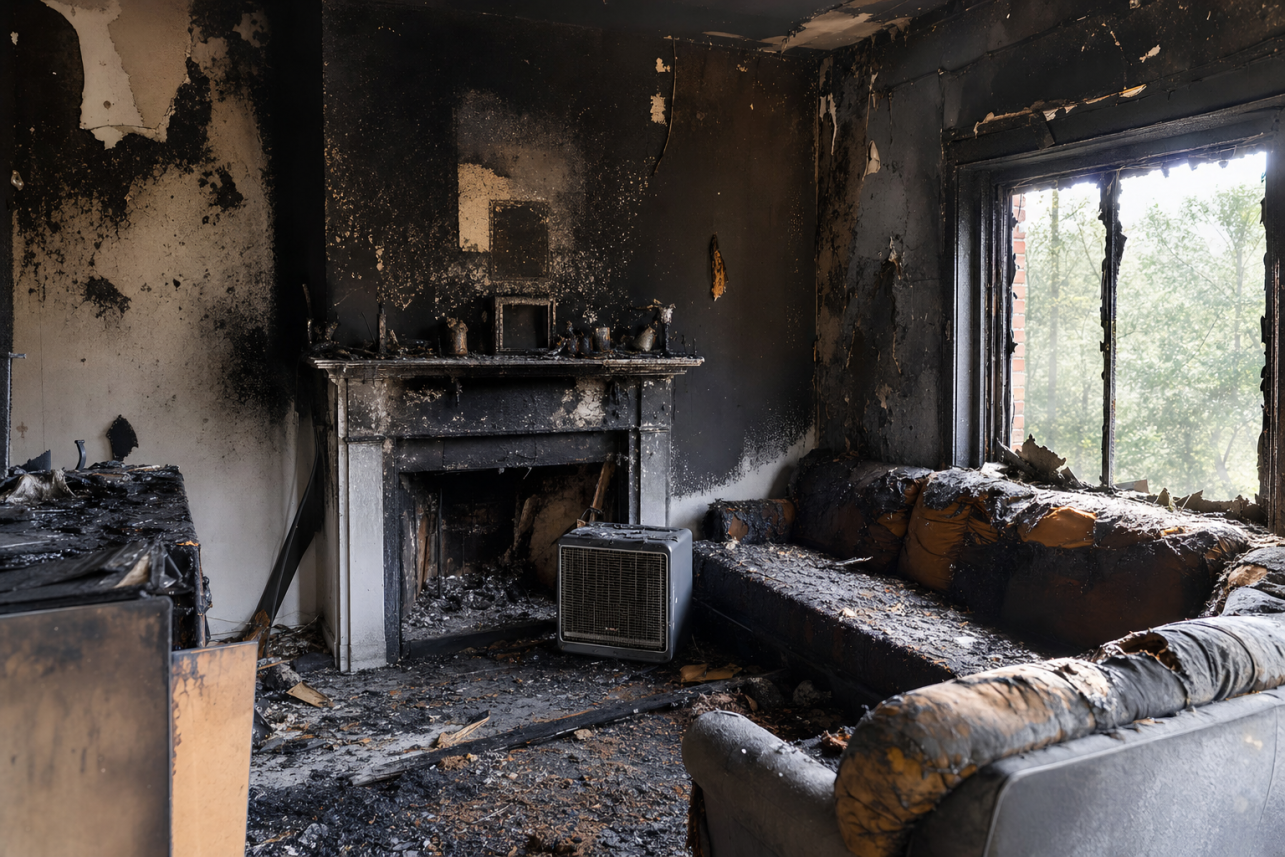
James Zoppo owned a tavern that was destroyed by fire. Investigators determined the fire was intentionally set — but that finding alone says nothing about who set it. Rather than working to identify the actual cause and culprit, the insurer, Homestead, zeroed in on the policyholder himself. It denied the claim on the theory that the owner had burned his own business, and the accusation followed him from that point forward.
The Evidence the Insurer Ignored
What made the case remarkable was not just the accusation, but everything the insurer chose not to pursue:
- Other likely suspects: There was evidence that individuals who had been ejected from the bar had made threats — an obvious lead the insurer failed to meaningfully follow up.
- Witnesses left uninterviewed: The investigation skipped people who could have shed light on who else had motive and opportunity.
- The owner’s own account: Zoppo’s explanation of his whereabouts and circumstances was brushed aside rather than tested against the facts.
In short, the insurer built a case for denial instead of conducting an investigation to find the truth. That distinction is exactly what a policyholder-side professional looks for; anyone dealing with a suspicious-fire dispute can benefit from fire damage claim help in Garner or wherever their loss occurred, precisely because a second set of trained eyes can expose these gaps.
What the Ohio Supreme Court Ruled
The jury sided with Zoppo, and the Ohio Supreme Court upheld the result. The court held that an insurer acts in bad faith when it denies a claim without reasonable justification — and that an inadequate, results-driven investigation cannot supply that justification. In other words, the denial itself, built on suspicion rather than a genuine inquiry, was the wrongful act. The ruling reaffirmed that policyholders can recover damages beyond the policy when an insurer refuses to investigate fairly.
The lesson for home and business owners is straightforward: an arson accusation is only as strong as the investigation behind it. If your insurer skipped the hard work of finding out what really happened, that failure can become the foundation of your fight — something an experienced public adjuster in High Point NC deals with when documenting how a carrier handled, or mishandled, a fire loss.
Can an Insurance Company Deny a Fire Claim on Suspicion Alone?
No. An insurer cannot deny a fire claim based on suspicion alone. Insurance companies owe policyholders a duty of good faith, which requires a reasonable, genuine investigation before denying any claim. Courts have held that failing to adequately investigate is itself an act of bad faith — even if the insurer later argues its suspicion was sincere.
The Duty of Good Faith, in Plain Language
Every insurance policy carries an implied promise: the company will treat your claim fairly and honestly. That means it must look for facts, not just excuses. In the well-known Zoppo case, an Ohio bar owner had his fire claim denied as arson, and the court found the insurer acted in bad faith because its investigation was superficial — the company latched onto an arson theory and ignored evidence pointing elsewhere. The key takeaway from the ruling is that an insurer lacks “reasonable justification” for a denial when it never did the work needed to justify it. Suspicion without investigation is not a defense; it is the violation.
What an Adequate Arson Investigation Should Include
If an insurer suspects arson, good faith requires it to actually test that theory before denying. A legitimate investigation generally involves:
- A qualified cause-and-origin examination of the fire scene by a trained investigator, not just a hunch from a claims adjuster.
- Interviewing all relevant witnesses, including people who may support the policyholder’s account, not only those who fit the arson theory.
- Reviewing fire department and official reports and following up on alternative causes they identify.
- Examining motive claims honestly — financial records should be verified, not assumed to show distress.
- Documenting the basis for any conclusion, so the denial rests on evidence rather than speculation.
When an insurer skips these steps and denies anyway, the problem isn’t just a wrong answer — it’s that the company never earned the right to give one. Policyholders who understand this often benefit from having a public adjuster in Garner or elsewhere review how the insurer’s investigation was actually conducted.
How Good-Faith Duties Protect North Carolina Policyholders
North Carolina law imposes similar obligations. Insurers here must conduct reasonable investigations and cannot refuse to pay claims without a legitimate, evidence-based reason. Unfair claim settlement practices — like denying a claim without a reasonable investigation based on all available information — can expose an insurer to liability beyond the policy amount. That protection applies whether you’re a business owner facing an arson accusation or a homeowner seeking smoke damage claim help in Fuquay-Varina after a smaller kitchen fire. The principle is the same: the insurer must prove its position with facts, and a denial built on suspicion alone is one you can — and should — challenge.
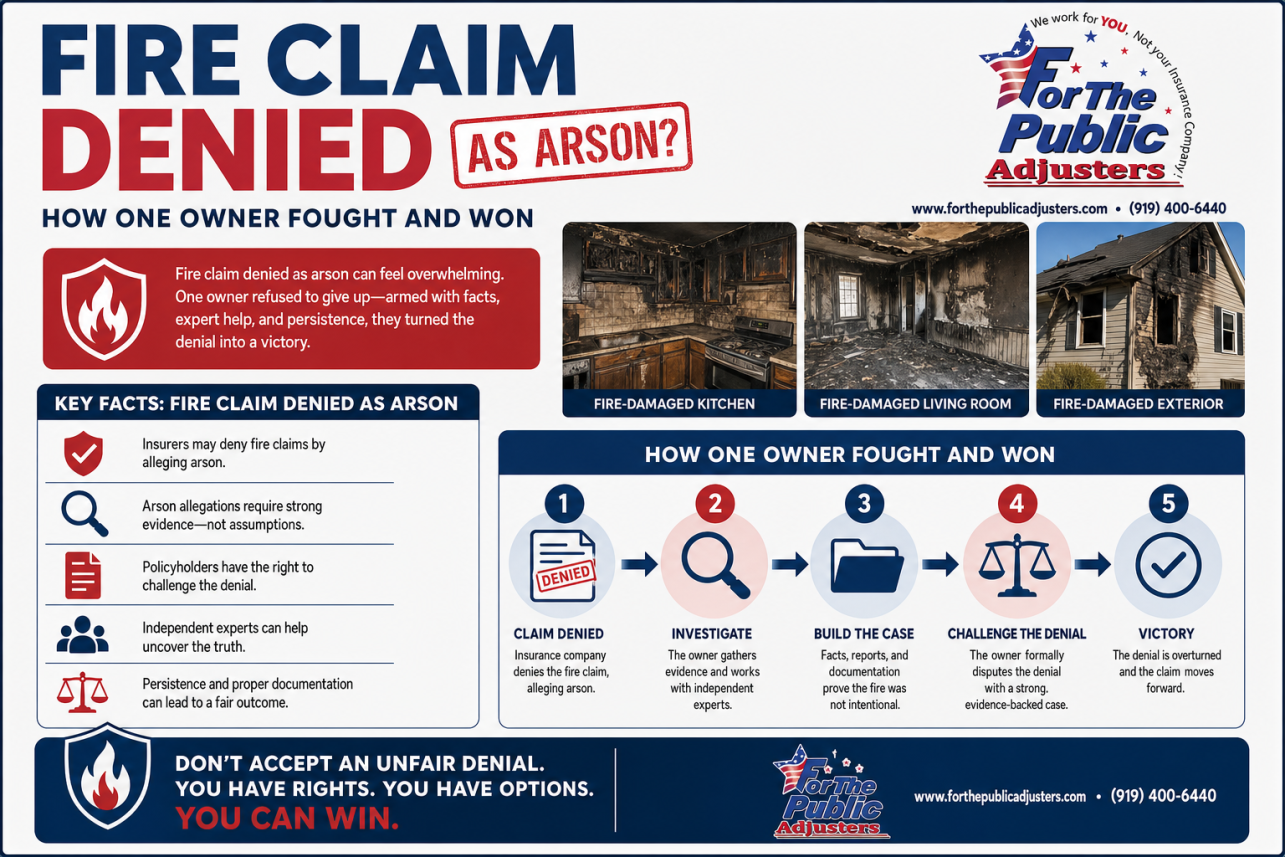
What Are the Warning Signs Your Fire Claim Is Being Treated as Arson?
The clearest warning signs are a demand for an examination under oath, requests for your personal financial records, repeated delays blamed on an ongoing “origin and cause” investigation, and pressure to give recorded statements. When these appear together, your insurer has likely shifted from adjusting your loss to building a case against paying it.
None of these steps automatically means your fire claim will be denied — insurers are allowed to investigate. But when the investigation stops feeling like fact-finding and starts feeling like an interrogation, North Carolina home and business owners should pay attention to how the process is unfolding.
Procedural Red Flags to Watch For
- Examination under oath (EUO). This is a formal, transcribed questioning session, often conducted by the insurer’s attorney. It goes well beyond a normal claim interview, and how you answer can be used to deny your claim.
- Demands for financial records. Requests for bank statements, tax returns, credit reports, or business ledgers usually mean the insurer is probing for a financial motive — the cornerstone of most arson defenses.
- Endless “origin and cause” delays. A fire investigation is normal. Months of silence, repeated re-inspections, or refusal to share findings while the property sits untouched is not.
- Recorded statement pressure. Being pushed to give multiple recorded statements, especially soon after the fire when details are fuzzy, can create inconsistencies the insurer later cites against you.
- Reservation of rights letters. A letter saying the insurer is investigating “under a reservation of rights” signals it is preserving its ability to deny coverage.
If several of these are happening at once, it is worth getting your own representation involved early. Situations like an arson homeowners claim in Clayton show how quickly a routine investigation can turn adversarial when the policyholder is navigating it alone.
Why Fall Fires Get Flagged as Suspicious
Autumn is when heating-season fires spike — and, unfairly, when suspicion often spikes with them. Common fall fire scenarios that sometimes get wrongly treated as arson include:
- Space heaters left near bedding, curtains, or upholstered furniture, which can produce burn patterns investigators may initially misread.
- Chimney and flue fires in fireplaces or wood stoves that haven’t been cleaned since last winter, where the fire’s origin point can be hard to pinpoint.
- Leaf and yard-debris burning too close to a structure, where an accidental spread can look, at first glance, like a fire that was “set” outside the building.
Accidental heating-season fires can superficially resemble incendiary fires — multiple apparent ignition points, exterior origins, fast spread. That’s exactly why a thorough, independent review of the evidence matters. Working with an experienced fire claim adjuster in Wake Forest or elsewhere in the Triangle gives you someone examining the same evidence with your interests — not the insurer’s — in mind.
What Should NC Home and Business Owners Do If a Fire Claim Is Denied?
If your fire claim is denied, request the denial in writing with the specific policy language cited, preserve the fire scene and all official reports, document every item and business loss, calendar your policy deadlines, and avoid giving recorded statements or examinations under oath without preparation. North Carolina law also prohibits insurers from using unfair claim settlement practices.
A denial letter is not the end of the road — it is the starting point for building your response. What you do in the days immediately after a denial often determines whether you can turn the decision around.
Lock Down the Evidence Before It Disappears
- Get the denial in writing. Ask the insurer to identify the exact policy provisions and factual findings it relied on. Vague verbal denials are hard to challenge; written ones create a record you can rebut point by point.
- Preserve the fire scene. Do not clean up, demolish, or discard burned materials until you have documented everything and, ideally, had an independent expert examine the origin area. Once the scene is gone, so is your best evidence.
- Obtain official reports. Request copies of the fire department incident report and any fire marshal or investigator findings. If officials did not classify the fire as incendiary, that fact directly undercuts an arson-based denial.
Document Your Losses Thoroughly
Build a detailed inventory of damaged contents with photos, receipts, and replacement cost estimates. Business owners should also gather records supporting lost income, payroll obligations, and extra expenses. Complete documentation matters because disputes like an arson homeowners claim in Clayton often turn on whether the policyholder can prove the full scope of loss independently of the insurer’s own file.
Watch Your Deadlines and Your Words
Read your policy for time limits on filing a proof of loss, requesting appraisal, or bringing suit — these deadlines keep running even while you dispute a denial. Missing one can forfeit your rights regardless of how strong your case is. Just as important, do not sit for recorded statements or an examination under oath without preparation. Anything you say can be used to reinforce the insurer’s theory, and innocent inconsistencies are easy to create under pressure.
Know Your Protections Under North Carolina Law
North Carolina’s unfair claim settlement practices provisions prohibit insurers from, among other things, denying claims without conducting a reasonable investigation or failing to promptly explain the basis for a denial. If your carrier labeled the loss arson without genuine investigative support, that conduct may itself be grounds for a complaint to the NC Department of Insurance and can strengthen your negotiating position.
Finally, consider bringing in your own professional early. An experienced fire claim adjuster in Wake Forest or your local area can evaluate the denial, coordinate scene documentation, and manage deadlines so nothing slips while you rebuild your case.

How Can a Public Adjuster Help When You’re Accused Instead of Helped?
A licensed and bonded North Carolina public adjuster works for you, not the insurance company. They independently document the fire’s origin, the full scope of damage to your home or building, and the value of lost contents — then use that evidence to challenge a fire claim denied on suspicion rather than proof.
When an insurer treats you as a suspect, the investigation stops being about helping you recover and starts being about building a file against you. A public adjuster restores balance by putting a trained, credentialed professional on your side of the table — someone who knows how carriers evaluate fire losses and what documentation actually moves a claim.
Documenting the True Origin and Scope of the Loss
Arson accusations often rest on thin or incomplete fieldwork. A thorough independent review can expose that. Working alongside qualified origin-and-cause experts who follow recognized standards such as those published by the National Fire Protection Association, a public adjuster helps ensure the fire scene, burn patterns, and physical evidence are evaluated properly — not assumed away.
Beyond cause, a public adjuster builds the damage side of the claim, which insurers under investigation often neglect entirely:
- Detailed room-by-room inventories of damaged and destroyed contents
- Structural damage assessments covering smoke, soot, water, and heat effects — not just the burn area
- Repair and replacement estimates prepared to policy standards
- Documentation of additional living expenses or business interruption losses where the policy provides them
Pushing Back on Evidence-Free Denials
Insurers must base denials on a reasonable investigation, not a hunch. A public adjuster reviews the denial letter, the policy language, and the carrier’s stated basis, then responds with organized documentation and formal correspondence that demands the insurer justify its position. If the carrier’s conduct crosses the line, policyholders can also file a complaint with the North Carolina Department of Insurance, and a public adjuster can help you assemble the record that supports it.
Local experience matters here. A fire claim adjuster in Wake Forest, for example, will know how regional carriers, restoration contractors, and fire officials typically handle these losses — knowledge that helps anticipate and counter weak denial arguments.
Honest Expectations — No Guarantees
An ethical public adjuster will never promise a specific payout or guarantee your denial gets overturned. What they can promise is diligent, professional representation: a fully documented claim, a fact-based challenge to unsupported conclusions, and a process where you’re no longer facing the insurer’s team alone. Most work on a contingency basis, so their fee comes from what they help you recover.
If your home or business suffered a fire loss and the carrier’s tone has shifted from helpful to accusatory, talking with a fire damage insurance claim adjuster near Elon or elsewhere in the Triangle area costs nothing up front — and it may be the step that turns suspicion back into a legitimate, documented claim.
Fire Claim Denied as Arson: Reasonable Investigation vs. Bad-Faith Shortcuts
| Investigation Step | What a Reasonable Insurer Does | Red Flag of a Bad-Faith Denial |
|---|---|---|
| Cause and origin analysis | Hires a qualified fire investigator and documents an evidence-based cause determination | Assumes arson from circumstances like a recent policy purchase or business losses |
| Alternative suspects and leads | Interviews witnesses and follows up on other people with motive or opportunity | Ignores suspects the policyholder identifies — the core failure in Zoppo |
| Policyholder’s finances and alibi | Verifies financial records and whereabouts before alleging motive | Cites ‘financial motive’ without actually reviewing the numbers |
| Denial decision | Denies only when evidence reasonably supports each element of arson | Denies on suspicion, then looks for justification afterward |
Illustrative Example: A Restaurant Fire Denied on Suspicion, Reversed with Evidence
Illustrative example
Consider a hypothetical, composite scenario: a North Carolina restaurant owner’s building burns overnight, and the insurer denies the claim as suspected arson, pointing mainly to the owner’s slow season and a recently increased policy. The owner’s attorney demands the claim file and discovers the insurer never interviewed a former employee who had made threats after being fired, and never reviewed the owner’s actual bank records. Independent fire investigation and financial documentation show the owner had an alibi, stable finances, and no connection to the fire’s point of origin. Faced with evidence that its investigation was one-sided, the insurer reverses the denial and pays the claim, with the unresolved bad-faith exposure driving a favorable overall resolution. This composite reflects the lesson of Zoppo: an insurer must investigate the facts, not just its suspicions.
Frequently asked questions
What should I do first if my fire claim is denied as arson?
Request the denial in writing and ask the insurer to identify the specific evidence it relied on. Then gather everything you have: the policy, fire department and cause-and-origin reports, photos, receipts, and your own timeline of events. Don’t argue with the adjuster by phone or give recorded statements without preparation. Consult an attorney experienced in bad faith and fire claims before responding, since anything you say can be used to bolster the arson theory.
Can an insurance company deny a fire claim just because they suspect arson?
No. Suspicion alone is not enough. To deny on arson grounds, the insurer generally must show the fire was intentionally set, that the policyholder was responsible or arranged it, and often a motive such as financial trouble. Courts, including in Zoppo, have held that an insurer must conduct a reasonable investigation before denying. Denying based on a hunch while ignoring other suspects or evidence can itself constitute bad faith.
How do I prove my insurance company acted in bad faith?
Bad faith turns on whether the insurer had a reasonable justification for the denial and whether it investigated adequately. Evidence includes the claim file (obtainable in litigation), showing the insurer ignored leads, never interviewed key witnesses or suspects, cherry-picked facts, or decided to deny before finishing its investigation. Zoppo is a leading example: the insurer’s failure to pursue the actual arson suspects was itself the bad faith, separate from whether arson occurred.
What can I recover if I win a bad faith lawsuit against my insurer?
You can typically recover the full policy benefits you were owed, plus consequential damages caused by the wrongful denial, such as lost business income or costs of borrowing. In many states, proven bad faith also opens the door to punitive damages and attorney fees, which can substantially exceed the policy amount. Exact remedies vary by state, so an attorney should evaluate what your jurisdiction allows.
How long does it take to fight a denied fire claim?
There’s no fixed timeline. If a demand letter or appraisal resolves it, a dispute may settle in a few months. If you must file a bad faith lawsuit, expect one to three years, sometimes longer if the case goes to trial or appeal. Zoppo itself went all the way to the Ohio Supreme Court. Many cases settle once the insurer’s claim file is produced in discovery and its investigation gaps become visible.
How much does it cost to hire a lawyer for a denied fire insurance claim?
Most policyholder attorneys handle denied fire claims on contingency, meaning you pay nothing upfront and the lawyer takes a percentage of the recovery, commonly around a third, sometimes more if the case goes to trial. Some offer free initial consultations to assess whether the denial is defensible. If bad faith is proven, some states allow courts to shift attorney fees to the insurer, which can improve your net recovery.
What mistakes do people make after a fire claim is denied for arson?
Common mistakes: giving a recorded statement or examination under oath without counsel, missing the policy’s suit-limitation deadline (often shorter than the general statute of limitations), throwing away fire debris or evidence, failing to request the denial basis in writing, and accepting the denial as final. Another big one is not documenting financial stability, since insurers often build arson denials around an alleged money motive. Silence and delay only help the insurer.
Does a fire department ‘undetermined’ or ‘incendiary’ finding mean my claim will be denied?
Not necessarily. An ‘undetermined’ cause means investigators couldn’t establish origin, which does not prove arson. Even an ‘incendiary’ finding means someone set the fire, not that you did. The insurer still must connect you to the fire with actual evidence, not speculation. Independent cause-and-origin experts hired by policyholders frequently challenge insurer-friendly conclusions, and fire science standards have tightened, making old-style ‘looks like arson’ opinions vulnerable in court.
Should I appeal to the insurance company or sue if they won’t pay my fire claim?
Try the written route first: a detailed rebuttal with supporting evidence, and possibly a complaint to your state’s Department of Insurance, which is free and creates a record. If the insurer won’t move, litigation is usually the only way to force production of its claim file and investigation notes. Watch your deadlines carefully, because many fire policies require suit within a limited period after the loss regardless of ongoing negotiations.
Does the Zoppo ruling apply to fire claims in North Carolina?
Zoppo is an Ohio Supreme Court decision, so it isn’t binding in North Carolina, but its core principle travels well: an insurer that denies a claim without a reasonable investigation acts in bad faith. North Carolina policyholders have their own tools, including bad faith claims and the state’s unfair and deceptive trade practices law, which can allow enhanced damages. A North Carolina attorney can map the Zoppo reasoning onto your specific denial.
Commercial Business Claim help near you
Related local pages
If your fire claim has been denied or stalled on suspicion instead of evidence, talk to our licensed and bonded NC public adjusters for a free claim review today. Get in touch.
Last updated: September 22, 2026