

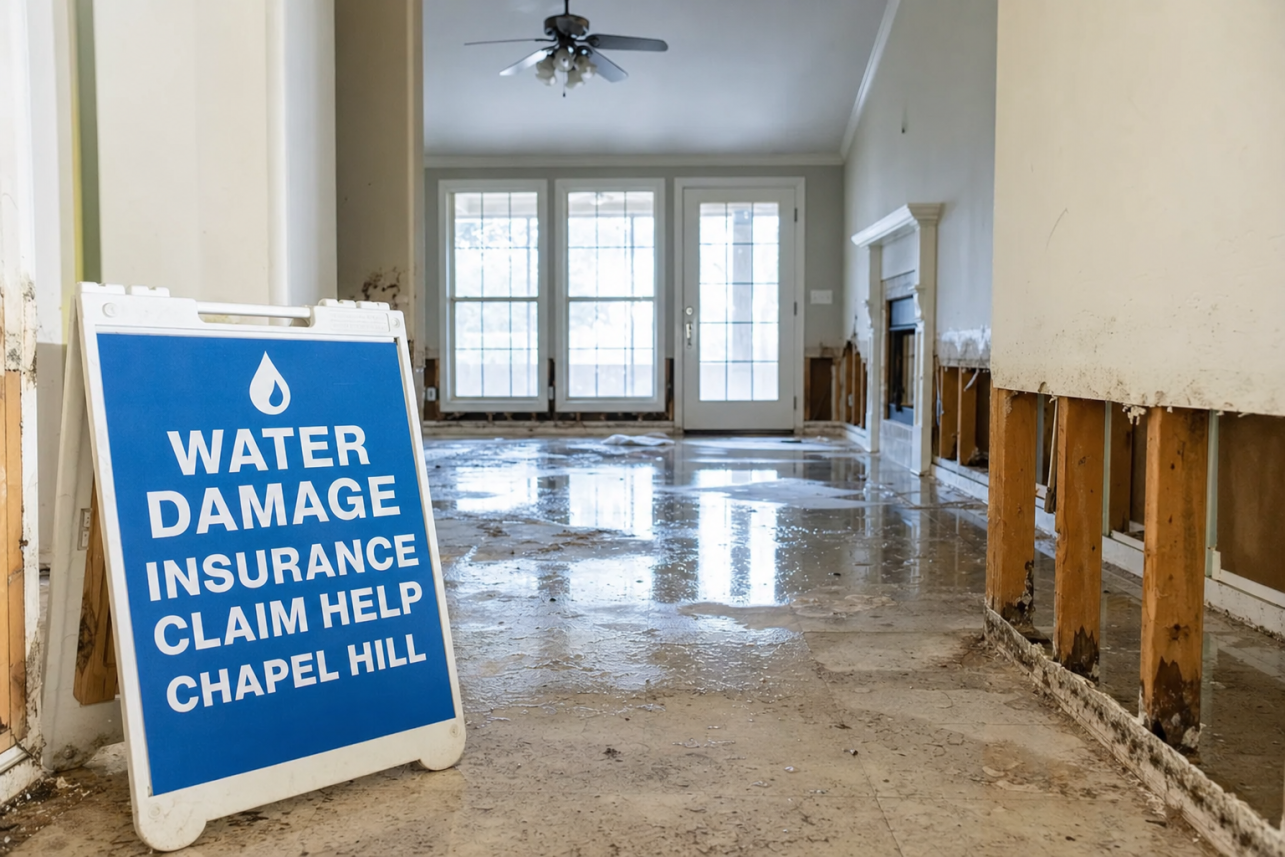
If you’re searching for water damage insurance claim help Chapel Hill, For The Public Adjusters, Inc. represents you — not the insurance company — from the first inspection through final settlement. We are licensed and bonded public adjusters who document the full scope of your loss, prepare the proof your insurer requires, and negotiate on your behalf. Whether the water came from a burst pipe, a roof leak during a summer thunderstorm, or a failed water heater, we work to make sure nothing gets missed or undervalued.
What This Service Is
A public adjuster is the policyholder’s own claims professional. The adjuster your insurance company sends works for the insurer; we work only for you. When water gets into a Chapel Hill home — through a supply line failure, an appliance leak, a roof opened up by a storm, or a slow leak inside a wall — we step in to measure the real damage, not just what’s visible on the surface.
That means documenting saturated drywall, wet insulation, buckled flooring, damaged contents, and the moisture hiding in wall cavities and crawl spaces. It also means reading your policy carefully: what your coverage limits are, how your deductible applies, whether you’re owed replacement cost or only depreciated actual cash value, and which exclusions the insurer may try to lean on.
We prepare the proof of loss, build a detailed repair estimate, handle the insurer’s inspections and questions, and negotiate the settlement. The North Carolina Department of Insurance publishes guidance on public adjusters and licenses this profession precisely so homeowners have a regulated advocate in this process. We also handle related residential and commercial losses — fire, smoke, tree damage, vandalism, and flood claims through the NFIP — but water losses are among the most commonly underpaid claims we see in Orange County.
Common Problems
Why Is My Settlement Offer So Much Lower Than My Contractor’s Repair Estimate?
This gap is the single most common reason Chapel Hill homeowners call us. Insurers often pay based on a quick visual inspection, price repairs using software defaults, and then subtract depreciation — leaving you with an actual cash value figure that won’t come close to covering a real contractor’s bid.
Water losses make this worse because so much of the damage is hidden. Wet subfloor, soaked insulation, and moisture inside wall cavities don’t show up in a ten-minute walkthrough, but they absolutely show up in your repair bill. If the first check doesn’t cover the work, that shortfall comes out of your pocket unless the claim is reopened and properly documented.
We build an independent, line-by-line estimate of the full scope of damage — including emergency drying costs, contents, and code-required work where your policy covers it — and negotiate from evidence, not from the insurer’s first number.
My Claim Was Delayed, Disputed, Or Denied — What Now?
Denials and stalls usually hinge on policy language. Insurers may argue the leak was ‘long-term’ and therefore excluded, blame maintenance, or classify storm-driven water as flood damage that your homeowners policy doesn’t cover. Meanwhile, in Chapel Hill’s summer humidity, mold can start growing in wet materials within days — and insurers sometimes then dispute the mold as a separate, excluded problem.
A denial is not the end of the road. Courts have long held insurers accountable for mishandling property claims; in Gruenberg v. Aetna Insurance Co., a landmark building-loss case, the California Supreme Court ruled the policyholder could sue the insurer for handling his claim in bad faith — a decision that helped shape policyholder rights nationwide.
We review the denial letter against your actual policy, gather the moisture readings, photos, and expert documentation the insurer says is missing, and push the claim back through with a properly supported proof of loss.
Who Actually Provides Water Damage Insurance Claim Help Chapel Hill Homeowners Can Rely On?
You have three options after a water loss: handle the claim yourself, let your contractor argue with the insurer, or hire a licensed public adjuster. Handling it yourself means negotiating against trained claims professionals while your house is torn open. Contractors know construction, but they aren’t licensed to interpret your policy or negotiate your settlement — and disputes between contractors and insurers often leave the homeowner stuck in the middle.
When choosing a public adjuster, verify licensing with the state, confirm they’re bonded, and ask specifically about water-loss experience — moisture mapping, hidden damage, and depreciation disputes are their own specialty. Be wary of anyone promising a specific dollar outcome; no honest adjuster can guarantee what an insurer will pay.
For The Public Adjusters, Inc. is licensed and bonded, works on your behalf from day one, and handles everything from documentation to final negotiation so you can focus on getting your home back.

Our Process
Free Claim Review And Full Damage Inspection
We start by reviewing your policy and your loss — no obligation. Then we inspect the property thoroughly, tracing where the water traveled, not just where it pooled. That includes checking crawl spaces, wall cavities, insulation, and flooring layers where hidden moisture and early mold growth are easy for a rushed inspection to miss.
Documentation, Estimate, And Proof Of Loss
We photograph and inventory everything, from structural damage to ruined contents, and account for reasonable emergency mitigation costs like water extraction and drying. We then prepare a detailed repair estimate and the formal proof of loss your policy requires, applying your coverage limits, deductible, and replacement-cost provisions correctly the first time.
Negotiation Through Settlement
We present the claim to your insurer, attend their adjuster’s inspection alongside you, and respond to every pushback with documentation. If the insurer disputes scope, pricing, or coverage, we handle those arguments directly. Our job isn’t finished until the claim is resolved — and we keep you informed on the timeline at every stage.
| What Happens | Filing Alone | With For The Public Adjusters |
|---|---|---|
| Damage documentation | Photos of visible stains; hidden moisture usually missed | Thermal imaging, moisture mapping, and room-by-room inventory before evidence dries out |
| Estimate scope | Based on the carrier adjuster’s walkthrough, often a patch-and-paint scope | Independent line-item estimate including flooring continuity, cabinetry, drying, and code upgrades |
| Policy interpretation | You rely on the carrier’s reading of exclusions like seepage or wear | Provisions like matching, ordinance & law, and ALE are identified and enforced for you |
| Negotiation | One offer, take it or push back alone | Documented rebuttals, reinspections, and direct negotiation with the desk adjuster |
| Your time | Weeks of calls, emails, and paperwork during a stressful loss | We manage the claim start to finish; you approve decisions, not paperwork |
| Typical result | Settlements frequently reflect visible damage only | Settlements that fund complete, properly dried, and matched repairs |
Commonly Overlooked In The Public Adjusting Industry
- Moisture trapped behind cabinets and in wall cavities — Carrier adjusters typically test only surfaces they can see, so water wicking up drywall and into cabinet boxes gets left out of the scope entirely.
- Flooring matching provisions on continuous hardwood — Insurers scope a patch for the wet room and ignore that the same flooring runs through three connected rooms, leaving homeowners with a visible seam.
- Ordinance and law coverage for code upgrades — Rebuilding to current NC code often costs more than replacing what was there, and carriers won’t pay the difference unless someone invokes the coverage.
- Additional living expense documentation from day one — Families pay for hotels and takeout out of pocket during repairs, then can’t recover it because nobody told them to keep receipts and mileage logs.
- The seepage exclusion misapplied to sudden losses — Without plumber reports or drying logs establishing a timeline, carriers default to calling water damage ‘gradual’ and denying otherwise covered claims.
- Secondary mold growth clocks starting immediately — In Orange County’s humidity, incomplete drying creates mold within days, and carriers later argue the mold was the owner’s neglect rather than part of the loss.
- Depreciation holdback and recoverable RCV funds — Policyholders treat the first ACV check as the final payment and never file for the recoverable depreciation they’re owed once repairs are complete.
- Contents inventory beyond the obvious ruined items — Rugs, electronics, books, and stored belongings absorb water quietly, and once they’re tossed during cleanup there’s no proof left to claim them.
Case Studies
Case Study #1
Situation: A family in the Southern Village area of Chapel Hill came home from a weekend trip to find their upstairs bathroom supply line had failed, sending water through the second floor, down interior walls, and into the kitchen ceiling below.
Problem: Their carrier’s field adjuster spent forty minutes on site and issued an estimate of $11,400 — enough to replace some drywall and repaint, but nothing for the hardwood flooring, cabinetry, or the moisture trapped inside wall cavities. The family was told the hardwoods ‘could be sanded’ and the cabinets ‘only needed the toe kicks replaced.’
Investigation: We brought in thermal imaging and moisture meters and mapped every affected assembly, not just the visibly stained ones. We documented moisture readings behind the kitchen cabinets, inside the ceiling joist bays, and under the site-finished oak flooring that had already begun to cup.
Findings: The water had migrated well beyond the carrier’s scope. Cupped, site-finished hardwood ran continuously through the kitchen, dining room, and hallway — meaning a patch repair would leave a visible mismatch the policy’s matching provisions didn’t allow. The lower cabinet boxes were particleboard and had wicked water; they were structurally compromised, not cosmetically scuffed.
Solution: We rewrote the scope line by line, supported every item with moisture logs, photos, and manufacturer specs on the cabinets, and invoked the continuous-flooring argument for full replacement of the connected hardwood. We then negotiated directly with the desk adjuster and their reinspection team.
Outcome: The claim settled at $67,800 — roughly six times the original offer — covering full hardwood replacement across connected rooms, new lower cabinets, proper structural drying, and code-required upgrades. The family also recovered additional living expenses for the three weeks they couldn’t use their kitchen.
Lesson: The first estimate after a water loss almost always reflects what’s visible, not what’s wet. In Chapel Hill homes with continuous hardwood and built-in cabinetry, the difference between a surface scope and a properly documented one is routinely tens of thousands of dollars.
Case Study #2
Situation: The owner of a small professional office off Franklin Street discovered water pouring through ceiling tiles after a rooftop HVAC condensate line backed up over a holiday weekend. Carpet, drywall, IT equipment, and client files were soaked.
Problem: The insurer initially denied most of the claim, arguing the loss was ‘long-term seepage’ excluded under the policy, and offered only $4,200 for carpet cleaning and tile replacement. The business also faced lost revenue while the suite was unusable, and the carrier hadn’t addressed business interruption at all.
Investigation: We pulled maintenance records showing the HVAC unit had been serviced weeks earlier with no noted issues, obtained a report from the mechanical contractor pinpointing the sudden blockage, and had the drying contractor’s daily moisture logs prove the water intrusion was acute, not gradual. We separately documented the interruption loss with the firm’s booking calendar and prior-year revenue.
Findings: The evidence showed a sudden and accidental discharge — a covered peril — not seepage. The scope also missed wet insulation above the ceiling grid, damaged low-voltage cabling, and drywall that had absorbed water above the visible stain line. The business interruption loss alone exceeded the carrier’s entire initial offer.
Solution: We submitted a rebuttal package tying the mechanical report and moisture data directly to the policy’s covered-cause language, then presented a documented business income claim with supporting financials. When the desk adjuster held firm, we requested a reinspection with our documentation in hand.
Outcome: The denial was reversed. The final settlement came to $58,300, including full build-back of the suite, replacement of damaged equipment and cabling, and eleven days of business interruption coverage the owner didn’t know he was entitled to claim.
Lesson: Carriers frequently label commercial water losses as excluded ‘seepage’ when the timeline is undocumented. Independent evidence — maintenance records, contractor reports, and moisture logs — is what turns a denial into a paid claim, and business interruption should never be left off the table.
| Your Situation | Smart First Move | Why It Matters |
|---|---|---|
| Water is still flowing (burst pipe, appliance line) | Shut the supply valve, then photograph everything before cleanup | Stopping the source limits damage; photos preserve proof the carrier will later question |
| Loss just happened, no claim filed yet | Get moisture readings and an independent scope before the carrier inspects | The first documented scope anchors the whole negotiation — you want it to be yours |
| Carrier’s offer seems low | Don’t cash the check as ‘final’; have the estimate reviewed line by line | Most water-loss offers omit hidden moisture, flooring matching, and code items |
| Claim denied as ‘seepage’ or ‘gradual’ | Gather plumber reports, maintenance records, and drying logs proving a sudden event | Denials on cause-of-loss grounds are often reversible with a documented timeline |
| Hardwood or tile runs through multiple rooms | Ask whether the policy’s matching rules require replacing the connected area | Patching continuous flooring leaves a visible mismatch you shouldn’t have to accept |
| Home is unlivable during repairs | Track every hotel, meal, and mileage cost from day one | Additional living expenses are covered but only paid when they’re documented |
| Water sat more than 48 hours | Insist on professional drying and mold assessment, not just fans | Trapped moisture in Orange County’s humidity breeds mold the carrier may later blame on you |
| Commercial space affected | Calculate lost income alongside the property damage | Business interruption coverage is real money carriers rarely volunteer |


Reviews
Our water heater let go in the garage and flooded two finished rooms. State Farm’s first check wouldn’t have covered half the flooring. For The Public Adjusters found moisture in walls the insurance adjuster never even tested, documented everything, and got the settlement raised from about $9,000 to over $40,000. They handled every call with the carrier so I didn’t have to.
Marcus T., Chapel Hill
After a pipe burst in our crawlspace near Meadowmont, the insurer tried to call it ‘gradual damage’ and denied us. This team proved it was a sudden break with a plumber’s report and moisture readings, and the denial was overturned. We ended up with full coverage for the subfloor, ductwork, and mold remediation. I genuinely didn’t think a denial could be reversed.
Deborah L., Orange County
Washing machine hose failure while we were at work — water everywhere on the main floor. My only critique is the negotiation took about six weeks longer than I hoped, but that was the carrier dragging its feet, not them. They kept me updated the whole way and the final number covered replacing all the connected hardwood instead of patching it. Worth every bit of the fee.
James R., Chapel Hill
Frequently Asked Questions
How Does Water Damage Insurance Claim Help Chapel Hill Homeowners Actually Get Paid More By Their Insurance Company?
Water damage insurance claim help chapel hill residents rely on works because a licensed public adjuster documents damage the way carriers are required to recognize it — not the way a rushed field adjuster estimates it.
When For The Public Adjusters, Inc. takes on a water loss, we start with moisture mapping. Water travels behind baseboards, under hardwood, and into wall cavities, and much of that damage is invisible during a 20-minute carrier inspection. We use moisture meters and thermal imaging to prove the full footprint of the loss, then build a line-item estimate that includes everything your policy owes: demolition, drying, mold prevention, matching flooring and cabinetry, code upgrades, and additional living expenses if you had to leave the home.
In Orange County, we see carriers routinely underpay by omitting drywall replacement beyond the visible stain, refusing to match continuous flooring, or applying wear-and-tear exclusions to sudden pipe failures. We push back with policy language, North Carolina Department of Insurance regulations, and documented evidence.
Because we negotiate on your behalf from the first phone call to the final check, the insurer knows every shortcut will be challenged. That accountability is often the difference between a settlement that covers a patch job and one that restores your home properly. Our fee is a percentage of what we recover, so we only succeed when your payout does.
My Water Claim In Chapel Hill Was Underpaid Or Denied. Is It Too Late To Bring In A Public Adjuster?
No — in most cases it is not too late, and this is one of the most common situations we handle. North Carolina generally allows three years from the date of loss to pursue a property claim, though your specific policy may set shorter deadlines for certain steps, so it pays to act quickly.
If your claim was underpaid, we can file a supplemental claim. We reinspect the property, document damage the original adjuster missed or minimized, and submit a revised estimate with supporting photos, moisture readings, and repair pricing that reflects real Chapel Hill contractor rates — not the discounted software figures carriers often use.
If your claim was denied, we review the denial letter against your actual policy language. Denials on water losses frequently hinge on debatable interpretations: whether the leak was ‘sudden and accidental’ versus long-term seepage, or whether the source falls under an exclusion. We regularly find that the carrier’s investigation was too shallow to support the conclusion, and we build the evidence to reopen the file.
One caution: do not throw away damaged materials or complete permanent repairs before the dispute is resolved, if you can avoid it. Preserved evidence — cut sections of pipe, damaged flooring, photos with timestamps — strengthens your position enormously. Call us before you sign any release or accept a final payment, because a signed settlement can limit what we’re able to recover afterward.
What Types Of Water Losses Do You Handle For Chapel Hill And Orange County Properties?
We handle nearly every category of water loss that homeowners and business owners in this area face. The most common calls we get involve burst supply lines, water heater failures, washing machine and dishwasher hose ruptures, and slab leaks — sudden events that most Chapel Hill homeowners’ policies cover.
We also work frequently with roof-related water intrusion. The heavy summer thunderstorms and occasional tropical remnants that move through Orange County drive rain under shingles and flashing, soaking attic insulation and ceilings. These claims get complicated because carriers try to separate wind-created openings, which are covered, from wear-related leaks, which usually are not. Proving the cause correctly is where an experienced adjuster earns their fee.
Older homes near downtown and in established neighborhoods like Coker Hills and Glen Lennox present their own challenges: aging galvanized or polybutylene plumbing, crawlspace moisture, and finishes that are expensive to match. We document pre-loss condition carefully so the insurer cannot blame everything on age.
One important distinction: rising floodwater from creeks or storm surge falls under separate flood insurance, not a standard homeowners policy. If you’re near Bolin Creek or another flood-prone area and have a flood policy, we can assist with that claim too — the documentation standards are different, and we know both systems.
Whatever the source, our job is the same: identify every dollar of covered damage, present it properly, and negotiate until the settlement reflects what repairs actually cost here.
How Much Does Professional Water Damage Insurance Claim Help Chapel Hill Cost, And How Do Your Fees Work?
For The Public Adjusters, Inc. works on a contingency fee, which means water damage insurance claim help chapel hill property owners pay nothing upfront and nothing out of pocket. Our fee is a percentage of the settlement we recover for you, agreed in writing before we begin, as required under North Carolina’s public adjuster licensing laws.
If we recover nothing, you owe nothing. That structure keeps our interests aligned with yours: we only get paid when your claim gets paid, and we’re motivated to pursue every covered item rather than settle quickly.
Homeowners sometimes worry the fee will leave them short on repair money. In practice, the opposite is usually true. Water claims are among the most commonly underpaid losses we see in Chapel Hill — hidden moisture, mold prevention, flooring matching, and code compliance costs are routinely left off carrier estimates. Industry studies and our own case files consistently show professionally adjusted claims settling significantly higher than homeowner-handled ones, even after the fee.
Your initial consultation is free. We’ll review your policy, inspect the damage, and give you an honest assessment of whether your claim justifies representation. If the carrier’s offer is already fair, we’ll tell you so — it costs us nothing to be straight with a neighbor, and it’s how we’ve built our reputation in Orange County. If there’s meaningful money being left on the table, we’ll show you exactly where, and you can decide from there.
What Should I Do In The First 24 To 48 Hours After Finding Water Damage In My Chapel Hill Home?
First, stop the source if you safely can — shut off the supply line or main valve, and cut power to affected areas if water is near outlets or appliances. Then document everything before you touch it. Take wide photos of each room, close-ups of damaged materials, and video walking through the property.
Do not throw anything away yet. Soaked drywall, buckled flooring, and ruined furniture are your evidence. If a restoration company needs to remove materials for safety, photograph them first and keep samples of flooring, carpet, and cabinetry when possible.
Your policy requires you to mitigate further damage, so drying equipment and tarping are appropriate. But be careful about signing broad work authorizations or assignment-of-benefits paperwork under pressure — read what you sign, and keep every invoice and receipt.
Finally, call us before you give a recorded statement to the insurance company. How a loss is described in that first call can shape the entire claim. As Chapel Hill public adjusters, we help you report the loss accurately, meet your policy deadlines, and avoid the early missteps that carriers later use to reduce or deny payment. Those first two days matter more than most homeowners realize.
How Long Does The Claim Process Take When I Use Water Damage Insurance Claim Help Chapel Hill Services From Your Team?
Most water claims we handle in Chapel Hill resolve in 30 to 90 days, though the timeline depends on the size of the loss and how the carrier responds. A straightforward pipe-break claim with clear coverage often settles on the shorter end. Larger losses involving flooring throughout the home, kitchen cabinetry, or mold remediation can take longer, especially if the insurer disputes scope or pricing.
Here is what the process usually looks like. In the first week, we inspect the property, review your policy, and take over communication with the carrier. Over the following weeks, we prepare a detailed line-item estimate, meet the insurance company’s adjuster on site, and negotiate the differences between their numbers and ours.
North Carolina regulations require insurers to acknowledge and respond to claims within set timeframes, and we hold them to those deadlines. If a carrier drags its feet, we escalate in writing and, when warranted, invoke the appraisal clause in your policy to force a resolution.
One thing worth knowing: homeowners who call us early usually see faster results than those who come to us after months of back-and-forth. Getting the documentation and estimate right the first time removes most of the delays carriers rely on.
Will My Claim Cover Hidden Damage Like Mold, Wet Subfloors, Or Water Inside The Walls?
Often yes — but only if someone finds it and documents it before the claim closes. This is one of the biggest gaps we see in underpaid water claims across Orange County. The carrier’s adjuster measures visible staining, writes an estimate for paint and a few square feet of drywall, and never checks what is happening behind the wall or under the floor.
Water travels. In Chapel Hill’s older homes near downtown and in established neighborhoods like Coker Hills and Greenwood, moisture wicks into plaster, hardwood subfloors, sill plates, and insulation. Our humid North Carolina climate means wet cavities can grow mold within days, and crawl spaces trap moisture long after surfaces look dry.
We use moisture meters and thermal imaging to map how far the water actually traveled, then document every affected material in the estimate. Mold coverage varies by policy — many carriers cap it at $5,000 or $10,000 — so we also identify when remediation should be classified as part of the water mitigation itself rather than counted against a small mold limit.
That distinction alone can be worth thousands. Professional water damage insurance claim help chapel hill homeowners can rely on means catching this hidden damage while the claim is still open, because reopening a closed file to add mold or subfloor damage is far harder than getting it right up front.
Do I Have To Let The Insurance Company’s Adjuster Inspect My Property Alone, Or Should Someone Be There With Me?
You are not required to leave that inspection in the carrier’s hands alone, and we strongly recommend you do not. The insurance company’s adjuster works for the insurance company. Their inspection sets the baseline for your entire settlement, and anything they miss, minimize, or misclassify becomes your problem to fight later.
When we represent a homeowner in Chapel Hill, we attend that inspection. We walk the adjuster through every affected area, point out moisture readings they did not take, and make sure damaged materials are measured correctly. A carrier adjuster might allow patching three feet of drywall; we push for the full wall when matching texture and paint is impossible, because your policy entitles you to a uniform, pre-loss condition.
We also protect you from casual questions that get used against you. Something as simple as saying the leak was “probably going on a while” can trigger a wear-and-tear or long-term-seepage exclusion, even when the loss was sudden.
If the carrier has already inspected without us, that is fixable. We conduct our own inspection, prepare an independent estimate, and request a re-inspection with their adjuster present. In Orange County we do this regularly, and the difference between the carrier’s first estimate and the final settlement is often substantial.
My Insurer Says The Water Damage Was ‘gradual’ Or ‘wear And Tear’ And Won’t Pay. Can That Decision Be Challenged?
Yes, and this is one of the most common disputes we handle for Chapel Hill homeowners. Insurance companies frequently label a loss as gradual seepage or deferred maintenance because those causes are excluded, while sudden and accidental discharge is covered. The line between the two is often far blurrier than the denial letter suggests.
A supply line behind a wall can fail suddenly even if the resulting stain took weeks to appear. In Chapel Hill’s older homes near Franklin Street and in established neighborhoods like Coker Hills, plumbing runs through crawl spaces and wall cavities where a homeowner has no realistic way to spot a leak the day it starts. North Carolina law does not require you to have x-ray vision, and a delayed discovery is not the same thing as a gradual cause.
When we take on a disputed denial, we investigate the actual failure point. That may mean bringing in a plumber to document a burst fitting, using moisture mapping to show the water traveled fast rather than slowly, or reviewing the policy language line by line, because many policies still cover the resulting damage even when the source itself is excluded.
We then present that evidence to the carrier in writing and push for a reversal or an appraisal. Many ‘gradual damage’ denials in Orange County do not survive a properly documented challenge. If your claim was turned down on this basis, have us review the denial letter and your policy before you accept the outcome as final.
Do You Provide Water Damage Insurance Claim Help Chapel Hill For Condos, Rental Properties, And Commercial Buildings?
We do. For The Public Adjusters, Inc. works with condo owners, landlords, and commercial property owners throughout Chapel Hill and Orange County, not just single-family homeowners.
Condo claims are often the trickiest. If a pipe bursts in a unit at a community like those off Estes Drive or near Meadowmont, coverage typically splits between your HO-6 policy and the association’s master policy. Carriers and HOA management companies frequently point at each other while your floors and drywall sit soaked. We sort out which policy owes what, review the association’s bylaws and the master policy declarations, and make sure neither insurer shortchanges you by shifting responsibility.
For landlords, especially those with rental houses serving UNC students and university staff, a water loss brings an added layer: lost rental income. Most landlord policies include loss-of-rents coverage, but carriers rarely volunteer it. We document your rental rates and vacancy period so that income is part of the settlement, not an afterthought.
Commercial claims for restaurants, offices, and retail spaces add business interruption, inventory, and code-upgrade issues. Chapel Hill’s permitting requirements can force upgrades during repairs, and ordinance-or-law coverage should absorb those costs when the policy includes it.
Whichever type of property you own, our role is the same. We inspect and document the full scope of damage, prepare an independent estimate, and negotiate directly with the carrier on your behalf, so the settlement reflects what the repair actually costs in this market rather than what the insurance company’s software suggests.
Should I Accept My Insurance Company’s First Settlement Offer On A Water Claim?
Almost never without an independent review first. In our experience handling water losses across Chapel Hill, first offers routinely miss significant portions of the damage, sometimes by tens of thousands of dollars.
The reason is simple. The carrier’s adjuster typically spends under an hour on site and writes an estimate based on what is visible that day. Water does not stay visible. It wicks into subfloors, saturates insulation, travels along framing, and sits in the crawl spaces common under homes in Orange County. Our humid climate means anything left damp becomes a mold problem within days, and none of that shows up in a quick surface-level inspection.
First offers also tend to lean on discounted software pricing that does not match what licensed contractors in the Chapel Hill and Durham market actually charge, and they frequently omit items like content cleaning, matching flooring across connected rooms, and code-required upgrades.
Here is the good news: accepting a first check usually does not close your claim in North Carolina. You can typically pursue a supplemental payment when additional damage is documented, and this is where water damage insurance claim help chapel hill property owners rely on makes a measurable difference. We re-inspect with moisture meters and thermal imaging, build a complete line-item estimate, and negotiate the gap.
Before you sign anything or agree to a scope of repairs, let us compare the carrier’s offer against the real damage. The review costs you nothing, and if the offer is fair, we will tell you that too.
What Documentation Do I Need For A Chapel Hill Water Damage Claim, And What If I Already Threw Damaged Items Away?
Strong documentation is the backbone of a well-paid claim, and it is one of the first things we build when clients bring us in.
Ideally, you want photos and video of the standing water and the source before anything is moved, close-ups of damaged flooring, walls, cabinets, and belongings, and receipts for emergency expenses like water extraction, tarping, dehumidifier rentals, or a hotel stay if the home was unlivable. Keep every invoice from mitigation companies, and save any communication with your insurer in writing.
That said, do not panic if the loss happened weeks ago and you have already ripped out soaked carpet or hauled ruined furniture to the Orange County landfill. Claims are recoverable without perfect records. We reconstruct losses using moisture readings that reveal the water’s path, drying logs from mitigation contractors, plumber’s reports identifying the failure, bank and credit card statements proving purchases, and even dated photos from your phone that happen to show the rooms before the loss.
Water also leaves physical evidence long after cleanup: staining on framing, delaminated subfloor, rusted fasteners, and elevated moisture in wall cavities. Our inspections in Chapel Hill homes regularly uncover proof the carrier’s adjuster never looked for.
Going forward, follow one rule: document before you discard. Photograph anything you throw out, keep a simple written inventory with approximate purchase dates and values, and do not sign a final release until the full scope is established. If you are unsure whether something matters, save it and let us make that call.
Is Water Damage Insurance Claim Help Chapel Hill Worth It For A Smaller Loss, Or Only For Major Floods?
It depends less on how the loss looks and more on what it actually costs to fix properly. A burst supply line under a kitchen sink can seem minor, yet once you account for cabinet replacement, flooring that runs continuously into other rooms, drywall, baseboards, and drying equipment, the real scope often lands in the tens of thousands.
We regularly see Chapel Hill claims where the insurer’s first estimate covers a fraction of the true repair cost simply because hidden moisture was never measured. In older homes near Franklin Street or established neighborhoods like Greenwood and Coker Hills, plaster walls, hardwood floors, and dated plumbing make accurate scoping even more important.
As a rule of thumb, if the damage touches more than one room, involves flooring that continues into adjacent spaces, or sat wet for more than a day, a professional review usually pays for itself. Because our fee is a percentage of what we recover, there is no upfront cost to find out.
If a loss genuinely is too small to benefit from representation, we will tell you that honestly during the free evaluation. Water damage insurance claim help chapel hill homeowners can trust starts with a straight answer about whether you need us at all, and many of our clients first called us for exactly that question.
What’s The Difference Between Your Public Adjusters And The Adjuster My Insurance Company Sends Out?
The adjuster your insurance company sends is employed or contracted by the insurer. Their job is to evaluate the claim on behalf of the company that has to pay it. They may be perfectly professional, but they do not represent you, and their estimates are built inside the insurer’s own pricing guidelines and scope limits.
A public adjuster works exclusively for the policyholder. For The Public Adjusters, Inc. is licensed by the North Carolina Department of Insurance to represent property owners, not carriers. When we handle a water loss in Chapel Hill, we independently document the damage, take our own moisture readings, write our own line-item estimate, and negotiate directly with the carrier’s adjuster on your behalf.
The practical difference shows up in scope. A carrier adjuster might allow drying and a patch of drywall. We push for everything the policy actually owes: matching flooring across continuous rooms, cabinet runs that cannot be partially replaced, code-required upgrades under Orange County requirements, contents, and additional living expenses if you had to relocate during repairs.
You are never required to accept the insurance company’s numbers as final. Having your own licensed representative at every inspection and on every call levels a process that is otherwise entirely controlled by the insurer’s people.
I Already Hired A Water Mitigation Company And Started Repairs. Can You Still Take Over My Chapel Hill Claim?
Yes, and this situation is extremely common. Most homeowners call a mitigation or restoration company first because water is actively spreading, which is the right instinct. Stopping the damage is your duty under the policy, and doing so never hurts your claim.
When we step in after mitigation has begun, we start by collecting everything the mitigation company generated: moisture mapping logs, drying equipment records, photos, and their invoice. Those records are often the strongest evidence of how far the water traveled, including into walls and subfloors that look dry now.
If repairs have already started, we document the current state, gather photos taken before work began, and reconcile what was done against what the policy should have paid for. Insurers frequently pay mitigation invoices but shortchange the rebuild, and that gap is where most of our recovery comes from on Chapel Hill water losses.
One caution: try not to sign an assignment-of-benefits or direction-to-pay agreement with a contractor without reading it carefully, and keep every damaged material you can until it has been photographed and measured. Even torn-out flooring sitting in the garage is useful evidence.
If you are mid-claim in Chapel Hill, Carrboro, or anywhere in Orange County, bring us your paperwork and we will tell you exactly where the settlement stands and what is still recoverable.

Does Homeowners Insurance In North Carolina Cover All Water Damage, Or Do Some Losses Fall Under Flood Insurance Instead?
This distinction decides many claims, so it is worth understanding. Standard homeowners policies in North Carolina generally cover sudden and accidental water discharge from inside the home: burst pipes, failed water heaters, washing machine hose ruptures, HVAC condensation line failures, and overflowing fixtures. They also typically cover rainwater that enters through storm-created openings, like a roof damaged by wind.
What homeowners policies do not cover is flood, meaning rising surface water, storm runoff, or groundwater seeping in from outside. Around Chapel Hill, heavy storms pushing water through low-lying lots near Bolin Creek or Morgan Creek would fall under a separate flood policy, usually through the National Flood Insurance Program.
The gray areas are where insurers deny claims that should be paid. Water backing up through drains, sump pump failures, and combined events where wind damage lets rain in are frequently misclassified. Carriers sometimes label a covered pipe failure as “groundwater” or “seepage” based on a brief inspection, and that conclusion deserves scrutiny.
When we provide water damage insurance claim help chapel hill property owners rely on, one of the first things we do is establish the true source and cause of the water with our own inspection and documentation. If the cause is covered, we hold the carrier to the policy language. If your denial letter cites flood, seepage, or surface water, do not assume it is correct — bring it to us and we will evaluate it at no charge.
Local Relevance
Chapel Hill’s housing stock is a mix that keeps water losses interesting: mid-century ranches with original galvanized or aging copper plumbing, older homes near town with decades-old roofs, and newer construction out toward the county line with finished basements and complex plumbing runs. Older supply lines and water heaters fail without warning, and summer is when the area’s weather piles on.
June through September brings severe thunderstorms and, some years, the soaked remnants of tropical systems pushing inland across the Piedmont. Heavy rain finds worn flashing and aging shingles fast, and Chapel Hill’s humid summers mean anything left wet can turn into a mold problem within days.
One local trap worth knowing: standard homeowners policies do not cover rising water. If a downpour sends runoff into your crawl space or ground-level rooms, that’s a flood claim — a distinction the Federal Emergency Management Agency draws clearly, and one insurers use to deny homeowners claims. We handle both sides of that line, including NFIP flood claims, so the cause of your loss gets classified correctly rather than conveniently.
Many Chapel Hill homes sit over vented crawl spaces, and in the Piedmont’s humid summers a plumbing leak or storm-driven runoff under the house can quietly saturate subfloor and insulation for weeks before anything shows upstairs — which is why we always moisture-test below the living space, not just where the stain appeared.
Water In Your Chapel Hill Home? Get Your Own Adjuster Before You Accept A Number
The insurance company already has professionals working its side of your claim. You should too. For The Public Adjusters, Inc. is licensed and bonded, and we start with a free review of your policy and your loss — before you sign anything or accept a first offer. Whether it’s a burst pipe, a storm-damaged roof letting rain in, or a flood claim, call us and let’s look at what your claim is really worth.
Call us: (919) 400-6440
Helpful Resources
- Federal Emergency Management Agency (FEMA)
- National Flood Insurance Program (NFIP)
- FEMA guidance on flood and water damage — Federal agency resource explaining flood coverage basics
Serving Chapel Hill · Orange
Last updated: July 27, 2026