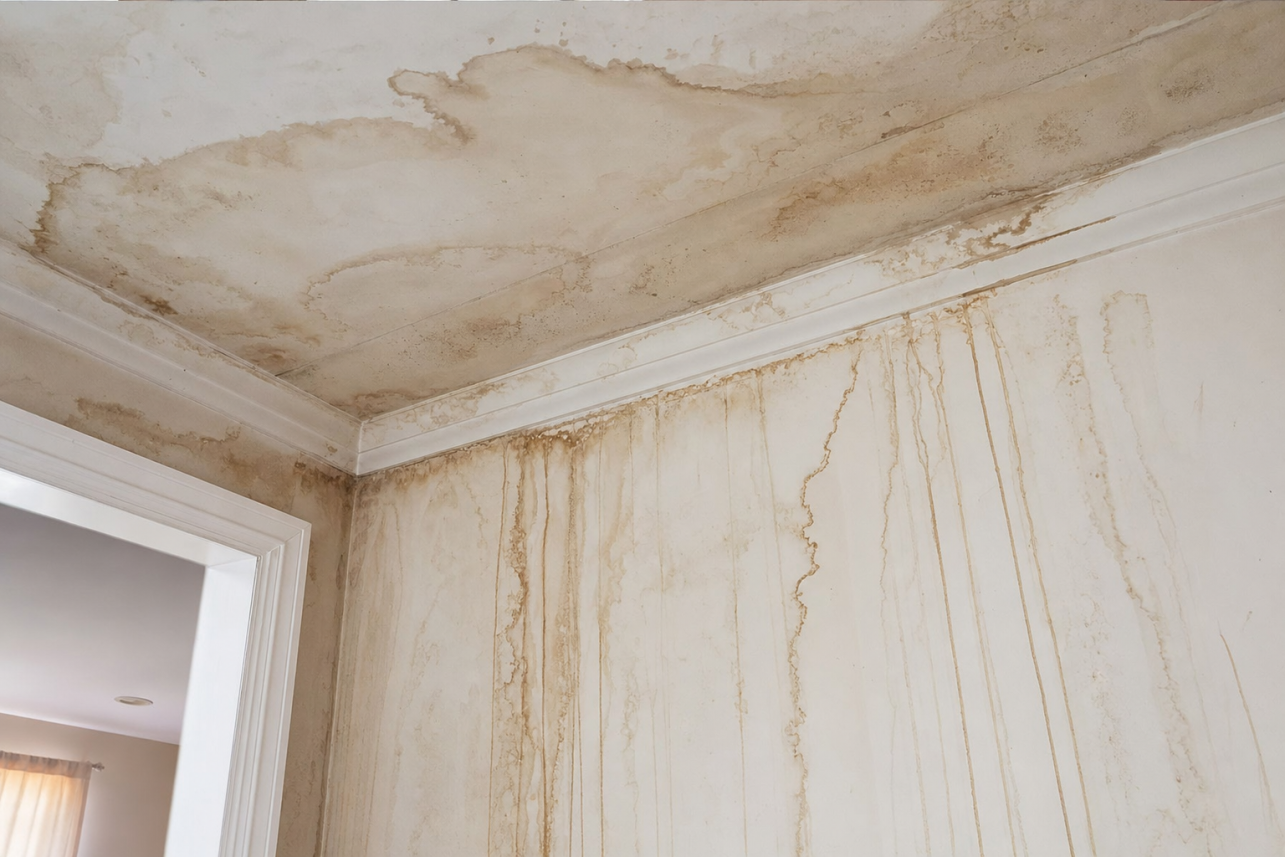
A water damage adjuster Mebane NC homeowners hire works for you — not the insurance company — when a burst pipe, roof leak, or appliance failure damages your home. For The Public Adjusters, Inc. is licensed and bonded, and we build the documentation and repair estimate your insurer has to answer to. If your claim was denied, delayed, or the settlement offer will not come close to covering the repairs, we step in and fight it on your behalf.
What This Service Is
When water gets into your home, your insurance company sends its own adjuster to inspect the damage. That person is paid by the insurer, and the estimate they write tends to reflect that. A public adjuster is the opposite: a licensed professional who represents only the policyholder in the claim.
Our job starts with your policy. We read the fine print most homeowners never see — coverage limits, exclusions, how your deductible applies, and whether you are entitled to full replacement cost or only a depreciated 'actual cash value' payout. That last distinction alone can change a settlement by thousands of dollars.
Then we document everything the insurer's inspection missed. Water travels behind walls, under flooring, and into insulation, so the visible stain is rarely the whole loss. We measure moisture, photograph hidden damage, inventory ruined contents, and prepare a detailed proof of loss with a line-item repair estimate.
Finally, we negotiate. If the carrier denies the claim or offers less than the repairs actually cost, we push back with evidence, not opinions. The North Carolina Department of Insurance publishes the NCDOI Public Adjusters Guide explaining exactly what public adjusters are permitted to do for policyholders in this state — and we operate squarely within it, licensed and bonded.
Common Problems
The Offer Won't Cover The Repairs — Am I Stuck Paying The Difference?
This is the single most common call we get from Mebane homeowners. The insurer's estimate says one number, and every contractor who walks through the house quotes something much higher. That gap is not your imagination — it usually comes from depreciation deductions, missed hidden damage, or pricing that does not reflect real local repair costs.
You should not be draining savings to cover a loss your policy was written to pay for. We rebuild the estimate from scratch, including tear-out, drying, materials, and the contents you lost, then present it as a formal supplement. Courts have long held that policy ambiguities are read in the policyholder's favor — in Gaston County Dyeing Machine Co. v. Northfield Insurance Co., the North Carolina Supreme Court sided with the insured over its carriers in a dispute involving water damage from a ruptured vessel, applying exactly that principle. The law gives you leverage. We use it.
My Water Damage Claim Was Denied — Is That Final?
No. A denial letter is the insurance company's position, not the last word. Carriers routinely deny water claims by labeling the damage 'long-term seepage,' 'wear and tear,' or 'flood' — and each of those labels can be challenged with evidence.
The flood distinction matters most. Standard homeowners policies exclude rising groundwater, which is what NFIP flood policies through the Federal Emergency Management Agency cover. But a burst pipe, a failed water heater, or rain entering through storm-damaged roofing is not flood — and insurers sometimes blur that line to their own benefit.
We review the denial against your actual policy language, document the true cause of the water, and file a formal dispute. Many denied and underpaid claims get reopened once the carrier is facing organized evidence instead of a frustrated homeowner. We never guarantee a specific outcome — no honest adjuster can — but we make sure your claim gets a real fight.
Why Hire A Water Damage Adjuster Mebane NC — Can't I Handle The Claim Myself?
You can, and some straightforward claims settle fine that way. But water losses are the claims insurers underpay most often, because so much of the damage is invisible on inspection day. If you do not know to look inside the wall cavity or under the subfloor, neither does your settlement.
A good public adjuster does three things you likely can't do alone: read the policy the way the carrier's lawyers do, document damage to a professional standard, and negotiate with adjusters who handle claims for a living. When judging one, check for a North Carolina license, bonding, and fees that come only as a percentage of what is recovered — never money up front.
For The Public Adjusters, Inc. checks all three boxes. We handle water, fire, smoke, and tree damage claims across the Mebane area for both homeowners and commercial buildings, and we only get paid when you do.
Our Process
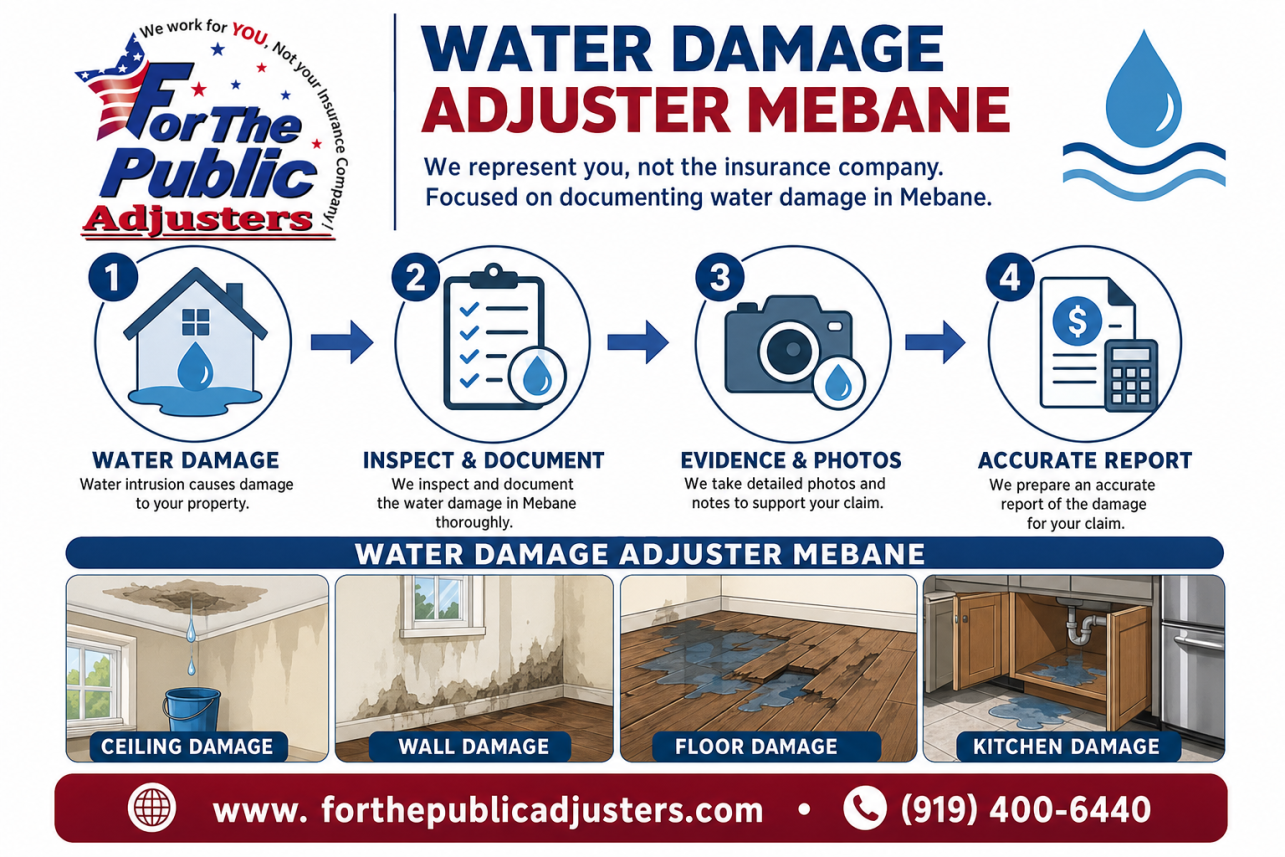
Free Policy And Claim Review
We start by reading your policy and any correspondence from the insurer — the denial letter, the estimate, the settlement offer. Within that first review we can usually tell you whether the carrier's position holds up and what the claim is realistically worth pursuing. There is no charge and no obligation for this step.
Full Damage Documentation
We inspect the property ourselves, including the places carrier adjusters skip: wall cavities, subfloors, crawl spaces, and attic decking where moisture hides and mold starts. We photograph everything, inventory damaged contents room by room, and account for emergency mitigation costs you already paid — water extraction, fans, tarps. All of it goes into a formal proof of loss.
Negotiation And Settlement
We submit our documentation and line-item estimate to the insurer and handle every call, letter, and re-inspection from there. If the carrier disputes our numbers, we respond with evidence until the offer reflects the actual cost to restore your home. You stay informed at every stage, and our fee is simply a percentage of the recovery — nothing out of pocket.
| What Happens | Handling It Yourself | With Our Team on Your Side |
|---|---|---|
| Who documents the damage | The carrier's adjuster, working for the insurance company, sets the scope | Independent moisture mapping, photos, and a room-by-room scope built for you |
| Hidden water damage | Wet wall cavities, subfloors, and insulation are often missed and never paid | Moisture meters and thermal imaging find damage before it becomes mold |
| Policy exclusions | Carriers apply seepage and gradual-leak exclusions broadly, often to covered losses | We separate covered perils from excluded ones using the actual policy language |
| Estimate pricing | Carrier software often prices below real Orange County contractor rates | Line-item estimates matched to what local restoration actually costs |
| Negotiation | You argue alone against trained claims professionals | A licensed NC public adjuster negotiates every supplement and re-inspection |
| Typical result | Quick, low first offer accepted under pressure | Settlements frequently multiples of the initial offer |
Commonly Overlooked In The Public Adjusting Industry
- Moisture trapped inside wall cavities and under subfloors — Carrier adjusters often measure only visible surfaces, so saturated framing and insulation behind dry-looking drywall never make it into the estimate.
- Water category classification (clean vs. gray vs. black water) — A category 2 or 3 loss requires far more expensive remediation and material removal, but carriers frequently scope it as a simple clean-water dry-out.
- Flooring continuation and matching across connected rooms — Insurers routinely pay to patch one room even when the same hardwood or tile runs throughout the downstairs and cannot be matched.
- Additional living expense (ALE) coverage during repairs — Homeowners rarely know they can claim hotel stays, meals, and even pet boarding while their home is uninhabitable, and carriers seldom volunteer it.
- Code-upgrade coverage triggered by the repair — Opening walls in an older Mebane home often requires bringing plumbing or electrical up to current code, a cost many estimates silently omit.
- Separating covered damage from an applied exclusion — When a carrier denies under a gradual-leak exclusion, the resulting collapse, contents damage, or mold may still be covered, but blanket denials bury that distinction.
- Contents inventory done before the tear-out — Once restoration crews haul out wet belongings, proving what was lost becomes nearly impossible, and unphotographed items go unpaid.
- Deadlines and proof-of-loss requirements in the policy — Missing a sworn proof-of-loss deadline can forfeit an otherwise valid claim, and carriers are under no obligation to remind you it's approaching.
Case Studies
Case Study #1
Situation: A homeowner off Fifth Street in Mebane came home from a weekend trip to find a burst supply line under the kitchen sink had been running for nearly two days. Water had migrated through the kitchen floor into the finished basement below.
Problem: The insurance carrier's staff adjuster spent twenty minutes on site, offered $9,400, and classified most of the basement damage as 'pre-existing seepage' excluded under the policy. The homeowner knew the basement had been dry for years but had no way to prove it.
Investigation: Our team brought in moisture mapping equipment and traced the water path from the kitchen down through the wall cavities. We documented moisture readings in every affected room, photographed the water staining patterns, and pulled the homeowner's prior home inspection report showing a dry basement at purchase.
Findings: The moisture pattern proved a single top-down event, not groundwater seepage. The carrier's adjuster had also missed saturated insulation in two wall cavities, damaged hardwood subflooring under the kitchen tile, and category 2 water contamination requiring proper remediation rather than simple drying.
Solution: We filed a supplemental claim with a full scope of repairs, line-item pricing based on Orange County contractor rates, and the moisture documentation refuting the seepage exclusion. When the carrier pushed back, we requested a re-inspection with their adjuster and walked the property together, reading by reading.
Outcome: The claim settled at $67,800 — more than seven times the original offer — covering full kitchen and basement restoration, contents cleaning, and six weeks of additional living expenses while the family stayed elsewhere.
Lesson: Carriers frequently reach for the seepage or 'gradual damage' exclusion on water losses because it shifts the burden onto the homeowner. Moisture mapping and documentation done early can dismantle that argument before it hardens into a denial.
Case Study #2
Situation: The owner of a small dental practice near downtown Mebane discovered a slow leak from a second-floor water heater had been soaking the ceiling and back wall of an exam room for weeks before staining finally appeared.
Problem: The carrier denied the entire claim, citing the policy's 14-day 'long-term leakage' exclusion. They argued the owner should have discovered it sooner and offered nothing — not even for the sudden ceiling collapse that happened after discovery.
Investigation: We reviewed the actual policy language rather than accepting the denial letter's summary of it. The exclusion barred damage from leakage over 14 days, but the resulting collapse and the mold remediation triggered by the sudden failure were separately covered perils. We also retained a plumber to document that the leak point was inside a sealed wall cavity with no visible warning signs.
Findings: The denial had lumped covered and excluded damage together. Roughly 60% of the loss — the ceiling collapse, damaged dental equipment, business interruption during closure, and code-required electrical work — fell outside the exclusion the carrier was leaning on.
Solution: We submitted a written rebuttal separating the loss into covered and excluded components, backed by the plumber's report and photos showing the concealed leak location. We also documented lost production days and canceled patient appointments to support the business interruption claim.
Outcome: The carrier reversed the blanket denial and paid $84,200, including three weeks of business interruption coverage. The practice reopened with the exam room fully rebuilt and equipment replaced.
Lesson: A denial letter is the carrier's opening argument, not a final ruling. Hidden-leak claims are often partially covered even when an exclusion legitimately applies to part of the loss — the key is refusing to let one exclusion swallow the whole claim.
| Your Situation | Fight It or Accept? | What It Depends On |
|---|---|---|
| Carrier offered a settlement that feels low | Fight it | Whether the estimate includes wall cavities, subfloor, insulation, and flooring continuation — most first offers skip at least one |
| Claim denied as 'gradual leak' or seepage | Fight it | Whether the leak was truly visible and discoverable, and whether any part of the loss (collapse, mold, sudden failure) is separately covered |
| Carrier says damage is 'wear and tear' | Fight it | Whether a sudden covered event (burst pipe, appliance failure) caused the water release, even if the pipe itself was old |
| Estimate only patches one room of flooring | Fight it | NC matching considerations often support replacing continuous flooring across connected rooms |
| Mold appeared after the water loss | Usually fight it | Whether the mold resulted from a covered water event and how your policy's mold sublimit is worded |
| Offer covers a full, verified scope at real local rates | Accepting may be fine | Have an independent contractor or adjuster confirm nothing hidden was missed before you sign |
| Loss is small and clearly under your deductible | Skip the claim | Filing tiny claims can affect your record without any payout — get the scope verified first |

Reviews
Our washing machine hose failed while we were at work and flooded half the downstairs. State Farm offered us $6,200 and called it done. For The Public Adjusters found wet drywall and insulation their adjuster never even checked, and we ended up settling for over $38,000. They handled every call with the carrier so I didn't have to argue with anyone.
Danielle R., Mebane
The insurance company tried to say our pipe leak was 'wear and tear' and denied the claim outright. I was ready to give up until a neighbor recommended this team. They pulled the actual policy language, brought in moisture readings, and got the denial overturned. It took about two months but the difference was our entire kitchen being rebuilt versus us paying out of pocket.
Marcus T., Orange County
After a water heater leak damaged our floors, the carrier's estimate didn't even include matching the hardwood in adjoining rooms. I called For The Public Adjusters and they knew exactly what NC matching rules required. The revised settlement covered continuous flooring through the whole downstairs. Honest, responsive, and worth every penny of their fee.
Sherry L., Mebane
Frequently Asked Questions
Why Do I Need A Water Damage Adjuster Mebane NC Homeowners Can Trust Instead Of Relying On My Insurance Company's Adjuster?
The adjuster your insurance company sends works for the carrier, not for you. Their job is to settle your claim quickly and, frankly, as cheaply as possible. When For The Public Adjusters, Inc. steps in, we work exclusively for you, the policyholder, and our only goal is recovering every dollar your policy owes you.
Water losses are notoriously underpaid because hidden damage gets missed. Moisture wicks up drywall, seeps under hardwood and LVP flooring, and saturates insulation inside wall cavities. A carrier adjuster doing a quick walkthrough of a Mebane home often writes an estimate for surface repairs only, leaving you to discover mold or warped subflooring months later, after the claim is closed.
We use moisture meters and thermal imaging to document the full extent of the loss, then build a line-item estimate using the same software carriers use. That means we argue with them in their own language, and it is very hard for them to dismiss.
Here in Orange County and the surrounding Alamance line, we have seen firsthand how older homes off Fifth Street or newer builds near Mill Creek respond to burst pipes and slab leaks differently. That local knowledge matters when scoping repairs. If your settlement offer felt low, or you have not filed yet and want it handled right from day one, having a licensed public adjuster in your corner typically changes the outcome dramatically. Studies of claims across multiple states consistently show policyholders represented by public adjusters recover substantially more than those who go it alone.
How Does For The Public Adjusters, Inc. Fight The Insurance Company When They Lowball Or Deny A Mebane Water Claim?
We start by tearing apart the carrier's position, line by line. If they issued a lowball estimate, we compare it against our own independent scope of damage, backed by photos, moisture readings, and current local repair pricing for the Mebane and greater Triangle market. Carriers frequently use outdated or regionally inaccurate pricing, and we call that out with documentation.
If the claim was denied, we go straight to your policy language. Denials for water losses often lean on exclusions like "long-term seepage" or "maintenance issues," and carriers apply those exclusions far more broadly than the policy actually allows. We know how North Carolina policies are written and where the carrier's interpretation falls apart.
From there, we handle every negotiation. We attend the reinspection with the carrier's adjuster, present our evidence, and push the claim up the chain to desk examiners and supervisors when the field adjuster will not budge. You never have to argue with your insurance company on the phone again.
When a carrier still refuses to pay fairly, we invoke the appraisal clause in your policy, a formal dispute process that takes the decision out of the insurance company's hands. Many of our largest recoveries for Orange County homeowners have come through appraisal.
The entire fight is documented in writing, which protects you and creates pressure the carrier cannot ignore. Insurers settle fairly when they know the policyholder's representative will not go away, and that persistence is exactly what we bring to every water loss we handle.
What Does It Cost To Hire A Public Adjuster In Mebane For A Water Damage Claim?
We work on contingency, which means you pay nothing upfront and nothing out of pocket. Our fee is a percentage of the amount we actually recover from your insurance company. If we do not get you paid, you do not owe us anything.
This structure matters for two reasons. First, it makes professional claim representation accessible to any Mebane homeowner, whether the loss is a burst supply line under a kitchen sink or a whole-house flood from a failed water heater. You do not need cash on hand at the worst possible moment.
Second, it aligns our interests completely with yours. We only earn more when you recover more, so we have every incentive to find each item of damage, from soaked baseboards to compromised HVAC ductwork under the house, and fight for full replacement value.
In practice, our involvement usually pays for itself many times over. When we re-scope a water loss that a carrier estimated at a few thousand dollars, the corrected figure often comes back several times higher once hidden moisture damage, code-required upgrades, proper drying protocols, and matching materials are included. North Carolina's matching considerations for flooring and finishes alone can significantly change a settlement.
Before you sign anything, we review your policy and your situation at no charge. We will tell you honestly whether we believe your claim has been underpaid and roughly what a proper settlement should look like. There is no obligation, and the consultation costs you nothing whether you hire us or not.
How Soon Should I Call A Water Damage Adjuster Mebane NC Residents Rely On After Finding A Leak Or Flood?
Call as early as possible, ideally before you file the claim or speak with the carrier's adjuster. The first statements you make to your insurance company can shape the entire claim, and carriers train their staff to ask questions that set up later denials, especially around how long the water was present.
That said, it is never too late. We regularly take over Mebane claims that were already filed, underpaid, or flat-out denied. In North Carolina you generally have three years from the date of loss to pursue a property claim, so even a settlement from many months ago can often be reopened and supplemented.
Before we arrive, do a few things to protect yourself. Stop the water source if you safely can, photograph and video everything before any cleanup, and keep damaged materials rather than throwing them away. Save every receipt for emergency mitigation, fans, dehumidifiers, or a plumber. Your policy requires you to prevent further damage, but it does not require you to accept the carrier's version of what happened.
Avoid signing anything from a restoration company or the insurer without understanding it, particularly documents that assign your claim benefits away or release the carrier from further payment.
Once we take over, For The Public Adjusters, Inc. handles the inspection, documentation, estimate, and every conversation with the carrier. Whether your loss is in downtown Mebane, out toward Efland, or anywhere across Orange County, the sooner we see the damage in its original condition, the stronger your claim will be.
My Insurance Company Already Denied My Water Claim In Mebane. Can A Water Damage Adjuster Mebane NC Policyholders Hire Still Help Me?
Yes, and denied claims are actually one of the most common reasons Mebane homeowners call us. A denial letter is not the end of the road — it is the insurance company's opening position, and it can be challenged with the right evidence and policy knowledge.
When we take on a denied claim, we start by pulling apart the denial letter itself. Carriers often cite exclusions like "gradual seepage" or "wear and tear" without proving the damage actually fits those definitions. A burst supply line behind a wall in an older Mebane home, for example, is frequently mislabeled as long-term seepage when the physical evidence says otherwise.
We then re-inspect the property ourselves, document moisture readings, photograph damage the carrier's adjuster ignored, and compare everything against the actual policy language — not the insurer's summary of it. In North Carolina, you generally have three years from the date of loss to pursue a claim, though your specific policy may shorten that window, so timing matters.
From there, we file a formal supplement or demand for reconsideration backed by documentation the carrier cannot easily dismiss. If they still refuse to pay fairly, we can invoke the appraisal clause in your policy, which forces an independent valuation process.
Many of the denied claims we handle in Orange County end up paid at multiples of the original offer. If you have a denial letter in hand, do not sign anything or accept a closed-claim status until someone on your side has reviewed it.
What Kinds Of Water Losses Does For The Public Adjusters, Inc. Handle For Mebane Homeowners?
We handle nearly every category of water loss that shows up in Mebane and the surrounding Orange County area. That includes burst and frozen pipes, water heater failures, washing machine and dishwasher supply line breaks, roof leaks after storms, HVAC condensation overflows, sewer and drain backups, and slab leaks under the foundation.
Each of these is treated differently by insurance companies, and that is exactly where homeowners get hurt. A pipe burst is usually covered under a standard HO-3 policy, but a sewer backup often requires a specific endorsement — and carriers love to blur that line to justify a denial. Part of our job is proving which category your loss actually falls into under your policy's own definitions.
We also pursue the damage that follows the water itself. Soaked drywall, buckled hardwood floors, ruined insulation, damaged cabinetry, and mold growth are all part of the claim, and they are routinely undervalued in the carrier's first estimate. Mebane's humid summers make hidden moisture especially dangerous, because mold can develop inside wall cavities within days.
One important distinction: rising floodwater from outside — like creek overflow after heavy rain — falls under flood insurance rather than a standard homeowners policy. We can review your coverage and tell you honestly which policy applies before you file anything.
If you are unsure whether your specific loss is covered, bring us the policy and let us read it. The answer is often better than the insurance company led you to believe.
Will Hiring A Public Adjuster In Mebane Make My Insurance Company Retaliate, Raise My Rates, Or Drop My Policy?
This is one of the most common fears we hear, and the short answer is no — hiring your own adjuster does not give the carrier grounds to retaliate against you. Public adjusters are licensed by the North Carolina Department of Insurance, and using one is your legal right as a policyholder.
Your premium is affected by the claim itself, not by who represents you on it. Whether the insurance company pays $8,000 or $40,000 on your water loss, the fact that a claim was filed is what gets recorded. Accepting a lowball settlement to "stay friendly" with your insurer does not protect your rates — it just leaves you paying out of pocket for repairs the policy owed you.
In practice, carriers often behave better once a licensed adjuster is involved. Adjusters and desk examiners know that documentation will be thorough, deadlines will be tracked, and bad-faith tactics like unexplained delays or vague denials will be challenged in writing. That accountability tends to move claims forward, not backward.
North Carolina also has unfair claim settlement practice laws that prohibit insurers from penalizing policyholders for asserting their rights. If a carrier ever tried to cancel a policy purely because a homeowner hired representation, that would create serious regulatory exposure for them.
We have represented homeowners across Mebane and Orange County for years, and retaliation is simply not something our clients experience. What they do experience is a claim handled on their terms instead of the insurance company's.
How Long Does A Water Damage Claim Take To Settle In Mebane, And Can A Water Damage Adjuster Mebane NC Families Work With Speed Things Up?
A straightforward claim can settle in four to eight weeks, but contested water losses in Mebane routinely drag on for three to six months when homeowners handle them alone. The difference usually comes down to documentation, deadlines, and pressure — and yes, a water damage adjuster mebane NC homeowners bring in early can shorten that timeline considerably.
North Carolina rules require insurers to acknowledge claims promptly and to accept or deny them within a reasonable period once they have your proof of loss. Carriers stretch those timelines by requesting documents piecemeal, scheduling and rescheduling inspections, or sitting on estimates. Every one of those tactics costs you weeks.
We compress the process by front-loading the claim. Before the carrier's adjuster ever walks through your home, we have moisture mapping, photographs, a room-by-room damage inventory, and a detailed repair estimate built to local Alamance and Orange County contractor pricing. When the file lands on the examiner's desk complete and defensible, there is far less to argue about.
We also track every deadline in writing. If the carrier goes quiet, they get a documented follow-up that creates a paper trail — the kind of record that matters if the claim ever escalates to appraisal or a bad-faith complaint.
One honest caveat: if the insurance company is determined to fight, forcing a fair settlement can still take months. But a fair settlement that takes four months beats an unfair one paid in four weeks. Our job is to make sure you never have to choose between speed and full payment.
The Insurance Company Says My Water Damage Was Caused By "Wear And Tear" And Isn't Covered. How Does A Water Damage Adjuster Mebane NC Homeowners Hire Push Back On That?
Blaming "wear and tear," "long-term seepage," or "deferred maintenance" is one of the most common tactics insurers use to escape paying water claims in Mebane. The carrier's adjuster spends twenty minutes in your home, points to a corroded fitting, and declares the whole loss excluded.
We don't accept that conclusion at face value. Our team documents the actual mechanism of loss — a supply line can fail suddenly even if it's older, and North Carolina policies generally cover the resulting damage from a sudden discharge even when the failed component itself isn't covered. That distinction is where many Mebane claims are won or lost.
When the facts call for it, we bring in independent plumbers, leak-detection specialists, or engineers to establish that the release of water was sudden and accidental. We then hold the carrier to its burden: in North Carolina, the insurer must prove an exclusion applies, not simply assert it in a denial letter.
Many of the homes we work in around downtown Mebane and the older neighborhoods off Fifth Street have original plumbing, and carriers lean hard on age-of-home arguments here. We've reversed those positions repeatedly by building a documented, evidence-based file the insurance company can't wave away. If your claim was denied or minimized based on wear and tear, get a second opinion before you accept it.
The Insurer Wants To Pay For Only Part Of My Flooring And Paint. Can A Mebane Public Adjuster Force Them To Cover Matching?
This is one of the most frequent fights we take on for Mebane homeowners. Water ruins the hardwoods in your kitchen, and the carrier offers to replace only the wet boards — leaving you with a patched floor in two different finishes running through connected rooms.
North Carolina recognizes that repairs should result in a reasonably uniform appearance. When flooring runs continuously through a kitchen, dining area, and hallway — common in homes throughout Mebane and greater Orange County — replacing only a section often isn't a legitimate repair. The same logic applies to paint, cabinetry runs, and tile.
Our job is to document continuity: photographs, floor plans, and measurements showing where materials flow from room to room without a break. We then write a detailed estimate that scopes the full, matching replacement and push the carrier to justify, line by line, why a mismatched patch job satisfies the policy. Most desk adjusters won't hold that position once it's challenged with proper documentation.
We also catch what the carrier's estimate quietly leaves out — baseboard removal and reinstallation, furniture manipulation, floor prep, transition strips, and disposal. Those "small" omissions routinely add up to thousands of dollars. If the settlement offer you received would leave your home looking pieced together, that offer is negotiable, and we negotiate it for a living.
What Should I Document Before The Insurance Company's Adjuster Shows Up At My Mebane Home?
Everything you capture in the first hours protects you later, because the carrier's version of events starts forming the moment their adjuster walks in. As the water damage adjuster mebane NC policyholders call when claims go sideways, we see the same mistake constantly: homeowners clean up too thoroughly before anything is documented.
Start with wide photos of every affected room, then close-ups of standing water, saturated carpet, stained ceilings, swollen baseboards, and buckled flooring. Video is even better — walk the house narrating the date and what you're seeing. Photograph the source of the water if you can identify it, and keep the failed part. Do not throw away a burst pipe, a split supply line, or a leaking water heater fitting; carriers use missing evidence as an excuse to dispute the cause.
Save every receipt: emergency plumbers, water extraction, tarps, fans, dehumidifiers, even towels and cleaning supplies. If you have to stay elsewhere, keep hotel and meal receipts — additional living expenses are frequently covered and frequently unclaimed.
Move damaged contents to a dry area rather than discarding them, and make a written inventory as you go. Finally, be careful what you say in recorded statements. Casual phrases like "it's probably been leaking a while" get quoted back in denial letters. Better yet, call us before that inspection so we can be there representing your side of it.
The Insurance Company Is Holding Back "Depreciation" On My Mebane Water Claim. Is That Money Gone, Or Can I Recover It?
In most cases that money is recoverable — but only if you know the rules, and insurers rarely go out of their way to explain them. If you have replacement cost coverage, the carrier typically pays the actual cash value up front, holds back depreciation, and releases the balance after you complete repairs and submit proof.
The problems start with how depreciation gets calculated. We regularly see carriers apply aggressive depreciation to Mebane water claims — treating five-year-old flooring like it's twenty, or depreciating labor in ways the policy doesn't clearly allow. Every percentage point they shave off the front-end payment makes it harder for you to fund repairs at all, which is exactly how homeowners end up settling for patch jobs.
Our team scrutinizes the depreciation schedule line by line, challenges inflated age and condition assumptions, and corrects the underlying scope so the holdback is calculated on a full and accurate estimate rather than a stripped-down one. Then we make sure you understand the deadlines and documentation required to claim the recoverable depreciation, because carriers quietly let those windows close.
We also watch for lowball unit pricing that doesn't reflect what contractors in the Mebane and Orange County market actually charge. Depreciation applied to an already-undervalued estimate compounds the shortfall. If the check you received won't come close to covering real repairs, have us review the settlement before you cash it or sign anything — there's usually money still on the table.
The Insurance Company Wants A Recorded Statement About My Water Loss. Should I Give One Before Hiring A Water Damage Adjuster Mebane NC Policyholders Recommend?
Be careful. Recorded statements feel routine, but insurers use them to lock you into answers that can shrink or sink your claim later. An innocent guess about how long a pipe was leaking, or when you first noticed a stain, can be twisted into a 'gradual damage' or 'late notice' defense down the road.
We strongly suggest talking to a public adjuster first. Once For The Public Adjusters, Inc. is on your claim, we prepare you for any statement your policy actually requires, sit in on the call when permitted, and make sure the questions stay within the scope of your duties under the policy. You have an obligation to cooperate — you do not have an obligation to speculate.
We also review your policy before you say a word, because in Orange County we routinely see carriers ask Mebane homeowners about maintenance history, prior claims, and unrelated repairs, hoping to find an exclusion to lean on. Knowing what your policy actually says keeps you from volunteering ammunition.
If you already gave a statement, don't panic. We obtain a copy, identify anything the carrier may misuse, and build the documentation — plumber reports, moisture readings, photos — to put your words back in their proper context. But if the adjuster hasn't called yet, reach out to us first. Ten minutes of preparation can protect tens of thousands of dollars in your settlement.
The Insurance Company's Contractor Gave A Repair Estimate That's Way Below What Real Mebane Contractors Are Quoting. What Can Be Done?
This is one of the most common fights we take on, and it's winnable. Carrier-preferred vendors often write estimates using discounted pricing, skipped line items, and repair methods no reputable Mebane contractor would actually use — like painting over water-stained drywall instead of replacing it, or drying a saturated subfloor that needs to come out.
Our first step is a line-by-line teardown of their estimate. We inspect your home ourselves, take moisture readings, and write our own detailed estimate using the same industry software carriers use, but with accurate local pricing and a complete scope. When the two estimates sit side by side, the gaps become hard for the insurer to defend.
Then we negotiate. Most disputes resolve once we force the carrier to justify every omission in writing. When they dig in anyway, your policy almost certainly contains an appraisal clause — a formal dispute process where each side selects an appraiser and an umpire breaks any tie. We prepare and present Mebane claims through appraisal regularly, and carriers know it, which often moves negotiations before appraisal is even invoked.
The key point: the insurer's estimate is an opening offer, not a verdict. You never have to accept a number that won't actually restore your home. Get real quotes from local contractors, keep them, and let us use the difference as leverage.
How Does A Water Damage Adjuster Mebane NC Homeowners Hire Find Hidden Damage The Insurance Company's Adjuster Missed?
Water is sneaky, and carrier adjusters are often in and out of a Mebane home in under an hour. They document what's visible — stained ceilings, buckled floors — and miss what's soaking inside wall cavities, under subfloors, and in insulation. Weeks later, homeowners discover swollen baseboards, musty odors, or mold, long after the claim was closed short.
Our inspections go deeper. We use moisture meters and thermal imaging to trace where water actually traveled, which is rarely limited to where it first appeared. A second-floor supply line failure in a typical Mebane two-story can wet the wall cavities, the first-floor ceiling, the insulation between floors, and the crawlspace below — and every bit of that belongs in the claim.
We also open up small inspection points where warranted and coordinate with plumbers and mitigation professionals so the cause and the full extent of damage are documented before repairs bury the evidence. That documentation matters, because insurers rarely pay for damage nobody proved existed.
If hidden damage surfaces after you've already been paid, the claim usually isn't dead. We can present a supplemental claim with the new findings and push the carrier to reopen and pay the difference. Our team handles supplements constantly, because underscoped water losses are the rule in this area, not the exception. The sooner we get eyes on your property, the less gets missed in the first place.

My Home Isn't Livable After The Water Damage. Will The Insurance Company Pay For Us To Stay Somewhere Else, And Can A Mebane Public Adjuster Help With That?
Most homeowner policies include Additional Living Expenses (ALE) or 'loss of use' coverage, which pays the extra costs of living elsewhere while your home is uninhabitable. That can include a comparable rental or hotel, increased food costs, extra mileage, pet boarding, even laundry — expenses many families never think to claim.
The fights usually start over two things: whether the home is truly 'uninhabitable,' and how long the carrier will keep paying. We've seen insurers tell Mebane families with no working kitchen, exposed subfloors, and industrial dryers roaring in every room that they should just stay put. We push back with photos, contractor timelines, and air-quality or mold documentation showing the home isn't safe or functional.
For The Public Adjusters, Inc. also builds and tracks your ALE claim itself. We help you keep receipts organized, calculate the difference between your normal living costs and your displaced costs, and submit them so the carrier can't nickel-and-dime the reimbursement. When repairs run long — which happens often when the insurer underpaid the scope in the first place — we fight to extend ALE rather than letting the carrier cut families off mid-repair.
One practical tip: save every receipt starting the day of the loss, even before coverage is confirmed. Comparable rentals near Mebane can be limited, so document what's actually available at real market rates. If the carrier offers a housing allowance that won't cover anything local, that's a negotiation, and it's one we handle all the time.
Local Relevance
Mebane sits in North Carolina's Piedmont, where humid summers, heavy thunderstorm downpours, and the occasional hard winter freeze create a steady mix of water losses. Cold snaps burst pipes in crawl spaces and exterior walls, while summer storms — including the remnants of hurricanes that push inland — drive rain through aging roofs and flashing.
The housing stock here compounds the problem. Mebane has plenty of older mill-era homes with original plumbing and galvanized supply lines, sitting alongside fast-built newer subdivisions where slab leaks and builder-grade water heaters fail earlier than owners expect. Both ends of that spectrum produce claims where the visible damage is a fraction of the real loss.
Humidity is the other local factor. In this climate, water that sits inside a wall for even a few days can start mold growth, turning a modest pipe leak into a major remediation job. Insurers often try to cap or exclude that secondary damage — which is exactly where having your own adjuster documenting the timeline and cause makes the difference. We work with homeowners and business owners throughout Mebane and the surrounding Orange and Alamance county communities.
Many Mebane-area homes have vented crawl spaces sitting over the region's slow-draining red clay, so pipe leaks and storm water under the house often go unnoticed until moisture readings — not eyesight — reveal them; a claim inspection here should always include the crawl space, because that is where insurer estimates most often come up short.
Get A Free Review Of Your Water Damage Claim
Before you accept the insurance company's number — or their denial — let For The Public Adjusters, Inc. take a look. We are licensed and bonded in North Carolina, we represent only you, and the review costs nothing. If we take your claim, our fee comes solely from what we recover.
Call us: (919) 400-6440
Helpful Resources
- NCDOI Public Adjusters Guide
- Federal Emergency Management Agency (FEMA)
- North Carolina Department of Insurance consumer resources — State regulator's guidance for policyholders
- FEMA's National Flood Insurance Program at FloodSmart.gov — Official flood insurance information
Last updated: August 9, 2026