
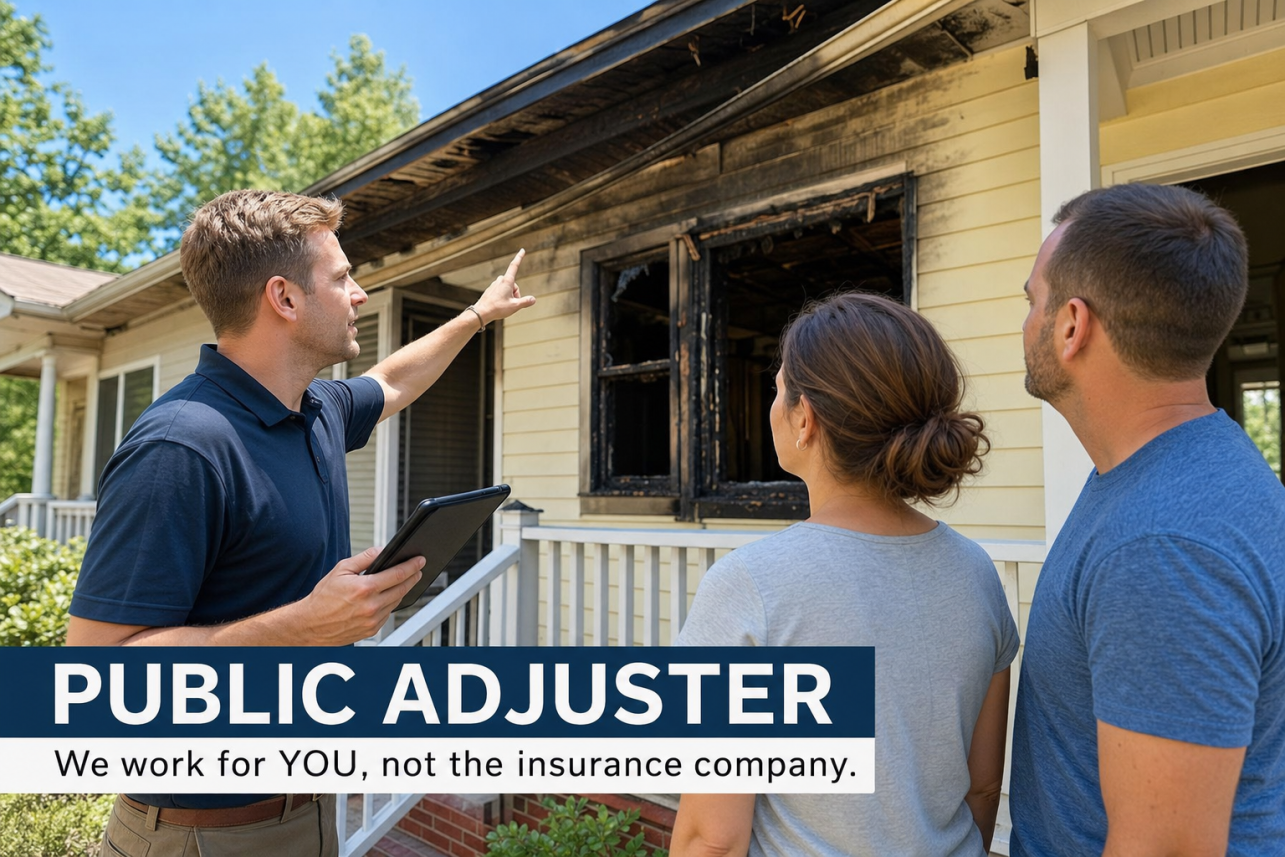
A public adjuster Bynum NC policyholders hire works exclusively for you — not the insurance company — to document, value, and negotiate your property damage claim. For The Public Adjusters, Inc. is licensed and bonded, and we represent Bynum homeowners and business owners on fire, water, smoke, flood, tree, and storm-related claims throughout Chatham County. If your insurer has underpaid, delayed, or denied a legitimate claim, we step in to level the playing field.
What This Service Is
When your home or building is damaged, your insurance company sends its own adjuster to assess the loss. That adjuster works for the carrier. A public adjuster is the licensed professional who works for the policyholder instead, and the roles are very different.
Our job starts with a thorough, independent inspection of the damage — structure, systems, and contents. We read your actual policy language, because coverage disputes often turn on a single endorsement or exclusion the carrier's estimate quietly ignored. Then we prepare a complete, line-item claim and negotiate directly with the insurance company on your behalf.
In North Carolina, public adjusters must be licensed by the state, and the NCDOI Public Adjusters Guide is a good starting point if you want to understand how the profession is regulated and what a legitimate adjuster's contract should look like. We encourage every Bynum policyholder to verify licensing before signing with anyone — including us.
We handle residential homeowners claims and commercial business claims alike: fire and smoke damage, water damage from burst pipes or roof failures, tornado and hurricane wind damage, tree damage, vandalism, arson-related homeowners claims, car-hits-home incidents, and flood claims including NFIP policies. We do not handle claims involving vehicles themselves, cell phones, health, or life insurance — our work is buildings and their contents.
Common Problems
What Does A Public Adjuster Bynum NC Homeowner Hires Actually Cost — And Is It Worth It?
Public adjusters in North Carolina typically work on a contingency fee — a percentage of the claim recovery, agreed to in writing before any work begins. There is no hourly bill and no upfront retainer with our firm.
The value question is really about what the carrier's estimate left out. Insurance company estimates on older homes frequently miss code-upgrade costs, matching issues on discontinued materials, hidden moisture behind walls, and smoke residue in areas that look clean. On a mill-era house in Bynum, those gaps can be substantial.
We can never guarantee a specific outcome — no honest adjuster can. What we can do is make sure every covered item is documented, valued at real local repair costs, and actually presented to the carrier.
My Insurer Is Delaying, Lowballing, Or Denying My Claim. What Now?
This is the most common reason Chatham County policyholders call us. The carrier's first offer arrives, and it will not come close to what a licensed contractor says the repair costs. Or weeks pass with requests for the same documents over and over.
You have more leverage than the carrier's letters suggest. Policyholders have prevailed against insurers in court — in Guessford v. Pennsylvania National Mutual Casualty Insurance Company, a North Carolina homeowner took his insurer to trial over an underpaid storm damage claim to his house and won a verdict far exceeding the carrier's offers.
Most claims should never need a courtroom, though. A properly documented, professionally negotiated claim resolves most disputes well before that point, and that is exactly the work we do.
Should I Handle The Claim Myself, Or Hire Someone — And How Do I Judge Who's Good?
Small, straightforward claims where the carrier pays promptly and fairly often don't need us, and we'll tell you so. Where a Bynum public adjuster earns their fee is on larger or contested losses: structure fires, significant water intrusion, flood, tornado damage, or any claim where the offer and the real repair cost are far apart.
When you're vetting anyone, ask three things. Are they licensed and bonded in North Carolina? Will they put their fee in writing before you sign? And have they handled your specific type of loss — a smoke damage claim is a very different animal from an NFIP flood claim.
A good adjuster inspects personally, reads your full policy rather than skimming the declarations page, and keeps you informed at every stage. If someone pressures you to sign on the spot after a disaster, walk away.
Our Process
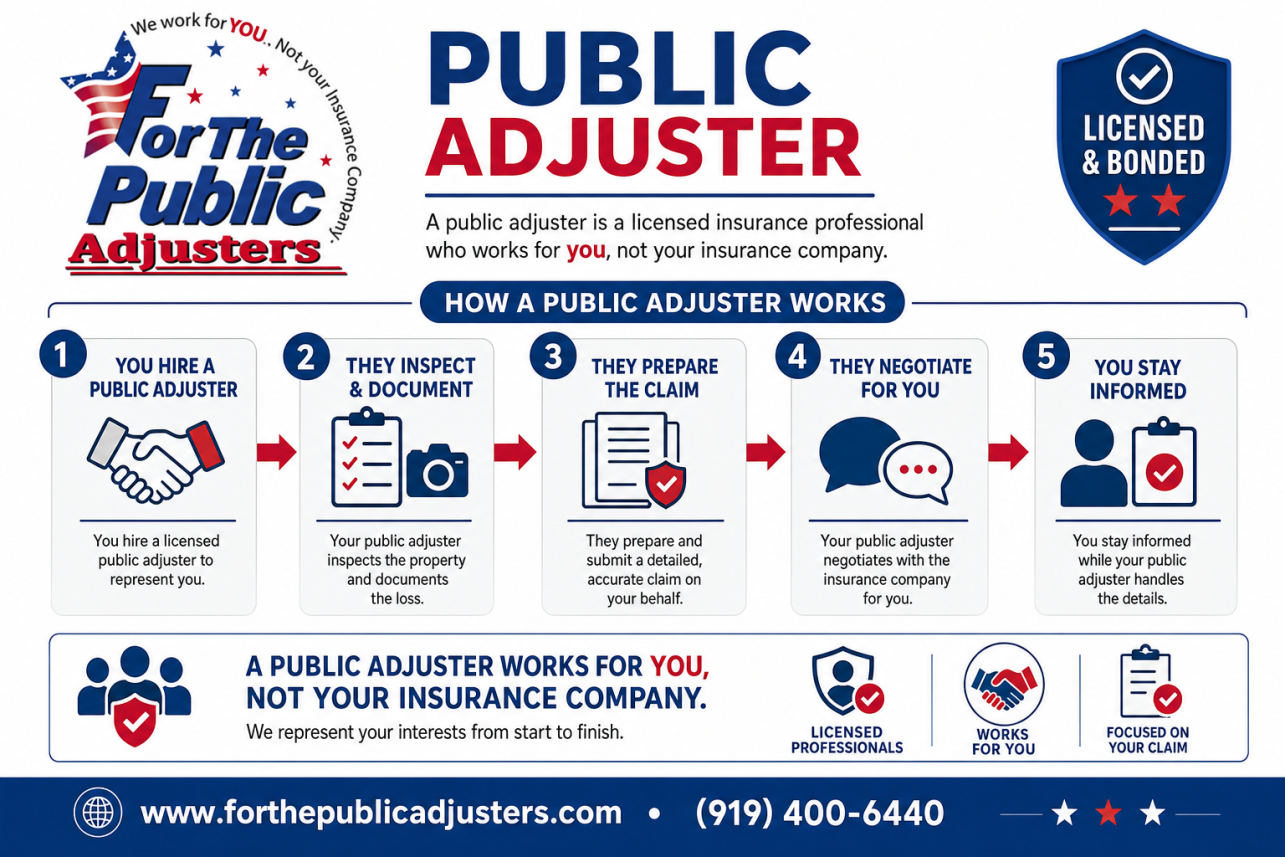
Free Claim Review And Policy Analysis
We start with a no-cost review of your loss and your policy. We look at what happened, what the carrier has said or paid so far, and what your coverage actually provides — including endorsements and exclusions most policyholders never read. If we don't believe we can add value, we say so plainly.
Independent Inspection And Full Documentation
We inspect the property ourselves and build a complete inventory of the damage: structure, roofing, mechanical systems, finishes, and contents. On fire and smoke losses that includes odor and residue testing areas; on water and flood losses it means moisture mapping beyond what's visible. Everything is photographed, measured, and priced at real local repair costs.
Negotiation And Settlement
We present the documented claim to your insurance company and handle the back-and-forth — the carrier's re-inspections, supplement requests, and disputes over scope and pricing. You approve every decision. Our goal is a settlement that reflects the true, covered cost of putting your property back the way it was.
| What Happens | Handling It Yourself | With For The Public Adjusters, Inc. |
|---|---|---|
| Who writes the damage estimate | The insurance company's adjuster, using their pricing and scope | An independent estimate built room by room, with local material and labor pricing |
| Hidden damage (walls, subfloors, attic) | Usually missed until you're mid-repair and out of pocket | Found upfront with moisture meters, thermal imaging, and staged demolition |
| Negotiating a lowball offer | You argue alone against trained claims professionals | We handle every call, letter, and inspection with documentation the carrier can't dismiss |
| Additional living expenses & contents | Frequently forgotten or under-claimed | Fully inventoried and included in the settlement demand |
| Your time investment | Dozens of hours of calls, paperwork, and re-inspections | A few hours total; we manage the claim start to finish |
| Typical result | First-offer settlements that often fall short of real repair costs | Settlements that reflect the true scope of the loss, often substantially higher |
Commonly Overlooked In The Public Adjusting Industry
- Code-upgrade (ordinance and law) coverage on older homes — Chatham County requires damaged wiring, framing, and plumbing in older houses to be brought to current code during repairs, and carriers won't pay for it unless it's specifically claimed.
- Moisture trapped in wall cavities and subfloors — Adjusters working from the doorway only price what's visible, and by the time hidden moisture shows up as mold the carrier calls it neglect and denies it.
- Additional living expenses (ALE) during repairs — Most policyholders don't know their policy pays for hotels, meals, and even extra mileage while the home is unlivable, so it never gets claimed.
- Matching requirements for siding, shingles, and flooring — Carriers offer to patch one slope or one room, ignoring that discontinued materials can't be matched and North Carolina claim practice often supports replacing the continuous run.
- HVAC condenser fins and soft-metal damage after hail — Hail dents on gutters, window wraps, and AC fins are easy to miss from the ground, yet they're the proof that confirms roof-level hail damage the carrier disputes.
- Depreciation that's recoverable after repairs are done — Replacement-cost policies hold back depreciation until work is complete, and thousands of dollars go unclaimed because nobody tells the homeowner to file for it.
- Contents inventory beyond the big-ticket items — After a fire or flood, families remember the TV and forget hundreds of smaller items — pantry contents, clothing, tools — that together add up to a major part of the loss.
- The deadline to dispute or supplement a settled claim — Policies set strict time limits for reopening claims and filing suit, and homeowners often discover the underpayment only after a contractor's bid — sometimes with just weeks left to act.
Case Studies
Case Study #1
Situation: A homeowner on Bynum Hill Road owned a 1920s former mill house with original heart-pine floors and plaster walls. A summer thunderstorm dropped a mature loblolly pine through the roof over the kitchen, and rain poured in for hours before a tarp went up.
Problem: The carrier's first estimate covered roof decking, shingles, and a small patch of drywall — about $18,400. It treated the plaster walls as drywall, ignored water that had tracked down the wall cavities into the floor system, and priced the heart-pine flooring as standard oak.
Investigation: We brought in a moisture meter and thermal camera and mapped saturation two rooms beyond the visible damage. We documented the plaster construction, pulled baseboards to show wet sill plates, and had a flooring specialist confirm the heart pine could not be patch-matched with modern lumber.
Findings: Moisture readings showed the subfloor and joists under the kitchen and adjacent hallway were wet enough to require drying and partial replacement. Plaster repair costs roughly triple drywall in this market, and matching reclaimed heart pine required refinishing continuous flooring through connected rooms.
Solution: We rewrote the scope line by line with correct materials, added structural drying, mold prevention treatment, and code-required upgrades to the older wiring exposed in the damaged wall, then presented the documentation package to the carrier and walked their adjuster through the property.
Outcome: The claim settled at $67,900 — more than three and a half times the original offer — and the homeowner kept the historic character of the house instead of accepting a drywall-and-oak patch job.
Lesson: Older Bynum mill-village homes are routinely priced as if they were modern tract houses. If the estimate doesn't name your actual materials, it's undervaluing your claim.
Case Study #2
Situation: A family off Highway 15-501 south of Bynum came home from a weekend trip to find a failed supply line under the upstairs bathroom sink. Water had run for roughly two days through the ceiling, an interior wall, and into the finished space below.
Problem: The insurer accepted the claim but paid only for visible ceiling drywall and carpet — around $9,200 — and denied the wet insulation and cabinetry, arguing the damage 'appeared pre-existing' based on staining. They also pushed the family to sign off before demolition revealed the full extent.
Investigation: We stopped the sign-off, documented everything with dated photos before any tear-out, and had controlled demolition done in stages. We collected the failed supply line as evidence, pulled the family's plumbing service records, and logged humidity readings showing an active, recent loss.
Findings: The wall cavity insulation was saturated, the bathroom vanity and kitchen cabinets below had delaminated, and microbial growth had started on the wall framing — all consistent with a sudden two-day event, not long-term seepage. The staining the carrier cited was fresh tannin bleed from wet framing.
Solution: We submitted a rebuttal with the physical evidence, a plumber's causation letter, and a corrected estimate including full drying, mold remediation, cabinet replacement (since the discontinued line couldn't be matched), and additional living expenses for the week the kitchen was unusable.
Outcome: The carrier withdrew the pre-existing damage position and the final settlement came to $41,300, including $2,100 in living expenses the family didn't know they were entitled to claim.
Lesson: Never let anyone close a water claim before demolition shows what's inside the walls. What you can see from the doorway is rarely the whole loss.
| Your Situation | Handle It Yourself? | Call Us First? | What It Depends On |
|---|---|---|---|
| Small claim under ~$5,000 with obvious, visible damage | Usually fine | Optional | If the damage is fully visible and the carrier pays promptly, our fee may not be worth it — we'll tell you that honestly |
| Tree or wind damage to the roof | Risky | Yes | Roof claims hide decking, underlayment, and interior water damage the carrier's drive-by inspection won't catch |
| Water leak that ran for hours or days | No | Yes, before demolition | Damage inside walls and floors must be documented before tear-out or the carrier can deny it |
| Fire or smoke loss of any size | No | Yes, immediately | Smoke migrates far beyond the burn area; contents and living expenses are almost always under-claimed |
| Carrier's offer feels low but you can't say why | No | Yes | You need an independent line-item estimate to compare — you can't negotiate against a number you can't check |
| Claim denied for 'pre-existing damage' or 'wear and tear' | No | Yes | Denials can often be reversed with causation evidence, but the window to dispute is limited |
| Older mill-era or historic home in the village | No | Yes | Plaster, heart pine, and true-dimension framing get priced as modern materials unless someone documents otherwise |
| Claim already settled but repairs cost more than the payout | Maybe | Yes | Claims can frequently be reopened for supplemental payment if the policy period allows |
Reviews
Hail hit our place near the Haw River last spring and State's adjuster offered us $6,800 for a roof repair. For The Public Adjusters found wind-lifted shingles on two more slopes, damaged gutters, and dented HVAC fins the first adjuster never even looked at. Final settlement was over $31,000 and we got a full roof replacement. Chris walked the roof himself and explained every line of the estimate to us.
Melissa T., Bynum
We had a kitchen fire and honestly had no idea how to read the insurance paperwork. These folks handled the whole claim — smoke damage testing in rooms the carrier said were fine, contents inventory, even the hotel costs while we couldn't cook at home. The carrier's number nearly doubled after they got involved. Worth every penny of the fee.
Daniel R., Chatham County
Our claim had already been underpaid once and I thought we were stuck. They reopened it, documented water damage inside the walls with moisture readings, and got the mold remediation covered that the insurance company had flat-out denied. Only reason it's not five stars is the reopened claim took about four months — but that was the insurer dragging, not them. They returned every call same day.
Karen W., Bynum
Frequently Asked Questions
What Does A Public Adjuster Bynum NC Homeowners Can Hire Actually Do For My Insurance Claim?
A public adjuster works exclusively for you, the policyholder — never for the insurance company. When you hire For The Public Adjusters, Inc., we take over the entire claim process: documenting the damage, reading your policy line by line, preparing a detailed estimate, and negotiating directly with the insurer's adjuster until you receive a fair settlement.
Here in Bynum and the surrounding Chatham County area, the most common claims we handle involve wind and hail damage from storms rolling through the Haw River corridor, water damage from burst pipes, fire and smoke losses, and fallen trees on older homes near the historic mill village. Many of these houses have unique construction — original hardwoods, plaster walls, metal roofing — that carrier adjusters routinely underestimate.
Our job is to build the claim the way it should have been built from the start. We photograph and measure everything, pull moisture readings, obtain contractor pricing that reflects real Chatham County labor and material costs, and present a documented demand the insurer has to take seriously.
You never deal with the insurance company alone again. We attend inspections, respond to their requests, and push back when they lowball, delay, or deny. Most clients tell us the biggest relief isn't just the larger settlement — it's handing off the paperwork, phone calls, and stress to someone who fights for their side of the table.
How Much Does It Cost To Hire A Bynum Public Adjuster, And Is It Worth It?
For The Public Adjusters, Inc. works on a contingency fee, which means you pay nothing upfront and nothing out of pocket. Our fee is a percentage of the settlement we recover for you, agreed to in writing before any work begins. If we don't recover money, you don't owe us a fee.
North Carolina law regulates how public adjusters charge, and every agreement we sign is fully compliant with the state's licensing rules. You'll see the exact percentage in plain language on the contract — no hidden costs, no hourly billing, no surprise invoices.
Is it worth it? In our experience across Chatham County, professionally prepared claims consistently settle for substantially more than what the insurance company first offers. Carriers often miss code-upgrade costs, matching requirements for siding and roofing, hidden water migration behind walls, and the true cost of skilled trades in a smaller market like Bynum, where contractors travel from Pittsboro, Chapel Hill, or Sanford.
Even after our fee, most clients net significantly more than they would have accepted on their own — and they get their time back. Instead of spending weeks arguing with a claims department, you have a licensed professional building the file, meeting the insurer's inspector at your property, and negotiating every line item.
If you're unsure whether your claim is large enough to justify hiring us, call. We review claims at no charge and will tell you honestly if it makes sense.
My Insurance Company Already Sent An Adjuster And Made An Offer. Can You Still Help?
Yes — in fact, this is exactly when many Bynum homeowners call us. The adjuster your insurance company sends works for the carrier, and their estimate reflects the carrier's interests. A low first offer is not the end of your claim; it's usually just the starting point.
As your public adjuster in Bynum NC, For The Public Adjusters, Inc. can reopen the conversation. We inspect the property ourselves, compare what we find against the insurer's estimate, and identify everything that was missed or underpaid. Common gaps include undervalued roofing on older homes, overlooked interior water damage, inadequate allowances for debris removal on wooded Chatham County lots, and code-required upgrades the policy actually covers.
Even if you've already cashed a check, you can typically pursue a supplemental claim for the difference between what was paid and what the damage actually costs to repair. We handle supplements regularly, and insurers expect them when new documentation is presented.
Timing matters, though. North Carolina policies contain deadlines for filing and disputing claims, and evidence gets harder to document as repairs begin or damage worsens. The sooner we can walk your property — whether it's near the old Bynum bridge, off Bynum Road, or out toward Pittsboro — the stronger your position.
Bring us the insurer's estimate and your policy. We'll review both for free and tell you plainly whether the offer is fair or whether there's meaningful money still on the table.
What Types Of Property Claims Do You Handle For Bynum And Chatham County Residents?
We handle virtually every type of residential and commercial property claim in the area. The most frequent losses we see around Bynum include wind and hail damage from spring and summer storms, lightning strikes, fallen trees and limbs from the mature hardwoods that shade so many local properties, and hurricane remnants that push up from the coast with heavy rain and straight-line winds.
Water claims are another major category: burst pipes in winter cold snaps, water heater failures, appliance leaks, and slow hidden leaks that cause mold and rot before anyone notices. Fire and smoke claims — whether a kitchen fire or a total loss — are among the most complex we handle, because they involve structure, contents, and additional living expenses all at once.
We also represent business owners and landlords in Chatham County with commercial property and loss-of-income claims, and we assist with theft and vandalism losses.
Because Bynum sits along the Haw River, we're familiar with the flood and water-intrusion issues specific to low-lying properties here, and we can help you understand what your homeowners policy covers versus what falls under separate flood coverage.
If you're searching for a public adjuster Bynum NC property owners trust with complicated or disputed claims, that's precisely the work For The Public Adjusters, Inc. was built for. If we look at your situation and believe you're better off handling it yourself, we'll tell you that too — an honest assessment costs you nothing.
How Long Will My Insurance Claim Take Once I Hire A Public Adjuster Bynum NC Residents Recommend?
Every claim moves at its own pace, but most homeowners in Bynum see resolution within 60 to 120 days after we take over. Straightforward claims, like a single-room water loss, can wrap up faster. Larger fire or storm losses that require engineering reports or contractor estimates naturally take longer.
North Carolina insurance regulations require carriers to acknowledge claims promptly and respond to communications within reasonable timeframes, and we hold them to those standards. One of the biggest advantages of professional representation is that files stop sitting idle. We document the loss thoroughly up front, which cuts down on the back-and-forth requests that stall so many self-managed claims.
A few things affect the timeline here in Chatham County specifically. After a widespread event, like the severe storms that roll through the Haw River corridor, carriers get flooded with claims and response times slow across the board. Older Bynum homes, including former mill houses, sometimes require extra documentation for materials that are no longer standard, which can add a few weeks but usually adds real value to the settlement.
We give every client an honest timeline estimate after our initial inspection, then provide regular updates so you are never wondering where things stand. If a carrier drags its feet unreasonably, we know the escalation steps available under North Carolina law and we use them. Our goal is a full, fair settlement as quickly as the facts of your loss allow, never a rushed lowball just to close the file.
My Claim Was Denied. Can A Bynum Public Adjuster Get It Reopened?
In many cases, yes. A denial is the insurance company's position, not the final word. Under North Carolina law, you generally have the right to dispute a denial, submit new evidence, and demand a re-evaluation, and that is work we handle regularly for Chatham County homeowners.
The first step is a careful review of your denial letter and policy. Denials often hinge on how the damage was characterized. For example, a carrier may call roof damage "wear and tear" when a proper inspection shows wind or hail impact from a specific storm date. We inspect the property ourselves, pull weather data for Bynum and the surrounding area, and build documentation that directly addresses the stated reason for denial.
From there, we prepare a formal rebuttal with photographs, measurements, repair estimates, and policy language that supports coverage. If the carrier still refuses, options include invoking the appraisal clause in your policy or filing a complaint with the North Carolina Department of Insurance. We guide you through each step and handle the communication so you are not arguing with the carrier alone.
Timing matters. Most policies and North Carolina's statute of limitations put deadlines on disputing a claim, typically three years from the date of loss for breach of contract, though your policy may impose shorter requirements. If your denial is recent, do not wait. Bring us the letter and your policy, and we will tell you honestly whether we believe the denial can be overturned. If we do not think we can help, we will say so.
What Should I Do In The First 48 Hours After Storm Or Water Damage To My Bynum Home?
The first two days after a loss shape the entire claim, so act deliberately. Start by making sure everyone is safe and the property is secure. If there is an active leak, shut off the water. If there is fire or structural damage, do not re-enter until it is safe.
Next, document everything before you touch anything. Take wide photos of each affected room, then close-ups of specific damage, and capture video walking through the property. Photograph damaged belongings before you move or discard them. This evidence is often worth thousands of dollars later, and it is impossible to recreate once cleanup begins.
You are required under most policies to take reasonable steps to prevent further damage, called mitigation. That means tarping a damaged roof, extracting standing water, or boarding broken windows. Keep every receipt, because these costs are typically reimbursable. What you should not do is authorize permanent repairs or sign contracts with restoration companies that show up unsolicited, which happens frequently in Chatham County after big storms roll through.
Report the loss to your carrier to preserve your rights, but keep the initial report factual and brief. Give the date, the cause as you understand it, and the general areas affected. Avoid speculating or minimizing.
Then call us. When For The Public Adjusters, Inc. gets involved early, we control the documentation, the scope of damage, and the estimate from day one. Claims that start on the right footing settle faster and for more than claims we have to rescue midstream.

How Do I Verify That A Public Adjuster Is Licensed To Work In North Carolina, And What Should I Look For Before Hiring One?
Every legitimate adjuster representing policyholders in North Carolina must hold an active license from the North Carolina Department of Insurance. You can verify any license for free through the Department's online licensee lookup, or by calling their consumer services line. Never hire anyone who hesitates to give you their license number. Reputable professionals volunteer it.
Beyond the license, ask about experience with your specific type of loss. Handling a kitchen fire claim is different from handling hurricane wind damage or a slab leak, and you want someone who has settled claims like yours. Ask for local references too. A public adjuster Bynum NC homeowners have actually worked with should be able to point to results in Chatham County, not just claims handled hours away.
Read the contract carefully before signing. North Carolina regulates public adjuster agreements, and the fee percentage, scope of services, and your cancellation rights should all be spelled out in plain language. Be cautious of anyone who pressures you to sign on the spot, promises a specific dollar outcome, or asks for money up front. Legitimate firms in this field work on contingency and get paid only when you do.
Finally, pay attention to how they communicate. Your claim may run for months, and you need someone who returns calls and explains things clearly. At For The Public Adjusters, Inc., we encourage every prospective client to verify our licensing, ask hard questions, and compare us to anyone else they are considering. An informed homeowner is exactly the kind of client we want.
Will Hiring A Public Adjuster Bynum NC Insurers Deal With Regularly Cause My Insurance Company To Cancel My Policy Or Raise My Rates?
No. North Carolina law protects your right to hire your own claim representative, and an insurer cannot cancel your policy or single you out for a rate increase simply because you brought in professional help. Carriers in this state work with licensed adjusters representing policyholders every week, and it is a normal, recognized part of the claims process.
What actually affects your premiums is the claim itself, not who negotiates it. Filing a covered loss on your Bynum home may factor into future rates whether you handle it alone or have representation. Since the claim is already on your record either way, it makes sense to recover the full amount you are owed.
In our experience around Chatham County, the opposite of intimidation usually happens. When the insurance company sees that a policyholder has knowledgeable representation, the file tends to get handled more carefully. Estimates get scrutinized less casually, deadlines get respected, and lowball tactics become harder to justify.
We also handle every communication professionally. There is no adversarial shouting match, just documented damage, policy language, and line-item estimates the carrier has to respond to on the merits. If you are worried about rocking the boat with your insurer, that concern should never keep you from getting a fair settlement on a legitimate loss.
Do You Handle Older Homes And Rural Properties Around Bynum, Like Historic Mill Houses Or Homes Near The Haw River?
Yes, and honestly, these are some of the claims where a Bynum public adjuster earns their keep. Many homes in and around the old mill village date back generations, with plaster walls, heart-pine floors, original siding, and framing details that a standard insurance estimate simply does not price correctly. Carriers often default to modern, builder-grade replacement costs that would leave you unable to restore what you actually lost.
We document these properties differently. That means identifying like-kind and quality materials, getting real quotes from craftsmen who can match historic work, and pushing back when an estimate treats a 1920s mill house like a tract home.
Rural properties off Bynum Road and throughout Chatham County bring their own issues: detached barns and outbuildings, long private drives, well pumps, fencing, and tree damage across larger acreage. These items are frequently overlooked or undervalued in the carrier's first inspection, and we make sure every covered structure and system is included in the claim.
Proximity to the Haw River also matters. Water losses near the river raise questions about flood versus wind-driven rain versus plumbing failure, and the cause of loss determines what your homeowner policy covers. We investigate the source carefully and document it, because getting that determination right can be the difference between a paid claim and a denial.
Can You Represent Businesses, Rental Properties, Or Churches In Bynum, Or Only Homeowners?
We represent both residential and commercial policyholders throughout Bynum and greater Chatham County. That includes rental houses and small multi-family properties, farms and agricultural buildings, retail and office spaces, restaurants, and churches or community buildings. If you hold the policy and suffered the loss, we can advocate for you.
Commercial claims tend to be more complicated than residential ones. Beyond the physical damage, there are often business interruption and lost income calculations, extra expense coverage, spoiled inventory, damaged equipment, and code-upgrade requirements when older commercial structures are repaired. Each of those has its own documentation standards, and insurers routinely underpay them when the policyholder does not know what to submit.
For landlords with rental property in the Bynum area, we also address loss of rents coverage, which reimburses you for income lost while a unit is uninhabitable during repairs. Many owners never claim it because they do not realize it is in their policy.
Churches and nonprofit buildings deserve a special note. These claims often involve steep roofs, stained glass, older masonry, and sanctuary finishes that carriers undervalue badly, and volunteer boards rarely have time to fight a complex claim. We prepare the full scope, present it to the insurer, and keep the board informed so they can focus on their congregation instead of estimate spreadsheets. Whatever the property type, the fee structure works the same way: we are paid a percentage of what we recover for you.
What Should I Have Ready For My First Meeting With A Public Adjuster Bynum NC Property Owners Can Call For A Free Claim Review?
The most important document is your full insurance policy, including the declarations page and all endorsements. If you cannot find it, do not worry; we can request a certified copy from your carrier on your behalf. The policy language controls everything, so reviewing it is always our first step.
Beyond that, gather whatever you already have: photos or video of the damage, any correspondence with your insurance company, the claim number if one has been assigned, the carrier's estimate or offer if you received one, and receipts for emergency repairs like tarping or water extraction. Contractor quotes are helpful too, even rough ones.
If the loss just happened, do not throw anything away yet. Damaged furniture, flooring samples, and even broken shingles serve as physical evidence, and we would rather photograph and catalog items before they head to the landfill. Keep a simple log of dates, phone calls, and who you spoke with at the insurance company.
The first meeting itself is straightforward. We walk the property with you, look at the damage firsthand, review the coverage, and give you an honest assessment of whether representation makes sense for your situation. Sometimes the carrier's offer is actually fair, and we will tell you so. There is no charge and no obligation for that initial review, whether you are in the village itself or anywhere else in Chatham County. If we do move forward, we handle the documentation and negotiation from that point on.
When Should I Hire A Public Adjuster Bynum NC Offers Versus An Attorney For My Insurance Dispute?
For most property claims, a licensed adjuster is the right first call. We handle the documentation, estimating, and negotiation that make up the bulk of any claim dispute, and we do it for a fraction of what litigation costs. Attorneys generally become necessary only when an insurer acts in bad faith or flatly refuses a fair settlement after every other avenue is exhausted.
Think of it this way: your claim is fundamentally a valuation argument, not a legal one. The question is usually what the damage to your Bynum home is actually worth, not whether coverage exists. That's adjusting work — measuring, scoping, pricing to current Chatham County construction costs, and pushing back on lowball estimates line by line.
Hiring counsel too early can also slow things down. Once lawyers are involved on both sides, communication gets formal and settlements often stall for months. Our team resolves the vast majority of claims through direct negotiation or the policy's appraisal provision without any court involvement.
That said, we know when a file has crossed the line. If we see evidence of bad-faith handling — ignored deadlines, misrepresented policy language, unreasonable denials — we'll tell you honestly and can point you toward North Carolina attorneys who focus on insurance litigation. In those cases, the detailed file we've already built becomes powerful evidence. Starting with a public adjuster rarely closes any doors; it usually strengthens whatever comes next.
My Settlement Check Mentions 'recoverable Depreciation.' What Does That Mean, And Can You Help Me Collect It?
Yes, and this is one of the most common places Bynum homeowners leave money on the table. Most replacement-cost policies pay claims in two stages. First, the insurer issues a check for actual cash value — the replacement cost minus depreciation for age and wear. The withheld depreciation becomes 'recoverable' once you actually complete the repairs and submit proof.
Here's the problem: many families never collect that second payment. Some don't realize they're entitled to it. Others miss the policy deadline for completing repairs, which in North Carolina policies is often 180 days to two years depending on the carrier and endorsements. A few get shortchanged because their final invoices don't match the insurer's line items closely enough.
As your public adjuster Bynum NC based or beyond, we track every dollar of held-back depreciation from day one. We make sure the initial estimate is priced correctly — because if the replacement cost is undervalued at the start, your recoverable depreciation shrinks too. Then we help you document completed work with invoices, photos, and contractor statements formatted the way carriers require.
We also watch for depreciation applied where it shouldn't be. Some items, like labor in certain contexts or code-required upgrades under ordinance-and-law coverage, are frequently depreciated improperly. Catching those errors on a roof or interior rebuild in Chatham County can mean thousands back in your pocket. If you've already received an ACV check and aren't sure what you're still owed, bring it to us and we'll walk through it with you.
How Long Do I Have To File Or Dispute A Property Insurance Claim In North Carolina?
You're working with two separate clocks, and both matter. The first is your policy's own notice requirement, which typically says you must report a loss 'promptly' or 'as soon as practicable.' The second is North Carolina's statute of limitations for suing an insurer over a claim, which is generally three years — though many policies try to shorten that window contractually, so the exact language in your policy controls.
Practically speaking, sooner is always better. Storm damage around Bynum has a way of compounding: a wind-lifted shingle becomes a ceiling stain, then swollen drywall, then mold. Insurers often use delay against you, arguing that late-reported damage came from neglect rather than the original event. Reporting quickly and documenting everything protects you from that argument.
If you already filed and got underpaid, you're not out of options just because time has passed. In most cases we can reopen or supplement a claim within the limitations period, even if you accepted an initial payment. Cashing a check does not usually mean you've waived your right to additional money, despite what some policyholders are told.
Our advice for Chatham County property owners: don't try to calculate deadlines yourself from memory. Pull your policy, note the date of loss, and call us for a free review. We'll read the actual conditions section, identify every applicable deadline — including proof-of-loss and repair-completion timelines — and build a schedule so nothing lapses while your claim is being fought.

The Insurance Company Says My Hail-Damaged Roof Is Just 'cosmetic' Or Normal Wear And Tear. Can A Public Adjuster In Bynum Challenge That?
Absolutely — this is one of the disputes we handle most often. After hailstorms roll through central Chatham County, carriers frequently classify legitimate hail strikes as 'cosmetic damage,' 'mechanical damage,' or ordinary wear, then deny or minimize the roof claim. Those labels are opinions, not facts, and they can be challenged with better evidence.
Our process starts with a full roof inspection, not the ten-minute walkthrough some staff adjusters perform. We photograph and chalk-mark individual hail strikes, document granule loss, bruising, and fractured mats, and check soft metals like vents, gutters, and flashing that record hail size reliably. We also pull storm data confirming the date, hail diameter, and wind speeds that hit your specific address near Bynum.
Functional damage is the key distinction. Hail that fractures a shingle's fiberglass mat or dislodges granules shortens the roof's life and compromises its ability to shed water — that's functional, not cosmetic, and it's covered under standard policies. We build the technical argument, sometimes bringing in an independent engineer when the carrier digs in.
We also watch for partial approvals that create mismatched roofs. If damaged shingles can't be reasonably matched, North Carolina claim practices and many policy provisions can support replacing full slopes or the entire roof rather than patching. If your roof claim was denied or slashed, get a second opinion before you accept it — the inspection and review cost you nothing, and we only get paid if we recover more for you.
Local Relevance
Bynum sits right along the Haw River, and that shapes the claims we see here. Riverside and low-lying properties carry real flood exposure, and standard homeowners policies do not cover flood — that requires a separate flood policy, typically through the National Flood Insurance Program. The Federal Emergency Management Agency publishes flood maps that are worth checking for any property near the river, and NFIP claims follow their own rules and deadlines that trip up many policyholders.
The housing stock matters too. Bynum grew up as a mill village, and many of its homes date back generations. Older framing, plaster walls, aging plumbing, and hard-to-match original materials all complicate fire, smoke, and water damage claims — carriers routinely estimate repairs as if these were modern tract homes, and the numbers come up short.
Add the regional weather — humid summers with severe thunderstorms, the remnants of Atlantic hurricanes pushing inland, occasional tornadoes, and winter ice that brings down mature hardwoods onto roofs — and Chatham County property owners have plenty of reasons a claim can go sideways. Tree damage claims in particular are common here, and disputes over what portion of removal and repair is covered come up constantly.
Because so many Bynum homes are older mill-village construction near the Haw River, water and flood losses here often hide behind original plaster and hardwood that dry slowly and mask damage — which is why carrier estimates on these houses tend to miss hidden moisture and the true cost of matching period materials. Documenting that hidden scope early, before repairs close things up, is often the single biggest factor in how the claim resolves.
Get A Free Claim Review Before You Accept The Carrier's Number
If your Bynum home or business has fire, water, smoke, flood, tree, or storm damage — and the insurance company's offer doesn't add up — talk to us first. For The Public Adjusters, Inc. is licensed and bonded in North Carolina, and the initial review costs you nothing.
Request Your Free Claim Review
Call us: (919) 400-6440
Helpful Resources
- NCDOI Public Adjusters Guide
- Federal Emergency Management Agency (FEMA)
- National Flood Insurance Program (NFIP)
- FEMA flood insurance resources — Federal guidance on flood coverage and flood maps
Our services in this city
Last updated: August 3, 2026