If you need a public adjuster Chapel Hill NC property owners can rely on, For The Public Adjusters, Inc. represents you — not the insurance company — through every stage of a fire, water, storm, or flood claim. We document the full scope of your damage, prepare the estimate, and negotiate directly with the carrier’s adjuster on your behalf. We are licensed and bonded, and we work on your side from the first inspection to the final payment.
Key takeaways
- For The Public Adjusters, Inc. is a trusted public adjuster Chapel Hill NC homeowners and businesses rely on to maximize insurance claim settlements.
- A public adjuster works exclusively for you, the policyholder, not the insurance company, ensuring your damage claim is fully documented and fairly valued.
- Chapel Hill property owners who hire a public adjuster often recover significantly higher settlements than those who negotiate claims alone.
- For The Public Adjusters, Inc. handles fire, water, storm, and other property damage claims throughout Chapel Hill and Orange County, NC.
- Public adjusters typically work on a contingency basis, meaning you pay nothing unless your claim is successfully settled.
What This Service Is
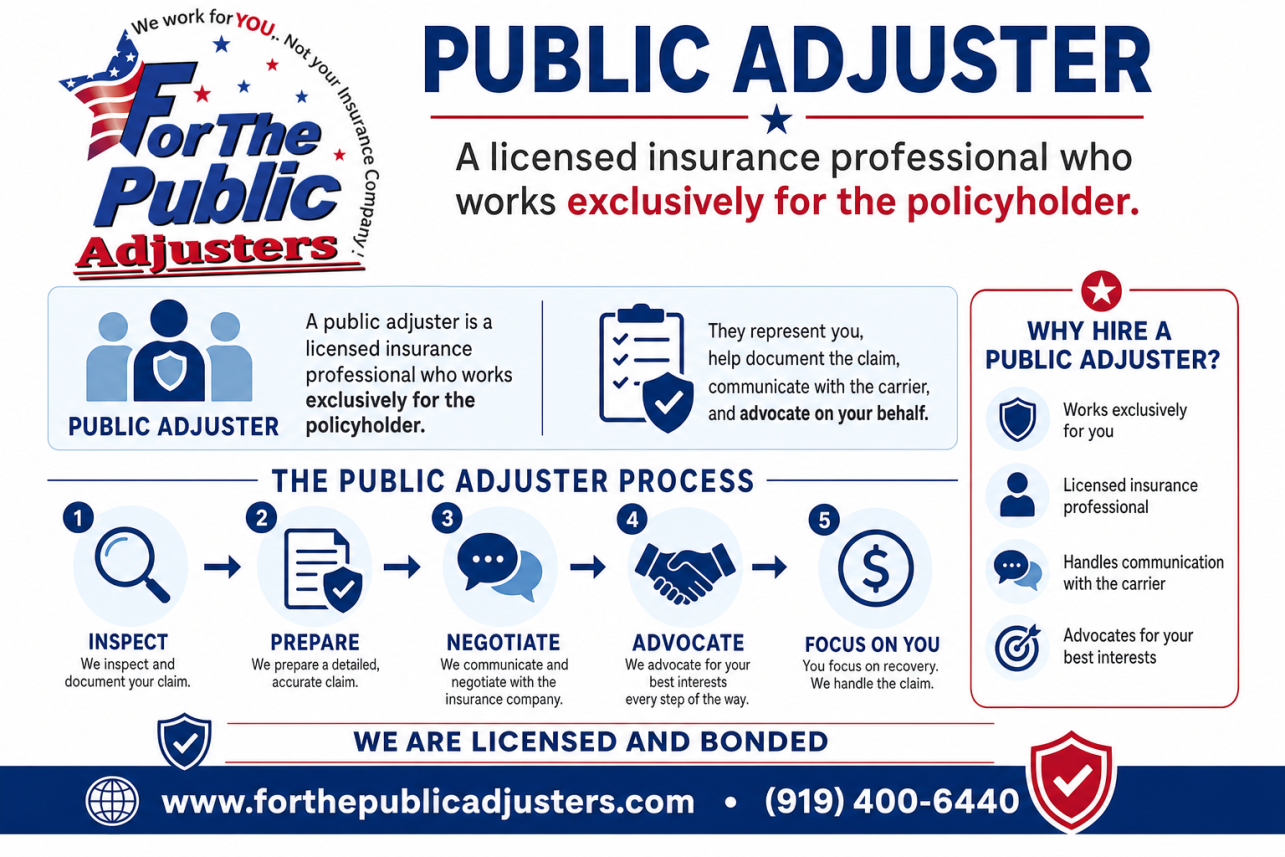
A public adjuster is a licensed insurance professional who works exclusively for the policyholder. The adjuster your insurance company sends works for the carrier. We work for you.
Our job starts with reading your policy line by line, because coverage for things like code upgrades, tree removal, smoke cleaning, and additional living expenses often goes unclaimed simply because homeowners don’t know to ask. We then document the loss thoroughly — photos, moisture readings, contents inventories, and a detailed repair estimate built the same way contractors actually price work in the Triangle.
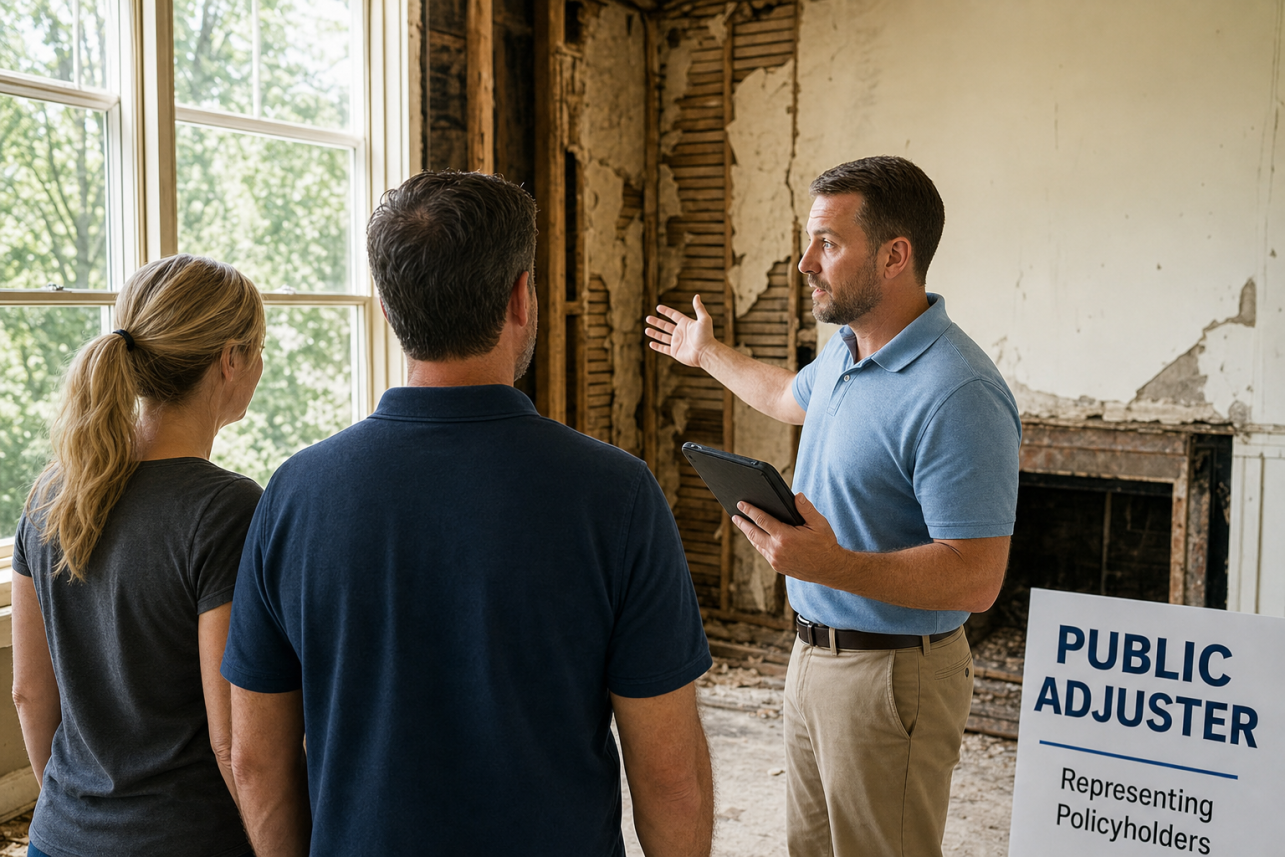
From there, we handle the negotiation. We meet the carrier’s adjuster at your property, challenge low scopes, and push back on partial denials in writing. The NCDOI Public Adjusters Guide explains that public adjusters in North Carolina must be licensed by the state, and we encourage every homeowner to verify any adjuster’s license before signing anything — including ours.
We handle residential homeowners claims and commercial business claims alike: fire, smoke, water, hurricane and tornado wind damage, tree damage, vandalism, arson losses where the homeowner is the victim, car-hits-home incidents, and flood claims including NFIP policies. We do not handle auto, health, life, or cell phone claims — buildings and contents are our entire focus.
Common Problems
The Carrier’s Estimate Misses What Chapel Hill’s Older Homes Actually Need
Many homes in Chapel Hill’s established neighborhoods date back decades, with plaster walls, hardwood floors, and materials that can’t be patched with off-the-shelf replacements. Carrier estimates frequently price repairs as if every house were new construction.
When a summer thunderstorm drops a mature oak through a roofline, the real cost includes matching materials, structural repair, and often code-required upgrades. We build estimates that reflect what restoring an older home genuinely costs — not what a software default says it should.
Why Hire A Public Adjuster Chapel Hill NC Homeowners Can Verify And Trust
After a loss, homeowners get approached by all kinds of people promising fast money. North Carolina requires public adjusters to hold a state license, and reputable firms welcome that scrutiny. We are licensed and bonded, and our fee comes from the settlement we help you recover — we never ask for money up front.
We also never guarantee a specific outcome. Any adjuster who promises you a dollar figure before documenting the loss is telling you what you want to hear, not what the evidence supports. What we can promise is a complete, professionally documented claim presented forcefully to your carrier.
Delays And Lowball Offers After Hurricane Season Losses
When remnants of a tropical system push through the Triangle, carriers get flooded with claims at once, and individual files slow to a crawl. Homeowners accept early offers just to move forward, often leaving hidden water intrusion and structural damage unpaid.
Courts have recognized how costly insurer delay can be. In Bi-Economy Market, Inc. v. Harleysville Insurance Co. of New York, the insured suffered a fire loss to its building and business, and New York’s highest court held the policyholder could pursue consequential damages caused by the insurer’s failure to pay the claim promptly. The lesson for homeowners is simple: you don’t have to accept slow-walking or a first offer that doesn’t cover the loss.
Our Process
Free Claim Review And Policy Analysis
We start by inspecting the damage and reading your actual policy — endorsements, exclusions, deductibles, and all. Whether it’s smoke damage after a kitchen fire or water intrusion from a summer storm, we identify every coverage that applies before anyone talks numbers.
This review costs you nothing, and you’re under no obligation afterward.
Full Documentation And Independent Estimate
We photograph and measure the damage, inventory affected contents room by room, and prepare a detailed repair estimate using real regional pricing. For flood losses, we build the documentation the National Flood Insurance Program requires, including the proof of loss that NFIP claims live or die on.
Thorough documentation is where most claims are won or lost. We don’t leave gaps for the carrier to exploit.
Negotiation Through Final Settlement
We present the claim to your carrier, meet their adjuster on site, and respond to every pushback in writing. If the carrier’s scope is short, we show them exactly why — line item by line item.
You stay informed at every step, and nothing gets settled without your approval. Our fee is a percentage of the recovery, so our interests are aligned with yours from day one.
| What Happens | Filing Alone | With For The Public Adjusters |
|---|---|---|
| Damage documentation | You rely on the carrier’s adjuster, who works for the insurance company | Independent inspection with moisture mapping, thermal imaging, and photo documentation of hidden damage |
| Estimate accuracy | Carrier’s scope often covers only visible damage at insurer-set pricing | Full line-item estimate at real Orange County contractor pricing, including code upgrades |
| Negotiation | You argue policy language against trained claims professionals | A licensed adjuster negotiates supplements and re-inspections on your behalf |
| Your time | Weeks of calls, paperwork, and chasing responses | We manage the entire claim; you approve decisions and review updates |
| Typical result | Settlements frequently based on the first, lowest scope | Documented claims routinely settle substantially higher than the initial offer |
| Cost | Free, but often costly in unclaimed damage | Contingency fee — a percentage of recovery, nothing if you collect nothing |
Commonly Overlooked In The Public Adjusting Industry
- Ordinance and law (code upgrade) coverage — Chapel Hill and Orange County building codes require upgrades during repairs — like updated electrical or hurricane strapping — that carriers won’t pay for unless you specifically invoke this policy provision.
- Matching of discontinued shingles and siding — Carriers approve patch repairs without checking whether the material is still manufactured, and homeowners don’t realize a mismatched repair can trigger full-slope or full-elevation replacement.
- Moisture migration beyond the visible stain — Water travels along joists and inside wall cavities far past what the eye can see, and most carrier inspections never use a moisture meter or thermal camera to trace it.
- HVAC duct contamination after fire or smoke — Ductwork is out of sight, so soot and corrosive residue circulating through the system get left off estimates until occupants notice odors months after the claim closes.
- Additional living expenses (ALE) beyond hotel nights — Policyholders don’t track increased food costs, pet boarding, mileage, and laundry during displacement, and carriers never volunteer that these are reimbursable.
- Depreciation recoverable after repairs are complete — Many homeowners never file for the recoverable depreciation held back from the initial payment, effectively forfeiting thousands the policy owes them once work is finished.
- Seasonal revenue in business interruption calculations — Carriers default to annual averages, which badly shortchanges Chapel Hill businesses whose income spikes around UNC’s academic calendar and game weekends.
- Statutory deadlines and proof-of-loss requirements — North Carolina policies contain strict notice and documentation deadlines, and missing one — often buried in the policy’s conditions section — can void an otherwise valid claim.
Case Studies
Case Study #1
Situation: A homeowner in the Meadowmont neighborhood of Chapel Hill came to us after a summer thunderstorm dropped a mature oak limb through the rear roofline of their 1990s two-story home. The insurance company had already sent its own adjuster and issued a settlement offer of $18,400.
Problem: The carrier’s estimate covered patching the visible roof puncture and replacing wet drywall in one bedroom. It ignored water that had traveled along the truss system into the attic insulation, and it priced the roof repair as a partial patch even though the shingle line had been discontinued years earlier.
Investigation: Our adjuster spent a full day on site with a moisture meter, thermal imaging camera, and attic inspection. We mapped moisture readings across the ceiling joists in three rooms, photographed staining on the truss chords, and pulled the shingle manufacturer’s discontinuation notice to document that a matching partial repair was impossible.
Findings: Moisture had migrated roughly 22 feet beyond the impact point, saturating blown-in insulation across most of the attic. Two bedrooms and a hallway ceiling showed elevated readings. Because the shingles were discontinued, North Carolina’s matching considerations and the policy’s replacement cost language supported a full roof slope replacement, not a patch.
Solution: We prepared a line-item estimate with photo documentation, moisture maps, and the manufacturer’s product records, then filed a formal supplement and met the carrier’s adjuster for a joint re-inspection. We walked the attic together and demonstrated every reading on the spot.
Outcome: The claim settled at $71,200 — nearly four times the original offer. That covered full rear-slope roof replacement, complete attic insulation removal and replacement, drywall and paint in three rooms, and additional living expenses while the interior work was done.
Lesson: The first offer after a storm is usually based on what’s visible from the ground and the doorway. Water damage in Orange County homes with vented attics almost always extends farther than the carrier’s initial scope, and discontinued materials change what a fair settlement looks like.
Case Study #2
Situation: The owner of a small restaurant near Franklin Street suffered a kitchen fire that started at a fryer. The fire itself was contained quickly, but smoke and suppression chemicals spread through the dining room and HVAC system. The carrier offered $42,000 and pushed to close the claim within three weeks.
Problem: The offer covered cleaning and repainting but treated the business interruption portion as a two-week closure. It excluded HVAC duct decontamination, priced smoke-damaged dining furniture as cleanable, and used the restaurant’s slowest quarter to calculate lost income — ignoring that the fire happened right before UNC’s fall semester rush.
Investigation: We brought in an industrial hygienist to test for soot and chemical residue in the ductwork and on soft goods, reviewed three years of monthly sales records to establish true seasonal revenue, and obtained health department guidance confirming the kitchen could not reopen until full decontamination and equipment certification were complete.
Findings: Corrosive soot residue was present throughout the duct system and had etched stainless prep surfaces, which meant replacement rather than cleaning for several fixtures. Realistic reopening time was eleven weeks, not two. Sales data showed August through October historically produced 38% of annual revenue.
Solution: We rebuilt the business interruption claim using the correct seasonal figures, submitted the hygienist’s lab results to support duct replacement and equipment losses, and negotiated directly with the carrier’s large-loss team through two rounds of documented supplements.
Outcome: Final settlement came to $187,500 — covering full HVAC decontamination and partial duct replacement, kitchen equipment replacement, smoke remediation of the dining room, and business income calculated on actual seasonal performance through the true reopening date.
Lesson: Commercial fire claims fail on two fronts: invisible contamination and undervalued lost income. If your business income calculation doesn’t reflect your real seasonal cycle — and in a college town like Chapel Hill, seasonality is everything — you’re leaving the largest part of the claim on the table.
| Your Situation | Should You Bring in an Adjuster? | What It Depends On |
|---|---|---|
| Small claim under ~$5,000 with obvious damage | Usually not necessary | If the carrier’s offer covers a written contractor quote, handle it yourself and save the fee |
| Roof or hail damage after a storm | Yes, before accepting any offer | Carriers often approve patches; discontinued shingles and matching rules may justify full replacement |
| Water damage from a burst pipe or appliance | Yes, early — ideally within days | Hidden moisture in walls, subfloors, and crawlspaces is missed on visual-only inspections and leads to mold disputes later |
| Fire or smoke loss | Yes, immediately | Soot contamination in HVAC systems and contents, plus additional living expenses, are the most underpaid parts of fire claims |
| Claim denied or blamed on ‘wear and tear’ | Yes — denials are frequently reversible | Whether independent evidence (plumber reports, weather data, engineering opinions) can establish a covered sudden cause |
| Business interruption after a commercial loss | Yes, before submitting income figures | Whether the lost-income calculation reflects your true seasonal revenue rather than an annual average |
| Offer already accepted and check cashed | Possibly — claims can often be reopened | North Carolina generally allows supplements within the policy period if new documented damage is found |
| Total loss or major structural damage | Absolutely, from day one | Policy limits, ordinance and law coverage, and debris removal decisions made early shape the entire recovery |
Reviews
Our insurer offered $12,000 after hail damaged our roof and both skylights. Honestly, I almost took it just to be done. For The Public Adjusters found damage to the gutters, siding, and window wraps the first adjuster never even photographed. The claim settled at $46,000 and the roof is fully replaced. They handled every call with the carrier so I never had to argue with anyone.
Denise W., Southern Village
A pipe burst in our crawlspace while we were out of town and the insurance company tried to blame it on ‘long-term seepage’ to deny the claim. These folks brought in documentation, plumber reports, and moisture readings that proved it was a sudden break. Denial reversed, claim paid at $58k including our hotel costs. I would never file a large claim without a public adjuster again.
Marcus T., Chapel Hill
Tornado-warned storm took shingles and part of our fence, and the carrier’s estimate didn’t even include the fence or the water stains inside. For The Public Adjusters re-inspected everything, wrote a proper line-item estimate, and got the settlement more than doubled. Only reason for four stars is the process took about ten weeks — but they warned me up front that carriers drag their feet, and they kept me updated the whole time.
Priya R., Carrboro / Orange County
Frequently Asked Questions
What Does A Public Adjuster Chapel Hill NC Homeowners Hire Actually Do For My Insurance Claim?
A public adjuster works exclusively for you, the policyholder — never for the insurance company. When you hire For The Public Adjusters, Inc., we take over the entire claim process from documentation to final settlement negotiation.
That starts with a thorough inspection of your property, whether it’s a water-damaged home near Franklin Street, storm damage in Southern Village, or fire loss in a Meadowmont townhome. We document every item of damage the carrier’s adjuster might minimize or miss entirely, including hidden moisture behind walls, roof decking damage, and code-upgrade costs common in Chapel Hill’s older housing stock.
From there, we read your policy line by line to identify every coverage that applies — dwelling, other structures, contents, additional living expenses, and ordinance-or-law coverage. Many homeowners in Orange County leave thousands on the table simply because they didn’t know a coverage existed.
Finally, we prepare a detailed, itemized estimate using the same software insurance carriers use, then negotiate directly with the company’s adjuster on your behalf. You never have to argue with the carrier yourself. Our job is to make sure the settlement reflects the true cost of repairs at current local labor and material prices, not a lowball figure. Most clients tell us the difference between our estimate and the carrier’s first offer is substantial — often the deciding factor in whether repairs actually get completed properly.
How Much Does It Cost To Hire A Public Adjuster In Chapel Hill, And Is It Worth It?
For The Public Adjusters, Inc. works on a contingency fee, meaning we’re paid a percentage of the settlement we recover for you. There’s no upfront cost, no hourly billing, and no fee at all if we don’t recover money on your claim. North Carolina regulates public adjuster fees, so the percentage is disclosed clearly in your contract before we do any work.
Is it worth it? For most claims, yes — and often dramatically so. Industry studies and our own case files show that professionally represented claims routinely settle for significantly more than claims handled by homeowners alone. Even after our fee, clients typically net far more than the carrier’s initial offer.
The reason is simple: insurance companies employ trained adjusters whose estimates protect the carrier’s bottom line. Without your own expert, you’re negotiating against a professional with only your instincts. We level that playing field with detailed scope-of-loss reports, local repair pricing, and knowledge of North Carolina policy language.
There’s also the time factor. Chapel Hill homeowners juggling careers at UNC, Duke, or in the Research Triangle rarely have hours to spend photographing damage, compiling contents inventories, and fielding carrier phone calls. We handle all of it.
For very small claims — those barely above your deductible — we’ll tell you honestly if representation doesn’t make financial sense. That candid assessment is free during your initial consultation.
When Should I Call A Public Adjuster After Storm, Fire, Or Water Damage In Orange County?
The best time to call is before you file the claim, or as soon as possible afterward. How a claim is opened — the cause of loss you describe, the date reported, the initial documentation — shapes everything that follows. Getting professional guidance from day one prevents mistakes that are hard to undo later.
That said, it’s never too late. Many Chapel Hill and Carrboro homeowners call us after receiving a settlement offer that won’t come close to covering repairs, or after an outright denial. We regularly reopen and supplement underpaid claims, and North Carolina law generally allows claims to be revisited within the policy’s time limits, often up to three years depending on the situation.
Certain red flags mean you should call immediately: the carrier’s adjuster spent only a few minutes inspecting your property, the estimate omits obvious damage, you’ve been asked for a recorded statement, or the company is delaying without explanation. Hurricane and severe-thunderstorm losses in Orange County frequently involve hidden roof and water damage that a quick inspection misses.
After a fire or major water event, also call before signing anything with a restoration contractor. Some agreements assign your claim rights away or lock you into pricing before the full scope of damage is known.
Our team offers a free initial claim review, so there’s no risk in having us look at your situation early — even if you ultimately decide to handle the claim yourself.
Can A Public Adjuster Chapel Hill NC Homeowners Rely On Reopen A Claim That Was Already Denied Or Underpaid?
Yes, in most cases. A denial or a lowball settlement offer is rarely the end of the road in North Carolina. Insurance policies allow for supplemental claims, and state law gives policyholders time to dispute a carrier’s decision — often up to three years from the date of loss, depending on your policy language.
When we take on a previously denied or underpaid claim, we start by re-reading the full policy, not just the declarations page. Denials in Chapel Hill frequently hinge on gray areas like wind-driven rain exclusions, wear-and-tear language, or matching disputes on roofing and siding. Many of those arguments fall apart when challenged with proper documentation.
We then re-inspect the property, build a line-item estimate using the same pricing software carriers use, and document damage the first adjuster missed — hidden moisture behind walls, compromised roof decking, or smoke residue in HVAC systems are common examples.
From there, we file a formal supplemental claim or dispute and negotiate directly with the insurance company on your behalf. If the carrier still won’t move, we can invoke the appraisal clause found in most homeowner policies. Bring us your denial letter and estimate, and we’ll tell you honestly whether the claim is worth reopening.
How Long Does The Claims Process Usually Take Once I Hire Your Chapel Hill Adjusters?
It depends on the size and complexity of the loss, but here is a realistic picture. A straightforward wind or hail claim on a Chapel Hill home often resolves in 30 to 60 days from the time we take over. Larger losses — a house fire near Southern Village or major water damage in a Meadowmont townhome — can run 90 days to six months, especially if engineering reports or code-upgrade negotiations are involved.
North Carolina insurance regulations do keep carriers on a clock. Insurers must acknowledge a claim promptly and respond to communications within reasonable timeframes, and we hold them to those deadlines in writing every time they slip.
Our involvement typically shortens the timeline rather than extending it. Because we submit a complete, itemized estimate with photo documentation, moisture readings, and policy citations up front, there’s less back-and-forth than when a homeowner sends piecemeal information.
Where delays do happen, it’s usually over disputed scope — the carrier wants to patch a roof we can prove needs full replacement, for example. We’ll always tell you when standing firm for another few weeks is likely to add real money to your settlement, and when accepting an offer makes sense so you can start rebuilding.
What Types Of Property Damage Claims Do You Handle In Chapel Hill And The Rest Of Orange County?
We handle residential and commercial property claims of nearly every kind across Chapel Hill, Carrboro, Hillsborough, and the surrounding parts of Orange County.
The most common losses we see locally are wind and hail damage from the severe storms that roll through the Triangle each spring, fallen-tree damage — a constant risk given the mature hardwoods in neighborhoods like Greenwood and Coker Hills — and water losses from burst pipes, failed water heaters, and appliance leaks. Winter freeze events cause a surprising number of pipe bursts in older homes near downtown and the UNC campus area.
We also represent policyholders after fires and smoke damage, lightning strikes, hurricane remnants that push inland from the coast, and vandalism or theft losses. For business owners, we handle commercial building damage along with business interruption claims, which are frequently undervalued because carriers miscalculate lost income.
What we don’t handle: auto claims, injury claims, or flood claims paid through the National Flood Insurance Program, since federal flood policies restrict adjuster fees differently. If your loss falls outside our scope, we’ll tell you immediately and point you toward the right help. For everything else, the initial damage review and policy consultation costs you nothing.
Are Your Adjusters Licensed In North Carolina, And How Can I Verify That Before Signing Anything?
Yes. Every adjuster at For The Public Adjusters, Inc. holds a current North Carolina public adjuster license issued by the NC Department of Insurance, and you should verify that before hiring anyone — including us.
Verification takes two minutes. Go to the NC Department of Insurance website and use the licensee search tool, or call the Department directly in Raleigh. Search by the individual adjuster’s name or license number, which we provide in writing before you sign a contract. North Carolina also requires public adjusters to carry a surety bond, so ask any firm you interview for proof of both.
Why does this matter? After major storms, out-of-state operators and unlicensed “claim consultants” sometimes canvass Triangle neighborhoods, and homeowners have been burned by contracts that violate state fee rules. A licensed public adjuster Chapel Hill NC property owners hire is bound by state regulations covering contract terms, fee limits, and your right to cancel within a set window after signing.
Beyond licensing, ask for local references. We’re glad to connect you with Orange County homeowners and business owners whose claims we’ve settled, and we’ll walk you through our contract line by line before you commit to anything.
Will Hiring Your Firm Upset My Insurance Company Or Affect My Policy And Rates?
No. Hiring a public adjuster Chapel Hill NC homeowners choose to represent them is a legal right under North Carolina law, and carriers deal with our profession every day. Your insurer cannot cancel your policy, raise your rates, or deny your claim simply because you brought in your own licensed representative.
In practice, having professional representation often makes the process smoother, not more adversarial. Insurance company adjusters would rather negotiate with someone who speaks their language — line-item estimates, policy provisions, depreciation schedules — than go back and forth with a frustrated homeowner. Claims tend to move with fewer misunderstandings when both sides are documenting the loss the same way.
What can affect your rates is the claim itself, and that happens whether or not you hire representation. Filing a claim is already on record the moment you report the loss. Our involvement doesn’t change that; it changes how thoroughly the damage gets documented and how fairly the settlement reflects your actual policy coverage.
Some Orange County clients tell us they hesitated to call because they didn’t want to seem confrontational. There’s nothing confrontational about it. We handle communication professionally, keep everything in writing, and hold the carrier to the terms of the contract you’ve been paying premiums on. That’s advocacy, not antagonism, and reputable insurance professionals treat it that way.
What Happens If My Insurer And A Public Adjuster Chapel Hill NC Firm Like Yours Disagree On The Damage Estimate?
Disagreements happen more often than most policyholders expect, and there is a defined path forward. Our first step is always documentation-based negotiation. We present the carrier with a line-item estimate built on photos, moisture readings, contractor pricing for the Triangle market, and the specific language in your policy. Most disputes in Orange County resolve at this stage because insurers know a well-supported estimate is hard to dismiss.
If the carrier still won’t move, nearly every North Carolina property policy includes an appraisal clause. That process lets each side name an appraiser, and those two appraisers select a neutral umpire to settle the difference in value. It’s faster and far less expensive than litigation, and we’ve used it successfully on Chapel Hill claims ranging from hail-damaged roofs to kitchen fire rebuilds.
We also know local replacement costs, which matters here. Chapel Hill’s older neighborhoods, from Westwood to Gimghoul, include homes with plaster walls, custom millwork, and slate or cedar roofing that generic pricing software routinely undervalues. When a desk adjuster in another state plugs your home into a template, the number comes out low. Our job is to prove what rebuilding actually costs in this market.
Throughout the dispute, you stay informed but out of the crossfire. We handle the calls, the written responses, and the deadlines, so the disagreement never becomes your daily burden.
Is My Claim Big Enough To Justify Bringing In Your Adjusters, Or Is It Only Worth It For Major Losses?
There’s no strict dollar minimum, but there is an honest answer: the value we add depends on the gap between what your insurer offers and what your loss is actually worth, not on the size of the loss itself. A modest water claim that a carrier scoped at $8,000 might genuinely be a $30,000 loss once you account for hidden moisture in wall cavities, matching flooring across connected rooms, and code-required upgrades in an older Chapel Hill home. That gap makes representation worthwhile even on a smaller claim.
During your free initial consultation, we’ll tell you plainly whether we can add enough value to justify our fee. If your carrier’s offer is fair and complete, we’ll say so and send you on your way. Because we work on contingency, taking on a claim we can’t improve helps no one, and our reputation in Orange County depends on that honesty.
As a general guide, claims involving water intrusion, fire and smoke, roof damage, or any structural component tend to be underscoped most often, because so much of the damage isn’t visible in a quick walkthrough. Chapel Hill’s mix of 1950s-70s ranch homes and newer construction means hidden issues like outdated wiring, polybutylene plumbing, or non-code framing frequently surface mid-repair, and those costs belong in your settlement.
If you’re unsure, call us before you accept anything. A twenty-minute conversation costs nothing and can prevent a five-figure mistake.
How Can I Tell If My Insurance Company’s Settlement Offer Is Too Low?
Common red flags include estimates that omit visible damage, pricing that doesn’t match local contractor bids, missing line items like code upgrades or debris removal, and pressure to settle quickly. Comparing the insurer’s estimate against an independent, detailed scope of loss is the most reliable way to know. Read more: Low Insurance Settlement Offer? Signs & Next Steps →
Do I Need A Public Adjuster Or An Attorney For My Insurance Claim?
For most disputes over damage scope or claim value, a public adjuster is the right fit — we document, estimate, and negotiate your claim for a percentage of the recovery. Attorneys become necessary when coverage itself is denied or bad faith is involved, and the two often work together. Read more: Public Adjuster vs Attorney: Who Does Your Claim Need? →
Should I File My Insurance Claim Before Or After Contacting A Public Adjuster?
Ideally, contact a public adjuster before you file. How a claim is first reported — the cause of loss you describe, the damage you list, the wording you use — shapes how the insurer handles everything afterward. An adjuster can help you document the loss properly and report it accurately from the start. That said, if you’ve already filed, you haven’t lost anything; a public adjuster can step in at any stage and take over communication with your insurer.
Can You Help With Additional Living Expenses If My Chapel Hill Home Is Unlivable After A Loss?
Yes. Most homeowners policies include additional living expenses coverage, which pays the extra costs of living elsewhere while your home is repaired — temporary housing, increased food costs, and similar expenses. Many homeowners underuse this coverage because they don’t know what qualifies or how to document it. We review your policy’s loss-of-use provisions, help you track eligible expenses correctly, and make sure that portion of your claim is presented alongside the property damage itself.
Do You Serve Areas Around Chapel Hill Like Carrboro, Hillsborough, And The Rest Of The Triangle?
Yes. While this page focuses on Chapel Hill, we handle claims throughout Orange County — including Carrboro and Hillsborough — and across the broader Triangle region. Property damage doesn’t stop at town lines, and neither do we. If you’re anywhere in the surrounding area and dealing with storm, fire, or water damage, reach out and we’ll confirm we can take on your claim, usually the same day you call.

Can I Cancel My Contract With A Public Adjuster If I Change My Mind?
Public adjuster contracts in North Carolina include cancellation terms, and you should read them carefully before signing — a reputable firm will walk you through them and answer questions without pressure. If you’ve already signed and want out, review the cancellation provisions in your agreement and put your request in writing promptly. We’d rather you feel fully comfortable with the arrangement than feel locked in, so ask us anything before committing.
Local Relevance
Chapel Hill sits under one of the most beautiful — and most claim-prone — tree canopies in the Triangle. Mature oaks and pines that shade older neighborhoods become genuine hazards during summer severe thunderstorms and when tropical systems track inland across the Piedmont, as Hurricane Fran memorably demonstrated across this region. Tree damage claims, roof punctures, and the water intrusion that follows are among the most common losses we handle here.
The area’s housing stock adds another layer. From mid-century homes near the university to historic properties in older districts, many Chapel Hill houses feature materials and construction methods that standard carrier estimates undervalue. Restoring a plaster ceiling or matching decades-old siding costs more than replacing modern drywall and vinyl, and your settlement should reflect that.
Humid summers also mean water and smoke losses escalate fast. Moisture trapped in wall cavities after a storm or a firefighting effort breeds secondary damage within days. Getting the full scope documented early — before the carrier closes its file — matters more here than in drier climates.
Chapel Hill’s dense mature tree canopy and its stock of older homes tend to combine into a specific claim problem: a storm-felled limb opens the roof, and the carrier pays for the shingle patch while underpaying the interior water damage and the cost of matching original materials — so homeowners here often benefit from having the full chain of damage documented before accepting any estimate.
Get A Free Claim Review Before You Accept The Carrier’s Number
Whether a summer storm dropped a tree on your roof, a fire damaged your kitchen, or floodwater reached your crawlspace, you’re entitled to have someone on your side of the table. For The Public Adjusters, Inc. is licensed and bonded, and your initial claim review costs nothing. Call before you sign anything from your insurance company.
Call us: (919) 400-6440
Helpful Resources
- NCDOI Public Adjusters Guide
- National Flood Insurance Program (NFIP)
- Federal Emergency Management Agency (FEMA)
- North Carolina Department of Insurance — State regulator where consumers can verify adjuster licensing
Our services in this city
- Arson Chapel Hill NC Claims: When A Homeowner Is Wrongfully Accused Of Setting Their Own Fire
- Fire Damage Claim Dispute Help Chapel Hill NC: When The Insurer's Fire Or Smoke Payout Doesn't Match Your Actual Loss
- Tree Fell On House Insurance Chapel Hill: When A Mature Oak Or Pine Comes Through Your Roof
- Water Damage Insurance Claim Help Chapel Hill — From Burst Pipes To Summer Storm Intrusion, We Handle The Claim So You Don't Have To
Last updated: August 28, 2026