

If you are in the middle of a Flood Insurance Claim dispute Raleigh insurers are dragging out, you have the right to challenge the denial or the low payout — and you do not have to do it alone. For The Public Adjusters, Inc. is licensed and bonded to represent you, not the insurance company, in flood claim disagreements across Wake County. We re-document the damage, rebuild the estimate line by line, and negotiate directly with the carrier or NFIP adjuster on your behalf.
What This Service Is
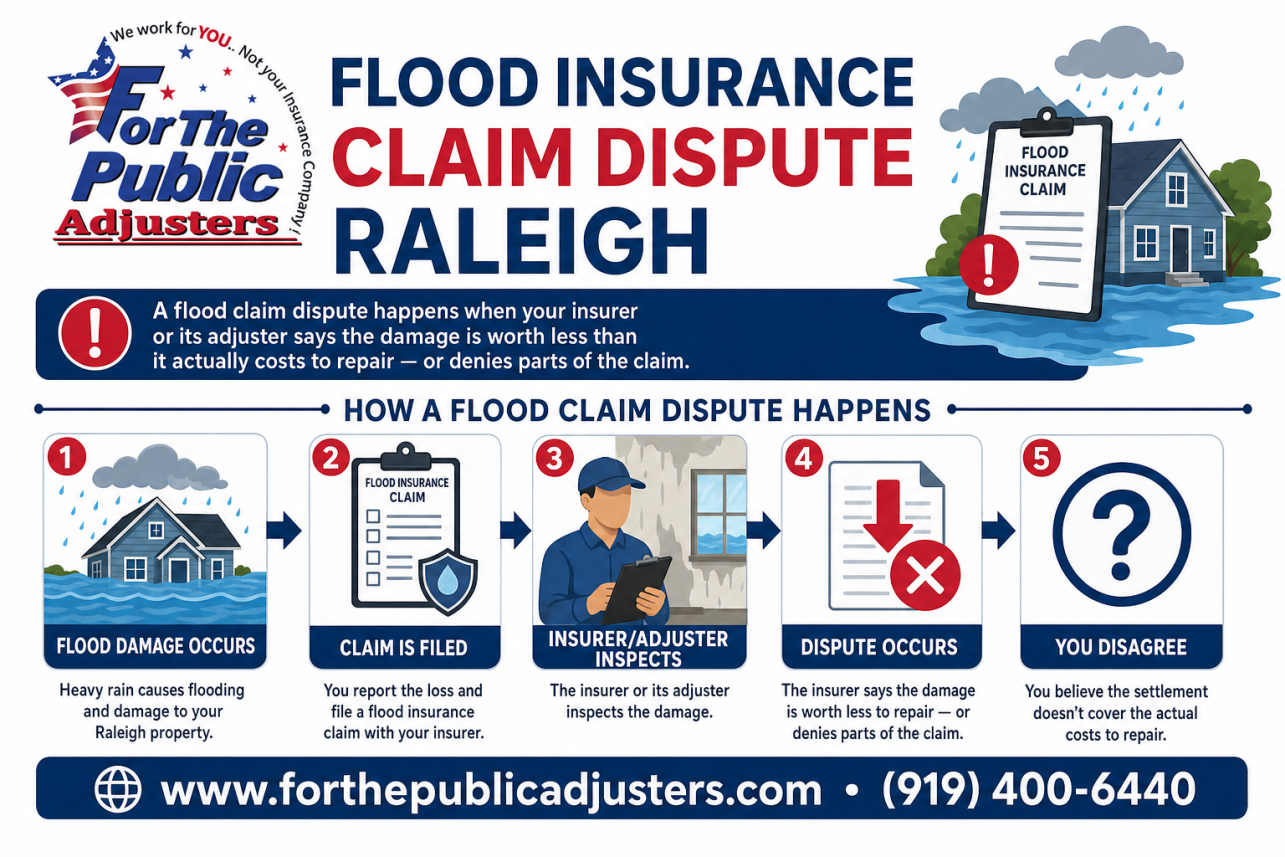
A flood claim dispute happens when your insurer or its adjuster says the damage is worth less than it actually costs to repair — or denies parts of the claim entirely. Common flashpoints include drywall and flooring cut short of the actual water line, structural drying that was never priced, contents valued at depreciated ‘actual cash value’ instead of what replacement really costs, and damage blamed on causes the policy excludes.
As your Raleigh public adjuster, we step in on your side of the table. We inspect the property ourselves, photograph and measure the water intrusion, build a room-by-room repair estimate, prepare a detailed personal property inventory, and handle the proof of loss paperwork the National Flood Insurance Program requires — including its strict filing deadline, which trips up many policyholders who try to go it alone.
Then we negotiate. If the carrier will not move, we help you pursue the formal appeal process and, when needed, coordinate with insurance dispute lawyers. We handle these disagreements throughout the Triangle, from downtown Raleigh out to our Flood Insurance Adjuster Apex clients on the western edge of the county. Our fee is a contingency percentage of what is recovered, so our interests stay aligned with yours.
Common Problems
Why Is The Flood Payout So Much Lower Than My Contractor’s Repair Estimate?
This gap is the single most common complaint we hear. The carrier’s adjuster may have used outdated pricing, skipped whole categories like structural drying or subfloor replacement, or applied heavy depreciation deductions to your contents.
Many flood policies also pay actual cash value on personal property rather than replacement cost, and coverage limits for the building and contents are separate — so it matters enormously how each dollar of damage gets categorized. A careful re-assessment often reveals thousands of dollars in damage the first estimate simply never priced.
We rebuild the estimate from scratch using current local repair costs, then push the carrier to reconcile the difference. One important caution: standard NFIP flood policies generally do not include additional living expenses, so getting the building and contents portions right is even more critical when flood is the cause.
My Claim Was Denied Or Delayed — Is A Flood Insurance Claim Dispute Raleigh Policyholders Can Actually Win?
Yes — policyholders can and do win these fights, but rarely by simply asking the insurer to look again. Denials often turn on causation arguments: the carrier claims the damage came from an excluded source, or that pre-existing conditions are to blame. Delays often trace back to missing documentation or a proof of loss that was never properly submitted.
Courts have sided with homeowners in these battles. In Broussard v. State Farm, a federal jury found the insurer liable after it attributed a family’s covered storm damage to excluded flooding following Hurricane Katrina — a reminder that a carrier’s first answer is not the final word.
Our job is to close every documentation gap the insurer could use against you: moisture readings, photos of the water line, structural damage documentation, and a complete inventory. The same disciplined approach applies whether the dispute involves a flooded slab home in Raleigh or a Water Damage Insurance Claim in Rolesville.
Should I Fight The Insurer Myself, Or Hire A Raleigh Public Adjuster?
You can appeal on your own, and for very small disagreements that may make sense. But flood disputes are document-heavy and deadline-driven, and the carrier’s adjuster does this every day while you may be doing it for the first time — often while also dealing with mold spreading through wet wall cavities as days pass.
A good public adjuster does three things you cannot easily do yourself: builds an independent, defensible damage assessment; speaks the carrier’s language on scope and pricing; and manages every deadline, including the NFIP proof of loss requirement. Before hiring anyone, verify they are licensed in North Carolina and ask exactly how their contingency fee works — reputable firms put it in writing.
We are licensed and bonded, we never charge upfront, and we never promise a specific dollar outcome — no honest adjuster can. What we promise is a thorough, professionally documented claim, the same standard our Public Adjuster Garner clients receive just south of the city.
Our Process
Free Dispute Review And Policy Analysis
We start by reading your actual flood policy — the coverage limits, the deductibles, and how it values contents. Then we compare the carrier’s estimate and denial letters against what your policy actually says. Many disputes are won or lost right here, in language most homeowners were never shown.
Independent Inspection And Re-Documentation
We inspect the property ourselves: water lines, damaged framing and subfloors, HVAC and electrical systems, and the progression of mold where water sat. We photograph everything, price repairs at current Raleigh-area rates, and prepare a complete personal property inventory so no damaged item goes unclaimed.
Negotiation, Proof Of Loss, And Appeal
We submit the corrected proof of loss and supporting documentation, then negotiate directly with the carrier or flood adjuster. If they refuse a fair settlement, we guide you through the formal appeal process that the Federal Emergency Management Agency oversees for federally backed flood policies, and coordinate with insurance dispute attorneys if litigation becomes the right move.
| What Happens | Handling the Dispute Yourself | With For The Public Adjusters |
|---|---|---|
| Proof of loss deadline (60 days on NFIP claims) | Easy to miss — missing it can permanently bar recovery | Tracked, prepared, and filed on time with full supporting documentation |
| Damage scope | You rely on the carrier’s adjuster’s estimate | Independent line-by-line estimate including hidden moisture, ducts, and code upgrades |
| Policy interpretation (basement rules, exclusions, general condition of flood) | Carrier’s reading usually goes unchallenged | Definitions verified against elevation data, municipal records, and neighboring losses |
| Negotiation | One-sided calls with a trained claims professional | Licensed adjuster negotiates carrier-to-adjuster on equal footing |
| Appeal or litigation posture | Weak file, few documented facts | Court-ready evidence package built from day one |
| Typical cost | Free upfront, but often tens of thousands left unrecovered | Contingency fee — paid only as a percentage of what we recover |
Commonly Overlooked In The Public Adjusting Industry
- The 60-day NFIP proof of loss deadline — Homeowners assume filing the claim starts the clock in their favor, but the signed, sworn proof of loss is a separate document and missing it can bar recovery entirely.
- Basement misclassification under NFIP definitions — Carrier adjusters often label any lower level a basement without checking grade on all four walls, wiping out coverage for finishes and contents that should be paid.
- Category 3 contamination in HVAC ducts and wall cavities — Floodwater is sewage-contaminated by definition, but ducts and insulation are hidden from a quick visual inspection and get left off the carrier’s scope.
- Proof that neighboring properties flooded — NFIP coverage requires a general condition of flooding, and evidence from adjacent parcels often defeats a denial — but nobody thinks to collect it before neighbors clean up.
- Elevation certificate errors — An outdated or wrong certificate changes how the policy pays, and few policyholders ever compare it against actual site conditions.
- Code-required upgrades during repair — Raleigh and Wake County building codes may mandate raised electrical, flood vents, or material changes, and carriers rarely volunteer that these costs can be claimable.
- Separate building and contents coverage limits — NFIP policies split the two, and adjusters sometimes pay contents-type items against the building limit, quietly shorting the total recovery.
- Non-recoverable depreciation on NFIP contents — Unlike many homeowners policies, NFIP contents payments are actual cash value with no depreciation holdback to recover later, so an undervalued inventory is money lost for good.
Case Studies
Case Study #1
Situation: A homeowner near Crabtree Creek in Raleigh had two feet of floodwater move through their finished lower level after a tropical system stalled over Wake County. They filed under their NFIP policy and waited on the carrier’s adjuster.
Problem: The insurer’s proof of loss came back at $31,000 — roughly a third of what local contractors were quoting. The carrier’s adjuster had classified the entire lower level as a ‘basement,’ which under NFIP rules stripped coverage for finished flooring, drywall below grade, and most contents.
Investigation: Our team pulled the elevation certificate, measured grade on all four sides of the structure, and photographed the walkout entrance. We also documented the water line, tested moisture levels behind remaining drywall, and inventoried contents room by room with pre-loss photos the homeowner had on their phone.
Findings: Two of the four walls sat fully above grade with a walkout door, meaning the space did not meet the NFIP definition of a basement. The carrier’s scope had also missed saturated insulation in wall cavities and category 3 water contamination in the HVAC ductwork running below the slab.
Solution: We prepared a corrected proof of loss with the elevation data attached, a revised Xactimate estimate reflecting full finished-space coverage, and a supplemental demand for ducts, insulation, and contents. We submitted before the NFIP proof-of-loss deadline and requested a re-inspection.
Outcome: The carrier reclassified the space and issued a revised payment of $94,600 — more than triple the original offer — without the homeowner ever setting foot in a courtroom.
Lesson: The ‘basement’ designation is one of the most expensive misclassifications in a flood claim. If any wall of the flooded space is at or above grade, get the elevation verified before you accept the carrier’s number.
Case Study #2
Situation: A small commercial property owner off Capital Boulevard in Raleigh had floodwater from an overwhelmed storm drain enter a retail unit and adjoining storage area. The tenant’s inventory and the building’s interior finishes were both damaged.
Problem: The insurer denied the claim outright, arguing the water was ‘surface water backup’ excluded under the policy, and separately claimed the two-inch water line inside didn’t meet the NFIP’s general condition of flood — inundation of two or more acres or two or more properties.
Investigation: We obtained City of Raleigh stormwater records, rainfall data for the event, and photos from neighboring businesses on the same block. We interviewed two adjacent tenants who had also taken on water and gathered their timestamps and images.
Findings: Three separate parcels flooded during the same event, which satisfied the NFIP’s definition of a general condition of flooding. The water entered at grade from overland flow, not through a backed-up interior drain, which defeated the exclusion the carrier cited.
Solution: We assembled a dispute package — neighbor affidavits, municipal drainage records, and a corrected causation analysis — and filed a formal appeal of the denial with a full damage estimate covering flooring, lower drywall, shelving, and code-required electrical work.
Outcome: The denial was reversed on appeal. The owner recovered $67,200 for building repairs, and the documentation we assembled also supported the tenant’s separate contents claim.
Lesson: A denial letter is an opening position, not a final answer. Proving that neighboring properties flooded in the same event is often the single fact that turns an excluded loss into a covered one.
| Your Situation | Best First Move | Key Deadline or Risk | When to Escalate |
|---|---|---|---|
| Lowball offer but claim accepted | Independent re-scope and supplemental proof of loss | 60-day NFIP proof of loss deadline still applies to the corrected amount | If carrier refuses re-inspection after documented supplement |
| Claim denied for ‘groundwater’ or ‘seepage’ | Gather evidence of overland flow and neighboring flooded properties | Appeal windows run from the date of the written denial | FEMA appeal or suit if the causation evidence is ignored |
| Space classified as a ‘basement’ | Verify grade on all sides with the elevation certificate | Accepting payment can lock in the misclassification | Formal dispute with survey-grade elevation documentation |
| Contents payout far below actual losses | Room-by-room inventory with pre-loss photos and receipts | Depreciation applied to contents on NFIP policies is not recoverable later | Negotiated supplement with itemized valuation support |
| Hidden damage found during repairs | Stop work, document, and file a supplemental claim immediately | Carriers resist supplements once repairs conceal the evidence | Re-open the claim with contractor findings and moisture readings |
| Missed the proof of loss deadline | Check whether FEMA extended the deadline for the event | Late filing is one of the few near-fatal errors on NFIP claims | Professional review — extensions and exceptions sometimes apply |


Reviews
After Hurricane flooding hit our neighborhood off New Bern Ave, the flood carrier offered us $28k when repairs were quoted at $85k. For The Public Adjusters found the elevation certificate error, refiled the proof of loss before the deadline, and got the offer raised to $81,500. They knew the NFIP rules cold and handled every call with the adjuster so we didn’t have to.
Marcus T., Raleigh
Our flood claim was denied because the insurer said it was ‘groundwater seepage.’ I was ready to give up. This team pulled rainfall data and photos from two neighbors who flooded the same night and won the appeal. The denial was reversed and we were paid in full for the flooring and drywall. Worth every penny of the fee.
Denise W., Wake County
The carrier’s estimate missed our ductwork, subfloor, and all the contents in the flooded storage room. For The Public Adjusters re-scoped everything, documented category 3 contamination, and negotiated a supplement nearly double the first check. Only complaint is the process still took a couple months, but that was the insurer dragging, not them — they communicated the whole way.
Robert K., Raleigh
Frequently Asked Questions
What Are The Most Common Reasons For A Flood Insurance Claim Dispute Raleigh Homeowners Should Watch For?
Most disputes we handle in Raleigh come down to three issues: undervalued damage, disputed cause of loss, and coverage denials tied to policy exclusions.
Undervaluation is the most frequent. Flood adjusters working for the NFIP or a Write Your Own carrier often miss hidden damage — saturated subfloors, wicking in drywall above the visible waterline, or contaminated insulation behind walls. Their estimates may also use pricing that doesn’t reflect actual reconstruction costs in Wake County, where labor and material rates have climbed sharply.
Cause-of-loss disputes are the second big category. Carriers sometimes argue that damage came from groundwater seepage, a plumbing failure, or wind-driven rain rather than a qualifying flood event. That distinction determines whether your flood policy pays at all, so how the loss is documented and framed matters enormously.
Third, we see denials based on technicalities: basement limitations, claims that contents weren’t properly documented, or assertions that damage was pre-existing. Homes near Crabtree Creek, Walnut Creek, and the Neuse River floodplain often have prior flood history on record, and carriers will use that to argue old damage rather than new.
If any of these apply to your situation, don’t accept the first answer as final. Federal flood claims have strict deadlines — including a one-year window to file suit after a written denial — so acting quickly protects your options. For The Public Adjusters, Inc. reviews the carrier’s estimate line by line, documents what was missed, and builds the evidence needed to challenge a low or denied payout.
How Does A Public Adjuster In Raleigh Handle A Disputed Flood Claim Differently Than I Could On My Own?
The biggest difference is documentation and negotiation leverage. Flood claims under the National Flood Insurance Program follow strict federal rules, and disputes are won or lost on the quality of your evidence — not on how frustrated you are with the carrier.
When For The Public Adjusters, Inc. takes on a disputed flood loss, we start with a complete re-inspection of the property. We measure waterlines, test moisture levels in framing and subfloors, photograph everything, and pull data like FEMA flood maps and USGS gauge readings for local waterways to establish the flood event itself. That kind of technical file is difficult for a homeowner to assemble alone.
Next, we build an independent damage estimate using professional estimating software — the same tools the carrier’s adjuster uses — but scoped to include everything they missed. We then submit a formal proof of loss, or an amended one, within the required deadlines. Missing a proof of loss deadline is one of the most common ways Raleigh homeowners lose valid claims, and we make sure that never happens on our watch.
From there, we negotiate directly with the carrier’s adjuster and examiners, respond to their engineers’ reports, and, if needed, prepare the file for FEMA appeal. Because flood claims are federal, the appeal process is different from a standard homeowners dispute, and experience with it matters.
You stay informed at every step, but you’re no longer the one arguing with the insurance company. That alone reduces stress — and in our experience, it consistently produces materially better settlements than homeowners achieve on their own.
How Long Does It Take To Resolve A Disputed Flood Claim In Wake County?
It depends on how the dispute is resolved, but most cases we handle in the Raleigh area fall into one of three timelines.
If the carrier underpaid and the evidence is strong, a supplemental negotiation often resolves in 30 to 90 days. We re-inspect, submit a revised proof of loss with our documentation, and negotiate the difference directly with the flood adjuster and examiner. Many underpayment cases settle this way without a formal appeal.
If the claim was denied or the carrier won’t move, the next step is usually a FEMA appeal. You have 60 days from the written denial to file, and FEMA’s review typically takes another 90 days or more once submitted. Realistically, appealed cases run four to eight months from start to resolution.
The longest cases involve litigation. Under federal flood rules, you must file suit within one year of the written denial — a much shorter window than most North Carolina insurance disputes — so we track that deadline carefully on every file.
A few things speed the process up: keeping all receipts and damaged items (or thorough photos before disposal), providing your policy documents and prior correspondence right away, and allowing prompt access for re-inspection. Delays usually come from carriers requesting engineer reports or additional documentation, which we anticipate and answer quickly.
While the dispute is pending, we also help clients pursue advance payments where available, so families in Wake County aren’t stuck waiting with an unlivable home and zero funds for repairs.
What Does It Cost To Hire For The Public Adjusters, Inc. For A Flood Insurance Claim Dispute Raleigh Residents Are Facing?
We work on a contingency fee, which means there is no upfront cost and no hourly billing. Our fee is a percentage of the recovery we help you obtain, agreed to in writing before any work begins. If we don’t improve your outcome, you don’t owe us for our time.
On a disputed flood loss, the fee structure typically applies to the additional funds recovered — the amount above what the carrier already offered or paid. That keeps our interests aligned with yours: we only do well when your settlement improves.
The initial review is free. When a Raleigh homeowner brings us a lowball estimate or a denial letter, we examine the carrier’s adjuster report, your policy declarations, and the photos and correspondence you have. We’ll tell you honestly whether the numbers justify a dispute. Some claims are paid fairly, and we’ll say so rather than take a case that won’t benefit you.
Homeowners sometimes worry the fee will eat up the increase. In practice, the gap between an initial flood payment and a properly documented settlement is often substantial — missed structural drying, subfloor replacement, code-required upgrades, and undercounted contents add up quickly at current Wake County construction prices. Even after our fee, clients typically net significantly more than the original offer.
Everything is spelled out in a plain-language contract compliant with North Carolina public adjuster regulations. If you’re weighing whether a flood insurance claim dispute in Raleigh is worth pursuing, the free consultation is the easiest way to find out before committing to anything.
What Documentation Do I Need To Support A Flood Insurance Claim Dispute Raleigh Property Owners Are Pursuing?
The strength of your dispute rests almost entirely on documentation, so start gathering it immediately. Photos and video of the flood damage before any cleanup are critical, especially for homes near Crabtree Creek, Walnut Creek, and other flood-prone corridors in Raleigh where water recedes quickly and evidence disappears with it.
You will also need a detailed, room-by-room inventory of damaged contents with approximate purchase dates and replacement costs. Keep every receipt for emergency mitigation work such as water extraction, tarping, and dehumidifier rentals, because those costs are often recoverable and often overlooked by the carrier.
Beyond your own records, the dispute frequently turns on independent expert evidence. That can include a licensed contractor’s line-item repair estimate, moisture mapping readings, a structural engineer’s report if the foundation or framing was affected, and mold testing results when drying was delayed. Under NFIP policies, a signed and sworn Proof of Loss must also be filed within the deadline, and it needs to reflect your full documented damages, not the carrier’s low figure.
When our team takes on a disputed flood claim in Wake County, we compile all of this into a single organized demand package. Adjusters on the insurance side respond very differently to a professionally documented file than to a homeowner’s email with a few phone photos. If you have already thrown items away, all is not lost, but bank statements, credit card records, and manufacturer specifications can help reconstruct what was damaged. The sooner you start preserving evidence, the stronger your position becomes.
Can I Still Start A Flood Insurance Claim Dispute Raleigh Homeowners Face If I Already Accepted A Partial Payment From My Insurer?
In most cases, yes. Accepting a partial payment on a flood claim does not automatically waive your right to pursue the rest of what you are owed, and this is one of the most common misconceptions we correct for Raleigh homeowners. Carriers often issue an initial check based on their adjuster’s first estimate, and cashing it is generally treated as payment toward the claim, not a final settlement.
The key is to review what you signed. If the check or any accompanying paperwork included release language stating it was full and final satisfaction of the claim, that changes the analysis, and you should have it reviewed before assuming the door is closed. Most routine claim payments do not include a release.
With NFIP flood policies, you can submit a supplemental claim or an amended Proof of Loss documenting damages the original payment did not cover. Deadlines matter here, so timing is critical. FEMA has historically extended Proof of Loss windows after major flooding events affecting Wake County, but you should never count on an extension.
For The Public Adjusters, Inc. regularly takes on files where a homeowner accepted $20,000 or $30,000 and later discovered the real repair cost was double or triple that amount. We re-inspect the property, document what the first estimate missed, such as subfloor damage, insulation saturation, and code-required upgrades, and present a supplemental demand. If you have a partial payment sitting in hand and a contractor telling you it will not cover the work, that gap is exactly what a dispute is designed to close.
Does It Matter Whether I Have An NFIP Policy Or Private Flood Insurance When Disputing A Claim In Raleigh?
It matters a great deal, because the two types of policies follow completely different rules, and the dispute strategy changes accordingly.
NFIP policies, which cover the majority of flood-insured homes in Wake County, are federal contracts. That means strict, non-negotiable deadlines, including the requirement to submit a signed Proof of Loss, typically within 60 days of the loss unless FEMA extends it. Disputes on NFIP claims follow a defined path: supplemental claims, a formal appeal to FEMA within 60 days of a written denial, or litigation in federal court within one year of the first denial letter. Miss those windows and even a strong claim can be lost on procedure alone.
Private flood policies, which have become more common in Raleigh as carriers expand coverage options, are governed by the policy contract and North Carolina insurance law. They often allow appraisal as a dispute mechanism, may have different deadlines, and are subject to state regulations on claim handling that do not apply to NFIP claims.
The practical difference for you: with an NFIP dispute, precision and paperwork discipline win the day, while a private policy dispute may offer more leverage points, including complaints to the North Carolina Department of Insurance. Our adjusters read your specific policy first, because we have seen homeowners burn weeks pursuing the wrong process. If you are not sure which type you have, check whether your declarations page references the National Flood Insurance Program or a private carrier’s own flood form, and we can confirm it during a free file review.

What Deadlines Apply To Disputing An Underpaid Or Denied Flood Claim In Wake County?
Deadlines are where flood claim disputes are won or lost, so treat every date as firm. For NFIP-backed policies, the first critical deadline is the Proof of Loss, generally due within 60 days of the date of loss. This is a signed, sworn statement of your damages, and an inadequate or late filing can sink an otherwise valid claim. After major flooding events, FEMA sometimes extends this window for affected North Carolina counties, but never assume an extension applies to you without written confirmation.
If your claim is denied in whole or in part, you have 60 days from the date of the written denial letter to file a formal appeal with FEMA. Separately, if you intend to sue, NFIP policies require filing in federal court within one year of the first written denial. These are hard federal deadlines with almost no exceptions.
Private flood policies set their own timelines in the contract, and North Carolina’s statute of limitations for breach of an insurance contract also comes into play, so the safest move is to have the policy reviewed early rather than close to any cutoff.
One trap we see with Raleigh homeowners: negotiations with the carrier do not pause these clocks. People spend months going back and forth with a desk adjuster, believing progress is being made, while the appeal or lawsuit window quietly closes. When we take on a disputed flood claim, calendaring every applicable deadline is one of the first things we do, and we prepare filings in advance so no negotiation delay can cost you your rights.
My Insurer Says The Damage Was Groundwater Seepage, Not Flooding — Can I Still Start A Flood Insurance Claim Dispute Raleigh Policyholders Can Win?
Yes, and this is one of the most common battlegrounds we see across Wake County. Flood policies cover a “general condition of flooding” — typically surface water affecting two or more acres or two or more properties. Insurers sometimes reclassify legitimate flood damage as seepage, hydrostatic pressure, or poor drainage to deny the claim.
The key is evidence of what actually happened during the event. After storms push creeks like Crabtree, Walnut, and Marsh Creek over their banks, water frequently enters homes at grade level before it ever seeps through foundations. Photos of standing water, waterlines on exterior walls, neighbor accounts, USGS gauge data, and local flood reports can all establish that a general condition of flooding existed.
We build that case for you. Our adjusters document the entry points, map the water path through the structure, and pull weather and stream-gauge records specific to your Raleigh neighborhood. When the facts show surface flooding reached your property, the seepage argument often falls apart under scrutiny.
Even when some seepage did occur, that does not automatically defeat the claim. If flooding was the efficient cause of the loss, coverage may still apply, and the burden of proving an exclusion generally sits with the insurer. Do not accept a denial letter as the final word — get the file reviewed before any deadline passes.
How Does The FEMA Appeal Process Work If My NFIP Flood Claim Was Denied Or Underpaid?
If you carry an NFIP policy, you have a formal appeal right directly with FEMA — but the window is tight. You must file a written appeal within 60 days of the date on your insurer’s written denial letter, whether it was a full denial or a partial denial of specific items.
A strong appeal is not a complaint letter. FEMA wants documentation: the denial letter itself, your adjuster’s report, an itemized estimate of the disputed damage, photos, receipts, contractor bids, and a clear explanation of why the carrier’s position is wrong. Vague appeals get vague results.
Before or alongside an appeal, there are other tools. You can request a re-inspection, submit a supplemental claim with new documentation, or invoke the appraisal clause if the dispute is purely about the amount of loss rather than coverage. Choosing the right path matters, because appraisal and appeal serve different purposes and using the wrong one can waste months.
Our team handles this sequencing for Raleigh homeowners regularly. We prepare the sworn proof of loss, assemble a line-by-line rebuttal to the carrier’s estimate, and package the appeal so a FEMA reviewer can see the underpayment clearly. In many disputed flood claims we resolve directly with the Write Your Own carrier before an appeal is even necessary, because a properly documented supplemental demand often gets the file re-opened and re-priced on its own.
Are Basement And Crawl Space Losses Treated Differently In A Flood Insurance Claim Dispute Raleigh Homeowners Bring?
They are, and this catches a lot of people off guard. NFIP policies sharply limit coverage in basements and enclosed areas below the lowest elevated floor. Finished flooring, drywall below certain heights, personal property stored in a basement, and improvements like a finished rec room are often excluded or capped, while structural elements, foundation walls, furnaces, water heaters, and central AC units are typically covered.
The dispute usually is not about whether the rules exist — it is about how the carrier applied them. We regularly find adjusters misclassifying spaces in Raleigh homes. A split-level or a walk-out lower level on a sloped lot in neighborhoods near Lake Johnson or along House Creek may not meet the policy’s definition of a basement at all, which changes what is covered dramatically.
Crawl spaces raise their own issues. Damaged insulation, ductwork, vapor barriers, and structural components under the home are frequently missed or lowballed because the carrier’s adjuster never fully inspected the space.
When we take on a disputed flood claim, we measure and photograph these areas ourselves, apply the policy definitions correctly, and challenge misclassifications with elevation data and construction details. Getting the space classified correctly can shift thousands of dollars in a Flood Insurance Claim dispute Raleigh property owners might otherwise lose simply because nobody questioned the first adjuster’s assumptions.
Can Raleigh Business Owners Dispute A Commercial Flood Claim, Or Does This Only Apply To Homeowners?
Commercial policyholders absolutely can dispute an underpaid or denied flood claim, and in our experience they often have more at stake. Business flood losses in Wake County involve building damage, inventory, equipment, tenant improvements, and — depending on the policy — business interruption, which makes underpayment more expensive and more common.
NFIP commercial policies cap building coverage at $500,000 and contents at another $500,000, and they do not include business interruption. Many Raleigh businesses layer private excess flood coverage on top, which means a single loss can involve two or more carriers pointing at each other over who owes what. Those layered disputes are exactly where an experienced advocate earns their fee.
Common commercial fight points include depreciation applied too aggressively to equipment, inventory valued at cost when the policy allows more, code-upgrade costs left out of the building estimate, and contents in below-grade storage areas denied without proper analysis of the space.
We represent both commercial and residential policyholders throughout Raleigh and Wake County. For a business, we reconstruct the loss with your financial records, purchase invoices, and equipment schedules, then present a documented demand the carrier has to answer line by line. The dispute rights, appraisal clauses, and proof-of-loss requirements apply to businesses just as they do to homeowners — the difference is the complexity, which is precisely why business owners should not negotiate a six-figure flood loss alone.
My Damage Came From A Hurricane With Both Wind And Water — How Does That Affect A Flood Insurance Claim Dispute Raleigh Property Owners Can Bring?
Storms like Fran, Matthew, and the remnants of tropical systems that push Crabtree Creek and Walnut Creek out of their banks often cause both wind and flood damage at the same time. That creates one of the messiest situations in claims: your homeowners carrier says the water did it, your flood carrier says the wind did it, and both underpay while pointing at each other.
The key is causation mapping. We document the sequence of the storm, the water line inside the structure, roof and envelope damage, and the physical evidence that separates wind-driven rain from rising water. Flood policies only cover flooding as defined in the policy, so drawing that line accurately determines who owes what.
In many Wake County cases we handle both claims in parallel — the flood claim for everything below the water line and the wind claim for roof, siding, and interior damage from openings the storm created. That way neither carrier can shift responsibility onto a file nobody is pursuing.
If you already accepted a low number from one carrier because you assumed the other would pick up the rest, don’t panic. We routinely reopen and reconcile split-cause claims. Bring us both policies and both estimates, and we’ll show you where the coverage gaps are real and where they’re just adjuster convenience. A dual-cause loss is harder to dispute alone, but it’s also where the largest underpayments hide.
The Insurance Company’s Engineer Says My Damage Was Pre-Existing Or Caused By Poor Maintenance — Can That Finding Be Challenged?
Yes, and these reports are challenged successfully all the time. Carrier-hired engineers frequently attribute foundation cracks, buckled flooring, or wall damage in flooded Raleigh homes to settlement, age, or deferred maintenance rather than the flood event. That conclusion conveniently reduces or eliminates what the insurer owes.
Our first step is obtaining the full engineering report, not just the summary letter you were sent. We look at what the engineer actually inspected, how long they were on site, what testing they performed, and whether their conclusions match the physical evidence. A ten-minute walkthrough that produces a firm causation opinion is vulnerable.
Second, we build the counter-record. That can mean pre-loss photos, prior inspection or appraisal reports showing the condition of the home before the water rose, moisture mapping, and when warranted, an independent structural engineer familiar with Wake County soil conditions and how flood saturation affects crawl space foundations common in older Raleigh neighborhoods.
Timing evidence matters too. If your hardwoods were flat in a listing photo from eighteen months ago and cupped after water sat in your crawl space for three days, the “pre-existing” theory falls apart.
An engineer’s report is an opinion, not a verdict. Insurers rely on policyholders treating it as final. When we put a documented, technically supported rebuttal in front of the carrier — or in front of FEMA on appeal for an NFIP policy — those opinions get revisited far more often than most homeowners expect.
My Flood Carrier Paid Actual Cash Value Instead Of Full Replacement Cost — Is That Worth Disputing?
Often, yes, and it’s one of the most common issues we see in a Flood Insurance Claim dispute Raleigh homeowners bring to us. Under NFIP rules, replacement cost coverage on the building generally applies only if the home is your principal residence and you’re insured to at least 80% of full replacement cost. If either condition is missed — or the carrier claims it was — you get paid depreciated value instead.
The first question is whether the carrier applied the rules correctly. We regularly find principal-residence homes wrongly treated as secondary properties, or replacement cost calculations built on inaccurate square footage or outdated construction pricing that doesn’t reflect what rebuilding actually costs in the Triangle right now.
The second question is the depreciation itself. Even when actual cash value legitimately applies, carriers frequently over-depreciate. A five-year-old HVAC system depreciated as if it were fifteen years old, or flooring assigned an unrealistically short useful life, quietly strips thousands from a payout. Depreciation schedules are judgment calls, and they can be contested with documentation of age, condition, and quality.
Remember also that contents under NFIP policies are always paid at actual cash value, so the depreciation math on your personal property deserves the same scrutiny.
Bring us the adjuster’s estimate and the payment breakdown. We’ll show you line by line where value was removed, whether the holdback should be recoverable, and what evidence rebuilds those numbers. On a significant flood loss, the gap between a careless ACV payment and a correct one is rarely small.
Where Should I Stay During Repairs, And Does Flood Insurance Help With Those Living Expenses While My Dispute Is Pending?
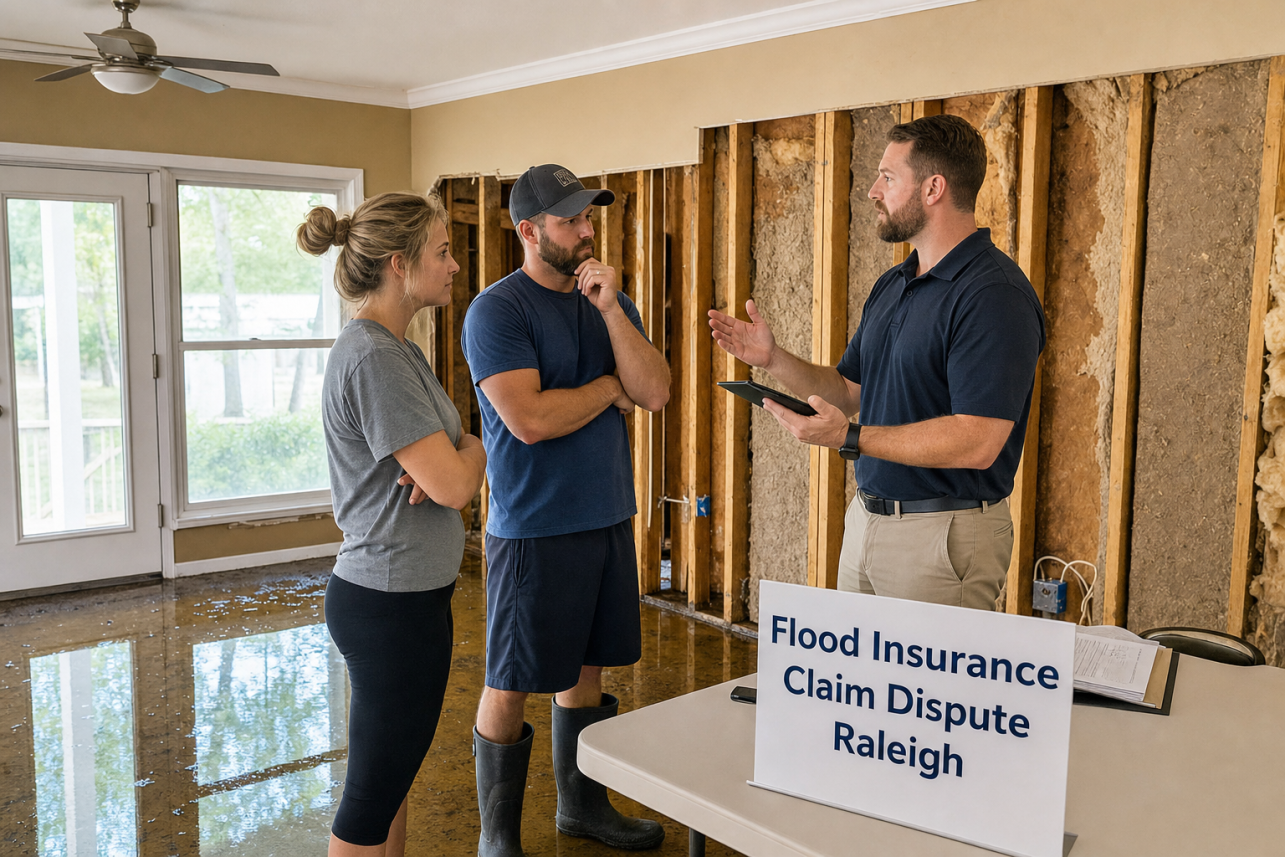
This surprises almost everyone: standard NFIP flood policies do not pay additional living expenses. Unlike your homeowners policy, there’s no coverage for a hotel, rental, or meals while your home is unlivable. That reality is exactly why an underpaid flood claim hurts so much — every week the dispute drags on is a week you’re paying for housing out of pocket.
There are exceptions worth checking. Some private flood policies sold in North Carolina do include loss-of-use coverage, so read your declarations page carefully or send it to us and we’ll interpret it for you. And if your loss involved both wind and flood, the homeowners side of the claim may trigger additional living expense coverage even though the flood side won’t.
After major flood events, FEMA disaster assistance and state programs sometimes provide temporary housing help for Wake County residents, separate from your insurance claim. Those programs have their own deadlines and don’t reduce what your flood carrier owes.
Because living costs pile up fast, our strategy in a Flood Insurance Claim dispute Raleigh families are dealing with is to push for undisputed funds immediately. Carriers can and should issue payment for the portions of the loss they don’t contest while the disputed items are resolved. Getting that partial payment moving lets you start drying, demoing, and rebuilding sooner — which shortens the whole displacement.
Keep every receipt for temporary housing and storage anyway. If any coverage or assistance avenue applies, documentation is what gets you reimbursed.
Local Relevance
Raleigh may sit well inland, but flooding is a genuine and recurring threat here. Remnants of hurricanes like Fran, Matthew, and Florence have pushed the Neuse River and its tributaries — including Crabtree Creek — out of their banks, and intense summer thunderstorms routinely overwhelm drainage in low-lying neighborhoods.
Wake County’s housing stock adds complications. Older ranch homes with crawlspaces hold moisture long after the water recedes, while newer slab-built homes can wick water up into walls faster than owners realize. Both situations create disputes over how far the damage actually extends — exactly where carriers tend to cut estimates short.
We handle these disagreements across the Triangle and beyond, including for policyholders working with a Public Adjuster in Smithfield NC along the flood-prone Neuse downstream. Wherever the water came from, the documentation standard that wins the dispute is the same.
Raleigh’s dense Piedmont clay sheds stormwater quickly into creek basins rather than absorbing it, so homes near Crabtree Creek and other Neuse tributaries often flood from short, intense storms — sometimes outside mapped high-risk zones. That matters in disputes, because carriers frequently question whether damage in these areas was truly caused by flooding, making early, thorough water-line documentation the strongest card a policyholder holds.
Don’t Accept The Insurer’s First Answer
If your flood claim was denied, delayed, or paid far below your real repair costs, get a second opinion from adjusters who work for you — not the carrier. For The Public Adjusters, Inc. is licensed and bonded, the review costs nothing, and we only get paid if you recover.
Call us: (919) 400-6440
Helpful Resources
- National Flood Insurance Program (NFIP)
- Federal Emergency Management Agency (FEMA)
- FEMA flood insurance resources — Federal guidance on flood insurance claims and appeals
Last updated: September 3, 2026