

For The Public Adjusters, Inc. manages every stage of a Flood Insurance Claim Morrisville NC homeowners face after rising water gets inside — from the strict proof of loss deadline to disputing a payout that will not rebuild what you lost. As a licensed and bonded public adjusting firm, we work for you, not the carrier. We document the structure and contents, prepare the paperwork the National Flood Insurance Program requires, and negotiate directly with the flood adjuster the insurer sends. You focus on your family; we handle the claim.
What This Service Is
A flood claim is not like a normal homeowners claim. If your policy was written through the NFIP, it comes with its own rules, its own forms, and a hard deadline: a signed, sworn proof of loss must usually be submitted within 60 days of the flood. Miss it, and even a legitimate claim can be denied on a technicality.
Our job as your Morrisville flood adjuster is to take that burden off you. We read the policy first — building coverage versus contents coverage, the deductible that applies to each, and the limits you actually purchased. Many owners discover their contents limit is far lower than they assumed, or that items stored in a basement or crawl space have sharply restricted coverage.
Then we build the claim itself: moisture readings, photos before anything is torn out, a room-by-room inventory, and a structural damage assessment that reflects real Triangle repair costs. We handle the same work on a Flood Insurance Claim Help Garner file as we do here in Morrisville, so the methods are proven across Wake County.
One more thing worth knowing: policyholders do win when carriers overreach. In Corban v. United Services Automobile Association, the Mississippi Supreme Court sided with homeowners after Hurricane Katrina, ruling the insurer could not use its flood exclusion to escape paying for damage the hurricane's wind caused before the water arrived. Courts expect carriers to pay what the policy actually owes — our role is to prove what that is.
Common Problems
Why Is The Flood Payout So Much Lower Than My Contractor's Repair Estimate?
This is the most common call we get after a flood. The carrier's figure is built on actual cash value for many items — the depreciated worth of ten-year-old flooring, not the cost of new flooring. Your contractor is quoting replacement cost. The gap between those two numbers is where lowball settlements live.
On top of that, flood policies carry separate deductibles for the building and for contents, and basement-level finishes are often excluded or limited. An underpaid estimate also tends to miss drying, mold treatment, and code-required work behind the walls.
It also matters enormously whether your loss is flood or water damage, because they fall under different policies. A burst pipe or appliance failure is a homeowners matter — the same coverage questions we untangle on a Water Damage Coverage Insurance Fuquay-Varina claim — while rising surface water is flood. Filing under the wrong one is a fast route to denial.
Flood Insurance Claim Morrisville NC: What If The Deadline Is Closing In Or The Claim Stalls?
The proof of loss deadline does not wait while the carrier's adjuster reschedules inspections. If you are weeks past the flood and still have no written estimate, the clock is the real threat. We prepare and submit the sworn proof of loss on time, with documentation attached, so a paperwork gap can never be used against you.
There is also the mitigation trap. You are required to make reasonable emergency repairs and dry the home out, but if you gut rooms before everything is photographed and inventoried, you have thrown away your evidence. We sequence it: document first, mitigate second, keep every receipt.
If the first payment comes in short, the claim is not over. A supplemental claim can recover damage found during repairs — hidden mold, swollen framing, failed subfloor — and disputed amounts can move into the formal appeal process. We have carried that fight on everything from a townhome here to Flood Insurance Claim Help Hillsborough files across the county line.
Do I Need My Own Flood Claims Adjuster, Or Can I Just Deal With The Insurance Company Myself?
You can handle it yourself — the question is whether you should. The flood adjuster who inspects your home is assigned by the carrier. They may be fair, but they do not work for you, and their estimate is the opening number, not the final word.
A good flood claims adjuster on your side reads the policy before the inspection, attends it with you, and produces an independent estimate line by line. When people search for one, they often also wonder which carriers fight hardest — what are the top 5 worst insurance companies and similar questions. Our honest answer: the company name matters less than how well your loss is documented.
When you vet anyone, confirm they are licensed in North Carolina — the NCDOI Public Adjusters Guide explains what a public adjuster may and may not do here. We are licensed and bonded, we charge nothing up front, and as the Public Adjuster in Morrisville NC for this community, we only get paid when you do. We never promise a specific dollar outcome — no honest adjuster can — but we make sure nothing you are owed gets left out of the claim.

Our Process
Policy Review And Deadline Control
We start by reading your flood policy in full: building limits, contents limits, deductibles, and exclusions. Then we calendar every deadline — especially the proof of loss — so the carrier can never win on a technicality. If FEMA disaster assistance is also in play after a declared event, we help you keep the two tracks straight.
Documentation And Independent Estimate
Before demolition, we photograph everything, take moisture readings, and build a room-by-room contents inventory with values. We complete a structural assessment and write our own repair estimate using current local pricing, including drying, mold remediation, and code upgrades the carrier's estimate often omits.
Negotiation, Supplements, And Resolution
We present the claim, attend the carrier's inspection, and negotiate the differences line by line. If hidden damage surfaces during repairs, we file a supplemental claim. If the carrier will not move, we pursue the dispute and appeal options your policy provides — including invoking the appraisal clause where it applies — until the file reflects your actual loss.
| What Happens | Filing On Your Own | With For The Public Adjusters |
|---|---|---|
| Damage scope | Carrier's adjuster sets the scope; hidden saturation in walls, insulation, and cabinetry is often missed | Independent moisture mapping, thermal imaging, and a full room-by-room scope documented with evidence |
| Proof of Loss deadline | The NFIP's strict filing window is easy to miss, and late filings can bar recovery | Deadlines tracked from day one; a complete, itemized Proof of Loss filed on time |
| Contents inventory | Homeowners typically list a fraction of damaged items and under-value the rest | A line-item inventory built from photos, receipts, and records, priced to replacement standards |
| Policy interpretation | Carrier's reading of NFIP building vs. contents coverage usually goes unchallenged | Policy language reviewed and disputed scopes challenged with documentation — the approach that prevailed for homeowners in Corban v. USAA |
| Negotiation | One-sided; most policyholders accept the first estimate | Supplements and disputes handled with the carrier's examiner until the file reflects the real loss |
| Your time | Weeks of calls, paperwork, and contractor coordination | We manage the claim so you can focus on getting back into your home or business |
Commonly Overlooked In The Public Adjusting Industry
- The NFIP 60-day Proof of Loss requirement — Carriers rarely remind policyholders of it, and many Morrisville homeowners learn about the deadline only after it has passed.
- Saturation above the visible waterline — Drywall and insulation wick water upward well past the flood mark, and a quick carrier inspection that only measures at floor level misses it.
- Flood-exposed electrical components below the waterline — Outlets, junction boxes, and wiring that sat in floodwater often look fine from the outside, so they get left out of estimates despite code requiring replacement.
- The building vs. contents split in NFIP policies — Items like carpet, cabinets, and appliances fall under different coverage parts with different deductibles, and misclassifying them quietly shrinks the payout.
- Silt lines and high-water-mark evidence — Cleanup crews scrub away the single best proof of flood depth before anyone photographs it, leaving the carrier's lower estimate unchallenged.
- HVAC equipment and water heaters in garages and crawl spaces — These units take on water through their bases and ductwork, but because they may still power on afterward, adjusters frequently call them undamaged.
- Allocating damage when a hurricane brings both wind and flood — Each carrier blames the peril the other one covers, and courts like the one in Corban v. USAA have had to remind insurers that the burden of proving an exclusion is theirs, not the homeowner's.
- FEMA's Increased Cost of Compliance (ICC) coverage — NFIP policies can include up to $30,000 for required elevation or floodproofing after a substantial-damage determination, yet most policyholders never hear it mentioned.
Case Studies
Case Study #1
Situation: A family in the Breckenridge neighborhood of Morrisville came home after a tropical storm pushed Crabtree Creek tributaries over their banks. Eighteen inches of floodwater had moved through the first floor of their home, soaking drywall, flooring, cabinetry, and a finished storage area.
Problem: Their NFIP flood carrier's adjuster spent under an hour on site and issued an estimate that covered flooring replacement and two feet of drywall, but excluded the kitchen cabinets, the HVAC air handler in the garage, and nearly all of the family's damaged contents. The carrier claimed the cabinets were 'salvageable' and that moisture readings didn't justify removal.
Investigation: Our Morrisville public adjuster documented the loss room by room with calibrated moisture meters, thermal imaging, and a detailed contents inventory. We pulled FEMA flood zone data and high-water-mark evidence from neighboring properties to establish the actual flood depth, which was higher than the carrier's file reflected.
Findings: Moisture readings inside the cabinet toe kicks and behind the back panels showed saturation that made restoration impractical under NFIP guidelines. The air handler had taken on water through the base, and the contents inventory identified 212 line items the carrier's adjuster never listed. The carrier's scope also used below-market unit pricing for the Wake County area.
Solution: We prepared a supplemental Proof of Loss with a corrected Xactimate estimate, the moisture documentation, manufacturer statements on the water-damaged equipment, and the full contents schedule. We then negotiated directly with the NFIP adjuster and the carrier's examiner, citing the policy's actual language on flood-damaged building components.
Outcome: The carrier reopened the file and issued a supplemental payment covering full cabinet replacement, the air handler, proper drywall and insulation removal, and the documented contents — a settlement several times the original offer. Every figure was supported by the policy and the evidence, not guesswork.
Lesson: The first flood estimate is rarely the complete one. Hidden saturation, under-scoped contents, and strict NFIP Proof of Loss deadlines mean policyholders benefit from a documented, deadline-aware claim — and courts have backed insureds who push back. In Corban v. United Services Automobile Association (Mississippi Supreme Court, 2009), the court sided with homeowners after Hurricane Katrina, holding that the insurer could not use flood exclusions to escape paying for covered damage it failed to properly allocate.
Case Study #2
Situation: The owner of a small office condo off Aviation Parkway in Morrisville had floodwater enter the building after a stalled storm system dumped more than six inches of rain in a single evening. Water wicked up the walls, ruined the server room's lower equipment racks, and saturated the slab-level flooring throughout.
Problem: The commercial flood policy had both building and contents coverage, but the insurer's estimate treated the loss as a minor 'water intrusion,' paid for carpet only, and denied the electrical and low-voltage repairs on the grounds that the damage was 'pre-existing wear.' The owner also faced the NFIP's strict Proof of Loss window with no guidance from the carrier.
Investigation: We brought in moisture mapping across the slab and walls, obtained an electrician's written evaluation of the flood-exposed outlets, junction boxes, and panel, and photographed silt lines that established a consistent water depth throughout the unit. We also reconstructed the contents loss from purchase records and vendor invoices.
Findings: The silt lines and moisture map proved uniform flooding to roughly nine inches — contradicting the 'pre-existing' theory entirely. The electrician confirmed that flood-exposed receptacles and wiring below the waterline required replacement per code. The carrier's estimate had also omitted baseboards, door assemblies, and vinyl wall base in three rooms.
Solution: We filed a timely, fully itemized Proof of Loss with the supporting trade documentation and demanded the carrier's engineer address the silt-line evidence directly. When the examiner pushed back, we referenced Corban v. USAA, where the court held the burden falls on the insurer to prove an exclusion applies to property damage — not on the policyholder to disprove it.
Outcome: The carrier withdrew the pre-existing-damage position and paid for the electrical replacement, full flooring and wall repairs, and the documented business contents. The owner was back in the space without absorbing tens of thousands in uncovered repairs.
Lesson: Flood carriers sometimes label flood damage as 'wear and tear' or 'pre-existing' to shrink the payout. Physical evidence like silt lines and moisture maps, filed before the NFIP Proof of Loss deadline, is what turns a lowball estimate into a fair one. FEMA's own NFIP claims handbook (available at fema.gov) confirms policyholders have the right to submit their own documented Proof of Loss.
| Your Situation | Best Next Step | What It Depends On | Deadline Pressure |
|---|---|---|---|
| Water is still in or just left the home | Photograph everything, mark the high-water line, then begin drying — don't discard items before documenting | Whether you capture evidence before cleanup crews remove it | Immediate — evidence disappears within days |
| Carrier's adjuster already inspected | Get the written estimate and have it independently reviewed before signing anything | Whether the scope includes hidden saturation, electrical, HVAC, and full contents | High — the Proof of Loss clock is running |
| Received a settlement offer that seems low | Request the itemized estimate and compare it against a documented independent scope | The gap between the carrier's pricing and actual Wake County repair costs | High — supplements must be supported and timely |
| Claim was partially or fully denied | Demand the denial in writing with the specific policy language cited, then dispute with evidence | Whether the carrier can actually prove its exclusion applies — the insurer's burden under Corban v. USAA | High — appeal and litigation windows are short |
| Approaching the NFIP Proof of Loss deadline | File a documented Proof of Loss immediately, even if the full scope isn't finalized | How quickly a complete inventory and estimate can be assembled | Critical — missing it can forfeit recovery |
| Not sure if you're in a flood zone or had NFIP coverage | Check your policy declarations and look up your address on FEMA's flood map at msc.fema.gov | Whether your policy is NFIP or private flood, since rules and deadlines differ | Moderate — but confirm before filing anything |
| Both flood and hurricane wind damage occurred | Document each cause separately; two policies may apply and carriers often point at each other | How the damage is allocated between the wind and flood policies | High — both carriers' deadlines run at once |


Reviews
After the creek behind our subdivision flooded, our NFIP adjuster offered less than half of what the repairs actually cost. For The Public Adjusters came out the same week, measured moisture behind walls the first adjuster never opened, and handled the Proof of Loss paperwork before the deadline. The revised settlement covered our cabinets, flooring, and the HVAC unit the carrier originally skipped. I would never handle a flood claim alone again.
Denise H., Kitts Creek, Morrisville
Our home office took on water during a flash flood and the insurance company kept saying our contents 'weren't documented well enough.' This team built a full inventory from photos, receipts, and bank records, and walked us through exactly how NFIP flood policies value contents. The difference between the first offer and the final payment was substantial. Professional, patient, and they knew the flood policy better than the carrier's own adjuster did.
Marcus T., Morrisville NC
When Crabtree Creek flooding hit our townhome, I had no idea there was a 60-day Proof of Loss deadline on flood claims. For The Public Adjusters caught it with two weeks to spare, re-scoped the whole loss, and got the carrier to pay for drywall, insulation, and electrical work that had been left out. They were upfront that no outcome is guaranteed, but the documentation they built spoke for itself. Licensed, bonded, and genuinely on our side.
Priya R., Savannah neighborhood, Morrisville
Frequently Asked Questions
What Does A Public Adjuster Do For A Flood Insurance Claim Morrisville NC Homeowners File After A Storm?
A public adjuster works exclusively for you, the policyholder — never for the insurance company. When your home near Crabtree Creek or in a low-lying Morrisville neighborhood takes on water, we document every area of damage, from saturated subfloors and drywall to ruined contents in crawl spaces and garages.
Most flood policies in Wake County are written through the National Flood Insurance Program (NFIP), which has strict documentation and proof-of-loss requirements that differ sharply from a standard homeowners policy. Missing a deadline or submitting an incomplete proof of loss can reduce or delay your payment. We prepare the detailed room-by-room inventory, moisture readings, and repair estimates the NFIP expects, and we handle communication with the insurer's adjuster.
Policyholders who push back with proper evidence often prevail. In Corban v. United Services Automobile Association, 20 So. 3d 601 (Miss. 2009), the court sided with homeowners after Hurricane Katrina, rejecting the insurer's attempt to use an anti-concurrent causation clause to deny coverage for structural damage. That decision reshaped how storm-related losses to homes are evaluated nationwide.
For The Public Adjusters, Inc. is licensed and bonded in North Carolina. We can't promise a specific dollar outcome — no honest adjuster can — but we can make sure your loss is fully documented and your claim is presented the way the policy and federal flood rules require. You can review program details yourself at FEMA.gov and FloodSmart.gov, the official NFIP site.
My Morrisville Home Flooded, But The Insurer's Offer Seems Low. Can The Payout Be Challenged?
Yes. An insurer's first estimate is not the final word, and flood payouts are frequently understated. Common problems we see across Wake County include scope gaps — the adjuster measures the waterline but misses wicking damage higher up the wall — along with lowball unit pricing that doesn't reflect actual Triangle-area contractor rates, and overlooked items like insulation, ductwork under the home, and hardwood flooring that cups weeks after the water recedes.
Under an NFIP policy, you generally have 60 days to submit a sworn proof of loss, and you can submit a supplemental proof of loss when additional damage is found. We re-inspect the property, pull moisture readings, photograph hidden damage, and build a line-item estimate to support a revised claim.
Courts have repeatedly backed policyholders who challenge inadequate settlements with solid evidence. In Corban v. USAA, 20 So. 3d 601 (Miss. 2009), the Mississippi Supreme Court ruled for the homeowners, holding the insurer could not escape paying for covered damage to the dwelling simply because excluded water damage also occurred. The case underscores that insurers carry the burden of proving what an exclusion actually applies to.
We're licensed and bonded, and we never guarantee a particular result — but a properly documented supplement is the legitimate path to a fair settlement. FEMA publishes its flood claims handbook at FEMA.gov, and it's worth reading alongside your policy so you know exactly what the program owes you.
How Long Does A Flood Insurance Claim Morrisville NC Policyholders File Usually Take To Resolve?
Timelines vary with the size of the loss and how quickly documentation gets submitted. For a typical flooded home in Morrisville — say, two feet of water through the first floor after a tropical system stalls over the Triangle — a well-documented NFIP claim often resolves in 60 to 120 days. Poorly documented claims can drag on much longer, especially if the proof of loss is rejected and has to be redone.
The critical deadlines come early. You must notify your carrier promptly, mitigate further damage, and submit a signed, sworn proof of loss, generally within 60 days of the loss date (FEMA sometimes extends this after major disasters — check FEMA.gov for current notices). Missing that window is one of the most common reasons Wake County flood claims stall or get denied.
Our role is to compress that timeline by getting it right the first time: complete contents inventories, structural estimates that match NFIP pricing guidelines, and photographs tied to every line item. When the insurer's adjuster and our documentation disagree, we negotiate from evidence, not opinion.
If a dispute hardens, policyholders have real remedies. In Corban v. USAA, 20 So. 3d 601 (Miss. 2009), homeowners prevailed when the court refused to let the insurer stretch a water exclusion to erase coverage for storm damage to their house. For The Public Adjusters, Inc. is licensed and bonded; we can't promise a specific timeline or amount, but thorough preparation is the single biggest factor in how fast a flood loss pays.
Does Flood Insurance In Morrisville Cover Damage To My Contents, Like Furniture And Appliances?
Only if you purchased contents coverage — and that catches many Wake County homeowners off guard. NFIP policies split building coverage and contents coverage into two separate limits, purchased separately. If your declarations page shows a building limit but no contents limit, your furniture, electronics, clothing, and appliances are not covered, even though the structure is.
If you do carry contents coverage, documentation decides everything. The NFIP pays most contents at actual cash value, meaning depreciation is subtracted, so an itemized inventory with brand names, model numbers, ages, and purchase prices directly affects your check. We photograph and catalog damaged belongings before anything is hauled to the curb, because once items are gone, proving their value gets much harder.
There are also location rules specific to flood policies: contents in basements and certain below-grade areas receive very limited coverage, which matters for Morrisville homes with finished lower levels or crawl-space storage. We review your policy language line by line so nothing covered gets left off the claim.
Courts have protected policyholders' property claims when insurers read coverage too narrowly. In Corban v. USAA, 20 So. 3d 601 (Miss. 2009), the court ruled for the insured homeowners, requiring the carrier to cover damage to the home and its contents that the policy actually insured rather than hiding behind a broad exclusion.
For The Public Adjusters, Inc. is licensed and bonded in North Carolina. We make no guarantees about outcomes, but we will make sure every covered item is counted. Coverage details are also explained at FloodSmart.gov.
What Documentation Do I Need To Support A Flood Insurance Claim Morrisville NC Residents File Through The NFIP?
Most flood policies in Wake County are written through the National Flood Insurance Program, and the NFIP has strict documentation requirements. You'll need a signed Proof of Loss, typically due within 60 days of the flood, along with a detailed inventory of damaged contents, photographs or video of the damage, and receipts or other proof of value where possible.
For the building itself, you should document the water line on walls, damaged flooring, drywall, cabinetry, HVAC equipment, and anything in a crawlspace or lower level. Do this before tearing anything out, but keep samples of carpet, flooring, and drywall as physical evidence. FEMA's guidance at fema.gov and the NFIP resources at floodsmart.gov both outline what adjusters expect to see.
Where many Morrisville homeowners run into trouble is incomplete inventories and missed deadlines. A single missing Proof of Loss element can delay or jeopardize payment. Our team prepares the full claim package — scope of repairs, line-item estimates, contents schedules, and the Proof of Loss itself — so nothing is left to chance.
As licensed and bonded public adjusters, we work only for you, not the insurance company. We can't promise a specific dollar outcome on any claim, but we can make sure your documentation is thorough, properly valued, and submitted on time, which gives your claim the strongest possible footing.
Have Policyholders Actually Won In Court Against Insurance Companies Over Flood And Storm Damage To Their Homes?
Yes, and the case law shows why thorough documentation matters so much. In Broussard v. State Farm Fire & Casualty Co., decided in federal court in Mississippi in 2007, a couple's home was destroyed during Hurricane Katrina. State Farm denied the claim, arguing the damage was caused by excluded flooding rather than covered wind. The judge found the insurer failed to prove its exclusion applied and directed a verdict for the policyholders, awarding them the full policy limits of roughly $223,000, and the jury added punitive damages on top of that.
That case turned on evidence — who could prove what actually damaged the structure. The same principle applies to flood losses here in Morrisville, whether water comes from Crabtree Creek overflow, Indian Creek drainage, or sheet flooding after a tropical system moves through the Triangle.
Most disputes never need to reach a courtroom. When a claim is properly documented, measured, and presented under the policy language, insurers frequently revise their position during the adjustment or appraisal process. Our role as your Morrisville public adjuster is to build that evidence-backed file from day one.
We can't guarantee any particular result — no honest adjuster or attorney can — but cases like Broussard confirm that policyholders who stand on solid documentation are not powerless against a lowball offer or a wrongful denial.
I'm Not In A Mapped Flood Zone In Morrisville. Do I Still Need Flood Coverage, And Will A Claim Work The Same Way?
You may be surprised to learn that a large share of flood losses nationwide happen outside high-risk zones. Morrisville sits in the Crabtree Creek watershed, and rapid development across western Wake County has increased runoff. Heavy rain from tropical remnants or a stalled summer storm can overwhelm drainage in neighborhoods near Church Street, Town Hall Drive, and the low-lying areas along Aviation Parkway.
Standard homeowners policies exclude rising water, so without a separate flood policy — usually through the NFIP or a private flood carrier — that damage generally isn't covered. FEMA's flood map service center at fema.gov lets you check your property's current zone, and floodsmart.gov explains coverage options for lower-risk areas, which often cost less than policies in mapped floodplains.
If you do have coverage and suffer a loss, the claim process works the same regardless of your zone: notice to the carrier, inspection, documentation, Proof of Loss, and settlement. The challenges are also the same — undervalued repair scopes, disputes over pre-existing conditions, and depreciation applied too aggressively.
For The Public Adjusters, Inc. handles flood losses for homeowners throughout Morrisville and the surrounding Wake County communities, whether the property sits in Zone AE or Zone X. We're licensed and bonded, and our job is to measure the damage independently and present your loss accurately rather than letting the carrier's numbers stand unchallenged.
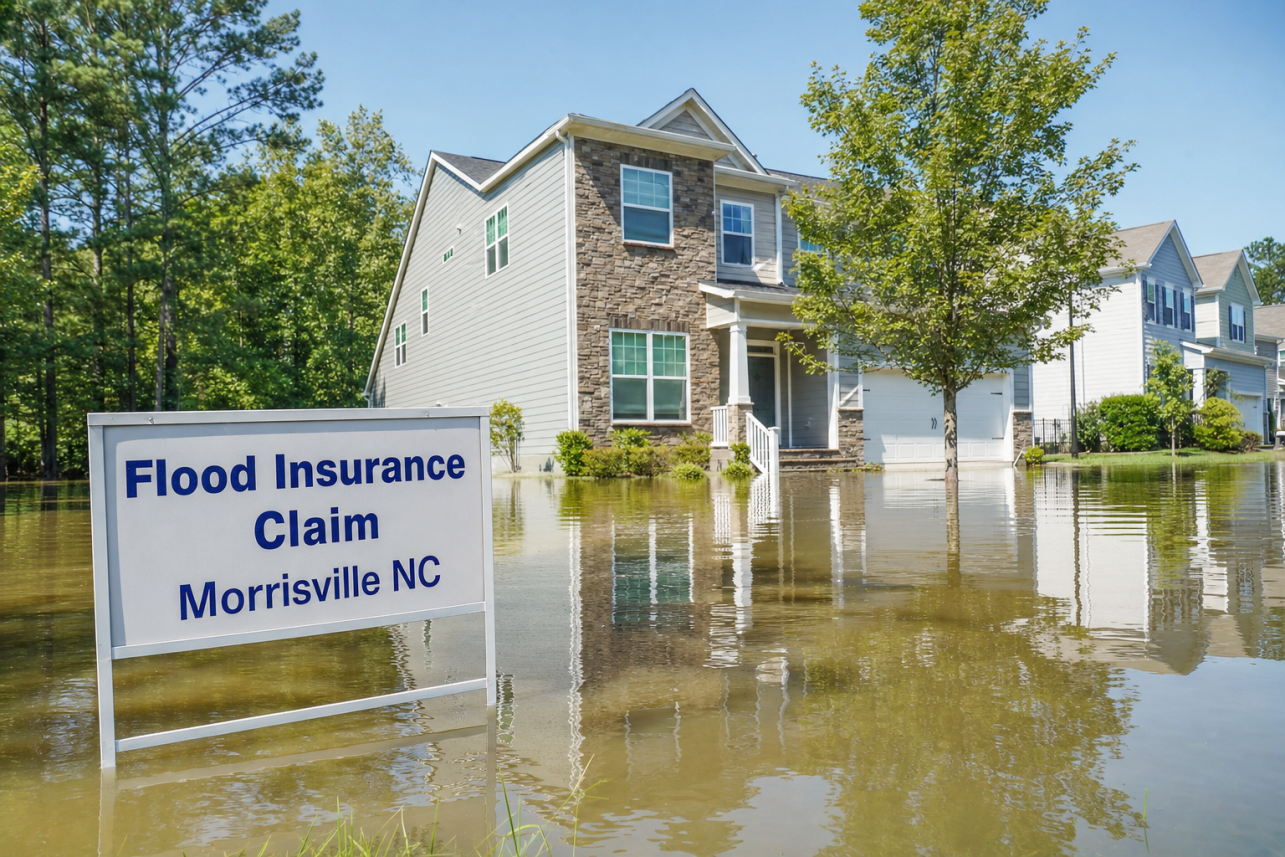
When Should I Call A Public Adjuster After Flooding — Before Or After The Insurance Company Inspects My Morrisville Home?
The honest answer is as early as possible, ideally before the carrier's adjuster walks the property. The first inspection often sets the tone for the entire Flood Insurance Claim Morrisville NC homeowners pursue, because the carrier's initial scope becomes the baseline every later negotiation has to overcome.
When we're involved from the start, we document the loss independently — moisture readings, the high-water line, structural and contents damage, and hidden issues like saturated insulation or compromised subfloors that a quick walkthrough can miss. Flood damage in Triangle homes frequently extends behind baseboards and inside wall cavities, and once drying equipment runs for a few days, visual evidence disappears fast.
That said, it is never too late to bring us in. We regularly take over claims after a low settlement offer, a dispute over the scope of repairs, or a partial denial. Under NFIP rules there are firm deadlines, including the 60-day Proof of Loss window, so timing still matters even on an existing claim. FEMA's claims handbook, available at fema.gov, spells out those timelines for policyholders.
Our initial consultation costs you nothing, and as a licensed and bonded firm we're held to professional and financial standards in North Carolina. We won't promise a specific payout — no one legitimately can — but we will tell you plainly whether your claim has been undervalued and what a properly documented loss should include.
How Much Does It Cost To Hire A Public Adjuster For A Flood Claim In Morrisville?
For The Public Adjusters, Inc. works on a contingency-fee basis, which means our fee is a percentage of the settlement your policy pays — there are no upfront costs or hourly bills. If your claim does not pay, you do not owe us a fee for the adjusting work. That structure keeps our interests aligned with yours from the first inspection to the final check.
For Wake County homeowners, this matters because flood losses are rarely simple. Standing water in a Morrisville crawlspace or finished basement can hide damage to subflooring, insulation, ductwork, and electrical systems that an initial estimate often misses. A licensed and bonded adjuster who works for you — not the insurance company — documents all of it before the file is closed.
It is worth noting that NFIP flood policies are federally regulated, and FEMA publishes the rules that govern how those claims are handled. You can review them yourself at FEMA.gov and FloodSmart.gov. We know those rules in detail, which is often where the difference between a thin payout and a properly documented one is found.
We cannot and will not guarantee a specific dollar outcome — no honest adjuster can. What we can promise is a thorough, line-item accounting of your home and contents damage, prepared by professionals who handle these claims in the Triangle every week.
What Deadlines Apply To A Flood Insurance Claim Morrisville NC Homeowners Need To Meet Under The NFIP?
The single most important deadline is the Proof of Loss. Under a Standard Flood Insurance Policy, you generally have 60 days from the date of loss to submit a signed, sworn Proof of Loss to your insurer, though FEMA has sometimes extended that window after major disasters. Missing it can jeopardize your recovery, so we treat it as the backbone of every flood file we handle.
There are earlier obligations, too. You must give prompt notice of the loss, protect the property from further damage, and separate damaged from undamaged contents so an adjuster can inspect them. Throwing out soaked drywall or ruined furniture before it is photographed and inventoried is one of the most common — and costly — mistakes we see in Morrisville and across Wake County.
If a claim is denied or underpaid, FEMA provides a formal appeal process, and you typically have one year from the date of the denial letter to file suit in federal court if needed. The details are published at FEMA.gov under the NFIP claims guidance.
Because these timelines are strict and federally governed, we recommend getting professional help early rather than after a deadline has passed. For The Public Adjusters, Inc. prepares the Proof of Loss, the contents inventory, and the supporting estimates so the paperwork is complete, sworn, and submitted on time.
My Flood Claim Was Denied. Is It Worth Fighting The Insurance Company, Or Do Policyholders Ever Actually Win?
Policyholders absolutely do prevail — a denial letter is a position, not a verdict. One well-known example is Corban v. United Services Automobile Association, decided by the Mississippi Supreme Court in 2009 after Hurricane Katrina. The Corbans' home suffered both hurricane wind and storm-surge damage, and the insurer tried to use flood exclusions to escape paying for the wind portion of the loss. The court sided with the homeowners, ruling that the insurer could not use an anti-concurrent causation clause to deny covered damage that occurred before the flooding, and that the insurer bore the burden of proving what its exclusion actually applied to.
The lesson for a Morrisville homeowner is that causation, documentation, and policy language decide these disputes — not the adjuster's first impression. Many denials rest on thin engineering reports or a misreading of what the Standard Flood Insurance Policy covers.
Under the NFIP, a denial can be appealed directly to FEMA, and the appeal must be supported with evidence: photographs, moisture readings, contractor estimates, and a corrected scope of damage. That is exactly the package we build.
For The Public Adjusters, Inc. reviews denied and underpaid flood files throughout Wake County at no obligation. We cannot guarantee a reversal — no one can — but we can tell you honestly whether the denial holds up against the policy language and the physical evidence in your home.
I Already Accepted A Payment On My Flood Insurance Claim Morrisville NC — Can I Still Recover More If I Find Additional Damage?
In many cases, yes. Accepting an initial payment on a flood loss does not automatically close the door. The NFIP allows supplemental claims when additional covered damage is discovered after the first payment, and this happens constantly with flood losses in our area.
Water damage reveals itself over time. A home near Crabtree Creek or Indian Creek may look dried out, yet weeks later you find swollen subfloor seams, delaminated cabinets, mold behind baseboards, or corroded wiring in the crawlspace. Those are real, documentable damages that the original estimate may never have included.
To pursue a supplemental payment, you will need a revised Proof of Loss supported by new evidence — photos, moisture mapping, repair invoices, and contractor estimates that tie the newly found damage to the flood event. FEMA's claims handbook, available at FEMA.gov, outlines the supplemental process, and your deadlines still apply, so acting quickly matters.
For The Public Adjusters, Inc. re-inspects previously paid flood losses throughout Morrisville and the rest of Wake County. We compare what the carrier paid against what the damage actually requires, then prepare and submit the supplemental documentation on your behalf. We never promise a specific additional recovery, but we can tell you plainly whether your file was scoped short — and in our experience reviewing Triangle-area flood settlements, many were.
What's The Difference Between Flood Damage And Regular Water Damage On A Flood Insurance Claim Morrisville NC Policyholders Submit?
The distinction matters more than most homeowners realize. A standard homeowners policy typically covers sudden water damage from inside the home — a burst pipe, a failed water heater. Flood damage, defined by the NFIP as water from an external source affecting two or more acres or two or more properties, falls under a separate flood policy.
In Morrisville, this comes up constantly after heavy rains push Crabtree Creek and Indian Creek out of their banks. If stormwater enters your home at ground level, that's a flood claim. If the same storm backs up your sump pump and water rises from below, coverage can hinge on specific endorsements and how the loss is documented.
Insurers sometimes use this gray area to shift a loss onto whichever policy pays less — or to deny both. Courts have pushed back on that tactic. In Corban v. USAA Insurance Co., 20 So. 3d 601 (Miss. 2009), the Mississippi Supreme Court sided with homeowners after Hurricane Katrina, ruling the insurer could not use its anti-concurrent causation clause to escape paying for damage its policy actually covered. That decision reshaped how mixed-cause hurricane losses are evaluated.
When we handle a Flood Insurance Claim Morrisville NC families bring to us, we document the water's source, path, and high-water marks carefully so each portion of the loss is assigned to the correct policy. Getting that causation analysis right early often determines whether the claim is paid fairly. You can review the NFIP's own definitions at FloodSmart.gov to see how your loss may be classified.
Is My Finished Basement Or Crawl Space Covered If My Morrisville Home Floods?
This is one of the most misunderstood areas of flood coverage, and it catches a lot of Wake County homeowners off guard. NFIP policies sharply limit what's payable in basements and enclosed areas below the lowest elevated floor.
Covered items generally include structural elements, foundation walls, furnaces, water heaters, central air units, electrical panels, sump pumps, and unpainted drywall. What's typically excluded: finished flooring, carpet, paneling, most personal contents stored below grade, and improvements like a finished rec room or home theater.
Morrisville's rolling terrain means many homes near the Shiloh community and along the Crabtree Creek corridor have crawl spaces or partial basements, so these limits come into play often. The good news is that insurers sometimes misclassify a ground-level walkout or split-level space as a 'basement' when it doesn't meet the policy definition — and that misclassification can wrongly shrink your payout.
As part of our work on a flood loss, we measure and photograph the space, compare it against the policy's actual definition, and itemize every covered component the carrier's adjuster may have skipped, from HVAC equipment to foundation damage. Mechanical systems alone can represent tens of thousands of dollars.
If you're unsure what your policy covers below grade, FEMA publishes a plain-language summary of NFIP basement coverage at fema.gov. And before you discard anything damaged in a crawl space or basement, document it thoroughly — photos, serial numbers, and receipts make the difference between a paid line item and a denied one.
How Is The Payout On A Flood Loss In Morrisville Actually Calculated — Replacement Cost Or Actual Cash Value?
It depends on the property and how it's used. Under the NFIP, your primary residence's building coverage is generally paid at replacement cost value (RCV) if you carry insurance equal to at least 80% of the home's full replacement cost or the maximum available. Otherwise, the building is paid at actual cash value (ACV) — replacement cost minus depreciation.
Contents are almost always paid at ACV. That means your five-year-old sofa and kitchen appliances are depreciated, sometimes aggressively. One of the most common problems we see in Wake County flood files is carriers applying depreciation rates far steeper than the actual condition and age of the items justify.
Building valuations have their own pitfalls. Carrier estimates frequently use outdated unit pricing that doesn't reflect what Triangle-area contractors actually charge. With the construction demand across Morrisville, Cary, and the broader RDU corridor, real-world rates for drywall, flooring, and structural drying often run well above the software defaults in an insurer's estimate.
Our role is to prepare an independent, line-by-line estimate using current local pricing, challenge excessive depreciation with documentation, and verify whether your policy's RCV provisions were applied correctly. As a licensed and bonded firm, we can't promise a specific dollar outcome — no honest adjuster can — but we can make sure the valuation reflects your actual loss rather than a computer's shortcut.
If you want to understand the RCV and ACV rules in detail before your settlement is finalized, FEMA's NFIP Flood Insurance Manual spells them out, and we're happy to walk through how they apply to your specific policy.

Can For The Public Adjusters Handle A Flood Loss At My Morrisville Business Or Commercial Building, Not Just A Home?
Yes. We represent commercial policyholders throughout Morrisville and Wake County, and flood losses at business properties are often more complex — and more underpaid — than residential ones.
Morrisville's commercial corridors along Airport Boulevard, Aviation Parkway, and Town Hall Drive include office parks, flex warehouses, labs, and restaurants, many of them close to low-lying creek drainage. When tropical remnants stall over the Triangle, as they did during Hurricanes Fran, Floyd, and Matthew, ground-floor commercial spaces can take serious water in a matter of hours.
Commercial flood claims involve layers that residential claims don't: building coverage, business personal property, tenant improvements and betterments, inventory valuation, and specialized equipment. NFIP commercial policies cap building coverage at $500,000 and contents at $500,000, so larger operations often carry excess flood coverage through private carriers — which means two insurers, two sets of adjusters, and two opportunities for the loss to be undervalued.
We inventory damaged stock and equipment, document structural and finish damage with photos and moisture readings, prepare the sworn proof of loss, and negotiate with every carrier on the file. Note that we handle property claims only — we don't work on claims involving motor vehicles, health, or life insurance.
If your commercial property took on floodwater, call before major cleanup begins so the damage can be documented properly, and report the loss to your carrier immediately to preserve your NFIP deadlines. FEMA's guidance for business flood recovery at fema.gov is a useful companion resource while your claim is being prepared.
Local Relevance
Morrisville's flood risk hides off the map. The town sits low between Crabtree Creek tributaries and heavily paved growth around RTP, and two decades of rapid development mean far more runoff than the older flood maps anticipated. Homes well outside the mapped high-risk zones take water here — and many owners learn only afterward that their homeowners policy excludes flood entirely.
Much of Morrisville's housing stock went up in the late 1990s through the 2000s, so crawl spaces, builder-grade materials, and slab-on-grade townhomes are common. Rising water in a crawl space can soak insulation, ductwork, and subfloor without ever showing above the baseboards, which is exactly the damage a quick carrier inspection misses.
Because we work these same Morrisville streets on other perils too — from flood files to a Smoke Damage Insurance Claim Help Morrisville loss — we know what local rebuilding actually costs, and we hold the carrier's estimate to that standard.
Western Wake, including Morrisville, sits on Triassic Basin clay that drains poorly, so stormwater that would soak away elsewhere ponds against foundations and pushes into crawl spaces — and the creek-fed flooding here regularly reaches homes outside FEMA's high-risk zones. If an out-of-area adjuster shrugs off your damage as groundwater or settling, that local soil story is often the missing piece of the claim.
Ready To Get Started?
Reach out today for a free, no-obligation conversation about your situation.
Call us: (919) 400-6440
Helpful Resources
- NCDOI Public Adjusters Guide
- Federal Emergency Management Agency (FEMA)
- National Flood Insurance Program (NFIP)
- Insurance Information Institute (III)
- National Association of Insurance Commissioners (NAIC)
- Weather Underground
- The Weather Channel
- Hurricane Center
- National Fire Protection Association (NFPA)
- American Red Cross Fire Prevention
- U.S. Fire Administration – Home Cooking Fire Safety
Serving Morrisville · Wake
Last updated: October 20, 2026